




Abstract
According to feminism, the discipline of international relations (IR) a decade ago had, and indeed still has, connotations similar to ‘maleness’. This maleness is not based strictly on individual personalities, but on a ‘hegemonic masculinity’ that expresses what masculine men should be in opposition to femininities, which are less valued. Women are not a strong factor in the discipline, and knowledge gained from women’s experiences also remains at the periphery of the discipline’s analysis. It is clear to Professor J. Ann Tickner that there are gendered perceptions in IR, hidden by purported ‘gender neutrality’ and ‘objectivity’. In other words, although women and gender are both important parts of the daily operation and scholarship of IR, this presence is neither debated nor analysed by most theorists. The goal then of feminist IR is two-fold: to recognise gender where it exists in IR, and to move beyond gendered ideas into collaborative scholarship. In this way, feminist IR theory challenges other strands of IR theory on a number of levels, contributing to the major theoretical debates in the discipline and raising new areas of analysis.
J. Ann Tickner’s work on the feminist perspectives of international relations (IR) is based on the recognition of the significance of gender/human oppression. She challenges the way in which ‘malestream’ IR has been conceptualised, the maleness not based strictly on individual personalities but on a ‘hegemonic masculinity’ that defines what masculine men should be, in opposition to femininities, which are less valued. Women are not a strong force in the discipline, and knowledge gained from women’s experiences also remains at the margins of the discipline’s analysis. It is clear to Professor Tickner that there are gendered perceptions in IR, hidden by a claimed ‘gender neutrality’ and ‘objectivity’. In other words, women and gender are both important parts of the daily operation and scholarship of IR, yet their presence is neither discussed nor examined by most theorists. The goal of feminist IR is dual: to carve out space for gender where it exists in IR, and to move beyond gendered ideas into collaborative scholarship. In this vein, feminist IR theory challenges every conventional category of IR theory on a number of levels, contributing to the major theoretical debates in the discipline and raising new areas of analysis.
Based on J. Ann Tickner’s perspectives on feminism, this article has been organised into seven sections, the section ‘What Is Feminism?’ is an introduction that includes a brief history of the feminist movement and the context of the IR debates/narratives within which feminist IR is juxtaposed. The second section explores the ways in which IR feminisms contribute to the identity/methodology debate in IR. The third section looks at how IR feminisms frame the debate concerning the definition of security. The fourth section examines the way IR feminism treats the levels of analysis in IR/security theory, while the fifth section looks at how IR feminisms deal with the scope assumptions of IR. The sixth section deals with the ecofeminist perspective on international political economy; and finally, the goals of IR feminisms as articulated by Professor Tickner.
What Is Feminism?
The Three Waves
Feminism is the idea that women should have rights equal to men’s in political, social, sexual, intellectual and economic spheres. It comprises a diverse collection of social theories, political movements and moral philosophies, largely motivated by or concerning the experience of women. Feminism concerns itself with issues of gender difference (a distinction of biological and/or physiological characteristics typically associated with either the males or the females of a species) that advocate equality for women’s rights and interests (Lerner, 1993). Some feminist scholars have divided the movement’s history into three ‘waves’ (Krolokke and Sorenson, 2005, p. 24). The first wave refers to women’s suffrage movements in the 19th and the early 20th centuries (mainly concerned with women’s right to vote), although it originally focused on the promotion of equal contract and property rights for women and opposition to chattel marriage and the ownership of married women by their husbands (Krolokke and Sorenson, 2005).
The second wave refers to a period of feminist activity that began in the early 1960s and lasted through to the late 1980s. Some scholars suggest it was a continuation of the earlier phase of feminism that involved the suffragettes of the UK and the USA, but whereas the first wave focused on rights such as suffrage, the second wave was largely concerned with other issues of equality, such as ending discrimination. The slogan ‘personal is political’ became identified with second-wave feminists, who saw women’s cultural and political inequalities as inextricably linked. They encouraged women to understand aspects of their personal lives as deeply politicised and a reflection of sexist power structures, sexism being the belief that one gender or sex is inferior or less valuable than the other. Feminism’s third wave began in the early 1990s, arising as a response to the backlash against the second wave. Third-wave feminism seeks to challenge what it deems is the second wave’s essentialist definition of femininity (for every specific kind of entity there is a set of characteristics, all of which any entity of that kind must possess), which, in its view, emphasises the experiences of upper-middle class white women (Gillis et al., 2007).
The third wave often critiqued second-wave feminism for its lack of attention to the differences among women that arise from race, ethnicity, class, nationality and religion, and emphasised ‘identity’ as a site of gender struggle. The third wave, with its origins in the mid-1980s, sought to negotiate a space within feminist thought for the consideration of race-related subjectivities. Third-wave feminism also contains internal debates among feminists, such as the psychologist Carol Gilligan, who believe that there are important differences between the sexes, and others who believe that there are no inherent differences between the sexes, contending that gender roles are due to social conditioning (Gilligan, 1982). Some feminist scholars object to the wave model on the grounds that it identifies feminism with these particular moments of political activism, eclipsing the fact that resistance to male domination, which should be considered ‘feminist’, has occurred throughout history and across cultures, as, for example, resistance outside mainstream politics, particularly by women of colour and working-class women.
Feminism is a recent intervention in the theory and practice of IR. It challenges the foundations of IR, one of the last bastions of men and masculinity, in terms of ontology (the philosophical study of the nature of being or reality) and epistemology (the branch of philosophy concerned with the nature and scope of knowledge). Indeed, according to Christine Sylvester’s analysis, women and their association with the private realm of domesticity, morality, subjectivity and passion stand for everything that the IR field is not, especially in terms of its disciplinary boundaries (Sylvester, 1994). The portrayal of IR as ‘high politics’ is implicitly gendered in so far as its authority and public power are established by the exclusion of women from its work. To get a complete picture of world politics feminists suggest attention be paid to the discipline’s empirical, theoretical and political exclusions that lend meaning to the agents, characteristics and outcomes seemingly included in IR. 1 For example, the construction of the realist conception of citizenship is drawn from ancient Greek city-states. A militarised conception of citizenship, it is based on honouring a citizen’s heroic performance and sacrifice in war (Tickner, 1992). The real test of ‘manliness’, in the Greek view, was victory in war, which was considered a ‘virtue’. However, in this warrior community women and slaves were excluded from citizenship for fear of polluting the realm of high politics.
The Context
The three debates in IR as laid out by Professor Tickner 2 are realism versus idealism, realism versus social science, and positivism versus ‘post-positivism’. She locates IR feminism in the context of the ‘third debate’ (Lapid, 1989). Tickner attributes the origin of the discipline of IR in the aftermath of World War I to the need to prevent another global war. The inter-war period focused on international law and collective security, embodied in the League of Nations, as mechanisms with which to prevent future conflicts. The outbreak of World War II exposed the limitations of collective security and, disillusioned with idealism, its proponents turned to political realism. Realist scholars such as George Kennan and Henry Kissinger warned of the dangers of moralism and legalism in foreign affairs and argued that conflict was inevitable. The best way to avoid war, argued realists, was by preparing for it. Realism prescribed accumulation of power and military strength to assure state survival, to protect an orderly domestic space and pursue legitimate national interests. The Cold-War phase in the latter half of the 20th century led many scholars to focus on Soviet-American rivalries and military arms races, ensuring the predominance of realist explanations of state behaviour. Ideology, they claimed, was only a cloak for ‘realpolitik’ and they claimed objectivist methodology and generalisable laws could offer universalistic explanation for state behaviour over time and space. In the 1960s classical realism came under criticism for its methodology and failing to live up to the standards of positivist science. Critics, noting its imprecision and lack of scientific rigour, advocated the collection of data relating to war and other international transactions. The neorealists responded by attempting to build a true objective science of IR, borrowing from economics, biology and physics, which offer universal explanations for the behaviour of states in the international system. The depersonalised discipline resulting from methodologies borrowed from the natural sciences has been carried to its extreme in the field of security studies, which analyse the strategies of nuclear deterrence, rationally, through the use of game theoretic models (Tickner, 1992).
In the 1970s realism was challenged by the ‘interdependence’ school, which questioned realism’s singular focus on political conflict by pointing to relations between the USA and Canada and the European Union, where war was not expected. The activities of the OPEC cartel prompted some scholars to focus on economic interdependence and non-state actors rather than on power politics. However, Tickner explains that the end of the Cold War signalled the end of realism’s consensus because, in a world where nuclear conflict could result in the destruction of winners and losers alike, realism becomes counterproductive. She also notes that in the absence of conflict among the great powers IR has begun to focus on ethnic conflicts and economics.
A fundamental challenge to realism came from scholars influenced by the Marxist school, which emphasised issues of equality and justice rather than order, and moved the field away from its excessive Western focus to the marginalised areas of the world that had been subjected to colonialism. The world economy had perpetuated the asymmetry of development between and within states. A structural condition known as ‘dependency’ fastened these states on the peripheries of the world system into a disadvantageous relationship with the centres of political and economic power, denying them an autonomous development. This was followed by the normative turn in the field and world order perspectives that asked how humanity could reduce the likelihood of international violence and create minimally acceptable conditions of worldwide economic well being, social justice, ecological stability and democratic participation. This approach questioned whether the state was an adequate instrument for solving a multiplicity of problems when constraints on resources were seen as the outcome of the workings of global capitalism, and thus beyond the control of individual states. Environmental pollution, for example, defies protection by state boundaries, and is an issue to be addressed by international collective action.
What is conspicuous, according to Tickner, is the silence of critics of realism on questions of gender and the way global politics or the global economy affects women, which, drawing from feminist theories, could contribute to the understanding of gender in IR. Her approach to the study of gender in IR may be categorised as ‘standpoint’ feminism, a feminist scholarship that argues for the construction of knowledge based on the material conditions of women’s experiences, giving us a more complete picture of the world (Griffiths et al., 2009). Tickner’s perspectives not only alert us to the many ways in which the conventional study of IR can marginalise gender but also pave the way for the transcendence of gendered inequalities in the theory and practice of IR. As part of that search Tickner’s work must be situated within the context of the rise of ‘identity politics’ in the 1960s, which was characterised by an emphasis on group differences rather than on commonality (Griffiths et al., 2009). Her work supports the view that women have knowledge, perspectives and experiences that should be brought to bear on the study of IR. Feminists called for the acknowledgement of patriarchy within the family and opposed the traditional distinction between the ‘private’ and the ‘public’ spheres. They called for women’s liberation in all spheres of social and political life.
Feminism’s Contribution to IR Feminisms
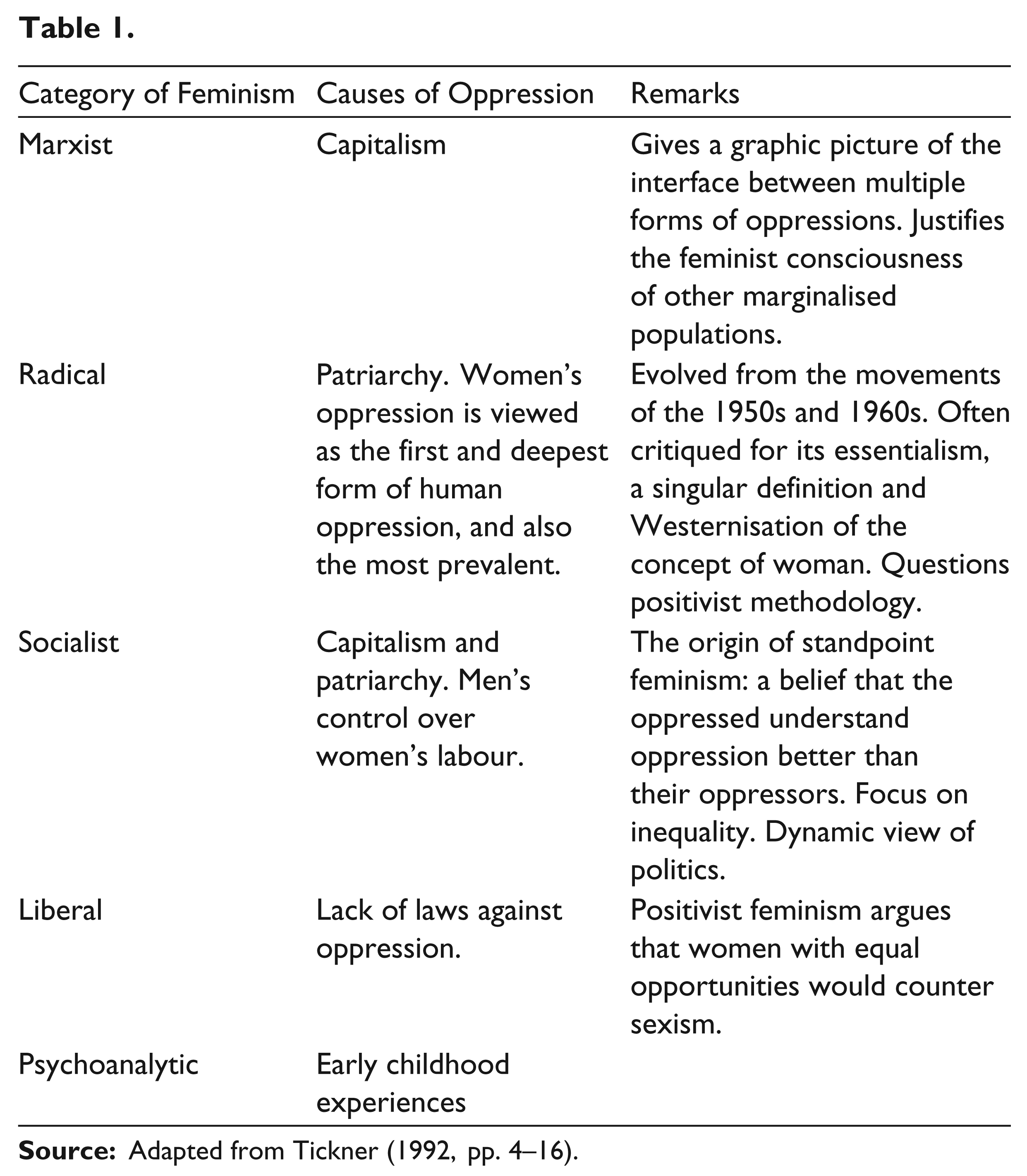
In both her works, Gender in International Relations and Gendering World Politics, Tickner explores the encounter between feminism and IR and the debates within each. She details the various forms of feminism and how they may impact IR feminisms. Drawing on the work of Rosemarie Tong, Tickner categorises feminisms as presented in Table 1. It charts the various forms of feminism and yet, at the same time, portrays the commonalities between them, particularly their mindfulness of gender as a variable of analysis and a feminist standpoint in IR (Tickner, 1992, pp. 17–19).
IR Feminism’s Contribution to the Identity/Methodology Debate in IR
Methodological issues have constituted the deepest sources of misunderstanding between IR feminists and mainstream IR theorists. Tickner’s conversations with Keohane and her critique of Hans Morgenthau’s political realism bring out the methodological estrangement between mainstream IR and feminist IR (Tickner, 2005). In an article titled Beyond dichotomy: Conversations between international relations and feminist theories, the troubled engagements between the two have been highlighted and point to the difficulties in continuing a conversation between feminist IR and mainstream IR (Keohane, 1991). Keohane suggests that feminist IR develop and test falsifiable propositions because the scientific method is the best path towards persuading current non-believers of the authenticity of their message. He also proposes a research programme for IR feminists focused on a variant of the popular democratic peace theory that democracies do not go to war with each other. He further proposes that feminists investigate whether more gender-equal societies are less inclined to fight each other, and use for their investigations the basic methods of social science; that is, formulate hypotheses in ways that are testable and falsifiable with evidence (Keohane, 1991). Although there have been attempts to answer the question posed by Keohane using social science methods, it is accepted that there are not enough female leaders to establish a correlation. However, the results do show that the severity of violence used by states in international crises decreases as domestic gender equality increases. Feminists respond that empirical evidence will require a significant number of women (30 per cent at least) in leadership positions to establish a correlation. Moreover, the questions asked are state centric or related to interstate behaviour. Tickner reiterates the feminist position of there being no single standard of methodological correctness or ‘feminist way’ to do research; rather, feminists embrace methodological pluralism. Drawing on the works of Reinharz and Sandra Harding, she avers that feminist knowledge building is an ongoing process, tentative and emerging through the conversations with texts, research subjects or data (Harding, 1986). In fact, many feminist scholars use the term ‘perspective’ rather than ‘methodology’ to indicate the ongoing project of feminism, its goal being to rethink traditional knowledge based on women’s different experiences. Feminist knowledge is constructed out of disciplinary frameworks and feminist criticism of these disciplines. Feminist enquiry is a dialectical process—listening to women and understanding the subjective meaning they attach to their lived experiences, which are at variance with meanings internalised from society at large. Feminist scholarship is, therefore, transdisciplinary and admittedly political. Deeply connected to the women’s movement, it seeks to understand the unequal gender hierarchies in societies and their effects on the subordination of women, with the goal of changing them.
Drawing on the research of Sandra Harding, Tickner points to the relationship between the development of modern Western science and the history of European colonial expansion (Harding, 1986). Harding challenged the value neutrality of modern science with respect to the questions it asked, arguing that European voyages of discovery went hand-in-hand with the development of modern science and technology. Research topics and questions were selected not because they were of intellectual interest but to deal with problems related to colonial expansion, as, for example, the study of winds, tides and environments and the drawing of maps. Harding stated that it is not in the origin of the scientific problem but rather in the testing of the hypotheses or the ‘logic of scientific inquiry’ that we look to judge the success of scientific methodology as advocated by Keohane. Feminists have countered this claim by stating that the questions asked—or not asked—are as determinative to the adequacy of the project as any answers. The questions that IR has asked since the discipline was established have focused on the security-seeking behaviour of powerful states in an anarchical environment. The questions that IR feminists ask are different questions and they use different methods to answer them. Questions posed by feminists challenge the core assumptions of the discipline and deconstruct its central concepts. On the issues of war and peace, they ask why wars have been fought predominantly by men, and how gendered structures of masculinity and femininity have validated war and militarism for both women and men. Why are women disadvantaged politically, socially and economically? Seeking a better understanding of this neglected but constitutive feature of war, IR feminists question why war was primarily a male activity and the causal and constitutive implications of this for women’s political role, which has been constructed as a ‘protected’ category. Such questions have led to a redefinition of security to include the effects of the structural inequalities of race, class and gender. Recognising that past behavioural realities were publicly constituted in biased gendered ways, feminists have relied more on hermeneutic, historical, narrative and case study methodology rather than a ‘causal analysis of unproblematically defined empirical patterns’ (Tickner, 2001). Since feminists use gender as a social construction and a variable of analysis they work from the ontology of social relations, in which individuals are embedded, constituted by historically unequal political, economic and social structures. According to Professor Tickner, to satisfy the feminist requirement of recognition of gender the criteria for gender inclusion in evaluating an IR theory are (i) it allows for a discussion of the social construction of meaning; (ii) it discusses historical variability; and (iii) it permits theorising about power in a way that uncovers hidden power relations. Professor Tickner goes on to discuss the research methods suggested by IR feminism as under (i) ethnography and (ii) discourse analysis (Tickner, 2001).
IR Feminisms Frame the Debate on Security
Perhaps the primary contribution of Professor Tickner’s study is the recognition of the masculinity of strategic discourse, which relates to the hegemonic masculinity of states. The security of the state is perceived as a core value by citizens. National security and the maintenance of its interests continue to be an almost exclusively male domain. Through its association with war, national security has been valorised in several cultures (such valorisation necessitates a devalued femininity and devalued alternate masculinities). Hegemonic masculinity cannot be applied generically to all males but is sustained through subordinated and devalued masculinities, such as homosexuality and, more importantly, through its relation to various devalued femininities. Whereas men are associated with defending the state, construed as the highest form of patriotism, women are excluded from this, engaged instead in the domestic realm in ‘ordering’ and comforting roles as mothers or basic needs providers and in caring professions such as teachers and nurses. It is this gender bias that forms the basis for Tickner’s call for a feminist redefinition of security. The extreme ‘depersonalisation’ in the idea of security is another reason for her argument. Although humans are the objects of security they are conspicuous by their absence in the security discourse. Rather, the key terms used in the discourse are ‘states’, ‘nukes’ and ‘power’ (Tickner, 1998).
In her engagement with Hans Morgenthau and Kenneth Waltz, prominent IR scholars, J. Ann Tickner articulates her perspective on security. For realists, security is tied to the military security of the state. In an imperfect world states can never be sure of one another’s intentions, and so they arm themselves to achieve security, an act that threatens somebody else’s security (the classical security dilemma). This sets in motion a vicious cycle of rivalry and competition, which results in the spiralling procurement of armaments and the possibility of war. Kenneth Waltz suggests that as states cannot, in an anarchical international system, count on others’ help, they should augment their security by following the principle of self-help (Tickner, 1992, p. 2). Morgenthau’s power maximisation and Waltz’s notions of self-help could have dangerous consequences, given the considerations of anarchy and mutual distrust. Morgenthau claims that peace depends on two mechanisms, balance of power and international law, whereas Waltz claims that balance will form as states act, either alone or through alliances, to counter the power of others (Harding, 1986). In the United States, the unprecedented build-up and maintenance of huge military arsenals in times of peace led to a new branch of IR scholarship known as national security studies.
Realism’s prescriptions for national security rest on the claims of its scholars to a rational, objective assessment of the international system and the behaviour of the states within. Politics, according to Morgenthau, is governed by objective laws that have their roots in human nature; therefore, it is possible to discover a rational theory that reflects these objective laws. Political realism is the concept of interest defined in terms of power and stresses the rational, the objective and the unemotional. The ‘political man’ must be abstracted from other aspects of human behaviour to develop an autonomous theory of political behaviour.
Neorealists have attempted to construct a positivist science of IR using game-theoretic models and rational-choice models to insert scientific rigour into the field. According to Waltz, it is at the level of the international system that laws can be found to help us understand the international behaviour of states and their propensity for conflict. He claims to observe regularities in the power-balancing behaviour of states that can be explained in terms similar to those of the equilibrium theory in microeconomics.
Drawing on the works of Evelyn Fox Keller, Tickner disagrees with scientific communities that postulate that the universe they study is shaped by the demands of logic and experiment and that the laws of nature are beyond the relativity of language. Rejecting this positivist view of science as ‘coercive, hierarchical and conformist’, feminists, who believe that knowledge is socially constructed, question the neutrality of language and its objectivity (Tickner, 1992, p. 36). Professor Tickner’s analysis of IR feminisms argues for an interpretation of knowledge that recognises its inherent subjectivities. She states that the objectivity claimed by the realist/positivist school of IR is problematic and gendered (Tickner, 1992); not only is objectivity impossible but it also veils the marginalisation of subordinated classes and genders. In IR, this plays out as a linguistic problem that manifests masculinist assumptions. The gender neutrality of objective realism privileges the hegemonically masculine ideas of war and competition as the shaping forces of human relations. Therefore, Professor Tickner explains, ‘feminist reformulations of the definition of security are needed to draw attention to the extent to which gender hierarchies themselves are a source of domination and thus an obstacle to a truly comprehensive definition of security.’ Tickner’s work falls within an expansionist category of security thinkers and she labels the feminist concept of security as ‘comprehensive’ or ‘common’ security. Her conception of security is closer to Buzan’s redefinition of security in People, States and Fear (including the military, political, economic and societal and environmental dimensions). 3 Underlying the concept of human or individual security is the scope of security in individual life, and Tickner includes in it safe working conditions, freedom from the threat of war and an end to structural violence. Tickner’s definition of security is closely linked to the ideas of justice and emancipation as opposed to order. Feminists reinterpret power as the ability to act in concert.
IR Feminisms Address Levels of Analysis in IR Theory
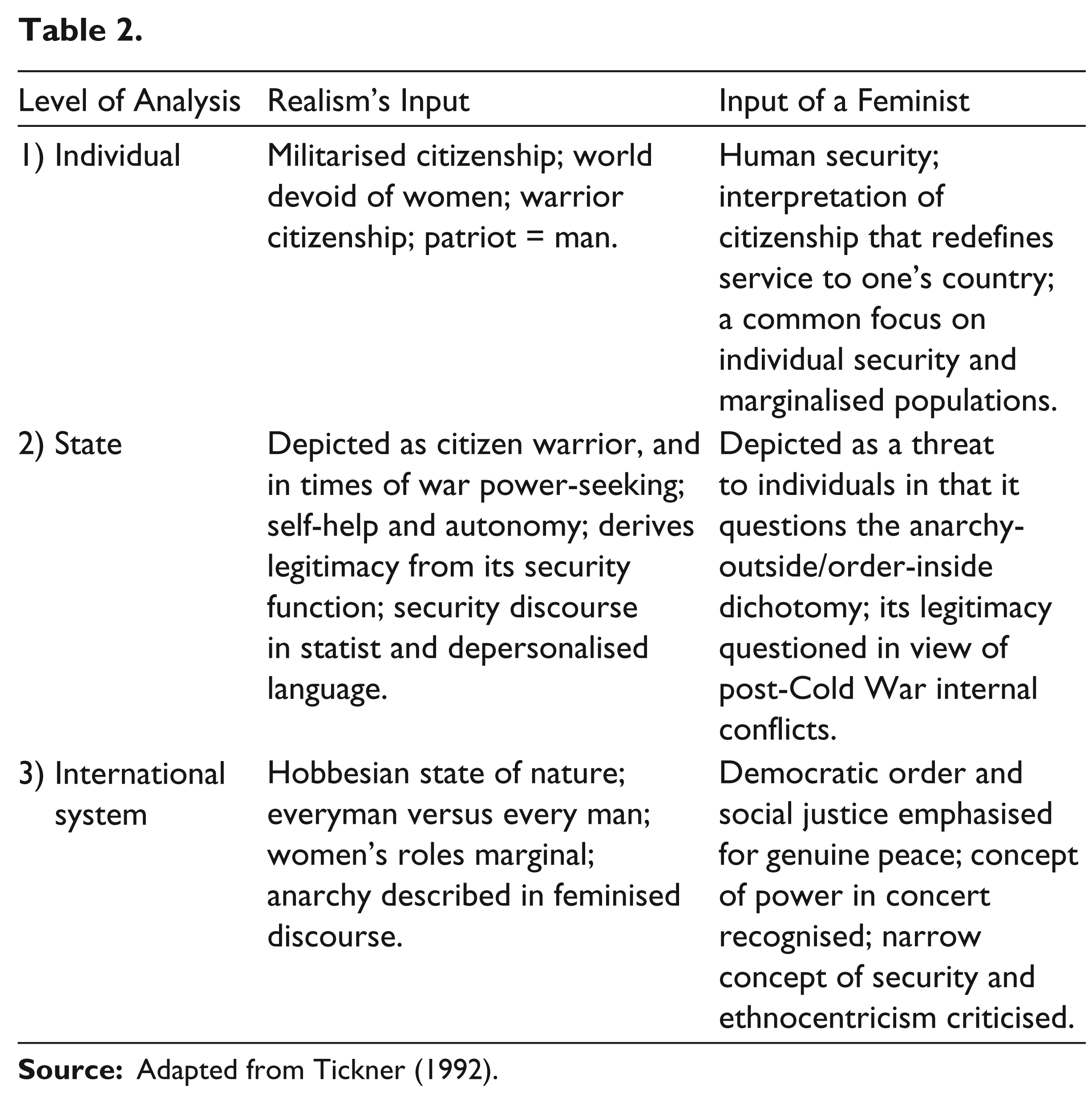
Realists use three levels in their analysis of war and national security (Tickner, 1992). This analysis schema separates the individual, the state and the international system. As a theoretical device it has become the most influential way of classifying explanations of war and even the understanding of interstate relations. Professor Tickner states that in this three-tiered picture of the world survival requires ‘war-capable’ states inhabited by ‘heroic masculine citizen-warriors’. Peaceful international systems are considered utopias. Non-power seeking states are dismembered and a non-warrior citizen is inessential to the reproduction of the state. Continuing her engagement with the realists Tickner states that these are gendered ways of depicting the political man, the state and the international system and that such security discourse privileges conflict and war while silencing alternative options. It distracts us from the role of individuals and groups in the maintenance of state- and systemic-level relationships and from thinking in terms of life-giving rather than life-risking qualities. Professor Tickner describes interpenetrating levels as a result of feminist discomfort with the traditional levels of analysis as articulated by Waltz. Table 2 represents the interactions between IR feminisms as explained by Professor Tickner and the traditional levels of analysis.
The Anarchy/Order Dichotomy
The rhetoric of traditional IR, Tickner claims, is loaded with the basic assumption of realists, which is that we live in a dangerous world devoid of an overarching authority to maintain peace. In this anarchic world realists advocate the accumulation of power and military strength to ensure state survival, the protection of an orderly ‘domestic’ space, and the pursuit of legitimate national interests beyond one’s territorial boundaries (Harding, 1986, p. 147). However, the pervasiveness of internal conflict within states in the latter part of the 20th century and the threat posed by militarised states to their own populations have blurred the anarchy-outside/order-inside dichotomisation, a dichotomy further disproven by women’s global oppression. Feminists aver that a state’s domestic policies cannot be separated from its behaviour in the international system. They call attention to women’s particular vulnerabilities within states, which arise from hierarchical gender relations that are also interrelated with international politics. In militarised societies women are particularly vulnerable to rape, and evidence suggests that domestic violence is higher in military families.
Feminist theories draw our attention to another order/anarchy distinction: the boundary between a public domestic space protected by rule of law and the private space of family where no such legal protection exists. Domestic violence is not considered a concern of the state and most of it takes place outside the sanction of the legal system. The line that demarcates public and private separates state-regulated violence or the rule of right for which there are legally sanctioned punishments, and male violence or the rule of might for which no such legal sanctions exist. Pointing to the interrelationships of violence across all levels of analysis, feminists want violence to be seen in the context of wider power relations. Any feminist definition of security must therefore include the elimination of all types of violence, including violence produced by gender relations of domination and subordination. Feminists allege that the public/private dichotomy has marginalised women for centuries and is used to keep IR in the political realm, neglecting the social domain.
Ecofeminist Perspectives on International Political Economy
In her engagements with international political economy (IPE) theorists, J. Ann Tickner explored the way in which the interaction between states and markets was contingent on the exploitation of nature, and argued that the European state system and the capitalist world economy reveal a common history in their exploitative attitude towards the natural environment (Tickner, 1993, p. 60). To mercantilists, natural resources form the crux of elements of national power. The market’s expansion under neoclassical economics also depends on exploiting natural resources, suggesting a need for international regulations to prevent ecological catastrophes. Scholars of IPE have pointed out the difficulties of achieving the cooperation necessary for such agreements in an anarchical international system (Tickner, 1993, p. 61).
Feminist perspectives, on the other hand, posit an interrelationship between the evolution of the modern nation state and market on the one hand, and the exploitation of women on the other, their research claiming the marginalisation of both the environment and women. Ecologists and feminists have challenged the Enlightenment’s view of nature as an inert, lifeless machine used for human and material progress. Science in the 17th century linked nature and the body with women, and so the mind or rational thought came to be linked with men. Concepts of gender began to change with market expansion at this time and male/female definitions became polarised to suit the growing division of labour between work and home required by early capitalism. Women’s work was placed in the private domestic sphere as opposed to the public world of state and market occupied by men. As the compulsions of early capitalism reinforced this division of labour between home and workplace the economic, political and social opportunities available to women were curbed. Feminists believe that 17th-century gender metaphors were central to developing social attitudes towards nature and women as well as to non-Western people, attitudes that were discriminatory and consistent with the practices of a capitalist world economy and an expansive Eurocentric state system (Tickner, 1993, pp. 62–66).
Indiscriminate exploitation of resources for Europe’s ship-building industry led to ecological crises in the early 16th century. Ship building, which depended on mature oak for masts and hulls, caused severe wood shortages in many parts of Europe, stimulating the rise of coal mining in the search for an alternative fuel.
As Europeans sailed beyond their shores, the exploitation of natural resources took on a wider dimension, leading in the 20th century to a highly interdependent global resource base. Economic competition and political conflict inevitably resulted from a single resource base. In an attitudinal change, natural resources were no longer viewed as gifts in the 17th and 18th centuries; instead, the new lands being settled by Europeans were viewed by them as wastelands in need of improvement by superior Western culture and technology. Also, as agriculture transformed from subsistence to market, and farming gradually changed into a manufacturing industry, production split into two spheres. Women were defined by their reproductive function within the private sphere. Commercial farming required management of nature as an abstract mechanical force. Nature as mother retreated into the private sphere along with the women, who were expected to be upholders of moral values that had no place in the market economy.
Continued European explorations led to the reconceptualisation and organisation of geographical space on a global basis. This led in turn to the natural environment being controlled and dominated. Spatial changes were also accompanied by power changes, with geopolitics defining the power of the state as a function of geographical circumstances. In geopolitical terms spaces were contested areas populated by colonists, soldiers, navies and traders. While geopolitics effected a transformation in perceptions of the global environment, the native inhabitants of this space became increasingly marginalised with women being confined to the private space of the family. Environmentalists encourage us to look at the world not as a system of competitive states but as an ecosystem, a global unity of natural carriers composed of the atmosphere and sea water. The fragile ecosystem cannot be protected by boundaries as the ozone layer, acid rain and river and ocean pollution are problems impervious to national boundaries. The 1970s literature on global modelling warned of extending the physical limits of growth. The Club of Rome predicted that an exponential growth in population and industrial pollution would collide with a fixed environment in 50 to 100 years. The people were alerted to the dangers of environmental degradation and recourse constraints. However, this resulted in cleavages between the North and the South at the United Nations conference on environment in 1972 (Tickner, 1993, pp. 123–129).
The Malthusian implication of the limits of growth, which precludes any chance of a better life for the world’s poor, was bluntly criticised by the South when it blamed the North for prioritising the issue of environmental pollution. Admonitions that economic growth be stopped in all parts of the world, even as an average person in an industrial market economy used more than 80 times as much energy as someone in sub-Saharan Africa, were deemed unacceptable. Ecologists are critical of modern society and its dependence on a market economy fuelled by excessive appropriation of nature’s resources. Modern society’s values are seen as based on an incomplete model of human behaviour emphasising instrumental rationality, production and consumption at the expense of humaneness, creativity and compassion. Feminists charge most ecologists with neglecting gender issues when calling for fundamental changes in modern science and contemporary economic, political, social and economic structures. Some ecofeminists see this as basic to the hierarchical nature of these structures as well as to the project of modern science. In order to live up to its claim as a holistic science, ecology must incorporate gender as a category of analysis.
Conclusion
Professor Tickner’s Contribution
J. Ann Tickner’s feminism carved out significant space for gender as a variable of analysis in IR scholarship and its now robust subfields. She notably challenged the dominant paradigm of IR discipline and berated the realistic perspectives of security with its top-down, state-centred approach. Feminists come mostly from the bottom-up micro level of analysis, attacking, for example, the premise that wars are fought to protect women and children. On the contrary, they argue, to the extent that wars breed violence, mass rape, refugee crises and rampant prostitution, their effect on women is brutal. By raising issues such as domestic violence, rape and prostitution Tickner gives a human-rights dimension to her narratives. She also forays into issues hitherto ignored by conventional IR, such as democratisation, women’s and international organisations, norms and human rights. Additionally, she challenges the gender-loaded binary oppositions, rational/emotional or public/private for example, in IR scholarship as studied in the West, since they are products of the Western Enlightenment. This knowledge tradition is premised on the separation of mind (reason) from body (nature) and hence diminishes women as ‘knowers’. Tickner also complements the methodological repertoire of IR by integrating new methodologies— ethnography, discourse analysis and, in particular, her innovative style of dialogue and conversation—as tools of analysis.