



Abstract
This paper sets out to interrogate an interesting dimension of a popular form—the graphic novel—and its use as a mode of social activism. Illustrating clearly the myriad manifestations of sexuality in modern Indian urban spaces through 14 graphic narratives, Drawing the Line: Indian Women Fight Back (2015) is a bold attempt by Priya Kuriyan, Larissa Bertonasco and Ludmilla Bartscht in documenting the predicament of young women in our society in a rather refreshing manner.
I focus on the performative aspect of gender by analysing the graphic texts where an effort is made to subvert the power structure by appealing to social conscience. Here, the authors have tried to rethink femininity in the contemporary Indian context by developing a counter-hegemonic narrative which challenges the aggressive nature of dominant masculinity and by opening up the possibility of constructing a ‘counter-space’ (Lefebvre). Intersection between verbal and visual representation in the graphic stories is studied with theoretical inputs from W. J. T. Mitchell, Michel Foucault and Judith Butler.
Due to the overarching influence of technology, visual culture has virtually become the norm in today’s world, extending to different genres of popular culture. The visual is the site where meanings are created and contested (Mirzoeff, 1999, p. 6) and the tendency to define culture in linguistic terms has been replaced by what W. J. T. Mitchell called ‘the pictorial turn’ (p. 11) while elaborating his ‘picture theory’ which argues for a world-as-a-picture instead of world-as-a-text. 1 This paper investigates the popular form of graphic novel as a mode of social activism. Illustrating the myriad manifestations of sexuality in modern Indian urban spaces through 14 graphic narratives, Drawing the Line: Indian Women Fight Back (2015) is a bold attempt by Priya Kuriyan, Larissa Bertonasco and Ludmilla Bartscht in documenting the predicament of young women in contemporary Indian society. As a plea for social awakening, the graphic artists in this unique anthology make a laudable effort in unmaking the social mindset conditioned by patriarchal society. It seeks to redefine and reconstruct feminine identity by critiquing institutions such as family and marriage, while the darker nuances of man–woman relationships are exposed, the woman’s right to lead a life of dignity and individuality is strongly underlined.
The protagonists in the narratives occupy the central space of panels and are thus foregrounded spatially. By producing their own space within the panels, they are constructing what Lefebvre called ‘counter-space’, a space which subverts the domains of power. This is achieved through their body performances (including looks) in panels where they challenge and subvert the established hegemonic social codes set by patriarchy. Space is conceived as ‘a means of control, of domination, of power (Lefebvre, 1991, p. 26); it is a “social product”’ (p. 26). Lefebvre’s notion of counter-space is particularly relevant in reading visuals in a graphic narrative because it is an appropriated space, a site of resistance which aims at attaining an ‘alternative society’ (p. 381) even though, the appropriation may be only temporary as it has to withstand the interference from the state and its agencies. This essay is an attempt to telescope the activist role that the graphic novel—a hybrid form—can perform in generating social awareness in the wake of what we call the ‘visual turn’ in the contemporary world scenario. I call this graphic activism. The unfortunate tragedy of a young physiotherapy student in Delhi on 16 December 2012 proved to be the catalyst in bringing together 14 graphic artists in India to work on this anthology, to highlight ‘violence, fear and the strategies to deal with both …’ (Susan, 2015, p. 3). Table 1 gives us a clear picture of the nature of the stories in the collection.
Contextualising Drawing the Line
The first story ‘That’s Not Fair’ drives home the age-old obsession with fair skin which is deeply rooted in the Indian psyche; dark is ugly and fair is beautiful. Narrated from the perspective of a foetus, it unveils what is regarded as the rather unpleasant occasion of the birth of a girl in our society; the baby girl who is dark is considered a liability by not only her parents but also by her kin. In the story, her parents start wondering about her dowry even before the baby is born! Harini Kannan plays with the word ‘fair’ and suggests that it is unfair to discriminate against people on the basis of skin colour; such an attitude is a leftover of the colonial prejudice towards natives. Diti Mistry’s ‘Mumbai Local’ reveals the travails of a woman in a local train in Mumbai. In the hustle and bustle of the train, we come across different types of women, selling vegetables or fish, while others engage in casual conversation, all of whom, we see, annoy the narrator. To the young protagonist, the train journey becomes a means of self-exploration, a voyage of self-realisation. She represents the sophistication of urban life and finds the activities of the other women inside the compartment odd. The unexpected arrival of a bug and the panic it creates when it bites the girl, may indicate the lurking danger, with the insect symbolising evil or at least unwanted attention to the person/body of the girl. One of the co-passengers, a middle-aged Indian lady, helps the young girl by offering food in a tiffin box. The narrator is deeply touched by her words of consolation: ‘You’ll laugh about this later. Here, have some halwa [a glutinous sweetmeat] I made it myself. You’ll feel better soon’. And the concluding dialogue of the girl narrator on the last page sums up her mood and self-realisation: ‘It took an incident like this to make me realise I was actually a part of this sisterhood of daily commuters and not just an observer of their lives. They had accepted me as the one of their own long before I knew it. Suddenly, I knew I wanted to belong’. Thus, through the unique world of a ladies’ compartment, ‘a being in itself, with a certain energy that was quite different from all the other compartments of the train’ (Mistry), creates a special female bonding, a ‘sisterhood’ in the absence of any male presence.
Thematic Illustration of the Graphic Stories in Drawing the Line
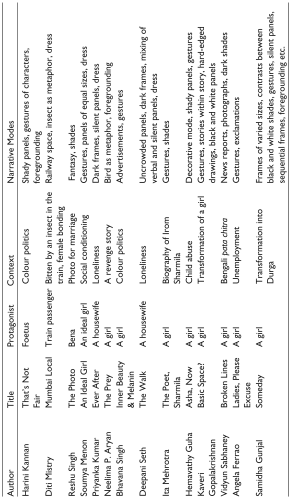
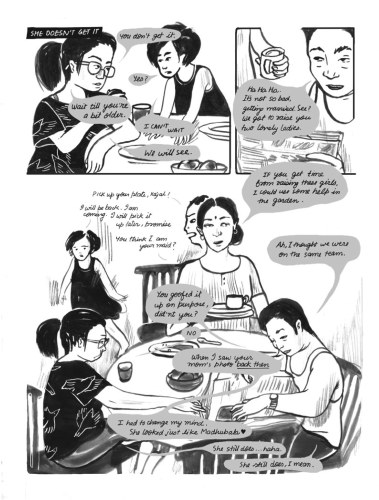
‘My name is Bena. My family can’t wait to marry me off and party hard at my wedding’—these opening lines by the narrator in Reshu Singh’s graphic story ‘The Photo’ (Figure 1) addresses the issue of marriage in the life of a girl, and how she is forced to fall in line to be a part of the family structure. In order to get her married, it is important for the parents to take her photo so that it may be exhibited to prospective grooms. The girl is not yet ready to opt for marriage and wishes to explore and know her true self. Her quest for freedom drives her on one occasion to remind her mother about the latter’s life of duty and responsibility. Instead of such an identity, she suggests, she would rather be alone and have her freedom.
Reshu Singh, ‘The Photo’ (with kind permission of the artist).
Soumya Menon’s piece ‘An Ideal Girl’ presents to the readers those conditions imposed by patriarchy upon women: they are supposed to learn cooking, cleaning, stitching and dutifully serving the ideal boy. The ideal girl has to learn how to become a responsible, ideal wife in future. The girl experiences gender discrimination within the family where her brother is given better treatment by her parents. Having seen and experienced these for many years, the girl rebels against social conditioning and leaves her home on a bicycle. Her act is symbolic of a journey away, into the world and perhaps to freedom from her home of do’s and don’ts.
Priyanka Kumar’s ‘Ever After’ narrates the plight of a housewife who suffers from boredom and loneliness in the company of her insensitive husband. The tedium of married life causes the woman to escape into a dream world and she metamorphoses into a bird and flies away into a world of freedom outside the home/family. Neelima P. Aryan’s ‘The Prey’ illustrates a young girl’s revenge by trapping an eagle. Set against the background of rural Kerala, the bird trap is used figuratively to highlight the traps women face at the hands of men waiting to exploit them. The girl succeeds in killing the hungry bird (which is sketched along with a voyeur waiting for his prey) and thus effectively eliminates the danger around. Bhavana Singh’s story ‘Inner Beauty and Melanin’ portrays the absurdity of human desires, particularly the proclivity for consumer culture. The colour of skin is crucial for women in order to be a valuable commodity in the marriage market, and they are forced to resort to various cosmetics to construct a beauty that is appealing. The story reminds us of the social and psychological difficulties of dark-skinned people in Indian society. ‘The Walk’ by Deepani Seth narrates the loneliness and rootless existence of a typical housewife in an Indian city. Forced to lose herself in urban space, she is surrounded by several blank faces all around her.
Ita Mehrotra ‘The Poet, Sharmila’ (with kind permission of the artist).
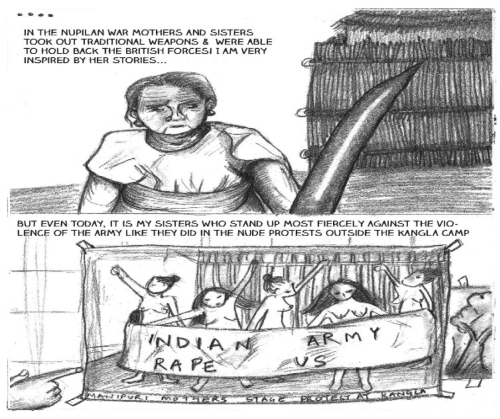
Ita Mehrotra’s ‘The Poet Sharmila’ (Figure 2) is a graphic biography of Irom Sharmila, who fasted for over a decade in protest against the violence unleashed on Manipuri women by Indian paramilitary forces under cover of the Armed Forces Special Powers Act. The narrator recaptures her journey from Delhi to Manipur where she met Sharmila. Not permitted by the army initially to visit the activist, she eventually manages an interview with Sharmila. The history of Manipur is narrated by Sharmila’s mother, with numerous jibes at Indian nationalism. ‘Asha Now’ is Hemavathy Guha’s story about a girl who is molested by her own brother. It reminds us that a woman is not safe even within the four walls of her own home and family. The resultant trauma has a profound impact on her family life when she becomes a wife later, and Asha now is suspicious of everyone, and feels insecure on behalf of her daughter when the latter is in the company of her uncle.
Kaveri Gopalakrishnan’s ‘Basic Space’ is a graphic narrative encapsulating five other micro narratives. It is the story of an insecure teenager who is taught to behave (‘draw a line’) in certain ways by patriarchal society. She is asked to place or carry her ‘bag over [her] chest’ so that her chest will not be exposed as a potential site of male voyeurism. She is taught to dress in a way that her body is fully covered. However, the protagonist opts to select ‘a world without boundaries’ and flouts the social codes imposed by hegemonic male society. Towards the end of the story, she appears ‘bra-less, naked, scratch in public’ attitude. ‘Never Mind’ becomes her favourite slogan. In Broken Lines, Vidyun Sabhaney mentions the gang rape of December 2012 and acid attacks against women in Delhi and uses scrolls to embody her narrative. Angela Ferrao’s ‘Ladies Please Excuse’ highlights the need for financial security for women in a prevailing atmosphere of gender inequality in the job market with its hidden dimension—that of sexual exploitation. Unable to find a job despite her qualifications, the protagonist escapes to a dream world, dreaming of success. Finally, ‘Someday’ by Samidha Gunjal is about a girl in an urban setting who becomes a victim of what is called ‘eve teasing’. After several uncomfortable moments and a sense of increasing anxiety, she metamorphoses into the goddess Durga, and we are shown the men running away from her glare. One can see the subversion of patriarchal values where Durga in her fierce avatar as Kali appears naked, smoking a cigarette and drinking tea.
‘Ways of Seeing’/Reading Dissent
Panel Composition
When we read picture frames, it is important that we look at both the visual as well as verbal texts. Jan Baetens and Hugo Frey in Graphic Novel: An Introduction (2015) argue that page layouts ‘make a crucial contribution to the building of a story world as well as to the managing of the reading process, which is always also a reading for the plot …’ (p. 132). A page layout works on three levels: (1) foregrounding vs. backgrounding, (2) establishing links beyond the mechanisms of mere panel-to-panel transition and (3) speeding up or slowing down (p. 132). An interesting taxonomy was introduced by Benoit Peeters in his work Four Conceptions of the Page. His classification is based on ‘the various relationships between two basic elements: narrative (the graphic novel as a storytelling device) and composition (the graphic novel as a device for the production of images, visual patterns, and spatial forms…’ (discussed in Baetens & Frey, 2015, p. 108). He rightly argues that ‘either form can be dominant at the automatic expense of the other: the more we follow the story, the less we notice the visual components of the panels ….’ (p. 108). Peeters’ first mode of panel utilisation, the conventional mode, is marked by equal horizontal and vertical lines with ‘the same panel or the same tier is repeated over and over again, tier after tier, page after page, book after book…’ (p. 109).
In Drawing the Line, for instance, we do not find a narrative that follows the conventional narrative mode except Soumya Menon’s ‘An Ideal Girl’. In the story, the protagonist is conditioned to act like an ideal girl, the panels are arranged as a sequence of equal horizontal and vertical lines in tune implying the ideological underpinnings of the text, and stressing the strictures of gendered social order and decorum. However, the last panel is of a bigger size: and this panel depicts the girl breaking away from the rigidity of patriarchal values. This scene of her pedalling off is set in a larger frame from a wider angle with a picturesque location as background, implying a whole new life, with new meaning and hope.
Stories like ‘Someday’ follow Peeter’s third narrative mode, the rhetorical one. Peeter observes: ‘The panel and the page are no longer autonomous elements; they are subordinated to a narrative which their primary function is to serve. The size of the images, their distribution, the general pace of the page, all must come to support the narration’ (Baetens & Frey, 2015, p. 112). When the girl becomes Kali, a goddess who symbolises woman-power, in ‘Someday’, the frame is much bigger in size and fills almost two pages, eclipsing all the men. She becomes a gigantic figure who is so radiant that no one can even look at her. The graphic artist’s technique of magnifying the size of the frame has increased the effect of narration. Another such instance of the enlargement of the panel occurs in ‘The Walk’ where the lonely housewife is seen facing concrete buildings on both sides of the road, thereby effectively symbolising a sense of being hemmed in and restricted in the space of the city, and the space of the panel. In fact, the lady is seen ‘suspended in a quiet comfortable blankness’ looking at the sea from a distance, where the sea is beyond restrictive lines.
Drawing Style
The drawing style of an artist is ‘one of the signatures or trademarks of the author, and one can easily observe that personality and individuality really matter in the field’ (Baetens & Frey, 2015, p. 136). Peeters introduces the notion ‘graphiation’ as a neologism for ‘visual enunciation’ or ‘graphic expression’ where the body and personality of the graphic artist becomes important in representing object, character, setting or event (Baetens & Frey, 2015, p. 137). He identifies two extreme styles: the highly subjective style in which the personal agenda of the author overshadows the representation, and the objective style in which the representation acquires more importance than the content part (p. 137).
In a graphic novel, one may not identify a set pattern of representation; there may be
differences in the chromatic code (shifts from black and white to colour, the use of different colors for different characters) and differences in drawing techniques (shifts from hard-edged, singular forms to soft, curbed or curved forms in the figuration of, respectively, male and female characters and moods (Baetens & Frey, 2015, p. 140).
In Harini Kannan’s ‘That’s Not Fair’ that opens with six panels showing the development of a girl from egg to foetus to an infant, the use of dark shades is significant. The dark background reflects the mystery surrounding the growth of life in the womb. As soon as the doctor identifies the gender of the foetus as female (It’s a girl!), the immediate reaction of the pregnant woman is a sigh (Oh!) which indicates her frustration. The frame in which her dark face and drooping head appear symbolises pictorially her state of mind; the image speaks more than the spontaneous exclamation. Dark shades are prominent in the panels and they are also subtly drawn. It may also be noted that the space of the frames are not crowded and the foetus is given visual prominence.
‘Mumbai Local’ opens with a full page frame capturing the many shades and sides of life in Mumbai city, with its love, longing, poverty, loneliness and rush. The narrator is portrayed as a little lost in the complexities of life, represented by the zig-zagging railway lines. The first panel of Reshu Singh’s ‘The Photo’ shows a full-length illustration of the narrator sitting in a studio tilting her head ‘to a stranger’. Unwillingness and apprehension about her future are writ large on her face when she looks out of the page, and therefore at the reader. The panel showing her head upside down reflects her attitude to life. She says that she prefers to be happy and heroic in life, unlike the girl in the photograph whose identity is artificial, superficial and socially crafted because this identity is what is expected of her.
Verbal/Visual Dialectics
The graphic novel is a hybrid art form which is ‘presented through the visual as well as the verbal channel’ (Baetens & Frey, 2015, p. 143). However, apart from the visual, the story is also narrated through ‘the text and its forms such as balloons or captions or integrated textual material’ (p. 143) and both can compliment or contradict each other. It is to be remembered that in a graphic novel, it is ‘the meaning of the text that must be anchored or relayed’ (p. 147) and not the other way around. 2 The image can contradict the text ‘not just by showing something completely different, but by emphasizing some nuances that help us understand that the narrative voice is, willingly or unwillingly, deceptive’ (pp. 147–148). In certain stories, we come across wordless images. On the whole, ‘language in the graphic novel is always just half of the story: good language and good drawing are never enough; it is the interplay between words and images that has to work’ (p. 149).
The foetus’s predicament in ‘That’s Not Fair’ is conveyed by the graphic artist with the help of both the visual text (it is seen crying) and the verbal text which is highlighted by the use of the uppercase—‘WHAT ABOUT MY COLLEGE FUND??’ The foetus who is already in the know of social attitudes towards the girl child, turns into a rebel even as a foetus, and wishes to get out in order to undertake a mission: ‘It’s high time I came out and taught this society a goddamn lesson’. The word ‘lesson’ is in bold, signifying a mark of protest. The baby emerges from the womb uttering ‘WAAAAAH!!!’ and in one full single frame the image of the foetus is drawn, magnifying her introduction to the world of discrimination, when her umbilical cord is cut by the doctor.
Equally important is the ‘internal hierarchy between words, letters, syntagms, and sentences …. the shift from normal to bold (or from lowercase to capitals, from black to color, from small to big, and so on)’ (Baetens & Frey, 2015, p. 158). In theorising verbal/visual dialectics, W. J. T. Mitchell’s (1994) observes:
The ‘differences’ between images and language are not merely formal matters: they are, in practice, linked to things like the difference between the (speaking) self and the (seen) other; between telling and showing; between ‘hearsay’ and ‘eyewitness’ testimony; between words (heard, quoted, inscribed) and objects or actions (seen, depicted, described); between sensory channels, traditions of representation, and modes of experience … (p. 5).
For instance, in the present anthology, Vidhyun Sabhaney in ‘Broken Lines’ adopts different modes of multimedia ranging from newspaper reportage to pata chitra scrolls to foreground violence against women in ‘our society, particularly in city spaces’. In panels of different shapes, what is noticeable is the predominant black background.
Constructing Space, Performing Bodies
Through their work, graphic artists construct a space for themselves and their characters. The space of panels in which characters and background settings are drawn, brings out the interplay between characterisation and spatialisation. A character’s thoughts are conveyed through balloons, exclamations, gestures and ‘the emotional consequences of the action on the mirror of their minds: their bodies, their faces, their eyes’ (Baetens & Frey, 2015, p. 176). The paratexts of the panels in the stories include individuals representing humdrum life, more buildings and less landscape. Female characters predominantly occupy the constructed spaces with the occasional presence of male characters. Thus, ‘the spaces of urban India as portrayed in the graphic narrative are often spaces of haunting, of revenants, traumatic pasts and uncertain presents … of trauma and alternative desires, doubling, of secrets and secrecy and of violent undercurrents’ (Nayar, 2016, p. 49). The discourses generated from the interactions between various characters in the sequence of stories turn out to be counter-hegemonic and subversive whether it is the decision of the girl to stop being an ideal girl or the exemplary attitude of Sharmila in resisting the state apparatus.
Judith Butler’s notion of ‘performativity’ is a useful critical tool for analysing the performance aspects of the picture frames in the 14 graphic texts in Drawing the Line. In Gender Trouble: Feminism and the Subversion of Identity (Butler, 2006), Butler argues:
the very notion of ‘the body’ [is] not as a ready surface awaiting signification, but as a set of boundaries, individual and social, politically signified and maintained. No longer believable as an ‘interior truth’ of disposition and identity, [gender] will be shown to be performatively enacted signification … [and] occasion the parodic proliferation and subversive play of gendered meanings (p. 44).
Thus, individual identity does not exist outside of culture, but the subject instead is ‘performatively constituted’ (p. 33) by what Butler calls ‘the repeated stylization of the body’ or ‘a set of repeated acts within a highly rigid regulatory frame that congeal over time to produce … a natural sort of being’ (p. 33). Thus, one can transgress the frameworks fixed by the state and power structure, reframe or renegotiate the ‘matrix of coercion’ as Michel Foucault (1978, p. 141) said. 3
Two stories, ‘The Poet, Sharmila’ and ‘Basic Space’, may be taken as case studies here. Sharmila’s repeated attempts to defy the state through her performance of the fast, by placing her body in risky situations is an act of subverting set norms. In fact, we can see her using her body to generate an alterate discourse of resistance. The girl in the second story changes her body’s performativity and adopts an entirely different one when she acts ‘boldly’ (as it is phrased in Indian idiomatic expressions), flouting all restrictions imposed by patriarchy. The girl who is forced to change her body language in public, especially when in the presence of men (which includes keeping a ‘blank stern face’, ‘straight back’, ‘battle story stance’ and ‘bag over chest’) finally erases the constricting lines of patriarchy. Thus, we see two characters challenging the established social codes, and trying to redefine their identity through their repeated acts of transgression and renegotiation.
Conclusion
All 14 female protagonists in Drawing the Line are victims of domination by patriarchal society; many characters are targets of the male gaze and a few are victims of sexual abuse. Voyeurism acquires another dimension in this graphic book; the readers also becoming voyeurs when they enter into the private lives of the female characters. Thus, every visual plate becomes ‘a place where meanings are created and contested’ (Mitchell, 1994, p. 6) mainly due to clash of ideologies. Applying the idea of performativity when reading graphic narratives, one needs to also examine the body performances in the visual texts, generating what I would call ‘readerly performativity’. It is taken for granted that the characters in the frames come to life or rather act during the process of reading and it may be admitted that reading is a performative act with profound ideological implications. In fact, the responses by readers to characters and their behavioural patterns depend on the moral codes transmitted by the power structure.
Ita Mehrotra ‘The Poet, Sharmila’ (with kind permission from the artist).
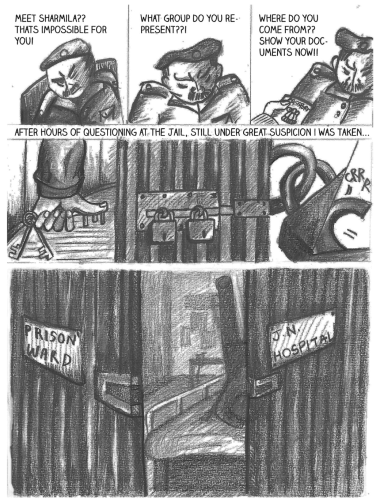
The stories in this collection have succeeded in redefining gender identity; the characters starting from the foetus to the girl who discovers her shakti in the new avatar of Durga/Kali, assert and proclaim that every woman has her own individuality, identity and separate existence instead of being only an object of pleasure. Hence many, including Sharmila and the girl in ‘An Ideal Girl’, protest against the exploitative machinery of patriarchy (Figure 3). Other protagonists who withdraw into the world of fantasy and dreams, suggesting a new set of lines they draw for themselves: lines that are to do with the life of their minds and imaginations.
Drawing the Line has effectively depicted the different shades of femininity. In fact, the graphic novel has given freedom to the artists to represent taboo areas including nudity in stories such as ‘Ever After’, ‘Asha, Now’ and ‘Someday’. Family appears as the prominent institution of social conditioning in these narratives, victimising the female characters. Many are seen subverting and breaking the patriarchal framework by proclaiming and enacting their freedom, where both visual and verbal texts show us this act of freedom. To conclude, the graphic novel as a form has become a major mode of delineating gender inequalities in Indian society and books such as Drawing the Line: Indian Women Fight Back is indeed a powerful plea for human rights. A new addition to the canon of Indian writing in English, the graphic novel thus marks ‘a democratizing of forms of socio-political commentary but also a democratizing of the language of cultural analytics’ (Nayar, 2016, p. 7, emphasis in original).