



Abstract
This article identifies the ways in which researchers and practitioners situated in different institutions engage with different systems of knowledge in their study of gender in the context of development, and the implications it has on how these professionals work together. Key informant interviews with 25 gender specialists from universities, research organizations, NGOs, UN agencies and donors undertaken in Delhi, India, are used as an illustration. The study finds that researchers/practitioners perceive that they study gender in dissimilar ways based on differences in academic training, professional roles and explicit affiliation with feminism. In practice, however, they have adopted ‘pragmatic’ ways to bridge the epistemological divide between the perspectives of ‘gender and development’ and ‘feminism’. These pragmatic practices are visible in the ways in which they work with the government, academia and donor organizations. I voice their need to traverse the quantitative–qualitative divide in order to strengthen our understanding of gender. The study demonstrates that researchers can negotiate epistemological differences for the sake of achieving the common goal of gender justice. This is important as the field of research on gender expands globally, with the emergence of new sites of knowledge production and emphasis on numerical evidence.
Keywords
Introduction
Globally, gender equality and women’s empowerment are recognized as critical for development (Beneria, Berik, & Floro, 2016; Kabeer, 1994). The entry of international development organizations and private donors into knowledge production on women and gender has opened epistemological debates, especially in developing countries such as India (Arutyunova & Clark, 2013; Chaudhuri, 2010; John, 1996; Kishwar, 2004). Different discourses and epistemologies shape our understanding of gender/women (Chaudhuri, 2010; Cornwall & Rivas, 2015; Krishnaraj, 2006; Podems, 2010). This influences the research carried out by knowledge producing institutions. Such institutions include universities and centres of academic and applied research, community-based organizations, multilateral organizations and the state. Many of these institutions employ researchers and practitioners largely engaged in the study of gender/women, whom I refer to as ‘gender specialists’. This article demonstrates how these professionals negotiate epistemological differences by adopting pragmatic practices to share knowledge and work towards their common goal of advancing research for gender justice. These experiences can inform how cross-institutional collaboration can be strengthened.
The debate on the framing of gender is often based in the discursive traditions of ‘feminism’ and ‘gender and development’ (GAD), which tends to place them as antinomies. This study assesses whether these epistemological differences, visible in the ways gender is framed by development researchers and practitioners, restrict professional conversation and exchange between them. The research questions I ask are: (a) How are researchers and practitioners, situated in their respective institutions, informed by different systems of knowledge in their study of gender? (b) What implications does this have on the ways in which these gender specialists collaborate? Key informant discussions carried out with 25 researchers with expertise on gender/women based in Delhi, India, are used to answer these questions. This analysis relies on a grounded theory approach, a process by which theory is generated from data (Charmaz, 2001; Corbin & Strauss, 1998).
The Framing of Gender in Development Discourse
The inclusion of gender in development discourse can be traced to the work of Ester Boserup. Her work, Woman’s Role in Economic Development, showed how women have been equal to men as producers in traditional economies, until the introduction of modern commercial agriculture (Boserup, 2007). It called for an integration of women with the economy as a means of improving women’s status (Razavi & Miller, 1995). This approach of ‘Women in Development (WID)’ was expanded to bring in the relational aspect of women’s status vis-à-vis men’s in the study of development, or the GAD approach. In India, the practice of development is chiefly instituted by the state, in rolling out policies, laws and programmes for women’s empowerment and gender equality. More recently, the state has been liaising with ‘development organisations’, which have been on the rise following neo-liberal economic reforms in the 1990s (Agnihotri & Mazumdar, 1995; Chaudhuri, 2010; John, 1996). The research priorities and policy agendas of the Government of India (GOI) and many of these development organizations are guided by international policy declarations such as the Sustainable Development Goals (SDGs). These policies focus on ensuring gender equity in primary and secondary education, eliminating all forms of violence against women, increasing women’s access to reproductive and maternal health services and expanding their participation in the labour force and political sphere (Rai, 2011; The World Bank, 2012).
Feminist critiques of development discourse assert that it has shifted the signification of women as ‘exploited’ (which was first brought out by feminists) to women as ‘efficient’ players for the economy (Beneria et al., 2016; Cornwall & Rivas, 2015; John, 1996; Wilson, 2015). In other words, girls/women are framed as a good ‘investment’ for development and gender equality is ‘smart economics’. For instance, development discourse portrays educated adolescent girls as ‘altruistic’ and ‘hard working’, who as individuals can solve the problems of development (Wilson, 2015). It neither underscores their socio-economic constraints, nor acknowledges the importance of collective action to address structural problems. Development organizations and donor money have shifted from long-term movement building approaches towards projects which have more visible and measurable outcomes and can be completed in a short amount of time (Batliwala, 2007; Subrahmanian, 2007). Feminist ideas have been appropriated and transformed by neo-liberal development discourse, evident from development strategies such as the expansion of microfinance, concern for family planning and support for increased participation of adolescent girls (Batliwala, 2013; Wilson, 2015). Scholars have also argued for strengthening the research on women’s active role in the agrarian and informal economy, understanding local meanings of work, profit and exchange and for addressing rights to property and land, often overlooked by development discourse (Agarwal, 2008; Krishnaraj, 2008; Mazumdar & Sharma, 1979).
Though feminism and GAD practice are both considered active strategies for social change (Batliwala, 2013; Mohanty, 1988; Sen & Grown, 1987), the instrumental strategies of the development sector (which are primarily economic in nature) are seen in direct contrast to feminist agendas driven towards social change by political means: ‘…there is an emptying out of politics from the present economic model. It transforms itself simply as a technical decision-above ideologies, above politics…’ (Chaudhuri, 2010, p. 385; Esquivel, 2016; Subrahmanian, 2007). For instance, the creation of women’s self-help groups by mainstream development organizations seems to nurture a form of de-politicized collective action that is not threatening to the political order (Batliwala, 2013). The meanings of concepts that emerged from academia have been transformed and put to the ‘service of development’, creating a divide between academic and policy discourse (Cornwall & Eade, 2010). For instance, the idea of women’s empowerment, which is rooted in the concept of ‘power’, has lost its original meaning in development agendas. It has been instrumentalized, visible in many international development indicators and targets (Cornwall & Rivas, 2015; Esquivel, 2016). Further, the concept is increasingly being abandoned, with the rhetoric shifting to a ‘rights-based approach’ (Batliwala, 2007).
Epistemological Distinctions
In evaluation studies of development interventions geared towards gender equality and women’s well-being, ‘feminist evaluations’ have been contrasted with ‘gender evaluations’ (Hay, 2012; Krishnaraj, 2005; Podems, 2010). ‘Feminist’ evaluations seek to understand the local context with the aim of a structural transformation of patriarchal structures. ‘Gender’ evaluations do not necessarily challenge women’s position in society, rather they record it. Feminist research neither assumes certain concepts that are universally applicable, nor privileges empirical methods of knowing such as quantification of social processes (Krishnaraj, 2005). Gender evaluation frameworks assume that women want what men have, which can be brought about through development interventions. Feminist evaluators allow for the possibility that women do not want what men have and do not emphasize gender equality but instead, look for gender justice. They recognize that in most societies, women and men are assigned different roles and that women are more embedded in familial roles, hence, both have different values, experiences and needs (Harding, 1991; Kabeer, 1994).
These approaches can be differentiated on epistemological grounds. Epistemologies provide philosophical bases for the ways in which social reality is studied and understood. This article approaches feminism and GAD as ‘ideal types’ in their epistemological orientation. An ideal type is a methodological tool for social science, to study subjective social reality objectively (Weber, 1947). An ideal type is a combination of typical characteristics of a social phenomenon abstracted into a logically constructed whole. Ideal types are not found in reality, but allow the investigator to make comparisons with empirical reality. I use ideal types to locate how informants frame gender in their work. These ideal types can be closely associated with the epistemologies of ‘positivism and post-positivism’ on the one hand and ‘critical theory, constructivism and participatory/cooperative inquiry’ on the other (Lincoln & Guba, 2000).
Lincoln and Guba (2000) argue that positivism and post-positivism are commensurable, while the set of critical theory, constructivism and participatory inquiry are philosophically coherent with each other. Positivist and post-positivist inquiry aim at explanation, while critical theory, constructivism and participatory inquiry aim to critique, transform and emancipate. A key ontological difference between these two is reality’s accessibility and universality for scientific enquiry, calling for different ways by which we can know reality. The origins of positivism/post-positivism can be found in the Cartesian duality of approaching reality, that reality can be broken down or reduced to its constitutive parts, and each can be studied in isolation from each other (Kabeer, 1994). Methodologically, this can be unravelled by treating social facts as ‘things’ (Durkheim, 1933), which can be measured empirically, primarily with quantitative methods and additionally with a qualitative inquiry. This approach strives for a value-free, objective science in which theories can be tested repeatedly and said to hold universal claims. I place this as the basis of the ideal type of GAD.
On the other hand, feminism as an epistemology (like the set of critical theory, constructivism and participatory inquiry) is more likely to accept multiple realities constructed by both the researcher and participant of the study in their respective contexts and hence, calls for more ways of knowing, including hermeneutics, reflexivity, historical/dialectical and participation/collaboration (Sudarshan & Sharma, 2012). Social actors interpret and make meaning out of the world they experience. This approach privileges local, experience-based and ‘situated knowledges’ (Haraway, 1988; Kabeer, 1994; Podems, 2010). Thus, the knower is argued to be more connected and passionate, than detached and neutral to the participants’ experiences (Lincoln & Guba, 2000).
Methods and Sample
Gender specialists serve as key informants to this study. An ideal informant is the one who is willing and able to communicate her/his knowledge in a manner that is intelligible to the researcher and can provide the big picture along with her/his opinions (Marshall, 1996; Tremblay, 1957). The key informant interview method allows one to obtain rich data in a short amount of time. Key informant interviews were conducted in Delhi, the capital of India in the summer of 2016. India has a long, extensive and unique tradition of scholarship on women and gender (Chaudhuri, 2010; Purkayastha, Subramaniam, Desai, & Bose, 2003). Recently, these epistemological positions are being reframed with the emergence of international development organizations, which are producing research on women and gender, especially in developing countries. This study provides an illustration. Delhi was chosen because it has many types of knowledge-producing institutions focussed on the study of gender. These include influential and international organizations, which play a key role in shaping research and policy. Many of these produce research from different states across the country and are thus useful for understanding the framing of gender at the national level.
I posit that five ‘types’ of institutions play a dominant role in carrying out research on gender, viz. academic institutions, the Ministries of the Government, UN agencies, donor organizations and applied research organizations. An academic institution is the one that offers courses of study and degree programmes. The category of ‘applied research organisations’ includes any organization that carries out research for gender equality and/or women’s empowerment. In addition to carrying out research, these organizations may implement programmes for the benefit of a community. These organizations refer to themselves in different ways including ‘research institute’, ‘trust’, ‘resource centre’, ‘rights-based organisation’ and so on, but all carry out research. Their published research is available to the public. This category includes both national and international organizations. Noteworthy differences between informants by kind of applied research organization are mentioned where relevant.
For this study, a list of organizations representing these institutional types was prepared based on my knowledge of the field and a web search. One or two informants were selected in each institution/department, with an attempt to reach out to those in senior positions, as they are likely to know more about the field since they would have been associated with it longer. Eventually, 52 specialists from 37 different organizations were emailed regarding the purpose of the study, and 38 specialists from 29 organizations responded with interest in having a discussion on this topic. Additional follow-ups were made by email and/or phone to those who did not respond. I was able to fix meetings with 29 informants of which 25 agreed to be formally interviewed. Of these 25, seven specialists work with international applied research organizations 1 and 5 with Indian applied research organizations. Five informants are employed by academic institutions and four by UN agencies. Three work with international donor organizations and one represents a Ministry/the state. Donors are not a monolithic category (Arutyunova & Clark, 2013), and this sample only includes international donors, which can be considered homogenous for analysis. All organizations represented in this study are well known in the field of gender in India and at the international level.
Since epistemology is a philosophical/academic concept, cues were taken from the types of concepts, theories and literatures that informants used, the types of thematic areas in which they worked, the kinds of methods preferred for data collection and the use of certain words. In some discussions, informants did explicitly share their opinions on different systems of knowledge. All interviews were built upon content from the previous ones as I constantly engaged with data analysis, a basis for generating theory from data or grounded theory (Charmaz, 2001; Corbin & Strauss, 1998). All discussions/interviews were conducted in English, which is largely used in these professions. Words or expressions in the Hindi language were occasionally used. Interviews took place at the offices of the informants, as it was convenient for the participants. This is also considered professional. Each discussion took around an hour and was audio-recorded. All interviews were manually transcribed in English from the audio recordings. Analysis began from the interview process and proceeded through note taking and transcribing. Typed interviews were coded and further analysed in Atlas.ti 7. Transcripts can be made available upon request. They do not bear the names of the informants. Some quotes in this article have been paraphrased for brevity.
With few exceptions, respondents had at least 10 or more years of experience working on the theme of gender in their careers, although the designations they held in their organizations varied. While preparing the list of institutions and potential informants, very few men were found to be gender specialists, which explains why only four of the informants are men, and the rest are women. Six informants categorically mentioned that they had been thinking about the topic of this study, and that had motivated them to participate. They found this topic of practical importance today for different reasons. For instance, one raised the concern that with ‘professionalization’ of the field, young researchers are choosing topics that are well funded and considered important by development organizations and are no longer driven by what they are passionate about or by theory. These specialists shared what they thought ‘ought to be done’ as researchers and practitioners and the ‘politics of discourse’. They too struggle with the same question of collaborating across institutions and bridging theory and practice.
An Eclectic Mix for Professional Dialogue
Informants reported that there are dissimilar ways in which gender specialists approach this theme based on differences in academic training, professional role socialization, including community-based experience and extent of affiliation with feminism. Specialists were trained in a wide variety of disciplines from communications, demography, economics, psychology, public administration, sociology, statistics and women’s studies. Some felt:
The world has not come together, the gender people, the statisticians, the feminists…it’s a disciplinary bias…like for the target of unpaid work under (Sustainable Development) Goal 5, people interpret and measure it very differently. Such as how men and women’s household chores are divided, how much time a woman is collecting water or firewood or contributing to subsistence or engaged in home-based work such as stitching buttons on a t-shirt for a Benetton or Gap. Feminists, economists, feminist economists, statisticians, policymakers, women workers…all will see it differently (UN representative).
Most agreed that practice in the development sector does not need to explicitly draw on academic theory. Instead, with the exception of the academics interviewed, all informants frame questions around gender based on their organization’s framework/conceptual model, such as a ‘Gender Action Plan’ or ‘Gender@Work’ framework, or what is commonly referred to as a ‘theory of change’. Those informants affiliated with international organizations rely on a global conceptual framework developed by the organization’s headquarters, with the India office having the liberty to modify the framework based on cultural specificities and the government’s mission. Conceptualizations of gender are also shaped by community-based experiences. For instance, a representative from a donor organization pointed to the intersectionality of class and gender by discussing how young boys are equally disadvantaged as girls. Hence, their programmes on gender have long addressed boys and consequently men and masculinities.
Informants distinguished three types of gender specialists based on their professional roles: researchers and practitioners who design, implement and evaluate development programmes (referred to as programme implementers and evaluators from here on), academics and activists. Programme implementers and evaluators align their research with the international development agenda, such as the SDGs and are not likely to have strong opinions on government policies. They prefer concepts and theories that can be translated into concrete measures with which change can be captured. Academics feel their role is to ‘think’ about society and social processes. They feel that they have the advantage of time, to reflect, compared to programme implementers and evaluators. Those not affiliated with an academic institution, mentioned that academics use abstract concepts and measures that cannot be easily translated into programmatic work and are not always connected to the realities faced by communities. A few academics and non-academics mentioned that some programme implementers and evaluators do not spend time developing theoretical grounding. A tension between these professional roles could be sensed:
With evaluation studies, what can the academic bring into? Good social science can only come out of good understanding of history, economy, polity, culture…if that is left out and you are doing only evaluation, which is at the surface level, you have fancy PowerPoint presentations, lots of diagrams…it’s not the same as old fashioned social science …you see a global trend, everyone speaking the same language, you have ads which say, ‘wanted feminist to work with an NGO’…which was unthinkable in our time. Good or bad, I am not commenting [sic], but it will have implications (Academic).
Activists engage with the state and law and were considered closer to policymakers and programme implementers because of their eagerness to change policy, law and society. They could have opinions about policies and programmes and be critical of a kind of ‘development’, depending on their ideology. Like academics, they raise topical issues, which are not necessarily framed in the discourses of international development and gender. While some saw a connection between academics and activism, others found these to be disconnected. In practice, I found that the categories of programme implementers and evaluators, academics and activists are more fluid than believed by the informants.
Though discussions with most informants were rich with feminist perspectives/expressions/ thought, only three informants explicitly referred to themselves as feminists and mentioned that they are affiliated with a feminist organization. In addition to conducting monitoring and evaluation studies (which are in line with the GAD approach), these feminist organizations were more explicit in their discussions that they advocate participatory tools for research and engagement with the community such as ‘power walks’ and ‘body mapping’. 2 Many informants expressed that some donors, and a large proportion of the research community and public view feminism negatively. For one informant, their organization preferred not to openly claim that it is a feminist organization, which could be perceived as ‘male bashing’ and threaten the continuity of their programmes. Another informant mentioned that they have changed the name of the kind of work they do, from ‘feminist evaluations’ to ‘gender-transformative evaluations’, as using the word ‘gender’ rather than ‘feminism’ is believed to reach a wider research community.
Integrated Epistemologies
Development brings with it a discourse (Cornwall & Eade, 2010; King & McGrath, 2004). Discourse is a way of representing knowledge about a particular topic in a particular moment in history visible through linguistic categories (Hall, 2001). Hence, linguistic categories (words and phrases) from the discussions were used to construct the epistemological ideal types for further analysis as show in Table 1.
Typical Characteristics of the Ideal Types of Gender and Development (GAD) and Feminism that Emerged from the Key Informant Discussions
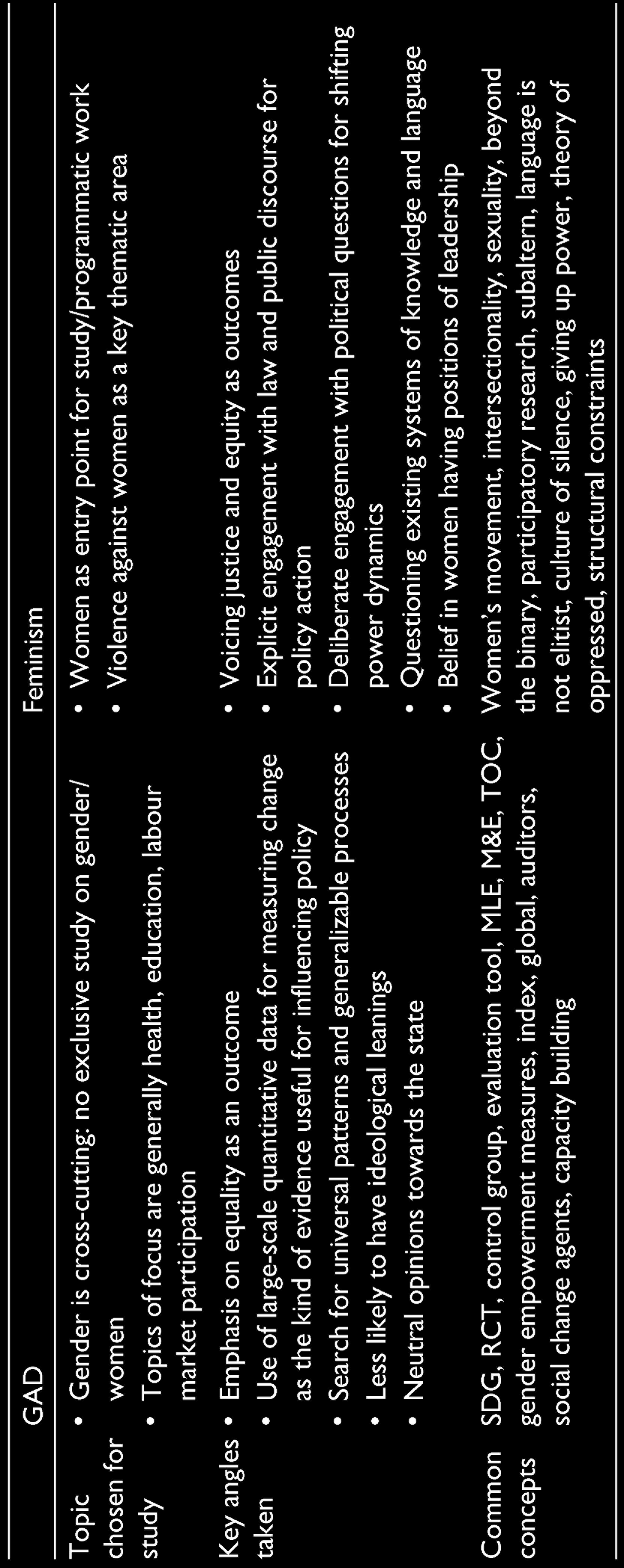
In describing their practice, informants used concepts indicative of both the ideal types of GAD and feminism, indicating that these epistemologies are integrated in practice:
Our work is broadly based on GAD…we have helped develop feminist principles for monitoring and evaluation (donor representative). Every time we work with civil society organisations, we ask them if they have women in their leadership positions (UN representative). We are using a tool called the Women’s Empowerment in Agriculture Index, which is being used in other countries to find patterns across the globe ([feminist] NGO representative).
Discourse constructs knowledge, which has the authority to claim the truth. This knowledge can be used to regulate, constrain and discipline people’s actions and hence, constitutes power or symbolic capital (Bourdieu & Wacquant, 1992; Hall, 2001). The use of certain words illustrates what constitutes knowledge and legitimatizes research practices in the field of development (Cornwall, Harrison, & Whitehead, 2007; King & McGrath, 2004). A content analysis of the concepts/phrases expressed in the discussions were carried out to understand if certain institutions tend to use certain words. The number of informants who spontaneously used these words at least once in the discussion was totalled by type of institution. Figure 1 shows the most common utterances of these concepts by type of institution. If at least one informant representing the type of institution used the selected concept once during the discussions, the institution is placed above the horizontal X-axis. The vertical Y-axis, on the other hand, divides concepts by the ideal types of GAD and feminism. Because only one informant representing the GOI was interviewed, that informant’s responses are not included in the Figure 1.

The analysis reveals greater use of words from the GAD framework compared to the feminist approach among all types of institutions (including the GOI). The most commonly articulated GAD words were ‘monitoring and evaluation’ (as a method/tool), ‘evaluation’ (importance of/need for) and ‘equality’ and ‘survey’. The most commonly articulated feminist words were ‘sexuality’, the ‘women’s movement’ and ‘power’. 3 Figure 1 also shows that Indian applied research organizations used the most diverse vocabulary from these epistemologies. It is plausible that as national organizations, they are largely dependent on international and government grants, which necessitates familiarity with the international development discourse such as GAD. These organizations used the most vocabulary drawn from feminism, which is not surprising as most of these identify as feminist organizations. These organizations seem to be working hard to keep the language of feminism thriving while forming alliances with international development organizations. Representatives from donor organization and academics used the least diverse vocabulary of both GAD and feminism. Perhaps, their current discursive fields such as theoretical social sciences or management determine most of their vocabulary used (which need not be shaped largely by GAD and feminism). It is also plausible that these organizations are not as financially dependent on project-based funding (characteristic of development practice) and hence, need not acquire familiarity with the lexicon of international development.
Pragmatic Practices: Specialization and Interdependence for Knowledge Sharing
All informants reported that their research is geared towards social change and not carried out simply for knowledge’s sake—a pragmatic approach. Pragmatic researchers see knowledge as a tool for action and accept the plurality of knowledge and methods (Cornish & Gillespie, 2009). Specialization and acknowledgement of expertise facilitate cross-institutional collaboration. Expertise varies from conceptualizing/theorizing, measuring, training, implementing, monitoring, advocating, publishing and providing ‘technical assistance’/advice and funding and can be thematic. In this way, each organization is able to maintain its boundaries and sustain itself in the research field through interdependence in knowledge sharing. Informants realize that they have to collaborate to get work done, and only one kind of organization cannot achieve the mission towards gender equality single-handedly, again a pragmatic approach to research. I draw upon the ways in which these professionals interface with policymakers/the state, academics and donors to illustrate these pragmatic practices.
Interface with Policymakers
Organizations primarily interface with the government in three ways, that is, through evidence building, funding and advocating for legal reform. These organizations build evidence by carrying out research studies, testing interventions and evaluating schemes and programmes. All institutions interviewed engage with the state. They work with government officials and/or develop and roll out programmatic interventions via government platforms such as the health care system and administrative bodies. It is acknowledged that only the GOI can make a significant and long-term impact, given its resources, personnel and infrastructure, as heard:
I think there is a divide in the feminist movement on the role of the state and how much it can regulate. But I think this is the only way to institutionalize and sustain. That’s the only reason why I work with the UN. There might be a huge criticism of the UN, of GAD, but ultimately, there is a mechanism, there is a role of the state, member states that have committed to these promises, who are for human rights and gender equality, and they work on it. My own view is that you have to engage with the system (UN representative).
Interest in gender-related research has increased because the government is acknowledging it. The government is increasingly feeling accountable to the public and is interested in providing evidence of success of schemes/programmes. The media is taking up debates related to women and gender, which shapes the public’s perception of the government in power. These debates present an opportunity to bring diverse opinions and actors together, including policymakers, academics and NGO professionals to discuss the same issue. Moreover, as mentioned by a government official, the GOI knows that India is being ‘watched’ by the international community on its development indicators for which the GOI has to ‘report against’ SDG targets. Hence, the GOI is interested in evidence through data and needs to ensure that studies are ‘rigorous’.
Organizations that work closely with policymakers acknowledge that relationships with officials have to be built over a period of time. Unfortunately, when collaborating officials are transferred to other bureaucratic positions, a new relationship has to be built again. Another way to influence the policymakers is to work as a consortium of institutions, since one organization generally cannot have significant influence on its own. Some informants held the view that the UN has the most influence on policy and found it disappointing that academics, independent research organizations and NGOs have less leverage. This was partly attributed to the fact that the UN provides more funding to the government compared to other organizations. The UN organizations explicitly expressed that they work in tune with the government’s agenda and develop their country programme plans along with government officials, perhaps making them more influential.
Some informants expressed the view that policymakers could strengthen programmes promoting gender equity by collaborating more often with social scientists and building in the study of social processes and norms. A common example given was that the government programme, which provides a cash incentive to families, who postpone their daughter’s marriage to age 18 or more, ends up reinforcing patriarchal norms instead of addressing the root cause of discrimination against girls. The cash incentive is often saved to use as a dowry for a daughter’s marriage. It bolsters the idea that a daughter’s marriage is a significant and costly event and supports patrilineal practices unfavourable to daughters/girls. Hence, it may not be as effective to achieve gender justice.
Interface with Academics
Two kinds of academics emerged based on the extent of acceptance of development discourse and practice. One kind considered themselves independent and/or were critical of development agendas and chose not to work with policymakers. These informants raised the issue of preservation of autonomy in academics:
Suppose there is a policy meeting and they tell me to speak, I will be very happy, but they cannot tell me what to say. My role is to make policy makers understand…it’s not that policy makers tell me to do this study…if my role becomes that, then I am an employee of the policy maker (academic).
Another set of academics were involved in programmatic research and contractually hired by large organizations including the UN and donors for a specific project. These academics developed a relationship with these organizations, which could contact them for more projects, but they remained affiliated with a university/centre of academic research and primarily carried out academic activities such as teaching and research. This relationship with a non-academic organization was maintained by an academic’s interest and ‘wavelength’ with the professional representing the non-academic organization. This relationship is facilitated when the authority of the academic institution is not restrictive. Generally, when an academic’s publications in journals and the media are noticed by UN/donor agencies, they are approached for collaborative work.
Most organizations do not directly engage with academics but draw their theoretical understanding from the published academic literature, including peer-reviewed journals and research reports. Publishing (and knowledge production) is considered integral for cross-institutional and interdisciplinary learning, which is why it was raised that programme implementers need to be trained to write effectively on the process of programme implementation. For researchers affiliated with nonacademic institutions, publishing work was considered integral for reaching a wider audience but depended on a donor’s interest to publish academic material. Most of these informants expressed that they are hardly able to publish academic papers because academic writing and publishing is given low priority in many non-academic organizations. These researchers had an interest in writing, but not the time, since writing academic papers was not ‘budgeted’ in their work. Those who wanted to write academic papers or share their experiences took out additional time to do so. For some, publishing work in academic journals was seen to be important, while others felt that communicating beyond academia is more important. One informant said that journals are increasingly accepting articles based on programmatic research (regarded as different from academic research) and qualitative inquiry, unlike earlier. Some academics took a pragmatic approach by publishing in journals that are read by the policymakers and beyond academia, such as the Economic and Political Weekly or leading newspapers, particularly when a topic is being debated in the public sphere. Using social media to share research findings and debate on gender issues was also suggested to further reach a broad audience.
Interface with Donors
All informants expressed that donors are practical and want to spend their money efficiently, hence, the search for evidence is considered ‘value for money’. The donors have become flexible over the years in what activities they fund. They make field site visits and many recommend formative studies 4 and research to explore why an intervention may or may not work. Donors and funded organizations work together at all stages of the research process, and a proposal is discussed with the donor organization before it is finalized so that both are on the same page regarding how they will conceptualize the programme and measure the gender-related concepts. NGOs and research organizations utilize pragmatic strategies such as tailoring research proposals to make their goals clear yet, keeping space for flexibility if requested by the donor.
Funding for gender-related research and programmatic work is increasing, but compared to other development goals such as poverty eradication, expansion of education and family planning, it still remains low. It was also raised that organizations like the UN Women and the Ministry of Women and Child Development are not as well funded as other UN organizations and government Ministries. An informant presented this reasoning:
It’s simple. Patriarchy is pervasive because it’s about everybody’s own homes; that’s what is most difficult to change. I always compare it with the resource mobilization efforts of UNICEF, you have a hungry child on the cover of your report…, and you get all the publicity [and donor interest]. If you are talking about a woman who has faced mental and physical violence, it’s your own home, so you don’t talk that openly about it. It’s complex and challenging, and if you are challenging gender norms, you are challenging caste, religious institutions and all the structures, which are deep rooted. You are challenging the way you exist, the way you behave, your daily routine on what you do in the house and that’s not easy. It doesn’t come easy to feminists who are so critical; it cannot come easy to non-feminists. I think that’s the biggest challenge (UN representative).
Evidence and Need to Bridge Quantitative–Qualitative Divide to Study Gender
Gender specialists expressed a desire to bridge the quantitative–qualitative divide in studying gender. They pointed out that ‘evidence’ 5 in the form of numerical data is considered more ‘useful’ in making policy level decisions (which affect a large population) and for indisputably demonstrating the ‘change’, compared to qualitative data. Quantitative data is thus of particular interest to policymakers and donors, with whom all organizations have to interface. This concern for evidence is driven by the donors, initially by the international government and bilateral donors and recently by private donors. Further, numerical measurement of institutions, ideology, resources and norms is not perceived as adequate and given less priority for study in research. Theoretically rigorous studies, which initially informed development discourse, are waning. Some informants felt that because of the growing demand for quantitative studies, institutions are prioritizing research projects over movement-building activities and measurement over conceptualization and theorization. The feeling of being united under the women’s movement is diminishing, and allegiances are shifting towards an organization’s specific activities.
All informants felt that rigorous qualitative studies on gender-related themes are needed. Existing qualitative studies were also believed to be less circulated, and thus less known in the research community. Researchers need to study gender in historical and cultural contexts and bring in the role of social institutions and norms around sexuality and the process of socialization to improve our understanding. As voiced:
There is too much of an emphasis on RCTs on women’s issues. Though we have used RCTs for measuring the baseline and end line for our various projects related to violence against women, it may not be the best methodology (donor representative). There should be good strong courses, strong researchers and bodies of work that are built around qualitative work. I think there is a lot of information on what qualitative research is and that it’s not systematic, and it’s epistemologically different, but I don’t think so. There is sampling in qualitative work, methodologies and designs. I think people don’t do it well or they don’t do it enough, as everyone thinks you need to have a survey. But we don’t have the how and why questions, we think very anecdotally about these things. It comes from a perception that quantitative data is saying more (donor representative).
Although all informants expressed an eagerness for more qualitative work, almost all draw on large-scale data for understanding national and state-level contexts and for setting benchmarks for indicators used in their studies. A concern repeatedly voiced was the lack of large-scale national level data on gender. With one exception, all informants who work on the theme of gender-based violence talked about a lack of comprehensive data on this topic, the difficulties in defining violence, and the need to collect data from diverse samples. An informant from the UN, pointed out the difficulty in assessing what violence against women means:
Once we visited two state governments, which had done good work with women’s self-help groups. The one from Andhra Pradesh said, we have empowered our women; there is no violence. The one from Kerala said, we have empowered our women; there is growing violence (UN representative).
All considered that only the government is capable of funding such national level data-collection projects. The informant from the Ministry shared that the GOI has to be sensitive when collecting such data, noting, ‘So many nations are eyeing our data’. This reflects the various ways in which countries are framed in development discourse. For example, India is often portrayed as a place where violence against women is notoriously high.
Discussion
This article seeks to understand how researchers and practitioners, situated in their respective institutions, engage with different systems of knowledge in their study of gender, and the implications this has on how they work together. Gender specialists feel that they conceptualize and measure gender-related topics differently amongst themselves, based on disciplinary academic training, professional role, practical experience and extent of identification with feminism. While these professionals perceive differences in perspectives among academics, programme implementers and activists, they share similar values, which enable collaborative work as found in studies from other settings (Denis, Lehoux, Hivon, & Champagne, 2003; Stephan, 2006). For all informants, their research is geared towards social change and action for which cross-institutional collaboration is essential. Most organizations have found ways to collaborate and complement one another and to work together, pointing to the positive link between specialization and interdependence (Durkheim, 1933). I show that perceived epistemological dissimilarities do not restrict professional conversation and exchange as researchers and practitioners adopt pragmatic ways to bridge these differences. As a pragmatic group, these researchers/practitioners judge knowledge by how well it serves the interests of the people and not by its epistemological underpinnings or by the methods used to obtain it (Cornish & Gillespie, 2009). They find commensurability in different conceptual frameworks and perspectives. Pragmatic researchers attempt to solve problems in an actual real-world situation (Duram, 2012). They do not separate knowledge from values. Knowing subjects, embody reason, emotion and values and that ideas can be tested in experience and practice (Kloppenberg, 1996). For pragmatists, neither the method of enquiry provides the correct answers, nor can we hold a hierarchy of evidence, rather each method serves a different purpose. Pragmatic practices include implicitly accepting the use of different perspectives, drawing upon quantitative and qualitative methods to generate evidence, working closely with the government and those in power, translating abstract concepts into concrete measures, tailoring research proposals and reports to the needs of donors and the funded organization’s own mission, funding exploratory studies and field visits and publishing in newspapers and policy-oriented journals to reach a wider audience. Pragmatic studies often draw upon mixed-method approaches (Duram, 2012). These gender specialists too, expressed a desire to bridge the quantitative–qualitative divide in studying gender and favour triangulation. They assert that this research field needs more rigorous qualitative studies and large-scale quantitative data.
Research in the field of development is largely guided by an organization’s conceptual framework. The explicit use of academic theory and engagement with academics is not very common. I did find more of a rift between those who pursue academic research and those who pursue policy-oriented research than between types of organization/profession or epistemology. This is perhaps because development practice took birth as a planned process aimed to improve the lives of people and hence, explicitly engages more with policy than with academics (Cornwall & Eade, 2010; King & McGrath, 2004). Further, the theorization on gender/women has been interwoven with activism and the lived realities of people emerging as a political discourse (Mohanty, 1988). However, collaborative research will advance our understanding of gender. As a caveat, academics interviewed raised the need to retain their autonomy from policymakers/development organizations and development discourse, as reiterated by other scholars (Béteille, 2000). Based on the type of audience and knowledge, Burawoy (2004) finds out how different types of sociologies (policy-oriented and academic) are complementary and synergistic, while individuals and institutions tend to view them as hierarchical and antagonistic.
A majority of the organizations engage more with linguistic categories and concepts of GAD compared to those of feminism. However, Indian applied research organizations are able to keep the language of feminism thriving while forming alliances with international development organizations. As most of these are feminist organizations, perhaps they make strategic choices in the linguistic forms used to ensure that gender issues are addressed and resourced (Arutyunova & Clark, 2013; Cornwall et al., 2007). However, it is plausible that as national organizations, they are largely dependent on international and government grants, which necessitates familiarity with international development discourse, hence, the use of GAD concepts. Though feminist ideas are referred to by most types of organizations (both national and international), taking a feminist stand is generally viewed negatively, depicting the struggles that researchers/practitioners face to bridge theory and practice (Bourdieu, 1975). A pragmatic solution, as mentioned by one of the informants, draws on the typology developed by Murthy (2018), suggesting the use of the concept of ‘gender-transformative’ research. Gender-transformative research retains the principles of feminism within the linguistic category of gender. Gender-transformative evaluations, for example, categorically examine how far a development programme contributes to changing power relations and involving women as team leaders. It goes beyond gender-instrumental and gender-specific evaluations.
I argue that professionals engaged in development work use words from both GAD and feminism as symbolic capital to claim legitimacy as researchers/organizations in this field. Tracing some of the key ‘buzzwords’ in the development discourse, Cornwall and Eade (2010) find that many of these, which were once contested, have become depersonalized and depoliticized. As these words become universally accepted, their meanings became ambiguous. It is this ambiguity that is able to shelter multiple agendas and secure the endorsement of multiple actors and audiences (Cornwall & Eade, 2010). Even if specialists move between type of organizations/professional roles, while they are associated with GAD projects, they maintain vocabulary from both GAD and feminism. Unless professionals choose not to be associated with development projects or policy discourse, such vocabulary is retained. This attempt to claim legitimacy in a discursive field seems to have a stronger influence than financial dependence on donors in shaping the vocabulary of the informants. This is visible in the fact that all organizations use similar vocabulary irrespective of their position in terms of financial influence.
Financial dependence, however, does directly impact the kind of methodological tools and focus areas of projects based on specific donor interests. It needs to be kept in mind that the funding landscape is ‘diverse, complex and rapidly changing’, and organizations no longer rely on a single donor as in the past (Arutyunova & Clark, 2013). The article reveals that relationships with donors are much more flexible. A global study found that there is a considerable alignment between the priorities identified by women’s organizations and the issues to which the donor funding is directed. However, with the emergence of new kinds of donors in the field of development, mainly private organizations (for-profit) and individual philanthropists, it is plausible that this will impact the tone and agenda of the discourse on women/gender. Corporate actors emphasize women as economic agents: consumers and entrepreneurs. Such a shift may reflect in the greater use of corporate approaches to development and even changes in the notion of what development is or should be (Arutyunova & Clark, 2013). For example, the Nike Foundation is known to have led the way in framing adolescent girls as having the potential to reduce poverty. This framing shifted the framing of a social problem to an economic one. This has created a representation that an individual can address a structural problem, an idea which has been met with criticism. Emerging economies are also acting as donors themselves, such as India. These countries have the potential to play a strong role in asserting their influence in development debates, and such pragmatic researchers could show the way to embrace diverse epistemological and linguistic categories.
This research is not without limitations. I was not able to meet many policymakers and those activists who are not affiliated with an organization. As each informant had distinct views, I tried to weave a general picture from those who were based in the capital city; hence, perspectives from other organizations based elsewhere, and points of disagreement are not presented here. Many of my informants were self-selected, and collectively, they represent some of the bigger and more influential organizations in this field. In addition, those who were interviewed may have been selective in the stories they opted to tell. The results presented here cannot be generalized to the expansive field of research on gender/women, but they present a range of concerns about studying gender in the context of development. This is useful as sites of knowledge production expand, particularly in developing countries. Personal stories shared with me reveal tensions in personal opinions vis-à-vis an organization’s, which lay bare the axiom that the personal is political. A female informant in a senior position talked about her encounter with biases because she is unmarried, while a male informant talked about how his wife would answer my questions differently because of gendered socialization. Gender may be a topic of research for all informants, but questioning one’s own biases is the beginning of any social science research. Interestingly, it was the male informants who raised the point that gender equality and transformation starts with men giving up power; and one of these informants left me with a question, ‘Do men really want to give up the power they have?’
Footnotes
Acknowledgements
I thank Lindy B. Williams, Alaka Basu, Parfait M. Eloundou-Enyegue, Sarah Giroux and George A. Spisak for their insights, comments and edits to the article. I also thank the anonymous reviewer and editors of the Indian Journal of Gender Studies for strengthening the article. The study could not be possible without the experiences shared by the researchers and practitioners. I also thank the Mario Einaudi Center for International Studies and the Department of Development Sociology, Cornell University for the research and travel grants.
Declaration of Conflicting Interests
The author declared no potential conflicts of interest with respect to the research, authorship and/or publication of this article.
Funding
The author received research and travel grants from the Mario Einaudi Center for International Studies and the Department of Development Sociology, Cornell University.