



Abstract
This article explores the role of reserved-seat women members of the Union Parishad, the lowest unit of local government in Bangladesh. The number of women representatives has increased manifold over the years, most of whom are elected from reserved seats. Formally, a reserved-seat member has a larger constituency than a general seat member; and enjoys almost similar powers and responsibilities. In practice, there remains a major gap between what the rules say and what transpires on the ground. Notwithstanding their increased presence, women elected from reserved seats to the Union Parishad, often find it difficult to make their presence felt and are ignored, especially by their male colleagues, for several reasons. This article identifies those reasons and argues that women’s increased presence is a necessary but not a sufficient condition of empowerment. Legitimacy gained through winning elections in a competitive process and the willingness of the elected women to get things done in an adversarial situation can be considered important steps towards empowerment. Nonetheless, more is needed, especially organised support from outside, to enhance empowerment and make it sustainable.
Introduction
Women constitute nearly half of the total population in Bangladesh. Yet, women lag far behind men in almost every respect. Although the Constitution of Bangladesh (Government of Bangladesh [GoB], 2011) provides for equality of opportunity for men and women [Articles 27, 28(1), 28(2), 28(3), 28(4), 29(1), 29(2)], one can find only a few women, especially at the higher levels, in education, work, politics and decision-making. It is an irony that women have largely been undermined and discriminated against in a country that has had a woman prime minister as well as a woman leader of the opposition for nearly three decades. Women’s subordinate position and low representation can be observed in different sectors. Several efforts have been made in recent years to encourage greater participation of women in both local and national level politics and policymaking. For example, the number of reserved seats for women in Parliament was increased from 15 to 50. A similar increase can be noticed in local government. Although women still do not hold a significant portion of the total number of elective positions, in absolute terms their number has increased considerably.
The main objective of this article is to examine the implications of the change(s) in public policies aimed at encouraging greater participation of women at the local level of governance in Bangladesh. The article also seeks to identify problems that women encounter in getting elected to local councils, the difficulties they face while performing their functions, and the strategies they adopt to cope with uncertainties/challenges. It evaluates proposals advanced for better representation and greater empowerment of (political) women at the local level.
Women in the Structure of Local Government
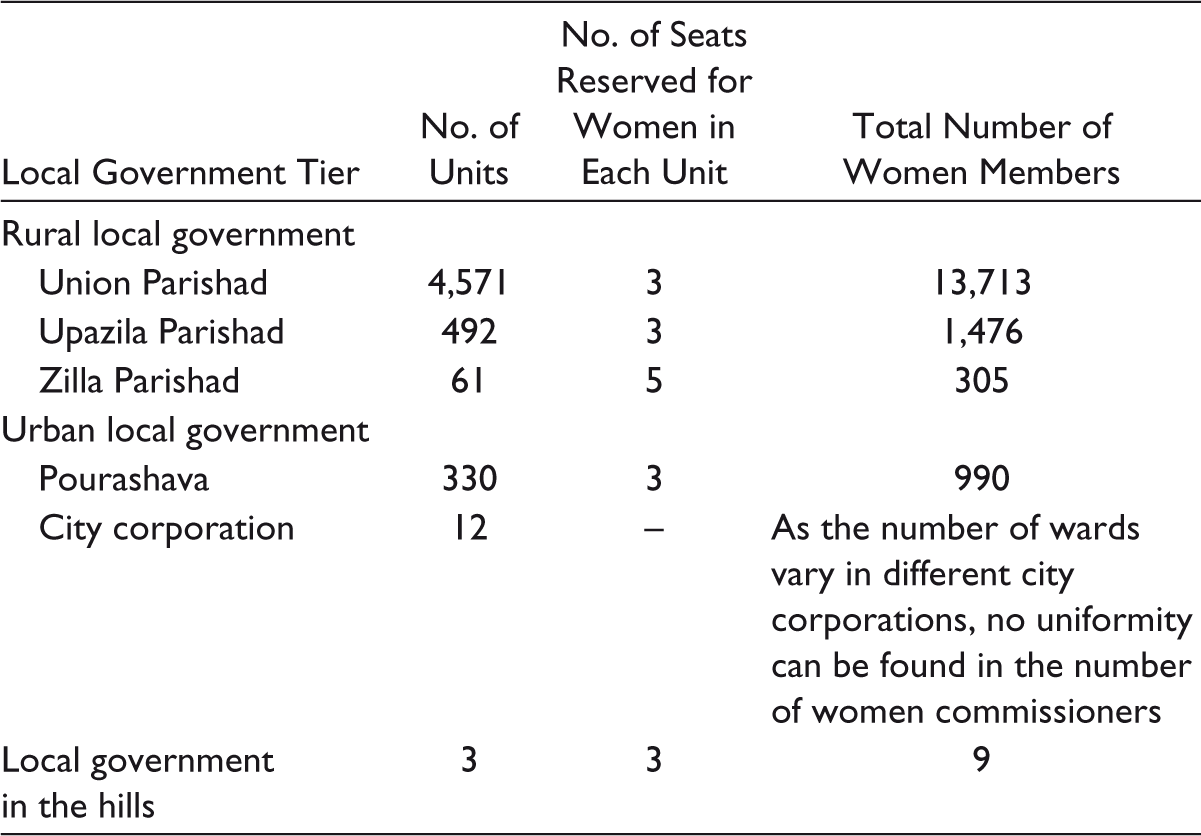
There are three different systems of local government in Bangladesh, one each for the rural areas, the urban areas and the hill region. Each system is governed by an Act of Parliament. There is an organic link between different units within each local government system. For example, the chair of each Union Parishad (UP), the grassroots council, is a member of the Upazila Parishad (UZP), the middle-tier in the three-tier rural local government structure. Although the head of the UZP is elected by popular vote, he/she cannot do anything without the concurrence of the chairperson of the UP. The electoral college for electing the chair and members of the Zilla Parishad (ZP), which is the apex body, is composed of chairpersons, vice-chairpersons and members of the UZPs and the UPs. The UP is more democratic in composition than the other councils (UZP and ZP). The chairperson of the UP and all of its members are elected by popular vote. Provisions exist in each law for the reservation of a certain number of seats for women at all three levels (Table 1).
Women in Different Local Government Councils (Reserved Seats)
Each local council is statutorily required to undertake several functions. For example, the UP Act of 2009 prescribes four categories of activities—administration, maintenance of public order, services related to public welfare activities and preparation and implementation of plans that relate to local economic and social welfare activities. A long list of 39 activities has been prescribed for the UP; some of these relate to education, health, sanitation and drinking water. However, these are not now seen as primary activities of the UP, for various central government ministries have specific responsibility for providing these services. However, the range of services provided by the UP is still considerable and vital for the village. These include settlement of petty disputes (related to land and family), issuance of certificates and licenses, conducting relief work, clearance of (agricultural) loans and referral work in connection with treatment at the Upazila health complex (Siddiqui, 2005, pp. 162–163). Construction and maintenance of rural infrastructures such as roads, bridges and culverts are also seen as very important. These works are an important source of employment during the slack agricultural season. The central government as well as donors have followed a liberal grants-in-aid policy, providing a huge sum of money to the UP. The UP is currently better able to provide services as it enjoys greater powers and has better access to resources than in the past.
Pathways to Political Power
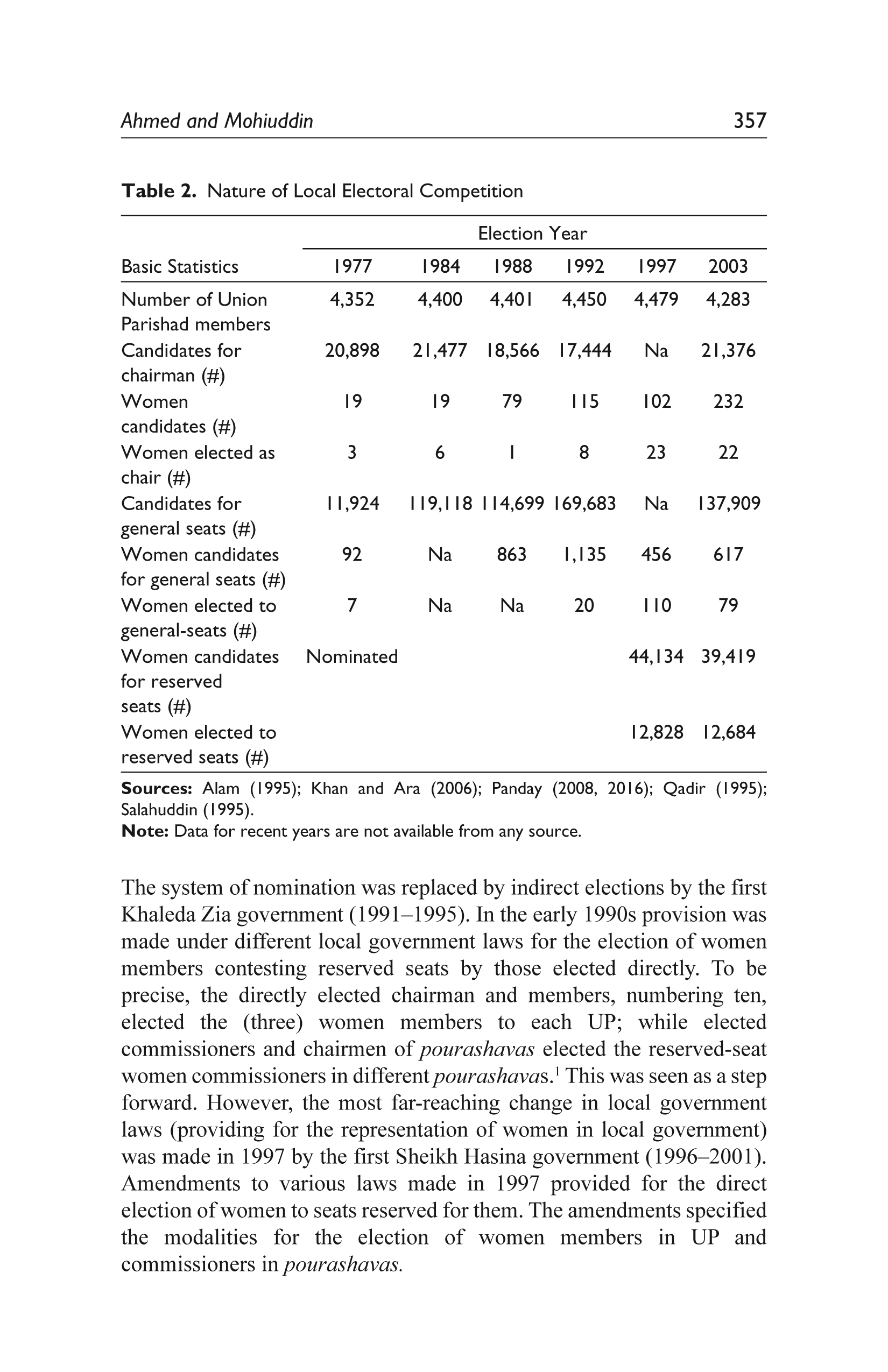
In each UP members are elected from general as well as from reserved constituencies. Women are eligible to contest for both types of seats. But experience shows that only a few women vie for general seats (Table 2). Women contesting general seats experience greater difficulties than men and only a few succeed. To offset this disadvantage, provisions have been made in various local government laws for reserving a certain percentage of seats for women at each tier of local government. The original provision for the reservation of two seats for women in each UP was made in the Local Government (UP) (Amendment) Ordinance of 1977. The number of seats subsequently increased to three in the early 1980s. Initially, the government nominated members to seats reserved for women. Research shows that the nomination system was biased in favour of the rural rich and those who had traditionally controlled local politics (Panday, 2013, p. 68). Women nominated to the UP were generally inactive. It was not uncommon to find husbands of nominated women members attending UP meetings on their behalf. Nominated members also lacked independence in exercising their voting rights. As Panday argues
Although women had equal voting rights, they were more inclined to please male members and chairmen who were key actors in their selection. These women were not inclined to cause any aggravation among the males by exercising their voting rights against them. If they resorted to such tactics, their chances of getting selected in the next term would be reduced. (Panday, 2013, p. 68)
Nature of Local Electoral Competition
The system of nomination was replaced by indirect elections by the first Khaleda Zia government (1991–1995). In the early 1990s provision was made under different local government laws for the election of women members contesting reserved seats by those elected directly. To be precise, the directly elected chairman and members, numbering ten, elected the (three) women members to each UP; while elected commissioners and chairmen of pourashavas elected the reserved-seat women commissioners in different pourashavas. 1 This was seen as a step forward. However, the most far-reaching change in local government laws (providing for the representation of women in local government) was made in 1997 by the first Sheikh Hasina government (1996–2001). Amendments to various laws made in 1997 provided for the direct election of women to seats reserved for them. The amendments specified the modalities for the election of women members in UP and commissioners in pourashavas.
Each Union is now divided into nine wards, with each ward electing one member. Three women are directly elected: each reserved-seat member represents three general wards. The average size of the constituency of a reserved-seat member is thus three times larger than that of a general-seat member. The introduction of the new provision for the direct election of women representatives can be seen as a big leap forward, a major way towards the empowerment of women. However, the extent to which the new system can help change the status quo depends upon various factors over which elected representatives have limited control. The new provision is thus likely to have only a limited impact.
Electoral Contests and Women’s Participation
Bangladeshis vote in elections and also take part in different election-related activities in large numbers, perhaps more than voters in many other countries. Until recently, electoral politics mostly remained the preserve of men. It is only since the ‘historic’ 1997 amendment that women have found a new way of participating in local elections in large numbers. Table 2 provides a summary account of the nature of women’s participation in different local elections. It shows that the number of women contesting the post of chairman was the highest in 1997, and the lowest in 1984. More women contested general seats in 1992, the year the provision for indirect elections was introduced. Their number, however, dropped in 1997 when the provision for direct election to reserved seats was introduced. Overall, the number of women contestants for the post of chairman and general seats remains stubbornly low. For members, it was 0.4 per cent in 2003, and for chairman, 0.5 per cent. The success rate of women contestants also decreased from 24.1 per cent in 1997 to 13.8 per cent in 2003. Notwithstanding the decrease, the seat–candidate ratio in local elections in Bangladesh still compares favourably to figures in other developing countries.
Reasons for the decrease are many and varied. Many of those who contested the 1997 elections for reserved seats decided to quit politics or remained inactive in 2003. Many women felt that they had not been able to deliver on their commitments and promises made at the time of elections which is why their voters had lost faith in them—they had not been able to carry out development work or distribute safety net allocations as demanded by their constituency (Sultan et al., 2016). Family responsibilities and pressures also accounted for the decrease, especially if the family felt that the woman member had not gained as much benefit as they had hoped for (either financially or otherwise). In a few cases, the reason was not having a good relationship with the UP Chair and therefore feeling that they had no influence in the UP (Sultan et al., 2016).
One of the important choices that local ‘political women’ have to make is to decide on contesting elections. Those who very often influence them in making such decisions include family, community and party (Mohiuddin & Ahmed, 2021). One study reveals that of the total number of candidates living with husbands, 64.12 per cent reported that their husbands persuaded them to contest the elections; while 23.66 per cent observed that their relatives helped them in making the decision (Islam & Islam, 2012). The change in the attitude of husbands and relatives appears to be revolutionary in nature; in the past, the family was considered to be an important hindrance. The influence of the community or women’s organisations in the nomination process of women candidates is less evident than that of non-governmental organisations (NGOs). A significant percentage of women, especially those who were members of different NGOs, claimed to have had the support of NGOs. One study shows that RDRS (Rangpur Dinajpur Rural Service)—sponsored Federations nominated a total of 1,430 members from 343 unions of nine northern districts in the UP Election of 2011, of whom 559 were elected—27 as chairman, 218 from reserved seats and 314 from general constituencies. 2
Getting elected to the local council is not an easy task, especially for a woman. Those who decide to contest have to adopt different strategies to win. Experience shows that women candidates use different campaigning techniques; probably the most important is knocking on doors, followed by the use of posters (Mohiuddin & Ahmed, 2021). Only a few women candidates organise public meetings and/or speak to groups. Those who help candidates most in the campaign process are husbands and family members. Neighbours also often provide an important source of support (Shamim & Nasreen, 2002). Contesting elections involves incurring a great deal of expenditure. Many women often fail to contest for lack of the funds required for campaigns. One study shows that two-fifths of women candidates in the 1997 elections spent between TK. 25,000 and TK. 150,000 (Shamim & Nasreen, 2002). Only a few women have the ability to defray election expenditure from personal sources; they often have to borrow money. Since local elections are now held on a party basis, it is to be hoped that parties may provide women candidates adequate financial support in the future.
Women Members of UP: Scope of Work
It is conventional wisdom that much of what members of the UP can do depends, among other things, on its formal position in the framework of governance. If the UP remains disadvantaged vis-à-vis other sources of power, its members (from both general and reserved categories) are unlikely to have any meaningful role to play. The formal scope of work of the UP is limited. The central government has historically remained reluctant to decentralise power and authority to local councils; the latter has mostly worked as extended arms of the government than as autonomous agencies. Although no significant decentralisation has taken place, the number of functions that the UP is required to do has increased manifold over the years. Members of the UP now do much more than their predecessors. However, all members are not active to an equal extent. Those who are elected from general seats are able to engage in more activities than those elected from reserved seats.
Initially, the law did not prescribe any specific role/responsibility for members from reserved seats. They had to depend upon their male colleagues particularly the chairman, for their share of work. Researchers have observed that the male members of the UP do not have a positive opinion about the role and performance of their female colleagues. Men often remark that women lack proper knowledge to implement the activities of the UP and that many of them do not feel confident enough to speak up in meetings (Panday, 2013, p. 169). Women members often do not attend the meetings and salish (arbitration meetings) of the UP regularly since they have to finish all of their household activities before leaving home (Panday, 2016, p. 169). More importantly, male members of the UP were not hospitable to the legitimate claims of women members in reserved seats to share power. They were denied a role in project planning, budget-making, financial management, and preparing lists and distribution of VGD (Vulnerable Group Development) and VGF (Vulnerable Group Feeding) cards 3 under food security schemes (Sultan, 2018, p. 257).
However, under pressure from reserved-seat women members and NGOs/Civil Society Organisations (CSOs) promoting women’s rights, the government subsequently revised the rules and prescribed some specific responsibilities for all women members. Following the revision of rules, they can now engage in more activities than before. For example, provisions have now been made for the reservation of a certain percentage of committee chairs (one-third) for women members. The law also now requires that women must have representation even in committees they do not chair. Women members can now also plan projects within certain budget limits and exercise their authority to spend funds allocated in the way they think best. They are involved in the preparation of the list of safety net beneficiaries. Women members have been given greater responsibility for works that have implications for women. In other words, they are required to do more women-focused activities than to deal with issues that have policy implications.
Problems Encountered
Experience shows that although women members currently have better scope to be assertive, they still face various problems. Many UP chairmen often do not allow reserved-seat women members to assume responsibility for important works, arguing that they are not capable of organising or implementing projects. One author has referred to the comment of one chairman, ‘Women members cannot hire labour if it is digging work, and cannot spend full time in the project area because they have to take care of their household work’, (Panday, 2016, p. 173). Sultan et al. (2016) report from the field that the general public also believes that women members lack many attributes needed to get things done in a proper manner. It is true that women members of the UP lack experience in matters such as construction, negotiation, manpower management and handling the bureaucracy. All these factors put them in a weak position when it comes to working at the field level (Sultan et al., 2016, p. 32).
Discrimination in the allocation of funds and projects in favour of men is routinely found, although formal rules bar it. Women members constantly face hostility and devaluation from male colleagues who consider the political rights of women as a ‘favour’ given to them by the government. Women are constantly belittled in various ways (Khan & Mohsin, 2009). These include symbolically putting women members at the bottom of UP membership lists; declaring a quorum at meetings when women members are absent; getting women to sign on empty forms; taking policy decisions at meetings of which women were not even informed; verbal abuse by chairmen and members against women at meetings, official functions and in public forums for their lack of political knowledge and experience; inviting women members’ husbands to official functions in their place, and sexual harassment of women representatives (Khan & Mohsin, 2009).
Women members lack the numbers to override decisions taken by the majority and do not actively protest discrimination and devaluation. More importantly,
women members themselves very often cannot agree on a common issue; they remain divided and do not present a united front. They accept discrimination without any protest for fear of being harassed; those who raise their voice against injustice and discrimination are few in number (Panday, 2016, p. 75).
Sultan et al. (2016), however, point out that women members do not always accept decisions made for them by others, especially by the chairman. Nazneen and Tasneem (2010, p. 36) observe that women may adopt ‘hard’ strategies such as turning to and seeking help from different CSOs/NGOs to raise their voice against decisions or practices to which they have strong objections. The evidence shows that since a confrontational strategy is likely to be counterproductive, women members very often prefer a conciliatory approach or indirect methods to get things done their way.
It is clear that on their own women members cannot do much by raising their voices to change the status quo. They need the support of others, especially non-government actors. As stated earlier, women candidates supported by different NGOs/CSOs have a better chance of winning elections than those who lack such support. Hundreds of candidates, supported by RDRS, were re-elected in the 2011 UP elections in the northern region, which was not the case in other parts of the country. RDRS provided different kinds of support to women members, which helped them acquire skills, expertise and the courage to confront adversarial situations.
Presence without Empowerment?
There are more women in local government now than in the past. The number of women members has increased considerably over the years, especially since the introduction of direct elections for reserved seats. Notwithstanding an increase in their number, women members in the UP often find it difficult to assert their views either in UP meetings and/or in public. Elections have apparently made them important but they still face serious difficulties in popularising their views and opinions. Their views are not given importance for there is downright hostility to women. Men are reluctant to accept women as their colleagues in the UP. Women elected from reserved constituencies to UPs are identified more as ‘women’ than as ‘representatives’. One researcher has observed that some male colleagues even raise objections to women members sitting alongside them in chairs in the office (Begum, 2007).
Nevertheless, there has been a noticeable change in the attitude and behaviour of women representatives ever since they have begun to be directly elected; in the past, nominated women members were mostly docile and accepted the decisions of the (male) majority without critical scrutiny. As Nazneen and Tasneem observe
The male resistance experienced by the women is not unique to Bangladesh but the act of women voicing their views at UP meetings and in public in a context where, before direct elections, very few did, is significant…. Women members have become more critical and vocal about the difficulties they experience because of the gender biased attitude and behaviour of male colleagues and the problems that lie within the UP system. (Nazneen & Tasneem, 2010, p, 37)
Women elected to local councils (and Parliament) do not differ much from their male colleagues in terms of social origin. Both belong to similar social groups. Yet experience shows that women more than men hold more egalitarian attitudes towards issues that concern the great majority of people. Women are also considered to be less corruption-prone than men (Panday, 2016, p. 166). Corruption is less evident in those countries where women hold leadership positions at different levels. This is, however, not to overstress the role of women. Like men, some women councillors may also get involved in activities that laws do not permit. In general, however, they have a better record of doing things properly (Sultan et al., 2016, p. 33). Women leaders are seen to be promoting integrity in the UP, providing better community services and contributing to social justice through the rural salish system (Rahman, 2015, pp. 203–208). One scholar has argued that the presence of more women in the UP can be seen as beneficial from several standpoints. Islam and Islam (2012) conclude that women’s presence does matter. What is important is to adopt measures for ensuring that their voices are better heard than they are now.
Women still face various constraints such as the unequal mode of representation, lack of proper power and resources, absence of proper guidelines and regulations (Islam & Islam, 2012, p. 83), which hinder their effective participation in UPs. These discourage them from utilising their full potential and creative energy to make the UP a strong institution. Measures should be taken to help them become true ‘representatives’—those who can raise issues and problems that concern their constituents. There is no ‘one best way’ of doing it. Several options may be identified.
In Bangladesh, each union is divided into nine wards, with each ward returning a member. There is no provision for reservation for women in general wards, although the law does not bar a woman from contesting for general seats. Instead of having nine wards, each UP could be divided into 12 wards, with each electing a member. Of the 12 wards, four could be earmarked for women. Each member, irrespective of sex, should enjoy equal status and power. This system will allow women members to claim the same right as their male counterparts. It will also provide opportunities to compare the performance of the two groups of members in concrete terms.
Second, the ‘rotation system’ followed in India may also be considered as an alternative. Under this system, one-third of the total number of constituencies are usually reserved for women in each election by rotation. Thus, Indian women are elected for reserved seats from constituencies which change with each election. Women panchayat members from reserved seats in India can claim similar powers, facilities and privileges as enjoyed by their male colleagues.
Another option for Bangladesh is to enact laws requiring parties to nominate women in at least one-third of the total number of wards. As stated earlier, local elections in Bangladesh are now officially held on a party basis. In the absence of any strong outside support (either a political party or a CSO/NGO), many ‘competent’ women do not now want to join the electoral race fearing threats/recriminations and violence by local ‘thugs’ at the behest of those who control local politics. A serious consequence of this has been the decrease in the number of women candidates. The involvement of political parties in order to prevent malpractices may help aspiring women overcome this problem.
The various options identified above have their own strengths and weaknesses. On balance, the first option—increasing the number of wards from 9 to 12—may be seen as having the best potential to empower women members to have equal rights. It will allow members of both sexes to wield similar powers and privileges. It can ensure that women will have adequate representation in local government. The other options—borrowing the Indian system of ‘rotation’ and requiring parties to nominate women in at least one-third of constituencies—are fraught with disadvantages. The risk with the rotation system is that as women’s constituencies change with every election, there is not much scope for a sitting woman member to get (re)elected in the next election (Baviskar, 2003). Regarding the third option, it will be extremely difficult, almost impossible, as experience shows, to ensure that parties comply with any requirement needed for an increase in women’s presence.
Conclusion
This article has examined different dimensions of the role of women representatives in local government in Bangladesh. The election of such a huge number of women in a traditional patriarchal society like Bangladesh may in itself be considered an important achievement. What is evident from the discussion is that although changes in the behaviour of different actors associated with local government are beginning to take place, the pace of change is slow. Yet, the few changes that have taken place are encouraging. No one could probably think of women campaigning at night for votes, and/or sitting together with men in UP meetings a few years ago. Nor was it considered appropriate for a woman to challenge points raised by male members or to make counter-arguments to justify her own actions and decisions. This kind of change in the behaviour of women members as well as the grudging readiness of their opponents to accept such assertiveness can be considered an important step towards women’s empowerment. Women are certainly more visible in the political arena now than in the past; they have also succeeded in achieving a certain measure of social legitimacy through winning elections in a competitive process. Many women members have become critical and vocal about the difficulties they experience because of the gender-biased attitude and behaviour of male colleagues and the problems that lie within the UP system (Nazneen & Tasneem, 2010, p. 37). Their voices cannot always be ignored. The problem of course is that male voices are still heard better than women’s. Measures then should be taken to adopt corrective measures to ensure that all voices are heard equally.
Footnotes
Declaration of Conflicting Interests
The authors declared no potential conflicts of interest with respect to the research, authorship and/or publication of this article.
Funding
The authors received no financial support for the research, authorship and/or publication of this article.