



Abstract
The Bodoland territorial council (BTC) region of Assam has witnessed many conflicts in the past. The women of the conflicting communities, Bodo, Bengali-speaking Muslims, and Adivasi, have largely borne the brunt of these conflicts. The societies are patriarchal and women face domination at various levels—family, society, and state. This article seeks to answer the question, ‘How do the conflict-affected women belonging to the Bodo, Bengali-speaking Muslim and Adivasi communities in BTC display resistance against the dominant forces in the family, society, and state?’ The article attempts to understand the forms of resistance (overt, physical or confrontational, and everyday forms of resistance) displayed by these women, by analysing the in-depth interviews conducted with them. The narratives help us understand their condition, their struggles, and the ways in which they display resistance against the dominant forces. The article argues that the Bodo women display overt resistance, such as participating in the Bodoland movement, holding protests, contesting elections, and carrying out peace marches against insurgencies and ethnic conflicts. The Bengali-speaking Muslim women display everyday forms of resistance, such as pursuing education, holding jobs, maintaining silence and refraining from making contact with members of the dominant community. The Adivasi women display physical resistance, such as engaging in direct confrontation with forest officials, and overt resistance, like participating in protests and social movements to demand their rights.
Introduction
Resistance study has gained enormous prominence in the previous decades and has been explored in different fields such as anthropology, political science, and women’s studies among others (Hollander & Einwohner, 2004). The term ‘resistance’ has been used in different contexts to refer to various behaviour and actions, making it difficult to arrive at a standard definition (Hollander & Einwohner, 2004). For the purpose of this article, the term resistance has been defined as ‘… behaviours and cultural practices by subordinate groups contesting hegemonic social formations that threaten to unravel the strategies of domination’ (Haynes & Prakash, 1991, p. 3). As a subordinate group, women constantly negotiate with and resist the powerful forces that marginalise, subjugate, and oppress them in various ways. They fight injustices individually as well as collectively. Women’s collective agency leads to women’s movements against different atrocities and their relentless demands for freedom, justice, and equality Scholars have identified several forms of resistance, such as physical, overt, covert and everyday forms of resistance (discussed in the Literature Review section).
This article discusses the different ways in which women display resistance in the Bodoland Territorial Council (BTC) region of Assam. The article is based on in-depth interviews conducted with women affected by the past ethnic conflicts between Bodo and Adivasi and Bodo and Bengali-speaking Muslim communities in the BTC region of Assam. The findings reveal that Bodo women display overt forms of resistance, such as holding protests and carrying out peaceful initiatives against insurgencies and ethnic conflicts. The Bengali-Muslim women display everyday forms of resistance, such as pursuing education, holding jobs, maintaining silence and distancing themselves from the dominant community. The Adivasi women display physical resistance, such as engaging in confrontation with forest officials, and overt resistance, such as participating in protests to demand their rights. Whatever may be the forms of resistance displayed by the women, over time, as Scott (1985, 1990) argued, the consequences could be enormous. Although these acts of resistance by women have not received their due recognition, at some point they could bring about considerable social changes.
Literature Review
Based on the extensive review of literature on resistance, Hollander and Einwohner (2004, p. 535) conceded that the most commonly identified mode of resistance is ‘physical resistance,’ in which the actors’ bodies or other material objects are involved. For example, women in armed resistance, such as the female suicide bombers of the Liberation Tigers of Tamil Eelam (LTTE) and women in Naxalism. In Nepal, women’s involvement in the Maoist movement stemmed from their desire to bring about social changes and a motivation to resist the government security forces (Thapa, 2016). Dalit women’s participation in the Naxalite movement in Bihar is ‘a mode of resistance towards the sex-ploitation and patriarchy’ (Srivastava, 2007). However, barring the above examples, women mostly play supporting roles in armed resistance (Murthy, 2016). Another form of physical resistance observed by Varghese (1993) in the Dangs district of Gujarat was the use of small weapons like sickles by local people, particularly women, to drive away forest officials.
Hollander and Einwohner (2004) further argued that ‘resistance’ is readily thought to be referring to participation in social movements, such as the formation of organisations or protests. They call it ‘overt resistance’ and define it as ‘…behaviour that is visible and readily recognised by both targets and observers’ (p. 545). In the context of India, there are many examples of overt resistance, such as Indian women’s participation in the nationalist movement to overthrow the colonial rule and pave a way for their emancipation (Chatterjee, 1989); peasant women’s role in ‘peasant revolts’ (Omvedt, 2000); Dalit women’s movement to express their identity and address the caste question and oppression (Andharia & The ANANDI Collective, 2008; Guru, 1995) and Adivasi women’s movements to fight against class and gender inequality and various social issues (Lund & Panda, 2015). Another example is women’s participation in protests during the initial phase of militancy in Kashmir (Shekhawat, 2015). The Kashmiri women did not take part in the revolution as combatants but played supporting roles, such as shielding militants from security forces, alerting them about the arrival of security forces, and sheltering and feeding them. Kashmiri women also organised themselves, took up decision-making roles and carved out a space for themselves in politics; for example, Dukhtaran-e-Millat, Women’s Welfare Organisation and the Muslim Khawateen Markaz (Malik, 2015). Women’s active participation in movements in the North East of India demanding peace and justice has also been documented well (Kolas, 2017). From participating in the freedom movement against colonial rule to protesting the atrocities of the state security forces and insurgents, women in the North East of India have exercised their agency. In contemporary times, women’s organisations such as the Naga Mothers’ Association (NMA) in Nagaland, Nupi Samaj and Poirei Leimarol Meira Paibi Apunba Manipur (PLMPAM) in Manipur have resisted conflicts and negotiated for peace (Devi, 2017). The NMA played a significant role in trying to broker peace between the National Socialist Council of Nagaland-Isak Muivah (NSCN-IM) and the National Socialist Council of Nagaland-Khaplang (NSCN-K) faction (Banerjee, 2001; Choudhury, 2016). In Assam, members of Mahila Samitis and the Kasturba Gandhi National Memorial Trust intervened during the conflicts between Bodos and Santhals in Kokrajhar to broker peace (Banerjee, 2001). In addition to playing significant roles as advocates of peace, women in the North East of India have also displayed unique forms of resistance against insurgencies, ethnic conflicts and atrocities committed by the state security forces. For example, the Kangla Fort protest in Manipur in 2004 by 12 mothers. The mothers demonstrated a nude protest carrying banners that read ‘Indian army rape us’ (Ray, 2018). They used their bodies as resistance against the atrocities committed by the Indian Army in Manipur, particularly the brutal murder of a woman called Thangjam Manorama Devi (Samom, 2016). Another unique case of resistance is the decades-long fasting by activist Irom Sharmila against the draconian Armed Forces Special Powers Act (Yhome, 2016).
While physical and overt resistance is readily noticed, some other acts go unnoticed. Hollander and Einwohner (2004, p. 545) called this category of resistance ‘covert resistance’ and defined it as ‘…acts that are intentional yet go unnoticed (and therefore, unpunished) by their targets.’ Covert resistance may also be defined as everyday forms of resistance, which Scott (1985) argued are ordinary weapons of the poor such as pilfering, slander, feigned ignorance, deliberate delays, and so on. Everyday forms of resistance differ from other forms of resistance in being quiet and involving a gradual approach; they are also covert, informal, and not concerned with immediate gains. According to Scott (2008), everyday forms of resistance are the politics of the subordinate groups and an outcome of the relationship between the powerful and the weak.
Women in different societies around the world display various forms of everyday resistance. For instance, Awlad Ali Bedouin women display everyday resistance by hiding information from men, smoking secretly and meeting clandestinely with friends and relatives, to defy the restrictions imposed on them (Abu-Lughod, 1990). Palestinian women display resistance against the Israeli state through ‘Sumūd’ or every day (non- violent) resistance, which is demonstrated in the form of survival strategies such as engaging in small projects to generate income and provide livelihoods; cultural resistance such as upholding traditions, folk songs or customs; and social and ideational resistance as a sense of normality and faith (Richter-Devroe, 2011). Afghan women use negotiation as everyday resistance to exercise their agency (Amin & Alizada, 2020). Negotiation may be in the form of ‘creating distance, persuasion, compromises, accepting trade-offs’ (Amin & Alizada, 2020, p. 368). In Northwest Pakistan, Shi’a women display resistance against a patriarchal society using their performance of mourning ritual (majales) (Hegland, 1995). In Northern Sri Lanka, in female-headed households, women employ several livelihood strategies to resist the ‘established order of domination’ Vasudevan (2013). Riessman’s (2000) study of everyday resistance practices among childless women in South India revealed resistant thinking and reinterpreting harsh comments by neighbours, avoidance (covert) and ‘talking back’ (overt) as strategies to challenge society’s discriminatory practices. In India’s North East, women display weaving as an ‘art of defiance’ (Samom, 2016, p. 231).
Background of the Conflict
Three communities of the BTC, namely Bodo, Bengali-speaking Muslim and Adivasi have engaged in conflicts in the past (conflict between the Bodos and the Bengali-speaking Muslims in 1993, 1994, 2008 and 2012 and between the Bodos and the Adivasis in 1996, 1998 and 2014) (Saikia, 2021).
The differences between Bodos and Bengali-speaking Muslims or Bodos and Adivasis in BTC are not contemporary manifestations but are rooted in the colonial period. In the middle of the 19th century, the British created tea plantations in Assam and brought labourers from central India to work in the plantations (Weiner, 1983). Bengali was made the official language and the administrative posts were filled by educated Bengali Hindus, which resulted in strong anti-immigrant sentiments in the minds of the Assamese nationalists (Weiner, 1983). Another influx of migrants took place in the 1900s when Bengali-speaking Muslims from then East Bengal were brought to work as labourers in the railroads by the British (Hazarika, 1993). Consequently, the ethnic composition of the state changed, and the population growth rate doubled (Weiner, 1983). Many immigrants who were brought by the British during the 1900s from East Bengal settled in the Brahmaputra valley (Hoque, 2016), which was inhabited by the Bodos. The Bodos were dependent on shifting cultivation, before recently transitioning to settled farming (Misra, 2012). Since they kept moving without acquiring any permanent land tenure, the immigrant peasants occupied the land left behind. Moreover, the Bodos were denied the Sixth Schedule 1 status thus contributing to a sense of alienation (Misra, 2012). With time, land became the bone of contention between the tribal and non-tribal communities, and conflicts ensued. Misra (2012, p. 37) argued that the problem in BTC was ‘…the result of failure as well as unwillingness on the part of the government to act decisively with a political will to put an end to the alienation of tribal land.’ When BTC was formed, the land issue was not addressed, and encroachment continued. Also, the constitutional right of other groups, especially the Santhals and Bengali-speaking Muslims, was not taken into consideration while creating an autonomous region for the Bodos, thus leading to conflicts between the Bodos and these communities (Misra, 2012, p. 37).
Methodology
This qualitative research was conducted in the violence-affected districts of Kokrajhar and Chirang, in the BTC region of Assam. The research was operationalised by conducting in-depth interviews using an interview guide with Bodo, Bengali-speaking Muslim and Adivasi women affected by past ethnic conflicts. Selected themes, such as women’s everyday lives, inter-community interactions, construction of the ‘other’, experiences of conflict, memories of conflict, daily struggles, dominant forces and modes of resistance against the dominant forces, guided the interview process.
The interviews were conducted in Assamese and translated into English during the transcription phase. In addition, observations also helped collect insights that enriched the data. The observations were recorded in the field notes, reflected upon, and written down in detail at the end of each day so that valuable information was not lost. Observations of the participant’s facial expressions and pauses helped determine the questions that made them uncomfortable. The presence of distractions—environmental or interference from men—was also noted.
Purposive sampling was used to choose information-rich participants for the research. The total number of participants was 12. Only women who agreed to be interviewed and those interviews that yielded sufficient information were included in the research. Therefore, the age range of the women whose interviews were considered for the research was between 30 and 61 years. The relevant narratives from some of the interviews are presented in this article. The details of the participants, such as age, location, the community that they belong to, marital status, educational status, and occupation, are presented in Table 1. Pseudonyms have been used to maintain the anonymity of the participants (see Ethical Considerations).
Profiles of the Participantsa.
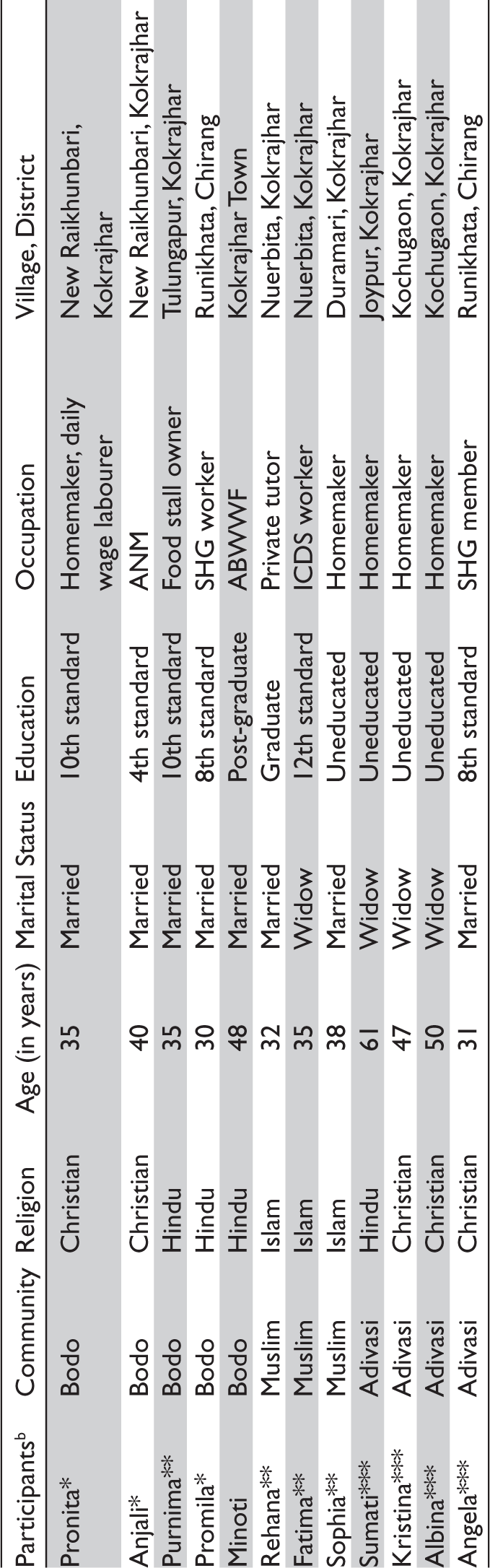
Before the field visit, the director of the non-governmental organization (NGO) Nedan Foundation, which works on various social issues in the conflict-affected villages of Bodoland, was contacted by email. Access to the Bodo and Muslim communities was gained with the help of Nedan’s field representatives in those villages. Participants were also chosen with the help of field representatives. Access to the Adivasi community was gained with the help of an Adivasi leader, who was contacted after being referred to by a Bodo student leader.
My positionality in the research was that of an outsider because I did not possess in-depth knowledge about the values and traditions of the communities I studied. Language was not a barrier because women of all three communities speak Assamese, which is my mother tongue.
Interviewing conflict-affected women was not an easy task for several reasons. First, finding women who were willing to talk was difficult. While some agreed to talk initially, they appeared disinterested after a certain point in the interview process. Second, answers to questions about their village, festivals or livelihood were provided without hesitation. However, they preferred to remain silent, look away or smile when questions about the ‘other’ community, their fears, details of the conflict, and inter-community relations were asked. Some women preferred to talk in the presence of other women in the neighbourhood. And when they did so, they discussed among themselves first and either passed a smile, remained silent or provided neutral one-word answers. The one question for which the participants provided detailed answers concerned the difficulties that they faced in the relief camps. Almost all the participants spoke about compensation, probably because they hoped to receive financial benefit if they talked about relief and compensation. Third, in many instances, men hijacked the interviews. It was almost impossible to interview the women alone because men lurked around, kept their ears on the conversation, and provided uninvited views and opinions. I observed that the men stayed at home, sat in groups talking and guarding the entrance of the villages (seen in Muslim villages) or played cards or carom (seen in Bodo villages). I learned that since men are mainly engaged in agricultural work, their work gets over by 11
In every village, the first task was to introduce myself to men posing themselves as the gatekeepers of the village before getting entry. I went through an interview process myself before being able to interview the women participants. I faced questions such as Apuni ki kaamot ahise? (What kind of work brings you here?) Ei kagoztu sabo pari niki? (Can I have a look at those papers?) Ki hobo eitu di? (What will you do with this?) Okol maiki manuhor logot kiyo kotha patibo? (Why do you only want to talk to women?) Some men followed me and remained near me till the end of the interviews. Some intervened and added their views or asked whether I would interview them. Some even answered on behalf of the women.
Ethical Considerations
Reading Wood’s (2006) article, The Ethical Challenges of Field Research in Conflict Zones prior to data collection proved to be extremely beneficial. Several ideas were adopted from the article and applied to this research. As Wood rightly stated, data collection in conflict zones could be quite challenging. Several issues, such as the political situation of the region, the presence of armed actors, the safety of the participants, the volatility of violence, the emotional makeup of participants, and so on, must be considered from the very beginning while conducting research in conflict zones (Wood, 2006). The biggest challenge is to not harm the sentiments of the communities and take a neutral standpoint, especially in the case of this research since multiple communities were involved. The point that was kept in mind was Do not put participants at risk, and respect vulnerable populations (Creswell, 2009, p. 89). The research proposal detailing the plan of data collection and the interview guide to be used for data collection was presented in front of an expert panel of professors for approval. Their suggestions were incorporated before conducting the research.
Utmost care was taken to make the entire process of the interview comfortable for the participants. Keeping in mind the sensitivity of the issue, the participants were informed of the purpose, procedures, and needs of the research beforehand. It was also mentioned that no monetary compensation would be provided, except the costs of travel, if any, incurred by the participants. An oral consent-seeking procedure was followed because any written record could pose a risk to the participants. The stated purpose of the project was to write a dissertation for obtaining an MPhil degree from the Tata Institute of Social Sciences, Mumbai. The intent to get the work published so that it would reach a wider audience eventually was also stated. It was also clearly mentioned that the sole purpose of conducting the research was academic and no other benefits were intended.
The participants were given complete freedom to choose whether to participate or not as well as to discontinue participation at any time during the interviews. The participants were also informed that their identities would be kept strictly confidential and that they would not be named as having said or stated certain things. Consent was also sought before audio recording the interviews. In most of the cases, the participants were not comfortable with having the interviews recorded. Hence, the points were noted down. The participants who consented to audio recording the interviews were assured that the audio clips would be deleted after the transcription is completed. Pseudonyms have been used to maintain the confidentiality of the participants. The request of the Bodo participant Minoti, ‘Please do not write this’ at certain points during the interview was respected. The pen and notebook were kept aside. Consent was sought before resuming writing. Care was taken to keep the data safe because they were sensitive and included information on participants’ political views, perceptions of ‘other’ communities, relationships with other communities, criticisms of other communities, and so on. Anonymity was the key to keeping the data safe.
Women’s Resistance in the Bodoland Territorial Council (BTC) Region
The Bodo, Bengali-speaking Muslim, and Adivasi societies in BTC are patriarchal (Basumatary et al., 2014; Swargiari, 2017). Women in the BTC region face challenges of gender inequality (Sarma & Daimary, 2021). Conversations with various stakeholders, such as NGO personnel, Bodo and Adivasi student leaders, Bodo and Adivasi women leaders, in-depth interviews with conflict-affected women in the villages, and observations revealed the condition of women in the BTC region. Barring slight differences across the communities, the overall condition of women in BTC is largely the same. The sections that follow discuss the resistance that the women of the three communities display against the dominant forces (family, society, or state).
Bodo Women and Resistance
In the past decades, the BTC region witnessed resistance movements, particularly among the Bodo community. The Bodo people in their demand for autonomy demonstrated organised forms of resistance in the 1980s. The All Bodo Students’ Union (ABSU) was at the forefront of the demand for autonomy. ABSU felt that the Bodo women could significantly contribute to the Bodoland movement (Choudhury, 2017; Sarmah, 2010). Accordingly, a women’s organisation called the All Assam Tribal Women’s Welfare Federation (AATWWF) was formed on 14 July 1986. Pramila Rani Brahma was the founding President of the organisation. The members of the group contributed towards the Bodoland movement in multiple ways, although not as combatants (Sen Chaudhuri, 2004).
AATWWF was renamed ABWWF when their focus on the issue of a separate Bodoland distanced the women belonging to other tribal groups, such as Koch, Rajbonshis, Tiwa, Karbi, and so on (Choudhury, 2017; Sen Chaudhuri, 2004, as cited in Saikia, 2021). The ABWWF members protested rape by security personnel (Choudhury, 2017; Sen Chaudhuri, 2004, as cited in Saikia, 2021). 2 A participant (Minoti), 3 who is an active member of ABWWF, shared that in 2016 they protested the gang rape of a pregnant Bodo woman by security forces in the Kochugaon area of Kokrajhar (Saikia, 2021).
Apart from ABWWF members, some Bodo women who are members of self-help groups (SHGs) also display different forms of resistance in their villages, as participant Promila narrated,
Women raise their voices against different forms of atrocities in society. Women members of SHGs of Runikhata village in Chirang district take up social initiatives such as prevention of child marriage and domestic violence. They also protest when the Indian army tortures people in the jungle areas and arrests Bodo men. The women go in big groups to free the detained men.
4
Bodo women also resist the dominance of men in the political sphere by contesting elections. Members of civil society groups, like ABWWF and Bodo Women’s Justice Forum (BWJF), have been striving for peace in BTC. In the past, they tried to broker peace between Bodo insurgent groups by holding talks. 5
Bengali-Speaking Muslim Women and Resistance
The Bengali-speaking Muslim women mainly display everyday forms of resistance against the Bodo community and the dominant forces in society and family. Observations and interviews with participants (Rehana, Fatima, and Sophia) revealed that in the Bengali-speaking Muslim society, not many women step out of their homes. Most women take care of the house, families and children; cook and clean; rear cattle and poultry, and sew. Women from this community are not very educated. They are married at a very early age. Even if some girls express their wish to study, the patriarchal forces in the family do not allow them to do so, as the following case narrated by participant (Fatima) reveals,
I was married at the age of 17 years in 1996. I studied till the 12th standard. I was very good in my studies. After our father passed away, my brother did not allow me to study. He said that if I go to college, I will spend my days with boys in the movie theatre. Hence, I was married off.
6
Another Muslim participant (Rehana) added that she fought against all odds to complete her graduation. She could take on society because of the support of her husband and in-laws. It is, however, a one-off case. She faced a lot of resistance from the community for continuing with her studies and imparting education to school children at her home. On being asked how society reacted to her decision of pursuing higher studies, the participant (Rehana) said,
No no no … our village people do not like my going to college, writing exams, taking part in college activities. They taunt me saying that she is such a bad woman, she got married, stays in her husband’s home, has children … why does she have to study now?
7
It is also not acceptable for women to hold jobs in the Bengali-speaking Muslim community of this area. Two Bengali-speaking Muslim participants work as Integrated Child Development Services workers. Both receive a salary of ₹3,000 per month, which is not paid regularly. These women are disliked by society because of the jobs that they hold. The people accuse them of stealing the supplies that are provided by the government to the Anganwadis.
One participant (Rehana) stated that women who refuse to comply with society’s norms are termed ‘bad women’. They are dissuaded from pursuing their dreams. However, some women have been able to overcome societal forces. For instance, participant Fatima who holds a government job on a contractual basis, which she acquired because of her educational qualification, refused to resign despite being pressurized by the members of the community, especially her own relatives.
Adivasi Women and Resistance
In the case of Adivasi women, the pent-up anger and frustration took the form of direct confrontation. The Bodos claim that the Adivasis have no right to forest land as they are not the original settlers in the BTC region, which is designated as a tribal belt and block and comes under the Sixth Schedule of the Constitution. Hence, the Adivasis are often evicted from their settlements in the reserved forest areas. However, the Adivasis say that they have been living in those lands for more than 25 years, which gives them the right to forest lands. The Adivasis have withstood numerous evictions and kept on rebuilding their homes year after year until a point came when there was an outburst of pent-up anger and frustration.
In 1990, a large group of Adivasi women in one of the villages resisted the forest officials who came to evict the Adivasis from their homes. The incident was narrated by an older Adivasi woman (Sumati) as follows,
One incident happened in the 1990s. At that time, forest officials used to evict the Adivasis very often. They would come, destroy the houses, and go back. The Adivasis would build them again with bamboo and straw. This kept on happening for many many years. During one eviction, one official hit me with a rifle butt because I stopped them from destroying my house. I held a broom in my hand and stopped him from proceeding forward. When the official hit me, the Adivasi people who gathered around were angered. Soon, the news spread and within no time, some 200 Adivasi women gathered with brooms in their hand. They prevented the eviction party from entering the village. The women picked up brooms and started hitting them. The eviction party left that day but the next day they returned to arrest the Adivasi men. The women pleaded with the officials not to arrest the men and prevented them from entering the village. But 185 Adivasi men were arrested. The Adivasi women then took out a procession to the Deputy Commissioner’s office in Kokrajhar. Back then, CPI(M) extended its support to the women. The gates at the DC office were closed. The women stood there until the DC finally ordered the gates to be opened and arranged for food and water for all of them. The next day, the arrested men were released and were sent back to their homes. The eviction stopped since then.
8
Another Adivasi woman (Albina) narrated her experience of participating in an organised public demonstration for the demand of the Scheduled Tribe (ST) status of the Adivasis in 2007.
9
The incident took a violent turn when a local group attacked the protesters (Talukdar, 2007). The participant narrated the event as follows,
I went to Guwahati to take part in a protest to demand ST status in 2007, 24 November. There was a big incident in Guwahati then. We were beaten up. One girl held my saree from behind and was shouting ‘Didi help me, Didi help me’. Two men were beating her up. I fell down when she held my saree. Then those men beat me up. I was not able to move. Like hailstorm, stones, bricks, Pepsi bottles were thrown at the protesters. We could have died that day. We survived somehow. My son tells me not to go on protests now. He says that I have a house and children. If I die then darkness will occupy their lives. That’s why they do not allow me to go on protests. We did not get to know who initiated the attacks in Guwahati that day – the local people or our people. Men came on motorcycles, and they had big bamboo in their hands. With that they hit whoever came on their way. Many people were hit. One boy died. We could not even recognise his face. Many others were treated in Guwahati Medical College hospital for broken bones. They paid for their own medical expenses.
10
Apart from taking part in the protests, the participants demonstrated other forms of resistance as well. Matters related to land are the bone of contention between the Bodos and the Adivasis, regarding which Banerjee (2011, p. 46) wrote,
… beginning in 1996, when the riots between Bodos and Adivasis started, Bodos resented the Adivasis settling on forest land. The government should not have allowed khas land and reserve forests to be occupied by encroachers. Settlements on the grazing reserves were also leading to tension. Villages set up by newly arrived people on the grazing reserves often abutted on tribal villages. These led to quarrels over plots of land and other tension.
The above argument can be corroborated by an anecdote narrated by participant Albina. The family of the Adivasi participant (Albina) owns a piece of land in a Bodo-dominated village. Although they constructed a house on the plot and were cultivating their agricultural land, the conflicts changed the dynamics between the two communities. Post-conflict, the Adivasis were not able to occupy their properties because of constant threats from the Bodo people in the vicinity. The fear of being attacked by the Bodos deterred the participant’s family from shifting to their newly constructed house. But knowing that this could not continue for long, the Adivasi woman voiced an ultimatum to the Bodo people. Despite the fear of being attacked by the Bodos, the woman mustered the courage to speak up for herself and her sons.
Interpreting Women’s Resistance in Bodoland Territorial Council
As the findings of the research reveal, the BTC region in Assam has witnessed different forms of resistance by women. While collective actions such as organised political movements are more prominent in Bodo and Adivasi women, everyday forms of resistance are more prominent in Bengali-speaking Muslim women. Having said that, the Bodo women’s resistance against domestic violence, polygamy, child marriage, witch hunting and alcoholism, which are widespread in society, are also everyday forms of resistance. The Bodo women’s active participation in the Bodoland movement to overthrow the Assamese and Bengali domination in the late 1980s is overt resistance. In many instances, they have resisted the atrocities of the security forces deployed by the state. The women belonging to civil society organisations advocate for peace in the BTC region by taking out peace marches and rallies. Similarly, at the state level, they join political parties and contest elections and try to resist the dominance of men in the political sphere. Although slowly, the Bodo women have been successful in carving out a niche for themselves and making their voices heard to a certain extent.
While some women speak up, some choose silence to display resistance. Although women across all three communities practice silence as a form of resistance, it was most prominent among the Bengali-speaking Muslim women. Their silence can be interpreted in various ways—as submission to fear, as resistance, or as distancing oneself from the dominant. The latter two are more appropriate in this context. Montoya (2000) argued that silence has different dimensions and its usage in cultures varies according to age, gender, rank, etc. With its many attributes such as anger, sorrow, dislike, avoidance, and concealment, the actual meaning of silence may be difficult to comprehend. In conversations that deal with emotions or sad situations, sensitive issues and taboos, silence acts as a substitution for words (Montoya, 2000), just like in the conversations with the Bengali-speaking Muslim women for this study. ‘Silence’ is a means that they have adopted to resist the dominant Bodo community. This could be because of the extent of damage caused by Bodo men during the 2012 conflict, which is in accordance with Scott’s (1990) conceptualisation that the higher the extent of menace, the greater the silence exercised by the subordinate. Scott (1990) talked about public transcript (what is used in front of the powerful) and hidden transcript (what is used when away from the powerful) by the subordinates. In the case of the Bengali-speaking Muslim women in BTC, silence is the public transcript and what they chose to speak in front of others (the researcher, for instance) is the hidden transcript.
Contrary to the Bengali-speaking Muslim women who chose silence as a way of resistance, the Adivasi women displayed confrontational resistance. Despite being the most marginalised, some Adivasi women showed the courage to protest and voice their opinion against the forces that tried to dominate them. Scott (1985, 1990, 2008) argued that the subjugated people revolt against the powerful in a group so that they can evade identification from the state authorities. This mode of group resistance was seen in the case of Adivasi women in BTC in the 1990s when they resisted in huge numbers the eviction drive conducted by forest officials.
On an everyday basis, Adivasi women resist domestic violence meted out by men in their homes due to alcoholism, which is rampant in the Adivasi community. The participants said that they do not shy away from physically retaliating against the men if beaten by them. There have been many instances when the Adivasi women have resisted the domination of the Bodo community. For instance, they have been resisting evictions from their homes on and off or claiming their right over land in Bodo-dominated areas or speaking up their minds in front of the local administration. By participating in protests demanding ST status for the community, the women have demonstrated resistance against the state. They travelled from their homes to the state capital to show solidarity with the Adivasi community all over the state whose demand is to be awarded the ST status.
Conclusion
The recurrent conflicts between different groups in BTC in the past indicate differences between groups along ethnic lines. Over the years, the assertion of demands by different groups has strengthened. The demands do not accommodate the needs of the other communities and the gaps created by the differences in aspirations of the groups are difficult to be bridged. The desire to mark certain boundaries as belonging to only one ethnic group, the assertion of one identity as being dominant over the others, and the inability to accommodate the ‘other’ groups within the boundaries has led to the interethnic clashes in the BTC region. These conflicts affected women disproportionately and had devastating impacts on their lives, irrespective of the ethnic groups that they belonged to. The participants of this research narrated harrowing experiences of ethnic conflicts—loss of near and dear ones, damage to property, uprooting from hearths and homes, psychological trauma, etc.
In conflict and post-conflict situations, there is a tendency to project women as passive victims. But in different societies, women have exercised their agency to bring about changes in post-conflict situations (Hunt & Posa, 2001; Manchanda, 2005; Mckay, 1998). As evident from the discussion on resistance in this article, women in BTC have also not remained passive victims but became agents of change by negotiating for peace and social reconstruction. They have displayed various forms of resistance against the dominant forces in the family, society, and state. Their first level of resistance is against the patriarchal forces in the families, the second against the ‘other’ community, and the last against the state. The women of all three communities—Bodo, Bengali-speaking Muslim and Adivasi—have many obstacles to overcome to realise their aspirations. Overall, the women in BTC struggle to get educated or continue education; hold jobs; resist marriage at an early age; resist violence at home, by society or by state forces; and wrestle for the rightful space in decision-making and politics. The recurrent conflicts add to their struggles. They must deal with the shackles of poverty, deprivation, marginalisation, and violence. While some women have been successful in overcoming the obstacles to a certain extent, for the rest, the struggles continue.
Footnotes
Acknowledgements
I would like to thank Mr Digamber Narzary, the Director of Nedan Foundation, Kokrajhar, for helping me access the villages in Kokrajhar and the participants of the research for agreeing to be interviewed. I would also like to thank my supervisor Professor P. K. Shajahan, School of Social Work, Tata Institute of Social Sciences, Mumbai, for his constant guidance and supervision.
Declaration of Conflicting Interests
The author declared no potential conflicts of interest with respect to the research, authorship and/or publication of this article.
Funding
The author received no financial support for the research, authorship and/or publication of this article.