




Abstract
Over the last 140 years, the Tata Group has been a pioneer not only in corporate India, but has been a leader of sorts in the social sphere also. It has contributed substantially to nation building. Among other initiatives for social development and welfare, it has established eminent institutions, such as, the Indian Institute of Science (IISc), the Tata Institute of Fundamental Research (TIFR) and the Tata Institute of Social Sciences (TISS). This article studies the structure of the Tata Group and its main Trusts which facilitate the unique philosophy of the Group that integrates social responsibility and corporate functioning. Over two-thirds of the Tata companies are held by the Trusts, and these Trusts are focussed on social welfare initiatives. This is a unique example in the corporate world deserving a detailed study. This article details some innovative initiatives undertaken by the Tata companies in their respective industries for the society and local community. The study is based on triangulation of data and follows the descriptive research design and the anecdotal style of narration. The data collection has been done by the author through personal interviews with top executives of the Group companies, responses to an Executive Perception Survey on the society and local community, and secondary data gathered through the information available in the public domain.
Keywords
Tata Group: Introduction1,2
The Tata Group was founded in the last quarter of the nineteenth century when India had just set out on the road to gaining independence from the British rule. Founded by Sir Jamsetji Nusserwanji Tata 3 in 1868, Tata’s early years were inspired by the spirit of nationalism. It pioneered several industries of national importance in India—steel, power, hospitality and airlines. The founders of the Group aligned business opportunities with nation building. This approach remained ingrained into the Group’s ethos even a century later as it operated from several continents of the globe. In 2012, the activities of the Tata Group were categorized within seven business sectors. These include: Information Technology and Communications, Engineering, Materials, Services, Energy, Consumer Products and Chemicals. In its March 2012 report, Brand Finance, a UK-based consultancy firm, valued the Tata brand at $16.3 billion and ranked it 45th among the top 500 most valuable global brands. In 2010, Business Week magazine ranked Tata 17th among the 50 Most Innovative Companies list.
In recent times, Tata’s pioneering spirit was showcased by companies, such as, Tata Consultancy Services (TCS), India’s first software company, and Tata Motors (formerly TELCO), which made India’s first indigenously developed car, the Indica, in 1998 and unveiled the world’s lowest-cost car, the Tata Nano in 2008. Tata Group’s flagship companies included Tata Steel which became the sixth largest steel maker in the world after it acquired Corus (January, 2007). Tata Motors was among the top five commercial vehicle manufacturers in the world and acquired Jaguar and Land Rover in March, 2008. TCS was a leading global software company, with delivery centres in the US, UK, Hungary, Brazil, Uruguay and China, besides India. Tata Tea was the second largest branded tea company in the world, through its UK-based subsidiary Tetley (since February, 2000). Tata Chemicals was the world’s second largest manufacturer of soda ash and Tata Communications was one of the world’s largest wholesale voice carriers.
Each of the Tata companies is independently run and has its own Board of Directors and shareholders. The Tata Group is India’s largest conglomerate with revenues equivalent to almost 3.2 per cent of the nation’s GDP (in 2007–2008). In 2011–2012, the total revenue of all Tata companies taken together was US$ 100.09 billion (around ₹ 475,721 crore), with 58 per cent of this coming from business outside India. The Group employed around 450,000 people worldwide. As in October, 2012, there were 31 publicly listed Tata enterprises with a combined market capitalization of about US$ 89.59 billion and a shareholder base of 3.8 million. Group companies exported products and services to over 85 countries and have operations in over 80 countries.
The Group and its companies have been distinctive in their adherence to business ethics and their commitment to corporate social responsibility for more than a century. They are said to have been guided by the watchwords of the Zoroastrian Faith—Humata, Hukhta, Hvarshta (good thoughts, good words, good deeds). Tata companies always believed in returning wealth to the society they serve. Two-thirds of the equity of Tata Sons, the Tata promoter company, is held by philanthropic trusts that have created national institutions for science and technology, medical research, social studies and the performing arts. The Tata Trusts also provided aid and assistance to NGOs working in the areas of education, health care and livelihood generation. Tata companies also extended social welfare activities to communities around their industrial units. The combined development-related expenditure of the Trusts and the companies amounts to around 4% of the net profits of all the Tata companies taken together.
Envisioning the future of the Tata Group, the Chairman Emeritus of the Group, Mr Ratan Tata said:
One hundred years from now, I expect the Tatas to be much bigger than it is now. More importantly, I hope the group comes to be regarded as being the best in India—best in the manner in which we operate, best in products we deliver, and best in our value systems and ethics. Having said that, I hope that a hundred years from now, we will spread our wings far beyond India.
4
The Purpose Statement of the Group 5 reflects the philosophy of the founding fathers of this century old organization.
At the Tata Group our purpose is to improve the quality of life of the communities we serve. We do this through leadership in sectors of national economic significance, to which the Group brings a unique set of capabilities. This requires us to grow aggressively in focused areas of business.
Our heritage of returning to society what we earn evokes trust among consumers, employees, shareholders and the community. This heritage is being continuously enriched by the formalization of the high standards of behaviour expected from employees and companies.
The Tata name is a unique asset representing Leadership with Trust. Leveraging this asset to enhance Group synergy and becoming globally competitive is the route to sustained growth and long-term success.
The Tata Group is said to have been a values-driven organization over the years of its existence. These values continue to direct the Group’s growth and businesses. The five Core Tata Values
6
underpinning the way the Group does business are:
In the words of Bharat Ratna, Mr Jehangir Ratanji Dadabhoy Tata (1904–1993), the Former Chairman of the Tata Group (1938–1991):
The Tata philosophy of management has always been and is today more than ever, that corporate enterprises must be managed not merely in the interests of their owners, but equally in those of their employees, of the consumers of their products, of the local community and finally of the country as a whole. (Lala, 2004)
Objective of the Case Study
The main objective of this case study is to highlight the Society and Local Community-related practices of the leading companies in the Tata Group.
For over a century, the Tata Group and its companies have been known for their unique style of business and management, where the wellbeing of the society and community are interlinked with the functioning of the organization. Through this article, an attempt has been made to study the structure and initiatives of the Tata Group and its constituent companies that have enabled them to go beyond the need to merely ‘managing’ the society and the local community from a purely strategic perspective, and actually contribute towards the welfare of these vital stakeholders, as an integral part of their business philosophy.
Methodology of the Case Study
The case study methodology based on an exploratory and descriptive approach following the evolving anecdotal style of narrative has been used. This has been compiled based on triangulation of data from primary and secondary sources of information. While the primary sources of information consist of responses to an Executive Perception Survey on Society and Local Community and interactions with senior executives of the Group companies, the secondary sources of information consist of information published in the public domain. Details of each of these are provided.
Personal Interactions with Senior Executives of the Company
The case study data has been collected based on personal interaction by the author with top executives of the Group and based on the following five parameters:
The parameters of Needs, Constraints and Alterables as stated above are based on the Social Systems Engineering Tools as proposed by Sage (1977) and Warfield (1976).
The top executives interviewed by the author include:
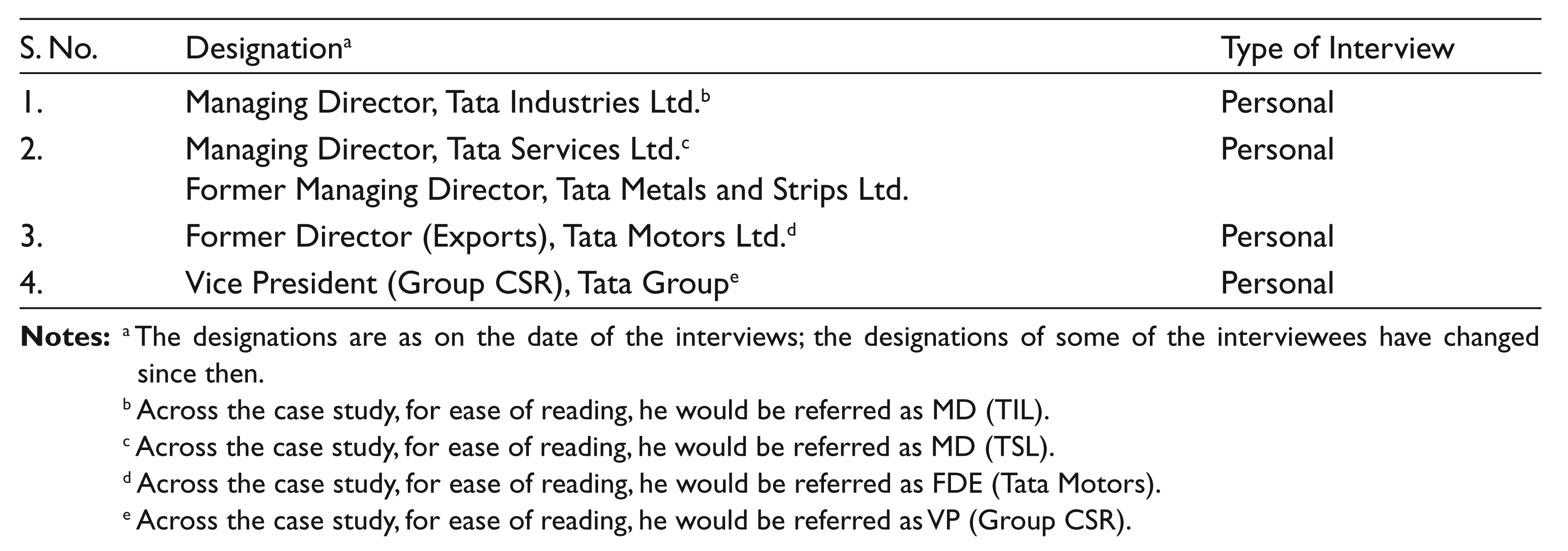
b Across the case study, for ease of reading, he would be referred as MD (TIL).
c Across the case study, for ease of reading, he would be referred as MD (TSL).
d Across the case study, for ease of reading, he would be referred as FDE (Tata Motors).
e Across the case study, for ease of reading, he would be referred as VP (Group CSR).
Responses Gained through Executive Perception Survey
Responses were also gained by the author to an Executive Perception Survey on Society and Local Community. This consisted of 23 parameters relating to various aspects and initiatives related to the Society and Local Community stakeholder by the Group companies. Thirty respondents across different levels of the management hierarchy within the Group companies responded to the survey and indicated the level of implementation of each of the stated society and local community-related initiatives within their respective companies. Important observations relevant to the case study have been appropriately included.
Secondary Sources of Information
The interview and survey responses have been supplemented by information available in the public domain through documents, such as, the Company Annual Reports, newspaper, magazine and journal articles and also information available on the Tata Group and individual Tata Company websites.
The Society and Local Community Stakeholder at the Tata Group of Companies: An Introduction
In a free enterprise, the community is not just another stakeholder in business, but is in fact the very purpose of its existence.
Clause 10 dealing with Corporate Citizenship in the Tata Code of Conduct
7
states:
A Tata company shall be committed to good corporate citizenship, not only in the compliance of all relevant laws and regulations but also by actively assisting in the improvement of quality of life of the people in the communities in which it operates. The company shall encourage volunteering by its employees and collaboration with community groups. Tata companies are also encouraged to develop systematic processes and conduct management reviews, as stated in the Tata ‘corporate sustainability protocol’, from time to time so as to set strategic direction for social development activity. The company shall not treat these activities as optional, but should strive to incorporate them as an integral part of its business plan.
Explaining why Corporate Social Responsibility (CSR) is not optional but necessary for companies operating in India, Dr J.J. Irani, Advisor and Former Director, Tata Sons observed:
While today eyebrows are being raised about corporates doing social work, the Tata Group feels it is the need of the hour. Thus, where in the West companies are doubtful of spending the shareholders’ money and corporates are considering discontinuing CSR, which is fine for them, but not for a country like India. The governments of the western world have a strong social security net so corporates can concentrate on profit-making and paying taxes regularly. But in this regard India still lags behind. We are far away from reaching that phase of economic development where government is solely responsible for the basic needs of the public. We don’t have a social security, adequate health and education services. So, till then, corporate houses should fill the gap.
Thus, it can be perceived through this observation, that the Tata Group’s objective of CSR is not just goodwill building or undertaking acts of corporate charity, but attempting to genuinely contribute to improving the lives of its communities.
Based on discussions with the Managing Director, Tata Industries Ltd.; Managing Director, Tata Services Ltd.; Former Director (Exports), Tata Motors Ltd.; and the Vice President (Group CSR), Tata Group, a detailed list of the Needs–Constraints–Alterables, Strengths and Areas of Improvement with respect to the Society and Local Community as a Stakeholder have been collated.
Needs
There is one kind of charity common enough among us…It is that patchwork philanthropy which clothes the ragged, feeds the poor, and heals the sick. I am far from decrying the noble spirit which seeks to help a poor or suffering fellow being…[However] what advances a nation or a community is not so much to prop up its weakest and most helpless members, but to lift up the best and the most gifted, so as to make them of the greatest service to the country.
The VP (Group CSR) highlighted the expectation of the local community and society from corporate organizations. He observed:
For the last 100 years we have been serving the communities for meeting their felt needs. Felt needs means they know the needs and we know the needs. We know that children are dying of malnutrition so feed them and give them nutrition and health. Children are not getting education, so provide them schools and education. After schooling they have to be trained. Girl children have to be continuously motivated to school and not just stay back at home and take care of siblings. These are all known things in life. There is one huge gambit where we know, the communities know and they ask you and you do the needful. Later on you make them live sustainably so that they can take care of themselves. These are the things known to us.
8
One such need that has been identified and catered to a large extent by the Tata Group and its companies is rural development and self-sufficiency. The FDE (Tata Motors) said:
Village adoption for self-sufficiency in terms of energy, employment opportunities, general welfare of the people is vital. In today’s context, organisations should adopt villages and show how they can be independent and generate their own wealth. Helping them in agriculture and allied activities will help them become self-sufficient and will also reduce migration to urban areas.
9
The MD (TIL) added:
We need to try and figure out what the community requires and see if we are in a position to contribute. Do they need training, do they need education, do they need better quality of life in terms of health, hygiene, entertainment, etc. It will all depend on what the organisation is capable of doing.
10
While there is hardly any facet of CSR that the Tata Group and its constituent companies have not touched upon, it is important to note what Mr J.R.D. Tata had said, about the responsibility that every corporate organisation has towards the society and local community. He said:
Every company has a specific and continuing responsibility towards the people of the area in which it is located and in which its employees and their families live. In every city, town or village, large or small, there is always need for improvement for help, for relief, for leadership and for guidance. I suggest that the most significant contribution organised industry can make is by identifying itself with the life and problems of the people of the community to which it belongs and by applying its resources, skills and talents to the extent that it can reasonably spare them to serve and help them.
11
His words effectively sum up the type of expectations that the local community and society would have from any corporate organization including the Tatas.
Constraints/Challenges
One challenge for the Group’s continued focus on community development as a part of its core business philosophy is its recent increase in reliance on foreign investors who are traditionally known for their emphasis on short-term returns. This could affect the quantum of financial contribution by individual Tata Group companies to social and community development projects.
Alterables/Best Practices 12
Be sure to lay wide streets planted with shady trees, every other of a quick-growing variety. Be sure that there is plenty of space for lawns and gardens. Reserve large areas for football, hockey and parks. Earmark areas for Hindu temples, Mohammedan mosques and Christian churches.
In Retrospect
The time was the early 1990s and the occasion was gathering of industrialists called by India’s then Prime Minister, Mr P.V. Narasimha Rao. Representing the Tata Group were Chairman Mr Ratan Tata and Dr J.J. Irani, then Managing Director of Tata Steel.
The Prime Minister proposed that we business people set aside 1% of our net profit for community development projects totally unconnected to the workers and industry any of us was involved with,’ recalled Dr Irani. ‘Mr Tata and I looked at each other; we didn’t make any comment. Later, we drew up a chart that quantified Tata Steel’s contribution on Mr. Rao’s scale. We discovered that, over a 10-year period, the company had been dedicating between 3 and 20 per cent of its profits to social development causes. In the years since, depending on profit margins, the figure has continued to vacillate within this band. 13
The Tata Steel example is not an anomaly for a Tata company. By a rough estimate, the Tata Group as a whole, through its trusts and its companies, spends about 30 per cent of its profits after tax (PAT) on social-uplift programmes. While the ‘big boys’ in the group, the likes of Tata Steel, Tata Global Beverages (formerly Tata Tea) and Tata Chemicals, have in-house organizations dedicated to the community development task, the smaller companies do not lag behind. ‘Each Tata company has its own priorities in social development,’ said Mr Chaukar.
They take up whatever is relevant to the communities and constituencies in which they function. Somebody is working in water management, somebody is in education, someone is in AIDS containment, someone in income generation; the range is huge. You have to take on board different desires, anxieties, and requirements.
The variety of community development endeavours undertaken by Tata companies embracing everything from health and education to art, sport and more, has touched, and changed, many lives.
The Tata Trusts
The illustrious patriarch—Sir Jamsetji Nusserwanji Tata’s charitable nature was inherited by his two sons Dorabji Tata and Ratan Tata. While J.N. Tata died in 1904, bequeathing his dream of starting a world-class research institution in India and making India self-sufficient in steel production and manufacturing, his son Dorabji and Ratan carried forward the father’s legacy. Not only did they fulfil his dreams by establishing the Tata Institute of Sciences (now Indian Institute of Sciences—IISc) and the Tata Iron and Steel Company (TISCO, now christened Tata Steel); they even continued in greater measure the charitable initiatives their father had commenced. At the time of their death, Ratan Tata (1918) and Dorabji (1932) bequeathed their personal wealth, assets, possessions, jewellery and shares to Trusts which would continue to undertake activities for the betterment of all Indians. It was with such noble intentions that the Sir Ratan Tata Trust and the Sir Dorabji Tata Trust were formed in 1918 and 1932 respectively. These are the biggest Trusts in the Tata Group. Today, the Tata Trusts control 65.8 per cent of the shares of Tata Sons, the holding Tata Company.
Sir Dorabji Tata Trust 14
This Trust was started with the prime purpose of encouraging learning and research in the country, of meeting the costs of relief during crises and calamities and of carrying out worthwhile charitable activities. The grant making pattern of the Trust involves three broad areas:
Endowment Grants NGO Grants Individual Grants
Endowment grants
The Sir Dorabji Tata Trust has pioneered several leading institutions with endowment grants—the first of its kind in India—and in doing so has created many centres of excellence particularly in medicine, science and education. These include:
The Tata Institute of Social Sciences (TISS), Mumbai. The Tata Memorial Centre for Cancer Research and Treatment, Mumbai. The Tata Institute of Fundamental Research (TIFR), Mumbai. The Tata Agricultural and Rural Training Centre for the Blind, Phansa. The National Centre for Performing Arts (NCPA), Mumbai. The Sir Dorabji Tata Centre for Research in Tropical Diseases at the Indian Institute of Sciences, Bangalore. The JRD Tata Ecotechnology Centre, Chennai. The National Institute of Advanced Studies, Bangalore.
Most of these institutions have now been handed over to the respective state or central governments for day-to-day administration. However, they continue to receive programme and recurring grants for specific purposes from the Trust.
Grants to NGOs
The Trust supports a number of NGOs working in different sectors across the country. Based on the parameters of innovation, timeliness, sustainability, adding value and promoting linkages, geographic spread and the felt needs of the community, grants are made in the five major sectors of social development—management of natural resources, livelihood generation in urban and rural areas, educational initiatives, social development and art and culture-related initiatives, and small grants to needy organizations for innovative initiatives.
Individual grants
Besides the above, the Trust also provides need and merit-based educational and medical grants to deserving individuals. The Trust disbursed ₹200 crores in 2008–2009 of which 65 per cent went to NGOs working in the field of health, education, livelihoods, social development and natural resources management.
Sir Ratan Tata Trust 15
The Trust seeks to be a catalyst in development through giving grants to institutions in the areas of rural livelihood and communities, education, enhancing civil society and governance, health and arts and culture. It focuses its grants to organizations which it can partner to undertake innovative and sustained initiatives with the potential to make a visible difference. It also provides grants for endowments, has a separate programme for small grants and gives grants to individuals for education and medical relief. Rural livelihoods account for the major part of the Sir Ratan Tata Trust’s funding support (50 per cent), with education (25 per cent) coming second. During 2010–2011, the Trust managed ₹1,697.09 million (US$ 38.34 million). Disbursals of ₹1,367.54 million (US$31.08 million) were made on all programme grants during the year, endowment grant disbursals totalled up to ₹22.17 million (US$ 0.50 million), and individual grants were ₹272.14 million (US$ 6.19 million).
Over 75 per cent of both the Trusts’ funds come from dividends on the shares it owns in Tata Sons, the Group’s holding company. The remaining funds come from their own statutory investments. Both these Trusts do not support or fund initiatives of the individual Tata companies. The trustees’ view is that if a company has started something, then it should sustain itself through its own funds instead of asking the Trusts for financial support. However, they do consider cases based on merit. For example, the Sir Ratan Tata Trust has funded initiatives by Tata Steel and Tata Chemicals.
The Tata Council for Community Initiatives (TCCI)
Social Responsibility is central to the core values we adhere to in the Tata Group for over a century. Our Companies have not only been proactive on compliance to regulatory requirements but have had a far sighted vision in ensuring sustainability in business processes; restoration of biodiversity and conserving the wildlife where possible. In the recent years, our Companies have marshalled these strengths together more consciously to institutionalise all this through the TCCI, what they have been doing for many, many years.
TCCI is an offshoot of the restructuring efforts of the early 1990s with a focus on adopting a more systematic and unified Tata Approach to CSR. Prompted by the rapid industrialization of the Group, which required greater professionalization and formalization, TCCI relies on core principles going back to the founders of the Group and was built on the road map provided by the Tata Code of Conduct.
The TCCI was formed to evolve a common direction for Group companies’ initiatives in community work, to synergise their work and to optimise the Group’s contribution to the development of the Indian society. As the Group’s nodal agency on corporate sustainability, TCCI facilitates initiatives of Tata companies related to social development, environmental management, biodiversity restoration, climate change initiatives and particularly employee volunteering by facilitating networking among representatives from over 40 companies. External stakeholders, such as, the Central and State Governments, NGOs and Development Agencies, find a one point contact in the TCCI to work with the group on themes of larger development.
In its focus on facilitating volunteering, TCCI encourages Group companies with specific technical know-how to offer their services to those in need and also design and implement programmes in the specific areas of health, education and issues concerning women and children. The TCCI has set up regional groups in cities where Tata companies have a significant presence, and employees are encouraged to volunteer with NGOs and the communities in their vicinities. In all, over 10,400 corporate volunteers have registered from the companies.
Since 2013, Dr Mukund Rajan is the Chairman of TCCI. A member of the Group Executive Council, he is also the Tata brand custodian, the Chief Ethics Officer of Tata Sons, and the spokesperson of the Group. Till recently, Mr Kishor Chaukar, a member of the erstwhile Tata Group Corporate Center was heading the initiative. TCCI also includes CEOs of major Tata companies. TCCI is also involved in assisting Tata companies address sustainability reporting as per guidelines set by the Global Reporting Initiative. It is also the focal point for the UN Global Compact in India, which has 42 Tata companies as signatories, the highest in the world from a business group. 16
Tata Index for Sustainable Human Development
In collaboration with the United Nations Development Programme (India), TCCI has crafted the Tata Index for Sustainable Human Development, a pioneering effort aimed at directing, measuring and enhancing the community work that Group enterprises undertake. The Index provides guidelines for Tata companies looking to fulfil their social responsibilities, and is built around the Tata Business Excellence Model (TBEM), an open-ended framework that drives business excellence in Tata companies.
As per Branzei and Nadkarni (2008), this Index was a world-first corporate sustainability system and was developed in 2003 by the TCCI in partnership with the Tata Quality Management Services. Deployed since June 2004, the main objective is of ensuring continuous improvement in the delivery of social responsibility initiatives at the company level. The evaluation categories are: human consideration, human achievement, human development and human excellence. By 2005, the Group averaged almost half of its intended goal, that is, 452.95 points on a 1000 point scale with companies ranging from 261 (Tata International) to 712 (Tata Steel). Tata Motors achieved one of the highest scores ate 663 (Branzei & Nadkarni, 2008).
Tata Relief Committee (TRC)
The TRC focuses on emergency charity in India and elsewhere by mobilizing emergency funds in response to natural and man-made catastrophes. These relief and rehabilitation activities are orchestrated as hybrids between typical emergency responses, such as, floods, earthquakes, cyclones, tsunamis and terrorist events and corporate-run initiatives, which are focused on creating value for societies in which they operate. TRC is often said to have been one of the first organizations to step in after natural disasters, assisting displaced people with basic supplies, and often helping communities rebuild basic infrastructure in the aftermath of destruction. TRC had done a lot of work during the tsunami in Tamil Nadu in December 2008 and also during the cyclone Aila in 2009 in West Bengal.
At times TRC efforts spearheaded new trusts, such as, the welfare trust that Ratan Tata and the Taj Hotels set to benefit those killed during the November 2008 terrorist attacks in Mumbai.
Indian Hotels form the Taj Public Service Welfare Trust 17
During the unprecedented terrorist attacks on Mumbai between 26 and 29 November 2008, many people from the security forces, the police, the fire services, hotel employees, guests of the Taj and general public were wounded or even killed. In the aftermath of this terror attack, the Taj group witnessed an outpouring of emotional support from well-wishers in India and across the globe, both for the restoration of the hotel and to offer relief for those affected by the attack. In response to this, the Taj group set up a public service welfare trust fund named Taj Public Service Welfare Trust (TPS Welfare Trust). The objective of this is to provide immediate relief to all victims of the recent attack, including to the families of those who were killed—be it the general public, the security forces, employees of the Taj or employees of other establishments affected by the terrorists. This trust would continue to discharge its mandate in the coming years, specifically covering relief to victims of sudden acts of violence, natural disasters and other tragic events that inflict damage to life and property.
Company-specific CSR Initiatives
Technology-related Initiatives
The VP (Group CSR) shared examples of Tata Companies which have used its technological capabilities to solve the problems of the society and in many cases the beneficiaries do not even know that it is a Tata initiative.
Tata interactive systems
The VP (Group CSR) shared an example of this ‘little-known’ Tata Company and its unique contribution. He said:
Tata Interactive deals in e-learning capabilities and builds e-learning modules. Some employee there got an idea that e-learning modules can be used for children with dyslexia. I have spoken to thousands of doctors in the learning disability forum that has been happening for the last two years. About 30–40 doctors come from abroad. I asked them whether they knew that an e-learning company had the solution for them. The parents and counsellors did not know, the Sion Hospital (Mumbai) here did not know, the media and NGOs did not know. Tata Interactive also did not know, but some imaginative person used an imaginative way to use technology, it solved society’s big tough problem.
18
Tata Consultancy Services (TCS)
TCS developed an adult literacy programme (spearheaded by Prof Keshav Vitthal Nori) which could help a totally illiterate person become literate in 40 hours of learning. The Computer Based Functional Literacy (CBFL) programme which started in 2000, was available in nine languages by 2012. This included Hindi, Marathi, Gujarati, Tamil, Oriya, Kannada, Urdu, Bengali and Telugu. It was also implemented for the Northern Sotho language in South Africa and for the Moore language in Burkina Faso. In India, the programme helped over 175,000 adult illiterates. While CBFL initially focused on reading, the second-generation version incorporated reading, writing and arithmetic and was available in eight of the nine Indian languages served (Wadia, 2011).
Joint Initiatives
Tata Chemicals, Tata Business Solutions Ltd. and Tata Teleservices, jointly established call centres specific to local languages in remote places like Mithapur (Gujarat) and Babrala (Uttar Pradesh) where youth were trained to take up professional careers. This project played a major role in empowering economically underprivileged groups in these regions. 19
Company-specific Local Community-based Initiatives
Tata Chemicals
The Tata Chemicals Society for Rural Development (set up in 1980) works to protect and nurture the rural population in the areas surrounding its manufacturing units across India and helped people achieve self-sufficiency in natural resource management, livelihood support and the building of health and education infrastructure. The employees of the Company participate in these initiatives and help empower rural communities to chart their own developmental course. 20
Tata Steel Rural Development Society (TSRDS)
Established in 1979, the TSRDS is involved in various social development programmes aimed at helping the rural communities living around Tata Steel’s operational units. Prior to the setting up of TSRDS, Tata Steel’s community initiatives were conducted through its rural and community services division. However, the fundamental differences between the imperatives of rural and urban development prompted the Company to reclassify its community initiatives programmes under three units: Community Development and Social Welfare, TSRDS and Adivasi and Harijan Welfare Cell, now known as the Tribal Cultural Society. TSRDS has expanded its agenda and identified the advancement of education, sports and self-reliance as tools to ensure a better quality of life for the people it works with. The Tata Steel Family Initiatives Foundation works in urban and semi-urban areas of Jamshedpur with family welfare activities and HIV/AIDS. 21
Rallilove Assisting Communitiest through Service (ACTS)
Rallilove ACTS is an organization set up by Rallis, to improve the quality of life of the poor, especially women and children, through sustainable community development programmes in areas, such as, health and education, and especially in helping the girl child. 22
Voltas for Women (VOW)
Founded in 1965, VOW membership is restricted to female employees of Voltas and the wives of male employees. It helps the needy with assistance in health and education, and offers career and vocational guidance. 23
Employment Generation at Tata International
Tata International Ltd. set up co-operatives and self-help groups (SHGs) to generate leather industry-related employment for women. It also provided formal training to women in the manufacture of leather articles, footwear and its components. For The Leather and Jute Training Centre at Indore, in collaboration with the Madhya Pradesh Handicraft Development Board and the World Bank—the Company ran formal training courses and gave meritorious students employment at its leather factory. At the new Ladies footwear manufacturing plant, the complete end-to-end operations were managed by 2,000 women, who were trained to manufacture footwear by trainers. 24
North Delhi Power Ltd. 25 (NDPL)
NDPL had a unique initiative for the JJ cluster residents who otherwise indulged in electricity theft. These people were brought in the billing loop by the Company and were complemented through various income generation, health and educational programmes to ensure their holistic development. Free health camps, drug de-addiction camps, accidental life insurance for JJ cluster residents, vocational training, adult literacy programme were a few of the initiatives. 26
While a few unique and company-specific initiatives of the Group companies have been highlighted here, there are many more which are said to be undertaken by each of the 96 operating companies of the Tata Group as a part of the Group culture and philosophy.
While an attempt has been made to gain insights into the structure and functioning of many of the Tata group companies’ social initiatives from the senior executive companies, an executive perception survey was used to gain insights from executives across the management hierarchy from across the Tata companies. The strengths and areas of improvement with respect to the Society and Local Community as identified by them have been presented below.
Organisational Strengths with Respect to the Society and Local Community
The responses to the Executive Perception Survey from the Group indicate the following to be its strengths with respect to Society and Local Community (in order of importance as identified by the respondents):
Organisational Areas of Improvement with Respect to the Society and Local Community
The responses to the Executive Perception Survey from the Group indicate the following to be its areas of improvement with respect to Society and Local Community (in order of importance as identified by the respondents):
While some of the major companies of the Tata Group have formal Social Audit Reports, it is interesting to note that a significant proportion of the respondents to this survey opined that they should have such a formal report. This could indicate that many of the other Group companies could also initiate the publication of such a report on a regular basis.
Reflections
It can be said of the Tata Group, that long before the term ‘Corporate Social Responsibility’ was coined in formal management literature, this Group and its companies were living the essence of this concept. As seen throughout this case, the noble values of the founding fathers continue to be the undercurrent of the business philosophy of the Tata Group and its varied businesses. CSR has not been an add-on in this Group as is the case with many corporate organizations, where CSR is a goodwill-building, brand-building and image-building exercise, and Socially Responsible Investing an allied fad.
The Group has, in most cases, interlinked business practices and community well-being in a neat fashion. Whether it is the rural development-related initiatives at the near century old Tata Steel for the benefit of its rural local community; the technology-enabled initiatives at TCS, Tata Teleservices and Tata Interactive Systems; or the establishment of the Taj Public Service Welfare Trust wherein the Indian Hotels Group went much beyond the call of duty to help the victims of the terrorist attack on the Taj Hotel in November 2008; the Tata Group of companies have been very innovative and much beyond their time in the field of CSR. The type of involvement that Mr Ratan Tata had in such initiatives and the priority that he gave to such initiatives is indicative of Tata Group’s approach to business. This is true of him and his illustrious predecessors who were all well known for their keen business sense and their benevolent and philanthropic nature. In fact, Mr J.R.D. Tata, the predecessor of Mr Ratan Tata and Chairman of the Group for over six decades, is the only businessman in the history of independent India to have been conferred the highest civilian award—the Bharat Ratna by the Government of India in 1991. On that occasion Mr Tata reiterated the importance of using growth for community development. He said, ‘An American Economist has predicted that in the next century, India will be an economic super power. I don’t want India to be an economic super power. I want India to be a happy country’ (Lala, 2004). Mr Cyrus Mistry who took charge as the Group Chairman in December 2012 has also emphasized on CSR as an important focus area for the Tata Group of companies in the future.
All this speaks volumes of the high esteem in which the polity and society hold this company. Emerging organisations across industry categories in India and abroad can learn a lot from the Tata Group and its unique approach to business and its management.