




Abstract
In the collectivist culture of India, family occupies a central place in organizing social and personal lives of the people. However, the forces of industrialization and urbanization are changing the life style and leading to reprioritization of values. Against this backdrop this study examined the pattern of actual and desired family values in the context of ecology, family type and generation. The sample (n = 90) was drawn from urban, semi-urban and rural areas in central India representing parent–child pairs belonging to joint and nuclear families. Using an indigenously developed measure of family values the study revealed that ecological setting and generation significantly influenced the family value of positive interaction. The type of family emerged as a significant factor for three major values, that is, social order, manners and helping. The interaction of ecology, family type and generation were significant for the values of social order and helping. In general, the type of family and ecological setting yielded major influence in shaping values. The implications of the findings for parenting are discussed.
Value is normally considered as a form of personal and cultural integration. In general, values are viewed as ‘preferences/generalized and relatively enduring beliefs concerning what is desirable and undesirable’. They work as standards to guide and determine the course of behaviour on a long-term basis. Values are acquired through the processes of socialization and acculturation. A value determines the course of action in personal and social lives of the people. People often find that human groupings evolve certain shared normative orientations. They are essentially conceptions of preferred and obligatory conduct and of desirable and undesirable states of affairs. Such normative orientations are often created to vary across different societies and are very complex. Values are also used as criteria for choosing the course of action. When fully understood and made explicit values function as criteria for preference and choice. They are, however, neither concrete rules of conduct; nor can be mixed into the conception of institution.
Values include both knowledge and beliefs, for our judgement of ‘what should be’ is always related to our judgment of ‘what it is’. Any variation in values may lead to change in our conception and belief in reality. Thus values indicate an appreciative system, which acts as a kind of complex pre-coding for the preferences and choices. They express some relationship between environment pressures and human desires (Tripathi, 2012).
Value development of children and young people has always been a matter of great concern. At the present time, the subject of value education is becoming relevant in educational discussions at all levels. There seems to be growing body of opinion in favour of devoting more time and effort in schools to help pupils to develop greater understanding and awareness of values. The reason behind such concerns is that, young people are living in a more different society, which appears to be full of paradoxes and contradictions, than their forefathers did.
The family has been identified as an important unit of society because of the role it plays in generation of human capital and resource and because of the power that is vested in it to influence individual, household and community behaviour. It derives its significance from a socio-philosophic tradition with roots deep in the past.
Levels of family authority and care and upbringing of infants and children by the parents find references in ancient Indian texts and epics such as the Mahabharata, Ramayana and Manu Smriti which present examples with values of duty and devotion for the children towards their parents. These epics also describe the samskaras (sacred and ritualistic ceremonies) given by parents to their growing children during various stages of life. Samskaras are visualized to delineate the childhood stage and give an indication of the chief characteristic of each stage (Kakar, 1978; Saraswathi & Pai, 1997). Arthashastra, the ancient Indian discourse on economics, considers age 16 to be the demarcation between childhood and youth for the boys and age 12 to be the cut-off year for girls. Bhagavat Purana, a tenth century essay supports that, ‘A son should be doted on for the first five years, he should be disciplined for the next ten years, when he is 16 he should be treated like a friend’ (Dube, 1981, p. 187).
Research studies on the family conducted in the past four to five decades have focused on generating empirical evidence in relation to various dimensions of family life its multiple forms, structure, size, fertility trends, changing functions, individual roles and the resultant problems. There studies have had their roots in the predominant disciplinary and methodological orientations or the fads prevalent at a particular time. However, the major concern of research has been on a sociological analysis of the family in terms of structural differences in Indian family and the effect of industrialization and urbanization on family norms, functions and individual roles. Understanding and analyzing the internal dynamics of the family, the changes there in and the resultant consequences have received little attention from researchers.
Human society is organized around the protection and well being of females and children. India’s ‘culturally idealized family’, which reflects prominence to the collective interests, is male oriented, both in terms of its structure and values and therefore has a predominately patriarchal family setup (Liddle, 2007; Seymour, 1999).
The basic unit of social existence is the family. More often the term ‘family’ does not refer to a single nuclear family, but indicates several generations with grandparents and their married and unmarried children living in the same household together, and sharing a common budget. When an Indian says, ‘He’s my brother’, you can expect anything from a real brother to a distant cousin or simply a very close friend. The system of familial closeness is under some pressure as more and more people migrate to the cities in search of jobs. Nonetheless, family bonds remain strong, and siblings make efforts to live near each other and to have frequent interaction. Weddings, childbirth, festivals and funerals are different occasions when the members of extended families joint together (Joshi, 2003).
Indian society follows patriarchal extended families, as well as nuclear families. Both joint and nuclear families are prevalent in almost equal proportions in India, but reflect some geographic variations in family structure. In the south, almost 60 per cent of the families are nuclear, whereas 42 per cent families in the north belong to a nuclear family structure. The joint family system is declining due to industrialization, urbanization, increased mobility and increased influence from the western world. Following are the four main types of families that are a part of Indian society.
Traditional joint family: It includes the head of the house, usually a male figure, his extended family, his married brothers and their extended families. Re-located Indians try to recreate that same feeling of being connected and supported by a larger network.
Patriarchal extended family: It includes a male head of the house, his wife, his married sons and their wives and children.
Intermediate joint family: It consists of a male head of the house, his wife, unmarried children and one of his married son’s nuclear family.
Nuclear family: It consists of a male head of the house, his wife and unmarried children.
The family values and lifestyle in India have been undergoing a dramatic change during the past several decades. Due to urbanization, industrialization and migration in search of jobs, the traditional setup of joint/extended families (consisting of three or more generations including uncles–aunts, nephews, nieces and grandparents) is slowly changed to a nuclear family (Chekki, 1996; Sinha, 1984). The joint family is still the ideal to which people aspire. The major task as visualized by the lawmakers during India’s ancient history was the development of children into able and contributing youth who show responsibilities towards both family and society (Kakar, 1978). Being an able family person meant being respectful and acknowledging their foremost duty towards the parents.
As a set of principles or standards of behaviour, the concept of ‘value’ has been quite important to the Indian mind. The idea of ‘rina’ (for example, Bhut, Guru, Rishi, Pitri) suggests that an individual owes to all beings and have obligations to them. The scheme of four aims of life (purusharthas) namely, dharma (order in life), artha (politico-economic values), kama (hedonistic values) and moksha (spiritual values) render a well-coordinated structure of values. Similarly the scheme of ‘Ashrama Dharma’ evinces a detailed account of developmental pathways for structuring the life concerns in the context of Desh (space), Kala (time) and Patra (person). The epics Mahabharat and Ramayan and Dharmshatras provide a rich source of natural development and operation of values (Kakar, 1978).
Research Questions
What is the pattern of family values in relation to ecological setting, type of family and generational context?
Hypotheses
The parent and children coming from diverse background shall differ in the salience of values and desirable of values.
Method Sample
In the present study, equal numbers of participants (n = 15) living in urban, semi-urban and rural were selected from parent and child categories from joint and nuclear families. Thus the researcher approached a total 90 families for data collection. The age range of children was between 12 and 16 years. Data were collected from Bhopal (MP) nearby locality.
Measures
Family Values (Current and Desired)
The family value scale developed by the researcher for this study where the subjects have been asked to express their preference for the various family values (current and desired) on a five-point scale ranging from ‘least preferred’ (1) to ‘most preferred’ (5) during the course of study, was used in the study. The scale included 25 items. Two versions of the scale were used in this study. One scale was given to participants to know about their current values, the question asked was, ‘What is the extent of these values present in the family members?’; in the other version, the question was, ‘How much importance do you give to these values to your life?’ Participants responded to these questions on 25 items on a five-point scale ranging from ‘least preferred’ (1) to ‘most preferred’. Items 2, 5, 6, 7, 8, 13, 14, 22, 25 assessed the positive interaction. Items 1, 9, 11, 12, 16, 17, 19, 21 were related with the values of social order. Items 3, 10, 20, 24 and 4, 15, 18, 23 were related with the values of manners and helping respectively. The principle component factor analysis method with Chronbach alpha are (0.83), (0.83), (0.72) and (0.73) respectively.
Procedure
The researcher contacted parents and children from joint and nuclear families living in rural, semi-urban, and urban areas located near Bhopal. The researcher individually contacted the participants and after getting their consent, they were explained about the purpose of the study.
Results
The scores obtained for the family values by ecological setting, types of family and generation are shown in Table 1. A close perusal of the mean scores revealed that the obtained scores have an appreciable degree of variation in the responses. In order to examine continuity and change in value preference across generation the scores of ecological setting and family type were analyzed. The raw scores on the four dimensions of family values were subjected to a separate 3 × 2 × 2 factorial between group ANOVAs.
Means and SDs of Scores on the Major Family Value Clusters Endorsed by Parents and Children in Joint and Nuclear Families across Current and Desired Value Contexts

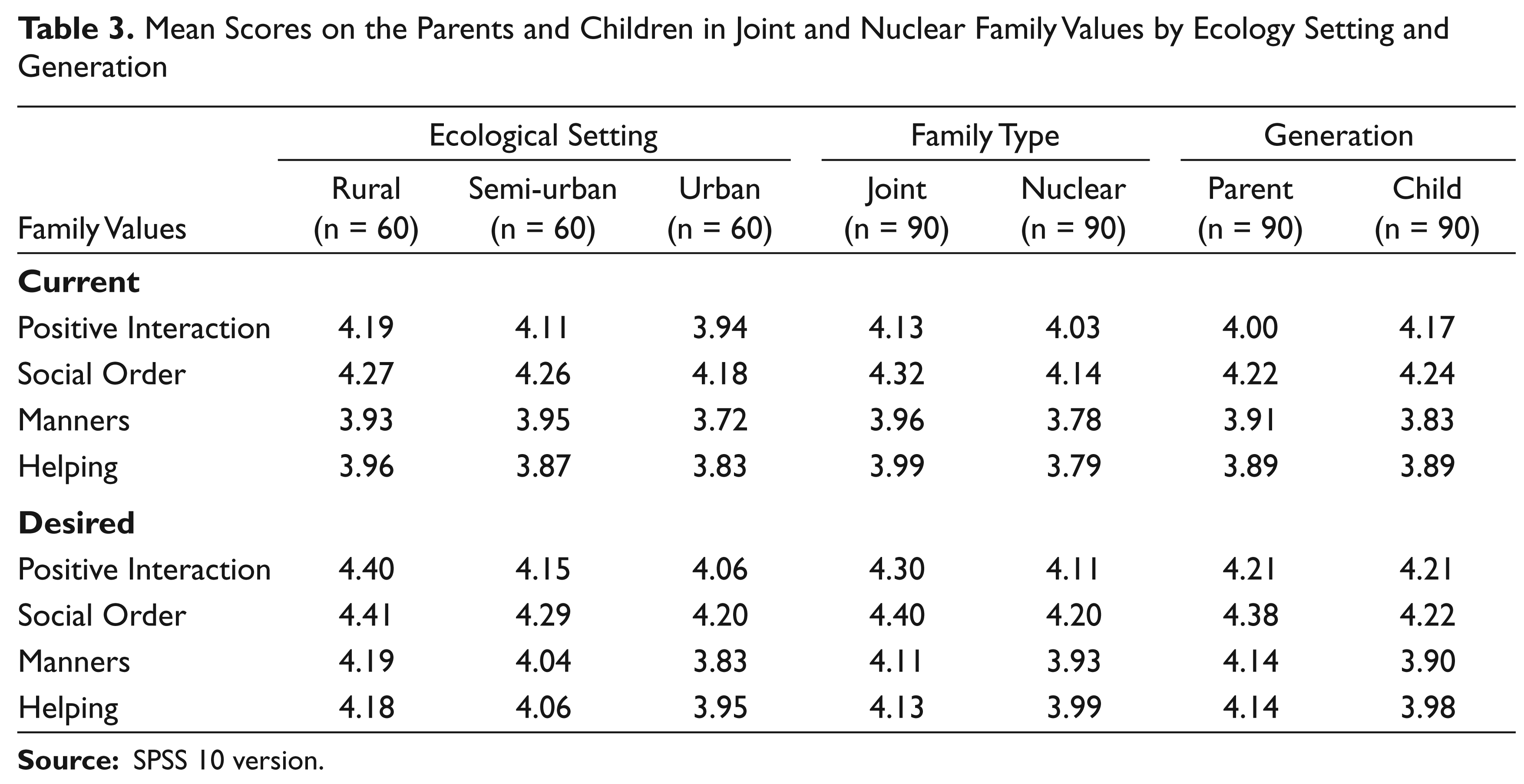
The summaries of their ANOVAs appear in Table 2. It was found that in case of current values the main effect of ecology was significant for positive interaction, F (2, 168) = 3.97, p < 0.05. The results presented in Table 3 reveal that mean score from rural respondents (M = 4.19) was higher than the mean score of the semi-urban (M = 4.11) and urban (M = 3.94) participants. The effect of family type was significant on social order, F (1, 168) = 6.45, p < 0.05, manners, F (1, 168) = 3.83, p < 0.05, and helping, F (1, 168) = 4.80, p < 0.05, the joint families endorsed them higher than nuclear families in these values. The effect of generation was significant for positive interaction, F (1, 168) = 4.95, p < 0.05, scores of children (M = 4.17) was higher than the parents (M = 4.00).
Summaries of 3 × 2 × 2 Factorial ANOVAs Performed on the Scores Types of Family Values for Joint and Nuclear Families
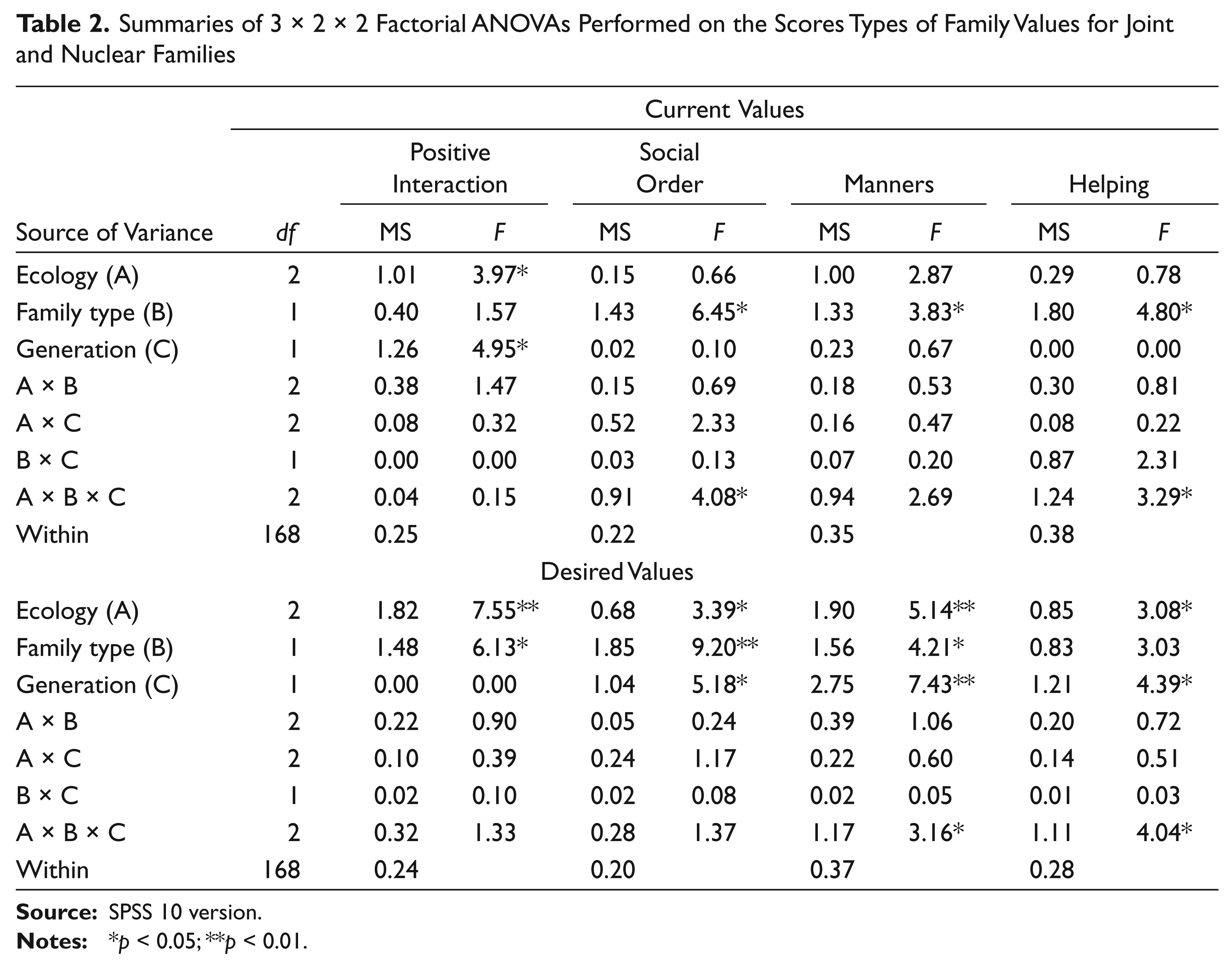
In the case of desired values the main effect of ecology was significant for four major values, that is, positive interaction, F (2, 168) = 7.55, p < 0.01, social order, F (2, 168) = 3.39, p < 0.05, and manners, F (2, 168) = 5.14, p < 0.01, and helping, F (2, 168) = 3.08, p < 0.05. The main effect of the ecology of positive interaction was that the rural groups endorsed social order, manners and helping with higher strength than the semi-urban or urban groups. The difference between semi-urban and urban groups was significant. The effect of family type was significant for the three major values, that is, positive interaction, F (1, 168) = 6.13, p < 0.05, social order, F (1, 168) = 9.20, p < 0.01 and manners, F (1, 168) = 4.21, p < 0.05; the joint families endorsed them higher than nuclear families. The effect of generation type was significant for the major values namely social order, F (1, 168) = 5.18, p < 0.05, manners, F (1, 168) = 7.43, p < 0.01, and helping, F (1, 168) = 4.39, p < 0.05; the parents group endorsed them higher than the children’s group.
Mean Scores on the Parents and Children in Joint and Nuclear Family Values by Ecology Setting and Generation
In the case of current values, the effects of interaction of ecology and family type and generation were significant for social order, F (2, 168) = 4.08, p < 0.05. Figure 1 graphically presents this interaction. In the case of a rural setting, parents from joint families scored higher than the parents from nuclear families, but the children from nuclear families scored higher than children from joint families; and semi-urban setting parents and children from joint families scored higher than nuclear family parents and children. The same was true in the urban group.
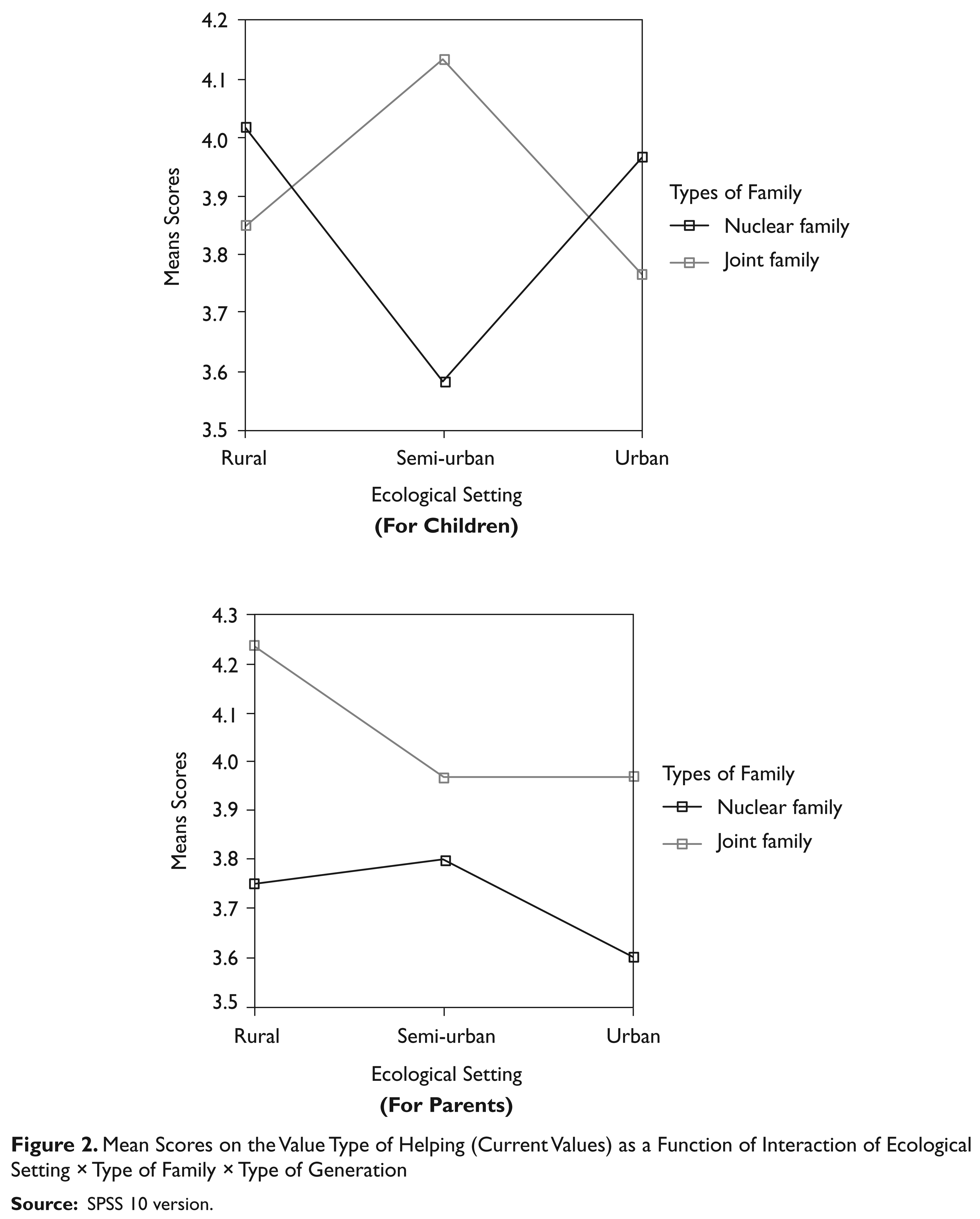
In case of current values, the interaction was significant for helping, F (2, 168) = 3.29, p < 0.05. Figure 2 shows that rural parents from joint families scored higher than nuclear family parents on helping; however, children from nuclear family scored higher than joint family and in semi-urban setting parents and children from joint family scored higher than their nuclear family counterparts. In the urban setting the parents from joint families scored higher than nuclear families; but in the children, the score of nuclear families was higher than the children of joint families.
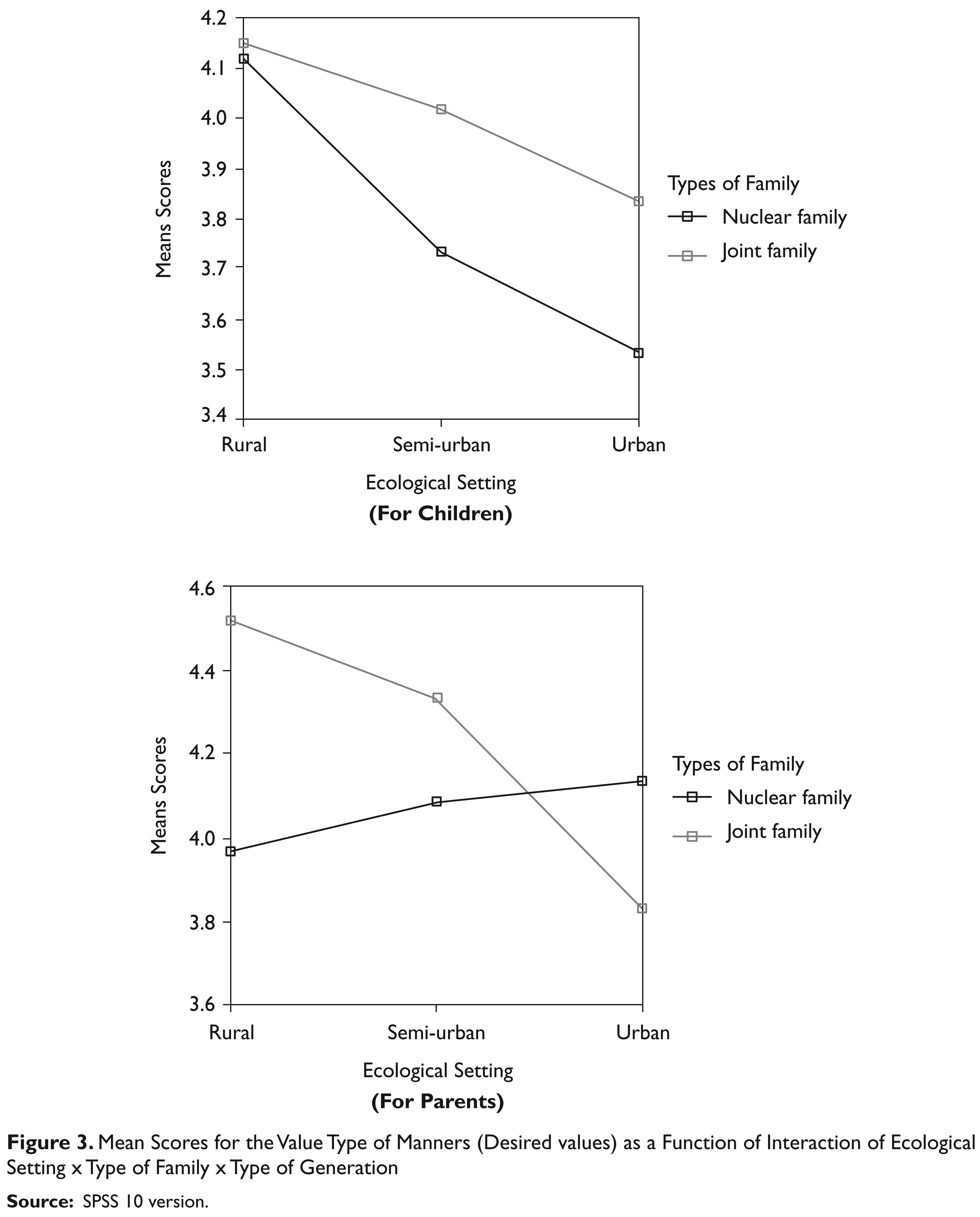
In the case of desired values the interaction of ecology and family type and generation was significant for manners, F (2, 168) = 3.16, p < 0.05. Figure 3 makes it evident that rural and semi-urban group parents and children from joint families scored higher than the nuclear families of parents and children on manners. The scores of nuclear family parent group in the urban setting was higher than joint families, but in the case of children from joint family, mean score was higher than nuclear family.
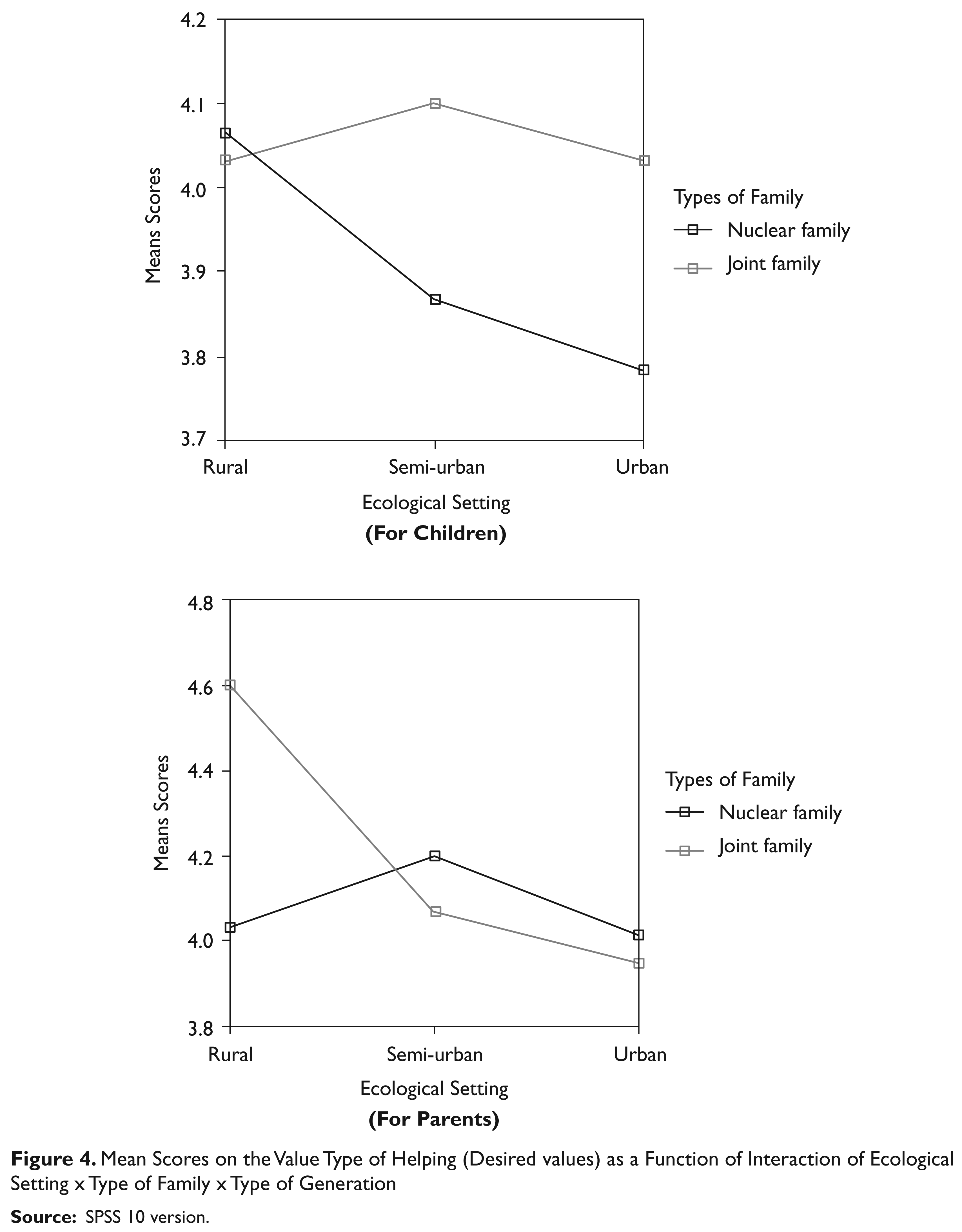
The interaction effect for helping was also significant, F (2, 168) = 4.04, p < 0.05. Figure 4 shows that in a rural setting the score of parents from joint families was higher than nuclear families, but in the children, the nuclear family mean score was higher than the score for joint families. In a semiurban setting parents from nuclear families scored higher than joint family parents; however, in the children, the joint family group scored higher than the nuclear family group. The same was true for the urban group.

Discussion
Intergenerational differences in values preferences in joint and nuclear families were analyzed in the present study. A close look at the results reveals that the effect of type of family was significant for the values of social order, manner and helping in the current context. The pattern of results also reflect that participants (parents and children) living in joint families showed a higher preference in favour of these values as compared to participants of nuclear families. It appears reasonable that among joint families a more supporting climate is available to practice these values as compared to nuclear families. In joint families people get more opportunities to interact, to share, to extend cooperation and to practice manners as compared to nuclear families (Agrawala, 2007; Tripathi, 2012).
In nuclear families, members are limited and consequently people have less opportunity to interact, share and practice these values. Due to differences in experiences in the practice of values, individual and nuclear family participants reacted in a different manner to these values. The effect of ecological setting was significant for the value of positive interaction in the current context. Rural people showed their agreement to positive interaction more as compared to semi-urban and urban people. The rural context provides a better opportunity to interact; hence it becomes part of people’s behaviour. Similarly, generational difference was also significant for positive interaction in current context. Children are perceived positive interaction is more important as compared to parents, and children need support from parents.
Possibly children are more innocent as compared to parents. Thus children are more inclined towards values of positive interaction in their behaviour as compared to parents. Interaction of ecology, type of family and generation was also reported as significant in this study. The pattern of results evinced that children of nuclear families living in rural settings gave higher importance to the value of social order as compared to parents of nuclear families. Similarly, children participants of nuclear families from semi-urban settings gave higher importance to values of social order as compared to their joint family counterparts living in semi-urban settings. These results import that type of family and ecological settings have important role to determine the acceptance of values of parents and children. The structure of a family provides feedback differently to its members, thus they perceive and learn values accordingly. An almost similar pattern of results was obtained for the value of helping in the current context. Researchers have shown that family is the most salient in-group followed by friends, relatives, caste, religion, region and languages, etc. (Katju, 1986; Singh, 1986; Sinha & Verma, 1987).
In the present study we find that growing in different residential backgrounds, people learn values differently. In the present study, the effect of ecological context on the desired family values of positive interaction, social order, manner and helping was significant. Rural participants placed greater emphasis on these values as compared to semi- urban and urban participants. Participants living in nuclear and joint families perceived the desired values of positive interaction, social order, and manner differently. An intergenerational difference was reported to be significant for the value of social order, manner and helping.
The overall results demonstrate that participants living in joint families perceive these values more valuable and relevant as compared to participants living in nuclear family. Similarly, parents also accepted these values as important in comparison to children participants. The interaction effects of ecology with family and generation were also significant for family values of manner and helping. The patterns of results suggest that the role of ecological setting and structure of family in the development of values (Garg and Parikh, 1993) have also observed the role of family relationships in the development of the value system of the individual.
Roland (1988) was of the opinion that the elderly women member of the family transmits cultural values system to the younger generation. This value system focuses on cooperation, affection and understanding following the traditional norms and customs of family. Similarly, Garg and Parikh (1993) have shown that the upper middle class populations are at the crossroads along with familial values such as obedience to parents, conformity, self-denial and fulfilment of parental expectations.