



Abstract
The aim of this study is to analyze if two emergent models of leadership, servant and spiritual are really different or, on the contrary, are similar, with different labels. Both approaches were analyzed from their backgrounds, depictions, definitions, theoretical models proposed and limitations. It is concluded that both models of leadership are about the same models that share a similar root; both of them are oriented towards transcendental values of employees as a core component of leadership and a main factor related to the quality of job performance. Further studies should be done in order to provide new empirical evidence to support whether servant and spiritual leadership can be considered as completely independent models.
In the last decades, a significant change in the body of knowledge in leadership has been observed. Currently, topics such as values, ethical and moral behaviour, quality of life, spirituality and even positive emotions are reaching special relevance in this field, mainly in organizational settings. Based on these trends, a new variety of leadership models have appeared, all of them from the so-called ‘Emergent Theories of Leadership’, which includes servant and spiritual leadership, among others (Dinh et al., 2014). These models have features in common; all of them are centred on values, focusing more on people than productivity and a genuine concern for the needs of employees, overcoming the interest for productivity as the main objective. In spite of these similarities, the emergent proposed models are presented as different. The aim of this study is to analyze to what extent these models, spiritual and servant leadership, are conceptually different from each other and to determine if they are basically the same models with different names or on the contrary, if they are different models with their own conceptual structure.
Background and Definitions
Different approaches and models of leadership have been increasing rapidly in the last decades. Recently Dinh et al. (2014) presented 17 different theories of leadership grouped thematically, almost half of them deriving from the ‘Emerging Theories of Leadership’. The theories of servant and spiritual leadership appear in these Emerging Theories of Leadership. Both of them belong to the same thematic category: Ethical/Moral Leadership Theories. Although these theories were developed towards the end of the last century, there are some decades among them which might suggest the possible influence of one over the other.
Servant leadership theory is older than spiritual leadership. In 1970, Robert Greenleaf proposed this theory. The core idea of this concept is the service of leaders towards their followers and the commitment to serve people (Parris & Peachey, 2013). Greenleaf (1977) asserted that servant leadership ‘begins with the natural feeling one wants to serve, to serve first. Then conscious choice brings one to aspire to lead. That person is sharply different from one who is leader first’ (p. 5). This statement shows a kind of leader that takes care of the followers and is worried by their needs. However, some authors such as Spear (2004) and Sendjaya and Sarros (2002) point out that servant leadership is more a way of life or a philosophical posture than a leadership theory.
Conversely, spiritual leadership is a model that was proposed at the end of the 1990s, although its basis came from 1980 (Modaff, Dewine & Butler, 2008). This model emerged from the increasing interest at that time to apply the spiritual issues to work environments by both researchers and practitioners. Crossman (2010) asserts that this approach emerged as a different alternative to understanding the human factors in work settings in contrast to the traditional perspective oriented only towards productivity. Pioneer studies of spiritual leadership were done by authors such Fairholm (1996, 1998), Biberman, Whitty and Robbins (1999), Cacioppe (2000) and Mitroff and Denton (1999). The last one studied spirituality at work related to values and religion in a corporation. Nevertheless, it is important to recognize that it was Fry who made the main contribution to develop this model of leadership; in fact, he is one of the most cited authors in this topic. Fry (2003) defined spiritual leadership as the understanding of values, attitudes and behaviours needed not only for self-motivation but to motivate others, through the commitment and membership related to organization. Later, Fry (2005) proposed a wider definition, asserting that spiritual leadership is necessary to create a vision, to achieve congruent values among the employees and employer, as well as to empower the teams in the whole organization, fostering higher levels of organizational commitment and productivity.
This initial depiction shows two approaches that seem to have the same roots; servant leadership is more related to moral behaviour of the leaders, whereas spiritual leadership is attributed to organizational behaviour and performance. Nonetheless, it is important to recognize that both models are supported by intrinsic motivation, commitment and membership.
The Servant and Spiritual Theories
Some authors suggest that servant leadership could be located in the critical/transformative theory (Russell & Stone, 2002; Sendjaya & Sarros, 2002); however, further studies suggest that this model is more oriented in an empirical/analytical approach due to the interest in assessing the dimensions of the model made through reliable questionnaires (Barbuto & Wheeler, 2006; van Dierendonck & Nuijte, 2011). For this reason, Burrell and Morgan (1979) affirm that this model has had an important change, passing from a radical humanistic paradigm to an interpretative (Spear, 2004) and functionalist approach (Laub, 1999; Sendjaya, Sarros & Santora, 2008). Previously, Laub (1999) described the characteristics of servant leadership as the following: centred on the peoples’ values, believing in the people and never judging them, helping people to develop themselves, giving them opportunities to learn and grow, building communities through authentic interpersonal relationships, anticipating the future and sharing power. Subsequently, Spears (2004) proposed the following characteristics that servant leaders should have: listening skills, empathy, healing (everyone has the capacity to heal oneself and others), awareness (including the self-awareness), persuasion (instead of authority), conceptualization (to deal with the problems), perspective (understanding the lessons of the past, the reality of the present and the consequences of making decisions for the future), commitment (towards people, more than an interest for employee contributions) and being a community builder.
Although the proposals of Spear (2004) and Laub (1999) have been oriented to develop servant leadership models, their application in the scientific literature is not frequently used. Recently, Parris and Peachey (2013) found that only 12 of 39 studies registered in the literature were supported by the Spear and Laub proposals. By contrast, the majority of these studies have been done under the original model proposed by Greenleaf. Consequently, this means that these new proposed models are not integrated into the classic model of servant leadership.
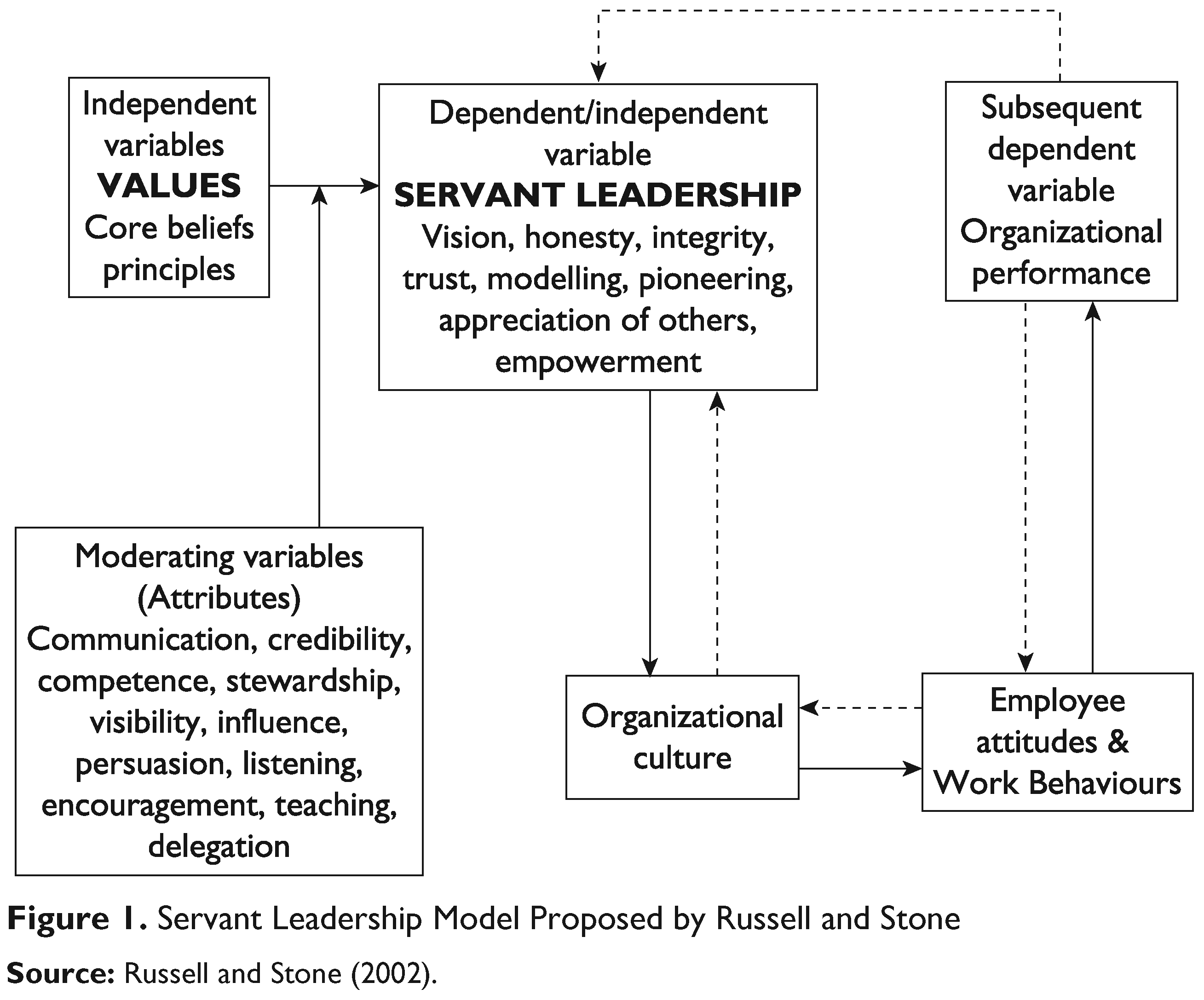
Among the models of servant leadership, it is important to mention the proposals of Russell and Stone (2002) and Van Dierendonck (2011). Both of them constitute a significant effort to advance in the conceptual model arising from the servant leadership theory. In the first case, the model proposed by Russell and Stone (2002) is focused mainly on the consequences of servant leadership in organizational culture and performance. Likewise, this model includes attitudes and employee behaviour.
According to this model, values influence servant leadership, and this relationship affects the organizational culture, which will affect employees’ attitudes and behaviour, influencing in turn organizational performance, which is included in the model, as a dependent variable. It is important to note that the relationship between values and servant leadership is mediated by organizational variables (Figure 1).
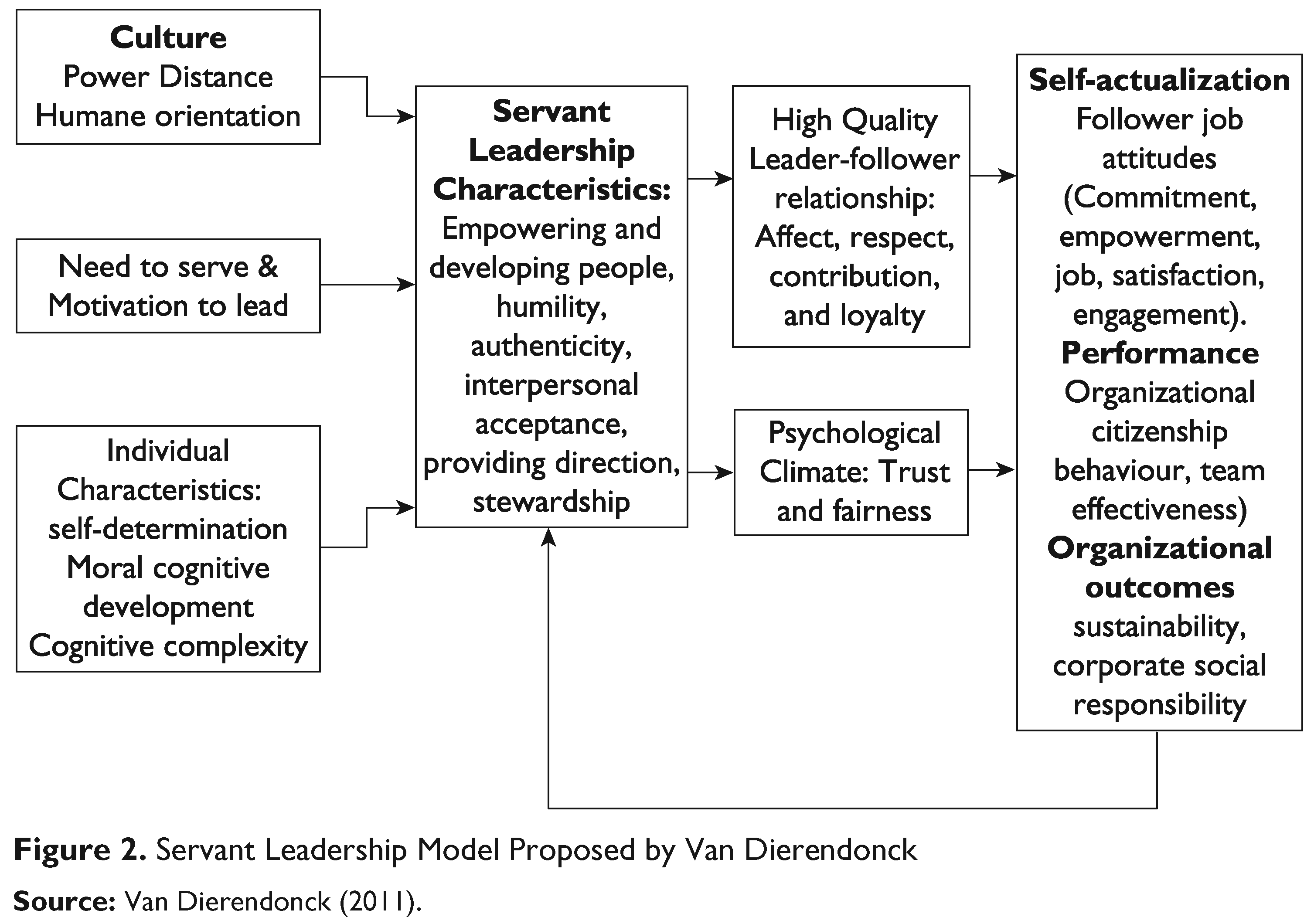
The model proposed by Van Dierendonck (2011) centres on the characteristics of servant leadership, focusing on its causes and effects on employees behaviour and, consequently on organization than the aforementioned one. Unlike the previous model, culture, the need to serve and individual characteristics are the factors that influence servant leadership. This kind of leadership has an effect on the quality of relationship between leaders and followers and on the psychological climate; all of them favourably influence the attitudes, performance and organizational outcomes (Figure 2).
On the other hand, the spiritual leadership model includes some concepts such as intrinsic motivation traditionally used by other approaches. This characteristic is shared with other models, such as transformational and charismatic leadership. Spiritual leadership is supported from religiosity (i.e., loving everyone), ethical behaviour and being responsible. From this approach, organizational culture and human relationship are fostered (Reave, 2005); in fact, cultural values are one of the most important features of this kind of leadership that is different from the other emergent models (Fry, Matherly, Whittington & Winston, 2007).
Spiritual leadership could be seen as an evolutionary model of leadership in so far as to improve the characteristics of other models of leadership. According to this model, spiritual leadership emphasizes the importance of not just achieving company goals, but overall social growth, through membership and calling. Thus, spiritual leadership includes in the same way, rational determinants as well as ethical and spiritual values, shaping a particular style to manage the companies (Beazley & Gemmill, 2005; Nicolae, Ion & Nicolae, 2013). Then, spiritual leadership is an emergent construct which supports employees’ necessities, related to transcendence, connection, abilities to self-motivate, satisfaction, spiritual well-being, membership and personal calling (Fry, 2003, 2005). This is a theory based on vision, altruistic love and hope/faith that is supported in an intrinsic motivation theory (Fry, 2003).
Likewise, the spiritual leadership model takes into account both the needs of leaders and followers fostering better levels of organizational commitment, productivity and performance (Fry, 2003, 2005). From this model, vision, hope, faith and altruistic love are related to three effects of a leader on organization, which are performance, effort and reward. The relationship among these variables influence on calling and membership, affecting favourably the organizational commitment and productivity (Figure 3).

As observed, spiritual and servant leadership, are both moral and inspirational models of leadership that offer opportunities to create an organizational environment that fulfils the necessities of current companies. According to Fry, Matherly, Whittington and Winston (2007), the creation of this kind of environment will become strategic imperatives for companies in the new millennium. As a result, emergent models are being currently studied, a matter of interest for both, scholars and practitioners (Crossman, 2010; Nicolae, Ion & Nicolae, 2013). Northouse (1997) presents a comparative analysis of these models (Figure 4).
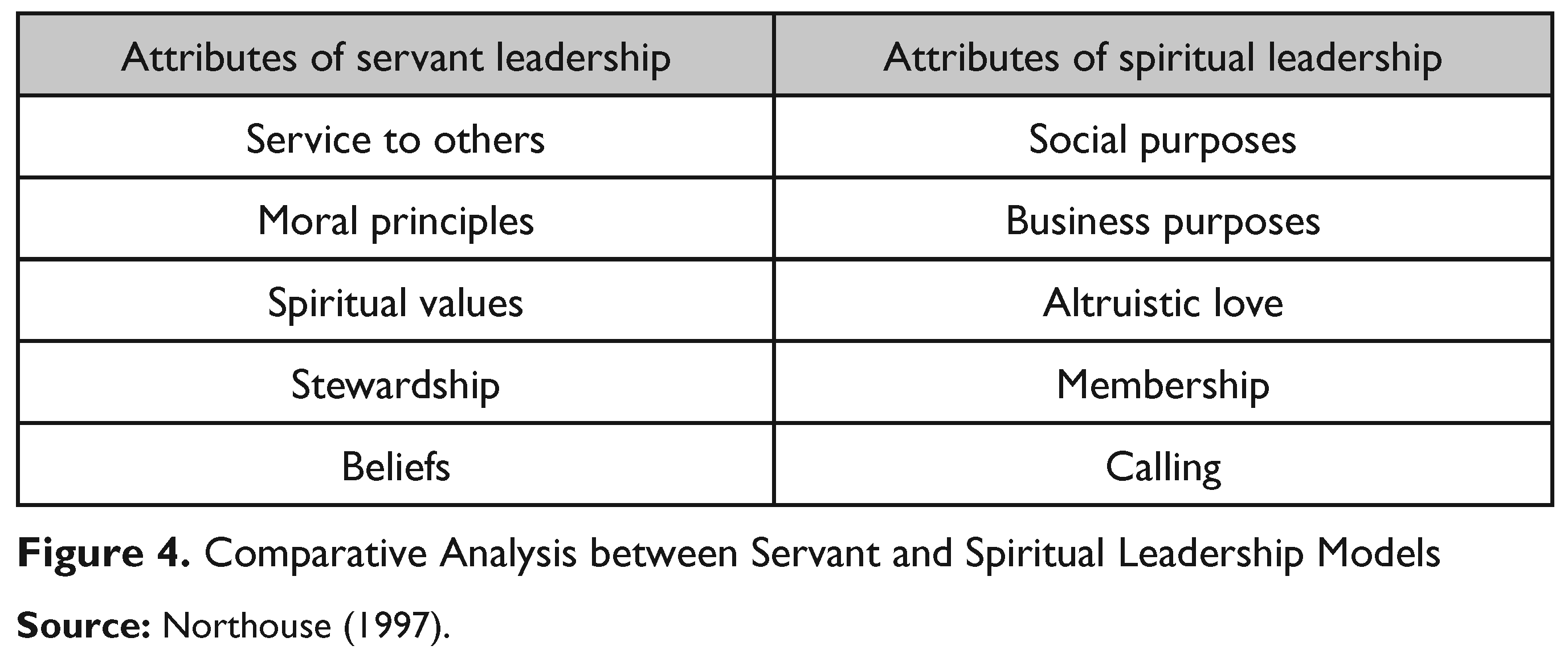
As it can be observed, spiritual leadership as well as servant leadership are addressed to achieve not only social purposes, but also organizational goals. Thus, both emergent leadership models go beyond moral and ethical principles, which include these values as determinants for a particular style to manage (Beazley & Gemmill, 2005; Nicolae, Ion & Nicolae, 2013). Moreover, these models include the organizational outcomes related to job attitudes and organizational performance, even though, these models use different terms. For both models, the relationship between leaders and followers is very important and is considered as a critical factor in the effectiveness of leadership. On the other hand, servant leadership involves some organizational variables while spiritual leadership does not (for instance, culture, communication, competence, delegation, among others). However, although spiritual leadership model seems to be more focused on spiritual characteristics of leaders and followers, both proposed models emphasize the impact of leadership in organizational outcomes.
Limitations of Servant and Spiritual Leadership
According to the scientific literature, servant leadership lacks conceptual consensus, and does not have a clear definition shared by scholars. Some authors assert that their argument is more philosophical and religious mainly supported in Christianity (Sendjaya & Sarros, 2002). Likewise, there is scarce empirical evidence that supports this model (Parris & Peachey, 2013).
Something similar happens with spiritual leadership; there is no academic consensus regarding its definition, which has produced confusion and has delayed any advances in this field (Dent, Higgins, & Wharff, 2005). Spiritual leadership has been used in several studies, mainly related to different organizational behaviours. There are more than 100 tests developed to assess this kind of leadership. Some of these inventories are centred in organizational spirituality and others are addressed to evaluate individual spirituality. Maybe one of the most important challenges to validate this theory is to understand the spirituality from a scientific approach and explain how this knowledge can be applied in organizational settings.
Conclusions
The aim of this study is to analyze to what extent these models, spiritual and servant leadership, are conceptually different from each other and to determine if they are basically the same models with different names or on the contrary, if they are different models with their own conceptual structure. In spite of some singularities observed, the conceptual delimitation among these emergent styles of leadership is still vague; it seems that the difference between both models are related to the inclusion of some organizational variables in a more explicit way (in this case, servant leadership). Thus, it remains unclear, what the conceptual delimitation is, because both models include human strengths, job attitudes, performance, and organizational outcomes. Moreover, both models have in common is that they are scarcely supported in empirical evidence, which affects its academic robustness. Further studies should provide new empirical evidence to support if servant and spiritual leadership are completely independent models. Likewise, it is necessary to evaluate, in a deeply way, the psychometric properties of the questionnaires used to assess these models.