



Abstract
With the increasing popularity of Facebook among adult users and the diverse social networks, especially based on age, that adults form on Facebook, it is important to examine what adult Facebook users have seen on Facebook and deem inappropriate. Previous studies only address college students and most of them involve hypothetical post-scenarios. This study addresses these gaps by examining 190 adult Facebook users from a northeastern Pennsylvania university and asking them to identify the top three types of posts they have seen on Facebook and considered to be inappropriate. Findings suggest that these adults consider sex/nudity, foul language and politics to be inappropriate for Facebook. These mirror values of face-to-face interaction, but are not mentioned in research of online inappropriate behaviour. When more specific themes are combined for group comparisons, two additional themes, social issues and aggression which are also generally unexplored in the research, emerge as inappropriate as well. However, with the exception of gender and educational differences in the perceptions of sex/nudity, there are few group differences in the observed Facebook posts that these adults find to be inappropriate. Implications for online interaction and future research are discussed.
While Facebook was originally designed for college students, it has now spread to a wider population. According to a recent PEW research study, 62 per cent of the entire adult population use Facebook (PEW Research Center, 2015). Like their younger counterparts, older individuals primarily use Facebook to keep in contact with friends and family and to feel involved with others’ lives (Brandtzaeg, Lüders & Skjetne 2010; Nadkarni & Hofmann, 2012). In a study of 529 individuals aged 18–69, Leung (2013) found that social media, such as Facebook, satisfied people’s needs to show affection, vent negative feelings, gain recognition, obtain entertainment and broaden their knowledge base.
Part of online interaction involves not just following others but disclosing information about oneself as well (Brandtzaeg et al., 2010; Hilsen & Helvik, 2014; Ledbetter, Mazer, DeGroot, Meyer, Mao & Swafford, 2010). Some researchers have found that people tend to disclose more about themselves and their opinions online than they do face-to-face (Davis, 2012; Ho & McLeod, 2008). In a study of 256 college students, Ho and McLeod (2008) found that fear of social isolation and a negative response limited students’ willingness to share opinions in face-to-face interaction, but that this fear was mitigated on social media because it is more anonymous and people have more time to craft their presentation of self. However, unlike face-to-face interaction, online interaction is more uncertain and messages can be more easily misinterpreted because people cannot read social cues such as facial expressions or tone of voice which aid interpretation in face-to-face interaction. To combat this, people need to disclose more about themselves and their message to facilitate accurate interpretation of the material presented (Ho & McLeod, 2008; Joinson & Paine, 2007; Walther, 2002).
However, self-disclosure comes with norms and risks. While Facebook is a place where people can share their emotions and vent negative feelings or experiences, it has to be done carefully. Online self-disclosure norms have evolved which involve disclosing material that will give others a positive self-impression of oneself (Birnbaum, 2013; Brandtzaeg et al., 2010; Peluchette & Karl, 2010). Therefore, when people who are hurt, angry or depressed use Facebook to vent negative emotions and try to gain social support, they may violate this norm and risk a negative perception by others (Oldmeadow, Quinn & Kowert, 2013). For example, just like the norm in face-to-face interaction is to respond ‘Fine’ or ‘Good’ when asked ‘How are you?’ even if the opposite is true, people generally do not want to see negative or depressing information on Facebook (Leung, 2013). Nor do they want to know too much about a person. Brandtzaeg and colleagues (2010) found that there is also a self-disclosure norm against sharing too much personal or private information and doing so may strain online social networks.
Sharing too much information, especially personal information, relates to a second risk of self-disclosure, which is balancing self-disclosure with privacy. Krasnova, Spiekermann, Koroleva and Hildebrand (2010) found that online participants create a conscious evaluation of the pros and cons of self-disclosure; if they perceived their privacy to be at risk, they consciously limited the amount to disclose. Young adults, such as college students, grew up with social media and are accustomed to sharing even mundane information with online friends; therefore, they may perceive few privacy risks (Johnson, 2010). However, face-to-face norms and values suggest that the older adult population may be more likely to find the exposure of personal information to be intrusive and may negatively perceive others who share too much information online (Kirkpatrick, 2010). The findings on age values and online privacy, however, are not conclusive.
Brandtzaeg and colleagues (2010) found that both young and older Facebook users share content regardless of concerns for privacy even though they recognize that different types of personal information may not be appropriate for different types of Facebook friends and they are the concerned about over-sharing. Contrary to what face-to-face norms may suggest, older people may be less concerned about privacy than younger people because they are less concerned with what they post or how they express themselves. Younger people may be especially vulnerable to the input of their peers (Brechwald & Prinstein, 2011; Williams & Merten, 2009) and therefore are tempted to post information that they think will gain them approval from their cohort. For example, some researchers have found that adolescents and college students feel the need to not only copy their peers but also do copy what they think their peers are doing, regardless of any proof of the behaviour (Brechwald & Prinstein, 2011; Ehrenrich, Underwood & Ackerman, 2014). Therefore, adolescents and young adults may post risky behaviours that involve alcohol, sex or nudity or use foul language because they think that this is what their friends are doing or they think these behaviours are a part of college life and, therefore, are expected in order to fit in (Ehrenrich et al., 2014; Goodmon, Smith, Ivancevich & Lundberg, 2014; Peluchette & Karl, 2007). Older adults may be less vulnerable to peer pressure or may be less likely to behave in risky ways and, therefore, are less concerned with what they or their Facebook friends are posting. This possible lack of concern with the privacy of their own posts, however, still leaves the question of how they view the posts of others and when they feel that others have breached privacy norms by revealing too much.
The sharing of information and perception of privacy relates to adult attachment theory. Attachment theory was initially formulated to explain how children’s attachment to their primary caregiver affects their perceptions about themselves (Collins & Allard, 2004; Mikulincer & Shaver, 2007). Children whose need for comfort and security are met will develop a firm attachment to their primary caregiver, will develop a positive view of themselves as someone worthy of love and will be capable of forming close relationships (Oldmeadow et al., 2013). Individuals who do not form these positive attachments may develop attachment anxiety where they fear rejection of others which lasts into adulthood. Individuals with weaker attachments will pay particular attention to any cues from others that will symbolize criticism or rejection (Oldmeadow et al., 2013). Researchers have linked attachment theory to Facebook by arguing that on Facebook, individuals feel that they can manage their presentation of self in such a way as to obtain and maintain rewarding interpersonal relationships. Depending on their level of attachment, some Facebook users may be particularly sensitive to the online reaction of others to their posts (Oldmeadow et al., 2013). Therefore, from an attachment theory perspective, for Facebook to foster interpersonal relationships, people need to know what types of posts would be negatively viewed and would be counterproductive to achieving desired social connections and a sense of belonging.
What types of Facebook posts people find to be inappropriate and view negatively remain a relatively unstudied area. So far the existing research, limited as it is, focuses on the post perceptions of college students, which seems appropriate since Facebook originated for this population. For example, Bazarova (2012), in a study of 226 college students, found that students viewed online disclosures that were highly intimate to be inappropriate. Roche, Jenkins, Aguerrevere, Kietlinski and Pritchard (2015) furthered this study by examining 150 college students asking them to react to mock Facebook feeds regarding the feed’s level of appropriateness. Their feeds focused on romantic relationship drama, negative emotion, passive aggression and frequent status updates. They decided upon these areas after an informal poll of 20 college students regarding what these students felt was inappropriate for Facebook. Their findings revealed that posts involving relationship drama were perceived as the most inappropriate, followed by passive aggressive posts. These findings support those of Brandtzaeg and colleagues (2010) regarding the self-disclosure norm violation of sharing too much. According to their findings, negative emotion posts, frequent status updates and neutral posts were all deemed as relatively appropriate for Facebook.
However, these studies are limited in a few ways. First, they all involve college students. It is unclear whether these findings apply to adult Facebook users. Second, the methods all involve hypothetical Facebook walls or posts. In both studies, the researchers created hypothetical Facebook posts or feeds and asked students to react to them. Therefore, the type of topic covered was decided by the researcher. Roche and colleagues (2015) did pick their topics after an informal poll of 20 students; however, this approach, while an improvement over purely researcher-driven scenarios is obviously limited. Students may find other topics to be inappropriate for Facebook, but this is unable to be examined when researchers decide on the nature of the posts selected.
Other topics may be inherently inappropriate for Facebook, as well. For example, Miller, Bobkowski, Maliniak and Rapoport (2015) recognize that political discussions on Facebook can be risky and that college students who do participate in them do so with like-minded individuals and will edit their privacy settings to ensure this. While political discussion is not inappropriate in face-to-face interaction per se, its controversial nature is obvious. Given that other studies have found that adults use Facebook for social and entertaining purposes more so than for heated political discussion, they may view political discourse on Facebook as inappropriate (Brandtzaeg et al., 2010; Nadkarni & Hofmann, 2012; Weckert, 2007). The controversy over the appropriateness of sexuality and nudity in public and the offline media also is not new and is well documented (Fix, 2016; Hetsroni, 2007; Mayo, 2013; Potts & Belden, 2009). As clothes get more revealing, as sexual behaviour becomes more visible, there is still uncertainty and controversy as to whether it has ‘gone too far’, and this is especially evident based on age. Younger Facebook users may be more tolerant of sex and nudity than those who are older. Finally, swearing and cursing are also seen as inappropriate in face-to-face interaction, at least among the older population (Chirico, 2014).
The desire to use Facebook to stay connected with friends and family, to foster interpersonal relationships and to present a positive self-image to others, all point to the importance of understanding what types of Facebook posts others view as inappropriate. This is especially relevant because researchers have found that sharing even a small amount of negatively perceived information leads to a negative view of the individual doing the sharing (Goodmon et al., 2014; Steeves & Regan, 2014). However, as mentioned previously, an examination of the literature revealed no studies focusing on what adult Facebook users see and define as inappropriate on Facebook. Adults frequently use Facebook not only to follow other people’s lives but also to keep tabs on their children, who may be posting behaviours to impress their peers, but which are contrary to the values adults tried to instil (Brandtzaeg et al., 2010; Steeves & Regan, 2014). Because on social network sites, people interact with others of different social contexts (e.g., peer versus parents), what to self-disclose become trickier.
Therefore, in sum, limiting evaluation to hypothetical scenarios risks ignoring topics, such as the cultural issues found in Wolfer’s (2014) study, that Facebook users may deem inappropriate. As previously mentioned, there is also no research examining this topic among adult Facebook users. Given that controversies over appropriate levels of public displays of sex/nudity, foul language, social issues and political views, adults may be more likely to find these topics inappropriate on Facebook than college students. To address these gaps, this study is an exploration of what adults have seen on Facebook and consider to be inappropriate. To accomplish this, this study examined two research questions:
What do adults consider to be the most inappropriate posts based on their direct experiences with Facebook? Are there gender, race and educational differences in the perceptions of inappropriate posts?
Methods
An online survey via a Survey Monkey link was administered to all faculty and staff at a small liberal arts college in northeastern Pennsylvania regarding their Facebook experiences. The survey asked faculty and staff about their Facebook usage, some brief demographic variables, and for them to describe the three most offensive posts that they have seen on Facebook. Institutional Review Board (IRB) approval was obtained, and the respondents were offered a chance to win a Kindle Fire for study participation. Surveys and respondents were tracked separately by unique identifiers, which enabled the researcher to know what faculty/staff responded to the study, but did not allow the researcher to link respondents to individual survey responses. The faculty/staff response rate was 20.8 per cent (190), which is less than desirable. Like the university from which the data were collected, the majority of the sample is female (72.9%) and white (93.7%). The majority of the sample is between 45 and 54 years old (28.9%), followed by 55–64 years old (24.2%), and about three quarters of the sample have at least a 4-year college degree (75.8%). All but one of the respondents had a Facebook account at the time of the study and over half of them report being on Facebook multiple times a day (53.2%). Among 109 faculty/staff who made some type of comment describing the three most offensive things they have seen on Facebook, only 7.9 per cent (n = 15) claim that they have never seen any offensive Facebook posts.
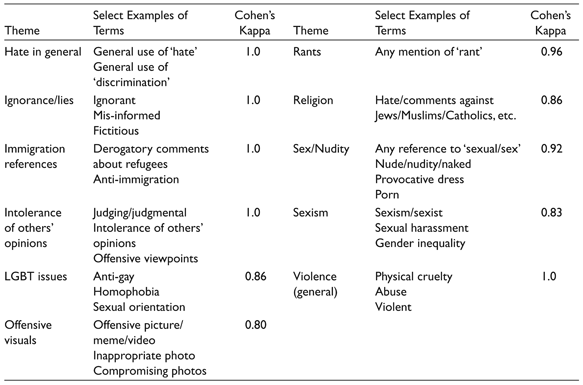
This research utilizes open coding where descriptive labels were written for every reference of inappropriate post seen on Facebook. First, the author read through all responses and color-coded like statements into themes, making a codebook simultaneously. Individual respondents received a ‘1’ if a comment related to a particular theme in the codebook and a ‘0’ if they did not mention a theme. Sometimes, two or more comments received only one code. For example, when listing the top three offensive posts seen, if an individual put ‘comments about gays’ as one comment and ‘comments about transgender individuals’ as a second comment, they both apply to lesbian/gay/bisexual/transgender (LGBT) individuals so even though there are two comments, they can only receive one code of ‘1’ for the theme ‘LGBT issues’. Similarly, some comments may have received more than one code. For example, a response of ‘racist comments against President Obama’ would receive both a ‘1’ for the theme of ‘racism’ and a ‘1’ for the theme of ‘politics’ (since there is a specific reference to the President). Furthermore, not all respondents identified three examples, but some identified only two. Based on this, 18 different themes emerged in the data which had more than five observations. Some examples (not exhaustive) of comments that are coded for particular themes appear in Table 1.
A second independent evaluator coded the same data using the coding themes developed. Inter-rater reliability was established via Cohen’s kappa since the themes were categorical in nature. Originally 9 of the 18 items had a Cohen’s kappa of 0.8 or higher, indicating very strong inter-rater reliability (McHugh, 2012; Viera & Garrett, 2005). For the remaining nine categories, the raters discussed the areas of individual areas of discrepancy for each respondent until agreement in coding was reached and changed accordingly on the master data set; therefore, these themes have a Cohen’s kappa of 1 since they were discussed until agreement was reached. The respective Cohen’s kappa for each theme also appears in Table 1.
Coded Themes in Alphabetical Order with Select Examples of Content

Results
Research Question 1: Inappropriate Themes
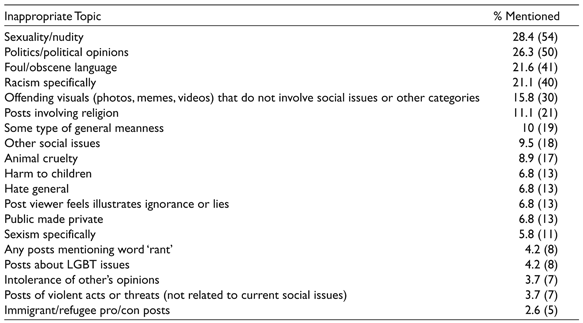
As shown in Table 2, the most common offensive topic adult Facebook users have seen on Facebook involve sex or nudity (28.4%, n = 54). This is followed closely by the discussion of politics (26.3%, n = 50) and the use of foul or offensive language (21.6%, n = 41). These findings suggest that two of the top three offensive posts these adults view, sex/nudity and foul language, are similar to common etiquette in face-to-face interaction. Interestingly, these three themes are generally absent in the previous research where researchers generated hypothetical scenarios (Bazarova, 2012; Roche et al., 2015), suggesting the merit of both using more qualitative methods and looking at different age cohorts.
The use of Facebook for entertainment, rather than controversy, is also indirectly supported by the themes that appear in the middle of the findings’ ranks. For example, of the middle 13 themes found, about half of them involve some type of social issue such as racism, sexism or LGBT issues (Table 2). The specific nature of individual issues may explain why they are not ranked higher.
The three least offensive posts seen on Facebook involve discussions of immigration (2.6%, n = 5), violent acts (3.7%, n = 7) and intolerance of others’ opinions (3.7%, n = 7). It is important to keep in mind that this question is posed as ‘What are the three most offensive posts you have seen on Facebook’. It may not be that these individuals are not offended by such posts; it may simply be that they have not seen them.
Adult Perceptions of Inappropriate Facebook Posts
Research Question 2: Group Differences
Methods
The qualitative results indicate that adult Facebook users find sex/nudity, politics and foul language to be inappropriate on Facebook. There were other, more detailed, themes that emerged that individually may not have enough observations to make the top three; however, these themes can be conceptually grouped with other themes to create categories that may facilitate demographic comparisons between inappropriate perceptions. Therefore, in order to compare group differences, some of the robust detail found in Table 2 was combined into broader categories in order to address Research Question 2 without losing broad themes. The following categories were created by combining some of the previous, more detailed themes: social issues (includes racism, sexism, other social issues, LGBT, disability/illness, Islamic State of Iraq and Syria [ISIS]/Muslim/terrorist, police issues, immigration, feminism and religion); aggression (includes bullying, meanness, hate, violent acts against people, animal cruelty and harm to children); opinion intolerance (includes the subjective judgement of posts as ‘wrong’ and therefore offensive, ‘lies’ and ignorance); and airing private issues in public (includes negative posts about family or friends or too much information).
Also, due to the relative homogeneity of the sample, in order to test group differences, some demographic variables had to be recoded as well. Because almost 94 per cent of the sample is white and there are less than five respondents in any other racial category, race had to be recoded into ‘white’ or ‘non-white’. Education also had to be recoded. Because the research site is a university, the population of faculty and staff tend to be educated, as evidenced by almost three quarters of the sample having at least a 4-year college degree. Therefore, in order to make sure there were enough observations among respondents with lower levels of education, education was recoded into ‘less than a 4-year college degree’, ‘a 4-year college degree’ and ‘more than a 4-year degree’. Last, age needed to be recoded. The categories were coded in a way that divided the sample relatively into thirds and are ‘age 34 and under’, ‘35–54’ and ‘age 55 and older’.
Results
The reorganization of themes into broader categories revealed that social issues is now ranked as the most common type of post seen on Facebook and deemed inappropriate (36.7%, n = 70, Table 3). This is followed by ‘aggression’ (31.6%, n = 60). This is not surprising given that these two categories are composites that include multiple specific themes. The top three areas identified in Research Question 1 are ranked 3–5 accordingly; however, again, these three themes were not changed from their operationalization.
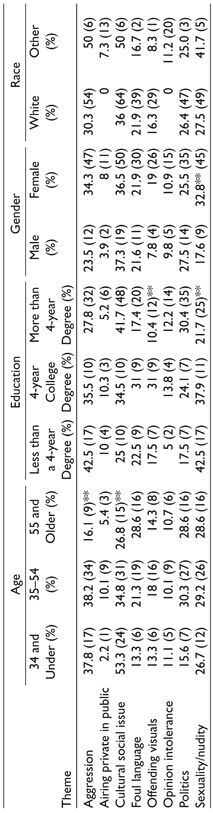
Group findings suggest that there few demographic differences in the types of posts encountered on Facebook and deemed inappropriate. There were no differences in any of the coded categories based on whether a respondent was white or not or based on respondents’ age (Table 4). Gender also had a very limited effect on experiences with inappropriate posts and was limited to posts that involved sexuality or nudity. Perhaps unsurprisingly, women (32.8%) were significantly more likely than men (17.6%, p < 0.05) to claim to identify nudity/sex on Facebook as inappropriate posts that they have seen.
Only education level had more than one statistically significant effect on the inappropriateness of viewed Facebook posts. As with gender, education affects ones’ exposure or view of sexual/nude inappropriate posts. Those with less than a 4-year college degree are more likely (42.5%) to witness and define sexual/nude posts as inappropriate than are those with a 4-year college degree (37.9%) or more (21.7%, p < 0.05).
Education also affects whether one sees visual posts on Facebook that are considered inappropriate. Those with a 4-year college degree are more likely to claim seeing inappropriate visual posts (31%, n = 9), than are those with less (17.5%, n = 7) or more (10.4%, n = 12) than a 4-year degree. The reasons for this are unclear and the finding may just be a statistical anomaly.
Collapsed Themes of Adults’ Perceived Inappropriate Facebook Posts

View of Inappropriate Facebook Posts by Age, Education, Gender and Race
Discussion
With the wide use of Facebook even among the adult population, researchers have begun to study adult experiences with this form of social media. Consequently, we have learned much about adult motivations for Facebook use and that these motivations primarily revolve around learning pleasant and entertaining news of others, to stay connected to others (especially children) and to feel involved with others’ lives (Brandtzaeg et al., 2010; Leung, 2013; Nadkarni & Hofmann, 2012).
However, we know nothing about what adults consider to be inappropriate on Facebook. Current studies focus on college students and issues that are generally generated by the researcher (Bazarova, 2012; Roche et al., 2015). From these studies, we have learned that issues deemed inappropriate for Facebook involve romantic relationship drama, too much personal information or intimate posts (Bazarova, 2012; Roche et al., 2015).
There are no studies that focus on adult Facebook users, including those which are qualitative in nature and focus on what adult Facebook users have experienced and defined as inappropriate in their own words. To address this gap in the literature, this study used a sample of 190 faculty and staff at a university in northeastern Pennsylvania to ascertain the three most inappropriate posts these adults have seen on Facebook.
The findings of this study suggest that two of the three most commonly cited inappropriate posts mirror inappropriate practices in face-to-face interaction and are absent in the previous studies of inappropriateness done on college students. Sex/nudity, foul language and politics were the top three posts encountered on Facebook that these adults considered to be inappropriate. This supports the studies indicating the ongoing controversy over sexuality in public (Fix, 2016; Hetsroni, 2007; Mayo, 2013; Potts & Belden, 2009) and the norm against foul language found among adults in face-to-face interaction (Chirico, 2014). The controversial nature of politics and the use of Facebook for generating entertaining and social ties are possible explanations for why politics was also in the top three themes identified (Miller et al., 2015). Politics and foul language are also themes that are unexplored in previous research and should be included in future studies of both young and older Facebook users.
Interestingly, intolerance of others’ opinions, what would be seen as a breach of etiquette in face-to-face interaction, was among the least mentioned online (Dixon, 2014). Initially, this seems inconsistent with politics being mentioned as inappropriate due to the controversial nature of politics. There are two possible explanations. One, these adults surveyed do not see many examples of intolerance of others’ opinions; therefore, not many mentioned this. Two, as Miller and colleagues (2015) found, people who do discuss politics online do so with like-minded individuals; therefore, while these adults may not particularly feel political discourse is appropriate for Facebook, when they do see it, they may see comments shared among like-minded individuals which minimizes potential controversy. This requires further examination.
In order to explore group differences, some of the details found addressing Research Question 1 were lost as individual themes were sometimes combined into broader related themes in order to facilitate group comparisons. Doing so revealed two more themes, also largely ignored in the literature. The first is social issues. As noted in Research Question 1, many individual social issues were mentioned as inappropriate for Facebook. Obviously, the specific issues mentioned relate to a particular respondent’s interests and views and so many specific issues did not have enough observations to make the top three inappropriate posts. Once combined, the importance of social issues as inappropriate on Facebook, however, became clear. Aggression as a new theme also emerged in the combining of related specific themes and placed in the second position as most inappropriate.
Beyond the emergence of these two new themes, there were not many demographic differences in Facebook perception. The theme with the greatest variation was posts about sex/nudity. Women and those with less than a 4-year degree were most likely to claim to have seen inappropriate posts such as these. While untested, given the long history of the sexual objectification of women in American society and the current view of its inappropriateness in wider society (Fix, 2016; Mayo, 2013; Potts & Belden, 2009), it is unlikely that this difference is because men are not seeing nude or sexual posts and women are. The difference is more likely to be one of interpretation of inappropriateness; however, this explanation cannot be tested here. However, the explanation for the education difference is less clear. Moore and Ovadia (2006) have found that those with lower levels of education tend to be less tolerant of sexuality and nudity than do those with higher levels of education and these findings seem to support that. It is unclear though whether this finding is one of the observation or of the tolerance. In other words, those with lower levels of education may be more likely to encounter Facebook posts involving sex or nudity than are those with higher levels of education; it may be that regardless of level of education, adults find these types of posts to be inappropriate.
In summary, this research contributes to the existing literature by examining what a previously unexplored population—adult Facebook users—has encountered and deemed inappropriate on Facebook. By doing so, previously unexplored themes were found. These themes are sex/nudity, foul language and politics. When unique, but conceptually related, themes were joined, cultural issues and aggression became commonly encountered and considered inappropriate on Facebook. Sex/nudity, foul language and politics became the third to fifth most commonly identified themes.
From a social attachment theory perspective, this is important knowledge. People present themselves in such a way on Facebook as to help others form a positive view of them and facilitate the formation of online relationships. If people share too much of themselves (such as sexual or nude information), put others down (aggression) or use foul language, this presentation of self may backfire since negative post perceptions can lead to negative views of the poster (Goodmon et al., 2014; Oldmeadow et al., 2013; Steeves & Regan, 2014). Furthermore, given the controversial nature of social issues and politics, posts about these issues also risk offending others, leading to negative judgement, and social network strain.
However, because research into adult views of Facebook inappropriateness is new and this was rather exploratory, if done again there are some areas that can be changed. One area of future research is to couple what adults may find offensive with what they have actually seen. This would involve first posing various topics or scenarios indicating potentially offensive posts and asking the adults to react to them, much like researchers of adolescents have done (Bazarova, 2012; Roche et al., 2015). This can be followed with asking adults whether they have actually seen any of the posts described. However, given these findings, the topics researchers propose should be expanded. Second, future research might want to explore why adults find these types of posts inappropriate. This will give more insight to understanding the dynamics between Facebook motivation (e.g., entertainment and social connected- ness) and emerging values involved in Facebook use. Finally, this sample and the population from which it was drawn are rather homogenous in terms of race and gender. Using different populations may identify other themes or suggest more group differences in themes that Facebook users deem to be inappropriate for that venue.