




Abstract
The importance of cultural enterprises to the creation of jobs, generating incomes, alleviating poverty and distributing development has long been recognized. Based on empirical research, this article adopts the convergent parallel mixed design to assess extent of influence of cultural values on the type of cultural industry established in Ghana, taking a case of the kente textile industry in Adanwomase. Adanwomase is argued to be a prominent traditional community in the printing of kente cloths in Ghana. Primary data were obtained from 210 weavers and relevant bodies, such as the Business Advisory Council and traditional leaders through direct interviews, observation and focus group discussions. Findings show that the craft industry in Adanwomase is informal and small-scale in nature. Six key cultural values were identified to statistically have significant influence on the establishment of the textile craft industry. Strongest among them were the festival celebrations and customary law/traditional customs. There was strong correlation between the identified cultural values and the establishment of the textile industry in Adanwomase. Urgent policy and creation of the enabling environment to promote entrepreneurship and create employment through support for research and development (R&D) of cultural industries are needed.
Introduction
This article is concerned with the discourse of the influence of cultural values on the establishment of craft or cultural industries in Ghana. The enterprise establishment and growth of economic ventures is regarded as one of the most improved and successful economic development paths particularly during the post-communist economies (Levitsky, 1996; Milford, 2000; Zecchini, 1997). Every human society has its own shape, purposes and meanings, and is unique in its own way. They express them within institutions, enterprises and in the arts and learning. These are mostly shaped by the cultural values of the societies. As such, the ways that societal institutions function, their goals and their modes of operation, express cultural value priorities (Schwartz, 1999, 2005, 2006). Fukuyama (2001, pp. 31–30) states that ‘culture covers the norms, values, interpretations and the modes of behaviour that define societies and/or other social entities’. It is the set of ideas and values that are portioned out and non-genetically transmitted within a group (Sperber, 1996; Zion & Kozleski, 2005) and are transmitted between individuals of the same generation and between generations (Stamatopoulou, 2007). The differences of societies mean different cultures and the varying attitudes towards the kind of economic activities they engage in (AlMatawah & Jadaan, 2013). Cultural values are fundamental dimensions of the development process (United Nations Population Fund [UNFPA], 2008) and this shows that the development of an economy aside other factors is largely influenced by the cultural values of the human society. This is reflected in several empirical studies, which showed that the types and choices of enterprises that societies engage in are influenced by the cultural values of the societies (Adjei, 2012; Davidsson, 1995; Gibson and van der Vaart, 2008; Hood, 2003).
However, classical theories of cultural values, such as that of Inglehart (1977, 1990) and Triandis (1990) address limited aspects of culture (such as materialism–post-materialism; individualism– collectivism) rather than seeking to capture a full range of potentially relevant value dimensions. With this Duh and Belak (2009, p. 4) argued that in an enterprise ‘values serve to convey a sense of identity to its members, enhance the stability of its social system, direct attention to important issues, guide subsequent decisions by managers, and facilitate commitment to something larger than self’. Individuals are born into a very complex morass of beliefs, values, rules, behaviour, norms and institutions and these impact on individual decisions, as do the institutions (Levitsky, 1996; Zecchini, 1997). Therefore while ‘enterprise culture’ may be described as the typical views, beliefs, behaviour, norms and institutions of a group which relate to enterprise, efforts to enable and stimulate entrepreneurial activity need an answer to the question of why and how culture and individuals interact; that is; ‘In what ways does culture form and influence the decisions of individuals and enterprise establishment?’ (Hull, 2003). This requires an understanding of how it moves within a group and how it evolves (Wimsatt, 2001, p. 15). This is particularly relevant for enterprise development based on cultural values (Audretsch, 2002; Robson, 2001).
Cultural Values and Cultural/Craft Industries
Cultural values plays important role in enterprise development, specifically the craft, creative or cultural industry. The craft industries sub-sector argued to be one of the 13 economic sub-sectors grouped under the definition of creative industries (advertising, art and antiques, architecture, crafts, design, designer fashion, film, interactive leisure, music, performing arts, publishing, television and radio) (United Nations Educational, Scientific and Cultural Organization [UNESCO], 2005; United Nations Industrial Development Organization [UNIDO], 2002). The cultural industry though small scale is noted for its job creation, income generation, skill development and local economic development capability (Boeh-Ocansey, 2008; Food and Agricultural Organisation [FAO], 2009). In Ghana, cultural values are expressed in either non-material or intangible forms; languages, political ideas, dialects, philosophical thought, morals and ethics, religious beliefs and rituals oral traditions, folklore, festivals, music and dance, social customs related to birth, marriage, family life, work, death among others. Ghana has over 50 ethnic groups whose common cultural and traditional values and institutions represent collective national heritage (National Commission on Culture, 2015). The groups, Akans who are the predominant ethnic group in Ghana (47.5 per cent), followed by the Mole Dagbani (16.6 per cent), the Ewe (13.9 per cent) and Ga-Dangme (7.4 per cent) and the Mande ethnic group (1.1 per cent) (Ghana Statistical Service [GSS], 2012), are identified by means of history, unique cultural characteristics and traditions.
In an enterprise therefore, Kadocsa (2007) notes that values convey a sense of identity to its members, which have the ability to enhance the stability of its social system, direct attention to important issues, guide subsequent decisions and facilitate commitment to something larger than self. A clause in the Ghana Cultural Policy, ‘… the State shall actively support research into production and preservation of local foods and the compilation of traditional recipes and methods of preservation … Ghanaians shall be encouraged to develop a culture of producing what they eat and eating what they produce’, indicates that Ghana’s cultural traditions can and should be positively tapped for developmental agenda. For instance, a report by the UNESCO shows that in 2010, cultural activities contributed to 1.5 per cent of the Gross Domestic Product (GDP) in Ghana, where about 41 per cent of this contribution was generated by central cultural activities, 0.03 per cent of the employed population in Ghana had cultural occupations and 60 per cent by equipment/supporting cultural activities (UNESCO, 2011). This underpins the significance of the enabling and driving role of culture in sustainable development. The present study therefore avoids repetition of what other scholars have written on the textile (kente) industry in Ghana but places much emphasis on the specific cultural values that influences the development of the industry. Thus, culture is argued to be very key in creating economic opportunities in human societies, but to what extent? Despite the various attempts by researchers to show how important cultural values can be in promoting establishment of craft industries, most of such studies failed to identify the individual values and assess their extent of influence on the establishment of cultural enterprises in society. There are no known empirical studies on the influence of cultural values on industry establishment in Ghana. At best, studies on cultural industries in Ghana discusses the industry players, culture and the challenges confronting the industry (Badoe & Opoku-Asare, 2014; Frimpong & Asinyo, 2013; UNESCO, 2011), without prior consideration to the symbiotic relationship between these two important variables. The study therefore investigates the specific cultural values that have influenced the establishment of cultural enterprises, taking the case of the textile industry in the Adanwomase community, which is argued to be the prominent traditional community in the printing of kente cloths. Efforts are made to recommend appropriate solutions to overcome identified challenges confronting the industry based on the findings of the study. We further sought to statistically test the null hypothesis: ‘There is no significant association between the type of cultural industry established and the cultural values of a community’.
Materials and Methods
Research Design
The current study adopts the convergent parallel mixed design which provides a mixture of quantitative and qualitative explanations to the study (Johnson & Onwuegbuzie, 2004). The design was adopted to identify and examine the cultural values that had influenced the establishment of creative/craft industries in Adanwomase, specifically the textile industry. The quantitative approach provided quantity on the number and types of industries operated by respondents, the age, ethnic affiliation and a statistical analysis (multiple regression and chi-square test) on the level of influence of cultural values on enterprises establishment and development. Group discussion and key informant interviews were used to understand, interpret and describe (Morse & Field, 1996) the cultural values that have shaped the craft industries in the community. The qualitative techniques were inductive, subjective and process-oriented method which was adopted to understand, interpret and describe cultural values that had influenced the kind of cultural industries in Adanwomase.
Sampling Strategy
The study population comprise enterprise operators within the kente textile industry in Adanwomase. A sample of 210 economic actors (kente weavers) out of a total population of 438 was used for the study, at 95 per cent confidence level and 5 per cent error margin. A limitation of the study was the absence of data on the number of kente weavers in the study community. Owing to this limitation, the authors enumerated all identifiable kente weavers in the study area to obtain the sample frame, upon which the sample size was statistically determined. The purposive sampling method was adopted for the selection of the actors because the scope of the research was limited to only the kente textile industry in the Adanwomase community. The actors, who happened to be the units of inquiry, were then randomly selected for interview.
Units of Inquiry and Analysis
Totally 210 kente weavers were selected for the study. To ensure internal validity, the quantitative and qualitative techniques were used to obtain responses from various groups to understand the influence of cultural values on the types of enterprises that are established in the Adanwomase community. The data collected from the primary respondents were triangulated with those obtained from the heads of relevant institutions identified in the study to render the findings more accurate and valid and superior to mono-method. The units of inquiry were the kente weavers, traditional leaders of the Adanwomase community and the heads of relevant institutions, such as the Business Advisory Council (BAC) and District Planning Office of the Kwabre East District Assembly.
Data Collection Tools and Process
Design of the Tools for Data Collection
Interview schedules, interview guides and observational checklists were prepared by the authors to elicit the required responses from the kente weavers, traditional leaders and heads of the relevant institutions. The interview schedules were pre-tested. As part of the pre-testing, we observed the time taken to administer each interview schedule, the responsiveness of participants and any difficulty experienced in understanding and interpreting the questions in the instruments. The results of the pilot testing helped improve the quality of the instruments by incorporating relevant feedbacks from respondents. The interview schedules gathered information on business characteristics, demographic and occupational characteristics, income and expenditure and cultural values. Observational checklists were prepared to guide direct observations. The checklist covered issues on the sex of operators, process of weaving, equipment used and the cultural practices in the community.
Process of Data Collection
At the community and economic actors’ levels, personal interviews and focus group discussions were used to gather relevant data from respondents on the influence of cultural values on the forms of enterprises they were engaged in. Focus Group Discussions (FGDs) were held to have a better understanding of the issues raised by the communities, particularly on their cultural values and how they had influenced the kente weaving industry. The average number of participants of the FGDs was 10. The number of participants selected for the focus group discussions was thus inspired by the work of Manoranjitham and Jacob (2007) who argued that the optimal number of participants for focus group discussion should range between eight and ten. The FGDs were held for the Adanwomase traditional authority and two groups of the kente weavers; one male and female group each. The survey research approach was further used in obtaining relevant data for the study. This was undertaken by constructing a set of questions that were either asked by means of a structured questionnaire or through an interview as indicated by Babbie (2010) to achieve the objectives of the study. The approach allowed the authors to quantify and generalize the research findings to an entire population, if the sample was appropriately determined and selected. Errors were minimized in the approach using standardized structured questionnaires and guides. Primary data were obtained through direct interviews with members the selected officials of relevant institutions, such as the Business Advisory Council and District Planning Office, under the Kwabre East District Assembly and traditional authorities in the study community. The units of enquiry were purposively selected due to the mandated roles they are expected to play in promoting economic development and general wellbeing in the community.
Analytical Methods
Assessing the Influence of Cultural Values on Enterprise Establishment
The study adopted both quantitative and qualitative techniques in analysing the responses from the units of analyses. The quantitative data were presented in simple frequencies, percentages ad in Tables in consultation with traditional leaders, economic actors and institutions, the six independent/predictor variables (cultural values–festivals, respect for traditional leaders, funeral celebrations, symbols/identity, folklore and customary laws/traditional customs) were obtained. The multiple-linear regression model was hence applied to assess the influence of the predictor variables on the dependent variable (the kind of enterprises/craft industry established); where the linear correlation coefficient (R) and the coefficient of determination (R2) were used to provide further explanation of the results. The R, measured the strength and the direction of a linear relationship between two variables. The R2 gave the proportion of the variance (fluctuation) of one variable that is predictable from the other variable. It allowed the authors to determine how certain we could be in making predictions from the model set. The parameters of the model were estimated using the multiple squares method.
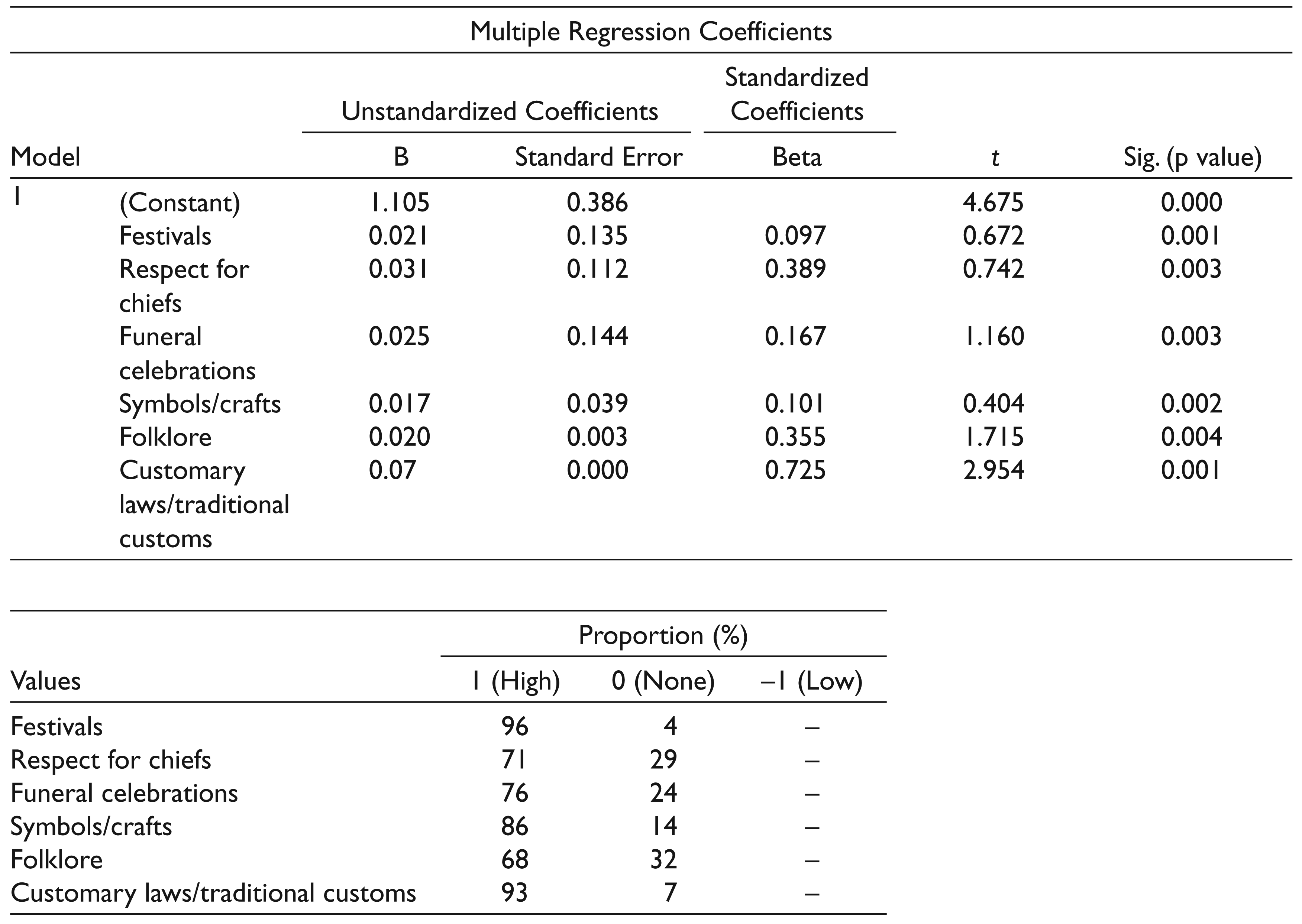
The equation y = k0 + k1x1 + k2x2 + k3x3 + k4x4 – k5x5 – k6x6 was the multiple regression equation model used in the analysis. In this equation, y is kind of enterprise (cultural industry) establishment (dependent variable); k is constant; x1 is festivals (independent variable); x2 is respect for traditional leaders (independent variable); x3 is funeral celebrations (independent variable); x4is symbols/identity (independent variable); x5 is folklore (independent variable); x6 is customary law and traditional customs (independent variable). After the identification of the variables, the first question respondents were asked was Do these cultural values (which were asked one after the other) have influence on the kind of industry you are presently engaged in? This was a dichotomous question which required a ‘yes’ or ‘no’ answer. Respondents who indicated ‘yes’ were further asked to rank by means of a three-point likert scale (1: positive/high influence; 0: no known influence; and – 1: negative or low influence). These were then quantified and used in the subsequent statistical analysis to assess the association between the dependent and predictor variables.
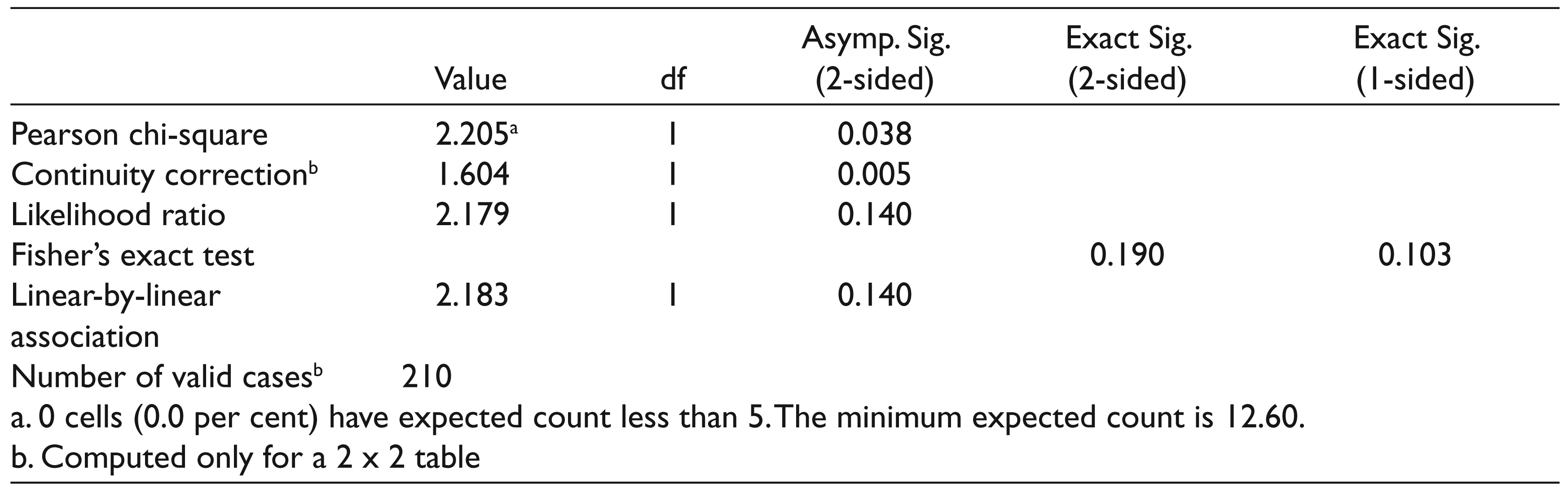
The Pearson chi-square test was further used to determine the degree of association between cultural values and the type of craft industries established in the Adanwomase community. This was accepted at p ≤ 0.05. The authors further employed the participatory rapid appraisals which involved FGDs with members of the community on cultural values and enterprise establishment.
Results and Discussions
The Adanwomase Community
The study was carried out in Adanwomase, a rich traditional community in the Kwabre East District of the Ashanti Region, Ghana. The district has Mampongteng as the district capital. The district lies within latitudes 60’44 North and longitudes 10’33 to 1044’ West. It has Afigya-Kwabre, Sekyere South, Kumasi Metropolis and Ejisu-Juaben Municipality as bordering districts to the West, North, South and South-East, respectively. The district has over 40 towns and villages. The district capital, Mamponteng, is about 14.5 kilometres from Kumasi to the northeast Kwabre East District Medium-Term Development Plan (KEDMTDP, 2013) (Figure 1).

The proximity of the district to the Kumasi Metropolis is the major reason for the increase in growth over the years. This has had implications with respect to the increased human pressure on economic and social infrastructure. The Kumasi Metropolis is the traditional home of the Asantes, whose tradition and festivities create enormous market and demand for the rich kente textile cloth. The district is predominantly ‘Akan’ constituting about 87 per cent of the population. Approximately 10 per cent of the populace comes from the northern part of Ghana and the others constitute about 3 per cent of the population. People from the northern part of Ghana are largely migrants who are used as farm hands. The stability of the district is thus portrayed in the structure of ethnic groups and their predominately homogenous in nature (KEDMTDP, 2013). Our interview with the traditional leaders of the community showed that, during traditional occasions such as the ‘Akwasidae’ festival, traditional leaders put on the best of kente cloth to such occasions, as is the customary practice of the Ashanti kingdom. The Kwabre District is regarded the home of kente cloths. Adanwomase is noted for its famous kente industry. Every year several tourists visit these weaving towns to acquaint themselves with information about the industry.
Sociocultural and Political Geography of Adanwomase and the Kente Textile Industry
Adanwomase is a known traditional Asante Kente Cloth weaving town of about 5,000 residents in the northeast part of the Kwabre East District, Ashanti Region. It is about 27 kilometres northeast of Kumasi. It is a settlement of kente textiles weavers, using traditional designs and symbols which are indicative of the religious, political and sociocultural reasoning of the Asantes. The major occupation aside farming is thus kente weaving, a skill that is mostly innate and only needs polishing from the professionals. Ghana and for that matter the Ashanti Region, is known for its rich traditional kente cloth which is synonymous with the country and her traditional rulers, particularly those from the southern part. The kente cloth is a source of pride to its owners as it demonstrates one’s position and status in the community depending on the type worn. Around 1697, the Ashanti King, desiring hand-woven cloth, commissioned one of his sub-chiefs, the Akyimpimhene, to send people from the towns of Adanwomase, Asotwe, Bonwire and Wonoo to study strip-weaving in Bontuku, a small village in present-day Ivory Coast. When they returned, the apprentices were given swatches of fabric with specific patterns on them that they were told to study and be able to recreate on demand. These patterns were called Sesea and are considered to be the first examples of true Ashanti Kente Cloth. The original centuries-old Sesea swatches are to this day kept in the kente chief’s house in Adanwomase. Since the first apprentices returned from Bontuku, Adanwomase has been the royal weaving village for the Ashanti King. The apprentices spread the art of kente-weaving to friends and families and in the process added their own designs and colours, creating the cloth that today is recognized worldwide as ‘Ashanti Kente’.
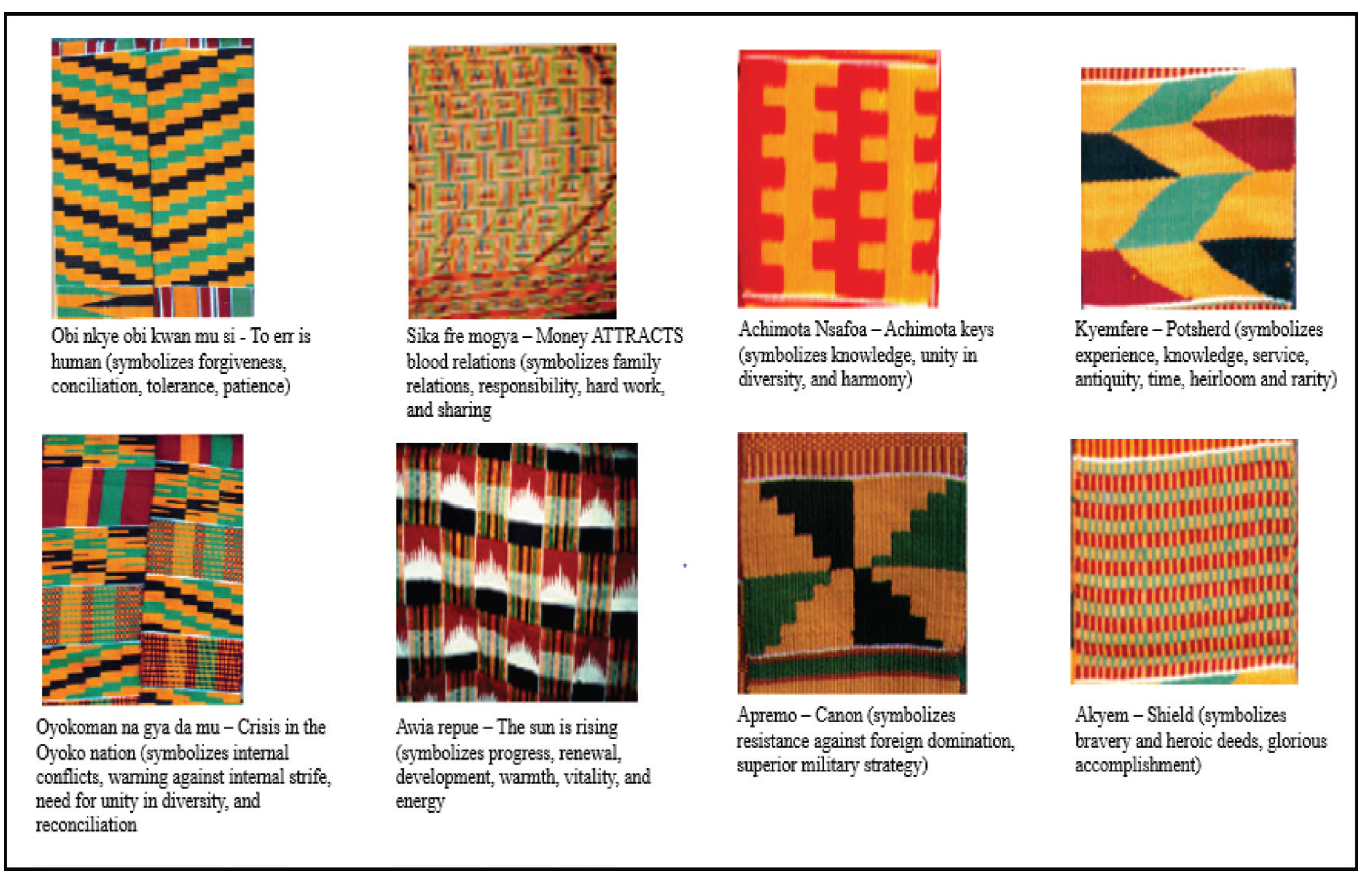
The cloth is a hand-woven cloth created for people of royalty due to its cost and complexity and has a deep rich history. It is often woven out of cotton, rayon and silk. Weavers in Ghana convey philosophy, ethics, history, oral literature, moral values, codes of conduct and religious beliefs through ceremonial weaving of special patterns and colours called ‘kente’. The cloth is woven on horizontal loom. Strips of about four inches wide are sewn together to make larger pieces of cloth. Yarn for the cloth is traditionally spun from cotton or silk. Various colours have different symbolic meanings and different combinations of silk, cotton and coloured yarn carry different levels of prestige. There are more than 300 types of cloth design patterns. Each design has a name and a meaning, and notably weaving the designs with different colours depicts the meanings. Over time, the use of the cloth became more widespread. However, its importance has remained and is held in high esteem in the Akan family and the entire country of Ghana. In Ghana, kente is made largely by the Akan people (including the Asante, Bono, Fante and Nzema) and is also produced by Akan groups in Cote d’Ivoire, such as the Baoule and Anyin, who trace their ancestry back to Ghana before the rise of the Ashanti Empire. It is also worn by other ethnic groups in the country, such as the Ewes and Gas who have been influenced by the Akan culture and traditions. To this day, Adanwomase carries on the centuries-old kente weaving tradition. Under the guidance of the kente chief, Adanwomase weavers continue to weave cloths for the Ashanti king, royals and anyone in the world who appreciates the history and cultural significance woven into Ashanti Kente.
Major Economic Establishments and Background of Respondents
We observed that the predominant craft industry in Adanwomase, aside other economic ventures (retail, blacksmithing, construction, transport), the textile industry, kente weaving, tie and dye prints, which employed about 82 per cent of the residents in the community. The diversification of the local economy presents enormous potential for employment and revenue generation. The industry is dominated by males (89 per cent of the weavers are males). On the dominance of males in the textile industry in Adanwomase, Keane and Velde (2008) assert that ‘although most studies on gender and equity in textile and clothing production find a gender bias against women in both working conditions and financial remuneration, employment within the industry is in many countries favours women’. This is because it is regarded as better compared to other alternatives, such as agriculture and/or domestic service, in the amount of wages paid (Barrientos, Kabeer & Hossain, 2004). Kabeer and Mahmud (2004) further assert that the alternative for women in the urban garment firms, particularly in Bangladesh and Cambodia is seeking employment in rural areas which is dominated by men and where gender inequalities are higher. The textile industry therefore offers better employment opportunities than they would have had in the rural areas, and they pay twice the rate of domestic servants in Bangladesh. Our study revealed that the higher proportion of the male weavers was largely because they are seen to be skilful with the craft. Women largely are involved in flexible employments, such as the sale of the finished products. This was confirmed during FGDs with both men and women groups, who indicated that women, though were also very skilful with craft, preferred selling the finished products than working tirelessly on the making of the cloth. This is deemed a sociocultural practice, where females are to provide and undertake basic flexible support for the family, such as engaging in farming, petty trading and other commercial ventures (Baah-Boateng, 2009). The weaving craft industry is argued to be one which requires ‘strength’ to undertake due to the traditional tools and equipment used in the weaving process (Badoe & Opoku-Asare, 2014), and as such requires young talented individuals to undertake it. The survey hence showed that 80 per cent of the weavers are within the economically active age group (18 to 64 years). Out this figure, approximately 42 per cent are in their youthful ages, with the mean age of 31 years. Respondents further indicated that youth unemployment which is one of the principal social and economic challenges of this decade around the world need to be tackled and so the need to learn and practice a craft. Actors in the textile industry produced traditional cloths for their customers, tourists, chiefs, households, retailers and wholesalers and anyone who had need of the products.
Cultural values are believed to be passed on from one generation to another (Bruman, 1999; Fukuyama, 2001) and thus require time and experience to perfect the craft. Actors had been in the craft industry for a minimum of 5 years, with the average number of years of being in the industry was 8 years. The FGDs with the weavers pointed out that ‘it takes time for one to learn and understand the craft. I starttd learning the craft from my father at age 12. It took me almost 4 years to know almost everything about it. The sustainability of the craft industry is therefore dependent on one’s ability to pass the craft onto the incoming generation’. AlMatawah and Jadaan (2013) supporting this state that there is the likelihood of passing over the craft onto the younger generation, thus sustaining the craft industry within the study area. Also, remaining in business for that length of time gives an indication of the industry being a major source of livelihood support to actors.
Actors operated their businesses on sole proprietorship. A majority of the actors (92 per cent) operated on sole proprietorship largely because they take pleasure in owning and operating their own businesses, have control over the activities and put in measures to improve upon the business revenue so as to take care of the financial needs of the enterprise to keep it running. As espoused by Permwanichagun, Kaenmanee, Naipinit and Na Sakolnakorn (2014), the major challenge of businesses run on such basis is high degree of indebtedness and collapse. However, such a business classification is popular because it is easy to set up and carries a low cost for a first investment. The textile craft industry, as found in several economies, was revealed to be informal in nature and part of the Adanwomase’s urban informal economy. Ghana’s urban informal economy presents three (3) key issues that should be critically considered. The first critical issue is where workers are confronted with the challenge of social marginality and where actors were casual workers with unstable wage earnings. Second issue is where businesses are also confronted with the state regulation of the labour process where actors are self-employed and labour conditions characterized by the absence of official protection. Last is where activities are characterized by a set of heterogeneous activities of micro-and small-scale activities, no formal registration and free entry and exit (Ayerakwa, 2012; Hull, 2009). The craft industry accordingly was largely neglected by urban authorities (the BAC and Planning Office of the District Assembly) in terms of regulating their activities and providing the needed infrastructure and related services. Last, none of the enterprises was registered, which is usual of informal economic activities in Ghana (Amponsah, Quansah & King, 2012). However, weavers indicated that they paid a daily rate of GH¢2 1 (US$ 0.50) as taxes/tolls to the urban authorities (District Assembly), which was for developmental projects in the community and the district at large. The craft industry plays significant role in creating employment opportunities to many people across the globe (Davidsson, 1995; Gibson & van der Vaart, 2008), by training numerous apprentices who later become owners of their own establishments. The apprentices were however not paid regular wages, because they were under training. The non-payment of regular wages permitted enterprise operators to engage many apprentices, confirming a study by Anokye and Afrane (2014). The study showed that the labour strength (number of workers) of the textile industry in Adanwomase averaged three workers. This according to respondents was to help to train others of the craft and as well increase the scale of their production to meet the needs of their customers.
Developing and sustaining the craft industry and improving living standards of the people require adequate and reliable finance (The World Bank, 2015; UNIDO, 2002) and raw materials. UNIDO (2002) specifically indicates that the cultural industry thrives well with good and sound capital base. The industry, due to it been ran on small scale, was threatened by the challenge of accessing formal and sound credit support, managerial skills and sound macroeconomic policies (Boeh-Ocansey, 2008; Variyam & Kraybill, 1994). We identified that 66 per cent of the economic actors did not have access to (regular and adequate) credit facilities in cases where they needed financial assistance, which they argued adversely affected their activities whenever there was the need to purchase raw materials during high demands. Estimating the expenditure/costs of production and revenue accrued to the enterprises showed that actors incurred an average monthly expenditure of GH¢1,407.04 (US$ 354.80) and monthly revenue of GH¢1,731.11 (US$ 436.52) depicting an average monthly profit/turnover of GH¢324.07 (US$ 81.72). The foregoing discussion indicates that the cultural industry is a very significant sector to local economic development. It has the potential of addressing unemployment issues, presenting and protecting the rich cultural and traditions of communities, generating revenue for actors and ensuring overall wellbeing of individuals.
Cultural Practices and Values and the Kente Textile Industry
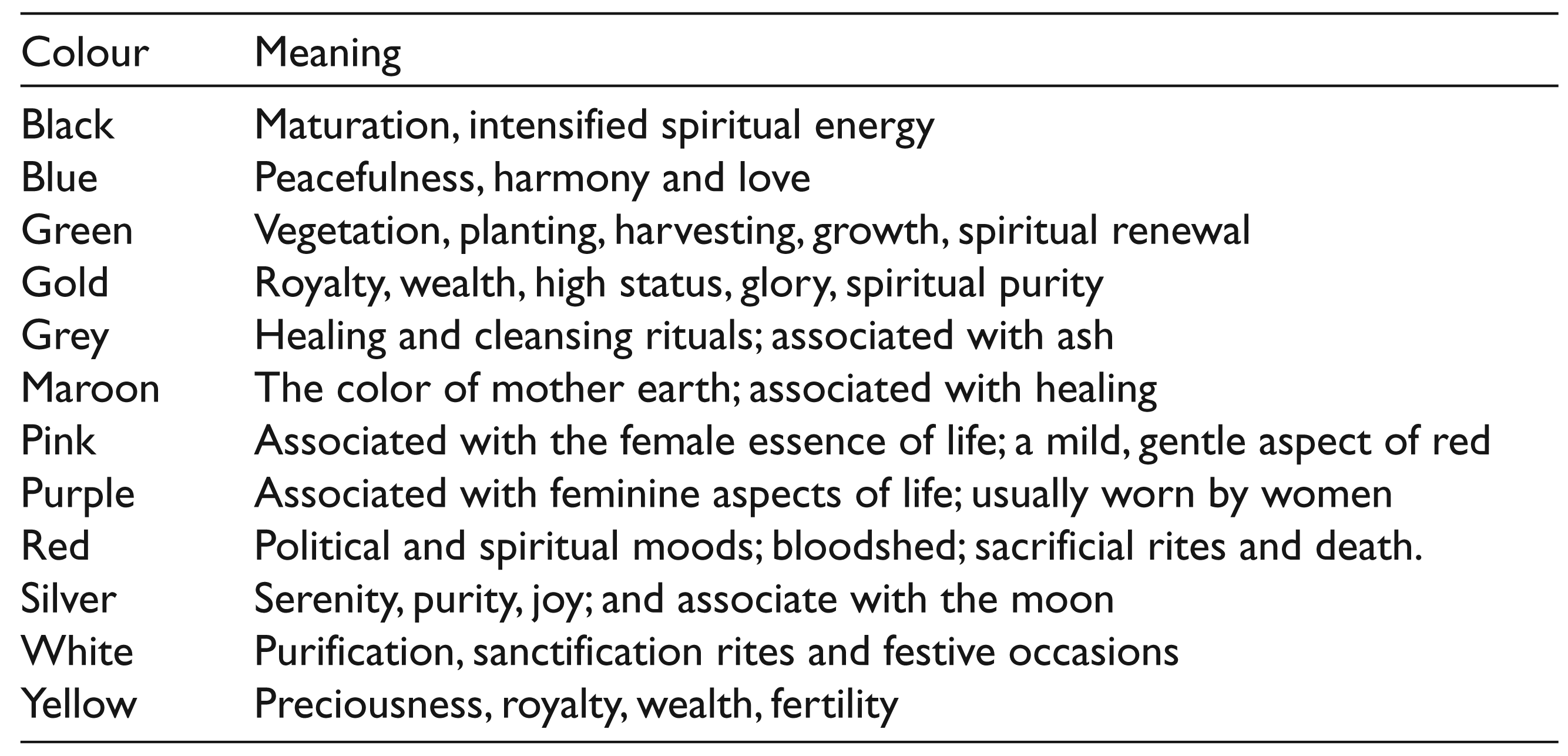
Cultural values, practices and beliefs are ideal measures as they can influence the forms of craft or cultural industries that exist in a community (Adjei, 2012; Schwartz, 2006). We identified eight distinct cultural values that had influenced the establishment of the textile craft industry in Adanwomase. These values identified were festivals, respect for traditional leaders, funeral celebrations, symbols/identity, folklores, and customary laws/traditional customs, which largely influenced the names of some of the finished products produced and offered for sale. The festivals mainly observed by the community, which happen to be an Akan community, are the popular Akwasidae and Addae Kese. The Addae Kese is held every 5 years, whereas the Akwasidae is celebrated every 6 weeks in accordance with the Akan calendar which is based on a cycle of 42 days and 9 months in a year. The last Akwasidae festival invariably is set aside for the celebration of Addae Kese. The festivals are observed in the honour of the King of the Ahanti Kingdom, Otumfour Osei Tutu II. The festivals bring to the Kumasi Metropolis, traditional leaders across the country, foreigners and other dignitaries, who would wish to pay their respect and homage to the King. The type of kente cloths worn by traditional leaders indicates the position of the respective leaders. Traditional leaders and other visitors put on the best of kente cloths of different colours and meanings to the festivals to pay homage to the King (Table 1).
Meaning of Colours of Kente Cloth
Silayoi and Speece (2007) note that products of the cultural industry seek to make use of traditional and cultural names, symbols, signs and colours to make products appealing and attractive to customers. There exist a collection of many kente designs most of which are identified by their specific names, associated with customs, symbols, occasions and traditions. The commonest ones are showed in Figure 2.
The cloths were purchased by indigenes, residents outside the district and foreigners (tourists) for various purposes. Prices of the cloths ranged between GH¢300 (US$ 75.65) to as high as GH¢2,000 (US$ 504.32), which was dependent on the type, size, quality, ‘iconic name’ and occasion for which the products were made.
Multiple Regression Analysis: Cultural Values and Enterprise Establishment
The extent of influence of cultural values (independent variable) on the kind of craft industry established (dependent variable) was assessed by means of the multiple regression analysis. The test showed a strong positive correlation between the type of craft industry (kente textile industry) operated in Adanwomase and the predictor variables (cultural values). This is depicted by a multiple correlation coefficient (R) of 0.904. The multiple regression model with the predictors produced a coefficient of determination (R2) of 0.817 (Table 2 and 3). This implies that about 82 per cent of the variation in the type of cultural enterprise (kente industry) established (dependent variable) has been accounted for through linear effects of the predictor variables (festivals, respect for traditional leaders, funeral celebrations, symbols/identity, folklore, customary laws/traditional customs).
Model Summary of the Relationship Between the Dependent Variable and the Independent Variables

Macroeconomic policies aimed at creating cultural industries should therefore identify existing cultural practices/values, capitalize on it and create the needed industry for residents (Bekele & Zeleke, 2008). Weavers indicated that they were into the business because they had learned it over the years and because of the high tradition attached to the cloth, it was very lucrative to engage in such an industry. The establishment of the cultural industry has further created employment opportunities for the labour force of the community and means to improving wellbeing of dwellers (Thiyagarajan, Turton & Beresnev, 2014).
Analysis of Variance to Test the Strength of the Multiple Regression Model
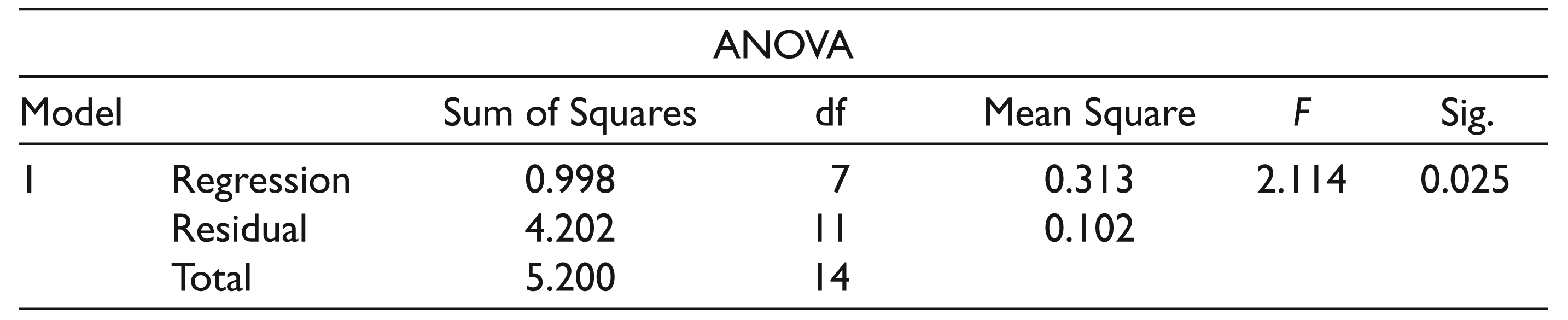
Our research also showed that the cultural values did not function as a hindrance to the development of the textile craft industry, but a key driver to its growth. The Ashanti tradition which has in it festivals, celebrations and other important occasions, call for producing more of the cloth. There is always demand for the cloth [A male weaver/respondent]. Respondents were however unhappy about the increasing number (entry) of weavers in the industry which they argued has adversely affected sales and income.
The predictor variables could be reliably used to statistically predict the dependent variable in Adanwomase, since the p value of 0.025 is less than the F value of 2.114 (Table 4). Hence, the overall equation was found to be statistically significant (F = 2.114, p < 0.025) The overall significance test shows that the predictor variables have positive impact/influence on the kind of cultural enterprise (kente textile) established (dependent variable) in the study area.
The individual predictor variables exerted a positive and significant effect on the type of cultural industry and respondents were engaged (kente textile) in Adanwomase (Table 4) since their significant values are less than or equal to 0.05 (p ≤ 0.005). Furthermore, the computed Pearson chi-square statistic value of 2.205 with p-value of 0.038 is less than the significance value of 5 per cent or 0.05 (p < 0.05) which gives an indication that there is a statistically significant association between cultural/creative industry and cultural values (Table 5). The null hypothesis is therefore rejected but accepts the alternate hypothesis that ‘there is an association between cultural/creative industry and cultural values of individuals/community’. In other words, the type of cultural/creative industry established is not independent of cultural values/practices. This confirms several studies that cultural values influence the type creative industry individuals are engaged in and as such culture influences people’s values, their beliefs and can, in turn, determine their behaviour (AlMatawah & Jadaan, 2013; Zion & Kozleski, 2005). Schwartz (2006) further state that a cultural value emphasis on success and ambition may be reflected in and promote highly competitive economic systems.
Multiple Regression Model for Kind of Enterprise Establishment
Across the globe and in Ghana, cultural values are shown in either intangible or non-material forms (National Commission on Culture, 2015). Nijkamp (2003) notes that cultural values have been the focus of many researchers particularly in the behavioural science, to ascertain the level of influence of how these values impact the development and establishment of businesses. The cultural industries sub-sector impacts significantly and positively on the economic growth of countries and people (Levitsky, 1996; UNIDO, 2002; Zecchini, 1997). The sub-sector comprises both small-and medium-scale enterprises. This indicates the significance of these craft enterprises, which are traditionally or culturally inclined to the local, regional and global development, if well researched into.
Association Between Cultural/Creative Industry and Cultural Values of Individuals/Community
Challenges Confronting the Industry
The cultural industry in Adanwomase is confronted with the major challenge of difficulty in gaining access to appropriate technologies and information on available techniques. This according to Aryeetey, Baah-Nuakoh, Duggleby, Hettige and Steel (1994) limits innovation and SME competitiveness. According to Boeh-Ocansey (2008), high transaction costs, a risk related to small loans and lack of collateral restricts, limits industry’s access to formal credit. Other challenges revealed were low patronage of finished products (71 per cent), high cost of ‘raw materials’ (92 per cent ), limited access to credit/financial support, and high expenditure patterns (66 per cent). The growth of the industry in terms of the increasing number of actors also adversely affected sales and income generation. These challenges according to actors impede on the success of their activities; low revenue or income to sustain the business, register the enterprises, pay their tolls to the assembly and cater for the households.
With regard to the selected relevant institutions in developing the industry, the BAC and Planning Office revealed weak institutional support and capability to promote the cultural (textile) industry. The offices also argued that they did not have enough logistics to regularly monitor the activities of the actors and as well provide the needed infrastructure and other related service. The survey also revealed that most of the youth (who wanted to enter the textile industry) could hardly afford the initial investment to start their own business and thus called for a financial scheme to be set up solely for people within the industry. Furthermore, due to logistical and financial constraints, and also the informal nature of the industry, authorities (BAC and Planning Office) were unable to have a detailed list and the exact number of workers within the industry in the community. This has implications on revenue mobilization for development activities in the community and the district at large.
In Nigeria however, the challenge of the failure of many programmes to develop enterprises were not attributed to poor managerial skills, limited access to financial support and macroeconomic policy, but rather limited access to land, weaker marketing strategies, undeveloped infrastructure, unfavourable policies and legislations and economic climate (Bekele & Zekele, 2008). Some other works identified policy environment and political stability as well as human development as factors affecting enterprise development (Masakure, Cranfield & Henson, 2008). These were similarly experienced by the industry players in the community. Improving cultural enterprises’ access to financial support is a major tool to positively impact the development and establishment of many enterprises to ensure development of the local economy (Lawson, 2007).
Conclusion
There has been much attention to promoting the development of industries in a more sustainable way, through the establishment of small-and medium-scale enterprises. There exist varied empirical studies in countries across the globe on the relationship between the economic and sociocultural and political factors that influence enterprise establishment and development (Kotir & Obeng-Odom, 2009; Ogunrinola & Alege, 2007; Pronyk, Hargreaves & Morduch, 2007). The establishment of local enterprises has great impacts on import-substitution strategy as some goods and services are produced by local firms (Ojo, 2003). Research works have showed that cultural practices and factors to a large extent have influence on the establishment and development of cultural/craft industries (Audretsch & Fritsch, 1994; Davidsson & Delmar, 1992; Davidsson, 1995; Mueller & Goić, 2002; Reynolds, Storey & Westhead, 1994). Hence, the culture, values, norms, beliefs and practices of a region determines the kind of enterprise or cultural industry in that region. The study, based on the kente textile industry in Adanwomase in the Kwabre East District, reveals that the industry has a number of potentials for local development in terms of employment and income generation, skill acquisition and transmission, technology adaptation, survival or sustainability instincts, growth and expansion. Most importantly, the cultural values of individuals and the community strongly and significantly had influence on the type of craft industry (kente textile industry) found in the Adanwomase community.
We recommend the need to promote entrepreneurship and creating employment through support for research and development (R&D) of cultural industries. A comprehensive study of the importance of cultural factors on enterprise establishment process is deemed necessary to identify and take note of the traditions, values, norms and attitudes of the population of the country. This calls for the channelling of enough resources by the Ministry of Trade and Industry; both financial and human; to identify all cultural factors that can influence the development of cultural industries. The National Board for Small Scale Industries (NBSSI) and BAC are to spearhead the research and development process to promote the development of such industries. This would help identify all potential and/or constraining cultural factors in other jurisdictions that affect enterprise development, take advantage of the potentials to develop the cultural industries, and create employment to promote local and national development.
The study also calls for the need of administrative and regulatory frameworks for the textile craft industry to be simplified and improved so that they can flourish. Improvements in the levels of entrepreneurial activities require that individuals make decisions: to either start enterprises along with all the decisions that this entails, or to consider ways to improve their enterprise activities. To make these decisions of the individual (entrepreneur) requires sound/enabling environment, where his investments would be fruitful.
The Ministry of Trade and Industry should develop an implementable and sound policy framework in order to promote entrepreneurship and create employment through the cultural industries. The framework should define clearly the requirements of individuals who would want to enter the cultural industries. Furthermore, the enabling environment should take into focus the measures, such as tax incentives and infrastructural development, for entrepreneurs to expand the scale of operations and enjoy economies of scale. Also, the desires and interest of the investors/entrepreneurs should also be well protected by the framework.
Last, the District Assembly through the BAC should take steps at formally registering the businesses so as to have a database of the enterprises, create the avenue to effectively mobile revenue and provide the needed infrastructure and other related services. Furthermore, there should also be conscious steps to sensitize owners of enterprises on efficiently managing their financial statuses (revenues and expenses). Owners should be educated on to efficient ways of practicing sound savings so as to have ‘easy’ access to credit support from financial institutions to sustain their businesses, pay their taxes (as source of IGF) to the District Assembly for it (the District Assembly) to undertake its planned programmes and projects.
Compliance with Ethical Standards
Informed consent was obtained from all individual participants included in the study.