



Abstract
Organizational values determine the behaviour and norms expected in the organization. The more similar the attitude, the way of thinking and the value system among organizational members the stronger the culture is. The characteristics of personality can be well modelled with the concept of self-evaluation. The purpose of this article is to create a theoretical framework that reveals the relationships between self-evaluation dimensions, organizational values and employees’ commitment dimensions. Based on the results, affective commitment is supported by a high level of self-esteem and self-efficacy through the organizational values such as collaboration, trust, affiliation, achievement, autonomy, competition and growth. In contrast, professional commitment is supported by a high level of locus of control and emotional stability, through the organizational values such as routinization, attention to details, formalization, support, communication and consistency. The conclusions of the theoretical model can be used to determine effective motivational strategies for groups and organizations with strong cultures, as the results show that motivational tools used at group level can be successful as well, depending on the self-evaluation profiles.
Keywords
Introduction
Employees’ self-evaluation has an effect not only on perceived authentic leadership and on psychological empowerment but also has a significant positive impact on organizational citizenship behaviour (OCB; Joo & Jo, 2017). This is partly contrary to Rasheed and Byrd (2017) who found that self-evaluation is not suited to take into account its influence on employees’ performance. According to Debusscher, Hofmans and De Fruyt (2017), self-evaluation is a variable of the personality, which can positively affect the relationship between task complexity and individual performance. Performance at the workplace is necessarily influenced by other job attitudes, such as organizational and professional commitment, job satisfaction, work environment and specialties of teamwork (e.g., Brett, Cron, & Slocum, 1995; Schleicher, Watt, & Greguras, 2004; Torrente, Salanova, Llorens, & Schaufeli, 2012). This explains the strong link between self-evaluation and positive work affect, between self-evaluation and job engagement and between self-valuation and affective organizational commitment, these relations are demonstrated in research that had been made among teachers (Haynie, Flynn, & Mauldin, 2017).
Self-evaluation correlates not only with workplace conditions or with the conscious or less conscious acts. As a part of growing up, the development of some dimensions of self-evaluation can be traced back to the socialization processes of adolescent as well. It has been proved that parent–child interactivities contribute to the adolescent core self-evaluation, and in this respect the father’s social support is particularly relevant (French, Butts, & Allen, 2016). As a critic, it should also be noted that the supportive family atmosphere and the conscious, caring education given by parents may help to increase the self-evaluation of adolescent, as the mother’s and the father’s social support have the strongest effect on it (the correlation is 0.54 at p < 0.05; French et al., 2016).
Workplace attitudes primarily come from personality traits, while work outcomes have only a slight influence to develop the psychological characteristics of personality. This is confirmed by Debusscher, Hofmans and De Fruyt (2016), they believe that the self-evaluation as a concept for describing personalities is a well indicator of employees’ job performance rather than turning the relationship into reverse. Their results also demonstrate that the core self-evaluation has a positive effect on OCB, but practically in this regard it does not matter whether OCB is captured as a one-dimensional variable that describes workplace behaviour in general or as a two-dimensional variable in which the subject of the OCB can also be the individuals (the correlation is 0.13) and the organizations (the correlation is 0.14).
Cheung, Herndon and Dougherty (2016) came to an interesting conclusion when they examined the impact of self-evaluation on the employees’ pay, considering the network size (small or large). Unlike their expectations, it had been found that there were significantly higher salaries among employees with a strong self-evaluation and small developmental network, than employees with a strong self-evaluation and large developmental network (Cheung et al., 2016). This finding raises the question about employees who strive to build a large developmental network by their strong capabilities for affiliation, have or not have a high level of need for performance as the employees with low levels of need for affiliation have, or the strive to build a large developmental network derives only from the conviction that an individual is not able to be excellent in his profession, so he needs colleagues’ support.
Other researches also corroborate that employees with high levels of core self-evaluation show a less emotional-oriented behaviours. Workplace bullying is more common among employees with deviant behaviours (Peng, Chen, Chang, & Zhuang, 2016), who let off the emotional effects (e.g., job stress, emotional fatigue) in this way. Surprisingly, the frequency of bullying is more rare among employees with deviant attitudes who had high levels of core self-evaluation compared to employees with low levels of self-evaluation (Peng et al., 2016). That is, employees with low core self-evaluation are more inclined to act emotionally in their workplace decisions.
High level of core self-evaluation positively influences job satisfaction and negatively the turnover intentions (Haynie, Harris, & Flynn, 2016). According to Haynie et al. (2016) it is very important because it highlights that the high level of core self-evaluation enables employees to accept organizational changes through the ability of such individuals to handle uncertainty. Based on the above, in handling uncertainty not only the social network in the workplace can provide an effective role (which is given by staff through informal groups and friendships), but as an alternative, high self-evaluated employees can deal with the uncertainty by positive expectation.
This attitude is supported by the fact that employees with high core self-evaluation rather focus on their jobs and performance than would create the best relationships with colleagues, namely with a high level of self-evaluation and self-esteem, employee is less dependent on colleagues’ support and can experience the self-realization easier in their jobs. High core self-evaluation shows a strong positive correlation with intrinsic motivation (0.52) and with domain knowledge (0.51) (at p < 0.000), which separately also show strong correlations with creativity (0.23) and individual performance (0.43) (Chiang, Hsu & Hung, 2014). Strong intrinsic motivation, desire for learning and openness can only be driving forces of behaviour if the employees’ psychological well-being is not threatened by job stress or emotional exhaustion. High level of core self-evaluation has a strong negative correlation with emotional exhaustion (–0.42) and has a strong positive correlation with trust in the superior (0.41) (at p < 0.01) (Neves & Champion, 2015). Therefore, trust is not a result of emotional decisions: employees with high level of core self-evaluation leave their emotions outside the workplace and their trusts have other bases, such as the co-workers’ positions, their professions or the subjective evaluation of their performance.
Bowling, Wang, Tang and Kennedy (2010) also emphasize the role of core self-evaluation in job-related attitudes (such as organizational commitment, job satisfaction and turnover intention) and job-related behaviours (such as OCB and counterproductivity). However, they suggest changing the construct of core self-evaluation model to be more than a general psychological variable, and using its four dimensions, it is necessary to produce a work-specific core self-evaluation concept as well, in which the original items refer to workplace situations, making responders to think of their interactions and feelings at workplace. The fact is work-specific core self-evaluation has a closer link to job-related attitudes and behaviours than the general concept of core self-evaluation (Bowling et al., 2010).
Core self-evaluation promotes the development of a high level of goal orientation, thus supporting the intrinsic motivation as well. Achieving goals is supported by strong intention and the belief in oneself together. Core self-evaluation supports both learning goal orientation and prove performance orientation, but it has a significantly stronger correlation with the first one (Debicki, Kellermans, Barnett, Pearson, & Pearson, 2016). In context with the fact that employees with high levels of core self-evaluation have a stronger emotional balance, the strong correlation between core self-evaluation and learning orientation supports the employees’ strong intrinsic motivation, because the lower but still significant correlation between core self-evaluation and performance orientation is influenced by the expectations of the workplace environment, namely employee wants to itself, his leader and also his colleagues.
In order to achieve the goals and a high level of intrinsic motivation, high levels of affective and normative commitments are needed (Gagné & Deci, 2005). According to Xiao et al. (2014), the correlation between core self-evaluation and affective commitment, and between core self-evaluation and normative commitment can be statistically demonstrated, but the logical relationship is indirect because career satisfaction should be considered as a mediator variable between them.
Dimensions of Self-evaluation Shaping Organizational Culture Values
The above-mentioned research findings do not obviously clarify the relationship between self-evaluation and commitment. These conclusions establish that there are correlations between them; however, the effect of dimensions of self-evaluation on dimensions of employees’ commitment is still not clear. The development of employees’ commitment is necessarily not only an individual-dependent factor but also affected by organizational aspects, such as organizational structure, leadership, working methods, work environment and attitudes, teamwork, etc. (e.g., Avolio, Zhu, Koh, & Bhatia, 2004; Sheng, Tian, & Chen, 2010; Shouksmith, 1994). All of these together form the values of organizational culture and the norms and behaviours that are accepted in organizational cultures, so employees with similar profiles of self-evaluation can create a strong organizational culture. From the point of view of commitment, it is advantageous when employees with similar profiles of self-evaluation form an organizational culture in the same organization.
There are many definitions of organizational culture in the management literature (e.g., Schein, 1985), but there is a consensus that it can be relatively easily influenced by leadership and means more than management policies or organizational climate (Ogbonna & Harris, 2000). However, assumptions, beliefs, values and behaviours that are typical of the organizations and employees can be described relatively accurate (Cameron & Freeman, 1991). Organizational values and behavioural norms can be summarized to characterize and capture an organizational culture. Some of the organizational values that are identified by Hartnell, Ou and Kinicki (2011) (without completeness):
Organizational values: collaboration, trust, support, affiliation, growth, variety, autonomy, attention to detail, communication, competence, competition, achievement, routinization, formalization and consistency.
The more similar the attitude, the way of thinking and the value system among organizational members is, the stronger the culture is. In other words, in contrast to the requirement of an effective group where the diversity of personality gives strength to the group, the key to the power of organizational culture is the rate of employees with the same values in the whole company. Self-evaluation is able to capture the motions of personality in addition to the Big Five model in management analysis (e.g., Pierce & Gardner, 2009).
The four dimensions of self-evaluation are self-esteem, self-efficacy, locus of control and emotional stability. Each dimension has a positive effect on job satisfaction, and on average, each dimension has a slightly less effect on job performance (Judge & Bono, 2001). Self-esteem shows how the individual is satisfied with self, accepting his self-person and respecting himself. People with high self-esteem need less external feedback because they know themselves exactly and are able to evaluate their decisions objectively (Rosenberg, 1965). In the workplace, colleagues with high level of self-esteem are success-oriented employees who both focus on the job task and establishing good relationships with staff at the same time. Assuming a high level of self-esteem is necessary for the unreserved acceptance of other personalities and attitudes; high self-esteem is expected to contribute to the emergence of effective, productive teams and their long-term survival. Therefore self-esteem promotes the co-operation among the staff, the growth of the level of trust, and contributes to increasing the sense of affiliation.
Self-efficacy means that an individual is able to perform his duties and, in addition, able to successfully execute his job responsibilities. Employees with high level of self-efficacy are purposeful and, if they are partially in conflict with the interests of others, they will be inclined to take into account co-workers' interests only limited (Schwarzer & Jerusalem, 1995). Such employees are relaxed, creative and able to make quick decisions on a professional basis. Therefore, high level of self-efficacy is specifically relevant to the job, because it contributes to increased self-evaluation through the individual positive assessment of professional competence. Thus, a high level of self-efficacy promotes the growth of the organization, supports the autonomy, feeds the healthy competition among employees, and thus includes the efforts to overcome the individual’s own and others’ performance.
The locus of control enables to consciously direct the things around employees and makes them not only adjust to the changes. Employees with a high level of locus of control have the power to plan future happenings so they can get ready to deal with new situations, and random occasions play a lesser role in their lives (Pearlin, Menaghan, Lieberman, & Mullan, 1981). Such an attitude is supported in structures where designing of business and operational processes is in the foci and as much details as possible are taken into account when making decisions. However, to plan the future and to avoid unexpected situations, employees need not only assertiveness but also need a suitable routinization in the organization. Arranged organizational background ensures that resources can be used in the future. Finally, in this context, formalization of processes is needed as well, since the setting processes and situations makes not only the future visible but also allows to understand and learn common corporate knowledge from more transparent and more comprehensible structured systems.
The fourth dimension of self-evaluation is the emotional stability (as a reverse of neuroticism), which implies an optimistic personality, which is basically engaged in expectations of positive happenings in the future. An employee with high emotional stability is balanced, cannot make him self angry and worry is not a characteristic of his personality (John & Srivastava, 1999). High level of emotional stability promotes to support employees each other at the workplace, because they are not worried about the future, are able to approach others as an opened personality and can put themselves into other people’s position by their high levels of emotional intelligence. So the support here is not only professional already but also emotional among the colleagues. In this context, it is also possible to see that emotionally stable employees have excellent communication skills, thus creating an organizational practice where flow of information within the organization is quick and smooth. In fact, emotional stability has a particularly strong correlation with social control (0.53, at p < 0.001; Riggio, 1986), suggesting that emotionally stable employees embrace rapidly and successfully the norms of their closer and broader groups as well, during the socialization process they do not struggle with internal resistance, yet this is impossible without active communication. Employees with high levels of emotional stability are not only agreeable but also conscientious (Judge, Van Vianen, & De Pater, 2004), which implies that they feel both responsible for maintaining good relationship with colleagues and for performing high-quality tasks at the same time. This also suggests that strong emotional stability requires consistency, as occupational consistency is a necessary component of professionalism, while consistent behaviour makes them predictable, accepted and thus friendlier.
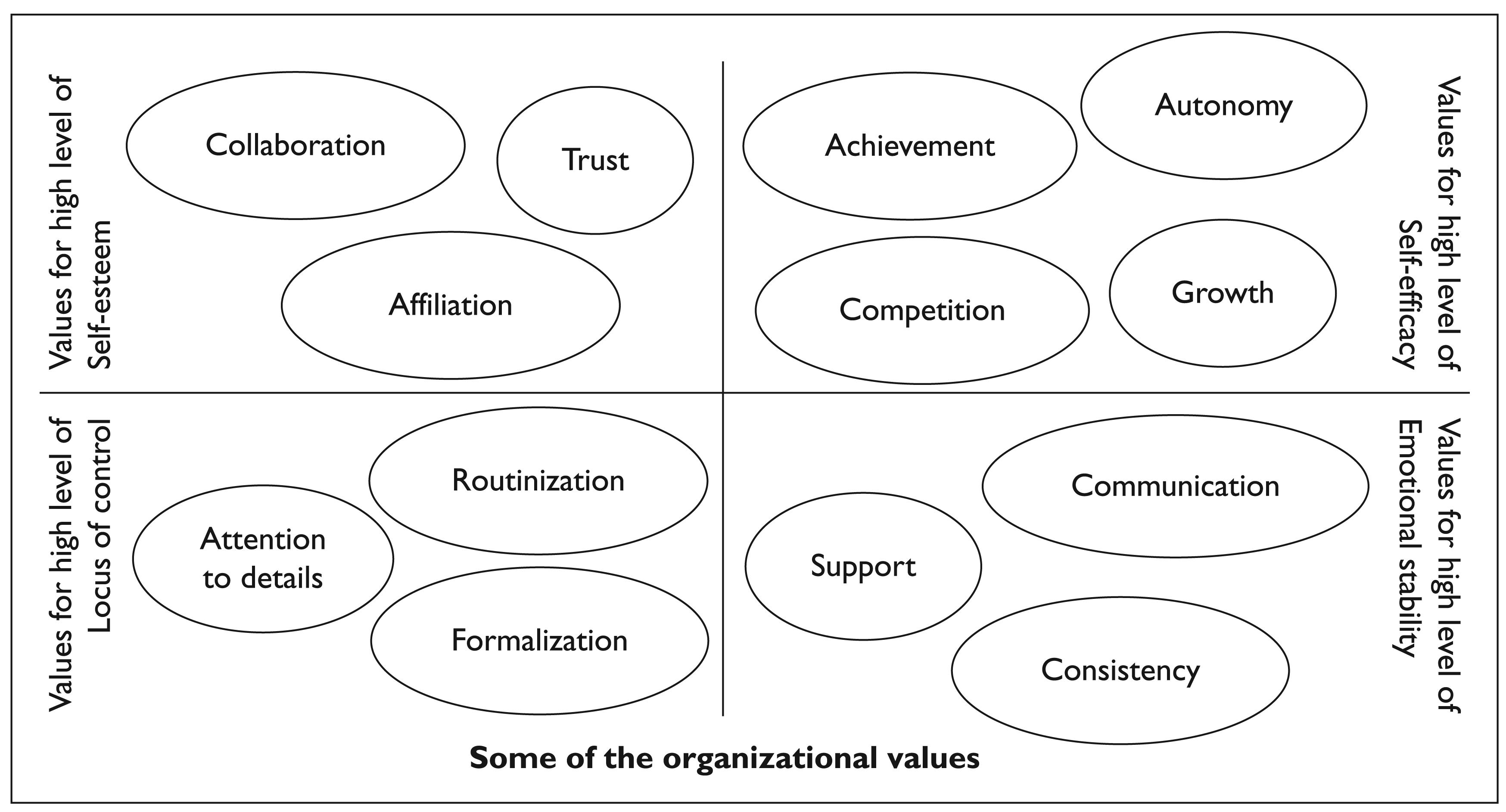
In the foregoing, the dimensions of self-evaluation have been linked to some of the values of organizational culture that help employees with similar self-evaluation profiles to form a strong organizational culture. The relationships between the organizational values and the dimensions of self-evaluation are illustrated in Figure 1.
Impact of Organizational Values on Employee Commitment
Organizational values describing the organizational culture, assuming a strong culture, form a homogenous community where employees share a similar view of their attitude towards work, of the importance of professional challenges or about the importance of the relationships with their colleagues. It means that if an organization has the same values as most dominant, then there will only be a little difference among the attitudes of the employees. Employees’ commitment is also such an attitude: in a strong organizational culture, organizational values determine the dominance among dimensions in the employees’ commitment profiles. In order to analyse this, the potential orientations of employees’ commitment need to be examined.
Organizational commitment distinguishes effective, continuance and normative variables (Allen & Meyer, 1990). However, an employee with high continuance commitment is constantly considering the other possible positions in the labour market; so his attachment to the organization does not derive from a positive internal conviction. Higher wages, perhaps employee relations and contracts negotiated in the workplace, may force him to stay there for a while, but if he has a better alternative, an employee will change his job. Employees with high continuance commitment can be retained long term primarily by extrinsic motivation tools that can be expressed in money. The concept of continuance commitment is based on Becker’s (1960) side bet theory, which states that commitment can be primarily achieved by enhancing job satisfaction and offering rewards. Continuance commitment also has a positive impact on the employees’ performance, but this effect is significantly smaller when the commitment is based on emotional funds (Suliman & Iles, 2000). Continuance commitment is a two-faced attitude as it has some values for organizations by its force of retaining the employees, but the employees’ performances and successes make them more precious resources in the labour market (thus, they can sell themselves easier for the actively searched alternative employers). In the following, this dimension of organizational commitment is not taken into account as the organizational efforts made to increase the continuance commitment actually do not reinforce the general commitment to organization, but serve retention, usually only in a short term.
Affective commitment is emotional-based attachment, whereby the subjects of loyalty can be the colleagues, the institution (organization) or the leader as well (Vandenberghe, Bentein, & Stinglhamber, 2004). Employee with a high level of affective commitment wants to keep up his organizational membership in a long term, proud to work there and feel the challenges in the organization as his own. In the development of the emotional attachment, interpersonal relationships between colleagues have a doubtless importance. Nyhan (1999) had demonstrated strong correlations between the system trust and affective commitment, and between the supervisory trust and affective commitment (0.34 and 0.43 at p < 0.001 level). Interpersonal relationships without frequent conflicts, employee relations that transforming into friendships by trust, and the lack of communication barriers make the conditions possible for effective collaboration. On the base, affective commitment may not only be increased by experiences gained in informal groups but also in formal groups where positive experiences of cooperation make employees happy with their colleagues and their jobs. This increases the sense of affiliation in the employees, who can be characterized by collectivist task solutions, willingness for the team and common problem solving simultaneously. Communication, support and consistency are the organizational values associated with emotional stability, which, by its nature, also support the emergence of emotional ties.
The third dimension of the organizational commitment model is the normative commitment. A high level of normative commitment involves an inner, moral-based conviction in which an employee feels owing an organization to remain its member. It might be better to change a job, or maybe changing the job would be profitable for him, but he would not leave as feeling a gratitude to the organization. There are two types of such workplace behaviours: either a moral duty or a sense of indebtedness, and both behaviours have different manifestations (Meyer & Parfyonova, 2010). Since normative commitment cannot be clearly determined by its motives, therefore organizational values cannot be attached without doubt that clearly support its appearance or strength. For this reason, we will not even consider this dimension of organizational commitment in this study.
However, it is worthwhile to explore the organizational environment supporting the professional commitment, as professional commitment has many advantages that create a connection with organizational performance. A high level of professional commitment assumes a high level of skills required for the given job. Such employees are not primarily interested in the organization or its other members, but are interested in the work they are doing. The striving for professional excellence is especially advantageous for the organization when the job and profession are specially related to the current organization because the labour market alternatives for these employees are limited. That is, professional commitment is particularly valuable when looking for alternatives is accidental (which means that the level of continuance commitment is low). Its value is well illustrated in relation to the organizational commitment, that the organizational commitment is positively associated with the job-related, team-related and organization-related OCBs as well, while the professional commitment primarily supports the work-related OCB (Somech & Bogler, 2002). Like continuance commitment, duality also manifests in professional commitment: it also includes the employees’ effort for being perfect (even independently of the organization) and the responsibilities for job-related tasks (necessarily in the organization). Consequently, it is also difficult to grasp completely organizational values that support the professional commitment, but it is not impossible as the drives of the behaviour do not derive from conflicting attitudes, as opposed to the normative commitment. Among the organizational values shown in Figure 1, attention to details, routinization and formalization are organizational values that are independent of the individuals and are related to the tasks and tools at the workplace. These values are reflected in a strong organizational culture that are made by the high level of locus of control. In contrast, growth, autonomy, competition and achievement are organizational values that appear as needs of motivation independently of the job tasks as well: the high level of self-efficacy supporting these organizational values comes from the needs for development and self-realization that can be independent variables of the actual job activities.
Based on the above analyses, some of the identified organizational values support clearly the affective commitment, while other values support the professional commitment due to their double roles. The discovered relationships are illustrated in Figure 2.

Conclusions
If employees within an organization have almost the same profiles of self-evaluation, they think similarly about the organizational values, the community already assumes a strong culture in itself, and in a similar way they think of the object and strength of their own commitment. Therefore, in order to develop a strong organizational culture and to build a sustainable employee commitment system, on the input side of human resources, the question is whether we are able to address and successfully select employees with high levels of self-evaluation in the recruitment function, while on the output side of human resources we have to examine what kind of tools, most appropriate, are to motivate them as a group effectively, according to their needs determined by the similar profiles of self-evaluation.
Therefore, in selecting new employees, measuring the levels of dimensions in self-evaluation of the candidates is particularly important as it is a reliable predictor of fitting-in to the organizational culture, which is supported by the fact that employees with similar self-evaluations create and hold similar organizational values during the organizational operation. For this reason, after pre-screening CVs, but for cost-effectiveness reasons before the personal interviews, it is recommended to measure the levels of the four dimensions in self-evaluation profiles. It is advisable to invite only those candidates whose self-evaluation profiles fit-in with organizational values, for the interview. Thus, not only the likelihood of the employees’ suitability in the job can be increased but the employees more likely want to remain a member of the organization in a longer term.
Motivation plays a major role in both retaining and enhancing individual performance. In practice, they often use general motivational tools, but which solutions work in an organization may be completely ineffectual elsewhere. Organizational values also depend on the national culture, and national affiliation affects the motivation tools, as there are differences among nations in the sensibility to the motivational practices (Moberg & Leasher, 2011). Organizational values associated with affective commitment, such as collaboration, trust, affiliation, support, communication and consistency, primarily require motivational solutions in which employees can solve their tasks in teamwork. In this way, the joy of the joint work can be shaped in which employees learn how to handle useful conflicts, learn from each other and help each other to develop their skills. This practice can mostly be accomplished in project works, where the leader can provide the framework of the job (e.g., tools, fixing the required quality and deadline), but the work is performed without his presence.
On the other hand, if there are organizational values, for example, growth, autonomy, competition, performance, attention on details, routinization and formalization, then the opportunity to work individually has to be given, in which the employees can develop their creativity independently of the others.
Assuming a strong organizational culture, only one or just another motivational strategy can be applied, otherwise the risk of fluctuation may increase. By the conscious development of individual self-evaluations, both commitment and organizational culture can be strengthened, thus it serves both the employees’ well-being and the enhancement of organizational effectiveness at the same time.