




Abstract
This article places Friedrich Nietzsche’s call to trans-valuate values into a wider historical (and disciplinary) panorama, hearkening back to ethical orientations within both the Archaic and the Attic Greek world with respect to the unity of the virtues. It is argued that the unity of cognitive and bodily (i.e., erotic, athletic) excellence, so central to the Greek world, and culminating in Aristotle’s ethics, functioned inchoately as the measure according to which Nietzsche evaluated values. Extrapolating from the phenomenon of rival perceptions regarding the paradigmatic sculpture of Rodin’s The Thinker—both from the time of its creation and in our own day—the article concludes by suggesting that moral philosophies alienated from the demand of the unity of physical and cognitive virtues might indeed be subject to the devastating critique that Nietzsche had advanced. The egalitarian nature of these values and this critique, however, remains an open question.
The Critique of Morality
In the history of philosophy, the critique of morality has been present ever since the dawn of the advocacy of it. As students and scholars of Greek philosophy have encountered with the Sophists through various Platonic dialogues, there are numerous vexing challenges to the basic question, ‘Why should I be moral?’. While philosophers such as Immanuel Kant, John Stuart Mill and so many others throughout the vast history of moral philosophy believed that they had offered compelling answers, Friedrich Nietzsche’s attempt to ‘trans-valuate all values’ 1 sought in no uncertain terms to destroy each of them in turn. Nietzsche’s aim behind this destruction was intended to be positive and rejuvenating. He frequently evoked the Sophists as his predecessors in this regard. But given the admiration for Nietzsche by the likes of Hitler and other heinous men, one may wonder if the positive ethics Nietzsche advocated was in fact more harmful than the destruction he had undertaken to prepare for it.
This article attempts to place Friedrich Nietzsche’s call to trans-valuate values into a wider historical as well as disciplinary perspective, hearkening back to ethical orientations within both the Archaic and the Attic Greek world with respect to the unity of the virtues. I wish to suggest that the unity of cognitive and bodily (whether as erotic, athletic or in other forms) excellence, so central to the Greek world, and culminating in Aristotle’s ethics, functioned inchoately as the rule according to which Nietzsche evaluated values in his own days. Of course, Nietzsche did not merely evaluate values, but utterly destroyed them. In addition to rhetorical diatribes and literary writings (e.g., Nietzsche, 1954), much of this destruction took place through systematic works critiquing moral philosophy (e.g., Nietzsche, 1990, 1967). Such critiques of morality, not just within the purview of philosophy, but through its actual manifestation in real politics, have always been dangerous. This, indeed, was the position that Plato seemed to maintain throughout his dialogues, both symbolically and analytically.
The Tyranny of Erotic Virtuosity
At the realm of the symbolic, in Plato’s Republic (1930, 1968), we learn that the tyrant is Eros incarnate—his soul is driven by indwelling tyrant Eros (erosturannos). But in striking contrast, in Plato’s Symposium we learn that the philosopher, or at least Socrates, is Eros incarnate. 2 If this is not puzzling enough, in Plato’s Phaedrus we learn that with respect to its pre-incarnate interaction with the forms, the soul of the philosopher is the highest type, and the soul of the tyrant is the lowest type—that is, they have as little as is humanly possible to do with one another. 3 This complicated framework could be illustrated by reference to specific characters in the Platonic dialogues. For example, in the Gorgias, the Sophist and proto-tyrant Callicles is regarded by Socrates as someone with whom Socrates can share an understanding, as both of them are lovers and enjoy a common feeling (Gorgias 482b).
If we consider these several statements and illustrations synthetically, we come up with a pretty typical Socratic position running something like this: both the philosopher and the tyrant share in being erotic. Eros includes but is also inherently much deeper and wider than sexual satisfaction. 4 Diotima refers to Eros as longing for union with the kalon, the fine, noble and beautiful. But this longing is not unequivocal. Diotima also says that we want the good to be our own forever—clearly an impossibility for mortal man. There is, thus, the tincture of selfish satisfaction in erotic striving, the seed for the possible flowering of injustice in the deep quest for fulfilment. Eros can drive one to the greatest heights just as well as to the greatest depths. Fully unleashed in the wayward or misguided soul, Eros may eat into the soul, becoming the soul’s tyrant, creating the tyrant’s soul, that is, immoderate, overreaching and unjust. Stamping out a man’s nobler aspirations and seeping him into base aims, power for its own sake, licentiousness, avarice and perhaps even madness, tyrant Eros (Republic) drives a man down as forcefully as winged Eros (Phaedrus) raises him up.
And as the Republic presents it in a political context, when the tyrannic soul rules a polity by decree, that is, a polity not stabilized by the rule of law, then political tyranny is at hand. This is the account of Eros gone mad, in the soul and in the city, in the Republic. Diotima’s depiction of Eros in the Symposium, then, gives the complementary side, or Eros at work not in the misguided soul, but guiding the soul upward towards the good and towards the beautiful. The philosopher is also Eros incarnate, but another avatar of Eros altogether. The philosopher’s soul—moderate, harmonious and just—lifts itself out from the mire of greed and power quest, rising to the world of forms and taking delight in the good. To be sure, the philosopher need not eschew the so-called lower pleasures. These may be delighted in, as Socrates hints at in his statement that he loves Alcibiades and philosophy, explaining to Callicles—who loves Demos and the demos—that he is not, however, at his lovely youth’s beck and call. Socrates is erotic, but he has trained his daemon into self-sovereignty.
As the Phaedrus illustrates, the chariot may fly high or it may fly low—but all the while it is the black horse (Eros) which charges forward. This forward thrust is in itself good and need not be thwarted. We are all erotic creatures, all hopeful and longing. Aristophanes’ speech on Eros in the Symposium makes the point that that is how we must be. Eros is, therefore, not something that either ought to be or even can be stamped out. Rather, it must be directed:
It is a controlled erotic life that hopes to attain what love unconsciously seeks: eternal truth, justice, beauty, wisdom. Few are capable of such a life, and most of those who aren’t will gratify their yearnings in predictable ways and lead middling lives. Others, though, become utter slaves to their drives and nothing will control them. These people Plato calls tyrants. (Lilla, 2001, p. 210)
In short, then, for Plato the tyrant is a sort of negative reflection of the philosopher, who, rather than channelling his desires to accord with noble aspirations, is a man of frenzied soul possessed by Eros, slave to baser desires and their aims. But in this way, we see the reconciled puzzling expressions and images of the Republic, particularly its eighth book, the Socrates–Diotima episode of the Symposium, the long speech or palinode of Socrates in the Phaedrus, the Callicles encounter of the Gorgias and so on. Eros is the middle term binding together the philosopher and the tyrant, the highest and lowest expressions of man’s possibility. And, carrying it further, as the polis is the soul in large letters, tyranny is the regime of Eros unleashed most unjustly, while the philosopher’s absolute rule would be most just—of course, the latter is, for various reasons, impossible (i.e., it is nothing more than a ‘city in speech’, possible only in speech). So the next best approach would be a rule-of-law polis wherein the effect of the man of tyrannical soul coming to power would be dampened by his inability to rule by decree.
It has been frequently suggested that the description of the degeneration of regimes from Republic Book Eight (i.e., where Socrates explains the decline of democracy and its transformation to tyranny) is based on Plato’s observations from his first visit to Sicily around 388–387, by which time the tyrant, Dionysius I, had seized power and steadily stripped Syracuse of its democratic institutions and culture. It is, thus, not in spite of Plato’s disgust with the situation in Syracuse but because of that disgust that Plato was willing to return there during the tyranny of Dionysius II, in an effort at bottom to educate the latter into virtue. The tyrant, undoubtedly, did have Eros, and Plato’s avowed mission was redirecting that Eros and not opportunistically reaping its base boons.
Let me sum up this brief foray into Plato’s symbolic representation of the risks and rewards of tying together the prowess of the physical or bodily excellence (here, erotic) with the so-called higher virtues: Plato considered tyranny to be serious and deep confusion about the nature of human longing and how this longing should be satisfied. The longing, the Eros, must be redirected, the baser passions must not be stamped out but trained and sublimated in accord with the natural cosmic order, 5 if a just regime is to be humanly possible. Plato sought to educate Dionysius II into virtue and philosophy—as Socrates had sought (and also failed) with Alcibiades—because he saw tyranny as a longing for erotic satisfaction, parallel to philosophy but erroneously and dangerously vectored.
The Unity of the Virtues
Let us now return to the disparate sets of virtues or human excellences, the physical and the intellectual, that so troubled Nietzsche, as mentioned in the opening. Eros is the impulse, the excellences are the expressions. But because Eros cannot be adequately controlled, another strategy has been operative throughout much of human history in order to keep it contained. If Nietzsche’s rhetoric is to be believed, it is manifest within an ideological package that blinds and binds us all. We are its puppets. In writings such as Zarathustra and The Antichrist, Nietzsche lambasts Christianity and attributes our blindness to the dictates of that religion. Here, however, I will broach the issue in a completely different way; that is, by means of the phenomenology of perception.
Any reader would immediately recognize Rodin’s The Thinker. We have all assumed that pose ourselves: hunched over, chin resting on the hand and drifted away deep into thought (see Figure 1).

The Thinker is an iconic sculpture for those who live the life of the mind. Indeed, it serves as a ubiquitous representation not just of the pensive philosopher but as a symbol of philosophy itself.
This sculpture is one of the very few symbols that vulgar popular culture and the elitist philosophical academy agree upon completely: The Thinker, all equally assert, depicts the life of the mind; he is the philosopher par excellence; highbrow philosophy is here represented by the deeply wrinkled brow of Rodin’s extraordinary bronze. Countless book covers, numerous university squares, libraries, offices and studies are adorned with this image of cogitation, learning, wisdom and thought. Everyone everywhere equates The Thinker with the life of the mind.
But everyone is wrong. We are not mistaken because Rodin’s sculpture was meant to represent the poet Dante rather than a philosopher. The life of the mind is equally well depicted by Dante or Descartes.
We are mistaken, rather, because there is an anomaly—an anomaly of epic proportions—between what we actually see and what we think we see. We are blind to what we actually see, and see instead what we are told to see. As Nietzsche might argue, this is because of ideology and social control.
We can break through this using simple, naive phenomenological seeing.
Look at the physical body of Rodin’s The Thinker and describe to yourself what you actually see. If you are honest and straightforward, you will use terms to capture a quintessentially muscular physique. The pensive philosopher–poet’s broad shoulders are rounded, he is taut and fit, high on the lean muscular mass that comes only from athletics and low on the body fat indicative of a sedentary thinker’s life. Frankly, you don’t get biceps like that from rhyming couplets.
That may be the ‘position’ of the thinker, but it is not his ‘body’. It is the body of a physically active person. How could that be Dante, how a philosopher?
We could further illustrate the mismatch by way of an episode that occurred during Rodin’s own lifetime. George Bernard Shaw, author of the well-known work Pygmalion, was captivated by Rodin’s sculpture, which in his case manifest in a desire to be photographed nude in the pose of The Thinker. Rodin received the nude photograph from Shaw in 1906, which is now also on display at the Rodin Museum in Paris (see Figure 2).
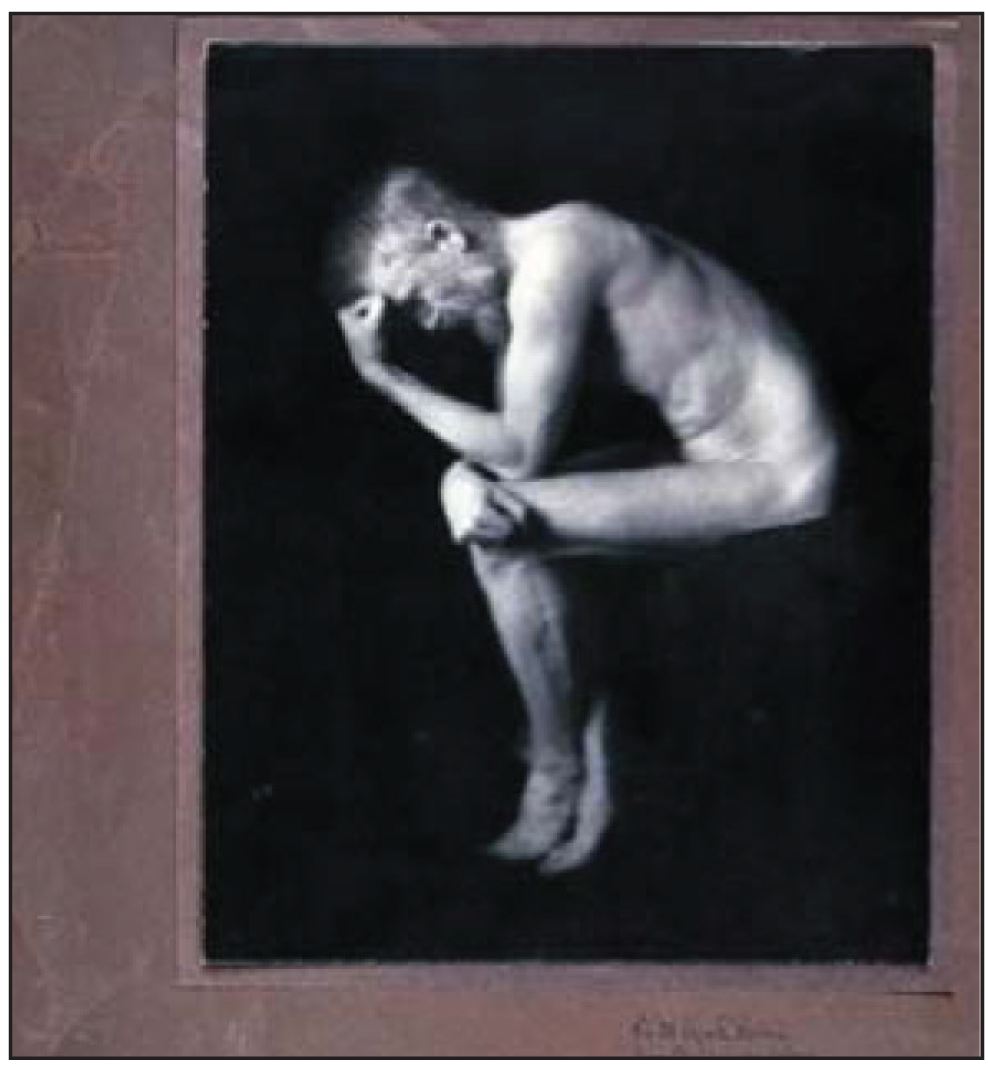
Compare Rodin’s sculpture to a bona fide flesh-and-blood thinker, to George Bernard Shaw. The real-life thinker, Shaw, is wan and flabby with undefined musculature. Rodin’s The Thinker, which is universally taken as an ideal depiction of the life of the mind (that Shaw concretely represented), is muscularly well defined. Thus, we clearly have a problem matching our perception with the underlying realities. It is a problem for us, but not for Plato.
Mind Versus Muscle
Rodin’s The Thinker visually contradicts our actual experience. We know that great scholars and intellectuals tend to be effeminate and weak. We also know that massively muscular people tend to be mentally less fertile. Bodybuilders, as the common notion runs, are morons. There may be exceptions. But Rodin’s masterpiece is not meant to portray the exception; it is, remember, taken as representing the archetype—not just the philosopher but philosophy as such.
Nietzsche wrote at length about the physical weakness of philosophers (and indeed their intellectual weaknesses as well). He fantasized about an ideal type of man, an overman, who synthesized and united all of the excellences of the scholar-philosopher-philologist’s mind with the athlete-gladiator-bodybuilder’s physique. Nietzsche’s conception of the Overman influenced Bernard Shaw, as apparent from Shaw’s play Man and Superman (1904), as well as from Shaw’s misplaced admiration of the likes of the early twentieth century pseudo-overmen tyrants like Stalin.
But the fantasy of housing a profoundly philosophical mind in a perfectly chiselled body was not only a nineteenth century dream or a twentieth century nightmare. It is, in fact, a notion that dawned with the very birth of Greek philosophy itself. It is also a question that Aristotle sought to answer in his Ethics. That is: Can the man of excellence unify the intellectual and the physical virtues? Or, to put it back into terms familiar from Bernard Shaw’s portrait: Is it even possible to be a real-life version of Rodin’s sculpture?
Let us now leave aside Rodin and turn back once again to the Greek world. There are iconic sculptures from the time of Plato’s Republic that may represent another archetype altogether. In this case, it is the archetype not of the thinker but of the athlete.
Myron, not Moron
Myron’s Discus Thrower is a study on the perfection of the athlete’s aesthetic form (see Figure 3).
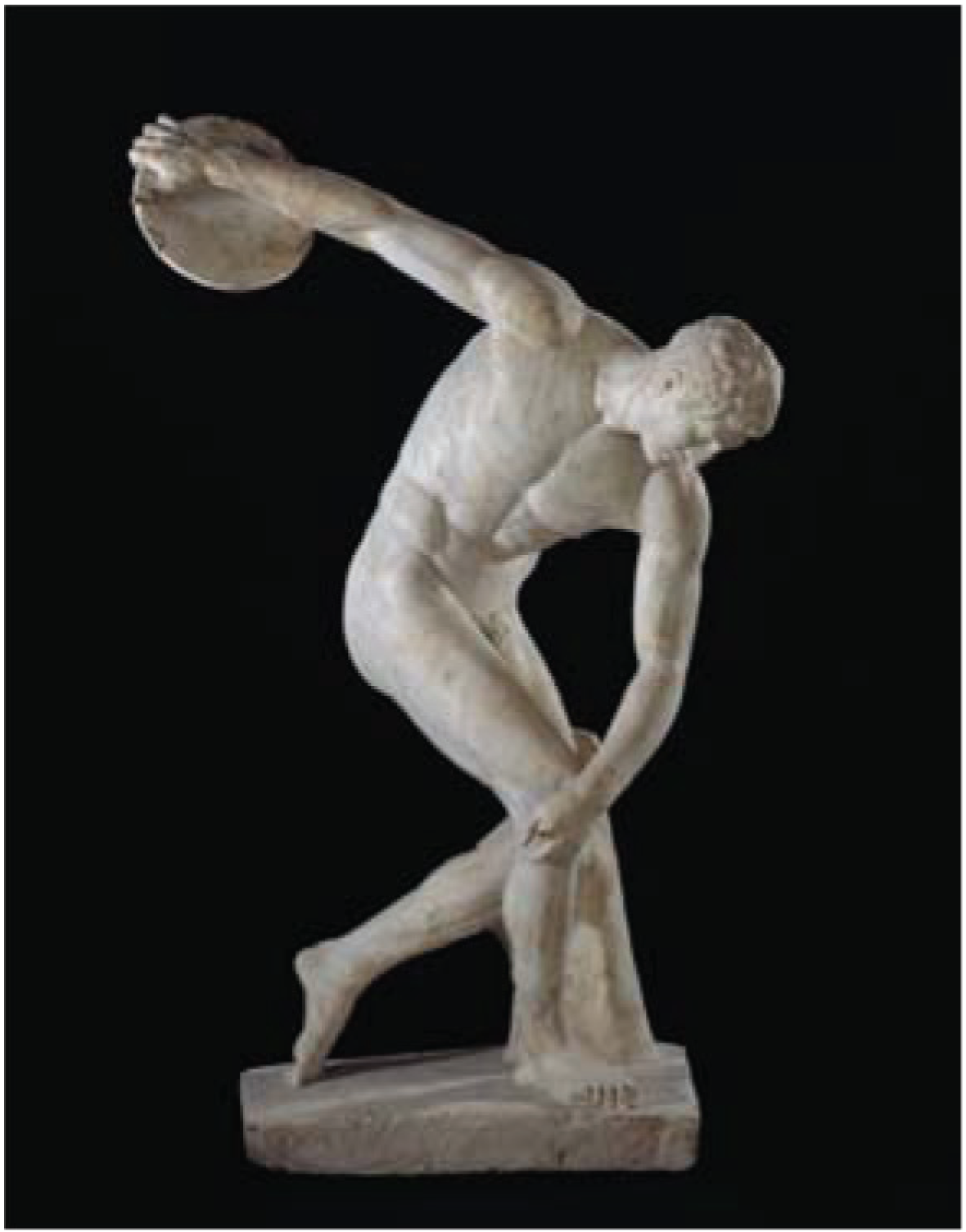
The discus thrower’s physique was meant to seduce the onlooker into delighting in the human body in audacious flawlessness. The lean, muscular form of the athlete angles like the tense archer’s bow. And there is no occasion for misprision here. With Rodin’s The Thinker, we are forced to ignore the way that the bodily representation contradicts everyday experience of the physical manifestation of the life of the mind. With Myron’s Discus Thrower, it is precisely the manifestation, culmination and embodiment of physical culture that we are invited to admire.
But what about this athlete’s mind? We are thus led back to the same question, now reversed by a glance at Myron’s work: Could the athlete’s physical perfection belong to someone profoundly dedicated to the life of the mind? Or, thinking along the lines of Aristotle’s Ethics: Is it really possible to unify the physical and intellectual virtues or excellences?
From Attic Greek Back to Archaic Greek: Homer’s Odyssey
There is a vivid scene from the eighth book of Homer’s Odyssey that Aristotle himself alluded to in his Ethics:
Noble and long-suffering Odysseus…addressed the Phaeacians: ‘…if any of you young men have the courage and spirit, then come prove yourself. I will box, wrestle, run, anything. Any of you Phaeacians come try. I excel at every athletic sport there is. As an archer, I handle the bow with skill. I am always the first to bring a man down from the enemy ranks, no matter how many others stand with me to shoot. Only Philoctetes surpassed me when we Greeks fought at Troy. But I far excel all other mortal men who still eat bread upon the face of the earth. And I hurl the spear farther than others can shoot an arrow. Only in running I am afraid that one of you Phaeacians might beat me, for I have long been tossed about by the waves at sea, and my legs are still weak from it’. They all stood silent at his words.
6
Odysseus is a paradigmatic hero with overweening pride. He tends to do everything in extremes; indeed, right around the passage cited above Homer describes noble Odysseus as ‘weeping like a woman who was just widowed’. This extreme Greek hero possesses excellences in abundance. He is strong, courageous and confident and demonstrates every physical virtue. But what is interesting is that his most distinguishing trait is his sharp intellect, his cunningness and wisdom. It is packed into the very name by which Homer refers to him, metis Odysseus, the Greek word metis meaning cunning intelligence. Homer supplements this epithet of metis with another term signifying Odysseus’ versatility and guile—polytropos (many turns).
It is because the cunning Odysseus of many turns is not just brave and warlike, not just an athlete of exceptional prowess but also brilliant, clever and wise, 7 that the Goddess Athena adores and protects him.
Athena, the eponymous for the city of Athens, was of course the Goddess of Wisdom. As Plato writes, philosophers have always evoked her name (Cratylus, 407b). In cultures such as our own that so rigidly separate the physical from the intellectual, it is easy to forget that Athena was not just the Goddess of Wisdom; she was also the Goddess of War (or, more precisely, of battle or war strategy). In fact, in the imagination of Greeks from Homer to Plato to Aristotle, Athena herself represents the unity of physical and intellectual perfection.
Myron’s Discus Thrower recalled the eighth book of the Odyssey because of a particular feat of Odysseus that he performs there, in the land of the Phaeacians:
Euryalus then mocked Odysseus: ‘Stranger, you look like you are unused to manly sports. Rather, more like the captain of a merchant ship…seeking profit. The athlete you are not’. Fiercely, Odysseus of many turns replied: ‘Stranger, you are quite mistaken…. I have endured much both on the field of battle and by the hostile sea. And yet, despite my suffering, I will compete….’ He hurried to his feet, still wrapped in his cloak, and seized a discus larger than the rest, thicker and heavier than those the Phaeacians normally compete with. Spinning around, he threw it from his brawny hand, and it hummed as it flew through the air. The Phaeacians cowered beneath the rushing stone that sped so gracefully from his hand. It flew beyond all the other marks, and goddess Athena, taking the form of a man, pegged the place where it fell. She said, ‘Stranger, even a blind man groping with his hands could find your mark, it is so far ahead from the cluster. No Phaeacian could come near to it’.
8
In both Homer’s Iliad and Odyssey, we are offered many examples of Odysseus’ wit and wisdom, beyond the mere designation of his epithet. The Trojan Horse was Odysseus’ invention. It permitted the end of the war in decisive victory for the Greeks. But before the Trojan War had even begun, Odysseus’ cunningness was seen in the way he found out where the hero Achilleus was hiding, and the way he tricked the unsurpassed archer Philoctetes into fighting on the side of the Greeks. Throughout the war, too, and during his long and laborious voyage home from it, we learn of numerous tales recounting how Odysseus outwitted strongmen like Ajax, monsters like the Cyclops, seductresses and enchantresses such as Circe, Calypso and the Sirens, and escaped both Scylla and Charybdis. Odysseus visited the underworld Hades and returned to tell of it. He achieved not once but on several occasions what no other mortal man, howsoever wise, ever had been able to manage.
And though clever enough to delight Athena herself, when we ask the question about whether it is possible to be both Myron’s sculpture and a philosopher in the sense evoked by Nietzsche’s overman, Odysseus would not pass the test. This is because metis Odysseus puts his intelligence to use for the sake of supplementing his physical virtues; he does not, nor would he choose to lead the life of the mind over and against the life of action, the heroic life. Odysseus could not have composed an Odyssey. He was no Homer, no Plato, no Dante, no Shakespeare and not even a Bernard Shaw. It is not, then, this sort of hero whom Nietzsche seeks, though it is clearly this sort of archetype which lingered within the imagination of Greek philosophers who sought the unity of body and mind, of physical and cognitive virtues.
Platonic Pedagogy
Within the discussion on education in the Republic, we see that Plato’s ideal citizens have the souls of athletes. In Plato’s late dialogue, The Laws (1980), the Athenian says:
Let’s see, now, once I’ve organised the state as a whole, what sort of citizen do I want to produce? Athletes are what I want—competitors against a million rivals in the most vital struggles of all. (Laws 830a)
Plato’s ideal Republic is of course ruled by philosopher-kings. These philosophers are selected from among the guardians, both female and male, who have been thoroughly trained in athletics. Philosophers who can break through, who can undertake the dangerous and seemingly impossible task of rising up from out of the cave into the light of the sun, must necessarily be trained in the physical virtues, so they can cultivate their courage and moderation, their grit, their determination and their stamina.
Heather Reid, in her innovative work entitled ‘Plato’s gymnasium’, captures these thoughts usually neglected in orthodox Platonic scholarship:
Plato set up his own school at a gymnasium called the Academy where promising youth had long since trained their bodies, formed lasting friendships and prepared themselves to become productive soldiers and citizens. Plato seems to have endorsed Athens’s traditional educational goals, even the apparently body-based practices of nudity and pederasty. But he saw education ultimately as the cultivation of wisdom and harmony in the soul and therefore redirected educational conventions away from the body and other worldly objects such as wealth and political power, upward towards ideals such as truth and goodness; goals best achieved by athletic souls that love the right things. Despite his conservatism and persistent aristocratic tendencies, Plato’s gymnasium, in the end, embraced the essence of the Hellenic democracy. (Reid, 2010, p. 180)
This reinterpretation of the pedagogic teleology of Plato as supported by the Republic and the Laws, also has its resonances in the Symposium. While we should not take the character Pausanias as speaking fully for Plato, still this statement of his is powerful and significant:
In…places where people live under the rule of the barbarians [pederasty] is considered base. This is shameful to the barbarians because of their tyrannical regimes, as are also philosophy and the passion for athletics (philogymnasia). For, it is not in the interests of the rulers that their subjects have high thoughts, nor strong bonds of friendship, which most especially Eros above all these other practices are accustomed to create. (Symposium, 182b-c)
What Plato writes here, finds frequent repetition throughout the later writings of Nietzsche. That is, the lethal combination of the unity of intellectual and physical virtues is made shameful in the ideology perpetuated by governments. It is not in the interest of our rulers that we have high thoughts, paired with physical virtues like courage and the willingness to die for our righteous convictions.
The Conspiracy against Philosophy
The new values sought by Nietzsche are in some respect evocations of ancient, profoundly aristocratic conceptions: the philosopher-king, the unity of intellectual and physical, the master morality espousing self-mastery, self-overcoming and self-sovereignty, those which precondition the mind and body for both rigour of mental and physical training, daily. In these, Homer, Plato, Aristotle and Nietzsche appear in the main to agree.
Plato did not teach morality but virtue. Aristotle (in his Ethics and Politics) advanced upon some of these teachings, specifically in terms of a master morality of self-cultivation for the good of the polis. It was the Sophists (some of them, that is), however, who undertook a proper destruction of morality in order to pave the path for the eradication of oppressive class distinctions grounded in false cosmologies perpetuated by priests, grounding the possibility of egalitarianism instead of Aristocratic inequality, making the democratization of Athens possible (Jarratt, 1990, 1998). Nietzsche himself claimed to have taken up the Sophists’ critique of morality. The question remains, however, whether in doing so, he re-aristocratized it.
Nietzsche’s trans-valuation was required because he understood the social world to be a systemic conspiracy against virtue. As he suggested in Ecce Homo (2009), society expects us to believe that reading the philosophy of Plato is a useless luxury. Even those who should be teaching Plato, teach it in a way that undermines its teaching, its true power. Philosophy was not conceived by Socrates, Plato and Aristotle, notwithstanding their contextual differences, to liberate the philosopher’s soul at the expense of the polis, or city or state; rather, as Nietzsche argues in Zarathustra, philosophy aims to liberate the society and the state and along with it, the minds and souls of all citizens who are capable.
As Nietzsche’s Zarathustra phrased it so eloquently, ‘We have long been, and continue to be, systematically misled to believe in the uselessness of philosophy because its true uses are dangerously radical and totally revolutionary’.
Declaration of Conflicting Interests
The author declared no potential conflicts of interest with respect to the research, authorship and/or publication of this article.
Funding
The author received no financial support for the research, authorship and/or publication of this article.