




Abstract
Why do we buy houses as opposed to renting one? This question, in its simplistic formulation captures, inter alia, some of the most fundamental emotions of temporal values that we impose on ourselves. Yet, the question has attracted little scholarly scrutiny. The article, using this question as a case, attempts to excavate the silences of our imagination of time in the cacophony of modernity. Time has had varying versions of existence in the modern world. When time is singular, it has the same meaning attributed to by everyone in the same community. A pluralistic conception of time is the exact opposite. I use discount rates as a unique entry point to understand how people view their future (time), and thereby a conceptual aperture to see if time is losing its singularity or not. More importantly, how so. I collected data on house prices in India in five major metropolitan cities in India and compared those prices with rental values. The crude estimation is a useful proxy to observe discount rates, and consequently, varying conceptions of time. I show that time has become a homogenized entity for people falling in similar economic class while it has lost its singularity for those within the same social class (community). This gets folded into questions of ethical implications of modernity’s impact on one’s aspirations.
Introduction
In September 2013, an old Hindu seer in a small town of Unnao, in the province of Uttar Pradesh, India, saw a dream. He dreamt that over a thousand ton of gold was buried under the ruins of a certain old fort in a nondescript village in the town. Inspired by this dream, he wrote a letter to the President of India, Archaeological Survey of India (ASI) and Ministry of Mines to propose the excavation of the site. The ASI never responded but began the excavation in October. Notably, the ASI claimed, ‘ASI does not go about digging on the basis of dreams. We are conducting the excavation on the basis of scientific reports and historical importance’. After a month, having found nothing, they abandoned the project. The incident attracted global media with its frenzy, ridicule and amazement (Srivastava, 2013).
This incident is symptomatic of how warped modernity feels in a context like India. Non-western societies in their reception to modernity grapple with confounding sets of experiences. Bruno Latour’s (1993) excellent exposition, We Have Never Been Modern, offers a compellingly simple explanation of modernity, which is the phenomenon of culture separating itself from nature. Pre-modern societies could not distinguish between nature and culture. A solar eclipse was part of both nature and culture. Modern societies can now effortlessly categorize an eclipse as nature (science) while worshipping the Sun God—of whatever of it is left—falling under culture (religion).
These distinctions are fairly crystallized for Western societies, which were the crucibles for the formation of ongoing conceptions of modernity. Thereafter, attributed to the colonial project, this got transplanted everywhere in the world. Some, where they settled (USA and Australia), became very much part of the Western world. The others, where colonization was a moment in time, became the non-Western societies. There is no strict watertight category that separates the two. But of the many fuzzy boundaries, relying on income levels, shared histories, skin colours and the rule of law, there is one more boundary, that is, receptivity to modernity.
Colonization was a gigantic project of transplanting value systems and morality. It was hugely successful. But regardless of the erosion of moral soil of these societies, non-Western countries had been drawing their value systems from cultural roots that penetrated far under the top soil alone. So, while the top soil seems to have been replaced, a number of underground layers remain. This makes a distinction between nature and culture, hard to find in as much clarity in India, as one would find, say in the Netherlands. While in the Netherlands, people will line up to watch solar eclipses, sparking interesting conversations in classrooms and laboratories, in India, this will be accompanied by perhaps more voluminous family conversations on why gods’ anger must be placated by following some ‘dos’ and ‘don’ts’. People will do ‘purity’ rituals, not engage in material pleasures, chant gods’ names and definitely not watch it. The nature is a part of culture.
Nowhere is this tension more visible than in the conception of time itself. And because time is central to our own views about the self, these conceptions are fundamentally embedded within our reasons so deep that they do not even surface. Our decisions will inadvertently draw from these conceptions, without even knowing, and such is the rootedness of them. And therefore, time is pivotal to understanding (un)changing value systems. In drawing ideas of modernity and their mixed receptivity in non-Western societies, one can argue that conception of time, as driven by modern conceptions in these societies, is at stark contrast with its efforts of homogenization that accompany the economy of it.
I illustrate these tensions in ideas of home ownership in India. For this, I examine the price-rent ratios in select Indian cities. The price-rent ratio is the price of the house divided by the annual rent it fetches—a crude measure of how long should you be living in a house to justify its purchase. This ratio is, therefore, a sense of time in the minds of those who are buying (or not buying) a house. The way its values are shifting offers a unique window into the ‘modern conception’ of time. I engage with these ideas through the article. In the next section, I focus on the conception of ‘time’ in modernity, which also offers some interesting literature worth dwelling on. Later, I dwell on the idea of time losing its singularity and its concept of plurality. This section invokes the concept of discounted rates as a hinge around which one can view differing notions of time. This is then used as a raw material to weave the idea of home ownership in India, and its temporal determinant is discussed in the next section. This section illustrates the prince-rent ratio in various cities of India and attempts to understand the differing imagination of future time in the minds of a rapidly changing India. The latter part of the article contains discussion and conclusion.
Conception of Time in Modernity
Modernity has had an intimate relationship with time. The emergence of watches, clocks and clock towers, forcing time to be collectively imagined in a similar fashion, has had a linear impact on everyone falling in the wake of ‘time’, which led people to think about time in the sense of its immediacy and transitoriness (Calinescu, 1987; Whitrow, 1988). In fact, for many scholars, like Calinescu (1987), time is central to understand modernity, for it is modernity that has lent us a specific awareness of time, a historical time, which is linear and irreversible, and that which moves onwards. This process, in some sense, has ‘discovered time’ (Quinones, 1972). The imagination of time as a linear entity had tethered away from its long-held beliefs of time being cyclical in many cultures.
But this does not mean that time became singular. In fact, it is quite the opposite. This would happen in two separate styles. The first one is Blumenberg’s (1991) design of modernity, which introduces historical progress as a result of human efforts, rather than supernatural intervention. Going by this understanding, modernity is, therefore, ‘synonymous with man’s self-transformation, permanent change, the continually renewed critical dissolution of any conceptual or empirical crystallization’ (Palti, 1997). An individual is the sole creator and a result of his/her life and commands all that has mattered to him/her. There is no God, per se. The sovereign governs me because I choose him/her to do so, not because he/she is chosen by some God. And if divine power is believed to exist, that is purely part of ‘culture’, and not ‘nature’. Nature is science, which I understand as if laid bare. That which I can’t will relegate to culture.
No surprise then, Blumenberg’s ideas can very swiftly lead us to construct a heterogeneous and open-ended nature of temporality. Modern experiences, says Berman (1982), emphasize our awareness of radical transitoriness of our existence and values. When I carry the sole responsibility of whatever happens to me (because there is a scientific logic to it), then I become the master of my time. While the clock imposes a singularity on all of us, my time and the way I regard my transitory life in that moment can be markedly different from those around me, who are, obviously, masters of their time. The temporal world transforms itself into a pluralistic avatar, like a schizophrenic manifestation of itself.
This temporal schizophrenia affects different societies differently. Just like human bodies, which react differently to certain proteins, antibiotics or enzymes, modernity affects all of us differently. Societies where modern conceptions of value systems were imposed and transplanted have a tensed relationship with it. Those where it originated are somewhat ‘comfortable’ in its scope and breadth of application. The Netherlands and India, both have massive bilateral trade and are stooped heavily in science and technology dictated by modernity’s conception of capital growth and accumulation. Yet, the Netherlands will not find it difficult to claim that it is a modern, atheist nation. But, India will. Strictly speaking, however, (and as Latour would have said) even the Netherlands is not modern. But for the purposes of comparative understanding, one can say that the Netherlands is more modern than India. And so, time is more singular in the Netherlands than in India.
Be that as it may, time is plural in differing measure of intensity, everywhere. Every year in June, almost all high school Chinese students who want to attend the college sit for the national college entrance exam, called as Gaokao. It lasts for around 9 hours over 2–3 days. These 9 hours determine the future of over 10 million students. No one, other than these people and their family, thinks of these 9 hours in the same way. All financial companies at the end of March are busy closing their annual accounts. Except for them, no one in the world has any sympathy for their overstretched working hours. The fight at the airport counter for delayed flights coexist with the sight of patient travellers sleeping on the platforms, waiting for the train that is terribly delayed. The Hindu calendar change every year, with the changing positions of the moon, but the Gregorian calendar remains fixed. A school going student following the latter has to submit a leave in his/her school because of a yajna at home that was following the former. The seething anger in the host when the guest arrives inordinately delayed is matched only by the heart wrenching apology tendered at the moment. In another household, the delay is understood by both as a parcel of life without invoking any grammar of intention on either. The clock ticks life away and gives it elsewhere under the same roof. When one lawyer charges by the hour, the ‘less successful’ ex-classmate lounges on a local grocery store puffing away cigarettes in those hours. Some people are fearful of the future and look at time accordingly. Others are anxious, and their anxiety hinged on the moment of time they are finding themselves in.
Such descriptions are more acute in the non-Western world. When W. H. Auden wrote his poem Age of Anxiety (1948), he was decidedly claiming that post the war, we are going to welcome the age of freedom. Nandy (2009) reminds us that he (along with Erich Fromm) had connected anxiety with experiences of western nations that have been characterized with middle-class material culture, high degrees of individualism and the aspiration for an urban-industrial future. The non-Western nations were lurking in an age of fear, that is, fear of starvation, humiliation, loss of livelihood, self, agency and in security. And since fear in the linearly narrativized historical process is a process that precedes anxiety, one would have imagined that fears are not important. Nandy goes on to explain that the primitive fears have continued to be buried within the cacophony of anxieties in a developed world, but that is not the point. The point here is that non-Western societies that have now begun grappling with anxieties, as much as with those fears it started with is a laboratory of understanding transformation of time itself. Rich are more insecure, and poor are more fearful. In either case, temporal experiences are continuously shifting like temporal tectonic plates.
Time is inherently a plural entity and not an indigestible claim. Gell’s (2001) insightful work, Anthropology of Time, helps us appreciate the manners in which awareness of time is culturally conditioned. For some, time is a cycle of continuum (which comes and goes), and for others, it is a linearly moving resource that can be ‘used’ or ‘wasted’ (like a conveyor belt). Drawing on cognitive differences in understanding time that are attributed to culture and societies, Gell dwells on the works of Durkheim, Evans-Pritchard, Lévi-Strauss and the like. This is not difficult to understand. Throughout histories, societies have their indigenous sense of time. When Robert Jordan was writing his series called The Wheel of Time, he was drawing his title and even plots from the Indian and Buddhist tradition of viewing time as cyclical. Scholars have claimed for a long time that Indians think of time moving in a cyclical fashion that will repeat itself, even though there are hints of linear narration too (Thapar, 2005). For Europeans, on the other hand, time is linear. One can see this in their own diverging experiences in cultures that have varying conceptions of time. Best watchmakers are Swiss, and the painfully precise schedule that trains follow is in Germany. I was attending a conference once in Doha, and the organizers had sent a form to familiarize about some do’s and don’ts; more of a cultural dosage of what to expect and what to avoid. One of the points caught my eye—if someone is late here, please do not feel bad; he does not mean disrespect, it only means he is having a good time elsewhere.
If this is the case, does it mean that time is losing its singularity? After all, it has always been plural. The idea is, that time, in a particular space, remains singular. In other words, even though ‘[t]he creators of myths, the chroniclers of kings and the collectors of taxes subscribe to divergent images of time’ (Thapar, 2005), it is their respective time-spaces that are now getting warped under the pressure of modernity. The tax collectors operate in a particular time frame, but these very collectors are themselves experiencing diverging times within their own creed. This comes largely due to one specific change in our conceptions: while pre-modern societies will identify the tax-collector as a person of a community first and then the tax-collector—modernity labels him/her as a tax-collector first and then possibly someone as a part of his/her community. When we think about alienating our subjectivity, this is exactly what must come in our minds. The life of a worker in a factory is governed through the alarm in the workshop that nudges him to start, take breaks, eat, restart and end. This homogenization of time comes at the cost of him being alienated from the product, labour process, one’s social nature and ‘species-being’, leading to an alienation from that time, which is being entertained by his own family or community that he is an integral part of. Everyone is a statistic in the spreadsheet of modernity, driven by the algorithmic value system of the spreadsheet. This algorithm affords little freedom to its figures in the cell, and for all these spreadsheets, same numbers are pulled in different temporal directions.
The algorithm is simple indeed. It is the conception of capital and time becoming subservient to capital itself. The aphoristic, time is money, does not come from nowhere. It is a poignant reminder about money being centrality of our times, the time of our centrality. But this is temptingly distractive, so let me not engage on this further.
Discount Rates and Tension Between Singular Versus Plural Time
Following the same vocabulary of periodization, there is an epistemic homogenization that becomes order of our times. The centrifugal force of modernity dissipates time into pluralistic conception, when time itself loses its singularity. The centripetal force, on the other hand, is modernity’s attempt to homogenize anything diverse. The centripetal force designed by the algorithmic principle, which puts capital above everything else, is like an errant child who has pulled out various components of various toys, which were enjoying their existence as they were, into other boxes, collecting them together, in manners he/she felt was best. The plurality of their existence was boxed. This does not make their existence singular, even though they all were made to homogenize artificially.
It becomes imperative then to take a step back and see how does this tension reveal itself in reality. Societies have had different conceptions of time. A few years ago, the economist Keith Chen published a radical insight. We have long considered the power of language to influence or even trigger some sensitivity within us. Some aboriginals in Australia use Kook Thaayorre language. This language does not have words for left and right, but only directional words like east and west. Therefore, no matter where they are, they have to know their polar direction for them to be able to engage in any conversation involving directions. Consequently, they are more aware of their geographical directions at all times, which, a native English speaker would not. Armed with such intuitions, Chen (2013) categorized languages with weak and strong future tense. For an Englishman, the idea ‘I will go to the market tomorrow’ has a strong future tense, rather than German, Finnish or Mandarin, where the same idea translates as ‘I go to the market tomorrow’, which has a rather weak future imagination. Those with a weak future tense will perhaps equate future with present and may, therefore, exhibit more future-oriented behaviours. Chen found, across a range of societies and controlling for various factors, speakers with weak future tenses were 30 per cent more likely to save money, 24 per cent were more likely to avoid smoking and 29 per cent were more likely to exercise regularly as compared to their strong tense counterparts. This study is supported by the intuitions that had preceded the study—languages with obligatory future-time references will reduce the speakers’ motivation to engage in future-oriented behaviour for he/she will imagine future as a distant other. He/she will have, for lack of better word, a higher discount rate.
Discount rates tell us how far does one sees his/her future. Someone with high discount rate will not worry much about the harmful effect of smoking or will not use a condom as much as a person with a lower discount rate does. At the core of it, discount rates tell us our own conception of time. Almost all studies on climate change rely on a standard conception of discount rate across range of population. Discount rates are unique entry points into the idea of singular–plural dichotomy of time. They tell us how people view future, and consequently, time. While at one level, modernity forces them to look at time in the same fashion as everyone else (convergence), on the other, the traditional understanding of time rooted in culture encourages a more pluralistic mental design of time (divergence).
A very important long-term investment that people make in is housing and real estate. The decision to rent or buy often carries a substantial reliance on discount rates that people have for long-term investments. If I can live in a rented accommodation as much as in a purchased house, how do I determine which one to opt for? One of the factors that are often in the forefront in my decision-making is how far in distance do I see the future. The space-time continuum brings time as a dimension in this conversation. I see the future far, far away from me, and this is one type of time conception. Or I can see future looming right on my head; this builds a new time-type for me. Whether time has a singular or a plural characteristic, therefore, can be visible in my decision to buy or rent the house.
One way to find out the heaviness of this factor, and thereby dissect into the minds of people, is to get a sense of the other important factor, that is, money. How expensive is the place to buy, as compared to renting it out? This variable can reveal useful information on the concept of time as it is.
Case of House Pricing in India
When we divide the price of a house by the annual rent it fetches, we arrive at a value one calls, the price–rent ratio. The value offers the number of years one must stay at the rented house to make the purchase economically justified. The price–rent ratio is the dividend yield on a real estate property—house in this case. This value is crucial to understand the true historical return to housing, and it estimates the expectations of market participants about future capital gains to housing (Davis, Lehnert, & Martin, 2008). If one suppresses the rent by subsidized rented housing, the value will shoot up, thereby reducing incentives for people to buy the house (Chen, 1996). On the other hand, high price of the house encourages people to rent the properties out. This is visible in many ‘expensive’ cities of the world. The premia on the house purchase relies significantly on this parameter (Campbell, Davis, Gallin, & Martin, 2009). Overall, the price–rent ratio offers some predictability in understanding the housing markets (Engsted & Pedersen, 2015). The price-rent ratio carries within it an ability to estimate future returns and rent growth where the future returns encompassing expected real interest rates and expected risk premia over risk free rate (Engsted & Pedersen, 2015; Kishor & Morley, 2010). While studies on price–rent ratios abound for countries like the USA (Cochrane, 2011; Gallin, 2008), data and studies on developing country contexts are entirely missing.
This indicator is important for the purposes of my research, for it reflects an idiosyncratic value of time buried in it. House prices, unlike other commodities, follow an index more than a standard demand-supply curve. The idiosyncrasy comes from the subjectivity inherent in the housing market that depends on what Shiller (2005) has famously called irrational exuberance. Even though the research shows that an increase in the ratio signifies the future increase in returns, many confounding puzzles exist—the increase in the ratio can also be attributed to the suppression in rentals rather than increase in house prices, and second, predictive patterns may also depend on the values being real or nominal (Engsted & Pedersen, 2015). Yet, despite all these diverging results, the price–rent ratio must conceal within it a very strong estimate of how people view their future.
For instance, if the price–rent ratio of my house is 20, this means in 20 years, I would have given as much rent as it takes to buy the same place. In other words, if I am planning to live for more than 20 years in the same house, it is rational for me to buy it. Surely, inflation and interest rates will not keep on devaluing the money in the long run, so it will make even a greater sense to buy it. But for the purpose of the article, we keep inflation and interest rate adjustments out.
This also means, if the value of the price–rent ratio is, say 40, its price is far higher than that with the price–rent ratio of 20, or its rents are highly suppressed compared to the other. Since rental values and house price values move synchronously (expensive houses also draw higher rents), one can say with some sense of certainty, with other things constant, that higher price-rent ratio means house prices are inflated, irrationally. Price–rent ratios capture within them a rational tool to decide a smarter choice between renting or buying. Forbes, for instance, recommends that if the price–rent ratio is higher than 15, you would rather buy it than renting (Alford, 2010). If you buy a house with a high ratio, you will need a higher increase in house prices in coming years to justify the price you have paid for it.
Places with irrationally inflated values of house prices will also have high levels of price–rent ratios. Conversely, if the ratio is high, the house prices would be artificially inflated. For most societies, research has shown that the price–rent ratio of 20 is where the average lies. In fact, for many, 15 is considered to be the value of the ratio of a place where one is better off buying a house. In the USA, for example, NYC, Honolulu, San Francisco and Boston command high prices for the house and the price–rent ratio is 34, 30, 28 and 27, respectively (Andreevska, 2019). Even Washington DC is considered to have high house prices, and its price–rent ratio is 22 (Andreevska, 2019).
Why is this ratio important for us? Simply put, it offers a unique window into the discount rates of people. Discount rate is the time value of anything. It is the estimate of how important is the future me. Anything that has a long-term implication affects our brains differently—for some, future is far too distant to be worried about something today that affects the future. For others, it is rather close, and therefore, he/she must be careful in his/her decisions. Of course, for many things that have future implications, we often do them because of social norms and do not consider time value in future, for example, education. For many others, time values become important.
So, when we have a high price–rent ratio, and people are still buying the houses, there can be two economic reasons. First, I have considerable surplus and disposable capital. Second, and more importantly, I am looking into the distant future, and I am reasonably sure that my decision to buy the house is justified—I will be able to make up for it very soon. One might bring up the third reason, which is, the expectation that the increase in house prices will be high enough to compensate me for a high price–rent ratio. But this only means that the expectation from the returns from the house purchase is artificially set to increase its house price, which leads to a high price–rent ratio to begin with. In other words, this is a part of the second reason itself. Since I expect the house prices to increase soon, I am—equivalently—keeping a really long-term view of the purchase. Either I shrink the price increase duration or extend my life-term; the net result in both cases is that I will buy the house with a high price–rent ratio without balking at all.
Surely, there is a cultural reason to purchase such a house as well, that is, a social norm to buy the house. This cultural norm is high in India, and one may say that this would affect people’s decision. But one may also argue that the reason for the purchase decision embedded in culture is itself a design of a long-term future. Also, let us not forget that such a decision can affect some part of the overall purchase decisions of the society. For whatever the importance of culture, paying capacity is a strong influencer in these types of cases. And so, one can safely assume that purchase of a house with the high price–rent ratio exhibits a strong desire to see the future in a long-term horizon.
We did an extensive online survey to find out the price–rent ratio for the five Indian metropolitan cities: Mumbai, Delhi, Hyderabad, Chennai and Bangalore. The houses were categorized into standalone homes with ownership to the land and apartment in high rise buildings with no ownership to the land. Adjusted for area, we also saw both the rich and poor areas of the cities. The results, displayed in Figures 1 and 2, were startling.
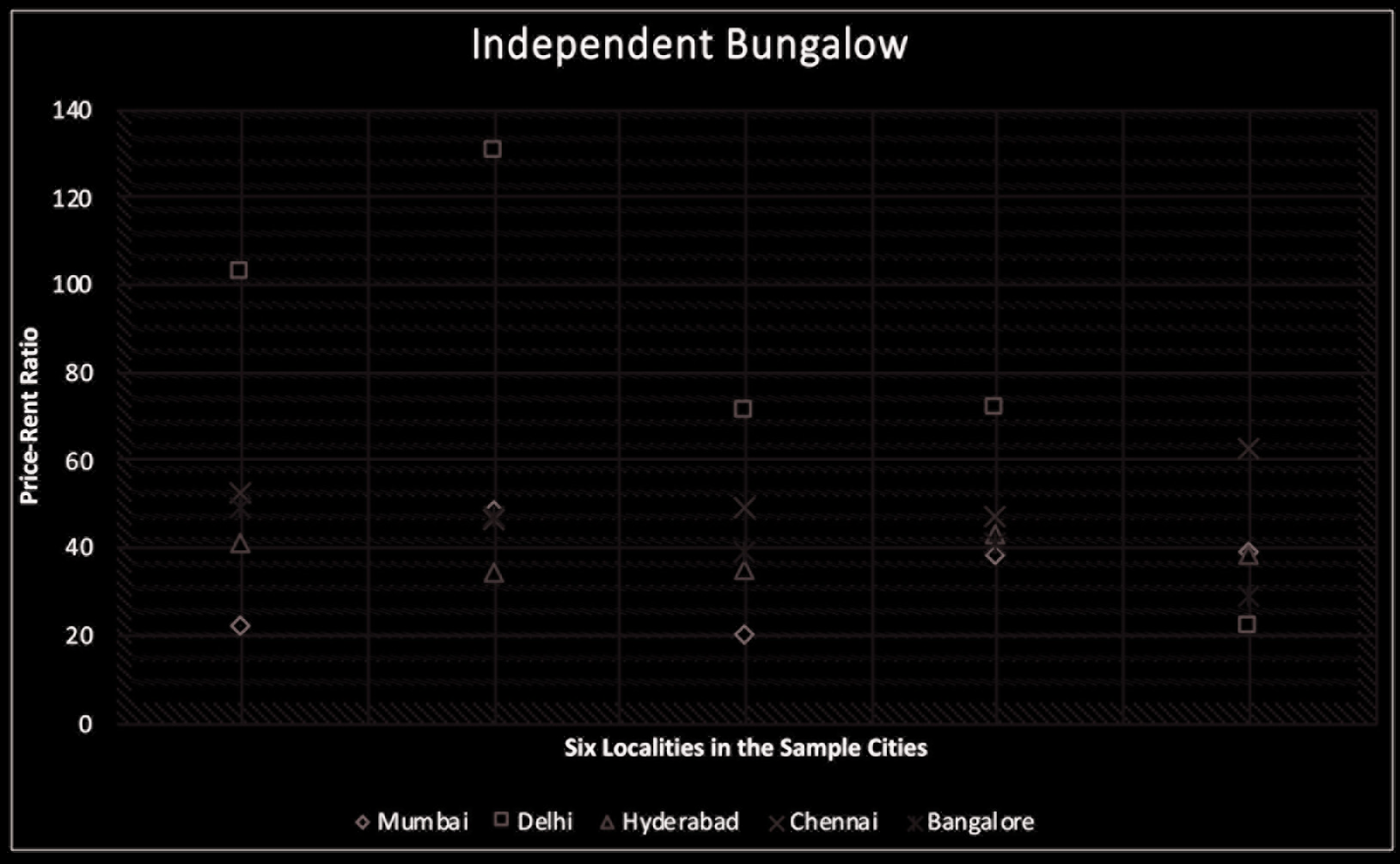
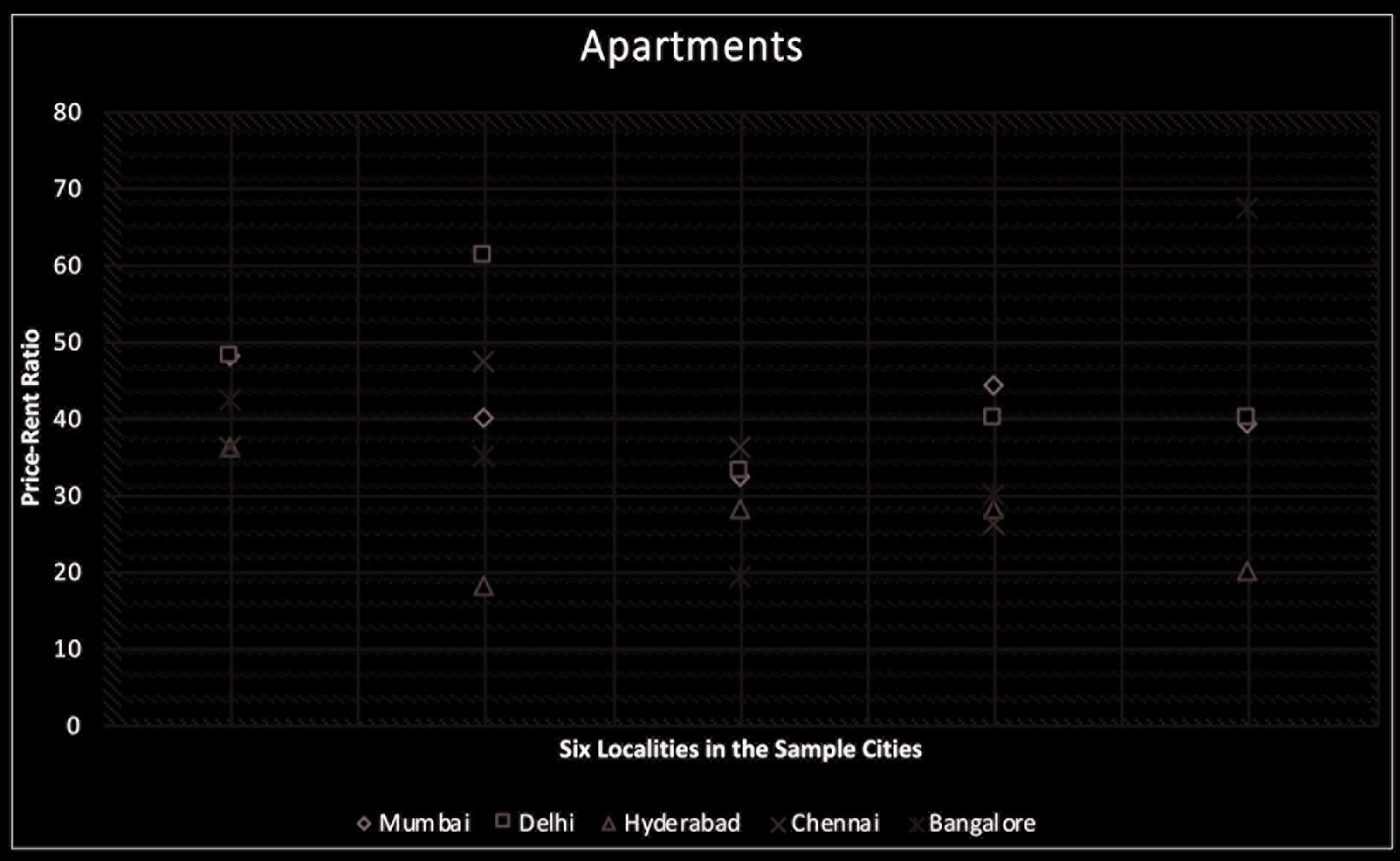
The price–rent ratio in Indian cities goes through the ‘roof’ proverbially speaking. For independent bungalows, some places in Delhi have a ratio beyond 100. The X-axis moves from expensive to inexpensive areas in terms of real estate, generally considered. And yet, one observes how high the ratio is even in poor localities. Keeping Delhi aside, even the remaining cities exhibit an average ratio lying around 40. This average is only slightly smaller in case of apartments. Not only are house prices in India insanely high but also there is a little correlation between the house prices as compared to the average incomes in these places. What must be going on in here? We return to the question of time, discount factor and loss of singularity in time.
Discussion
So, here is the puzzle posed by the data here. At one level, it is surprising to notice such high levels of price-rent ratio. This has one or more of the three implications. First, the idea of home ownership is far more than just being rational. Second, house prices are irrationally inflated. Third, people view time differently. Various studies have shown that for many cultures, home ownership has a value-laden heaviness, India included (Proxenos, 2002). But this difference is not big enough to address the problem of liquidity constraints that most Indians have, especially large sums of money required to purchase a home. Surely, house prices are inflated, for it simply doesn’t make sense for houses to have such high ratio—a good house built of reinforced cement concrete (RCC) will begin crumbling in 40–50 years anyway.
The third reason is what catches our attention. People view time differently. Westerners look at time linearly, while those in the east—like Indians—understand it cyclically. For the former, time is a limited resource, limited like any other, and people structure their life around deadlines, while in the country like India, deadlines are often looked at as targets, which compete with tasks at hand and possible strain on some relationship it must be put through (Pant, 2016). So, one would imagine, at least the Indians, to behave in their own cultural contexts.
This singularity is broken down.
One has to recognize that the past and present, in effect, exist only in minds. St Augustine, around 2,000 years ago, was emphatic in this assertion when he began exploring the philosophical view of time. We do know that the perception of temporal event is a result of how we access and assess our memory. For anything that is past, or anything that will happen in future, does not have an existence, except in our memory. In fact, any belief about the duration of any event is a result of our mind measuring it through memory, rather than any real estimate. This means, the idea of time, culturally, must lie at a similar sense of how cultures access memory. This should not change.
But this is changing and as a consequence, time is losing its singularity. It is changing because people in India buying houses and therefore staking a claim in the future are divorced from reality in so many ways, across various cities and various places in the same city. The impact of local contexts and spatial organization of housing has a good deal to influence such choices, but the sheer overwhelming size of ratios beg us to focus on a powerful explanatory variable, which is the perception of future, interwoven with the so-called economic decision of house purchase. People in Delhi do not look at future in the same way as those in Mumbai. They also look distinct from elsewhere.
Hidden behind modernity’s centrifugal force that diverges sentiments of recognizing time in a society that has otherwise found a converging culture to dwell upon (within the same region at least) is the centripetal force of bringing the otherwise heterogeneous imagination into a singular fold of estimating time value of money in house purchase decisions. In other words, the design of economic imperatives has led to a strong homogenizing attitude amongst people of various cultures to consider their time zone, markedly divergent from that of their own communities but similar to those possessed by similar economic imperatives. These imperatives are shaped by modernity and get manifested in the society through existence of modern institutions like banks, insurance industry and their modern tools like interest rates, predictive models and probability distribution patterns that define the scope of such tools.
Most residential purchases are done through financial intermediaries like banks. The cost of capital is the interest rate. So, I borrow money from the bank to buy my house today and repay it over several years. The beneficiary is today-me, and the victim is tomorrow-me. With a high discount factor, I become rather insensitive to the tomorrow-me. But this discount rate, even if different for different people, gets homogenized because banks impose the same cost of money to everyone in most cases. So, people separated from each other by distance, culture and language will end up viewing time in the same way, because they are all governed by the same interest rates that banks have imposed on them.
Even when time in their very own location is no longer singular—the elderly couple look at the faces of their grandsons and granddaughters to estimate time, while their son and daughter-in-law look at their clocks, company targets and annual appraisals to view the flow of time. The grandmother eats when she is hungry, the son eats when the luncheon meeting begins, a child views televized series of his/her favourite cartoon and estimates his/her time before and after it and the daughter-in-law is bound by the time metro rails in the city run. These sons and daughters-in-law are separated temporally from their own community where they live but are connected to another group of sons and daughters-in-law in communities that binds them through common interest rates. The kids of the family are separated in their time-view horizon from their parents but are bound by their friends in school who come from different communities but rely on the school bell to free them. Entities far away construct similar time imagination in their minds, while those sitting close to each other design their separate time-models. Must one say for the latter that modernity has time-alienated people? The same modernity imposes fresh rules for homogenizing them, albeit not in the same community but in the same ‘job’ community.
And here lies the proposition. Modernity is using time as a mould to construct homogenous entities. These entities are distinct from each other. So, while various communities had a singular architecture of time earlier, they now have a wide variety of it. And these varieties of temporal forms are what is homogenizing people located in various cultures. Time has lost its singularity at the cost of homogenizing ways of life. Both the homogenizing and breaking up of the temporal singularity is taking place through institutions of modernity—interest rates in case of house purchases as we saw.
This is the politics of homogenization, in which dominant become the advantaged as well in configuring how social relationships with time are framed. The cunning beauty of this modular structure of dominant institutions is that it self-selects its participants. And those who choose to do it get a sense of empowerment. People purchasing houses indeed feel a sense of accomplishment, a type of achievement which is irreplaceable. This happens with absolutely no sense of remorse for the future arrest of the same person’s freedom from the shackles of monthly instalments. These frameworks have consumed the possibilities of emergence of any revolutionary element of thought to unshackle the arrested view of time. When we sit back and relax in the pleasure of our newly purchased home, we are all being absorbed in the giant machine of modernity, which is not only throwing us into a different time frame of life’s philosophy but also compelling us to enjoy.
A sight at the bank’s loan-disbursing branch gives away this view. The sight is a phenomenological instruction into this overarching ‘social self-becoming’ in practice. In a typical bank branch in India, the space is full of couples with small kids dangling at their legs or sometimes running around, expressionless as the faces are, matched only by the eagerness of some bank staff in the office doing paperwork for them and interspersed with mid-level employees who are also expressionless, filling out their forms. A dry congratulatory smile greets every customer-couple when formalities are done. The exasperated look on the face of the couple comes at a stark contrast with the boundless joy the decision was taken in, and will doubtlessly be enjoyed in, the same evening after a ritual visit to the nearby temple. Before the couple exit the bank premise, another group of eager bank employees, waiting like lions in a cage for the meat to arrive, approaches the couple and offers them an insurance—what happens if the earning member dies, and the bank is forced to take possession of the house? One must buy an insurance so that the house remains with the family and instalments keep going to the bank. A good part of life is sacrificed at the altar of the bank.
One cannot help but notice the thrust of capital as a means of barter against time. The proverbial phrase time is money is clearer in the design of research intended here. If time is linear in its outlook, then time-period has a definitive start, accumulation, dissipation and death, just like money. So, we spend time and lose it. Similarly, as we spend money, it is also concurrently lost. Indeed, the idea of time being earned or spent carries a similar monetary connotation that are adequately analogized with time. This is a hallmark of any culture, which bases itself on imperatives of capital and material. Nonmaterial cultures have unflaggingly resisted this idea, somewhat effortlessly. Time is circular in most such cases, so even if it goes, it comes back, just like money—and hence, money is not the central hinge around which life revolves in such cultures.
One finds himself/herself at a conflicting crossroads then. At one level, time has lost its singularity, leading to a disappointing divergence from cherished goal of humanity to flourish in the way it deems fit, and at another level, the dominant institutions of modernity are forcing a homogenized value system of time, which is largely driven by the Western conception of time. Colonization did not let other ‘types’ of modernities to emerge or evolve. The strange ways in which modernity acts is to keep filling the container of culture with its own fluid, until a point when the drinker begins liking it. It may be an acquired taste, so to speak. And with time as an ingredient, a differing taste for everyone, and yet, the same taste for those having big containers and same for those having small ones.
Conclusion: Time’s Up
Time’s anthropology has also been found fragmented like shards into an array of dimensions that scholars engage with in politics, sociology, history, economics and the like (Munn, 1992). But the idea to locate it in differing conceptions of the discount factor manifested most evidently in-home ownership is new. India is also a typical case in point here. Housing Finance Information Network computes rates of home ownership in various countries in urban areas. There is also data on how much of the population resides in urban areas in the first place as a share of the total population. What must one expect?
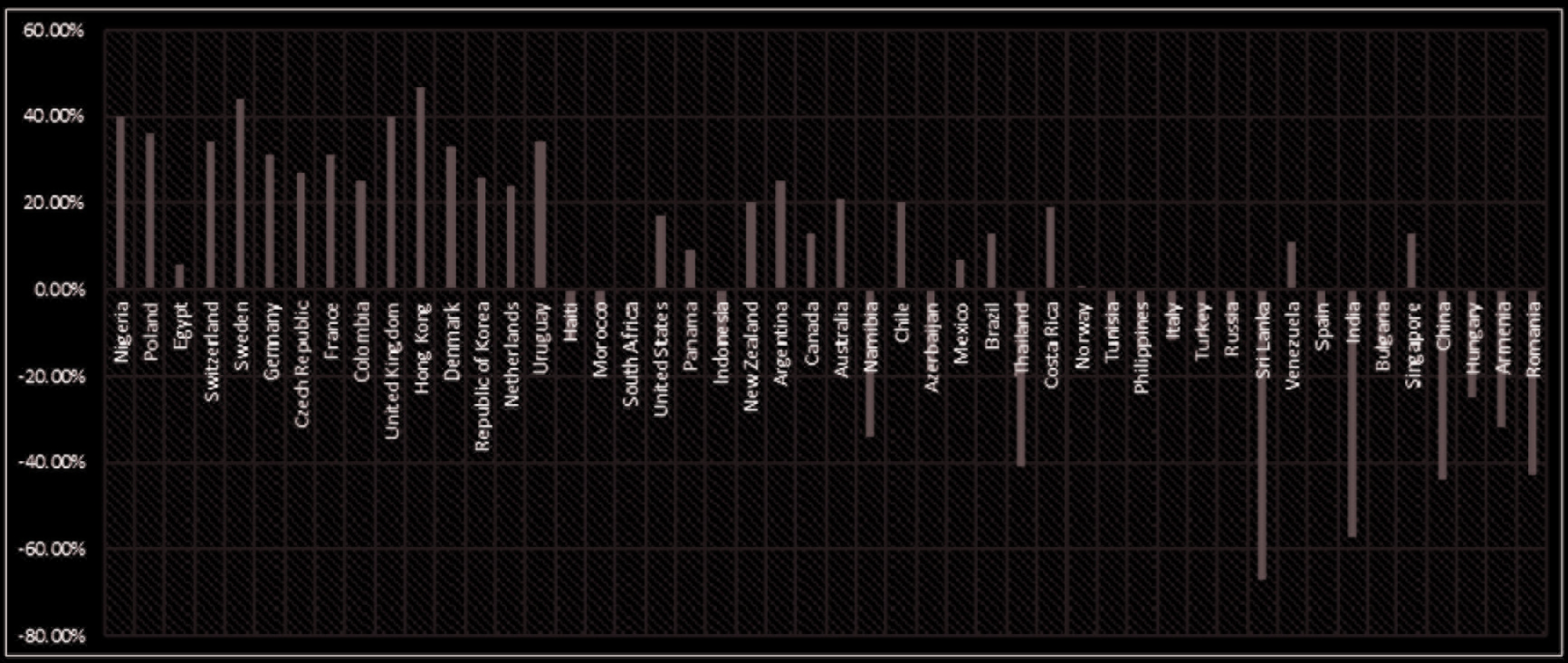
It is likely that the more the people live in cities, the costlier will the cities become, and therefore, they will have lower rates of home ownership. Indeed, this is what one observes in most countries in the world, mostly in developed countries. In the developing countries (except Italy), the values of urban population share are considerably lower and yet, the home-ownership rates are significantly high. If one draws a graph with countries’ difference in urban population share and that of home-ownership rates in urban areas, one discovers developing nations following a very different patterns compared to the developed ones. India, in fact, has the second highest negative value (high share of urban home-ownership and low share of urban population share) after Sri Lanka. See Figure 3.
Developing countries are the laboratories of modernity’s most devastating experiments and this experiment continues. Again, one cannot deny the prevalence of culture in disproportionately high levels of home-ownerships in India and other such countries. But the vastness of the spread of this homogeneity begs us to think about the pressures of changing concepts of time.
One is perturbed at this juncture if there is a need for an alternative conception to emerge. Surely there is. The inherent anxiety that surfaces as a result of our modern ways of living have led sociologists like Ulrich Beck (1992) and Anthony Giddens (1990) to call it risk society. This is a society that is incessantly preoccupied with future and engaged with systematic manners of dealing with insecurities introduced by modernization itself. For scholars who understand the world in this framework, it is easy to recognize how social relations have changed due to the build-up of risks and responsiveness in modernization efforts. These relations also change because endowments are now distributed equally rather unequally. These endowments, which affect quality of life in a pivotal manner, could be wealth or even risks. Both wealth and risks are unevenly distributed and influence different people differently. And so is time.
Time has a differential influence on people just as it is available and valued differently by different people. Its focal hinge is now not on a community, which values and possesses time in the same quantum but on a heavy dose of economic endowment. These are new ways of categorization that appropriate valuation and appreciation of time substantially. And it is in this categorization that alternative conceptions have to be sought. While a full-fledged analysis of what could perhaps ensue in time to come to attack the impulse of homogenization requires further research, a quick primer on how education ossifies the existing categories and tools of modernization merits special mention here, and emphasis on changing educational philosophy as a parting note may act as some fodder for future research.
Our conceptions of time are framed as we grow up. And while the family units in collectivist societies like India open the cultural world of time to the little children growing up there, it is the schools where the dosage of modernity’s conception of time is forcibly made to be swallowed. The design of a school is built on the industrial revolution complex. Children of the same age are made to sit with each other—with no serious body of literature showing that kids with same age have similar learning abilities—who are then forced to study subjects they may not like. They are all made to sit with each other, and like a monastic order, a teacher comes in and instructs them. The shift in thoughts take place through a clock and a school bell, which indicates that the teacher should be changed. The student is supposed to ask questions relating to only that subject and only that is relevant. The scoring is done based on who knows how much of that was taught. It is a classic factory model order, perfectly designed to crush creativity and openness in thinking. And the worst part is that this model infuses an obsession to compete. The child is restrained to think, and then in that restrained environment, compete. In both restrain and competition, the idea of time assumes a predominant role. Lecture hours, dates, time and watch, all of them become useful artefacts to ‘move ahead’ in life or ‘move behind’, depending on how your modernity wants you to look at space-time.
Footnotes
Acknowledgements
The article is greatly enriched by comments from Amiya Das, Sadan Jha, Anja Fröhnel, Kala Sridhar and Harini Shah in addition to be being benefited by presenting it in two conferences, at the Institute for Social and Economic Change, Bangalore in 2018 and Tezpur University in 2019. Author acknowledges the excellent research assistance of Prasen Kondru.
Declaration of Conflicting Interests
The author declared no potential conflicts of interest with respect to the research, authorship and/or publication of this article.
Funding
The author received no financial support for the research, authorship and/or publication of this article.