



Abstract
Although the impact of job demands and work–family conflict (WFC) on burnout has been extensively discussed and analysed in the past literature, the role of WFC as a generative mechanism has been neglected. Therefore, the purpose of this study is to examine the mediating effects of WFC between job demands and burnout. The studied sample consisted of 713 Indian primary school government teachers who completed a self-report questionnaire assessing job demands, WFC and burnout. The results confirmed that WFC partially mediates the adverse association of job demands with burnout. Primary schools should, therefore, be encouraged to provide effective practices to manage work–family interfaces.
Introduction
The World Health Organization (WHO) has classified burnout as an occupational syndrome that results from sustained and unmanaged high stress at the workplace. It is often reflected in the form of exhaustion, cynicism and reduced professional efficacy (WHO, 2019). Research has shown that teachers are at high risk of burnout, which not only impacts their physical and psychological health but also their performance (Hakanen et al., 2006; Kokkinos, 2007). Moreover, teacher’s burnout has a direct fallout on the quality of education, as burnout takes a heavy toll on the teachers’ thoroughness of preparation and involvement in classroom activities. Also, teachers are likely to criticize pupils more as their levels of burnout increase. Most of the available literature on teacher burnout is from Western countries like the United Kingdom, the United States and Australia (Shin & Jung, 2014). However, different countries have different academic systems (Dobbins & Knill, 2009), and these differences have an impact on the well-being of the teachers (Bentley et al., 2013; Shin & Jung, 2014). Hence, it is important to expand the scope of teacher burnout studies to include countries with different academic systems, like the public school system of India, which has unique characteristics.
Teaching in India can be far more difficult due to issues like high workload resulting from vacant positions and high teacher-to-pupil ratio. For teaching to be effective, it should take place at a level where students can grasp the content taught, as the ultimate intention of teaching is to bring about learning in students (Hirst, 1971), but due to issues of multi-grade teaching and assessment, and mismatch between student ability and curriculum, teachers are left frustrated and constantly feeling dissatisfied with what they are doing, which ultimately leads to detachment from their work and their pupils. However, a teacher cannot bring about a change in another individual by remaining detached, as his or her true task is to introduce to pupils a way of life in which they themselves believe and considers to be worthwhile (Scheffler, 1963). Buber (1975) suggested that true joy and happiness can be achieved only through strong relationships, but the conditions inside a government school classroom are not conducive to the formation of such relationships between a teacher and his or her pupils, ultimately resulting in a depersonalized and dejected teacher.
Sometimes, well-meaning governmental interventions also bring about unintended consequences, like the provision of ‘No Detention Policy’ under the recent Right to Education Act, 2009, which mandates compulsory promotion of all students till the end of elementary education. This has led to erosion of academic rigour, motivation and engagement (Ramachandran et al., 2018). Teacher trainings are also ineffective, as they neither cater to the practical needs of the teacher nor help them in adjusting to their professional role in the classroom, which is in direct conflict with their role in the family or society (Kumar, 2011). Kumar (2011) further points out the increasing lack of empathy towards teachers by the bureaucrats in government schools and the management in private schools, thereby resulting in loss of dignity, status and identity, which is further aggravated by the severe cuts in public funding on education. In government schools, teachers get overwhelmed in their jobs due to role expansion, which has led to the addition of tasks like extensive reporting, data collection, implementation of government programmes and election duties, which create strain, thereby resulting in negative affective outcomes.
Teacher burnout is caused by many factors like work-related stressors and personality (Kokkinos, 2007). It is to be noted that in contemporary society, work and family life are interwoven, especially with the increasing number of women joining the workforce and changes in the traditional family structure. This discussion is even more relevant in a society like India, where the family responsibilities include taking care of the elders and young children along with work. Also, with the rise in dual-earning families, the traditional roles of men—taking care of money—and women—taking care of household affairs—have been undergoing a transition, thereby resulting in conflicts, which requires further investigation to understand its impact on work-related outcomes like burnout (Aryee et al., 2005). As there is a paucity of research on work–family conflict (WFC) as a mediator between job demands and burnout (Karatepe et al., 2010), it becomes imperative to study this mechanism. Although past studies have explored the role of WFC in increasing burnout in different occupational groups, the Indian education sector, particularly, government primary schools, has been neglected. Since close to 75 per cent of the children in Chhattisgarh are enrolled in government schools (Pankaj et al., 2018), burnout among government school teachers becomes a very critical factor in the learning and developmental goals of the children in the state, and hence its study an imperative.
Literature Review
Burnout
Burnout is an unpleasant state of mind occurring due to high levels of prolonged stress in the workplace (Leiter et al., 2010). It is conceptualized as a syndrome of emotional exhaustion (EE), depersonalization (DP) and reduced personal accomplishment (RPA) that can occur among individuals who work with other people (Maslach & Jackson, 1981). EE is a feeling of being exhausted and overextended because of work-related demands. DP sets in when one feels cynical about and detached towards the recipients of their service. A feeling of RPA happens when one feels that they are no longer effective in working with the recipients and is not able to fulfil their work responsibilities. Over 90 per cent of studies measuring teacher burnout use Maslach burnout inventory (MBI) (Platsidou & Daniilidou, 2016), and therefore this study employs MBI to measure burnout. A lot of debate has taken place on whether all three dimensions are required to explain the burnout phenomenon, and if yes, then how the three are related to one another. Shirom (1989) has suggested that EE is the core component of burnout and the other dimensions are incidental. Another study finds that EE is a necessary condition but not sufficient to explain the experience of burnout (Maslach et al., 2001). In a similar vein, another study reports that RPA is the consequence of EE and DP (Lee & Ashforth, 1996). However, Leiter (1993) states that RPA develops in parallel to EE and DP and not sequential to the development of EE and DP. He posits that the components arise as reactions to different aspects of the work environment. This model is in direct contrast to the earlier model which proposed that the development of EE triggers the entire burnout syndrome in response to the environmental stressors. This does not take away the fact that there exists a correlation between the components, but this is more so because of the consistent relationships among the components of the work environment. Though an initial effort in building theory to understand the burnout phenomenon has been encouraging, much remains to be done. Yet, the major influence of the three distinct dimensions of burnout can be observed in the stressful jobs of nurses, educators and police personnel, which involve continuous interaction with other people, often making heavy emotional demands that, over time, can be very draining and can lead to burnout.
Theoretical Framework
The mediation model used in this study is based on the conservation of resources (COR) theory. The COR theory was proposed by Hobfoll (1989) as a general theory of psychological stress. The model proposes that people try to acquire and maintain resources. Resources can be objects (e.g., a car), conditions (e.g., marriage), personal characteristics (e.g., self-esteem) or energies (e.g., money, time). As one experiences a loss of these resources, or the threat of loss, or a lack of expected gain after the investment of these resources, stress ensues. In the Indian context, it has been found that availability and accessibility of work resources are very limited, as there is an inequitable distribution of power, pay and status. Additionally, there is a deficiency in terms of grievance redress systems, logistics and infrastructural facilities (Ladd, 2007; OECD, 2017), which means employees do not have the work resources required to respond effectively to the job demands; hence, teachers are highly dependent on their personal and social resources to meet the demands. The high levels of demands at work eventually start depleting critical social and personal resources in a consistent manner and at a rate faster than at which they are replenished, thereby leading to resource losses. Examples of work-related resources are ‘time for work’, ‘stable employment’ and ‘support from co-workers’. Family resources may include ‘good marriage’, ‘free time’ or ‘time with loved ones’. Stress occurs when these resources are (a) threatened; (b) lost; or (3) invested but do not reap the anticipated level of return (Hobfoll, 1989). The depletion of these resources across both work and home environments is particularly worrisome, given the often competing demands placed on teachers with significant work and home responsibilities (Freedy & Hobfoll, 1994). As more losses are experienced in one domain, fewer resources will be available to satisfy the demands in the other domain. The cumulative resource losses reduce the coping capacity of an individual, leading to negative outcomes.
The COR theory has been prescribed over other theoretical frameworks, because it recognizes the importance of both work and family in understanding burnout (Rupert et al., 2009). Using the COR model, the burnout process can be understood as a process during which the general work and family demands deplete resources in a consistent manner and at a rate faster than at which they are replenished, thereby leading to resource losses. The cumulative resource losses reduce the coping capacity of an individual, leading to increased psychological distress in the form of burnout. Literature supports the relationship between job demands and WFC, on the one hand, and between WFC and burnout, on the other (Khan, 2012). It can be argued based on the COR theory and existing research findings that as job demands increase, they lead to an increase in the levels of WFC, which further leads to an increase in burnout.
General Job Demands as an Antecedent of Burnout
Job demands can be described as stimuli contained in the work environment that require some effort, which can be cognitive, emotional or behavioural in nature (Montgomery et al., 2006). It has been theorized and observed through exploratory studies that as job demands increase, there is an increase in physical and psychological efforts, which creates physical and psychological costs, and in the absence of sufficient resources to meet these demands, an individual suffers from burnout (Demerouti et al., 2001). The nature of work has changed for teachers over the decades, prompted by the changing environmental, political and sociocultural forces. This has led to the need to evaluate a range of job demands, especially those which are relevant to the profession, as it has been found that studies are more relevant when specific job characteristics relevant to the profession are considered (Van de Ven et al., 2013). The job demands that a teacher faces generally in a school environment have been categorized into four categories and have been conceptualized as general job demands (GJD) (Bradley, 2007). The categories are: (a) workload; (b) job complexity; (c) student-related stressors; and (d) professional difficulties. These stressors are found to be quite common across varied settings in the teaching profession and have been found to positively contribute to burnout (Tuxford & Bradley, 2014). Studies have established the relation of time pressure (workload) with burnout (Kokkinos, 2007; Skaalvik & Skaalvik, 2009, 2017; Zapf et al., 2001), student misbehaviour with burnout (Friedman, 1995; Kokkinos, 2007; Roslan et al., 2015; Van Droogenbroeck et al., 2014) and non-teaching duties (job complexities) with EE and DP (Van Droogenbroeck et al., 2014). However, the associations of colleagues and supervisors (professional difficulties) with burnout are inconsistent. For example, some studies reveal significant relationships with all dimensions (Greenglass et al., 1997), some partial (Van Droogenbroeck et al., 2014), and some do not show any significant relationship (Tuxford & Bradley, 2014). In light of primary schools, GJD are important educational requirements; however, due to limited educational resources, meeting such demands becomes difficult, which in turn may lead to burnout. Moreover, inconsistent past evidence warrants further scrutiny and investigation.
Based on the arguments above, we propose the following hypothesis:
Work–Family Conflict as a Mediator of Burnout
WFCs have been conceptualized as inter-role conflicts between mutually incompatible role pressures from the work and family domains (Greenhaus & Beutell, 1985; Netemeyer et al., 1996). The ongoing societal and technological changes, like the increase in the participation of women in the workforce and the emergence and adaptation of technology that facilitates work from home, have removed the boundaries between work and home life. The excessive demands at work drain the personal resources of an individual, thereby making the person unable to meet the family demands, which eventually lead to burnout. The relationship of WFC with burnout has been extensively explored across different occupational groups like hospitality groups (Karatepe et al., 2010; Mansour & Tremblay, 2016), university and public offices (Blanch & Aluja, 2012), accountants (Mete et al., 2014), software developers (Singh et al., 2012) and psychologists (Rupert et al., 2009). A meta-analytic review that included retail employees, the police, executives and healthcare professionals found similar findings (Allen et al., 2000).
However, teaching has not been high on the list of professions that warrant research with respect to WFC, as it is assumed that teachers face less WFCs as compared to managers and those in other high-pressure roles (Cinamon & Rich, 2005). This is based on the following characteristics of teaching as a profession, among others: fewer working hours and more holidays. However, lately, these factors have changed due to the ever-expanding role of a teacher, which includes a tremendous increase in non-teaching duties, and ever-increasing demands from external stakeholders such as policymakers, supervisors, experts and parents. Additionally, teachers are expected to take on the role of parents in educating their wards on issues of social nature, such as addictions, health and civic education. These factors have significantly changed the nature of the teaching profession, which warrants investigation into previously ignored dimensions like WFC and its consequences for teachers. In the Indian context, it becomes even more relevant, as the majority of the teachers are married females with children and, as per the cultural norms, are the primary caregiver to their children, taking care of household chores and also taking care of other family members. The limited research that has been conducted reveals that there is a significant and positive relationship between WFC and teacher burnout (Erdamar & Demirel, 2014; Esson, 2004; Khan et al., 2012; Pu et al., 2017).
The literature available on WFC research is abundant; however, the conceptual framework is missing is many of these studies (Guerts et al., 2003). There has been a concern regarding where to theoretically place WFC in the stress–strain relationship (Demerouti et al., 2004), as it has been conceptualized as an antecedent as well as a consequence to burnout. Logically, WFC appears to be more a mediator than an antecedent, as it cannot exist in isolation without job demands. A mediator variable (WFC) typically explains the mechanism through which a predictor variable (GJD) influences the outcome variable (Burnout). For example, a recent study in Portugal among technology and service organization employees supported the mediating role of WFC between job demands and mental health (Carvalho et al., 2018). The extant literature on WFC also supports its mediating role (Frone et al., 1992; Geurts et al., 2003; Kinnunen & Mauno, 1998; Montgomery et al., 2003; Parasuraman et al., 1996; Stephens et al., 1997). It remains to be seen if similar results in different cultural contexts can be replicated for teachers as well.
Based on the above arguments, the following hypothesis is proposed:

Methods
Participants and Procedures
A convenience sample of 800 Indian primary school teachers from different regions of Chhattisgarh (Central India) participated in the current study. The participants were approached when they had come for training in Raipur, the capital of the Indian state of Chhattisgarh. The consent to obtain data from participants was first obtained from District Institute for Education and Training (DIET) officials. Thereafter, participants were given basic instructions on how to fill up the questionnaire and were requested to participate, and those who agreed were handed the questionnaire and requested to fill and return the same within a week. A total of 713 teachers returned completed survey forms prepared in Hindi, rendering a return rate of approximately 88 per cent. The sample comprised 63 per cent males and 37 per cent females; the average age of the teachers was 38 years, with a standard deviation of 6.75 years. The mean number of total years of teaching experience was 12 years; the mean number of years of experience in the current school was 8 years. About 53.1 per cent were permanent teachers, and the remaining 46.8 per cent held contractual positions. Confidentiality was strictly followed, as none of the participants were asked to reveal their identity.
Measures
Burnout
The Maslach Burnout Inventory–Educators Survey (MBI-ES) was used to assess burnout with a 22-item scale developed by Maslach et al. (1986). MBI-ES assesses three aspects of burnout: (a) EE; (b) DP; and (c) personal accomplishment. The sample item used to assess EE was ‘I feel emotionally drained from my work’, that used to assess DP was ‘I feel I treat some students as if they were impersonal objects’, and that used to assess personal accomplishment was ‘I deal very effectively with the problems of my students’. The responses were measured on a 7-point scale ranging from never (=0) to every day (=6). The items of personal accomplishments were negatively coded to measure RPA.
General Job Demands
GJD were measured using a 16-item scale (Bradley, 2007) that looked to assess major stressors in the teaching domain under the following dimensions: (a) qualitative load (job breadth and complexity); (b) quantitative workload (excessive work, short time frames); (c) student-related factors (motivational problems, discipline issues); and (d) non-classroom interpersonal issues (conflicts with superiors, colleagues, parents). The sample item used to assess qualitative load was ‘I am frequently restricted by the education department policies and practices’, that used to assess quantitative workload was ‘I find that there is not enough class time to cover the syllabus’, that used to assess student-related factors was ‘Students seldom misbehave in my class(es) (Rev)’, and that used to assess non-classroom interpersonal issues was ‘I occasionally have difficulties or conflicts with my fellow teachers’. The responses were measured on a 5-point scale ranging from completely true (=1) to completely false (=5).
Work–Family Conflict
WFC was measured using a 5-item scale developed by Netemeyer et al., (1996). The sample item was ‘My job produces strain that makes it difficult to fulfill family duties’. The responses were recorded on a 7-point scale ranging from strongly disagree (=1) to strongly agree (=7).
Results
The hypothesized relationships were examined using the partial least squares (PLS) approach to structural equation modelling (SEM). SmartPLS 3 (Ringle et al., 2005) was used to carry out the PLS model estimation. Path coefficients in a PLS model are standardized regression coefficients (Staples et al., 1998). PLS-SEM enables estimation of the simultaneous effects of multiple variables on a dependent variable; it is better suited for modelling formative constructs (Hair et al., 2014). Internal consistency reliability was assessed through Cronbach’s alpha and composite reliability. Cronbach’s alpha values were greater than 0.70 (Nunally & Bernstein, 1994), and composite reliability values ranged between 0.70 and 0.92, which are considered to be ‘satisfactory’ (Table 1).
Results of Descriptive Statistics, Reliability and Convergent Validity
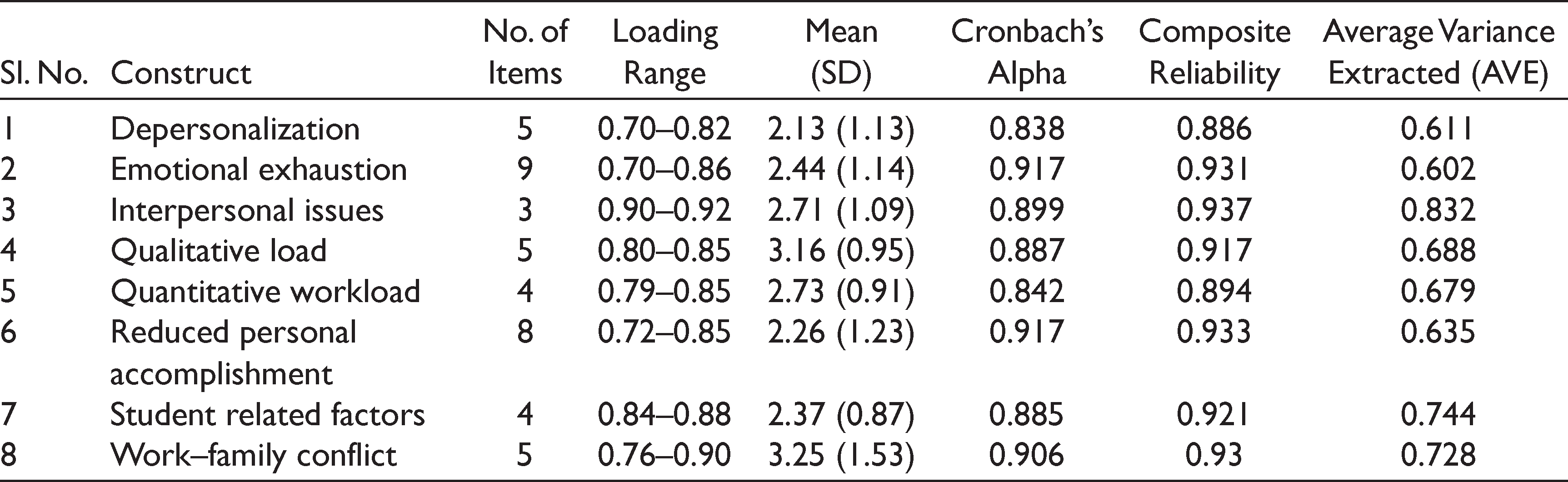
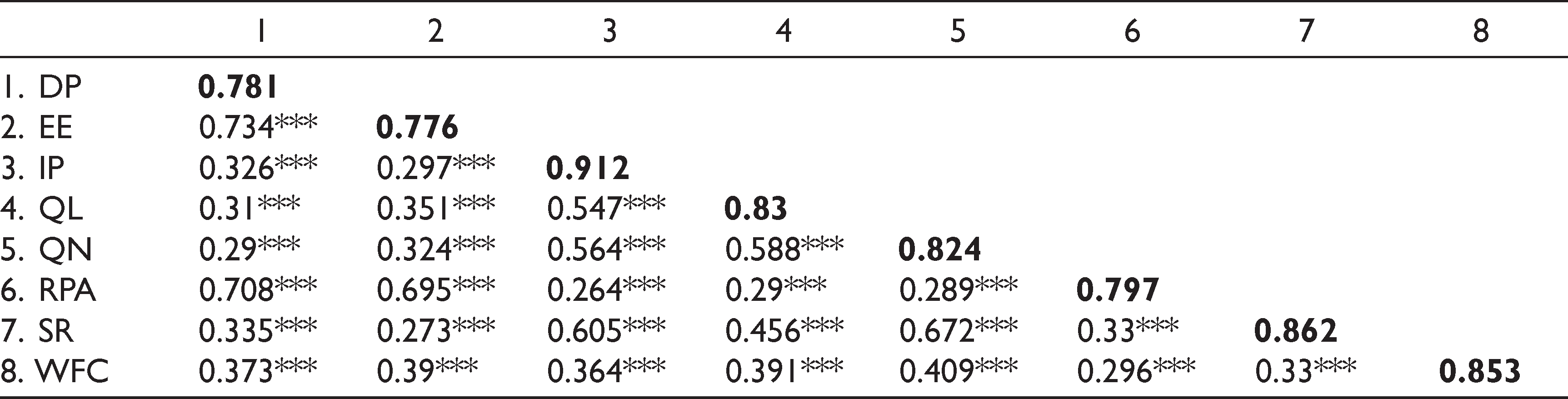
Convergent and discriminant validity were also examined (Campbell & Fiske, 1959). The average variance extracted (AVE) of all the constructs was greater than 0.50, suggesting good convergent validity. Moreover, the outer loadings of the construct were also considered to examine convergent validity. The standardized outer loadings were above the recommended value of 0.70, reconfirming good convergent validity (Hair et al., 2014). Fornell and Larcker’s (1981) criterion was followed to test discriminant validity, comparing the correlations between the constructs with the square root of AVE. All the variables indicated good discriminant validity (Table 2).
Results of Discriminant Validity
***p < 0.001.
Further, the second-order construct GJD’ validity was tested in accordance with the methodology specified by Petter et al. (2007). Variance inflation factor (VIF) was used to examine the multicollinearity among the first-order constructs. Low VIF values (<5) (qualitative load = 1.707; quantitative workload = 2.266; student-related factors = 2.113; non-classroom interpersonal issues = 1.877) among the dimensions suggested lack of multicollinearity. The coefficients of first-order constructs (qualitative load = 0.342; quantitative workload = 0.297; student-related factors = 0.315; non-classroom interpersonal issues = 0.261) were all significant at the p < 0.001 level. Thus, the above tests support the higher-order formative model of GJD and verify its validity.
The conceptualized relationship between the components of burnout was consistent with the model values of burnout. In accordance with Maslach et al.’s (2018) marker for high burnout, there are no defined scores that reflect high burnout, but there are suggested cut-off values of burnout dimensions (EE ≥ 3.0; DP ≥ 2.6; RPA ≥ 4.8). Accordingly, about 20 per cent of the study’s sample respondents were reported to be at a high risk of burnout.
Path-analytic hypothesized relationships were tested through the bootstrapping re-sampling procedure using 1,000 samples (Figures 2 and 3).
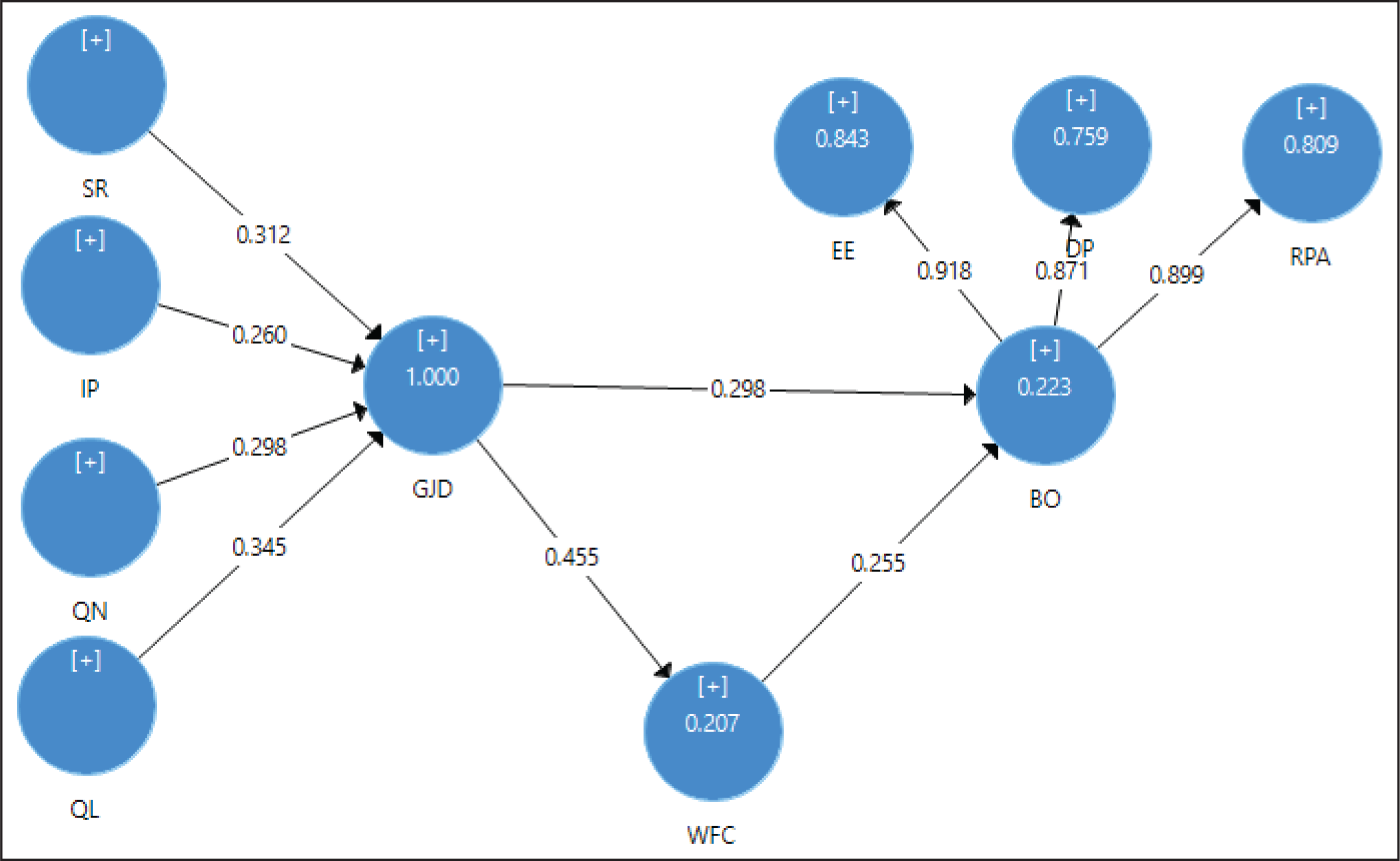
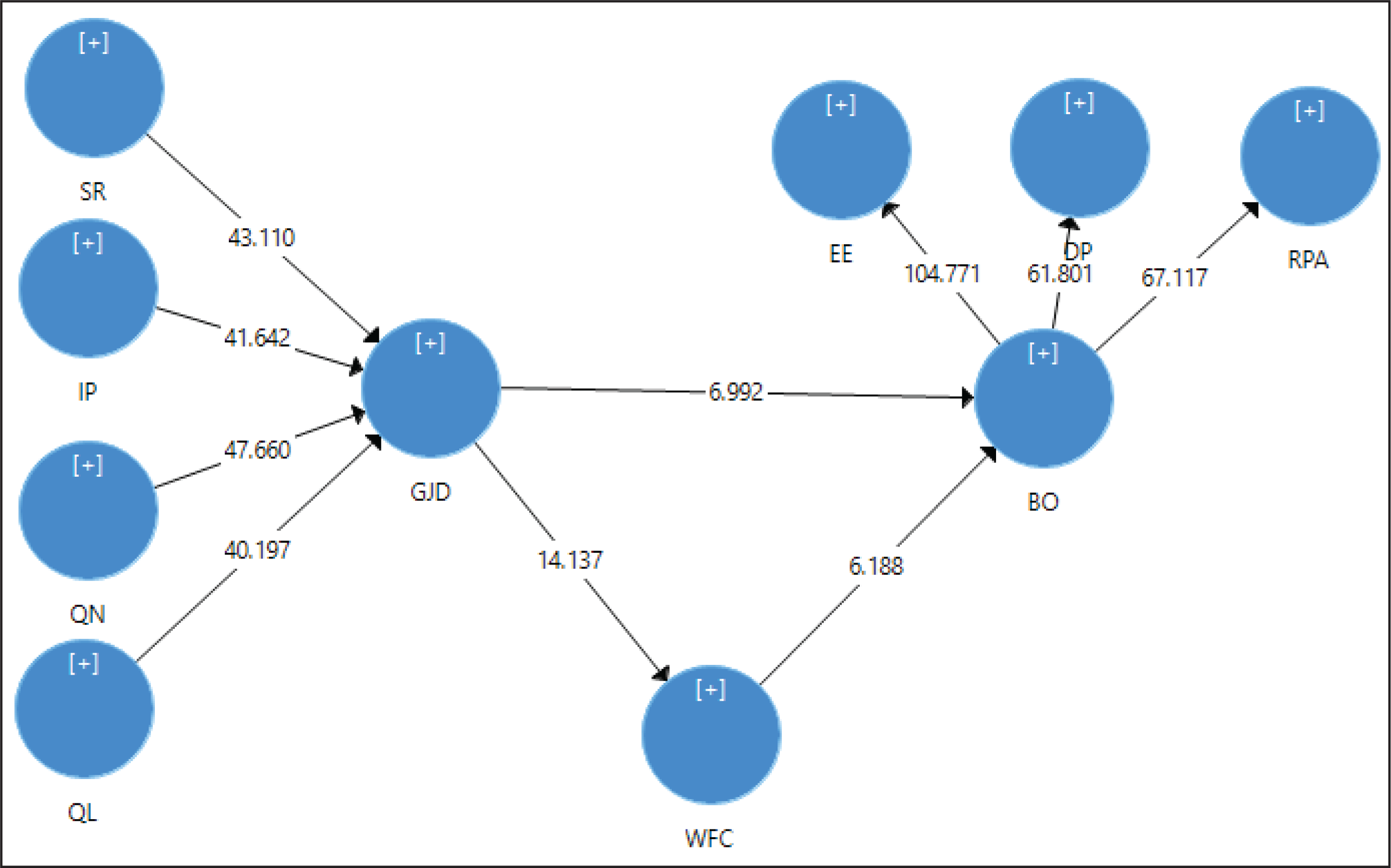
This procedure was used to calculate t-values using standard error estimates (Fornell & Barclay, 1983), so as to confirm whether path coefficients are statistically significant or not. Supporting the first hypothesis, the standardized path coefficients indicated that GJD and WFC increased burnout. The t-statistic value at the 0.05 level was 1.96. It may be noted here that if the t-statistic value is greater than 1.96, the path is significant (Efron, 1979).
In accordance with the second hypothesis, WFC partially mediated the associations of GJD with burnout. As per the guidelines provided by Hair et al., (2014) to check mediation in PLS-SEM, the significance of the direct and indirect path between the dependent and independent variables was tested. In case the paths turn out to be significant after the bootstrapping procedure, the variance accounted for (VAF) is found to evaluate the extent of mediation by the mediator variable. This is calculated by dividing the indirect effect of the total effect. If the VAF is less than 20 per cent, it can be concluded that no mediation has happened. In case it is greater than 80 per cent, one can assume full mediation, and if it is between 20 per cent and 80 per cent, partial mediation is concluded. In this particular case, the value of VAF was found to be 28 per cent; thereby, we can conclude that WFC partially mediates the association of GJD and burnout.
Discussion
Using the COR theory, this study makes an early attempt to examine the role of WFC in the relationship of GJD and burnout among Indian primary school teachers. COR as a theoretical framework is used in this study, as it recognizes the importance of both work and family in understanding burnout (Rupert et al., 2009). Accordingly, it was found that GJD have significantly contributed to the development of burnout among primary school teachers, as the path coefficient between GJD and burnout was found to be 0.298 and the t-value was 6.9. These results can be explained by analysing the existing literature in the forms of reports about teachers and teaching in Indian government schools (Ramachandran, 2005; Ramachandran et al., 2018; Teacher Absenteeism, 2017), and also based on the discussions that the authors had with primary school teachers in government schools of Chhattisgarh. The findings reveal that teachers have to deal with high job complexity in terms of increased non-teaching duties, discipline and motivation issues among students as a result of the no-detention policy, time pressures due to frequent and urgent data-reporting requirements of their department, conflicts with stakeholders, the threat of transfers, lack of resources such as adequate compensation, recognition in the department and society and grievance redress systems, and logistical issues like inadequate housing facilities near the school, all contributing to their burnout. This is an important finding, as it goes against the popular perception that government school teachers have an easy work life.
As hypothesized, WFC partially mediated the associations of GJD with burnout, as the VAF value was 28 per cent. As teachers indulge in academic work, there are chances that it can easily spill over into the home domain, as it is never-ending in nature and is flexible in terms of space and time (Zábrodská et al., 2018), as teachers tend to take home their many tasks like preparing for classes, checking students’ work and evaluating tests. This may lead to interference with family and leisure activities and thereby not provide the individual with time for recharging, hence contributing to burnout. Also, the partial mediation model is not only empirically supported by the literature but also is more plausible. It is unreasonable to expect individuals to form negative attitudes towards the workplace based on excessive demands only in terms of their impact on their home life (Bacharach et al., 1991). Even Baron and Kenny (1986) suggest that partial mediation may be a realistic goal for the social sciences, given the multiple causes of psychological phenomena.
Contributions
The current research contributes towards a theoretical understanding of the mediating role of WFC in the relationship between GJD of teachers and burnout, using the COR theory. The empirical findings are relevant and significant, as there is a paucity of research on WFC as a mediator between job demands and burnout. The findings show that close to 20 per cent of the teachers were found to be at high risk of burnout, which is a revelation in itself, as it goes against the general perception that government school teachers in India have an easy work life.
Practical Implications
As the findings have shown the centrality of WFC in developing burnout, the government should pay implement to family-friendly policies for school teachers, such as suitable leave arrangements, day care facilities and reduced administrative work, thereby leaving more time for teachers to attend to family responsibilities.
Limitations
We acknowledge certain limitations in the present study. First, all responses were self-reported and may not be free from social desirability effects. Although other objective measures would reinforce the study (e.g., from the head teachers/spouses), this may not be logically feasible, especially since the assessment is quite subjective in nature. Therefore, self-reports would provide a closer assessment of the individual’s experience of the problem. Second, the current study was cross-sectional, and hence causality cannot be established. Third, the data were collected from primary school government teachers. Therefore, this study may not be generalized to teachers employed in private schools, because their job demands might be different from those of teachers employed in government schools. Future research can be extended to include private schools to test the viability of this model.
Conclusion
This study measured the direct and indirect associations between GJD, WFC and burnout among primary school teachers of public schools in Chhattisgarh, India. The findings are in line with the extant literature, even though the study was done in India, an under-researched regional context, which is primarily a collectivistic and familial society. The findings reveal that an increase in the GJD of government school teachers is positively associated with an increase in burnout among these teachers directly and indirectly through the increase in WFC, which acts as a mediator, that is, teachers experiencing excessive levels of job demands find it difficult to manage the demands and responsibilities of their work and family roles and experience elevated levels of burnout. The entire mechanism is explained through the COR theoretical model. The findings provide evidence for policymakers to provide and manage family-supportive work environments that would allow educators to balance their work and family demands and responsibilities in a better way, thereby reducing burnout.
Footnotes
Declaration of Conflicting Interests
The authors declared no potential conflicts of interest with respect to the research, authorship and/or publication of this article.
Funding
The authors received no financial support for the research, authorship and/or publication of this article.