



Abstract
The study examines the effect of corporate social responsibility (CSR) culture on the relationship between CSR strategy–sustainability linkages, ethics and the CSR outcomes in public sector organizations in India. Using a sample of 200 lower-, middle- and upper-level CSR managers, a mediation model by Baron and Kenny was outlined and tested. Results demonstrate that CSR strategy–sustainability linkages and ethics have a positive relationship with CSR culture and CSR outcomes. Further, CSR culture has a positive relationship with the CSR outcomes of employees’ CSR perceptions and competence. While CSR culture fitfully mediated the relationship between ethics and competence, partial mediation was found in all other cases. Thus, the adoption of strategic and sustainable CSR not only leads to desirable CSR outcomes but is also associated with a better fit between CSR and culture. Hence, strategic and sustainable CSR and organizational ethics must facilitate greater congruence between CSR and organizational culture.
Keywords
Introduction
With a high population load and low developmental indices, the Indian government joined hands with corporate partners and other stakeholders to boost the state of development. With the introduction of corporate social responsibility (CSR) law in India, organizations are realizing the importance of CSR for attaining national development and sustainability goals. CSR strategy–sustainability linkages and ethics, and their influence on CSR outcomes, are pertinent issues to be explored. Scholars in the past have identified various drivers of CSR such as strategy, sustainability, governance, value chain and so on (Ditlev-Simonsen & Midttun, 2011; Maximiano, 2007; Rexhepi et al., 2013; Sarkar, 2008); however, very few have attempted to understand the relationship between culture and CSR performance. Though researchers like Galbreath (2010) and Kalyar et al. (2013) have established a significant relationship between culture and CSR in their studies, there is a need to establish culture as a driver of social responsibility in an organization. It is, therefore, necessary to build a more comprehensive understanding of organizational culture, factors contributing to CSR-oriented culture and the associated consequences. Different authors have presented different definitions of CSR culture in the literature. While Zohar and Marshall (2004) state that CSR-oriented culture focuses upon employee ownership of the concepts and processes of social responsibility, fairness in decision-making, and balancing economic, social and spiritual dimensions in the organizational set-up, benefitting potential stakeholders, Prutina (2015) explains it as a shared understanding among organizational members as follows: (a) they have obligations towards the environment; (b) they need to create value for different stakeholders instead of keeping focus limited to shareholders alone; (c) their decisions and conduct must be based on the well-known and applied code of ethics and (d) their engagement and motivation should result in effective and innovative CSR.
When an organization has a shareholder culture, it requires a change in its values and CSR orientation to transform into a CSR-embedded culture (Prutina, 2015). This is because organizations may have an orientation towards control and competition with their primary focus being enhancing the wealth of their shareholders with hardly any interest in financing CSR programmes or policies. CSR masquerade culture, on the other hand, focuses on innovation along with profits and is more futuristic in comparison to the shareholder culture. This kind of culture represents transactional leadership in CSR with a focus on economic values (Groves & LaRocca, 2011). Further, in CSR proclivity culture, the aim remains to be part of a greater good, which forms a strong premise for CSR projects of the organizations (Prutina, 2015). This is an accommodative culture type, wherein organizations take responsibility for their actions and take all necessary measures for CSR. This is the starting point for many organizations that begin their CSR journey with the support of top-level management and later on, transform into an embedded CSR culture. Here, the employees have a say in the decision-making process, and the organization as a whole works on the premises of loyalty and trust. Though CSR might not have permeated the strategy and policy of the organization, there exists a strategic emphasis on value creation and overall development. Many organizations with this type of culture are often considered to be socially responsible. Another category, embedded CSR culture, is a type of CSR culture that is desired for successful CSR implementation. This culture type has firmly established moral principles emphasizing creating value for all stakeholders. Participation, commitment and innovation are its major characteristics (Aguinis & Glavas, 2013).
Earlier research linked CSR-oriented culture with different variables, such as leadership, human resource management (HRM) practices, organizational-citizenship behaviour, competence, strategy, sustainability, employee attitude and ethics (Duarte, 2010; Gazzola & Colombo, 2014; Jamali et al., 2015; Luu, 2017; Sarvaiya et al., 2018; Singhapakdi et al., 2015; Slack et al., 2015; Strand et al., 2015; Thanetsunthorn, 2014; Yu & Choi, 2016), and so on. Thus, social responsibility has now been recognized as a fundamentally important concept that must be integrated into an organization’s strategies, policies and culture. The perception of employees about CSR activities and their impact attributes to the development of the organization and improves its performance (Kucharska & Kowalczyk, 2019). However, it has only been recently that academic literature has begun to consider the links between CSR, organizational culture, organizations’ strategies, policies and employee attitudes, with many authors suggesting that this area of research is underdeveloped (Branco & Rodrigues, 2006; Laszlo & Zhexembayeva, 2011). In response to their call, this article explores the dynamics of CSR culture and the link to strategy, sustainability, ethics and employee CSR attitudes and recommends that this is an important, yet complex, aspect of contemporary analysis and research in the CSR domain (Figure 1).
Research Model Relating CSR Strategy–Sustainability Linkages and Ethics with CSR Outcomes.
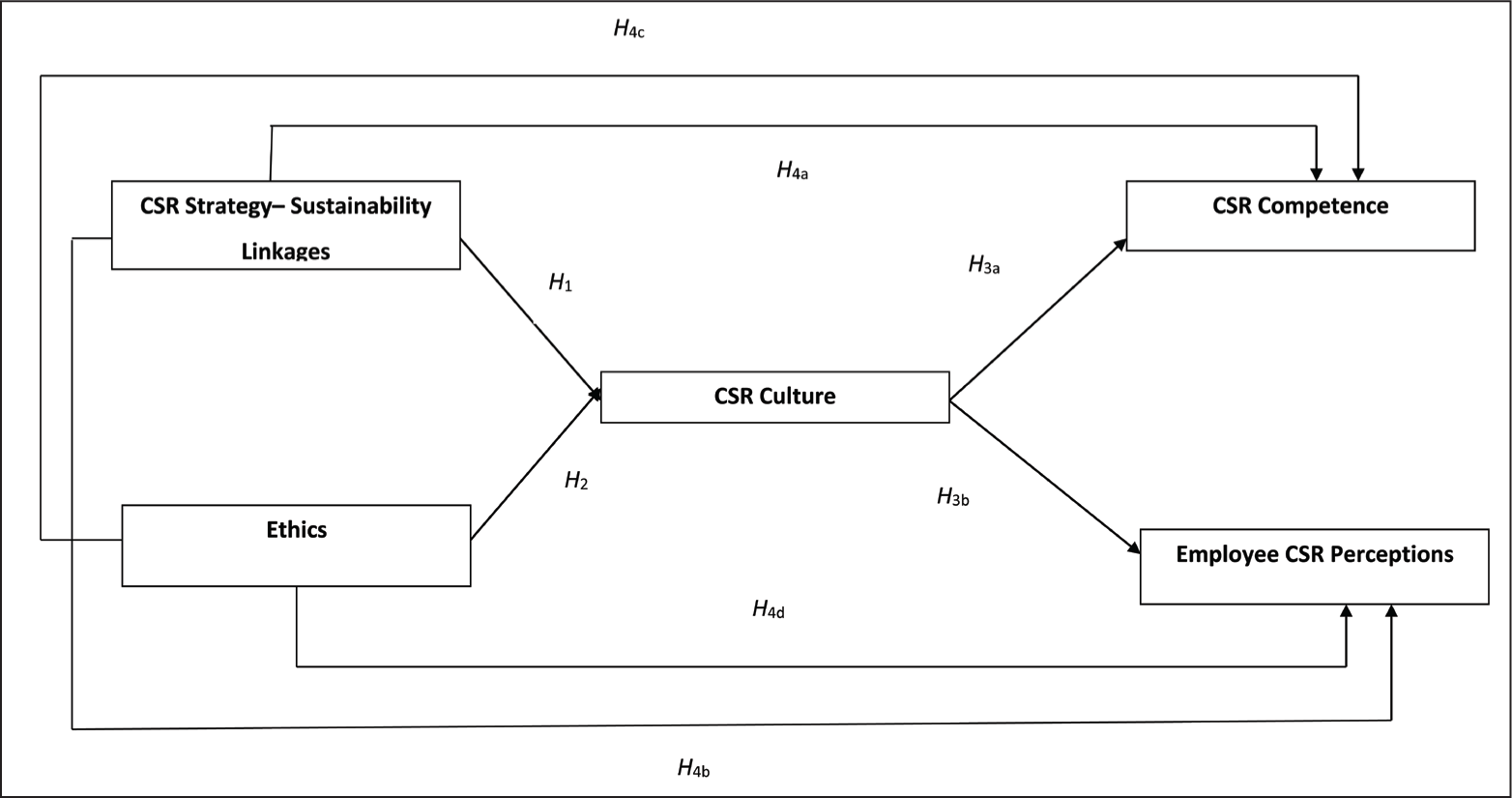
By examining the perceptions of multiple internal stakeholders, this research offers insights into the role of CSR-oriented culture, with other study variables, and contributes to the literature on CSR culture by analysing the mediating role of CSR culture between CSR strategy–sustainability linkages, ethics, CSR competence and employee CSR perceptions (Barker et al., 2014). The research emphasizes the crucial role of variables, CSR strategy–sustainability linkages and ethics in determining the level of internalization of dominant CSR values, beliefs and principles, and also has the potential to influence the level of commitment of employees to CSR within an organization. It also focuses on the perceptions of employees who were involved in those initiatives explicitly labelled as CSR by the organization to get a more complete understanding of the study variables in the organization as it is essential that an organization be transparent about its CSR efforts to stakeholders to assure the latter of the former’s sincere and genuine efforts to improve the environment and society (Latif et al., 2022). Therefore, this research can provide insight into the role of CSR-oriented culture, along with other study variables as key features for understanding the perceptions of employees on CSR.
Hypothesis Development
CSR Strategy–Sustainability Linkages and CSR Culture
CSR is often associated with strategy and sustainability for enhancing organizational CSR performance. Hargrave (2015) states that it is with globalization that organizations have been required to filter all their strategic decisions through a CSR lens to ascertain the best possible outcomes for all relevant stakeholders. At the same time, incorporating social responsibility into all strategic decisions may be one of the most difficult challenges faced by the management (Gazzola & Colombo, 2014). Strategic CSR is reflected in organizational practices through adherence to social responsibility codes and the implementation of social and environmental management systems that include a repeated sequence of events like CSR policy development, goal and target setting, programme implementation, auditing and reporting. In favour of sustainable CSR, Martinuzzi and Krumay (2013) have stated that social responsibility is an obligation of an organization to contribute to broader goals of the community and thus have directly associated the CSR concept with sustainable development. The developing BRICS economies, like India, are confronted with challenges of economic growth and sustainable development. 1 Thus, it is expected from the industries that they act in a socially responsible manner along with acting sustainably to meet the expectations of their relevant stakeholders and also promote inclusive growth. However, CSR practices promoting sustainability seem unclear regarding the morals and principles guiding business operations (Oginni & Omojowo, 2016). Thus, there exists a need to determine the focus of CSR practices in present corporate organizations regarding sustainable development goals for safe and inclusive growth. In the present Indian context, the government finds CSR to be a means to finance and achieve sustainable development. It was with this motto that the Department of Public Enterprises (DPE) issued CSR guidelines, making them mandatory for profit-making public sector undertakings in India. Thus, financing through CSR might lead us towards sustainable development, and mandatory CSR laws may prove to be an innovative way of financing development (Ray, 2013).
Strategic/sustainable CSR and the development of a culture that is reflective of CSR values are two crucial steps that are integral to socially responsible behaviour. A value-driven culture helps an organization shift from a negative duty-based morality to a positive duty-based morality, which helps span three levels: institutional, organizational and individual, driving the organization towards community betterment (Jones et al., 2007). Thus, the focus of the organizations must be on building an organizational culture that will encourage openness without being limited to self-sustenance alone. A culture of CSR is considered to be an essential factor for CSR implementation and also represents the long-term dedication of an organization towards socially responsible behaviour. There have been only a few studies exploring socially accountable cultures (Laszlo & Zhexembayeva, 2011). Silveira and Petrini (2017) stated that CSR initiatives do not have meaning if they are not sustainable, and thus organizations should look forward to sustainable CSR, aligning social responsibility goals with those of sustainable development, and making social responsibility culture in the organization. It is therefore inferred that when CSR gets associated with the broader goals of the organization like strategy and sustainability, it is likely that it will get embedded into the culture of the organization too. Thus, we propose the following hypothesis:
H1: CSR is linked to strategy, and the organizational sustainability is positively related to CSR culture.
Ethics and CSR Culture
Porter and Kramer (2006) reported that many organizations would engage in CSR just because they are forced by the laws of the land, communities and their relevant stakeholders. On the contrary, ethical theories have been found in support of a relationship between organizations and their surrounding communities, embedded with moral values. Thus, it is needed on the part of organizations to acquire socially responsible behaviour as an ethical obligation, above all considerations (Garriga & Melé, 2004). The very organizations that believe they have a moral responsibility towards their community get into socially responsible behaviour to play their part as good citizens and do the right things (Porter & Kramer, 2006). Carroll (1999) finds that the business ethics revolution of the past confirms ethics to be a legitimate CSR component. Though in his famous CSR pyramid, Carroll has presented moral responsibility as a separate level but finds it to be interplaying with the legal responsibility category. An ethically responsible organization ensures that the legal responsibility category is expanded to imbibe ethical concerns and also encourages the employees to perform above the minimum requirements of the law. When the culture of an organization is oriented towards community welfare, then the purpose of that organization is much more than profits. PricewaterhouseCoopers in their 2010 report, 2010 identified key criteria to encourage a CSR culture in the organizations through adherence to CSR principles. Primarily, they suggested that the key officials in the organization should be continually engaged in promoting ethics in the organization and seriously take up compliance-related issues. Then further aligning the systems, policies and procedures to extend support to the tone at the top will help inculcate engagement in socially responsible behaviour over time. This will include statements of values, ethical policies and procedures drafted to inculcate ethical conduct through training initiatives and incorporating ethical policies in staff handbooks.
2
Similarly, in a survey by the Institute of Business Ethics titled ‘Corporate Ethics Policies and Programmes: UK and Continental Europe Survey 2010’, it was found that 85% of the organizations agreed that the use of a code of ethics helps firmly establish socially responsible behaviour in an organization.
3
It is thus hypothesized that:
H2: Ethics are positively associated with CSR culture of the organization.
CSR Culture and CSR Outcomes
For organizations to sustainably continue with their businesses, there is a need to re-define their goals and capabilities and accordingly respond to organizational change. Socially responsible managers in organizations need to understand the external environment and recognise the potential of emerging CSR-related issues. It has been recently recognized and emphasized in the DPE CSR guidelines and CSR law of India that employees have an extremely important role to play in successful CSR implementation. Lee et al. (2013) state that the culture in an organization and its capabilities serve as premises for competitive advantage and employee perceptions of employees, and CSR plays a significant role in employee commitment to the organization and the CSR performance of the organization as a whole.
High-performing CSR organizations foster a culture of CSR and fully integrate CSR throughout their operations, rewarding and incentivizing CSR decisions and initiatives. Human resource managers have the tools and the opportunity to leverage employee commitment to the firm’s CSR strategy. Jamali et al. (2015) emphasise that HRM may have an influential role or may serve as the premise for successful CSR implementation. HR is the only function that influences the entire enterprise for the entire ‘lifecycle’ of the employees who work there; thus, it has considerable influence if handled correctly. HR is poised for this lead role as it is adept at working horizontally and vertically across and within the organization, which is important for successful CSR delivery through employees of the organization.
Osagie et al. (2019) state that organizations committed to CSR should ensure that their managers possess the appropriate competencies to effectively manage the CSR adaptation process. They have found in their study that CSR managers’ roles require a different combination and prioritization of these competencies. Consequently, it is required that the organizations strive towards defining the relevant competencies for managers and explore CSR-specific behaviour. In general, individual CSR competencies are seen as an individual’s integrated performance-oriented ability to attain particular goals, that is, an interlinked combination of three elements—skills, attitudes and knowledge elements—and their amalgamation for successful performance (Mulder, 2014). Cultural values have been found to influence CSR-specific knowledge in managers. CSR managers have a crucial role to play, to communicate to the upper management, the skills needed for CSR programmes and also managing building of such competencies. This is much easier when the culture of an organization centres on employee development; thus, the focus is on developing the employees by enhancing their CSR skills.
Nijhof et al. (2008) emphasized that an organization that has CSR built into its culture will be easily able to move forward with CSR competence management as it will strive to genuinely integrate CSR into organizational practices and develop a workforce that will enthusiastically work towards the cause. An organization can be called a good organization when it pays attention to vibrant workplaces, a motivated workforce, reinforcing cultures and shared leadership. It is thus hypothesized that:
H3a: CSR culture is positively associated with CSR competencies of the organization. H3b: CSR culture is positively associated with perceptions of employees towards CSR.
Mediation of CSR Culture
The existing literature lacks research connecting individuals to CSR or related outcomes. In other words, micro-level phenomena (e.g., values and leadership) are generally either assumed or not explicitly considered by CSR researchers (Orlitzky et al., 2011). If the employees are to be involved in CSR, they need an understanding of the concepts of CSR and sustainable development. This is very much evident from the findings of Ray (2013), who found that knowledge of the concepts of CSR and sustainable development is a crucial factor for the employees, as most of the CSR projects are in rural areas. Through interviews with key officials in the Public Sector Enterprises, the study found that most CSR managers had little idea of what CSR entailed. Many of the managers in the hydroelectric power company stated that CSR hardly reflects their technical background. The managers could not understand the broader concepts of sustainable development, climate change or renewable energy and, hence, could not link the same with the CSR projects. They concluded that knowledge management, individual capacity and the motivation of CSR managers are crucial areas that need attention. A focus on these areas requires that CSR does not remain fragmented from organizational goals and policies. Therefore, for better CSR outcomes for developing CSR competencies of individuals, organizations should look forward to strategic and sustainable CSR.
The DPE guidelines on CSR and sustainability emphasize that CSR must be integrated into the broader goals so that the concept is imbibed down the line into the culture of the organization (Kansal et al., 2018). Guidelines also emphasize that organizations must ensure that employees at all levels understand the philosophy of CSR and sustainability so that they get embedded in the core values of the company. These espoused values, coming from higher-level executives, are not likely to be shared among employees until they become involved (Bolton et al., 2011). The positive outcomes of adopting socially responsible behaviour may reinforce a positive attitude towards the CSR efforts of the organization (Caprar & Neville, 2012).
Suh (2016) examined the effects of CSR on employee attitudes and found CSR to have a positive influence on affective commitment and job satisfaction. Calabrese et al. (2013) have argued that employee positive perception and engagement in CSR will help manage social and environmental issues profitably and increase competitive advantage. Matten and Moon (2008) consider CSR as a cluster concept that overlaps with those of business ethics, sustainability, environmental responsibility and corporate citizenship. An ethically oriented organization will focus on developing ethical CSR and sustainability-associated competencies and will also encourage employees to take part in CSR initiatives, staying within ethical boundaries. Ethical organizations help develop a stakeholder culture taking into consideration the interest of others rather than adherence to self-interest (Jones et al., 2007). Such organizations follow moral principles, provide ethics training and ensure ethical conduct in regular practice, thus creating a culture where employees develop a positive attitude towards CSR and take up responsibility for doing things rightly.
The study argues that the variables strategy–sustainability linkages and ethics have a positive impact on CSR culture. Further, the mediator, CSR culture, has a positive impact on CSR outcomes. Accordingly, it is expected that CSR culture mediates the relationship between the independent and dependent variables. Yu and Choi (2016) have found that a CSR-oriented organizational culture has a fully mediating role in the relationship between stakeholder pressure and the adoption of CSR practices. However, the mediating role of culture for antecedents of CSR outcomes remains a scantly researched area. Hence, addressing the call for more research on the mediating role of culture (Anthony Wong & Hong Gao, 2014), this study addresses the gap and attempts to understand the mediating role of culture in CSR outcomes. Thus, the study hypothesizes the following:
H4a: CSR culture positively mediates the relationship between CSR-linked strategy–sustainability and CSR competencies. H4b: CSR culture positively mediates the relationship between CSR-linked strategy–sustainability and employee perceptions of CSR. H4c: CSR culture positively mediates the relationship between ethics and CSR competencies. H4d: CSR culture positively mediates the relationship between ethics and perceptions of employees towards CSR.
Methodology
The focus of this study was on the employees of Indian public organizations in the energy sector. These are the organizations that have a high growth rate and are profitable owing to their presence across the nation. They have enormous manpower and huge operations that affect the nearby communities and the environment. For years, these organizations have been carrying out CSR initiatives for the communities around them owing to their relocation and rehabilitation policy. As these organizations fall under the ambit of the CSR law, they are supposed to spend 2% of their last three years’ average annual profits on CSR activities, which is an enormous amount capable of bringing visible change in the lives of the marginalized. Thus, with the introduction of CSR clause 135, CSR has gained more prominence in the organizations that fall under the ambit of the law. The very manner in which public organizations have been involved in CSR for years leads to the expectation that the workforce in these organizations should have CSR-related perceptions in general and about the organization as well.
Sampling
The data collection for the study was planned through the CSR workshops in the sample organizations. For this purpose, personal calls were made to the executive managers of the public sectors in charge of CSR activities. The executive managers further provided the contact of the HR manager/deputy general manager CSR/general manager CSR/ director CSR/CSR project officers/executive director-CSR. The contacts for some of the organizations were also obtained from organizational websites, annual reports, institute alumni database and faculty referrals. After a conversation over the phone, emails were sent to the concerned CSR professionals for workshop proposals with an assurance to provide them with a comprehensive research report in return for their cooperation once the research was completed.
The CSR workshops had the dual objective of imparting CSR-related knowledge to the participants and data on employee CSR perceptions. This way, the data collection was planned face-to-face, using a self-reporting questionnaire. Permission to conduct the workshop could be obtained from five public sector organizations in which the study was conducted. These organizations were National Thermal Power Corporation Limited, Northern Coalfields Limited, National Thermal Power Corporation Limited, Power Grid Corporation of India Limited and South Eastern Coalfields Limited.
The purposive sampling technique was adopted for obtaining a sample of upper-, middle- or lower-level CSR managers from these organizations. The participants were very much assured of the anonymity and confidentiality of the data shared by them to control for social desirability bias (Chung & Monroe, 2003). A quantitative pre-test was done to cross-check both the adequacy of the study and the comprehensibility of the questions. This pre-test was done with 37 CSR managers of two companies to understand the problems associated with the adapted version of the items, and any other problems concerning the comprehension and flow of the questionnaire. With the pretest, two of the items related to the strategy dimension had to be rephrased. A fairly high response rate of approximately 92% was obtained owing to face-to-face data collection in the workshop mode. After the missing values were analysed, the final sample comprised 200 responses. The respondents were mainly male (93.4%) and ranged in the age group of 21 years to 52 years. Around 70% of them were from middle-level management, followed by junior-level management (20%) and senior-level management (10%).
Psychometric Tool Development
To understand the mediating role of culture for CSR outcomes, the CSR perceptions scale (CSR-PS) was developed which is a 42-item scale with different sub-scales. The validity of the scale was assessed through the face and content validity. The reliability of the entire scale as well as its different sub-scales was established with the help of Cronbach’s alpha. All survey items were anchored on a response scale from Strongly Disagree (1) to Strongly Agree (4). The description of the sub-scales of the tool is presented below.
CSR competence was measured by items partially adapted from the CSR competence scale (Vorhies & Morgan, 2003) with good internal reliability (α = 0.716).
Employee CSR perceptions were assessed by items partially adapted from Lichtenstein et al. (2004), Maignan and Ferrell (2001) and Montgomery and Stone (2009) CSR-PS. The sub-scale consists of 12 items that cover employee perceptions of social and environmental responsibilities in general, with Cronbach’s alpha coefficient of 0.689.
CSR strategy–sustainability linkages reflect the relationship between the long-term goals of the organization like strategy/sustainability and social responsibility. The subscale comprises 12 items partially adapted from Gorski et al. (2014) scale with Cronbach’s alpha of 0.775.
The ethics subscale was partially adapted from the scale of Witek-Hajduk and Zaborek (2016) to assess individual and organizational ethics. This was a seven-items scale with the purpose of assessing employee perceptions of ethics. The Cronbach’s alpha for this scale was 0.681.
CSR culture was assessed through items partially adapted from the CSR culture scale of (Cable and DeRue (2002). It is a six-items scale with a Cronbach’s alpha of 0.693.
The shorter form of scale has been used. Some of the items were deleted because of their limited relevance in the Indian context, especially in the context of Section 135 of the CSR Law. Principle component analysis was conducted, and some other items that were not having factor loading above 0.50 in pilot study were also deleted from the final version.
Findings
Table 1 presents the descriptive statistics and correlations of the variables. The results show that public sector employees have positively perceived socially responsible behaviour and organizational CSR performance (M = 3.07, SD = 0.30). Furthermore, above-average means were found for the independent variables: CSR strategy–sustainability linkages (M = 2.90, SD = 0.35) and ethics (M = 2.96, SD = 0.41), the mediator variable–CSR culture (M = 2.86, SD = 0.45) and the outcome variable CSR competence (M = 2.88, SD = 0.54).
Mean, Standard Deviation and Correlation.
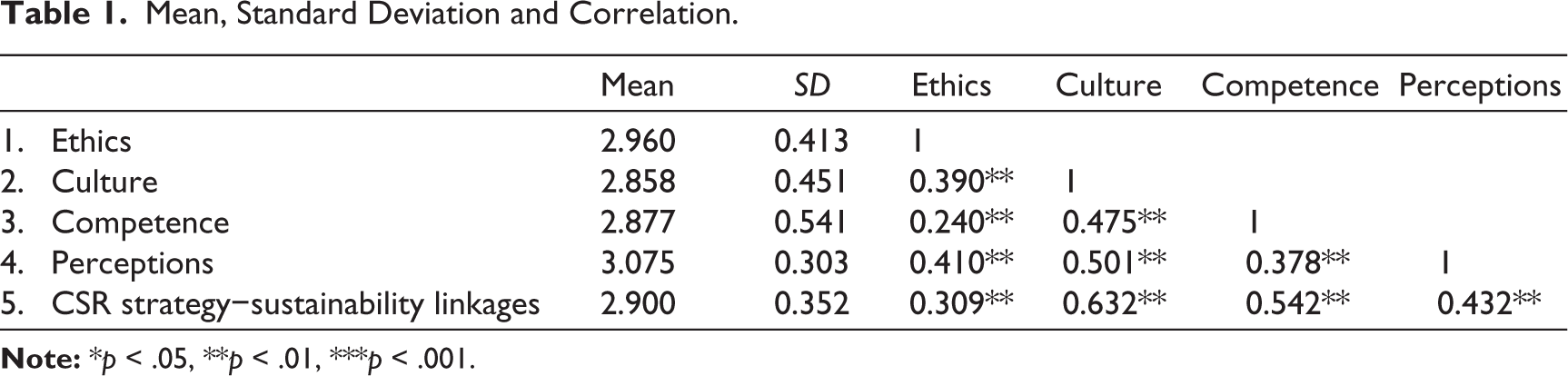
The results of the correlation matrix show that there are significant and positive bivariate relationships between CSR-oriented culture and CSR strategy–sustainability linkages (r = 0.632), ethics (r = 0.390), outcome variables CSR competence (r = 0.475) and employee CSR perceptions (r = 0.501). The independent variable, CSR strategy–sustainability linkages, shows positive associations with the outcomes of CSR competence (r = 0.542) and employee CSR perceptions (r = 0.432). Similarly, the ethics variable had significant positive relations with CSR competence (r = 0.240) and employee CSR perceptions (r = 0.410).
Mediation was tested in this study using the procedure outlined by Baron and Kenny (1986). Hypotheses 3a, 3b, 3c and 3d were mediation hypotheses and necessarily required multiple conditions to test. First, the predictor (e.g., CSR strategy–sustainability linkages and ethics) must be related to the mediator (e.g., CSR culture). Next, the mediator (e.g., CSR culture) must be related to the criterion variables (CSR competence and employee CSR perceptions). Finally, when the mediator is entered into the structural model of the relationship between the predictors, the criterion must be non-significant (for full mediation) or weakened (for partial mediation).
Table 2 provides the results of the regression analyses of the effect of the independent variables on the mediator variable—CSR culture. Hypothesis 1a was supported as the results of Table 2 show a positive association between the variable strategy–sustainability linkages and CSR culture (β = 0.81; p < .001). Table 3 provides evidence of a positive relationship between ethics and CSR culture (β = 0.43; p < .001), indicating that the more individual employees and the organization as a whole have an ethical orientation, the greater the probability that an organization will have a CSR-oriented culture. Thus, hypothesis 1b was supported.
Table 4 provides support for hypothesis 2a. Employees who perceive their employing firm to have a CSR-oriented culture also perceive that their organization will focus on developing the CSR competencies of its employees (β = 0.57, p < .001). Also, a significant positive relationship between CSR culture and employee CSR perceptions was found (β = 0.34, p < .001), thus providing support for hypothesis 2b (Table 4).
Regression Analysis: CSR Strategy–Sustainability Linkages and CSR Culture.

Regression Analysis: Ethics and CSR Culture.

Regression Analysis: CSR Culture and its Outcomes.

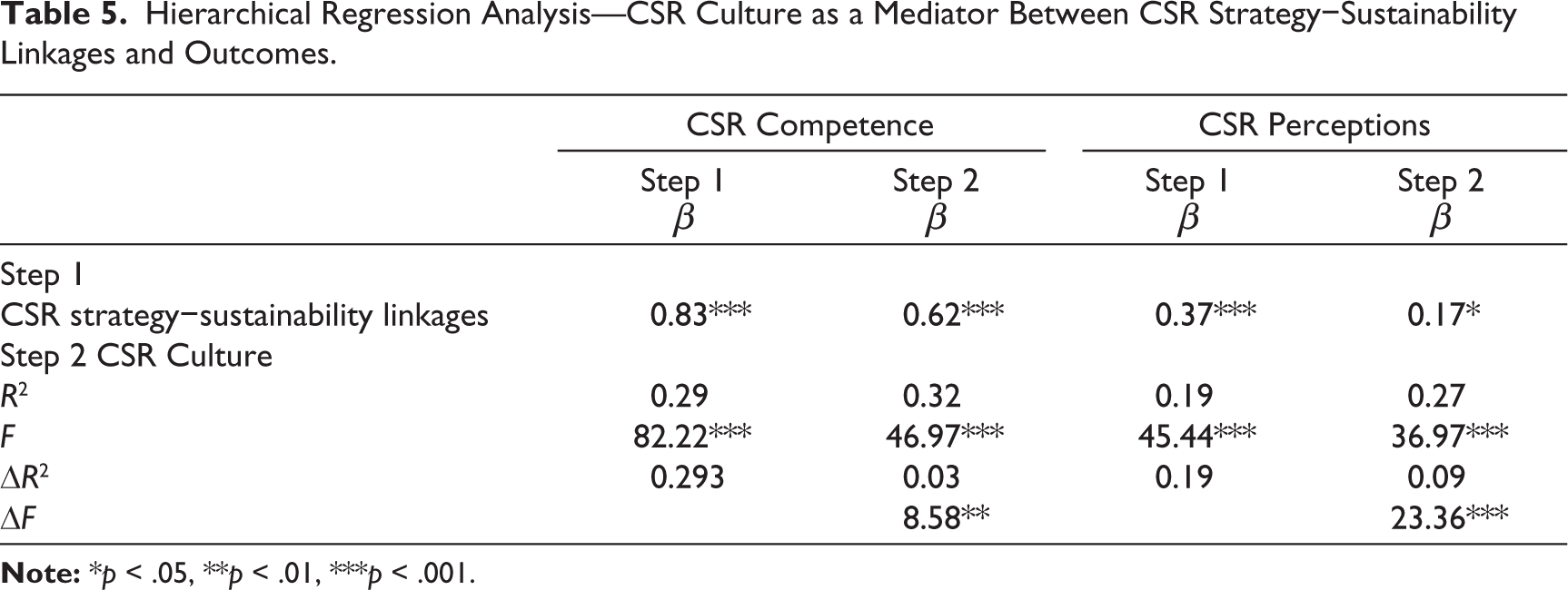
As seen in Table 5, the two independent variables, CSR strategy–sustainability linkages and ethics, are related to CSR culture and the mediator CSR culture is related to the two CSR outcomes. A hierarchical regression analysis was conducted in which the CSR outcomes were regressed on the first independent variable, CSR strategy–sustainability linkages, alone and then again with the CSR culture measure controlled. The addition of the mediator to the equation (step 2) led to a drop in the impact of the CSR strategy–sustainability linkages variable in both cases; CSR competence (β = 0.62, p < .001) and employee CSR perceptions (β = 0.17, p < .05), suggesting partial mediation in either of the cases.
Hierarchical Regression Analysis—CSR Culture as a Mediator Between CSR Strategy−Sustainability Linkages and Outcomes.
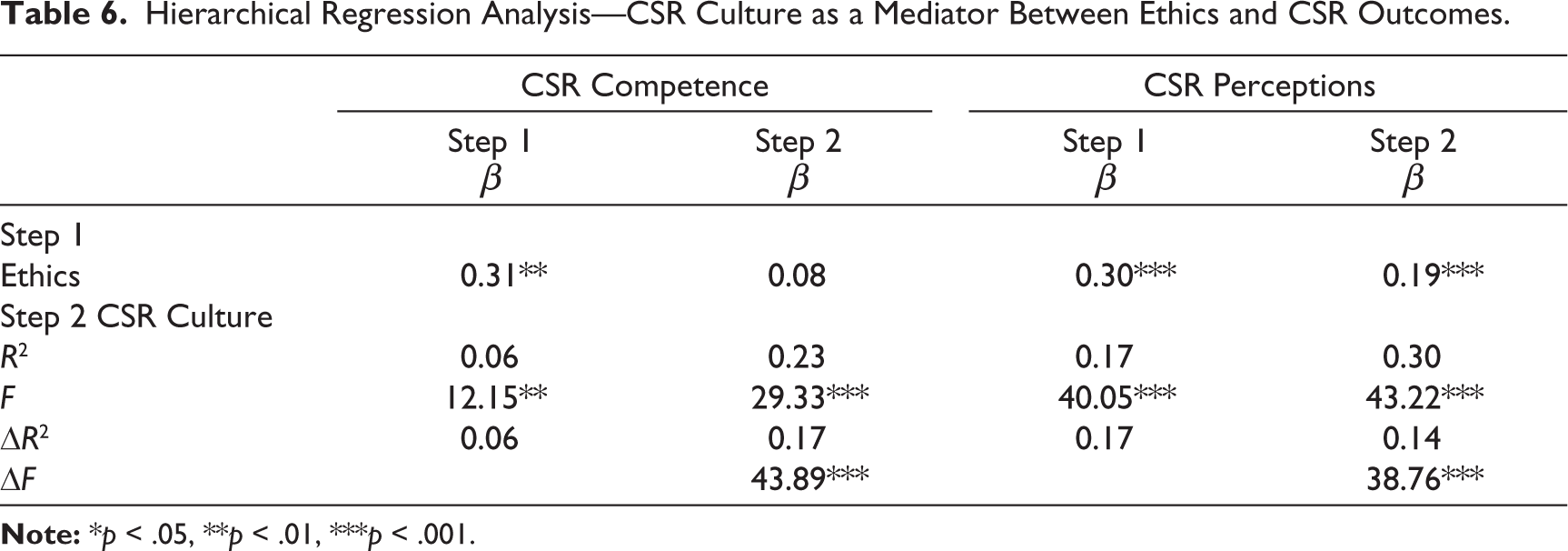
In the second case (Table 6) when the CSR outcomes were regressed on the independent variable ethics, the addition of CSR culture to the equation led to a considerable drop in the impact of the independent variable in both cases; CSR competence (β = 0.08) and employee CSR perceptions (β = 0.19, p < .001). In the case of CSR competence, the results depict full mediation; however, the addition of culture in the equation led to partial mediation in the case of CSR perceptions.
Hierarchical Regression Analysis—CSR Culture as a Mediator Between Ethics and CSR Outcomes.
Discussion
The main aim of this study was to examine the hypothesized model that CSR-embedded culture mediates the relationship between antecedents like CSR sustainability–strategy linkages and ethics and CSR outcomes. The result demonstrates that organizational ethics and CSR strategy–sustainability linkages directly influence the culture of the organization which in turn influences their CSR outcomes, such as the CSR perceptions of the employees and the CSR competence of the firm. It was found that CSR strategy– sustainability linkages and ethics influence CSR-related outcomes, and those relationships are mediated by CSR culture. The mediating role of culture between CSR strategy and CSR outcomes proves that the integration of CSR into the sustainability intents of the organization and the crafting of strategies focussing on CSR alone may not yield the desired CSR outcomes affirming the need for organization culture, which promotes CSR, as the more company employees perceive the organizational CSR engagement aligned with their company, the more likely they are to judge that their company is acting in a socially responsible manner (Schaefer et al., 2020).
The study addresses the call of Linnenluecke and Griffiths (2010) for more research on linking sustainability and culture. Owing to organizational rigidity and the existence of organizational subcultures throughout the organization, it is always a question if organizations can become more sustainable due to cultural change. However, organizations are integrating environmental and social indicators into strategic planning, performance measurement and decision processes (Adams & Frost, 2008), which means that the impact of sustainability-driven corporate culture on multiple facets of employee behaviour is more likely to have organized procedures for stakeholder engagement and would be more long-term oriented (Eccles & Krzus, 2010). Thus, it can be concluded that if CSR is linked with the broader sustainability ambition of an organization, it percolates down to the culture of the organization. The study also found that organizations’ holistic approach to incorporating CSR into policy-level decision-making helps promote a CSR-oriented culture which is in synchronization with the findings of Lazslo and Zhexembayeva (2017) that associations with policy-level decisions facilitate a culture of CSR in the organization. Since strategies are strong determinants of the kind of culture organizations will follow (Olson et al., 2016) for effective CSR interventions, it becomes important for an organization to link its CSR intentions with the strategy, which in turn influences the culture of an organization (Phillips et al., 2019). Thus, efforts should be made to make socially responsible behaviour everyone’s responsibility instead of limiting it only to a section by making CSR part and parcel of the organization. The more an organization would show concern for the community and environment, the more driven the employees of the organization would be towards organizational CSR.
The study also found organizational ethics to be positively associated with the CSR culture of the organization. It is a noted finding that organizational culture, when managed properly, acts as a mechanism that leads to ethical behaviour of management and employees (Constantinescu & Kaptein, 2020) and vice versa. When organizations clearly outline the guidelines related to individual ethical behaviour, there is no room for ambiguity (Kaptein, 2017), and organizations display cultures that are driven by a scale of right and wrong (Bruhn, 2009). The more the organizations focus on enhancing individual and organizational ethics, the more the employees perceive CSR positively, and the easier it is to develop the ethical competencies of the employees (Blok et al., 2016).
The findings further suggest that CSR culture has significant positive relationships with CSR perceptions of employees, which is in synchronization with the findings of Lee et al. (2013) that if the company culture fits with its CSR activities, employees are likely to accept and institutionalize such initiatives more effectively. This means that organizational cultures that promote CSR have employees who have positive perceptions about CSR and are more likely to be engaged in the CSR interventions of the firm. Employees are seen as a very important group influencing the CSR intentions of a firm, and consequently, a socially responsible corporation must address a set of issues related to employees’ wellbeing and perceptions at work (Duarte, 2010) efficiently.
This study further contributes by exploring the relationship between culture and the CSR competence of a firm. The direct positive relation explains that CSR-embedded culture leads to the CSR competence of a firm. Empirical investigations demonstrate that a firm’s positive culture motivates its employees towards greater commitment to achieving the firm’s goals (e.g., Galbreath, 2010; Kanji & Chopra, 2010), and employees derive a sense of control and mutuality from the CSR practices employed by their organizations. Embedding CSR into the culture allows active employee engagement in the planning and operational aspects of implementing CSR, which gives them a sense of collaboration and the feeling that their opinions and inputs are taken into consideration, thus enhancing their perceptions of control and increasing the CSR competence of the firm (Dhanesh, 2014). The CSR culture of the firm ensures that CSR practices are linked with the organizational value, and the organization gives high value to social and environmental activities as part of its work operations. This leads to the hiring and training of competent human resources and expertise for undertaking CSR activities to manage CSR projects and programmes professionally, thereby enhancing CSR competence of the firm. Going one step further in the analysis of sustainability and strategy linkages and organizational ethics, it would be possible to further analyse their effects on CSR outcomes. This finding contributes to the literature by providing a glimpse into how the relationship of CSR sustainability and strategy linkages and ethics with CSR outcome is impacted by culture.
The study found CSR culture to be mediating the relationships between CSR strategy–sustainability linkages and ethics with CSR outcomes of competence and perceptions. This implies that simply integrating CSR with policy-level decisions and being ethical does not lead the organizations towards better CSR perceptions or developing their competencies, but these factors, clubbed with CSR-oriented cultures, lead to better CSR outcomes in terms of better CSR perceptions and enhanced CSR competencies. Ethical organizations can motivate their employees to support community and environmental programmes for a better world; however, if the culture is not supportive, the desired CSR outcomes seem to be a distant reality. This is because organizational culture shapes the context in which all business activities are performed; hence, it remains a prerequisite to achieving CSR-driven competitiveness (Berger et al., 2007; Carroll & Shabana, 2010).
Thus, Central Public Sector Enterprises should look forward to adopting a holistic approach to CSR through aligning CSR with broader goals of the organization and promoting a culture of CSR, staying tuned to ethical practices to seek maximum participation from the employees in the journey of enhancing the efficacy of organizational CSR initiatives.
Conclusions and Recommendations
The results suggest two strong recommendations concerning CSR for managers. The first is that the CSR-oriented culture mediates strategic/sustainable CSR and ethics to CSR outcomes of employee CSR perceptions and CSR competence, suggesting that aligning CSR with the broader goals of the organization and the ethical orientation of an organization can lead to better CSR outcomes when clubbed with CSR-oriented culture. This understanding may help CSR leaders introduce essential policy-level changes for successful CSR implementation through employees. Because employees’ attitudes and behaviours constitute intangible resources that are valuable, rare, difficult to imitate and lacking in perfect substitutes (Ballou et al., 2003), CSR creates intangible firm resources. Previous studies examined the direct link between strategic/sustainable CSR and CSR culture with organizational productivity. By introducing culture as a mechanism, this study opens new avenues for CSR–employee research. CSR-oriented culture considerably affects employee CSR perceptions and their CSR competence development, which can contribute to carrying out CSR initiatives effectively and efficiently.
The second key recommendation is that strategic and sustainable CSR are broader terms that are more future-focused as the two are based on strategic moves and the development of strategic tactics for future CSR projects. As such, the very organization that ignores the relevance of CSR linkages with the broader goals of the organization will find their CSR performance less effective in comparison to those organizations that understand these linkages.
A focus on individual and organizational ethics can be construed as a behavioural model that can guide managers on how to develop a more ethical organization, and consequently, more ethical employees. Results suggest that CSR-oriented culture with an ethical component may become an important source of change in organizations. Moreover, the issues of hunger, poverty, education, health and sanitation in developing countries like India call for more transparent leadership in the CSR initiatives of the organizations, specifically in the public sector, as the CSR obligations of these organizations are huge and can create a lot of impacts.
Limitations and Future Research Directions
Although the study has contributed to the nomological work on CSR, it has certain limitations that should be addressed in future studies. Judgmental sampling from public sector organizations in the energy domain warrants some caution to generalizing the results to other organizations. Further research expanding the scope to public and private sector firms falling under the mandate of CSR in India will help get an overarching view of the role of CSR culture in building CSR Competence and a positive perception of CSR among employees for the organizations.
The current study uses a self-report cross-sectional instrument for establishing the proposed hypotheses and research questions, which means respondents have expressed their subjective perceptions towards CSR, which may lead to response bias due to social desirability and self-presentation (Schwarz, 1999). Measurement of variables at different intervals utilizing longitudinal research on CSR may strengthen the findings of the model and provide clearer causal relationships between study variables.
Footnotes
Declaration of Conflicting Interests
The authors declared no potential conflicts of interest with respect to the research, authorship and/or publication of this article.
Funding
The authors received no financial support for the research, authorship and/or publication of this article.