




Abstract
This article investigates R&D collaboration between universities and firms by looking at R&D outsourcing of private firms to universities and vice versa. It was found that universities are an important research partner of private firms, although industrialists often do not trust the research capabilities of universities. It is evident that universities are accustomed to receiving agents rather than giving agents in R&D activities. This fact implies that a give-and-take culture should be cultivated in universities in order to develop university–industry R&D collaboration. It may bring about university-generated cooperative R&D with private firms if universities contract out more of their research projects to private firms.
The results of our study also revealed that government policies to promote university–industry R&D cooperation have been strengthening. Two cases of government policy programmes showed that policy targets, especially to promote university–industry R&D collaboration, tend to be included not only in incumbent policy programmes but also in newly designed policy programmes. The government R&D budget has been increasingly allocated to specific policy programmes focusing on interdisciplinary cooperative R&D activities between universities and private firms.
Introduction
The R&D activities of a university are deeply intertwined in the innovation of not only economic agents at the individual level, but also at the meso level and at the economy as a whole. Innovation studies have featured the role of universities in technological innovation as universities have generated many scientific revolutions at the meso level. Especially, the universities have contributed to the innovation of science-based industries such as bio-engineering, electronics, telecommunication, software, etc. Society naturally gets high expectations from universities in innovative performance so as to increase their contribution to building up the dynamics of the economy both in developed countries and in developing countries.
In Korea entering into a post catch-up mode, fundamental research of the university is complementary to the development-oriented R&D of firms so as to greatly contribute to the innovative performance of firms. Leading firms of the Korean industry have recently become technological frontiers where a capability to explore fundamental technology is seriously required for them to pursue new innovation paths. However, they are not able to quickly equip with the capability to explore fundamental technology. The Korean government started to increase support to the fundamental research which is probably carried out by universities.
This article aims to investigate collaborative R&D activities between universities and firms. It statistically looks at R&D outsourcing of universities to firms and R&D outsourcing of firms to universities in Korea. We utilised the data on two-directional collaborations which were well surveyed and annually opened by the Ministry of Science, Information and Computer Technology (ICT) and Future Planning (MSIP) and the Korea Institute of Science and Technology, Evaluation and Planning (KISTEP). Then, it is going to take two policy cases in order to find out how the government has formulated policies to strengthen university–industry R&D collaboration in Korea.
Why Should Universities Collaborate with Firms in R&D?
Roles of the University in NIS
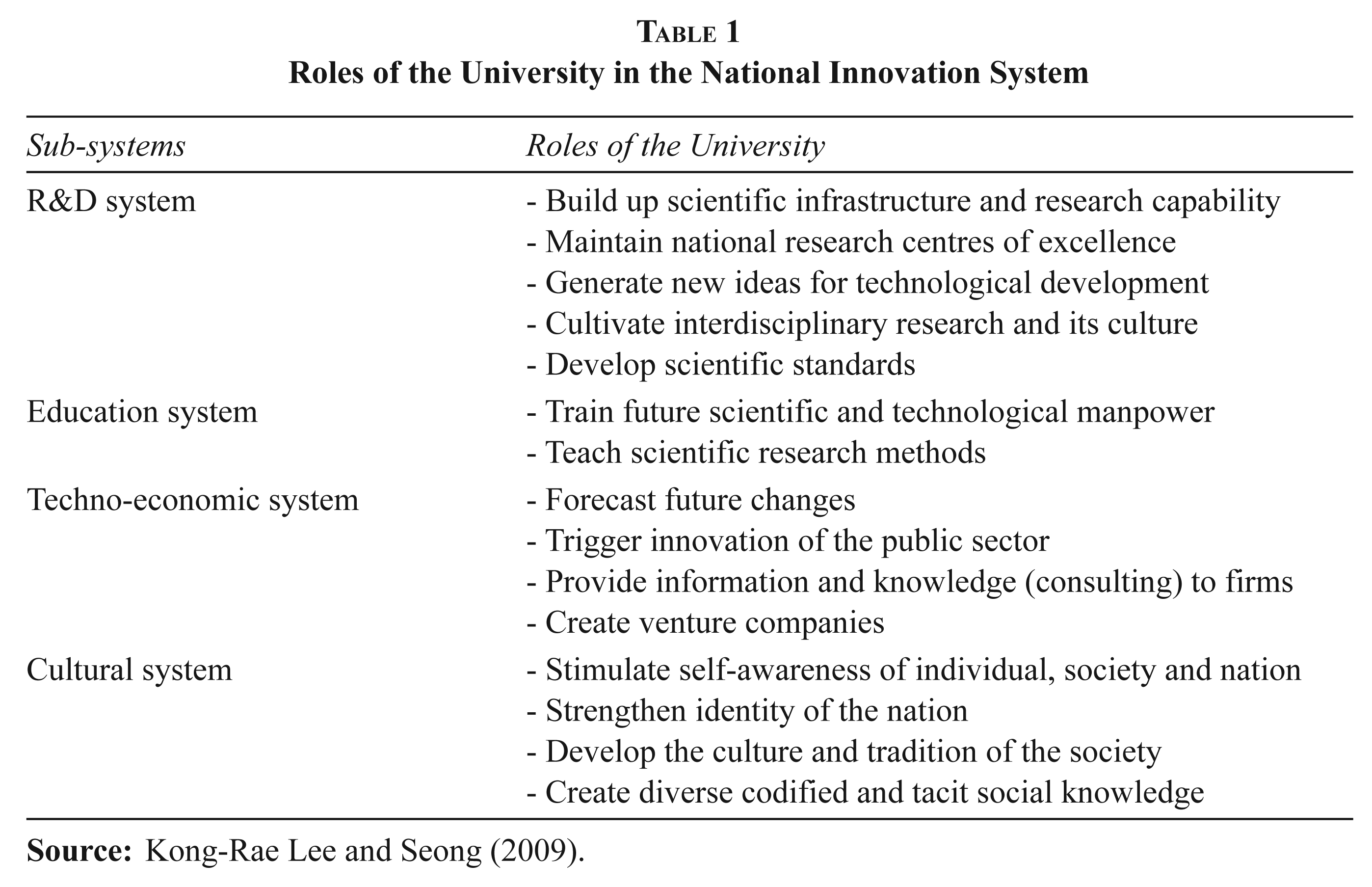
The role of the university in the NIS can be identified depending upon the sub-systems of the NIS. Suppose that there are four kinds of sub-systems in the NIS: an R&D system, the education system, a techno-economic system, and a cultural system. In the R&D sub-system of the NIS, the most important roles of the university are building up scientific infrastructure and research capability, maintaining national research centres of excellence, generating new ideas for development, cultivating interdisciplinary research and its culture, and developing a scientific standard of the nation (Kong-Rae Lee and Seong, 2009).
Likewise, three other sub-systems of the NIS have different kinds of universities as shown in Table 1. The university is basically educational institution and performs the mission to train future scientific and technological manpower and teach scientific research methods in the education system (OECD, 1981). The education function has been a typical traditional role of the university in most countries. In a techno-economic sub-system, the university may carry out economic missions such as forecasting future changes, triggering innovation of the public sector, providing information and knowledge (consulting) to firms, and creation of spin-off companies. Lastly, the university may stimulate self-awareness of individual, society and nation, strengthen the identity of the nation, develop the culture and tradition of the society, and create diverse codified and tacit social knowledge in the cultural sub-system of the NIS.
Roles of the University in the National Innovation System
There have been many studies on the role of the university. For example, Etzkowitz et al. (2000) investigated the increased importance of universities in technological innovation. They argued that the university is a cost-effective and creative inventor and transfer agent of both knowledge and technology. They concluded that universities are currently undergoing a second revolution, incorporating economic and social development as a part of their mission. Despite industrial and academic systems at varying stages of development, governments in virtually all parts of the world are trying to exploit the techno-economic potential of the university as a source to enhance innovation environments and create a regime of science-based economic development (Keun Lee et al., 2009; Intarakumnerd and Schiller, 2009).
The importance of specific roles, above mentioned, of the university varies by the development stages of each country. In general, specifically to train future scientific and technological manpower and to teach scientific research methods seems to be given a higher priority in the developing economies. However, a high level of R&D activities must be strongly anticipated as for the roles of the university in the developed economies. This is because as an economy evolves into a knowledge- and information-intensive one, R&D activities are deeply intertwined in the innovation of not only economic agents at the individual level, but also at the economy level as a whole. Therefore, the university, as a knowledge generating and R&D performing agent, plays a more and more important role in the economy as it evolves to a higher development stage (Burton, 2001; Clark, 1983).
In the Korean NIS which is featured as in transition from a catch-up to a post catch-up innovation stage (Kong-Rae Lee, 2010), the entrepreneurial role of the university has been emphasised as its economic growth is slowing down and the unemployment rate of university graduates is significantly increasing. Universities have contributed to the stimulation of innovation in firms by such means as generation and transfer of fundamental technological knowledge, creation of venture companies, etc., in addition to the traditional role of education as shown in Figure 1. Firms have got ideas, information and knowledge through outsourcing their R&D needs to universities. Various intermediary agents including government funding institutions supported university–industry collaboration in cooperation with the government.
It is also expected that the fundamental research of the universities are complementary for the development-oriented R&D of private firms so as to contribute to their innovative performance in the Korean NIS (Kong-Rae Lee, 2009; Tu et al., 2005). Leading firms of the Korean industry have recently reached the level of technological frontiers where a capability to explore fundamental technology is seriously required for them to pursue new innovation paths. However, they are not able to quickly equip the capability to explore fundamental technology. The Korean government started to increase support to fundamental research which is probably carried out by universities. This policy may have an effect on strengthening the research capability of universities to develop fundamental technology and improve their complementary contribution to private firms.
The Roles of the University and University–Industry Collaboration in the Korean NIS

The perception on the role of the university in the Korean NIS is much similar to that of the Japanese NIS. It was well known in the past that the university played a limited role in the innovation of the industry in the Japanese NIS. From the beginning of the 1990s, the Japanese government recognised the importance of the university in the recovery of her economic slump and radically reformed the public university system including the governance structure, ownership of intellectual property rights, establishing technology licensing organisations and so on (MEXT, 2009). As a result of the reforms and increasing allocation of resource to the university, university–industry collaboration and its productive output such as creation of spin-off companies and technology transfer from universities has been remarkably increased since then (Kondo, 2006, 2007).
To summarise, the role of universities have intensified and changed as the economy developed and faced difficulties. The educational role of the university is still important, but to a lesser degree in the contemporary knowledge-intensive economy than in the past. The techno-economic activity of universities is being increasingly perceived as important along with the role of their R&D activities. This is particularly the case in Korea and Japan where universities played a limited role in the past. University–industry collaboration may well be a good means to intensify the entrepreneurial role of the university which has been anticipated by the government and people.
Growth of the University Sector in Korea
University education has been emphasised as for the development of the nation from the early industrialisation in Korea. There has been a so-called ‘education fever’ among Korean parents to send their children to prestigious universities not only to upgrade their status, but also for better job prospects. Therefore, the university entrance ratio of high-school graduates has been normally higher than 80 per cent, slightly decreasing in recent years, to 81.9 per cent in 2009. This education fever of parents has created a demand for university education, making Korean universities to have grown fast. The number of universities has increased over the last two decades. It was 407 in 2009, including industrial universities—known as open universities in the past; teachers colleges and junior colleges—which have a shorter education period than general universities with a four-year study period. It has been increased at an annual growth rate of 2.3 per cent from 265 in 1990 as shown in Table 2. The increase in the number of universities caused the number of faculty to increase at the same time. Korean universities employed around 43,000 faculty members in 1990, which almost doubled to 75,000 in 2009, growing at an annual rate of 3.0 per cent over the last two decades.
The number of Korean universities seemed to reach a maximum level of 432 in 2012, and once showed a decreasing trend after 2005. The demand for university education substantially decreased as the number of high-school graduates became less than the number of recruitments made by universities. Until the middle of the 1990s, there was a high demand for university education so that universities enjoyed intense entrance competition and selected better qualified students. From the inception of the 2000s, this situation was reversed. Many universities, except for prestigious universities, could not fill the quota of student recruitment that caused financial difficulties for some universities. The government began to pursue a policy of adopting mergers and acquisitions among national universities.
Nonetheless it is surprising to see that the number of universities again increased in 2012 as seen in Table 2. Perhaps, it may be due to a diversification of university education, that is, remote education including cyber lectures and the operation of diverse graduate schools specialising in specific subjects. In fact, various types of universities tended to be established in recent years as ‘Others’ increased from 23 in 1990 to 89 in 2012 in Table 2. At the same time, the number of faculty members in the category of ‘Others’ substantially increased from 640 in 1990 to 2670 in 2012 at an annual rate of 12.6 per cent over the recent decades. It is the highest among those of five university categories. The number of students in the category of ‘Others’ also rapidly increased from 261,000 in 1990 to 740,000 in 2012 at an annual rate of 9.1 per cent, which is the highest as well.
Growth Trends of Universities in Korea

The environment of the university sector evolved as the Korean economy changed over time. On one hand, the number of high-school students to enter universities has been reducing, and on the other, the enrolment of foreign students, particularly from China, has been increasing. It is estimated that roughly 100,000 foreign students are studying in Korean universities. This obviously provides valuable opportunities for Korean universities to compensate for the losing domestic demand for university education. However, they are facing a concern with respect to the quality of education, since they eventually compete with universities of developed countries including many western countries and Japan.
Another positive environment that the university sector faces is that the society expects performance in university R&D as the Korean economy moves toward a knowledge-intensive one. Both the government and private firms show a high expectation on university-performed R&D. The government has actually increased R&D expenditure in the university sector. Provided that the universities are equipped with good research capabilities by mobilising their faculty members, Korean universities may be able to utilise a substantial amount of government R&D resources. Then, it is feasible for the university sector to continuously expand its functions and missions in the Korean NIS.
Status of University R&D in Korea
R&D expenditure of the universities has been continuously expanding in the Korean NIS. The university sector spent approximately 5034 billion KRW in 2011, which is more than tripled from 1565 billion KRW in 2000. The R&D expenditure of the university sector was smaller than that of government research institutes (GRIs) in 2000, but it surpassed that of GRIs in 2005, increasing the gap afterwards. Universities accounted for 11.2 per cent of the total national R&D expenditure, 0.2 per cent points lower than that of public research institutes with 11.4 per cent in 2011. It indicates that the university is a major R&D agent of Korea’s NIS, following the GRIs with 10.3 per cent and private firms which dominate the national R&D activities taking 75.3 per cent of the total national R&D expenditure.
Despite universities having expanded their scale of R&D expenditure, its relative position in the NIS has not changed much since 2000, as shown in Table 3. They accounted for 11.3 per cent of the total national R&D expenditure in 2000 when the size of their R&D spending is less than half of that in 2008. It is still 10.1 per cent in 2011, down by 1.2 per cent points since 2000. Compared with the universities’ share of the Japanese national R&D expenditure that accounted for 19.0 per cent of the total national R&D (MEXT, 2009), the universities’ share in Korea was very low. Japanese universities employed 290,000 researchers accounting for 36.0 per cent of the total number of national researchers in 2007, whereas Korean universities employed 37,000 researchers taking 16.9 per cent of the total number of national researchers, which is just one-eighth of Japan.
Looking at the annual growth rate of R&D expenditure by universities for the period of 2000–2011 (11.2 per cent), it is expected that the share of universities in national R&D spending is not to increase in the future, compared with that of GRIs (12.0 per cent). R&D investment of the public sector including GRIs and universities seems unable to strengthen its position out of national total which was 23.5 per cent in 2011, because private firms increased their R&D expenditure at the fastest speed, 13.0 per cent annually among national R&D agents.
National R&D Expenditure and Shares of R&D Agents in Korea Unit: billion KRW, %

Let us see the productivity of university R&D by measuring domestic patent applications per 1,000 million KRWs of government R&D investment. The trends of patent productivity of major three R&D agents revealed that the universities have been the highest in domestic patent applications per 1,000 million KRWs of government R&D investment as shown in Figure 2. Patent productivity of the universities was 1.1 in 2006, which doubled to 2.2 in 2008, and went a little bit down to 1.9 in 2010, all of which are continuously higher than that of public research institutes and private companies like small and medium sized enterprises (SMEs) and large firms.
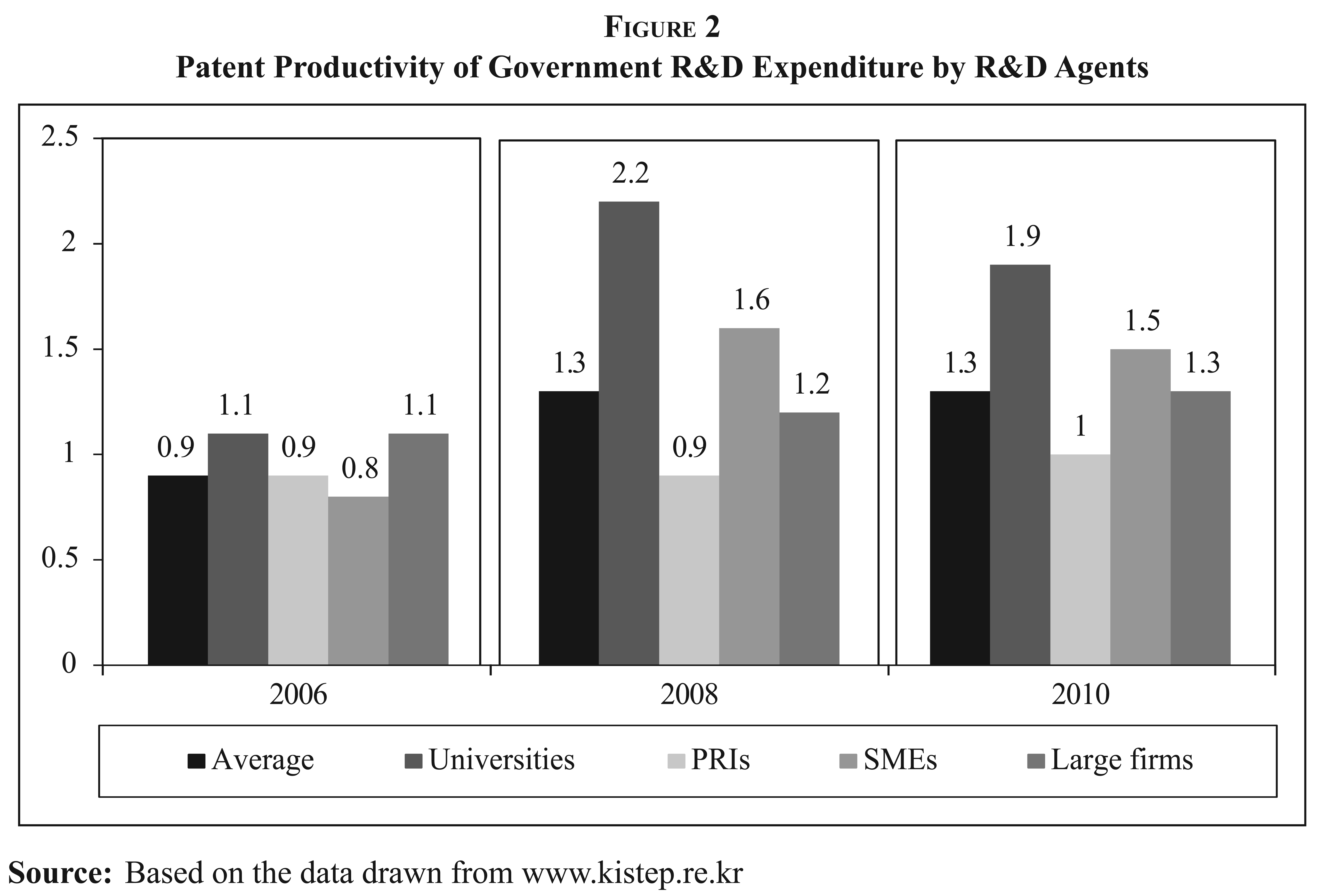
The higher patent productivity of the universities compared to public research institutes and private firms indicates that universities are more creative R&D agents than other agents. It may be possible because not only the universities carried out basic R&D that requires creative work, but they also generated a better output of R&D expenditure, perhaps recognising the importance of intellectual property rights much better than public research institutes and private firms.
University–Industry R&D Collaboration: The Korean Experience
Do Firms Need University Research?
A necessary condition for university–industry R&D collaboration is that firms really need the assistance of universities in their R&D activities. According to Joseph and Abraham’s study (2009) on the Indian case by using 750 samples, the reasons why manufacturing firms collaborate with universities, with their ranks, are ‘to get useful information which is not available inside firms’, ‘to get consulting services from university professors for their technological problem-solving’, ‘to find R&D trends of specific fields and information about technological activities of experts’ and ‘to outsource part of their R&D required for innovations’. These findings of the study imply that whether firms need university research depends on the research capabilities of universities. It is certain that firms really need university research when the research capability of universities is strong enough to provide knowledge to solve problems of firms.
A study made by Sung et al. (2009) on the Korean case revealed that the important sources of firms’ technological innovation are customers (35.0 per cent), followed by competing firms (20.0 per cent), machinery suppliers (14.2 per cent), part suppliers (13.9 per cent), universities (12.3 per cent) and so on as seen in Figure 3. Universities are not important compared with other sources from the viewpoint of manufacturing firms. However, universities might be a very important source of technological innovation in some high technology sectors, for instance, science-based sectors, but not in some sectors, if we investigate it by types of industrial sectors (Rasiah and Govindaraju, 2009). Taking into account the fact that the portion of science-based sectors increases as the economy evolves to a knowledge-intensive one (Kong-Rae Lee, 2008), the university sector as a source of technological innovation became more and more important.
The question on ‘do firms need university research?’ can also be answered by looking at how many private firms do basic research. The more firms there are conducting basic research, the more they need university research (Eun et al., 2009). Since basic research requires endurance to wait for research outcomes, few firms may be able to wait for outcomes of in-house basic research. It is certain that private firms resort to universities by contracting out their research projects or joint research. In this aspect, leading firms that reach the technological frontier level are more likely to need university research. University–industry R&D collaboration is therefore mostly feasible between technologically advanced firms and universities with a strong research capability.

Factors Influencing University–Industry Collaboration
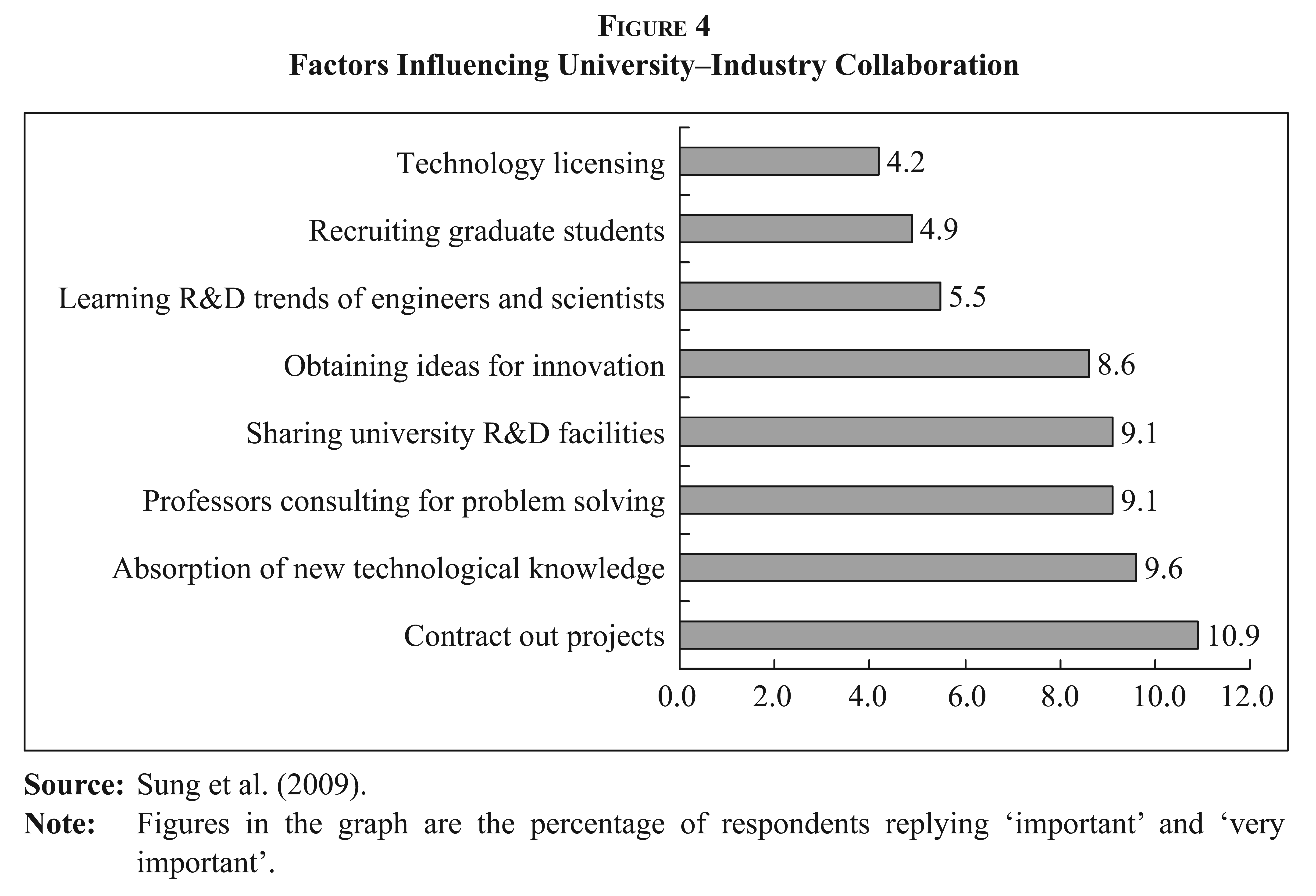
University–industry collaboration has been carried out in various forms as much as the missions of the university are diverse: technology licensing, recruiting graduate students, learning R&D trends of engineers and scientists, obtaining ideas for technological innovation, sharing university R&D facilities, professors’ consultation for problem solving of firms, exchange and absorption of new technological knowledge, contract research, etc. Sung et al. (2009) surveyed the relative importance of these factors using the data of the Korean innovation survey conducted by Kim et al. (2008). As shown in Figure 4, the most significant factor influencing university–industry collaboration appeared to be performing contract research (10.9 per cent), followed by absorbing new technological knowledge (9.6 per cent), professors’ consultation (providing knowledge and information) (9.1 per cent), sharing university R&D facilities (9.1 per cent), and so on.
The factors of university–industry collaboration mentioned above can be broadly grouped into four types: education, R&D, creation of venture firms and consultation (provision of information and knowledge). The first type, ‘human capital training’, is included because the university has been identified as an agent to train human capital for a long time. It has been pointed out in Korea that university education has been isolated from the industry needs so that university graduates need to be retrained after they joined firms. The government has recently focused on a customised education of the university, closely collaborating with companies both at the undergraduate and graduate level (Korea Research Foundation, 2008). Many universities are now operating customised education programmes in which sponsoring companies jointly design curricula with university professors. The Korean government has been increasing support for the customised education programmes.
The second type of collaboration is R&D on which this paper focuses. In the industrialising stage of Korea, the main mission of the university was education so that the government established R&D institutes for the purpose of conducting government research. Universities that employ excellent research manpower are naturally interested in R&D work. As a result, some of prestigious universities conducted a remarkable amount of government R&D, strengthening their research capability up to the level to compete with government research institutes. As will be analysed later, universities are now the largest R&D partner of private firms in Korea. Therefore, R&D is another important type of university–industry collaboration.
The third type of collaboration is the creation of venture firms. The creation of venture firms from universities is not always generated by collaboration with firms. Creating venture firms by university professors and students means that the university itself enters into industry, the closest collaboration and internalising of industry functions. By 2007, there were 482 venture firms created from universities while government research institutes created 1386 firms during the same period in Korea (OECD, 2009). Although Korean universities are not active in creating venture firms up to now, it is highly expected that university-created venture firms will flourish in the future, like American universities.
The last type of collaboration is consultation or provision of information and knowledge by universities. Firms tend to randomly get consultation from university professors in various fields of expertise: technology, accounting, strategies, management, labour disputes, etc. There are no systematic channels of consultation like professional consulting firms so the firms usually get consultation from university professors at a personal level. They directly pay some amount of honorarium to professors who provide consulting services, not by a formal paying system in Korea. There exists frequent interaction between university professors and firms, which is not measurable.
R&D Outsourcing of Private Firms to Universities
University–industry R&D collaboration can be statistically measured by analysing R&D outsourcing of private firms to universities and vice versa (from universities to private firms). Both universities and firms may have joint R&D activities as they conduct their R&D activities by consuming their own R&D resources to achieve common research objectives. R&D expenditure for this case is not captured in current R&D statistic surveys in Korea. Thus, this paper focuses on the R&D outsourcing of private firms to universities and vice versa as the data on these two-directional collaborations has been well surveyed and annually opened by the MSIP and KISTEP.
It appeared that firms have outsourced 4874 billion KRW (4061 million US dollars) of their R&D demand in total in 2011 of which 6.0 per cent went to universities, 4.1 per cent to public research institutes (PRIs), and 55.6 per cent to firms. It implies that universities are clearly an important research partner of firms. The amount of R&D outsourcing from private firms to universities far exceeded that outsourced to public research institutes since 2000. In the past, by 2000, firms had a tendency to outsource their R&D to PRIs rather than universities, because PRIs, particularly GRIs, were well equipped with manpower, facilities and budgets for collaborative R&D with firms.
Looking at the trends of annual growth rate of R&D outsourcing, we can see that inter-firm R&D outsourcing has been increasing the most rapidly, annually 24.5 per cent. It implies that firms collaborate with various firms such as part suppliers, capital goods suppliers, and sometimes competing firms for effective R&D. They might recognise the importance of their knowledge and specialty as innovation sources. This trend may also have resulted from the government effort to activate ‘often innovation’ of firms by initiating many policy programmes including university–industry collaboration.
R&D outsourcing of firms to universities has increased too. It was just amounted to 207 billion won (172 million US dollars) in 2000, which increased to 294 billion won (245 million US dollars) in 2011. It has been increased at the annual rate of 3.2 per cent from 2000 to 2011 as shown in Table 4. Such an increase in the amount of R&D outsourcing of firms to universities gives us positive signs on university–industry collaboration. First of all, it implies that the industry began to trust the research capability of universities so as to believe that universities can be a research partner to outsource their R&D demand. It also implies that universities may regard firms as an important research market and endeavour to seek research projects from firms by active interactions with them.
R&D Outsourcing of Private Firms to Universities in Korea Unit: 100 million won

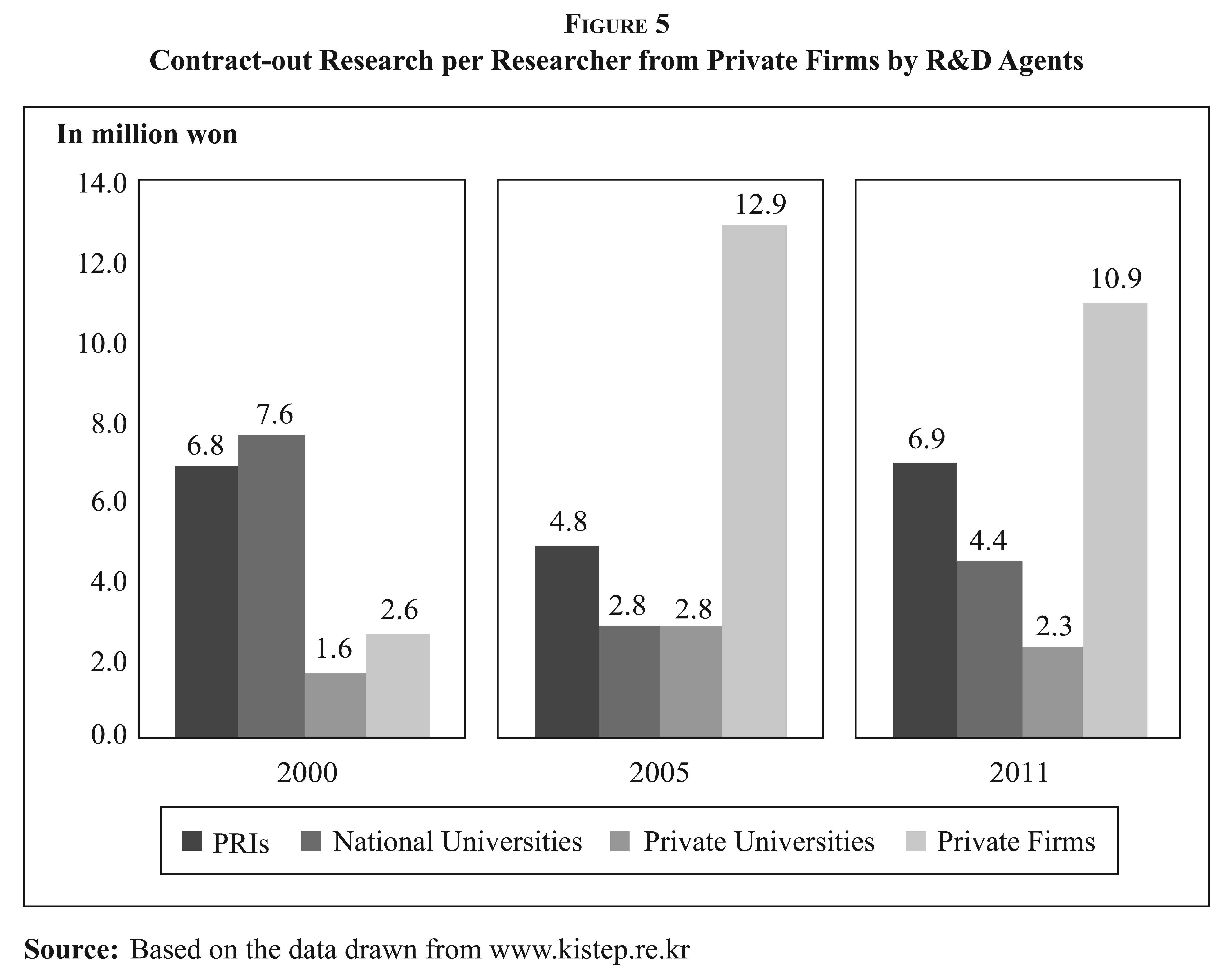
However, different stories can be explained if we see the amount of contract-out research per researcher from firms by R&D agents as shown in Figure 5. Numbers in the figure indicate intensity indexes converted into per capita R&D outsourcing by R&D agents. Contract research per researcher of firms to private firms was 2.6 million won in 2000, which is too low to compare with that of other national R&D agents. Contract research per researcher of firms to national universities was 7.6 million won in 2000, but decreased to 4.4 million won in 2011, while that to private universities remarkably increased from 1.6 million won in 2000 to 2.3 million won in 2011. Private universities appeared to be more active and intensive than national universities in attracting R&D orders from private firms.
On the other hand, contract research per researcher of firms compared to PRIs increased a little from 6.8 million won in 2000 to 6.9 million won in 2011. This is because PRIs have changed their research direction from industry-oriented to the fundamental-oriented technology so that they are not much interested in project orders from private firms. Nonetheless, R&D outsourcing from firms to GRIs has increased at an annual rate of 10.8 per cent as seen in Table 4. It is certain that GRIs should focus on the development of fundamental technologies. Yet, they need to interact with industrial firms and continue to carry out R&D projects which are complementary to the works of industrial firms.
R&D Outsourcing of Universities to Private Firms
Turning to R&D outsourcing of universities to private firms may provide another side of the story of university–industry collaboration. It is true that universities are not a R&D outsourcing agent, but a receiving agent. However, it was found that some universities outsourced such research works as practical application of research results, experiments in factories, research that needs to apply to specific products, and so on. It may be hard to outsource R&D works to private firms for late-coming universities in R&D activities. Nevertheless, if universities outsource their R&D to private firms, both parties benefit a lot. They can reinforce their research capability by gaining complementary results from their counterparts. Private firms may learn culture concerned with fundamental research and recruit excellent researchers from universities. Universities may build up strong research capabilities to cover larger areas of application and developmental works by such outsourcing. Moreover, two institutions can build up a real partnership by university-initiated interactive collaboration.
In Korea, R&D outsourcing of universities to firms is limited to a small scale in terms of absolute amount. Universities outsourced about 16 billion won (about 13 million US dollars) of their R&D projects to firms in total in 2000. However, it has increased at a fast speed, an annual rate of 22.9 per cent, reaching 152 billion won (about 127 million US dollars) in 2011. Private universities appeared to be more active in cooperative R&D work as their annual growth rate (22.5 per cent) is higher than that (11.7 per cent) of national universities. Rapid growth of R&D outsourcing from universities to firms implies the expansion of university R&D activities encouraged by the government. University professors who won government R&D projects are believed to outsource part of their R&D works to firms with which they maintain an R&D network for the purpose of strengthening their research capability.
R&D Outsourcing of Universities to Firms in Korea Unit: 100 million KRW
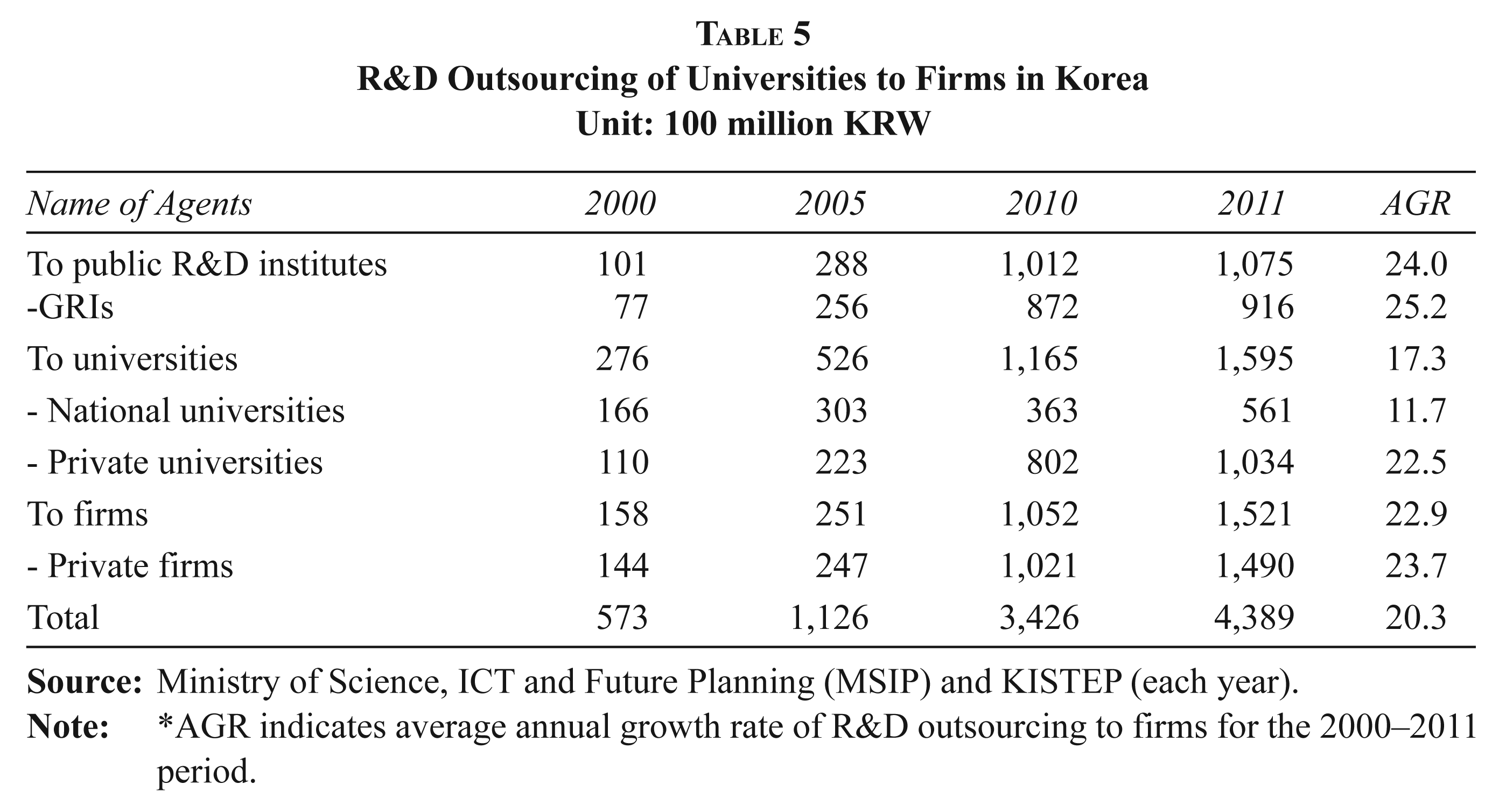
R&D outsourcing to firms by public R&D agents has been rapidly expanding in Korea. Not only universities but also research institutes and firms tend to increase outsourcing their R&D work to firms. GRIs especially showed the fastest increase in outsourcing R&D to firms (see Table 5). They have outsourced many specialty works that they are unable to conduct within their labs like carrying out such big projects as the construction of the Naro Space Center to shoot satellites into space, building of ice-crushing ships to do polar research, renewable energies and so on. It also seems to happen due to the government policy of restricting manpower increase in GRIs, which led them to outsource rather than conducting in-house research by employing research staff.
The growth of R&D outsourcing from universities to firms and vice versa shows positive prospects for future university–industry collaboration. Although the scale of R&D outsourcing is small, it certainly becomes a platform to increase trust and partnership between universities and firms so as to expect further collaboration in the future. Since firms do not generally trust the research capability of universities and are reluctant to cooperate with them in Korea, universities need to initiate R&D collaboration with firms by contracting out projects to firms. A government policy to induce R&D outsourcing from universities is likely to have a positive impact for strengthening university–industry R&D collaboration.
Spin-offs from Korean Universities
R&D outsourcing statistics of universities to firms and vice versa can be one dimension to measure R&D collaboration between universities and industries. The creation of venture firms by university students and professors may be a strong integration of the two agents: university and industry. Venture creation also indicates the degree of entrepreneurial dynamics of an economy at the macro level or at the sector level as well as a university at an organisational level. Spin-offs from universities is particularly important as modern economies tend to grow by the innovation of knowledge-based industries in which universities plays a critical role. A high entrance rate of spin-offs from universities into a market means high degrees of innovation opportunities, profitability, employment and ultimately economic growth.
Spin-off firms from universities and research institutes have tend to increase slightly over the last four years (2008–2011). They showed a decreasing tendency before 2008 as seen in Figure 6. This may be due to the fact that many venture firms collapsed after the venture booming pursued by the People’s Government (the president Kim Dae-Jung) during the period of 1998–2002. The People’s Government enacted a ‘Special Law to Promote Venture Firms’ when the Korean economy experienced a foreign currency crisis at the end of 1997 and provide them with a number of policy incentives.

Venture firms that have spun off from universities and research institutes have been continuously emphasised by the Korean government in the belief that they create high technology based firms so as to rapidly grow and have a high employment effect. Moreover, the survival rate of university-based venture firms appeared to be 72.7 per cent over the last ten years. It is much higher compared with an average survival rate of 55 per cent of general venture firms over the last five years (Kong-Rae Lee et al., 2010). Spin-off companies from universities and research institutes are relatively rare in Korea, but once created they show a higher possibility to survive and grow faster than general venture firms.
In order to promote venture creation, the government has provided many incentives such as finance, institution, taxes, etc., to university professors and researchers who are starting venture firms. It has also pursued policy programmes to support graduate schools of venture firms and many incubation centres, and to encourage the operation of technology-based venture academies by various agents. Currently five graduate schools and 285 incubation centres, of which 227 are based on universities, were operating, supported by the government in 2011. The MSIP has particularly paid attention to collage firms and research firms that utilise technologies of universities or research institutes and business know how of incumbent SMEs. They are supposed to have a synergistic effect by utilising the benefits of both SMEs and universities. If this policy is successful, the government does not need to encourage university professors and researchers to create venture firms, instead it needs to encourage them to concentrate on conducting R&D and create science and technologies useful for SMEs.
Policies to promote university -based venture companies are likely to be more developed and strengthened during the Geun-Hye Park, Geun-Hye’s government that took power in 2013. Ms Geun-Hye Park, the President of Korea, has initiated ‘creative economy’ as the motto of her government. She believes that the promotion of a creative economy might be the solution to cure the current problems of slow growth in the Korean economy. A creative economy is defined by the convergence of science and technology with industry, the fusion of culture with industry, and the blossoming of creativity in the border regions that were once permeated by barriers. This definition obviously emphasises the creation of venture firms not only by universities but also by any agents with imagination capacity and creative ideas.
As the results of continuous promotion policies by the government, spin-offs from universities and research institutes reached 2170, accounting for 8.3 per cent of the total number of Korean venture firms (26,148 firms) in 2011 (Small and Medium Business Administration,
Korean Policies for University–Industry R&D Collaboration
Policy Types for University–Industry Collaboration
Most countries have boosted university–industry collaboration by policies. The rationale to support collaboration between these two institutions is that market mechanism is not able to function properly in the cooperation between universities doing fundamental research and firms doing developmental research. The university needs financial support from somewhere else to do fundamental research which does not create value added and profits, whereas firms are not interested in cooperation with universities if they have not accumulated enough capability to assist their technological activities. A mismatch in needs, but a complementary relationship between universities and firms can be usually sorted and developed by government policies.
Policies to promote university–industry R&D collaboration are closely linked to policies for general university–industry collaboration which are grouped into five types by policy objectives: manpower training, R&D, venture creation, knowledge and information services and synthesis of all types as shown in Figure 5. Manpower training policies are, to a certain degree, associated with R&D type policies in the sense that manpower training can be carried out in the process of conducting R&D. Venture-creation policies are also connected to R&D because venture firms can be usually created as the results of successful R&D. Policies for knowledge and information services and synthesis policies of all types too are associated with R&D-type policies in that way.
The Korean government has pursued policies to promote university–industry collaboration. Various ministries have engaged in the promotion of university–industry collaboration, of which the Ministry of Education (MOE), the MSIP, and Small and Medium Business Administration (SMBA) are representatives. For example, the MOE and the MSIP planned and implemented many policy programmes such as manpower training for regional innovation, and support for joint operations of university departments as for manpower training, and the promotion of an advanced centre of excellence as for R&D, and promotion of college companies as for venture creation, and technology transfer and commercialisation as for knowledge and information services, and promotion of universities focusing on cooperation with industries and connection of university–industry (Connect Korea) as for synthesis cases as shown in Figure 7.
This article introduces two policy cases of the Korean government for promoting university–industry R&D collaboration. One is the ‘Joint University–industry R&D Programme’ taken from SMBA, and the other is the ‘Promotion Programme of Advanced Centres of Excellence (ACEs)’. The second case is likely to be important and useful because it was initiated by the MSIP when the Geun-Hye Park government took power in 2013.
Types and Examples of Policies for University–Industry Collaboration

Policy Programme for Joint University—Industry R&D
The policy programme for joint university–industry R&D was first initiated by the SMBA of Korea in 2007. It aims at solving technological problems and at developing new products of small and medium sized firms by utilising the excellent research manpower of universities and GRIs. Since large firms have their own R&D labs and technological capability to solve their technological problems and to develop new products and services, universities and PRIs are relevant resources to support SMEs.
This policy programme can be classified into three types: university–industry R&D cooperation (type A), university–research institute R&D cooperation (type B), and others including international cooperation and linkage (type C). Type A and B can be divided into two sub-types: leading cooperation and general cooperation. The former sub-type is concerned with the development of sophisticated technologies so as to provide greater support than general cooperation which is concerned with ordinary technologies requiring fewer resources to develop. Policy programme type C was designed for international R&D cooperation between domestic institutes or firms and foreign institutes or firms. It includes a ‘Linkage Programme’ which intends to promote the fusion of diverse technological knowledge by strengthening linkage among domestic R&D agents.
SMBA commissioned the management of this policy programme to the Korea Association of Industry, Academy and Research Institute (KAIARI), a non-profit organisation. Following the regulations and auspices of the SMBA, KAIARI announces the programme in the daily newspapers. Universities and research institutes that are interested in the programme organise joint R&D teams with firms and these apply for each type of this programme. KAIARI organises an examination committee to evaluate and finally select proposals as soon as the submission deadline passes.
University–Industry Joint R&D Programmes in Korea (2009)
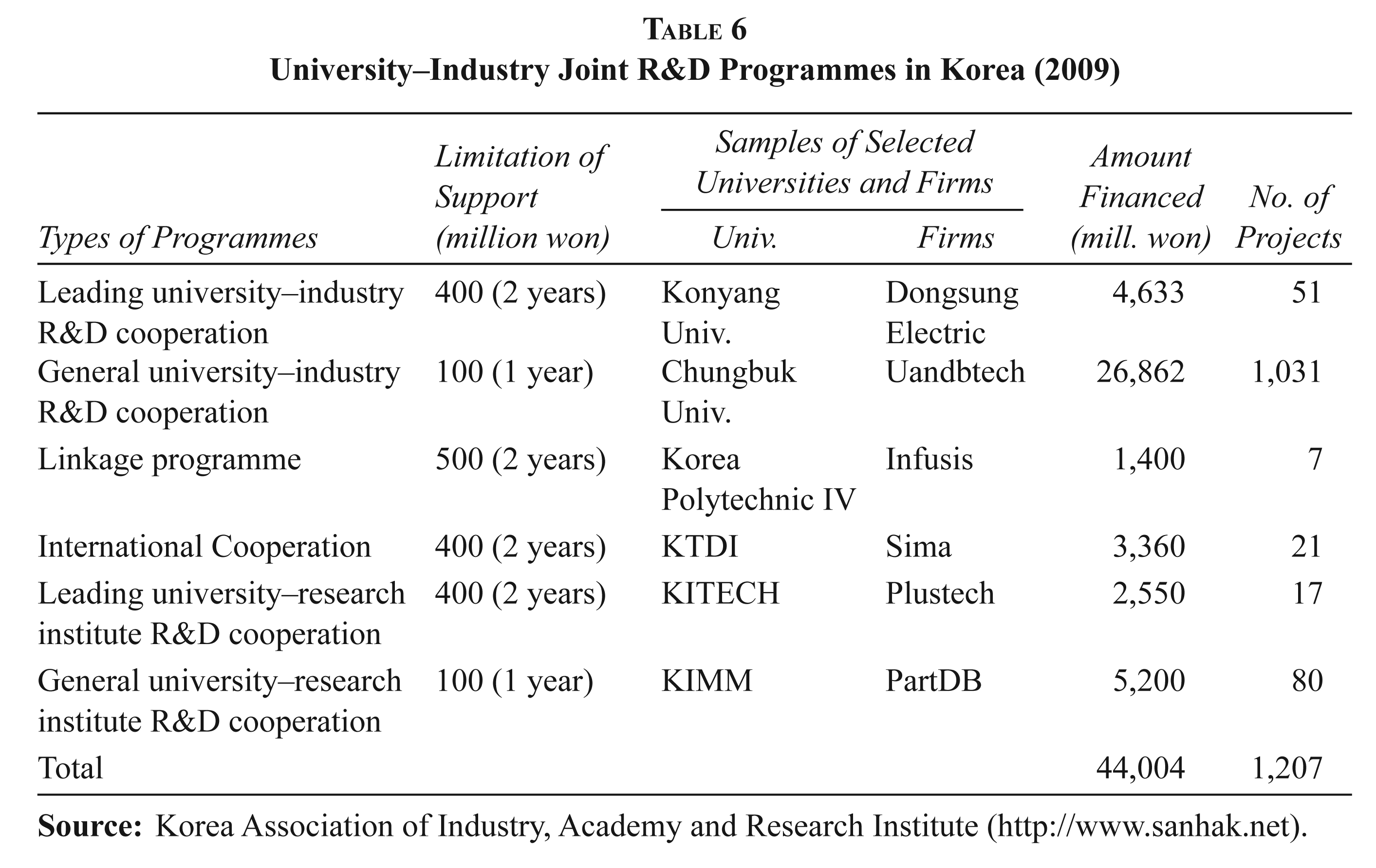
Wining the competition, responsible universities that organised R&D teams and applied for this programme, get the designated amount of financial support for a limited period of time from KAIARI. For instance, Konyang University organised an R&D team with Dongsung Electric Co. and applied for the ‘Leading University–industry R&D Cooperation’ programme. They won the programme and got 400 million won (0.3 million US dollars) of financial support for two years as shown in Table 6. Chungbuk University organised a joint R&D team with Uandbtech Co. and won the ‘General University–industry R&D Cooperation’ programme so that they got financial support of 100 million won (83 thousand US dollars) for one year. This general programme was the largest in terms of supporting scale as it obtained 26,862 million won (22.4 million US dollars). In total, 44,004 million won (36.7 million US dollars) was spent for this policy programme in 2009. Since 1207 projects were selected in 2009, average supporting scale per project is 36.5 million won (30 thousand US dollars).
Policy Programme to Promote Advanced Centres of Excellence
A policy programme to promote centres of excellence was first initiated by the former Ministry of Science and Technology in the name of the Excellent Research Centre Programme. The Korean government strategically started to promote science research centres (SRCs) and engineering research centres (ERCs) established in universities in 1990 when the research capability of Korean universities was weak. Universities that want to apply for this programme usually organise a consortium-like network with neighbouring universities and firms associated with applying research fields. Principal researchers and individual participants in this research network should show their past research performance in the proposal, which is seriously taken into account by an ad hoc examination committee for the selection.
This programme became popular from the beginning because it provided such powerful incentives as a yearly grant of 100 million won for seven to nine years. Once a university research centre is selected as an SRC or an ERC, academic prestige followed so that they could recruit excellent graduate students. As a result, competition for this programme has been intense. Only 133 university research centres were selected (9.9 per cent) out of 1147 applications from 1990 to 2005.
This programme was reshuffled in 2009 when the Lee Myung-Bak government merged three funding institutes 1 into one institute called the National Research Foundation of Korea (NRF). The NRF changed the name of this programme to ‘Advanced Center of Excellence Programme’ and added Medical Research Centers (MRCs) and National Core Research Centers (NCRCs) to ERCs and SRCs. 2 The NCRC was especially designed for encouraging fusion research of different academic fields by cooperative research of more than 10 participants. This programme is recognised as important, representing basic research areas as well as collective research among three types of government R&D programmes: individual research, collective research and infrastructural research.
In 2009, the NRF selected nine new S/ERCs, two MRCs and one NCRC (see Table 7). Nine S/ERCs were selected from six universities (four from Seoul National University, one respectively from KAIST, Donga University, Yonsei University, Segang University and Ewha Women University) where each centre received 1000 to 1200 million won per year. Two MRCs were selected from Seoul National University and Pusan National University, respectively receiving 300 million won (250 thousand US$) in 2009. The nano-material-based human interface Fusion Research Center of Sungkyunkwan University was selected as for the NCRC for the first time since this type of ACE began.
The Korean government allocated 89.9 billion won (75 million US$) to this policy programme in total in 2009, of which 55,750 million won (46.5 million US$) went to SRCs and ERCs, accounting for 62.0 per cent of the total fund size. The MRC programme got 19,200 million won (16 million US$) taking a 21.3 per cent share and the NCRC programme got the remaining 15,000 million won (12.5 million US$) with a 16.7 per cent share. Encouraged by the government support to this programme, the NRF increased the yearly funding scale up to 1200 million won (one million US$) for the case of ERCs, which had been 1000 million won at the maximum. It is generally perceived that research centres of universities receiving the support of ACE programme have a stable environment and resources comparable with that of developed countries.
Funding Scheme of the Advanced Center of Excellence (ACE) Programme

Concluding Remarks
The traditional role of universities was education in most countries for a long time. An entrepreneurial role of the university is recently being strongly anticipated as the economy evolves into a knowledge- and information–intensive one. R&D activities of the university became important, no less than the role of education, and a basis to perform the entrepreneurial role. A certain R&D capability of universities is required as a necessary condition for university–industry collaboration. Moreover, R&D activities of the university sector are deeply intertwined in the innovation of not only economic agents at the individual level, but also at the economic level as a whole. The university as a R&D performing agent plays a more and more important role in the economy as it evolves to a higher development stage.
In Korea, entering a post-catch-up mode, fundamental research in universities is complementary for the development-oriented R&D of firms so as to greatly contribute to the innovative performance of firms. Leading firms of the Korean industry have recently become technological frontiers where a capability to explore fundamental technology is seriously required for them to pursue new innovation paths. However, they are not able to quickly equip themselves with the capability to explore fundamental technology. The Korean government started to increase support to fundamental research which is probably carried out by universities.
It is highly feasible that the more firms conduct basic research, the more they need assistance from university research. This is because private firms resort to universities, by contracting out their research projects or joint research, when they need fundamental research. In this aspect, leading firms are more likely to need university research, and so do collaborative R&D with universities. University–industry collaboration can be carried out in various forms as much as the missions of the university are diverse. They are broadly grouped into four types: education, R&D, creation of venture firms and consultation that mainly provides information and knowledge.
Statistical analysis showed that Korean universities are accustomed to receiving agents rather than giving agents in national R&D activities. R&D outsourcing from universities to firms has been negligible in Korea despite the fact that it brings about university-generated cooperative R&D with firms. Nonetheless, universities have rapidly increased outsourcing their R&D to firms, implying a positive prospect for the future of university–industry collaboration. Although the scale of R&D outsourcing is small, it certainly becomes a platform to increase trust and partnership between universities and firms so as to expect further collaboration in the future.
A mismatch, but a complementary relationship between universities and industry can be usually sorted and developed by government policies. The Korean government has pursued a policy to promote university–industry R&D collaboration. The results of our case studies revealed that the government R&D budget has been increasingly allocated to specific policy programmes focusing on cooperative R&D activities between universities and firms. Especially, research centres of universities receiving the support of the ACE programme are believed to have a stable environment and resources comparable with that of developed countries.
To increase allocation of R&D resources to universities is one thing, to increase their R&D performance is another matter. As the society puts more R&D resources into universities, there will naturally be higher expectations for their outcome. Interactive and dynamic R&D collaboration between universities and firms are likely to bring about higher R&D performance than a simple one-way flow of R&D resources from firms to universities. Under the circumstances that private firms are reluctant to cooperate with universities, to induce universities contract out their research projects to private firms as much as possible by government policies may be effective for creating an interactive and dynamic cooperative relationship between universities and firms.