




Abstract
The qualification level of the emigrating Moroccans rose steadily in the 1990s, and especially since the year 2000. At present, an estimated 20 per cent of the highly qualified Moroccans live abroad. Student migration, which accounts for a large part of this 20 per cent, is contributing substantially to keeping this level high. For the last 20 years Morocco has been testing actions to mobilise and reconnect its S&T diaspora. The related special programmes and institutions are discussed and analysed in this article. Results are mixed, especially if measured against the original goals and the high expectations of the MREs (Marocains Résidant à l’Etranger: Moroccans living abroad). In response to these weaknesses and criticisms, proposals for institutional reorganisation and programme revisions have recently been put forth, or tested, but it is too early to evaluate the outcome.
Interviews conducted in Morocco and in Europe with scientists who returned to their country or were part of the diaspora living in Europe indicate a very strong desire to participate in the development of Morocco, but also highlight inhibiting factors inherent in the public higher education and research. The international mobility of the interviewees was a constant but not all thought that Morocco would be their final landing place. Many of them are the forerunners in a new type of mobility system that will contribute (together with the reform measures that Morocco will have to adopt) to making the Moroccan national research system attract Moroccan and foreign scientists for all or part of their professional career.
Introduction
MOROCCO, WHICH HAS increasing numbers of PhD students going and often staying abroad since they have little opportunity to find a job at home, is looking for ways to capitalise on its Scientific and Technical (S&T) diaspora in order to strengthen its national scientific capacities, access world science to a greater extent and take part of the world scientific flows.
At the end of the last decade, Morocco co-signed about 50 per cent of its indexed publications with scientists with a foreign institutional address (30 per cent in the early 1990s). This may suggest that Moroccan science is increasingly internationalised. 1 The mobility and circulation of both scientists and knowledge are central to the globalisation of Moroccan science and draws attention to the strategic and potential importance of Moroccan expertise abroad. The redefinition of the globalised institutional landscape is also being influenced by the recent creation of several private institutions for higher learning and research in Morocco, which are part of the ‘world science’ since most staff members are recruited abroad, especially from among the Moroccan S&T diaspora. These new private institutions 2 also contribute to a redefinition of the modes of organisation of science in Morocco and to strengthening international scientific collaborations.
Morocco can claim a number of major advantages that are highlighted next (Gaillard & Affifi, 2013):
Young population with a significant number of graduates
3
Political stability Geographical position and high potential of nearby markets (Europe, MENA, Africa) Presence of global companies in Morocco and political will to focus on ‘global businesses of Morocco’ Tangible number of highly skilled Moroccan abroad Legal provisions on intellectual property developed in accordance with international standards Knowledge Capital and participation in international networks Developed Partnership and Advanced Status with the European Union (EU).
But Morocco also faces a number of constraints and major challenges that should be overcome to develop a strong and efficient National System of Research and Innovation (Gaillard & Affifi, 2013):
Weakness in structuring, coordinating, monitoring and evaluating the National System of Research and Innovation (NSRI) and its components Insufficient critical mass of resources particularly human resources
4
System of financial control and accounting unsuitable for scientific activities (ex ante control) Inadequate recruitment policy and promotion of faculty Weak implementation of research results Stagnation in recruitment and aging faculty/worsening teacher ratio of students whose numbers are growing Weak R&D in the formal industrial sector.
Following a stagnation of the national scientific production measured in number of publications published in mainstream scientific journals in the first part of the last decade (up to 2007), Morocco has then registered a tangible increase of its scientific production. Despite this increase, Morocco’s rank in Africa declined from being 3rd in 1999 to 6th in 2010. The vast majority of academics (enseignants-chercheurs) do not publish at all.
This article focuses on the problem of mobilising Moroccan expertise abroad. Following a retrospective statistical analysis and the presentation of actions and policies to mobilise Moroccan scientists abroad, we describe the return of highly qualified Moroccans through 15 interviews of Moroccans who decided to go home and continue their professional career in Morocco, and interviews of five Moroccans living in France and Belgium who headed associations that launched joint actions to use their skills for the advancement of Moroccan science. 5 We go beyond explaining the reasons for this choice and for the support given to returning scientists by seeking answers to questions connected to the return. Does the national scientific community want these scientists to come home? How desirable is it? Can it contribute to strengthening and internationalising the Moroccan national research and innovation system (SNRI) by serving as a lever for the institutions that receive them or through the institutions that they help create? Do these scientists return permanently or is their return part of a circulation plan with Morocco being one station on the path?
Highly Qualified Moroccans Abroad: The Result of Endless Student Migration?
Moroccan emigration started in the early 1960s with a labour force composed of Moroccans leaving under bilateral agreements concluded mainly with France, Belgium, Germany and the Netherlands to work in European industries (Bellah, 2003). Over the years the migration phenomenon continued and gradually expanded, first with the arrival of the labourers’ families (as part of the family reunification policies) 6 and then with the arrival of growing numbers of students. At the beginning of the 1970s, King Hassan II decided that all Moroccan students who had their baccalaureat were eligible for a government scholarship to continue their studies in a foreign country. After graduating, many young students took advantage of this offer to leave their country. Most of them went to France.
With the arrival of these young high school graduates in their host countries, the emigrant population from Morocco became more varied and its qualification level rose significantly. In 1990 there were 86,300 highly qualified Moroccan abroad, 7 ten years later there were 156,120, which amounted to respectively 12 and 14 per cent of the Moroccan population residing outside their home country (Docquier, Lowel & Marfouk, 2007). Since the beginning of the millennium the figure has continued to rise. Figures from the IAB (Institut für Arbeitsmarkt und Berufsforschung/Institute for Employment Research) database (Brücker, Capuano & Marfouk, 2013) indicate a rise of 274 per cent of highly qualified Moroccans residing in 20 OECD countries between 2000 and 2010.
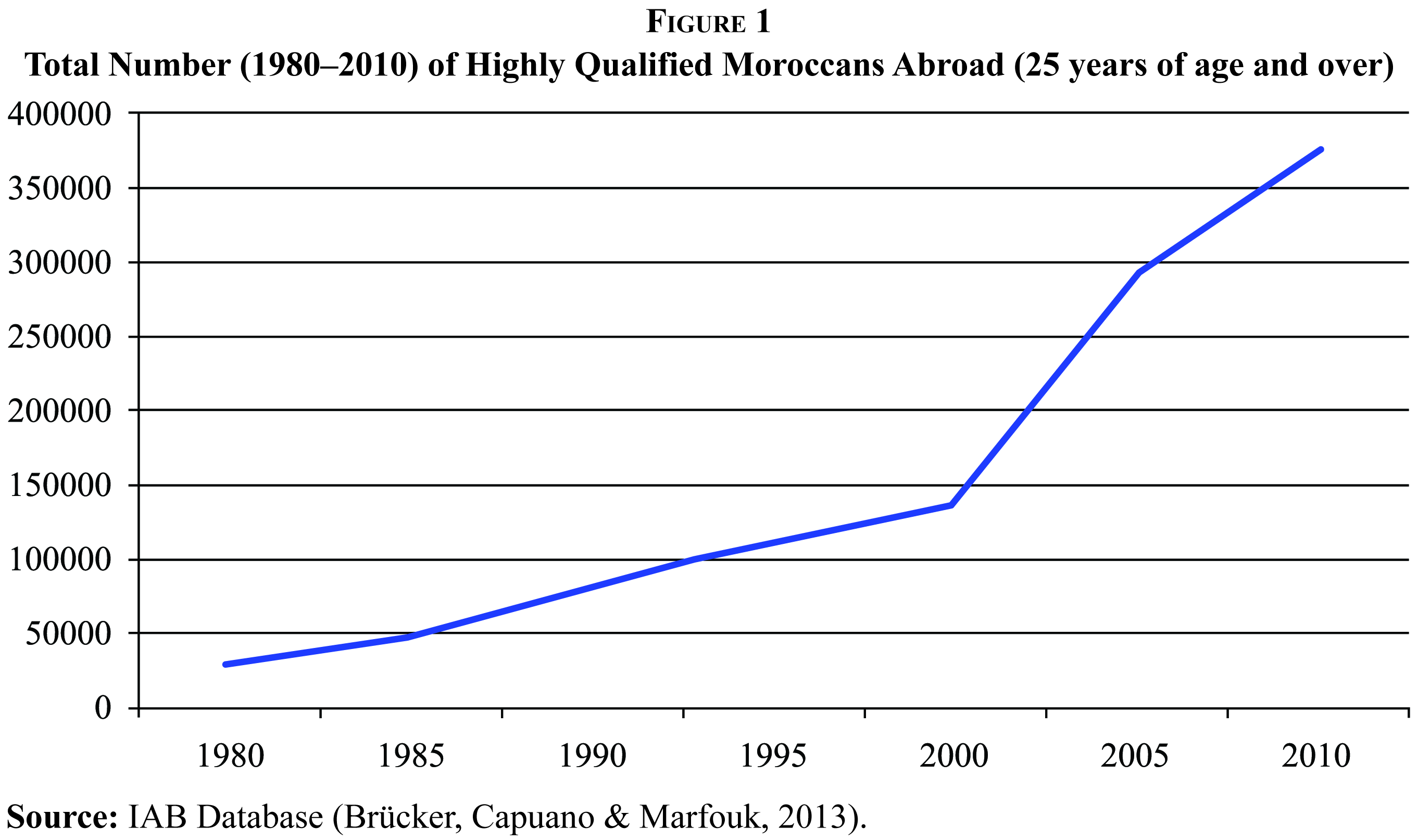
In 2010, more than 375,000 Moroccan university graduates age 25 and over were living in an OECD country 8 (Figure 1). Because of the age of the population in the survey, these figures do not include a large part of the student population (the ones under 25 years) and thus is mainly composed of professionals who have migrated. The authors of the IAB estimate that, in 2010, 20.13 per cent of the highly qualified Moroccans (in Morocco and abroad) emigrated (ibid.). 9 Between 1980 and 1990, this figure dropped by approximately 22 to 15 per cent but afterwards took an upturn (18.7 per cent in 2005 to 20.13 per cent in 2010) (Figure 2).

Today, while the enrolment rate has risen in all Moroccan universities in all disciplines over the last few years (about 18 per cent per annum), 10 the Moroccan students continue to emigrate (Table 1). But, according to the UNESCO Institute for Statistics (UIS), during the last decade their numbers remain more or less the same. Many migrating students stay abroad thus contributing to the growing stock of highly qualified expatriate Moroccans (Balac, 2009). But since the numbers of students registering in Moroccan universities has increased substantially, the Moroccan student expatriation rate has been going down regularly over the last ten years.
Number of Moroccan Students Enrolled Abroad

The dynamics of student migration can be traced to history and the special links with France, the country that created the first modern scientific institutions during the protectorate (Kleiche, 2008) links that made France the country of destination for a large number of Moroccan students as of 1970. The momentum was self-sustaining thanks to active collaboration between Moroccan academics trained in France and their French colleagues. Further, the dynamics of mobility which are also included in the globalisation of economies and trade, and explain the geographic diversification of migration, are supported by the policy of certain Moroccan schools of higher education and encouraged by the national scientific policy. Student mobility, thus, is central to, and a favoured tool of, the internationalisation of Moroccan science.
The main host country for the expatriating Moroccan students (Figure 3) is France (66.5 per cent) where, in 2011, they constituted the largest contingent of foreign students (10.9 per cent). The parameters of student migration to France vary, although many Moroccan students travel as part of interuniversity exchanges; one-third of the student visas delivered by the French consulate in Morocco in 2013 were for periods of less than 3 months. Two-thirds were for longer periods under interuniversity cooperation agreements or for individual students who decide to carry out all their studies in France.

According to 2013 data compiled by Campus France, 46 per cent were studying for a BSc (licence), 49 per cent for a MSc and 5 per cent for a PhD. It is logical to assume that the students in the inter-institutional mobility group are 3rd cycle students. Campus France reports that 40.3 per cent of them study science and technology, 31.0 per cent economics and management, 9.6 per cent the arts, languages, humanities and social sciences, 12.6 per cent medicine and 6.4 per cent law and political science.
How many of these students return to Morocco? There are very few indicators to assess the return figures. Most of the students covered by interuniversity agreements (and receive diplomas from two universities) return to Morocco to finish their studies and do not necessarily have the possibility (or desire) to leave again. This may not apply to PhD students (doctorant) who spend the last years of their studies in France or conduct their research in a French laboratory and receive offers for a post-Doc position in France or abroad. These students are afraid that if they go home they will have to face endemic unemployment and the risk to make their expertise obsolete.
Several studies have been carried out during the last few years on the propensity of highly qualified Moroccans to return home. An online survey of 1897 persons in 2012 showed that a little under 25 per cent (457) had already returned (no sampling method was included), a little over 50 per cent who were still in France said they hoped to return to Morocco in the next 2 to 8 years after obtaining their diploma mainly for family reasons and to contribute to the development of their country, but 60 per cent of them feared that they would not find a job that lived up to their expectations in terms of income and career advancement (Lycom, Career in Morocco, Club France Maroc, 2012). The propensity to return confirms a survey carried out in 2006 by the Association Maroc Entrepreneurs on 1823 persons of Moroccan origin, of whom 75 per cent lived in France and 14 per cent in North America; 76 per cent had a MSc or PhD degree and wanted, for the most part (86.4 per cent) to return to Morocco. This survey gave the following information on the propensity to return: ‘most students (96.6%) are inclined to return … as for the graduates, the intention to return is linked to the salary they receive abroad … the higher the salary the less inclined they are to settle in Morocco’ (Bensouda et al., 2006).
Job Offer and Employability of Highly Qualified Persons in Morocco
Young Moroccans and their families think that government jobs are the most desirable and that diplomas from a Moroccan university will automatically open the door to government employment (Mellakh, 1999). In 1991, for instance, when the national association of unemployed university graduates of Morocco (ANDCM) was created, the ‘unemployed graduates’ felt they were the ‘natural heirs’ to government jobs (Emperador, 2007). Young Moroccan unemployed graduates hold street rallies and organise sit-ins regularly before the Parliament; some have gone on a hunger strike and went as far as self-immolation. The last self-immolation protest was on 18 January 2014. These are tragic reminders of the relentless unemployment of university graduates. In the 1980s young people with their baccalaureat or technical training suffered the most from unemployment but for the last 20 years, high-level university graduates suffered the most, although the situation has improved over the last decade (see Table 2). The situation is paradoxical; the higher the education level, the harder it is to find a job.
National Unemployment Rates (%) According to Level of Education

Since the introduction of the structural adjustment policy in the 1980s, recruitment into the Moroccan public service has become more restrictive. 11 The recruitment policy, which is still applicable, induces harmful adverse effect on the functioning of the Moroccan research laboratories. Since the government recruited third degree graduates at the same level (regardless if they had a PhD or not), the higher level PhD students decided to leave many research laboratories and enjoy the security of an administrative government position in a ministry or a university rather that continuing their PhD studies and having to cope with the serious risk of not finding a job. The result is that the number of PhD students in the universities in Morocco is 2.5 times lower than in Algeria and is hardly higher than in Tunisia although Morocco has triple the Tunisian population. The number of PhD diplomas for all disciplines is very low (676 in 2009). The political authorities have to cope with two requirements that are difficult to reconcile: send a strong message to the public by recruiting unemployed graduates and contribute to the emergences of an organised labour markets for graduates, in the medium and long term, based on the market demand, as part of a strategy to restructure the national economy (Bougroun & Ibourk, 2002).
While enrolment in the post-graduate programmes (écoles doctorales) is going down, the universities have to absorb major increases in student enrolment which rose 34.76 per cent during the last decade when the number of teacher-researchers only rose by 5.80 per cent during the same period. This imbalance has had a negative effect on student supervision, scientific output of the teacher-researchers themselves, and on research training for students. This problem may grow worse in the very short term since student enrolment has risen by 20 per cent a year since 2010.
The governmental authorities are well aware of these weaknesses. In its last report, the Académie Hassan II des Sciences et des Techniques proposed three ways to correct the situation. One way concerns ‘training, and the mobilisation of senior staff and expertise’ (Académie Hassan II des Sciences et des Techniques, 2012). Extremely urgent measures have been proposed, such as:
Prepare a training plan for more than 15,000 teacher-researchers by the year 2025. Through a calls-for-applications process, accredit the best centres for graduate studies (Centres d’Etudes Doctorales). Promote the international mobility of doctoral students (doctorants).
Other short- and medium-term measures include:
A complete revision of the status of teacher-researchers to allow, inter alia, reputed Moroccan scientists living abroad to return to Morocco to contribute to national research by ensuring that their experience and academic seniority are recognised and validated. The integration of Moroccan research in world science by attracting international experts to Morocco and by encouraging Moroccan scientists to participate in major research projects on international themes.
Actions and Policies to Attract Moroccan Experts Living Abroad
For over 20 years, Morocco has been exploring ways to capitalise the scientific and technical skills of the Moroccan diaspora. This action reflects a political will that has coincided with the will of Moroccans residing abroad (MREs) to contribute to the development of their country. This progressively contributed to gradually replacing the concept of Moroccan S&T skills by a broader notion of skills.
Programmes to Enrol S&T Skills
In Morocco, it all started in 1993 when Morocco joined the United Nations Development Programme (UNDP) transfer of knowledge through expatriate nationals (TOKTEN) programme which aroused high expectations in the expatriate Moroccan academics. Three major conferences brought together high-level scientists whose enthusiasm soon faded because of the inertia of the Moroccan authorities. Both internal and external opinions were unanimously critical: no well-defined objectives, results limited to introducing expatriate Moroccan scientists to their colleagues in Morocco. A series of recommendations was made, but received no attention. In 1996 the project died a natural death since the Moroccan authorities did not take over from UNDP. 12
A few years later, in 2003, when discussions started on the role of the S&T diaspora in helping to develop national S&T communities, the Moroccan authorities showed new interest in the subject by creating the FINCOME (Forum INternational COmpétences Marocaines à l’Etranger) programme which means ‘where are you’. Unfortunately, for financial reasons, what was meant to be a major inter-ministerial programme under the auspices of the prime minister became a reduced action plan composed of two operational units under the auspices of the Secrétariat d’Etat chargé de la Recherche Scientifique (Secretariat of State for Scientific Research). The scientific and technical unit was housed at the Centre National de la Recherche Scientifique et Technique (CNRST) and the innovation and entrepreneurial unit was supposed to be managed by Association R&D Maroc but never got off the ground.
The CNRST unit started functioning 13 in 2006 when permanent staff was assigned. The best it could do, since resources were very limited, was to implement a small programme under the auspices of a committee composed of representatives of ministries and institutions. The programme offered temporary assignments in Morocco to teachers and experts of the Moroccan S&T diaspora and paid for travel and part of their living expenses for one week. Between 2006 and 2011, 243 offers to provide expertise were submitted and 197 were accepted, that gives an annual average of 40.
Now FINCOME has more ambitious goals and, under CNRST leadership, the programme offers support for the travels and living expenses of the MREs for periods of 6 to 12 months, a period equivalent to a sabbatical leave. To be eligible, the MREs have to have had at least 8 years of experience after their doctorate and have lived elsewhere but in Morocco for the last three years. Sixteen Moroccan scientists living abroad were selected during the second half of 2013 under the first call for applications, and received a net monthly indemnity of DH 22,500 (close to € 2000). This system will be repeated every year. It can and should contribute to the internationalisation of Moroccan research.
Hopefully these new ambitions will diminish even eliminate the traditional criticism that FINCOME reacts to opportunities and spontaneous invitations from universities (friends, colleagues met at conferences, etc.) rather than implementing a national strategy or recruiting experts to meet the country’s needs. Furthermore actions should be taken to lessen administrative bureaucracy and financial controls that have curtailed the submission of applications. 14
The Politics of Tapping the Expertise of Moroccans Residing Abroad (Mres)
In 1999 when the young Mohammed VI became king, his speech on the participation of Moroccans of the world in the development of Morocco led to the introduction of official programmes and an urgent demand from the MREs who wanted to participate in the development of their beloved home country. In the following years, two institutions were instructed to monitor the situation: the government’s Ministère chargé des Marocains Résidant à l’Etranger (MCMRE) and the Conseil de la Communauté Marocaine à l’Etranger (CCME) an institution created in 2007 by a royal decree.
Because of the nature and goals of these institutions, the term ‘competency’ should not be restrictive since Morocco has a special policy for its expatriates (who have the right to vote in the national elections and who provide political support to their home country from their country of residence), and should be able to count on all members of that population. These programmes, thus, targeted (at least in word) competency in the broad sense of the term, with equal respect for all competencies.
With this in mind, in 2007 the ministry’s research programme, in an effort to match Morocco’s needs with the skills available abroad, created a dedicated e-portal called the FINCOME portal which was replaced by the maghribcom platform in 2013. The approach used now is based on a process that starts with the identification of Morocco’s needs and then develops the involvement of the diaspora in responding to these needs (reshaped into project form). To stimulate these actions, a series of meetings was held between the diaspora and the Moroccans from the selected sectors, first in the MREs’ country of residence (preparatory meetings) and then in Morocco (the forums) in order to implement the projects and build up partnerships.
Since the beginning of the programme in 2009, six networks have been created of which two (in Germany and Canada) are operational, and three are being created in France and USA. A theme-specific network in the medical field called Compétences Médicale Marocaines du Monde (CMMM) was also created. The Ministry is trying to involve the MREs in other locally-important priority fields, for example, Plan Maroc vert and Agence de Développement Agricole (AGDA). But progress is slow and uncertain since these actions depend on networks of associations and, by principle, associations are vulnerable entities whose sustainability is not guaranteed.
The Conseil de la Communauté Marocaine à l’Etranger (CCME) is a think tank that puts forth proposals but does not have any specific programme to encourage the participation of the Moroccan diaspora. In 2013 it published an excellent report (CCME, 2013) that summarises actions that tapped Moroccan expertise abroad since the beginning of the 1990s. The report defines the basic principles of the MRE mobilisation strategy:
The concept of ‘competency’ must remain broad and inclusive and at the same time meet identified needs of the Moroccan public or private sector and serve to strengthen national human resources. The idea of ‘mobilisation’ must be expanded beyond the concept of ‘return’ to include support for all forms of mobility, cooperation, interuniversity agreement, etc., in other words all actions that could benefit from the skills of the expatriate Moroccans to promote the inclusion of Morocco in the diaspora’s spheres of action. The state should continue to play a central role. The state’s central role should be supported by public–private partnerships. Actions directed to the expatriate Moroccans should start prior to their departure and should be followed by Morocco’s involvement in the community life of its diaspora.
The CCME proposes the implementation on an experimental basis (3 years), of a body facilitating the convergence of the different actors initiatives and enabling their synergy with national policy.
That should lead to the establishment of a new entity under government control that would recognise CCME actions as national priorities that fit in with the national policy. This entity would provide a ‘single window’ for all the public and private Moroccan and foreign partners. The future will tell whether this proposal is supported by the political authorities or whether it will lapse into oblivion, as often happens with official reports.
The Organisation of the S&T Diaspora
The S&T diaspora that provides, by far, the most active support for Morocco is the Deutsch–Marokkanisches Kompetensnetswerk (DMK), the Germano–Moroccan Skills Network created in 2009 to involve highly qualified, Germany-based Moroccans in 12 work groups. 15 Thanks to excellent cooperation between the German authorities (consulates and development cooperation organisations) 16 and the expatriate Moroccan, this network carried out projects ranging from traditional diaspora actions (recycling tools and machines from German universities and sending them to Moroccan universities), to signing agreements for joint supervision for a masters degree or developing bilateral cooperation (in the field of renewable energy for instance).
However, the majority of associations of expatriate Moroccans have not been able to rally the authorities of their host country to these activities. Their situation is much more precarious and their activities are much smaller. In 2013 three of the 39 identified associations had a mission related to science and technology transfer. 17 The success of their actions depends upon their partners in Morocco and the tenacity of their members in following through on their actions. Whenever possible they serve as a ‘scientific watch’ and in some cases made it possible for Moroccan laboratories to participate in European projects, or were instrumental in setting up jointly supervised agreements, interuniversity cooperation, training workshops, etc. But the vulnerability of these associations affects their activities. Their members are active volunteers who complain, inter alia, that their actions are not covered by legally established formal agreements, which would ensure the sustainability of their actions. The information in the next section has been obtained from interviews with these members and highlights the difficulties in working with Moroccan scientific institutions.
Experiences of Expatriate Moroccan Scientists and Scientists Who Returned to Morocco: Results of a Field Survey
Fifteen semi-structured interviews were made in 2013 on the life story of Moroccan scientists who, after many years and most often a brilliant career abroad, decided to return to Morocco where they work today in the public and private academic world or in research and innovation institutions. An additional five interviews were carried out in Europe (France and Belgium) with scientists of Moroccan origin working in higher education and research (mainly public institutions) and also acting to contribute to the scientific development of Morocco either through personal efforts (developing special links, partnership contracts, receiving students, organising seminars, scientific workshops, etc.) or through special associations. The interviews lasted from one to several hours.
In Morocco the selection of scientists to be interviewed was based on a snowball selection targeting particularly private institutions likely to recruit Moroccan scientists from the diaspora, notably the International University of Rabat (UIR) and the Moroccan Foundation for Advanced Science, Innovation and Research (MAScIR). For practical reasons interviews were mainly carried out in Rabat. Interviewed scientists were predominantly men between 40 and 55 years old. Two women were both less than 40 years old. Most of them are working in advanced S&T fields (biotechnologies, materials including nanomaterials, informatics as well as renewable energy, management and anthropology). The majority joined universities both public and private or research institutes (predominantly private). Many of them occupy high-ranked positions up to president of universities and director of a research institute.
The information included in the following parts comes from the summary of the interviews.
Who Returns and How?
Four typologies were derived from the interviews carried out in Morocco. They determine the return phenomenon and integration (or re-integration) strategy and also characterise the behaviour of the return migrants and their capacity to cope with difficulties encountered after returning, since the return is more than returning, it is a new emigration (some call it ‘re-emigration’) full of snares.
Some returning migrants can be called the ‘resistant’. These are the ones who start preparing their return at the time of departure and who followed a results-based strategy throughout their period abroad that emphasises diplomas and practical skills. This group is mainly composed of scientists who have acquired great professional experience abroad. Before even leaving they know and prepare for the difficulties that they will have to overcome when they return to Morocco. Their main strategy is to avoid blocking the situation, to make as much progress as possible and when they have gone as far as they can, to change locations, in other words, to join another institution.
There is a group called the ‘ambitious’ composed of talented, young people who are full of ideas and projects, aware of what they can contribute and hope that developments (real and expected) in their home country will give them personal opportunities and allow them to contribute to the development of their country while giving them the possibility to live in Morocco. They are not equipped to cope with the difficulties that lie before them. Having to tackle all sorts of professional and personal problems slow but surely disappoints them. Some of them become bitter and toy with the idea of a secondary emigration in the more or less near future. Morocco apparently is unable to retain these promising, talented people and enable them to prosper in the traditional education and research structures.
Then there are the ‘the pragmatists’ who respond to opportunities that offer attractive conditions for their return (good salaries, good social welfare coverage, good professional environment) and who seem to be well satisfied. They are anxious for change and feel confident that their call for good conditions has been heard and will be implemented in the institutions where they are employed (most are private and/or independent). Their permanent settlement in Morocco will depend on whether they can continue to enjoy good living and professional conditions. They are perfectly ready to embark on an international career, in other words, leave Morocco. They want to be known for their scientific excellence and want to be published in indexed scientific journals and participate in international conferences in their domain.
The return migrants, called project or initiative ‘holders’ or institution ‘builders’, return to Morocco as a large innovative force (creation of institutions, laboratories and other major projects, etc.). This refers to developing complex projects or institutions that are worth analysing according to a special approach which is, however, not the purpose of this survey. The history of these projects shows that their leaders are subjected to very strong economic, administrative, political and social pressure that sometimes makes project management chaotic and risky. Innovative projects, and approaches borrowed from other countries will not necessarily bring about changes in governance and management in Morocco. That requires long-term projects whose future deeply affects the personal destiny of the people in charge.
Commitment of Diaspora that Contribute to S&T Development in Morocco
The aims of members of the S&T diaspora engaged in scientific cooperation and collaboration with Morocco:
Fight against the brain drain. Their idea is that Moroccans who study for a doctorate and start working abroad are ‘irremediably lost’ for their home country and that other ways and means have to be found to harness their skills for the benefit of Morocco. They see themselves as intermediaries.
As scientists living abroad we are bicultural. We have an opening onto the world that we can beneficially share with our country. If we could join the Moroccan think tanks we could bring reflection closer to European thinking, which is indispensable for upskilling institutions and developing scientific and technical collaboration.
18
They belong to French, Belgian, European and international scientific and economic networks and have been able to rally top scientific figures to their Moroccan cause. They say that they do not expect anything in return for their actions (especially no financial compensation) and very often contribute to the cost of their own travels. In sum, their commitments cost them time, energy and money. They appreciate the ‘recognition’ that is sometimes shown but have no illusions about its benefits for their career (since they are already on a satisfactory scientific career path). At a request from assistance their Moroccan colleagues, for instance, they sometimes formalise their actions within associations keyed to S&T development and transfer. Their participation in development groups on S&T in Morocco depends on the visibility of their association and their individual visibility but, they felt, it was too infrequent.
Perception of Return-support Mechanisms
Surprisingly, the scientists we interviewed in Morocco after their return had not or seldom been in contact with the Moroccan endogenous scientific community before their return and were not familiar with the government mechanisms for mobilising the skills of Moroccans living abroad.
On the other hand, interviews showed that expatriate Moroccan scientists in France and Belgium knew their mechanisms well and had, in some cases, contributed to their creation, development and organisation or had benefited from them. They were very critical of these mechanisms and suggested improvements (even major changes).
The definition of ‘expertise’ was at the heart of their criticisms. The expertise mobilisation policies, except for FINCOME which targeted science and innovation, have not given a precise definition of the best qualifications for Morocco and for what Morocco needs and wants. As a result, actions to promote the national mobilisation were unfocused and attracted members of the diaspora who were just looking for good opportunities. This fringe group of expatriates who had more or less failed in their host country and wanted to return to Morocco under good conditions made themselves often very ‘visible’ in the halls of the embassies and consulates and sometimes actively joined associations for the sole purpose of advancing their personal interests. Persons interviewed explained that this would not have happened if the term ‘expertise’ had been clearly defined in relation to the needs of each sector of activity and if the selection process had been strict and structured. We agree with the analysis of the Conseil de la Communauté Marocaine à l’Etranger that points out the difficulty of evaluating the real ‘Moroccan expertise abroad’ of the persons in associations in the host countries (CCME, 2013).
Public actions to encourage the mobilisation of expatriate Moroccans led to small programmes such as FINCOME and a succession of big, loud gatherings that always attracted the same people but then nothing happened. It went on year after year. 19 This is a hard judgement that blames the country for promoting communications rather than effective public action. The S&T diaspora can only serve as a lever for national development if the decision-makers are convinced of the necessity to convince the Moroccan S&T diaspora to participate in regional and national development and are convinced themselves that this participation would be economically and socially beneficial for all concerned (Lakhdar-Ghazal, 2008). The question that comes to the mind of the Moroccan expatriates working in S&T is the following: do the Moroccan authorities really want to rely on the diaspora to make things change? At the end of the day, do they really want to change the economic, social and human development model? The expatriate Moroccans have their doubts.
Difficulties Expected by the Diaspora and Difficulties Encountered by the Returning Moroccans
Paradoxically, the fact that expatriate Moroccans have been collaborating with colleagues in Morocco and know how the Moroccan universities and research institutions function are a strong disincentive. Expatriate Moroccans no longer expect a smooth return. Attempts at cooperation between Moroccans abroad and within the country are painful and, they say, are based on a mutual lack of confidence. 20 Interviews brought out two main reasons: the first, drawing on the saying, no one is a prophet in his own country expatriates have the impression that their home country is not anxious to use their skills (and does not acknowledge them). The second is more sociological and is explained by the fact that many of the scientists who are working abroad come from the lower or middle classes and benefitted from the social elevator obtained by the policy introduced by King Hassan II. 21 As one interviewee said: Morocco is still a hierarchical society, a society of networks and it is difficult for anyone who is not in the network that structures the circles of power to obtain support. 22
The returning migrants feel like they are seen as a threat: We went abroad and came back with different cultural bases and different expectations about operating systems. We question operating systems, both professional and cultural ones. This is something that our colleagues and the Moroccans in general are not ready to accept. 23
They see discrepancies between scientific interests and scientific capacities that hold back the implementation of joint projects. In interuniversity projects, for instance, potential lines of cooperation can be identified but when looking at the details (nature or subject of curricula and research) the interests, demands and subjects of the Moroccan diaspora and their colleagues within the country are very different.
The expatriates also regret the lack of formal structure for joint actions. Projects that university institutions develop with associations for Moroccans living abroad often have no legal structure. This automatically means lack of monitoring and continuity in the actions they undertake together. Since informal projects are not eligible for institutional or public funding and do not involve mutual obligations, they can easily fade out of existence.
Returning Moroccans have to face both professional and personal problems (that they always foresee). At the professional level, there are various types of difficulties, from legal, administrative and scientific, to associative, relational and governance and many may occur simultaneously. In the public institutions of higher education and research, where part of the returnees worked, the situation was marked by rigidity and red tape:
No administrative or financial autonomy due more to the a priori controls than to the a posteriori controls. It was difficult, and in some institutions totally out of the question, to be allowed to manage the research funds even funds from foreign sources that were directly earmarked for the project. Impossible to be recruited at a level that recognised the career experience abroad (except for top management positions in the institution). More and more administrative bureaucracy at every step of the research activity. Difficulties caused by a teachers promotion system that seemed unclear (reward was not for excellence or expertise and appointments were based on decisions the interviewees did not understand). No possibility for long-term teaching assignments and mobility (wish to receive foreign colleagues). Opposition by professional unions to certain appointments and assignments in public universities. Shortage of staff Shortage of funding No status for researcher and lack of commitment to research activities, despite an allocation of a research bonus provided to all academics.
For scientists working in the private sector, most problems were related to a top–down management of the scientific agenda. The goal of research is innovation and technological progress that can generate profit quickly, while the production of knowledge and publication in scientific journals, which are at the heart of the profession, are considered marginal or even trivial. There are also problems of governance connected mainly to the differences in objectives and the distrust between the scientific and the political/economic world.
Besides these professional difficulties, returning Moroccans have personal problems connected to health care, schooling for the children, appropriate job for the spouse, the income level, etc.
How Do They Contribute to the Development of the Moroccan S&T System
Despite these difficulties, the scientists interviewed in and outside of Morocco, all agreed that their work had had a positive effect on the development of their country’s S&T system. These actions included:
Participating in, contributing to and launching scientific and technological projects at the international level Developing new technologies in Morocco Establishing interuniversity collaboration (e.g., masters through co-diplomation, i.e., separate diplomas from each partner institution or a joint diploma from the partner institutions together) Creating associations to connect Moroccan laboratories with European partners Organising conferences and workshops Co-publications indexed in international databases Partnership to file for patents.
The returning scientists all feel that they contribute substantially to several levels of Moroccan scientific development:
By using an innovative approach (they have learned other practices in other systems) they know that their actions can be convergent with the actions of their colleagues (including colleagues from the diaspora) who want to contribute to changing the institutions’ mindset and practices; knowing that clashes can lead to no good they keep their expectations low-keyed. We have to win our colleagues’ confidence and not lock horns with them, not block the situation, but on the contrary try to understand the situation and make progress together.
24
By maintaining connections with scientific partners abroad who are helping their Moroccan colleagues and students; this entails the organisation of seminars, conferences, cooperation agreements and co-publications; By successfully bidding for international calls for tender that finance research and collaboration with foreign partners; By introducing new curricula for the masters or doctorate degree in conjunction or through joint supervision with foreign universities; By strengthening research and innovation that partners with industry (most of the people interviewed develop practices abroad that capitalised a research-industry partnership); Through a rigorous approach and methodology, patient and diligent monitoring, and scientific/technological acumen that leads to new opportunities.
Return or Circulation?
Only the Moroccans returning for strictly personal or emotional reasons (and who accepted the corollary, that is, the risk of deskilling or skill loss) said that they would stay in the country. All the others said that they gave priority to their career, their economic situation and/or the success of the projects they were heading. In other words, their future in Morocco was uncertain and they might only stay temporarily if it meant losing skills or being overqualified for their job. Some of them were already looking abroad again, either because they had kept their position abroad or wanted to look for a new one.
Although the return of Moroccans who decide to migrate again can be seen as a failure (which it undoubtedly is at the individual level where it is felt as such and is very costly), these secondary or repeat migrations can contribute to raising the level of scientific activity in Morocco and serve as the starting point for scientific mobility. Some young researchers who are second generation migrants go to work in Morocco although they were born abroad. They hope that someday Morocco can become a step in their international scientific careers that take them to Europe, the Middle East (in centres of excellence), the US and also … to Morocco.
Conclusion
After the migration wave of unskilled workers starting in the 1960s, the qualification level of the emigrating Moroccans rose steadily in the 1990s, and especially since the year 2000. At present, an estimated 20 per cent of the highly qualified Moroccans live abroad. Student migration, which accounts for a large part of this 20 per cent, is contributing substantially to keeping this level high, despite the considerable increase in enrolment in institutions of higher learning in Morocco over the recent past. Two-thirds of the Moroccan students who emigrate go to France, where they form the biggest cohort of foreign students. Moroccan expatriation for higher education is partly a reaction to the perpetuation of unemployment of Moroccan graduates and will continue to contribute to the permanent emigration of Moroccan students abroad as long as the national research and innovation system is not sufficiently developed and attractive. To that extent, Morocco is still a clear case of country affected by brain drain today.
Because of this situation, for the last 20 years Morocco has been testing actions to mobilise and reconnect its S&T diaspora. This has been a major political challenge. The government invites all ‘Moroccans of the World’ to participate in developing the country. The results of its special programmes and institutions are mixed, especially if measured against the original goals and the high expectations of the MREs (Moroccans living abroad). Besides the insufficient investments and the small size of the programmes, the main problems are the unclear overly comprehensive definition of the concept ‘skills’ and of the considered goals, as well as insufficient follow-up and capitalisation of actions conducted. In interviews, the scientists said that the political actions to attract the Moroccan S&T diaspora failed because the programmes were too small and a lot of ‘big talk’ led nowhere. Furthermore, most of the actions were directed to networks of associations whose future was uncertain. In response to these weaknesses and criticisms, proposals for institutional reorganisation and programme revisions have recently been put forth, or tested, but it is too early to evaluate the outcome. Comparison with other emerging countries in Asia highlighted in this special issue indicate that support scheme and policies are fully efficient only if and when national S&T and innovation ecosystems develop to a greater extent than is the case in Morocco today. Research intensity should also be higher to be attractive enough.
Interviews conducted in Morocco and in Europe with scientists who returned to their country (15) or were part of the diaspora living in Europe (5) indicate a very strong desire to participate in the development of Morocco, but also highlight inhibiting factors inherent in the public higher education and research system, namely: bureaucracy in administration and accounting, insufficient student supervision, lack of recognition of the importance of research, no recognition of career accomplishments abroad, teaching staff sees colleagues from abroad as a threat. All this in an environment where the public authorities’ attempts to introduce change is held back by a corporatist way of preserving out of date social or professional benefits.
The international mobility of the interviewees was a constant but not all thought that Morocco would be their final landing place. Emigrating again was not excluded and some of them have already considered this possibility for professional, economic, family and other reasons. The scientists who envisage secondary emigration feel that their stay (sometimes quite painful) in Morocco is a step in their career. With the help of the colleagues who they have gotten to know well in Morocco they hope to continue contributing to the development of their country’s S&T system. They still see themselves as intermediaries (passeurs) and say that they are still trying to add to the networks dedicated to information-sharing, cooperation, collaboration and student training. Last, they are the forerunners in a new type of mobility system that will contribute, (together with the reform measures that Morocco will have to adopt) to making the Moroccan national research system attract Moroccan and foreign scientists for all or part of their professional career.