




Abstract
The main objective of this article is to answer the question: How does one make a ‘new’ business model framework in a knowledge-based economy? In an effort to advance this issue, we built a research framework based on literature reviews. In addition, we performed social experiments at DGIST during 2011–2015 to arrive at a new business model framework. There are four different active business model-building processes. First is the customer open innovation-based business model developing circle. Second is the user open innovation-based business model developing circle. Third is the social entrepreneurship-based business model developing circle and fourth is the engineer open innovation-based business model developing circle. Empirical research to confirm the operation status of business model approaches, the study makes use of patents database.
Introduction
Research Question, Scope and Method
Why Business Models?
Traditionally, Business administration that deals with a firm’s management fails to pay attention to business models. With this, recent innovation theories that focused on the growth and development of firms’ technological innovation based after the advent of the knowledge-based society did not pay attention to firms’ business models either. If this is the case, then why should we give our attention to business models? The answer to this is because many subjects whom we meet in markets pay more attention to business models than anything else. Most firms, prep entrepreneurs who newly prepare for business start-ups and researchers who wish to connect their study results directly to business start-ups, pay more attention to the development of business models or innovation than anything else.
In addition, because of the acceleration of the second IT revolution and the deepening of the knowledge-based economy, the characteristics of the connected economy that can be linked to markets and technologies in the world are intensified. That is, the necessity of new business models for access to new markets and new business models created by the combination of technologies and markets is being intensified more than ever.
Thus, the purpose of this article is to answer the question: ‘How does one make a new business model in a knowledge-based economy?’
Research Scope and Method
The research framework used for this article is based on literature reviews.
The concept of business models, which has not yet been established, will be formed through analysis of previous studies and other methods. In addition, through a review of diverse results of previous studies on existing business model elements, core components of business models, which will serve as the foundation of this study, will be arranged. Furthermore, through a review of previous studies on existing business model development methodologies and interviews with firms that have experience in business model development, new business model development methodologies will be established.
Lastly, the business model development methodologies developed as such will be applied to develop new business models. As a way to implement concrete substances of business model development, this study takes the application of business model patents to the Korean Intellectual Property Office (KIPO). Under the Indian Penal Code (IPC0029 patent classification, G07Q is explicitly classified into business model patents. By combining the progress of social experiments-termed business model development with business model patent applications, the outcomes, the social experiments, and whether they are successful can be primarily measured and verified through institutional devices-termed patent application and registration (Bailey, 2008; Berg & Lune, 2004). By revising and supplementing business model development methodologies through these social experiments, the reliability and validity of relevant business model development methodologies will be enhanced. If some methodologies do not pass the conditions for patent application, the validity of the relevant development methodologies will be verified through interviews (DiCicco-Bloom & Crabtree, 2006; Schoenberger, 1991; Yin, 2009).
This study systematically analyses the entire process in which the lead author developed actual business model development methodologies in the DGIST convergence research department from January 2010 to December 2015. Business model patents based on the same methodologies were applied and registered, and the validity of the developed business model development methodologies was enhanced through the application of the relevant methodologies to the development of some external business models through interviews.
Literature Review and Research Framework
The Value of Business Model and its Relationship with Open Innovation
Despite the fact that business models play very important roles in the sustainable existence and development of firms in reality, diverse definitions exist on the one hand and it has not been completely established scientifically as with the concepts of strategies, among others, on the other hand (Osterwalder, 2004; Teece, 2010; Zott & Amit, 2010). It can be pointed out that business models act as various forms of models: to provide a means to describe and classify businesses; to operate as sites for scientific investigation and to act as recipes for creative managers (Baden-Fuller & Morgan, 2010). Definitions of business models may vary depending on the usage of business models.
In fact, as highly emphasised in entrepreneurial practice, business models have received limited attention from researchers (Morris, Schindehutte, & Allen, 2005). However, innovation in business models are increasing to a critical level for building sustainable advantage in a marketplace defined by unrelenting change, escalating customer expectations, and intense competition (Sorescu, Frambach, Singh, Rangaswamy, & Bridges, 2011). With the growth of business models, novel implications are to be expected (Gambardella & McGahan, 2010).
In concept with its partners, a firm’s business model as a system of interdependent activities enables them to create value and also appropriate a share of that value (Zott & Amit, 2010). Among others, value creation and sharing are core components of business models (Amit & Zott, 2001; Chesbrough & Rosenbloom, 2002; Johnson, Christensen, & Kagermann, 2008; Zott & Amit, 2010). Business models play roles as a mediating construct between technology and economic value (Chesbrough, 2007; Chesbrough & Rosenbloom, 2002).
In line with this, if business models are combinations of or connections between technologies and markets, it can be seen that open innovation, which means open relationships between technologies and markets in which the main agents of technologies and that of the market are not necessarily identical, is a concrete precondition of a business model (Brem & Tidd, 2012, p. 257; Chesbrough, 2006, 2007, 2010a, 2012; Yun & Mohan, 2012). The innovation of the business model designed for licensing such technologies will have unpredictable, but inevitable, consequences for industry structure and organisational capabilities, as well as for the content and context for upstream science talks in which technologies are a novel alternative to applied, specialised, commercially mature technologies, featuring business model innovation and the evolution of technology markets. Because of the deepening of the knowledge-based economy, the utilisation of technologies developed by a certain industry or firm in other firms and industries and the move towards technologies of general applicability are becoming representative characteristics of open innovation paradigms. Living Labs, which can be understood as user-centric environments for open innovation, are examples between business model and open innovation or the open innovation as the theoretical background of business model development.
Therefore, new value creations in diverse relationships between technologies and markets; that is, in four types comprising the relationships between existing technologies and existing markets, between existing technologies and new markets, between new technologies and existing markets, and between new technologies and new markets, as shown in Figure 1, can be defined as business models.
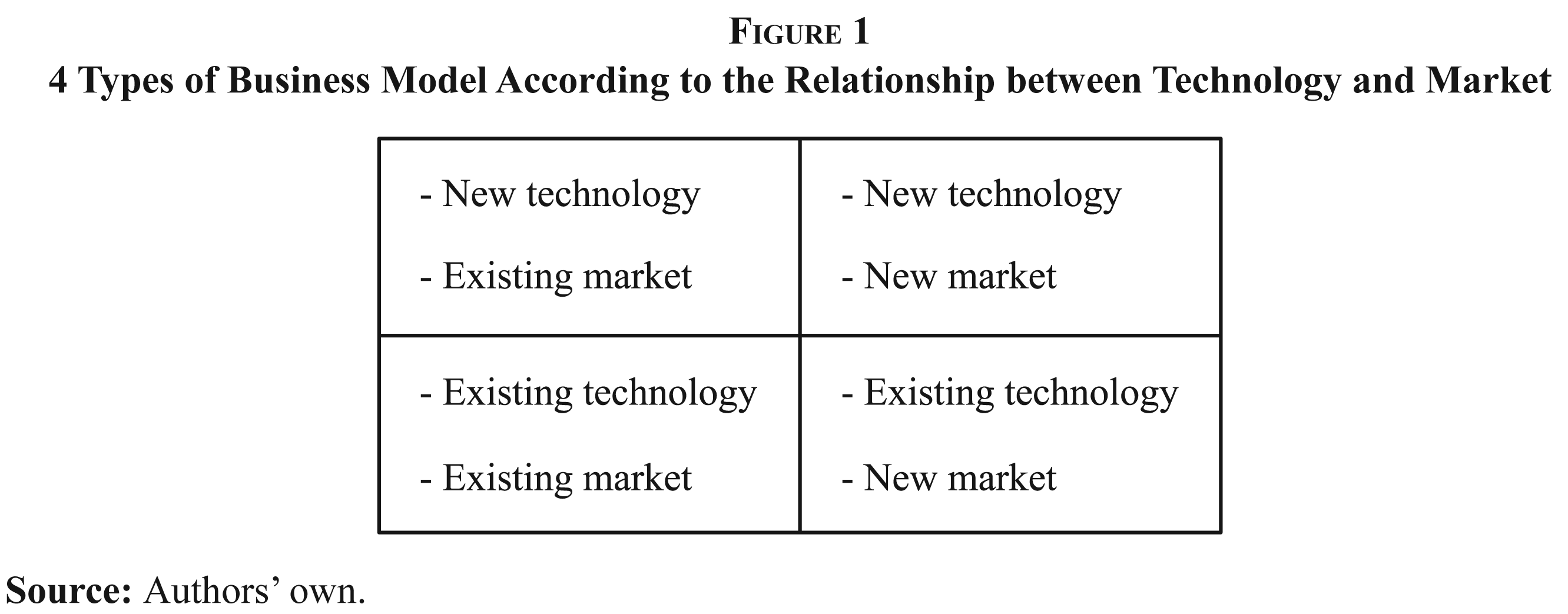
However, because conceptual definitions of business models are diverse and embracing comprehensive contents is limited, describing core contents will be more helpful in understanding the concepts.
Core Components of a Business Model
Centering on not only the top 10 papers in the degrees of quotation among those that discuss the components of business models, but also on recent papers that attract attention with their new themes or contents, core components of business models were as follows.
First, value proposition is directly presented as a core component of a business model in almost all papers (Chesbrough, 2010a; Desyllas & Sako, 2013; Dubosson-Torbay, Osterwalder, & Pigneur, 2002; Huarng, 2013; Johnson et al., 2008; Osterwalder, 2004; Teece, 2010; Van der Borgh, Cloodt, & Romme, 2012).
Second, a technology system that creates value and distributes to the customers is also quoted as a major component of business models. However, the technology system is indicated as a core component through diverse expressions rather than being directly quoted (Camponovo & Pigneur, 2003; Chesbrough, 2007, 2010a; Desyllas & Sako, 2013; Huarng, 2013; Johnson et al., 2008; Osterwalder, 2004; Osterwalder & Pigneur, 2002, 2010; Schubert & Hampe, 2005; Teece, 2010).
Third, the customer segmentation means concrete consumers of business models. Although some previous studies expressed this component within another business model component, major papers specified customer segmentation as an independent core component of business models (Camponovo & Pigneur, 2003; Chesbrough, 2007; Huarng, 2013; Osterwalder, 2004; Osterwalder & Pigneur, 2010).
Fourth, costs and revenues mean firms’ concrete costs in the process of realisation of the relevant business models along with gains to be obtained by the relevant firms through the realisation of the relevant business models. As a criteria for the judgment of the value of business models and as a ground for the innovation and development of business models and the development of new business models, costs and revenues are unavoidable core components of business models (Camponovo & Pigneur, 2003; Chesbrough, 2007, 2010a; Desyllas & Sako, 2013; Huarng, 2013; Johnson et al., 2008; Morris et al., 2005; Osterwalder, 2004; Osterwalder & Pigneur, 2010).
Fifth, to deliver the value created by business models to customers, connection with customers is presented as another major component (Chesbrough, 2007, 2010a; Desyllas & Sako, 2013; Osterwalder, 2004; Osterwalder & Pigneur, 2002, 2010). Connection with customers is characterised by being expressed in diverse ways, such as strategies in many previous studies. In addition, although this is indicated to be within other business model components, such as costs and revenues in some previous studies, it is presented as an independent core business model component in major previous studies.
Diverse Discussions on Business Development in Existing Studies
Discussions on business development in existing studies are divided into three types—maps of business model approaches, process of business model approaches and business model innovation strategies or cases. Maps of business model approaches include business model-mapping approach (Osterwalder, 2004), business model canvas (Osterwalder & Pigneur, 2010) and IBM’s component business modeling (Chesbrough, 2010a). The process of business model approaches present processes such as experimentation, discovery-driven planning, effectuation and leading change in the organisation (ibid.).
Business model innovation strategies or cases focus on presenting diverse strategic factors of the business model innovation. For example, business models can be designed from an activity system perspective, which includes design elements such as content, structure and governance, and design theme such as novelty, lock-in, complementarities and efficiency (Zott & Amit, 2010). Another representative case is when one profits from a business model innovation such as the Pay-As-You-Drive (PAYD) in auto insurance (Desyllas & Sako, 2013).
Business model innovation in two groups of design theme, such as one group that includes operational efficiency, operational effectiveness and customer lockin in value appropriation, and another group that includes customer efficiency, customer effectiveness and customer engagement in value creation is also proposed (Sorescu et al., 2011). Accelerating the business model renewal through three core meta capabilities to make an organisation more agile, such as strategic sensitivity, leadership unity, and resource fluidity, are proposed (Doz & Kosonen, 2010). In fact, as environmental conditions change, business models may require adaptation or wholesale change. These are the evolutions of business models, or internal and external ‘fit’, where the former is concerned with a coherent configuration of the key activities within the firm and the latter addresses the appropriateness of the configuration given the external environmental conditions (Morris et al., 2005). As a strategic development of business models, four factors, which are social networking, interaction orientation, user-added value and customisation or personalisation, are proposed for Web 2.0 in creating value on the Internet (Wirtz, Schilke, & Ullrich, 2010). An emerging dynamic perspective, such as business model innovation through trial-and-error learning, sees the business model development as an initial experiment followed by constant revision, adaptation and fine-tuning based on trial-and-error learning (Sosna, Trevinyo-Rodríguez, & Velamuri, 2010).
For the purposes of this study, the researchers explored the business model portfolios of four European biotechnology companies. The distinctive nature of business models are taken into consideration and their business model portfolios are defined as the range of different ways in which they deliver value to their customers to ensure both their medium-term viability and future development (Sabatier, Mangematin, & Rousselle, 2010). A study on an individual business model in the making analyses the process of innovation and development of that business model in the process of a chief’s quest for creative freedom (Svejenova, Planellas, & Vives, 2010). Studies that analyse the business model reconfiguration from technological development are also part of case studies (Calia, Guerrini, & Moura, 2007).
As shown in Table 1, among the existing discussions on business model development, only several discussions on business model mapping are closely similar to discussions on development. Instead, most discussions focus on the innovation strategies of existing business models. Map discussions focus on mapping existing business models and derive only some ideas for innovation of business models in the mapping process. On the other hand, discussions on processes focus on the process of business model innovation.
Diverse Researches on Business Model Development

Thus, these imply that existing discussions on business model development tend to focus on studies of business model innovation rather than on business model development.
Framework of Analysis
This study will steer away from approaches to business model innovation or mapping used in existing studies and will instead develop business model development methods. That is, as shown in Figure 2, business models that contain the five core components of business models will be developed. The approach to new business model development in this study begins from diverse channels of open innovation. When firms look for new business models or innovation sources, they rely on their innovative activities upon external search breadth, which is defined as the number of external sources or search channels (Laursen & Salter, 2006). Open innovation assumes that internal ideas can also be taken to the market through external channels outside the current business of the firm to generate additional value (Chesbrough, 2003b, p. 43). Open innovation can be defined as systematically encouraging and exploring a wide range of internal and external sources for innovation opportunities, consciously with firm’s capabilities and resources, and broadly exploiting those opportunities through multiple channels (West & Gallagher, 2006). Even if a firm is specialised in marketing and has critical information about market needs, has well-developed distribution channels and is in a collaboration with a manufacturing firm, it can be another type of open innovation at the commercialisation step (Lee, Park, Yoon, & Park, 2010). Beyond the borders of existing firms, new business models will be developed by creative combinations of open innovation-based technologies and markets. The process of business model development will begin from diverse channels of open innovation and follow the process of new open combinations of technologies and markets; provided that, the process will include the five major core components of business models.
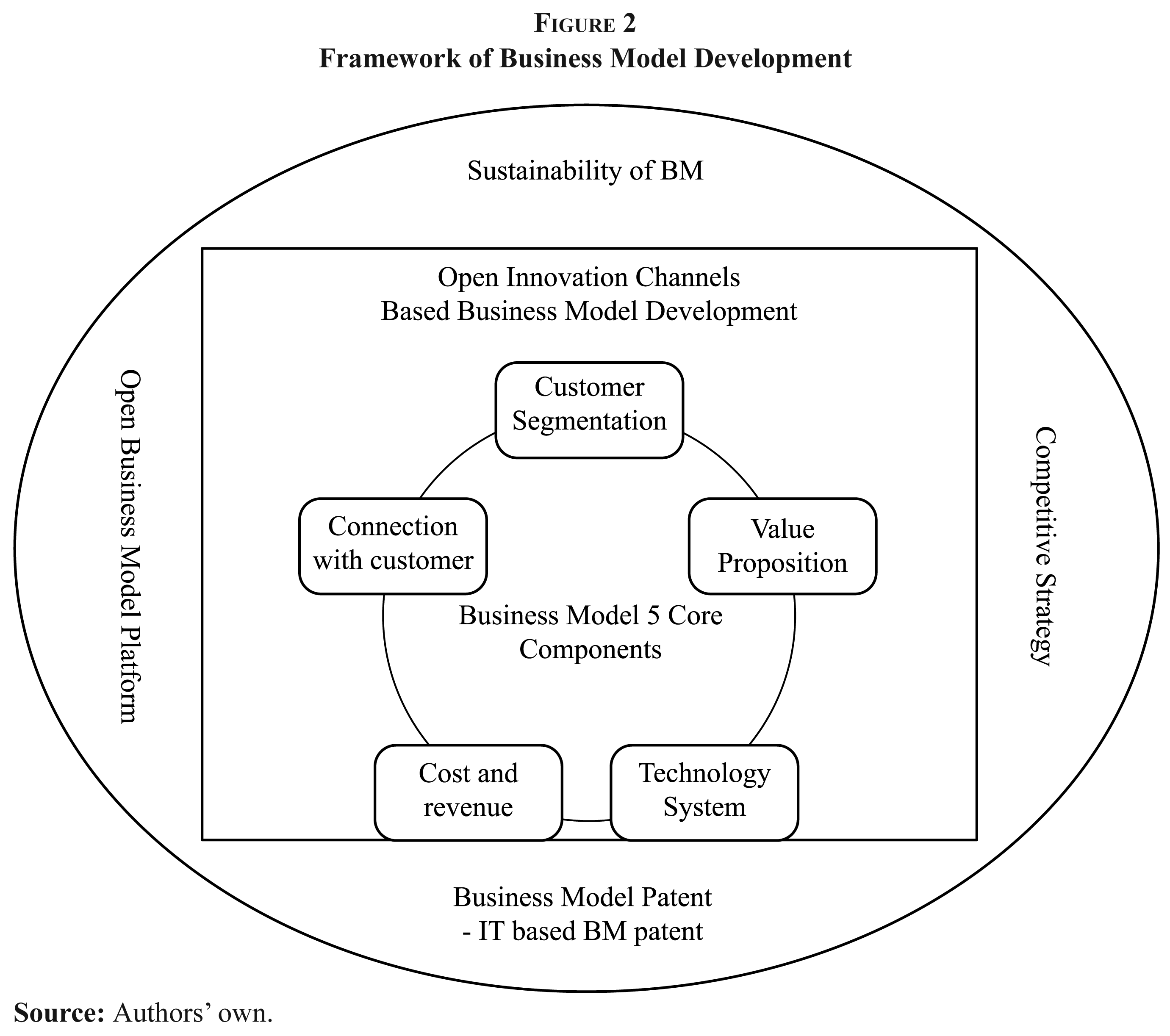
In line with this, it is thus also essential for the sustainable growth and development of firms that relevant business models be prevented from being easily imitated or caught up by other firms (Kim, 1997; Lee & Lim, 2001, p. 255). There are diverse ways to secure the sustainability of business models, such as combining business models with competitive strategies, constructing open business model platforms to open business models per se, and defending business models by securing business model patents.
First, the coupling strategy and business model analysis is needed to protect the competitive advantage that results from a new business model sign because a business model is more generic than a business strategy (Teece, 2010). As a business model is a reflection of a firm’s realised strategy, the substantive difference arises when the firm’s contingent strategy calls for business model modifications (Casadesus-Masanell & Ricart, 2010). According to Teece (2010), a competitively sustainable business model requires a strategic analysis filter to figure out and implement ‘isolating mechanisms’ to hinder or block imitation by competitors and disintermediation by customers and suppliers. Securing the dynamics of a business model through changes in the relationships among core components is also a way to secure a business models’ sustainable survival and development through competitive strategies (Casadesus-Masanell & Ricart, 2010; Demil & Lecocq, 2010).
Second, going beyond its position as a source of business models, open innovation is indispensable for business models’ sustainable development (Chesbrough, 2013, p. 110; Morris et al., 2005). An adaptive business model in an open innovation platform can identify new business models (Chesbrough, 2013, p. 111). External technology partnerships allow open business models to accomplish even more (Chesbrough & Schwartz, 2007). The case of Adobe Co., which promoted groundbreaking development of business models based on platforms, should also be noted (Chesbrough, 2003a). On the other hand, the fact that, although Apple Co. opens software business models, e-book business models, music business models, among others, through Appstore, ibook, iTunes, Newsboard and so on, they keep sources and core capacities internally, which proves the fact that among R&D capabilities, core capabilities should be stored internally (Chesbrough & Schwartz, 2007; Jobs, 2007). First of all, we need to establish a continuing business model innovation process in firms through open innovation of the business model itself (Mitchell & Coles, 2004; Smith, Binns, & Tushman, 2010). Open business models can be used by companies to create and capture value by systematically collaborating with outside partners (Osterwalder & Pigneur, 2010, p. 109). The next frontier of using outside technologies to develop products and licensing intellectual property to external parties is to open the business model itself (Chesbrough, 2012).
Third, Entrepreneurs and e-business companies who seek to patent e-business processes and even entire aspects of their business model are currently increasing (Osterwalder, 2004; Ovans, 2000). A firm cannot manage what you cannot measure and the importance of converting intangible assets into tangible outcomes, such as business model patents (Kaplan & Norton, 2004; Wu, 2005). The US Court of Appeals for the Federal Circuit vacated a preliminary injunction imposed on Barnes and Noble.com (B&N) for allegedly infringing US Patent No. 5,960,411 (the ‘411 patent’) assigned to Amazon.com (Amazon) for a ‘one-click’ ordering system for electronic commerce (e-commerce) transactions (Lesavich, 2001). A typical business model patent is an e-commerce patent. E-commerce patents including normal business model patents have two distinguishing attributes: ‘(1) it describes an essentially commercial (as opposed to technological) activity, normally some way to make or save money; and (2) the high level of generality that they are for all practical purposes nominal’ (Meurer, 2002). Modern business model patents are a subset of computer programs (Tousi & Albrecht, 2009). Business model patents are subclasses of electrical systems, which are in turn subclasses of all utility patents. Therefore, because the information technologising of all industries is in progress throughout the world following the second IT revolution, the number of targets of business model patents is expected to increase explosively. Internet business method patents appear to have been no worse than the average patent and possibly even better than most patents (Allison & Tiller, 2003). As with general patents, business model patents should be applied to KIPO and registered for core elements of business models based on IT when the business models have innovation, progress, and when it is useful for the business models to have patent rights (ibid.).
Logic of Business Model Development
Finding Channels for Developing New Business Models
From the viewpoint of the knowledge funnel, we can identify four open innovation channels as shown in Figure 3. First, at the starting point of the knowledge funnel, there is an engineer who connects between the technology and the market and takes the connection business model to the market by himself from the engineer’s perspective. Second, in the middle of the knowledge funnel, there is a user who connects between the technology and the market and takes the connection business model to the market by himself from the user’s perspective. In this, the user refers to the business entrepreneur who is already in his own firm’s knowledge funnel. Third, at the end of the knowledge funnel, there is a customer who connects between the technology and the market and takes the connection of the business model to the market by himself from the customer’s perspective. Fourth, at the next channel of the knowledge funnel market, there is a customer who connects between the technology and the market and takes the connection of the business model to the market by himself from the social welfare or the market failure perspective.
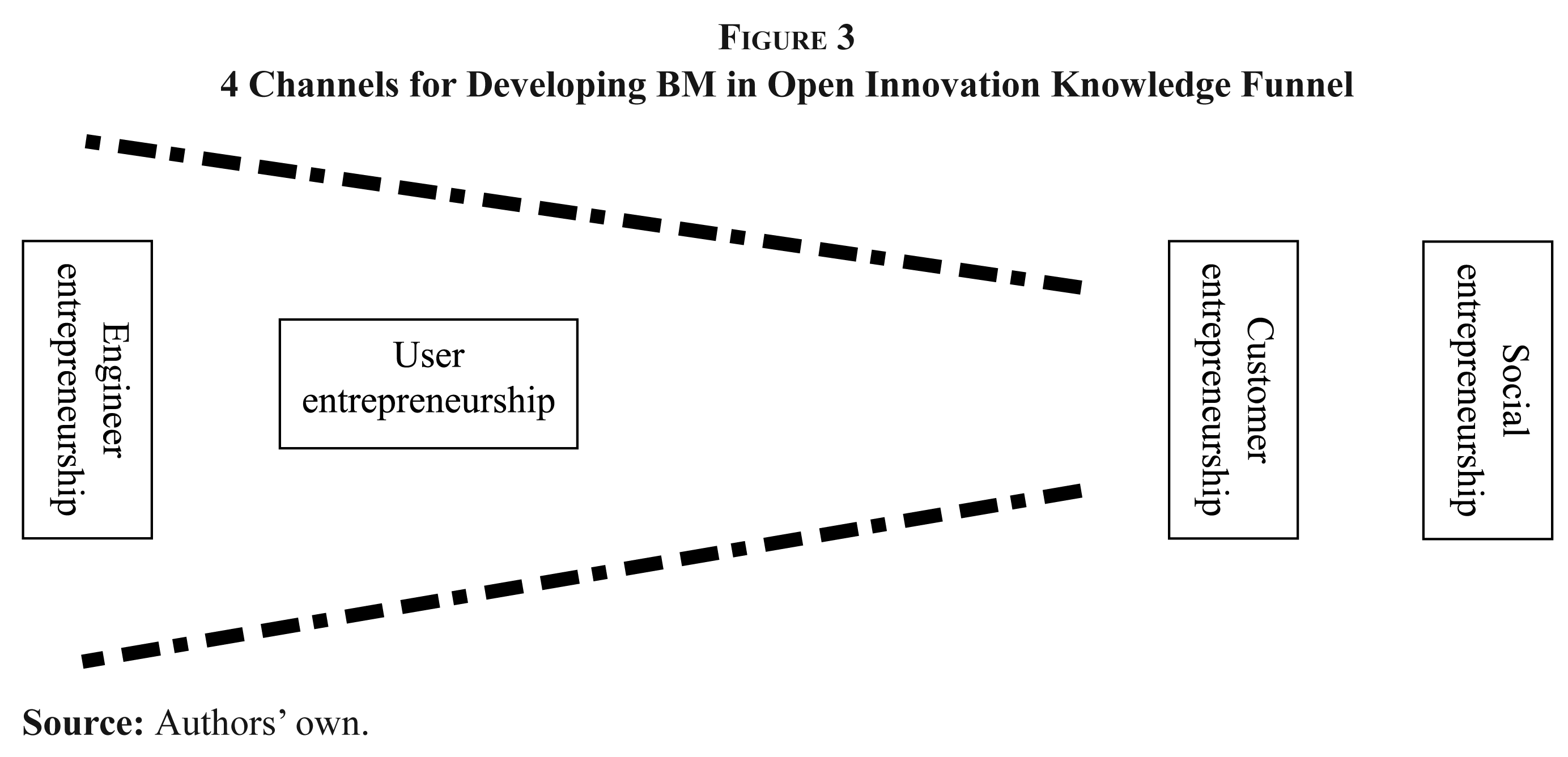
These four channels are all based on the convergence between the technology and the market, which are two different sectors as seen in Figure 1 (Kodama, 1986). At times of convergence, the differences among several of the characteristic differences between industries begin to blur from the four channels for developing a business model in an open innovation knowledge funnel (Bröring, Martin Cloutier, & Leker, 2006). The development of open innovation business models, in which existing technologies and markets and new technologies and markets are newly combined, has already been making active appearance, eventually leading to the phenomenon of industrial convergence and resulting in the emergence of diverse services and products that pass the boundaries of existing industries (Hacklin, 2007; Hacklin, Raurich, & Marxt, 2004).
Customer Open Innovation-based Business Model Development
According to Bettencourt (Bettencourt, 2010, p. 14), a business can begin from customer needs and proceed to breakthrough services. The method for a successful service strategy development has four steps:
Step 1. Select the innovation focus. Step 2. Detect the customer needs. Step 3. Prioritise the customer needs. Step 4. Develop a services strategy. (ibid., p. 15).
The open service innovation concept map, which is developed to escape the commodity trap, also has four steps:
Step 1. Think of your business as a service business. Step 2. Cocreation Step 3. Open innovation Step 4. Transforming business models (Chesbrough, 2010b).
As these methods reveal, an outcome-driven innovation to create breakthrough products and services also has to first capture the customer’s inputs (Ulwick, 2005, p. 15). Existing studies that began from the consumers’ demands and expectations are the catalyst of a firms’ innovation. However, because entrepreneurs are everywhere (Ries, 2011, p. 8), following the cycle shown in Figure 4, which begins from concrete and intensive consuming activities, consumers can actually develop new business models by themselves (Franke & Piller, 2004).
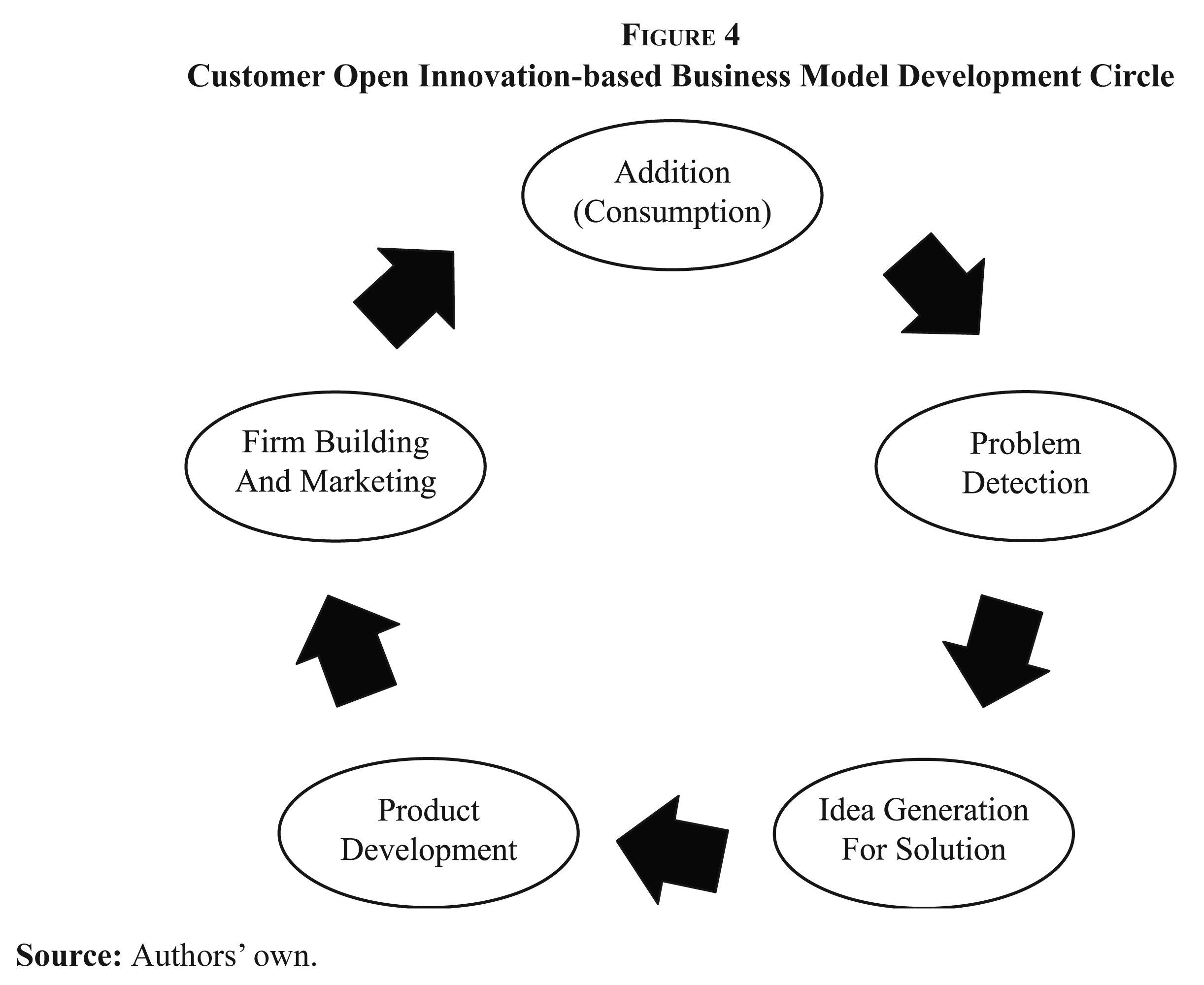
First, developing particularly addictive consumption areas of interest is the starting point of a consumers’ business model development. Because the consumption group is identified by consumers with a critical mind, it thus becomes the target of business models. This corresponds to the customer segmentation step.
Second, consumers grasp problems related to certain products or services more introspectively in areas on which they focus. This corresponds to value proposition proposed by the business model.
Third, consumers propose creative solutions for any problems they have found. In business model development, this step corresponds to the technology systems step in which consumers come to propose systems to create value for consumers and deliver the same to other consumers.
Fourth, in the product development step, consumers present their own solutions for problems they found and develop media to deliver the relevant solutions to other consumers. This also corresponds to a similar step in business model development, wherein concrete costs and relevant business models’ revenues are proposed.
Fifth, in the firm building and marketing step, consumers deliver products that were developed and proposed, based on their critical mind, to other consumers. This step thus corresponds to the connection with a customer step in business model development steps.
For those business models that have been developed based on customer entrepreneurship, as mentioned above to be sustainable, they should be combined with competitive strategies, open innovation-based business model platforms or business model patent developments. In particular, to apply for patents for the business models, the aforementioned five steps should be combined with IT so that they can be developed in more creative forms with innovation, progress and usefulness.
User Open Innovation-based New Business Model Development
It is known that end users of products and services sometimes innovate and that these innovations developed by users occasionally become the basis for important new commercial products and services (Morrison, Roberts, & Von Hippel, 2000). In particular, the main agents of user innovation in the areas of technology-based capital goods industries, such as medical devices, tools and cutting-edge equipment, are mostly small-or medium-sized enterprises (SMEs) rather than individuals. However, the word ‘user’ in user innovation considerably overlaps with the word ‘customer’, when used scientifically (Von Hippel, 2005). Therefore, in this study, the main agents of user entrepreneurship-based new business model development are limited to the main agents of user innovation of capital goods or cutting-edge technology products. This is in order to clearly differentiate the former from customer entrepreneurship (Yun, Nadhiroh, & Jung, 2013). Almost 30 years ago, innovation by user was generally regarded as a minor oddity. However, today it is clear that user-centered innovation is a very powerful and common phenomenon (Von Hippel, 2009). This is due to the following facts.
First, concrete demands from the current user or user community of a firm’s products are easily understood (Von Hippel, 2009). Understanding the users’ new demands corresponds to the discovery of new customer segmentations in Figure 5. The user community has been an important external source of a firm’s product or service innovation (Hau & Kim, 2011).

Second, in the solution generation step, the countermeasures against the demands or expectations raised by users are clarified. This step corresponds to the value proposition step of the business model development steps. The solution of the concrete demands presented by the users corresponds to the value that should be created by new business models.
Third, in order to realise the solutions, new ways to recombine technologies and markets between the technologies and markets already owned by the firm and those that are not owned by the firm are realised. In this step, the value propositions, which were newly proposed based on the users’ new demands, are concretely realised. This step corresponds to the business model development’s technology system step.
Fourth, in the internal points and process renewal step, the core capabilities that must be improved or revised among the core capabilities internal to the firm are clarified. This step corresponds to the business model development’s cost and revenue clarification step. In this step, the necessary costs to realise the new value propositions and related profits are clarified.
Fifth, matters that must be improved, replaced, implemented firsthand and be entrusted to suppliers among matters implemented by suppliers on the value chain of the firm are newly determined. This step creates concrete connections with customers anew.
The aforementioned user entrepreneurship-based business model developing is suitable as a new business model development process for existing firms’ switching start-ups. If this business model is implemented based on IT with more systematic innovation, progress and usefulness, a patent for the business model may be applied.
Social Open Innovation-based New Business Model Development
Social entrepreneurship combines the passion of a social mission with an image of business-like discipline, innovation and determination commonly associated with, for instance, the high-tech pioneers of Silicon Valley (Dees, 1998; Martin & Osberg, 2007; Yun, Park, & Avvari, 2011). The process of social entrepreneurship involves five steps as shown in Figure 6:
Step 1. Opportunity recognition including social problems and unmet needs. Step 2. Concept development including the identification of social rewards. Step 3. Resource determination and acquisition including financial resources. Step 4. Launch and venture growth including expansion and change. Step 5. Goal attainment, including attainment of a stable service equilibrium (Brooks, 2008).
In the first step, social problems are understood through diverse channels including media, such as the newspaper and broadcasting news, site visits and individual experience. This step corresponds to the customer segmentation step among business model development steps; recognising concrete social problems is the starting point.
In the second step, which is the market failure analysis step, concrete causes of the social problems are perceived. In particular, values that do not act in markets but are socially necessary are perceived and understood in this step. This step corresponds to the business model development’s value proposition (Austin, Stevenson, & Wei-Skillern, 2006; Zahra, Gedajlovic, Neubaum, & Shulman, 2009).
Third, in the potential consuming idea step, systems that will concretely solve social problems are developed. This step corresponds to the business model development’s technology system. In this step, the importance is given to systematically realising the blended value, while simultaneously considering the enterprise value and social purpose (Brooks, 2008, p. 71).
Fourth, in the resource acquisition step, the social capitals that are the grounds for the existence of social enterprise among others are secured and the social welfare is clarified (Adler & Kwon, 2002; Portes, 2000). This step corresponds to business model development’s cost and revenue clarification. In this step, the peculiarity of costs and revenues should be noted.
Fifth, in the marketing and social networking step, social networks through which social value is distributed are clarified to create connections with customers.
The social entrepreneurship-based business model development cycle approach is a way to create business models that create sustainable social value for second-class citizens, such as the elderly, the youth, the minorities and the unemployed (Hirshleifer, 1971). Business models for the creation of social value should also acquire competitive strategies, open innovation-based business model platforms or business model patents for sustainable growth and development. The way to secure business model patents through the creative implementation of the five components based on IT is a new, sustainable strategy of social entrepreneurship.
Engineer Open Innovation-based New Business Model Development
Engineer entrepreneurship refers to engineering specialists who have expanded their understanding of markets, established business on their own based on their engineering expertise or technologies held by them, developed related products and are selling those products in markets (Nichols & Armstrong, 2003). The University of Texas in Austin opened an engineering entrepreneurship course to provide opportunities for the commercialisation of specific technologies to students. In addition, diverse engineering entrepreneurship programs have been studied to promote business start-ups for students who major in engineering, through market or economy education (Creed, Suuberg, & Crawford, 2002; Dabbagh & Menascé, 2006; Refaat, 2009). In addition, a few studies have also been conducted on technology ventures that began from technologies. These studies discussed steps on how to establish new firms (Dorf & Byers, 2005, p. 133; Li & Atuahene-Gima, 2001). However, the discussions on engineer entrepreneurship-based business model development that began from the viewpoint of engineers have not yet reached a sufficient establishment of their development as a concrete business model.
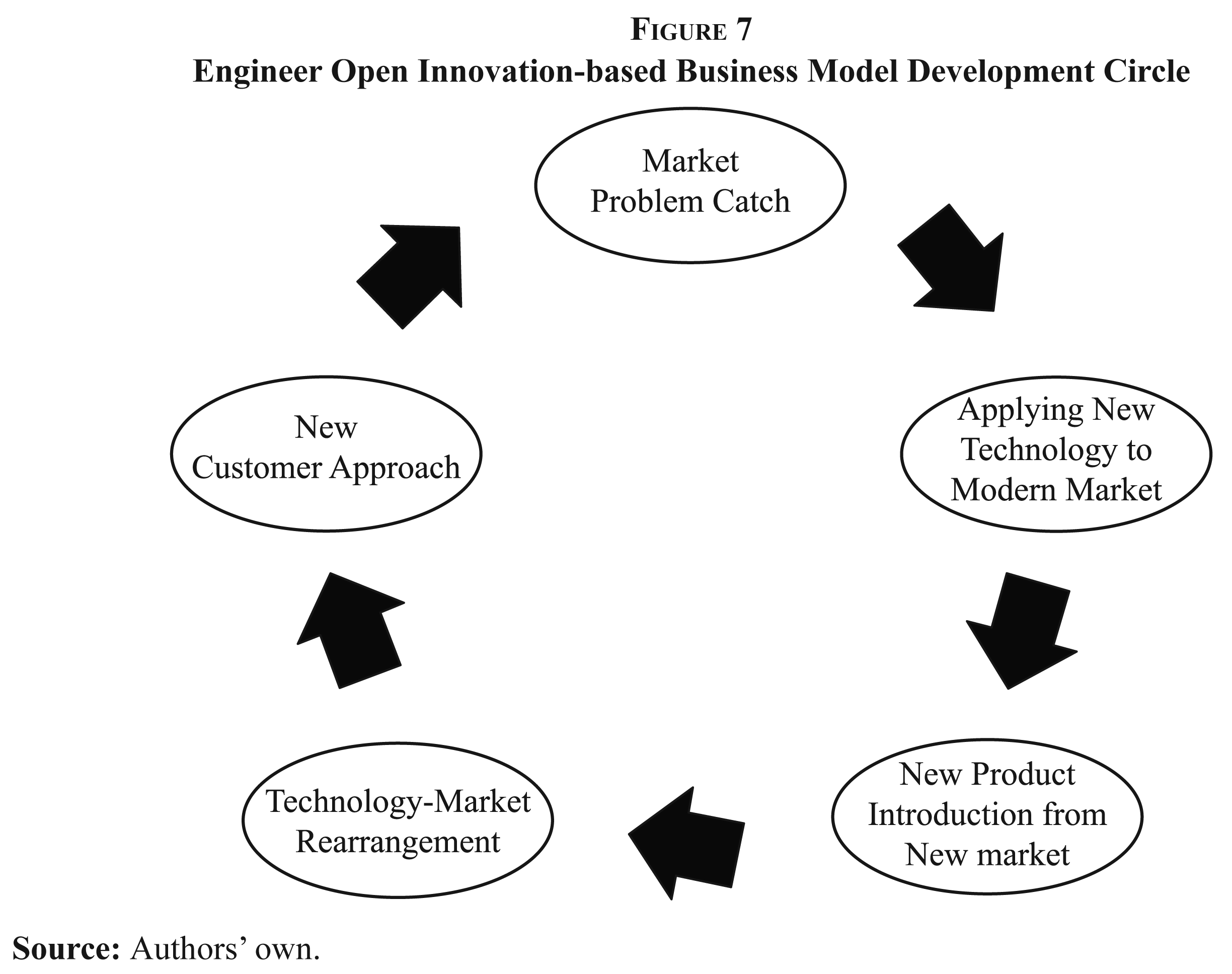
First, in the market problem catch step, which corresponds to the customer segmentation step, engineers perceive the tentative consumer demands from the standpoint of the most refined consumers based on their technological expertise as shown in Figure 7 (Young & Simon, 2006, p. 210).
Second, in the value proposition step, engineers apply their technological expertise to create solutions perceived from the standpoint of the most refined consumers (Isaacson, 2011, p. 71).
Third, in the technology system step, new products suitable for the anticipated markets are introduced (Brandt, 2011, p. 89). In this step, the systematic combination of new markets and new technologies is clarified.
Fourth, in the technology–market rearrangement step, costs and revenues related to the introduction of new markets and new technologies are clearly presented. In this step, engineers should clarify costs and revenues from the viewpoint of their new products’ users and contributors in particular (Goldman & Gabriel, 2005, p. 229).
Fifth, in the new customer approach step, customers are newly defined, connection channels are identified and all marketing plans for the relevant customers are renewed because the engineers are approaching new markets with new technologies. This step corresponds to the business model development’s connection with a customer step.
The engineer entrepreneurship-based business model development cycle is attracting attention as a new alternative for a new business model development based on the valuable technologies in the economic reality, where both economically valuable technologies and patents increase because of the acceleration of the knowledge-based economy. Therefore, it is essential that in the development of business models, the engineers are willing to go beyond their role as researchers and expand their role into those of entrepreneurs. Although there are considerable limitations in additionally acquiring business model patents for these business models because they are based on source technologies, these business models act as a very important element for the firms’ sustainability, along with competitive strategies and other similar factors.
Validating the Four Business Model Development Cycles through Social Experiments
First, in the case of social entrepreneurship, the research team held self-seminars, developed business models to meet the social requirement according to the cycle shown in Figure 7, and applied patents for the business models. Among four, two patents such as smart weekend farm system and social library system were issued. Smart library system was transferred and a new social enterprise was under construction. Social open innovation-based business model development circle was validated because half of applied patents were enroled. Normal enrolment rate of social business model patents is under 1/10 according to interviews with social firms.
Second, in the case of customer open innovation, six patents were applied and two patents such as smart real-time concert system, and cleaning robot control method was issued Two applications were rejected. Customer open innovation-based business model development circle was validated because 1/3 of applied patents were enroled. Normal enrollment rate of customer business model patents is under 1/7 according to interviews with customer entrepreneurs.
Third, in the case of user open innovation, twelve patents were applied and four patents such as real estate development information intermediate method, time and location based survey marketing service, art module apparatus for driving and controlling method thereof, system of preventing drowsy driving by one touch and method were issued. Three applications were rejected. All of this type business models were developed by the concrete idea of existing firms. So, user open innovation-based business model is first among four categories. One patent was transferred to target firms which joined to develop the business model and three patents are under transfer negotiation or process with the target firms. User open innovation-based business model development circle was validated because 1/3 of applied patents were enroled. Normal enrollment rate of the user business model patents is under 1/5 according to interviews with users entrepreneurs.
Fourth, in the case of engineer open innovation, six patents were applied and five patents such as mobile based putting posture correction device and method, feedback public relation server and method of manufacturing homepage, bed system for the detection of sleep state, open business platform service and network system for inter-vehicle and method were issued. The issue rate among the application of engineer open innovation-based business model patents is first among four categories. The engineer open innovation-based business model development circle was validated because 5/6 of applied patents were enroled. Normal enrolment rate of engineer business model patents is under 1/5 according to interviews with engineer entrepreneurs.
In fact, the engineer entrepreneurship-based business model development cycle shown in Figure 7 was set as a toolkit from the experiences of Steve Jobs, the co-founder of Apple, and Larry and Sergey, co-founders of Google, in business model development and business start-ups to secure the validity in advance. Because the validity of this business model development toolkit was secured through in-depth interviews with their representative founders in Korea, who began as excellent engineers and later succeeded in business start-ups in their respective expertise such as Minwha Lee, the founder of Medision Samsung, HyungWoo Lee, the founder of MIDAS, YungDal Kim, the founder of IDIS. Medison is currently Samsung–Medison, which is a cutting-edge medical device manufacturer that represents Korea. The business model development methodology could be verified, revised and supplemented through its founder’s, MinWha Lee, experience in business start-ups. Lee graduated from Seoul National University’s College of Engineering, one of the best colleges of engineering in Korea. An interview with him regarding business start-ups was conducted for this study.
Discussion and Conclusion
Discussion
First, this study identified that the source of new business models is convergence. The fact that convergence between customers and producers, between users and suppliers, between social requirements and markets and between technologies and markets is the source of a new business model development was identified through this study.
Second, this study proved that open innovation is the starting point of a new business model development. Both inward open innovations, in which firms actively utilise external technologies, and outward open innovation, in which firms’ internal technologies are not utilised, are commercialised outside the firms. These are based on the open relationship between technologies and markets. Also, since creative connections or bridges between technologies and markets are part of business models, developing creative business models without open innovation is impossible.
Third, to develop business models utilising the four business model development cycles and move towards business start-up, the business model developer should accumulate diverse kinds of creative energy at normal times. Participants in the social experiments for the development of the four cycles often include the following efforts: (a) frequent travel to domestic or overseas cities, (b) meditation and contemplation while walking for at least one hour per day and (c) efforts to intentionally make time for enjoying the arts (Table 2).
Summary of the Social Experiments for the Four Business Model Development Cycles
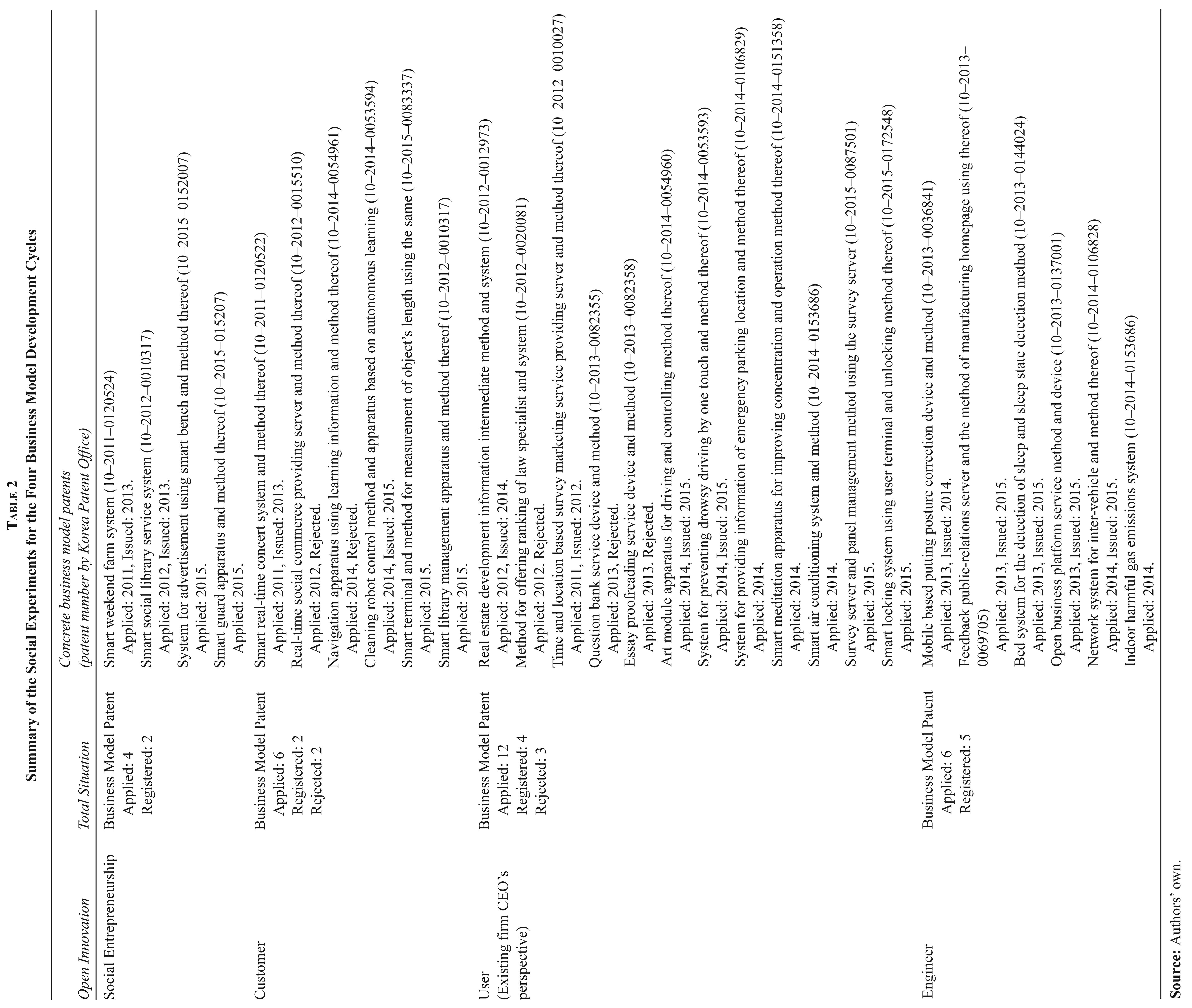
Fourth, making efforts to actively develop business models and apply patents for business models is a way to overcome the arrow information paradox as well as the chasm and death valley perceived due to the existence of great gaps between technologies and markets. In a knowledge-based economy, instances wherein technologies are not naturally and directly connected to markets still remains the same. Among the 28 business models developed in the process of this study, six led to new business start-ups and ten led to switching and expanding business start-ups. The remaining 12 business models have been actively taken up by diverse entities for new or switching business start-ups.
Conclusion
In this study, first, based on previous studies on business models and open innovation as theoretical foundations, the four business model cycles, customer open innovation-based business model development cycle, social open innovation-based business model development cycle, user open innovation-based business model development cycle and engineer open innovation-based model development cycle were developed. The validity of these business models was enhanced through applications for and registrations of business model patents, application of the business models to new or switching business start-ups and ex post facto verifications through interviews with engineers, who have greatly succeeded in business start-ups.
An implication of this study is the fact that the four types of business model development toolkits, which can be utilised by individuals on their current positions, were developed. Because the individual business model development cycles were developed from the four viewpoints on the knowledge funnel and were verified and supplied by applying them to actual social experiments, they can be seen as both suitable and applicable for the individuals’ current positions.
However, models validated only 50 per cent of the patents. Nearly half of the applied patents were not enroled. Even though the enrolment rates of business model patents from this study are high according to interviews and references, we should develop and validate this business model developing models based on several trials and errors. More people should develop business models that utilise these business model development circles and actually establish businesses. Success of the development and establishment of business models that successfully create profits in markets is important in accumulating cases for such. By applying these models to the entire processes of business value chains, these models should be further refined and more detailed processes suitable for more situations should also be developed.
Footnotes
Acknowledgements
This work was supported by the DGIST’s R&D Program of the Ministry of Science, ICT & Fucture Planning (16–IT).