



Abstract
Entrepreneurial education has received a fair amount of attention locally and internationally. Interestingly, disparities continue to exist in the quality of entrepreneurship education programmes on offer, particularly in curriculum design, delivery methods and forms of assessment within higher education institutions in South Africa. We examined the relationship between the entrepreneurial content of the curriculum (ENTCC), attitude towards entrepreneurship, general self-efficacy and students’ intentions towards entrepreneurship. The study is located within a quantitative research paradigm and the sample of 263 was drawn from final year students from the Faculty of Management at a South African university of technology (UoT) who were studying various business-related programmes in 2014. Data were analysed using correlation and regression analysis. The results indicate that the ENTCC, students’ attitude towards entrepreneurship and students’ self-efficacy exhibit significant predictive relationships with students’ intentions to venture into new business creation. Our study makes two major contributions: (i) it fills the gap in entrepreneurship education in order to revisit our curriculum to make the module/s more ‘hands on’ and (ii) it provides an avenue to further explore the feasibility for a fully fledged entrepreneurship programme with mandatory, elective and incubation start-up practical training in conjunction with the Science Park, Technology, Transfer and Innovation Centre within the university.
Introduction
The current rates of unemployment in South Africa are approximately in the region of 25 per cent (Statistics South Africa [Stats SA], 2013/2014). The development of an entrepreneurial spirit among students who may wish to start up their own businesses could possibly assist in the reduction of unemployment rates, which provides some comfort to alleviate poverty in South Africa (Mahadea, Ramroop, & Zewotir, 2011). In South Africa, the demand for an entrepreneurial-driven economy is increasing, particularly because of the employment creation benefits it offers, which is essential to develop and equip students with the skills required to become employers (Louw, Van Eeden, Bosch, & Venter, 2003).
The goal of this article is to find out how entrepreneurial-related programmes offered at the Vaal University of Technology (VUT) influence students’ intentions to venture into new business creation. Prodromou (2009) is of the view that providing numerous entrepreneurship courses and programmes is essential, but they will not be of benefit if students are not satisfied with them. Current evidence suggests that there is a gap between the perceived desirability of entrepreneurship among students and authentic self-employment and start-up rates among graduates. The objectives of this article are to examine the influence of the entrepreneurial content of the curriculum (ENTCC), attitude towards entrepreneurship, general self-efficacy on students’ intentions to become an entrepreneur. The research is a case study and conducted among students in the VUT in Gauteng, South Africa.
Literature Overview
This section provides a review of literature on entrepreneurship and entrepreneurship education, curriculum content of entrepreneurship modules, attitude towards entrepreneurship, self-efficacy and students’ intentions to venture into new business creation. Further linkages and partnerships with key stakeholders within the triple helix mode of knowledge production are explored.
Entrepreneurship and Entrepreneurship Education
Entrepreneurship is viewed as the opportunistic pursuit of economic wealth through the creative initiatives of an individual operating within an uncertain environment, which is constrained by limited tangible resources (Nga & Shamuganathan, 2010). De Faoite et al. (2003, p. 432) point out that teaching entrepreneurship is a mystery, since the actual entrepreneurial process involves both ‘art’ and ‘science’. The ‘science’ of entrepreneurship concerns the functional skills of business and management, and these would appear to be teachable via conventional methods. The ‘art’, however, relates to the creative and innovative aspects of entrepreneurship, and these do not appear to be teachable in the same way.
A number of scholars (Carayannis, Evans, & Hanson, 2003; Ibrahim & Soufani 2002) state that entrepreneurs who succeed in business possess not only creative and innovative flair together with positive attitudes and behaviours, but solid general management skills, business know-how and sufficient networks in forming long-term relationships as well. It therefore seems that entrepreneurship cannot exist in a vacuum; it requires a multidisciplinary approach in order to nurture a philosophy of congruence, whereby each discipline plays a significant part in developing a successful entrepreneur.
Entrepreneurship education is defined as a means through which entrepreneurship skills are imparted, developing the knowledge and attitudes required for graduates to go out and create their own futures and provide possible solutions to problems (De Faoite et al., 2003). Tan and Frank (2006, p. 417) further define entrepreneurship education as ‘the process of providing individuals with the concepts and skills to recognise opportunities that others have overlooked and to have the insight, self-esteem and knowledge to act where others have hesitated’ while Isaacs, Visor, Friedrich and Brijlal (2007) define it as ‘the deliberate intervention by the educator in the life of the learner to impart entrepreneurial qualities and skills to enable the learner to survive in the world of business’. Galloway and Brown (2002) and O’Neill (2004) advocate that entrepreneurship education should contribute to and improve the quality of new venture creation among students. However, although the benefits of entrepreneurship education have been researched, the role of entrepreneurship-related subjects in new venture creation remains untested among the undergraduate students at the university of technology (UoT) under consideration in this study.
Closely related to entrepreneurship and entrepreneurial activity is a social enterprise. In South Africa, there is no generally accepted definition for a social enterprise. Research commissioned by the International Labour Organization (ILO, 2011), which explored the development of eleven enabling environments for social enterprises in South Africa, sought to define a working definition of what constitutes a social enterprise for South Africans. Participants were of the view that a local definition should be adopted instead of using a European or American version. The concluding definition was that a social enterprise’s primary objective is to ameliorate social problems through a financially sustainable business model, where surpluses (if any) are principally reinvested for that purpose (Steinman, 2010). Based on this definition, a social enterprise is a revenue-generating business with primarily social objectives whose surpluses are reinvested for that purpose in the business or in the community, rather than being driven by the need to deliver profit to shareholders and owners (BC Centre for Social Enterprise, 2012). Social enterprises have been identified for their potential to solve society’s critical issues of poverty, unemployment and inequality. Many countries around the world are recognising the contribution these entities have to make and governments are taking steps to support social enterprise including through regulatory changes. South Africa in comparison to many other countries is lagging behind in this regard. However, the South African government is considering the development of a policy framework for social enterprise (Ker, 2014).
Universities are now increasingly recognised to have a broader role in the economic development and entrepreneurship. Entrepreneurship research and development is crucial in HEIs because of the rapid changes in the workplace where students are going to be employed after graduations. Hitt and Reed (2000) posit that entrepreneurship is not a new concept; it has gained increased interest and research attention during the past 15 years and considered as the essential mechanism to cope with the new competitive landscape. When universities promote employability, they are also promoting components of entrepreneurship.
While developing countries like South Africa face increased resource scarcity, competitive rivalry and exchange rate disadvantages, the key ingredients for universities’ efficacy are the quality and quantity of entrepreneurship-enabled innovation that unlocks and captures the benefits of enterprises (Carayannis & Campbell, 2012). Although VUT is not a fully research institution, research is a vital component of the teaching and learning strategy embedded in the teaching and learning model. One of the pillars that universities are judged in terms of performance is the research outputs and research development. VUT is still in the developmental stages in growing research partially because UoTs are barely a decade old in South Africa. With the advent of UoTs within the new government dispensation in 2004 stand-alone, UoTs seem to be lonesome, while comprehensive and traditional universities trailblaze and some incorporate the best of both worlds in terms of infrastructure, facilities, staffing and research (Du Pre, 2009). Further, the intensity and R&D spend in South Africa are deemed to be below the levels of developed economies (Alagbaoso, 2014; Alagbaoso, Carmichael, & Myres, 2015).
There are many mutual benefits arising from a close relationship between a university, an industrial firm and government. Firms gain access to not only leading edge technologies, but also to highly trained students, professors and university facilities. Involvement of the firms in the academic programmes of the universities is a major mechanism for knowledge transfer.
Against this background, it is essential for UoTs to embrace the ideas of the triple helix mode of offering entrepreneurship programmes. According to Etzkowitz and Leydesdorff (2000), the ‘Triple Helix’ emphasises the network connection of communications and expectations that redesign the institutional arrangements among universities, industries and governmental agencies. Currently, VUTs could be categorised as operating between mode 1 and mode 2 knowledge production. Mode 1 knowledge production relates to primarily basic research that is being organised in a disciplinary structure. Mode 2 focuses on knowledge application, which is transdisciplinary in nature. Mode 3 focuses on expanding and extending the mode 1 and mode 2 knowledge production systems consisting of knowledge clusters for knowledge creation, diffusion and use (Carayannis & Campbell, 2006). This multilayered, multimodal, multimodal and multilateral system encompasses mutually complementary and reinforcing innovation networks and knowledge and knowledge clusters consisting of human capital, intellectual capital, shaped by social capital and underpinned by financial capital. The mode 3 knowledge production system architecture focuses on and leverages higher order learning processes and dynamics that allow for both top-down government, university and industry policies and practices and bottom-up civil society and grassroots movements initiatives and priorities to interact and engage with each other towards a more unified, effective and efficient synthesis. The mode 3 knowledge production system is in short the nexus or hub of the emerging twenty-first century innovation (ecosystem) where people, culture and technology meet and interact to catalyse creativity, trigger innovation and accelerate innovation across disciplines (Milbergs, 2005).
Perumal (2010) points out that the research and innovation are integral parts of the work of universities. It is recognised that knowledge production must increase if South Africa’s developmental goals are to be achieved. The National Development Plan (NDP) acknowledges that while South Africa’s publication output is the highest on the continent, its innovation system is small by international standards. In particular, doctoral graduate numbers are significantly lower than in equivalent developing countries. This means that the research and innovation system, which includes universities, does not adequately address the developmental needs of our society and economy. The government announced its ambitious goals to eliminate poverty and reduce inequality by 2030 in the NDP. Some of the objectives identified were halving poverty and unemployment by 2014 and ensuring a more equitable distribution of the benefits of economic growth and reduce inequality. One of the priorities identified in the Minister of Finance budget speech placed emphasis among other things on job creation, with a particular focus on unemployed youth (Gordhan, 2012).
The UoTs have a distinctive mandate in translating knowledge into finding solutions for real world problems, whether in society or in the world of work. However, training students only for a job is wasted, since the acceleration of knowledge and the fast pace of change in technology and the external environment will soon result in jobs being changed significantly to reflect new realities. This could lead to unemployment. Therefore, it is incumbent on UoTs to train students to learn to solve problems by acquiring and generating new knowledge and translating them into a commercial commodity to generate income. Research generated should foster a spirit of entrepreneurship in staff and students, so that they can create jobs in society. The research conducted by Alagbaoso (2014) showed that there is a lack of collaboration among key stakeholders in entrepreneurship in South Africa. Although there is evidence of some collaboration with key stakeholders, there is a need for effective collaboration among key stakeholders.
Jacob, Lundqvist and Hellsmark’s (2003) research findings in a UoT affirm the gap between university and industry. Universities have traditionally perceived the transfer of information and industry collaboration as an unplanned event, which commonly came about through alumni networks or through meetings between professors and industry representatives.
A number of government initiatives exist to assist with the funding of entrepreneurial ventures, including Khula Enterprise Finance, Small Enterprise Development Agency (SEDA), the Industrial Development Corporation (IDC) and the National Youth Development Agency (NYDA). A problem that exists is that many of these initiatives are poorly marketed with respect to their targets. Although South Africa does have organisations that provide finance to micro- and entry-level enterprises, few of these have low default rates on the loans and many are not easily accessible to their target groups. In contrast, providing finance in the absence of adequate infrastructure, market opportunities and business and management skills is doubtful to lead to an increase in the number of successful businesses.
Rogerson (2004) states that South Africa’s SMME (Small, Medium and Micro Enterprises) policy initiative was first outlined in a 1995 White Paper and, since then, numerous measures have been implemented to promote the development of the sector. Herrington, Kew and Kew (2009) state that the annual review of small business in South Africa 2005–2007 also reveals that the SMME policy was primarily outlined in the 1995 White Paper on SMME development, and finds practical expression in the Integrated Small Business Development Strategy for 2005–2014. The strategy is based on three pillars:
increasing the supply of financial and non-financial support; creating demand for SMME products/services; and reducing regulatory constraints.
A number of institutions are responsible for implementation, the cornerstones being:
the SEDA with its Local Business Service Centres and SEDA-Technology on the service side; Khula Enterprise Finance for small and medium enterprise finance; and the South African Microfinance Apex Fund (SAMAF) on the micro finance side.
While a large number of interventions to small enterprises and partnerships within and outside government have been secured to enhance service delivery capacity of these cornerstone institutions, the literature indicates that greater coordination and a more effective implementation system is required. There is a lack of direction from the government through its implementation agencies.
The VUT Southern Gauteng, Science Park located in Sebokeng is one of the three science parks in the country that has become a vehicle for TTI. It is an independent strategic technology hub in the Southern Gauteng region. It serves as an important conduit between the university, industry, commerce and the community so as to empower the VUT to engage in partnership models in the Southern Gauteng region in order to develop shared strategies for the advancement of social, technological and economic development. To capitalise on a unique value proposition, it makes an impact in the region through focusing on capabilities in driving two flagship programmes, one in advanced manufacturing and the other in agriculture revitalisation. Research conducted within the university in various areas such as water and energy will also be boosted, but aligned to support the selected flagship programmes.
Advanced manufacturing remains a priority as government is driving a transition from an economy that relies on heavy industry to a knowledge economy that relies on smart and new alternative manufacturing technologies. Government through various agencies such as the Technology Innovation Agency (TIA) and the National Research Foundation (NRF) has already invested significantly in establishing one of the leading Advanced Manufacturing Precincts in the country based at the Science Park. VUT Science Park will be championing the training and application of advanced manufacturing within the communities through the satellites’ fabrications laboratories, which will be embedded within communities as well as within VUT satellite campuses. Formal training curricula in advanced manufacturing will be established to train relevant graduates in manufacturing design, design software and advanced manufacturing.
Agriculture has been identified as a key pillar for economic growth and revitalisation within the Vaal. VUT supports the Sedibeng district in driving Agro-dropolis as one of the game changers identified to enhance economic growth. The university already has multiple competencies and research projects within the agricultural sector such as community medicine, chemistry in natural products, bioscience recombinant technology for insect resistant maize, water quality as well as engineering that contribute bulk road infrastructure, sewage rehabilitation and will strive to align them to make a greater impact.
Some of the initiatives (Vaal University of Technology [VUT], 2014) include:
the expansions of the Sedichem incubator into an agricultural and natural products platform; attraction of funding from the IDC to establish a traditional medicines platform to the value of R34 million; the launching of the national footwear and leatherwear cluster as well as the shoe innovation centre; and the collaboration with the High Voltage Technology (Pty) Ltd to supply a novel anti-perch device to the Electricity Supply Commission (Eskom) over a 3-year period.
Further through the TTI, new platforms such as the footwear incubator and fabrication laboratory were established. Although numerous entrepreneurs and companies are supported in product development in collaboration with the IDC and the DTI (Department of Trade and Industry), the uptake of entrepreneurial-led activities emerging from research at VUT has been slow. This could in part be attributed to the fact that VUT does not have a fully-fledged entrepreneurship programme as part of the programme quality mix (PQM).
In South Africa, various universities inter alia, have started entrepreneurship education. For example, the entrepreneurship stream initiative was started in 2001 by the Department for Management Studies at the University of Western Cape. The Graduate School of Business at the University of Cape Town, the Wits Business School, the University of Johannesburg and the University of Pretoria also offer entrepreneurship programmes. In the private sector, the Branson Centre of Entrepreneurship in South Africa focuses on providing aspiring entrepreneurs who have started a business with the skills, opportunities and inspiration they need to succeed. The programmes are designed to help businesses develop and grow and, in turn, stimulate the economy. No funding is provided but they assist entrepreneurs with access to networks, knowledge, resources and markets.
Noteworthy, a nationwide survey on entrepreneurship in South African universities indicates that the entrepreneurship education in South Africa is in its developmental stage, although it is perceived as important in elevating the profile of any institution, and there is increasing commitment from the institutions in academic, research and outreach offerings in entrepreneurship. The teaching and assessment methods follow traditional classroom delivery, while research in entrepreneurship in South Africa is perceived as less rigorous than other management disciplines (Co & Mitchell, 2006).
Content of the Curriculum and Teaching Entrepreneurship
Traditionally, HEIs have not prepared students for self-employment as a career option, resulting in the loss of many potential entrepreneurs. However, of late, many HEIs have moved away from this educational bias and lack of information on self-employment as a career option, and have begun offering courses related to entrepreneurship and small business (Brijlal, 2008). Further evidence of these changes is found in North’s (2002) assertion that ‘the implementation of a new curriculum focused, inter alia, on entrepreneurship will be a problem for some years to come, and that care should be exercised to prevent entrepreneurship education from becoming yet another activity where predominantly theoretical knowledge is acquired’.
Maharasoa and Hay (2001) suggest that emphasis should be placed on the ability of the curriculum to prepare students with comprehensive knowledge and skills that are relevant to the needs and aspirations of the country and to students’ individual growth. Entrepreneurship education should not be ‘about’, but rather ‘for’, entrepreneurship (Kirby, 2004, p. 514). Education about entrepreneurship is primarily based on the concept of transference of knowledge about the field, while education for entrepreneurship focuses on the learning experience and the development of competencies, skills, aptitudes and values which require different teaching methods (Boyle, 2007, p. 12; Co & Mitchell, 2006). Interestingly, some studies (e.g., Mwasalwiba, 2010; Pretorius & Van Vuuren, 2003) reveal that every training institution has its own approach in constructing an entrepreneurship curriculum. This is validated by a comparative study conducted by Brijlal (2008) on the state of entrepreneurship education at HEIs in the Western Cape, South Africa. The study found that universities in the Western Cape such as the University of the Western Cape (UWC), University of Cape Town (UCT), University of Stellenbosch
Many students and graduates perceive that there are several obstacles that oppose business start-ups, and these include the lack of experience as well as the lack of finance, which block the path towards their preferred choice (Keat & Ahmad, 2012). The source of these inconsistencies may lie in the present curricular, which focuses almost entirely on the needs of aspiring middle and functional managers rather than the needs of aspiring entrepreneurs. As argued by Jones and English (2004), growing literature on entrepreneurship education tends to maintain that a different approach is required, which is a departure from the traditional lecture-centred passive learning used in traditional business disciplines such as management and marketing. Instead, the new style ought to be action-oriented to encourage experiential learning, problem-solving and creativity, and best provides the mix of enterprising skills and behaviours needed to create and manage a small business (Solomon, 2007). The learning process to develop students to be entrepreneurial should give students ownership of their own learning objectives, involve students in the real-world problem-solving, provide students with role models of successful entrepreneurs and enable students to reflect on what they have learned (Prodromou, 2009). Robertson and Collins (2003) maintain that the entrepreneurial orientation can also be enhanced by viewing short movie clips of entrepreneurs, discuss issues of entrepreneurs through video conferencing and go out to the business community and search for idea possibilities. In this manner, students will have both the motivation as well as the skills needed to develop entrepreneurship among them.
Attitude towards Entrepreneurship
Steenekamp, Van Der Merwe and Athatde (2011) are of the view that early formal entrepreneurship education transforms the attitudes of students, which in turn directs them towards certain future careers. Taatila (2010) affirms that ‘without an entrepreneurial attitude societies can stagnate, which can hinder the long-term growth and prosperity of a region’. This not only specifies the importance of entrepreneurship to society, but also the nation’s global competitiveness and economic development (Veciana, Aponte, & Urbano, 2005). Sowmya, Majumdar and Gallant (2010) suggest that without an entrepreneurial attitude, societies can decay, which can delay the long-term growth and success of a region. The society and the business world necessitate and demand entrepreneurial competencies, which place more pressure on the individual’s attitudes and skills than before (Taatila, 2010). It is therefore of interest to study how entrepreneurial education affects the attitudes and motivation of those undertaking these types of programmes at universities.
In addition to the aforementioned aspects, it can be mentioned that the major objectives of entrepreneurship education include to transform the students’ state of behaviours and even intentions that make them understand entrepreneurship, to become entrepreneurial and to be an entrepreneur (Dhliwayo, 2008). In this manner, entrepreneurship education programmes can significantly change the entrepreneurial intentions (ENTINT) of students (Peterman & Kennedy, 2003). Hence, in addition to the direct effects of entrepreneurship education programmes through new start-ups, students may repeat the entrepreneurial process many times during their entire working career, by starting new companies or starting new business areas in existing companies, by running their businesses more competently or by assisting other entrepreneurs.
Self-efficacy
The concept of self-efficacy advances that cognitive, motivational, emotional and functional processes are controlled and managed by an individual’s personal beliefs (Bandura, 1977). Self-efficacy is part of human nature, nurtured within us to relate to environments to perform tasks in different ways. Setiawan (2014) defines entrepreneurial self-efficacy as ‘a construct that measures a person’s belief in their own abilities to perform on the various skill requirements necessary to pursue a new venture opportunity’. The seminal work of Bandura (1986) perhaps provides fertile grounds as a stance to introduce self-efficacy. Rooted within the social-cognitive theory, Bandura defined self-efficacy as a belief in one’s own ability to organise and perform certain tasks which is related to a number of educational and psychological constructs (Bandura, 1986).
According to Bandura’s (1997) theory, self-efficacy has two components: efficacy expectation and outcome expectancy. The former is the conviction that one has the ability, knowledge and skills to perform successfully actions required to produce desired outcome(s). The latter represents a person’s estimate of the likely consequences (impact) of performing a task at the self-expected level of performance. That is, outcome expectancy is the belief that a given behaviour or action will indeed lead to (an) expected outcome(s). Judgments of self-efficacy expectation play a major role in determining whether to perform the behaviour, the degree of effort individuals invest and the length of time they persist in a given activity. The stronger the individuals’ perceived self-efficacy expectations, the more vigorous and persistent their efforts will be (Bandura, 1986). Hence, students with a high level of self-efficacy are more likely to rise to the challenges in engaging in entrepreneurial activities.
Intentions towards Entrepreneurship
Due to the high influence of entrepreneurial intention on entrepreneurial behaviours of individuals, many researchers have tried to offer entrepreneurial-intention-based models to predict entrepreneurial activities (Ajzen, 1991; Bandura, 1982; Karali, 2013; Van Gelderen et al., 2008). The entrepreneurial intention is guided by Ajzen’s theory of planned behaviour (TPB) model (Ajzen, 1991). The TPB holds that only specific attitudes towards the behaviour in question can be expected to predict that behaviour. In general, the intention to become an entrepreneur is influenced by different beliefs that could be grouped in the following three categories, as proposed by Herrington and Kelley (2012):
Personal attitudes towards the enterprise-creation behaviour: it refers to whether people have a positive or negative perception about this behaviour (most importantly attractiveness of entrepreneurship). Thus, a high positive attitude towards creating an enterprise will lead to a higher intention to become an entrepreneur. Subjective norms: it consists of the perceived social pressure to carry out entrepreneurial behaviours. This concept includes parental role-modelling, parental support and opinions of important others. A more positive subjective norm about becoming an entrepreneur will lead to a higher intention of becoming an entrepreneur. Perceived control is the perception about the capability to successfully execute specific firm-creation behaviours. A high sense of self-efficacy will determine a higher probability to take the decision to start an entrepreneurial activity.
These above-mentioned perceived personal beliefs are considered to be important predictors of ENTINT. Thus, more positive personal attitudes, subjective norms and greater perceived control are regarded as predictors of entrepreneurial activity.
Conceptual Framework
Drawing from a review of literature we present a conceptual framework linking the content of the curriculum, attitude towards entrepreneurship and general self-efficacy on students’ intentions to pursue a new entrepreneurial venture. These relationships are encapsulated in the conceptual framework illustrated in Figure 1.
Based on the conceptual framework, the following hypotheses are formulated:
H1: The content of the curriculum will positively influence students’ intentions to venture into entrepreneurship. H2: Attitude towards entrepreneurship will positively influence students’ intentions to venture into entrepreneurship. H3: Self-efficacy will positively influence students’ intentions to venture into entrepreneurship.

Methodology
Research Design
The VUT was chosen as a case study for data collection. VUT was chosen for the study due to its geographical location as it is situated within the industrial hub of Southern Gauteng, where there is a concentration of industries within the regions such as Accelor Mittal and SASOL.
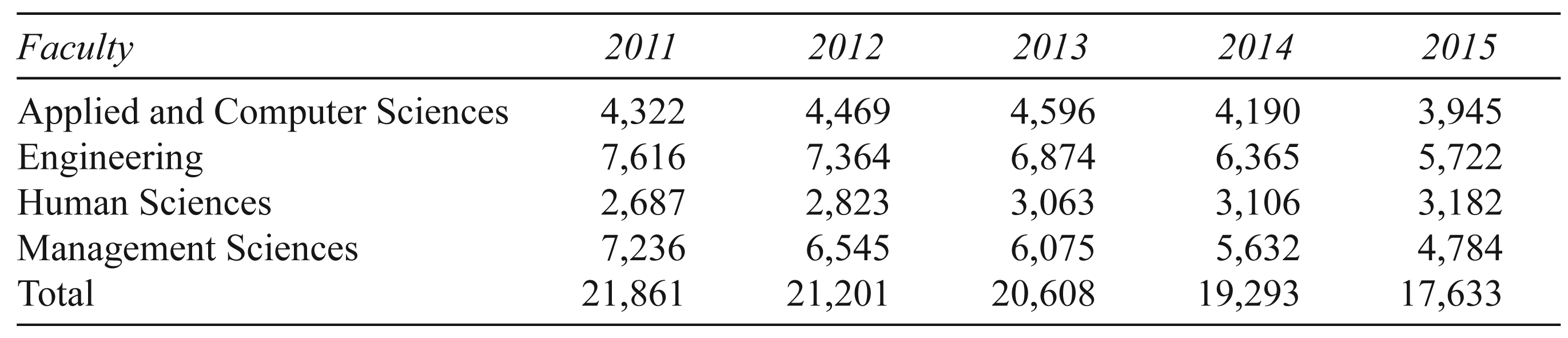
The profile of the student trends in enrolments is outlined in Table 1. On examination of the table, there was a decline in enrolment figures over the past 5 years. This resulted in a 19.34 per cent decrease in student enrolments in 2015 when compared to enrolments in 2011.
Five Year Enrolment Trends–VUT
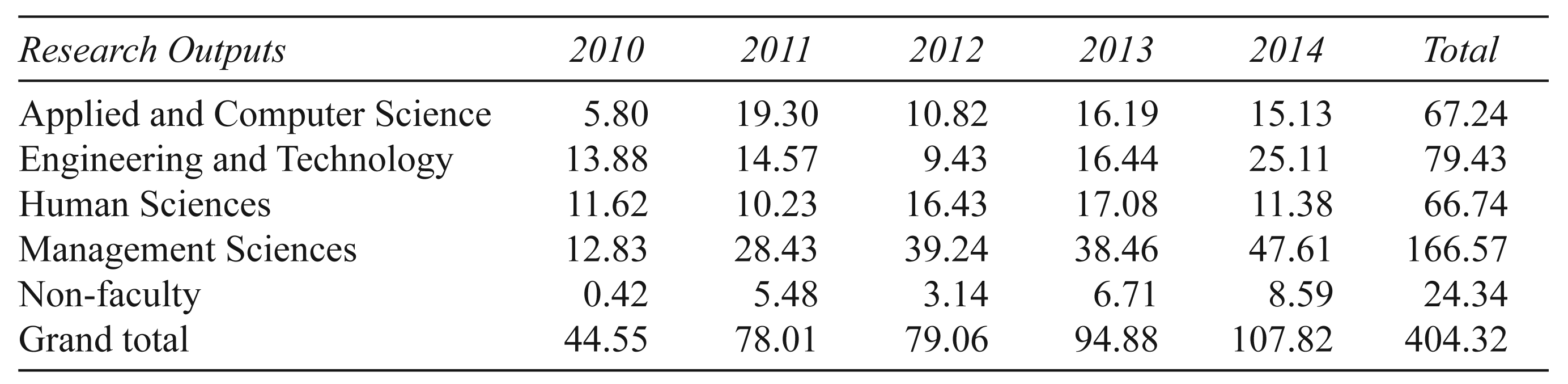
The research profile is shown in Table 2. Besides the Faculty of Management Sciences and Engineering, which showed a steady increase, research outputs in the other faculties seem to be erratic with the Faculties of Applied and Computer Science and Human Sciences showing a decline in 2014. The research base of VUT is small when compared to other comprehensive and traditional universities. Further, the research outputs compare very unfavourably when compared to universities such as University of Cape Town, University of Witwatersrand, University of Pretoria and University of Stellenbosch who have in excess of 1000 per annum of research output (Centre for Higher Education Transformation, 2013). This clearly indicates that UoTs are still in the growth and development stage when compared to the traditional and comprehensive universities.
Five Year Research Outputs Trends
The quantitative descriptive research design was used in the empirical segment of the study. This design was chosen because it was necessary to examine the relationship between one construct (an independent variable) and another (a dependent or outcome variable) in a population of interest (Creswell, 2003). Mertens and McLaughlin (2004) advocate that such a study involves the analysis of numerical data in order to give effect to the primary purpose of the study–to quantify data and to generalise results from a sample to the population of interest.
Sampling Design
The target population for the study was drawn from final year students from the faculty of Management Sciences at a UoT in South Africa. The faculty offers various courses in the field of human resource management, marketing, retail business management, logistics, internal auditing, financial information system and cost and management accounting. All these programmes have compulsory modules on entrepreneurship. The sample frame comprised the ITS (Integrated Tertiary Software System)-generated class list of third-year students registered in 2014. A probability sampling procedure was employed in the study and was preferred because inferential statistics could be utilised to establish meaningful conclusions (Maree & Petersen, 2007; Strydom, 2005). A systematic random sampling method was used in which students were randomly selected from various class groups. Every second student in the ITS-generated class list was randomly selected.
Instrumentation
Data were collected by means of a structured questionnaire. The scale items of questionnaires were tailored to assess respondents’ intentions to venture into new business creation. Five point Likert scales were used in sections B to E with 1 denoting strongly disagree and 5 denoting strongly agree. The questionnaire was divided into the following sections:
Section A: This section elicited information regarding the demographic and general profile of the respondents. Section B: This section explored the perceived quality of entrepreneurial content of curriculum using scale items adapted from Carter and Collinson (1999), Müller (2008) and Lorz (2011). Section C: This section examined the ENTINT of students after completion of their studies using scale items adapted from Linan and Chen (2006), Linan, Carlos Rodríguez-Cohard and Rueda-Cantuche (2011) and Lorz (2011). Section D: This section explored students’ attitudes towards entrepreneurship in general using scale items adapted from Souitaris, Zerbinati and Al-Laham (2007) and Muofhe (2010). Section E: This section explores the general self-efficacy of students to engage as entrepreneurs using scale items adapted from Pihie (2009), Souitaris et al. (2007) and Garg, Matshediso and Garg (2011).
Data Analysis
Correlations and multiple regression analysis were used to establish the nature of the relationship between students’ ENTINT to venture into new business creation. The Pearson correlation coefficient was used to measure the degree of linear association between the constructs used in the study. The four dimensions, ENTCC, ENTINT, attitude towards entrepreneurship and self-efficacy, were correlated with overall intentions to venture into new business. Regression analysis was used to examine the predictive relationships between ENTCC, attitude towards entrepreneurship, general self-efficacy and ENTINT.
Results and Discussion
On examination of the research outputs (Table 2), the research and innovation base is still small when compared to other universities in the country. This is further exacerbated by the limited number of research staff at the university and the number of students undertaking entrepreneurial research at post-graduate levels.
The policy on patents at VUT has been prepared but yet to be approved by the Senate of the university. However, the university follows the country’s Intellectual Property Rights (IPR) Act and takes due cognisance of the Intellectual Property Rights from Publicly Financed Research in particular, and has, from the outset, aligned all aspects of this policy with the provisions of the IPR Act.
At the empirical level of this study, the four dimensions, ENTCC, ENTINT, attitude towards entrepreneurship and general self-efficacy, were correlated with overall intentions to venture into new business. Table 3 reflects that the marked correlations were significant at p < 0.01.
Correlation Analysis and Reliability Statistics
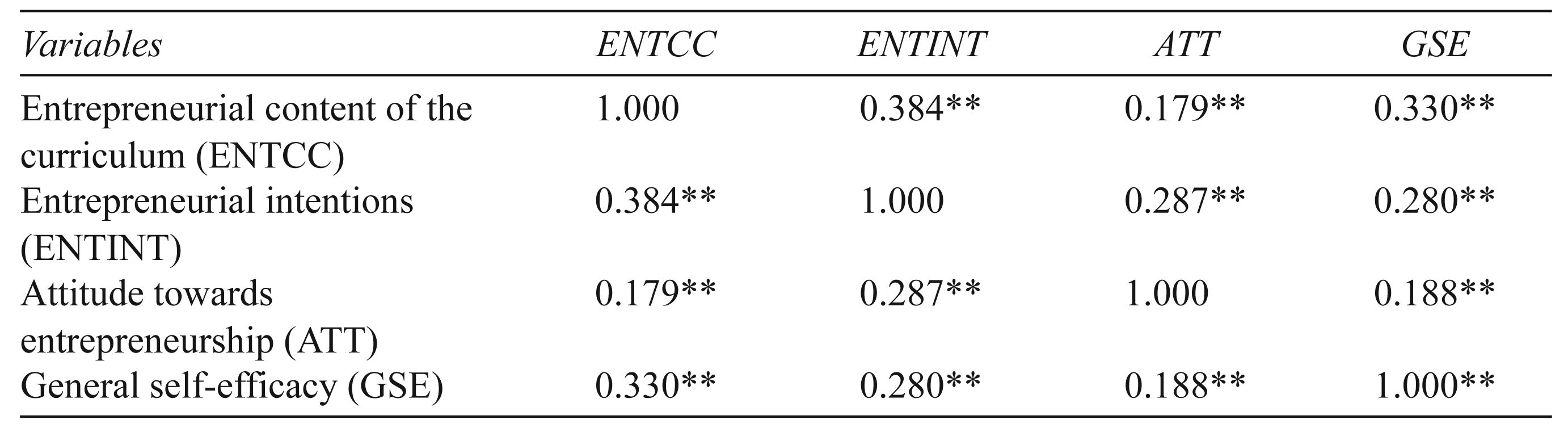
Table 3 reflects a moderate positive correlation between ENTCC and ENTINT (r = 0.384**; p < 0.000). There was a positive association between ENTCC and intention to venture into a new business. ENTCC reflected a weak but significant relationship with attitude towards entrepreneurship (ATT) (r = 0.179**; p < 0.004). In parallel, a previous study by Zegeye (2013) also showed a significant correlation between students’ entrepreneurial programmes of study and inclination towards entrepreneurship. The major challenge in entrepreneurship programmes is the appropriateness of the content of the curriculum in developing students’ attitude towards entrepreneurship (Pihie & San, 2009; Whiteley, 1995). The ENTCC should be enhanced with teaching delivery modes that enable students to gain hands-on experience by seeing, touching and ‘feeling’ the business world (Zegeye, 2013). Urban and Barreira (2007) assert that students who have not been exposed to the content of the curriculum that allow the commercial use of entrepreneurial knowledge show weak attitude towards entrepreneurship.
ENTCC showed a positive correlation with self-efficacy (general self-efficacy [GSE]) (r = 0.330**; p < 0.000). Entrepreneurial self-efficacy encompasses individuals’ beliefs concerning their capabilities to attain goals and control positive and negative cognitions that an entrepreneur has during the process of starting up a business (Pintrich & De Groot, 1990). Bandura and Locke (2003) accept that perceived self-efficacy is a major determinant of intention. Sources of self-efficacy can be obtained from mastery experience, mediated experience, social persuasion and physiological and affective states. Self-efficacy is not concerned with the number of skills that a person possesses, but with whether a person believes that s/he can do things with what s/he has under various circumstances (Drost, 2010). Thus, a need exists to streamline entrepreneurial content in order to ensure that it facilitates transformed entrepreneurial self-efficacy among learners in HEIs.
ENTINT showed a significant and moderate correlation with attitude towards entrepreneurship (ATT) (r = 0.287**; p < 0.000). The attitudes relevant to entrepreneurship include the willingness to tolerate the level of risk that individuals might be willing to bear and individuals’ perceptions of their own skills, knowledge and experience in business creation (Kgagara, 2011, p. 38). Two key fundamentals of entrepreneurial attitudes are the ability to recognise opportunities and the ability to take calculated risks (Nybakk & Hansen, 2008). In addition, ENTINT also showed a significant moderate correlation with self-efficacy (GSE) (r = 0.280**; p < 0.000). This result is in sync with the observations made in a study by Malebana and Swanepoel (2014), which also showed a statistically significant relationship between entrepreneurial intent factors and entrepreneurial self-efficacy. In support, Sarwoko and Nurdiana (2013) suggest that self-efficacy plays an important role in ENTINT of students, as higher self-confidence and mental maturity levels tend to generate higher ENTINT among students. Accordingly, it is important to inculcate positive ENTINT in students, with the prime intention of boosting their self-efficacy.
Attitude towards entrepreneurship (ATT) showed a positive correlation with GSE (r = 0.188**; p < 0.002). Likewise, a previous study by Izquierdo and Buelens (2008) found that students who exhibited higher positive attitudes towards entrepreneurial acts reported higher intentions to start a new business. Attitude is very important in the life of successful entrepreneurs, and they are bound to overcome hurdles, solve problems and complete tasks (Schunk & Ertmer, 1999). People who harbour positive attitudes are disciplined, determined and persistent and are able to commit and recommit quickly, and they do not easily succumb to challenges (Timmons & Spinelli, 2009). Another study by Kgagara (2011) confirms that students consider the option of being entrepreneurs and starting their own businesses, but they also agree that they would prefer to work for a large company for better career prospects. The more favourable the attitude towards the behaviour, the stronger will be an individual’s intention to perform the behaviour (Ajzen, 1991). Based on Ajzen’s TPB (1991), the stronger the positive attitudes towards a behaviour and the stronger the social norms towards a behaviour, the stronger the behavioural intention is. If the intention is high, the individual is likely to perform the specified behaviour. Thus, if entrepreneurship is seen as too risky by parents, educators and friends, the individual is less likely to perform entrepreneurial behaviour (Lorz, 2011).
Table 4 presents the regression analysis of ENTCC, attitude towards entrepreneurship, general self-efficacy on intentions towards entrepreneurship.
Regression Analysis—Entrepreneurial Content of the Curriculum, Attitude towards Entrepreneurship, General Self-efficacy on Intentions towards Entrepreneurship
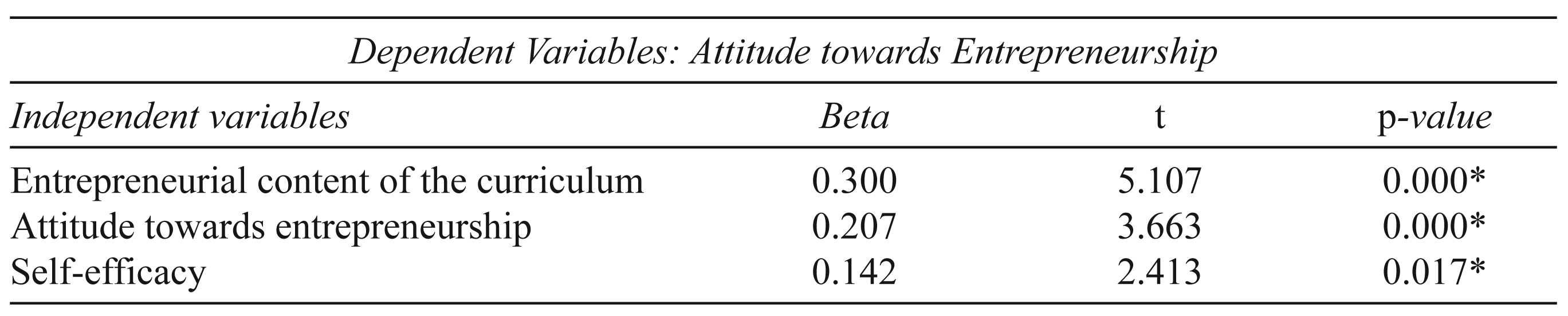
Three constructs, namely, the ENTCC, students’ attitude towards entrepreneurship and self-efficacy were entered into the regression model as independent variables, while ENTINT was entered in the model as a dependent variable. The results of the regression analysis indicate that approximately 21 per cent of the ENTINT can be predicted by the content of the curriculum, students’ attitude towards entrepreneurship and their self-efficacy. On examination of the beta weights ( β), the content of the curriculum ( β = 0.300) seemed to be the strongest predictor of students’ intention to venture into business, followed by students’ attitude towards entrepreneurship ( β = 0.207) and their self-efficacy ( β = 0.142). Hypotheses H1–H3 were therefore supported since the three constructs (content of the curriculum, students’ attitude towards entrepreneurship and their self-efficacy) showed positive and significant relationships with students’ intention to venture into business ( p < 0.05).
At the core of ENTINT lies the curriculum (Finney & Schraw, 2003). If the curriculum is without depth and not meaningful and lively, students will steer away from being entrepreneurially oriented (Solberg & Villareal, 1997). Edwards and Muir (2005) state that entrepreneurial curriculum is designed differently across universities, either as an optional module within business courses or a specific course on entrepreneurship. Mentoor and Friedrich (2007) posit that students have positive entrepreneurial attitudes, but the curricula at most institutions of higher learning emphasises the employee culture rather than the self-employment culture. Kgagara (2011) argues that there is a need for a modification in methods of instruction. Transfer of knowledge is important but the key lies within requisite competencies, development of skills and a change in attitudes. Rih and Guedira (2014) further propose that entrepreneurship educators should emphasise the significance of hands-on, active participation within a real-life entrepreneurial environment in the curriculum, where fruitful feedback from an expert is provided.
Garba, Kabir and Nalado (2014) assert that understanding students’ attitudes may assist significantly in finding their ENTINT. Khuong and Nguyen (2016) asserts that negative attitude towards entrepreneurship in society inevitably influence students’ ENTINT in the negative direction. Müller (2008) also argues that positive attitudes towards entrepreneurship seem to be influenced immensely by entrepreneurial intention, and that positive attitudes result mainly from associating entrepreneurship with freedom, self-actualisation and the opportunity to realise one’s own ideas. In addition, Karimi et al. (2013) advance that an individual’s self-efficacy can be enhanced by providing social persuasion and positive encouragement and feedback and by increasing positive affective reactions to engage in entrepreneurship. Previous research has also demonstrated that self-efficacy is related to motivational constructs such as perseverance and goal setting (Multon, Brown, & Lent, 1991), the use of strategies such as self-regulated learning, actual achievement and affective constructs such as stress and distress and disquiet (Pajares & Miller, 1995). The self-efficacy of students should lead to more effort and persistence, which in turn leads to greater self-efficacy (Susetyo & Lestari, 2014). The reverse is also true in the sense that if the self-efficacy of students is low, they give up easily, resulting in poor entrepreneurial outcomes, which then produces decreased self-efficacy. Therefore, efforts should be directed at shaping the attitudes of students towards embracing entrepreneurship.
Reliability Analysis
Reliability and Validity
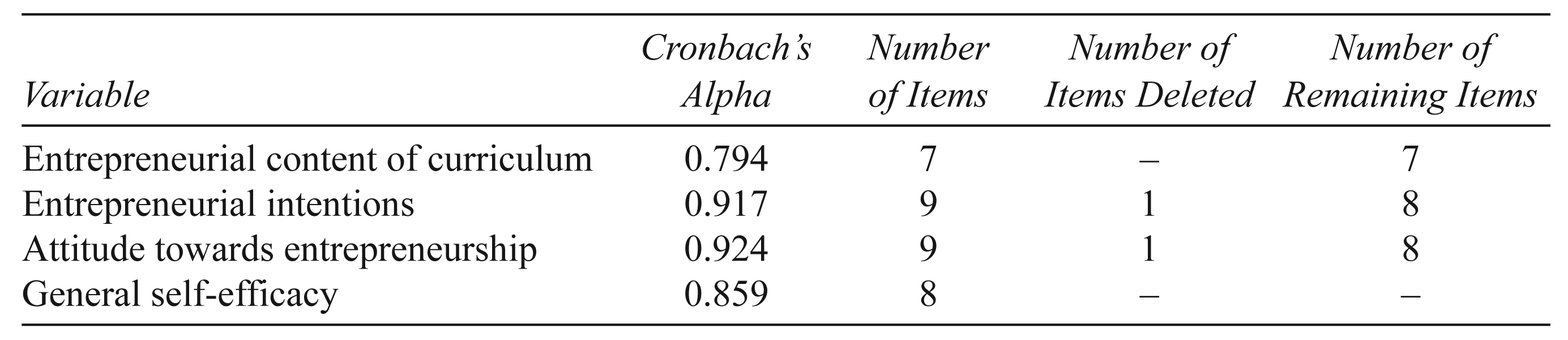
The internal consistency of the various constructs was computed using Cronbach’s coefficient alpha (De Vos, Strydom, Fouché, & Delport, 2005). The reliability of individual factors is shown in Table 5. A generally acknowledged rule of thumb is that an alpha of 0.6–0.7 indicates acceptable reliability and 0.8 or higher indicates good reliability.
As the Cronbach’s alpha coefficients in this study were higher than 0.70, the constructs were deemed to have adequate reliability for an exploratory study (refer to Table 5).
Construct validity indicates whether ‘there is an acceptable fit between the construct it supposedly measures and actual observations made within the instrument’ (Bernard, 2000). This is often influenced by the wording of a particular question and by the measurement used. To ascertain content validity, the instrument was refined during the pre-testing stage of the questionnaire among a cohort of ten students. In assessing the construct validity of the scale, a pilot test was undertaken among eighty respondents. Construct validity can also be determined through the computation of the Cronbach’s alpha coefficient for the scale (Mafini, Dhurup, & Mandhlazi, 2014). The Cronbach’s alpha values for the various constructs showed an adequate reliability which was greater than 0.7, which attests to adequate construct validity within the measurement scales. Convergent validity entails the measure of constructs that theoretically should be related to each other. Convergent validity was established by using correlation coefficient (Dhurup & Mofoka, 2011). The correlation coefficients reported significant correlations (refer to Table 3), thus provides evidence of convergence of the constructs. Predictive validity was measured through regression analysis. Significant predictive relationships were found between students’ attitude towards entrepreneurship, the ENTCC and self-efficacy with entrepreneurial intention, providing evidence of predictive validity.
Concluding Remarks
Although VUT has a science park, there seems to be a lack of synergy between entrepreneurial activities and TTI. In this context, UoTs like VUT should link their curriculum with basic and applied research with the market, via technology transfer and commercialisation mechanisms, including government–university–industry, community partnerships for sustainable advantage and prosperity. With the presence of innovation and incubation centres on the science park, entrepreneurial activities should be linked to these centres so that networks, partnerships and institutional support is harnessed between the different triple helix partners to generate creativity, innovation- and technology-based projects. However, part of the problem could be attributed to the fact that VUT does not have a fully-fledged entrepreneurial programme offering. Entrepreneurship while incorporated into all the university programmes is only one or two modules in the curricula.
The research and innovation at VUT is very low compared to other well-established universities. Currently, the science park has captured only twenty-two innovation disclosures until 2015 and 50 per cent of the disclosures are from external clients using the technology station. The low level of disclosure could mean that we need to train fellow colleagues on the services the science park can offer in terms of helping them translate their ideas. Further, on examination of the research base of staff, there is an urgent need for the university to recruit more research staffs, especially in the spheres of entrepreneurship and innovation in order to promote, encourage and support all activities within the VUT.
In the light of discussions of the results of the research, several recommendations may be put forward for improving entrepreneurship programmes in institutions of higher learning. First, a revision of the content of the curriculum is required to further generate an entrepreneurial orientation by including learning outcomes which are about and for entrepreneurship (Solomon, 2007). However, this calls for a holistic approach from all role players with adequate resource availability. These role players may include, but not limited to: top management, faculties, local government, businesses and communities. Second, the learning process of entrepreneurship should not only be restricted to just discussions but to the interaction within the current dynamic business socio-economic learning environments as well. The mode of delivery for entrepreneurship should be revisited and supported from lectures to other modes of delivery, such as real business case analysis, visits to business locations and more importantly an association with science parks, innovation centres, centres for entrepreneurship development and communities. In this manner, students’ experiential learning could be further advanced within the university.
Third, management within HEIs should ensure that entrepreneurship is part of students’ curricula from their first year of study to the third year. They should also create an environment conducive to venture into business creation by providing incubation support and start-up funds from the university, for students to embark on enterprise development. The feasibility for a fully-fledged entrepreneurship programme with mandatory, elective and incubation start-up practical training within the university should be explored. Fourth, it is recommended that students should be taught to adopt non-traditional approaches and pedagogies to be able to train others in the future. To increase the efficiency and motivation of the learners, educators should also be further trained in these pedagogies. In future, lecturers should act as facilitators to advance a supportive environment to the learning process. Furthermore, hands-on methodologies should be promoted at school level and at all educational institutions to stimulate young people to venture into new business creation.
Results from this study offer several implications for future research in the area of new venture creation. First, given the strong association of entrepreneurial orientation for entrepreneurial intent, students’ entrepreneurial orientation should be a new focus of research. The study used a quantitative research design, which makes it necessary to consider adopting a mixed method approach to get more meaningful results in future studies. A larger sample could be considered in order to generalise findings. However, the present research can be seen as a preliminary investigation of the opportunity to increase value in designing the entrepreneurial-related programmes that stimulate students’ intentions, attitude and self-efficacy to venture into new business creation. The sample used in the study inevitably limits the conclusion that can be drawn from the present findings in the sense that students from one faculty were exclusively included in the sample. In view of this, future studies should include students from other faculties. This fact notwithstanding, it should be noted that the purpose of the study was not to generalise the findings outside the sample, but to understand the phenomenon in its context, as further research is required to incorporate a wider range of graduates from different faculties and other higher learning institutions.
Entrepreneurial education is one of the keys in unlocking the economic and unemployment problem in South Africa. The essence of entrepreneurship is the ability to envision and chart a course for a new business venture by combining information from the functional disciplines and from the external environment in the context of the extraordinary uncertainty and ambiguity. It manifests itself in creative strategies, innovative tactics, uncanny perception of trends and market mood changes and courageous leadership when the way forward is not obvious. What is taught in entrepreneurship classes should serve to instil and enhance these abilities. In circumstances where graduate employment projections are never guaranteed, the chance of becoming self-employed remains an employment option, which also allows graduates to become masters of their own destiny.