




Abstract
This article examines the determinants of innovation using selected manufacturing firms in India. Our study is based on 190 manufacturing firms which were surveyed from Bengaluru and Hyderabad cities in India. The results based on panel probit model reveal that exports and R&D expenditure positively and significantly affect the innovation in case of manufacturing sector. Other key factors such as import intensity, manager’s prior experience, and conducting training sessions to the employee at firm level do positively affect the innovation activities. However, firm age and capital intensity negatively affect innovation. The results suggest the policymakers to concentrate more on export orientation policies and investing in R&D through subsidising or creating more R&D incentive projects which would significantly boost innovations in India.
Introduction
Innovation is a buzzword in Indian context and National Innovation Council of Government of India declares 2010–2020 as the roadmap to decade of innovations. Make in India programme launched by the honourable Prime Minister Narendra Modi in 2014 further emphasises the importance of innovation particularly for manufacturing sector in India. Especially, it was noticed since 1990s that the production processes across the different sectors of India shifted from the protected regime to proactive liberalised business environment, and market-driven systems were encouraged to adopt and create to modern technologies (Abraham & Moitra, 2001). Despite the role and importance of innovation in developing countries such as India, however, studies related to economics of innovation are scanty. In this backdrop, the present study examines the major factors that determine innovation in case of Indian manufacturing firms. There are plenty of studies which examine linkage between R&D and productivity, determinants of R&D, adoption of technology, FDI spillover effects and productivity, and relationship between R&D, productivity and trade in case of Indian manufacturing (see, for instance, Basant & Fikkert, 1996; Franco & Sasidharan, 2010; Hasan, 2002; Kathuria, 2002; Kumar & Aggarwal, 2005; Kumar & Joseph, 2006; Kumar & Saqib, 1996; Kumar and Siddharthan, 1994; Parthasarathi & Joseph, 2002; Raut, 1995; Ray & Bhaduri, 2001; Sasidharan & Kathuria, 2011; Sharma, 2012; Sharma & Mishra, 2011; Siddharthan, 1992; Siddharthan & Narayanan, 2016). But few studies have focused on innovation and its major determinants (see, e.g., Cohen & Levinthal, 1989; Monreal- Pérez et al., 2012; Narayanan & Bhat, 2009; Van Long, Raff & Stahler, 2011; Wang & Kafouros, 2009; Yang & Chen, 2012). First, a group of studies focused more on whether innovation hypothesised to function of internal activities within the firm level, such as conducting R&D activities through ‘leaning by doing’ 3 and the other strand found that innovations may stem from the external sources such as ‘learning by exporting’. 4 In a nutshell, the above studies found mixed evidence, which motivate us to examine this issue in the context of Indian manufacturing.
The major reason for considering manufacturing sector is because of its immense role in the growing modern India. Despite the emergence of service sector’s contribution in the recent days, manufacturing still considered as an engine of growth (Szirmai, 2012). Further, the Government of India has started conducting innovation surveys in providing guidelines for implementing and measuring innovations to create and improve the awareness among Indian firms to involve in such activities and it has declared this decade ‘2010–2020 as decade of innovation’. 5 On the other hand, National Manufacturing Policy of India 6 (2011) has aimed to create 100 million jobs with enhancing the share of manufacturing as 25 per cent to overall GDP by 2022. Continuing this momentum, the new government has taken steps towards encouraging entrepreneurs and to promote new ventures which makes India as a manufacturing hub through a global initiative calling for ‘Make in India’. 7
Given the greater importance to the Indian manufacturing, the contributions of this article are as follows. First, although there are plethora of studies pertaining to India manufacturing sector’s growth and performance, impact of trade liberalisation on productivity growth, profitability issue and competitiveness of this sector, however, to best of our knowledge, this is the first study which examines the determinants of innovation in case of selected Indian manufacturing firms. Focusing on such activities certainly brings an interest to academicians as well as global investors on growing Indian manufacturing. Second, findings of our results will certainly complement the government’s initiation to boost the innovation in India by 2020. Third, digging further, we also focus on the capital-intensive firms in which the likelihood of pursuing innovation is much higher as compared to labour-intensive firms. Finally, the findings of our study address upon the context of developing world might be a lesson for other low-income countries.
The remainder of this article is organised as follows: the second section describes a theoretical linkage on the determinants of innovation. The third section presents the database used as a sample of Indian manufacturing firms and the main descriptive indicators of innovation activities along with other variables. The fourth section illustrates the econometrics results and the fifth section concludes.
Theoretical Linkage on the Determinants of Innovation
In recent days, more particularly the developing nations have started in creating new knowledge and technological developments along with OECD and other developed nations due to several reasons. Particularly, the growth of manufacturing sector driven by the usage of high technological capabilities which facilitates to achieve higher growth has been noticed from the East Asian miracle where the high growth sparkles actually fuelled by the industrialisation, particularly through exports (Hsiao & Mei-Chu, 2003). Further countries proceed the transformational stage (from agriculture to technology usage) to catch up advancing world by spending more on capital goods which ultimately leads to high growth momentum. 8 Conventionally, the trade inflows and outflows made countries to learn, exchange ideas and gaining knowledge through the skill and technological diffusion, which ultimately improves the global welfare. Similarly, the growth empirics argue that ‘the differences in technology and ideas make the differences in wealth and welfare of the regions across the countries’ (Griliches & Mairesse, 1984; Hall & Jones, 1999).
Particularly countries like India which are late comers to trade need much adaptive new technologies and high speed of processing methods. The export-led growth strategist’s view suggests that innovation is interlinked via exporting at larger scale; hence, it hopes fastening growth in a better way of doing things via advanced learning capabilities (Bhagwati, 1988; Grossman & Helpman, 1991). Based on the literature, we examine the following hypothesis.
H1: Higher the export activity leads to the higher level of innovation implementation.
According to another strand of trade literature within the segment of trade theories particularly for developing nations like India, channelling import activities has become more viable to enhance the productivity through improving the capabilities and providing a better scope for innovation at micro level. Some scholars in recent days, for instance, Sharma (2014), emphasised the role played by the imports in the form of capital goods, raw materials and other imported inputs. In this channel more particularly unlike another channel, that is, export, firms more likely to receive high-end technologies, semi-developed products, in which firms may become excel doing such activities heading towards incremental or improved innovations. This form of importation gives more ideas to create greater impact once they start doing their own way, makes them specialise in the long run and earn monopoly rents. In some cases, for instance, in case of younger firms, it matter that how best they access initially to the best quality of inputs and raw materials, or adopting imported advanced technologies and implementing them and getting in-hand practices further boost up the long run and improve the innovation capabilities (see Rodrigue & Rodrigue, 2008). These theoretical predictions were stressed even in the endogenous growth theories and highlighted that technological progress can be achieved through importing such newly available methods and intermediary products that intended to improve innovations and some new way of organisational set-ups (see Grossman & Helpman, 1991). Concluding this, we arrive at the following hypothesis.
H2: Higher level of import intensity (in the form of capital, machinery and intermediary goods and so on) tends to enhance the learning or innovative capabilities.
Putting it in another form is that how firms sustain in the long run with high growth momentum. Again the Schumpeterian ideology comes into puzzle, the survival cycles of the firm that initiate the R&D undertakings among others that intended to invent a new and high technologies. In struggling to survive in the real world, firms must take to choose dynamic decisions that not only included in such product and process development but also may be in management and non-technological marketing improvements (see Agarwal & Gort, 2002). As it was concentrated that why firms invest on its own R&D which assimilates to create and improve the learning capabilities even from the internal and external sources (Tilton, 1971). 9
R&D is treated as a proxy for innovation due to its inherent capabilities that are plausible to nurture the innovation activities in firm businesses. However, it was just treated as an input to generate innovation, but could not be the realisations of true innovation but may fail to generate the innovative products and processes (see Lee & Stone, 1994); hence, it could only be treated as a factor of innovation, and hence we arrive at the following hypothesis:
H3: Higher the R&D activities would presumably lead to high level of innovation activities.
Similar studies in various contexts 10 which attempts on the diverse range of empirical grounds understand the firm-level characteristics in relation towards the innovation and creation of new technologies. Narayanan and Bhat (2009) focused on hypothesising the critical role of technology and made an attempt to see the plausible factors that impact the technological developments in Indian chemical industry. Similarly, Kumar and Aggarwal (2005) examined the factors that determine the R&D activity for Indian enterprise during the 1990s. This analysis provides that despite the cut down in R&D spending, firms have adapted various liberal norms to rationalise the R&D patterns and enhance the efficient and overall growth of the industry. However, the above studies were not given attention towards the external and internal sources of innovation and have not been addressed through these interactions how firms could able to do practicing innovations at firm-level businesses. Given these gaps and ambiguity in the literature, we focus on the issue particularly distinguishing under the two broad heads such as internal and external sources of innovation, that is, R&D and export, respectively.
Data and a Quick View of Indian Manufacturing
Some Facts
The economic liberalisation of India in 1991 has emphasised industrialisation as a very important instrument for sustained growth. As a result, in Eleventh Five-Year Plan (2007–2012), the annual average growth rate of the manufacturing (7.7 per cent) was lower than the country’s overall economic growth (8 per cent). Over the period from 1965 to 2015, it can be seen that the share of gross value added by the service sector in India’s GDP has consistently increased from 30 per cent in 1965 to 66.1 per cent in 2015–2016 (Ministry of Finance, Government of India, 2016). But at the same time, the manufacturing sector’s share was only 14 per cent in 1965 and around 17 per cent in 2015–2016, increased by just 3 per cent, over a period of 50 years. Figure 1 shows the annual growth of key sectors of Indian economy. The figure depicts the last 15 years data, which shows the lion’s share of service sector followed by the industrial sector. Within industry, manufacturing sector most effectively and significantly contributes towards high growth. The manufacturing growth rate is always faster than agriculture and overall industrial sector but lower as compared to the service sector.

Export and Import Shares of Manufacturing Sector in India (%)
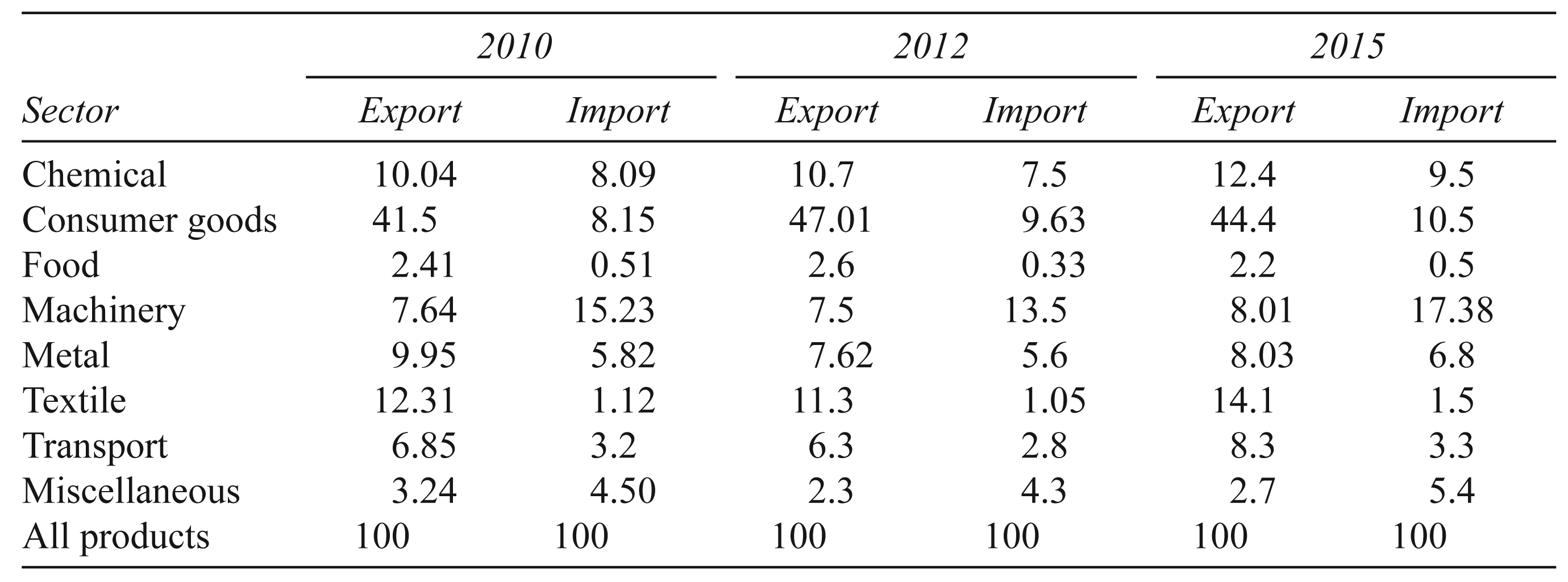
Table 1 presents the export and import shares of disaggregated manufacturing sector in India during last five years. The results clearly show that the export share of all disaggregated manufacturing industries except miscellaneous industry has increased in 2015 as compared to 2010. The consumer goods sector contributes more shares as compared to other industries highlighted in Table 1. Textiles and chemical industries also significantly contribute to India’s manufacturing exports. Similarly, machinery, metal and chemical industries are major importers within Indian manufacturing sector. After highlighting the quick facts of Indian manufacturing sector, the next section discusses the selection of firms by conducting a primary survey.
Sample Firms
Since there is hardly any data on innovation-related variables available in the secondary source, we conducted a primary survey only for the manufacturing firms located in Hyderabad and Bengaluru cities in the southern part of India. This study has been undertaken as part of PhD thesis work of first author. We purposively conducted the survey in Hyderabad and Bengaluru by targeting those manufacturing industries, which are registered in Bombay Stock Exchange (BSE).
This study has been conducted based on the conveyance sampling due to major reason being unavailability of innovation data as well as not providing information pertaining to innovation by many firms. First, we did not randomly pick any manufacturing firms, rather collect the data on R&D expenditure of those firms which are already registered in Bombay Stock Exchange (BSE) and provided to CMIE database. Then in the second stage, we sent the questionnaire to all the 1000 firms through email, but could not get any response. In third stage, the first author individually visited around 300 firms and obtained the information from 190 firms. These questionnaires are internationally recognised and provide guidelines for measuring innovation and other related variables of innovation. However, other variables were collected from CMIE 11 such as gross sales, gross fixed assets, exports, imports and R&D expenditure from 2011 to 2013. All the data are annual figures and we restrict our analysis to only three years across 190 firms, it is because innovation data were collected based on the primary survey contains the information spamming 2011 to 2013. The respondents are mostly firm management and senior personnel at firm level. The first author follows a purposive sample by targeting firms belongs to Hyderabad and Bengaluru cities because of time and financial constraint by the author as a PhD scholar and following the similar studies in the literature, using firm-level data. 12 Therefore, the results obtained in this article are free from error margin/sampling bias. We also provide the evidence in Tables 3 and 4 that most of the innovation data are binary in nature and explanatory variables are in ratios. The standard errors of each variable across firms are also below one. We also check the heteroscedasticity issue while estimating the panel probit model (Equation (4)).
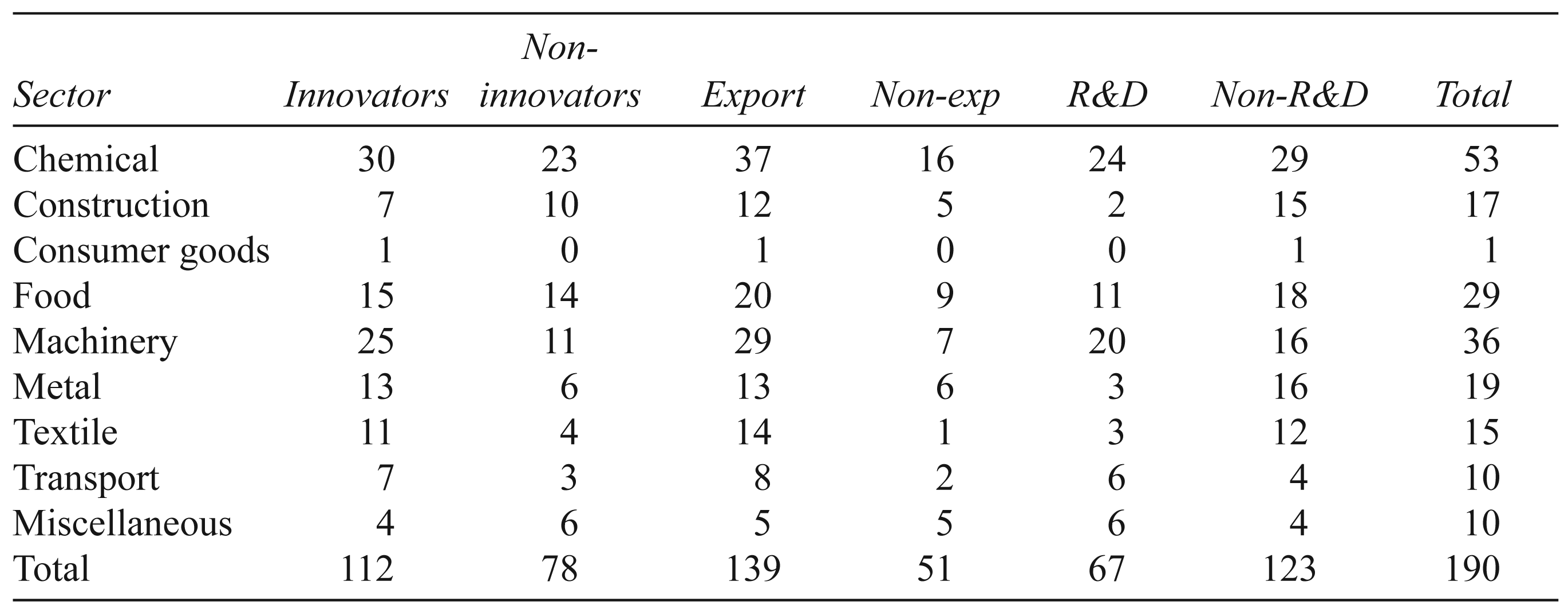
Table 2 presents the sample size of disaggregated manufacturing firms, which were surveyed in 2014 from Bengaluru and Hyderabad cities. The firms are heterogonous in nature; however, bulk of the firms belongs to capital-intensive industries such as chemical, machinery, metal and transport. Out of total in 190 firms, 112 firms reported in engaging innovation activities during 2011 to 2013. Most of the capital-intensive industries such as chemical, machinery and metal are doing much innovation as compared to labour-intensive industries such as food, construction and textile. We also notice that 139 firms out of 190 are engaged in exports, and only 67 firms spend on R&D expenditure, most of the firms in the sample are non-R&D-oriented in the initial year.
Type of Surveyed Indian Firms by Innovation, Exports and R&D
Definition of the Variables Used in the Study

Descriptive Statistics
Definitions of the variables used in the study are provided in Table 3. The questions pertaining to innovation activities are mostly in binary nature ‘yes/no’ type for making them easier to the respond. We define ‘innovation = 1, if a firm either engages in making a new product or making same product in a new process or following new marketing or organisational strategies’ and 0 otherwise. We also asked other questions to measure innovation like number of patents, trademark or copyright, but the response was very poor as majority of firms either do not wish to reveal those information or not having any record.
Following the standard literature and fulfilling fundamental mechanism, this paper tried to capture the factors that influence the firm level innovations. Firm age, captures the firm’s experiences and knowledge that has been accumulated over the time. It has capability to develop new knowledge, products, processing or other form of innovations through learning by doing or gaining from its experience.
However, in the literature studies which follow time-series data use ‘No. of employee’ as firm size. Capital intensity is measured as the ratio of gross fixed assets to total employee of a firm. Although the value of plant and machinery seems to be more appropriate, but there is hardly any time-series data available for this variable at firm level. Second, obtaining the exact depreciation rate for each firm’s machine or equipment was further challenging. Therefore, this article limits its estimation by using gross fixed assets. We consider some other explanatory variables, which are binary in nature and related to manager’s education, experience and conducting training sessions to the employee engaged in the firm business. We use manager’s education (engineering or technical education) as a proxy for human capital. Practically, manager’s education could have been used as a better proxy for human capital. However, most of the surveyed firms were unable to provide the data on manager’s years of experience. Therefore, this article also uses manager’s experience (MEXP) by asking a relative question on whether the manager has any experience in working in a foreign-owned firm or not. The foreign-owned firms in India typically bring better technologies from source country, and hence, it helps the firms to go for more innovation. The presence of those experienced manager in a firm some extent encourages to go for product or process innovation. Finally, training to employees always helps the firms to gain knowledge through learning by doing, which is likely to augment thinking process of innovative activities. But sometimes training could be additional costs to firm and thereby discourage the firms to go for more innovation because of high production costs and tendency to reduce the profits. To maintain the uniformity, we calculate export and import intensity as a ratio of total export to total sales and a ratio of total import to total sales, respectively.
Model and Results
Model
With the aim of estimating the determinants of innovation in case of manufacturing sector in India, we fitted a panel probit regression model by following few previous studies (see Bhattacharya & Bloch, 2004). Since this article uses the dependent variable as qualitative in nature, we tried to capture the determinants of innovation by applying a panel probit regression model, which uses the maximum likelihood estimation to evaluate the probability of categorical membership. The response on whether firms doing innovation actually varies over 2011 to 2013. Thus, we have three years data for 190 firms on innovation along with other key variables which are likely to determine the innovation activities, which motivate us to apply this model. Given the binary nature of our outcome variable, innovation can be measured and estimated panel probit regression can be written as:

In Equation (1), p is probability of occurrence of innovation measured through; if firm x performs any innovation during the period t, then it takes 1, otherwise 0, which depends on the normal probability distribution function N(•), and y is the dependent variable, innovation; and x represents all the explanatory variables; i denotes firm 1 to 190; and t denotes the time from 2011 to 2013. In this model, Equation (1) of panel probit model determines the βs of x that determine the probability of innovation whether such firms engaged in those activities.
The maximum likelihood estimates of the parameters of equation with the assumption of homoscedasticity would obtain the following log likelihood function.
The probit transformation in log ratio is defined, in terms of π (x), as follows:

In Equation (2), ø(•) is the standard normal probability distribution, and φ(•) is the cumulative probability distribution function. Using Equation (2), we can estimate the βs of the explanatory variables. But in the case of these dichotomous nature, the dependent variable, y, unlike the general linear models E(y|x) is xβ, so β will no more represent the marginal effect on the dependent variable x due to the inherent nature of the probit regression, in which the given reason is that the standard normal cumulative distribution function is an increasing function and E(y|x) is N(xβ) (see Equation (1)). Therefore, the marginal effect which measures the effect on the probability of a positive outcome has been measured separately in Equation (3). In other words, the magnitude of marginal effect shows the likely probability to undertake innovation activities on average given the response to the change in the right hand side variables of the probit equation, which can be written in the following form:

In Equation (3), ø(•) is the standard normal probability distribution. Equation (2) can be further expanded to:

where β0 is intercept, β1, β2, …, βk are the slope parameters to be estimated, and εit is a stochastic error term. The a priori expectations of the explanatory variables are provided in Table 3 for both the benchmark (aggregate sample) and capital-intensive (subsample) firms. We identify the capital-intensive firms based on their capital intensity scores (ratio of capital to labour). Further, we consider three models by running panel probit model corrected with heteroscedasticity to Equation (4). We choose three alternative specifications to avoid the multicollinearity problems if any persist in the model. Models 1 and 2 are in reduced form, where we dropped some variables, and Model 3 is considered to be the baseline regression model.
Results
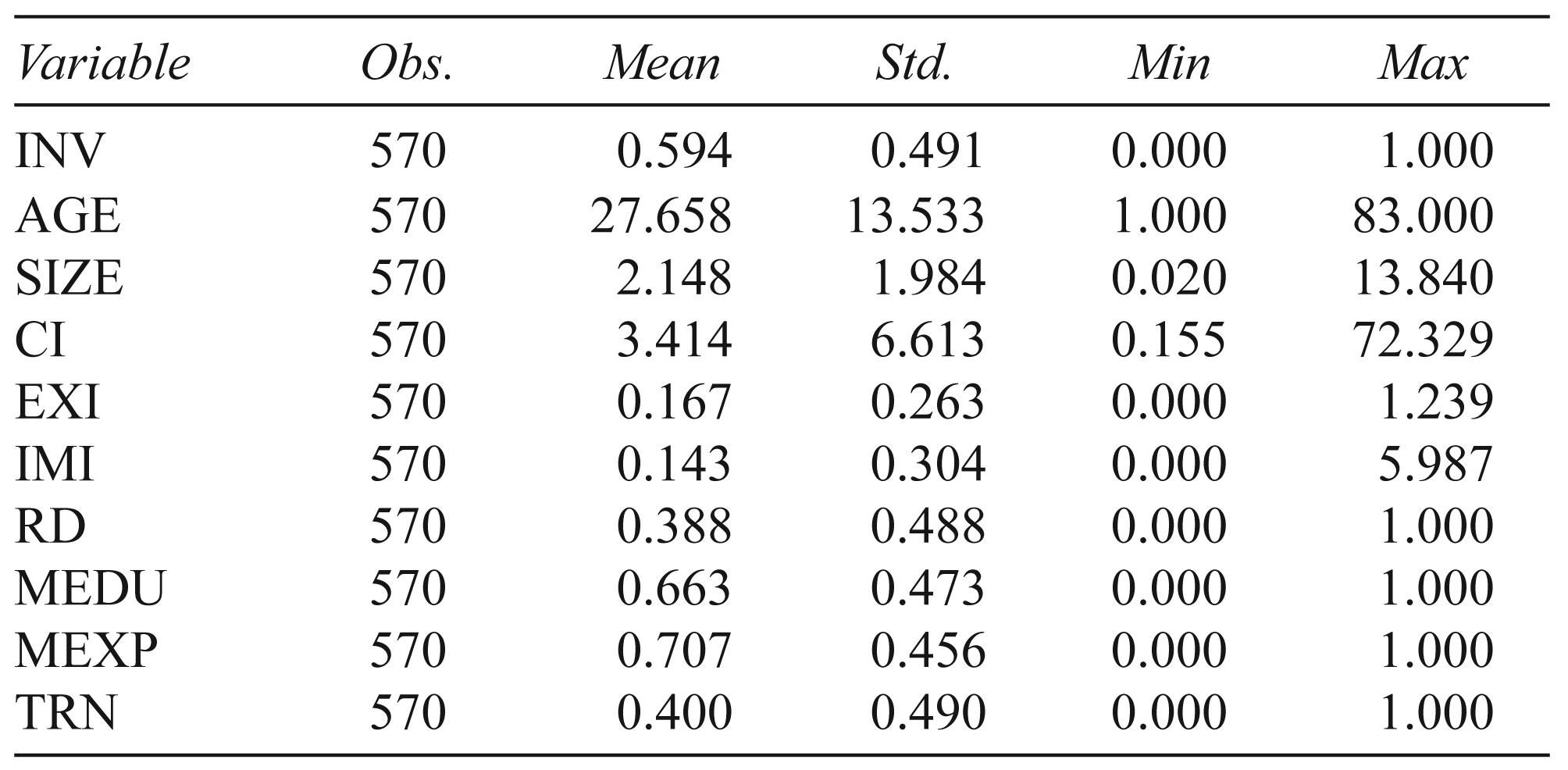
We start with the descriptive statistics results presented in Table 4.
We further proceed looking inside the data what actually it represents in Table 4. Among these variables, the mean value of the firm size and age is higher as compared to other indicators. The mean of the R&D dummy is 0.39 which indicates that most of the firms in the sample are not R&D-oriented; similar to this, the mean value of the R&D intensity replicates, which is measured as a ratio to total sales was found very low (close to zero 0.01). We have excluded R&D intensity from our model due to negligible magnitudes of R&D intensity amounts spending for generating output or the knowledge creation; hence, we consider R&D dummy to capture the R&D influence on innovation. Among others, most of the firms are export-oriented (70 per cent of the firms), and more than half of the firms conduct training sessions for their employee to enhance in-hand practices. In standard deviations, most of the variables are not much volatile except the firm age which indicates that some of the Indian firms are experienced relatively. The managerial indicators like manager’s education and manager’s experience are not volatile because both are binary in nature. We further observed from the descriptive statistics that labour-intensive firms have undertaken low level of R&D as compared to the capital-intensive firms.
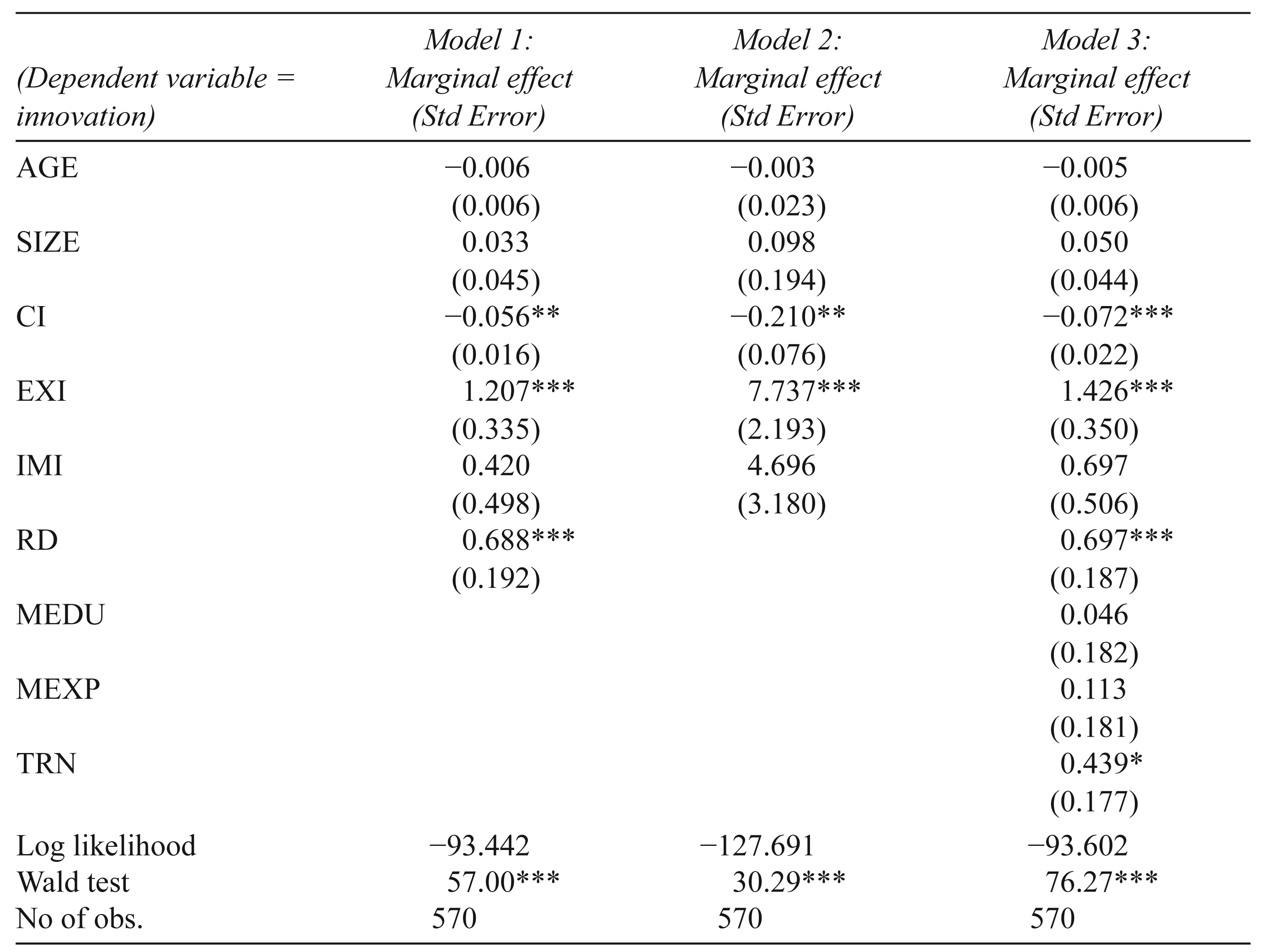
After describing the descriptive statistics, in the next step, we estimate the panel probit model using Equation (4). The results are presented in Table 5. The results from Table 5 indicate that capital intensity (CI), export intensity (EXI), R&D expenditure (RD) and training (TRN) are statistically and significantly affect the innovation. The coefficient of capital intensity is found significant and negatively influencing innovation, which suggests that increase in capital intensity as measured in terms of ratio of capital to labour leads to reduce the innovation activities in firm business. This might be the fact that the inherent characteristics of physical capital from which the returns diminish over the time and reflecting in the creation of innovative activities. Previous studies by Bob Van Dijk, Hertog, Menkveld and Thurik (1997) and Mansfield (1980) also found similar results. The export intensity does positively affect the innovation and which corroborate with the a priori expectation. One per cent increase in export intensity leads to 1.2 per cent innovation activities. In other words, the export-oriented firms are more likely to go for innovation higher than that of non-export-oriented firms.
Panel Probit Model Results of Determinants of Innovation (Overall Manufacturing)
The plausible reasons for export intensity to boost innovation in India are as follows. First, these firms are having skilled labour as well as better technologies through which they produce more output. Increase in output always encourages them to go for more innovation. Second, increase in export intensity enhances the competitiveness of these firms, which in turn make them to think differently from other rival firms. Higher competitiveness encourages firm to go for more innovation.
Our results also show that the firms who are doing R&D activities are likely to engage in more innovation as compared to non-R&D firms. This result confirms that higher R&D spending is likely to improve the innovative capability of Indian firms. The results of marginal effect of R&D dummy 0.7 per cent specifies that 1 per cent increase in R&D funding is likely to increase the innovation activities of innovator firms by 0.7 per cent as compared to the non-R&D-oriented firms. This confirms that investing for in-house R&D experiments can enhance the absorbing or learning capabilities of employers engaged in R&D departments. And these increasing volumes of R&D levels enhance the firm performance and effectiveness of doing business adopting or transferring technologies from foreign counterparts or countries. Findings of our study do corroborate with previous studies (Sun & Du, 2010; Wang & Kafouros, 2006) which stressed the importance of R&D intensity boosting innovations at firm level.
Finally, we have also considered the firm-level managerial activities to see how they influence the innovation. Our results indicate that managerial capabilities such as, having experienced management from the overseas or holding a foreign degree could influence the rate of innovation in firm, which was unnoticed in Indian firms. Within the managerial front, providing training sessions to the employee at firm level as a significant effect will influence innovation better than that of who do not provide such programmes for enhancing the quality of labour, learn to do better off at workplace and understand more with dealing such newly project which are intended to introduce new products or production processes. Especially, these methods of operational activities that require more on investing for high-skilled labour through initiating in-hand practice, know-how and more on learning capabilities to come up with innovations via reducing time and costs. The new way of learning practice may bring work allocation, labour division and human resource management which are fascinated to bring new changes. Overall, the above results are substantiating with our theoretical predications and empirically validated by the model, from which it argues that innovation could be promoted through trade linkages and other internal learning activities.
Robustness of Our Findings
Given the conformation, the data from Indian manufacturing firms generate innovations from the lines of export markets, within the firms through R&D efforts and at times even from some other sources, moderately. In this section, we exclusively study on capital intensive industry. Conventionally, the industry which refers to capital intensity is which requires investing more on capital or for machinery and advanced technological adaptations for the business conduction. It is believed that the capital intensity industries have a high potential to generate more profits than that of labour abandon technology-based firms, which is largely due to the inherent nature of the ability to generate mass production and keep strategies for high growth, due to the ability of making much familiar to the usage of high technology.
The results from our sample indicate that chemical, machinery, transportation, and metal and metallic firms have high proportion of capital intensity as compared to the other firms. We estimate the capital–labour ratio of 190 firms and select the industries where the capital intensity ranges from 3.363 to 5.007, and the labour-intensive firms such as textile, food and agro-based industries calculated capital intensity ranging from 1.177 to 2.048. This classification of sample performed based on the mean value of capital intensity.
With this idea in mind, this section provides further results for capital-intensive firms. Given this backdrop, the Table 6 provides results focusing on capital-intensive industry. It is clear from the Table 6 that results are similar to that of Table 5. The plausible reason for similar results is due to the fact that bulks of the capital-intensive firms, who engage in innovation, are either doing product or process or both innovations. Our theoretical arguments in the previous section highlight the nature of ‘capital-intensive firms’ more likely to engage in innovation activities, investing for high technology devices or adaptation of advanced processing techniques. Moreover, the high proportion of firms (118 firms comes under capital-intensive firms) in the whole sample study come from the technology-driven and technology-oriented mechanisms. Due to this reason, the findings of Table 6 significantly corroborate with the results of Table 5. However, our results in Table 6 are bit different as compared to Table 5, when we focus on the managerial aspects. In Table 5, training was significantly affecting the innovation, but in Table 6, we find that manager’s experience boosts the innovation in capital-intensive firms. In case of capital-intensive firms, we notice that firm managers and other higher personnel have foreign exposure.
Panel Probit Results of Determinants of Innovation (Capital-intensive Firms)
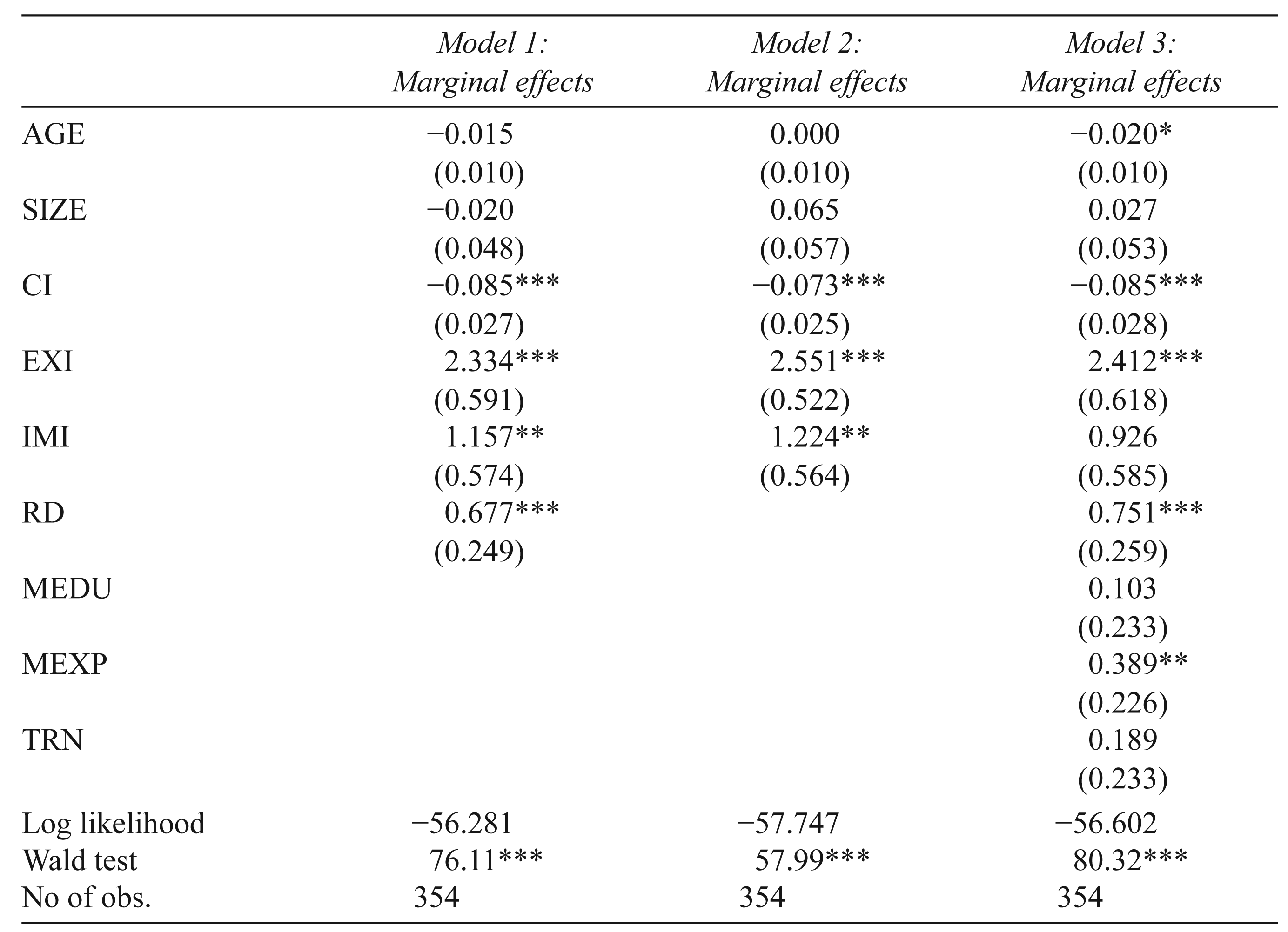
Our findings from export variable in both the cases (aggregate firms and capital-intensive firms) show that ‘learning through exporting’ hypothesis holds and stands together with previous evidence carried out by Monreal- Pérez et al. (2012) in Spanish firms, in which firms learn implementing innovations such as developing new products and advanced/improved processes through exporting. However, from these similar results, positive effects from export intensity on innovation imply that Indian firms have reached better catching up the potential to reach international standards and have improved the learning capacities since it has been doing from the early 1990s and will move further in future to show the better off in market place similar to that of the advanced nations.
In similar vein, another theoretical link from the trade theory which postulates that import activity promotes innovations in several angles. Our results in Table 6 turned out to be significant in the case of capital-intensive-based firms in contrary to the whole sample firms. The results implies that Indian firms that are having import participation are viable to make changes towards improving business organisations through inventing new techniques such as marketing and other organisational techniques. As explained in the theoretical approach, it was true that different forms of import strategies could really push up firm businesses in various fronts. In our case, the coefficient of import intensity is statistically significant because by importing different raw materials and other products, the firms reduce the production costs and improve the quality of products, which encourage them to go for innovation. This import intensity impacted in enhancing knowledge acquisition and also further engage firms to do innovation (Narayanan, 1998, 2004).
Next, we discuss about the R&D variable. Our result shows that R&D expenditure dummy is positive and significant at 1 per cent level. The distinctive feature of R&D expenditure is likely to influence innovation in which firms more accessed to high technologies, which may require buying large technological equipment or learning to develop new or improved products or techniques which needs to be poured through larger volumes of R&D investments. The marginal effect of R&D dummy 0.751 suggests that 1 per cent increase in R&D variable is likely to increase the firm-level innovation activities of these firms by 0.75 per cent than the firms who do not undertake these activities. The results obtained on R&D coefficient in capital-intensive industries are higher than the overall sample.
Further, capital intensity has continued to have negative impact on demotivating innovations. This is because the firm does involve for investing much on capital goods, however in the form of other than R&D like traditional physical capital may not lead to innovation. One could analyze that continuous investment flows into such physical capital might have detrimental effects or diminishes the ability to attempt for innovation.
Similarly, firm’s age found to be negative effect on innovation and our results are some extent supported by Balasubramanian and Lee (2008). They observed the fact that as time passes Indian firms suffering from the number of draw backs, which pull back the experience in turning towards generating positive outcome, resulting negative innovation as compared to the younger firms. However, there exists a considerable debate on the both the sides, found in mixed direction that whether innovations generate from new ventures or experience giants that are able to learn more and capture well through different sources and imitate or innovate to learn through different channels. 13 Another variable firm size, however, found an insignificant effect on stimulating such activities under the study.
Given the knowledge-based world economy, particularly the Indian economic environment in which it has allowing liberal policies and transforming towards use of high-end technologies, ease of doing business, adapting R&D-oriented production process, the country has witnessed remarkable growth rates in recent times. Significance of this study can be analysed in manifolds while integrating theoretical literature and business environment that has been creating in recent times. The status of R&D investment is, however, increasing irrespective of public and private sector, for instance, in 1980–1981 overall as ratio of GDP stood at 0.58, and however, it is about to cross 1 per cent to GDP. Even it is far below in comparison with several other emerging nations such as Korea (3 per cent of GDP), Tiwan (2.3 per cent of GDP) and China (1.5 per cent of GDP). However, in Indian case, the visible outcomes from such new investments have become much vibrant in corporate and moving forward in not only developing new products but also coming up through cost-cutting-effective policies. Having no clear data on true innovations at firm level such as patent counts, ratio of new products to total sales would may not allow us to infer the contribution towards overall firms growth but given structural transformation programmes such as Make in India, new manufacturing policy aims towards reaching 25 per cent contribution towards GDP by 2025 with the aim of creating 100 million jobs through viable manufacturing business enhancement.
In a nutshell, briefing the Indian economic scenario, our results from both the tables (aggregate and capital intensive) indicate that export intensity and R&D have positively affect the innovation, whereas capital intensity negatively affects the innovation. Training of the employee also boosts the innovation in case of overall manufacturing. However, in case of capital-intensive firms, we noticed that import intensity and manager’s experience do help in enhancing the innovation activities. At this juncture, it is believable that Indian firms have reached to attain the commercial viability through technological diffusion that is taking place all over the world, with the greater activities that are being implemented in Indian system.
Conclusion
Recognising the greater role of innovations in the production systems, the priority given to the public policy motivated us thinking or curiosity to investigate the major factors that drives innovation in Indian manufacturing firms. Though there are ample number of studies in India which made an attempt to see the dynamic linkage between R&D expenditure, exports and productivity growth, measurement of productivity and efficiency, determinants of R&D expenditure, etc., but none of the existing studies based on Indian manufacturing firms really answer the question of what motivates or deters for innovation in case of Indian manufacturing. To the best of our knowledge, this is the first study which has examined the determinants of innovation by taking a sample of Indian manufacturing firms. We made an attempt to filling the literature in this line particularly answering the research question by surveying 190 firms from Indian manufacturing plants and data collected from two cities of India, Hyderabad and Bengaluru. Though we restrict our sample survey to only two cities due to the time and financial constraints, the results derived from this study may be generalised to overall manufacturing firms in India because the operation and structure of the firms are similar irrespective of firm’s location in India. For example, a chemical plant operating in Hyderabad city (southern India) may not be operationally different from a chemical firm which is located in the New Delhi (North Indian city).
We examined the determinants of innovation in Indian firms which are engaged in innovation (any form of innovation activity such as product or processes or marketing or organisational) by considering three years of data from 2011 to 2013. The estimated results based on panel probit regression reveal that export intensity, R&D and capital intensity significantly affect the innovation for both aggregate and capital-intensive firms. Further, results also reveal that training of employee matters for innovation activities in case of aggregate manufacturing, but this indicator does not affect innovation when it comes to capital-intensive firms. Similarly, firm’s age, import intensity and manager’s experience affect the innovation in case of capital-intensive firms though they did not influence the innovation for overall firms.
Drawing upon these results, Indian manufacturing firms can concentrate more on investing in R&D, subsidising or creating more R&D incentive projects which would significantly boost up innovation activities in Indian firms. As a result, it helps in enhancing the firm’s growth and economic welfare. Further, our analysis, upon these results, is a wake-up call for Indian firms to concentrate more on not only investing in such R&D projects but also to improve in entering the foreign markets by enhancing exports and imports.
Footnotes
Acknowledgements
The authors gratefully acknowledge the suggestions of the editor and anonymous two referees on an earlier draft of this article. The usual disclaimer applies.