




Abstract
As a social practice, mathematics remains shrouded in mystery and seems inaccessible for outsiders. It comes across as a closed formal system that is largely considered independent of the people who practise it and hence totally impervious to sociological investigation. This article seeks to question these assumptions and is offered as a contribution to an emerging sociology of mathematics and abstraction. The argument unfolds on an ethnographic register and follows the reactions to a particular mathematical symbol in two different contexts. The first stretch of the description tracks the responses to this symbol on an online forum devoted to discussing mathematics and the other draws from a classroom context the author was part of as a participant observer. Thus focussing on just one aspect of mathematical practice, the way in which symbols are handled by practitioners, it attempts to underline the character of mathematics as a distinctive form of sociality. In the process it raises and seeks to address the following questions. What do controversies over and reactions to mathematical symbols tell us about mathematics as a practice? What roles do symbols play in the mathematical discourse? And, can a broader sociological perspective on mathematical symbolism be developed?
Introduction
T
The line followed in this article attempts to apply the sociology of symbolism latent in Lacan’s classic essay The Instance of the Letter in the Unconscious, or Reason since Freud (Lacan, 2006, pp. 412–444) to the two ethnographic case studies presented here. It is a deliberate attempt to call it ‘sociology of symbolism’ because in what follows the Lacanian categories of metaphor and metonymy are given an anthropological twist guided by Bhrigupati Singh’s treatment of Georges Dumézil’s categories of mitra and varuna in a recent paper of his (Dumézil, 1988; Singh, 2014, pp. 159–187). Singh, in search of appropriate concepts that could respond to the pressures of his ethnography, asks us to see mitra and varuna, two modes of sovereign power, not as rigid structural categories but as ‘ambivalent potentialities’ inherent in a bipolar idea of sovereignty (ibid., p. 166). He explains how the complex give and take between power and life can be ethnographically mapped through two potential tendencies of mitra (contract) and varuna (coercion) that are inherent in the encounter between the state and its subjects. Also it is suggested that privileging one mode of power over the other will not be true to the insights offered by the ethnographic attentiveness that an anthropologist brings to the field. In a similar vein in this article Lacanian categories of metaphor and metonymy are read not as separate formal mechanisms but as intensities and affects which are released when people doing mathematics encounter new symbols in the learning process. In particular, an attempt has been made to understand, with the help of metonymy and metaphor as intensities or potentialities, two very different sets of reactions to the same mathematical symbol in two different ethnographic contexts. One is an online forum devoted to the study of mathematics where the symbol was seen with unusual disdain and better and more efficient symbols were suggested for it and the other in a classroom context where the symbol was variously described as ‘powerful’, ‘apt’, ‘elegant’ and so on and was easily absorbed into the discourse of learning students. The article seeks to bring out how following these sets of reactions not only adds to our understanding of mathematical symbolism but also helps us in understanding mathematics itself as a form of life. Not getting too ahead of the argument, let us first review what Lacan says about metonymy and metaphor before moving on to the ethnographic contexts.
There are at least two important lessons to be learnt on the tropes of metaphor and metonymy from Jacques Lacan’s classic essay. One is that metonymy prepares the ground for metaphor to emerge. In the line the fog comes on little cat feet, the metaphor saying that something (fog) is something else (cat feet), carries such sublime force because the ground for it to emerge is already prepared through the metonymic relationship between feet (part) and cat (whole). 3 Thus metonymy enables the substitution of feet for fog by first transferring the idea of stealth from the little cat to its feet. The second lesson is that the bar of signification between the signifier and the signified is maintained in the case of metonymy, suggesting that different signifiers can be used to convey the same meaning whereas in the case of metaphor, the signifier crosses the bar of signification and ‘stuffs’ the signified, thus creating new or extra signification. 4 Interpreting it differently, it can be said that metonymy leads to the displacement of signifiers in the desire for meaning whereas metaphor attests to the autonomy of the signifier as it overshadows the signified, thus indicating a shift in registers. 5
Using these two key lessons, this article follows the discussions around the symbol for partial derivative, ∂, in two ethnographic contexts. 6 As mentioned before in the online context the symbol is seen as naggingly suspicious and in the classroom context it is seen as wonderfully exact. The contrast couldn’t have been more glaring! Taking metaphor and metonymy as strains in the symbol, partially bent d, that were activated when discussants on the online forum and students in the classroom context encountered it and using the Lacanian problematic outlined above, the author has tried to read these two situations as metonymy not leading to metaphor in one context and metonymy preparing the ground for metaphor to emerge in the other.
In the online context, one sees the metonymic displacement of the symbol and confusion prevailing over what exactly it conveys, and in the classroom context it emerges as a metaphor owing to the metonymic groundwork prepared through the preceding classroom discussions and hence comes across as exact and efficient. It will be seen how in the online forum, discussants find it difficult to move to the ‘as if” mode through the medium of the symbol and hence are troubled by its presence, whereas in the classroom discussions students easily acquiesce to the newly introduced symbol and treat it as an important element in itself. 7 It is also shown through the description that once the symbol is accepted by the students it introduces a measure of aprioriness into their operations such that there is a clear sense of shift to a different register and the symbol both attests to and plays a crucial role in initiating that shift. It is hoped that the description presented here, through the register of symbols, serves to address the question ‘how the path towards the emergence of agreement in mathematics is signposted?’ In the conclusion a sociological perspective on mathematical symbolism is outlined and it is suggested that various controversies over symbols that litter the history of mathematics can be understood in a new light using the framework described in this article. Also as part of the conclusion, the possibility of exploring mathematics as a form of life is hinted at and some preliminary remarks are offered with regard to the same.
The Ethnographic Context(s)
The first part of the description offered here focuses on the exchange that took place on an online forum on the relevance of the symbol for partial derivatives. This online community is part of the stack exchange network which is an online network of question and answer communities, where each community covers a specific area such as mathematics, philosophy, electrical engineering, Christianity and so on.
8
The stack exchange network is modelled after the hugely successful site Stack Overflow which was the original site in the network, created by Jeff Atwood and Joel Spolsky and launched on 15 September 2008. Whereas Stack Overflow was just about computer programming, the network now covers a whole range of areas as mentioned above. The web address of the forum, a thread of which has been specifically followed in this article, is
The author stumbled upon the page that is described in this paper while looking for the meaning of a particular concept that was being discussed in the classes on advanced calculus that he was attending as part of his ongoing ethnographic study of mathematics. This brings us to the second fieldwork site mentioned in the introduction. The vignette offered in the second part is reconstructed from discussions on higher calculus in the second-year mathematics honours class in Kirori Mal College, University of Delhi. This was part of the fieldwork that the author conducted in Kirori Mal College and St. Stephens College, University of Delhi, from July to November 2015. Specifically the classroom session described in this article took place on 4 August 2015. It was the first class of the morning and the teacher was supposed to begin with a new topic. A little scribe from the author’s field diary for 3 August 2015 says, ‘partial differentiation tomorrow super excited!!’ The excitement was partly because the author himself took a great liking to the topic when he did it as a student of mathematics in the same college some years back. But a far more important reason was that the students were doing partial differentiation for the first time as now they were supposed to move to the ‘next’ level in their apprenticeship and the excitement ensued from a central teaching of sociology that move to a different level, whether in rituals, language or in any other social practice throws up interesting insights into the constitution of the social and the way in which it is lived. With such transitions classificatory categories of a practice are renegotiated, mostly in subtle rather than extravagant ways, giving priceless insights into its nature to the observer.
Moving on, the first class on partial differentiation went well and was full of insights for a sociologist, but what is described in this paper is a very small slice of the discussion that unfolded. The students were introduced to the partially bent d, that is, the ∂ notation for partial derivatives, in the class as a very ‘powerful’, ‘effective’ and ‘usable’ one. The students quickly acquiesced to the newly introduced symbol and seemed very excited about it. Even after the class they discussed about how ‘powerful’ the symbol is, that it very clearly ‘conveys’ the concept of partial differentiation and how ‘elegant’ it ‘looks’. As mentioned before, the stark contrast between the reactions to the same symbol in two different contexts, that is, on the online forum and in the classroom setting, set the author wondering about the role of symbolism in mathematical practice, in particular in its learning and transmission. Certain questions were immediately posed for the ongoing ethnography. Why is it that such symbols become important for the learners while doing mathematics? Is there a relationship between conceptual transitions and perturbations occasioned by the use of mathematical symbols meant to register and signify those transitions? The following two sections not only seek to address these questions and others through close descriptions drawn from these contexts but also to offer some general comments on the role and efficacy of mathematical symbolism. The description begins by presenting a slice of the discussion that unfolded on the online forum.
The Suspect Symbol
Without any further elaboration let us begin with an extended extract from the forum on the symbol for partial derivatives:
Today, in my lesson, I was introduced to partial derivatives. One of the things that, confuses me is the notation. I hope that I am wrong and hope the community can contribute to my learning. In single-variable calculus, we know that, given a function y = f(x), the derivative of y is denoted as,
However, in today’s lesson on partial derivative, my professor constantly used this notation.
Given a function z = f(x, y), the first derivative with respected to x is written as
So, for example
z = 5x + 3y
Why can’t I just write it as,
z = 5x + 3y
Is it some convention or am I not understanding something in the notation? 11
Notice here the questioner understands well the concept of partial differentiation operationally for there is not much of a difference between the two as far as operations to perform are concerned.
12
As the response just quoted suggests, the questioner is having problems with clearly differentiating partial differentiation from ordinary differentiation. More precisely, it is his point that if the two are operationally identical then what is the point of using two different notations for them? It seems that he is suggesting that if you keep at the back of your mind that ‘z’ is a function of two variables (x and y) and then by holding one variable as constant and the other independent you perform differentiation exactly as one would do in the case of ordinary differentiation, and if this much is perfectly clear and causes no confusion then what is the use of this change in notation? To him introducing a partially bent d is completely unnecessary. What irritates him is the superfluity of this change from I confess I really dislike partial derivative notation; when one writes ∂/∂x, one ‘secretly’ means that they intend to hold y constant, then when one passes it through the differential, one gets
Here the respondent expresses a certain irritation perhaps even annoyance over the change in the notation and the ‘secrecy’ that it implies. She or he seems to suggest that the change in the notation gives the rather simple operation an air of surreptitiousness. By stressing the obvious that apart from the variable with respect to which one is differentiating all other variables have to be treated as constants gives a false impression that there is something else going behind what otherwise seems to be a very transparent operation. And the respondent is annoyed because there is nothing else to it! As with the first response in this case as well, the intensity of irritation or perturbation takes over that of understanding for both participants, implying that something untoward has happened. One can even say that they have a certain feel for the idea but clearly they haven’t understood it in terms of frame of reference which could have reminded them that they have moved onto the next level. Thus both the participants are unable to delegate any function of importance to the ∂ symbol, in fact for them it obfuscates the proceedings by introducing an unnecessary pictorial complexity. 14 Moving on, consider another response which not only acknowledges the perturbation caused by the partial derivative symbol but also and more importantly suggests a better way of writing it.
A nicer notion is that of the differential; If z = 5x + 3y, then dz = 5dx + 3dy. Then if you decide to hold y constant, that makes dy = 0, and you have dz = 5dx. 15
The readers are invited to note how the ∂ symbol is perceived as a hitch in an otherwise transparent discourse. For the responses quoted here and other similar responses on the page, the symbol mystifies the operation. The responses suggest it may convolute the understanding by diverting attention away from the crystalline clarity of the process. Another theme which might be important for the argument that is unfolding is that these perturbations might be a result of a deeper felt irritation with the image or picture of the symbol itself. This interesting hypothesis is suggested by an incident, in a different forum, that is in one of the classes the author attended on partial derivatives (the same classroom session which is described in the following section) where the teacher after writing the It is remarkable that mimicking the patterns of written mathematical terms yields profound new ideas in physics. The history of mathematics and science is replete with this strategy… The basic strategy is this: by looking at the way in which mathematical expressions are written and arise in the course of calculation, we are able to identify some new information. A simple example is that of a term which looks like 1/2ab
2
. When we see such an expression in the context of some calculation, it seems natural to identify ‘a’ with a mass term and ‘b’ with a velocity term since this expression looks like a kinetic energy term. Identifying and discovering such terms can be very important steps in theoretical research in science… The importance of mathematical form should not be underestimated. Mathematical form is not about doing mathematics alone; it is also about writing mathematics in some specific ways…The role of mathematics in the sciences seems to be essentially dependent on the possibility of using mathematical symbols as ‘pictures’. For example, we could look upon 1/2ab
2
as the ‘picture’ of kinetic energy. So even in contexts that are very different we can still recognize that picture and identify it with the kinetic energy of that object or system. Similarly…alphabets many times visually suggest the kinds of things that can be done with them. (emphases mine) (ibid., pp. 421–422)
Here one doesn’t have to go as far to assert that the
I’m constantly seeing questions here where people are confused about the notation
Problems with this notation:
Is the derivative evaluated at the point (x, y) or is that part of the definition of the function? If it’s evaluated at the point, then should we really use x as the name of the first parameter of the function…And if we leave off the (x, y), how do we even know that x is supposed to be the first parameter as opposed to anything else? The same problem that A nit-pick, but
Here, it is not necessary to go into the mathematics of it at all for the flow of the argument. But still one can easily see for oneself that the first point in the above excerpt concerns the definition of partial derivatives and what it means to evaluate it at a particular point. The second point makes an important observation that though The problem is that the standard notation doesn’t indicate which variables are being held constant. It assumes that you’ve defined a function of a certain set of variables, and that everyone remembers what these are. That’s fine if you only introduce a single function and write its partial derivatives as
There is no need to discuss this particular extract in detail except to point out that this one and all the excerpts quoted so far bring to the fore a fuzzy sense of some kind of a relationship between the increasing discreteness (it assumes that you’ve defined a certain set of variables, and that everyone remembers what these are…when you have a lot of things floating around that all look variables…) and the weird look of the partial derivative symbol. In fact, in almost all the responses quoted so far, unease with the symbol is accompanied by attempts to deal appropriately with the growing discreteness of the system. The particular form that it took was that the participants repeatedly raised the concern that the standard notation doesn’t tell them which variables have to be treated as independents and which as constants. As a result, the discussion kept coming back to this pivotal concern as also to the unsettling look of the symbol. Now the description offered so far establishes that the encounter with the ∂ symbol unleashed a range of affects amongst the participants in the online forum. For some it was theoretically nonsensical, for some operationally not needed or useless and for others simply pictorially weird. Noticing that the above-quoted response brings to the fore the apparent inability of the symbol to function as a precise notation amidst the growing complexity of the system, the perturbation caused by the partially bent symbol could be read as a symptom of a deeper problem of articulation posed for the learning subjects by its varying polysemy and discreteness. But what is it exactly with the symbol that they are unable to grasp? What is it that the symbol is supposed to do and is not doing? The purported role of symbolic construction in mathematics as duly noted by the great mathematician Hermann Weyl is to establish a formula or to create a general expression, that is, to take a significant step forward from intuition to abstraction (Weyl, 1956, p. 1840). Thus a symbol introduces aprioriness into operations in a very unique way. Abstraction doesn’t mean that specific cases are discarded, rather variables are allowed to range over an ‘apriori surveyable range’ (Weyl, 1956, p. 1834). Thus increasing discreteness is not a problem in itself; rather it is a form of generalisability attested to by the presence of the symbol. But as is clear from the preceding description, the symbol ∂ was not doing precisely that, that is, it was not helping the students in ‘crossing over’ to the ‘as if’ mode. When it surfaced in the discussion, it triggered a set of reactions and intensities among the participants and was perceived as unnecessary. Rather than being perceived as self-evident, it was deflected and displaced to make way for ‘better’ and more ‘recognisable’ symbols and expressions.
The basic issue the discussants were unable to grasp was that it was not only a question of increasing operational complexity but a matter of change in the frame of reference and the symbol was meant to stand for that subtle but unequivocal change. Moving from ordinary differentiation to partial differential they were also moving from two dimensions to three and more dimensions, but somehow the ∂ symbol was not leading them to this problematic. 21 Interpreting the perturbation in Lacanian terms, it can be stated that the signifier did not cross over the bar of signification or the metaphor did not emerging out of metonymic displacements. But as the description brings out, it is deeply significant that the discussants kept deliberating over the symbol as an important element to be thought about. It again underlines how mathematicians in their practice make every effort to exchange intuitive understanding with suitable symbolic constructions. Let us now proceed to a scene in a different setting, that of the classroom, and see how in this setting the very same symbol was not only easily accepted into the discourse of learning by students but was also perceived as a rather powerful and effective one.
The Powerful Symbol
In the classroom context, before introducing the relevant symbols to understand partial differentiation, the teacher first took, what he called, a real-world example to illustrate the concepts involved.
22
He asked the students to recall the ideal gas law from their school physics. After getting the students to respond, and most of them responded correctly, he wrote the equation for the ideal gas law on the blackboard. The equation in question was: P = k T/V. This equation the teacher explained as follows:
Simply describes that under appropriate conditions pressure P exerted by a gas enclosed in a container is the function of the volume V of the gas and its temperature T, where K is the constant. So Pressure (P) is the function of two variables Temperature (T) and Volume (V) and the concept of partial differentiation encapsulates what happens to the pressure of the gas if one of these variables is fixed and the other is allowed to vary. Hence it captures how the pressure changes if the temperature is held fixed and volume is increased or decreased or if the volume is held fixed and temperature is increased or decreased. So partial derivatives ‘describe’ these rates of change and are symbolically represented as:
He wrote the following symbols on the blackboard:
fx (x, y) = ∂ (f(x, y))/∂x, and fy(x, y) = ∂(f(x, y))/∂y, where f is a function of two variables x and y.
And explained them in the following way:
Here partial derivative of f, where f is a function of two variables x and y, or rate of change of f (with respect to x for example) means the variation of f as y is fixed and x is allowed to vary and vice versa.
The teacher took special care to emphasise that these are powerful symbols and ensured that students make a note of them by writing a remark on the blackboard which gave all the important notations for the topic in question. The teacher pointed out, as already mentioned, to the students that by looking at the symbol itself they’ll know what operations to perform because it evokes the idea of ordinary differentiation and they are already well versed in it. Here, by introducing these notations, a crucial and subtle shift was made from illustrating the concepts under discussion through a ‘real-world example’ to the memory laden discourse of mathematics itself. 23 Thereafter, the teacher proceeded to offer more axiomatic interpretations of partial differentiation, namely the geometric one and the limit-based one, respectively. It would be very interesting to follow the details of this presentation in order to understand the grammar of axiomaticity, but for the current purposes it is important to draw out the implications of the preceding discussion. After the class the author went up to the teacher to ask why is this axiomatic presentation important to which he replied—‘You can think non-axiomatically. In fact one often does so when one is thinking in terms of a problem at hand. But to do mathematics you need to describe without the constraints imposed by this or that particular problem’. This statement made by the teacher resonated with the opening remarks made by C. S. Peirce on the nature of mathematical reasoning in his celebrated paper Logic as Semiotic: The Theory of Signs (Peirce, 1955, p. 98). Peirce says that the notion of desire plays a very crucial role in the process of mathematical argumentation. What takes place in the process of abstractive reasoning, which is the hallmark of mathematical activity, is the following. Peirce says that desire stems from lack. That is, one desires or wishes for something which one cannot have given the means available at her disposal. At this point one makes an abstractive observation and imagines a state of affairs where all the necessary means are there to fulfil her desire. The question that one asks at this juncture is that once all the means available to satisfy a desire are there at hand, does the same ardent desire survive or not. That is, what happens to desire when one has all the necessary means to satisfy it? Does it remain or ebb away? Peirce says that this process of deflecting or manipulating desire is similar to what happens in mathematical reasoning. Thus what is involved in the process of abstraction is the deflection of desire with constant shifts in attention to ever new registers. 24 It is pertinent to note here that once he wrote the symbols on the blackboard after discussing the ‘real-world’ example, the teacher said, ‘we’ll now do some real mathematics’, clearly attesting to the fact that a shift in discourse has occurred.
Along with this desire to free oneself from this or that particular problem were several instances where the question of the symbol, seemingly well buried in a settled axiomatic discourse, kept coming up in the class. ‘Yes, remember the symbol for ordinary derivative won’t work in these cases’ was what the teacher said when he himself mistakenly used the wrong symbol rather than the stylised d while writing on the blackboard and was interrupted by a student who pointed out to him his mistake. It is important for the readers to keep in mind the context in which the symbol was introduced. It already appeared charged with a potential for delegation as it was placed alongside the move from a ‘real’-world example to the core discourse of mathematics. Not only that, the symbol was further related to a newly introduced concern of direction as part is related to whole in the case of metonymy.
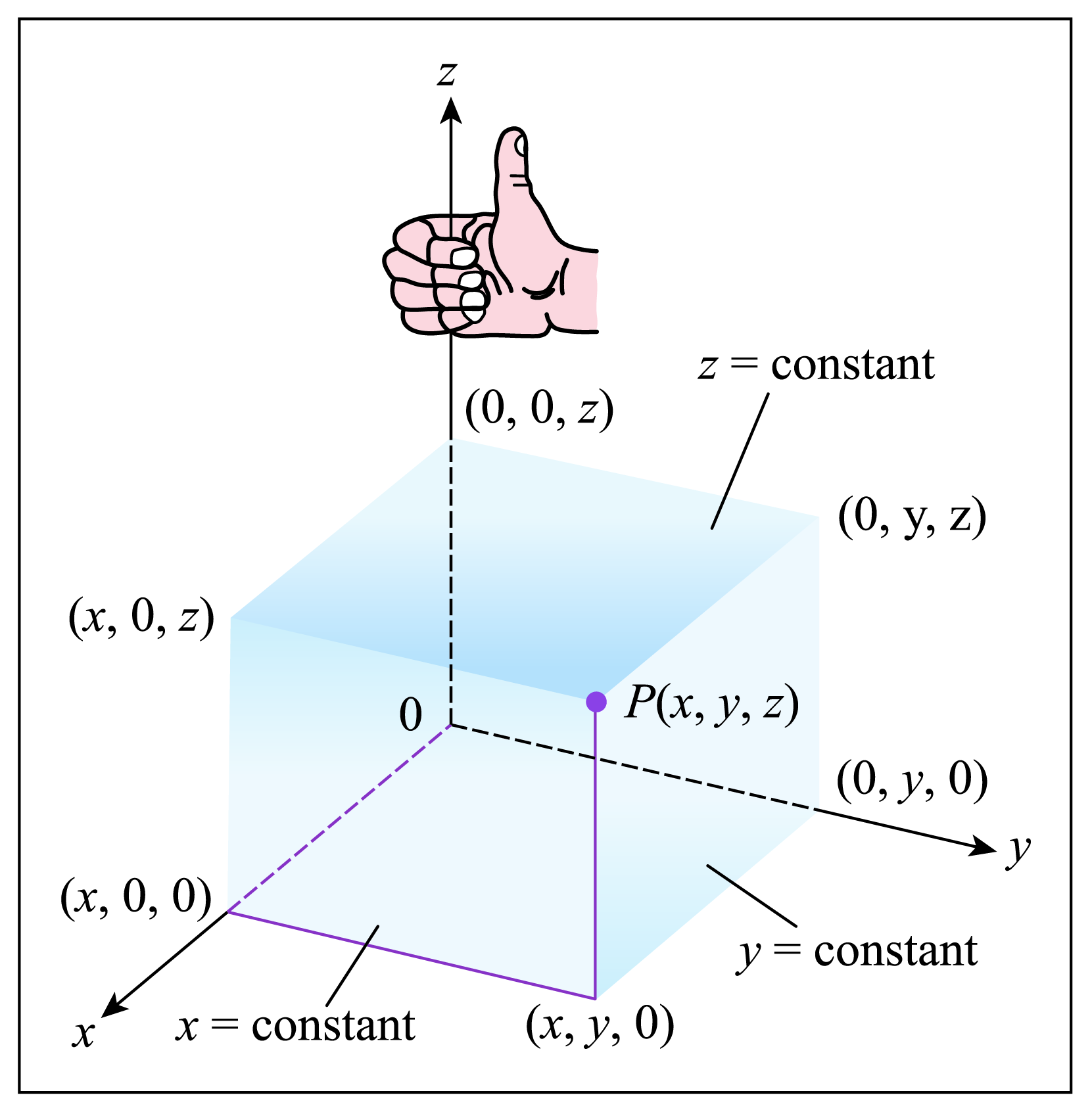
Before starting the topic of partial differentiation, the teacher took a good four to five classes discussing the ‘three-dimensional coordinate system’. His constant refrain was, if you do not get this you won’t follow anything in the upcoming discussion. To begin with, a model of the three-dimensional Cartesian coordinate system was drawn on the blackboard with three mutually perpendicular axes x, y and z, respectively. This diagram appeared to be nothing but a rather simple extension of the ‘two-dimensional Cartesian coordinate system’ to three dimensions with the addition of one more axis, that is, of height, perpendicular to the XY plane. However a new factor came to the fore, which was usually not there or was not considered important when one is introduced to a two-dimensional framework. This new factor was that of direction or orientation. What the teacher introduced was not simply a three-dimensional Cartesian coordinate system but a right-handed three-dimensional Cartesian coordinate system. Given above is a figure from the teacher’s presentation which depicts clearly what a right-handed three-dimensional coordinate system is (refer Figure 1).
Looking at the figure, one can note for oneself the distinct physical touch given to the diagram by depicting a curled palm on the z axis. The direction of the curled fingers specifies the positive direction of y axis, the thumb points in the direction of positive z axis and x axis is represented as perpendicular to the YZ plane. This step by the teacher brought a classic anthropological theme to the fore that learning begins through differentiation.
The teacher feels that the first thing that the students need to recognise is that they are not dealing with an undifferentiated space. In doing so he adopts a convention of ‘right-hand rule’ used in physics where angular momentum of a spinning particle is represented along the thumb of the right hand when it is spinning in the direction in which the fingers curl. Adopting this convention he underscores an anthropological theme, which detached studies of science and mathematics are unable to grasp, that a learning subject has to situate oneself vis-à-vis the space and has to endow this space with specific qualities, such as those of sacred and profane, right and left and so on, before one can even begin to ask questions about ecology and cosmos. Here the curled palm imbues the undifferentiated space with a sense of perspective and direction by introducing a learning subject in the midst. 25 This presentation was given a slightly dramatic sense by the teacher by asking the students to consider the classroom itself as a three-dimensional coordinate system and place themselves at the origin of this system, where the origin was nothing but the right-hand corner of the classroom. It emerges with this move that the orientation of the objects in space and the direction(s) in which they change depends on the presence of an observer. Putting it differently, the judgement of direction or orientation is literally mediated through the bodies of the learning subjects.
Moving from two dimensional to three dimensional a new factor that of height in geometry and time in physical cases is added and any point on the surface is specified with three coordinates (x, y, z) rather than two (x, y). Moreover, as already stated, the question of direction becomes even more important in the case of partial differentiation. Now it was in this classroom context that the symbol was seen as ‘interesting’, ‘powerful’, ‘mature’, ‘irresistible’, ‘apt’, ‘precise’ and so on. The students came out from the class and were discussing and chatting about the symbol over and above anything else. One of the statements that the author overheard and noted down in his field diary was, Ordinary derivative bada ho gaya isliye uski kamar jhuk gayi (ordinary derivative has grown mature that’s why it’s back is bent). 26 One of the students revealingly said that ‘ordinary derivative can be checked but partial derivative is irresistible’, suggesting that they have truly moved on from a dyadic to a triadic realm, to the realm that is truly transformative and extendable. The preceding discussion brings out that the metaphoric potential of the symbol emerged because of certain key steps which established and prepared the ground for it to emerge. This metaphoric aspect was also brought to the fore when some of the students compared the partially bent d to a paradigmatic metaphoric figure of the monster, owing to its extended applicability when compared to the straightened d. Not only did it emerge in the context of abstraction and direction or orientation, it also allowed the students to revel in these sinews hence also displaying its metonymic aspect. So there is a dual aspect to the delta symbol. Not only does it stand out but it also remains embedded in the discourse attesting to the physicality of engagement. By being so it breaks down the distance that students might have with the mathematical discourse. Thus they are able to engage with the idea of partial differentiation both intellectually (metaphorically) and viscerally (metonymically) through the medium of the symbol. So the symbol not only indicated a shift in registers but also secreted the context in which it emerged, thus enabling the students to pass over to the ‘as if’ mode without any fuss and almost unconsciously.
Conclusion
Veena Das in her subtle critique of Saul Kripke points out that he overrates the importance of agreement on rules rooted in the appeal to community in his interpretation of Wittgenstein’s solution to the sceptical paradox (Das, 1998). Rather taking a cue from Stanley Cavell, she points out that agreement in a form of life ‘is a much more complicated affair in which there is an entanglement of rules, customs, habits, examples, and practices and that we cannot attach salvational importance to any one of these in questions pertaining to the inheritance of culture’ (ibid., p. 176). These insights have been put to use in this article by setting forth that agreement on or belief in mathematical assertions or symbols cannot be taken for granted. Moreover, it is shown that agreement in mathematics, taken both as a language and as a form of life, grows around the complex process of the mutual absorption of what may be variously called mental, cognitive or intuitive and the social. As Roman Jakobson (1987, pp. 95–114) has shown that one gets a clearer sense of the fundamental structures of language by looking at the pathological cases of language loss, this article also begins an interrogation of the structure of mathematics as a form of life from what may be taken as a pathological case. By opposing two sets of responses to the same symbol in two separate contexts, the article isolates a relational framework with reference to which the contours of mathematics as a form of life can be drawn. Thus placing the two contexts on an equal level, one gains a sense of both the horizontal layout (controversies and debates over mathematical symbolism) and the vertical stretch (mutual absorption of the cognitive or mental and the social as and when symbols get absorbed into the discourse of students) of mathematical practice taken as a whole. Locating metonymy and metaphor as strains or affects which are released when discussants on the online forum and students in the classroom context encounter the symbol, it is shown that where metonymic potential enables the learners of mathematics to inhabit the discourse laterally, the metaphoric potential enables them to cross over to the next level. 27 But the fact that this will happen is contingent upon the context, and a set of factors therein is also demonstrated through the description. Thus the article provides a useful heuristic framework, which is open ended and context sensitive, through which controversies over mathematical symbols, whether located in the ethnographic present or historical ones, can be studied.
Moreover, the description offered in this paper also demonstrates that the concern with mathematical symbols is an important concern in itself. This is so because mathematical symbols are not simply representative of abstract ideas, they are also constitutive of them. This is particularly true of mathematical ideas which are complex and are difficult to grasp intuitively. Thus the argument made in the article clearly shows that there is more to symbols than just representation. To reiterate the point that has emerged through the article, aligning the two axes of metonymy and metaphor respectively with the twin senses of form and life into which the expression ‘form of life’ by Wittgenstein can be broken, one gets a simple and tentative structure through which various controversies over symbols in mathematics can be analysed and mathematics itself can be seen as a form of life. 28 It has been shown in this article how in one context metonymic displacement fails to lead towards the emergence of the metaphoric potential of the symbol and in the other this process takes place remarkably well such that a vague and intuitive shift to a different register is given a concrete form through the agency of the symbol. The author contends that with the help of this structure one can focus on any such controversy with a close attention to the context in which it took place in order to see which of the two potentialities, metonymic or metaphoric, enabled or disabled the concerned symbol(s) in becoming part of the mathematical discourse. Lastly, this paper has drawn out the importance of sociologically investigating aspects of mathematical symbolism because as mentioned before symbols are not just tools used by mathematicians but rather the very raw materials on which the mathematical practice is performed.
Declaration of Conflicting Interests
The author declared no potential conflicts of interest with respect to the research, authorship and/or publication of this article.
Funding
The author received no financial support for the research, authorship and/or publication of this article.