



Abstract
The purpose of this study is to investigate the effect of external knowledge search strategy on innovation ambidexterity for SMEs. In order to achieve the purpose of research, hypotheses were set up by dividing exploitative knowledge sources and exploitative knowledge. Based on the Tobit regression analysis results by using the 975 data of Science and Technology Policy Institute, this research provides four findings as follows: First, exploitative knowledge breadth positively and significantly influences innovation ambidexterity. Second, exploitative knowledge depth positively and significantly influences innovation ambidexterity. Third, explorative knowledge breadth positively and significantly influences innovation ambidexterity. Lastly, the relationship between explorative knowledge significantly influences innovation ambidexterity. The results indicate that their knowledge search strategies ware significant driver of their innovation ambidexterity. In the final conclusion section implications and limitations of research results and suggestion for future research are discussed.
Recently, it should be very important for companies to acquire and maintain competitive advantages to effectively respond to the external environment. In particular, small and medium sized enterprise (SMEs), which are relatively small and have resource constrains, must overcome the inertia of the organisation and promote change and innovation in order to secure the competitive advantages.
According to Lin et al. (2013), SMEs must continuously explore new technologies and services to achieve the dual purpose of growth and survival, as well as respond to uncertainties by utilising their current technologies and services. If SMEs focus too much on the exploration for innovation, they will fall into the failure trap, that is, by generating outdated new idea, they will be replaced by new ideas before they even produce organisational performance (Lin et al., 2013). On the contrary, SMEs are likely to fall into the success trap, if they focus on exploiting existing ideas or resources rather than exploring to create innovation (Levitt & March, 1988). From this point of view, it can be said that the source of competitive advantage for SMEs is to create the innovation ambidexterity that can effectively respond in an uncertain environment (Tushman & O’Reilly, 2007).
In terms of open innovation, it can be emphasised that it should be very important for companies to obtain and use knowledge from outside, beyond knowledge they have internally (Cohen & Levinthal, 1990). This is because companies can increase the possibility of creating innovation by combining the knowledge accumulated inside and the various knowledge possessed by external knowledge search (Monteiro et al., 2017). Prior studies (Anzola-Roman et al., 2018; Dyer & Singh, 1998) have argued that the need to pay attention to the contributions is being mentioned in many literatures related to the practice of innovation, that is, it can be conducted by the collaboration with external stakeholders. Therefore, a search strategy, that finds and utilises the knowledge and experience required for innovation from various external sources such as customers, suppliers, competitors and universities, can be considered as an important factor that can have a significantly impact on innovation performance (Kirschbaum, 2005; Laursen & Salter, 2006).
Despite the importance of open innovation, related theories and researches have been mainly centred on large companies (West & Bogers, 2017). Especially, there are not so many studies on how SMEs use external sources of knowledge throughout open innovation (Antikainen et al., 2010). Based on the above discussion, this study would like to examine the effects of firms’ exploration knowledge source and exploitation knowledge source on innovation ambidexterity in the context of SMEs. This study will be able to have academic implications by extending existed researches regarding to innovation ambidexterity, and practical implications by providing a better understanding of roles and key drivers of innovation ambidexterity.
The rest of article is organised as follows: the second section presents the hypotheses based on the concepts of innovation ambidexterity, external knowledge search strategy and external knowledge sources. The third section presents research methods. The fourth section presents the empirical results, and the fifth section discusses this study’s contributions, implications and limitations and proposes some suggestions for future research.
Literature Review and Hypotheses
Innovation Ambidexterity
Ambidexterity means the concept of pursuing contradictory attributes simultaneously. An early study of ambidexterity is described on the basis of contingency theory. Exploration aimed at long-term growth by developing new capabilities and use aimed at short-term growth by redeploying and expanding existing capabilities were perceived as conflicting and conflicting trade-off concepts (Tushman & O’Reilly, 2007). However, the recent perception of ambidexterity provides the theoretical foundation that two contradictory concepts of a company can coexist with each other based on the paradox theory (Gibson & Birkinshaw, 2004).
Research on ambidexterity innovation emphasises radical technological innovation and gradual technological innovation based on the concepts of exploration and exploitation proposed by March (1991). From an organisational learning perspective, exploration and exploitation have different methods, and it is necessary to strike a balance between the two (He & Wong, 2004). Exploration is essentially an attempt at new methods, meaning companies explore, discover and develop new knowledge. On the other hand, utilisation is described as improving and extending an inherently existing ability, skill, etc. (Koentjoro & Gunawan, 2021; March, 1991). From the perspective of dynamic capabilities, companies argue that exploration and exploitation are needed simultaneously for the two goals of survival and growth in order to respond to the changing environment (Lichtenthaler & Ernst, 2009).
Recently, innovation ambidexterity attracts attention because it has the ability to effectively adapt to a new and changing environment in order to secure and maintain a sustainable competitive advantage in a rapidly changing environment, although fit with existing businesses is also important. Innovation ambidexterity is to respond to disruptive changes that overturn the mainstream market, or the core capabilities built by the organisation can act as core rigidities that block new opportunities. It is possible to provide a source for raising the competitive advantage of the company (Christensen & Overdorf, 2000; Leonard-Barton, 1992). Empirical studies also show that companies that seek innovation ambidexterity have a competitive advantage over those that do not (Patricio et al., 2021; Tushman & O’Reilly, 2007). In particular, He and Wong (2004) examined the relationship between company innovation ambidexterity and performance in 206 manufacturing firms in Singapore and Malaysia. Research has shown that interaction between radical innovation and incremental innovation affects sales growth positively, while imbalance between radical innovation and incremental innovation negatively affects sales growth. Therefore, innovation ambidexterity strategy that simultaneously pursues both radical innovation and incremental innovation is a major factor that positively affects the performance of the company.
External Knowledge Search Strategy
Open innovation is defined as accelerating internal innovation and maximising value by appropriately leveraging the flow of knowledge into and out of the enterprise, and by expanding the market for external use of innovation (Chesbrough, 2003; Qu & Li, 2019). This type of innovation is characterised by different innovators, the formation of multi-organisational relationships among them, and internal and external paths to access distributed knowledge (Battistella et al., 2018). Open innovation activities of company are known to reduce innovation costs (R&D) and shorten the time it takes to commercialise new ideas, as well as creating new sources of revenue, positively impacting innovation productivity (Chesbrough, 2003). In the previous studies, open innovation based on continuous interaction and openness with other organisations, suggesting that cooperation with external networks promotes innovation activities and reduces innovation costs and risks to improve innovation performance (Ahuja, 2000; Belderbos et al., 2004; Yun et al., 2016).
The key to open innovation is how companies use the ideas and knowledge of external partners in the innovation process (Laursen & Salter, 2006). Companies are exploring various external entities in order to acquire the knowledge required for innovation activities, and each entity has different characteristics in terms of the type of knowledge and accessibility it possesses. In general, companies collaborate with universities and research institutes to acquire knowledge (Conway, 1995) and include suppliers, customers and competitors (von Hippel, 2005). Recently, its scope has expanded to realise open innovation through cooperation with foreign companies (Garriga et al., 2013). The knowledge that the company wants to understand from the outside is not limited to ‘new technical knowledge’ but it also contains ‘extant market knowledge’ linked to production, marketing and customer knowledge. In this study, we focus on exploratory search and exploitative search (Lane et al., 2006; Lichtenthaler, 2009).
In this regard, early research on knowledge search activities were classify local search and non-local search in the horizontal dimension of ‘knowledge search scope’ (Levinthal & March, 1993). The former contributes to incremental innovation through internal exploitative search activities within the scope of the existing knowledge that he possesses. The latter, on the other hand, suggests that it contributes to radical innovation an external explorative search activity on the new knowledge domain through the extension of the search domain. This is followed by attempts to identify explorative and exploitative agents, arguing that the types and impacts of enterprise search activities differ not only by horizontal dimension but also by vertical dimension (Chesbrough, 2003; Katila & Ahuja, 2002).
Laursen and Salter (2006) describe the external knowledge search activities of firms as horizontal characteristics and vertical characteristics according to the diversity of knowledge and the strength of utilisation. This search activity can be approached from the perspective of the breadth and depth of external knowledge. Knowledge breadth means the number of sources or exploration paths of different types of external knowledge used in an enterprise’s open innovation activities (Garriga et al., 2013). Companies can contribute to the reduction of uncertainty by acquiring external knowledge from a wide range of sources (Levinthal & March, 1993), and may have the potential to combine knowledge elements with novelty by searching knowledge from multiple sources (Zhou & Li, 2012). Knowledge depth refers to more specialised knowledge seeking activities focusing on a small number of external knowledge sources (Leiponen & Helfat, 2010). This enables the efficient combination of knowledge selection and knowledge in the process of knowledge search, thereby increasing the possibility of innovation (Katila & Ahuja, 2002). In the empirical study, the extent of external knowledge search is related to firm’s radical innovation, and the depth of external knowledge search shows a positive relation with gradual innovation (Chiang & Hung, 2010). This result implies that external knowledge search strategy plays an important role in the innovation ambidexterity.
Explorative Knowledge Sources and Innovation Ambidexterity
Explorative knowledge tends to have a tacit and uncertain value in seeking new knowledge beyond the scope of a company’s technology (Lavie & Rosenkopf, 2006). It is attracting attention as a source for exploring different levels of knowledge, such as external research institutes and universities (Faems et al., 2005). Universities, government agencies and companies in other industries are all considered to be horizontal partners (Stefan & Bengtsson, 2017). Horizontal technological collaboration can have a ‘spillover effect’ on SMEs, so it can have a learning effect on future innovative developments (Lichtenthaler, 2009).
Companies can use advanced technology through collaboration with universities and research institutions (Fukawa et al., 2021; Tether & Tajar, 2008). The external knowledge of universities and research institutes tends to be used more by R&D intensive high-tech companies. This is because these sources of knowledge can guarantee significant research and development for projects that are deemed too expensive or too risky for the business (Caloghirou et al., 2004; Yun et al., 2016). Therefore, use of this type of knowledge is positively associated with technology innovation (Rodriguez et al., 2017). Based on the discussions, the following hypothesis is proposed:
Exploitative Knowledge Sources and Innovation Ambidexterity
Exploitative knowledge refers to the knowledge that is used to enhance the skills or knowledge already held by a company (Koza & Lewin, 1998; Lavie & Rosenkopf, 2006). This knowledge can be obtained information and knowledge for problem solving on site through suppliers, customers and competitors in the company value chain (Katila & Ahuja, 2002).
Collaboration with suppliers is effectively enhance efficiency and complement the technological-base of company (Un et al., 2010). Customers can help better clarify market requirements for innovative products, services or processes and help to spread the cost and risk of innovation processes (Mina et al., 2014). Competitors can be complex and dangerous, but if partners can identify common goals, the availability of technology development through external support can increase significantly (Lee et al., 2018). Such diverse external knowledge forms the basis for designing radical and/or progressive innovation activities, as both exploratory and exploitative learning possibilities can be preferred (Koza & Lewin, 1998). Therefore, use of this type of knowledge are more likely to establish and engage in more inter-firm collaborative innovations with higher levels of performance. Based on the discussions, the following hypothesis is proposed:
Methods
Sample and Data Collection
This study used the ‘Korea Innovation Survey’ (2016) data from the Science and Technology Policy Institute (STEPI). This data is based on the Oslo Manual of OECD as a statistical survey to identify and provide the statistical data necessary for establishment of national innovation policy and innovation research by grasping the status of innovation activities of Korean manufacturers. To ensure data accuracy, we excluded companies that responded that radical innovation and gradual innovation did not take place over the past three years (2013–2015), and excluded companies with missing variables. As a result, a total of 975 samples were used for the analysis.
Variable
First, dependent variable is corporate innovation ambidexterity, consisting of radical innovation and incremental innovation. Radical innovation is measured as 1 or 0 when a new product is completely different from the existing product over the past three years and incremental innovation is measured as 1 or 0 when the product has been significantly improved compared to the existing product. Innovation ambidexterity is operationalised as incremental innovation performance times radical innovation performance (Koza & Lewin, 1998). In previous studies, multiplicative scale is preferred over a sum. This is because it makes it possible to capture whether the radical and incremental innovation measures are in balance (Gibson & Birkinshaw, 2004).
Second, independent variables were made by organising them according to the operational definitions given in the study of Laursen and Salter (2006). Explorative knowledge breadth investigated how important each knowledge source (suppliers, customers and competitors) was used for development for the ambidexterity innovation. In this case, the value of each source is set to 1, otherwise it is set to 0, and the values of each source are summed. Explorative knowledge depth investigated how important each knowledge source (consulting and private research institutes, universities, government participation institutes and national research institutes). was used for development for the ambidexterity innovation. In this case, the value of each source is set to 1, otherwise it is set to 0, and the values of each source are summed. Exploitative knowledge breadth investigated how important each knowledge source (suppliers, customers and competitors) was used for development for the ambidexterity innovation. In this case, the value of each source is set to 1, otherwise it is set to 0, and the values of each source are summed. Exploitative knowledge depth investigated how important each knowledge source (consulting and private research institutes, universities, government participation institutes and national research institutes) was used for development for the ambidexterity innovation. In this case, the value of each source is set to 1, otherwise it is set to 0, and the values of each source are summed.
Finally, control variables were used. SMEs require time to have an opportunity to build their capability to Innovation ambidexterity. Measured in years in operation, firm age was controlled for. Because the number of employees can also influence Innovation ambidexterity, the number of employees was controlled for. Because the R&D cost can also influence Innovation ambidexterity, the R&D cost was controlled for. These three variables were log-transformed to correct for any bias. The description of the sample characteristics is shown in Table A1.
Model Specification
The dependent variable is double bounded and between 0 and 1, that is, it is in the category of limited dependent variables (Long, 1997). In this case, due to those linear regressions (e.g., ordinary least squares) can lead to incorrect parameter estimations, it is needed to make them less than ideal (Wiersema & Bowen, 2009; Wooldridge, 2012). Base on previous studies (Ardito et al., 2018; Banerjee & Cole, 2010), we would like to correct this issue by adopting a Tobit regression, an econometric technique that can be considered as the most suitable method to be able to manage or deal with limited dependent variables (Ardito et al., 2020; Wooldridge, 2012).
Analysis and Results
Correlations
Table A2 shows the correlation values. As a result, all below the 0.70 threshold, thus limiting issues of multicollinearity (Mina et al., 2014).
Hypothesis Testing
Table A3 illustrates the direct effects for all hypothesised paths. Model 1 represents the relationship of the control variables, and models 2–5 show the results of the direct effects of the independent and dependent variables. Model 6 is the full model; it is intended to identify the relative importance of the relationship with the dependent variable. Specifically, the antecedents, namely explorative knowledge breadth (β = 0.481, p < 0.05), explorative knowledge breadth (β = 0.266, p < 0.01), exploitative knowledge breadth (β = 0.264, p < 0.01) and exploitative knowledge depth (β = 0.290, p < 0.01) had significant positive effects on innovation ambidexterity, providing support for H1, H2, H3 and H4.
Discussion
Summary
The purpose of this study is to investigate the effect of external knowledge search strategy on innovation ambidexterity for SMEs. In order to achieve the purpose of research, hypotheses were set up by dividing exploitative knowledge sources and exploitative knowledge. Based on the Tobit regression analysis results by using the 975 data of STEPI, this research provides four findings as follows: First, exploitative knowledge breadth positively and significantly influences innovation ambidexterity. Second, exploitative knowledge depth positively and significantly influences innovation ambidexterity. Third, explorative knowledge breadth positively and significantly influences innovation ambidexterity. Lastly, the relationship between explorative knowledge significantly influences innovation ambidexterity.
Theoretical and Practical Implications
This study expands on open innovation theories by simultaneously considering the explorative knowledge and exploitative knowledge in the innovation ambidexterity. It is true that research on open innovation has been going on so far. However, most of the previous researches (Ardito et al., 2020; Savino et al., 2017) have considered only a single type such as product innovation or process innovation, or the whole external knowledge source, respectively. Therefore, this study can find the theoretical contribution in that it examines the relative importance by analysing the influence of the knowledge exploration strategy on the innovation ambidexterity by classifying the external knowledge.
These findings are expected to provide useful practical implications as follows: First, companies require a clear capacities and significant external resources to meet their innovation. However, most SMEs have a lot of difficulties in their innovation activities. In particular, a chronic shortage of resources is cited as a crucial factor that fails to generate innovation. A variety of external knowledge is a long-term source of competitive advantage by reducing the cost and time required for innovation activities in the company. Therefore, it suggests that SMEs need to develop technologies and services for a higher market position than their competitors and acquire various knowledge to develop new markets.
Second, the breadth and depth of external knowledge among SMEs’ external knowledge search strategies has a positive effect on the ambidexterity innovation. Especially, the knowledge breadth was relatively important factor compared to the knowledge depth. This result implies that a large number of SMEs’ networks means that the number of external resources that can be utilised increases, and SMEs need to have a range of knowledge because they are more likely to absorb knowledge and contribute to innovation from various sources.
Third, explorative knowledge among external knowledge sources for innovation of SMEs is relatively important compared to the exploitative knowledge. These results show that SMEs have a weaker supply chain link structure than large corporations, so they do not have the breadth and depth of knowledge required. Therefore, it is suggested that SMEs are more important to work with universities and research institutes to acquire knowledge to enter new markets.
Limitations and Suggestions for Future Research
Despite these contributions and implications, this research has several limitations, which are presented with suggestions for future studies. First, in this study, all variables were analysed using secondary data. However, it is impossible to verify various factors affecting innovation duality by using only secondary data. Future research will be necessary to examine various factors affecting ambidexterity innovation by using primary data. Second, this study considers the firm age, firm size and R&D cost as control variables but does not control the industry differences. In future research, it would be meaningful to conduct a comparative study by categorising the surveyed companies into industries. Finally, this study focuses only on external knowledge search from the open innovation perspective as a major factor influencing ambidexterity innovation. However, in order to build ambidexterity innovation, there are characteristics that are realised by various activities of the company. Future research will be necessary to examine more specifically the relationship between knowledge search and ambidexterity innovation. For example, it may be meaningful to examine ‘black-box’ between external knowledge search and ambidexterity innovation by setting various factors such as corporate knowledge protection activities, HRM and corporate strategy as mediator and moderator.
Footnotes
Acknowledgements
This work was supported by the 2020 Yeungnam University Research Grant. We are very grateful to Jinhyo Joseph Yun for his many helpful comments, and to Dongwoo Ryu and Kwang Ho Baek.
Declaration of conflicting interests
The authors declared no potential conflicts of interest with respect to the research, authorship and/or publication of this article.
Funding
This work was supported by the 2020 Yeungnam University Research Grant.
Appendix
Results of the Tobit Regression Analysis
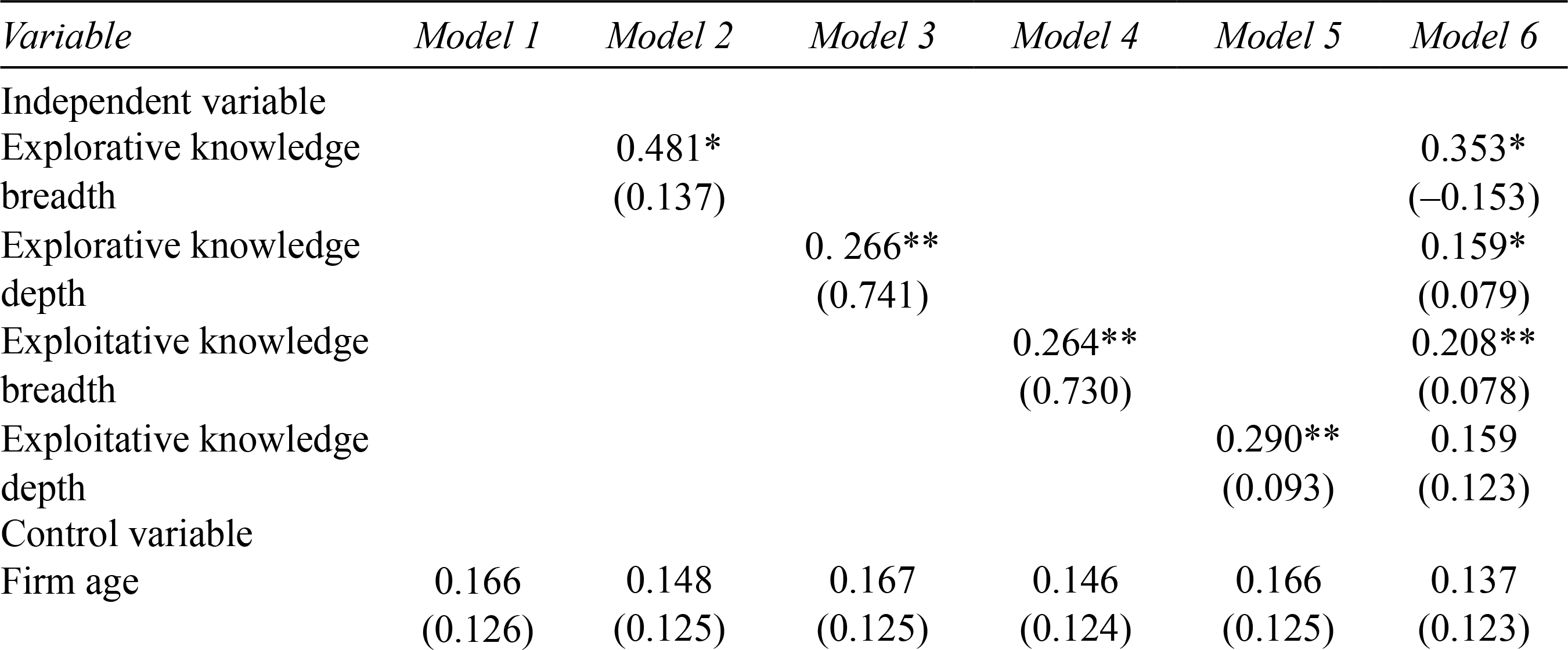
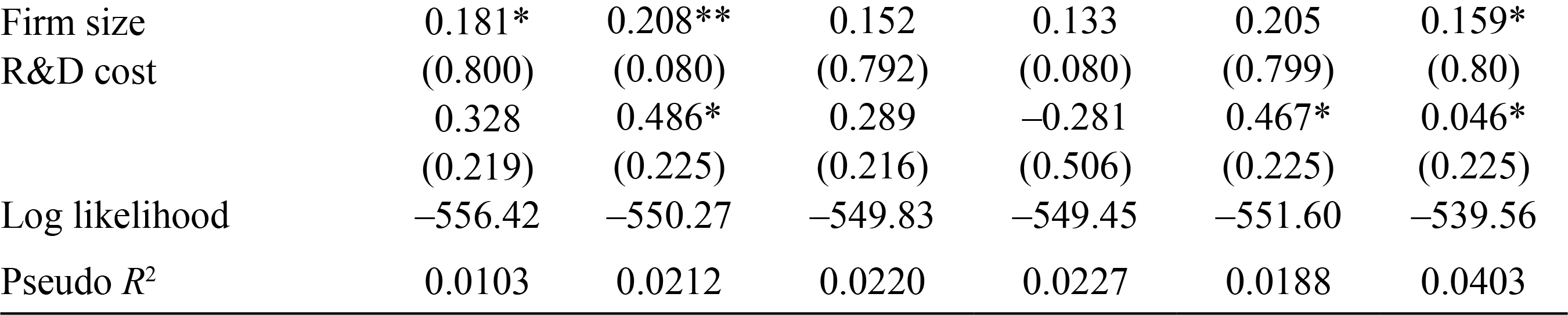
| Variable | Model 1 | Model 2 | Model 3 | Model 4 | Model 5 | Model 6 |
| Independent variable | ||||||
| Explorative knowledge breadth | 0.481* (0.137) |
0.353* (–0.153) |
||||
| Explorative knowledge depth | 0. 266** (0.741) |
0.159* (0.079) |
||||
| Exploitative knowledge breadth | 0.264** (0.730) |
0.208** (0.078) |
||||
| Exploitative knowledge depth | 0.290** (0.093) | 0.159 (0.123) |
||||
| Control variable | ||||||
| Firm age |
0.166 (0.126) |
0.148 (0.125) |
0.167 (0.125) |
0.146 (0.124) |
0.166 (0.125) |
0.137 (0.123) |
| Firm size R&D cost |
0.181* (0.800) 0.328 (0.219) |
0.208** (0.080) 0.486* (0.225) |
0.152 (0.792) 0.289 (0.216) |
0.133 (0.080) –0.281 (0.506) |
0.205 (0.799) 0.467* (0.225) |
0.159* (0.80) 0.046* (0.225) |
| Log likelihood | –556.42 | –550.27 | –549.83 | –549.45 | –551.60 | –539.56 |
| Pseudo R2 | 0.0103 | 0.0212 | 0.0220 | 0.0227 | 0.0188 | 0.0403 |
Standardised coefficients (standard error) are reported.