




Abstract
Informed by Foucault’s governmentality, this article examines the making of the smart home in China. Operating within the nexus of security and risk, smart homes foster a discourse of the ‘the good life’ that accelerates AI’s integration into the population’s daily life. Taking Xiaomi (a renowned smart home technology company) as a case study, I trace how commercial practices formulate issues of security and risk in three smart home products: smart door lock, home surveillance camera and virtual home assistant. Drawing on visual and discourse analyses of Xiaomi’s promotional materials, this analysis is structured around three levels of relationships: (a) trust and ontological security; (b) the practices of government and the practices of self (c) and the technologisation of Chinese society. This analysis demonstrates that Xiaomi further advances the state-driven technologisation of Chinese society, in which subjects are guided to embrace the positive dimensions of technology for self-actualisation and self-management. However, the technology that makes domestic life and the physical home more reliable, less prone to risks and more secure has at the same time further eroded social relations and trust.
Introduction
Recent (Mobile) Technology developments in China have given rise to a discourse on smart living. Within this broader context, the making of the smart home has gained momentum, with an annual growth rate of 20% (Daxue Consulting, 2019). The smart home, broadly understood as home automation, refers to the interaction with, monitoring and controlling of home appliances through the Internet and mobile applications in order to increase the quality and security of home life. Issues of privacy and cybersecurity risks, which have generated popular debates and concerns in the Western media, are often superseded in China by the discourse on smart living that celebrates efficiency, traceability, reliability and security. Nevertheless, the notions of security and risk are central for both: While the former concerns surveillance and control, the latter reveals how smart technologies are incorporated into (self-governance). The smart home is a key aspect of the State Council’s Next Generation Artificial Intelligence Development Plan (hereafter AI Development Plan), which aims to make China a global AI leader by 2030 (The State Council of The People’s Republic of China [¹úÎñÔº], 2017). But little attention has been given to exploring how issues of security and risk are formulated in relation to smart home technology.
Smart homeware has been recognised as one of the seventeen artificial intelligence (AI) development priorities which help advance the development of the smart economy and build a safe and convenient smart society (The State Council of The People’s Republic of China [¹úÎñÔº], 2017). The foundational principles laid out by the AI Development Plan call for active commercial- and market-driven collaborations (The State Council of The People’s Republic of China [¹úÎñÔº], 2017). The Ministry of Industry and Information Technology has recruited fifteen private companies to spearhead the country’s AI developments. Xiaomi was handpicked to lead the development of smart household products.
This article examines how the making of the smart home operates to foster the discourse on ‘the good life’ that accelerates AI’s integration into the population’s daily life. Building on the Foucauldian (1991) concept of governmentality, the governmentalisation of the home (as a household) provides the analytical framework to examine the relationship between national security and home-fashioning—how the practices of government guide individuals’ active participation in managing security and risk for the self, at home and within a household, on the daily basis. Security is anchored to fear, uncertainty, threats, dangers and risks. In this study, security and risk are understood in two senses: first, both consist of discursive knowledge formulated to shape the order of things so as to manage the population more efficiently and effectively; and second, security, as an achievement of safety, requires risk management.
This study zooms in on Xiaomi to examine how a leading technology company formulates issues of security and risk in its smart home products. It contributes to two research areas that are intertwined yet frequently overlooked. The first is the significantly understudied area of home (physical dwelling and household) in China Studies. Home has been intertwined with the governmental aim of building a xiaokang (a moderately prosperous) society since the Reform and Open-door Policy of the late 1970s, which drives economic growth by fostering individuals’ aspirations for a comfortable modern home equipped with electrical appliances (e.g., a television, washing machine). This has evolved into the popular discourse on ‘the good life’, which is often closely related to economic security that are connected with other levels of security—be they ontological, social or national. Common aspirations of ‘the good life’ are home ownership and an improved quality of living that is enhanced by technology (Chong, 2020). Technology at home, intersecting with the discourse on smart living, is crucial in shaping a subject’s aspirations for ‘the good life’. This aspiration directs subjects’ self-management that helps advance the governance of a population.
The second area of research concerns the notions of security and risk in smart everyday technology. Security, risk and trust are central to the realisation of the smart home (Coumau et al., 2017); yet most smart home studies focus on the (technological) design and (potential) usage of smart homes (cf. Patil et al., 2017; Strengers & Nicholls, 2017; Nicholls et al., 2017). Recent studies have begun to examine smart home (and data-) surveillance (cf. Apthorpe et al., 2017; Mäkinen, 2016; Maalsen & Sadowski, 2019). Whereas research interests in security and risk studies lie mainly in the political, spectacular and antiterrorism efforts (cf. de Goede, 2008; Ericson & Doyle, 2010), little has been done to examine the non-spectacular, ordinary, domestic and private realm of homemaking through the security, risk and technology lens.
In the following, I will first discuss the ways in which (smart home) technology has been incorporated into governmentality and how security and risk are essential in understanding the governmentalisation of the home. Next, in the methodological notes, I will illustrate the importance of Xiaomi’s promotional materials for visual and discourse analyses. These materials guide and shape citizen–subject’s aspirations towards security and risk in smart homeware. Background information about Xiaomi, and the reasons for selecting three smart appliances—a smart door lock, a home surveillance camera and a voice-controlled smart speaker (also known as virtual home assistant)—are provided for contextual understanding of this analytical framework. The analysis is organised around three themes: (a) trust and ontological security; (b) the practices of government and the practices of self; and (c) the technologisation of Chinese society: from personal security, home security and societal security to national security.
The home automation market in China is in its infancy, with just 12.2% household penetration in 2020 (statista, 2020). Technology companies are in the process of actively exploring and constructing the changing and diversifying desires and interests of the population. The development of Xiaomi, which has tripled its revenue in smart home products from 2017 to 2019 (statista, 2020), provides important insights in the making of a positive societal discourse on novel technology development. They offer a key example of how smart homes bring security, trust, reliability and certainty to daily life. By transforming the relationship between users and everyday objects at home, home automation products re-define and re-imagine what ‘the good life’ is for a citizen–subject, a family household and society. The development of the smart home further advances the technologisation of Chinese society. Subjects are shown the advantages of new opportunities in their everyday lives, lessening their dependency on and need for others (such as families and communities) and increasing their mobility away from their homes/hometowns. They are encouraged to embrace the technology-led changes without hesitation; however, in constructing the discourses on the need for home automation products, Xiaomi mobilises and configures imaginations of risk and an individual’s vulnerability that only technologies, not social relations, can help resolve in everyday life. This advocacy for smart home technology that makes domestic life and the physical home more reliable, less prone to risks and more secure has at the same time further eroded social relations and trust.
Smart Governmentalities: Home, Security and Risk
Technology companies in different parts of the world have envisioned and rolled out different kinds of smart home products, ranging from cloud-based virtual assistants to Internet of Things (IoT)-based automation that controls surveillance devices, heating and air conditioning, and from AI-based biometric door locks (using fingerprint or facial recognition) to voice-controlled sensors. The current popularity of smart home technology not only taps into what Featherstone called ‘the aestheticisation and stylisation of everyday life’ (Featherstone, 2007, p. 64) but also captures the growing need for everyday securitisation and sustainability across the world. With its spectacular growth in the past decades, and its expanding middle-class population, China’s consumption-driven economy deserves critical examination of how technology intertwines with stylisation (as a status symbol) and securitisation in the governmentalisation of the home.
Michel Foucault developed the concept of governmentality to broaden the analysis of ‘government’. This, he emphasised, should not be limited to the administration of a state but includes a wide array of relations interwoven within state and society. The practices of government, in Foucault’s words, are ‘multifarious and concern many kinds of people: the head of a family, the superior of a convent, the teacher or tutor of a child or pupil’ (Foucault, 1991, p. 91). Foucault suggested that the power of the state should be examined according to the productive exercise of power, that is, how it arranges a wide array of strategies, tactics, and discourses, not solely by the negative forms of power, such as coercion or fear: ‘It [power] needs to be considered as a productive network which runs through the whole social body, much more than as a negative instance whose function is repression’ (Foucault, 1980, p. 119). The concept directs attention to the diversity of ‘government’ and the importance of knowledge in regulating subjects and ensuring security within national territories. The art of government manifests in the ways that it establishes a continuity between the governance of the state and the governed, ‘in both an upwards and a downwards direction’ (Foucault, 1980, p. 91).
Fundamental in this formulation of governmentality is what Foucault (1991) called governmental rationalities, which are the systematic ways of thinking about and managing the socio-economic and political governance of a population. Against the backdrop of the global acceleration of technological development, and China’s ageing population and economic slowdown, the state put forward several national technology-driven strategic plans: Made in China 2025 and Internet Plus in 2015, and AI Development Plan in 2017. These plans demonstrate the government’s knowledge of the extraordinary potential offered by technology for securing its economic growth, political stability and legitimacy, and national security. The authorities have been tactically learning and organising strategic plans that help achieve its desired ends. A key strategy is to entice technology companies’ participation in these plans, actively seeking their (technological) innovativeness, expert knowledge and unique market insights about the population’s needs and desires to advance its governmental techniques (Chong, 2019; Stevens, 2019). Only five companies (Baidu, Alibaba, Tencent, iFlytek and SenseTime) were enlisted for the initial phase of the AI Development Plan in 2017, and ten other companies were recruited during the following year to accelerate the complete integration of AI into the population’s daily lives (Dai, 2019).
The present study decentres a single focus on the state by examining the practices of a commercial technology company in cultivating subjects’ aspirations, perceptions and behaviour in adopting smart home technology in their domestic environment. Not only do these technology companies thrive on their market competitiveness and technological innovativeness, their strategic collaborations with the state are motivated by their own interests, as their survival and success also depend on the Chinese authorities. Besides which, it is in Xiaomi’s innate interests to accelerate the population’s use of its smart homeware. Home automation technology requires network connectivity to collect and exchange data and to control and interact with devices remotely. The expansion of the smart home market could increase Xiaomi’s pace in developing a comprehensive digital ecosystem via its primary brand product—the smart phone—and therefore advance its market influence in the fast-moving technology market.
Foucault mentioned three essential types of government, each concerning a specific domain of knowledge: ‘the art of self-government, connected with morality; the art of properly governing a family, which belongs to economy; and finally, the science of ruling the state, which concerns politics’ (Foucault, 1991, p. 91). Home is the physical site where these three levels of government are connected as well as materialised, although Foucault did not write specifically about the home and technology. In the aftermath of 9/11 in the USA, James Hay (2006) examined how home-fashioning was mobilised against terrorism, arguing that safety, security and risk have been fundamental in the governmentalisation of the home since the 1950s. Home, as Hay argues, is
… made into a site of active citizenship through the imperative to watch over and after oneself, through fashioning (and protecting) the household as a moral economy (a regimen or system of rules) that allows a resident to feel most oneself and most at home in the world. (Hay, 2006, p. 357)
The moral economy of the household, Hay argues, demonstrates how ‘home safety’, enacted by and extended from individuals to the community, is linked to ‘national security’ (Hay, 2006, p. 350). This moral economy is what Foucault called ‘the conduct of conduct’—how the behaviour of an individual is shaped and guided (Gordon, 1991, p. 2) for self-government, and for the government of others, to guide their possible actions (Foucault, 1991, p. 91).
The making of the home, the physical dwelling, a household, is ‘a sphere of government and particularly of governing risk and of making oneself (and one’s family/household) safe and secure’ (Hay, 2006, p. 355). Hay also observed that since the 1950s, an assemblage of ‘smart’ technologies—‘intelligent’ household appliances, such as garage-doors, alarm clocks, microwave ovens, and the like—have been introduced and linked to home security and household risk management (Hay, 2006, p. 366). These smart appliances empower subjects to manage domestic tasks ‘at a distance’, fostering ‘a new rationality about freedoms at home and of being at home away from home, became integral to an emerging political reasoning that valued citizens’ self-sufficiency and self-directedness—a ‘neo-liberalisation of the domestic sphere’ (Hay, 2006, p. 367). ‘A smart home is a safe home’ made possible through individuals’ self-directedness as well as self- actualisation through technological home devices (Hay, 2006). Security within a nation-state is assured when techniques of self-management—including risk-management and self-preservation—are practiced and normalised on a daily basis, by subjects, at home and from home.
Hay’s exceptional study is aligned with the approaches put forward by scholars in post-9/11 antiterrorist security and risk studies, which urge us to examine the practices of security from defence to prevention (de Goede, 2008) and risk management to ‘preventive security’ (Aradau & Munster, 2007). These scholars have indicated that the everyday practices of securitisation (Bigo, 2002) have increasingly mobilised imaginations of threats and dangers, risk and surveillance (Andrejevic, 2005; de Goede, 2004, 2008) that link security studies to the question of sovereignty and legitimacy (cf. Schmitt, 1985) confining.
Although Hay examined how security concerns have been mobilised at the frequently overlooked micro-, domestic level, his study remained centred on a ‘recognisable’, spectacular, ‘imminent’ and terrorist threat. Moreover, the dominant focus on antiterrorism and national defence tends to assign universal meanings to security and risk, which overlooks how these practices are discursively constructed and determined by socio-cultural, historical and political contexts. What is perceived as a security issue with potential risks for the citizen–subject and nuclear family in a suburban house in the post-9/11 US context is likely to have a different meaning for those living in (urban) China. How Xiaomi takes a pioneering role in shaping the discursive perceptions of security and risk in the smart home will be explored in the following sections.
Methodological Notes: Xiaomi
Governmentality investigates the ‘how’ questions of governing: how one is governed, how one governs others and the relationship between the government of the state, the government of others and the government of oneself (Dean, 1999; Jeffreys & Sigley, 2009). These ‘how’ questions exemplify the ways in which a wide range of strategies, tactics and discourses are being arranged and practised, so as to guide, shape and discipline citizen-subjects’ aspirations and commitment to the state’s desired ends. Xiaomi’s promotional materials, representing its strategic positioning of the products to the population, are essential in shaping the ways the citizen–subjects perceive smart technologies, and thus mediate these governmental relationships. Drawing on visual and discourse analyses of Xiaomi’s promotional materials, this study examines how they configure the imaginations, perceptions and discourses of security and risk in accelerating the population’s use of smart home technology.
Regulations and market dynamics in China have allowed Chinese companies to advance and dominate in this relatively new smart homeware market. Xiaomi is a pioneer, with over 10 million active users in its leading smart home mobile application (Mi Home) in China (statista, 2020). Formed in 2010, Xiaomi is an electronics company that initially made smartphones. Its expansion to a global brand is seen as a renowned example of how China’s shanzhai (“mountain village”, a term used to refer to low-cost copycat productions) manufacturing of knock-off (low-end) products has progressed to the production of innovative and high-quality designed-in-China products (Shirky, 2015). In 2013, Xiaomi recognised the growing potential of the IoT and since then has invested in and partnered with hardware start-ups, such as Redmi (a budget-to-mid-range smartphone line of Xiaomi), Huami (a cloud-based healthcare provider, utilising wearables) and Viomi (a smart home appliances company), turning them into subsidiaries and integrating their products into its ecosystem. Huami and Viomi have been listed since 2018 on the New York Stock Exchange and the US-based Nasdaq Stock Market, respectively, while Xiaomi Corporation was listed on the Hong Kong Stock Exchange since the same year.
Today, Xiaomi has evolved into an ecosystem of products, ranging from phone accessories, to Internet-and smartphone-connected devices and lifestyle products. It builds mobile apps, and has its own e-commerce lifestyle online shop, Xiaomi Youpin (which means ‘Xiaomi has taste’). Its innovativeness and growing market influence lie in its capacity to harness, first, the country’s booming development of (technology) start-ups, and second, the country’s vast consumer need for products that are affordable, tasteful, and functional: ‘value for money’. Its growing popularity has given it a solid fan-base, known as Mi-fen/fan (a homophonic pun on ‘rice noodles’).
The analysis draws on two corpora of media materials: first, product information from Xiaomi’s webpage mi.com 1 ; and second, promotional videos (product advertisements), which capture essential features of the smart products and are embedded in the webpages. These advertisement videos are also available on popular video websites, such as Youku. All these product promotional materials were extracted in 2019 and 2020.
Three products—smart door lock, home security camera and voice-controlled smart speaker (also known as virtual home assistant)—were chosen for the analysis. The three main reasons that motivate Chinese consumers to purchase smart home products are as follows: (a) home security; (b) convenience and comfort; and (c) pleasure in using technologically advanced products (Daxue Consulting, 2019). Driven by the need for home safety, the smart door lock and home security camera are popular because they function to prevent unwanted risks and threats, rendering the dwelling a safe and secure private place for the household.
The voice-controlled smart speaker is an all-round virtual home assistant that checks daily agendas, weather and traffic, plays music, makes calls, asks questions and performs all kinds of household management tasks. It is one of the most popular smart home appliances in China, where the market for smart speakers doubled during the period 2016–2019 (Daxue Consulting, 2019). Lei Jun, chairman of Xiaomi, expressed surprise about the popularity of the company’s smart speaker. He said, ‘We found children playing with them as toys, while the elderly were using them when no one is at home to kill time, even when it may not be very smart at first’ (Dai, 2018). Families with children are the main consumers (Daxue Consulting, 2019), as these speakers have the capacity to help teach and entertain young children.
The Governmentalisation of Home: Xiaomi’s Smart Home and ‘the Good Life’
The governmentalisation of home seeks individuals’ active participation in managing security and risk through an array of relationships—between the technology, ‘the self’, members within the family, the household and the social environment—on a daily basis. As a socio-cultural concept, security and risk in the Chinese language reflect the intertwining relationship between the practices of government and the practices of the self. The word ‘security’ consists of two characters—peace/safe (°²), complete/entirety/well-equipped (È«)—a state of being that is acquired from being well-prepared and complete. It suggests the techniques of self-directedness and self-management are needed to be in control, being well-equipped and therefore immune from external harm or threats, and potential risks. Security goes in tandem with the socio-cultural practice of trust (ÐÅÈÎ)—belief/faith/confidence (ÐÅ)—and responsibility (ÈÎ). When one is well-prepared and in complete control, there is trust; when there is trust, one feels safe. Security is intrinsically linked to the action of risk-management. It is a sphere of government since this condition requires regularised and regulated maintenance, from the personal, the household and the social to the political level.
At the heart of security lies the quest to prevent potential risks from developing into real dangers. Security and risk are two sides of the same coin. In Chinese, risk (風險) consists of two characters—wind (風) and danger (險)—suggesting that potential danger may emerge along with a varying velocity of wind. As a part of nature, risk is inseparable from daily life. Managing risk is about managing probability, being prepared and vigilant and taking precautionary actions to ensure security.
To understand how issues of security and risk are framed, the analysis below is structured around three interwoven levels of relationships: (a) trust, smart technologies, and ontological security; (b) the practices of government and the practices of self: risks and self-management; and (c) the technologisation of Chinese society: from personal security, home security and societal security to national security.
Trust, Smart Technologies and Ontological Security
Xiaomi is renowned for offering quality products at a highly competitive price, a marketing strategy that makes products highly accessible and popular for a large segment of the Chinese population. To further accelerate the population’s use of its smart homewares, Xiaomi positions these technologies as daily essentials that one is attached to and relies on through trust. Trust is pivotal in forging this ontological security—security of the self and a sense of stability and order—between the subject and technology, and for advancing technology’s indispensable roles in the practices of self-government. This is visually and discursively constructed through, first, the ‘likeable’ product images; second, the non-threatening, unintrusive, attentive and reliable role(s) of this technology in relation to the user–subject; and third, the great variety of daily, household and personalised tasks carried out satisfyingly and smoothly by these smart technologies.
Combining the Muji- and Apple-inspired minimalistic look, Xiaomi’s product designs and features look simple, neat and professional, making them widely accepted and popular. Sold at the price of RMB 229 (USD 33), Xiaomi named its smart speaker, Xiao AI (literally, little love); the pinyin translation of love(°®) being ai, which is also the acronym for AI. Xiao AI has different versions, but the most widely advertised one appears as an ordinary, white-coloured speaker.
Xiaomi’s home camera is white, while the camera lens, being black, consists of two spheres, which give it a doll-/snowman-like appearance. This cuteness sharply mitigates the impression of its intrusive surveillant function. Priced at RMB 199 (USD 29), the camera offers a range of useful functions: 1080P high-definition, a 360° panoramic view, infrared radiation (IR) viewfinder, AI-enhanced motion detection and two-way real-time voice communication.
Xiaomi’s door lock is black. Priced at RMB 1099 (USD 155), the promotional material emphasises its technical features: six unlocking modes (using fingerprints, passwords (long-term, temporary and one-time) and NFC (near-field communication) features, safety checks (built-in smart sensor, detection of door lock status, alarm when abnormal conditions are detected), smart home connections (e.g., automatic switching on of lights when one arrives home) and remote control via Xiaomi’s Home app (Mi Home). Winning international awards—The Red Dot Design Award and Good Design Award in 2019, and a Design Award 2020 from the iF Industrie Forum Design e.V.—has highlighted its state-of-the-art features and high-quality.
Simple, convenient, easy-to-use and personalisable are the commonly used descriptions of Xiaomi’s smart home technologies. All three products can be easily monitored and controlled via Mi Home on the user’s smartphone. The defining slogan of Xiaomi’s smart speaker, Xiao AI, speaks of this modest simplicity: ‘Get things done in one sentence’. The slogan is displayed in its advertisement videos after the fictional scenarios are presented, or between the scenarios. The implication being that by simply giving a brief command, the user’s needs and wishes are swiftly satisfied.
In the promotional videos for Xiao AI, an array of domestic situations are imagined and constructed to encapsulate a broad range of users (of different age groups and gender compositions) and different household settings (e.g., single, married, family with young child, multigeneration household) to showcase its all-round ‘intelligence’ potential.
Xiao AI is tactically positioned as an unintrusive other. It has a gentle, soft, young female voice interface, which draws on the gendered stereotypes about the submissiveness and servitude of femininity. Interestingly, on its webpage, the subject pronoun ‘it’ (Ëü) is used in its written text to position Xiao AI as an object. The different positionings probably reflect the liminal nature of introducing the smart technology in a not-yet-smart-enough world. However, when projecting Xiao AI’s potential technological advancement (placed in the middle of the webpage), the gender-neutral term Ta (pinyin translation of he, she, it) is used to suggest its gradual transformation to human-like intelligence.
Xiao AI is presented to take on different roles, such as personal assistant, companion and domestic helper. The user–subject is shown to be given the flexibility to determine the relationship between themself and Xiao AI—either that of master and apprentice, or of master and servant—as the protagonist/user–subject can give orders directly to the smart speaker (without addressing it) or can address it as a subordinate, ‘Xiao AI student’. Xiao AI’s responses are quick, polite, attentive and concise, first repeating part of the command to confirm the order. It thus delivers a sense of compliancy and orderliness. For instance, in one of the functions presented in the promotional videos, a lady is shown applying a cosmetic facial mask and Xiao AI serves as an alarm system by addressing the lady as ‘Master’ saying: ‘Master, it’s time to take off the facial mask’. Its designated ‘intelligent’ role is to serve and to take orders obligingly, without autonomy, and therefore without risking crossing the boundary of the hierarchical relationship between the owner–object/master–servant that could challenge the ontological security of the user–subject. Trust is formed through this routinisation that establishes certainty and order on a day-to-day basis.
Xiao AI’s product webpage lists its thirty-nine ‘skills’, easily and flexibly catering for personal interests and needs (e.g., music-player, audio book, or Chinese-English translation). Its customisable and programmable potential is repeatedly and regularly stressed: ‘you can train it, make it smarter, let it understand you better’; ‘come train it, let it understand you better’. This customisation potential stimulates interactivity that encapsulates personal needs and strengthens one’s sense of control and self-management.
The specific function of these smart technologies in the home environment reduces uncertainties and brings order to daily lives. The interaction between the user and these technologies, as Hay noted, ‘encourages self-management, self-sufficiency, and self-actualisation through a technological regime that makes programmatic the personalisation/customisation/programmability upon which freedom, mobility, and security are achieved’ (Hay, 2006, p. 373). A secure self and household can be acquired through the subject’s use of an ‘intelligent’ product at home; and that technology strengthens subjects’ beliefs in self-empowerment and having options. These technologies’ routinised role in daily life generates an attachment and dependence, which gradually becomes normalised and indispensable for a subject’s sense of order and stability. Ontological security becomes gradually inseparable from these smart technologies.
The Practices of Government and the Practices of Self: Risks and Self-management
All the scenarios presented in the promotional videos for Xiaomi’s products take place in minimalistic, modern, well-lit and well-furnished domestic environments, which resonate with the affluent urban households presented in contemporary Chinese TV series. This high standard/middle-class way of living is aspirational, cultivating individuals’ desire for ‘the good life’ that drives personal, economic, and national growth. However, it also requires regular, timely and costly self-management. The ‘996’—working hours from 9
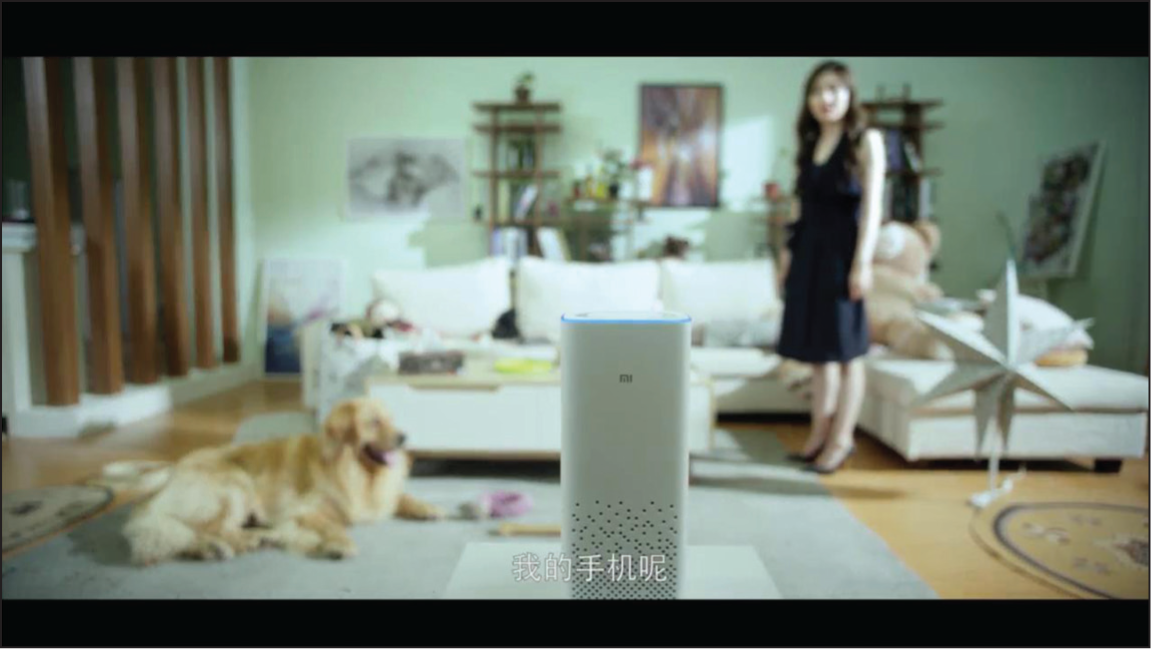
Not only do smart home technologies save the user from repetitive, mundane tasks but more importantly, they deliver added value through sharing household and personal responsibilities, mitigating the risks involved in relation to self-(mis)management. Xiao AI is discursively presented as an ideal solution—an essential and indispensable assistant—that drives away uncertainties and manages plausible risks. A recognisable and identifiable moment in modern life is misplacing a smartphone when one is in a hurry to get to work or an appointment (Figure 1). The protagonist in this video appears frustrated and nervous, and then relieved when their phone is found. It is not simply about this lost-and-found function, but the negativity associated with this self-(mis)management that powerfully convinces one that Xiao AI is useful. The emphasis is placed on how it can empower the user in their daily work–life management by checking agendas, the weather, traffic conditions and driving restrictions, in a timely and cost-effective manner.
Xiao AI’s all-round functions help manage a varying level of uncertainties and risks from the demands of modern (urban) daily lives. For instance, (a) it assists personal wealth management by avoiding an escalating utility cost (or wasting resources) when failing to switch off a heater, air-conditioning or other electronic appliances; (b) it ensures physical well-being by minimising discomfort when failing to turn on a heater or air-conditioning; (c) it reduces home security risks when one forgets to switch on surveillance cameras and alarm systems; (d) it reduces the levels of anxiety when one is forgetful or too busy and stressed to manage multitasking. For instance, in just a simple matter such as taking a measurement in a home improvement scenario, Xiao AI is shown to record the measurement in a timely and effective manner. Other household scenarios demonstrate how it helps a user–subject organise basic and mundane household tasks, such as diming or brightening lights when appropriate; it manages daily household chores, such as vacuuming apartments and charging the vacuum cleaner when its battery is low, and so forth.
Xiao AI performs the functions of an ideal butler, who manages personal as well as household matters, and is a pleasant companion in the home. Its ‘intelligence’ helps individuals manage their busy lives at home and from the home. When promoting its capabilities, the imagined scenarios repeat, strengthen and regularise the discourse of self-empowerment, self-maintenance and self-care in today’s highly competitive and demanding work–life environment. It encourages self-improvement, for instance, maintaining physical beauty by keeping track of time when applying a facial mask; it promotes endurance and self-discipline (pushing personal limits) by playing music when doing planking exercises. Daily (self-)management can be achieved–safely and securely—with the assistance of Xiao AI, a post-human subject.
Additionally, the intelligent assistant can provide personal support in intimate martial relationships. In bed, the female protagonist in a promotional video instructs Xiao AI—secretly and quietly—to ignore an order in the middle of the night, so her husband will not get up to watch a football match. This seemingly comical episode indicates how the virtual assistant can be an intimate ally that helps manoeuvre martial dynamics. The personalisation function turns it into a functional and trustworthy double of the user–subject.
In all these household scenarios, Xiao AI is presented as an essential item for constructing a well-operated, peaceful and safe home life. Not only the smart speaker but also Xiaomi’s home camera and smart door lock include these ‘self’ technological applications. For example, the AI-enhanced motion detection and built-in smart sensors automatically switches on lights when the user is home. These smart technological applications make self-actualisation possible; their functions illustrate ‘examples of the micro-physics of self-regulated household maintenance that link freedom and security’ (Hay, 2006, p. 367). It becomes a customised technology for risk-management, endowing everyday freedom and (home-)security on users.
One’s sense of security is derived from this personalised intimacy, a technological personal assistant that satisfies and manages the needs of its user at home and away from home, without the risks—albeit imagined—of self-mismanagement (careless) human errors, subjective or negative emotions, or physical sickness. This smart technology, as such, functions to assist the user’s self-government—managing their own conduct and interests, so that other forms of government do not need to. When self-management can be achieved effectively with technology, social relations and trust of others—that used to play an indispensable role in daily life management—are rendered obsolete. On the one hand, these smart technologies assist and advance a subject’s self-government by managing their own conduct and interests, and on the other hand, when self- government is regularly practised, this becomes a normalised practice at the societal level. This AI-enabled self-management is not only encouraged but much needed for the drastic social transformations that are taking place in China’s drive for politico-economic growth.
Technologisation of Chinese Society: From Personal Security, Home Security and Societal Security to National Security
China’s economic growth in the past decades has resulted in drastic changes in the governmentalisation of the home. Internal migration from the rural to the urban setting is a common practice. Due to the demanding urban working environment, as well as the high cost of living in the cities, the elderly and children are usually left behind in their hometowns. Xiaomi’s smart homewares address and are designed to cater for the needs of these social transformations that enables one to manage security and minimise risks away from home.
Seeing has long been recognised as the basis for one’s existential security, for seeing allows one to acquire information first-hand, and that strengthens the belief of being in complete control. The necessity of having a 360° panoramic smart surveillance camera is framed as giving protection and care for one’s family and household; as Xiaomi defines it on the webpage, ‘guarding and protecting every aspect of the home’ and ‘a complete care and protection for the family’ (Figure 2). Watching and being watched-over become inseparable; the practice of surveillance is justified and normalised as the practices of self-care for the home is care for the self.
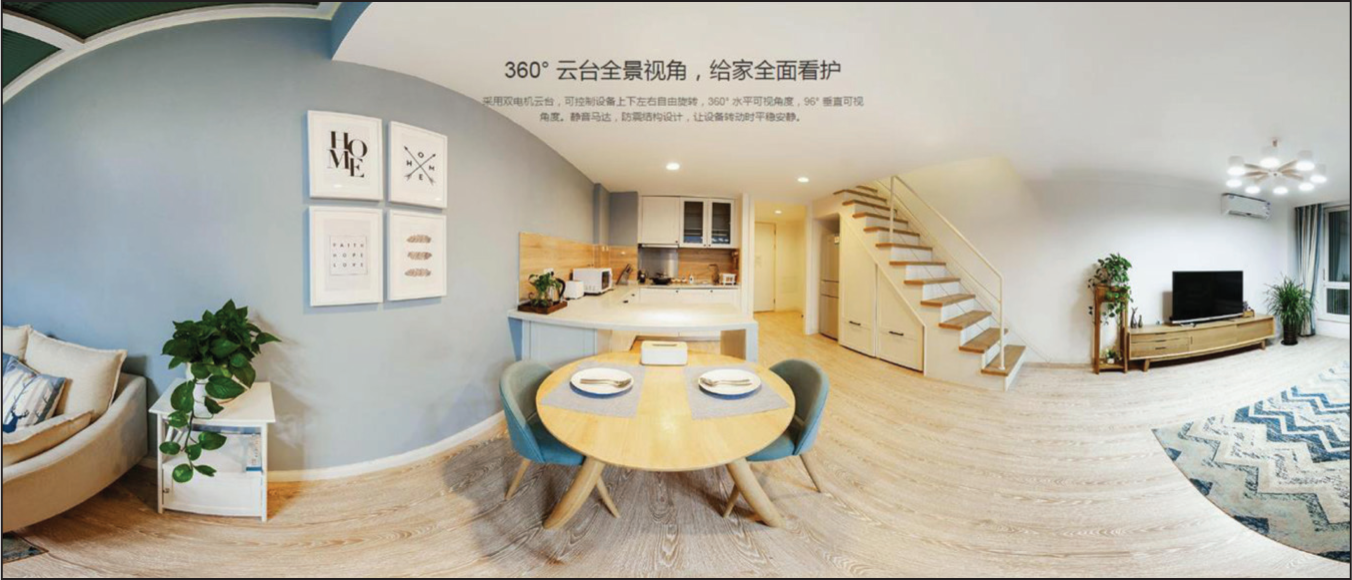
When describing its function of connecting and communicating with the home whenever one wants, the product webpage of Xiaomi’s surveillance camera has a real-time moving image of a cat in a beautifully furnished dwelling. As the cat cannot possibly have a conversation with the user, this temporal urgency of real-time communication/connection is not about being socially connected to other subjects but more about the user asserting a sense of ‘freedom’ and control, anytime and anywhere, which can drive away uncertainties and maximise the management of the home. On the one hand, the almost non-presence of human figures allows one to identify oneself with the all-seeing subject, and on the other hand, avoids one the feelings of insecurity of being monitored in one’s own home.
The presence of a human is shown in order to highlight the ‘smart’ functions of these cameras. In the 2019 version of the product webpage, in the section describing the camera’s AI humanoid detection function in its app, the danger surrounding one’s home comes from external threats: a sequence of five screenshots captures a burglar-like shadowy figure searching different cabinets in a poorly lit room. In a later version (last quarter of 2020), this ‘threat’ is replaced and neutralised by an image of the back of a female figure in daylight. Her long hair and causal clothing style—a light brown cardigan and jeans—leaves one an impression of an ordinary figure, easily identifiable as one’s sister, daughter, wife or even a neighbour (the girl next door), familiar and non-threatening. Despite her ambivalent identity, she appears to be more in need of care than a threat. Another image of a young girl sleeping peacefully was added around the same period to demonstrate the high resolution, and the filming angle parallels that of a guardian’s perspective. The images are interchanged quickly with two empty home images to demonstrate the high-resolution, visual clarity. From external threats and risks, the social anxieties and vulnerabilities are now directed internally towards the young and female subjects.
Framed as a private bodyguard, the smart camera promises home safety and security for the owner. Surveillance is not posed as a potential risk of invasion of privacy. Rather, the capability of total surveillance is presented as an empowerment, a solution, freeing one from social anxiety and the burden of having to trust or rely on another. Trust and attachment are thus discursively built on these smart technologies, not with other human beings.
The image of social disconnectedness—reminding one of social anxiety and vulnerabilities—is employed to accentuate the ways in which the smart lock can ensure the security of the self as well as the household. The background of the smart lock in the promotional video is a sanitised, blue (cold), well-furnished and soft-lit apartment floor. Six apartment doors are in close proximity to each other: the female subjects are placed on the left, while the males are on the right. In the advertisement video, the six dwellers are presented in the following sequence: a man in a suit, a well-dressed woman with shopping bags and high-heels, an elderly woman with a walking stick, a boy of around 8-years-old, a young male with a backpack and another well-dressed single woman. All the doors are tightly and safely locked, the characters are all alone. The majority—except in the more ambivalent cases of the man in the suit and the young man—are presented as vulnerable subjects in need of the smart lock to help guard their safety against plausible risks and threats, even in this upper-middle class apartment block.
Even though the dwellers appear to be decent, well-dressed and easy-going, each walk in and out with barely any contact or interaction. The only moment of interaction is between the elderly woman and the young man. This sequence—with barely any social contact—consequentially suggests that even in what seems like a safe place, there are potential risks for one’s safety. In fact, the young man enters his unit by using a code on his phone, suggesting that he is a visitor, not a formal resident, and therefore a plausible risk to the neighbours. This responds to a common Chinese saying, one should not judge others by their looks, suggesting a distrust of strangers. The last single female character enters the scene clutching a pet cat to her chest; she appears to be more at ease and comfortable with the animal than with her neighbours. She swiftly unlocks the door, enters the fully automated empty apartment (lights, curtain, air-purifier, robotic vacuum cleaner, automatically in a breeze). The smart lock is more important to one’s security than the social support offered by neighbours.
On a similar note, little children in the promotional material are well-nourished, well-dressed and self-contained; however, they often appear singly, and alone. The smart technologies are not only physically closer to them than their family or social surroundings but are also better companions and guardians that will keep them safe, reading stories and playing with them. The little boy in the smart lock video goes home alone with a Xiaomi Lego-like truck: he is alone but safe. A faceless father-like figure—in an office-like space suggesting a busy working schedule and distance—monitors him via a mobile application, no voice or tactile physical contact is required (Figure 3).

The responsibilities of childcare have shifted from parents and other adults (e.g., grandparents or nannies) to a range of ‘intelligent’ technological applications. The smart speaker Xiao AI is a companion as well as a teacher for young children. One of the images presented is of a young child interacting with the speaker accompanied by the following text: ‘Xiao AI student, what is 2 + 2 = ?, [It] can do addition, subtraction, multiplication and division, [it] can translate, recite Chinese poems, make animals sounds, has encyclopaedic knowledge, [it] can answer the little kid’s 100,000 questions easily’. The care for a child, a significant part of family household management that requires significant time- and resource-management in the busy work–life daily lives, can now be effectively entrusted to and organised by smart technologies, conveniently, in a timely manner, flexibly and, above all, safely without much cost or effort.
Another significant aspect of Chinese family household management is the well-being and safety of the elderly, which is heavily promoted in the governmental practice of filial piety in legal and in moral terms. The smart technologies are shown to perform these roles superbly, when their children cannot, for example: (a) keeping them company without the risk of them feeling lonely (the smart speaker plays Chinese opera while the elderly couple are making dumplings alone at home); (b) taking care of their security (the alarm of the smart lock engages when the elderly person does not lock the door correctly); and (c) attending to their needs with respect (the smart speaker switches off the loud music played by the grandchild-like teenager).
The discursive formulation of security and risk in these promotional materials points towards how smart technologies assist the self- and household-management that makes self-realisation possible, providing security at personal (ontological) and familial household levels. These technological applications are presented as essential and indispensable for security and risk management, whereas social relations with other human subjects become less important or even obsolete. Concerning familial relationships, young nuclear families do not need to rely on the older generation, the hired help, the nanny, or educational institutions for monitoring and parenting their children. For parenting, technological devices—such as virtual assistants, smart lock, and home camera—can provide safety and well-being without the risks associated with human assistance. For the elderly, their care and well-being can be attended to by smart homeware applications. National security is ensured when societal security is taken up by each citizen–subject for themselves and their immediate family.
Conclusion
This study of Xiaomi’s smart home products has grown out of two intersecting developments: one towards the Chinese state’s ambition in becoming an AI and technology superpower, as nations across the world race on innovation and technology development; and another towards the use of smart home technology in guiding individuals’ perceptions of ‘the good life’. The former aims to raise China’s political–economic power internally as well as on the global stage: domestic support for home automation products will accelerate the country’s AI development to achieve its national ambition of becoming a hi-tech superpower. Meanwhile, ‘intelligent’ home technology applications present to individuals the possibilities of risk- and security-management, having choices, freedom, and mobility at home and from home. The state governs ‘at a distance’ (Foucault, 1991, p. 93), when individuals take on the responsibilities to regulate and manage their own, as well as their family’s well-being and safety, in the mundane daily domestic sphere. Security and the management of risk can then be shifted from the institutional spheres outside of the home to the individual’s private and personal spheres.
These intersecting developments demonstrate, first, the significance of the non-spectacular, ordinary, domestic and private realm of the home in understanding the relationship between national security, smart technologies and the citizen–subjects. It challenges the widely held assumptions that (smart) technologies in China are solely dominated by the authoritarian interests of surveillance and control, in a word, a negative form of power that coerces and makes one fearful. This study demonstrates the state’s productive exercise of power in mobilising AI-driven smart home development—in cooperation with a commercial technology company Xiaomi—in guiding citizen-subjects’ possible behaviours when managing risk and ensuring their personal and family household security.
Second, these developments illustrate the significance of specific socio-cultural, historical and political forces in driving the ways these (smart) technologies are designed, promoted and integrated in contemporary China. The three interweaving levels of analysis demonstrate that Xiaomi reproduces as well as constitutes the dominant positive societal discourses on technology that bring trust, reliability and security to daily life. It further advances the state-driven technologisation of Chinese society, in which subjects are guided to believe in and embrace the merits and potentials of technology. However, the ‘intelligent’ qualities of these technological applications have simultaneously made one less dependent on other social relationships, eroding further the already waning social relations and trust.
This analysis reveals that the technology-led discourse of ‘the good life’, in relation to the governmental initiatives, do not stand as a totally cohesive truth. As Foucault (1989) argues, contradictions or conflicts exist alongside the dominant discourse. When highlighting the cost-effectiveness and merits of freeing oneself from relying on other social beings, these promotional materials also insinuate the plausible risks, dangers and uncertainties related to the current socio-economic and cultural contexts (e.g., long working hours, challenges faced by internal migrants, lack of social support, costly and timely care required for children and the elderly). How issues of security and risk are framed within the smart home reveal the potentials as well as the dangers of the use of technology in China today. National security anchored to AI development may pose challenges at other levels of government. The moral economy of a family household, such as communication between family members, becomes less important or unnecessary (e.g., parenting that is assisted by smart technologies has also deprived young children of parental guidance and interactions; elderly care that is managed through technologies reduces physical face-to-face interactions).
The home automation market in China as well as around the global is still at an early stage of development. Whether and how the emphasis on innovative home automation further strengthens people’s belief in the transformative power of technology, or further erodes the already deteriorating social relations and trust deserves longitudinal, cross-national and comparative study.
Footnotes
Declaration of Conflicting Interests
The author declared no potential conflicts of interest with respect to the research, authorship and/or publication of this article.
Funding
The research for this article was funded by the Hong Kong Research Grants Council (Project numbers 12610118).