



Abstract
This paper investigates the linkage between network characteristics of the innovation ecosystem, knowledge collaboration and enterprise innovation in the case of China. The results demonstrate that knowledge collaboration plays a part in the mediating role between network characteristics of the innovation ecosystem and enterprise innovation. The resource integration capability could regulate the mediating role of knowledge collaboration, which means the stronger the resource integration capability, the stronger the mediating effect.
Keywords
Introduction
In the ‘Outline of the 14th Five-Year Plan (2021–2025) for National Economic and Social Development and Vision 2035 of the People’s Republic of China’, the Chinese government put forward the policy recommendations of ‘accelerating the development of the modern industrial system, promoting the optimisation and upgrading of the economic system, accelerating the development of strategic emerging industries’. In the era of the new economic normal, cultivating and developing strategic emerging industries has become a major measure to adapt to the adjustment of China’s economic structure and the transformation of economic growth patterns. The development of strategic emerging industries and the enhancement of their core competitiveness critically depend on their innovation capabilities. Also, knowledge resources are the most fundamental strategic resources in the improvement of innovation capabilities of strategic emerging industries, because the essence of innovation lies in the effective integration and innovation of knowledge resources in the system. Chesbrough and Rosenbloom (2002), who were the first to put forward the ‘open innovation’ theory, believed that facing the fierce external competition environment, open access to knowledge resources from the outside was an important way to effectively improve the efficiency of innovation. At the same time, the network relationship theory emphasises that, due to the limited amount of knowledge of innovation subjects, enterprises can conduct knowledge searches in the network to obtain various external knowledge resources, so as to obtain the key resource elements to maintain the sustainable competitive advantage of enterprises. Finally, based on the above two theories, that is the ‘open innovation’ theory and network relationship theory, the innovation ecosystem formed by multiple innovation entities such as enterprises, scientific research institutions and universities, has emerged as a complex network system to explore collaborative innovation between enterprises and external innovation network environments. It also provides new ideas and research directions for the development of strategic emerging industries and the improvement of their innovation capabilities.
In the innovation network, the external network can not only provide heterogeneous knowledge resources for enterprise innovation, but also the characteristic elements of its network become the key to the growth of enterprise technical capabilities and innovation efficiency. Therefore, network size, openness, centrality, structural holes and network density have been widely studied in academia as structural characteristics of innovative networks. However, enterprise innovation depends not only on the collaborative acquisition of external knowledge resources, but also on the capability of integrating the enterprise’s internal resources, that is, to integrate external knowledge resources and share skills, which is also a key path to improve enterprise innovation (Leo, 2020, pp. 97–117). In view of this, from the perspective of the innovation ecosystem of Chinese strategic emerging industries, this study introduces knowledge collaboration as an intermediary variable and resource integration capability as a moderator variable, and assumes that in Chinese strategic emerging industries, the impact of the innovation ecosystem network characteristics on enterprise innovation should be ‘both inside and outside’. Specifically, first, we analyse the impact of the network characteristics of the innovation ecosystem on enterprise innovation. Second, we will verify the resource integration capability as a contingency factor from the perspective of enterprise capability. Third, in the innovation ecosystem, it is necessary to emphasise the strategic means of optimising and integrating knowledge resources. For this reason, we regard the knowledge collaboration of enterprises as an important internal factor affecting enterprise innovation. In summary, this paper attempts to find a bridge between knowledge and innovation, and further explores the impact of external factors on enterprise innovation activities, which can provide theoretical guidance for enterprises to make full use of external resources and improve innovation performance.
Literature Review and Research Hypothesis
Network Characteristics of Innovation Ecosystem and Enterprise Innovation
The innovation ecosystem is an important platform for strategic emerging industries to obtain external resources, in which the interconnection and cooperation of enterprises blur the original boundaries. Simultaneously, innovation resources and information are also shared and flowed in the network. Judging the innovation ecosystem from the perspective of the network, Bendis and America (2011) point out that an innovation ecosystem is a collaborative innovation ecological network that includes innovation species and innovation communities, and flows of people, information and capital. Most existing literatures believe that innovation ecosystems have the characteristics of general innovation networks, and carry out research from the perspectives of network structure and network relationships (Fallah, 2022, pp. 13–33). For example, Li et al. (2020) describe network relationships from the perspective of relationship strength, and study network structure from two aspects of network size and network heterogeneity, and divide the network characteristics of the innovation ecosystem into three dimensions: network size, relationship strength and network heterogeneity; Choi et al. (2021) investigate the network characteristics of future innovation ecosystems with a machine-learning approach based on the patent data.
From the perspective of micro-enterprises, the existing literatures study the relationship between the network characteristics of innovation ecosystems and enterprise innovation. For example, the research of Johnson and Filippini (2009) shows that enterprises with large internal and external social network sizes are better able to develop innovative products. Berraies (2019) conducts research on the impact of social networks on external and exploratory innovations of enterprises. Song and Wang (2020) incorporate the connection strength representing the micro-level characteristics and the network density representing the network macro-level characteristics of the network into the research framework. Their research shows that the connection strength has a positive impact on enterprises’ innovation performance, and the construction of a high-density network has positive implications for enterprise innovation performance. Dogbe et al. (2020) conduct a study on 388 SMEs and finds that network embeddedness has a significant positive impact on innovation performance. The research of Du and Liu (2021) uses the patent data in the field of information and communication technology in China from 2005 to 2018, which finds that both technological diversification and collaborative R&D network centrality have a positive impact on enterprise innovation performance.
In summary, the capabilities of enterprises to utilise network relationships mainly depend on the characteristics of the network. Therefore, after studying the network size, network connection strength and network heterogeneity of the innovation ecosystem, we find that with the expansion of the network size, the heterogeneous technologies and non-redundant knowledge resources flowing in the network will increase, and the information exchange between enterprises will be more frequent, and then enterprises will acquire more knowledge and resources from the network. Meanwhile, the stronger the heterogeneity of the network, the more opportunities for communication and cooperation between enterprises, and the more quickly enterprises can obtain the latest technical information and grasp the changes in market demand as soon as possible. Based on the above research, we propose the following research hypothesis:
Hypothesis 1: The innovation ecosystem network has a positive impact on enterprise innovation.
The Mediating Role of Knowledge Collaboration
The research on knowledge collaboration is first put forward by Karlenzig (2022), who defines knowledge collaboration as a strategic organisation method of a dynamic collection of internal and external systems. Chatenier et al. (2009) indicate that knowledge collaboration is a specific type of learning process, which goes through four stages: external sharing, internal integration, integration and innovation. Zhang and Zhu (2014) point out that knowledge collaboration could effectively integrate, complement and share knowledge from different subjects and different time points, so as to achieve knowledge innovation and effective application. Scholars generally believe that knowledge collaboration is a knowledge activity process in which multiple actors with knowledge resources collaborate to achieve knowledge innovation. And, knowledge collaboration is also regarded as management models and strategic means for organisations to optimise and integrate knowledge resources (Parsons, 2021, pp. 1490–1499).
From the perspective of the social network, the knowledge collaboration process can be regarded as a knowledge flow process. In addition, the network size is reflected in a large number of subjects and objects participating in the social network, which satisfies the exogenous situational requirements of knowledge collaboration. While, the network heterogeneity is reflected in a large number of heterogeneous knowledge stocks, which could satisfy the external knowledge acquisition of knowledge collaboration. At the same time, the stronger the connection strength of the social network, the more closely the subjects in the network are connected, which means that the trust degree between the subjects is also higher and the probability of knowledge collaboration is higher. The existing literatures have carried out related research on the relationship among the network characteristics of the innovation ecosystem, knowledge collaboration and enterprise innovation. For example, Kesting et al. (2011) believe that enterprises can improve their innovation capabilities by using external network collaboration and knowledge sharing. Han et al. (2019) study the mediating effect of network size on enterprises’ innovation performance from the perspective of knowledge collaboration, which finds that both individual knowledge collaboration behaviour and team knowledge collaboration behaviour have a certain mediating effect in the process of the influence of organisational network size on innovation performance. Li and Ma (2021) use complex network theory to establish a subject knowledge innovation model, through which they find that the relationship between network openness and network relationship strength shows an inverted U state. That is to say, the network density, network openness and network relationship strength all have a positive impact on knowledge innovation performance. Based on the theory of dynamic management and open innovation, Nguyen (2022) proposes a model of enterprise knowledge accumulation and innovation. Through this model, he studies the relationship between the breadth and depth of knowledge search, knowledge collaboration and enterprise innovation.
From the above research, we can see that knowledge collaboration plays a transfer role between enterprise innovation performance and network characteristics (such as network size, network connection strength and network heterogeneity). Specifically, after searching for heterogeneous knowledge with potential value from the outside, enterprises can absorb it into their original knowledge repository through knowledge collaboration and integrate it with the existing knowledge, and then reshape it into the enterprises’ own innovation knowledge, which will promote the enterprises’ innovation performance. In view of this, we focus on examining whether knowledge collaboration plays an intermediary role in the process of enterprise innovation and whether enterprises can transform external knowledge flow to form actual benefits, which could be used as a means to achieve superior innovation. Based on the above analysis, we propose the following assumption:
Hypothesis 2: Knowledge collaboration plays a mediating role in the relationship between innovation ecosystem network and enterprise innovation.
The Moderating Effect of Resource Integration Capability
Resource integration refers to a complex dynamic process in which enterprises select, absorb, allocate, activate and integrate different types of resources to make them more flexible, organised, systematic and valuable, and to create new resources in the meanwhile. In other words, resource acquisition and resource integration are both behaviours and capabilities. In the innovation ecosystem, enterprises are important parts, and the collaborative innovation network provides a platform for them to obtain the complementary knowledge resources they need on a larger scale. In addition, enterprises can also actively absorb external information to obtain knowledge resources and continuously accumulate them, so as to achieve the purpose of extensive sharing, storage and innovation within the enterprises. However, the key knowledge resources acquired by enterprises must be integrated in order to maximise their value, which means that resource integration plays an important role in exerting the value of these key resources. Therefore, the integration and utilisation of external resources and knowledge have become the key to the success of enterprise innovation, and the improvement of enterprises’ innovation capabilities must involve the integration of internal and external resources. Cannon et al. (2020) find that resource integration is not only a necessary way for enterprises to expand, but also a key factor for them to win in the competition, that is, enterprises can optimise and integrate resources through mergers and acquisitions, thereby expanding their scale and improving production efficiency.
In the innovation ecosystem, knowledge is a special resource, whose effect on breakthrough innovation will be affected by the way resources are integrated within the enterprise. When acquiring external knowledge resources, enterprises need to consider how to effectively coordinate and integrate the technical knowledge of internal research and development with the technical knowledge acquired externally, so as to jointly serve the knowledge update, product innovation and process improvement of the enterprise, and finally achieve continuous innovation. Wu and Wei (2017) study the different moderating effects of two different resource integration methods, namely solid integration and radical integration, in knowledge exploration and enterprise breakthrough innovation, and then find that the role of knowledge exploration in breakthrough innovation changes with the way resources are integrated. Yang and Yang (2016) believe that enterprises usually absorb and integrate externally acquired resources and knowledge based on their existing cognitive framework, and the strength of absorption and integration depends on their own digestive ability. After studying the relationship between technological diversification, inter-organisational knowledge collaboration and enterprise innovation sustainability from the perspective of knowledge collaboration, He et al. (2021) believe that coordination and integration ability has a significant positive moderating effect on the relationship between external technological diversification and enterprise innovation sustainability. Parente et al. (2022) analyse the relationship between relational resources, tacit knowledge integration capability and enterprise performance, and find that the enterprise resource integration capability is an important strategic asset to promote resource combination and coordination of enterprises, which could also help them absorb external knowledge from supplier knowledge networks and combine it with specific internal capabilities.
In summary, strong resource integration capability could not only promote enterprises to learn, absorb and reconstruct external heterogeneous knowledge, but also improve the compatibility between enterprise technical reserves and multi-technology, which provides a suitable external development environment for enterprises’ continuous innovation. Based on the above studies, we propose the following research hypothesis:
Hypothesis 3: Resource integration capability has a positive moderating effect on the relationship between innovation ecosystem network and knowledge collaboration.
Moderated Mediation of Knowledge Collaboration
According to the above hypothesis, we further infer that the mediating effect of knowledge collaboration on the network characteristics of innovation ecosystem and enterprise the innovation is mediated by resource integration capability, which is a mediated mediating effect. High resource integration capability can not only accelerate the knowledge transfer efficiency of enterprises and promote the integration and utilisation of knowledge in different fields and industries, but also promote the efficient conversion of embedded knowledge by innovative subjects and enhance the relevance of different types of knowledge, which means that the collaboration effect is enhanced in the mutual benefit and win–win of enterprises. Based on the above analysis, we propose the following assumption:
Hypothesis 4: Resource integration capability has a positive moderating effect on the mediating role of knowledge collaboration in the relationship between innovation ecosystem network and enterprise innovation. That is, the stronger the resource integration capability, the stronger the mediating role of knowledge collaboration between innovation ecosystem network and enterprise innovation.
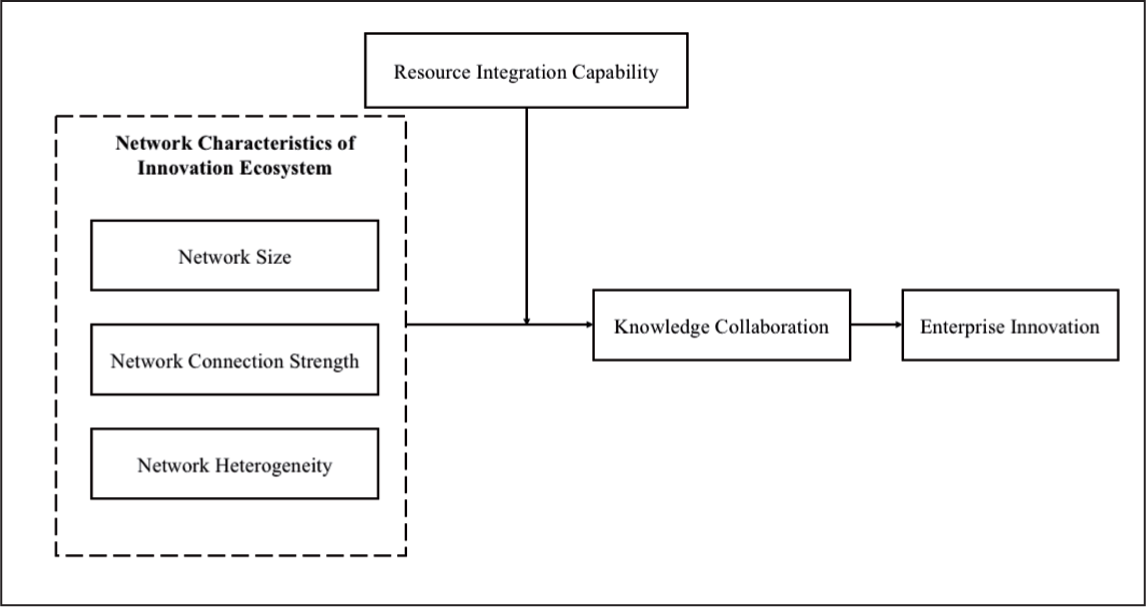
In summary, the concept model of this paper is shown in Figure 1. Based on the existing literatures, this study divides the network characteristics of the innovation ecosystem into three dimensions: network size, network connection strength and network heterogeneity.
Methodology
Sample Selection and Data Collection
We use the questionnaire method to collect the sample data required for this paper. The questionnaire survey lasted for nearly half a year, from September 2021 to January 2022. The sample enterprises belong to Chinese strategic emerging industries, including the energy conservation and environmental industry, new generation information technology industry, biomedical industry, advanced material industry, high-end equipment manufacturing industry, new energy vehicle industry, new energy industry, and so on. We mainly invited those responsible for enterprise management or technology R&D to fill in the questionnaire.
In the process of collecting data, we strictly follow the operation procedure of ‘pre-survey → correction → formal survey’. First, we start the pre-investigation stage, during which we select 50 enterprises as samples and conduct a small sample pre-test to test the rationality of the scale and form the final questionnaire. Second, the survey object of this paper is the enterprises in the ‘China Statistical Yearbook 2021’. As ‘China Statistical Yearbook 2021’ includes enterprises of various natures according to their holdings, and enterprises of different natures have different management methods in terms of ‘knowledge collaboration and enterprise innovation’. Therefore, in the second stage, we adopted the ‘stratified sampling → random sampling’ method to formulate a sampling plan. We first conducted stratified sampling according to the nature of enterprises and calculated the proportion of enterprises with different natures according to the classification of ‘state-owned or state-controlled’, ‘private’, ‘foreign or joint’ and ‘other’ in ‘China Statistical Yearbook 2021’. On this basis, we conducted random sampling for enterprises at all levels, taking into account the enterprise size (people). The distribution methods include: entrusting MBA students to distribute questionnaires to their enterprises, offline visits and contacting enterprises for questionnaire distribution, and distributing electronic questionnaires to relevant enterprises through personal relationships. According to the above methods, we distribute 500 questionnaires, including 200 paper questionnaires and 300 electronic questionnaires. Finally, we recover 344 questionnaires, which means that the recovery rate is 68.8%. After reviewing the recovered questionnaires and excluding unqualified questionnaires with missing item responses, a total of 321 questionnaires are collected, and the effective recovery rate is 64.2%.
Variable Measurement
Based on the international mature scale, the questionnaire scale of this paper is rephrased according to China’s special situation. Also, we make appropriate adjustments to the test items of the scale in combination with the research question. The scale is designed by a 5-point Likert Scale, where 1 represents completely inconformity, 2 represents non-inconformity, 3 represents uncertainty, 4 represents conformity, and 5 represents completely conformity. Except for the basic information of respondents and enterprises, other variables in the questionnaire are measured by a 5-point Likert Scale. First, the network characteristics of the innovation ecosystem scale includes three dimensions: network size, network connection strength and network heterogeneity, with a total of thirteen items. In the above items, the network size scale refers to the scales of Hislop (2005), Xie and Zuo (2013) and Li et al. (2020); the network connection strength scale is designed with reference to the scales of Dodgson et al. (2013), Xie and Zuo (2013) and Li et al. (2020); the network heterogeneity scale refers to the scales of Acemoglu et al. (2016) and Sammarra and Biggiero (2008). Second, the knowledge collaboration scale includes seven items, which is designed with reference to the scales of Su et al. (2017) and Laursen and Salter (2006). Third, according to the scales of Fey and Birkinshaw (2005) and Li and Gao (2014), we design the enterprise innovation scale, which includes six items. Fourth, based on the scales of Wu (2007), Zeng (2009) and Du et al. (2017), the resource integration capability scale is designed with a total of four items. Since the influence of enterprise scale, funding time and enterprise nature on the relationship between the variables studied in this paper, based on the existing research, we make statistics on these three variables and set them as control variables.
Data Analysis and Hypothesis Test
Reliability and Validity Analysis
Reliability Analysis
We use the method of measuring internal consistency to test the reliability of the scale of network size, network connection strength, network heterogeneity, knowledge collaboration, enterprise innovation performance and resource integration capability. The Cronbach’s α of the above variables are 0.729, 0.866, 0.708, 0.928, 0.720 and 0.854, respectively, which are all greater than the critical standard of 0.7, indicating that the scales have good reliability.
Validity Analysis
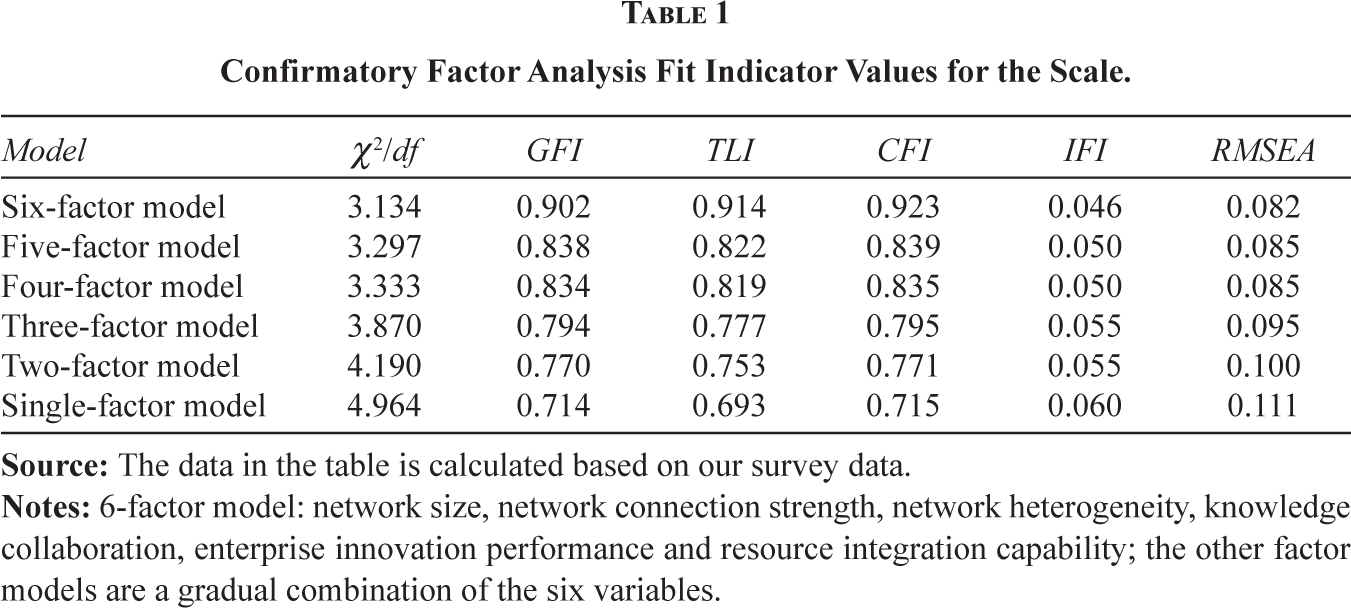
In order to ensure the content validity of the scale, we refer to the well-established scales that have been repeatedly demonstrated by scholars. In addition, we have repeatedly revised the questionnaire’s statement and structure through the pre-investigation stage, which makes the scale have pretty good content validity. Also, we further test the construct validity of the scale on the basis of confirmatory analysis of the factors through AMOS 21.0 software (see Table 1). By comparing the fitting indices of the six models in Table 1, it can be found that the fitting degree of the 6-factor model is best, which indicates that there is pretty good discriminant validity among these six variables. Except the AVE and CR values of the network heterogeneity are close to critical, the AVE values of other variables are all >0.5 and the CR values are all over 0.7, which means that the scale has good convergent validity.
Confirmatory Factor Analysis Fit Indicator Values for the Scale.
Homology Bias Analysis
We use Harman Single Factor Test to measure factors. According to the exploratory factor analysis results, we find that the loading of the first principal component is 17.291% (<61.860% of the total variance), which indicates that the homology bias does not threaten the reliability of the research results.
Descriptive Statistics and Correlation Analysis
In order to provide preliminary data support for the verification of research hypotheses, we calculate the correlation coefficient of each variable. The network size, network connection strength, network heterogeneity, knowledge collaboration, resource integration capability and enterprise innovation performance all show a significant positive correlation, which means that the above variables are suitable for further regression analysis.
Hypothetical Test
Main Effect Test
We use hierarchical regression analysis to test the hypothetical relationship between variables in the model and obtain the main effect test results (as shown in Table 2). Among them, Model 1 shows the regression result of control variables on enterprise innovation. Under the premise of controlling the three variables of enterprise scale, funding time and enterprise nature, Model 2, Model 3 and Model 4, respectively, test the influence of network size, network connection strength and network heterogeneity on enterprise innovation. From the test results, it can be found that there is a significant positive relationship between network size and enterprise innovation (β = 0.460, p < .001), as are the effects of network connection strength (β = 0.323, p < .001) and network heterogeneity (β = 0.323, p < .001), which means that Hypothesis 1 can be supported. In addition, we can also find that among the above three variables, the influence of network size on enterprise innovation is the greatest.
Direct Effect Test Results.

Mediating Effect Test
In order to test the mediating effect of knowledge collaboration in the relationship between network characteristics of the innovation ecosystem and enterprise innovation, we use the three-step test of the mediating effect proposed by Chinses scholar Wen et al. (2004), which is a procedure that includes Sequential inspection and Sobel inspection. The test results are shown in Table 3.
Mediation Test Results.

First, according to the test conditions of the mediating effect, we have tested the influence of the independent variable on the dependent variable in the direct effect stage.
Second, under the premise of controlling the three variables―enterprise scale, funding time and enterprise nature, Model 2 shows that network size has a positive impact on knowledge collaboration (β = 0.785, p < .001). If we add the mediating variable on the basis of Model 2, we can get Model 5, which shows that compared to Model 2, the positive impact of network size on enterprise innovation is reduced (β = 0.128, p < .05) and the regression coefficient β is also reduced from 0.460 to 0.128. On the contrary, compared with Model 2, the effect of knowledge collaboration on enterprise innovation is more significant positive (β = 0.423, p < .01), which means that there is a partial mediating effect of knowledge collaboration on the relationship between network size and enterprise innovation.
Third, the results of Model 3 prove that the network connection strength positively affects knowledge collaboration (β = 0.529, p < .001). If we add the mediating variable to Model 3, we can get Model 6, in which the positive impact of network connection strength on enterprise innovation is reduced (β = 0.101, p < .05) and the regression coefficient β is reduced from 0.323 to 0.101. However, compared with Model 3, the positive impact of knowledge collaboration on enterprise innovation is more significant (β = 0.419, p < .001), which shows that in the relationship between network connection strength and enterprise innovation, knowledge collaboration could play a partial mediating role.
Fourth, based on the results of Model 4, it can be found that a significant positive relationship between network heterogeneity and knowledge collaboration (β = 0.570, p < .001). Through adding the mediating variable based on Model 4, we can get Model 7. In Model 7, it can be seen that the regression coefficient β of network heterogeneity is reduced from 0.403 to 0.187, which means that the positive effect of network heterogeneity on enterprise innovation is reduced (β = 0.187, p < .001). However, the impact of knowledge collaboration on enterprise innovation is still significant positive (β = 0.379, p < .001). This result confirms that there is a partial mediating role of knowledge collaboration in the relationship between network heterogeneity and enterprise innovation. It can be seen that Hypothesis 2 is supported. In terms of the influence coefficient, among the three mediating models of Model 5, Model 6 and Model 7, knowledge collaboration plays a stronger mediating role in the relationship between network size and enterprise innovation.
Finally, on the basis of the above test, we use the Bootstrap method to test the robustness of the knowledge collaboration mediation effect. As shown in Table 4, none of the 95% confidence interval contain 0, indicating that knowledge collaboration plays a significant mediating role in the relationship between network characteristics of the innovation ecosystem and enterprise innovation, which means Hypothesis 2 is further supported by more data. In addition, from the perspective of the proportion of the mediating effect, among the network characteristics of the innovation ecosystem, the mediating role of knowledge collaboration in the relationship between network size and enterprise innovation accounts for 72.081%, and its mediating role in the relationship between network connection strength and enterprise innovation accounts for 72.081%. As for the relationship between network heterogeneity and enterprise innovation, the mediating role of knowledge collaboration accounts for 53.587%. In a word, the above proportions indicate that the mediating role of knowledge collaboration in the relationship between network size and enterprise innovation is stronger.
Bootstrap Test Results for Mediating Effects.

Moderating Effect Test
If we want to test the moderating effect of resource integration capability in the relationship between the network characteristics of the innovation ecosystem and knowledge collaboration, we should propose three interaction items of ‘network size × resource integration capability’, ‘network connection strength × resource integration capability’ and ‘network heterogeneity × resource integration capability’, which are on the basis of the research hypothesis. Simultaneously, we run a hierarchical regression analysis with the network size, network connection strength and network heterogeneity of the innovation ecosystem as dependent variables. The test results are shown in Table 5.
The Moderating Effect Test Results.
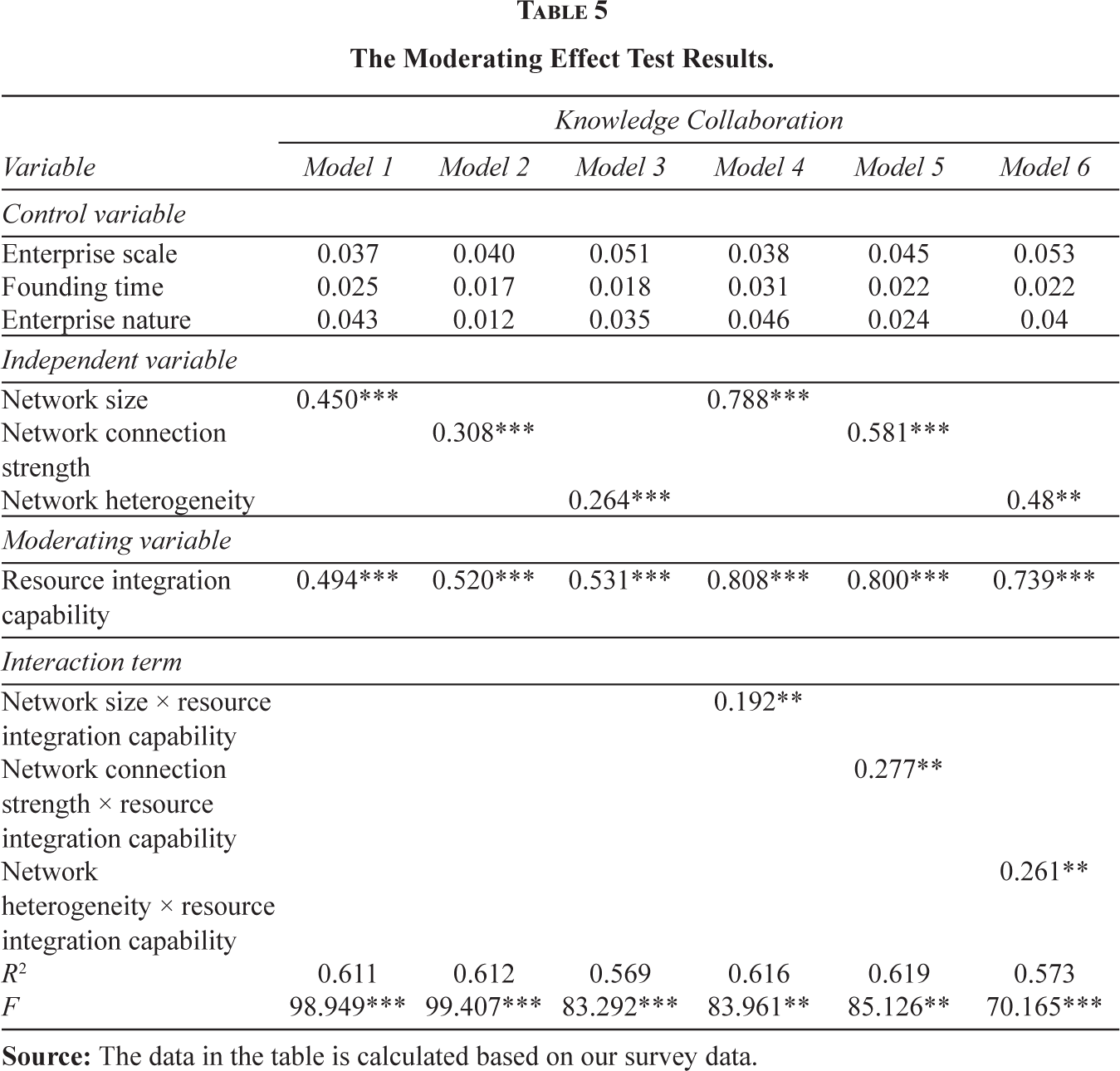
First, under the premise of controlling the three variables of enterprise scale, funding time and enterprise nature, we construct Model 1 and Model 4 to test the moderating role of resource integration capability in network size and knowledge collaboration. The results show that the influence of ‘network size × resource integration capability’ on knowledge collaboration is significant positive (β = 0.192, p < .01), that is, the stronger the resource integration capability, the stronger the positive impact of network size on knowledge collaboration.
Second, Model 2 and Model 5 are constructed to examine the moderating role of resource integration capability in network connection strength and knowledge collaboration. From the model results, we can find that the effect of ‘network connection strength × resource integration capability’ on knowledge collaboration is significant positive (β = 0.277, p < 0.01), which means that the stronger the resource integration capability, the stronger the positive relationship between network connection strength and knowledge collaboration.
Third, we use Model 3 and Model 6 to examine the moderating role of resource integration capability in the relationship between network heterogeneity and knowledge collaboration. On the basis of the model results, we can see that ‘network heterogeneity × resource integration capability’ has a significant positive impact on knowledge collaboration (β = 0.261, p < 0.01). This result also indicates that the stronger the resource integration capability, the stronger the positive impact of network heterogeneity on knowledge collaboration. It can be seen from the above that Hypothesis 3 can be supported.
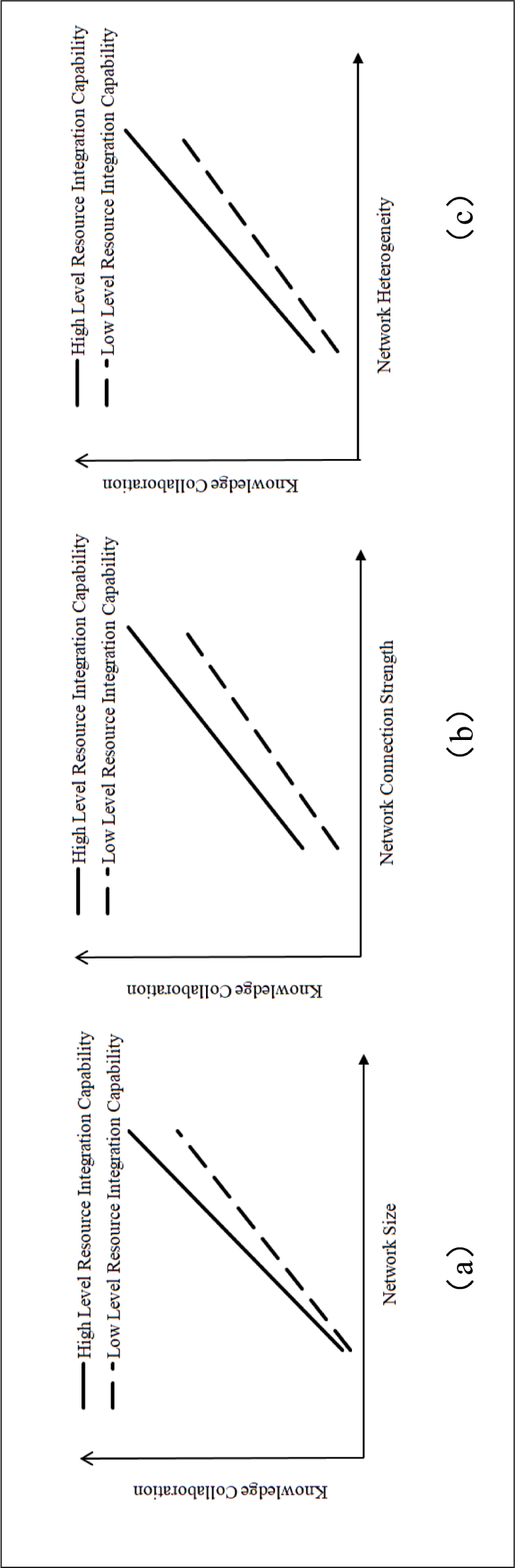
Finally, we draw a moderating effect plot of resource integration capability (as shown in Figure 2). Regardless of the high or low score of the knowledge resource integration capability, the network size, network connection strength and network heterogeneity of the innovation ecosystem are positively correlated with knowledge collaboration. In addition, from the slope of the straight line, when the resource integration capability of the enterprise is pretty strong, the effect of network size, network connection strength and network heterogeneity on knowledge collaboration is significantly enhanced, and vice versa is weakened. At the same time, the above conclusion could further confirm Hypothesis 3.
Moderated Mediation Test
In order to further examine the moderated mediation model, we use the Bootstrap method (shown in Table 6). First, in terms of high-level resource integration capability, under the influence of the network size of the innovation ecosystem, enterprise knowledge collaboration could significantly affect enterprise innovation (β = 0.221, at the 95% confidence level, confidence interval is [0.137, 0.307], excluding 0). Under the condition of low-level resource integration capability, the influence mechanism of knowledge collaboration on enterprise innovation is similar to the above (β = 0.167, at the 95% confidence level, confidence interval is [0.103, 0.241], excluding 0). The above results show that in the relationship between network size and enterprise innovation, there is a positive role of resource integration capability in the mediating role of knowledge collaboration.
Bootstrap Test Results for Moderated Mediating Effects.
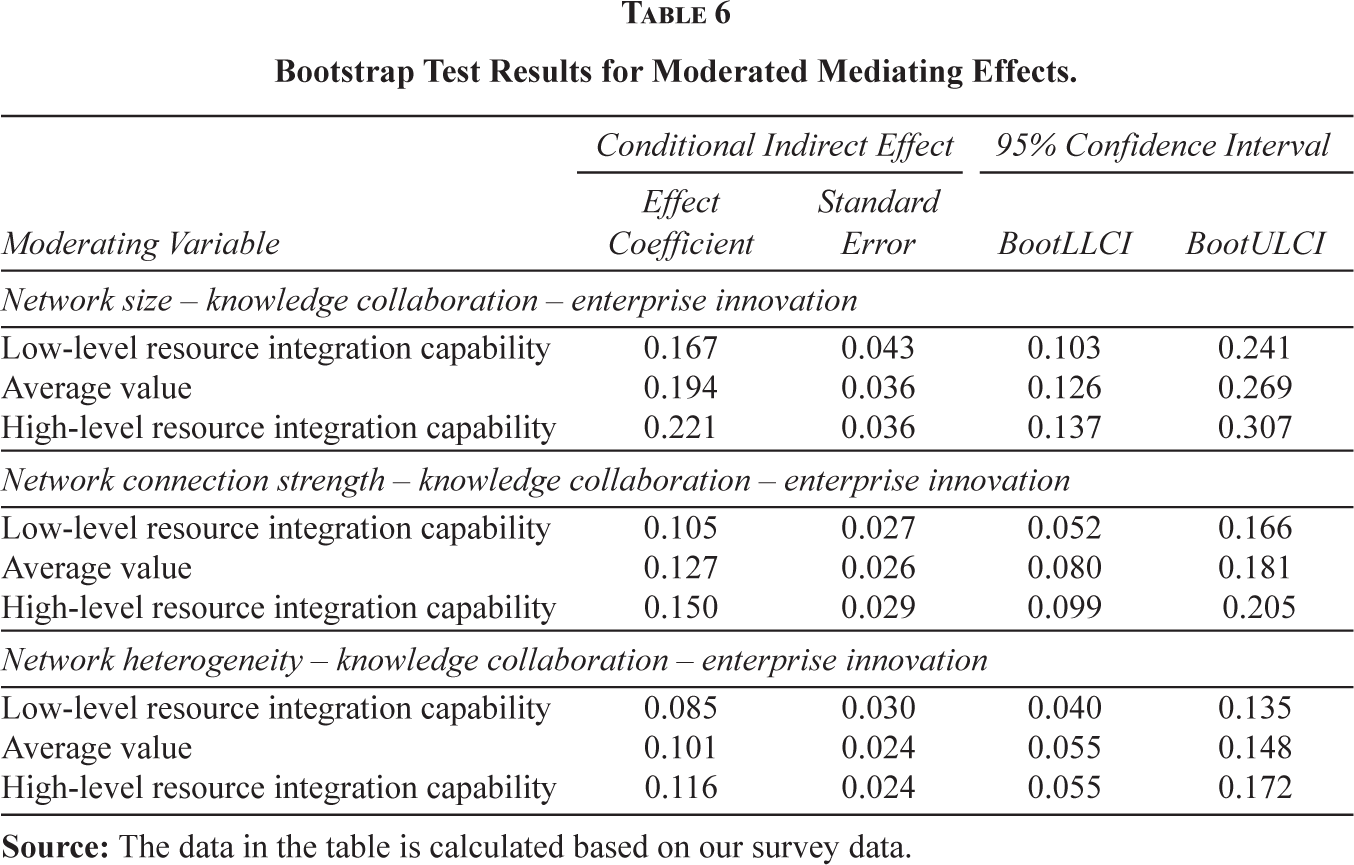
Second, under the condition of high-level resource integration capability, the network connection strength of the innovation ecosystem affects enterprise knowledge collaboration, which in turn has a significant impact on enterprise innovation (β = 0.150, at the 95% confidence level, confidence interval is [0.099, 0.205], excluding 0). As for low-level resource integration capability, the network connection strength of the innovation ecosystem affects enterprise knowledge collaboration and has a significant impact on enterprise innovation (β = 0.150, at the 95% confidence level, confidence interval [0.052, 0.166], excluding 0). Therefore, the higher the effect coefficient, the higher the level of resource integration capability, which indicates that in the relationship between the network connection strength of the innovation ecosystem and enterprises innovation, the effect of resource integration capability on the mediating role of knowledge collaboration is positive.
Third, facing the high-level resource integration capability, the network heterogeneity of the innovation ecosystem affects the knowledge collaboration of enterprises and has a significant impact on enterprise innovation (β = 0.116, at the 95% confidence level, confidence interval [0.055, 0.172], excluding 0). As for low-level resource integration capability, the impact of network heterogeneity on knowledge collaboration and enterprise innovation is also significant (β = 0.085, at the 95% confidence level, confidence interval [0.040, 0.135], excluding 0). When the effect coefficient is higher, the level of resource integration capability is higher, which means that the resource integration capability plays a positive role in the mediating role of knowledge collaboration in the relationship between the network heterogeneity of the innovation ecosystem and enterprises innovation. To sum up, Hypothesis 4 is supported.
Conclusion and Discussion
Research Conclusion
In this paper, we regard the innovation ecosystem of Chinese strategic emerging industries as the research object. From the theoretical perspectives of innovation ecosystem theory, knowledge management theory and enterprise innovation theory, we select knowledge collaboration as the mediating variable and resource integration capability as the moderating variable. Also, on the basis of the above theories, we construct a moderated mediation model, which reflects the relationship among innovation ecosystem network characteristics, knowledge collaboration and enterprise innovation. The empirical research results show that:
First, the network characteristics of the innovation ecosystem, such as network size, network connection strength and network heterogeneity, have a positive role in promoting enterprise innovation. This is because the social network where the enterprise is located is an important carrier for it to acquire knowledge resources. By connecting with external innovation entities, an enterprise can continuously obtain the knowledge resources of other innovative subjects in the innovation ecosystem, such as universities, scientific research institutions, partners, competitors, and so on. Therefore, the more innovation partners in the innovation ecosystem, the longer the cooperation time, the more frequent communication, and the more extensive the contacts with different enterprises or industries, the easier it is for enterprises to establish mutual trust and obtain innovative knowledge resources.
Second, knowledge collaboration plays a partial mediating role in the relationship between the network size, network connection strength, network heterogeneity and enterprise innovation of the innovation ecosystem. This shows that with the expansion of the network size of the innovation ecosystem, the increase of network connection strength and the improvement of network heterogeneity, the technology of the innovation subject in the system is more diversified and the knowledge resources are more abundant. Therefore, according to their own needs and resource investment, enterprises could attract external knowledge resources, and conduct vertical or horizontal knowledge collaboration with other organisations. The above measures can help enterprises to acquire more heterogeneous knowledge. At the same time, these measures could directly or indirectly improve the innovation performance of the enterprises. From the data on the mediating effect, the mediating effect of knowledge collaboration in the relationship between the network size of the innovation ecosystem and enterprise innovation is stronger. This shows that the more innovation partners in the innovation ecosystem, the more opportunities can be created for enterprises to discover and create knowledge connections, which could help enterprises to establish wider social connections and create favourable conditions for open innovation and knowledge collaboration.
Third, resource integration capability has a moderating effect on the network characteristics of the innovation ecosystem and knowledge collaboration. The resource integration capability enables the enterprise to continuously develop its resource advantages without being exhausted quickly. The innovation ecosystem network provides a platform for enterprises to obtain the complementary knowledge resources they need in a wider range. Through resource integration, enterprises break their own resource constraints, obtain the resources which they need but lack from external innovation subjects, and rationally allocate and fully utilise the existing internal resources. In addition, a higher resource integration capability could speed up the knowledge collaboration efficiency of enterprises.
Fourth, the resource integration capability plays a positive role in the mediating role of knowledge collaboration in the relationship between innovation ecosystem network characteristics and enterprise innovation. That is to say, the stronger the resource integration capability, the stronger the mediating role of knowledge collaboration between the network size of the innovation ecosystem and enterprises innovation. This is because knowledge collaboration plays a transfer role between the innovation ecosystem network and enterprise innovation, and the resource integration capability accelerates this transfer effect. Specifically, the resource integration capability could promote the efficient transformation of embedded knowledge by innovation subjects, and enhance the relevance of different types of knowledge. On this basis, the knowledge collaboration effect can be enhanced in the mutual benefit and win-win situation of the innovation subjects, thus promoting the improvement of enterprise innovation. Therefore, the size, effectiveness and feasibility of resource integration capability determine enterprise innovation to a large extent.
Management Enlightenment
The conclusions of this study could provide some reference for the management practices of Chinese strategic emerging enterprises in the innovation ecosystem.
First, the network size, network connection strength and network heterogeneity in the innovation ecosystem have an important impact on enterprise innovation. With the increasingly fierce competition among enterprises, the technological innovation of enterprises in Chinese strategic emerging industries will develop from ‘linear innovation’ to ‘network innovation’. During this period, enterprises in Chinese strategic emerging industries should pay attention to maintaining network connections with other innovative entities and establish strong ties with innovation partner enterprises.
Second, enterprises in Chinese strategic emerging industries should actively utilise resources in the innovation ecosystem for effective knowledge collaboration. This is because in the process of growth, enterprises must not only have internal core technologies and resources, but also master the cluster resources which are provided by scientific research institutions, government departments, financial institutions, and the chain resources from upstream and downstream enterprises, competitors and customers. Through knowledge collaboration, enterprises in Chinese strategic emerging industries can increase the opportunities for mutual learning and communication with the enterprises in the same industry, enrich the scope of enterprise heterogeneous knowledge resources, and obtain frontier knowledge required for enterprise innovation.
Thirdly, enterprises could continuously improve the resource integration capabilities. For enterprises in Chinese strategic emerging industries, resource integration is not only a strategic means for them to achieve innovation, but also the source and foundation of technological innovation. The specific management practices of enterprises to improve their resource integration capabilities include: (1) deeply integrating the external innovation ecosystem network, interacting and cooperating with universities, research institutions and other innovation entities, as well as the government and financial institutions, and providing channels for enterprises to obtain knowledge resources by leveraging external resources; (2) establishing a learning enterprise organisation to encourage employees to participate in training and independent learning; (3) deepening the business process through knowledge management to better stimulate the value of knowledge resources; (4) building knowledge management information system to promote knowledge sharing; and (5) establishing a supporting security system for enterprise innovation and forming enterprise knowledge collaboration dynamic mechanism.
Research Deficiencies and Prospects
Based on the Chinese strategic emerging industries, this paper explores the influence mechanism of the network characteristics of the innovation ecosystem, knowledge collaboration and enterprise innovation. Although this research has achieved certain breakthroughs, there are still some issues that need to be continued in the future.
First, the survey scope of this study is limited to 321 Chinese strategic emerging enterprises, and the sample size is relatively small which needs to be expanded. In the future, in order to obtain more general research conclusions, we can expand the survey area to increase the sample size, or divide it according to different industries of Chinese strategic emerging enterprises for comparative analysis.
Second, we select three characteristics, that is network size, network connection strength and network heterogeneity, to measure the innovation ecosystem. However, do other characteristics of the innovation ecosystem have a certain impact on enterprise innovation? This question deserves further study.
Third, limited by the research conditions, we obtain data by means of a questionnaire survey and put forward research hypotheses based on the cross-sectional sample data of the strategic emerging enterprises surveyed. Although we adhere to a scientific and standardised process in the design and distribution of the questionnaires, there is still a strong subjectivity in the measurement methods and data acquisition. At the same time, there may be a ‘time lag effect’ in the innovation capability of enterprises. Therefore, in order to more fully examine the causal relationship between the characteristics of the innovation ecosystem and enterprise innovation, future research needs to rely on longitudinal data, that is, adding the time factor.
Footnotes
Authors’ Contributions
YANLI ZHANG: conceptualisation, methodology, writing-original draft preparation, project administration; DANTONG WANG: writing-original draft preparation, writing-review and editing; XUN XIAO: data curation, visualisation.
Declaration of Conflicting Interests
The authors declared no potential conflicts of interest with respect to the research, authorship and/or publication of this article.
Funding
This research received supports from ‘the Ministry of Education of the People’s Republic of China’s Youth Foundation for Humanities and Social Sciences Research Project (22YJC790172)’ and ‘the Social Science Foundation of Hebei Provence (HB21YJ059)’.