



Abstract
We begin our reflection in this paper with the cursory observation that most of the major variants of the SARS CoV-2 virus were deciphered in the Global South, namely, alpha (China), beta and omicron (South Africa). This underappreciated fact demonstrates that independent capabilities in frontier sciences in the South contributed fundamentally to global efforts to minimise the human cost of the pandemic. However, while the more efficient vaccines primarily emerged from research and development (R&D)-based capabilities in the Global North, some novel vaccines, secondary innovation in the form of manufacturing and the innovative deployment of preventive measures were also salient in the Global South. Thus, rather than starting with the ‘deficit model of development’ that is implicit in several policy discourses on the Global South, we argue that innovation concepts should instead be anchored in the rich civilisational heritage of such societies themselves. Theoretical notions such as secondary innovation, which emerged from Chinese efforts at economic catch-up, endogenous development, which seeks to ground Africa’s advancement in its own historical antecedents, and grassroots innovation from the Indian subcontinent, guide our South–South dialogical exchange in this article. Consequently, we propose a contextually rooted conceptual framework on endogenous innovation that could better inform socially transformative efforts and highlight some implications for medicinal innovation and astronomy beyond COVID-19.
Keywords
Anchoring Innovation Discourses in the Global South
The crucial role that innovation has played in mitigating the adverse impacts of the COVID-19 pandemic around the world offers an opportunity to reflect on the diverse societal responses on the basis of their own tangible and immaterial resources. Our core argument in this paper is that many such domestic responses underscore the imperative of re-centring innovation discourses in the cultural imaginaries and intellectual heritages of Global South societies themselves. Such a conceptual orientation, we contend, is necessary for them to achieve more meaningful human developmental outcomes within a relatively short time horizon. A corollary to this proposition is that insofar as the more influential innovation theories tend to emerge in the Global North; the locally and yet globally relevant intellectual inquiry directed by the Global South is more likely to be decisive for its peoples’ quest for a more just socio-economic and environmental international order. This heightens the need for a South–South dialogue that is based on a critical re-appropriation of insights from the hemisphere’s diverse civilisations, rather than an acquiescent implementation of dominant paradigms. From an African perspective, such an imperative for a post-COVID-19 world was poignantly captured in a recent keynote address by the distinguished sociologist and gender scholar, Oyeronke Oyewumi, in the following quote:
Africa is a treasure trove not only of Benin bronzes, coltan from the Democratic Republic of the Congo, and diamonds from Botswana. The real unmined gems are African concepts, ideas, values, ways of being and systems of knowledge and episteme. (Oyewumi, 2022, p. 4).
Theoretical rejuvenation as a vital dimension of human development is fairly widespread in scholarly debates around the foundations for nation building in many social science disciplines, with frequent historical references to the Meiji Restoration in 19th Century Japan; for instance, Ujamaa (African socialism) in Tanzania in the 1960s, and more recently to the ‘civilisational state’ in 21st Century China. Conversely, while an increasingly pertinent discourse on innovation systems, particularly with respect to the Global South, sympathetically acknowledges the importance of the culturally embedded knowledge heritage of various societies in achieving more relevant developmental outcomes, it generally does so in a propositional manner. This ‘broad perspective’ on innovation systems, as opposed to the ‘narrow perspective’ that centralises the generation and diffusion of scientific research and development (R&D) as its core functions, is one that nevertheless requires more specific content and systematisation. In an effort to deepen the scope of such considerations, we therefore anchor our analysis of innovation activities in a diachronic or temporal consideration of illuminating historical, philosophical and economic bases for their sites of expression and in a spatial interchange across geographic and cultural expanses.
The constant dialectic between the past and the present, and between the local and the global, is the living essence of the theory and praxis of endogenous development, influentially articulated by the late, pioneer African historian from Burkina Faso, Joseph Ki-Zerbo (Ki-Zerbo, 1992). We also lean on the articulation by the preeminent Indian historian, Romila Thapar, of a civilisation as being inclusive of both an internal dynamic or ‘indigenous genesis’, and transmission from other cultures, while featuring concessions as much as contestations (Thapar, 2001). Our grounding of this dialogue across space and time, following Ki-Zerbo, is in ‘endogenous knowledge’, cursorily understood to signify that ‘knowledge of self’ is the properly suited basis for a reciprocal valorisation of diverse knowledge systems. Therefore, these perspectives reflect the civilisational outlook that foregrounds our paper.
With respect to contemporary studies on innovation in the Global South, there are a number of notable exceptions, particularly in relation to East Asia, whereby innovation scholars root their work, to varying degrees, in the deeper intellectual heritage of such societies. We highlight a few of these at some length due to the widely acknowledged economic success of most of this region while leveraging the best of its cultural antecedents. For instance, in discussing the notion of ‘harmonious development’ in China, which seeks to simultaneously address social and environmental challenges, Gu and Lundvall (2006) ground it in examples of China’s ancient contribution to the world’s scientific and technological knowledge through its introduction of the compass, paper and gunpowder. They also premise it upon the Confucian heritage, which conferred enormous intellectual prestige on public officials and humanities scholars, although they argue that science and technology were largely based on practical experience until the establishment of formal R&D institutions in the 1950s (Gu & Lundvall, 2006). Gu et al. (2016) have subsequently highlighted the contemporary state policy of zizhu chuangxin or endogenous innovation, understood as socio-economic development that is driven by domestic science, technology and innovation (STI) actors, which has marked a clear shift in emphasis from imitative innovation to self-directed, R&D-driven innovation. Shulin Gu and her research collaborators reveal that this is concurrently implemented alongside baorongxin chuangxin or inclusive innovation. Inclusive innovation, in their view, extends this focus on cutting-edge, STI-led innovation by further relating it to existing problems in industry, using it to boost the capabilities of existing firms, and encouraging lifelong learning. Such an orientation can be observed in rural e-commerce initiatives like the Taobao villages that promote ‘harmonious development’ (Gu et al., 2016).
Wu and Li (2015) likewise use the term ‘endogenous innovation’ in their theorisation of secondary innovation, which they define as a co-evolutionary process of technological and business model innovation that is deployed by resource poor firms in latecomer economies to acquire, assimilate, improve and ultimately capture a larger market share. However, in the preface to his co-edited book on Huawei’s transformation, Xiaobo Wu suggests that the integration of China’s traditional concepts into management theories from the West helped to explain the success of its firms (Wu, 2020). Nevertheless, Wu contends that the resultant practices were so different that such enterprises could no longer simply be thought of as the ‘Confucian merchants’ of ancient times. It is also made clear in the book that Huawei’s founder, Ren Zhengfei, tries to apply Chinese philosophical principles such as the four spheres of living (innocent, utilitarian, moral and transcendent), and the Confucian ethos of worker commitment while caring for the wider society (Lewin et al., 2020). Similarly, the noted organisational innovation theorists, Ikujiro Nonaka and Hirotaka Takeuchi, demonstrate that in light of the volatile, uncertain, complex and ambiguous (VUCA) world inaugurated by the COVID-19 pandemic, practical wisdom, understood as prudent, timely and human-centred judgements drawn from Japanese folk wisdom have been critical in preserving the resilience of Japanese firms; that is, over and above the computational power of digitally led automation (Nonaka & Takeuchi, 2021).
From the point of view of national preconditions for economic catch-up, Lee (2016) locates the origins of the East Asian activist state model in the Chinese Qin Dynasty (221-206 BCE). More specifically, Keun Lee explains its high level of capacity as being due to the Confucian legacy of state autonomy (from both internal partisanship and external interests), as well as the extremely selective and well-trained bureaucracy. What is of utmost significance to us in these examples is that the sources of endogenous innovation need not be limited to the ‘rational’, profit maximising activities of domestic firms as in neoclassical economic models. And neither should they be restricted to the confines of contemporary Westphalian states in the Global South. As the political theorist Adom Getachew has ably argued, the latter often reflect the enduring logics of economic and political subordination that characterised their creation (Getachew, 2020).
Therefore, our subsequent analyses in this study transcend administrative boundaries, as called for in the theory of endogenous development (Ki-Zerbo, 1992). They are also informed by the call made nearly two decades ago by Muchie (2004) for researchers to utilise an ‘emancipatory methodology’ to entrench a ‘total learning and innovation culture’ that can enable human, attitudinal, institutional and structural transformation in Africa and elsewhere in the Southern hemisphere. Therefore, the above introductory considerations inform our key concern in this paper. In the face of the differential socio-economic impact of the COVID-19 outbreak globally, what unique features of innovative responses in the Global South could inform a conceptual reinvigoration of endogenous innovation in the post-pandemic hemisphere?
Endogenous Innovation in Transversal Perspective
Some Early Historical Antecedents
As suggested in the above introductory section, a key premise of our paper is rooting endogenous innovation in a civilisational perspective because, as Ki-Zerbo (1993) reminds us, the contemporary nation-state is a legacy of 19th Century Europe that must itself be transcended in favour of the positive, particular values of various communities that link them to universal ones through a dialectical process. As such, a transversal or cross-cutting comparative approach is needed to underscore themes that may resonate, as well as elicit contestations, both within and across cultures. In a similar vein, Romila Thapar (2001) challenges earlier notions of civilisations as characterised by a narrow rationalism, as being geographically static, culturally monolithic, prone to violence or a ‘clash’ with others, in favour of a more inclusive and dynamic interpretation. Instead, she views civilisations as encompassing a diversity of cultural forms within a wide territory (Thapar, 2001).
From a historical vantage point, Thapar’s insight about the openness of civilisations is accentuated in Ki-Zerbo’s critique of the recency bias in ‘modernisation’ theories. These typically neglect the diverse roots of contemporary science and technology, such as in Ancient Nile Valley civilisations from the prehistoric age to the 6th Century BCE; Chinese science from the 11th to the 15th centuries ACE; Arabo-Islamic science, which flourished from the 12th to the 13th centuries ACE (drawing on the heritage of Persia, Pakistan, India, Andalusia, Egypt, Greece, etc.); European science as from the 15th century ACE, and many more (Ki-Zerbo, 1992). It is in these senses, then, that we refer to ‘endogenous knowledge’ as encompassing both the cumulative stock of scientific knowledge, as mutually constituted with technological change, and societally determined imperatives for its acquisition, recombination and deployment as ‘endogenous innovation’.
Philosophical Groundings
The relevance of a civilisational perspective was evident in the widely reported meetings in Germany in 1930 between the celebrated physicist, Albert Einstein, and the renowned man of letters, Rabindranath Tagore, both of them Nobel Prize laureates, on the nature of reality. In two separate philosophical conversations reproduced in the book Science and the Indian Tradition: When Einstein met Tagore by Gosling (2007, pp. 161–164), both men expressed similar perspectives on the concept of beauty, but contrasting views on that of whether scientific truths exist independently of the human mind or in conjunction with it. On the surface, the two thinkers appeared to be drawing from distinct intellectual traditions (modern physics and Indian philosophy). However, Tagore also had close relationships with other exceptional scientists, notably, the Indian physicist and botanist, Jagdish Chandra Bose, on whom he leaned to shape his appreciation of the interrelationship between the sciences and the arts (Visvanathan, 2013). This awareness of interconnections, which was the basis of Tagore’s rejection of scientism or positivism (rather than of science itself), shaped a mutually fruitful interaction with the famed quantum physicist, Werner Heisenberg, in 1929 (Radice, 1998).
Conversely, Tagore’s aesthetics of science and technology appear to have been at variance with those of Mahatma Gandhi. While Tagore privileged free civilisational interchanges and a ‘dialogue of differences’ (including with the West) in order to prevent monotony, Gandhi’s greater concern lay with the risk of mimetism and the devastation of local communities through the use of machines (Visvanathan, 2013). Nevertheless, Gandhi’s own influence on the West is evident, for example, in Small is Beautiful, the popular book by the British-German economist and founder of the Appropriate Technology movement, E.F. Schumacher. Schumacher leaned on Gandhi’s insights and those of Swadesi (or self-sufficiency) movement adherents like J.C. Kumarappa, an Indian economist, and Ananda Kentish Coomaraswamy, a Sri Lankan geologist and theoretician of Indian art, to define his concept of ‘intermediate technology’ or ‘people’s technology’ (Schumacher, 1993). Intermediate technology was framed in opposition to technologies for mass production that Schumacher believed were detrimental to the environment and would lead to unemployment.
Economic Bases
In light of the profound flows of knowledge and insights in the first half of the 20th Century described above, we find the detailed analysis of original texts in German by Reinert and Reinert (2006) on the origins of the influential metaphor of ‘creative destruction’ in the economics of innovation to be compelling. This concept, which describes the process of obsolescence and renewal that ensures the long-term growth of economies, is most widely attributed to the Australian economist, Joseph Schumpeter. However, it can be traced to its earlier use by the German economist, Werner Sombart, who explicitly acknowledged his indebtedness to the philosopher, Friedrich Nietzsche, for it (Reinert & Reinert, 2006). According to Hugo Reinert and Erik Reinert, Nietzsche can in turn be firmly placed in an immediate intellectual environment at the University of Basel in Switzerland, in which metaphysical notions like that of Shiva in Hindu philosophy circulated widely. Indeed, we find in Rabindranath Tagore’s work, a poem originally written in 1883 and entitled Brahmā, Visnu, Śiva, which aesthetically captures the attributes of this deity of destruction and creation, as can be seen in the excerpt below (Tagore, 1994, p. 46):
‘Wake, wake, great Śiva,
Our body grows weary
Of its law-fixed path, Give us new form. Sing our destruction,
That we gain new life.’
While we find this origin story to be fascinating in relation to the evolution of endogenous knowledge, we are even more interested in the various possible interpretations of the ‘creative destruction’ metaphor with respect to innovation over time and in different parts of the world, including in the Indian subcontinent itself. For example, it is well known that Schumpeter first introduced the term in his 1942 work entitled Capitalism, Socialism and Democracy. Yet, he had originally described the process itself in his Theory of Economic Development, which was first published in 1911. The earlier and later perspectives are known to innovation scholars as Schumpeter Mark I and Mark II, respectively. Malerba and Orsenigo (1995) attribute Mark I, which is associated with small, new, forceful and disruptive entrepreneurs to ‘creative destruction’, while they ascribe Mark II, driven by large firms with internal R&D capabilities, to ‘creative accumulation’. Even though we agree with the identification of these different emphases in the two abovementioned works by Schumpeter, our independent reading of Capitalism, Socialism and Democracy suggests that he used the term ‘creative destruction’ to refer to both phenomena, but with greater prominence on the latter. We quote him briefly below to emphasise our key point:
Our argument however extends beyond the cases of new concerns, methods and industries. Old concerns and established industries, whether or not directly attacked, still live in the perennial gale. (Schumpeter, 2003, p. 90)
The notion of the ‘perennial gale’, therefore, appears to be Schumpeter’s revised understanding of creative destruction, which subsumes his earlier characterisation of firms becoming obsolete by not being able to overcome crises – but subsequently preferring the notions of ‘orderly retreat’ and ‘orderly advance’ for those that survive (Schumpeter, 2003, p. 90). Given this changing interpretation of ‘creative destruction’, as well as the fairly different European and American contexts of its application, it is legitimate to ask open questions such as the following: How might the metaphor be applied differently to innovation in the Indian cultural context from which it initially emerged? Furthermore, how could it inform innovative responses to demographic explosion, global climate change, fragile healthcare systems, increased unemployment in the face of COVID-19, and attempts by Global South societies to reverse global inequality?
A second query relates to Schumpeter’s predominantly internal account of creative destruction as the basis for economic development during the first half of the 20th century when colonial rule was still rife around the world. And despite his acknowledgement of the exploitative nature of colonial subjugation, as the Nigerian economic historian, Joseph Inikori (2002), has pointed out in his authoritative work, Africans and the Industrial Revolution in England, the overwhelming focus of Schumpeter’s analyses were on the leading industrialised economies of his day, namely, the United States, Britain and Germany. The equally respected Indian historian, Irfan Habib, has similarly challenged the emphasis on domestic productive forces in explaining the First Industrial Revolution. His work demonstrates that the overwhelming contribution to England’s industrialisation was underpinned by ‘tribute from conquest’ and the associated destruction of India’s textile industry (Habib, 1975). Likewise, the Indian political economist, Amiya Kumar Bagchi, in his review of Habib’s work, favourably cites Inikori’s assessment that international trade, namely, the import substitution of Indian textiles with British products, is a more persuasive argument for helping to explain the Industrial Revolution in England than interpretations that prioritise internal socio-political dynamics in explaining technological change in that revolution (Bagchi, 2015). Thus, given the attendant global inequality inaugurated by that historical period, we would emphasise ‘creative construction’, suitably embedded in a cultural context, as the aspect of the metaphor that better captures the imperative of attaining significantly more equitable educational, social, health and environmental outcomes.
Transnational Communities
Our brief discussion of diverse historical, philosophical and economic antecedents for endogenous innovation travels through the eyes of various thinkers, whose own identities traversed and transcended continually changing national borders. This lends credence to our proposition that civilisational reference points should be elevated in Global South innovation discourses, in particular. In the national systems of innovation literature, an extremely rich article by one of its pioneers, Freeman (2002, p. 194), recognised the centrality of ‘changing forms of political organisation and territorial boundaries’, such as principalities, city-states and empires, before nation-states became preponderant. However, from an African perspective, a deeper understanding of this evolution (and indeed, co-existence) of forms is required for an adequate appreciation of the possibilities of constructing suitable and effective innovation systems.
In a keynote address delivered at the India International Centre in New Delhi in 2008 entitled, Africa, the African Diaspora and the Prospect of Global Cultural Dialogue, the esteemed Beninese linguist, literary theorist and diplomat, Olabiyi Yaï, offered the following epistemological understanding of Africa:
… when I refer to Africa, I mean the sum total of African cultures, as sedimented for millennia in philosophies, wisdoms, ways of knowing, ways of being and doing things as well as of relating to otherness (Yaï, 2008).
Yaï (2008) contrasts the above understanding with what he calls the ‘problematic Africa’ – that which is associated with its imposed upon partition at the Berlin Conference (1884–1885), and that is all too often portrayed in relation to human misfortunes and the alienated elite running most of its states. He also quotes Rabindranath Tagore’s poem, Africa, at length, which demonstrates a deep appreciation of the multi-millennial history of the African continent as the backdrop for its subsequent predicament – ironically, through what Tagore called the ‘barbaric lust of civilised men’ (Tagore, 1994, p. 102).
Another integral component of this historically informed appreciation of Africa is its Diaspora, most of whose members were forcibly displaced to America, Arabia and elsewhere. The vibrancy of their interactions, circular movements and knowledge flows has led scholarly networks and international organisations, particularly UNESCO, to propose the innovative concept of ‘Global Africa’ to capture such transnational and transcontinental communities. Nevertheless, Africans in the Americas (North, Central, South and the Caribbean) have continually made wide-ranging and fundamental contributions to the societies in which they found themselves, with respect to economic development, language, music, culinary arts, religion and literature, while retaining their distinct identities (Walker, 2001). Such contributions, despite limited recognition, were equally substantial in mathematics, various sciences, technology, medicine and engineering (Van Sertima, 2007). And according to the economist, Lisa D. Cook, African American inventors in the 19th and early 20th centuries accomplished their exploits in large part through the development of their own social networks to boost innovative outcomes (Cook, 2011).
In an analogous manner, the concept of an Indian Oceanic world has been used to understand the relationships between the Indian sub-continent and its Diaspora. From an innovation perspective, Hobday (1995) has argued that beyond the ‘flying geese model’ explanation for East Asia’s development, overseas Chinese models that are reliant on strong familial and wider social relationships (or guanxi) offer a better account of autonomously driven or endogenous innovation.
Conceptual Framework: Endogenous Innovation
Our attempt thus far has been to identify some anchors for a more expansive, yet more grounded discourse on endogenous innovation. Indeed, the broader perspective on innovation systems (as opposed to the narrow, science and technology focused system) recognises the importance of social, cultural and historical factors in properly directing technological capabilities towards inclusive and sustainable outcomes in the Global South (Arocena & Sutz, 2020; Lundvall et al., 2009). Our present contribution, however, gives more explicit voice to the deeper knowledge heritage of those societies themselves as the starting point for engaging with additional perspectives on innovation and development. Nevertheless, rather than being essentialist, we instead propose ‘endogeneity’ as a referential, self-critical, dialogical and evolving matrix of interaction with diverse forms of knowledge.
Three exploratory theoretical propositions guide the development of our framework, which seeks to enable a more contextually grounded understanding of innovative responses to COVID-19 in the Global South. They are as follows:
Our initial theoretical proposition relates to the societal-governance context of innovation. While the contemporary nation-state is a legitimate locus of innovation system analyses in the Global South, the theory of endogenous development, as articulated by Ki-Zerbo (1992), nevertheless calls for a closer historical scrutiny of the emergence of such states, the diversity of their evolution and the possibilities for community-centred organisations to meaningfully contribute to developmental activities. We also draw on the notion of an ‘innovative society’, conceptualised by Krishna and Chandra (2019), as one that seeks to leverage advanced science and technology for human development. The first theoretical proposition is therefore that the appropriate societal unit of analysis need not be delimited to formal territorial boundaries but should also consider more fundamental socio-historical network ties that may range from the subnational to the transnational, including cross-cutting loci. Our second theoretical proposition explores the dilemma between the deployment of endogenous technological innovation to achieve inclusive societal outcomes and the concomitant risk of such societies falling even further behind the global technological frontier. In this respect, we propose a twinning of the theoretical orientations of technological catch-up (Lee et al., 2015) and inclusive innovation, with an emphasis on grassroots innovation (Sheikh & Bhaduri, 2020). Anchored in secondary innovation, we propose the adoption of a more fluid, ambidextrous and bi-directional (rather than primarily sequential) identification of innovative opportunities, relative to both original innovation and innovation for rapid deployment (tertiary innovation). In our final theoretical proposition, we introduce a separate analytical dimension, ‘historical path dependence’, which calls for a more critical interrogation of contemporary considerations from an internal perspective (Ki-Zerbo, 1990; Thapar, 2016). We propose that a historically informed assessment of the antecedents of economic catch-up (Lee, 2016) should guide a spatial and temporal search for the most effective combinations of technological innovation and innovative forms of societal organisation. These should in turn lead to ‘inclusive catch-up’ or a more rapid attainment of given human development objectives as the desired outcome.
Inclusive Catch-Up and Secondary Innovation
In light of the emphasis on inclusive socio-economic and environmentally sustainable outcomes in contemporary development discourses, there has been some ambivalence about the relevance of the notion of innovation for economic catch-up for various reasons. For instance, Djeflat (2017) prefers the term ‘take off’ because he views catching up as a premature ambition for late industrialising economies that are characterised by little and ineffective R&D, low industrial productivity and outdated technological and organisational strategies. For their part, Arocena and Sutz (2020) reject the term ‘catch-up’ in favour of ‘sustainable human development’ because in their assessment, catching up with the Global North would make it impossible to either reverse inequality or achieve environmental sustainability in the South. Conversely, however, Lee et al. (2015) have argued that Africa, in particular, has even more windows of opportunity for catching up than upper- income Asian countries because of the widespread emergence of industries such as information and communication technologies (ICTs). Therefore, Lee et al. (2015) recommend a diversity of catch-up strategies, which are adapted to market sizes, intra-African trade, and that are aligned with sustainable development imperatives.
More recently, Kruss (2021), perceiving South Africa as being caught in the ‘middle income trap’, sees that as both a cause and a consequence of inequality in the country. Glenda Kruss therefore proposes the formation of ‘upgrading coalitions’ to achieve catch-up for inclusive development. Our assessment of the merits of both sets of arguments leads us to adopt a qualified version of catching up, which we refer to as ‘inclusive catch-up’. We define this concept as closing the gap in desired human development outcomes, relative to an identified reference society, a specified target, or a given date and at a faster rate than had previously been achieved. Furthermore, we are convinced that the concept of secondary innovation, which has been theorised as a pathway for catching up in China by Wu et al. (2009a) and Wu and Li (2015), is actually grounded in an inclusive Confucian outlook (Wu et al., 2020). This enables the classification of secondary innovation as a category of endogenous innovation at the firm level, national level and in a civilisational perspective, respectively. At the level of the firm, secondary innovation proceeds in stages from duplicative imitation (with a focus on the operation of an adopted, foreign technology); to creative imitation (with a focus on its localisation); to exploitative innovation (with its focus on its differentiation) and to explorative innovation (with a focus on value innovation from new products) (Wu et al., 2009b).
However, from an inclusive catch-up perspective, the traditionally expected outcomes of novel products in a market (i.e. profitability and economic growth) can also be explicitly characterised in terms of indicators of human development. Examples may include universal access to potable water, improved sanitation, sustainable energy, affordable Internet services, the reduced incidence and ultimate eradication of certain diseases, etc. For instance, Figure 1 shows the evolution of access rates to electricity in the world regions, which suggests a need for Sub-Saharan Africa, in the aggregate sense, to close the gap with either the global average, or with the objective of universal access.
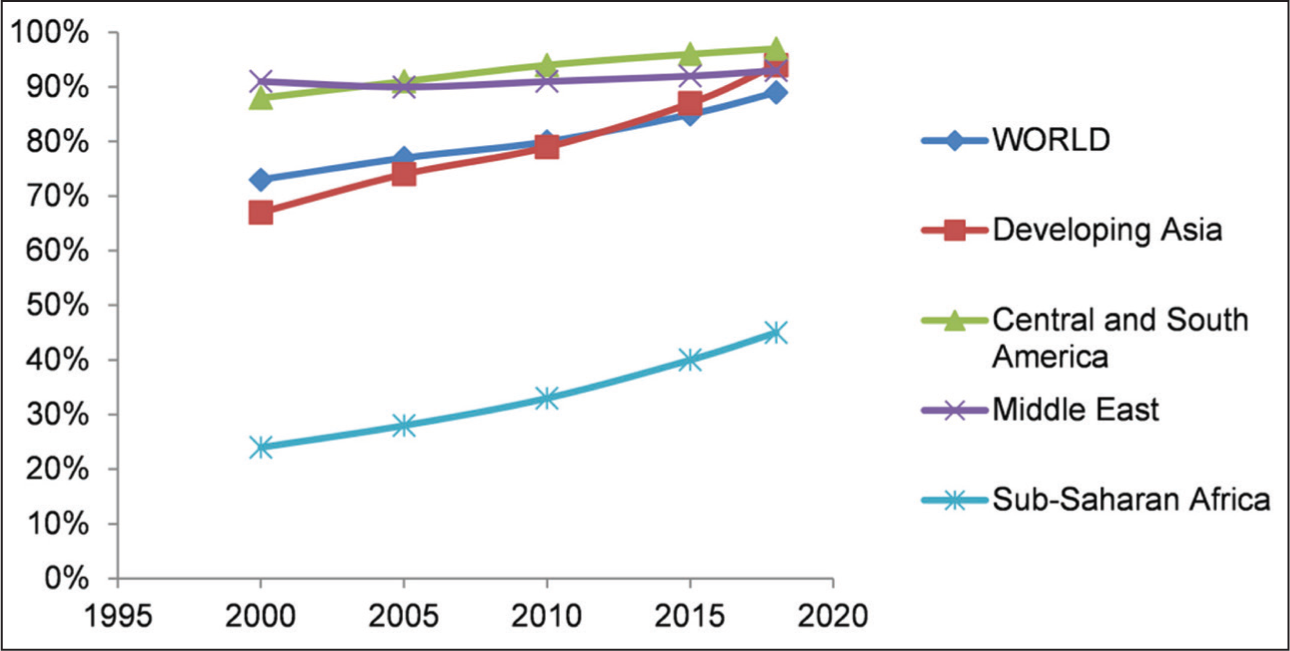
The figure below shows an incremental increase in the electrification rate of Sub-Saharan Africa, and more significantly, that the gap between it and the world’s average has been constant over the last two decades, at least. An increasing level of competence with respect to secondary innovation in clean energy technologies could then be mobilised to increase the rate of electrification such that universal access can be achieved by 2030 (the date set by the UN Sustainable Development Goals) or another date set nationally or regionally. In this case, ‘inclusive catch-up’ encompasses the urgency of not ‘falling behind’ technologically and economically, but subordinates that to sustainable human development. Thus, the following heuristic on catching up inclusively offered by Ki-Zerbo (1993, p. 19) is apt: It’s all very well to move fast as long as you know where you’re going.
Secondary Innovation as a Bi-directional Phenomenon
Secondary innovation is an approach to catching up that ultimately seeks to achieve original or R&D-driven innovation in a particular industry, which is new to the world, rather than imitative. Nevertheless, given that the framework is open and evolving, this makes it favourable to our proposition about bi-directionality – the main provisos being that the overall trend is towards greater originality and that the rate at which inclusive outcomes are met is faster than the rate at which the target itself changes.
Furthermore, in light of the health care resource constraints in Zimbabwe that were accentuated by COVID-19, Dandara et al. (2021) suggest that ancestral- and community-based knowledge of medicinal plants in Africa be further investigated using pharmacogenomics (involving human genome mapping) and molecular targeted therapeutics―a method that they refer to as ‘precision herbal medicine’. The fruitfulness of such an approach can be appreciated in the exemplary work of Youyou Tu, the Nobel Prize-winning Chinese phytochemist, who led the development of the plant-based anti-malarial drug artemisinin (or qinghaosu) by successfully drawing on the writings of the 4th Century ACE philosopher and physician, Ge Hong (Tu, 2011). At the onset of the COVID-19 pandemic, Tu and her colleagues called for malaria-endemic countries to stock their medical facilities with artemisinin-based therapeutics and malaria diagnostics, in addition to the infection management protocols for the pandemic, in order to boost their overall preparedness without undermining the fight against malaria (Wang et al., 2020).
Thus, we argue that grassroots innovation can play an important role in the generation of endogenous knowledge, its production at the relevant scale, the implementation of preventive measures and in the promotion of non-pecuniary and socially inclusive outcomes. Indeed, Sheikh and Bhaduri (2020) have shown that a number of inventions by artisans in Kashmir, which were put to productive use, were fundamentally motivated by values such as preservation of culturally based techniques, better health, improved social embeddedness and simply more time to rest. A recent study of endogenous pharmaceutical innovation in South Africa and Benin by Soumonni and Sègla (2021) also identified knowledge holders of herbal medicine (grassroots innovators) who were working with laboratories during the pandemic to improve the precision of their proposed therapeutic remedies. Together they formed an epistemic community united by common values, a shared philosophical outlook and collective objectives. In this sense, knowledge development that emerges in response to local challenges can be of universal relevance, and knowledge with broad applicability can be revised in the face of more site-specific considerations.
Even more decisive, however, is the innovative deployment and diffusion of secondary innovation to satisfy an existing demand (or tertiary innovation), whose effectiveness is primarily driven by business model innovation or an analogous organisational innovation. Nevertheless, in its technological dimension, we extend the insight by Soumonni and Ojah (2022), who refer to domestic ICT capabilities (corresponding to secondary innovation) that enable significantly more rapid diffusion of vital services (namely, energy), as constituting the basis for tertiary technological innovation. In the context of COVID-19, effective testing, contact tracing and even vaccine-related logistics benefited from novel software applications developed for those purposes. An excellent example of an innovative entrepreneur who brings all three tiers together is Khadidiatou (Khady) Sall, a Senegalese molecular biologist who founded an innovation lab in the city of Dakar named Ubbil (meaning ‘open’ in the Wolof language) in which she spearheaded the manufacturing of 3D-printed face shields that were distributed to medical staff at 60 different hospitals during the COVID-19 pandemic (Powell, 2021). In a recent interview that she gave to the scientific journal, Nature, Khady Sall, who has also founded a non-profit science education organisation, stated her mission as follows:
Sustainable development has to be rooted in the culture, preserving local languages and integrating ancestral practices that are good for the environment. It has to resemble you and where you want your country to go. You can get there by being authentic and you can do that by teaching science in the local language, such as Wolof, a language of Senegal, Gambia and Mauritania. (Powell, 2022)
The Innovative Society
We have earlier underscored the need to contextualise the nation-state in many parts of the Global South in its own historical context and in relation to contemporary challenges. In this vein, an incisive analysis by Krishna and Chandra (2019) of India’s efforts at building an ‘innovative society’―commensurate with Jawaharlal Nehru’s grand vision of eradicating poverty through science―driven by its world class Indian Institute of Technology (IIT) system is highly instructive for the remainder of the hemisphere. V.V. Krishna and Nimesh Chandra further signal the need to intensify complementary activities (e.g. industry-university partnerships) that would enable the emergence of competitive innovation clusters, akin to Silicon Valley, in order to achieve the desired ends (Krishna & Chandra, 2019). We also note that especially for polities in which socio-economic inequality and environmental problems are on the rise, Freeman (2002) had suggested that the appropriate innovation systems would need to leverage social solidarity, engender enlightenment and ultimately prioritise well-being over economic competitiveness. Building upon these scholars’ insights, we offer a definition of the ‘innovative society’ as a purposive coalition of actors that is animated by the imperative of self-directing or endogenous innovation. It is informed by a restorative ideal, through which a critical retrieval of ancestral values can be brought to bear in the building of just and sustainable societies. This notion of critical retrieval is embedded in a philosophical concept among the Akan people of present-day Ghana and Côte d’Ivoire, which is known as Sankofa.
In order to address this diversity of actors, the ‘innovative society’ dimension of our framework equally cuts across state agencies, private firms and grassroots organisations. In instances of weaker states, trust-based social network ties that are both loose and strong may anchor the formation of such a society. This core understanding as a starting point for thinking about a more effective supra-national African society (grounded in a civilisational outlook) that could in turn better interact with the Chinese civilisational state with respect to innovation-based economic relations, has been elucidated by Soumonni (2018).
The below schematic now depicts our overall conceptual framework. It does so in a transversal or cross-cutting perspective along three dimensions, which we subsequently explain.
In Figure 2, the first dimension (x-axis) is a categorisation of endogenous technological innovation based on original, secondary and tertiary innovation in a bi-directional manner. The second dimension (y-axis) identifies three main institutional actor categories and represents a historically informed ‘innovative society’ that is a subset or sub-network within a wider territory or polity, as well as the actors’ transnational innovator networks (e.g. the Songhaï Centre and Honeybee Network grassroots organisations in the figure). Our identification of these two dimensions is in accord with the evolutionary perspective, which views technological and organisational (or non-technological) innovation as co-evolving phenomena. Organisational innovation, whose degree of novelty is much more decisive for the effectiveness of tertiary innovation, includes innovative policies, business models and social enterprise models (for the state, private sector and grassroots organisations, respectively) However, even though we acknowledge that original, secondary and tertiary innovation each contain both components, the x-axis in our framework emphasises the technological component of these categories of endogenous innovation. Thus, while the two broad components are mutually constitutive in practice, for analytical purposes, orthogonality between the x- and y-axes enables us to separately assess the various organisational anchors within the innovative society that could best deploy various forms of endogenous technological innovation.
Endogenous Innovation in Transversal Perspective.

These two traditional dimensions produce a 3 × 3 matrix with nine possible institutional actor/technological innovation pairs that can be recombined with each other to identify feasible paths to achieve given inclusive innovation outcomes. They also enable an exploration of the first two theoretical propositions in relation to anticipated outcomes, which may be usefully classified, in economic terms, as public goods (e.g. vaccines, astronomy and climatic stability), quasi-public goods (e.g. electricity, potable water and higher education) or normal goods (e.g. agri-food, mobile phones and automobiles). Our illustrative examples offer some direction in relation to actors, the character of their technological capabilities and the nature of goods and services they may produce. The third dimension (z-axis), historical path dependence, then requires the analyst to reflect on the antecedents of the first two dimensions in a given environment in order to identify the innovation capabilities that are sufficiently endogenous, and the institutional actors that are most likely to deploy them to the desired ends. This dimension, discussed below, also explores our third hypothesis in relation to a historically, spatially and dynamically informed search for effective actor/innovation pairs that could lead to ‘inclusive catch-up’.
Historical Path Dependence
As can be expected, the interpretation of historical events from the distant past, or more recent ones for that matter, engenders disagreements even among those with the requisite skills. Nevertheless, to aid in our sense making beyond drawing on sources of the highest scholarly repute, we are guided by some broad principles. In the first instance, we adopt the approach articulated by Thapar (2016), which rejects the arbitrary bifurcation between the ‘civilised’ and the ‘primitive’ typically introduced to legitimise conquest (or other exploitative advantages), in favour of inclusive perspectives. Another precept, in addition to very specific methodological recommendations for specialists, is offered by Ki-Zerbo (1990, p. 1), who writes that:
…the history of Africa, like the history of mankind as a whole, is really the story of an awakening. That story needs rewriting, for it has been considerably distorted by ignorance or self-interest.
An example of such a distortion can be observed in a tribute to the noted sinologist and historian of science, Joseph Needham, by the sociologist of science, Steve Fuller. In assessing the manner in which the history of science might inform diverse socio-political objectives, Fuller reduces the book entitled Civilization or Barbarism by Cheikh Anta Diop (1991), a renowned African scientist and historian, to ‘a rhetoric of the ‘stolen legacy’ (Fuller, 2001, p. 125) (the title of a separate book by another author). Yet, in his chapter entitled ‘Africa’s Contribution: Sciences’ (Diop, 1991, pp. 231–307) reproduced portions of ancient mathematical texts such as the Papyrus of Moscow and the Rhind Papyrus, and translated them directly. This included an explicit demonstration from the Berlin Papyrus of the right triangle theorem that would much later come to be known as the Pythagorean theorem (Diop, 1991, pp. 258–260). He did this work independently, based on his training in the Ancient Egyptian language, as well as his expertise in the natural sciences (earned, parenthetically, at the most select institutions in France). As such, Fuller’s perfunctory treatment of Diop’s own work, strictly speaking, is wholly unjustified.
Given this caveat about the need for constant vigilance against internalising prejudices from an external gaze, the dimension of historical path dependence informs the first two dimensions of our framework with respect to existing competences that are likely to be deployed by specific actors. It can do so by highlighting historical experiences that could inspire contemporary efforts, as a source of insightful technical knowledge, to revive aspects of societal arrangements that may still be useful, or all three. With respect to medicinal innovation, for instance, the African American viral immunologist, Dr Kizzmekia ‘Kizzy’ Corbett, who co-designed the molecular structure for the first vaccine made by Moderna at the US National Institutes of Health (NIH), credits a cultural value encapsulated in the African American proverb, ‘each one teach one’, for inspiring her to persist during her own training and to mentor younger scientists from similar backgrounds (Corbett, 2020). This corroborates the strategic importance of ‘folk wisdom’ in the resilience of Japanese firms during the COVID-19 pandemic (Nonaka & Takeuchi, 2021); of socio-cultural networks for African American inventors (Cook, 2011); of the Zimbabwean scientific Diaspora for precision herbal medicine in its country of origin (Dandara et al., 2021) and of guanxi social relationships in East Asia (Hobday, 1995). All these have analogous implications for Diasporic communities with linkages in the Global South when adequately cultivated.
With respect to which actors in the ‘innovative society’ could contribute to endogenous innovation, the comprehensive and insightful review of the first 75 post-independence years of Indian STI policy by Krishna (2021) reveals that despite impressive accomplishments in science-driven innovation, including the independent development of two domestic vaccines (original innovation) and the manufacturing of two others (secondary innovation), the informal sector in India nevertheless constitutes ‘more than 95% of the total labour force, about 550 million’ (Krishna, 2021, p. 1). A similarly instructive study by Saradindu Bhaduri and his co-authors finds that due to political and historical antecedents, strong IPR regimes being implemented in impoverished countries, in particular, lead to adverse human development outcomes, whereas improving those outcomes first, appears to have a favourable effect on IPRs (Bhaduri et al., 2015). Therefore, in such contexts, research that emphasises low cost, socially inclusive and grassroots innovation can be systematically brought to bear in meeting vital needs by starting with the knowledge held by the communities themselves (Muchie et al., 2017).
Towards a South–South Endogenous Innovation Paradigm
To conclude, in this paper, we propose an expanded understanding of endogenous innovation in the Global South, which is anchored in deeply rooted historical, philosophical, cultural and economic (or civilisational) perspectives, and in a critical exchange with the developmental imperatives of the present. We propose an exploratory conceptual framework, underpinned by three succinct theoretical propositions that can enable researchers and policy-oriented actors to better search for opportunities for endogenous innovation on the basis of empirical evidence. The first is a transversal innovative society―which consists of social networks that cut across the state, private sector and grassroots actors, and that is animated by deeper, reflexive values, rather than mainly pecuniary ones. The second is a horizontal and bi-directional endogenous technological domain, anchored in secondary innovation, but with an overall objective of greater originality to avoid falling further behind the global frontier. Lastly, a third dimension, historical path dependence, informs the identification of multiple combinations of actors and opportunities for innovation that could yield desired socio-economic outcomes at a more rapid pace, that is, inclusive catch-up.
However, we acknowledge that elaborating a robust research agenda along the lines of our proposed framework would require a diversity of research skills that can best be harnessed through multi- and transdisciplinary teams. More in-depth studies with well-specified hypotheses will also be required to better guide praxis. For instance, the medical pioneers in Ancient Egypt, Imhotep and Peseshet, a female physician, are still favourably referred to in some contemporary scientific journals as symbols of erudition and commitment to social welfare in classical antiquity. Analogous outlooks currently characterise the philosophical reflections that have accompanied the Chinese lunar missions, Chang’E 1, 2, 3, 4 and 5 (Chang’E being the ancient goddess of the moon), and the ‘Shared Sky’ Aboriginal art exhibitions associated with the Square Kilometre Array (SKA) radio telescopes in Australia and South Africa. Similarly, a reconsideration of Abu Shaker and Shaykh Bakri Saṗalō, who were promoters of endogenous astronomy in Ethiopia, seven centuries apart, could serve a similar role with respect to modern astronomy in the country. Such innovative activities can serve to reinvigorate the cultural imaginary of these societies with respect to contemporary sciences and are a manifestation of what we term ‘endogenous modernity’. Future work will seek to specify how, through a genuine civilisational dialogue within the Global South as well as between South and North, various societies can galvanise inclusive catch-up (and post catch-up) efforts in sustainability transitions, equitable digital innovation, inclusive astronomy and more beyond the COVID-19 pandemic.
Footnotes
Acknowledgements
We acknowledge one of our anonymous reviewers for encouraging us to pursue our line of thoughts about the bi-directionality of secondary innovation.
Declaration of conflicting interests
The authors declared no potential conflicts of interest with respect to the research, authorship and/or publication of this article.
Funding
The authors received no financial support for the research, authorship and/or publication of this article.