



Abstract
Female domestic workers (FDW) are one of the most vulnerable segments of a society facing adverse social domination and economic discrimination. The present article aims at investigating to what extent the participation of poor women in economic activities empowers them. The study amalgamates data collected from 334 female domestic workers living in different areas of South 24 Parganas district of West Bengal through a semi-structured questionnaire during a period of 6 months from January 2016 to June 2016. This district was chosen on the basis of existing inter-linkage between the growth and expansion of the city of Kolkata in her southern part, existence of a large number of Bangladeshi migrants in South 24 Parganas (Kumar, 2010), evidences of large scale commuting of unorganized workers (Roy, 2003) and the expanding informal market where the supply of manual labour comes from the fringes of the district. The article tries to explore the different dimensions of empowerment from the study of female domestic workers. This includes workers’ involvement in taking household decision, free movement, possession of assets and restricting domestic violence. By adding the obtained scores and weights of the indicators, a cumulative empowerment index is constructed. Restrictions in mobility and lack of ownership of permanent assets amongst workers indicate their subordination in the household hierarchy and highlight that women are excluded from asserting influence over household properties. Severe domestic violence against women is common and visible even when husbands are unemployed. About 69 per cent of female domestic workers report incidences of physical assault at home. The index, thus, establishes that the majority of the domestic workers level of empowerment is between low to moderate.
Introduction
Discussion on women empowerment evolves from its inception in the United Nations Development Program’s (UNDP) Human Development Report (2000), where participation of women in economic activities remains one of the principal agendas in the scope of women empowerment process (Kantor, 2005). Helling et al. (2005) explained empowerment as the ability of women to effectively participate in all socio-political and economic activities which enable them to manifest and convert choices into attainments. In India, women constitute a significant proportion of the population. With economic development and gender promotional activities in India, women today have more prominence and ability to speak than they had a few years ago. But till date, women empowerment is a much-debated issue and gender discrimination against girls exists in investments on education, the formation of skills, health issues and so on. Bardhan (1985) reveals that though participation in the labour market is a vital prerequisite for the economic independence of women, it is not a sufficient condition to ensure an increase in the bargaining power of women restricting her decision-making role within families. Women empowerment leads to economic development. There is a bi-directional relationship between economic development and empowerment of women.
Over the last few years, there has been a rapid rise in female workforce participation rate in India. But, with a large mass of uneducated female population, majority of them are engaged in work which is informal in nature. Such work requires low skills, is low paid and has no security. It is found that amongst the different types of workers in the informal sector, the female domestic workers, especially the part-time female domestic workers are most vulnerable. Their earnings are the lowest and work conditions insecure. They work for 6–7 hours daily and are the invisible force; the cogs that run the machine of everyday existence of the majority of households. This is true for their own household as well, where their income is of vital importance for sustenance. As for the employers’ household, they act as substitute workers to regulate household chores. But, in real life, they have very few choices and are faced with extreme challenges in their day-to-day existence. This study on female domestic worker was planned with an objective to (a) explore the factors influencing the nature and extent of empowerment and (b) to suggest strategies for gender promotional activities for protecting and accelerating empowerment level of female domestic workers. The methodology adopted in this study is an integration of qualitative and quantitative methods based on data collected from part-time female domestic workers in South 24 Parganas District of West Bengal during the period January 2016 to June 2016.
The Survey Area and the Sample
South 24 Parganas District ranks first in terms of area (9960 km2) and is the second most populated district (18.17 per cent) in West Bengal, India. Once dismissed as non-lucrative, growth and expansion of the sub-urban areas of the district has gained momentum with the developers acquiring land for construction of real estates. Over 15 years, the population in these areas has skyrocketed. The choice of the district was prompted by the growth and expansion of the city of Kolkata in her southern part; the existence of a large number of Bangladeshi migrants in South 24 Parganas (Kumar, 2010); evidence of large scale commuting of unorganized workers (Roy, 2003) and the naming of local morning trains in the south-section railway route carrying female domestic workers as ‘jhee’ 1 special (Chakravarty & Chakravarty, 2010). There are empirical studies in the context of India highlighting the vulnerabilities of the low paid domestic workers, micro-studies in the context of West Bengal is rare.
The study of women workers in the informal sector, with special reference to part-time female domestic workers is an empirical one. Information on 334 female domestic workers was collected from extensive field survey for a period of 6 months. Working women in the informal sector of South 24 Parganas district constitute a heterogeneous group. A stratified sampling method was undertaken to identify the female domestic workers while selecting the sample. The respondent workers were listed under rural, sub-urban and urban areas and further categorized into locals, slum-dwellers 2 and commuters. Locals and slum-dwellers constitute 75.4 per cent of the sample signifying availability of work and affinity to live in urban areas. Access to diversified opportunities in off-farm jobs, advantage of the minuscule wage gradient and availability of schools and improved health care facilities in the urban area lures poor people to move to urban areas. Also, living in urban areas can have forward linkage effect in terms of status of the household and the freedom of mobility for women. Commuting female domestic workers are approximately 12 per cent in our sample and as mentioned earlier, Chakravarty and Chakravarty (2010) also found hundreds of maids travelling in local trains from villages of South 24 Parganas to Kolkata every morning.
Conceptual Issues
The study was conceptualized considering a set of personal and socio-economic dimensions that shape women empowerment. These dimensions are dynamic and inter-linked. At the household level, this inter-linkage can be highlighted by emphasizing the directly proportional association between gender equality and development. These dimensions are as follows:
Personal dimensions: Involvement in the process of household decision-making is considered in this dimension. Women’s participatory role in taking household decision enhances their self-determination, self-esteem and autonomy within households, as well as demonstrates exertion of power in control over resources. Participation of women in decision-making at the household level results in their own well-being as well as that of their children. By educating their children, their well-being falls straight in the process of encouraging capital accumulation. Doepke and Terlilt (2011) indicate that expenditures on children go up when transfers are made to females, with greater expenditure on schooling for kids. This encourages the accumulation of human capital, which in turn contributes to economic growth.
Socio-economic dimensions: This dimension includes women’s contribution to family income and decision-making in household economy, their access to socio-economic resources and ownership of assets. With increased earning, women’s participation in households’ economic decision gets enhanced, thereby improving her self-reliance and bargaining power and reducing economic subordination.
Various factors encourage women’s participation in household economy. Improved self-confidence, control over resources and freedom of choices are some of them. In this study, female domestic workers lack skills as well as a means of skill enhancement. As a consequence, they are virtually without any choice as regards obtaining worthwhile jobs that would reduce vulnerability and poverty. They are engaged in household-oriented services like cooking, cleaning and mopping, washing utensils and clothes and as elderly and child caretakers. Neetha (2013) showed that the number of women employed as domestic worker had a fourfold increase over the 10-year period from 1999–2000 to 2009–2010. Enhanced participation in labour force gives women an opportunity to earn income along with an exposure to the outside world. This ensures a right on arrangements and networks outside the family.
Empowerment Indicators
In this sector-specific analysis, it has been hypothesized that contribution to the household income, ownership of assets and resistance to violence and physical assault (PA) shape women empowerment. Bhattacharya et al. (2013) measured women empowerment at individual level; where empowerment is interpreted in terms of basic capabilities entitled health, knowledge and autonomy. The characteristics of female domestic workers in our sample reflect that they experience positive, personal and social changes with income generated and through their interaction with their employers. The opportunity to support a family financially has subsequent positive effects on the dimensions of empowerment like health, education, outside-home mobility and so forth; thereby improving their position within the household and the society. Education, for example, ensures women’s independence and improves control over resources and decision-making (Datta & Gaily, 2012). The behaviour of women tends to change with age and the experiences gained over lifetime empower her to voice her desired goals. As UN Secretary-General, Ban Ki-Moon in his speech on women’s health and girls’ education in Sahel said ‘educating girls and giving them the tools to shape their own future has an incredible multiplier effect on economic growth. It leads to increased prosperity not just for individuals but for their communities and their societies. It provides returns for decades’ (The World Bank, 2013).
Ownership of assets involves the capability of the workers to regulate and channelize those assets and enjoy benefits associated with them. Assets were classified into productive asset and durable asset. A third category included the financial asset that consisted of bank accounts and life insurance coverage. To get an idea of the market value of the worker’s asset, it was evaluated in terms of cash. Productive asset involved possession of land and ownership of house. Land is one of the many assets, people in the rural areas seem to own. But, the ownership lies with the male head of the household. Ownership of durable assets includes shallow tube well within the premises, radios, televisions, mobile phones, refrigerator and bicycles. There is a huge variation in the possession of durable goods amongst female domestic workers, although our data suggest that the urban and sub-urban workers are doing well.
Violence against women in the form of physical abuse seems common amongst poor households. Physical abuse emerges in the form of verbal abuse or wife-beating. Resistance against physical abuse can be considered an indicator of empowerment. As has already been stated, Indian women have a distinctly greater voice than before. Nonetheless, not all women are equal. As reported in UNDP (2000), women from the privileged and dominant classes and castes are independent and have opportunities that women from underprivileged groups are deprived off.
In our study, responses for indicators are analysed with binary choices. The total value for each indicator is calculated by summing up the responses (indicator × weight) under different dimensions. Rai and Ravi (2011) showed that they tend to be inter-correlated, that is, empowerment in a particular indicator would eventually bring about empowerment in another.
Construction of Women Empowerment Index
Composition of Empowerment Index for Female Domestic Workers

Cumulative Empowerment Index:
where
I11 =1, if she enjoys the freedom to visit friends and relatives without permission
= 0, otherwise
I12 =1, if she is a member of some local body/group
= 0, otherwise
I21 =1, if she hires service of someone to do household chores
= 0, otherwise
I22 =1, if she is a decision-maker in family expenditure
= 0, otherwise
I23 =1, if she sends her daughter to school
= 0, otherwise
I31 =1, if she operates her bank account
= 0, otherwise
I32 =1, if she lends money to her husband without physical abuse
= 0, otherwise
I33 =1, if she owns a house
= 0, otherwise
I34 = 1, if she has ownership of durable assets
= 0, if otherwise
I34 = 1, if she is a primary insurance account holder
= 0, otherwise
I41 = 1, if she has no restriction in social life
= 0, otherwise
I42 = 1, if she is not physically assaulted or restrains physical violence
= 0, otherwise.
Based on the different indicators, CEI for each female domestic worker in the sample is assessed separately. The response values for the items are summed up to get the value of the indicators. Moreover, the indicators under domestic violence are standardized to arrive at the final value of the index. The value ranges from 0–12, where 0 indicates no empowerment and 12 indicates high empowerment. For an absolute comparison of women empowerment, the values have been classified into four categories namely high (10–12), average (7–9), moderate (4–6) and low (0–3) empowerment.
Empirical Findings from the Sample
Socio-Demographic Profile of Female Domestic Workers
To understand the empowerment situation of the part-time female domestic workers, we have presented their socio-demographic profile in Table 2. The age group of the sample ranges between 22 and 60 years.
Classifying our sample into four age groups, we find 41.6 per cent of the workers are in the age-group of 30–40 years, 23.8 per cent are aged between 20–30 years and 40–50 years and only 10.8 per cent are older than 50 years. So, we observe predominance of middle-aged women amongst sample part-time domestic workers. The level of literacy indicates that 21.3 per cent of the female domestic workers are illiterate and 19.3 per cent can recognize alphabets and do minor mathematical calculations without ever attending school. Only 20 per cent of the workers have gone to primary schools. Women with education above secondary level are just 2 per cent. So, most domestic workers in the study are either illiterate or just literate. The lack of education is negatively associated with household decision-making. This is in line with El-Halawany’s (2009) results. He showed that education supplements women’s autonomy, empowerment and gender equality and that is visible through their participation in the social and economic decision for the welfare of their household.
Like education, media exposure strongly equips women with information and prepares them to adjust to the changing modern world. Kishore and Gupta (2004) consider media exposure as a proxy for education. Mass-media (television, cinema and so on) can sensitize illiterate women on gender issues. Electronic media also plays a pro-active role in raising awareness with advertisements, focussing a positive image of women. In our study, 53 per cent of the workers have television sets (in most cases, it is second hand and sometimes even purchased from their employers); 99 per cent of the workers have a mobile phone. Also, by interacting with employers they experience positive changes.
Socio-Demographic Conditions of the Domestic Workers
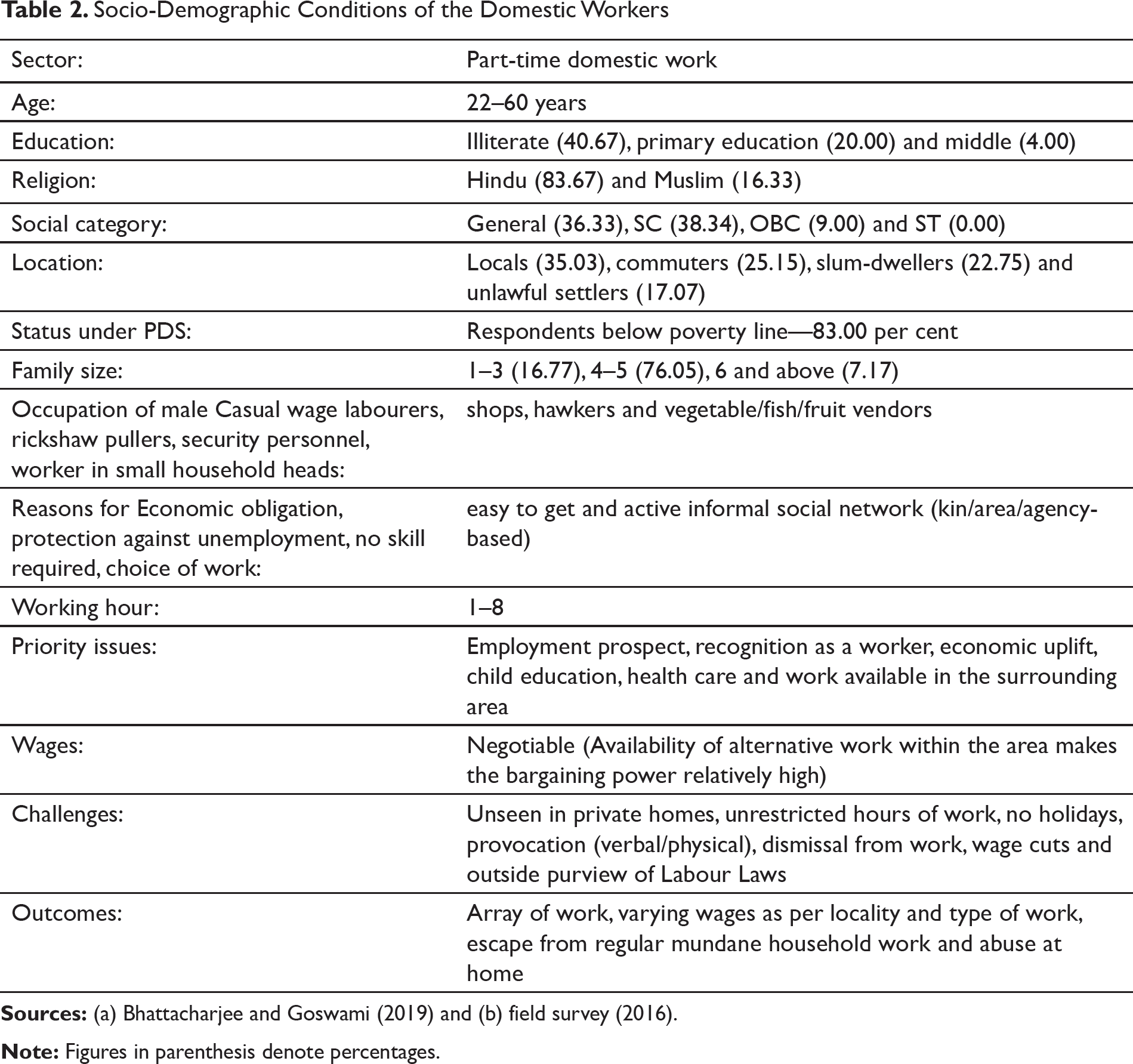
Therefore, we see that women with flexible working hours, low level of education or meagre assets of very low skills, finds easy entry into this sector. The priority issues of the workers in this sector are to supplement family income, provide education to their children and avail health care facilities for family members.
Findings Across Empowerment Indicators
Results from the sample give us the percentage distribution of responses of female domestic workers across indicators, as shown in Table 3. Under the social dimension, freedom of mobility refers to visiting friends and relatives or being a member of the social body. Since our respondents are domestic workers, mobility by default is associated with their type of job. This seemed to be in tune with literature pointing out free mobility to be high for the poorest women who have to indulge in travelling to join the labour force for sustaining a livelihood. Opposite views on poor labour market outcomes of Jordanian young women have been provided by Miles (2002). She found that cultural and family factors significantly restrict the mobility of women, thereby limiting their job search and job opportunities in turn. She also addressed that family opposition stemmed from the lengthy commutes that extended the working hours in private sector jobs.
Although there are no restrictions on work, 43 per cent of female domestic workers in our sample said that they had to seek permission from their spouse or family to go outside for social visits. The percentage is calculated from the outcomes that is assigned a value one, if the woman admits of no such permission and zero if she does. In our sample, only 21 women are members of self-help groups as more than 90 per cent of workers are sub-urban or urban settlers where there is meagre provision to join self-help groups.
Workers’ Response Across Indicators (in Percentages)
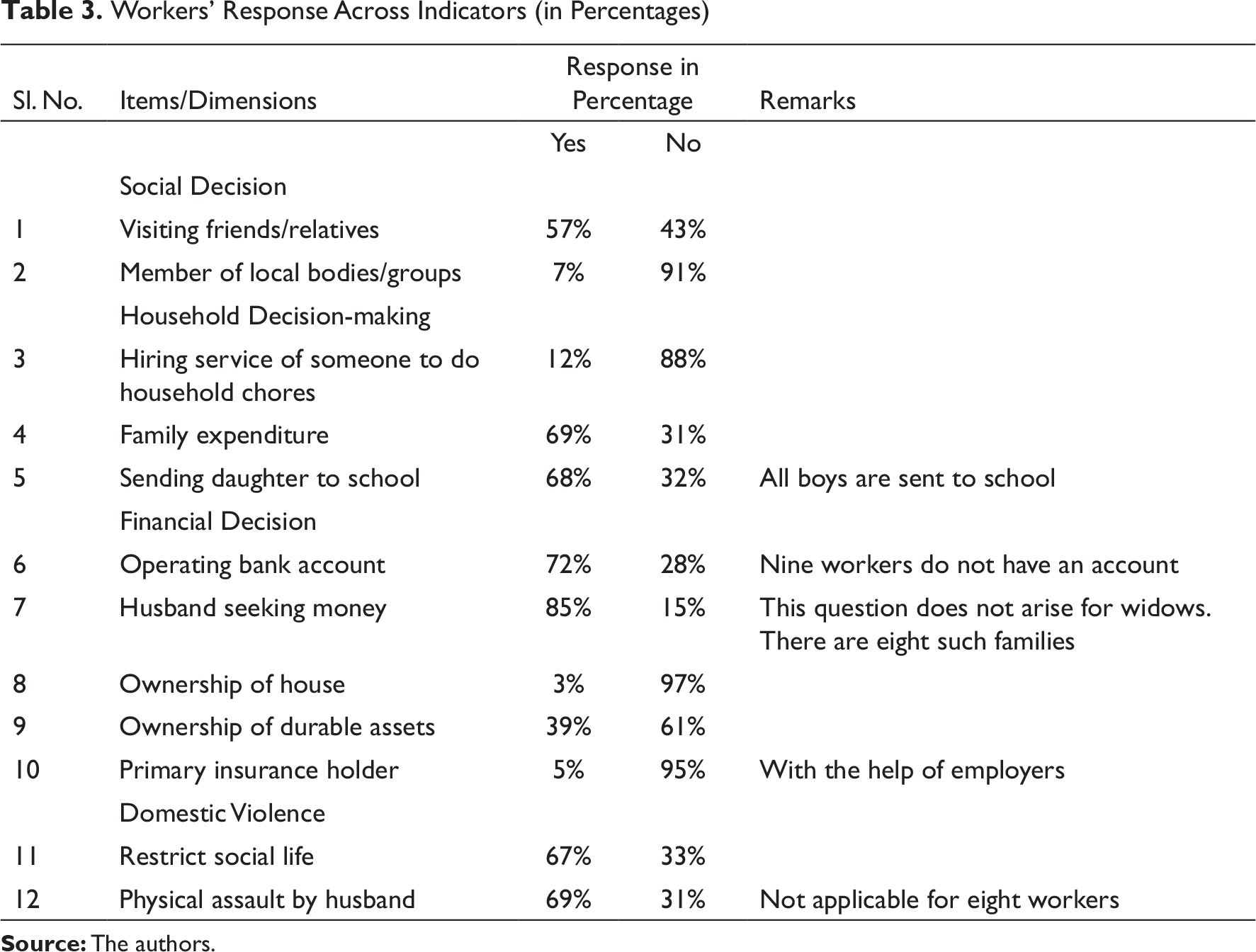
Despite women’s considerable contribution to family income and survival, social control largely rests with the household head. Violence against women is common even when husbands are unemployed. About 69 per cent of female domestic workers report incidences of PA at home. Accepting, experiencing and allowing violence on themselves is an expression of low self-confidence in women. There is an evidence of husband seeking money (85 per cent), and for many, this is true against physical violence. If women try to rationalize/justify violence against them, this empowerment scenario becomes disturbing. Under any condition, 31 per cent of women do not adhere to PA. Of these, 7 per cent are widows and 15 (5 per cent) are primary bread earners. About 19 per cent of the female domestic workers with medium to high economic contribution in households recorded no PA whatsoever.
In the financial aspect, 72 per cent of the respondents have a bank account. This can be attributed to Pradhan Mantri Jan DhanYojna, 3 which applies to all in the 18–65 years age-group. Ownership and control of property demonstrate the women’s economic status within the household. The respondents were asked about ownership of a house, agricultural land, durable assets, etc. A value one was assigned if a woman has control over the assets and income and zero if she does not. Just 3 per cent of the respondents own a house and 39 per cent have ownership of durable assets like television, mobile, refrigerator, etc. About 5 per cent of the respondents are primary life insurance holders and accept their employers’ initiative in this regard.
Magnitude of Empowerment
CEI: Dependent Variable
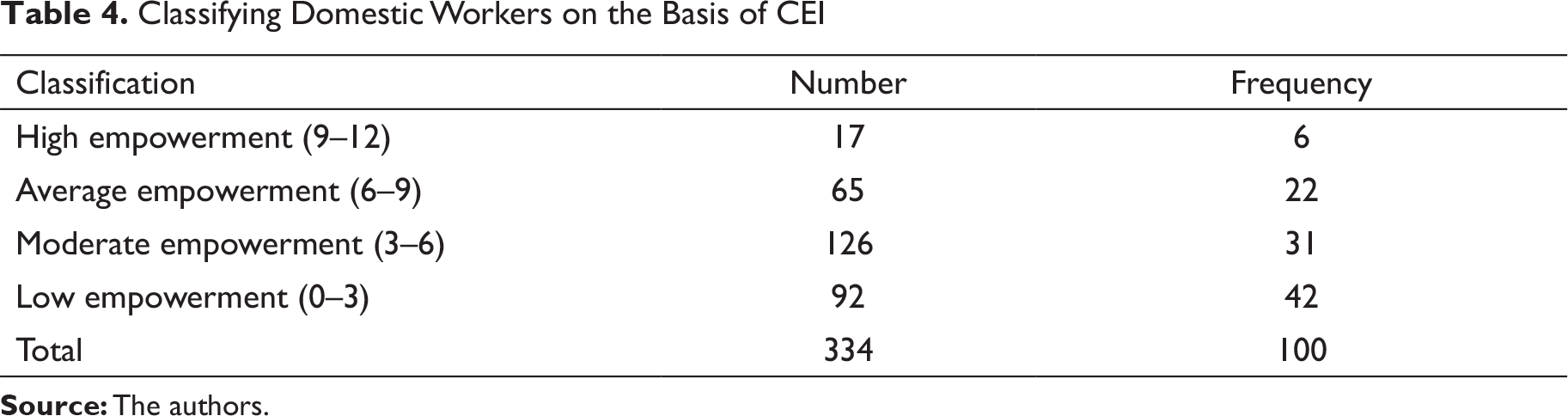
The extent of a domestic worker’s empowerment is portrayed in Table 4. This reveals that 42 per cent of the respondents have low empowerment, 31 per cent have moderate empowerment, 22 per cent have average empowerment and only 6 per cent are highly empowered. Nevertheless, it is clear from our study that more than 70 per cent of female domestic workers are concentrated in the low to moderate end of the distribution of empowerment, thereby revealing their insecurity and subjection within the household and society.
Determinants of Empowerment: Independent Variable
A multiple linear regression analysis is conducted to identify the effects of five determinants: wage, year of schooling (YOS), sex of child (SEX_CH), hiring domestic workers and PA on the CEI. The econometric model, explanatory variables and hypothesis are given below:
Classifying Domestic Workers on the Basis of CEI
Explanatory variables and hypothesis:
Wage: Wage rates vary with specificities of work. By managing time devoted to work in respective households, a female domestic worker tries to maximize the number of houses serviced. That way, she can increase her share in family income to that required level that helps her sustain a livelihood. Therefore, wage earned by the female domestic worker is a positive indicator of her empowerment.
Year of schooling: Years spent on schooling of the worker is inversely related to her years of work as a domestic worker. Domestic work is labour intensive and physically demanding. With the absence of any legal contract, wages are decided on the basis of the prevailing wage rate in the area as well as bargaining between the employer and the employee. It does not depend much on the education level of the workers. Therefore, it is hypothesized that years of schooling hampers her years of work, thereby reducing her income over the span of her work-life thus having a negative effect on empowerment.
Sex of the child: Sex of children is positive and significant only when one gives birth to a son. It is a common observation that a male child is an asset who will make an economic contribution to the household and look after parents in old age.
Hiring domestic help (HDH): HDH is an important indicator of empowerment for a female domestic worker. The increased decision-making role is definitely an outcome of the dependence of the family on the income of the domestic workers. Therefore, it is hypothesized that keeping a domestic worker is a positive indicator of empowerment.
Physical assault: Being physically assaulted is a negative indicator of empowerment. This empowerment scenario becomes alarming when women attempt to rationalize or justify violence against them.
Results of Linear Regression Analysis
Effects of Factors on Women’s Empowerment
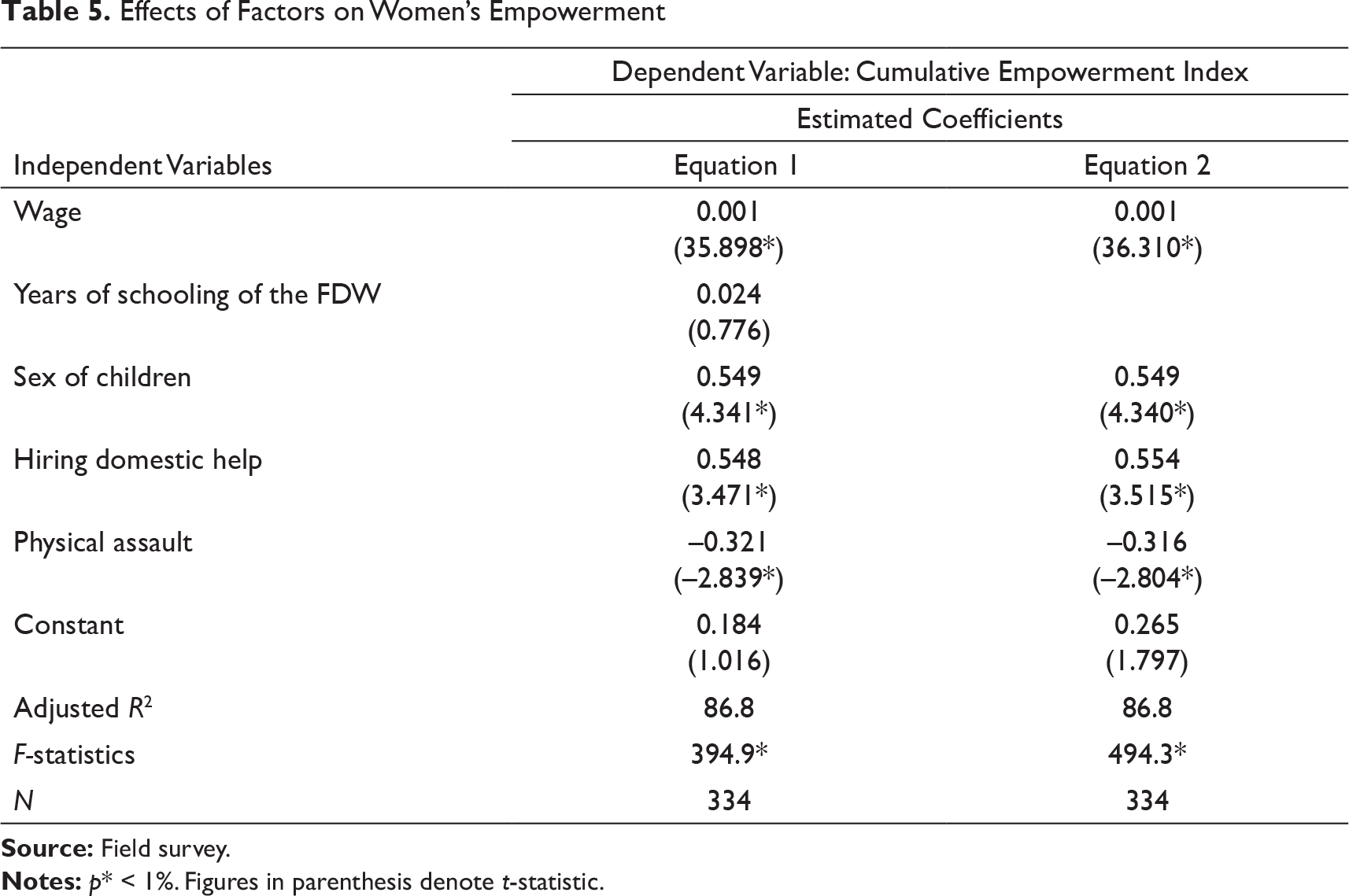
PA, on the other hand, is negatively related to the CEI. This provides a very significant result that indicates a negative relationship between wife-beating and empowerment.
Sex of children is positive and significant only when one gives birth to a son. It is a common observation that a male child is an asset who will make an economic contribution to the household and look after parents in old age. On the other hand, daughters who are required to play a wife, mother or caregiver’s position are considered economic liability. Yet, the presence of girl child in the household helps female workers to increase salaries by increasing the number of houses serviced. Here, the daughter bears the responsibility of unpaid household work.
Insignificant p-values of years of schooling can be interpreted in the following way. Domestic work as a profession does not require much of education or technical skill. These tasks are more labour intensive or physically demanding. As we have seen, 40.67 per cent of our workers are illiterate. A cook is the most skilled worker in the broad category of part-time domestic workers. Other part-time female domestic workers do work on piece rate, that is, different work at different rates. For example, mopping in one house and washing utensils in the other, where the payment varies with specificities of work. By managing time devoted to work in respective households, the worker tries to maximize the number of houses serviced. That way, she can increase her share in family income to that required level that helps her sustain livelihood. The increased decision-making role is definitely an outcome of the dependence of the family on the income of the domestics.
Hiring domestic help is an important indicator of empowerment. The regression coefficient is significant at 1 per cent level. This is actually interesting because not all workers hire a maid. Workers who are able to manage work outside their neighbourhood, especially in the housing estates, may redefine their bargaining power by employing domestic workers for household chores. They have an advantage of higher wage (data show that wages are higher in housing estates) and in effect operate an informal ‘closed-shop’ 4 mechanism in their workplace, thereby barring entry and restricting competition.
Such factors alone, however, do not justify the gamut of women’s empowerment. There are several other quantitative and qualitative factors that shape empowerment. Qualitative attributes like religious belief, social category and husband’s attitude, etc., contribute to the process of women empowerment. The regression analysis, therefore, indicates the need to apply all-inclusive approaches for female domestic workers to improve the status and quality of life under enormously disabled circumstances.
Recommended Strategies
Domestic work is a predominantly female-dominated sector. This type of informal work is poorly regulated and not protected by labour laws. They seldom have an organized mechanism for collective bargaining. Their vulnerability as a worker is made more complex as they work in isolation in private homes and depend on the generosity of their employers. Empowering domestic workers is essential and the following strategies may be considered.
Fair wages are the biggest obstacle to empower domestic workers. They are susceptible to unlawful working hours and low wages. Judicious working hours and a reasonable wage rate improve quality of life. Execution of the ‘Minimum Wage Act’ 5 and provision of Social Security Support is essential to improve their well-being.
They lack awareness as well as funds to save money for their old age. Access to financial support, information on insurance and retirement funds and access to family support services is important for long-term planning and saving.
Household work is physically demanding in the sense that it is labour intensive. They have no medical insurance and all expenses of illness, hospitalization of self and family are borne by the worker. Access to free or reasonable health facilities is a great key to improve the physical and mental well-being of domestic workers.
National and regional campaigns on the rights of domestic workers can be instrumental in raising awareness amongst employers and employees; thereby decreasing exploitation.
Conclusion
Present study provides an understanding about women empowerment amongst 334 part-time female domestic workers in South 24 Parganas district of West Bengal, India. We need to recognize the fact that female domestic workers extend care service which is multifaceted in nature. Their services include cleaning and mopping, laundry, cooking and also taking care of children and elderly.
They deserve respect and must get opportunities for self-empowerment. Based on the results and discussion, one can realize the unsatisfactory empowerment level of domestic workers. Low wages and informal work culture demean their self-esteem. Though a fair contributor to household income, restriction in mobility, deprivation in exercising power and control over family assets and PA indicate their subordination in household hierarchy and establishes their low to moderate level of empowerment in our survey area. Further, the entrenchment of certain traditional beliefs and practices in their lives often hinder their empowerment. Formalization and provision of social security support for female domestic workers is the basic requirement towards fostering empowerment. Based on the recommended strategies, the government and NGOs can take necessary steps and ascertain the level of empowerment for female domestic workers.
Footnotes
Declaration of Conflicting Interests
The authors declared the following potential conflicts of interest with respect to the research, authorship and/or publication of this article: This article is an original research study and has not been used on any other platform, digital or print.
Funding
The authors disclosed receipt of the following financial support for the research, authorship and/or publication of this article: Part of the work was funded by UGC, MRP under Financial Assistance Ref. No. PHW-120/14-15 (ERO)/WC2-165/ Dated 02 February 2015 (XII Plan).