



Abstract
This article aims to investigate how social distancing restrictions can be a potential factor to effect on the adoption of mobile money services (MMS) using panel data from seven countries in the Middle East (Egypt, Iraq, Jordan, Morocco, Palestinian territories, Qatar and the United Arab Emirates) during the period from January to December 2020. Employing panel data analysis, the author uses various measures from the global mobile money dataset GSMA and Google Coronavirus Disease 2019 (COVID-19) Community Mobility Reports. The findings reveal that the social distancing restrictions have begun to play an essential part in the shift to cashless payment due to the epidemic and influence the adoption and use of MMS. The results also suggest that the social distancing restrictions affect consumer adoption of MMS and indirectly affect retailers. Unlike prevailing studies, this study is unique in empirically investigating the association between COVID-19 community mobility and MMS adoption. This study contributes to financial studies on MMS adoption under extreme settings.
Keywords
Introduction
The Coronavirus Disease 2019 (COVID-19) pandemic began as a disruption to public health and healthcare systems. Nevertheless, the spread of COVID-19 can have long-term consequences for society and economies. Despite this, societies were forced to accept ‘social distance’ or stronger government lockdowns because of the virus’ speed of spread. This was the situation in countries hit or not hit by the actual spread of COVID-19. Furthermore, the spread of COVID-19 may create opportunities to encourage technological adoption (Fu & Mishra, 2020). Joseph (2020) highlights that mobile money services (MMS) have become a considerable tool to conduct secure and effective financial transactions throughout the actual spread of COVID-19 regardless of the disruption in the worldwide financial system. Unlike other industries that experienced turmoil and saw their market share eroded as COVID-19 spread, MMS providers increased their market share from 100% to 300% (Joseph, 2020). As a result of the COVID-19 pandemic, wholly new variables have entered the mechanism of encouraging minimizing cash in commercial transactions for consumers and businesses.
Fintech is undergoing a fundamental transformation in the Middle East. The region is ready for significant expansion in the industry due to rapid growth in information technology, government concentration on creating smart towns and the e-commerce revolution (Banerjee, 2020). Moreover, most central banks cooperate with MMS providers to increase fintech platforms’ usage for financial transactions like mobile money (MM) to lower financing costs (GSMA-b, 2020). The transformation depends not only on technology to achieve inclusive, emergent and qualitatively new practices but also on changes in the current social context (Esawe & Elwakeel, 2020).
Regarding MMS in the fintech ecosystem, according to Akomea-Frimpong et al. (2019), MMS in emerging regions worldwide has become increasingly popular. Furthermore, the cost of providing financial services, especially for people in developing countries who do not have bank accounts and do not have access to financial services, can be reduced by using MMS (Bongomin & Ntayi, 2019). Mobile technology brings more unbanked populations into the financial system in developing countries. However, according to Joseph (2020), most banks now offer MM solutions and services due to competition in the financial sector between banks and fintech companies, accompanied by frequent technological disruptions and the need to diversify the customer base. On the other hand, fintech companies offer competitive services to both bank customers and customers without a bank account (Figure 1).

The adoption of MMS in the Middle East generates multiple concerns for stakeholders as well as for academics, as many countries are relying on financial technology (fintech) in order to achieve digital transformation (DT), financial inclusion (FI) and trying to find the best solution to increase the MMS adoption (Ahmad et al., 2020).
Based on the data obtained from GSMA (2021), a depiction of the MMS indicators compared to the Q4 of 2019 and 2020 is shown in Figures 2–6 for seven countries in the Middle East, such as Egypt, Iraq, Jordan, Morocco, Palestinian territories, Qatar and the United Arab Emirates.
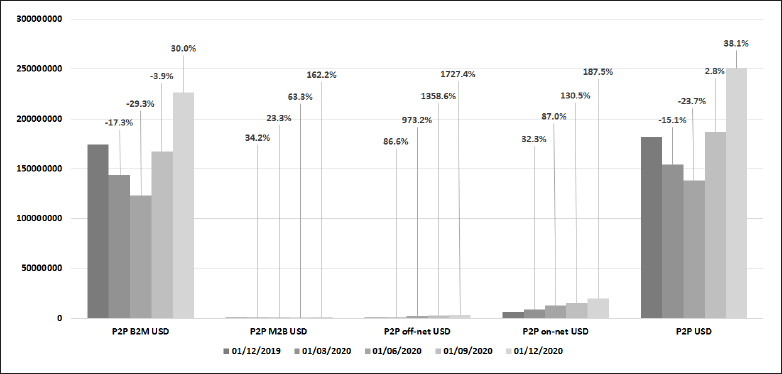
Figure 2 illustrates domestic transfers between two customer accounts (P2P) in seven Middle Eastern countries from January to December 2020. According to GSMA (2021), ‘P2P refers to domestic transfers between two customer accounts, including over-the-counter (OTC) transactions, off-net/cross-net transfers, bank account-to-mobile money account transfers B2M, and mobile money-to-bank account transfers M2B’.
From Figure 2, we can observe that transfers conducted between two customer accounts on a domestic-level P2P decreased in Q1 and Q2 by 15.1% and 23.7%, respectively, and increased in Q3 and Q4 by 2.8% and 38.1%, respectively. In addition, P2P bank account-to-mobile money account transfers (B2M) decreased in the Q1, Q2 and Q3 quarters by 17.3%, 29.3% and 3.9%, respectively, and increased in Q4 by 35.3%. Nevertheless, P2P mobile money-to-bank account transfers (M2B) increased in Q1, Q2, Q3 and Q4 by 34.2%, 23.3%, 63.3% and 162.2%, respectively, indicating the continuous increase in consumers’ mobile remittances usage. Apart from that, P2P on-net and P2P off-net have increased in Q1, Q2, Q3 and Q4. However, it is noticeable that the increase in P2P off-net was higher than P2P on-net, implying that customers opt for more P2P off-net.
Figure 3 illustrates merchant payments in seven Middle Eastern countries from January to December 2020. According to GSMA (2021), merchant payments refer to ‘movements of value from a customer to a merchant to pay for goods or services at the point of sale (POS) using a mobile money account.’ Figure 3 shows merchant payments decreased in Q1 by 20% and increased in Q2, Q3 and Q4 by 7.5%, 20.4% and 35.3%, respectively, indicating an increase in users’ usage rates to pay through points of sale for goods and services.

Figure 4 illustrates bill payment, airtime top-up and bulk disbursement in seven Middle Eastern countries from January to December 2020.

Concerning Figure 4, it is notable that airtime purchases decreased in Q1 by 6.0% and increased in Q2, Q3, and Q4 by 32.8%, 84.6%, and 145.1%, respectively. Furthermore, there was a notable decrease in bill payments using MM in Q1, Q2, Q3 and Q4 by 30.1%, 9.0%, 13.3% and 33.0%, respectively. In addition, bulk payments increased in Q1, Q2, Q3 and Q4 by 32.4%, 51.9%, 75.3% and 99.2%, respectively, indicating that the FI programmes for salary payments, government or non-governmental organizations (NGO) transfers are being conducted effectively and increasingly.
Figure 5 illustrates cash in and out in seven Middle Eastern countries from January to December 2020.

As shown in Figure 5, there is an increase in the total cash-in rates over 2020. However, it is noticeable that the increase in cash in at the agent was more significant than the increase in cash in at the ATM. Likewise, the total cash out increased, and the increase in cash out at the agent was more significant than cash out at the automated teller machine (ATM). It indicates that customers are more reliant on agents than ATMs.
Figure 6 illustrates international remittances in seven Middle Eastern countries from January to December 2020.

According to Figure 6, the total international remittance (IR) increased in Q1, Q2, Q3 and Q4 by 16.7%, 50.4%, 84.2% and 119.0%, respectively. However, the increase in IR sent was more significant than the increase in IR received, implying that customers’ usage of IR between accounts increased.
The above-mentioned depiction of MMS usage and the previous studies on MMS adoption, for example, Javed et al. (2021), showed that the MMS adoption rate has yet to be improved. We can argue that MMS’ potential is not entirely fulfilled. As a result, MMS must be understood broadly rather than just expanding the amount of MMS usage by integrating the adoption of MMS. Nowadays, after the spread of COVID-19 and the imposition of social distancing restrictions, the real problem is how to increase the adoption and use of MMSs under social distancing restrictions. Given that the Middle East comprises developing countries, the bulk of the population is unbanked (Nan, 2019) and has no access to sustainable financial services (Banna et al., 2022).
According to Wenxiu et al. (2021), MM as an emerging phenomenon has still not received as much attention despite increasing research into mobile financial services. On the one hand, the literature review revealed that most of the research on MMS adoption has concentrated on country-specific studies and survey data; only a few studies were carried out in two or more countries/regions (Mahmoud, 2019). On the other hand, some prior studies focused on the relationship between building economic resilience (Al nawayseh, 2020), FI (Ahmad et al., 2020), development (Asongu & Nwachukwu, 2018), sustainability (Emeana et al., 2020) and MMS adoption. However, existing MM studies have limitations, in that they do not consider the impact of social distancing restrictions on adopting MMS. Furthermore, while Alber and Dabour (2020) have investigated the relationship between fintech and social distancing during the COVID-19 pandemic in 10 countries, only three were from the Middle East. Therefore, the role of social distancing restrictions on MMS adoption during and after COVID-19 remains to be explored.
Taken together, this study contributes to financial studies on MMS usage under extreme settings. Moreover, the current study also contributes in different folds as follows: (a) to the author’s best knowledge, this is the first study that uses econometric techniques and investigates the impact of social distancing restrictions on the adoption of MMS for the panel of seven countries in the Middle East during the period from January to December 2020. (b) Based on the study’s estimated results, it provides some crucial insights for the governments and stakeholders that might help in increasing the adoption of MMS in the panel of selected countries.
The rest of this article is structured as follows: the second section begins with a brief discussion of related work. The third section then goes over the methods we use in this article to enable panel data analysis using mobility data and the adoption of MMSs. The fourth section contains in-depth assessments of the Middle East region. Finally, in the fifth section, we conclude and discuss future work.
Theoretical Background and Hypotheses Development
Related Work
The empirical rush sparked by the COVID-19 epidemic has resulted in much research. This section will first look at studies that link social distancing restrictions with COVID-19 and how mobility data might be included in this setting. Additionally, during COVID-19, we will investigate fintech and MMS adoption in the context of the Middle East.
Social Distancing Restrictions
Considering COVID-19’s highly infectious tendency, reduction in social interaction and crowd mobility were identified as critical to decreasing COVID-19 infectious rates (Ferguson et al., 2020). Accordingly, World Health Organization (WHO; World Health Organization, 2021) has identified social distancing restrictions as a core non-pharmaceutical intervention (NPIs) for anti-COVID-19. However, although known for decades, the relationship between mobility and diseases is challenging to analyze in depth. It is sometimes impossible to measure and quantify the rates of social interaction and mobility across huge regions and for enormous numbers of people (Sulyok & Walker, 2020). Nonetheless, the rapid growth of technology during the past decades has created the possibility of prospective new data sources that provide information on patterns of community mobility. Smartphones and Internet use have practically grown ubiquitous in this time. User behaviour records offered comprehensive new data sources related to mobility, which typically included location information (Aiello et al., 2020).
Many private tech companies, such as Ericsson (2021), Apple (2021) and Google (2020), have released anonymity mobility reports that include periods before and during COVID-19. Given the volatile nature of this data, these data sets provide a meaningful and worldwide gauge of social activity and movement. They are unique because they allow comparisons across regions and countries (Silvaa et al., 2020). After anonymity, the data in these reports can help improve scientific research by offering near-instant information about transformations in human movement patterns (Buckee et al., 2020). Moreover, these reports allow researchers to investigate the association between social engagement and mobility and the incidence of COVID-19.
Fintech and Money Mobility Services
DT opens the way to increased FI (Esawe & Elwakeel, 2020). According to Polloni-Silva et al. (2021), the concept of FI concerns the provision of secure, inexpensive and accessible financial services to all through the facilitation of financial services, for example, loans, deposits and access to credit. This might lead to health, education and even new companies investing. Moreover, cheaper and more efficient financial services may help financial planning. Duvendack and Mader (2020), in their systematic review of reviews on the impact of FI in low- and middle-income countries, illustrate that the current high-level evidence shows that FI influences are more positive than negative. However, the consequences are different and seem to have no transforming effect. Financial services have a minimal and incoherent influence on poor or low-income users, and there is no proof that results of change in behaviour are relevant. Furthermore, although developed countries have achieved advanced stages of FI, developing countries are still lagging (Pesqué-Cela et al., 2021; Polloni-Silva et al., 2021).
Fintech can indeed enable governments to follow consumer expenditure trends more effectively in real time (Agur et al., 2021). According to Hasan et al. (2020), fintech is rapidly gaining traction worldwide. The recent increase in smartphone apps and Internet use among users indicates that fintech has been integrated into the world financial system and has changed the financial services business (Esawe, 2022). Furthermore, fintech is defined as a mix of digital innovation and financial services aimed at improving the efficiency of the financial services sector (Karim et al., 2020).
Prior studies have examined the influence of COVID-19 on the use of MMS. Mansour (2021) shows that low- and low–medium-income countries have reacted strongly as compared to high-income and higher-income countries to digital payments during the pandemic. He further notes that the effectiveness of government and the number of commercial banks are predictors of government policy responses, while countries’ complete lock-up and digital adoption are not. Voinea (2020) analyzes the banking system in emerging Asian economies and emphasizes the financial institutions’ importance in implementing the early package of measures to control the COVID-19 influence on the region’s economies. Tut (2020) found that the pandemic at first had a detrimental impact on fintech’s adoption, although some of the adverse consequences were mitigated by favourable short-term regulatory changes. Moreover, remission inflows from fintech platforms have dropped dramatically because of contractions in the global economy. Thus, usage of charged cards increases when consumers switch to cheaper payments.
Wisniewski et al. (2021) considered the preferences concerning POS cash and cashless payment during the COVID-19 pandemic—5,504 interviewees from 22 European countries were surveyed. When users perceive that touching cash increases infection risk, they embrace cashless transactions. In addition, their behaviours seem to significantly reduce their demand for cash transactions, not only during times of restrictions but also after the outbreak has ended. In contrast, in a study conducted by Chen et al. (2020), a thorough survey was undertaken by the Bank of Canada; the findings show that, generally, but not uniformly, Canadians continue to have access to cash, and cash holdings was greater than e-transfers but lower than debit and credit cards. However, it is expected that 74% of Canadians will use cash in the future. Agur et al. (2021) stressed the need for many countries to adjust their legal and legislative frameworks for the provision by non-banks of payments and financial services, tax or data privacy issues, and interoperability standards in the field of fintech. In addition, regulators and authorities should have an adequate awareness of fintech’s operations and dangers to analyse the cost–benefit of its regulations and policies connected to fintech.
Fu and Mishra (2020) used mobile app data from 74 countries to investigate the effects of COVID-19 on fintech adoption. Their results showed an increase in the percentage of financial applications downloaded because of the COVID-19 spread and restrictions on social distancing in most regions worldwide. Their results also reveal that market size and population trends drive differential tendencies. Moreover, Alber and Dabour (2020) found that social distancing restrictions could hinder digital payments in their investigation into fintech growth prospects under social distancing restrictions.
Huterska et al. (2021) emphasized the importance of technological innovation in payments for excellent healthcare in their study. They demonstrated that both sociodemographic and emotionally motivated factors continue to play a critical role in the transfer to cashless transactions. Moreover, maintaining social distance defends against the severe acute respiratory syndrome coronavirus 2 (SARS-CoV-2) virus spread and reduces the chance of infection, and lowers the panic from shopping activities.
According to our review of the literature, the impact of social distancing restrictions on consumer adoption of MMS is a subject that requires more empirical research as well as theoretical justification. The impacts or manifestations of shifts in consumer payment behaviour were the subjects of existing papers on the problem of MMS adoption in the COVID-19 era. Nevertheless, a few studies on the social and psychological aspects impacting consumer acceptance of MMS in extreme settings were identified. In contrast to prior research, our findings are based on our investigation, which was conducted using panel data from seven countries in the Middle East from January to December 2020. According to the literature review, the impact of factors connected to the COVID-19 pandemic, like social distance constraints, on MMS adoption has not been addressed thus far. As a result, our research focuses on determining the causes of the shifts in MMS adoption during the epidemic. Our findings close a research gap in the scientific investigation of MMS adoption factors during the COVID-19 pandemic.
Hypotheses Development
Dependent and Independent Variables (DV and IV)
The study’s design is based on selecting a specific set of variables. These variables were chosen based on a review that included academic-related literature, international company and organization reports, as provided in the introduction and related work sections. MMS is now possible because several fintech solutions and innovative technologies are viewed as more beneficial and required for daily activities. Because of the pandemic, consumers have begun to employ more fintech technology and solutions. According to Alber and Dabuor’s (2020) investigation, a social distancing restriction was particularly significant in fintech growth during the COVID-19 pandemic. As a result, our model incorporates six variables related to social distancing restrictions. Table 1 describes the DV (Y) and the IVs (X1–X6).
DV and IVs in the Model.

As previously established, most developing countries lack FI. Nonetheless, COVID-19 has pushed several countries to increase MMS implementation and adoption. Therefore, this study seeks to answer the following question: ‘What is the impact of the social distancing restrictions on MMS adoption in seven Middle Eastern countries?’
To answer this question, the author extracts daily information on social distance from Google COVID-19 community mobility reports (Google, 2020). MMS adoption is also measured by the number of registered and active MM accounts obtained from GSMA (2021) (GSMA, 2021) from January to December 2020 for seven selected countries in the Middle East.
Moreover, the author assesses which of the six IVs has a significant impact on MMS adoption. The following hypotheses were formulated to analyze the impact of social distancing restrictions on MMS adoption.
A discussion of data and methodology for evaluating the response to MMS adoption in seven Middle Eastern countries to determine the impact of social distancing restrictions on MMS adoption is provided in the methods section.
Methods
Sample Description
This study was conducted considering seven countries in the Middle East using Google COVID-19 community mobility reports and GSMA data set to investigate MMS adoption under social distancing restrictions from January to December 2020. The countries in our sample are Egypt, Iraq, Jordan, Morocco, Palestinian territories, Qatar and the United Arab Emirates. The study sample consists of seven variables—one DV (MM adoption) and six IVs (retail and recreation, grocery and pharmacy, parks, transit stations, workplaces and residential).
Data Sources
The data employed in this research were gathered from various open-access sources. First, data on mobility in various categories, such as retail and recreation, grocery and pharmacy, parks, transit stations, workplaces and residential, from 15 January to 31 December 2020, were obtained from the Google COVID-19 community mobility reports (Google, 2020). This information was gathered by calculating the number of requests for directions submitted to Google Maps in specific countries worldwide and the towns of those countries. Mobility measures can support social distancing analysis. Second, the adoption of MMS was measured by the number of registered and active MM accounts (GSMA, 2021). We adopted the list of countries and dates available as identical and compatible in both sources to unify the panel data. The impact of mobility measures in analyzing social distancing and MMS adoption further justified this decision. Furthermore, it was difficult to evaluate the differences in lockdown regulations between countries, and their potential implications were not explored throughout this investigation.
Research Methodology
This study conducted panel data analyzes with the following major procedures (Kunst, 2009; Zulfikar& MM, 2019). The statistical software EViews version 12, Google Sheets and statistical package for social sciences (SPSS) version 23 were used in this study to estimate econometric models. Moreover, dependent variables of MM adoption were displayed in millions of accounts; then, it were divided by 10 million to decrease account ranges to maintain the simplicity of estimations.
The author initially used the statistical software EViews version 12 to display descriptive statistics for the research IVs and DV, such as mean, maximum, minimum and standard deviation, skewness and kurtosis.
Following that, according to Kunst (2009) and Zulfikar and MM (2019), the first step in the data panel analysis is the validity assessment of the pooled model versus the fixed-effects model. To decide which model is proper to use, fixed/random-effects testing with a redundant fixed-effects likelihood ratio is performed using the following hypotheses.
If the probability (p-value = 0.00) exceeds the 0.05 threshold, we will accept the null hypothesis and conclude that the pooled data technique should be used. On the other hand, the fixed-effects model will be best suited for estimating panel data.
Furthermore, if we determine that the fixed-effects model is best suited for estimating panel data, The Hausman test will then be used to determine which models are appropriate to apply; in other words, to compare random-effects and fixed-effects models, the Hausman test will be used (Hausman, 1978). Using the following hypotheses.
If the probability (p-value = 0.00) exceeds the 0.05 threshold, we will accept the null hypothesis and conclude that the random-effects model should be used. On the other hand, the fixed-effects model will be best suited for estimating panel data.
In addition, if we determine that the random-effects model is best suited for estimating panel data, then the Lagrange multiplier Breusch–Pagan test is performed to decide which of the pooled method and the random models is proper to use (Breusch & Pagan, 1980).
If the probability (p-value = 0.00) exceeds the 0.05 threshold, we will accept the null hypothesis and conclude that the pooled model best estimates panel data. Conversely, the random-effects model will be valid.
The econometric analysis outcomes will be illustrated in the Results section.
Results
Descriptive Statistics
Table 2 depicts the descriptive statistics for the research on IVs and DV.
Descriptive Statistics of Research Variables.

Table 2 illustrates the average values of the variables considered in the study. The median and middle values indicate how close the data is to the normal distribution. If their values are equivalent, we can indicate that the data has a normal distribution (Hozo et al., 2005). We can observe that the median and mean values have near values for all variables in the model. We might therefore assume that the models’ variables are normally distributed. The standard deviation values indicate a more exact and detailed representation of the dispersion. Furthermore, standard deviation clarifies and confirms the time series variability. In this regard, the variable X3 had the most volatility, followed by X4, while the variable X6 had the lowest volatility. The skewness values for X2 were 0, which indicates that the distribution is symmetric around its mean. The skewness values for Y and X4 were positive, which indicates that distributions are long right-tail symmetric around their mean. The skewness values for X1, X3, X5 and X6 were negative, which indicates that distributions are long left-tail symmetric around their mean. The kurtosis values for X1, X2, X3 and X6 were all above 3, which indicated leptokurtic distributions. Since the kurtosis values for Y, X4 and X5 were below 3, which indicates platykurtic distributions, regarding the Jarque–Bera test, the p-value for all variables is below 5%, and hence the null hypothesis of the normal distribution is rejected. Kuzmenko et al. (2020, p. 33) have stated that ‘The non-normal distribution is problem if we want to apply t-tests, to calculate the confidence intervals or to make predictions.’ Since the scope of this study does not include prediction, the non-normal distribution is not an issue in our study.
Following the presentation of descriptive statistics for the model’s variables, the redundant fixed-effects tests and the Hausman test were used to determine whether the approach utilized in our analysis of the model is a pooled OLS or fixed-effects or random-effect model.
Models of Pooled Ordinary Least Squares, Fixed Effects and Random Effects
The first step is to run redundant fixed-effects tests. A redundant fixed-effects test is a test to identify which model is best to utilize between the model of a fixed effects and the pooled OLS.
As shown in Table 3, the probability p-value (p-value = 0.00) is less than the 0.05 threshold; hence, the null hypothesis is rejected, implying that the fixed-effects model is better suited for estimating panel data.
Redundant Fixed-Effects Tests.

The Hausman test was then used to compare the random- and fixed-effects models. In that situation, the fixed-effects model should be adopted if a null hypothesis has been rejected. The random-effects model would otherwise be considered more appropriate. The results of this test are presented in Table 4.
The Hausman Test.

As shown in Table 4, the probability (p-value = 0.00) is less than the 0.05 threshold; hence, the null hypothesis is rejected. This finding implies that the fixed-effects model is better suited for estimating panel data for our investigation.
The previous section’s six statistical hypotheses were assessed using the fixed-effects approach for panel data regression. We utilized this method to examine the impact of the social distancing restrictions on adopting MMS in seven countries in the Middle East from January to December 2020 (Table 5).
The Impact of the Social Distancing on the Adoption of Mobile Money Services in Seven Countries in the Middle East from January to December 2020.

The regression equation of fixed-effects model panel data is as follows:

where
The regression equation, as seen in Table 5, is:

where:
Y = Adoption of MMS X1 = Retail and recreation X2 = grocery and pharmacy X3 = Parks X4 = Transit stations X5 = Workplaces X6 = Residential
As a result, apart from X3 parks, the findings showed that five IVs in our model significantly impacted the DV, validating the five hypotheses.
Furthermore, the model explains most of the variation in the DV. The current study’s primary findings are that X2 and X4 are positive and significant determinants of MMS adoption in seven countries in the Middle East, while X1, X5 and X6 have a negative and significant impact on MMS adoption in seven countries in the Middle East, without any support for X3’s significant effects.
The value of R-squared in Table 5 is 0.4165, indicating that the variation of the IVs in the model explains 41.65% of the variability of the DV.
Discussion
This study investigates the impact of social distancing restrictions on MMS adoption. This investigation was conducted in seven countries in the Middle East (Egypt, Iraq, Jordan, Morocco, Palestinian territories, Qatar and the United Arab Emirates) from January to December 2020. The findings showed that the model was valid and appropriately defined and that social distancing restrictions were significant predictors of MMS adoption in all seven Middle Eastern countries.
This study confirmed almost all the tested research hypotheses. The fixed-effects model’s positive coefficients of X2 and X4 imply that grocery and pharmacy, and transit stations related to the MMS adoption in all the seven Middle Eastern countries, show that as mobility declined, the MMS adoption increased, and a one-unit increase in mobility declined grocery and pharmacy, and transit results in a 0.0031 and 0.0004 increase in MMS adoption, respectively. While the fixed-effects model’s negative coefficients of X1, X5, and X6 point to the fact that a one-unit decrease in retail and recreation, workplace, and residential mobility, their decline results in a 0.0026, 0.0021 and 0.0060 increase in MMS adoption, respectively. Our results were in line with those of Alber and Dabour (2020), who created a multiple linear regression model to investigate the potential for fintech growth under social distancing restrictions. It is also worth mentioning that when consumer MMS use grows, as mentioned in this article, it may impact MMS providers and entrepreneurs, influencing their MMS processing tactics. In this sense, the social distancing restrictions affect consumer adoption of MMS and indirectly affect retailers, consistent to the results of Huterska et al. (2021).
Moreover, Campos-Vazquez and Esquivel’s (2021) results reveal that mobility patterns affect developing countries more than developed countries. It also shows that mobility indicators, which can be viewed virtually in real time, can be a suitable proxy for expenditure behaviour in some countries. It can be said that the results of our study showed the possibility of relying on mobility indicators to measure the adoption of MMS.
Conclusions
The COVID-19 pandemic’s extreme situation has significantly impacted MMS adoption. It has become a driving force in expanding MMS use by amplifying the impact of social distancing restrictions. According to our findings, factors that seem to play an essential role in the shift to MMS are retail and recreation, workplace, residential, and grocery and pharmacy. Customers’ infection anxiety prompted them to begin utilizing MMS or use them more frequently than before. When making payments, people can maintain social distance by using MMS. During the pandemic, the increased importance of MMS during social distancing restrictions has been noted worldwide. By determining the impact of the social distancing constraints on MMS adoption during the COVID-19 pandemic, this study fills a research gap in the literature. It should be noted that, to varying degrees, social distancing constraints guide MMS adoption around the world. However, more research is needed in this area to evaluate whether the shift to MMS has become a consumer payment habit or only a transient change throughout a pandemic.
This study contributes to scientific research in fintech and FI, particularly considering the virus’ continuous spread in the form of waves and mutation to various forms. No one knows yet when the spread of the virus will stop and when it may attack again in a way that may lead to imposing precautionary measures and causing general closure. Social distancing restrictions have become a global issue, necessitating further research into the adoption of fintech in general and MMS, particularly in developing countries that confront numerous impediments to the expansion of these services. Several initiatives in the Middle Eastern countries have been implemented to contribute to this field during the past years. This study has implications for decision-makers, as fintech adoption has been identified in the Middle Eastern countries with plenty to obtain from reinforcing the credibility of their FI, especially with the virus’ continued spread in subsequent waves, frequent technological disruptions and the need to diversify customer base in the Middle East.
The analysis was based on panel data gathered between 15 January and 31 December 2020. Hence, the first limitation of this study’s limitations is relevant to the time frame of the analysis. As a result, future research should explore more extended periods for their assessments since this may provide the economic model with a more realistic image. Second, it should be considered that we chose to use a data panel without any missing observations; therefore, we omitted countries with missing observations throughout the period covered in the analysis. Consequently, future studies may use incomplete panel data. Finally, the analysis was based on data from a panel of seven countries limited to the Middle East. Therefore, future studies should consider studying more countries and comparing between regions.
Footnotes
Availability of Data and Material
The data that support the findings of this study are available upon reasonable request.
Declaration of Conflicting Interests
The author declared no potential conflicts of interest with respect to the research, authorship and/or publication of this article.
Funding
The author received no financial support for the research, authorship and/or publication of this article.
