




Abstract
The purpose of this research is to provide a comprehensive qualitative review of empirical research studies as well as to propose a conceptual research framework on the factors influencing micro, small and medium enterprises (MSMEs) performance in the context of the Indian economy. The article is based on a systematic review of the scientific literature on entrepreneurial orientation (EO), market orientation (MO) and the firm performance. A comprehensive electronic search of the literature was conducted on the Scopus database, and the top 50 cited articles on EO-performance and MO-performance in the context of firms/MSMEs were identified. The findings show that firms with higher internal capabilities in the form of EO and MO have a better chance of gaining competitive advantage. The proposed framework may provide insight into the factors influencing MSMEs performance in an unstable environment. The study depicts the factors that either facilitate or limit the potential for entrepreneurship in India. This study also makes an important contribution to the field of entrepreneurship and small business in India.
Introduction
Micro-, small- and medium-enterprises (MSMEs), particularly in developing countries, have been hard hit by the COVID-19 outbreak. Lockdowns have been implemented in countries all over the world to slow the spread of the virus. COVID-19 related lockdown has serious implications for economic and social activities (Han et al., 2020). This lockdown, in particular, has a negative impact on Indian MSMEs. Many small businesses and entrepreneurs have been brought to their knees by the COVID-19 pandemic. The crisis, and especially the accompanying restrictions, have pushed economies and societies into uncharted territory, exposing the vulnerability of many MSMEs and entrepreneurs. According to the 2019–2020 GEM global report review, eight out of ten people in India believe there are good opportunities to start a business. Seeing good opportunities is a critical first step in developing an entrepreneurial culture (Shukla et al., 2020). Entrepreneurship is fundamentally dependent on would-be entrepreneurs plugging opportunities that could transform into exciting business propositions. MSMEs are regarded as the cradle of entrepreneurship because they assist young entrepreneurs in establishing their own businesses with little capital investment. As a result, the performance of MSMEs is given top priority by their respective owners. MSMEs in India help in the sustainable livelihood, poverty alleviation by enhancing employability and development of the nation. They account for 90% of businesses, more than 50% of global employment, and 40% of global GDP. India has approximately 63 million MSMEs, of which only 2.1 million units are registered with the ministry of MSME. This sector contributes nearly 29% towards the GDP through its national and international trade in the Indian economy (Indian Brand Equity Foundation, 2020). These small businesses assist young people who are looking for work to start their own businesses. Small business creation and development that creates jobs and potential economic opportunities is critical for developing economies. In recent years, the number of small businesses in India has increased.
MSMEs are known to be significant contributors to an economy’s economic development, GDP, and exports. As a result, they must maintain their performance (Gyanwali & Bunchapattanasakda, 2019) and to maintain their performance they must create value for their stakeholders. Commonly involved stakeholders in a company are its employees, customers, investors, partners, suppliers, communities, and government among others. Stakeholders’ wellbeing can help a company in creating value for the long run and sustain in a competitive environment.
Market orientation (MO) is a business culture that produces exceptional results by committing to providing superior value to customers by offering valuable and quality products and services (Verhees & Meulenberg, 2004). Past research has observed that an improved MO leads to more meaningful marketing programmes and new products developments and innovations (Im & Workman et al., 2004). For instance, various e-commerce companies have their own customer service which is intended to support its customers in choosing products and services that are personalized to their specific needs. By providing customised products, a company can establish long-term relationships with its customers. These initiatives will assist businesses in developing lasting relationships with their customers, resulting in improved business performance and value creation.
Market-oriented company excels at seeking and using market information and knowledge to create and deliver superior customer value. MO encourages businesses to keep an eye on their customers, assess their behaviour, and prioritize them. (Zhou et al., 2005). Research on entrepreneurial orientation (EO) and MO indicates that these two internal capabilities are critical resources that influence a firm’s performance, but also have capability to create value for them.
‘EO represents a promising area for building a cumulative body of relevant knowledge about entrepreneurship’ (Rauch et al., 2009). The performance of a business speaks about its well-being, success and growth, and every entrepreneur/owner strives to achieve the best performance for their companies. Performance is the outcome of a firm’s various combined efforts and internal resources. An enterprise strives to manage its resources in such a way that it achieves peak performance. Every organization has its own method of measuring success. Performance can be measured on various basis; financial performance (profit, sales, return on investments, return on sales, return on equity), market share captured, customer satisfaction, and job satisfaction, to name a few. Business owners can see increased sales, increased market share, increased income, profits, increased number of employees/workers, customer or employee satisfaction, increased level of sales, and investments or return on investments as indicators of business success and growth.
According to the literature, firms that can withstand environmental changes or uncertainty can improve their business performance. The evaluation of MSMEs performance is carried out on the internal and external parties of MSMEs. Thus, the MSMEs performance will be known from internal and external MSME in order to achieve a successful business and be able to compete in national and international markets. Small enterprises are capable of competing locally and globally, on an equal footing with competitors on the other side of the world (Afriyie et al., 2020). For managers, it is highly relevant to assess the degree in which their firm is entrepreneurial and to understand how that is related to internal firm aspects, because knowledge of these aspects allows managers/owners to make their firm more entrepreneurial and competitive. Prior studies have mainly focused on one orientation without considering the potential of other orientations and their interactions with the firm performance in Indian MSMEs context (Chahal et al., 2016).
The purpose of this study is to conduct a systematic literature review on the EO, MO and MSMEs performance. Articles were retrieved from the Scopus databases in order to achieve the research objectives. Top cited articles in both domains (EO and MO) were chosen from Scopus database. The current study was chosen after reviewing the relevant literature on the antecedents of firm performance. Their findings are reported in this study to give an overview of the past literature on the subject area. Moreover, a comparative review is conducted to compare the findings of past studies. In this article, we used firms/MSMEs/SMEs and business interchangeably.
Problem Statement and Research Gap
As the global economy undergoes a turbulent and formative period, the role of entrepreneurship in inclusive and sustainable development has become even more important. Harnessing the potential of entrepreneurs and micro-, small-, and medium-sized businesses in post-pandemic recovery, entrepreneurship strategies must place a special emphasis on structural policies to strengthen their resilience and competitiveness. Regardless of their contributions to the economic development of an economy, MSMEs have also faced many problems. These challenges include lack of entrepreneurial skills, market efficiency, innovation capability, technological advancements and inability to compete with their competitors in the market. In order to enhance their business performance, they need to possess some entrepreneurial traits and capabilities which might help them to achieve optimal performance.
Gone are the days when businesses could sell what they produced and rely on their strategies to increase sales. However, times have changed, and customer-focused strategies have taken the place of previous strategies. As a result, businesses must prioritise their customers’ preferences (Atuahene-Gima et al., 2005). Given that, several empirical studies have linked various MSMEs performance indicators, such as market shares, profitability, and sales growth, to EO and MO (Atuahene-Gima & Ko, 2001; Jantunen et al., 2005; Knight 2000; Li et al., 2009).
However, the findings of these studies were contradictory. Hence, it is imperative to check the impact of these factors on business performance in the Indian context as findings of different countries, regions and settings cannot be generalized in different economies. Single business orientation cannot provide viable results and past literature also suggests that (Boso et al., 2007; Chahal et al., 2016) firms combining various orientations (MO with other orientations, such as knowledge orientation, entrepreneurial orientation, innovation, etc.) perform better than the firms adopting only single orientation. Hence. our research will fill this void by reviewing the literature on internal capabilities (EO and MO) of a firm while examining the effect of external factors (COVID 19, recession, low level of GDP) on MSMEs performance. The aim of the current study is to review the related literature in the domain of entrepreneurial orientation, market orientation, innovation and environmental disruptions on MSMEs performance.
Review of Literature
Entrepreneurs are sometimes exposed to various problems related to MSMEs performance; therefore, in order to secure long term and sustainable performance, they must improve their ability to use resources and strategic orientations to gain a competitive advantage. Small businesses are known to be a major source of employment and income generation in low-income economies. The future of the Indian economy depends on the success of MSME as in many other developing countries. In India, the low level of EO and less emphasis on MO has been a major issue that constrains the performance of MSMEs in an unstable environment. In order to be competitive, entrepreneurs need to upgrade their resources both internal and external. Small firms face a plethora of issues that constrain their ability to innovate. Nonetheless, India has experienced growth and development in this sector through various policies and reforms. For entrepreneurs, it is high time to recognize their internal resources, and to comprehend how these internal capabilities are related to innovation and growth, because the ability of managers to use their resources makes their firm more entrepreneurial oriented and competitive. Recently, EO and MO has been promoted as a tool for resolving enterprise failures in developed and emerging economies, particularly during and after COVID pandemic.
Resource-based View Theory
Despite their contributions, MSMEs face a number of challenges. They must keep up with rapidly changing technologies and fierce competition from industry giants. However, they are also unable to identify their key competitive strengths and strategic orientations to keep up with their competitors and gain a competitive advantage. Various authors in this domain of research have focussed on the internal capabilities and resources a firm owns. These capabilities help them to manage their resources in a way that they can gain superior performance. As suggested by Wiklund and Shepherd (2003) ‘a firm’s resources should not only be valuable, rare, and unique in order to facilitate superior performance, but the firm should also have an appropriate organization in place to take advantage of these resources; how management employs those resources is critical in explaining firm performance‘.
The resource-based view (RBV) theory is used for analyzing the ability of businesses to gain competitive advantage and to what extent businesses are capable of using their resources in order to obtain and sustain competitive advantage (Barney, 1991). According to this theory, sustained competitive advantage originates from the resources, competences and capabilities a firm possess which are valuable, rare, difficult to imitate or imperfectly imitable, and not substitutable. These resources are collections of tangible and intangible assets and resources.
Past researchers have identified EO and MO as the internal capabilities and resources of a firm (Kropp et al., 2006). They have examined the impact of these resources on the performance and growth of firms and have found significant contributions of these resources on firm performance and survival. Firms having heterogeneous resources might be able to perform better than those who do not have access to these resources. According to RBV theory, a firm’s capability is defined by the resources it possesses. Tangible and intangible resources owned by a firm help them to sustain competitive advantage. EO and MO are the key resources that can contribute to the generation of economic benefits for such firms. EO and MO can be considered intrinsic resources that a firm owns and they have the potential to influence performance (Aragon-Correa et al., 2008). A firm’s growth is defined by the quantity and quality resources, assets and capabilities, and knowledge it owns and manages (Barney, 1991).
According to the findings of Lee et al. (2001), firms should pursue entrepreneurial strategies that have intangible resources for survival and growth. A firm cannot buy an EO or its proactiveness, or its risk-taking ability; these resources are built over time and reflected in an entrepreneur’s behaviour. Entrepreneurs who are willing to take risks cannot be purchased therefore firms must devote significant time to cultivating such a culture; thus, EO can be a source of long-term competitive advantage. Stam and Elfring (2008) examined the influence of a firm‘s internal capabilities (EO) on venture performance. The RBV is a strategic management theory that emphasizes on the competence and capability of a firm to use its resources in order to attain a competitive advantage and improve firm performance on the basis of value innovation capability. Firms with higher EO tend to have capability to enter new markets and deal with more hostile environments. Accordingly, SMEs with higher EO, MO, innovation will benefit from offering quality, and innovative products and services (Knight, 2000). According to RBV theory, a firm‘s value is created by accumulating internal resources or capabilities (Lee et al., 2001). The current study proposed a research framework based on the RBV theory. According to this theory, if a firm has the ability to use its resources, it can improve its performance and gain a competitive advantage. These resources can be both physical and intangible. The proposed framework extends RBV theory to a developing country like India. The research framework in this study includes two independent variables, MO and EO, that will serve as representatives of the MSMEs‘ valuable resource.
Research Methodology
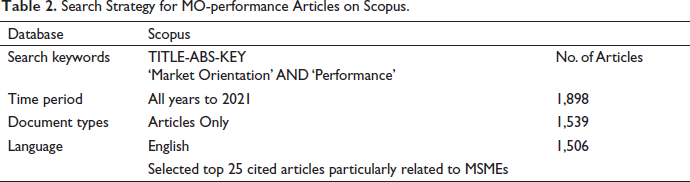
The article is based on a review of the scientific literature on EO, MO and MSMEs’ performance. A thorough electronic search of the literature was conducted by the Scopus database to identify articles on the EO performance and MO performance particularly related to MSMEs sector. On the Scopus database, however, we used a search strategy that included entering a retrieval formula of ‘TITLE-ABS-KEY’ = ‘Entrepreneurship Orientation’ AND ‘Performance’ and ‘Market Orientation’ AND ‘Performance’ into the advance search window with a time span of all years up to 2021. The option Title, Abstract and Keywords was selected, and all articles with these keywords in their title, abstract and keywords were displayed. Top 25 articles from both domains were chosen from thousands of articles based on the highest citation count. Tables 1 and 2 depicts the approach followed to retrieve articles from the Scopus database.
Search Strategy for EO-performance Articles on Scopus.

Search Strategy for MO-performance Articles on Scopus.
Conceptual Framework
Researchers believe that firms with an entrepreneurial mindset, skills, marketing strategies and knowledge have a better chance of sustaining long-term growth. Therefore, the objective of the present study is to develop a theoretical framework based on existing literature to support MSMEs’ performance after COVID-19 in order to achieve long-term, sustainable growth. This section presents the past literature findings on EO, MO and MSMEs’ performance. A theoretical framework has been proposed after comprehensive review. To construct the research framework the author has identified significant variables that may affect MSMEs performance. These variables are discussed in this section below.
Firm Performance
Performance of a business is a crucial indicator of its success and growth. Every business and organization try to maximize its performance based on various measures (Syarifah et al., 2020). Performance of an enterprise talks about its well-being, success and growth; and every entrepreneur/owner tries to achieve highest performance for their businesses. Because performance is multi-dimensional, it is advantageous to incorporate different dimensions of performance in empirical studies (Wiklund & Shepherd, 2005).
Performance is the result of various combined efforts and internal resources of a firm. An enterprise tries to manage its resources in a way that produces optimal performance. Every firm or enterprise has their own way to measure success. Performance can be measured on various bases such as financial (profit, sales, return on investments, return on sales, return on equity) market performance, market share captured, organizational performance, and customer satisfaction and job satisfaction. Performance of a business can be seen from several ways such as increase in employability, increase in gross domestic products, and increase in exports and increase in productivity.
Success of MSMEs can also be measured on the basis of their contribution towards national and international trade or exports. Some researchers have measured performance with indicators, namely sales performance and profitability. Afriyie et al. (2020) in their research examined the market performance of SMEs in terms of profitability, sales and customer satisfaction. Some researchers also measured the performance of SMEs on the basis of employee satisfaction, corporate reputation, employee retention and employee participation (Chahal et al., 2016). Performance is positively related to knowledge-based resources and EO (Lee et al., 2001). Thus, the ability to manage resources and activity is critical for improving firm performance.
Entrepreneurial Orientation and Firm Performance
EO referred to the ‘entrepreneurial strategy-making processes used by key decision makers to carry out their organization’s organizational purpose, sustain its vision, and create competitive advantage’ (Rauch et al., 2009). The concept of EO was first coined by miller in 1983. According to him, a firm is considered to be entrepreneurial if it engages in innovation processes such as product innovation, market innovation, undertakes risky decisions while selecting ventures, and is proactive, beating their competitors (Miller, 1983). He suggested three dimensions to assess the entrepreneurial orientation of owners/entrepreneurs, namely innovativeness, proactiveness, and risk-taking. EO assists an organization or firm in capturing emerging business opportunities and achieving peak performance. It enables a company to better capitalize on available business opportunities by leveraging its internal capabilities and resources. Stam and Elfring (2008) research contributes to a better understanding of how entrepreneurial orientation and social capital influence the performance of new ventures in emerging industries.
In explaining business performance, EO dimensions (innovation, risk taking and proactiveness) are all equally important (Rauch et al., 2009). EO plays an important role in improving business performance and has evolved into an acceptable way to explain business performance in an unstable environment. EO is one of the most studied factors in the field of entrepreneurship and organizational management. There are many studies identifying the influence of entrepreneurial orientation of firms and its effect on organizations performance (Atuahene-Gima & Ko, 2001; Hughes & Morgan, 2007; Jantunen et al., 2005; Keh et al., 2007; Knight 2000; Lee et al., 2001; Li et al., 2009; Moreno & Casillas, 2008; Rhee et al., 2010).
EO is defined as the ability of an entrepreneur to use their skills to achieve higher performance, or have innovative techniques, are willing to take risks, and have autonomy to make decisions.
Lumpkin and Dess (1996) suggested EO as a multi-dimensional construct. He made distinction between entrepreneurship and entrepreneurial orientation. He defined entrepreneurship as entering a fixed market or entering a new market with offering existing or new products and services, or even launching a new company. Whereas, EO is focussed on how to carry out new entries or how to enter the market with new or existing products. Basically, entrepreneurship is considered a product of EO. He measured the EO using five dimensions, namely innovativeness, risk taking, proactiveness, autonomy and competitive aggressiveness. Innovativeness is defined as an entrepreneur’s or an organization’s proclivity to pursue novel and distinct ideas, processes, and methods of producing goods and services. Risk taking is defined as an organization’s or an entrepreneur’s proclivity to embark on risky ventures and how organizations and individuals differ in their ability to take risks. Proactivity refers to being the first mover and other actions aimed at seeking safety and protecting market share, as well as looking ahead to the perspective reflected in anticipatory actions taken in response to future requests. Autonomy refers to ‘independent actions of an individual or group or organization in bringing up an idea or vision and bringing it to completion’. Competitive aggressiveness denotes the efforts of an organization or company to issue competitors from the industry. This effort can help to guarantee a high market share and will cause the company to have a good performance (Lumpkin & Dess, 1996, 2001). Further, Krauss et al. (2005) added two new dimensions to the Lumpkin and Dess five dimensions in 2005: learning orientation and achievement orientation.
In general, EO helps to improve performance. EO can be used to overcome the constraints imposed by limited access to financial capital and an environment in which new opportunities appear infrequently. Under these conditions, managers can truly benefit from being innovative and proactive, as well as pursuing risky new initiatives that differentiate their company from competitors (Avlonitis & Salavou, 2007; Wiklund & Shepherd, 2005). The EO of the firm, as well as its ability to effectively utilize its resources and capabilities, have an impact on its performance (Jantunen et al., 2005). Firms that compete in dynamic environments are expected to cope more successfully with uncertain conditions if they have an entrepreneurial orientation that includes risk taking, innovative behaviour and proactiveness (Knight, 2000).
The more entrepreneurial a company is, the more proactive and extensive its environmental scanning is. Because entrepreneurial firms face greater external and internal uncertainty, risk taking and proactiveness is considered a vital element of EO (Wang, 2008). EO is essential for improving firm performance (Hult et al., 2004). For firms that want to thrive in competitive and uncertain business environment, EO is seen as a must-have capability. Past studies have found that EO has a significant impact on firm performance and growth (Covin & Slevin, 1988; Hult & Ketchen, 2001; Keh et al., 2007; Li et al., 2009; Matsuno et al., 2002; Naldi et al., 2007).
Based on discussions of previous research in the domain of EO and an organization’s performance, we propose that:
P1: Entrepreneurial orientation significantly and positively affects firm/MSMEs performance
Market Orientation and Firm Performance
SMEs want information about their customers and competitors so that they can differentiate their offerings and positioning. Market orientation allows entrepreneurs to better meet their customers’ needs and compete more effectively against their competitors (Keh et al., 2007). MO refers to the ability of firms to create superior value for their customers by producing and transferring value products to them. This helps in creating an effective organizational culture in creating essential behaviours for the formation of superior value for their customers as well as business performance (Dutta et al., 1999; Hult & Ketchen, 2001; Matsuno et al., 2002; Noble et al., 2002; Pelham & Wilson, 1996; Ruekert, 1992; Rhee et al., 2010).
Monitoring competitors’ product innovation behaviour, surveying the market, assessing the customers’ needs and monitoring customer behaviour towards the embracing of the various products and services offered by competitors are all ways that a firm can get involved in product innovation. (Sandvik & Sandvik, 2003). MO is also a multi-faceted concept, with all dimensions interdependent. Superior performance and competitive advantage will result from the intersection of all three dimensions. MO allows entrepreneurs to better understand meet their customers’ needs. MO aims at creation of superior value and fulfilling customers’ needs. Businesses having MO tries to satisfy customers’ needs by way of providing value products and services. Firms having strategic orientation in the form of MO have superior skills in understanding their customers. Narver and Slater (1990) defined MO as a three-dimensional construct—customer orientation, competitor orientation and inter-functional coordination. Competitor orientation is related to the ability and the drive to identify, analyze and react to competitors’ actions. MO is one of the most important drivers of firm performance, assisting managers in developing superior products, processes and ideas (Atuahene-Gima, 1995, 1996; Hult et al., 2004; Verhees & Meulenberg, 2004).
MO assists in learning about competitors’ behaviour, strategies, product innovations, customer needs and requirements, all of which lead to a better understanding of product developments, innovations and improvements (Sandvik & Sandvik, 2003). MO is essential for businesses because ‘it captures their ability to anticipate, address, and capitalize on market changes in customer needs’, resulting in improved performance (Kropp et al., 2006). In addition, communication with customers, suppliers, and team members will aid in the achievement of superior business performance. Organizations with a strong MO are more likely to create a sustainable competitive advantage and can enhance their market-driven processes (Baker & Sinkula, 1999)
Furthermore, Han et al. (1998) discovered that MO had a significant impact on the organization’s innovation and business performance. Customer focus has the greatest influence on organizational innovation. Furthermore, customer orientation promotes a continuous, proactive attitude towards meeting customers’ needs, and customer focus is critical in creating superior customer value. Baker and Sinkula (1999) discovered that MO has a positive impact on certain aspects of organizational performance. MO had the greatest explanatory power on positional advantage and firm performance (Hult & Ketchen, 2001). However, following a crisis, MO has a negative impact on firm performance (Grewal & Tansuhaj, 2001).
The similar findings were reported by Slater and Narver (2000), Sandvik and Sandvik (2003), Atuahene-Gima and Ko (2001), where MO has influenced the MSMEs performance. On the contrary, Grewal and Tansuhaj (2001) found no significant influence of MO on performance. In the area of market research, MO has been significantly considered but in the area of entrepreneurship it still needs attention. Firms with high market orientation tend to outperform their competitors. A market-oriented firm is associated with the higher growth and performance thus we expect a positive relationship between MO and MSMEs performance. Therefore, on the basis of previous literature we can propose that;
P2: Market orientation significantly and positively affects firm/MSMEs performance
Innovation as Mediating Variable
Schumpeter (1934) defines innovation as ‘the introduction of new products, the introduction of new processes, the opening of new markets, the development of new sources of supply for raw materials or other inputs, and changes in industrial organizations’. According to Santoso et al. (2020) innovation is a ‘process’ or ‘result’ of the creation, utilization, or mobilization of resources that can provide more meaningful value. Schumann et al. (1995) defined organizational innovation as ‘an organization that implements new ideas and creative concepts as a basis for competitive advantage in anticipating and fulfilling consumer needs’. Innovation is made up of three major components, namely product innovation, process innovation and procedure innovation.
Overarching knowledge and encouraging innovation are two components of innovation orientation. In general, innovation is defined as a method for a company to increase its competitiveness. Many indicators indicate that a lack of innovation can cause a company to fall behind its competitors or even go out of business. Organizational innovation is expected to enable an organization to respond to the complexity of the environment and the dynamics of change in the environment, particularly in cutthroat competition, and to create sources of competitive advantage. This can be accomplished through product, process, and procedure innovation.
Companies that have the ability to innovate can quickly introduce new products and implement new systems. As a result, it is critical to consider the ongoing competition. The combination of assets and resources can explain innovation performance. Innovation in terms of product development, product process and procedures might have an influence on firm performance and also on entrepreneurial drive of the entrepreneurs. Hence, based on previous research it has been proposed that;
P3: Innovation mediates the relationship between EO and firm/MSMEs performance P4: Innovation mediates the relationship between MO and firm/MSMEs performance P5: Innovation significantly and positively affects firm/MSMEs performance
Discussion
An enterprise’s performance is regarded as critical to its long-term viability and well-being. These companies are constantly confronted with new challenges and diversities, such as unstable policies, environmental turbulence, and technological obsolescence as a result of global advancements. As a result, it is critical that they focus on their resource capabilities and improve their performance in order to achieve long-term growth. Various academicians emphasized on the importance of market orientation on the success of an enterprise (Baker & Sinkula, 1999; Han et al., 1998; Hult et al., 2004; Hult & Ketchen, 2001). Some authors have reported positive influence of EO and MO on the sustainability of MSMEs performance (Atuahene-Gima & Ko, 2001; Lee et al., 2001; Wiklund & Shepherd, 2005;). However, some had reported no influence at all on the performance (Grewal & Tansuhaj, 2001; Slater & Narver, 2000; Stam & Elfring, 2008). Various dimensions of EO and MO were reported in the literature; the dimensions of EO included innovativeness, proactiveness, autonomy, risk taking, competitive aggressiveness, learning, achievement, self-efficacy and motivation, among others. MO, on the other hand, included competitor orientation, customer orientation, and cross-functional coordination. Some had considered financial performance; return on investment, growth, profitability, return on assets, return and sales, while others had measured performance using non-financial parameters such as market share or growth, customer satisfaction, employee satisfaction, and increase in production, among others. We were also able to report from the literature review analysis that no top cited study was found in India or any other developing country. This discovery also provides a road map for developing economies to work on and research more in the area of entrepreneurship while taking these two internal capabilities into account (EO and MO).
In conclusion, the above literature review suggests that, when used appropriately, EO and MO can improve MSMEs’ overall performance. Also, evaluating EO and MO as resource capabilities and internal resources from the perspective of RBV theory we can ascertain whether these two resources have a substantial influence on the performance of MSMEs in developing economies. Research on EO and MO indicates that these two internal capabilities are critical resources that influence a firm’s strategy and operations, but also have potential to create value for their customer. Furthermore, as a resource capability, innovation will be tested as a mediating variable to see if it affects the relationship between EO, MO, and MSMEs performance. The current study also proposes that external factors in the environment have a moderating effect on the performance (Han et al., 1998; Slater & Narver, 1994; Wiklund & Shepherd, 2005). The study is significant to the government for framing policies and MSMEs entrepreneurs for taking relevant entrepreneurial decisions during an unstable environment. The proposed conceptual framework (Figure 1) could offer insight into the factors that are responsible for the performance of MSMEs during an unstable environment. The current study portrayed the factors that either facilitates or restraints the potential for entrepreneurship across India. According to our findings, MSME owners should reconsider their business strategies, including crisis scenarios and business continuity plans, in order to maintain business performance and sustainable development. By empirically validating the proposed research framework, this study will contribute to the field of entrepreneurship and small business management. The study will also make recommendations on how the firm’s key internal capabilities help them generate value for their stakeholders and sustain long-term business performance while operating in uncertain environmental situations.
Proposed Research Framework.

Agenda for Future Research
MSMEs are one of the fastest growing sectors of the Indian economy, contributing significantly to the country’s GDP and exports. Entrepreneurs are sometimes exposed to various problems related to MSMEs performance; therefore, in order to secure long-term and sustainable performance, they must improve their ability to use resources and strategic orientations to gain a competitive advantage. In order to be competitive, entrepreneurs need to upgrade their resources both internal and external. Small firms face a number of issues that restrain their ability to innovate. Nonetheless, India has experienced growth and development in this sector through various policies and reforms. As a result, research scholars and academicians are strongly advised to investigate the extent to which these firms have used internal capabilities, specifically EO and MO, in their business and how these resources have influenced the performance and growth of MSMEs.
Performance of any business is the result of its internal capabilities, and resources and how perfectly these resources are managed by its owners. Many businesses fail due to a lack of marketing strategy and entrepreneurial drive. As a result, entrepreneurs must depart from the traditional definition of entrepreneurship. More emphasis should be placed on various performance indicators such as corporate governance performance, sustainable performance, customer satisfaction, employee satisfaction, and the adoption of lean practices.
Future research should focus on the following areas:
Future research should consider a systematic review such as meta-analysis or bibliometric analysis on EO performance and MO performance. Other areas and dimensions of EO and MO must be explored in the future research and their individual impact must be accessed in an unstable environment due to COVID-19. Technological innovation is occurring in every industry and has become a necessity in this digital age. Therefore, to survive in the new era, MSMEs must incorporate digital innovation and technological changes into their strategies. Future research should look at the impact of EO and MO on non-financial indicators such as; corporate governance performance, sustainable entrepreneurial performance, customer satisfaction and employee’s satisfaction. The area of EO and MO is under-researched in the Indian context, and the major contributing studies in this area are from developed countries. As a result, this model must be empirically tested and validated in the Indian context. Future research could examine the impact of EO and MO on various organizational structures such as sole proprietorship, partnership, family business, and corporations. Additionally, it was reported that entrepreneurial activities in family businesses do involve risk-taking, but to a lesser extent than in nonfamily businesses (Naldi et al., 2007) As a result, additional research on other types of organizations is required to compare the findings. The existing literature requires a better understanding of how the impact of EO and MO dimensions differs depending on the business types and different cultural settings. Accordingly, additional investigation should be conducted to determine the impact of EO and MO practices in both service and manufacturing firms, as well as in various environmental situations. RBV theory is based on the firm’s internal capabilities and resources, which aid in the creation of value. Future research could also look into the effect of improved firm performance on its value creation. And how does a profitable and successful business provide value to all of its stakeholders?
As a result, the following questions must be addressed in the future:
RQ 1. What role does EO and its individual dimensions play in the performance of Indian MSMEs in relation to the external environment? RQ 2. Is there a difference between the EO of service and manufacturing firms? RQ 3. What is the impact of MO and its individual dimensions on the performance of Indian MSMEs in the context of the external environment? RQ 4. Is there a difference in the MO of service and manufacturing firms? RQ 5. Do EO and MO aid in the creation of stakeholder’s value by improving performance?
Footnotes
Declaration of Conflicting Interests
The authors declared no potential conflicts of interest with respect to the research, authorship and/or publication of this article.
Funding
The authors received no financial support for the research, authorship and/or publication of this article.
