




Abstract
The dome, one of the most stable forms of roof coatings, has passed many of its evolution stages in the dome-chambers of Iranian mosques. From the Seljuk era, when the first dome-chambers were seen, to today, the extent of the openness of the dome-chamber space to the adjacent space—shabestans and the porches—has changed a lot. This research seeks to answer the questions of why and how openness has happened and what factors have influenced their intensity. Since there may be different answers to these questions at different periods, the physical properties of the domes were studied in terms of measurable variables, both in the general context and in each period. For this purpose, 51 dome-chamber mosques were selected from Seljuk to Qajar periods, with variation in physical characteristics. The research method is a combination of content analysis method, comparative study and logical reasoning based on the descriptive and correlational statistics. As a result, it has been shown that structural constraints related to the extent and magnitude of the dome-chamber, are considered the main reasons for deciding how much and how to open the dome-chamber’s walls in different periods and that as the ratio of the span to the wall thickness increases, the openness of the walls decreases to the same extent. Also, the architecture of seljuk and safavid mosques are more similar than the other periods, possibly due to the common religious characteristics that affected them both.
Introduction
With the Arab conquest of Iran, not only did pre-Islamic art not disappear, but it also influenced Iranian architecture in various ways for several centuries. In the early days of Islam’s expansion, many of the Sassanid shrines became mosques and the Chahar-taq (A body with a square base and domed cover, consisting of four pedestals and a dome arch on them, with four arched entrances) formed the core of the mosques. The only change that made the Sassanid Chahar-taq into a dome-chamber mosques was the blocking of the Qiblah (the direction in which Muslims pray) span by a wall and the insertion of a mihrab (a semicircular niche in the wall of a mosque that indicates the Qiblah) inside it; creating dome-chamber mosques like the Izad-Khast Mosque. 1
In the early Islamic centuries, there were three types of mosques in Iran: Tomb: A Dome on top of a rectangular room (Sassanid shrine adapted for Islamic worship); the open porch: A simple barrel vault similar to those of Taq-e Kasra 2 ; The open courtyard: (known as the Arabic Mosque) Insulated with porches. 3 Eventually, new mosques, created by merging the Chahar-taq into the mosque’s shabestans (A quadrilateral, covered, pillared and often large space that leads to the courtyard of the mosque on one side) replaced them all. Over time, the dome-chamber became the main element of the new mosques. In addition to trying to improve the structure of the construction and developing of its geometry and Ornaments, an attempt to integrate the dome-chamber with adjacent spaces had also began. In the early prototypes of the dome-chamber mosques, there is a firm border between the dome-chamber and the surrounding spaces that gradually changes. The variety in the dome-chamber spaces openings to adjacent spaces—the shabestan and porch spaces—makes it hard to accept that only the advancement of the knowledge and experience of architects over time has determined the extent of the domes openness and that these openings are only the result of construction techniques. To test this, the physical and structural variables of the dome that could be related to the dome openness are studied.
Research Questions
What are the reasons for openness of the walls and expanding the dome-chamber space into the shabestan or porch?
Based on their type and location, how can the openness in the dome-chamber’s walls be classified?
What are the architectural variables that determine the dome-chamber’s openness size?
What is the historical development of openness and their related variables?
With the exception of structural limits, what other factors determine the amount of dome openness?
Methodology
Since the appearance of dome-chamber in mosques began in the Seljuk period, the samples selected to answer the research questions are from the Seljuk to Qajar periods. Since the evolution of dome-chamber openness is one of the research goals, the five significant periods in Iranian architectural history, including the Seljuk, Ilkhanid, Timurid, Safavid and Qajar periods, 4 were examined. Fifty-one samples of dome-chamber mosques with valid and accessible documentation were selected for the study. To avoid errors in the statistical studies, the samples chosen have several characteristics.
The number of samples selected from different periods is proportional. Hence, 10 samples from the Seljuk period, 10 from Ilkhanid period, 12 from Timurid period, 9 from Safavid period and 10 from the Qajar period were selected.
The samples are of both grand mosque and non-grand mosque types.
The dome shells are of both one and double (continuous and discontinuous) shell types.
Historical documents and theoretical literature about the subject of research discuss the architectural variables related to dome construction in the areas of dome span, outer diameter, dome thickness, dome height, dome walls thickness, ratio of span to dome walls thickness
5
and the ratio of the openness of the dome-chamber to the shabestan or the porch. By referring to three categories of sources, including:
Books on the recording of historical buildings containing documentations of historical mosques. Articles that contain case study documents or information about the variables under study. Documentation provided by relevant organisations such as the Cultural Heritage Organization.
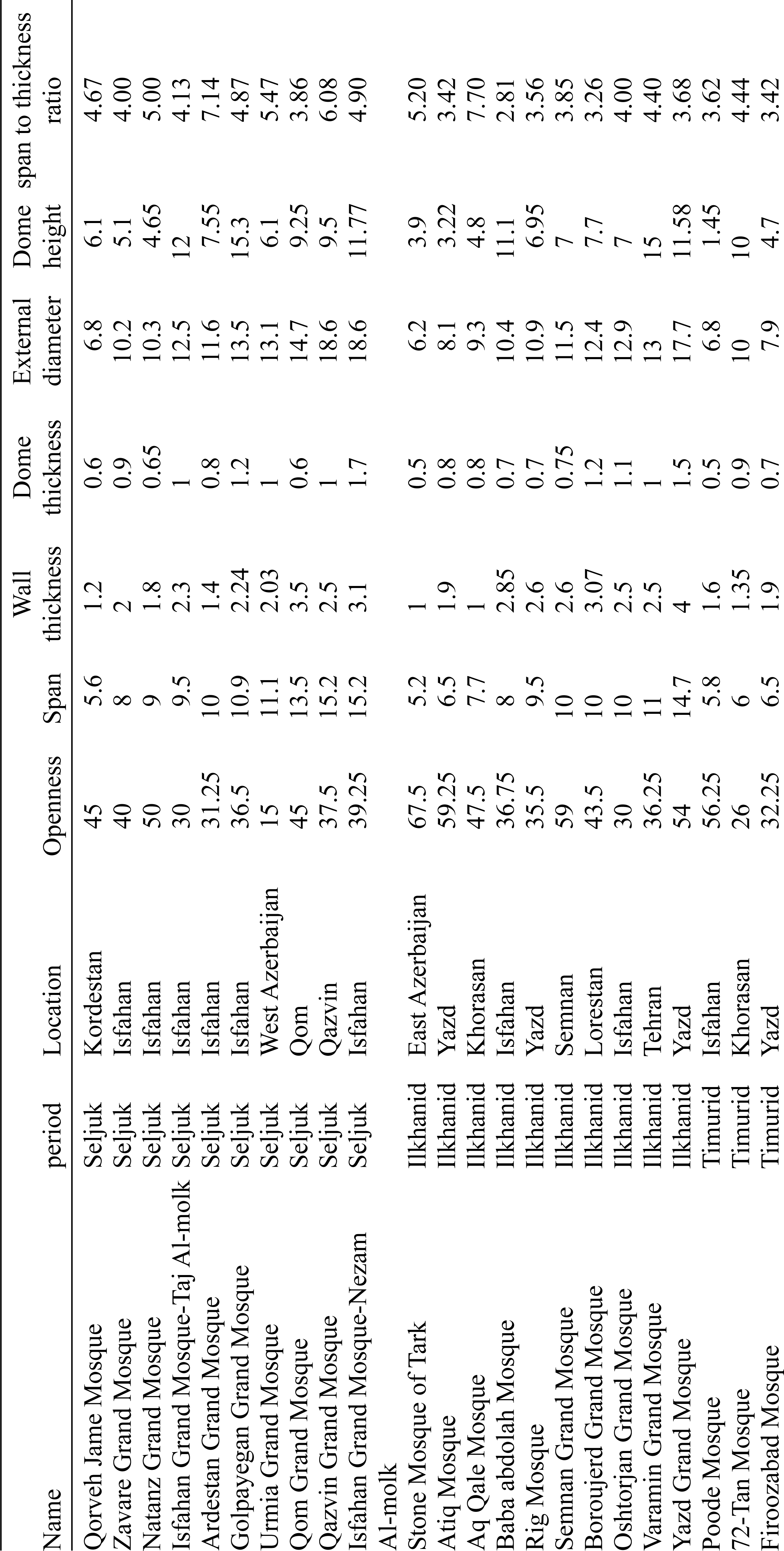
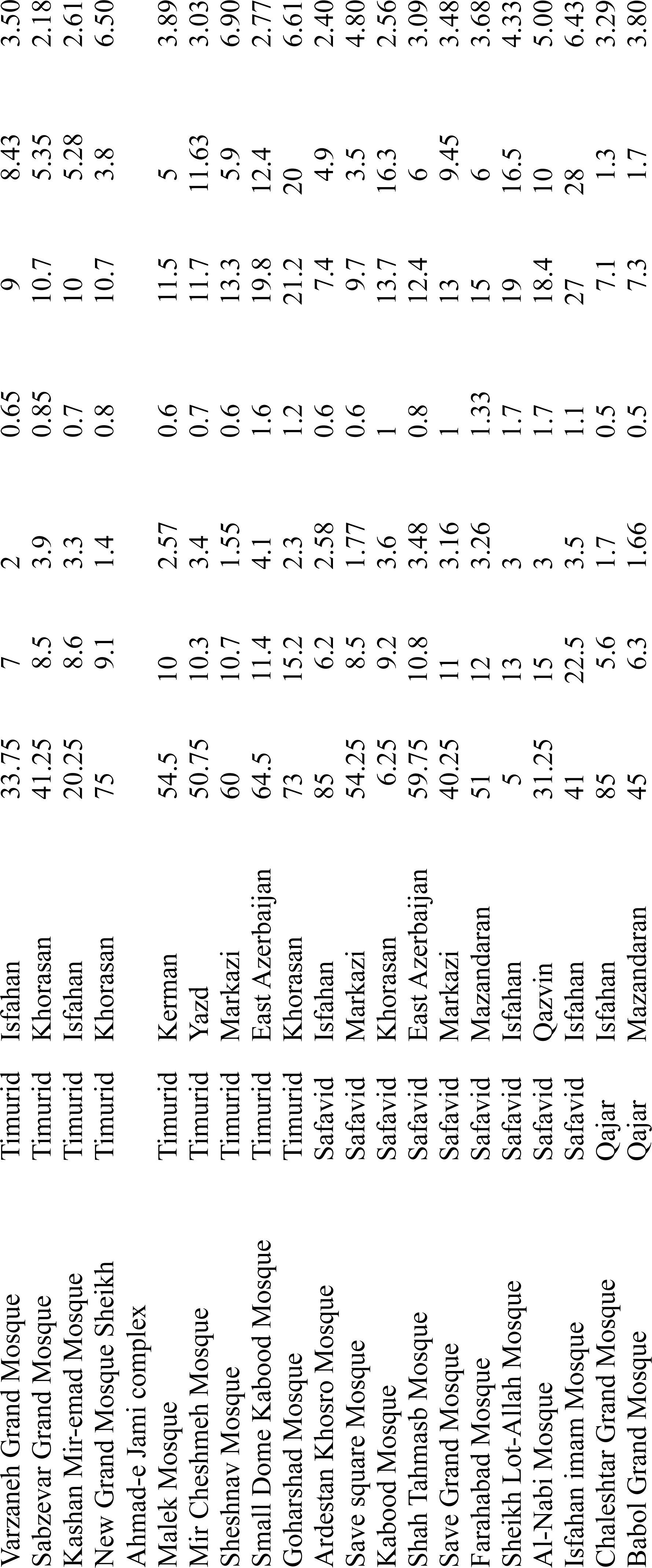
The required data was extracted from the text using content analysis method. The method of calculating the level of openness is such that in each geographical direction, the length of the wall and the length of the openness are calculated, and the openness of the wall is determined as a percentage, then the average of the four resulting numbers is considered as the level of openness in the information table (Table 1). Also, the location of the openness is mapped in the plan and the section of the building. The thickness of the lowest point of the dome shell (the vault base) is set as the basis of the thickness of the dome. Also, in double shell domes, the thickness of the outer shell is set as the criteria for action. If all the walls enclosing the dome are of equal thickness, then that thickness, and if not, the thickness of a wall not affected by other matters, such as side hallways, would be the basis of the wall thickness. After extracting the data, the necessary tables were prepared and transferred to ‘SPSS’ software to determine the correlation between the variables and also to extract the descriptive statistics. The outputs of the software are categorised and analysed by rational reasoning and comparative study with literature on the research subject.
Introduction of the Studied Dome-chamber Mosques and the Physical Characters of Them.

Dome Structure
The most basic human endeavour to construct, was the attempt to invent a kind of shelter that, while responding to its intended functions, could be altered by expanding space and not break. Due to the lack of quality wood resources as well as decreased wood resistance as a result of the loss of its texture in the vicinity of moisture and pests such as termites, beams and columns were not widely used to cover the ceiling. The invention of the arch and subsequently the dome, made with available soil materials, depending on the bracing of the incoming loads, was considered easy and inexpensive. In Iran, the earliest vaulted structures are found in a part of the entrances of the Chogha-Zanbil Ziggurat. 6 The dome was used many times, regardless of time, place and function, and gradually evolved and diversified. Since in the dome the incoming load is transmitted through membrane forces and the bending moment is limited, to transport the load much less thickness is required for the dome compared to the thickness of the horizontal beams. Depending on the fact that in most of the structure, the stresses resulting from the loads are either compressive or tensile, simple building materials with low tensile strength can be used in the construction of the dome. 7
The geometrical properties of the domes influence their behaviour. If the dome uses the form of a ‘parabola’, the tensile forces of the dome will be eliminated and horizontal thrusts will also be avoided. Such that the internal stresses caused by the loads in this form act only as direct pressure and tensions. 8 Since the domes have structural support all over their borders and are influenced by the vertical forces symmetrical to their axis, the meridian sections and circuits (perpendicular sections to the meridian) are the main sections to brace the main stress. 9
History of Dome-Chamber Mosques
The Bazeh hoor Chahar-taq 10 and the Firoozabad fire temple 11 are the first and second chahar-taqs built in Iran. 12 Some of the early mosques are Chahar-taqs that have been converted to mosques by changing their function, but in some mosques, like Golpayegan 13 and Barsian, 14 minarets (a tall slender tower, typically part of a mosque, with a balcony from which Muslims are to prayer) were embedded into the main body of the Chahar-taq since the beginning, which indicates such buildings were originally designed as mosques during the Seljuk era. 15 According to ‘Godard’, there were mosques in early Islamic Iran that, like ancient fire temples, consisted of one dome-chamber or even just a single porch; until finally, complex and complete buildings created in 11th century AD replaced them. 16
Generally, since the beginning of the 9th century AD and with the expansion of cities and villages, large mosques were built in most cities; However the dome-chambers and porches and elongated roofs created by the alteration of the fire temples and Mithraeums were never abandoned and gradually, with the joining of shabestans, each one found its place in the Iranian mosque and remained as one of the organs of the mosque. 17 ‘Hillenbrand’ believes that in the early Islamic centuries, some grand mosques were distinguished by others by adding mihrabs, minbars (The place where the Imam of the Muslims sits in the mosque to give a speech), downspouts, maqhsurahs (An enclosed booth-like space to separate the Imam of the Muslims from the rest), and domes. These distinctions that occurred while preserving the basic parts of the mosques, meaning the open courtyard and the covered shabestan, signalled the arrival of a flow of foreign ideals, techniques, and materials that would dramatically alter the primary simplicity of the shabestan mosques. He also emphasises that the Iranian mosque during this period was formed in connection with three strong elements that were also common before Islam: The dome-chamber, porch and columned shabestan, which through the articulation strength of these elements, reached a wider range of architectural expressions beyond the capability of the shabestan-based mosques. 18
The combination of the dome-chamber and the porch as an entrance, in addition to being part of the larger mosques, is also seen as an independent mosque; such as the Savot Mosque, 19 Sultan Shekarbar Mosque 20 and Sheikh Abdullah Mosque. 21 The oldest Iranian dome-chamber mosque was discovered by the Metropolitan Museum’s archaeological staff at the ancient site of School hill in Neyshabour. 22 According to archaeological evidence, except the courtyard and minaret that were added to the mosque during the Seljuk period, the rest were built in the early Islamic centuries. 23
‘Pirnia’ believed the reason why the dome-chamber was added to the shabestan-based mosques was that these mosques were incompatible with the tastes of Iranians, who saw the splendour of Sassanid architecture against the simplicity of shabestan-based mosques, such that dome-chamber mosques become one of the four types of Iranian mosques. 24 Opposing the Arabic plan (shabestan-based type) and an emphasis on the Qiblah direction (as the shabestan-based mosques lacked clarity in this subject), are also considered reasons for the creation of this mosque type. 25
Data Analysis
Analysing the Reason for Openness of the Dome-Chamber Walls
One of the concerns of architects building mosques, for much of Islamic architectural history, has been to reduce the length of the dome-chamber walls and extend it to adjacent spaces—the shabestan or the porch. An examination of the written sources, along with the analysis of the samples, showed that the walls were opened for various reasons. Including: linking the dome-chamber to the main geographical directions; The integration of the dome-chamber space with the shabestan to connect the rows of worshipers; Efforts by worshipers to see and hear the religious expert located in the mihrab; Reducing walls that prevent worshipers from seeing each other 26 ; The integration of the mosque space in order to create a single combination; bringing the light of the dome-chamber into the shabestan, fully understanding the symbolic shape of the dome from all parts of the mosque; Understanding the centrality of the dome as an integrator of the space and the legibility of the resulting space; Understanding the mihrab as the final destination of the axis guiding the worshipers to the mosque and thus understanding the direction of the qiblah by observing the mihrab; Preventing the ranking of the sanctity of spaces, which is considered contrary to the teachings of Islam. 27
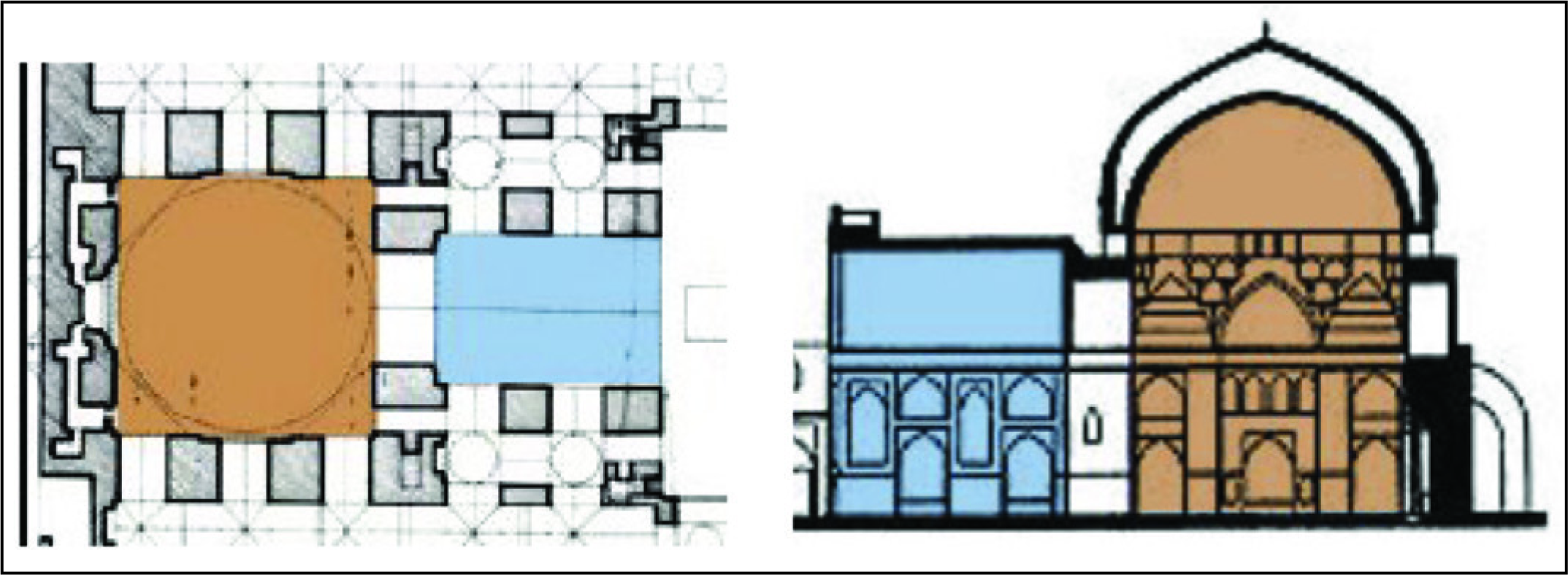
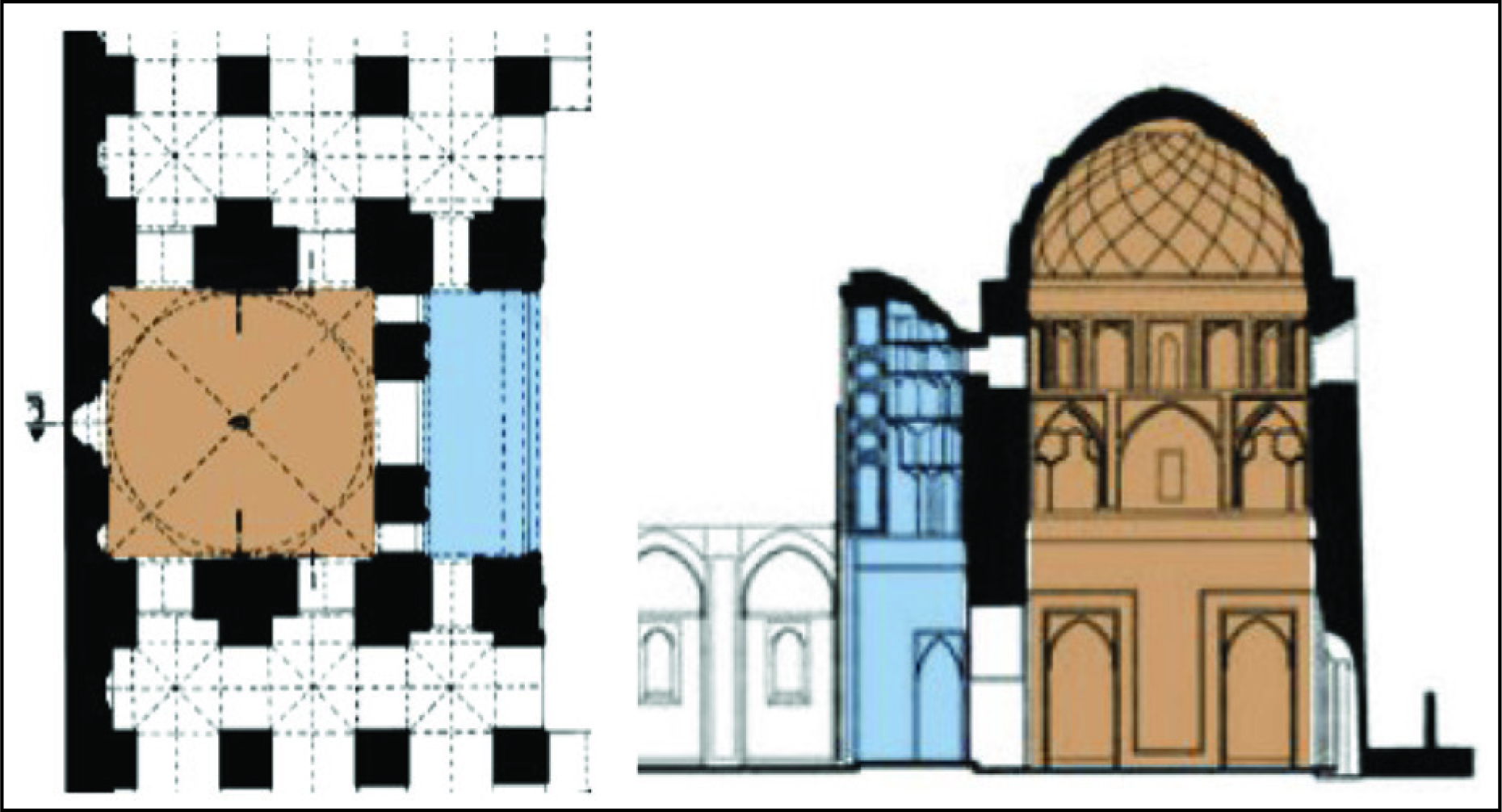
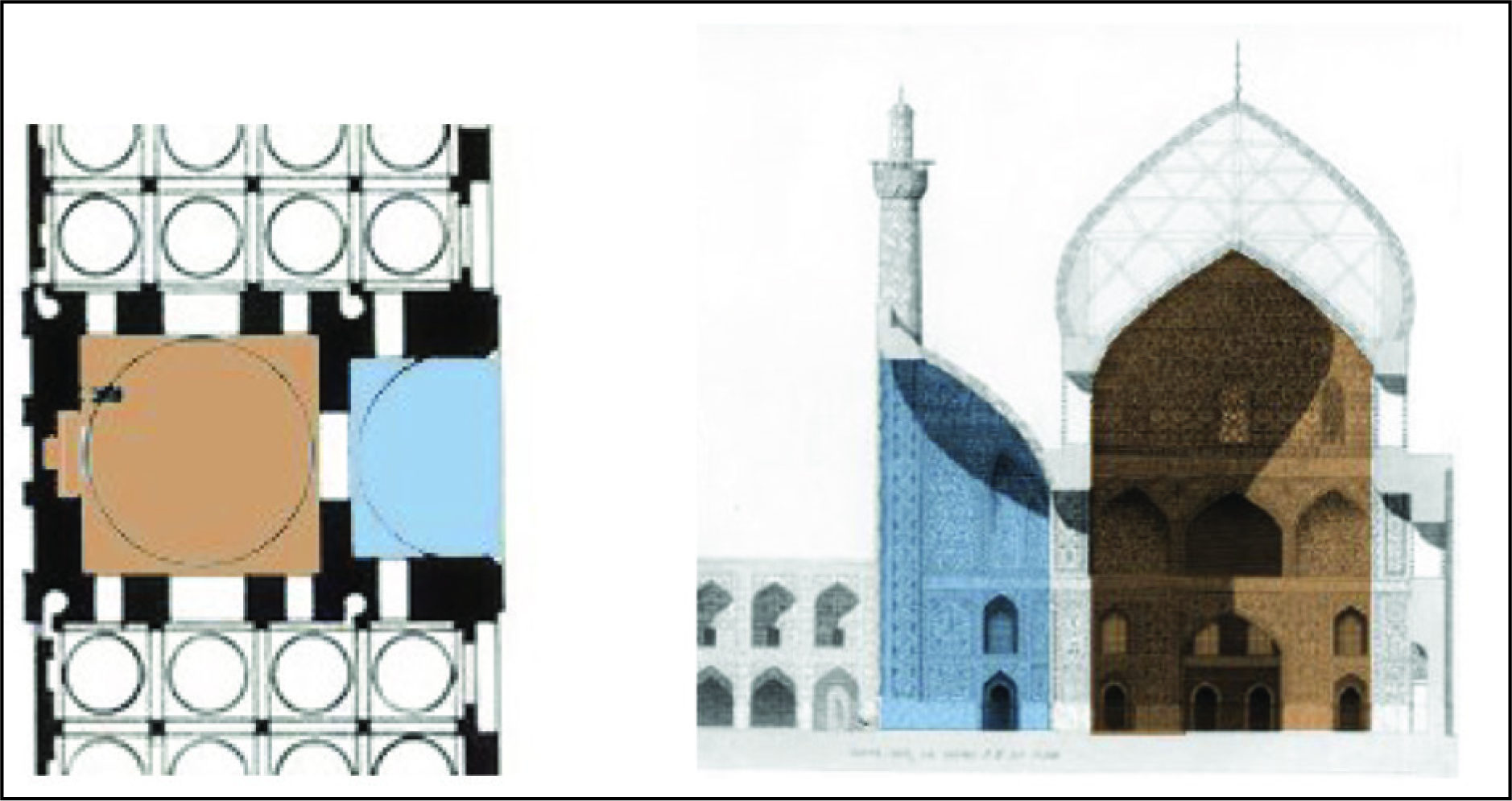
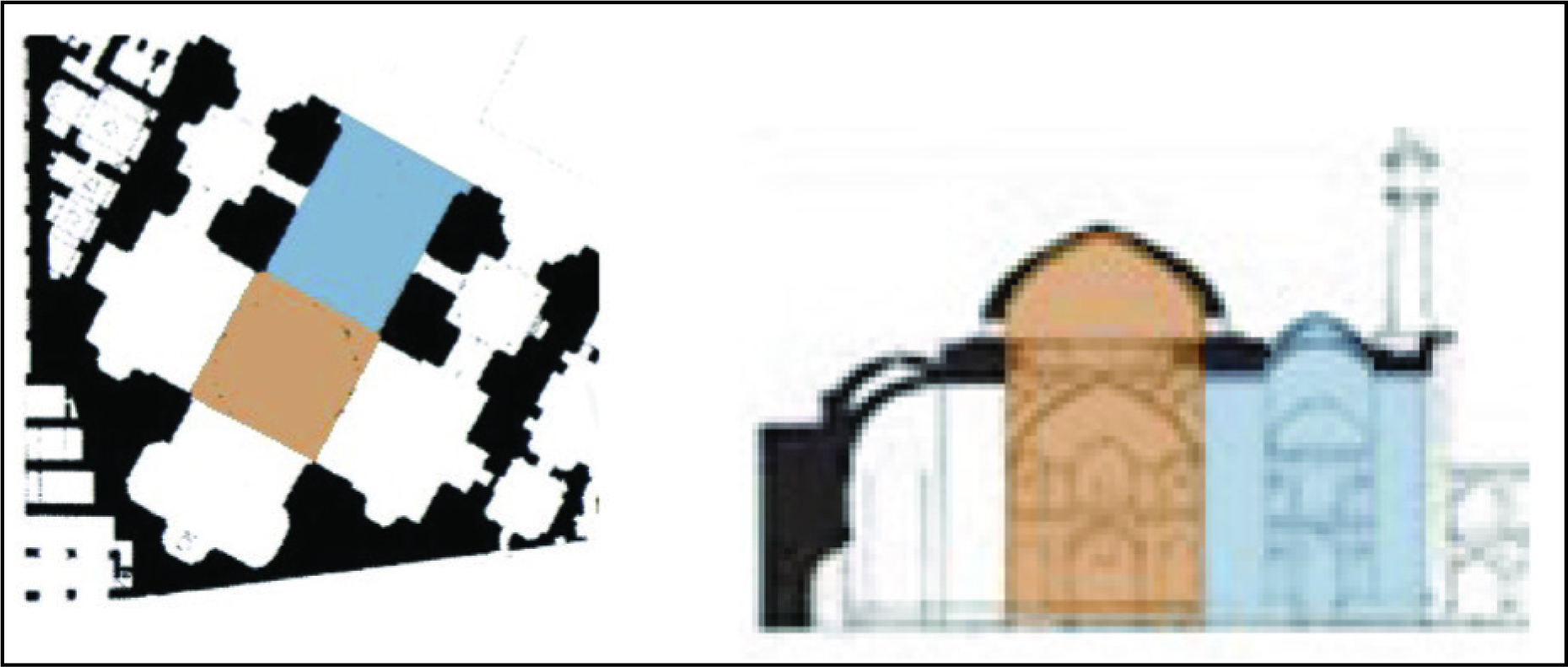
Presentation Type of Dome-Chamber Wall Openness
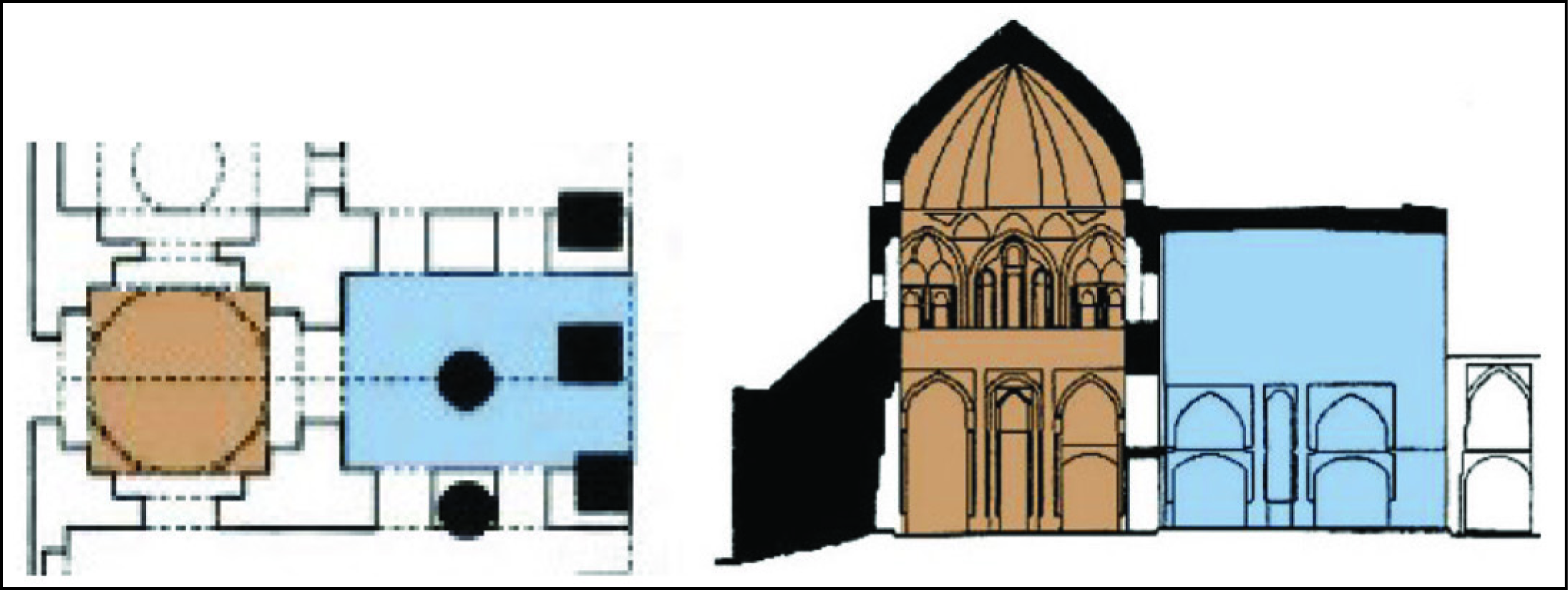
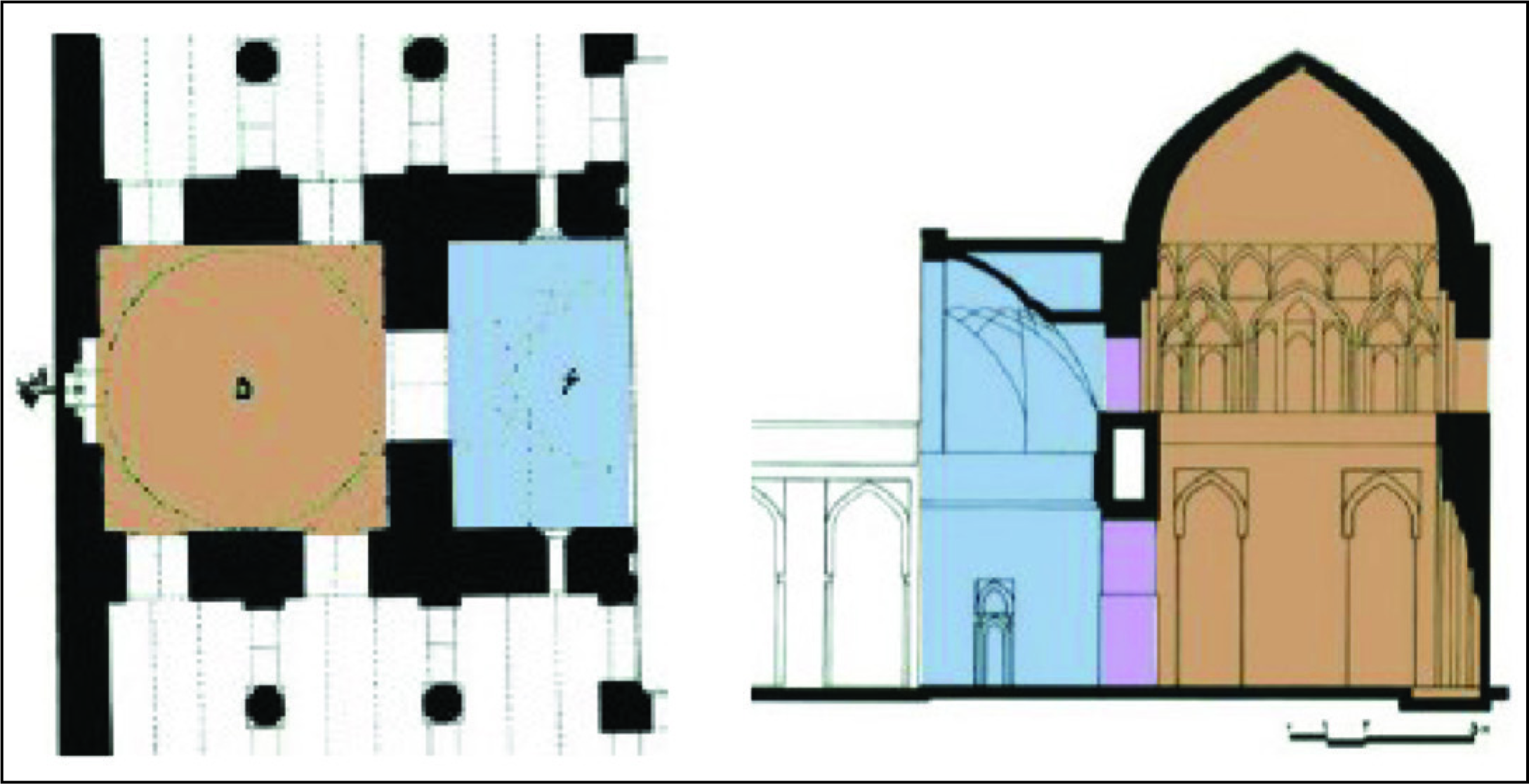
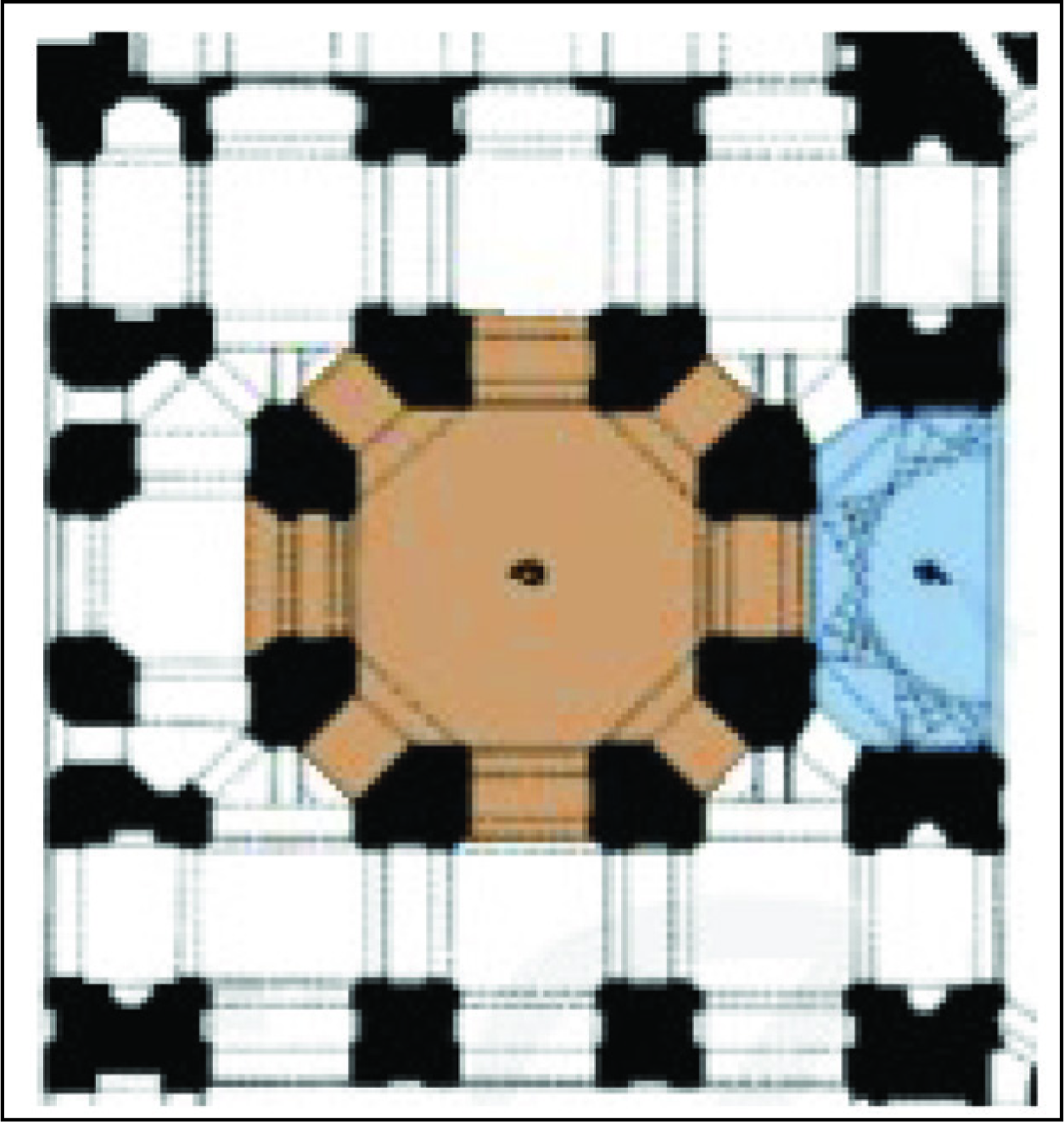
By checking all 51 mosques documents, at first, the location of the openness of the walls was mapped on the plans and section of the mosques. Then, the classification was done and five types of openness were declared:
The main openness the middle. Two main openness on both sides. One main openness in the middle and two side openness on either side of the main openness. Replacing columns with sidewalls. Full openness of the sidewalls to the shabestan.
(Figures 1 to 7 show the aforementioned pattern in the seven samples studied).
Correlation Analysis
Correlation Analysis in All Samples
The correlation between the physical properties of the dome in all studied samples are as follows.
The Inversely Correlation Between the Openness and Dome Height
The openness rate shows an average inverse correlation with dome height which means that in the high domes, the rate of openness of the dome walls decreases. The thrust force of the dome which is exerted in an inclined manner at the base of the arches of the dome, is divided into two horizontal and vertical components. The vertical component is transmitted to the ground via wall, but the horizontal component causes the dome base to open. One way to prevent this from happening is to use a thick wall under the base of the dome. These walls apply a horizontal force against the horizontal force of the dome. If this force is equal, all horizontal component is neutralised and, if less, the residual of the horizontal component should be dissolved in another way. The higher the dome, the bigger its weight, the greater the thrust force and the larger it’s horizontal component, thus reducing the openness of the walls. Because part of the thrust force can also be controlled by other solutions, the intensity of the correlation is moderate. Part of the dome thrust in the Chapireh (a transitional zone to convert the square base to a circle) is neutralised, 28 therefore, selecting the appropriate Chapireh does part of the task of controlling the thrust force.
Khashkhashies (Radial stiffeners as brick blades that are made in the space between the discontinuous double-shell dome) in addition to the coherence of the two domes’ shells also creates a symmetrical and uniform behaviour, and not only influences the transmission of forces that strengthen the dome 29 but they also make it resistant to external forces. 30
The type of vault and dome also plays a role in controlling the thrust force. For example, the domes with narrow archways create the least restriction of structure 31 or the KhanchePoush (A type of arch consisting of two other parallel load-bearing arches) Vault rather than the palanquin vault arch that allows more openness. 32
A Part of the thrust force generated by the domes located between the side corridors is counteracted by the horizontal component of the thrust force created by the vault of these corridors, which acts inversely to the same component in the dome. Likewise, the role of arches and adjacent domes and semiconductors 33 in controlling the thrust force can be mentioned.
In Iranian architecture, all of these methods, and in many cases a combination of all methods, have been used, in the meantime, the more efficient, faster and cheaper methods can be utilised in order to avoid the non-functional elements solely to solve the thrust problem.
The Intermediate Relationship Between Span and Wall Thickness
Span variable shows an average relationship with all other variables except for openness. As the openness increases, the thickness of the walls increases with moderate intensity. The lower parts of the semiconductor domes are subjected to horizontal orbital tensile stresses that can cause cracks. Therefore, these domes need a support structure capable of resisting horizontal pressure. In conventional ways, a larger span requires a taller and heavier dome that creates more thrust at the base of the dome. 34 Due to the inability of the masonry materials to withstand tensile stress in the brick domes, the downward transient forces must do as a compressed force to prevent tensile forces in them. 35 One of the common ways to restrain this force is to use thick walls and absorb the tensile stresses through more weight of wall materials. There has been much reliance on this method throughout the history of dome construction, especially the early domes, such as the wall thickness of the Bazeh Hoor is 3.5 m for the 7 m span and the Niaser Chahar-Taq 36 wall is 6.20 m for the 3 m. 37
Moderate Relationship Between Span and Dome Thickness
Shell thickness is one of the technologies of dome construction. The dome shell is 22.5 degrees from the horizon to a critical angle, then gradually diminishes to the tip, sometimes reaching to the thickness of a brick after 67.5 degrees. 38 In all shell structures, a minimum thickness is necessary to prevent local compression bending for the dome circuits to act like belts, they must be able to withstand small amounts of stress, at least in the lower parts of the dome. 39 The low circuits have stability against tensile forces. In low rise domes, compressive stresses are created in the meridian and the orbits. 40 In these domes, with the solving of the issue of tensile stress in the dome, a large amount of thrust is created. To provide stability against horizontal thrust force applied to the base, or the thickness of the shell in the base section of the high dome arch, environmental controls such as the brackets are used. 41 Therefore, in larger spans where the bending due to pressure is increased, the thickness of the dome shell at the base of the vault is required; However, it may sometimes be used to prevent excessive thickness of the dome base, brackets at the base of the dome are used sometimes causing the strong correlation between the two variables go unnoticed.
The Average Relationship Between the Span and Dome Height
Structural behaviour is mainly determined by shape and height. The semispherical shape is not the most suitable structure for large domes. Adding height and deflection is important in bearing the weight. If the dome height does not change as the span enlarges, the dome deflection decreases (relative to the semisphere state). In the domes with low deflection, the area under tension is less, but the reduction in existing curvature leads to higher tensions. Since the higher the dome height, the lower its base tensile stress; in the domes with low deflection, more horizontal forces become created—in comparison with the state in which the dome’s arch height is higher in the same span—which causes the creation of a correlation between the amount of span and dome’s height. Since there is no horizontal control at the bases of the domes, the outward drift of the radial arches can be completely inhibited by environmental stresses (such as brackets) in the lower parts of the dome; a moderate and not strong relationship between the span and the dome height holds. 42
Moderate Relationship Between Dome Thickness and Wall Thickness
As discussed, one of the methods of controlling dome thrust force is to increase thickness of domes or walls when the dome is higher or has larger span or is low deflection. This factor causes the correlation between two variables of dome thickness and wall thickness.
Moderate Relationship Between Dome Height and Wall Thickness
Typically, the weight of a dome with a specific rise and higher height is more compared to a similar dome with a similar rise but lower height, and its thrust is also greater. Since one of the strategies for controlling the force is the thickness of the bearing walls of the dome, the relationship between the height and dome thickness is formed.
The Average Relationship Between Dome Thickness and Dome Height
The ends of the meridians are supported by the lower cylinder of the dome and it is necessary to provide tensile strength to absorb the tensile stresses in the lower circuits. 43 This relationship is formed because the higher shell thickness in the lower circuits of the taller domes provides the necessary support structure of course to some extent.
Correlation Analysis in Each Period
The correlation between the physical properties of the dome in each period are as follows.
Seljuk Period
Strong relationship between span and wall thickness:
In the Seljuk period, due to the overall correlations, dome and wall thickness are correlated with each other, also although the intensity of this relationship is higher, there is no relationship between the other variables. Structural issues and limitations of single-shell domes that are more common in the Seljuk period than other domes, 44 for example, more thickness of the base of the vault in these domes 45 lead to lesser flexibility of structural solutions during this period; in a way that the increase in span mainly lead to in an increase in the thickness of a wall.
Ilkhanid Period
Strong relationship between span and wall thickness, medium relationship between height and wall thickness, strong relationship between wall and dome thickness:
In the Ilkhanid period, almost all variables are a function of the overall correlations. In the seventh to ninth centuries, the single shell dome was built less often, and until the eighth century, the double-shell dome was common. 46 Double-shell domes provide more flexibility to control tensile and thrust loads: For example, the necessity of increasing the dome thickness at higher domes is replaced by solutions suggested by the Ilkhanid architect: such as in the Grand Mosque of Yazd, 47 thrust of the dome and porch are gradually transferred through the arches and extended sidewalks of the side stretched halls, allowing the dome space to be opened and combined with the porch and shabestan. This causes no significant relationship to be seen between the openness of the dome-chamber walls to the surrounding spaces and the dome height during this period.
Timurid Period
Medium Relationship between openness and span, high relationship between span and dome height, medium relationship between thickness and height of dome:
In the Timurid period, with enlargement of the span, more of the dome-chamber walls were emptied. Likewise, with the enlargement of the span, the dome height also increased. The first relation may be related to the type of domes that are commonly built during this period and the second relation is formed following the first relation. During the Timurid period, discontinuous double-shell high drum domes and the ribbed domes became popular because of the Timurid kings’ tendency to build taller building. In domes with narrow archways which are more common in the eighth century, the main meridional stresses are transmitted from the narrow archways to the lower walls, which reduce the thickness of the shell and lesser weight enters the base of the ribs and the whole structure. Double-shell domes, which have been in use since the beginning of the ninth century, are thinner and exert lesser load on the structure and therefore do not require thick walls, whereas in single-shell domes, uniformity of the dome would cause the whole base of the dome to be under the stress of tensile and thrust forces. 48 Among the great innovations of the Timurid architects worth mentioning are the large sharp arches 49 and other innovative methods to reduce weight of walls. For example, in the 72-Tan mosque, 50 the Low-rise inner shell puts a lot of pressure on its base, but the narrow archways on the inner shell that are attached to the outer shell radial internal stiffeners—Khashkhashies—are effective in reduction of the thrust forces.
Safavid Period
Average inverse relationship between openness and dome thickness, strong relationship between span and dome height:
In the historical process of formal changes in domes of Iranian mosques, the ‘average external rise ratio’ of domes increased until the Timurid period and declined sharply during the Safavid period. 51 In the Safavid period, the reduction of the dome’s rise on one hand and the increased span and dome height on the other, could cause a serious increase of thrusts at the bases. Safavid architects have attempted to control this thrust in various ways, including the thickness of the dome in the lower circle, the walls thickness, and the drastic decrease in openness. This is due to the moderately inverse correlation between the openness and the dome thickness. On the other hand, unlike the previous periods, there is no tendency to integrate the dome and the shabestan. In the Safavid mosques, the dome space and the shabestan space were relatively separate, and the shabestan and dome skyline mosque become distinct in the Safavid period. 52 In this period, unlike the Ilkhanid era, the dome space was larger than the shabestan space. 53 Therefore, the Safavid Dome-chamber, moving towards a wide and high space, different and independent, shows less tendency to integrate with adjacent spaces.
Qajar Period
Strong relationship between dome thickness and the span and dome height:
Correlation variables’ in the Qajar period indicates that during this period the overall average relationship between span expansion and wall thickness increase has been replaced by the strong relationship between dome thickness and the span and dome height. The tendency of Qajar architects towards expanding and integrating the spaces, caused the thrust forces, which grow larger with the increasing of the span or dome height, to be restrained by focusing on thickening the lower layer of the dome (arch base) so that the bulky walls did not interfere with the goals of Qajar architecture.
Descriptive Analysis
Descriptive Analyses of Each Variable in All Samples
Descriptive statistics in Table 2 indicate the high extensive range of how each variable is handled. For example, the openness of the dome-chamber walls is variable from 5 percent of the total wall (related to the Safavid period) to 100 percent of the total wall (related to the Qajar period). On average, the wall openness rate was 46.3 percent and the median of this variable was 45 percent, which means that among all samples, the middle sample had 45 percent openness.
Descriptive Analysis of Each Variable in Different Periods
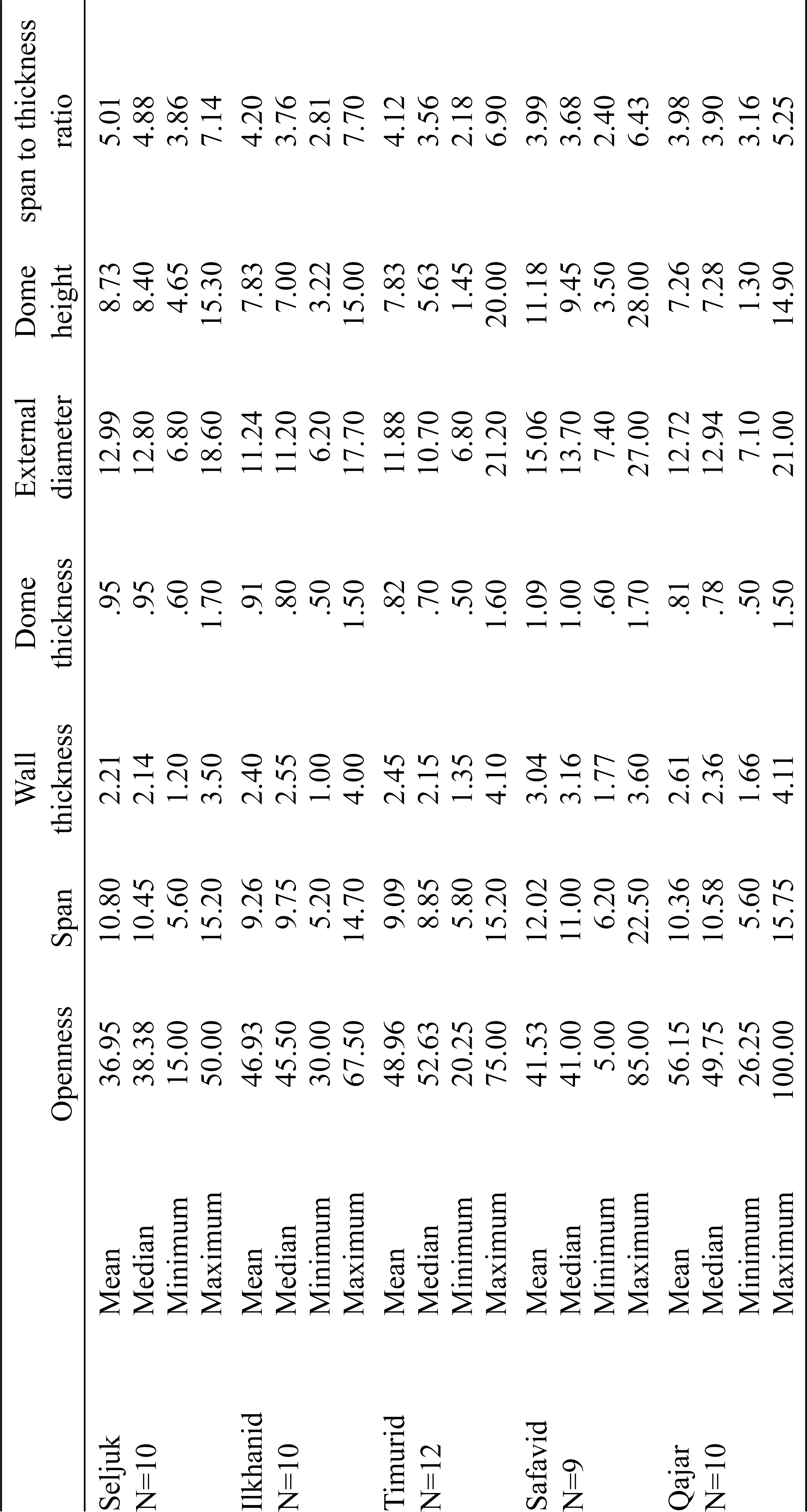
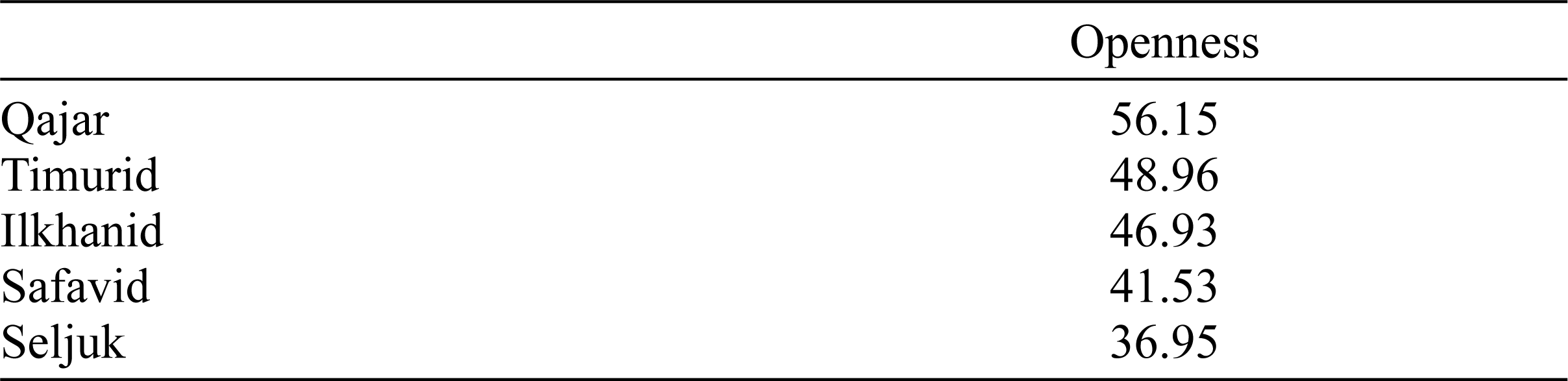
Descriptive statistics in Table 3 show that the variety of approaches when dealing with each variable have a more limited extensive range in each period. For example, the openness of the walls of the Seljuk period dome-chambers varies from 15 to 50 percent of the total wall. About 15 percent belongs to the Ormia Grand Mosque 54 and 50 percent to the Natanz Grand Mosque. 55 The average wall openness rate is 36.95 percent and the median of this variable is 38.38 percent.
Descriptive Statistics of the Physical Properties of the Dome in all the Samples Studied.

Descriptive Statistics of the Physical Properties of the Dome in Different Periods.
Investigating the Evolution of Variables in Different Periods
Span
Evaluation of the evolution of the average dome-chamber’s span (Table 4) in the historical periods of Iranian architecture shows that the largest span and consequently the largest dome-chamber area is for the Safavid period. After that are the Seljuk, Qajar and Ilkhanid dome-chambers, respectively. The Timurid domes having the smallest span and areas. The scope of the Safavid dome-chambers is significantly different from those of the Seljuk period (1.22 m), which is less in the other periods.
The Evolution of Domes Spans in the Different Periods.

The Evolution of Domes External Diameter in the Different Periods.

External Diameter
An examination of the evolution of the external diameter of the dome-chambers (Table 5) shows that the highest amount of external diameter is for the Safavid period. After that, the Seljuk, Qajar, Timurid and Ilkhanid dome-chambers have the most external diameter respectively. The difference between the scope of the Safavid dome-chambers and the Seljuk period ones is also significant (2.07 m), the difference being smaller with other periods. Since with the increase of the dome span, the external diameter also increases, it is expected that the changes of this variable be consistent with the span. This coordination exists except in the Timurid and Ilkhanid periods, which is related to the more frequent use of double-shell domes and bulbous arches 56 in these periods and the further increase of the external diameter.
The Thickness of the Wall
The thickness of the dome-chamber walls in the Safavid period is about 3 m in average, thicker than the other periods; then the dome-chamber walls are thicker in the Qajar, Timurid and Ilkhanid periods, respectively. The least wall thickness, with an average of 2.2 m, is for the Seljuk period. Although these periods are consecutive, the difference between the thickness of the Safavid period and the Qajar period walls is more than the difference between the other periods (Table 6).
The Evolution of Domes Wall Thickness in the Different Periods.

Dome Thickness
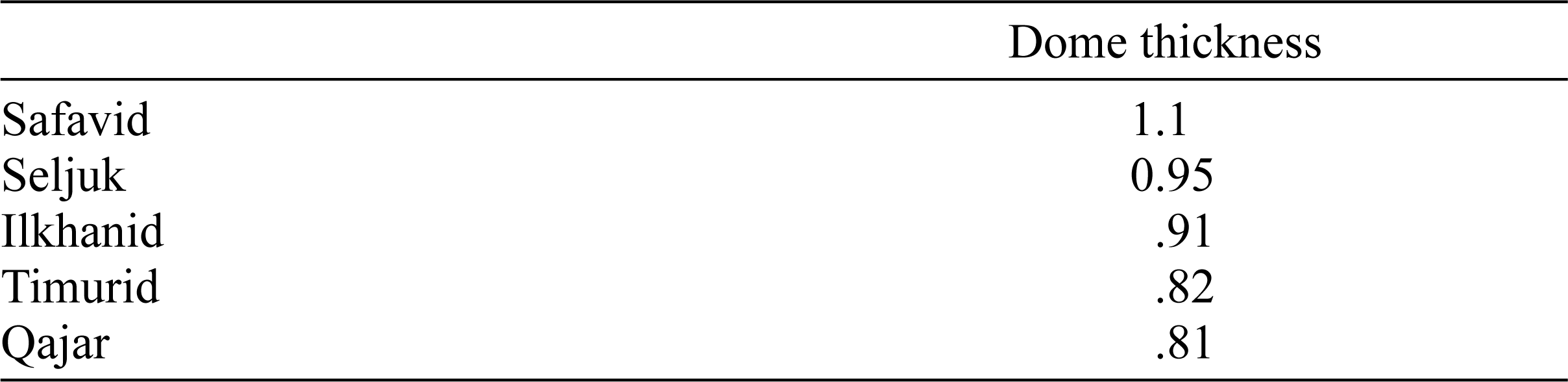
The thicknesses of the dome shells at the base of the vault, is the most in the Safavid period with an average of about 1.1 m, thicker than the Seljuk, Ilkhanid, and Timurid periods respectively. The least dome thickness with an average of 0.81 m is for to the Qajar period (Table 7).
The Evolution of Domes Height in the Different Periods.
Dome Height
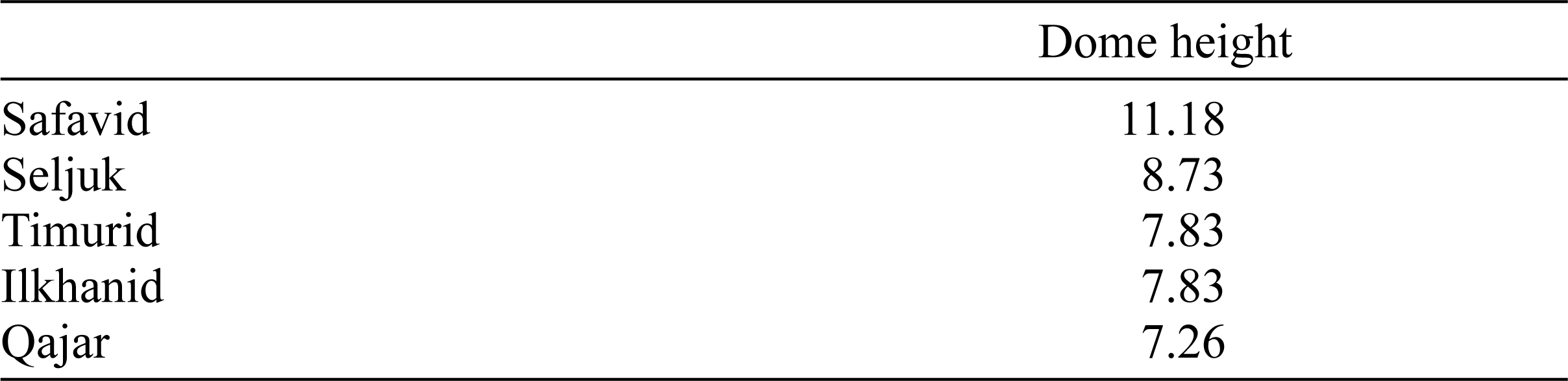
The study of the evolution of the average dome height (Table 8) shows that highest dome height rate belongs to the Safavid period. After that, the Seljuk, Timurid, and Ilkhanid dome have the highest dome height respectively, with the Qajar dome-chambers having the shortest dome height. The height of Safavid domes is 2.45 m higher than the Seljuk period domes, which is a very significant difference. Except for the Safavid domes, the average height of domes in the other periods ranges from 7 m to 8 m.
The Evolution of Domes Thickness in the Different Periods.
The Evolution of Domes Openness in the Different Periods.
Openness
An examination of the evolution of the average openness of the dome-chamber walls to the surrounding spaces (Table 9), shows that the highest rate of openness is for the Qajar period with 56.15 percent average openness. After that, the Timurid, Ilkhanid and Safavid domes have the highest openness respectively and the Seljuk dome-chambers have the least openness with an average of 36.95 percent. Although the difference in wall openness in different periods varied in a range of about 5 percent, this variable experienced less difference in the two Ilkhanid and Timurid periods.
Span to Wall Thickness Ratio
The variable obtained by dividing the span by the wall thickness indicates the mass and space of a space. As the number goes higher, the amount of space in the dome structure increases while the mass decreases. This variable is the only variable whose changes are proportional to the changes in time. With the passing of time this ratio is constantly decreasing, which signifies less dome-chamber space.
In the Seljuk period, the average of the span-to-wall ratio variable is higher than all periods (about 5). This means that the Seljuk period dome-chambers are more spacious than those of other periods. This ratio decreased in order and finally reaches its lowest amount in the Qajar period (about 4). There is a significant difference between the two Seljuk and Ilkhanid periods compared to the other periods (0.81) that indicates a significant difference in the spatiality of the Seljuk period dome-chambers compared to the Ilkhanid ones (Tables 10).
The Evolution of Domes “Span to Thickness Ratio” in the Different Periods.
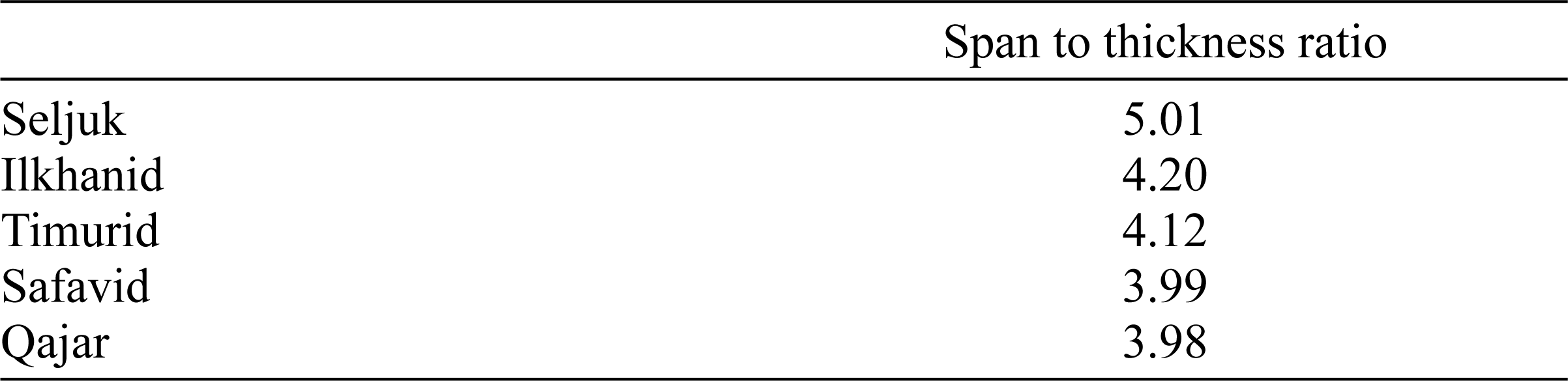
Examining the changes in the span to mass ratio and openness in different periods shows that the higher the span to mass ratio, the lower the amount of openness. In other words, the lowest openness rate occurred in the Seljuk period with the highest span to mass ratio, and the Qajar period, which has the lowest span to mass ratio, accounted for the highest rate of openness. In terms of structural subjects, this arrangement makes sense. High ratios, which indicate a thinner and more vulnerable structure, will limit the possibility of opening the walls of the dome so that the structure is no longer exposed to damage.
Discussion
Investigating the evolution of variables shows that the Safavid era has the highest rate for five variables out of the seven variables studied. These variables are dome span, outer diameter, wall thickness, dome thickness, and dome height.
The difference between each variable of this period with ones of the next ranked period indicates that in the Safavid period, the mosque dome-chambers have greatly developed in the mentioned variables.
After the Safavid period, in the Seljuk period the same variables—except wall thickness–—had the highest number. Although the Safavid and Seljuk periods have around 600 years of time difference and changes in architectural practices have occurred over this period, it seems that Savafid and Seljuk architects had the same approach to their craft. The larger span size in these two periods indicates a bigger dome-chamber area, and the greater outer diameter and height of the dome indicate that they have become larger than other periods. To support structural elements in the creation of larger and taller domes, inevitably the openness of the domes in both periods is reduced. Thus, the subject of architecture in both periods has been the creation of large and lofty domes, to the extent that achieving the functional and ideological concepts that are obtained through the further opening of the dome have been overshadowed by this grandeur. Since both governments had strong religious prejudices, the following reasons can be cited as the motives for these choices.
The Seljuk and Safavid Mosques as the Main Base for Promoting the Sunni and Shia Religions
Expanding Mosques
After the conversion of the Iranian people to Islam, except for the brief periods when Shia Islam was the official religion of the country, Sunni Islam was the official religion.
57
One of these brief periods is that of the Buyid dynasty, in which Buyids ruled Iran for about a century before the Seljuk rule. After this period of Shiism, the Seljuks who appeared in Transoxiana in eleventh century
Enlarging Mosques
The newly formed religion needed to impress people. Therefore, in both periods, efforts were made to use all architectural tools, such as size and decorations, to create effective mosques as bases for the new religion. In addition, during the Safavid period, mosques were formed in the heart of the cities, alongside other important urban buildings. Therefore, they had to be built in such a way that they were both legible and distinctive in the urban structure, and to maintain their status compared to the adjacent buildings for symbolic reasons.
National Symbolism
The efforts of the Seljuks and Safavids to create a great empire similar to the Sassanid one led to the construction of large domes in the architecture of mosques, similar to the great Sassanid domes. Witnesses claim that the mosques did not have a dome-chamber before the Seljuk period and were added to mosques during this time. On the other hand, in both the Seljuk and Safavid periods, after many years of monarchical chiefdom and non-monolithic rule over Iran, an independent and centralised empire was able to rule throughout Iran. Like many victorious governments, the authority of the government is demonstrated through the elevation of buildings. 58 By elevating the most important buildings in the city, mosques, these two governments created a sense of grandeur, glory and individuality in the audience.
International Symbolism
An important part of Iran’s borders was adjacent to the Byzantine Empire in the Seljuk period and to the Ottoman Empire in the Safavid period. Both countries were in serious political and religious competition during these times. The Seljuk and Byzantine governments in one period and the Safavid and Ottoman governments in another have sought to expand their territory and advance to other areas due to this. In this regard, we can mention the battle of Manzikert and Chaldiran in the first and second periods respectively. 59 The ideological differences between the Sunni Seljuks and the Christian Byzantines also contributed to the existing struggles; in a way that, on one hand, Christian governments were encroaching on the territory of the Seljuks, and on the other hand, the jihad (a struggle or fight against the enemies of Islam) policies of the Muslim Seljuks were causing conflicts. 60 The struggle between the Safavid Shia version of Islam and the Sunni version of the Ottoman Turks, who were both strongly committed to their religion, also remained an important aspect of the relationship between the two great empires. In this conflict, like the Seljuks, the Safavids also wanted Iran to have a unique identity in the face of their rival, 61 For this, mosques with huge domes were built in competition with Byzantine churches and Ottoman mosques—which themselves had huge domes as subjected to Byzantine traditions—in such a way as to show their political-religious authority over the region.
For example, we can point to the measures taken in the Shah (Imam) Mosque in Isfahan to create a huge dome-chamber. In this mosque, which was built by Master Ali Akbar Isfahani during the reign of Shah Abbas Safavid, discontinuous double shell domes are used. The span of the inner dome is 22.50 and the height from the top to the floor is 22 m. The span of the outer dome and its height from the top to the floor are 27 m and 54 m, respectively, and the distance between the two domes is 11.5 m. With this method while the height of the dome is not inconsistent with human proportions from the inside, it is displayed in a much larger way from the outside. The raising of the dome drum has been used to make the dome appear taller, as well as the protrusion of the outer dome above the dome drum to make the dome span appear larger. For the dome construction, a regular and integrated structure consisting of 32 brick blades in the role of semiconductor amplifiers inside the double-shelled dome space have been used (Khashkhashies). These blades are made to strengthen the dome against tensile stresses and bending moments. The blades are used in three different sizes to control the compressive forces at three levels of dome height. Different types of wooden coils connect the components of the dome (Figure 5).
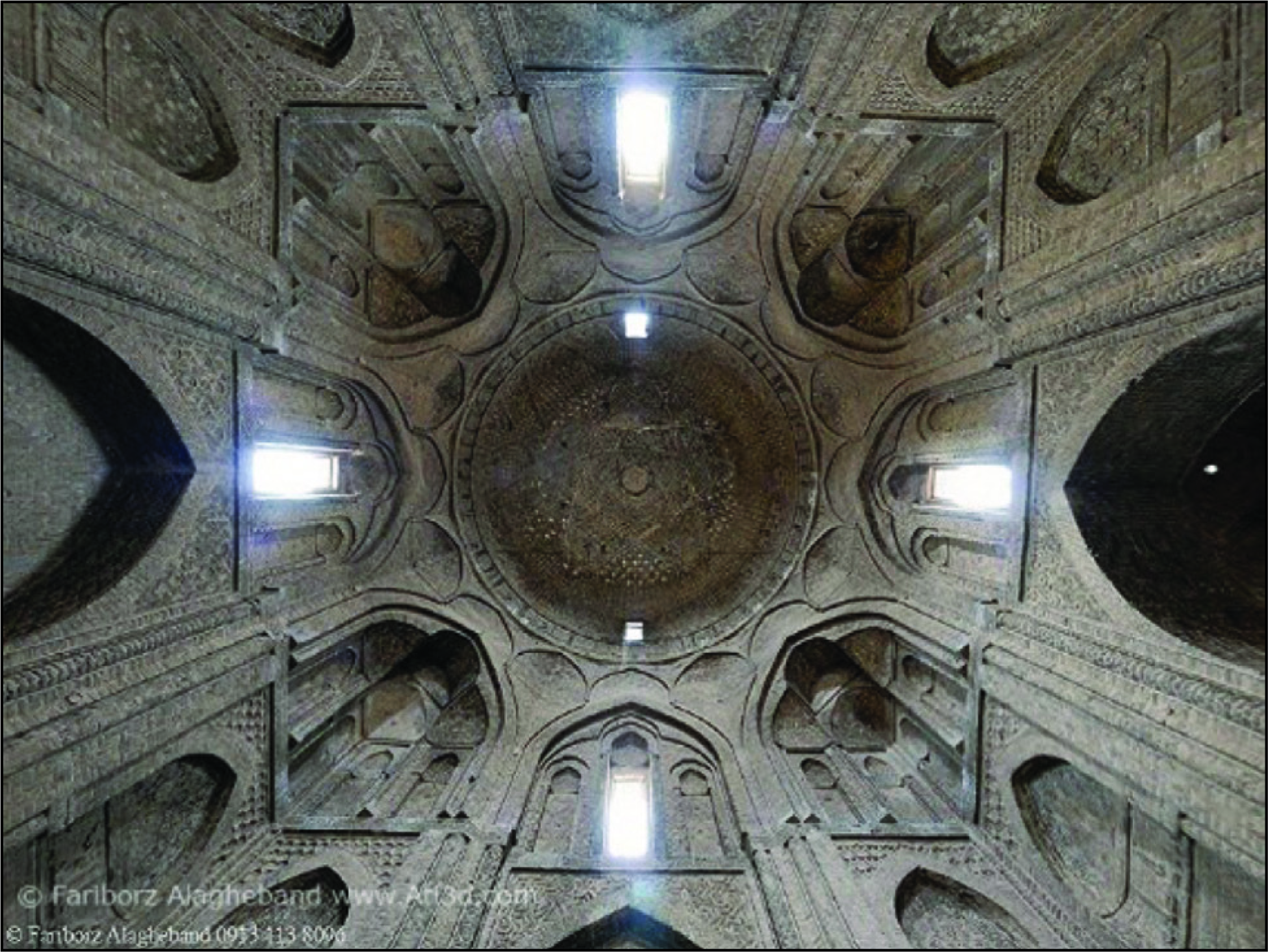
In addition to using large scales in the dome-chambers of mosques during these two periods, aesthetic principles have also been used to make the space influence the audience. For example, the dome of Taj Al-Molk Seljuk in the Isfahan Grand Mosque, which is very important both aesthetically and structurally. ‘Eric Schroeder’, while analysing the aesthetics and structure of this dome, calls it ‘the most beautiful structure in Iran’. 62
His geometric analysis showed the masterful use of the golden ratio in the construction of the dome. In such a way that the pentagon, which is in between the sides of a large Isosceles triangle that has the tip of the dome on its vertex, as a geometric base, determines the dimensions of each part of the construction. According to ‘Pope’,
this dome is mechanically compatible with the mathematical requirements of the ideal dome, and in critical points, such accuracy is achieved that it brings the dome closer to the exact mathematical model …. This single [brick] shell dome that has remained in an earthquake-stricken country for close to 900 years, is proof of its exact mathematical sciences and perfect mechanism …. This dome was built for eternity
63
(Figure 8).
Conclusion
This study explored reasons that necessitated the openness of the dome-chamber in dome-chamber mosques to the surrounding spaces, including the shabestan and the porch. The openness of the walls was classified into five types, depending on the location and amount of the openness. Then it was shown how the openness relates to each of the physical characteristics of the dome including span size, external diameter, wall thickness, dome thickness, dome height and span-to-wall thickness ratio. Despite the constant structural constraints for wall openness, different approaches have been used for solving this problem in each period.
The Safavid mosques, then the Seljuk mosques, have the highest average of the span and dome height. In the Safavid period, due to the large and unusual high of the mosque’s dome-chamber, the rate of openness was more controlled than the periods before and after it.
A palpable inverse correlation was observed between the ratio of span to wall thickness and the openness rate, such that as the space to mass ratio in the dome goes higher, the walls were less opened. The most amount openness and simultaneously the lowest span to wall thickness ratio occurred in Qajar mosques, and least amount of openness occurred in the Seljuk mosques, with the highest span to wall thickness ratio being for this period as well. Finally, it was shown that the architecture of Seljuk and Safavid mosques, subject to common religious characteristics that affected both periods, are more similar compared to other periods.
Footnotes
Declaration of Conflicting Interests
The authors declared no potential conflicts of interest with respect to the research, authorship and/or publication of this article.
Funding
The authors received no financial support for the research, authorship and/or publication of this article.