



Abstract
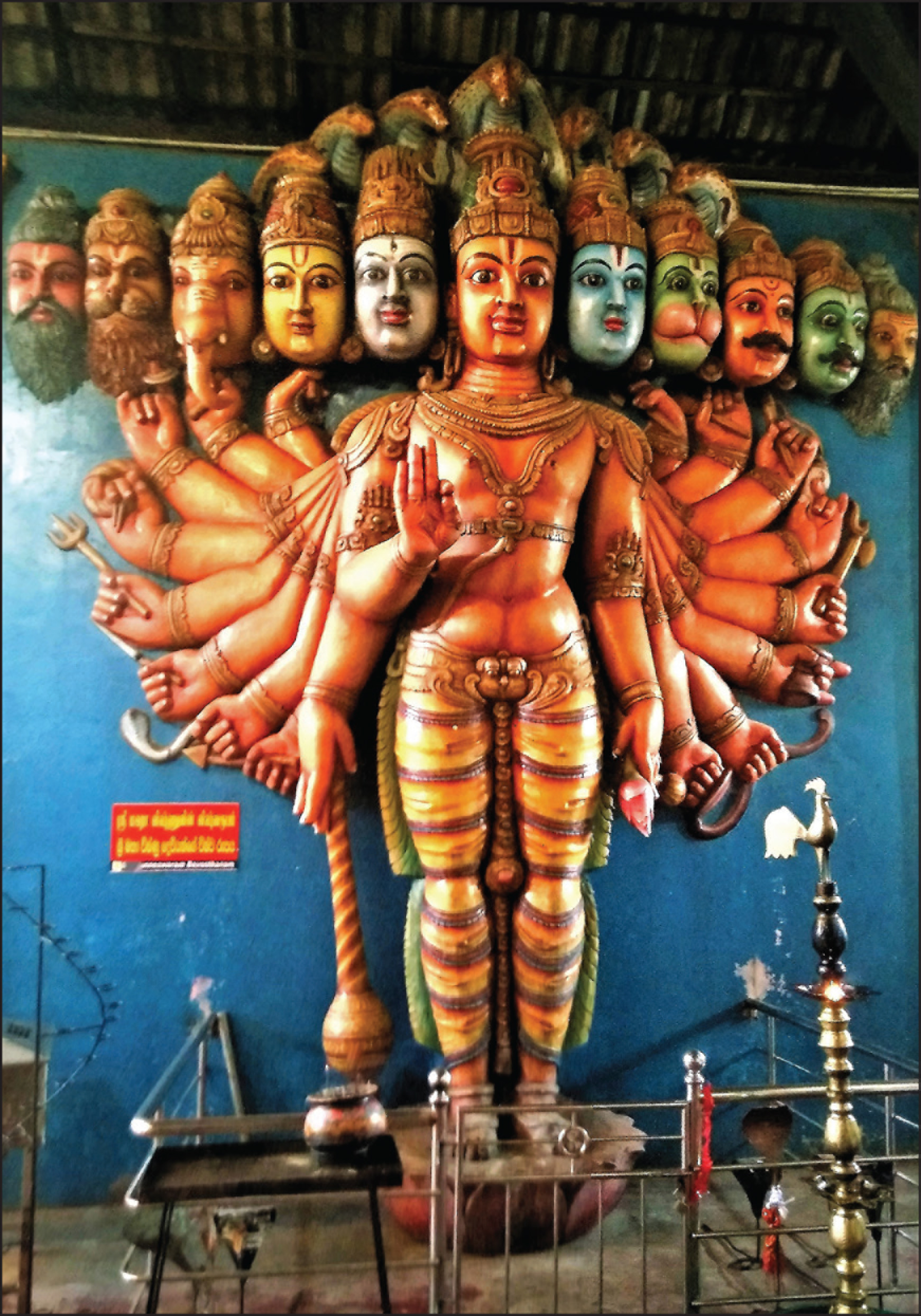
The pañcabhūtas convoked are pṛthvi ‘earth’, ap ‘water’, tejas ‘fire’, vāyu ‘air or wind’ and ākāśa ‘ether’. They are the five elements of nature in Hindu mythology. These are considered the abstractions of Viṣṇu (Figures 1–3, 6 and 10), Śiva (Figure 11) or Dēvī (Figures 7 and 15) as the case may be. Most virile among the five are ‘water’ and ‘fire’, the symbols of creation and destruction. Water from the Darwinian point of view is the creative force in which living organisms originate and survive. It is the sustaining principle, for example, the Mother feeding the child with milk as rain for the plant kingdom. Water is the symbol of destruction at the time of deluge, the mahāpraḷaya; cf. trees on the banks felled when rivers inundate (PTM 11.8.1). Fire creates when channelised through the oven; for example, Kumāra’s birth as also Mīnākṣī (Figure 16) and Draupadī emerging through yajñas. These ideas are best exemplified by the avatāras, aṃśāvatāras and other emanations of Viṣṇu. Śiva destroys the worlds by the power generated by his third eye (e.g., Sodom and Gomorrah in case of Biblical mythology), the God of Love, Kāmadeva symbolic of the seed of creation (Priapus in Roman mythology; Beard, 2008. Pompeii: The Life of a Roman Town. London: Profile Books Ltd: 104, figure 36). We are concerned in this article with water as the creative and destructive force, an idea that is as old as the Vedic and Biblical times. The focus is on the Āḻvārs’ Nālāyirativviyappirapantam. The Biblical myth of ‘Noah’s Ark’ may be of value for inter-religious dialogue. Several hundreds of the Tamil hymns have something to say on the symbolism of water. We cite a few examples hereunder. The emphasis is on water and Viśvarūpa.
Water is a colourless, odourless, tasteless liquid. It is hydrogen oxide H2O, the liquid containing associated molecules. It forms a large proportion of the earth’s surface, occurs in all living organisms, and no living organism could survive without water. Besides being essential for life, water has a unique combination of solvent power, thermal capacity, chemical stability, permittivity and abundance.
1
If only water is available in any planet in the Milky Way, the question of living organisms could be decided; for example, the researches of NASA on the planet, Saturn. Natural scientists confirm life originated in water when subjected to electronic interaction. The Darwinian evolutionary growth of living organisms is naïvely pointed out in a ninth century literature of Māṇikkavācakar, the Civapurāṇam
2
:
pullākip pūṭāy puḻuvāy maramākip palvirukamākip paṟavayaip pāmpākik kallāy maṉitarāyp pēyāyk kaṇaṅkaḷāy vallacurarāki muṉivarāyt tēvarāyc cellāniṉṟa it tāvara caṅkamattuḷ ellāp piṟappum piṟantiḷaittēṉ… Grass was I, worm, tree,/ Full many a kind of beast, bird, snake,/ Stone, man, and demon. ‘Midst Thy hosts I served/ the form of mighty asuras, ascetics, gods I bore,/ Within these immobile and mobile forms of life/ In every species born, weary I’ve grown
3
….
4
Therefore, in all religions of the world the deified water (e.g., Samudrarāja in the Rāmāyaṇa, Neptune in Roman mythology) and fire 5 play a vital role. Furthermore, most of the divinities of the Āryans were gods or goddesses of the natural forces. Indra (Tamil Vēntaṉ, God of fertile fields), Mitra, Varuṇa (Tamil Varuṇaṉ, God of the littoral tract), Maruts, Sūrya, Savitṛ, Pūṣan, Viṣṇu (solar origin), Agni, Soma, and Rudra are among them. 6
The hymns of Āḻvārs, the Nālāyirativviyappirapantam
7
(shortly ‘Nālāyiram’ are copious in demonstrating the symbolism of water (Sanskrit ap, jala, tīrtha; Tamil taṇṇir or nīr, veḷḷam
8
). Water is the source of sṛṣṭi/paṭaittal ‘creation’,
9
sthiti/kāttal ‘sustenance’ and saṃhāra
10
/aḻittal ‘destruction or end’ and these three linked with the cyclic process of tirodhana/maṟaittal ‘hiding/purification’ and anugraha/aruḷal ‘release’ that complete the five cosmic functions, the pañcakṛtyas.
11
A few avatāras and aṃśāvatāras, including canonical iconography of Viṣṇu such as vyūha
12
are associated with water. These forms are Matsya (the Fish), Kūrma (the Tortoise), Varāha (the Boar), Haṃsa (the Swan), Hayagrīva (the Horse-headed), Vaṭapatraśāyī (the little-Master, Kṛṣṇa reclining on the banyan leaf),
13
Śeṣaśāyī and so on. Viṣṇu ‘Virāṭ Puruṣa’, Viśvarūpa is the sthānaka-Mūrti who had devoured the entire Milky Way; the gods and goddesses forming part of his multi-faceted aṅgas. The Tamil ‘Nālāyiram’ is a comprehensive literature bearing on the Viśvarūpa of Viṣṇu, and the water in Hindu dissolution and creation mythologies.
14
Scholars have obtained a better picture from the Sanskritic lore.
15
The present article is devoted to Tamil sources that are derivations from the Sanskritic originals by about the seventh to ninth centuries
Mahāpraḷaya: End of the Cosmos
The following 10 hymns from the Periya Tirumoḻi (11.6.1–10) of Tirumaṅkai Āḻvār are on deluge and the Cosmic Lord, called ‘Aṇṭaṉ’, that is, Brahmāṇḍanāyaka, cf. Bṛhadrūpaḥ (VSN-272) or Lord Bṛhadīśvara 16 and Ammaṉ/Mother Bṛhadāmbāḷ. 17 The following summary is based on the later medieval commentary of Periyavāccāṉ Piḷḷai 18 (PVP c. 1167–1262). The relevant data is summarised.
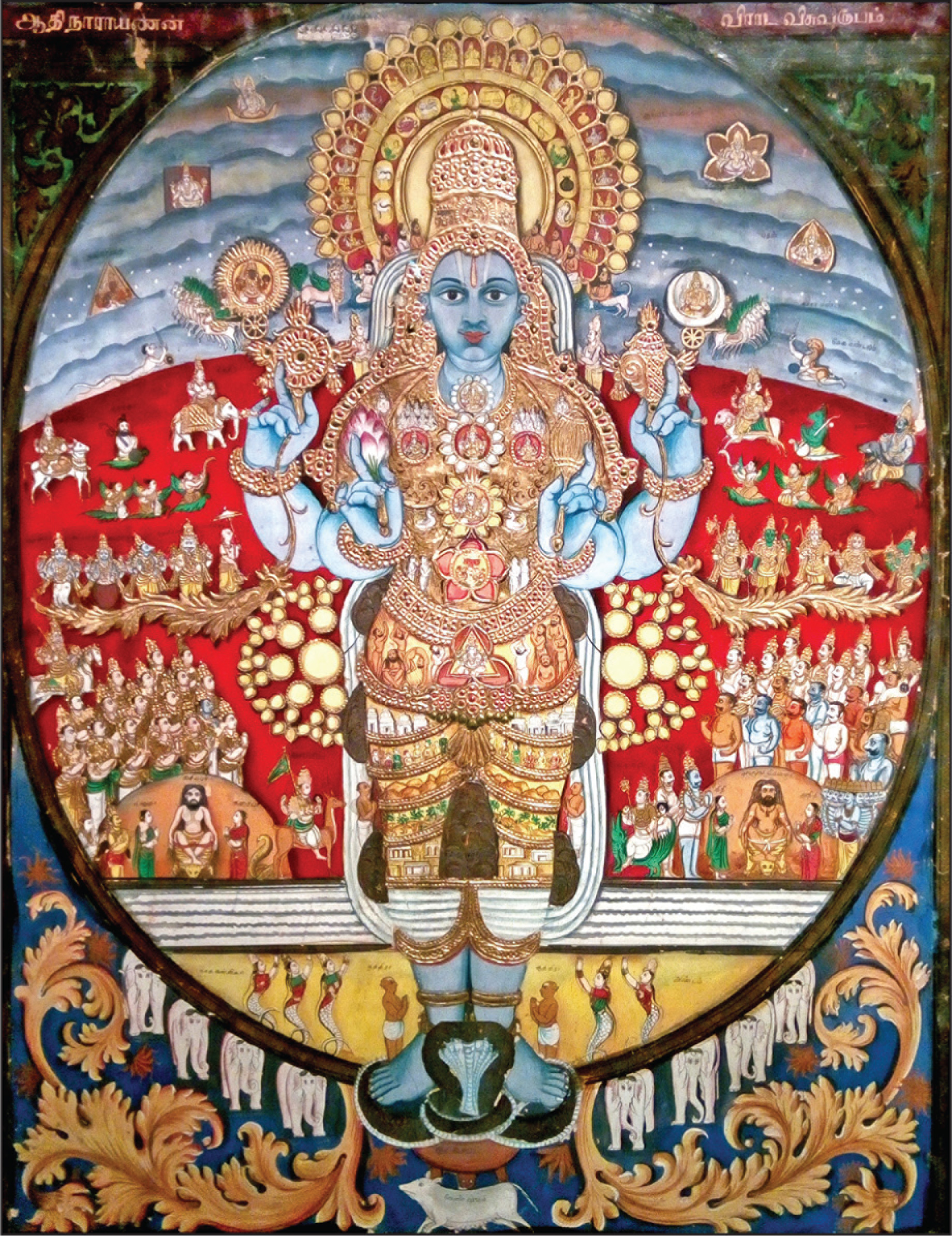
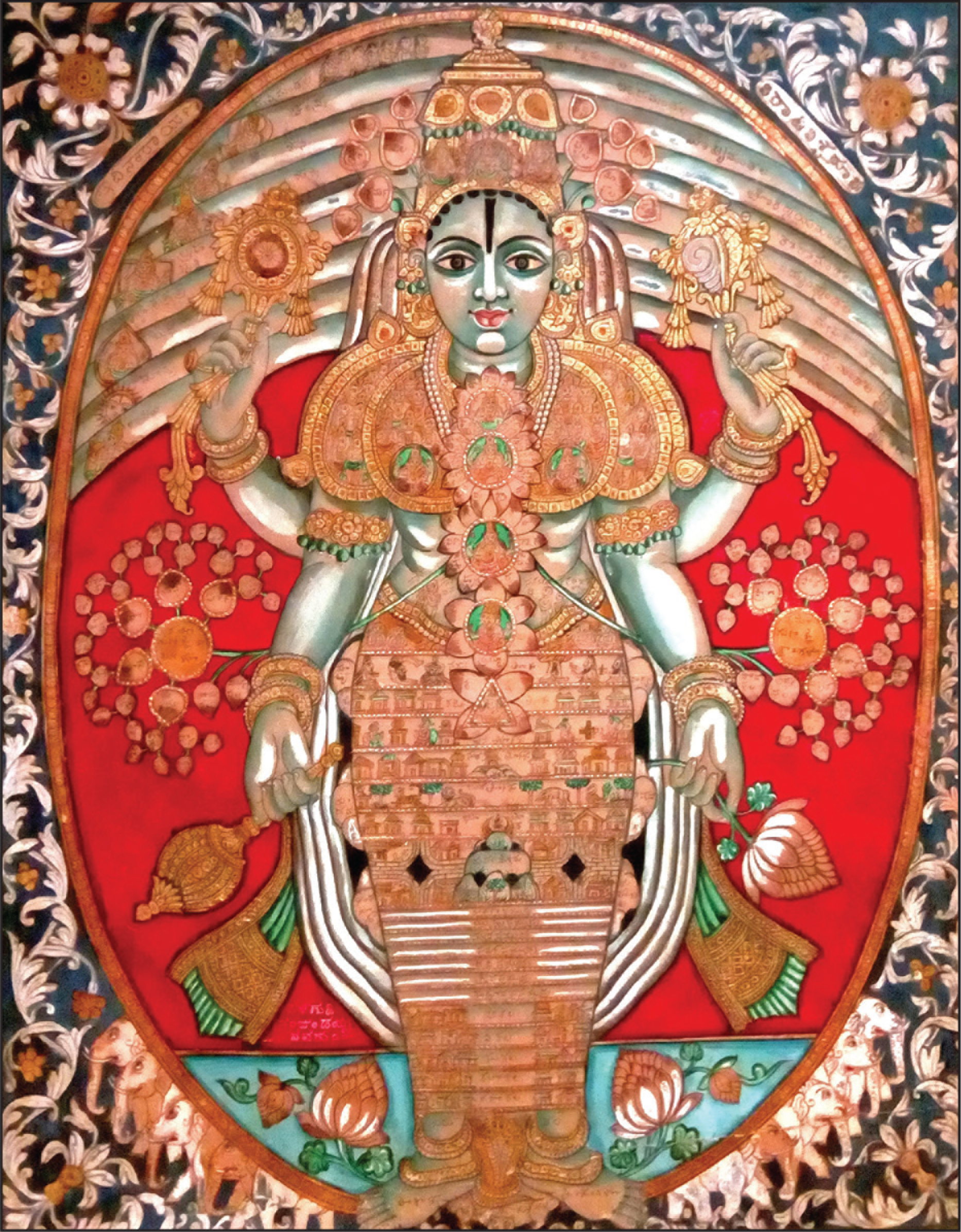
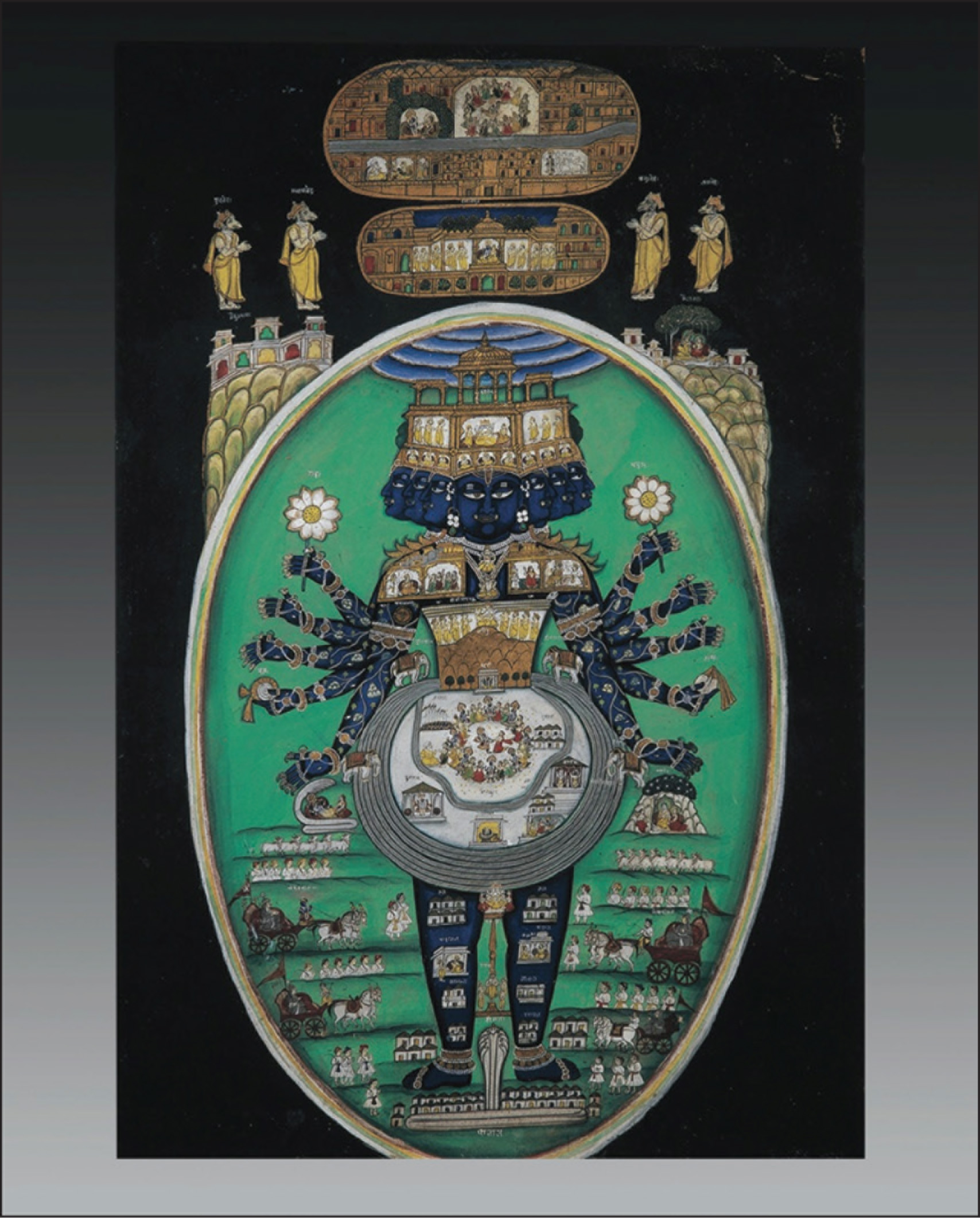
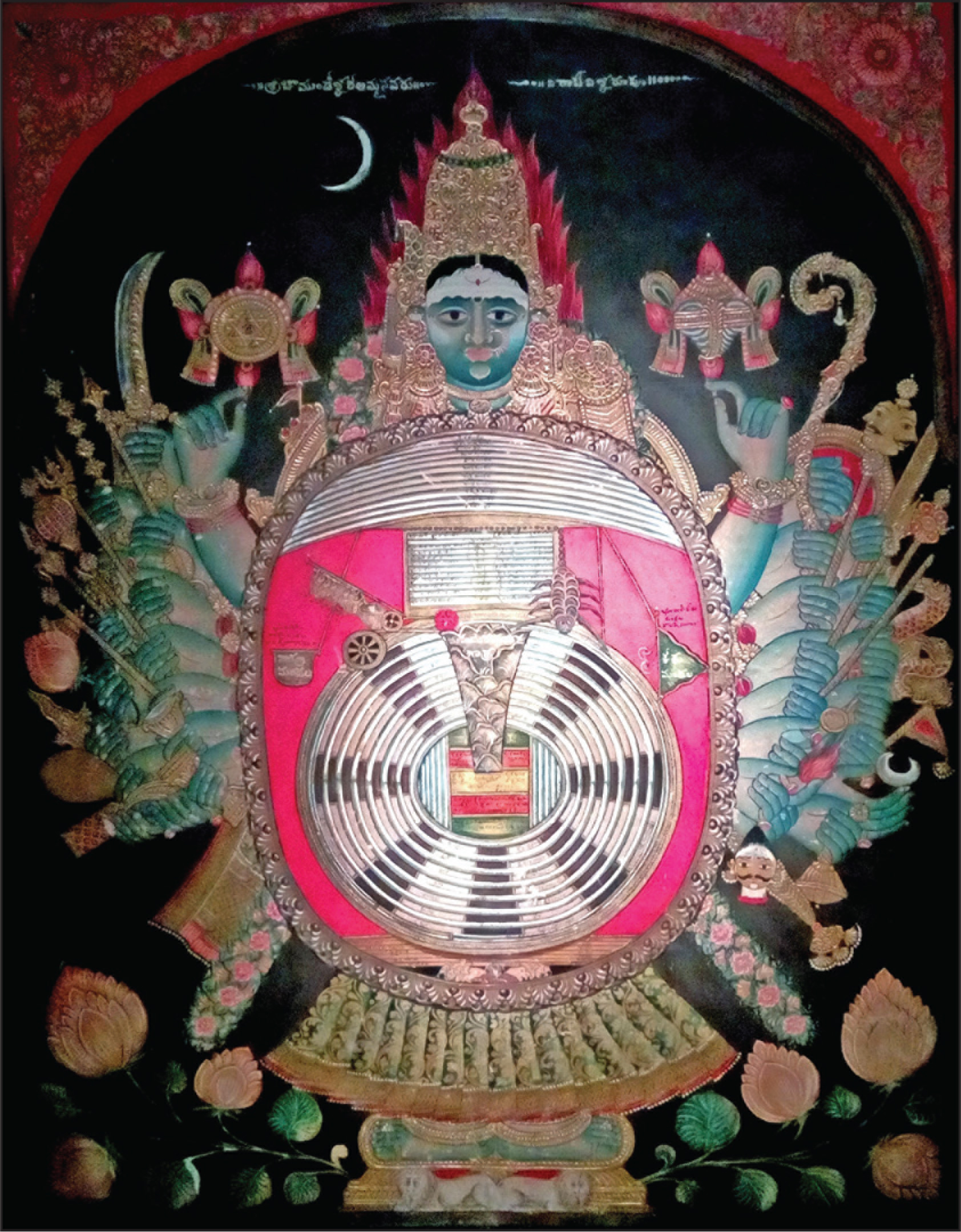
1. What all existed during the pre-Genesis period was the vast expanse of primeval black- water. The worlds did not exist at that time. The gods, we, and all other cosmic elements lay embedded for a long time in the Lord’s sacred stomach, tiruvayiṟu 19 (Figures 2, 3, 6 and 7). His ornament/weapon is the ghee-smeared disc. 20 You (gods and humans) originated within the Lord’s hiraṇyagarbha (cf. PTM 11.5.3). He is your Patriarch (PVP), Aṇṭaṉ, the Cosmic Lord (Figure 2); cf. āṇṭāṉ ‘ruler’. 21
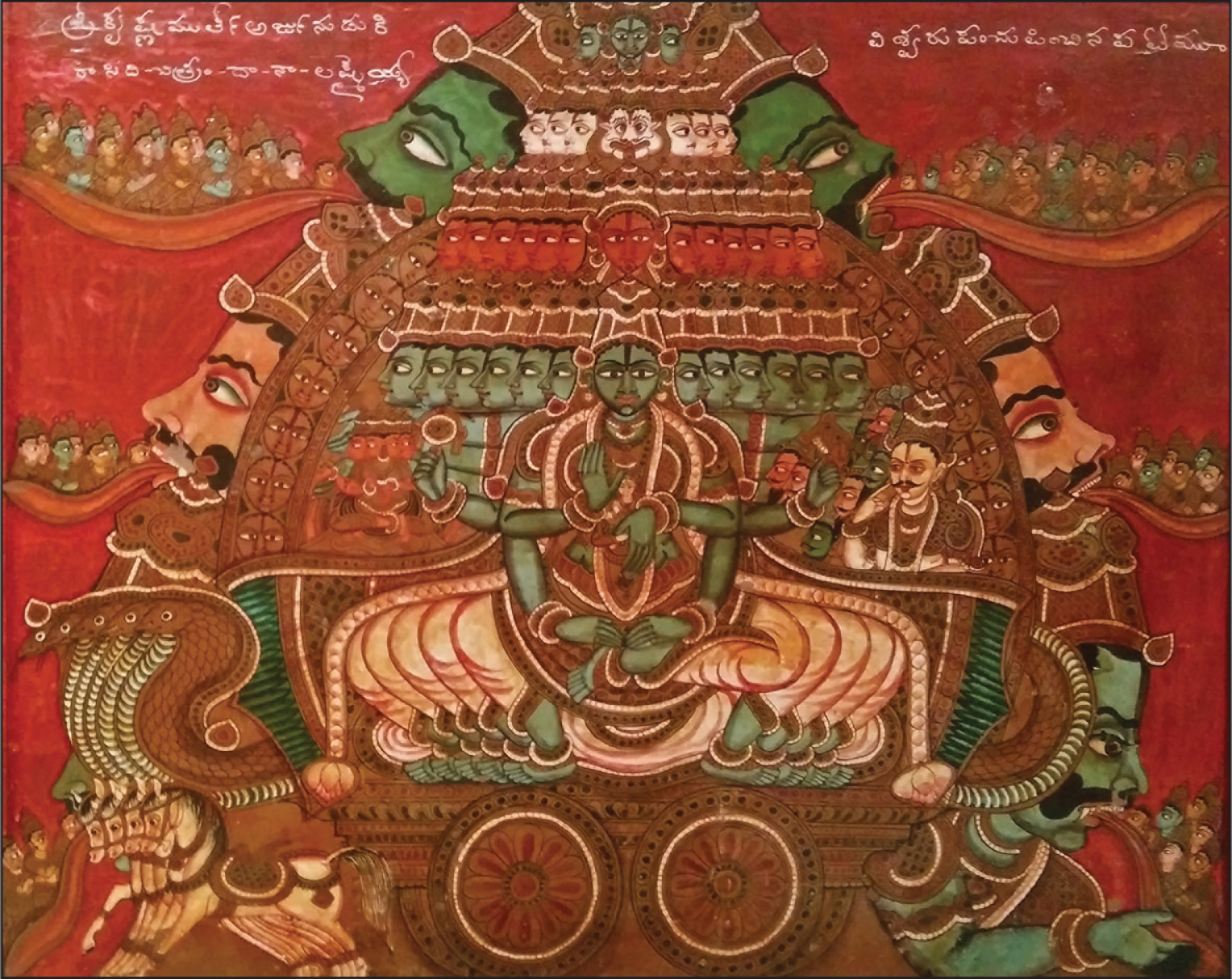
2. The incessant great floods bogged up above the endless ether. Unable to move further the deluge started receding. 22 The Lord’s majestic hands expanded to widen the Milky Way (Figures 6, 8 and 9). My Lord absorbed and vomited (Figures 9, cf. Figures 2 and 10) the lesser divinities (cf. the following hymn) that are His saliva, eccil-tēvar. 23 Is there any other longstanding divinity? The Cosmos is in His image.
3. Trinetra-Śiva gifted with an eye on forehead (cf. Figure 11), the four-faced Brahmā professed to enlighten the righteous languages, 24 Indra that commands the elephant-Airāvata, and all the other celestials were absorbed (Figures 3, 6, cf. 7). The Lord is the victorious king of the abysmal waters of the deluge. The Lord absorbed all cosmic elements and the gods in His sacred stomach to facilitate conservation.
4. The entire Milky Way was frozen; the waves were rising; it was the time when the entire world was immersed in the limitless ocean. We thought ‘none is there to redeem us’. The seven worlds were systematically absorbed. Foremost among the ṛṣis, the Lord Paraśurāma 25 kept the worlds in His barrel-like big belly (Figures 6, cf. 7). 26 The redeemer, He is of the hue (i.e., black-blue or green) of ripe kaḷā-fruit (whortleberry, Vaccinium Neilgherrense).
5. During the time of cosmic sūnya (void) none existed. The entire Milky Way was immersed in the ocean of deluge. The cosmic elements were embedded in the sacred stomach for a prolonged time. Concentrate on the king of gods, Trivikrama that measured the worlds (Figure 12). He is the dignified; cherish the Lord’s sahasranāma (thousand-names) for resurrection.
6. Ghouls 27 were roaming about the cosmos when the Great Floods, neṭu-veḷḷam were flowing across the shell of the Milky Way at the time of mahāpraḷaya. As a mother is fasting to assure the health of her child, the Lord conserves the cosmos in His sacred stomach (Figure 28 2, 3 and 6), the life defending incubator.
7. The Lord devoured the earth, the heavens, the gods, the demons, and others so that the Great Floods, peru-veḷḷam does not engulf the Cosmos. The dear-one that salvaged the worlds is keeping these in His sacred stomach.
8. The waters of the primal deluge rose up above, and spread vast cutting across the Milky Way. At that time of chaos and confusion, the Lord obtained the seven golden worlds, poṉṉulakamēḻu under His sovereign jurisdiction to safeguard within the safe custody of the Sacred Stomach. Thus, the Milky Way was redeemed from cataclysm. The dignitary is the Lord Viśvarūpa (Figures 2, 3 and 6).
9. The shell of the Milky Way was compressed inwardly causing the cosmic waters lash out in waves resulting in hue and cry. The Lord offered blessings to the servants, celestials and the ṛṣis. The sacred stomach devoured the seven worlds in order to conserve the cosmic elements within the (stomach)-chamber. 29 The Lord brilliantly shining as the blue-gem is endowed with cloud-hued hands. He is present in the city of frigid-Kuṭantai, jala-sthala. 30 Sing and dance the glories of the Lord.
10. ‘The Lord Viṣṇu had absorbed within his scared stomach the gods, the demons, the directions, the oceans, and the entire, including all, none excluded.’
Two examples from the Tiruvāymoḻi of Nammāḻvār may be cited here. 31 The Āḻvār says how the pañcabhūtas 32 went disorderly at the time of mahāpraḷaya, and were reassembled (summary based on Nam Piḷḷai c. 1147–1252).
nāḷumeḻa nilamnīrumeḻa viṇṇum
kōḷumeḻa erikālumeḻa malai
tāḷumeḻac cuṭartāṉumeḻa appaṉ
ūḷieḻa ulakamuṇṭaūṇē 33 (MOLI 7.4.4)
‘When deluge, ūḻi 34 (cf. PAV 4) was on rising tide the righteous order of the day was imbalanced; the integrity of the earth and purity of water were lost 35 ; the originality of the ether and the celestial bodies were gone, the fire (agni) 36 and the wind were lacking in sanctity; the hills were uprooted, and the Sun and Moon moved on the wrong path. My Lord, the Patriarch devoured the flesh of the Cosmos to the rhythm of integration’ (Īṭu). 37
Nammāḻvār says why the water was created, and thereby ‘Genesis’ took place after the deluge.
tammaiaṟipavartām avaṟkuāḷaṉṟiāvārō
paṉmaippaṭarporuḷ ātumilpāḻneṭuṅkālattu
naṉmaipuṉalpaṇṇi nāṉmukaṉaippaṇṇit taṉṉuḷḷē
toṉmaimayakkiya tōṉṟiya cūḻalkaḷ cintittē (MOLI 7.5.4)
‘Realize what you are! It was the time of cataclysm. All existing jaṅgama (movable) and sthāvara (immovable) properties were lost. The lord created the good water (see note 35). Caturmukha-Brahmā was ordained (in the lotus emanating from Padmanābha’s umbilicus). All elements that had mixed with Viṣṇu were given new shape. 38 Who knows the Lord is the Creator? He emerges up above suppressing the ancient règime’. 39
The above summary of the Āḻvārs’ hymns suggest the Tamils were acquainted with the ‘Great Floods’ and ‘Genesis’ by about the seventh to ninth centuries, the roots of which may be traced to an earlier time of the Paripāṭal c. fifth century
Viśvarūpa/Virāṭ Puruṣa
The idea of Viśvarūpa (cf. Figures 9 and 13) seems an over-growth of the Āryan creation mythologies that is elaborated in the Mahābhārata c. 500
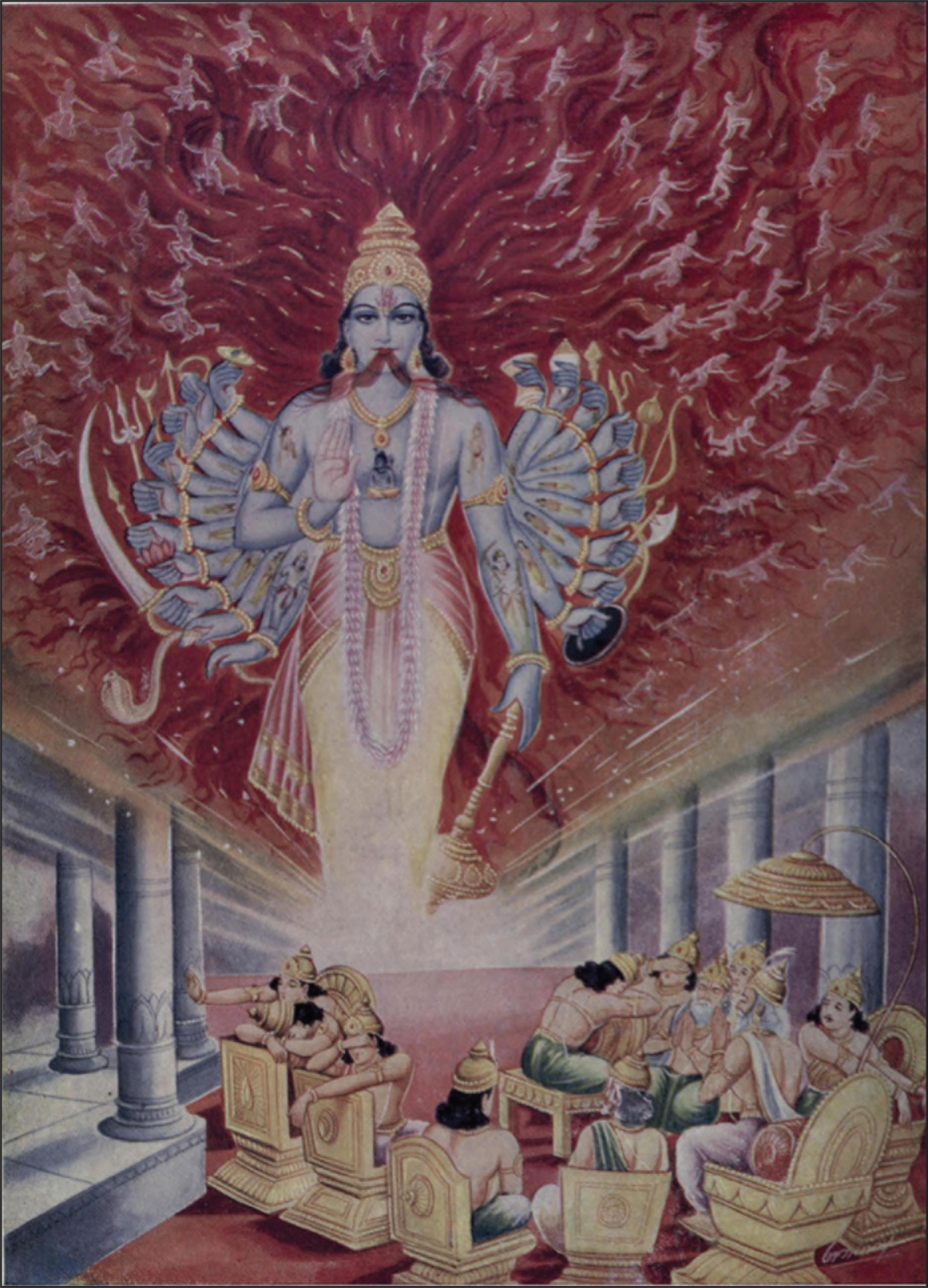
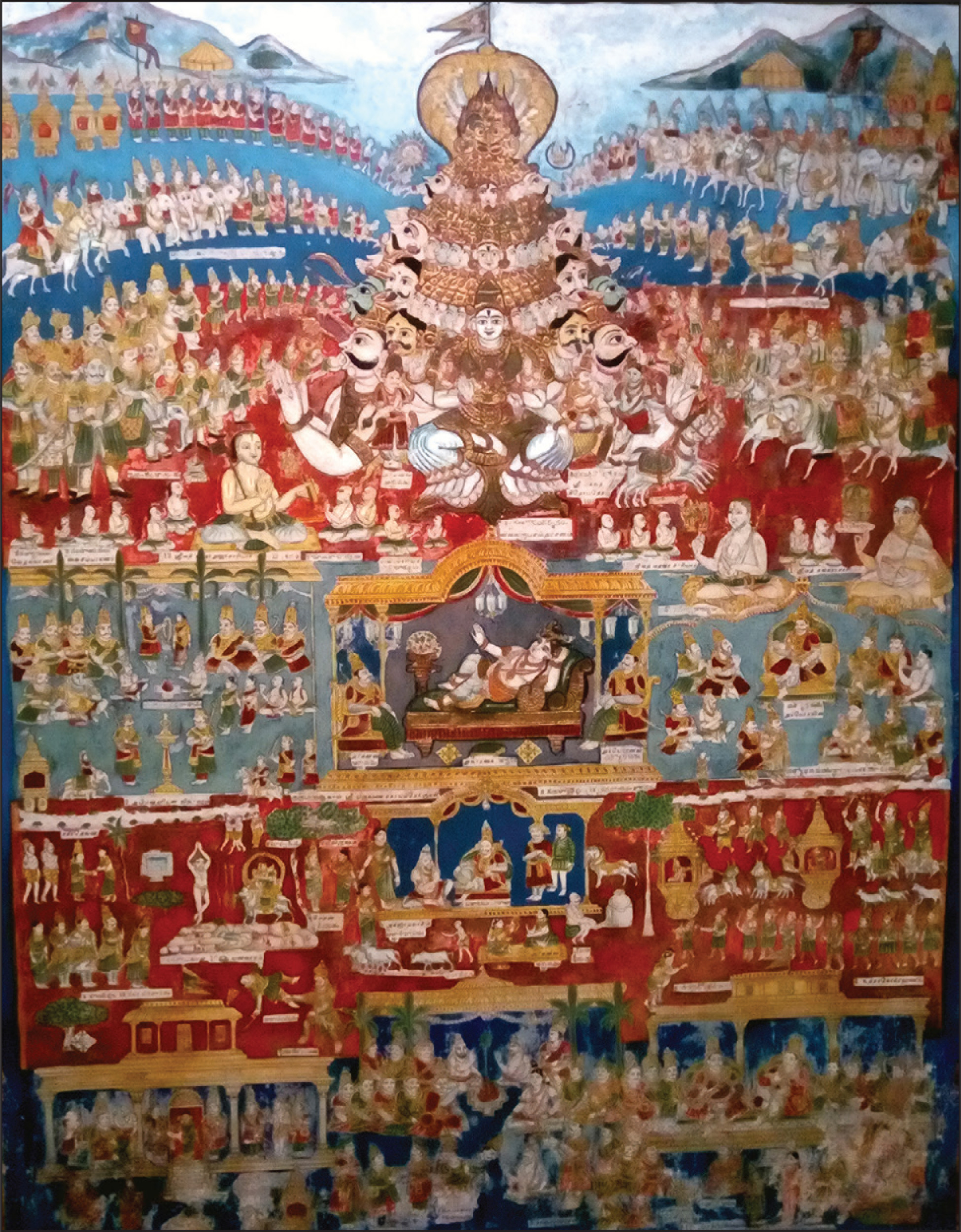
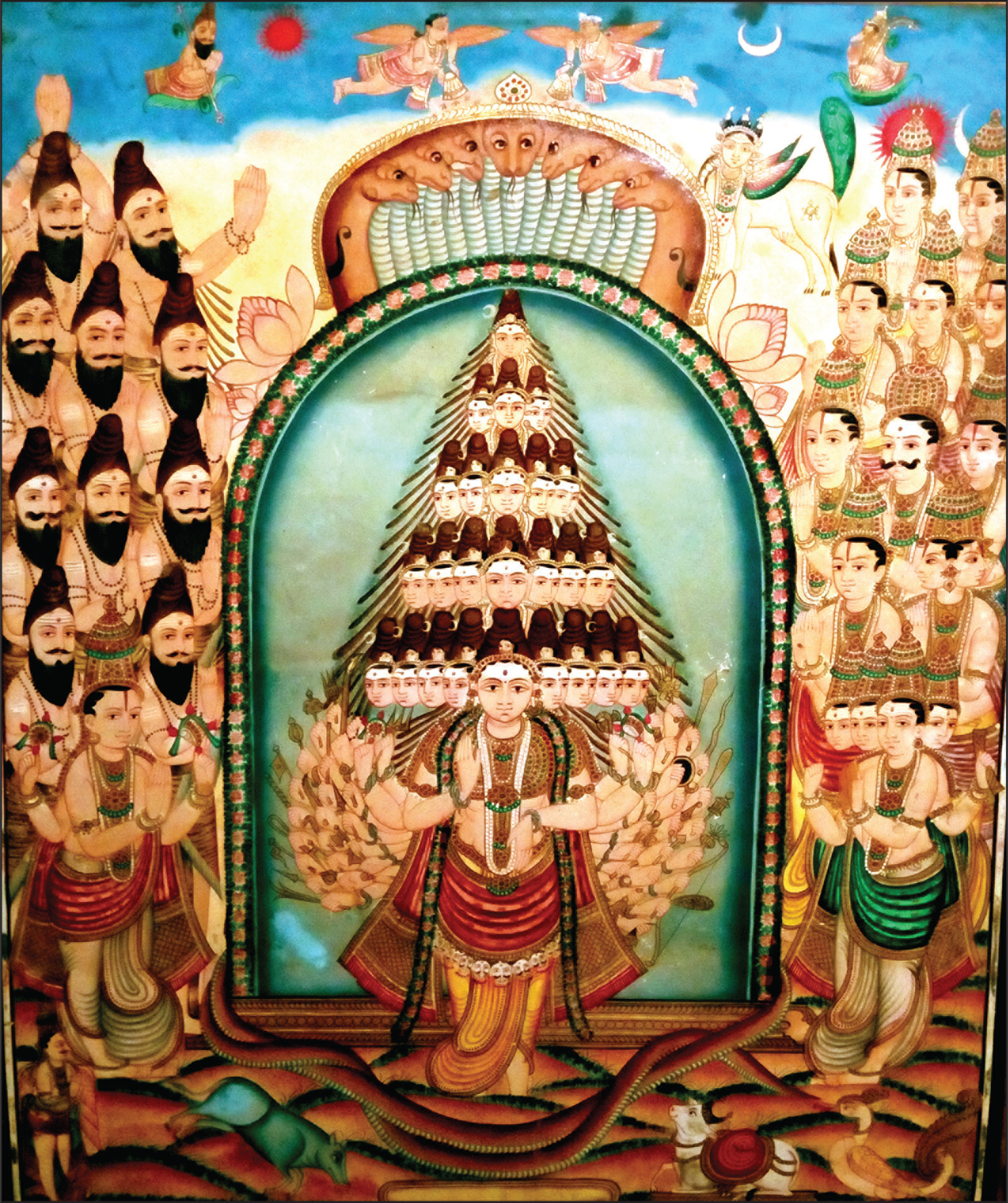
Virāṭ Puruṣa’s ‘gem-stomach conceived and devoured the worlds’, paṭaittuṇṭa-maṇivayiṟu (TM 1.6.1, 5.1.2; cf. MOLI 8.9.4, CTM 27, PTM 2.5.1). His legs, shoulders, and heads are spread out across the Milky Way 49 that produced myriads of suns (MOLI 8.10.8).
The Virāṭ Puruṣa 50 (PTM 4.5.7–9) embodies in his macro-personality the kuṉṟam ‘mountains’, vāṉ ‘sky’, maṇ or taraṇi ‘earth’, kuḷir-puṉal ‘cold water’, tiṅkaḷ ‘Moon’, veñcuṭar ‘Sun’, caṅkai (procrastination), tuṇivu ‘courage’, poy ‘falsehood (adharma, war)’ or pāvam (sinful terrorist deeds), mey or aṟam ‘righteousness (dharma, peace)’, mukil ‘cloud’, vīṭu (mokṣa ‘liberation’), iṉpam ‘delights’, tuṉpam ‘miseries’, kōvam ‘fury’, aruḷ ‘grace’, ellāk-kuṇam ‘all guṇas’ (uttamottama, uttama [cf. Puruṣottamaḥ VSN-507], madhyama, adhama of sattva, rājasa and tāmasa). The Lord devoured the entire cosmos, and said ‘the food is not enough for me’, eṉak-kārātu (PTM 2.4.6). The tirai or alai (waves of ocean), kulavarai/kulaparvatas (seven cosmic mountains), ūḻi (eons), eṇticai (eight directions), and iruḷ (gloom); and ulakaṉaittum (entire worlds) in the Milky Way form part and parcel of the mega-personality of the Lord (PTM 1.5.3, 7). He is an abstraction of the Vedas, Yajñas, and celestial and terrestrial worlds. He is the Primeval, the āyaṉ 51 /yādava ‘cowboy’, Kṛṣṇa (CAN 34).
Vaṭapatraśāyī
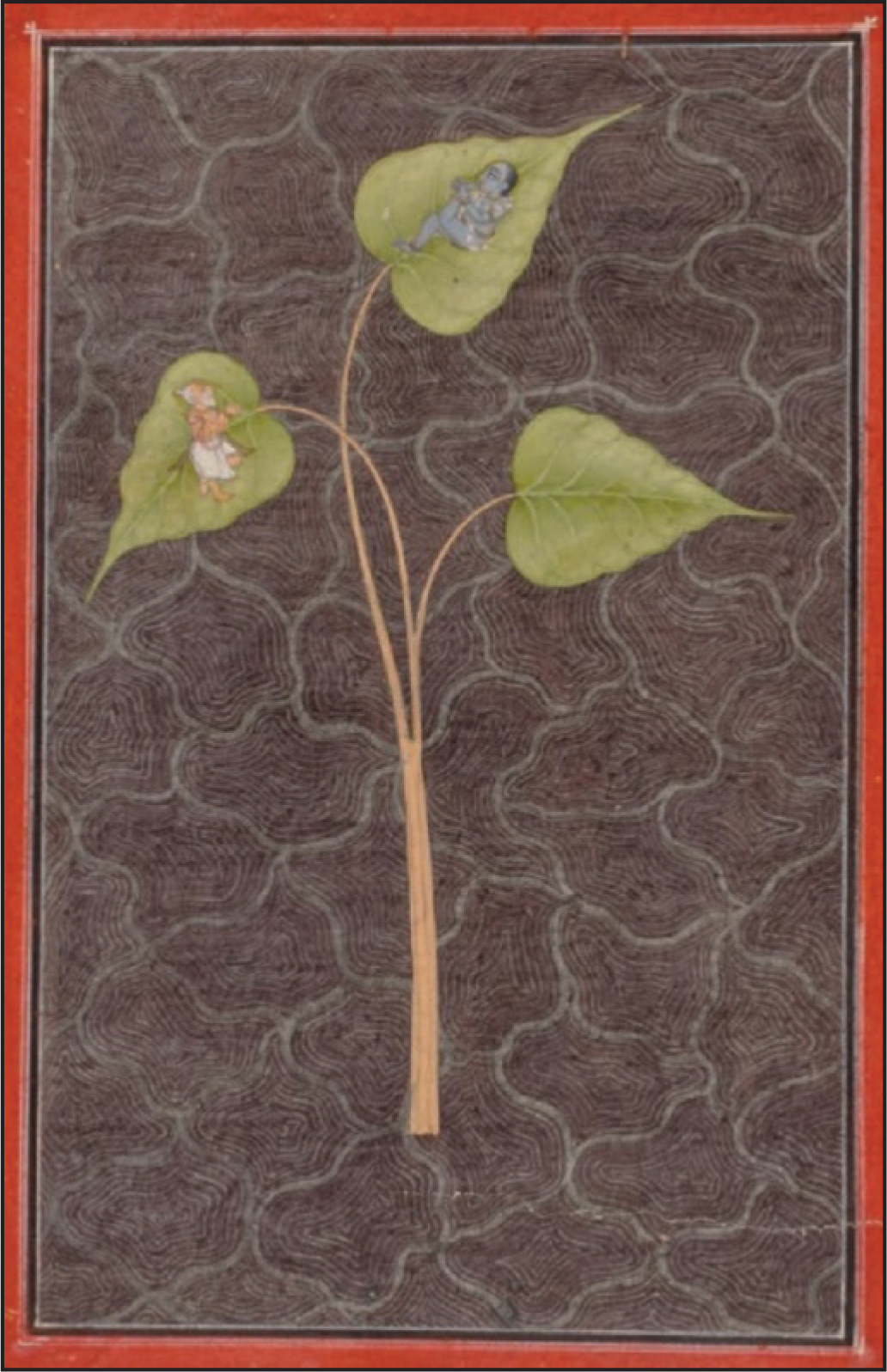
If the Viśvarūpa is macro, Vaṭapatraśāyī is the micro (Figure 4); Kṛṣṇa reclining on a leaf of the vaṭavṛkṣa (Tamil āl; Ficus bengalensis) that floats in the waters of mahāpraḷaya. 52 He is supposed to discuss the cosmic secrecies with the eternally youthful sage Mārkaṇḍeya. 53 Of the 108 divyadeśas in South Asia, 54 the Lord is known as Vaṭapatraśāyī or Jalaśayanattituk-kiṭantaruḷiṉa 55 Paramasvāmi 56 in the temple at Villiputtūr, the nativity of Periyāḻvār and Āṇṭāḷ. Inscriptional sources note the temple, Vaṭaperuṅkōyil 57 the Big Temple of the banyan tree. 58 The mūlabera is a colossal image; about three meters longitudinally. 59 If the iconographic devise of the mūlabera is examined from close quarters some subtle elements symbolising the vaṭapatra, a plant on the coils of the snake may be detected. 60
The baby-Kṛṣṇa, Vaṭapatraśāyī was pleased to ‘consume the worlds and minimise his stature to appear on a banyan leaf’, vaiyamuṇṭ-ālilaimēvumayaṉ (PT 5.4.2). He was pleased to devour the celestial worlds, the earth, the oceans, the misty mountains, and the eight directions (CAN 30, PT 1.8.6, 2.10.1). The banyan leaf was floating on the Ocean of Milk, alaikaṭal ālilai-vaḷarntavaṉ (PT 6.1.4). The Lord osmoses [karantu/tirodhana] the moon-crested Śiva, four-faced Brahmā, the king of gods Indra, the earth, the water, the fire, the wind, and the ether, including all others nothing left over (ACI 7). Steeped in philosophical speculations, Nammāḻvār does not know why the Lord gulps the cosmos. He is wondering: ‘who knows the idea behind the deceitful cosmic metabolism of the Lord?’: uḷḷuvār aṟivār avaṉtaṉ kaḷḷa māya maṉak karuttē (MOLI 2.2.7). 61 In this mythology the leaf is a metaphor for ‘ark’, and the sage Mārkaṇḍēya recalls minding Noah. 62
Recently, I came across two articles in which some Nepalese miniatures show ‘Vaṭapartraśayana’ on the top of a tree. In fact, the Tamil ‘Ālamarkaṭavuḷ’ means, (a) God seated (amar ‘sit’) up on the āl tree, (b) God seated below the āl tree. One will have to decide whether a man could sit at the shade of a tree (e.g., the Buddha and Bodhi tree) or sit on top of a tree
63
as monkeys do. It may be a regional variation, as M. W. Meister
64
would say on the MÂtṛkas. By the way, I may add the Tamil thought is dated in the
Śeṣaśāyī
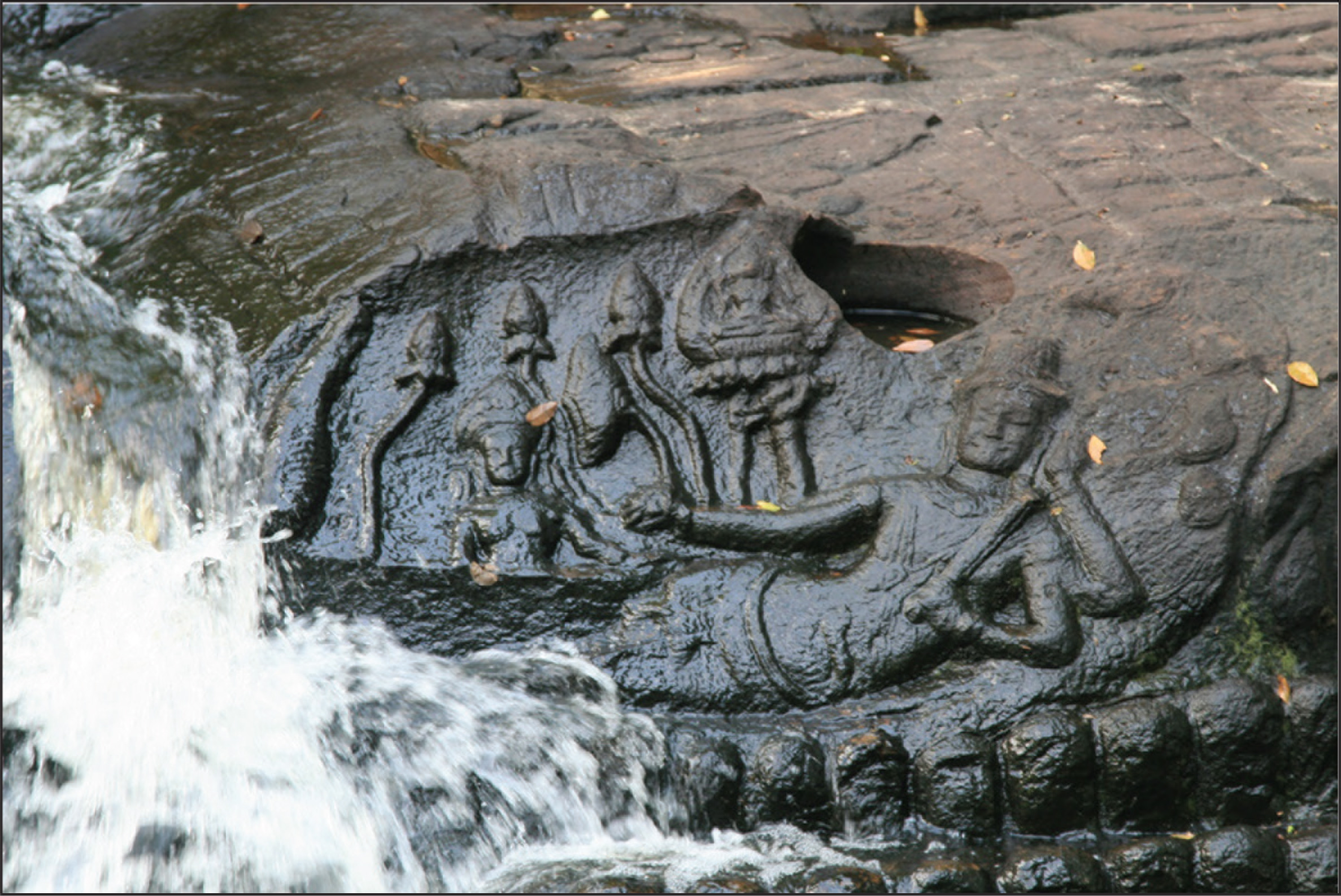
A popular paradigm in South and Southeast Asian iconography, 65 we have a rich literature on the subject from the Sanskritic sources. 66 Of the 108 divyadeśas, the Lord is supposed to appear in reclining mode in 26. Celebrated among these venues are Araṅkam/Śrīraṅgam, 67 kaṭal-Mallai-[talacayaṇam/sthalaśayana], 68 and ciṟu-Puliyūr-[calacayaṉam/jalaśayana], 69 Piruti/Nandaprayāgaḥ on the Himālayas and the Indian Ocean Aṉantapuram. 70 The Āḻvārs have appropriated plenty of material to recast the imagery of the Lord. 71 These are infinite riches in little rooms. We further distil the material to present chips.
A graphic description is obtained in the hymns of Tirumaṅkai (PTML 1–10);
The Lord is laid up on a snake-bed and pretends to sleep, pāmpu mettai kaḷḷa nittirai (PTM 5.1.7); it seems a blue mountain decorated with gems is laid up, nīlat taṭavarai māmaṇi tikaḻak kiṭantatupōl (PTM 3.5.2), cf. Meyya-malaiyāḷaṉ ‘sovereign ruler of the Meyyam hills’ 72 (PTM 3.6.9, 5.5.2);
He is reposing on the Ocean of Milk, pāṟkaṭal-paḷḷikoḷvāṉ (NT 5.7); the snake Śeṣa’s heads are 1,000, paṇaṅkaḷ-āyiram (MOLI 8.1.8), a symbol of limitless time such as kalpa and yuga; Ananta, the Eternal King Cobra, personification of the endless kalpa and yuga 73 ;
The head is placed on the west, legs extended towards the east, back turned to the north and the Lord facing southern Laṅkā 74 : kuṭaticai muṭiyai vaittuk kuṇaticai pātamnīṭṭi vaṭaticai piṉpukāṭṭit teṉticai yilaṅkai nōkki (Mālai 19); symbol of the endless spatial periphery;
Śrīdevī and Bhūdevī massage the Lord’s feet when the ṛṣis go on extolling the Praise of the Lord; for Śrī, Bhū and Nappiṉṉai attending on the Lord see Kalidos 75 ; feminism is sublimated to masculine hegemony in this analogy;
The experts in saptasvaras (seven music-s), Vedāṅgas (six integral parts of the scriptures), pañcayajñas (five sacrifices), four primary scriptures (catur-Vedas) and pañcāgni (five or triple fires) extol the Lord’s Praise; icaiyēḻ āṟaṅkam aintuvaḷarvēḷvi nāṉmaṟaikaḷ mūṉṟutī (PTM 2.10.2); these are symbols of the creative faculty;
What is performed by reposing is not exactly nidrā (sleep) but yoga (meditation), yōka-nittirai (MOLI 2.6.5, 5.4.111); a deceitful slumber, kaḷḷa-nittirai (TM 5.1.7);
The Lord preaches the true philosophies, mey-vācakam (MOLI 2.1.5) by silent discourse, 76 the technique that Vaṭapatraśāyī follows; the purpose was to recreate the worlds, Brahmā, Rudra and the galaxy of gods (ACI 4); Brahmā was ordained so that he creates the four Vedas (PTML 10).
The micro in all these mythologies may stand for molecular organisms such as bacteria, and macro the multi-cellular creatures such as fishes, whales or the defunct dinosaurs, see Māṇikkavācakar’s Civapurāṇam cited above. Śeṣaśāyī images carved on seaside rocks (e.g., Māmallapuram Shore Temple, 77 Bhokardān, 78 and Kabal Spean) are biologically reproductive because aquatic creatures deposit their eggs on rocks in waters, which if destroyed leads to the extinction of certain species of water fauna such as prawns.
Trivikrama
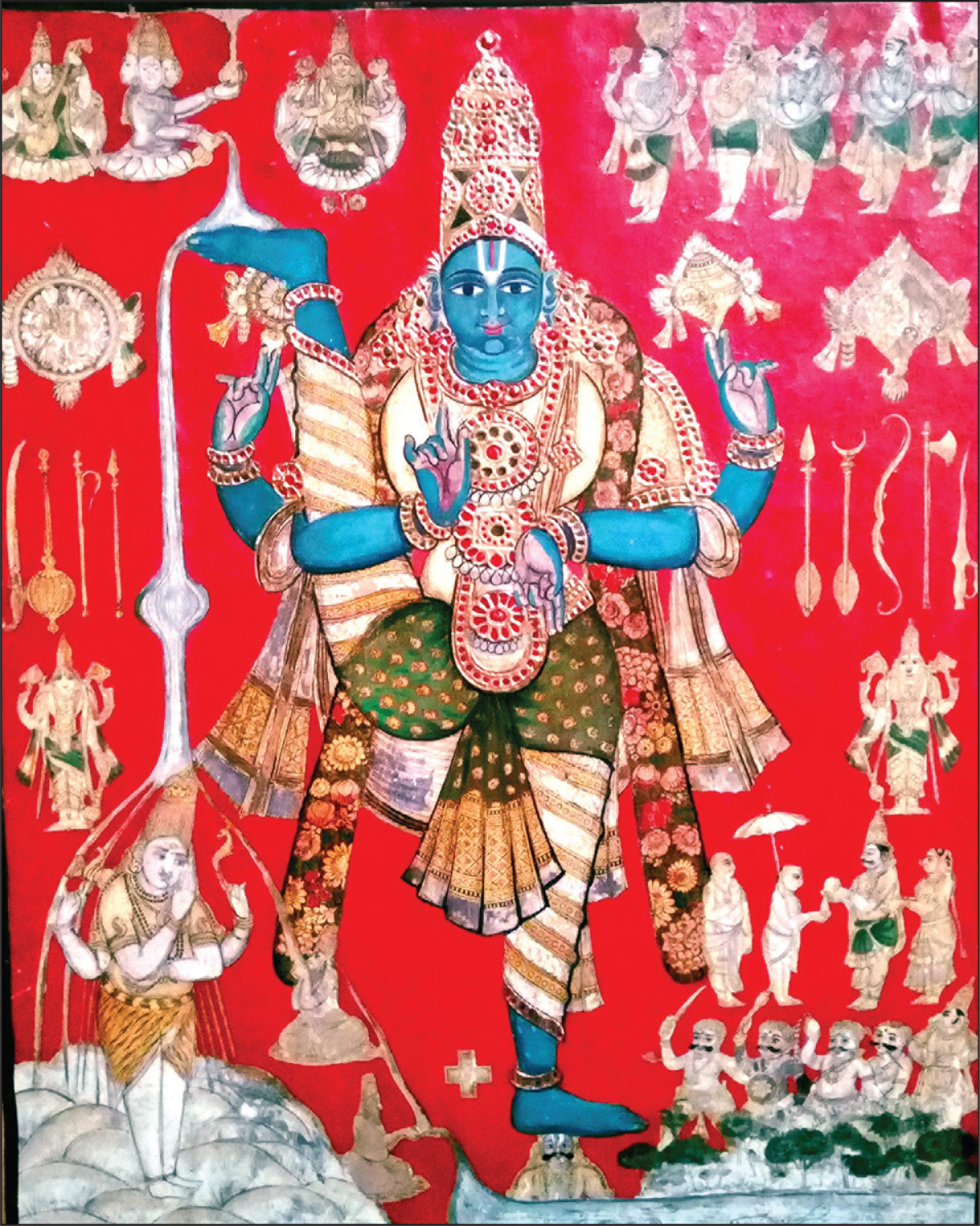
Trivikrama 79 and Gaṅgādharamūrti are two different pictures dealing with Gaṅgā through the Vaiṣṇava and Śaiva eyes. The two Tañcāvūr paintings under study is a fusion of the Trivikrama and Gaṅgādhara myth and iconography (Figures 12 and 14, from Kuldip Singh Collection). 80 In both, Trivikrama occupies the central space. Gaṅgādhara is one-fourth in size subordinated to Trivikrama. What is more popular in the Hindu iconography is the connection between Śiva and Gaṅgā as Gaṅgādharamūrti in the pan-Indian level. The images under study give ample inkling for the sectarian-rivalry between Vaiṣṇavism and Śaivism, elevating the status of Viṣṇu as the source of origin of Gaṅgā. The Āḻvārs provide ample clues for the origin of Gaṅgā in the lifted foot of Trivikrama (TI 74, 97) and that Śiva was able to rescue Mārkaṇḍya from Yama due to the grace of Viṣṇu (MOLI 4.10.8, 7.5.7).
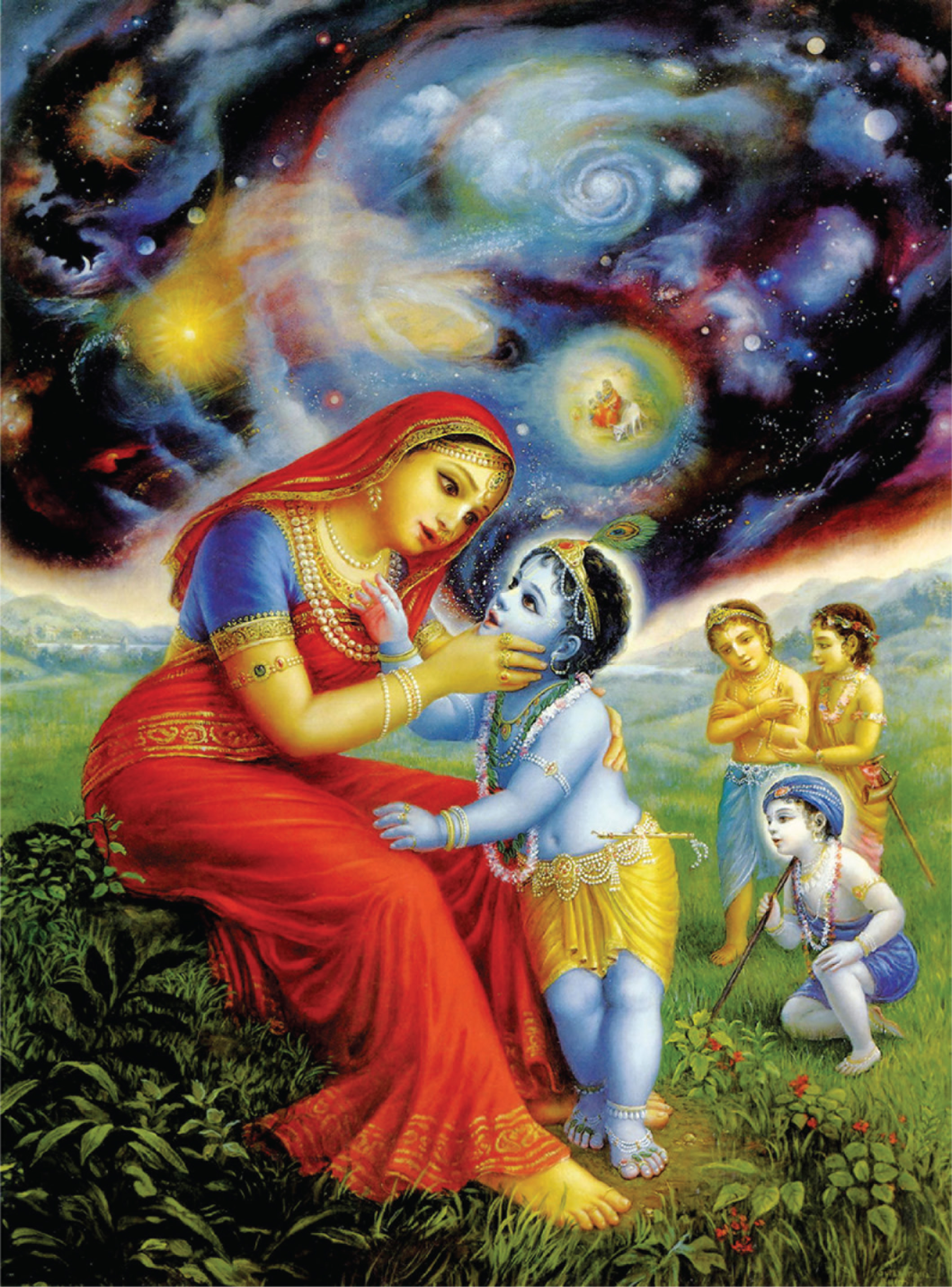
Source: © http://www.harekrsna.de/artikel/bala-krsna/krsna-shows-yasoda-vishvarupa.jpg
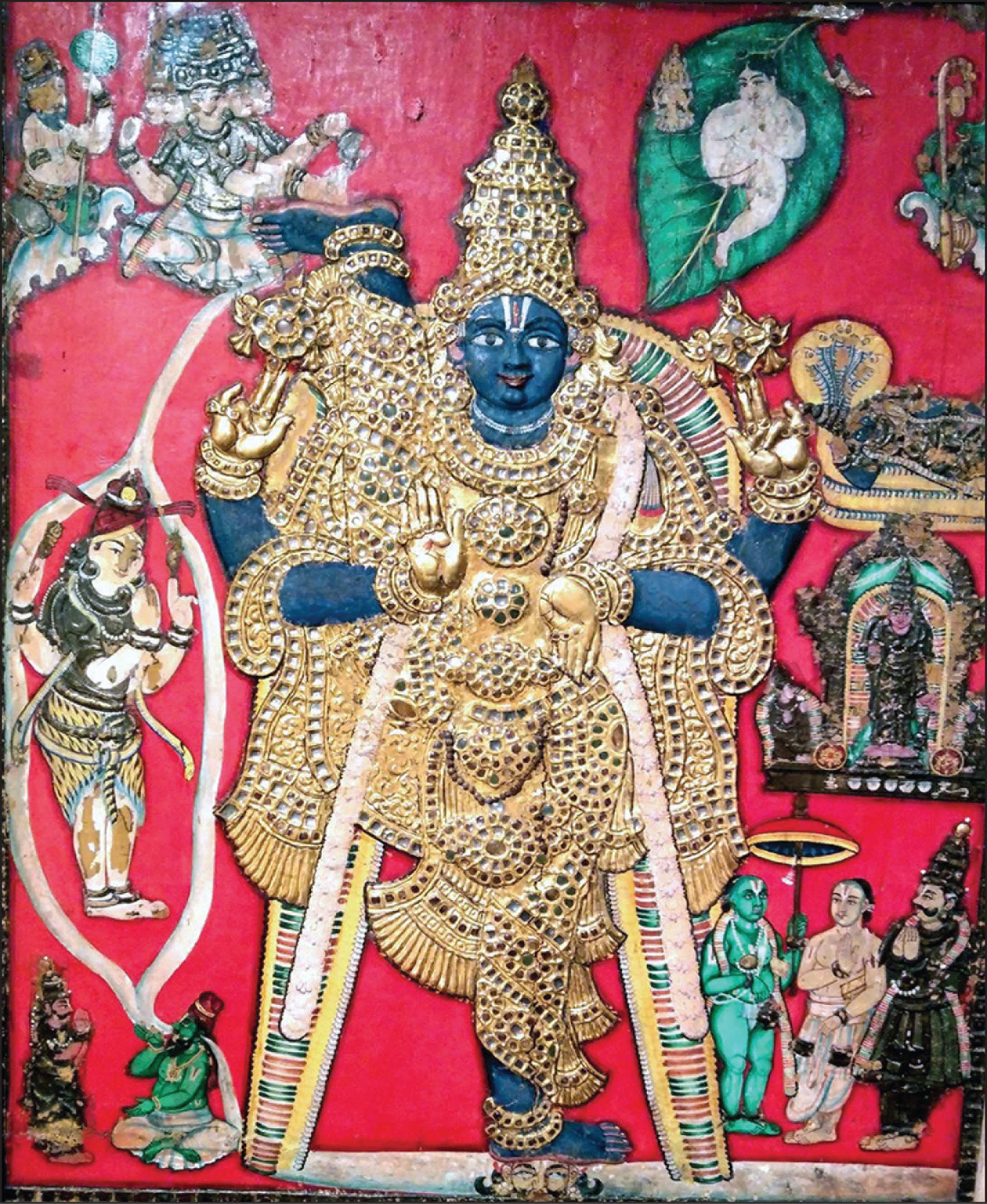
The icon may be dated in the eighteenth century. Trivikrama is found lifting the right leg, while the left is stubbornly placed on the head of Mahābali. 81 Both images can be read in clockwise from the lower left corner onwards. Close to the standing left foot, Vāmana is demanding a gift from Mahābali. In one image, sthānaka-Viṣṇu, āyudhas, śaṅkha, Garuḍa and Jāmbavat accompanied with other deities are depicted. Figure 14 includes sthānaka-Viṣṇu with consorts, Śeṣaśāyī, Jāmbavat playing vīnā and Vaṭapatraśāyī with Brahmā emanating from the naval. 82 Brahmā is trimukha and again shown pañcamukha. Brahmā pours Gaṅgā-jala on the exposed palm 83 of Viṣṇu. It is interesting to note, Brahmā is depicted in levitating mode (Figure 14) and collects the water from the ākasa and then washes the foot of Viṣṇu. The sacred water poured on the foot of Trivikrama is flooding downward that is the inundating uncontrollable GaṅgÂ. In one image, Śiva receives Gaṅgā, with the hands in añjalibandha (Figure 14) and the other image in reverential attitude (Figure 12), kaikaṭṭi vāypotti (hands fastened and mouth shut). 84
Figure 14 is very interesting that illustrates two sages. The first sage Jahnu drank up Gaṅgā and released her through his ear and so known as Jāhnavī. 85 The second sage seems to be Agastya, drank up Gaṅgā and released her through his kettle. 86 Figure 12 depicts Bhagīratha in añjalibandha requesting sage Jahnu to release Gaṅgā and the river flows through the sage’s ear. Finally, Gaṅgā is flowing on the earth cleansing the sons of Sagara and the commons to this day as the Hindus believe.
Several other forms of Viṣṇu are associated with water, mahāpraḷaya and Genesis such as Matsya, Kūrma (Kṣīrābdhimanthana ‘Churning the Ocean of Milk’ 87 ), Varāha, Haṃsa, Hayagrīva, and so on. 88 If investigated systematically, new avenues of creation annals could be discerned, 89 particularly the ‘Nālāyiram’. The early ninth century is a landmark in the history of Viṣṇuism in view of the proliferation of the regional and sub-regional purāṇas. 90 During this phase, the primeval Sanskritic lore had inextricably mixed with the Tamil philosophies, for example, Ciṟiya and Periya -tirumaṭals of Tirumaṅkai ĀḻvÂr. 91 Later, the Tamil thought is sure to have inspired the pan-Indian corpus, for example, Bhāgavata Purāṇa 92 in the overgrowth of Viṣṇuism, 93 which was reflected in the arts of India, for example, the Kaṅgra et alii schools of miniatures. This was the reversal of the process, Sanskrit><Tamil>Sanskrit > vernacular literature in Marāṭhi and Beṅgāli. The Tamil thought had a long-lasting impact over the future course of Viṣṇuism 94 focusing on the later medieval personalities; Jayadeva-Gītagovinda, Mīrābāī (1403–70), Tulasīdās (1543–6123), Tukārāma, Nāmadeva and others.
Water is the root-cause of Genesis and aborted end, the end leading to re-creation. The deluge is an ephemeral cyclic process lasting for endless mahāyugas, and kalpa, a day and night of Brahm (8,640,000,000 years). 95 The recurring cosmic activities do not stop here. Creation and sustenance through water are eternal, the lips and eyes of the LORD whether the Bible or the Veda. Therefore, water in Indian tradition is Gaṅgā-mātā (Mother Gaṅgā) or Kāvirit-tāy (Mother Kāviri). 96 The mother sustains her child. She is not a killer in any part of the world. If she resorts to killing that means she is Kālī 97 annihilating terrorism that is camouflaged evil. Religions that preach peaceful coexistence (e.g., the Vedic Viśvarūpa, cf. the Puruṣasūkta, and the Biblical ‘Creation Mythology’) are guidelines for humanity. To preach war (‘corona’ today) is satanic that causes the destruction of civilisations, for example, religion of the pyramids and Roman Egypt. Ultimately, the evil-mongers are destined to fall ‘from morn to noon, from noon to dewy eve dropt from the zenith like a falling star’. 98
Water as source of sthiti is a living tradition in India. The wise saying is ‘Men may come, men may go; I go on forever’ (Alfred Tennyson, The Brook). The Colombo Museum image of Pattiṉi-Kaṇnaki carries the śaṅkha, the feeding bottle in a hand, 99 the coveted insignia of Viṣṇu. 100 On the other side of the desert, you find mirage ‘water, water, everywhere, not any drop to drink’ (S. T. Coleridge, Ancient Mariner). Water in Indian tradition is Gaṅgā-jala. ‘Give me some water to drink’ is a request always obliged by the enlightened (see note 34); others are reckless sinners. Bathing is Gaṅgā-snāna, sacred bath on holidays, for example, Dīpāvali that purifies the soul, and assures prosperity for the cosmos. The samples of iconography exemplified in the foregoing account are positive pointers towards this end; the visual philosophies.
Footnotes
Acknowledgements
I am deeply beholden to Śrī Kuldip Singh and the Marg for the illustrations included in this essay.
Declaration of Conflicting Interests
The authors declared no potential conflicts of interest with respect to the research, authorship and/or publication of this article.
Funding
The authors received no financial support for the research, authorship and/or publication of this article.