




Abstract
The article presents the depreciation of soldiers’ equipment in the fifteenth–sixteenth centuries in Central-Eastern Europe based on the data from a dedicated financial institution existing in the Polish Kingdom until the 1560s. Soldiers received their pay, and the king additionally paid them compensation for any war damage. Owing to meticulous records, data were collected on 9,371 individuals. Based on the collected data, it has been established that the average losses in cavalry were equivalent to 40% of the pay and in infantry, the corresponding ratio was 13.7%. This formation was not only cheaper to equip, it was also less cost-intensive.
The article elaborates on the background of the liquidation of this institution in the Polish Crown, combined with an increase in soldiers’ pay, who gained only seemingly. It was mainly a profitable operation for the state. It improved the budgeting process, increased the combat value of the soldiers, facilitated military bureaucratisation and prevented extorted compensation. After the reform, the depreciation in the cost of the soldier’s pay is estimated to have been about 1/3. The percentage chance of losing a horse, arms and armour was also calculated, demonstrating a huge equine mortality rate of 48.2% over three months of fighting.
Introduction
Depreciation is an ahistorical concept, and obviously, this term was not used in the early modern period. 1 If, however, an individual soldier is regarded as an artisan or the entire unit as an enterprise, a legitimate question arises as to the extent of losses resulting from military service, comprising primarily damage to armaments and losses to horses. 2 This can be linked to two army supply systems. In the first one, the soldiers received their pay, but it was up to them to make up for the shortfalls themselves through personal resourcefulness. In the second, state structures took on the obligation to supply soldiers with uniforms, weapons and rarely horses. Both systems emerged in Europe in different periods, which resulted from the modernisation processes proceeding at different times; the processes were generally described by the theory of military revolution. The first system was encountered in particular in the fifteenth and sixteenth centuries, a period described by Olaf van Nimwegen as the ‘era of the free soldiers’. The author then distinguishes the period of the disciplined mercenary and standing army of professional troops, where the second system became common. 3
In the first case, depreciation affected the attractiveness of the profession, as the soldier or military entrepreneur had to take this factor into account when making use of his pay. In the second case, depreciation represented an additional cost covered by the state treasury 4 ; alternatively, it was partially offset by deducting certain amounts from the pay. 5 Thus, depreciation influences the analysis of basic historical and economic phenomena, but it is also responsible for the level of combat capability. This issue can also be looked at from the perspective of local markets and the redistribution of wealth, since a significant amount of the money allocated to the army went to suppliers, artisans and merchants. For example, in light of the 1641 budget of the United Provinces, pay for soldiers amounted to 41% of the total expenditure. 6 This money did not stay in the pockets of the soldiers but went to occupational groups catering to the army.
It is particularly difficult to assess this phenomenon at the turn of the medieval and early modern periods when the bureaucracy within the army was insufficient, the source base incomplete and, in addition, the first system of supplying the army was dominant. In this article, our focus is on the area of Central-Eastern Europe, where the source material concerning the armed forces of the Kingdom of Poland is under scrutiny. 7 Mercenary armies recruited for the needs of this state began to transform into enlisted troops in the fifteenth century. This change was based on the introduction into legal circulation of recruitment letters, in which the future commander-in-chief (captain) obtained from the king the right to recruit a unit from among the subjects of the ruler, according to strictly defined rules. It was important to handle the enlistment using the attendant-based system, which consisted of the formation of a subunit by a nobleman-attendant according to the medieval model. 8 It can be concluded that in the Crown, the paid soldier was associated with the ethos of the medieval knight fighting in the pospolite ruszenie (levée en masse). On the other hand, he was obliged to render unpaid military service (based, of course, on the received land grants), but as early as in the 1370s and 1380s, rulers guaranteed a knight’s rescue from captivity and generally declared compensation for the sustained damage. 9 Especially the latter declaration, which was very much imperfect, began to take shape in the mercenary army. An attendant had every right to expect compensation from his suzerain (ruler) for lost horses and weapons.
Data
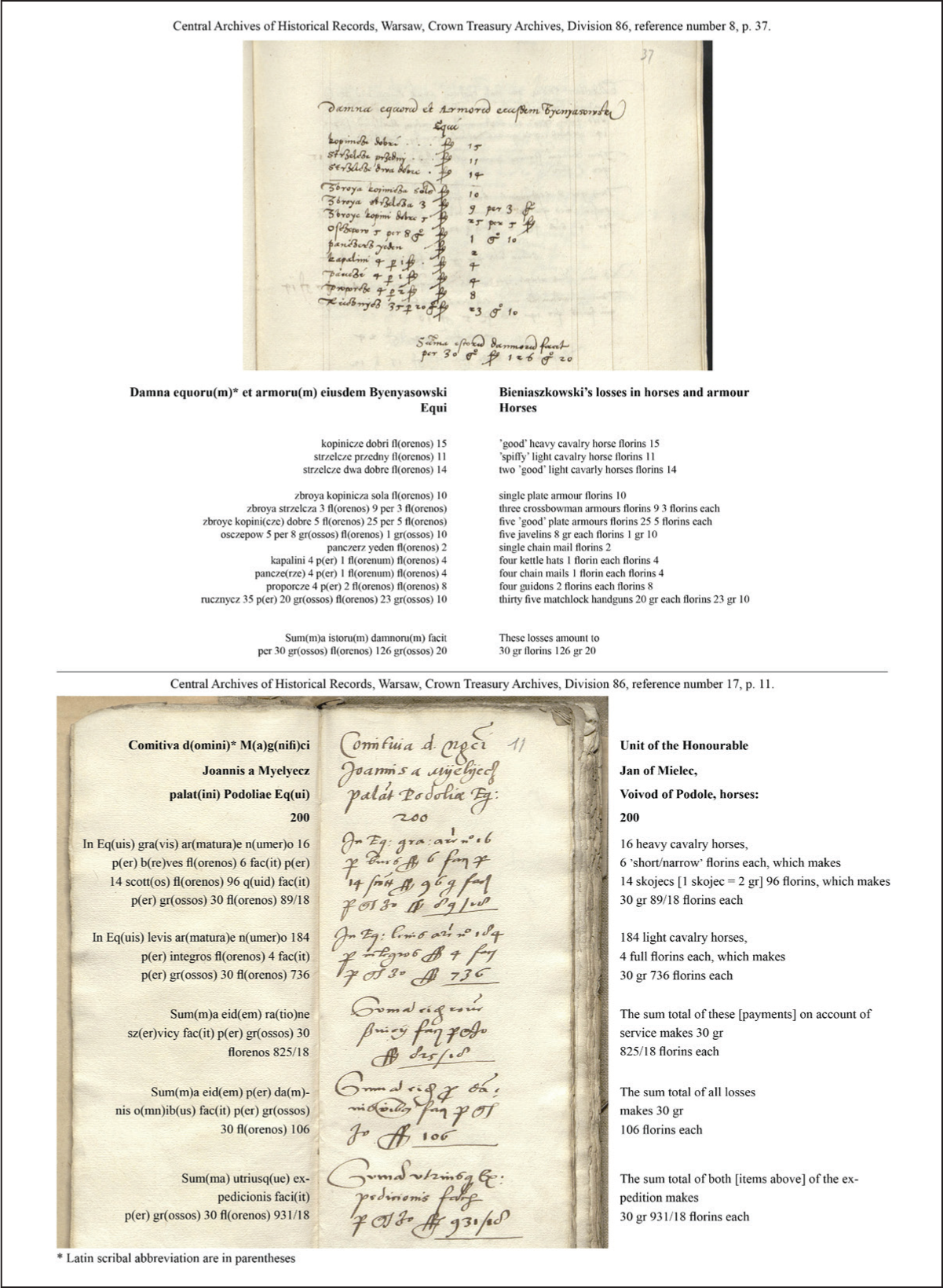
The royal obligations to pay compensation created a specific category of sources of a treasury-military nature, known in the subject literature as ‘damna’, ‘litterae indemnitatis/indempnitatis’, ‘payments for the damage’ or possibly list zaszkodny (letters of compensation for the sustained damage). The term ‘letters’ did not mean that they were documents similar in their form to list przypowiedni (recruitment letter). They were usually damage inventories prepared as lists that were not coherent in form (see Figure 1). Their legal origin was based on custom, and since the second half of the fifteenth century, the rule had been included in recruitment letters; this practice lasted at least until 1531. 10 With the development of Polish military laws, as early as the sixteenth century, legal norms containing soldiers’ entitlements to compensation began to be recorded in the so-called ‘articles in the letters of compensation for the sustained damage’ and ‘captain’s articles’, the Polish equivalent of ‘Bestellung’. 11 All in all, the institution disappeared in the 1560s. 12
The oldest known related treasury documents date from 1479 (they are connected with the so-called ‘War of the Priests’ waged by the Polish king Kazimierz Jagiellończyk against the Teutonic Order about the new bishop of Warmia). From the later period, we have included extant data from the years: 1497 (the Moldavian expedition of the Polish king Jan Olbracht), 1519–21 (wars with the Teutonic Order), 1538 (military operations in Moldavia) and 1555 (permanent military presence in the south-eastern border area of the Kingdom of Poland). 13 The surviving source base is varied in form and mostly decomposed (see Figure 2). It would be ideal to have a complete list of damage payouts, where the types of losses and their cash equivalent are listed, so as to have prices for individual items. At the same time, receipts attesting to the pay for the same unit have been preserved. In total, the collected data make it possible to study the cases of 2,613 infantry soldiers and 6,758 cavalry soldiers.
The subject literature has so far failed to analyse this phenomenon in practice, limiting itself to the general legal principles governing the enlistment of soldiers in the Jagiellonian states. Meanwhile, this manifestation of the remnants of medieval solutions adapted to new organisational structures makes it possible to assess the scale of incurred losses (depreciation). This relates to the pre-standardisation era of the armaments and the state taking that burden over. Based on the collected bulk treasury data, this phenomenon will be quantified. As we see it, the presented results can be applied to a broad spatial and temporal perspective. What occurred in the Polish Crown may also be applied to the realities of the Grand Duchy of Lithuania, the Czech Kingdom and the Kingdom of Hungary, and with some caution also to the entire Europe. If the source data do not permit similar calculations in other countries, it can be assumed that losses due to wear and tear of the armaments or the losses of riding horses were comparable, or at least their scale should be similar. In retrospect, our findings can be used to analyse the Polish-Lithuanian Commonwealth at the end of the sixteenth century and in the seventeenth century. The abolition of damna did not mean the disappearance of depreciation (although it definitely meant the liquidation of the source base). It was a process of transferring those costs to soldiers, who received a higher pay. This factor should be taken into account when studying the attractiveness of the occupation at a later stage. Eventually, our analysis can be used in the debate about the reasons for the shift away from cavalry (dominant in the Middle Ages) to infantry. In our opinion, more important than the cost of equipping these types of formations is the issue of depreciation.
Principles Concerning Damages for the Incurred Losses
The most extensive version of the ‘articles in the letters of compensation for the sustained damage’ is known to have been written in 1561. The king then pledged to rescue a soldier from captivity but only if the state apparatus negotiated to do so. In addition, a guarantee was made to pay the soldier the equivalent of four weeks’ pay in the event of a victorious battle. 14 Damages were to be paid according to the old custom, which meant that horses were valued at 5 to 15 florins, and armour at five to 10 florins. 15 A florin (30 groschen) was to be paid for edged weapons, firearms, a shield and a helmet and five groschen for a lance. 16 The soldiers partly negotiated new rates by obtaining an increased price of armour (in 1519 it oscillated between two and five florins). However, they failed to obtain higher rates for horses in Livonia, even though horses were much more expensive in Livonia than in Podolia, where Polish soldiers were usually fighting. 17
An example of a letter of compensation for the sustained damage, where the proposals of soldiers were taken into account originates from 1556. At that time, the Duke of Prussia, Albrecht Hohenzollern, decided to recruit 800 Polish horsemen. 18 To this end, captain’s articles were issued for them, which were later noted in the form of Bestallung in the duke’s treaty. In their light, payments for lost horses were also provided for, as a rule, from five to 15 florins, but it was added that for exceptional steeds the compensation could be as high as 50 florins. 19 In practice, an exceptional Turkish horse was sometimes valued at 30 florins. 20
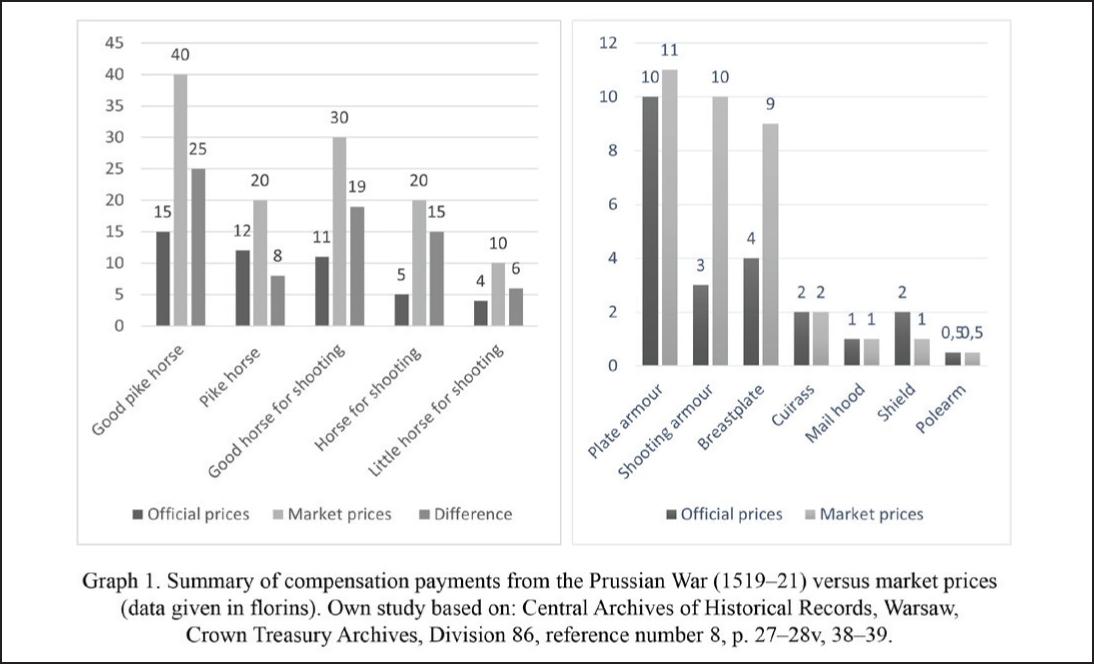
This difference underscores our observation, which is marginal here, that the analysis of the rejestr popisowy (the soldiers’ registers) for cavalry and infantry units from the late fifteenth and first half of the sixteenth centuries gives rise to the opinion that the weapons and riding horses used in the army were of poor quality. Many of the horses listed by military clerks and allowed into battle suffered from green cataract, glanders or founder. The situation was slightly better when it came to weaponry. From the turn of the fifteenth and sixteenth centuries, worn or damaged specimens were recorded less and less frequently. In general, apart from the wealthy nobility and magnates who wanted, for prestige, to make the retinue as magnificent as possible, the equipment of the troops did not include new equipment or the best horses. The phenomenon of the cheapest possible equipment was even reflected in literatura sowizdrzalska (the literature of the absurd), mocking the military reality. 21 The breakdown of payments for the lost equipment strongly deviates from market prices to the soldiers’ disadvantage. The data in Figure 1 show that the amounts paid for steeds constituted 39% of their market value (on average a horse was undervalued by 14.6 zlotys), while the corresponding ratio for weapons was much higher and amounted to 65%. However, it should be noted that an extensive catalogue of market prices is unavailable, and certainly, in Podolia, where Crown troops were generally stationed, the prices of horses were much lower.
The system of payments must have influenced the conduct of the nobility, who furnished their subunits. However, it is difficult to establish what was the cause and the effect. Every superfluity, especially a good horse brought to the army, involved a high financial risk. We believe that the payment of damages was adapted to the poor quality of the subunit; anyway, this discouraged the soldiers from investing in quality steeds and armour. The opposite tendency, obviously, was to equip oneself well for war and to ensure a much better chance of survival. This resulted in the full-fledged cavalry soldiers (attendants) being well armed, while their pachołek, pocztowy (subunit servants) had, as a rule, equipment of much poorer quality.
Amount of the Pay
The amount of the pay in the years 1479–562 must be referred to at this point. The situation of infantry is easier to assess; as a rule, infantry soldiers were paid 5 florins for three months’ service. 22 On the other hand, there were two rates in the cavalry. The vast majority of soldiers received 6 and a small number of them 10 florins per quarter of service. This was due to the division into light and heavy cavalry. Characteristically, a uniform rate was applied throughout the period in question; the rate was customary. Marcin Kromer wrote about it in his choreography of the Crown lands; he prepared the first version in the period between 1556 and 1557. When mentioning the amount of the pay, he added a remark that its amount had been unchanged for a long time and, consequently, extremely low. Only very low costs of the servants made it possible to balance the service. 23 Similar information about the pay was recorded by Great Crown Hetman Jan Tarnowski in 1558 24 and other writers of the Renaissance, such as Marcin Bielski 25 or Stanisław Sarnicki. 26 None of them mentioned an increased rate for heavily-armed knights; yet, the source leaves no doubt on the matter. There is a hypothesis of a reduction in pay in the years 1551–8, but for both legitimate reasons and the source accounts presented above, this view should be rejected. 27 The above rates also applied to Polish soldiers serving in the Grand Duchy of Lithuania in 1514 and 1535. 28
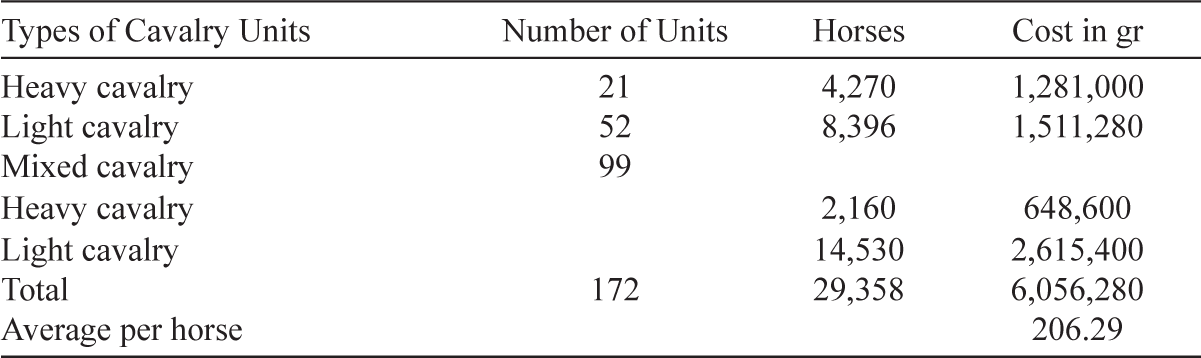
In order to further analyse depreciation, an assumption must be made about how much an average soldier earned during his service. We have summarised the surviving pay information, which shows that the average was 206.29 groschen (6.88 florins) per quarter of service and the proportions are 18% for heavy cavalry and 82% for light cavalry (see Table 1). In sixteenth-century Europe, especially in the first half of the century, the further east the soldiers lived, the lower their pay tended to be. At the same time, horsemen in the Grand Duchy of Lithuania were paid three or five florins, respectively. 29 If analogous proportions are applied, this means that on average a horseman received 100.8 groschen (3.36 florins). At that time (figures for 1534), the French state spent 855 groschen per quarter of service per horseman, which was equivalent to 28.5 florins. 30
Average Pay of a Horseman in the Years 1501–55.
Also, the basic equipment of a soldier of the light Crown cavalry (crossbowman’s armour, a shield, a mail hood, a sword) cost eight florins, and the cheapest horses cost six florins each. This means that the cost was recouped after seven months. 31 In heavy cavalry, 11.5 florins were to be paid for plate armour, a lance and a sword, plus at least 10 florins for a heavy horse (recouped after six and a half months). These calculations do not take into account all the costs of food, payment for military staff and hiring a war wagon.
Reasons for the Abandonment of Letters of Compensation for the Sustained Damage
The state authorities repeatedly tried to eliminate the letters of compensation for the sustained damage. As early as 1525–7, an attempt was made to discontinue them. Efforts were made to withdraw from commitments expressed in writing, although it was guaranteed that losses reported by captains and attendants would be accepted by the hetman, who would forward these claims to the treasury authorities for appropriate payments. 32 However, this did not change anything, as evidenced by an example from 1531, when a surcharge was paid for over 300 horses killed at the Battle of Obertyn. 33
Another time, withdrawal from commitments in writing was postulated by the Great Crown Hetman Jan Tarnowski in 1558. He stressed, however, that this required negotiations with the soldiers, who could relinquish their customary rights at the expense of a pay increase. In doing so, he added: ‘as there is difficulty and long bargaining with them’. 34 Władysław Semkowicz claims that the letters of compensation existed until 1563 when the quarterly pay of service for a horseman on the Livonian front (nominally in the Grand Duchy of Lithuania) was raised to 15 florins and at the same time payments for damage were abolished. 35 Some of this is true information. In The Russian State Archive of Ancient Documents, there are surviving captain’s articles issued for the summer enlistment of 1563 to Livonia. They introduced a conditional pay increase from 15 to 17 florins for cavalry and from five to six florins for infantry (in Livonia, soldiers had a much higher pay than in Podolia). The increase of 13.3% and 20%, respectively, was associated with the soldiers waiving the letters of compensation. 36
The letters were also abandoned in the south-eastern borderlands of the Crown. The withdrawal from the letters was extended in time from 1563 to 1567, when the Sejm officially passed a withdrawal from paying the so-called ‘damages’ in the quarter armies (financed from the so-called quarter of service, that is, one-fourth of the revenue paid by royal estate possessors), at the same time keeping the raised pay. Rank-and-file soldiers began to be paid eight instead of six florins quarterly, while the rate of 10 zlotys was maintained for eight out of every hundred soldiers in the unit. 37 On average, a soldier earned 8.16 florins, and the raise was about 18.6%. It can be stated that the abolition of the damna meant an increase in absolute numbers in the infantry by one florin and in the cavalry by two florins. Thus, the cost of the withdrawal from the letters of compensation was valued by the state authorities and the soldiers themselves at about 20%.
What was the rationale behind the abolition of the letters, at the expense of a significant increase in pay? The reasons were many and various. The first concerned a very low pay, particularly on the south-eastern front, where the so-called obrona potoczna (Permanent Defence) operated. Hence, the increase was simply necessary because of the rising inflation. However, as will be shown later on, the change was extremely profitable for the state treasury.
Second, the payment of damages made it impossible to plan the budget; in the era of permanent arrears in payment, additional unforeseen expenses had a destructive impact on the combat preparedness of the army. This is confirmed by a passus from the work by Jan Tarnowski, who postulated the establishment of a special treasury to pay damages. The hetman noted that a soldier who lost a steed was not obligated to serve on horseback until compensation was paid. This was a big loss because during this period, the soldier was officially on duty and received his due pay. 38
Third, in order to create complete documentation of the enlistment and armaments as well as the soldiers’ equipment, it was necessary to maintain meticulous and detailed records of the quantity and condition of the weapons and make a professional assessment of the quality and health of the horses. 39 These requirements could not be met by the administrative apparatus operating in the army.
Fourth, a pathology developed, consisting of the substitution of horses and armaments that did not belong to the soldier; they were then returned to their owners, and compensation was extorted for actually using weaker or sick animals. Additionally, armaments were illegally resold to merchants and their loss was declared during combat to extort additional compensation. 40
To summarise, a significant increase in pay in exchange for the abolition of recruitment letters containing a compensation clause was simply profitable for the treasury in organisational terms, and, moreover, made it possible to plan war expenditure much more precisely. This was a favourable change for soldiers, as the pay (in principle) was supposed to be paid on time, whereas the payment of damages could drag on considerably.
Amount of Depreciation and Reasons for Differences in Depreciation
Inventories of the amount of the sustained damage and losses in steeds and weapons were recorded on a regular basis and with great precision. There were two opposing tendencies. The first concerned fraud committed by the soldiers, which the military articles tried to prevent. One way was to order the lost horse to be shown. Thus, the hetman or field writer (and beyond the camp or while on the road the captain) was to be led to the fallen, sick or wounded animal. The steed was expected to be verified with the records by the mark burnt on the animal. 41 On the other hand, the state paid the customary amounts which, however, were lower in relation to market prices (see Figure 1). Thus, it was systemically assumed that soldiers presented poorer quality riding horses, weapons and armour. Despite the reservations, this source category represents a remarkable resource that makes it possible to pinpoint the scale of the cost intensity of the war much more precisely than has been done to date.
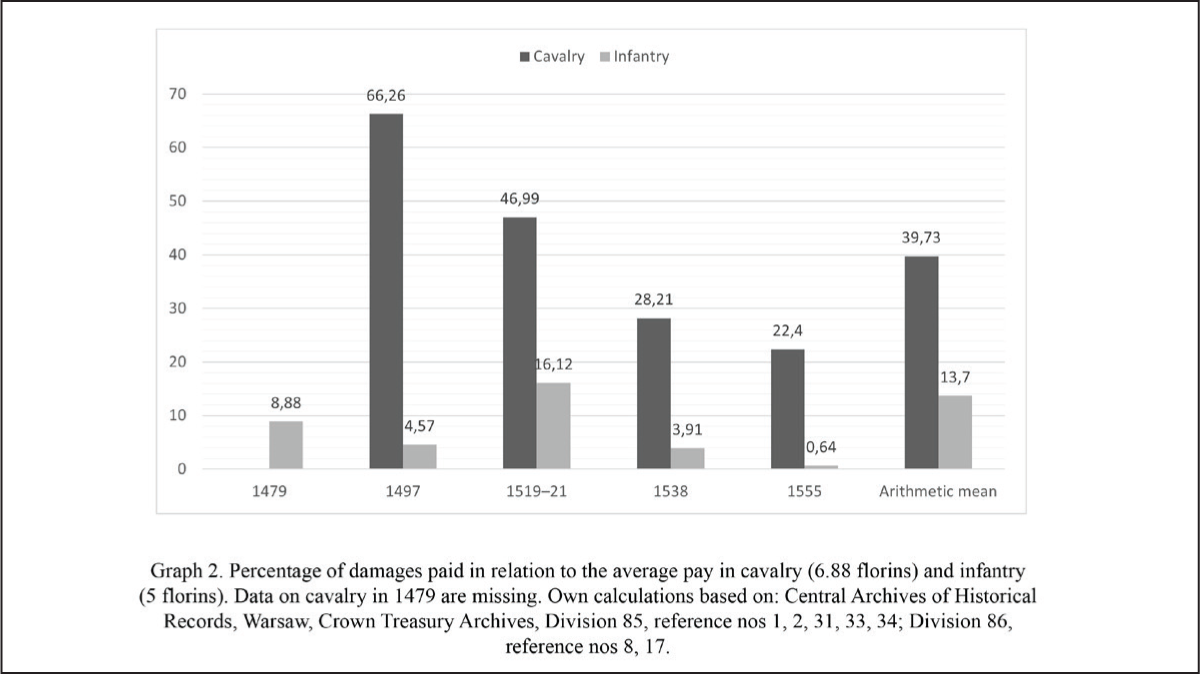
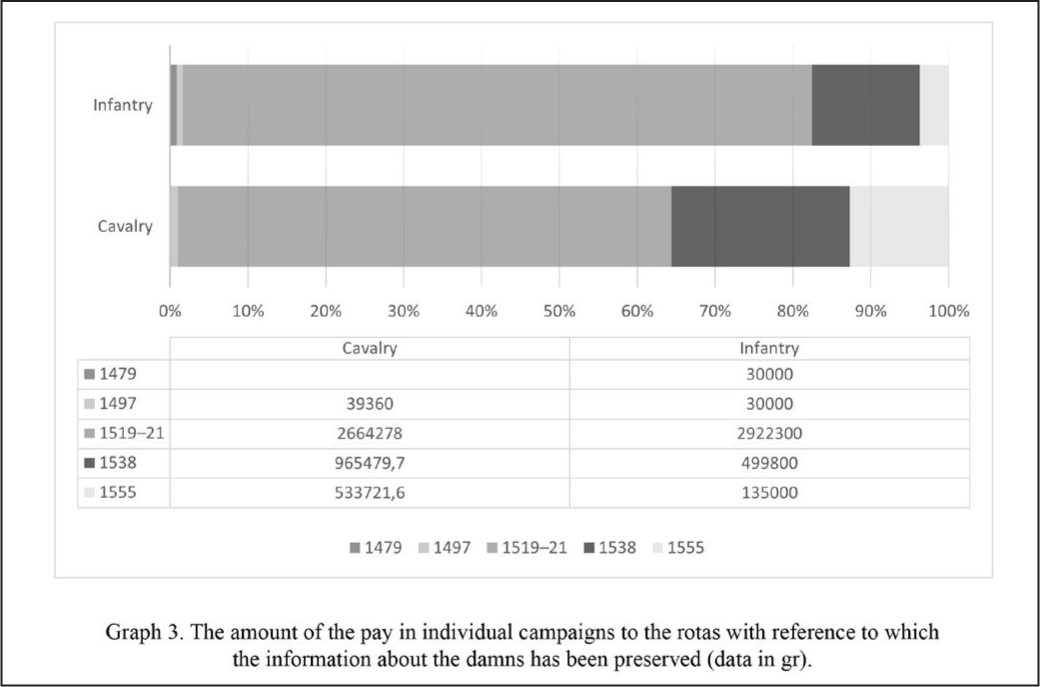
According to the calculations, the damages paid to the troops serving between 1479 and 1555 varied considerably (see Figure 3). However, these data should not be analysed from a chronological perspective. Differences in prices paid for the types of items hardly varied or were identical. Each of the examples within each year demonstrates the effects resulting from the specificity of military actions taken under varying conditions. It is clear that the destruction of war equipment depended on the intensity of operational activities (distances and the pace of movement) and combat operations. Even in 1555, when no war campaign was conducted, the service on the south-eastern borderland was not peaceful, as these areas were constantly threatened by Tatar invasions. 42
Undoubtedly, great battles and sieges changed the overall proportions of losses. One day could do more damage than an entire quarter of military service. This is also confirmed in the Battle of Ulla in 1563, when the Lithuanian 200-horse cavalry rota of Filon Kmita Czarnobylski received compensation for the incurred losses. For the loss of equipment, especially horses, the ruler agreed to pay 28.6% extra on the soldiers’ pay. 43
The overall depreciation rate is extremely high; almost three times as high as in the cavalry. The low rate of return for infantry is due to two factors. The first is impartial and concerns the fact that horses were the main types of losses. Yet, infantry used them only occasionally. The second relates to the infrequent use of infantry in warfare (obviously, with reference to the Crown). Hence the higher coefficient in 1479 and in the period between 1519 and 1521, when wars were waged in an area with a high degree of urbanisation (Warmia and Prussia, respectively). In contrast, where infantry did not play a significant tactical role, depreciation was very low.
Differences in the compensation coefficient in cavalry were primarily due to the intensity of warfare, correlated with the specificity of the terrain. As mentioned before, the ones from the period between 1519 and 1521 concern intensive warfare conducted in an area with a significant degree of urbanisation. The war consisted of numerous sieges, skirmishes and manoeuvers. 44 In this respect, the then Prussia was ranked in Europe after Flanders, the Rhineland, Silesia and Czechia, and just before France or England. 45 Other campaigns were conducted in sparsely urbanised or simply wild terrain without a settlement grid. Characteristic data can be obtained from a comparison of similar warfare in 1497 and 1538. In both cases, the army set off towards Moldavia and stopped by besieging the fortress (Suceava and Chocim, respectively). In the first case, it was unsuccessful; on the way back, the army was surprised and suffered a severe defeat at the Battle of Koźmin in Moldavia (currently Wala Kuz’mina, Ukraine). 46 In the second, the offensive was successful. 47 The differences in losses were enormous. While in 1497 the army suffered unprecedented damage (damage ratio of 66%) that virtually excluded some rotas from further service, the ratio in 1538 was almost 2.5 times lower. It should be emphasised that the losses of 1497 were concentrated at one point in time (the battle). Therefore, an episodic, one-day event like a battle was likely to lead to massive economic damage. This also explains why high rewards were willingly paid (in the amount of one month’s pay) for a victorious battle or a successful incursion. This was, from the perspective of the Crown treasury, a comparable or lesser burden than would result from having to pay huge damages after losing a battle.
On the other hand, the events of 1555 prove that even surveillance service on the frontier in quasi-peaceful conditions involved losses, especially of horses in the cavalry. These events can also be interpreted to mean that the nature of the frontier cavalry operations differed little from the covering operations of 1538, resulting in similar losses of 28.21% in 1538 and 22.40% in 1555.
Hence, the obtained coefficients can be looked at through the lens of the specificity of warfare and, depending on its type, a coefficient from 22.4 to 66.3 can be assumed (Figure 3). All existing data can also be processed, and the result can be applied for a longer period. Coefficients of 39.73% for the cavalry and 13.7% for the infantry were obtained in such a case. Assuming that a horseman received 206.29 groschen between 1497 and 1455, the treasury spent on average 82 groschen per quarter of service on depreciation (at least 46 groschen in 1555 to almost 137 groschen in 1497). In the infantry, an additional 20.5 groschen was spent on a quarterly pay of 150 groschen. Although the structure of pay was relatively simple in Europe, in the Crown it consisted of two components: a fixed salary and compensation for losses. The compensation varied depending on the intensity of wars.
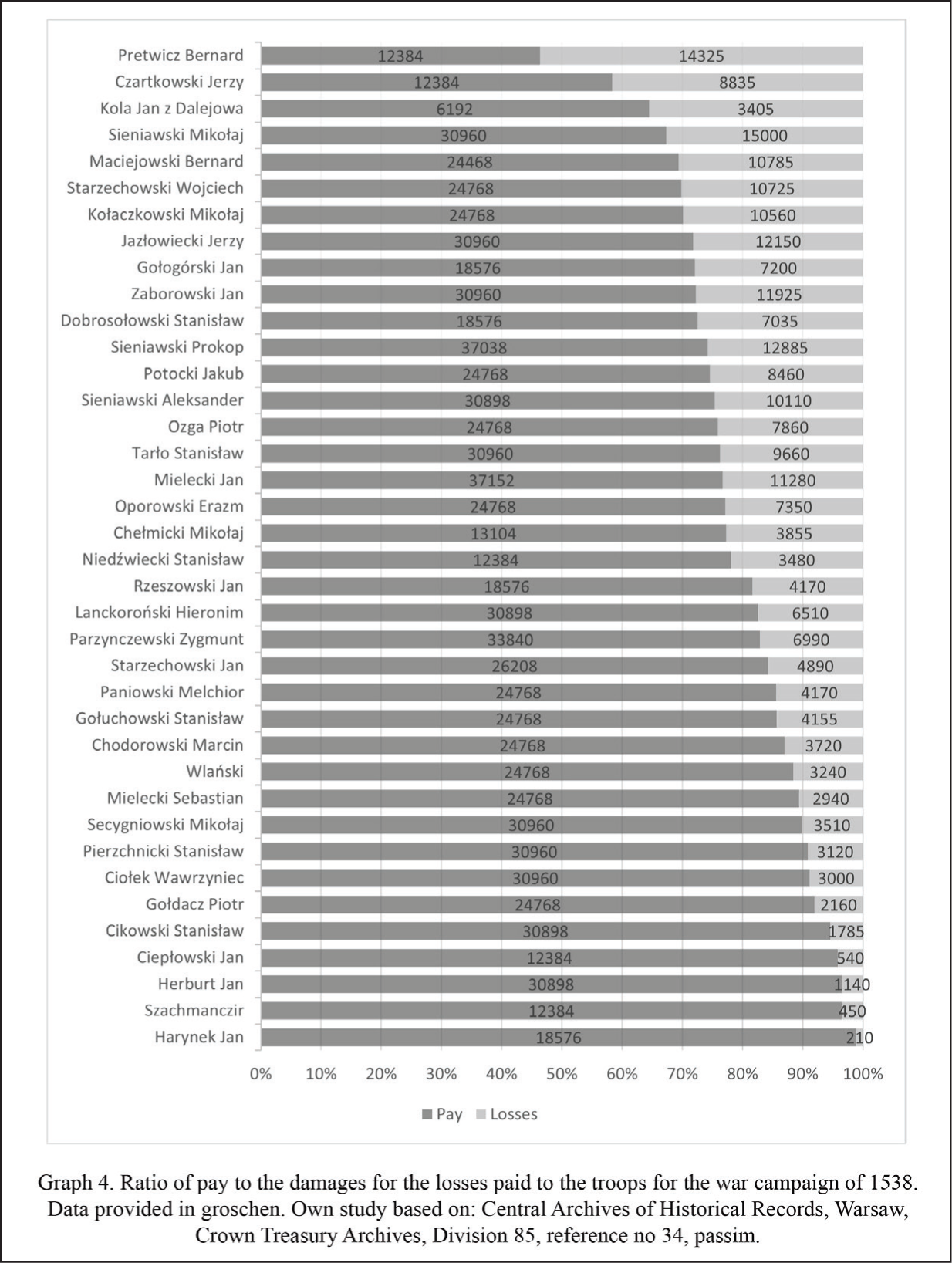
The broadest source base derives from the 1519–21 war (Figure 4). It can be inferred that a proportionately large number of soldiers were enlisted for the needs of the war for a long time. This is a favourable circumstance because the estimates can be adjusted to evaluate other conflicts, especially since the 1519–21 war was fought according to the principles typical of Western Europe. This is particularly true for the infantry, which further supports the utilitarian nature of our findings in a broad, European context. In the case of the cavalry, the data are more reflective of the Central-Eastern European specificity.
Globally, this means that, depending on the conditions under which the military operated, the sustained damage could lead to a significant increase in the treasury’s debt. Moreover, it could even ruin any state budget plan. Pay rises in the quarter army in the 1560s combined with the abolishment of compensation were an excellent fiscal solution. On average, wages increased by 18.6% in the cavalry, as the withdrawal from the payment of damages was associated with more than double the savings. The soldiers, not realising the real gains from compensation, were also satisfied. One group was affected, that is, the families of fallen soldiers. They could no longer expect financial compensation for the fallen soldier and his lost subunit. This change greatly simplified the administrative and fiscal functioning of the state. The costs of war could be calculated much more accurately, which permitted the design of appropriate extraordinary taxes that would ensure the upkeep of the military during wartime. 48
The treasury was much more generous towards the infantry. The adoption of a 20% increase was higher than the depreciation level (13.7%). This can be explained by the additional costs related to the need to purchase gunpowder and bullets for the matchlock handguns and harquebuses. According to our calculations, after 1538, a rota spent quarterly about 7.8 groschen (5.2% of the pay) on average per infantryman on gunpowder and ammunition. The calculations are based on the assumption that in the scrutinised period, the infantry was 75% equipped with matchlock handguns and harquebuses. 49 In general, the increase compensated for the damage, yet it was also adjusted to the rearmament of the soldiers with modern firearms.
Type of Damage Incurred in Warfare
The damage records are also interesting from the point of view of analysing the participation of individual rotas in warfare. Figure 5 shows the breakdowns of pay and damage incurred within each rota. The differences in compensation are enormous, ranging from 1.13% to 115.67% of the pay. The amount of losses clearly indicates the involvement of individual rotas in the war. Rotas that avoided combat recorded losses of a few per cent only, while those engaged in sieges, battles and long-distance reconnaissance suffered heavy losses. The case of Bernard Pretwicz is distinctive, with a 115.67% reimbursement for his damage. He was a zagończyk (a well-known soldier fighting in the enemy’s rear), and his rota was responsible for reconnaissance in the area. 50 Such a high loss ratio may have been caused by over-reporting of losses in order to gain additional benefits, but it must be borne in mind that Pretwicz usually led additional soldiers whom he maintained from his own funds, in addition to the army paid from the royal treasury. These warriors probably suffered losses comparable to those reported officially. Most likely, therefore, the income earned from the seized property was used to cover losses not accounted for by the royal treasury. Cases of ‘supplementing’ salaries with booty are also known in other countries. 51
The discussed depreciation rate model can be applied to the broader context in other ways too. A calculation can be made of the chance of losing a horse and equipment during a three-month tour of duty. This can only be examined in those rare situations where the field writer meticulously recorded not only the items and steeds lost but also provided their valuation (see Figure 1). A good example is the case of captain Święcicki in 1520, commanding a rota of 100 men. The losses of his rota comprised 99 horses of various categories and 76 items of armour. The lost horses were valued at 827 florins, while the armour was valued at 319 florins. 52 Damna thus consumed 1,146 florins, of which over 72.16% was spent on horses.
This part of the analysis is based on the data from 1479 to 1538, concerning eight cavalry units (1,228 soldiers) and seven infantry units (964 soldiers). 53 To assess whether the surviving records are representative of the collected data set, the percentage ratio between the soldiers’ pay and damage has been calculated (cf. Graphs 2 and 3). Cavalry units were paid 405,696 groschen and received 209,160 groschen in compensation, thus the depreciation rate was as high as 51.5%. It should therefore be assumed that the collected data are representative of intensive warfare of the Western European type. It is almost a duplication of the coefficient established for the Polish–Teutonic War of 1519–21 waged on the territory of Prussia. Infantry units, on the other hand, received 125,400 groschen and 13,801 groschen for the damage. Compensation is 11% of the pay, so this is a lower coefficient than can be inferred from the full source base, which may imply that the results may be slightly understated.
A full compilation is presented in Figure 6. It has not been possible to make calculations related to losses of edge weapons and polearms. Riding horses were recorded really meticulously; as a result, we know that in the examined period the horsemen lost 129 horses for kopijniczy (heavily-armoured pikemen) and as many as 463 horses for strzelczy (mounted crossbowmen). This means that a heavily-armoured horse rider had a 58.37% chance of losing his horse, while a light-armoured rider had a 45.98% chance. These differences can be explained in two ways. The first one is connected with the manner of fighting the battle—pikemen’s horses were mainly used to charge in the first line, while crossbowmen’s horses were usually placed behind. Moreover, they were often used by mounted archers or crossbowmen. 54 The second hypothesis is related to fraud. If there was no proper supervision, soldiers could overvalue their horses, thus crossbowmen’s horses were ‘transformed’ into pikemen’s horses.
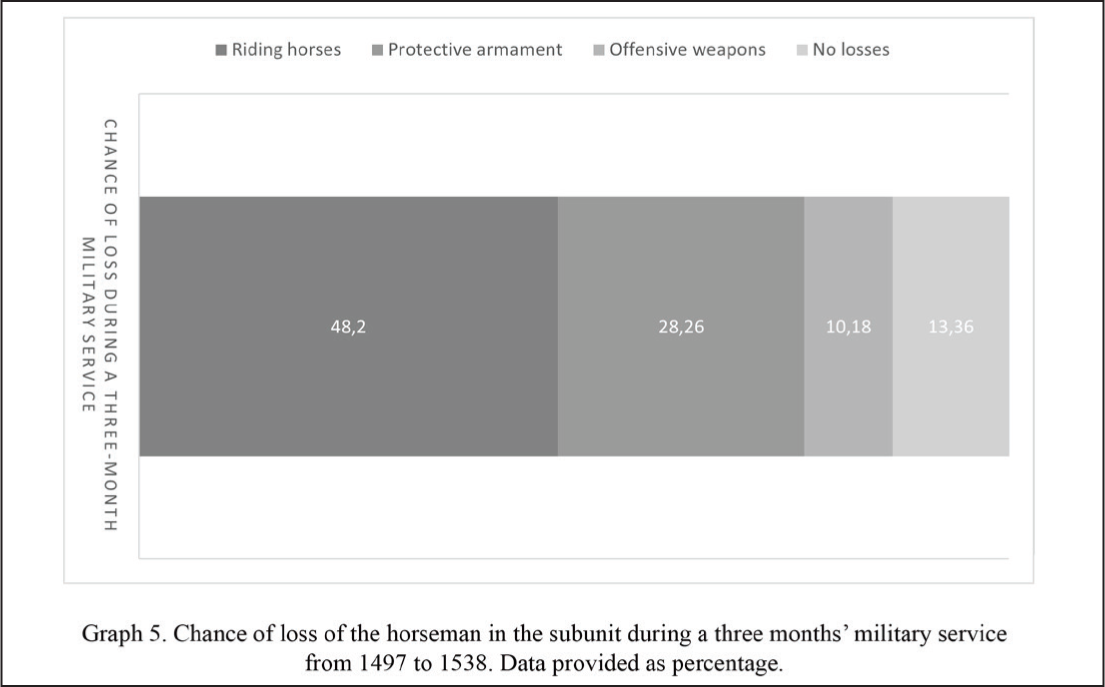
The surviving records indicate that the number of items lost is almost equal to the sum of the riders. The statistical chance that a soldier would avoid any losses for three months was only 13.36%. However, most of the damage was cumulative and consisted of the loss of a horse, an offensive weapon and often several pieces of protective armament, often due to the rider’s death. In addition to the high equine mortality rate, there was also an almost 30% chance (28.26%) of losing a vital piece of protective armament during the quarter duty, which was entered in the list of losses 347 times (as many as 316 items of armour alone). In addition, account must be taken of offensive weapons, of which 125 were reported lost (including 112 crossbows).
In the infantry, the occasional horses are omitted (on average, there were two in a 100-man unit and three or four in a 200-man unit). Infantrymen relatively rarely lost their protective armament; they did not have a lot of it, anyway (it was used mainly by pikemen and pavisemen—about 20% of them). Among the rotas under scrutiny, such incidents were reported only 39 times, of which 13 cases involved the loss of the pavis, a cover made of organic material that is not durable. This means that this group had a 20.2% chance of damaging the protective elements. Offensive weapons were the most frequently damaged (217 times). Among other things, 138 crossbows and 60 matchlock handguns were reported. In the period under consideration shooters in the infantry constituted a group of about 75%, hence it can be assumed that in the studied group there were 723 of them. This means that the average shooter had a 30.01% chance of losing a crossbow or a matchlock handgun. It should be added that the rearming of shooters in the infantry from crossbows to matchlock handguns, which took place at the turn of the fifteenth and sixteenth centuries, reduced the amount of damage payment, since an average matchlock handgun was valued at 20 groschen, whereas a crossbow was valued at 30 groschen. However, soon after the introduction of matchlock handguns, the shooters also started using harquebuses (from the 1530s), which were much more expensive. 55 To sum up: Among pikemen and pavisemen, every fifth soldier lost an item (a piece of protective armament), while among the shooters every third soldier lost an item (hand firearms).
General Conclusions
In our opinion, the above calculations can be translated into armies in almost all of Europe. Notably, the presented data are adjusted to the three months’ service and concern intensive warfare (primarily the cavalry). By applying them universally and multiplying by the prices of goods and horses in the region of interest, we obtain the potential depreciation cost of warfare in the second half of the fifteenth century and the first half of the sixteenth century. Taking depreciation into account is essential in the assessment of the attractiveness of military service. It also reveals the scale of the financial transfer to merchants, horse breeders and artisans. What is particularly surprising is the enormous mortality rate among horses, which indicates that one horse rider lost as many as two steeds. In our opinion, the research should be extended to include data from other European countries of the early modern period so that the results are more representative. Data from other periods and regions correlate with our findings. 56 Of particular interest is the loss of horses in the South African War (1899–902) reaching 66.88%. 57 The findings made concerning primarily the cavalry make us look at this formation as extremely expensive and difficult to maintain in organisational terms.
Our research indicates that the remuneration of a soldier in the Crown consisted of two parts: pay and damage payments. This was mentioned by the Renaissance military theorist Marcin Bielski, 58 yet the scale was far beyond our research intuition. On average, the cavalry paid an additional 40% of the pay, while in the infantry the payment was much lower—13.7%. We have shown the varying amount of depreciation depending on the intensity of warfare. The calculations make it possible to estimate the real pay for the cavalry in the period under analysis at 288 groschen and for the infantry at 170.5 groschen. Such amounts actually burdened the ruler’s budget and were much higher (especially in the case of the cavalry) than the pay rates assumed so far (180 and 150 groschen, respectively). At the same time, it can be inferred from the amounts that the demand for the clarification of the concept of the costs of war is most justified, and it contributes to a precise and, above all, more complete understanding of the economic/financial side of the warfare and its broadly understood consequences. 59
The mercenary army in the Crown in the first half of the sixteenth century not only recruited soldiers based on medieval customs but also maintained the medieval custom of paying compensation for the damage sustained in battle. This phenomenon climaxed in England in the fourteenth century. 60 In the Reich, it was still paid in the second half of the fifteenth century. 61 As has been demonstrated, it persisted in the Kingdom of Poland until the 1560s.
Since a significant portion of the damages was horse payments, most of the treasury expenditures were related to the maintenance of infantry. In other European countries, the proportions of cavalry and infantry were on the opposite end compared to Poland. 62 Here, due to the nature of the theatre of warfare, the cavalry constituted the vast majority of the armed forces, hence the risk of horse losses was proportionately greater. This entailed an increase in the ‘personnel’ spending on the military while minimising the ability to invest in other elements of the defence system. 63 This had a negative impact on the state budget especially in high intensive struggle periods (like in a some months during the Prussain War 1519–21). Due to the existence of an unpredictable factor (each time the amount of losses was unknown), it was impossible to plan expenses and secure the amounts necessary to pay for the military actions. Budget shortfalls and insufficient income of the royal treasury were also known in Hungary under the Jagiellonians. 64 The abolition of damna may have been one of the factors which had a positive impact on the process of state making, the transition from medieval to early modern monarchy. At the same time, it should be noted that the cost of this transition was at least partially borne by the soldiers. This is confirmed, among other things, by the higher pay paid to mercenary infantry, for example in Czechia (8–15 florins per quarter compared to 5 florins in Poland) 65 or in Hungary. 66
The withdrawal from damna in the 1560s combined with the increases was extremely profitable from a treasury perspective. Soldiers benefited from it too, as this decision put an end to the period of the customary (unchanging) pay rate and began a period of rapid rises in response to increases in the prices of food, horses and craft products. In the 1560s, depreciation accounted for 33.5% of the pay. It is reasonable to suspect that a third of the soldiers’ pay must have been spent on losses in items and animals belonging to the subunit in subsequent decades. Undoubtedly, the families of the fallen soldiers were the aggrieved group, as they could then recover at most their overdue pay, but the lost property belonging to the subunit was not returned.
Footnotes
Declaration of Conflicting Interests
The authors declared no potential conflicts of interest with respect to the research, authorship and/or publication of this article.
Funding
The authors disclosed receipt of the following financial support for the research, authorship, and/or publication of this article: The article was written as part of the research project of the National Science Center (Poland) SONATA, no. 2016/23 / D / HS3 / 03210 titled “Military revolution as a factor aiming to modernize the treasury and organize the Polish-Lithuanian state against the European background.”