



Abstract
Aim
To identify challenges faced by dental interns in the workforce and to suggest Pacific Island Countries (PIC) on further research in this area.
Materials and Methods
A comprehensive search of Medline, Embase, Scopus and ProQuest databases was conducted using relevant keywords. All studies, published from 1st January 2000 to 31st January 2021, were taken into consideration. Removal of duplicates and screening the full-text articles using eligibility criteria were used to finalise the number of articles. The significant findings and conclusions were extracted and grouped under themes.
Results
A total of 16 studies met the inclusion criteria, involving dental interns, medical interns, postgraduate and undergraduate. Five themes were identified as the main challenges faced by dental interns in the workplace including workplace bullying, handling medical emergencies, community placement, lack of interdisciplinary approach and poor record keeping.
Conclusion
There is a need for PIC to conduct research and surveys, to identify the challenges its dental interns may be facing. This will create an ideal foundation from which strategies and initiatives can be implemented and enforced in the dental internship programme. Ensuring that oral health services are delivered efficiently and oral status of the Pacific is not compromised.
Introduction
The most prevalent non-communicable disease affecting almost four billion people worldwide is oral disease (Benzian & Williams, 2015). General and oral health are integral and linked, and dentists aim to maintain and improve both of these through their scope of training, experience and education (Balasubramanian et al., 2017). The World Health Organization in 2015 acknowledged that the global dental workforce accounts for 1.5 million personnel, with 80% being dentists, and the remainder encompassing dental auxiliaries (GHO, 2020). Such a huge labour force is needed to provide dental services, as oral diseases have a profound impact on economic development and people’s daily lives, with the loss of millions of work and school hours around the world (Oral Health In America, 2000).
The Pacific region is no exception to this growing issue, and the people of this area face oral health problems of varying extents (Doherty et al., 2011). This is because industrialisation and urbanisation of Pacific island nations, in particular those which lie on trade routes, have brought a transformation in lifestyle, which encompasses a diet high in refined sugar, resulting in deterioration in oral health (Jamieson et al., 2004). At the Pacific Oral Health Summit in 2001, regional oral health leaders were asked what they perceived to be the major challenges they faced in the provision of oral healthcare; the factors identified were: equipment, finance, lack of management and manpower (Tuisuva et al., 2003). A survey conducted by the Commonwealth Dental Association (Kravitz & Treasure, 2007) highlighted the disparity in dentist to population ratio throughout the Pacific region. It was noted that countries such as Papua New Guinea (1:283,527), Kiribati (1:42,247) and Vanuatu (1:34,812) were found to have the lowest dentist-to-population ratio in the world (Kravitz & Treasure, 2007; Tuisuva et al., 2003). Furthermore, the movement of dentists from the public sector (government) to the private sector is also a major reason for the inadequate dental workforce. This was highlighted in the Fiji Islands Health System Review (2011), which states that dentists are attracted to private practice due to a bottleneck regarding promotion within the public system. Thus, it could be said that having an adequate dental workforce remains a major challenge for Pacific Island Countries (PICs).
It has been demonstrated that most students who chose a career in dentistry were self-motivated. The self-motivating factors included: ability and desire to help people, self-employment, better opportunities and prestige (Haslach et al., 2018). Despite the motivation and drive, it is normal for healthcare providers to encounter different challenges as they enter the workforce (Al-Bitar et al., 2008; Hofler & Thomas, 2016). These challenges may arise as part of the shift from a student to a practitioner (Fita et al., 2020). This is because internship is a platform where students apply the skills they learned in a classroom setting to the real world (Green et al., 2011). In fact, students begin to recognise certain levels of future career challenges at an undergraduate level (Hofler & Thomas, 2016). Therefore, it is critical in the field of dentistry for students to know the challenges related to their future careers, as there is a rare chance that a dentist may change his/her career after entering the profession (Hawley et al., 2008; Rad et al., 2014). Based on this, it could be said that the internship year of dental graduates is very crucial, in ensuring their motivation and commitment to the profession. According to McManus and Feinstein (2008), a successful internship programme requires sufficient resources to structure and monitor the programme. Furthermore, it is crucial for the interns to feel in control of their decisions and have a sense of autonomy.
In general, PICs face a major challenge in having an adequate dental workforce, and that internship programme could become a key component in ensuring that dental graduates are retained in the public sector (government), and do not move to the private sector or change profession. The purpose of this narrative review is to identify challenges faces by dental interns in the workforce, and to suggest, PIC’s on further research in this area.
Materials and Methods
Search Strategy and Information Sources
This systematic review was performed following the preferred reporting items for systematic reviews and meta-analyses (Hutton et al., 2015). The research was done to find an answer to the question: ‘what are the challenges faced by dental interns in the workforce.’ The research-focused question was identified with the aid of the PICO format: (P) is for the Participants, (I) for the Intervention, (C) for the Comparison and (O) for the Outcome (Schardt et al., 2007). (P) was the studies that focused on dental interns, (I) was situations deemed difficult for dental interns to handle, (C) was situations that dental interns managed easily and (O) was the challenges faced by dental interns in the workforce. An electronic search was conducted in Medline, Embase, Scopus and ProQuest databases. The keywords used included: (Dentist* OR ‘Oral health’) and (‘Dental intern’ OR ‘Dental student’), AND (‘Dental Services’ OR ‘Oral Health’) AND (Challenge* OR Difficult* OR Barrier). The focus of the search was all type of studies published between 1st January 2020 and 31st January 2021 in the English language. This was done to include all studies relating to challenges faced by dental interns. In addition, there were a lack of studies that focused entirely on the topic of interest. Inclusion criteria were all types of studies that focused on the challenges faced by dental interns in the workforce, and the studies between 2000 and 2020. Exclusion criteria were conference abstracts, case reports, unpublished data and studies conducted prior to 2000.
Study Selection
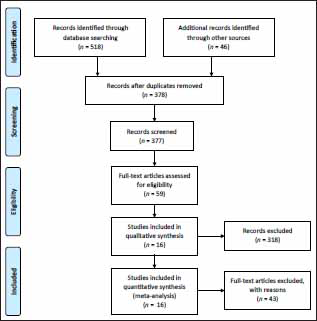
All the study titles were entered to endnote, and duplicated studies were excluded when the titles of all the studies were scanned by two independent researchers. The abstracts of the remaining studies were reviewed, and those did not meet the inclusion criteria were excluded. Finally, the full text of the manuscripts that met the study inclusion criteria was printed for future review. A total of 564 papers were retrieved, reduced to 378 following the removal of duplicates. The abstracts were screened using the eligibility criteria, 59 were found to match the criteria. After screening the full-text articles, 43 were excluded, resulting in a total of 16 articles. These 16 articles were selected in the review; significant findings and conclusions were extracted and grouped to formulate the themes made in this study (Figure 1).
Data Extraction
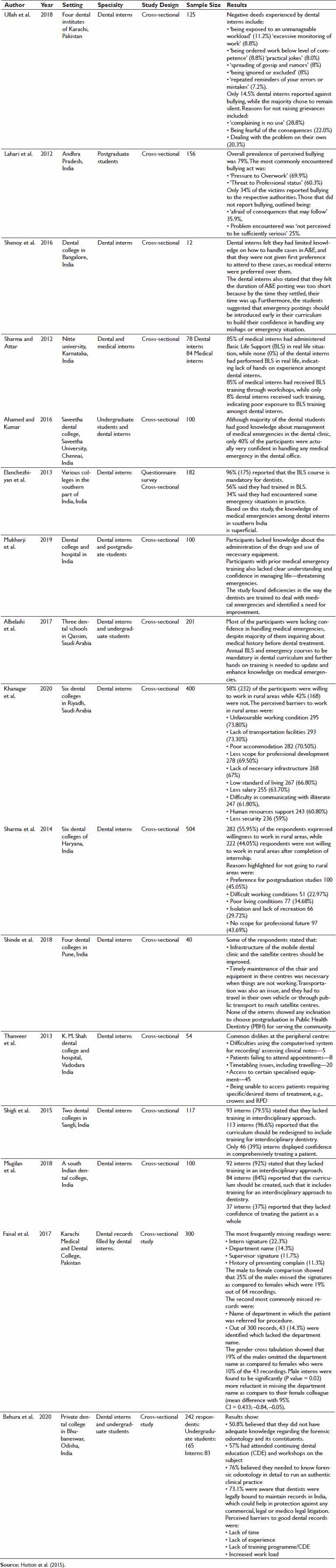
Characteristics of the Included Articles.
Results
Description of Study
Sixteen cross-sectional studies involved 1,695 dental interns, 84 medical interns, 156 postgraduate students, 165 undergraduate students and 401 dental interns/students. Twelve studies (75%) from India, two studies (12.5%) from Pakistan and the remainder (12.5%) from Saudi Arabia. All studies utilised self-reported information on difficulties or challenges faced by new graduating dentists in the workforce.
Five themes were established from the analysis: workplace bullying (WPB), handling medical emergencies, community placement, lack of interdisciplinary approach and poor record keeping, which will be discussed further.
Theme 1: Workplace Bullying
WPB has been investigated in two studies. Ullah et al. (2018) and Lahari et al. (2012) established from their study that WPB was a common occurrence at the workplace. The most commonly encountered bullying act on dental interns and postgraduate students included: pressure to overwork, excessive monitoring at work, being ignored or excluded, being a subject of jokes and gossip and repeated reminders of errors and mistakes. Furthermore, a majority of the victims chose to remain silent, and only less than half of the victims ever reported bullying to their respective authorities. Reasons for not reporting bullying mainly included: the notion that complaining is of no use, being fearful of the consequences or dealing with the problem on their own. According to Ullah et al. (2018), since a majority of the dental interns did not report bullying and are apprehensive towards complaining, there may be a lack of, or loose enactment of anti-bullying policies within the institutions resulting in poor accountability of perpetrators.
Handling Medical Emergencies
Handling medical emergencies was highlighted in six studies. Shenoy et al. (2016) and Sharma and Attar (2012) found from their study that dental interns lacked training and hands on experience in BLS, when compared to medical interns. Ahamed and Kumar (2016), Elanchezhiyan et al. (2013), Mukherji et al. (2019) and Albelaihi et al. (2017) found that dental interns and students, in general, were not completely aware of and are not being trained in the effective management of all emergency situations.
Community Placement
Community placement was investigated in four studies. Khanagar et al. (2020), Sharma et al. (2014), Shinde et al. (2018) and Thanveer et al. (2013) established in their study that dental intern’s had faced challenges in their rural placements. The perceived barriers to working in rural areas as expressed by the dental interns were mainly: unfavourable working conditions, poor accommodation, lack of necessary infrastructure, lack of transportation facilities, isolation and lack of recreation, no scope for professional future and being unable to provide specialised services. Furthermore, Khanagar et al. (2020) and Sharma et al. (2014) found that almost half of the dental interns did not want to work in rural areas after completion of internship. Shinde et al. (2018) further elaborate that, none of the 40 dental interns in their study showed any inclination to choose postgraduation in PBH for serving the community.
Lack of Interdisciplinary Approach
Lack of an interdisciplinary approach was highlighted in two studies. Shigli et al. (2015) and Mugilan et al. (2018) established in their study that the majority of the dental interns identified that they lacked training in an interdisciplinary approach, and that the curriculum should be redesigned, such that it includes training for an interdisciplinary approach to dentistry. It was also noted that many dental interns did not have the confidence to comprehensively treating a patient.
Poor Record Keeping
Poor record keeping was investigated in two studies. Faisal et al. (2017) found in their study that dental records filled by dental interns were incomplete. The most frequently missed information was intern signature, department name, supervisor signature and history of presenting complaint. It was also highlighted that male interns were more likely to miss out on information than female interns. Behura et al. (2020) established from their study that dental interns and students believed in the importance of dental records for running an authentic clinical practice, as well as protection against any commercial, legal or medico-legal litigation. However, the perceived barriers to good dental record keeping in the study were: lack of time, lack of experience, lack of training programme/CDE and increased workload.
Discussion
This systematic review demonstrated the challenges faced by dental interns in the workforce. It was also found that the challenges experienced by dental interns were highlighted across the studies and could be attributed to five factors which are WPB, handling medical emergencies, community placement, lack of interdisciplinary approach and poor record keeping.
Bullying can be described as a complex violent, antisocial conduct marked by repetitive harassment of a weaker victim without any provocation (Ramachandran, 2012). ‘Workplace bullying’ (WPB) means offending, harassing, socially excluding someone or negatively affecting daily duties of victims (Ullah et al., 2018). Some examples of WPB include direct attacks, such as cursing, mocking, hitting or indirect ones such as spreading rumours of the victim (Law et al., 2011). WPB is becoming a common occurrence, and the health care sector is no exception to this (Annagür, 2010). In the case of doctors in training, some bullying behaviours may be done with the intention to improve trainee’s performance, however, the impact on the trainee may be the opposite (Paice & Smith, 2009). A junior who feels undermined and shamed by a senior will hesitate to ask questions or seek support from him or her. Furthermore, unhelpful criticism, sarcastic comments and embarrassment in front of colleagues will cause even the strongest trainee to lose confidence in him or herself (Paice & Smith, 2009). Another major reason for WPB in the hospital has been attributed to senior doctors venting out their disaffection of workload and pressure, onto junior colleagues, leading to a climate of anger and disappointment (Paice & Smith, 2009; Paice et al., 2002). Some forms of bullying in the medical field are more insidious, such as threats over references and support letters, because progress in the medical sector still works on a system of patronage and word of mouth (Lone et al., 2009). Having said that, doctors in training, similar to other employees have the right to be treated with respect, dignity and consideration. They should not be subjected to behaviours that undermine their self-confidence and professional self-esteem (Lahari et al., 2012). This is because, WPB on an individual level has been linked with health care workers having: lower levels of job satisfaction, high levels of anxiety and depression, increase in sickness/absenteeism or desire to leave work (Kivimaki et al., 2000; Quine, 1999, 2001). Organisational consequences of WPB can manifest in a hostile or toxic work environment, which is closely linked to compromised quality of patient safety and care. It also inhibits teamwork, disrupts behaviour and obstructs communication and has the potential to increase medical errors by affecting the quality of healthcare organisation (Bentley et al., 2009; Martin, 2008). Overall, WPB of any sort must be condemned, interns, as well as other staff, must be given respect and a positive environment to work in. This is because, victims of bullying may themselves go on to harass others when they become seniors, thus continuing the vicious cycle of abuse (Lahari et al., 2012). It is believed that medical students not only learn medicine but also learn behaviour patterns of their seniors and mentors, widely regarded as the ‘hidden curriculum of medical education’ (Hsu & Marshall, 1987). Thus, it could be said that WPB is a major challenge that dental interns face upon joining an institution, and policies and initiatives must be created that condemn WPB.
Handling medical emergencies is another major challenge faced by dental interns that requires attention. This is because many situations in the dental office can incite medical emergencies (Albelaihi et al., 2017). The most common medical emergencies encountered in the dental chair include: postural hypotension, bronchospasm, swallowed foreign bodies, anaphylaxis, syncope, hypoglycemia, seizures, cardiac arrest and angina pectoris (Ahamed & Kumar, 2016). In general, these emergencies can be life-threatening, and there have been instances of patients dying due to medical emergencies in the dental setting (Little et al., 2002). Effective management of medical emergencies in the dental office is ultimately the dentists’ responsibility, via emergency management procedures aimed at reducing mortality and morbidity when the need arises (Ahamed & Kumar, 2016; Albelaihi et al., 2017). Lack of training and inability to manage medical emergencies can lead to serious consequences and legal action (Wood, 2014). According to Shenoy et al. (2016) dental students suggested that emergency postings should be introduced early in their curriculum to build their confidence in handling any mishaps or emergency situation. Furthermore, Shenoy et al. (2016), Sharma and Attar (2012), Ahamed and Kumar (2016), Elanchezhiyan et al. (2013), Mukherji et al. (2019) and Albelaihi et al. (2017) express deficiencies in the current way the dentists are trained to deal with medical emergencies, and that there is a need for incorporating structured training of BLS into the school dental curriculum, together with additional periodical assessment and enhancement training for dental professionals regarding medical emergencies. Mukherji et al. (2019) further elaborate that theoretical knowledge with demonstrations but without practice is insufficient to ensure competence in handling medical emergencies. Frequent training with the use of simulated scenarios in the environment where the emergency response will be delivered is recommended to achieve better results. Overall, it could be said that managing medical emergencies is a huge challenge for dental interns, and strategies must be in place to make dental interns competent in the management of medical emergencies to improve patient care.
Another major challenge dental intern’s face is during their community placement. Introduction of compulsory rural attachment in the internship programme of dental interns has been done, since most dentists usually practice in the cities and treat the affluent parts of the urban population, thus, it is often difficult for the rural population to get access to emergency and basic oral health care (Shinde et al., 2018). This geographical unequal distribution of the dentist–population ratio significantly influences the accessibility to oral health care services and presents a challenging problem in the planning and delivery of quality dental care in these areas (Sharma et al., 2014). Rural attachments are referred to as ‘outreach’ or ‘outplacement’ programmes, where mobile dental clinics as well as portable dental equipment are used to provide dental services in the absence of traditional set-ups (Shinde et al., 2018). According to Yoder (2006), community service has the capability to provide dental students with knowledge and motivation to engage into and promote public health by understanding and appreciating the concepts, characteristics and objectives of community service and its impact on the public. However, other important job attributes, such as better income, good living conditions, utilisation of skills, education opportunities for children, safe working and living environment, tilt the balance in favour of urban location (India Health Beat, 2009). Overall, it could be said that rural settings pose significant challenges, and dental interns could feel intimated and demotivated when faced with such challenges. Thus, it is important to mitigate these challenges, so that dental interns feel at ease and possibly take up rural postings in the future. For instance, K. M. Shah Dental College is implementing strategies at its peripheral centres in order to increase the efficiency of outreach programmers. One such strategy is the expansion of peripheral centres in terms of infrastructure and providing dental students with the most recent technology for patient management (Thanveer et al., 2013).
Utilising an interdisciplinary approach is another significant challenge encountered by dental interns. Interdisciplinary dentistry is manifested by the application of methods, concepts and perspectives that go beyond the boundaries of individual specialty (Slavicek et al., 2013) to deliver the highest level of dental care to every patient (Spear & Kokich, 2007). In countries such as India, Bachelor of Dental Surgery graduates are posted in several departments for short periods of time to obtain clinical abilities relating to the particular department. As a result, they are poorly prepared to carry out comprehensive treatment planning or interdisciplinary approach Elangovan et al., 2010; Vasanthakumar & D′Cruz, 2014). Shigli et al. (2015) elaborated that the current scenario involves dental interns providing treatment is based on the knowledge that is compartmentalised, and there is a need to develop an internship programme, based on the concept of an interdisciplinary approach.
Lastly, poor record keeping is another issue displayed by dental interns, which needs attention. This is because, clinical records play a vital role in the process dental care delivery, as they are essential for the diagnosis, planning and correction sequencing of treatment (Faisal et al., 2017). Dental records comprise of clinical notes, plaster models, radiographs and treatment done including serial numbers of prosthesis (Kutesa & Frantz, 2016). These records also serve other purposes, such as administrative, research, quality assurance, education and even used as evidence in legal proceedings. Therefore, producing detailed accurate patient records, maintaining, storing and retrieving them should be an integral part of practice, and this habit should be ingrained during the professional training of dental students (Behura et al., 2020). Faisal et al. (2017) further elaborate that organising training sessions on a regular basis that informs students about the benefits of accurate and detailed records, as well as problems that might arise when records are substandard would greatly help in inculcating the trend of efficient and qualitative record keeping in the times to come.
Application for Pacific
Based on these findings, it can be said that WPB, handling medical emergencies, community placement, lack of interdisciplinary approach and poor record keeping, are major challenges faced by dental interns. Acquisition of an adequate dental workforce remains a major challenge for PIC, and movement of dental workers from the government sector (public) to private or other professions further compounds this problem. A well-designed and executed internship programme could be a key component in ensuring dental graduates is retained in the profession and public sector. PIC must conduct surveys to identify the challenges, its dental interns are facing, and create an ideal foundation from which strategies and initiatives can be implemented and enforced in the dental internship programme. The ultimate goal is to ensure dental graduates are retained in the profession and public sector. Further ensuring oral health services are delivered efficiently, and oral status of the Pacific is not compromised.
Limitations
Several limitations of this study need to be mentioned. Firstly, this systemic review looked at studies conducted in countries outside the Pacific, since no data or studies were available for PIC. As a result, the conclusions drawn from these studies may not necessarily be applicable to PICs. Furthermore, the general limitations of systemic review can be applied to this study as well, which includes subjective biasness in study selection and analysis and the possibility of misleading conclusions being drawn. Therefore, there is a need for PICs to conduct research, and to accurately determine the challenges faced by its dental interns in the workforce.
Conclusion
Challenges faced by dental interns in the workplace include WPB, handling medical emergencies, community placement, lack of interdisciplinary approach and poor record keeping. The aim of this literature review was to highlight this grey area, of new graduates leaving the profession or moving over to the private sector, which is very prevalent in PIC. There is a need for PIC to conduct research and surveys, to identify the challenges its dental interns are facing. This will create an ideal foundation from which strategies and initiatives can be implemented and enforced in the dental internship programme. The ultimate goal is to ensure dental graduates are retained in the profession and public sector. Further ensuring that oral health services are delivered efficiently and oral status of the Pacific is not compromised.
Footnotes
Declaration of Conflicting Interests
The authors declared no potential conflicts of interest with respect to the research, authorship and/or publication of this article.
Funding
The authors received no financial support for the research, authorship and/or publication of this article.