



Abstract
Given that citizen participation is considered the main pillar of ‘Development’, the political economy behind its practice (behaviour and utilisation) remains a question. To disentangle the complex web of relationships that the governance shares with the citizens’ interface, it would be worthwhile to examine the whole phenomenon at the grass root level. A review of issues surrounding democracy has led different schools of thought to realise the need for adopting a holistic development approach for ensuring citizens’ participation in development processes. One such school believes that it is only through addressing governance bottlenecks and ensuring spaces for participation in policy design, programme formulation and implementation supplemented with proper monitoring, that ‘real’ development can be achieved. It is also universally accepted that governance is an enabler for socio-economic transformation and this can help in the improvement of lives through the eradication of structural inequality. Hence, strengthening the local governments is critical for ensuring citizen empowerment, civic participation and better service delivery. Furthermore, governance is measurable and can be monitored; thus can ensure a measurable implementation, accountability and monitoring framework (Global Thematic Consultation on Governance and the Post-2015 Development Framework, 2013). Against these backdrops, the current study endeavours to unearth plausible factors influencing the health behaviour of rural people examining a case of India’s National Sanitation Program—Swachh Bharat Mission in Odisha villages. Analysis of primary data collected from six districts across different regions of the Odisha state shows that various managerial, governance and social factors have a significant effect on the health behaviour of people and present more insightful results.
Prelude and Theoretical Critique
Within a broader frame of health management, governance would mean the provision of basic and essential health services to the citizens with the best possible quality and adequacy. Hence any departure from this endeavour or outcome would be a real concern for researchers and policy monitors in terms of the level of impairment, causes behind such and possible course corrections. At the macro level, this is reflected in some schools of thought as
Weak and illegitimate governance—both within and between countries—explains to a significant degree why the benefits of development are not equally shared nor sustainable over time, despite the existence of abundant material and human resources sufficient to enable people and future generations everywhere to live a life of dignity, free of disparity and deprivation (Global Thematic Consultation on Governance and the Post-2015 Development Framework, 2016, p. 2).
Similarly, ‘Governance in practice is often coloured by unequal relations of power, between the state and impoverished/discriminated groups, between the government and the private sector, and between small states and more influential ones’ (Global Thematic Consultation on Governance and the Post-2015 Development Framework, 2016, p. 2). In this line, the use of efficient tools and techniques to gauge these aspects is theorised as essential towards improved governance.
It is thought that ‘The ability to consistently monitor and review conduct of development actors against established responsibilities is an essential prerequisite for just and accountable governance’ (Global Thematic Consultation on Governance and the Post-2015 Development Framework, 2016, p. 3). What emerges from this discourse is the participation of citizens in the governance/development process is the key. Even the theories of democracy and management often advocate varying degrees of participation (as a must) by the people with the government. These theories propose that full, free and transparent participation of citizens in the development process is required not only for optimal utilisation of services but also to confirms the validity of the service provision procedures for future stages.
At a conceptual level, overall development may be seen as a linear path of welfare for the beneficiaries or citizens, but many schools of thought believe in various other alternatives focusing on human capabilities 1 . While many Management and Anthropological theorists focused on the importance of an individual’s need and vision for development design, few (say Emile Durkheim) saw the need for institutional linkages as the backbone for the same. On the other hand, economists dissected the concept of development in terms of an individual’s response to outside forces (say modernisation and industrialisation) as an output. Whereas neo-liberalist and post-development theories criticise the economic concept of living standards as being partial and half-baked thoughts for development and emphasise the need of the consumers. Many development alternative thinkers are often armed with concepts such as development paradigms, development alternatives and so on. The need for such paradigm change might probably germinate from citizens’ development expectations in a more or less normative context.
Keeping the citizen free from health hazards is a fundamental responsibility of the policymakers. India’s national sanitation programme is one programme which is worth examining the governance aspects. Earlier avtar of the National Flagship Programme of the Government of India for public health and sanitation was known as Nirmal Bharat Abhiyan (NBA) which was recently restructured with a new name ‘Swachh Bharat Mission-Gramin (SBM-G)’. The Nirmal Bharat Abhiyan (NBA) was initiated (in the form of the Total Sanitation Campaign (TSC) in 1999 when the Central Rural Sanitation Programme was restructured making it demand-driven and people-centred. In 2012, the Government of India in the Ministry of Drinking Water & Sanitation came up with a scheme of convergence between TSC, rechristened as Nirmal Bharat Abhiyan (NBA), with NREGS. Given that the main goal of the GoI (Government of India) is to eradicate the practice of open defecation, the NBA is a comprehensive programme to ensure sanitation facilities in rural areas to achieve this end. It follows a principle of ‘low to no subsidy’ where a nominal subsidy in the form of an incentive is given to rural poor households for the construction of toilets. NBA is a step forward in creating new entitlements of IHHLs (individual household latrines) both for BPL (below poverty line) and identified APL (above poverty line) households covering Scheduled Castes/Scheduled Tribes (SC/ST), small & marginal farmers, landless labourers with homestead land, physically handicapped and families headed by women within a gram panchayat (GP).
The SBM programme encompasses the ways to ensure access of every rural citizen to sanitation facilities including toilets, solid & liquid waste disposal systems and cleanliness among a host of other related services. After several decades of efforts through various flagship programs, such as the Total Sanitation Campaign (TSC), and the Nirmal Bharat Abhiyan (NBA), the Government of India’s Swachh Bharat Mission (SBM) announced by the Prime Minister on 2 October 2014 is now midway through an ambitious 5-year agenda of achieving open defecation free (ODF) status in the entire country by 2 October 2019. The two components of the program—SBM Gramin and SBM-Urban—aim to accelerate the building of Individual Households Latrines (IHHL), along with the general goals of improving hygiene and promoting cleanliness in the country. The target of 2019 is especially ambitious in rural areas, where the slow and incremental gains in coverage over the years make it particularly challenging to achieve the stated goal by 2019. SBM-G estimated that as of October 2014 (start of SBM-G), 42% of rural India was covered by IHHLs and that 64% coverage was achieved by May 2017. One would see whether the remaining one-third was covered successfully by 2019. Whether coverage in terms of an increase in the number of toilets is sufficient to achieve ODF status in the country is a much-debated and discussed question. The need to nudge beneficiaries of the program to use the toilets is increasingly felt. Various reasons, ranging from the poor quality of toilets built, to cultural, social and ‘religious’ compulsions for not using the toilets make the ODF goal more challenging than just achieving the target numbers for toilets built. Unless beneficiaries buy into the idea of toilets, their importance and utility, it is increasingly becoming clear that ODF is not an achievable goal.
Approximately 69% of rural India’s 167 million households still practice open defecation, as per Indian Census 2011. Further, 58% of all open defecations in the world happen in India. The problem is particularly daunting in rural areas. Poor sanitation and hygiene are leading causes of infant and child deaths. Every 30 seconds a child under five dies as a result of diarrhoea. Poor health affects not only productivity but also school attendance, particularly for the girl child. Women/girls are affected by a lack of privacy from limited access to toilet facilities in schools and households. India loses US$54 billion (₹24,000 crore) a year due to poor sanitation and hygiene, which is 6.4% of its GDP.
Among many health management issues, the practice of open defecation (OD) has emerged as one of the major concerns in the context of health behaviour and governance. The plethora of international study findings reveal varying determinants/antecedents of open defecation in Indonesia (Mukherjee et al., 2012), India (O’Reilly et al., 2017) and South Africa (Kirigia & Kainyu, 2000). According to a WHO report of 2017, almost 520 million people in India defecate in the open. Open defecation is a major health concern that calls for specific governance interventions (Sahoo et al., 2015).
Hammer (2013) reported evidence in which he found that open defecation had a negative and statistically significant impact on height (controlled for age) which was robust across various specifications. He also documented evidence from Delhi, based on different regressions, that even if one person in a household defecated in the open sometimes, it had a positive and statistically significant impact on the possibility that the person had diarrhoea in the past 2 weeks, implicating the practice. In a similar vein, pointing out that the impact on nutrition of many faecally-transmitted infections, not just diarrhoeas, has been a blind spot, Chambers and Von Medeazza (2013) found that the puzzle of persistent under-nutrition in India is largely explained by open defecation, population density and lack of sanitation and hygiene.
Open defecation is a cultural practice that is deeply ingrained in rural communities in India. An impact assessment of the TSC implemented by Water Aid and its NGO partners in a coastal district in Orissa by Barnard et al. (2013) showed that the most common reason why latrines were not in use was that individuals within households preferred open defecation (29%), the latrine was not complete (28%) or using a latrine was deemed inconvenient (20%). Other reasons for non-use were that the latrines lacked privacy (23%), were used for storage (22%), were broken (17%) or were blocked (9%). Kondepati (2013) pointed out that while the usual narratives promoting toilet construction are articulated around women’s issues, men are the key to achieving open defecation status after the toilets are constructed, given cultural issues still prevented men from using them. Spears (2012) summarised policy lessons from the first 10 years of latrine construction under India’s Total Sanitation Campaign (TSC). This article found that TSC had been able to improve average health and human capital among Indian children where it had been implemented, but sanitation coverage remained substantially incomplete. Most importantly, this article pointed out that achieving an open defecation-free India will require more and better data—administrative data about the implementation of the TSC and survey data for research.
Interestingly in an untold story of policy failure, Huesoa and Bell (2013) pointed out how policy failed to translate into practice and the TSC implementation was rather government-led, infrastructure-centred, supply-driven and subsidy-based. This study pointed out how thousands of latrines were planted throughout the country without any involvement or appropriation by the ‘beneficiaries’, severely affecting sustainability. While the Government of India was claiming that rural coverage had reached 68% in 2011—up from 22% in 2001—Census 2011 data showed that real coverage was only 31%. This implies that only one in five latrines reportedly constructed since 2001 were in place by 2011. The rest either had become unusable due to bad construction quality and lack of maintenance or were not fully built in the first place. The decadal coverage increase was less than 10% points; less progress than in the previous decade. Five main reasons behind the theory–practice gap in the TSC were identified: low political priority; flawed monitoring; distorting accountability and career incentives; technocratic and paternalistic inertia; and corruption.
George (2009) summarised India’s sanitation journey from its subsidy-driven and construction-oriented days to its present state, pointing out that a lot more still needs to be done. However, the study pointed out the need to make a constant effort to improve the performance of the programs by making them more responsive to local needs and aspirations. An evaluation study of the TSC by the Planning Commission (2013) found that though it is very difficult to isolate the impact of TSC on general quality of life of the rural people, the study found that the people in the Nirmal Gram Panchayats were enjoying a better quality of life by way of fewer incidences of diseases caused by improper hygiene and unsafe water supply, reduced medical expenses and increased time for earning. The Planning Commission study found that the average number of times family members in a household became ill in NGP-awarded Gram Panchayats had been reduced from 0.24 in 2006 to 0.17 in 2008. A majority—88% of the selected households who were having toilets expressed the view that their ‘general well-being’ had improved and 96% of the households in this category were of the view that with the availability of the toilet, women were more secure. This study found that the unavailability of toilets was the main reason for the huge percentage of households still defecating openly. According to estimates from this study, out of 73 households per 100 rural households where at least one member of the family practised open defecation, 66 households were forced to do so due to unavailability of toilets, 1 household was forced to do so due to inadequacy of the number of toilets and 6 households were doing so in spite of having toilets.
While antecedents of this practice are found in some studies to have no significant association directly with literacy rate or level of poverty (Coffey et al., 2017), some contradicting evidence showed education level of household head inversely affected the practice of open defecation in Nigeria (Abubakar, 2018). Noor and Ashrafee (2004) found that the construction cost of the toilet can be a deterrent for people to use toilets in Bangladesh. An ethnographic study indicated that the use of toilets is largely determined by the availability of physical space and water as well as poor access to hygiene technology in Odisha, India (Mohanty & Dwivedi, 2019).
With this knowledge void and contradictory evidence gap, this article looks to study possible managerial and social frameworks that might affect health behaviour and the governance aspects of such programmes. The study takes up a case study of a health and sanitation programme implemented with more or less common guidelines across the state of India—the National Sanitation Program—Swachh Bharat Mission. Again, for a micro level and intensive understanding of the phenomenon at the micro level, select districts from different regions of Odisha state (an Eastern Indian State) have been covered.
Study Context and Research Questions
In line with the national goal of the SBM-G programme, the Government of Odisha had also taken strong initiatives and strived to make the state open defecation free (ODF) by 2019. This programme covers the construction and monitoring of regular use of Individual Household Latrine (IHHL) along with environmental cleanliness in rural areas. While this is more of a supply-driven programme following largely a construction-only approach, the actual outcome will be the full and regular usage of the toilets by all people every time without the practice of open defecation at all. Then only the larger objective of full sanitation can be achieved. This article endeavours to examine at the micro level, the managerial factors such as governance and social factors like citizen participation behind the outcome of the National sanitation programme (SBM-G) in Odisha.
The main question that this article tries to find the answer is does an impaired governance lead to disproportionate participation and hence produce an asymmetrical outcome? In this study, there are governance aspects such as rendering government services and subsidies to people for SBM-G toilets are tested against the regular usage of these toilets by all family members of the beneficiary. The concept of participation is studied in terms of people’s direct participation in the construction of their household toilets received under the SBM-G scheme. It could be the case where the user (beneficiary of the SBM-G programme) has been actually involved in the construction process of her or his household toilet or arranging the mason and required support from people of his own choice for the purpose of household toilet construction. Outcomes in this study are expressed in regular usage of toilets by all members of the beneficiary households.
Specific research questions that this article tries to answer are:
RQ1: What is the usage pattern of toilets by the rural beneficiaries who have received IHHL under the SBM-G programme and the factors behind the usage of the toilet? RQ2: Does participation in own IHHL toilet construction process significantly enhance the usage of the toilet? RQ3: What are other social and managerial factors that influence the usage of toilets?
Study Methodology and Operationalisation
Data for this study come from a 3-year empirical research project carried out in Odisha during the period of the year 2014–2017. Relevant Social Accountability Tools were used in the project to help ‘close the loop’, mainly the citizen report cards (CRCs) to collect user and provider feedback about the programme implementation. The CRC survey covered 2,660 beneficiary households across different regions (six districts with similar sample size) of the Odisha state on various aspects of construction and usage of SBM-G toilets by individual beneficiary households. The study districts are Ganjam, Baleshwar, Cuttack, Dhenkanal, Angul and Sambalpur. It followed scientifically rigorous probability sampling techniques, digital methods of data management (CAPI) and rigorous Quality Control (QC) mechanism. The data analysis was carried out by using Statistical Package for the Social Sciences (SPSS) software.
CRC is a survey-based user feedback accountability tool used for service delivery improvement. It articulates citizen/civil society’s demand for better services and enables service providers to strengthen reform measures from information generated across different sectors, geographical regions and demographic profiles. This specific survey instrument usually covers the following components such as availability, access & usage, quality & reliability, incidence & types of problems, the responsiveness of service providers, cases of bribes both extortionary versus voluntary and overall satisfaction (Nair et al., 2012).
Data, Analysis and Discussion
Results from the analyses of the current data examine whether, how much and in what way different managerial and social factors can influence the health behaviour of the users and the governance options, for the six study districts of Odisha. This covers the usage pattern of household toilets by the beneficiaries, participation in their own toilet construction process, use of water for the toilet, spending of extra money and bribes in different stages of the toilet scheme, level of satisfaction reported by the beneficiaries in different aspect of the scheme and multivariate analysis for understanding the causal relationships between factors and outcomes.
Usage of Toilet—By Six Study Districts of Odisha
In terms of the pattern of the usage of household toilets by the beneficiaries, the analysis depicts significant variations across the study districts mainly in terms of their geographical locations. Out of the six study districts, three coastal districts (Cuttack, Baleshwar and Ganjam) have higher a proportion of households where all the family members use the toilet every time in contrast to the cases (beneficiary families) where some members of the beneficiary household use the toilet only sometimes and rest of times go for the open defecation (Figure 1). However, there could be variations in such types of associations in varying populations, for instance in Nigeria (Abubakar, 2018), OD practice was found to be more common among people living in the coastal area, which may be due to proximity to the water bodies. In the current study on the Odisha population, the coastal districts are relatively better off in terms of socio-economic development and thereby have enhanced awareness and access to the resources which might be a possible explanation for a different result.
Usage of Toilet by Members of Household: Primary Data of this Study.
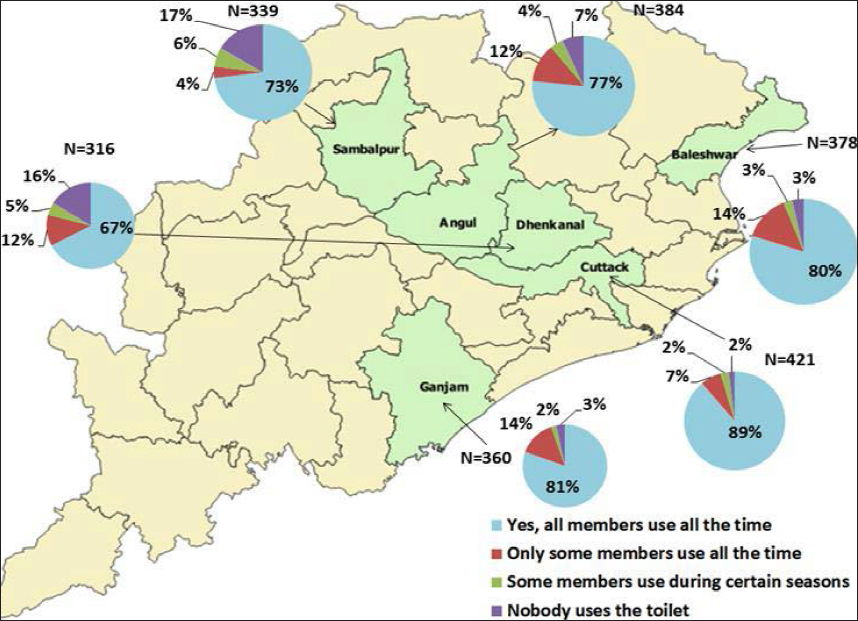
The usage of the toilet by all members every time is the national goal as well as the precondition in creating a healthy environment. Then, why there is a differential in the usage of toilets by people from different districts when the same programme was being implemented across the districts and the states of the country? The further analysis highlights some of the important reasons.
Toilet Usage Vs. Who Built the Toilet
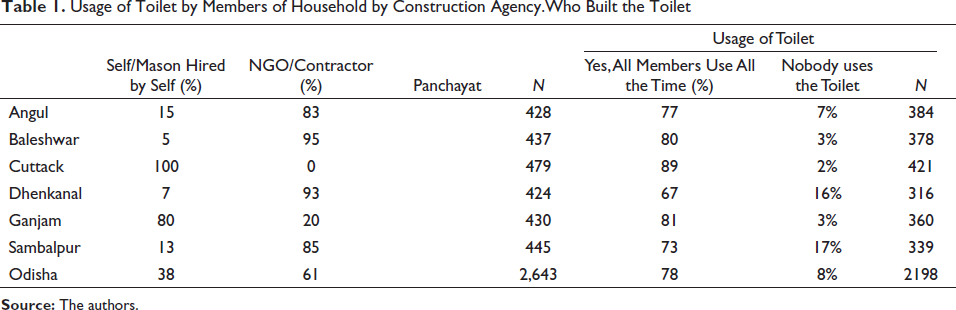
It was observed in the data analysis that one of the most common reasons behind the differential usage of the toilet by people in different districts is ‘who actually built them’. As in the government scheme, different options are often available such as building by contractor, by the family itself using mason or by NGO and so on, one may find different proportions of households utilising different options. It is found that whenever the toilet construction was done by self (meaning the beneficiary family itself) or by the mason hired by the family—the usage is more compared to those households where NGOs or contractors have built the toilets (Table 1). This could be because the self-built toilets create a sense of ownership and relatively higher satisfaction in terms of design, choice, etc., over the case where the toilets are built by ‘outsiders’ (such as NGOs or contractors). This finding is also supported by the observations of a Nigeria study (Abubakar, 2018), where ‘ownership of latrines by house hold’ is suggested to improve the use of toilets.
Usage of Toilet by Members of Household by Construction Agency.Who Built the Toilet
Usage of Water Vs. Usage of Toilets
As many studies have found, the availability (represented by usage data) of water for the purpose of toilet usage emerged as another very important and practical reason behind the differential usage of the toilet by people in different districts. In the current study data, it is observed that higher average usage of water goes parallel with the higher usage of household toilets (Table 2), which confirms the former statement on the reason behind the differential toilet usage. This kind of association also resonated with another study by Mohanty and Dwivedi (2019) which found open defecation to be a consequence of water scarcity.
Total Water Usage Per Day by Study Districts of Odisha.

Extra Payment
In addition to usage, the current research also aimed to know whether there is some kind of extra cost in terms of bribe or hidden cost that the consumer (beneficiary household) had to bear as it has ethical and governance implications in public programmes (Hutton et al., 2020). It is found that on one hand, higher usage of toilets resonated with higher self-built toilets and availability of water, but at the same time, the research finds the prevalence of an ‘extra’ cost borne by the households. Close to one-fifth of all households in the high usage (toilet) districts have made extra payments for the construction of toilets (Figure 2). Why did they pay extra (than the admissible cost)? The next analysis reveals some answers to this question.
Percentage of Households Done Extra Payments: Primary Data of this Study.
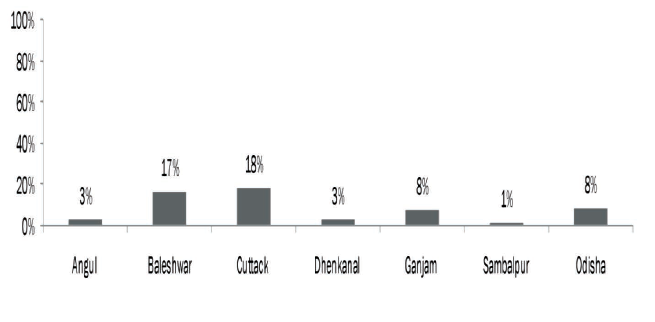
Percentage of Households Done Extra Payments: Primary Data of this Study.
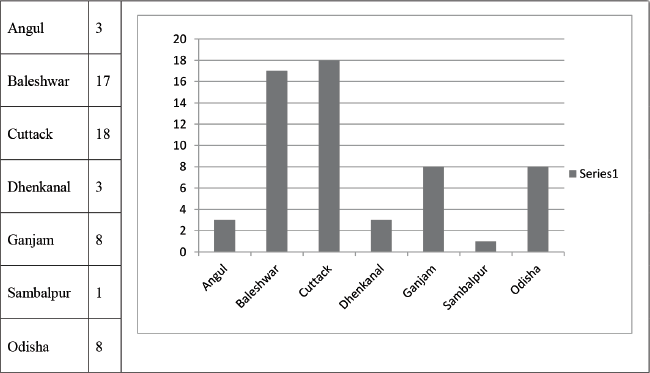
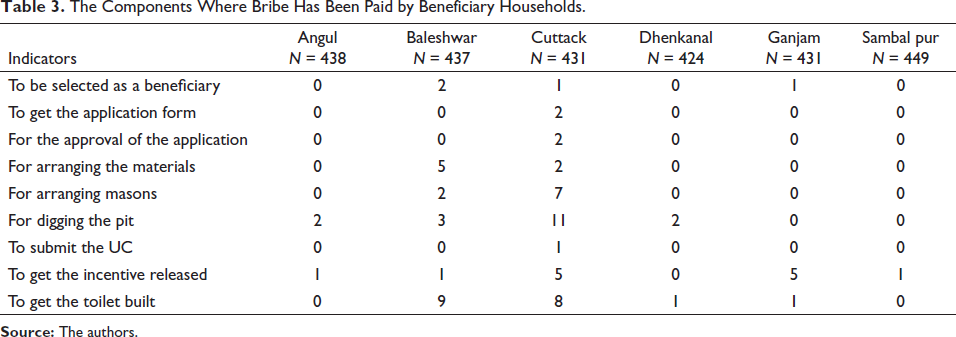
Further component-wise analysis showed that extra payment or hidden cost is involved in various stages of the SBM-G toilet scheme. Mainly during the arrangement of materials required for the household toilet construction, digging of the pit and release of the incentives (incentives or subsidies given by the government to the beneficiary households after the construction of toilets under the SBM-G scheme) are some of the common ‘points’ where people had to spend extra (Table 3 and Figure 3). The extra expense could be towards payment of a bribe, frequent travel (due to glitch in official procedures) and some sort of repeat payments to people.
The Components Where Bribe Has Been Paid by Beneficiary Households.
Extra Money Vs. Total Money Spent on Toilet Construction
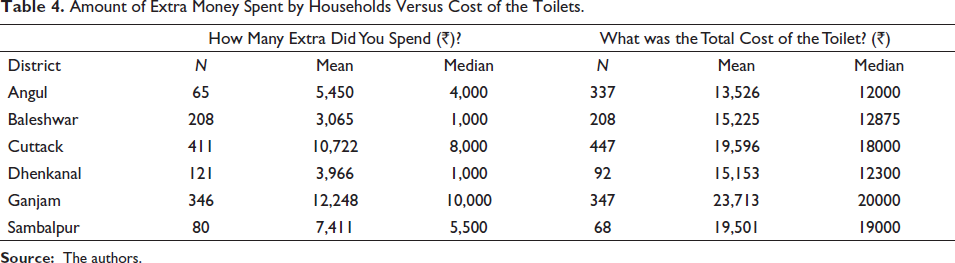
Carrying out a comparison of the actual cost of toilets versus the amount of extra money spent by beneficiary households may provide some insights. This too can explain the differential between the cost of the toilet and the actual spending, hence may provide some idea about the magnitude of possible irregularities.
Table 4 showed that in most places (districts), the mean extra spending resonates with the mean total cost of the toilet. It implies that the people had to spend more during various stages of the toilet construction with the increase in the cost of their toilet received from the SBM-G scheme.
Amount of Extra Money Spent by Households Versus Cost of the Toilets.
Satisfaction Level by Various Aspects of Toilet Construction
One can see that on one hand, toilet usage is found to be correlated with the level of participation of people in their toilet construction and availability of water for toilet use, and on other hand, people spent more money than the actual estimate. Does this reflect in the level of satisfaction as reported by the beneficiary households? Which are the aspects that might create a differential in the satisfaction level?
In terms of the level of satisfaction in different information-related aspects, in the majority of the study districts, it is relatively higher (Table 5). But in the governance aspects, such as the release of subsidy in terms of the right amount and time of disbursement and so on, the users (beneficiaries) are much less satisfied. Of course, there are some variations among the districts.
Level of Satisfaction in Terms of Various Aspects of Toilet Construction.

Multivariate Analysis Results.

This kind of shortfall in governance and disproportionate participation (of beneficiary households) can be responsible for an asymmetrical outcome like poor usage of toilets.
Multivariate Analysis: 3-Model Approach
Delving into understanding the actual mechanism behind the usage of household toilets versus the contributing factors, their sole effects and the magnitude of the effects, multivariate statistical analyses were carried out using the multiple regression method. The analysis follows a 3-Model process where the dependent variable or the outcome variable ‘usage’ is tested against the ‘participation in toilet construction’ and various sets of other independent variables (determinants). The dependent variable ‘usage’ depicts the actual use of the SBM scheme toilet by the number of family members in the beneficiary household. Here higher usage means almost all the family members use the SBM toilet at every time which is ‘well expected’ condition as per the government policy. Similarly, 3, 2, 1, 0 values of the variable ‘usage’ would mean the use of toilet by some members every time, use of the toilet by some members some time and irregular use/no-use of the toilet by the family members which would depict a poor level of development expected.
Model-1 tests the magnitude and nature of the causal relationship between the regular usage of the toilet (dependent) and only one independent variable which is the participation in toilet construction. Model-2 examines the magnitude and nature of the causal relation between toilet usage (dependent) and the independent variable ‘participation’ after controlling the effect of a set of proximate variables (independent) which are directly related to toilet construction. Model-3 presents a larger scenario which meticulously examines the amount and nature of the causal relation between toilet usage (dependent) and two types of independent variables consisting of proximate and tertiary variables (socio-economic factors). For each model, the major statistical components such as beta-value, R-square value and standard error (SE) are compared to check the magnitude and quality of the causal relationship testing and the nature of the effects.
Results from the multiple regression analysis (Table 6) showed that the sole effect (Model-1) of participation in toilet construction over toilet usage is enhanced by the inclusion of managerial and governance factors in Model-2 (increase in the R-square value). This effect is further enhanced by the additional inclusion of socioeconomic factors in Model-3 (further increase in R-square value). These relationships are also statistically significant and valid as the value of standard error (SE) decreased consistently from Model-1 to Model-2 to Model-3. This means both social as well as managerial factors contribute significantly towards the usage of toilets by the users.
Conclusion and Policy Implications
The rigorous analysis of the current data makes it clear that the higher the ownership in terms of user participation in building the household toilet, the higher the regular usage of the toilets. At the aggregate level, as high as 78% of households who got their toilet constructed by themselves or mason hired by themselves showed regular use of the toilets by all family members as against a mere 38% of households who got their toilets constructed by NGO/contractors. In one district, it was found that as high as 92% of households got toilets constructed by NGOs and for the same district just in 5% of the study households all family members used the toilets all the time.
Results from all different types of data analysis brought into light many important managerial and social aspects as focus areas affecting health behaviour and governance hence warranting policy and research emphasis such as:
User participation in toilet construction Availability of water Usable condition of the toilet (O & M) Better payment process Extra spending from the user side Availability of RSM (Rural Sanitary Mart) Better design of the toilet—easy to use and maintain Awareness (IEC) about the need for toilets for girls, women and elders Socio-economic condition: Education, caste, house type, income
The whole discussions show that there exists some sort of an asymmetry in the programme outcome among different districts of the same state implementing the same programme and a number of socio-managerial factors playing major roles in such an outcome. This has significant implications for health governance and policy formulations. Some aspects of exclusion are also visible in many managerial aspects, such as the timely construction of toilets, awareness gaps and so on.
It is thus fundamental to note that there is a greater need for awareness about the ill effects of open defecation and public health risks. Health hazards of OD practices such as polluting the environment, water bodies and other public spaces can lead to the spread of fatal diseases, which must be avoided by promoting greater usage of toilets. Widespread ill effects of OD in developing nations include diarrhoea and hookworm infestations that lead to anaemia and the death of more than half a million young children of less than 5 years of age (Mara, 2017). Erosion of the physical and cognitive health of the citizens of a nation will have a long-lasting impact on the growth of the nation. Hence, creating better awareness about the health benefits of using toilets is of high significance for nations like India and other countries which has high population density. This article is significant not only for academics but also for further research and programme implementation purposes.
Footnotes
Declaration of Conflicting Interests
The authors declared no potential conflicts of interest with respect to the research, authorship and/or publication of this article.
Funding
The authors received no financial support for the research, authorship and/or publication of this article.