



Abstract
In India, physical inactivity in children and youth is a public health concern, and it is unfortunate to see that most Indian children do not accomplish prescribed levels of physical activity. We strongly believe that the availability of a physical activity motivation instrument specific to the Indian population can significantly promote physical activities in India. This study aimed to develop the student’s physical activity motivation scale (SPAMS). The convenience sampling method was used to collect data from 622 participants from 5 states and 1 union territory of India. A multi-stage approach using exploratory and confirmatory factor analysis was computed to develop and validate its psychometric properties in two different samples (EFA-311 and CFA-311). Factor analysis revealed three distinct factors underlying physical activity motivation: skill development, appearance and positive health. Based on the findings, it can be concluded that SPAMS meets the concept and external validity criteria and that it is suitable for theoretical and practical applications.
Introduction
Physical inactivity is claimed to be the driving cause of the hypertensive ailment and is assessed to cause 3.2 million deaths each year (WHO, 2023). At least one hour each day, more than 60 minutes will provide significant health benefits for those who spend most of their day inactive (Katapally et al., 2016). Individuals are getting to be less physically dynamic since innovation has made our lives less demanding. We live in the age of technology, and smartphones, with their numerous engaging highlights, make our lives less physically active.
It is well documented that regular physical activity in school-aged children contributes to positive health benefits, such as an increase in cardiovascular endurance, skeletal muscle strength, self-esteem, quality of life and psychosocial well-being (Lubans et al., 2016; McMahon et al., 2017; Thompson et al., 2003). Conversely, physical inactivity and sedentary behaviours at a young age may cause childhood obesity (Gilbert-Diamond et al., 2014), which may lead to cardiovascular disease, type 2 diabetes, depression and psychosocial issues (Daniels, 2006; Lavie et al., 2016; Llewellyn et al., 2016).
Despite these well-established benefits of engaging in regular physical activity, globally the physical activity levels of all people remain a concern. According to the WHO, physical inactivity is the fourth leading cause of death worldwide. Physical activity can prevent at least 3.9 million premature deaths each year around the world. In an analysis of data from 168 countries and 1.9 million participants over 15 years, Guthold et al. (2020) found 27.5% did not meet WHO’s recommendations. A similar analysis of 146 countries and 1.6 million youth ages 11–17 years found 81% to be insufficiently involved in an activity. With these data, the situation seems to be more alarming and needs to be addressed with the immediate attention of the policymakers. The overwhelming majority of youth globally do not meet current physical activity recommendations established by the WHO.
Physical Activity Status in India
Bhattacharya (1987) defined India as one of the oldest civilisations in the world: A civilisation that all throughout history has emphasised physical activity, sports and diversions for improving one’s well-being. However, similar to other countries, currently in India, inactivity is also increasingly prevalent during every period of growth from childhood to old age. In India, physical inactivity in children and youth is a public health concern, and it is unfortunate to see that most Indian children do not accomplish prescribed levels of physical activity.
Katapally et al. (2016) started the concept of the physical activity report card in India, which was the first assessment of physical activity of its kind; their intervention suggested that only 38% of adolescents and 17% of children get the suggested 60-minutes/day of moderate-to-vigorous concentrated physical activity. It recognised a few holes to prove, counting broadly agent information on dynamic living and relevant indicators such as ‘active play’ and ‘family and peers’.
Furthermore, Bhawra et al. (2018) conducted a systematic search of peer-reviewed and grey literature from 2010 to 2018 for 10 indicators. The result of the physical activity report card 2018 shows that even though the largest part of children and youth in India are not amassing prescribed levels of physical activity, there are empowering signs of their cooperation in dynamic transportation and dynamic play, a wonder that ought to be investigated advance to encourage more physical activity.
A new WHO study carried out by Guthold et al. (2020) revealed that India is among the top 10 nations with the most reduced level of deficient physical movement among young. India is positioned eighth with a general predominance of deficient physical activity in an adolescent at 73.9%.
Similarly, the Indian Journal of Endocrinology and Metabolism, 2019 statistics stated that around 5%–8.8% of schoolchildren are obese in India, and if the rates increase at a pace like this, India will reach at the spot closest to China by 2030 in the world chart for the most number of obese children (5–19, a long time of age). In line with this, Bansal (2019) reported that around 27 million Indian children will be obese by 2030.
Satija (2018) found that inadequate physical activity levels are reported among Indian youth, with the lowest levels among adolescents, particularly girls. Despite the clear benefits associated with physical activity, existing literature points towards a physical inactivity epidemic among children and youth in India. This epidemic could be attributed to multiple factors, including the lack of upstream active physical activity policies and the less supportive environment that can promote physical activity (Shirotriya, 2016).
Conceptualisation of This Study
Obesity in childhood has a deleterious impact on adolescent development; as a result, early treatments encouraging young children to engage in active lifestyles are required (Llewellyn et al., 2016). As Poobalan et al. (2012) mentioned, 18–25-year-olds favoured doing physical action for delight instead of assembling social expectations. This can be a beginning point to make strides in positive attitudes towards physical activity and advance sound living in this age group as well.
Physical education is the ideal subject to promote active and healthy habits, to acquire sports competence as well as foster active resources for students’ leisure time (Girard et al., 2019). Nevertheless, the first step to attaining motivation can be found in physical education classes as it is considered as one of the privileged instruments to promote youths’ physical activity, both inside and outside the school.
Physical activities and sports practice engagement are closely related to psychological components (Sierra-Diaz et al., 2019). Although the motives to participate in physical activity are highly complex, we believe that the most crucial reason for people to be physically active during their spare time is motivation. This statement is well supported by Kueh et al. (2019), who mentioned that one of the most pronounced factors that stimulate and maintain individuals’ participation in physical activity is motivation. Molanorouzi et al. (2015) have also argued that motivation not only affects physical activity participation but is also a critical factor in exercise and physical activity adherence.
Cox et al. (2009) focused on motivation theories such as self-determination theory (SDT) to get the psychosocial variables that back or obstruct inspiration to engage within the behaviour. SDT contends that there are essential mental needs for autonomy, competence and relatedness, all of which are conceived as fundamental and all-inclusive nutriments to mental well-being and the advancement of inner inspiration. Fulfilment of these essential needs comes about in expanded sentiments of imperativeness and well-being (Ryan & Deci, 2000a, 2000b).
Encouraging participation in physical activity is a global public health priority of the WHO and the promotion of physical activity is one of the significant elements of the strategy of public health institutions (Kahlmeier et al., 2014). To plan intervention strategies for promoting physical activity, it is important to identify the motives behind students’ participation in physical activities that must be used as effective mediators to motivate teenagers and advance their physical activity (Hallal et al., 2012; Koka & Hagger, 2017). We strongly believe that the availability of a physical activity instrument specific to the Indian population can be a significant contribution to strengthening public health and promotion of physical education activities in India that may help foster a discussion to improve the physical activities guidelines in India.
Aim of the Present Research
India is one of the most youthful countries with the largest population of teenagers in the world. About 327 million Indians (30%) are between 10 and 24 years of age, and approximately 70% are below 35 years (Tripathi, 2021). To date, many Indian researchers have examined motives for physical activity among students with the foreign standardised scales. According to Poortinga (1989) standardised tools built inside a particular social environment will make idiosyncratic issues, due to the detailing of things related to the particular culture.
This is why we identified an urgent need to validate an Indian version of an effective tool. This research aimed to develop a broader, multi-dimensional instrument specific to students’ motivation for physical activity within the population of India. In stage 1, potential items for the Student Physical Activity Motivation Scale (SPAMS) were subjected to exploratory factor analysis (EFA). In stage 2, the factor structure was tested in another sample using confirmatory factor analysis (CFA).
Method
Stage 1 Scale Development
As a starting framework for identifying important aspects of motivation for engaging in physical activity, we used the previously developed multi-factor efficacy standardised scales such as Attitudes toward Physical Activity Scale (APAS; Dinc et al., 2019), Physical Activity and Leisure Motivation Scale (PALMS; Molanorouzi et al., 2014), Attitudes Towards Physical Activity Scale (ATPAS; Mok et al., 2015), Motives for Physical Activities Measure–Revised (MPAM-R; Ryan et al., 1997) and Physical Activity Scale for Elder (PASE; Washburn et al., 1993) to generate the latent variables and relevant items. In this research, related questions could be supported by belief attitude theories and SDT. Belief attitude theories focus on the cognitive antecedents of behavioural intentions, such as efforts being invested to achieve target behaviour. Statements such as ‘To get more positive energy’ and ‘Help me to set my goals’ have been framed based on the cognitive antecedents To begin with, we pooled important things from past studies and after that produced new items. The second strategy was started by gathering things and spaces from target respondents.
Initially, we had identified the 52 items from the 5 indicators, i.e., competition, fitness and well-being, positive health, skill learning/skill development and social recognition. The content validity of each item and latent variables were assessed to decide whether all vital perspectives were secured and recognised.
As a secondary process, a version of the instrument was provided to five experts from the school physical education teachers, university faculty and researchers in physical education and exercise sciences to determine whether the things produced by the authors in each factor were adequately clear and significant. We also invited representatives from the target population to determine the content validity because target population judges are experts at evaluating face validity, which is a component of content validity (Haynes et al., 1995). They assessed each thing relative to the clarity of the explanation, the degree to which each thing reflected the substance validity and each item’s significance for consideration within the instrument relative to other comparable things. Changes were made based on their feedback and 7 items were removed.
Next, a convenience sample of 81 students completed a pilot survey of 45 items. Based upon their responses and feedback analysis was done and the outcome suggested removing 16 items from the scale, as these items had a poor factor loading. The final scale consisted of 29 items which comprised the two sections.
Data Collection
Data were collected from November 2020 to February 2021. During this period, all the schools were closed because of the mandatory lockdown to maintain social distancing to break the COVID-19 chain, so we decided to use the Google form to collect the data. We selected some educational institutions from five states and one union territory of India for data collection, institutions were selected based on the presence of qualified physical education staff and the availability of the playfield. The physical education and sports department faculty members were asked to give this survey link to their students who were regular in the physical activities/sports activities (at least 5–10 days a month). Participants (n = 622) were asked how strongly they agreed with each statement on SPAMS. They responded using a 5-point Likert scale (strongly disagree, disagree, undecided, agree and strongly agree).
Data Analysis
We used the R foundation for statistical computing; both statistical and empirical techniques were used to select the items. The 29 potential SPAMS items were subjected to factor analysis with a varimax rotation used to investigate the structure of SPAMS.
Results
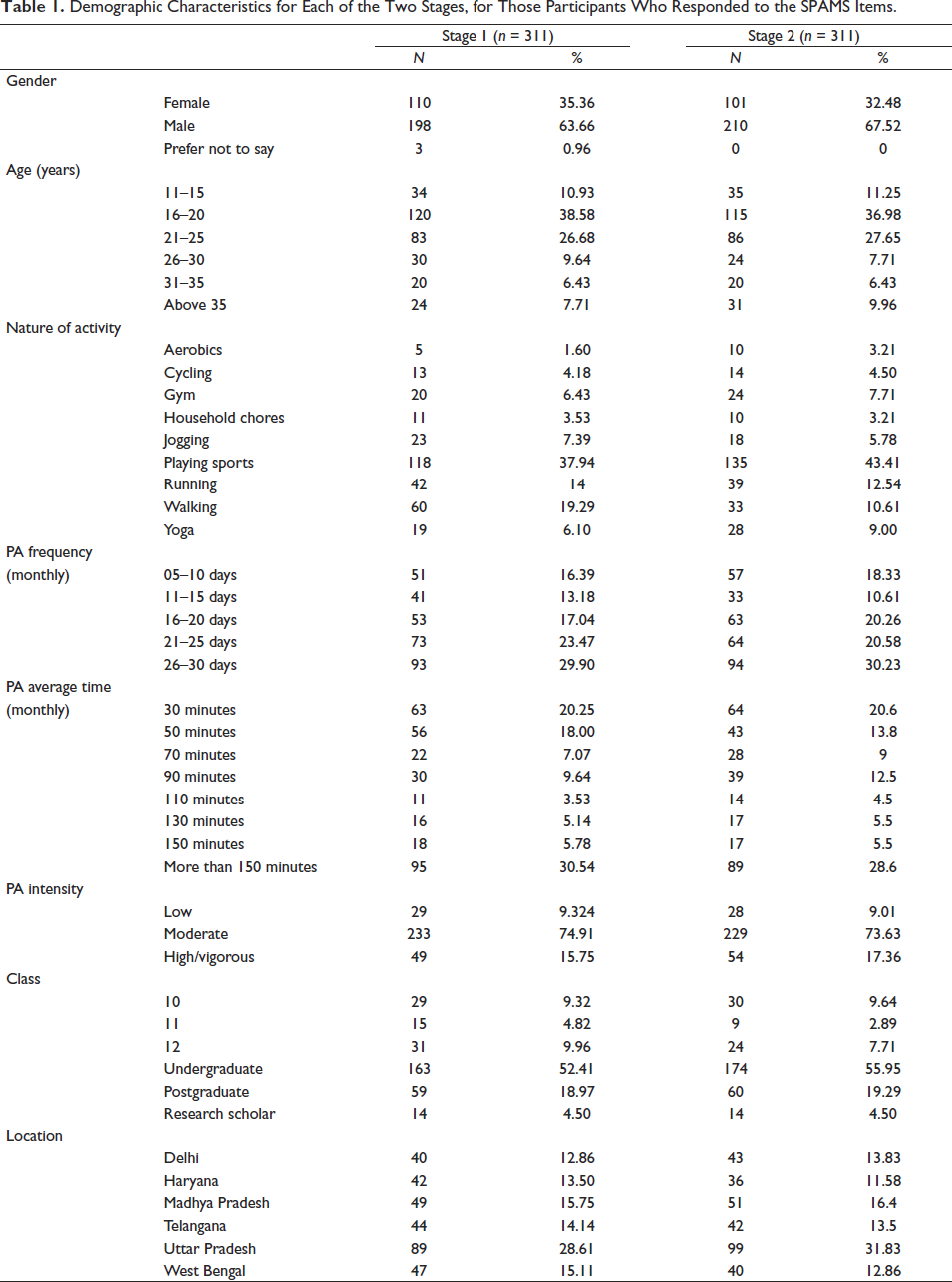
The survey was completed by a total of 622 participants. The demographic profile of the respondents (as described in Table 1) shows that 408 (65.59%) respondents were males, and 211 (33.92%) were females.
Demographic Characteristics for Each of the Two Stages, for Those Participants Who Responded to the SPAMS Items.
Kline (2005) suggested that both experimental (e.g., factor loadings) and substantive contemplations (e.g., hypothesis, rationale) be utilised within the re-specification of a scale. Thus, we fundamentally utilised the factor loadings from things.
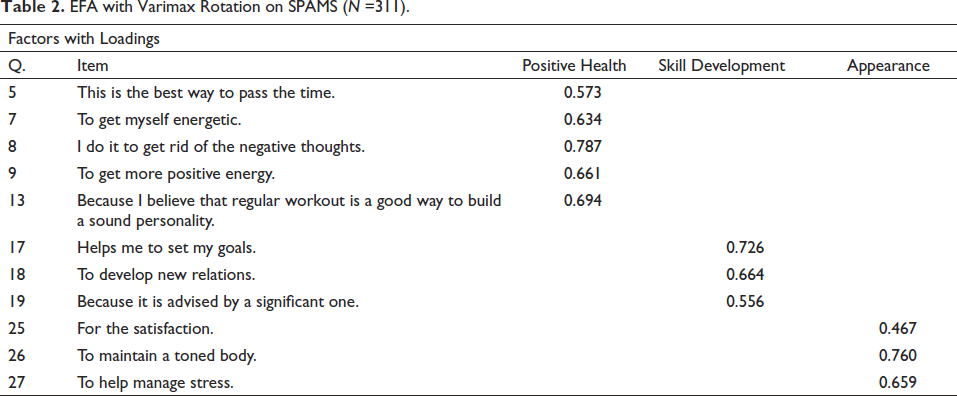
To determine the number of factors, several criteria, including differences between adjacent eigenvalues, a scree plot and differences in the percentage of variance, were used. Of the 29 items, 18 items with low factor loadings (≤0.40) were excluded from the analysis. The final scale suggested 3 factors consisted of 11 items, each factor being measured by 3–5 items and all items loading ranged from 0.467 to 0.787 (Table 2). These factors had eigenvalues of 5.77, 1.79 and 1.02, respectively, accounting for 66.41% of the total variance.
EFA with Varimax Rotation on SPAMS (N =311).
Internal Consistency
A reliability analysis (Cronbach’s alpha) for each factor/subscale was performed to determine the contribution of each item to its respective factor. Reliability analyses showed that scale and subscales had at least acceptable internal consistency. According to the Gliem and Gliem (2003) the cronbach’s alpha was excellent for SPAMS (0.91), good for positive health (0.88) and appearance (0.88), and acceptable for skill development (0.75).
Stage 2 Scale Validation
In stage 2, we attempted to test the factor structure in a different sample (Table 1) using CFA. A new sample (N = 311) was selected from the different institutions by using the same procedure. Using the maximum likelihood estimation, CFA was carried out with the Lavaan package on R to examine whether the three-factor structure developed in the first sample was replicated and to assess the fit of the model. There were no missing data, and no items had insufficient variation in the responses. The CFA yielded a good fit of this model (Table 3) to the data in which each of the 11 items is shown (Figure 1) with a path connecting it to the appropriate motive among the three subscales (positive health, skill development and appearance).
Model Fit Indices for the Data Collected Using SPAMS.


Internal Consistency
Reliability analyses suggested that scale and subscales had at least acceptable internal consistency. Cronbach’s alpha was good for SPAMS (0.87), positive health (0.84) and appearance (0.80) and acceptable for skill development (0.72).
General Discussion
The overarching point of this study was to create an instrument to recognise the students’ motives for physical activity. The findings indicate a model of SPAMS, conceptually and empirically developed using three subscales with 11 items. According to Deci et al. (1991), socio-contextual variables affect motivation when they influence the degree to which people fulfil the three essential mental needs of competence, autonomy and relatedness. The three subscales calculation structure was replicated overall two stages, and all of the ultimate subscales had great confronted validity, conceptual clarity and internal consistency. The subscales are depicted in more detail below.
Positive Health
This subscale consists of five items to indicate the positivity towards health and well-being. Physical activity is considered to be a positive health measure. Physical activity and workouts, when embraced routinely, are profoundly useful for well-being and physical and mental well-being (U.S. Department of Health and Human Services, 2008). Health and wellness are a strong motivational factor that stimulates youth to participate in physical activity. In India, the syllabus of physical education has been revised by the leading academic boards, new syllabi are conveying positive notes on health and wellness; therefore, now the students are taking a serious interest in physical education activities. Item no. 5, ‘this is the best way to pass the time’, seems awkward in this subscale, but the good factor loading (0.573) has considered retaining this item in the scale. High loading in this item seems to be a paradigm shift in the attitude among students who have also started realising that involving inactivity could be a more fruitful time-pass activity than sitting in front of a screen. Youth is also facing lots of psychological challenges and the biggest of them all is insomnia. Probably, some of them might have realised the need of engaging in physical activity and sports.
Skill Development
This factor included items related to skill learning by being involved in physical activities. Most students do not take an interest in physical exercises and sports to learn skills but do it for other reasons such as social interaction, aptitude competency or fair for fun (Turke, 2012). Statements like ‘To develop new relations’ and ‘because it is advised by a significant one’ are the testimony of the dual process which assumes that a friend reminded that you intended to go for a run or remembering that you had planned to go for a run that triggers automatic associations.
In recent research in India, skill development has also been identified as an important motive for sports participation (Shirotriya & Bose, 2020). Physical activity is an efficient way for students to develop social skills that can benefit them throughout their lives. Goal setting and developing good relations can be considered strong skills to excel in life. Relatedness, which is one of the major concepts in SDT, centres primarily on social settings and natural components that bolster or debilitate the improvement of social working, self-motivation and personal well-being (Deci et al., 2017; Ryan & Deci, 2000 a, 2000b). We retained item number 19 ‘because it is advised by a significant one’ because of its good factor loading, and it is a reinforcement skill that is an effective tool for motivating students. Nevertheless, the role of a significant one is inevitable for bringing about a desirous change among students.
Appearance
This factor included items related to appearance. Physical appearance is one of the primary personal characteristics taken note of by others and has a vital impact on social intelligence and thus has ended up critical build in modern social orders (Pop, 2017). Moreover, physical appearance is an integral part of overall self-esteem. Confidence in an individual appearance may help to self-esteem among students. Prima facie, item no. 27, ‘to help manage stress’, seems to be unfit under this subscale, but previous research suggests that body dissatisfaction and the recognition that one’s appearance is judged contrarily by others may be related to expanded stress. Besides, body dissatisfaction has been related to more noteworthy depressive side effects (Ferreiro et al., 2014). Youth, as a significant move organise, is profoundly impacted by the improvement of body picture (positive or negative), which in turn influences their body shape, weight status and appearance (Ahmed et al., 2020; Sabik et al., 2018). Based on self-determination theory motivation to lock in physical activity can incorporate inborn and/or outward viewpoints. Natural inspiration alludes to locks in a movement for joy and inborn fulfilment (Deci & Vansteenkiste, 2004).
Conclusion
This study demonstrated the reliability and validity of an 11-item scale to measure motives for students’ involvement in physical activity. Given the varying physical activity levels among changing sociodemographic bunches, there is a requirement for relevantly important intercessions pointed at expanding physical activity in youth populations in India. Recently, Ahmed et al. (2020) summarised that the incidence of non-communicable diseases has increased due to a disturbing obesity issue and an increment in the number of people locked in sedentary activities.
As a result, sports and physical education activities are being advanced as crucial for individuals to preserve sound ways of life and well-being.
For measuring physical activity and exercise-related motivation of students in early and middle adolescence, it is required to design specific physical activity programmes for them. Based on the findings, it can be concluded that SPAMS meets the concept and external validity criteria and that it is suitable for theoretical and practical applications.
Limitation
The survey has been sent to 800 students, and of these, 622 (77.75%) have responded, as the students were engaged in fully online classes and all were heavily engaged with their assignment submission, so the majority of respondents did not respond to our research. It would be more comprehensive if a similar study could also be conducted all across the country with the same sample size. The authenticity of the responses with an e-survey of school students cannot be judged. Because participants were approached through web-based platforms, the nonprobability sampling method used in this study may be considered a selection bias.
Recommendation
The SPAMS has the potential as a tool for researchers wanting to assess motives underlying students’ physical activity. With the rising cases of non-communicable diseases, specifically childhood obesity, the SPAMS might also be beneficial for use with populations to frame strong physical activity/physical education policies so that physical activities can reduce time spent on sedentary activities. A strength of the SPAMS is the vigour of the factor structure over different samples. Be that as it may, there were too few likenesses between the samples. To confirm the convergent validity of SPAMS, the relationship of this scale with other scales for measuring physical activity such as Physical Activity and Leisure Motivation Scale (PALMS; Molanorouzi et al., 2014) and Attitudes Toward Physical Activity Scale (ATPAS; Mok et al., 2015) should be explored. The study could present a few imperative suggestions for schools, colleges and as well as other capable offices for advancing physical activities. Future research is also needed to see if some reasons for physical activity are more applicable to certain groups of people than others. Finally, given the paucity of data on the relationship between physical activity motivation and objective indicators of accomplishment in physical education (such as grades, types of PA and so on), we recommend that more studies should be done in this area.
Footnotes
Declaration of Conflicting Interests
The authors declared no potential conflicts of interest with respect to the research, authorship and/or publication of this article.
Funding
The authors received no financial support for the research, authorship and/or publication of this article.