



Abstract
The impact of job demands on job performance is not always straightforward but relies on whether employees are burned out or engaged. Although such relationships were established previously based on job demands–resources (JD-R) theory in Western developed countries, evidence from Eastern developing countries is very limited. During the peak of COVID-19, this study was conducted to examine the impact of job demands on nurses’ job performance via the mediating role of work burnout and work engagement. By employing the tenets of the JD-R theory, the theory was tested through collecting data from 202 nurses who were working in Palestine. The SPSS statistical software (version 25) and partial least squares structural equation modelling (PLS-SEM) were used to analyse the collected data. The findings disclosed that work burnout was negatively related to job performance, and work engagement was positively related to job performance. Unexpectedly, job demand had a negative relationship with work burnout and a positive relationship with work engagement. However, work burnout and work engagement mediated the relationship between job demand and job performance. A discussion of the findings, contributions, implications, limitations and future directions is provided.
Introduction
Organisations, specifically those in the healthcare industry, encounter exponential pressures and unstoppable challenges. The growing costs of health care, technological advancement and new types of diseases such as the COVID-19 pandemic have placed unprecedented pressure on hospitals. Hospitals are innately stressful workplaces where nurses normally work in a life-or-death setting, which renders their work mentally, emotionally and physically taxing (Montgomery et al., 2015). Being a nurse during the COVID-19 pandemic is accompanied with a plethora of stressors beyond those experienced routinely (Baskin & Bartlett, 2021). Such stressors have affected nurses’ mental and physical health as they are responsible for maintaining the safety of infected people, whereas they are at immediate risk of becoming infected (Mihaylova et al., 2021). Consequently, the frequent exposure to substantial job demands is economically exhausting to hospitals and further contributes to diminishing overall quality of healthcare and might predispose patients to adverse consequences, such as morbidity and mortality (García et al., 2021).
According to the job demands–resources (JD-R) theory (Bakker & Demerouti, 2007), job demands indicate the tasks needed to be done in order to attain an organisational goal. Job demands are regarded as job stressors, which might augment strain and lessen nurses’ capability to perform their tasks effectively. Based on the National Academies of Sciences, Engineering, and Medicine (2021) Future of Nursing 2020–2030 report, the well-being of nurses is impacted by their job demands, which in turn affects their job performance. Job performance is known as a prime standard in gauging nurses’ contributions to the technical core of the job and to the social environment of hospitals (Greenslade & Jimmieson, 2007).
Previous studies have proposed that job demands may reinforce job performance, whereas escalating pressure upon employees undermines their job performance (LePine et al., 2005). It is therefore important to understand how job demands affect nurses’ job performance. It is also critical for healthcare management to know how to help nurses deal with job demands and maintain high levels of performance. Nevertheless, past studies on the relationship between job demands and job performance have demonstrated antithetical findings, with empirical studies concluding negative, positive, curvilinear, weak and no relationships (Gilboa et al., 2008; Lu et al., 2016; Nakagawa et al., 2014; Rosen et al., 2010). Those studies argued that the relationship is complicated, and the weak association between them could be due to the omission of possible intervening constructs that may mediate such relationship (Lu et al., 2016).
Based on JD-R theory, burnout can be an appropriate mediator as it is generated as a result of high job demands (Bakker & Demerouti, 2007). Burnout is a renewed epidemic and remains a predominant universal concern among employees (Hobfoll et al., 2018). It is considered as a fundamental workplace crisis that can have costly consequences for employees and organisations (Leiter & Maslach, 2016). From the nurses’ perspective, burnout has constantly been linked with adverse events, medical errors, low productivity, reduced efficiency, lower levels of motivation, job satisfaction and commitment to the hospitals and job turnover (Bunjak et al., 2021; Zangaro & Soeken, 2007).
However, burnout generates when there is an imbalance in the employees’ resources (Pennbrant & Dåderman, 2021). One significant resource that nurses bring to work is work engagement. If there is a deficiency in the nurses’ work engagement, the hazard of making a poor work environment escalates. Work engagement has been identified as one of the positive resources, which is deemed to be the precise antithesis of work burnout (Maslach & Leiter, 2016). Based on JD-R theory, work engagement enhances employees’ mental and physical well-being and diminishes the possibility of having work burnout (Loerbroks et al., 2017). For a profession that concentrates on saving humans, having disengaged nurses suffering from work burnout is undesirable and alarming in these unprecedented times.
Previous research has displayed that work engagement could be a preventative remedy for work burnout, and thus burnout can be alleviated when organisations intensely implement programs which strengthen work engagement (Maslach & Leiter, 2016).
However, although a great amount of research has tested the mediating roles of work burnout and work engagement in the relationship between job demands and work outcomes based on JD-R theory, the majority of these studies have been conducted in the Western context. Thus, such study has not been sufficiently tested in the Eastern context and is very limited in Arab countries (Hamdan & Hamra, 2017). As such, nursing is a profession that is extremely dependent on the context. For example, nursing in developed countries such as Switzerland, the United Kingdom and Australia is different from nursing in developing countries such as Indonesia, Ghana and Bolivia as well as is different from conflict zone countries such as Yemen, Syria and Palestine. The differences engender due to the diversity in values and cultures, differences in national policies and community beliefs, and the availability of resources, among other aspects. Hence, it is plausible to say that nurses encounter different job demands from country to country. In this regard, it was necessary to test the JD-R theory in one of the developing Arab countries. In Palestine, the situation is extremely unique as Palestinian healthcare sector, especially in the Gaza Strip, is suffering from many crises such as limited funding, insufficient medical supplies and essential medicines, blockades, internal political divisions and wars’ consequences (Abu Dalal et al., 2021; Keelan, 2016). In such, the latest war in May 2021, in parallel with the COVID-19 pandemic, has imposed huge job demands on Palestinian nurses as they had to deal with the influx of casualties and infections respectively (Abu Dalal et al., 2021; Maraqa et al., 2020). These challenges, coupled with increasing workloads, work–life imbalance and job insecurity, have highly exacerbated the job strains among nurses and dampened their ability to perform the required tasks (Blome & Safadi, 2016), ultimately undermining the provision of healthcare service and organisational effectiveness (Dahleez et al., 2022). Under the light of these environmental and professional hazards, it is significant to examine the effect of high job demands on job performance. Despite the significance of our study, our literature review did not find any empirical studies that investigated the impact of job demands on job performance, neither with work burnout nor with work engagement in the Palestinian context, especially in the healthcare sector. To address these gaps in the literature, we aimed to (a) examine the direct impact of job demands on work burnout and work engagement, (b) investigate the relationship between work burnout and work engagement with job performance and (c) assess how work burnout and work engagement may mediate the relationship between job demands and job performance.
Theoretical Framework and Hypotheses Development
The theoretical framework of the study was built on the basis of the JD-R theory. The JD-R theory elucidates how job strain (i.e., burnout) and motivation (i.e., work engagement) can be generated by two specified sets of working conditions, which could occur in all organisational contexts irrespective of the profession’s type: (a) Job demands and (b) job resources (Demerouti et al., 2001).
Job demands indicate psychological, physical, organizational or social aspects of the profession, which demand constant psychological and/or physical efforts and are therefore accompanied with particular psychological and/or physiological costs (Bakker & Demerouti, 2017). Job demands can emerge in the form of poor environmental conditions, high work pressure and emotionally demanding interactions with patients, clients or customers. In this study, we examined three specific types of job demands: (a) Cognitive demands, which primarily impinge on brain processes involved in information processing, (b) physical demands, which denote dynamic and static physical exertion at workplace and (c) emotional demands, which indicate the needed efforts to cope with job-ingrained emotions during interpersonal dealings (de Jonge et al., 2012).
On the other hand, job resources are defined as psychological, physical, organizational or social aspects of the profession, which are instrumental in attenuating the associated psychological and physiological costs of job demands. They are critical for accomplishing organisational targets and invigorating personal growth, learning and development (Bakker & Demerouti, 2007).
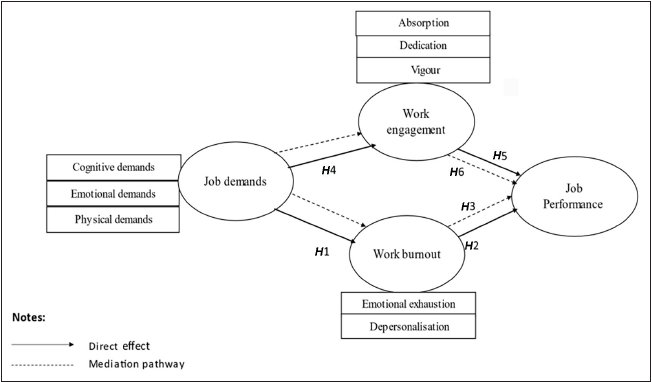
Based on the JD-R theory, extreme job demands with a shortage of job resources drive to health impairment such as mental and physical ill-being and stress (Bakker et al., 2004). Bearing the above in mind, job demands are normally the most significant predictors of negative outcomes such as work burnout because job demands basically consume energetic resources (Hakanen et al., 2008), whereas job resources are recognised as the most significant predictors of work engagement because they fulfil the basic psychological needs, such as the needs for autonomy, competence and relatedness (Nahrgang et al., 2011). Putting JD-R theory into consideration, the phenomenon under examination is explained in Figure 1.
Research Model.
Job Demands and Work Burnout
Work burnout indicates a state of mental, emotional and physical exhaustion occurring from dealing with emotionally demanding situations. It is commonly described as ‘a situation of exhaustion in which individual is cynical about the occupation’s worth and doubtful of one’s ability to perform’ and is characterised by emotional exhaustion, depersonalisation and a reduced personal accomplishment (Maslach et al., 1996). Emotional exhaustion is defined as feelings of being overextended by the emotional demands of one’s job. Depersonalisation is a negative, cynical and detached response to the job itself and/or to the people (i.e., patients, colleagues, managers) with whom employees interact while performing their tasks, whilst reduced personal accomplishment refers to a decline in one’s feelings of competence and of successful accomplishment at work (Leiter & Maslach, 2016).
Having said that, the relationship between job demands and work burnout can be appropriately understood through JD-R theory (Bakker et al., 2004), which argues that excessive job demands with a lack of job resources are disposed to arouse negative symptoms in employees (Bakker & Demerouti, 2017). According to this theory, when nurses are extremely and persistently prone to high job demands, their psychophysiological systems stay operative, psychological and physiological costs amass, and negative effects, such as burnout, can emerge (de Vries & Bakker, 2021). In other words, high job demands require nurses to function extra time and utilise more energy to achieve their tasks. The additional energy and time needed may make nurses feel mentally, psychologically and physically drained, driving to burnout (Geisler et al., 2019). Based on this theory, excessive job demands in the workplace usually exacerbate employees’ weariness, nervousness and hopelessness, thus leading to emotional exhaustion (Nasharudin et al., 2020). This is consistent with conservation of resources (COR) theory (Hobfoll et al., 2018), which illustrates how overtaxing job demands may likely diminish nurses’ resources, driving to energy depletion and thus burnout. Previous studies have asserted that under situations of high job demands, employees’ function more, have lower level of satisfaction with their work–life balance, and are more likely to feel stressed, depleted and thus burned out (Bunjak et al., 2021). In addition, there is powerful empirical evidence for this strain process, showing that job demands have a positive relationship with work burnout in several organisational settings, especially in healthcare context (García & Ayala Calvo, 2020; García-Sierra et al., 2016; Maglalang et al., 2021). Therefore, based on the JD-R theory and in line with above considerations, we formulate the first hypothesis for this study.
H1: Job demands positively influence work burnout.
Work Burnout and Job Performance
Job performance indicates those conducts and actions that are under the control of the employees and contribute to the organisational goals (Rotundo & Sackett, 2002). Borman and Motowidlo (1993) proposed that job performance can be divided into two different sets of behaviours: In-role behaviours (i.e., task performance) and extra-role behaviour (i.e., contextual performance). Hence, task performance is defined as the effectiveness with which employees perform tasks that are formally regarded as part of the job and that influence the technical core of the organization, either directly by carrying out a part of its technical process or indirectly by providing it with needed services or materials (Borman & Motowidlo, 1993). On the other hand, contextual performance indicates employees’ voluntary actions and activities that are beyond the fundamental requirements of an individual job position and are not officially stated in their job description but help in moulding the psychological, social and organisational contexts (Borman & Motowidlo, 1993).
Based on Hockey’s (1993) control model of demand management, employees may adopt a performance protection strategy when encountered with extreme job demands. During such process, they will mobilise additional energy to recompense fatigue through mental efforts. This implies that when nurses become drained under the effect of environmental demands, they may not be able to perform their tasks well due to decline of energy resources.
In other words, nurses suffering from burnout pull out mentally, physically and emotionally from interactions with patients, endangering the quality of caregiving (Montgomery et al., 2015). Previous studies have demonstrated that nurses inflicted by burnout mostly experience discontent, pessimism, dismay and fatigue, which can discernibly affect their job performance (Rudman & Gustavsson, 2012). From a theoretical perspective, burnout is negatively associated with job performance in JD-R theory (Bakker & de Vries, 2020). Thereby, previous empirical research has argued that a high level of work burnout decreases job performance (Dyrbye et al., 2019; Pourteimour et al., 2021; Sharma & Dhar, 2016). Employees’ job performance is compromised because burned-out individuals need to invest extra effort and time in implementing their tasks (Bakker & Costa, 2014). In addition, the adverse emotions, which are consequences of burnout, confine the thought processing breadth and weaken decision-making quality (Fredrickson, 2001). Employees who undergo unfavourable emotional status are psychologically disconnected from their tasks, show few approach behaviours towards people, and are more exposed to counterproductive work behaviours such as taking longer breaks, withholding information and even stealing (Penney & Spector, 2008). Besides, burnout has been found to negatively correlate with contextual performance. Burned-out nurses are less likely to assist others and less willing to receive assistance from others, which may result in productivity losses and consequently poor job performance (Palenzuela et al., 2019). Hence, based on abovementioned arguments, we posit the following hypotheses:
H2: Work burnout is negatively related to job performance.
H3: Work burnout mediates the relationship between job demands and job performance.
Job Demands and Work Engagement
Work engagement can be defined as a positive, fulfilling and work-related state of mind characterised by vigour, dedication and absorption (Schaufeli & Bakker, 2004). Vigour indicates the willingness to invest effort into job and is characterised by high level of energy and mental resilience, whereas dedication points out robust involvement in job and is distinct by zeal and pride in the job and feeling of inspiration and challenge, while absorption is featured by being fully focused and happily engrossed in work (Schaufeli et al., 2006).
According to JD-R theory, the extent to which employees are focused, enthusiastic and energetic in their jobs is extremely influenced by their work environment (Bakker & Demerouti, 2014). High job demands are expected to trigger the process of energy depletion and exhaustion of energetic resources, which may end up in high level of strain and consequently health issues. Previous studies have figured out that job demands may diminish work engagement among nurses. For instance, attempting continuously to cope with conflicting standards and high job demands may exhaust nurses, diminishing their capability and willingness to engross themselves in their work roles (Montgomery et al., 2015).
In addition, a conceivable clarification was presented by Schaufeli, Bakker et al. (2009) and Schaufeli, Leiter et al. (2009), who expounded that high job demands may lessen energy level in the employee body’s systems. Hence, drain of energy tends to compel the systems to function harder than normal. This situation renders employees to feel weak when performing their jobs, which probably impinges their level of engagement at work. Thus, a low level of capability to tackle the resulting stress may impact the psychological and physiological body systems. Such process may diminish self-enthusiasm among employees, which in turn may deteriorate their engagement at work (Nasharudin et al., 2020). Besides, Mauno et al. (2007) found that high job demands reduced the work engagement level among Finnish healthcare employees. This line of thought, therefore, has led to the formation of the following hypothesis.
H4: Job demands negatively relate to work engagement.
Work Engagement and Job Performance
Kahn (1990) suggested that the meaningfulness and importance of the goals, the safety of the environment and availability of resources when needed stimulate employees to be fully and psychologically present in the workplace and more willing to invest their abilities and energies into effectively performing their jobs (Mukaihata et al., 2019). Engaged employees are anticipated to perform their jobs better through experiencing positive emotions and better health (Borst et al., 2019). In other words, employees with high level of work engagement have higher levels of vitality, passion and enthusiasm towards their jobs. They are more likely to be fully engrossed in their tasks and more willing to assist their coworkers, which may increase their performance (Bakker & Albrecht, 2018). Accordingly, previous studies have shown that work engagement boosts nurses’ performances (Salanova et al., 2011; Toyama & Mauno, 2017).
Moreover, the potential mediating role of work engagement in the job demands-performance relationship may be expounded by self-exchange theory (SET). Generally, job demands in the workplace are observably associated with the level of work engagement. Specifically, when employees are performing in a lower job demands workplaces, higher work engagement is recorded (Bakker et al., 2007; Nasharudin et al., 2020). This reciprocity is considered as an interdependence exchange in SET, which posits that positive relations between the management and the employees boost employees’ positive behaviour towards work, resulting in a higher level of job performance (Cropanzano & Mitchell, 2005). Based on the above discussion, the following hypotheses were formulated:
H5: Work engagement is positively related to job performance.
H6: Work engagement mediates the relationship between job demands and job performance.
Methods
Study Setting, Sample and Procedure
We adopted a cross-sectional design utilising self-administered questionnaires. The targeted respondents were nurses providing primary, secondary and tertiary healthcare services under the Ministry of Health in Gaza Strip, Palestine. Purposive sampling was recruited from August to September in 2021 to approach the nurses in the largest five public hospitals in the five governorates in Gaza Strip. In addition, the study was approved by the ethics committee of Directorate General of Human Resource Development and Palestinian Health Research Council Helsinki Committee, which are related to Palestinian Ministry of Health. Regarding recruitment, we approached the administrations of Palestinian public hospitals to get the permission for conducting this study. Once permission was obtained, we distributed the survey with the assistance of each hospital’s appointed supervisor. We informed all the participants about the aims and the course of the study, as well as their rights to participate and withdraw at any time during the study. We confirmed their anonymity and confidentiality, and we started collecting the data after obtaining their participation consent to ensure that their participation was completely voluntary. Hence, we distributed 300 questionnaires to registered nurses working in various wards and who had been working in their hospitals for at least 1 year. In such, 202 completed questionnaires were received back, which denoted a response rate of 67%. In addition, the study protocol was prepared in line with the Helsinki Declaration (World Medical Association, 2013).
Measures
We utilised a self-administered questionnaire as an instrument for data collection, which included five sections concerning the variables of the study, namely nurses’ socio-demographic data, job demands, work burnout, work engagement and job performance. All the item scales were adopted from past studies. Since the measurement items were developed in English, we had to accurately translate them from English to Arabic, as the respondents spoke Arabic. Therefore, we conducted backtranslation. Such procedure has been vastly applied to examine translation’s precision within a cross-cultural survey (Brislin, 1980). Hence, two bilingual experts working at Islamic University of Gaza, Palestine, compared the translated instruments with their original English version to evaluate if any contradiction in semantic equivalence occurred. Then, the quality of Arabic version was confirmed. In addition, we performed a pre-test and pilot test to ensure the survey is valid before collecting the data.
Job Demands
We chose the Demand-Induced Strain Compensation (DISC 2.1) questionnaire, which was developed by de Jonge et al. (2009), to assess the job demands. The scale consists of 16 items. It gauges three subdimensions of job demands: Cognitive demands (five items), emotional demands (six items) and physical demands (five items). Examples of items are: ‘I have to make complex decisions in the workplace’ (cognitive demands); ‘I have to do a lot of emotionally draining work’ (emotional demands); and ‘I have to perform a lot of heavy physical-related tasks’ (physical demands). The scale ranged from 1 (strongly disagree) to 7 (strongly agree). The values of Cronbach’s alpha of cognitive demands, emotional demands and physical demands were 0.88, 0.82 and 0.80, respectively.
Work Burnout
We selected the Maslach Burnout Inventory (Maslach et al., 1996) to measure the two core dimensions of job burnout: Emotional exhaustion and depersonalisation. We excluded the reduced personal accomplishment because it has constantly been found to show a relatively low correlation with emotional exhaustion and depersonalisation and a different pattern of correlations with other variables (Xanthopoulou et al., 2007). However, emotional exhaustion (e.g., I feel emotionally exhausted because of my work) consists of nine items, and depersonalisation (e.g., I have become more callous to people since I started doing this job) contains five items. Respondents were asked to indicate how frequently they experience a particular aspect of burnout using a 5-point scale ranging from never = 1 to always = 5. The reliability of emotional exhaustion was 0.92, while depersonalisation was 0.86.
Work Engagement
We adopted the short version of the Utrecht Work Engagement Scale for students (UWES-S) (Schaufeli et al., 2006) to assess work engagement. The scale includes nine items evaluating vigour (e.g., I feel bursting with energy at my work), dedication (e.g., I am enthusiastic about my job) and absorption (e.g., I am immersed in my work). The responses were rated on a 5-point scale (1 = never; 5 = always). The scale had a good internal consistency, as the reliability of vigour was 0.86, dedication was 0.79 and absorption was 0.84.
Job Performance
Job performance was evaluated using a six-item questionnaire developed by the World Health Organization, as adapted by Kessler et al. (2003). This scale was selected because it is more appropriate for measuring the job performance of employees, especially the healthcare personnel. A simple item for this scale is ‘I always work at times when I was supposed to be working’. The scales ranged from 1 (strongly disagree) to 7 (strongly agree). The Cronbach’s alpha of job performance was 0.83.
Data Analysis
We employed the SPSS statistical software (version 25) for performing descriptive analysis [i.e., frequency distribution, mean and standard deviation (SD)]. We tested the research hypotheses using Smart-PLS version 3.0 (Ringle et al., 2015) following the partial least squares structural equation modelling (PLS-SEM) approach, which involves two steps: (a) analysis of the measurement model (i.e., convergent and discriminant validity) and (b) analysis of the structural model, which tests the direct relationships via bootstrap as well as investigation of the mediation effects.
Results
Descriptive Statistics
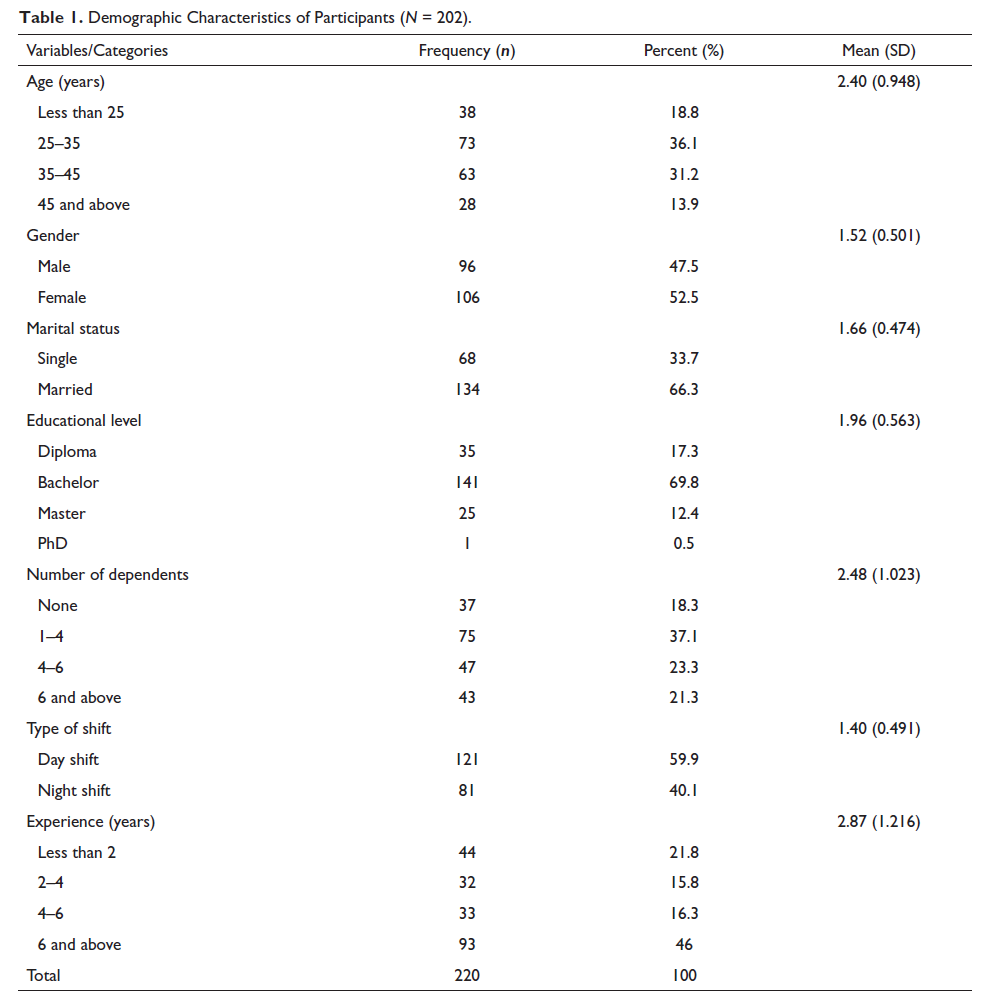
As can be seen in Table 1, the gender of the respondents was convergent, with a slight increase for females (n = 106, 52.5%), and most of them were married (n = 134, 66.3%). The mean age of nurses was 34.12 years (SD = 0.94), whereas solely 13.9% were above 45. Regarding educational level, more than two-thirds (n = 141, 69.8%) of the participants held bachelor’s degree, whereas only one participant had a PhD. By and large, more than 59% of respondents worked in a day shift, whilst 40.1% of them worked in a night shift. Interestingly, almost half of the respondents had over 6 years’ experience (n = 93, 46%), while only 44 participants had less than 2 years’ experience.
Demographic Characteristics of Participants (N = 202).
Common Method Variance
Common method variance (CMV) is a serious issue in the research, especially if data is self-reported or collected from a single source as in our study. However, we employed procedural remedies suggested by Podsakoff et al. (2012) in order to subdue the issue of CMV. As such, (a) we used instruments of different scales with different scale endpoints. (b) We incorporated questions related to demographic information between items, which measure the independent and dependent variables. (c) We emphasised the academic nature of the study to the respondents and assured their identities’ confidentiality throughout the process of data collection. (d) We averted employing any intricate or vague words to ensure better understanding from the respondents and to assure that all responses need similar efforts (Reio, 2010; Shuck et al., 2014). (e) We adopted the cognitive rigidity as a marker variable with three items developed by Oreg (2003). Although it was collected in the same questionnaire, it was not incorporated in the model being assessed. Example for the items is ‘Once I’ve come to a conclusion, I’m not likely to change my mind’. Hence, we established a method factor utilising the marker indicators as an independent variable, anticipating each dependent variable in the model. Then, we compared the method factor model with the baseline model. In such method, we regressed all study variables against a common variable. (f) We followed the suggestions of Hair et al. (2017) for testing the full collinearity. Hence, we regressed all study variables against a common variable. A variance inflation factor (VIF) of ≤3.3 denotes that there is no bias from the single-source data. In this study, the CMV resulted in a VIF of lower than 3.3, thus attesting that our collected data were not flawed by CMV issues.
Measurement Model
The study employed a two-step technique to evaluate the model’s validity. Prior to assessment of the structural model, we assessed the measurement model as the first step in PLS, following the approach of Ramayah et al. (2018). Measurement model entails assessing the convergent validity and discriminant validity. Convergent validity examines the degree of similarity between indicators for a specified construct, and it is assessed by indicators’ outer loadings, average variance extracted (AVE) and composite reliability (CR), which is employed to evaluate the internal consistency reliability of study variables (Hair et al., 2017). The values of the factors’ loadings require to meet the threshold of 0.708. The AVE must be ≥0.5, and the CR should exceed a value of ≥0.7, as a rule of thumb (Hair et al., 2017).
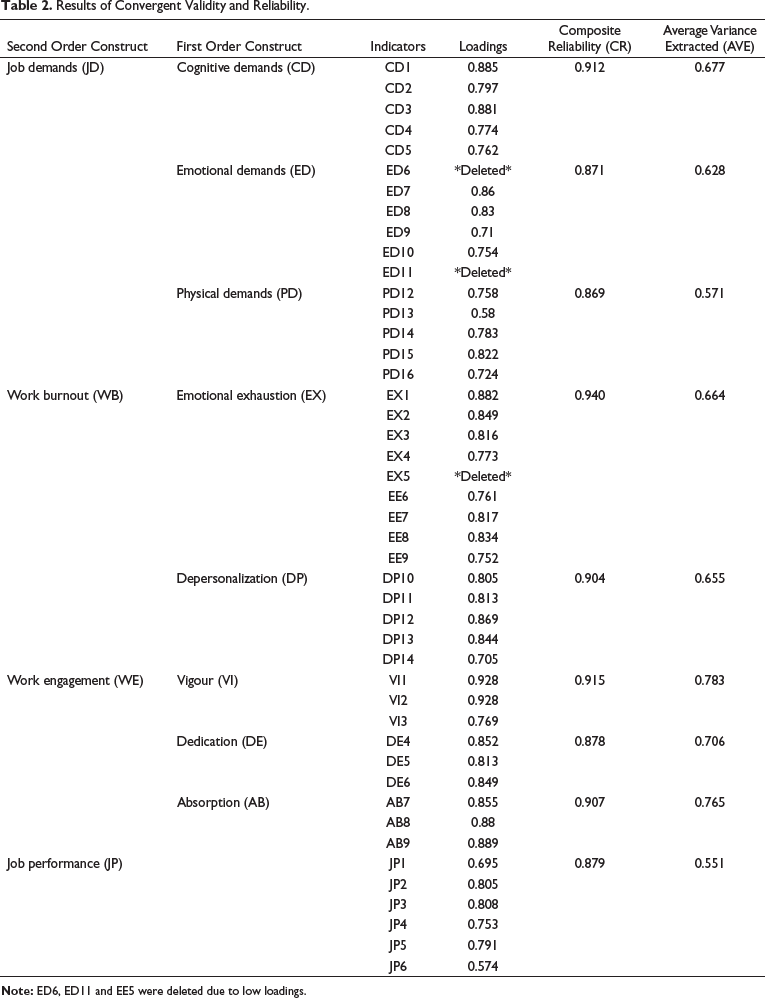
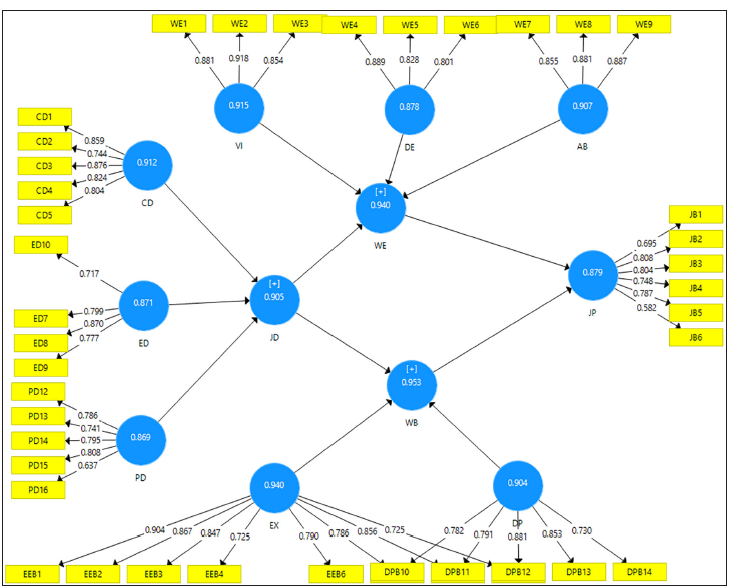
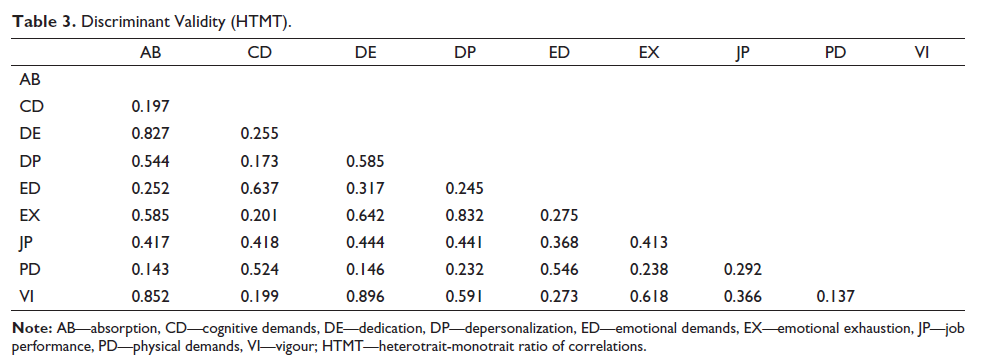
As shown in Table 2, the majority of the outer loadings were higher than the threshold of 0.708. The outer loadings of PD13, JP1 and JP6, which were lightly below 0.708, were retained because the AVE was greater than 0.50 (Hair et al., 2017). However, three items (e.g., ED6, ED11, EX5) were dropped due to low factor loadings, as can be seen in Figure 2. The CR of the variables ranged from 0.869 to 0.940, which is higher than the cut-off value of 0.70 (Hair et al., 2017). The AVE, which gauges the overall amount of variance in the indicators accounted for by the latent variable, surpassed the threshold of 0.5. Besides, we evaluated the discriminant validity employing the heterotrait-monotrait ratio of correlations (HTMT) criterion in the second step. HTMT criterion demonstrates the degree to which items are featured from one another (Gold et al., 2001). As shown in Table 3, all HTMT values were lower than 0.85 and 0.90, which proves that the discriminant validity was established. In other words, the measurement items and the model are valid and reliable.
Results of Convergent Validity and Reliability.
Discriminant Validity (HTMT).
Structural Model
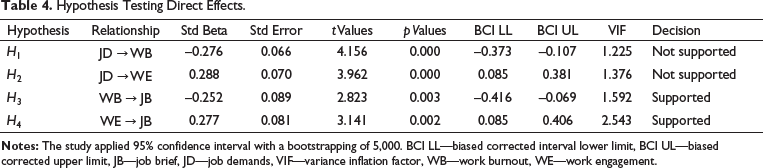
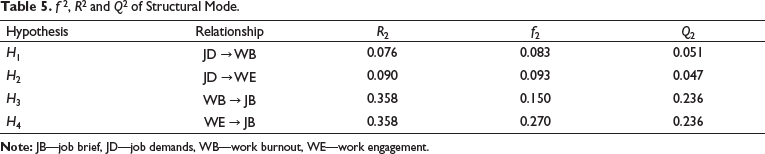
In prior to performing the structural model, the collinearity between study variables was assessed to assure that the structural model did not contain any lateral collinearity issue (Hair et al., 2017). As shown in Table 4, all VIF values range from 1.225 to 2.593 and are ≤3.3 (Hair et al., 2017), which indicates that collinearity was not a serious issue in the structural model. In addition, following the suggestion by Hair et al. (2017), we evaluated the multivariate skewness and kurtosis. The findings proved that all collected data were not multivariate normal according to Mardia’s multivariate skewness (β = 5.115, p < .01) and Mardia’s multivariate kurtosis (β = 62.566, p < .01). Next, we employed the bootstrapping of 5,000 subsamples technique in testing the path relationships of the model (Hair et al., 2017). As presented in Table 4, job demands negatively affect work burnout (β = –0.276, t = 4.156, p < .001) and positively influence work engagement (β = 0.288, t = 3.962, p < .001). Thus, H1 and H2 are not supported. Concomitantly, work burnout had a significant negative relationship with job performance (β = –0.252, t = 2.823, p < .003), whereas work engagement was found to have a significant positive relationship with job performance (β = 0.277, t = 3.141, p < .002). Hence, H3 and H4 are supported. Regarding the R2 values of endogenous variables, independent variables explained 35.8% of the variance in job performance as shown in Table 5. Following the guidelines of Chin (1998), R2 values of 0.19, 0.33 and 0.67 are identified to be weak, moderate and substantial, respectively. Thus, the R2 values of job performance fulfilled the acceptable levels of predictive accuracy (Chin, 1998; Cohen, 1988). Similarly, by following the guideline of effect size (f2) set by Cohen (1988), where 0.35, 0.15 and 0.02 denote large, medium and small effect sizes, respectively, we found that work engagement and work burnout have a moderate effect size of 0.150 and 0.270 on job performance, respectively. In addition, the blindfolding technique was carried out to evaluate the predictive relevance, which is only employed for reflective endogenous constructs (Hair et al., 2017). As shown in Table 5, the Q2 value of endogenous constructs was above zero, which discloses that our model had predictive relevance for the outcome variables. To measure the mediation effects, the significance of the indirect effects was tested; the bias-corrected and accelerated bootstrapping techniques were employed for this assessment (Hair et al., 2017). As proposed by Hair et al. (2017), the significant indirect effects are achieved at t values >1.96 and p values < .05. Table 5 shows the results, which denote that work burnout (β = 0.070, t = 2.049, p < .01) and work engagement (β = 0.091, t = 2.163, p < .01) mediated the significant indirect effects of job demands on job performance. In addition, the bootstrap confidence intervals of these results did not include zero, indicating the inclusion of mediation effects (Preacher & Hayes, 2008). Therefore, H5 and H6 were supported as illustrated in Table 6.
Hypothesis Testing Direct Effects.
f 2, R2 and Q2 of Structural Mode.
Hypothesis Testing Indirect Effects.

Discussion
We aimed to investigate the impact of job demand on job performance via the mediating role of work burnout and work engagement. As expected, our study found that work burnout had a significant negative relationship with job performance, which is in line with JD-R theory. This theory posits that work burnout contributes to diminishing job performance (Demerouti et al., 2001) and is compatible with previous empirical findings (Lemonaki et al., 2021; Palenzuela et al., 2019), which displayed that work burnout diminished nurses’ attention to their work, made nurses unable to recall significant details, to grasp new techniques and resolve a job-related issue, which in turn impede their job performance. Moreover, previous findings manifested that burnout is positively related to daily mistakes and lapses, misdirected conducts and perceptual failures, thus adversely impacting job performance (Lemonaki et al., 2021).
On the other hand, the findings showed that work engagement had a positive significant relationship with job performance. The result is consistent with the motivational process of the JD-R theory, which stipulates that engaged employees are more likely to perform well in their jobs (Bakker & Demerouti, 2017) and aligns with previous empirical studies that underscored that work engagement increases job performance (Bakertzis & Myloni, 2020; Zhang et al., 2022). Nurses who are engaged in their jobs are totally connected emotionally, cognitively and physically with their work tasks. They are fully energetic and possess a feeling of enthusiasm, importance and challenge (Borst et al., 2019). Nurses who prosper are capable to evolve friendly and trustful relationships with their surroundings and are willing to boost their potential, develop and flourish as an individual, which in turn drives to better job performance (Diener et al., 2010). Supporting the previous arguments, Bhatti et al. (2018) emphasised that engaged nurses were performing better than other nurses because they are open to new experiences, have positive emotions and have the passion for taking care of patients, which inevitably augments their job performance.
Surprisingly, our results disclosed that job demands had a negative significant relationship with work burnout. The result is compatible with Bakker et al.’s (2005) study, which found that high levels of job demands did not result in high levels of burnout when employees experienced high levels of work engagement and adequate job resources. In addition, our study found that the level of work burnout was moderate among nurses, whereas the level of work engagement was higher than work burnout. More importantly, previous cross-cultural studies have found that work stressors are perceived in several ways (Glazer & Gyurak, 2008; Nasharudin et al., 2020; Spector et al., 2002), and thus there is logical reason to believe that Palestinian nurses may also perceived some aspect of the job demands (i.e., cognitive, emotional and physical) as not part of these stressors. In addition, one interpretation is that Palestinian workers operate in extremely difficult conditions such as incomplete salaries, deep levels of poverty and political violence (Easton et al., 2017). Research has found that these workers often form bonds of solidarity through the lived experience of stressful conditions and collective trauma in Palestine and cultivate advanced coping strategies (Blome & Safadi, 2016). As such, they may view their profession as more than provision of vital human services to Palestinians living in poverty but also as a form of empowerment or national service. Thus, job stressors (i.e., job demands) may cultivate worker resilience and dedication to organizational goals. Therefore, we argue that Palestinian nurses may interpret job demands in a different mode compared with nurses in the Western countries.
In the same vein, we found job demand to have a positive and more significant relationship with work engagement. Indeed, we did not expect a positive relationship between job demands and work engagement. The literature associates job demands and work engagement negatively (Borst et al., 2017). However, previous studies argued that this relation is inconsistent, and the effect appears to rely on the nature of the demands measured as different demands may have different effects in different work contexts (Crawford et al., 2010; Demerouti & Bakker, 2011; Moreno-Jiménez et al., 2012). Hence, our findings are compatible with Inoue et al. (2013), Geisler et al. (2019) and Russell et al. (2020). It should be noted that although job demands are mostly deemed negative, they may not necessarily degrade the work engagement of employees in their workplaces and instead could establish challenging work environment where significance, eagerness and meaning are developed (Russell et al., 2020). Thus, Harter et al. (2002) suggested that work engagement manifests when employees sense they offer significative contributions to their work and have opportunities to develop and grow. This may have significant implications for work engagement and other outcomes. For instance, when nurses are granted opportunities to generate solutions to problems and innovate, which can be perceived as a job demand, work engagement is more likely to be reinforced. The previous argument leans on the transactional theory of stress, which posits that individuals appraise stressful positions such as job demands in terms of their significance for well-being as either potentially challenging or threatening (Lazarus & Folkman, 1984). Based on Crawford et al. (2010), if employees interpret job demands as hindrances, negative relationship with work engagement can occur. Whereas in the case of job demands are perceived by employees as challenges, positive relationship with work engagement is more likely to happen. This is compatible with Macey and Schneider’s (2008) argument, which stated that challenging situations (i.e., high job demands) boost engagement when employees are confident that their expending of time, energy and efforts would be rewarded meaningfully. In addition, Bolton (2001) found that engaged nurses had the capability to resist emotional demands. Hence, we argue that engaged Palestinian nurses mobilised the needed personal and job resources to resist job demands, enabling them to display a positive outlook of their circumstances and perform jobs of better quality. Moreover, in relation to the mediation pathway, we did find work burnout and work engagement mediated the relationship between job demand and job performance.
Theoretical Contribution
This study was conducted in one of the most unique environments, where people have been suffering since more than seven decades. The findings of this study therefore offer significant theoretical and empirical contributions to the literature of healthcare, nursing and positive psychology. First of all, this study broadens the knowledge concerning the buffering role of work engagement as a positive work attitude in the context of healthcare sector. Additionally, it examines the effectiveness of work burnout and work engagement as a mediator in the job demands–performance relationship within healthcare sector, highlighted by its obvious absence from the literature that investigates similar constructs in the Eastern context (Bailey & Cardin, 2018). Theoretically, this study contributes to the extant literature on healthcare sector, providing a profound understanding of how healthcare and nursing managers can develop and boost nurses’ work engagement in order to sustain a high job performance. Above and beyond that, Burke (2010) mentioned the difficulty of having data regarding workplace stress and work engagement outside the Western context due to lack of organisational research tradition in Eastern countries. Accordingly, most psychological theories were developed and investigated in Western settings. Therefore, we contribute to the literature by answering the call to investigate how well such theories apply in the Eastern context, especially in a fragile Arab country like Palestine. As such, most studies that have investigated the correlation between the variables of our study have been conducted in the Western setting. There is a dearth of studies that have appeared to examine such relationships in the Eastern setting, especially in the Middle Eastern and Arab contexts. Hence, our study plugged this gap in literature. In the same vein, to best of our knowledge, our study is the first to be conducted in Palestine from the general perspective (i.e., public sector, private sector, educational sector, banking sector, etc.) and in healthcare sector specifically. This research therefore contributes to the literature of work stress and psychology. Moreover, our study did not provide empirical support for the JD-R theory because we showed that job demands vary based on the context and scope, and thereby may not necessarily increase work burnout or reduce work engagement. However, further investigation is needed to investigate such issues in other healthcare sectors in the Arab developing countries where similar circumstances are common like Syria and Yemen.
Practical Implications
From a practical perspective, our study has crucial practical implications for Palestinian healthcare management. First, Palestinian healthcare management should consider the adverse effects of high job demands, which have resulted from COVID-19. Therefore, programs aim to diminish the exposure to high job demands, such as emotional demands and physical demands, should be implemented. Palestinian healthcare management should consider employing additional nurses to counter the excessive job demands. Thereby, workload may be diminished, and working conditions might be improved. Besides, we suggest that Palestinian healthcare management may consider job redesign in more efficient ways. Further, Palestinian healthcare management should conduct activities designed to boost the professional interactions and team spirit among nurses, which may minimise the level of stress and burnout related to job demands. Although our findings did not support that job demand necessarily increase work burnout, the healthcare management must not disregard the unfavourable consequences of work burnout, especially during COVID-19. Thus, Palestinian healthcare management must support nurses practically and psychologically to preserve their health in the short and long run. Hence, it is essential for healthcare management to conduct more interventions aimed towards fostering the psychological aspects of nurses such as psychological well-being, psychological capital (i.e., hope, optimism, self-efficacy, resilience), work–life balance and mechanisms for mental health support. In this regard, we strongly recommend Palestinian healthcare management to create mental health teams of psychiatric nurses and psychiatrists who may conduct psychosocial interventions to strengthen psychological resilience of nurses who are directly impacted by the pandemic. For example, Palestinian healthcare management can provide and implement psycho-education training courses for nurses to attenuate their level of burnout. In the same vein, the nurses’ work environment is stressful and complicated. Therefore, providing social support, which is one of the effective factors, may attenuate the level of nurses’ burnout. Thus, healthcare management should concentrate on sustaining a positive work environment. Third, our study has highlighted the paramount importance of work engagement. Hence, nursing management can benefit from such fruitful weapon. In addition, our results proved that reducing the exposure to job demands in order to augment work engagement is not the sole option. Instead, job resources should be adequately provided and fostered. Therefore, healthcare management should equip nurses with sufficient resources such as providing more effective incentives, implementing efficient training and development programs, reinforcing internal communication, providing mentoring opportunities, boosting job autonomy and performance feedbacks. Hence, those procedures may strengthen work engagement among nursing staff, which in turn may increase their job performance and thus patients’ safety. Based on foregoing, Palestinian healthcare management must constantly measure the level of nurses’ job performance to ensure the quality of healthcare services and patients’ safety, especially during times of crises such as COVID-19.
Limitation and Direction for Future Studies
Despite the significant implications, our study is subject to several limitations that open avenues for further investigation. First, our study relied exclusively on self-reported questionnaires, which may introduce common method bias. Although we provided evidence that common method bias is not an issue in our study, and simultaneously this method is reasonable in psychological studies, future studies should consider taking data from various sources (i.e., supervisor or peer rating). Second, our study is bound to a cross-sectional design; therefore, it is not probable to examine causal relationships. Hence, it is better to conduct a longitudinal study for more comprehensive and accurate view. Third, we only examined job demands and their relationships with work burnout, work engagement and job performance based on JD-R. We thus could not be able to investigate the role of job resources in such process. Accordingly, future research should examine job resources such as job autonomy or social support in order to explore the potential motivational role of job resources. Fourth, the focus of our study was only on nurses. However, it is highly recommended for future studies to examine the other healthcare staff such as managerial staff, physicians in various fields, surgeons and so forth. Fifth, this study was carried out solely in the healthcare sector. Consequently, it would be beneficial to aggrandise this study by investigating other sectors such as banking and educational sector. Finally, it would be interesting to conduct comparative studies using the same model at the national level to see differences between nations and how national culture may change the study’s results.
Conclusion
In short, the present study examined the impact of job demands on job performance via the mediating role of work burnout and work engagement under the lens of JD-R theory.
The findings of the study were inconsistent with studies conducted in Western developed countries. Bearing the above in mind, we argued that job demands differ based on the context and culture of the study and may not necessarily result in negative impacts on job performance. Besides, the findings of this study emphasised the effective role of work engagement in combating the effect of excessive job demands and attenuating the impact of resulting burnout, which in turn may influence positively job performance.
Footnotes
Declaration of Conflicting Interests
The authors declared no potential conflicts of interest with respect to the research, authorship and/or publication of this article.
Funding
The authors received no financial support for the research, authorship and/or publication of this article.