



Abstract
The study conceptualises COVID-19 fear among healthcare workers as a job resource (meaningfulness of work) and job demand (physical and emotional demands), while exploring its effect on healthcare workers’ job satisfaction and quality of work life. The potential numbing effect of emotional exhaustion on COVID-19 fear is studied in the proposed framework. Data were collected from 202 Indian healthcare workers using standardised scales and analysed using Smart PLS 2.0. The results indicate that COVID-19 fear has a significant positive relationship with job satisfaction and a significant negative association with quality of work. The study results validate the hypotheses that COVID-19 fear simultaneously acts as a job resource and job demand. COVID-19 fear had an indirect, negative effect on job satisfaction via reduced quality of work. Emotional exhaustion in healthcare workers reduced healthcare workers’ COVID-19 fears, suggesting a numbing effect of emotional exhaustion on the arousal of emotions. The study is among the first, to the best of our knowledge, that identify the same factor (COVID-19 fear) as both a job resource as well as a job demand for an occupational group (healthcare workers). The ability of COVID-19 fear to simultaneously increase the meaningfulness of the job for healthcare workers and reduce their quality of work life suggests that healthcare administrators need to espouse policies that simultaneously enable healthcare workers to perceive strong emotions that make the meaning of their job salient and buffer them from the emotional, cognitive and physical demands consequences.
‘If one does not know to which port one is sailing, no wind is favourable’. – Seneca Minor
Introduction
The coronavirus disease (COVID-19) pandemic poses a serious threat to human life and has upended economic activity globally. Healthcare workers play a key role in controlling and treating this highly infectious disease. However, as part of their duties, medical professionals are continually exposed to this virus and have a high chance of contracting it (Mertens et al., 2020). The continual exposure to the COVID-19 virus because of their job duties can impact the job satisfaction of health workers, which, in turn, can impact their retention (Santarone et al., 2020) and productivity (Penwell-Waines et al., 2018). The COVID-19 outbreak has brought a slew of difficulties for Indian healthcare workers. These dedicated professionals have faced elevated infection rates due to close contact with infected patients, leading to a shortage of personal protective equipment (PPE) during the early stages. The crisis has taken a heavy toll on their mental health, creating burnout, anxiety and despair, which has been aggravated by physical tiredness caused by prolonged hours and increasing workloads in the face of resource shortages. Furthermore, limited training and preparation put them at a disadvantage at first, while stigma and discrimination from their communities exacerbated their difficulties. During lockdowns, the pandemic also delayed ordinary healthcare services and caused financial pressure, with some healthcare personnel enduring salary cutbacks or the loss of extra income sources. Another problem was overcoming vaccine scepticism among healthcare personnel, which had an influence on total immunisation efforts. While attempts to resolve these challenges are likely to have been undertaken, continual support and recognition are required to guarantee the well-being of India’s healthcare workers. As the continued efforts of health workers are essential in countering COVID-19 and other health threats, it is imperative to understand the effect of COVID-19 fear on the job satisfaction of health workers.
Based on the job demands–resources (JD-R) model (Bakker & Demerouti, 2007), the study posits that fear of COVID-19 has contrasting direct and indirect effects on job satisfaction. By constantly highlighting the meaningfulness of their job, fear of COVID-19 might increase job satisfaction. At the same time, by placing higher physical and cognitive demands on healthcare workers in terms of working hours, safety requirements and fear of infection, fear of COVID-19 might lead to reduced job satisfaction via reduced quality of work life (QWL). The study tests the hypothesised, contrasting direct and indirect effect of fear of COVID-19 on health workers’ job satisfaction. As fear of COVID-19 is an emotion, the potential role of emotional exhaustion in moderating the relationship between fear of COVID-19 and job satisfaction is also tested.
The article is structured as follows. First, the existing literature is reviewed to identify theories and variables relevant to health workers’ job satisfaction. Second, hypotheses are formulated. Third, the hypotheses are tested and followed with it there is a discussion on the results and their implications. The article concludes after highlighting limitations in the research and areas for future research.
Theoretical Framework
The study assesses the impact of affective events on healthcare workers’ organisational satisfaction and work environments (Schaufeli & Enzmann, 1998). JD-R theory (Bakker & Demerouti, 2013) posits demands as factors causing strain and resources as factors improving satisfaction and engagement forms the theoretical bedrock of the study.
The JD-R model is one of the most widely used models in organisational behaviour literature. It characterises all job elements as demands and/or resources and postulates how differing combinations of demands and resources can lead to organisational outcomes. Broadly, the presence of adequate job resources enables employees to develop the self-efficacy that they can tackle work-related pressures, leading to lowered stress, improved engagement, improved satisfaction, improved perceptions of quality of work and reduced burnout. On the other hand, excessive job demands lead to feelings of inadequacy, leading to perceptions of burnout and reduced quality of life. The JD-R model has been used to study the negative effect of job demands on the job satisfaction of nurses (McVicar, 2016) and unspecified healthcare workers (Kaiser et al., 2020). JD-R model has also been used to conceptualise COVID-related changes in work schedules and arrangements as an additional job demand and support the negative effect of such job demands on job satisfaction (Chowhan & Pike, 2022). The JD-R model has also been used to explore the impact of job elements on nurses’ (Lu et al., 2011) and social workers’ (Geisler et al., 2019) perceptions of the QWL. Studies based on the JD-R model have also identified QWL as a mediator between job demands and resources and job satisfaction (Geisler et al., 2019). Hence, given the extensive theoretical and empirical backing behind the JD-R model and its use for relevant constructs and relevant samples, we have used it in our study.
Corona’s Fear and Job Satisfaction
Fear is defined as an adaptive response in the presence of danger. It is activated by a threatening stimulus (Steimer, 2002) and has been experienced in previous epidemics like severe acute respiratory syndrome (SARS) (Reynolds et al., 2008) or Middle East respiratory syndrome coronavirus (MERS-CoV) (Bukhari et al., 2016). Hence, we expect the current COVID-19 pandemic to generate fear among the populace in general and frontline healthcare workers in particular. The COVID-19 pandemic has increased the risk of psychiatric symptoms among healthcare workers working in the field of intensive or critical care, public health and emergency medicine (De Kock et al., 2021). Besides being a source of anxiety, the fear of COVID-19 can also augment the meaningfulness of the jobs of healthcare workers as their services are vital to securing life and health. Meaningfulness has been identified as a job resource (Albrecht et al., 2021). Availability of job resources augments job satisfaction.
Job satisfaction, defined as contentedness with work, leads to increased retention (Santarone et al., 2020) and productivity (Penwell-Waines et al., 2018). A study conducted on frontline workers at the time of COVID-19 concluded that despite the exposed risk to infections, the workers worked hard to save the lives of people with high satisfaction as their work was recognised and appreciated all over the world
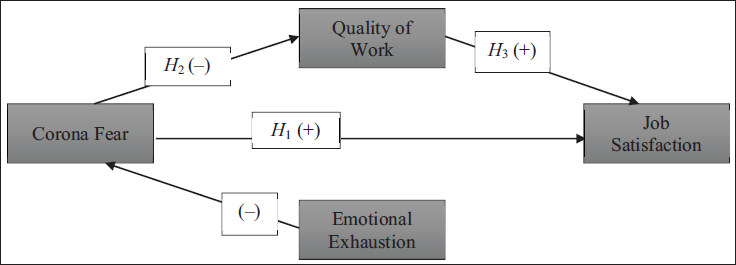
H1: Corona fear has a positive effect on job satisfaction.
Corona’s Fear, Quality of Work and Job Satisfaction
Martel and Dupuis (2006) defined QWL as the condition experienced by an individual based on their perceptions of the desired and actual completion of goals at a given point in time. The high gap indicates low QWL and the low gap indicates high QWL. The multifarious safety and work-related demands imposed on healthcare workers while working to serve COVID-19 patients and the high probability of experiencing failure, that is, the death of patients, are likely to lead to low QWL.
The COVID-19 pandemic tends to lower workers’ QWL (Majumder & Biswas, 2021). Nurses working during COVID-19 experience low QWL, with physical/mental deficiencies, due to work pressure and long working hours (Nikeghbal et al., 2021). The negative impact of COVID-19 on health workers’ QWL has also been observed in other studies (Maqsood et al., 2021). The pandemic has shown various negative psychological impacts affecting the mental health and QWL in frontline workers (Al Dhaheri et al., 2021). The differential impact of the crisis impacted the quality of work and private life in German and Swiss employees affecting mental well-being and self-rated health (Tusl et al., 2021). So, the study hypothesised that:
H2: Corona fear hurts the quality of work.
High QWL indicates that work goals are being met (Martel & Dupuis, 2006), and this is likely to result in greater contentedness with work, that is, higher job satisfaction. Numerous studies have validated the reasoning that high QWL increases job satisfaction (Aruldoss et al., 2020; Dhamija et al., 2019; Seibert et al., 2001). Hence, in line with earlier studies, the study hypothesises that:
H3: Quality of work in health workers shows positive relations with job satisfaction.
Emotional Exhaustion and Corona Fear
Affective events theory suggests that work environment and work events activate affective states in employees that, in turn, influence their job-related attitudes and performance (Weiss & Cropanzano, 1995). A corollary of the basic propositions of affective event theory is that structural factors that contribute to emotional exhaustion and depersonalisation would also lead to emotional numbing. Emotional exhaustion is defined as the state of feeling emotionally drained and worn out due to the accumulated stress resulting either from work or personal life (Zohar, 1997).
Emotional exhaustion has been found to lead to emotional numbing (Peng et al., 2016). Healthcare workers are likely to experience emotional exhaustion due to physical and emotional demands such as an increased number of patients and emotional strain arising from continuous interaction with chronic patients (Dorz et al., 2003). During COVID-19 times, the probability of healthcare workers experiencing emotional exhaustion has increased due to problems such as long working hours, lack of safety equipment, the imbalance between work and home and lack of autonomy (Van den Broeck et al., 2016). The emotional numbing resulting from increased emotional exhaustion is likely to diminish the activation of all emotions including corona’s fear. Therefore, the fourth hypothesis of the study is as follows:
H4: Emotional exhaustion shows significant negative effects on corona fear.
The proposed conceptual framework of the study is presented in Figure 1.
Hypothetical Framework.
Methodology
Design and Procedure
This study took place empirically on health professionals currently working in India during the pandemic COVID-19. The sample constituted of health sector organisations (public and private) operating in the following states and union territories—New Delhi, Haryana, Jharkhand, Jammu and Kashmir, New Delhi and Uttarakhand from August to October 2020 The data were collected through face-to-face interaction with 202 healthcare workers comprising doctors, residents, patient care technicians, nurses and interns. The sample constituted of 143 males and 59 females. The age of health workers was between 25 and 65 years. Standardised tools were used in collecting the data on a seven-point Likert scale. The following scales were used: Fear of COVID-19 scale (FCV-19S) by Ahorsu et al. (2020); job satisfaction and quality of work were taken from the organisational commitment scale (OCS) by Hyde and Roy (2006); and emotional exhaustion from Maslach Burnout Inventory (MBI-ES) by Maslach and Leiter (2016).
Results
Data Analysis
In the study, partial least squares structural equation modelling (PLS-SEM) is used to construct and test the structural equation models containing reflective constructs. G*Power is a statistical package for calculating the minimum sample size for PLS-SEM. It recommended a sample size of at least 91 for achieving a statistical power of 95% (Faul et al., 2009), suggesting an adequate sample size.
Measurement Model
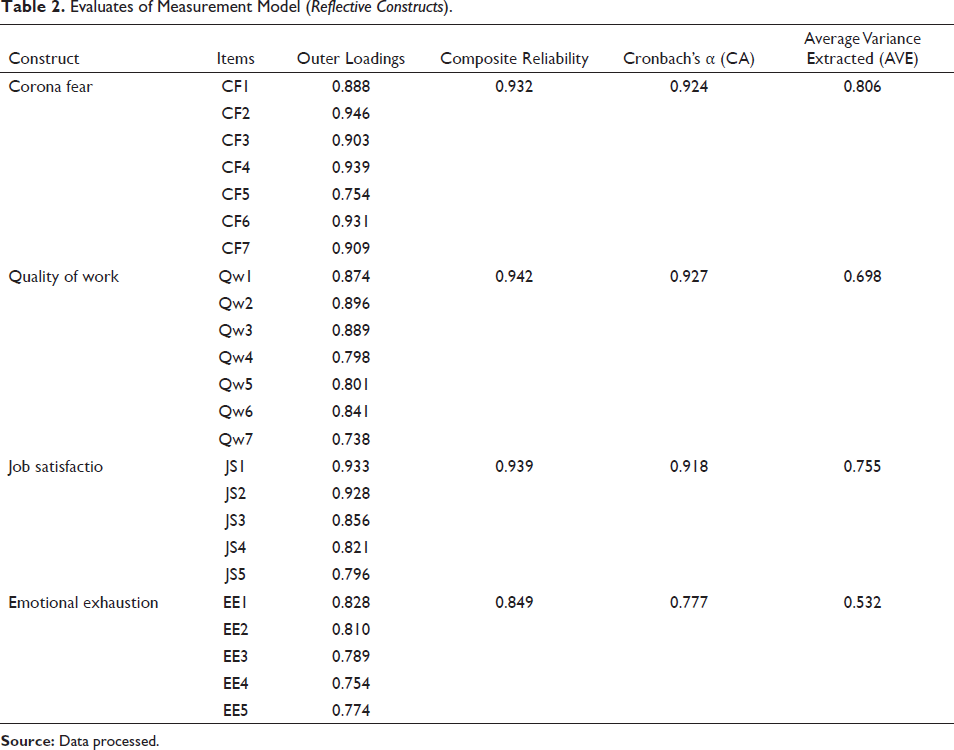
Recent standards for PLS-SEM software were used to evaluate the study’s structural and measurement model. Hair et al. (2011) found that removing low-loading items enhances the measurement model, hence factors with low loadings (0.7) were eliminated. The reliability, convergent validity and discriminant validity of the measurement model were all assessed. The measuring model for the research is shown in Table 1. All items had outer loading values greater than 0.5 (Hair et al., 2017), with the majority of items loading near 1. This shows that the measurement model is of high quality (Hair et al., 2017). Cronbach’s and composite reliability were used to assess the internal reliability of model constituents, both of which were higher than the minimum acceptable value of 0.70 for all constructs (Hair et al., 2011).
Evaluates of Discriminant Validity (Fornell–Larcker Criterion).

Discriminant and Convergent Validity
The discriminant validity of the construct demonstrates the distinctiveness of the constructs from other constructs in the measurement model, and convergent validity demonstrates the correlation reflected by the multiple indicators of the same construct (Hair et al., 2017). The discriminant validity is evaluated through cross-loading indicators of Fornell–Larcker criteria with values closer to 1 indicating adequate discriminant validity (Hair et al., 2017). Table 1 indicates sufficient discriminant validity for all the constructs. Convergent validity is demonstrated if the factor loadings, composite reliability and average variance extracted (AVE) exceed the threshold of 0.5 (Hair et al., 2017). Composite reliability for emotional exhaustion is 0.849, Cronbach’s alpha is 0.777, and AVE is witnessed as 0.532, which are acceptable. Table 2 indicates adequate convergent validity for all the constructs.
Evaluates of Measurement Model (Reflective Constructs).
Structural Model
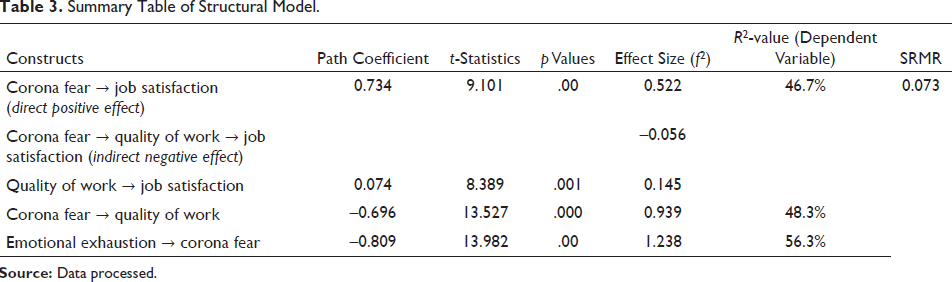
In the structural model, the significance of path coefficients for exogenous (independent) and endogenous (dependent) constructs is studied (refer Figure 2). A path coefficient is considered significant at a 95% level if the t-value of standardised β coefficients is more than 1.64 (Hair et al., 2017). In PLS-SEM, bootstrapping procedure is applied to confirm the model’s predictive relevance. Table 3 shows the t-values, path coefficients and significance level for constructs used in the study. The amount of variance explained in the dependent variables is measured through the coefficient of determination (R2) (Hair et al., 2017).
Summary Table of Structural Model.

Hypotheses Testing
Bootstrapping technique is used in PLS-SEM for assessing the hypotheses of the study (refer Table 3). The model was bootstrapped 10,000 times. The model indicates the direct effect of corona fear on job satisfaction and quality of work. The relationship shows that corona fear is showing a positive and significant effect on job satisfaction (β = 0.734; t = 9.101; p < .00); therefore, H1 is accepted. Furthermore, corona fear shows a strong and negative relation with quality of work (β = –0.696; t = 13.527; p < .00); hence, we accept H2. Quality of work shows a positive effect on job satisfaction (β = 0.074; t = 8.399, p < .001), letting H3 be accepted. Emotional exhaustion has a significant negative impact on corona fear (β = –0.809; t = 13.982; p < .00); thus, H4 is accepted.
The strength of dependent/endogenous and independent/exogenous is measured by the effect size (f2) with f2 <0.02 indicating a small effect, f2 between 0.02 and 0.15 indicating a medium effect, and f2 above 0.15 indicating a high effect. Thus, the effect size in the study indicates the high effect of corona fear on job satisfaction and quality of work. Medium effect size is witnessed between the quality of work and job satisfaction. Emotional exhaustion has the highest effect on corona fear (f2 = 1.238).
Discussion
The study found that fear of COVID-19 among healthcare workers led to increased job satisfaction. This seemingly paradoxical result is perhaps explained by the enhanced meaningfulness of healthcare workers due to their role in combating the pandemic. However, COVID-19 fear also leads to a decrease in QWL, probably owing to increased COVID-19-related work demands. As expected, QWL was positively related to job satisfaction. COVID-19 fear had a significant negative effect on job satisfaction via QWL. Emotional exhaustion was found to be negatively related to COVID-19 fear. The COVID-19 pandemic provided an unprecedented opportunity to improve the current JD-R model by encompassing pandemic-specific aspects. Healthcare professionals were subjected to new job demands, such as handling highly infectious infections and following changing protocols, which resulted in increased stress and probable burnout. Furthermore, psychological demands, worries about health and safety, cooperation, remote work, flexibility and organisational support were revealed as important factors impacting job satisfaction and quality of life. By including these pandemic-specific characteristics in the JD-R model, researchers were able to get a more thorough knowledge of healthcare professionals’ problems and coping strategies during the crisis, allowing for targeted interventions and support for their well-being and job satisfaction in future crises. The rest of the section focuses on discussing the study results and their implications.
COVID-19 disease fear increased the job satisfaction levels of healthcare workers, which rationalised that meaningfulness of work has a significant role in improving an employee’s capacity to achieve organisational goals and objectives (Mowday et al., 1982). At times of pandemic crisis, healthcare workers with immense mental and physical courage withstand as they know their duties are needed for the society. Work meaningfulness promotes significant and positive contributions to one’s life, impacting satisfaction driven by the job (Hackman & Oldham, 1976).
QWL in healthcare workers is a multifaceted variable that shows employees feeling about numerous dimensions regarded to their job. During the pandemic crisis, various factors affected the QWL of healthcare workers; to name some are workplace conditions, poor management support, occupational stress, duty discretion, involvement in decision-making processes, organisational security, interpersonal/intrapersonal relations and work life stability (Lee et al., 2015). Fear of COVID-19 disease negatively affects the QWL, leading to an imbalance between professional and personal life (Vandevala et al., 2017); hectic work schedules, lack of autonomy in decisions, shortage of equipment, poor staffing and inadequate salary at lower levels. The healthcare sector promoting QWL of health workers should work towards solving staff problems by giving affluence managerial support. Steps such as prioritising healthcare workers’ safety, supporting their mental health needs, skilled workforce and safe and healthy working conditions would help in fighting such indefinite pandemics. Empowering healthcare workers through training and facilities will enable better health responsiveness. Sufficient procedural guidelines and working policies are also influential in this regard.
QWL has a significant and positive relationship with job satisfaction (Nair & Subash, 2019). Healthy and safe work conditions, motivation, opportunities for development, job characteristics and pay and benefits impact the QWL, influencing job satisfaction and organisational commitment (Usha & Rohini, 2018). Job satisfaction, measuring employees’ cognition and emotional experience, is considered to be an important part of healthcare workers as it affects patients’ care directly and indirectly (Akter et al., 2018). Research in healthcare services showed that QWL reported a significant correlation with job satisfaction. Healthcare organisations intend to increase employee and patient satisfaction by producing quality healthcare services that strive to improve the harmony between employees and the working environment. Supportive and quality working environments during pandemics enable healthcare workers to optimally use their skills and facilitate autonomy in work and decision-making freedom, which improves their productivity and satisfaction.
This study finds that emotional exhaustion among healthcare workers leads to lowered COVID-19 fear. As the study postulates, COVID-19 fear is positively linked to the meaningfulness of work; emotional exhaustion might lead to a loss of intrinsic meaning in the job. This adds to the literature on the adverse impact of emotional exhaustion on healthcare workers. Emotional exhaustion is widely prevalent among healthcare workers, with 54.3% of doctors experiencing high emotional exhaustion even before the COVID-19 pandemic (Imo, 2017), and leads to reduced quality of service (Luceño-Moreno et al., 2020). This percentage is expected to have increased during the pandemic as frontline medical staff working during COVID-19 experience increased emotional exhaustion associated with occupational stresses and fears such as fatigue, long working hours and fear of spreading the infection to family/friends (Elghazally et al., 2021; Xiang et al., 2020; Zhang et al., 2020). Hence, there is an immediate need to formulate concrete steps to reduce emotional exhaustion among healthcare workers.
Healthcare workers are working for more than 8 hours in night shifts and rotating shifts with a shortage of equipment and oxygen, which tend to exhaust them physically and emotionally. The exacerbated existing risks of the pandemic triggered new risks in the second and third COVID waves, increasing the workload of healthcare workers as critically ill patients were admitted, arising mental and emotional exhaustion which negatively affected their productivity as it tends to measure cognition and emotional experience of job facets during COVID-19 pandemic.
Limitations and Recommendations
There are a few limitations to this study. First, the use of cross-sectional questionnaires and a correlational design necessitates caution when attempting to draw causal correlations between variables. Second, the sample size was modest; in other words, it was not representative of all the healthcare workers. These two considerations may limit the results’ generalizability. More studies must be carried out to investigate the effect of the variables in other industries and sectors. Future studies employing a longitudinal approach can be conducted for a better understanding. The study does not test the assumption that COVID fear leads to increased meaningfulness of job or the role of organisational support. Future studies can investigate the moderating effect of type of support from organisations on frontline employees’ fear and emotional exhaustion. Future researchers should focus on the demographics of the healthcare workers along with the different categories of healthcare workers. The data were collected in the first wave of the pandemic COVID-19; the second and third waves should be incorporated into further studies.
The study finds that COVID-19 fear leads to increased job satisfaction but decreased QWL among frontline healthcare workers. Increased emotional exhaustion led to decreased feelings of COVID-19 fear, probably due to emotional numbing. The positive effect of COVID-19 fear on healthcare employees’ job satisfaction might be attributed to the increased salience of work meaningfulness in pandemic times. Affective states like empathy and meaningfulness are important for healthcare employees’ psychosocial well-being and organisational effectiveness. Hence, it is necessary to understand the elements that contribute to emotional exhaustion and take steps to reduce them. The administrators also need to ensure that healthcare workers’ work life balance is maintained despite the internal and external demands posed by COVID-19.
Emotional exhaustion can be reduced if professional duties and responsibilities are clarified (Chen et al., 2021). Stress management and resilience training programs would help counter the negative impact of negative emotions like fear on work life balance. Social recognition of healthcare workers’ efforts will increase the perceived meaningfulness and task significance and lead to improved satisfaction and performance. Recognising the efforts of health professionals by society and government levels decreases their exhaustion and burnout rates (De Hert, 2020). Monthly meetings with beneficiaries of services can be held to improve task significance in line with the suggestions of Grant et al. (2007).
Conclusion
This research on healthcare professionals during the COVID-19 pandemic discovered that fear of the virus increased job satisfaction owing to the heightened significance of their involvement in combatting the pandemic. COVID-19 dread, on the other hand, resulted in a deterioration in QWL due to increasing pandemic-related job demands. QWL was found to be favourably associated with job satisfaction, but COVID-19 fear had a substantial negative impact on job satisfaction via QWL. COVID-19 fear was adversely connected to emotional tiredness. The study emphasised the significance of including pandemic-specific aspects in the JD-R model in order to better understand healthcare workers’ challenges and coping strategies during the crisis, allowing for targeted interventions and support for their well-being and job satisfaction in future crises. The findings emphasise the need for promoting the mental health of healthcare professionals and maintaining safe and healthy working conditions during pandemics.
Facing all the toils and complications by healthcare workers during the pandemic, they are still putting their best into community services. This study offered an insight into the serious problems faced by healthcare workers during the COVID-19 pandemic. Understanding the organisational challenges faced by healthcare workers plays a significant role in public health and emergency management.
This global pandemic has once again recognised healthcare workers as valuable resources for society who are risking their lives and living in constant fear. This addresses the issue of QWL of health professionals, which contributes to their productivity and job satisfaction. Emotional exhaustion is alleviated in healthcare workers as they are dealing with infectious patients, which increases fear and stress, but insignificant levels of job satisfaction are witnessed which can be improved through cognitive reappraisal.
Footnotes
Declaration of Conflicting Interests
The authors declared no potential conflicts of interest with respect to the research, authorship and/or publication of this article.
Funding
The authors received no financial support for the research, authorship and/or publication of this article.