



Abstract
Without the availability of a vaccine (at the time of writing) to control the spread of the COVID-19 virus, countries must rely largely on lockdown measures to limit population movement and community spread. The case of COVID-19 in small island territories is particularly important given their vulnerabilities to external shocks, limited capacity to prepare for and respond to a health crisis, and a population susceptible to non-communicable diseases. This article utilise novel crowdsourced cell phone data gathered by Facebook Data for Good and difference-in-differences estimation as well as event studies to examine the effectiveness of shelter-in-place orders (SIPOs) on population movement patterns across Trinidad and Tobago. We find that most SIPOs result in reductions in population movement patterns across the country, the most effective being the closure of all public places and non-essential businesses. Also, the relaxation of these measures does not readily result in increasing population movement patterns, indicating relative embeddedness in population movement. Our results further suggest that voluntary compliance, adaptive behaviour among citizens, government transparency and public information can also be important motivations for reduced population movement during the pandemic.
Keywords
Introduction
The coronavirus disease (COVID-19) is an international health, human and economic crisis without precedent. The overall burden of COVID-19 remains uncertain, and it is still not clear when and how regular economic and social life will return to normal. In the absence of effective treatments and antiviral drugs and vaccines for COVID-19, social distancing measures have been the major mechanism adopted by countries to reduce transmission of the disease (Anderson et al., 2020; Lipsitch et al., 2020). As a result, countries have implemented several shelter-in-place orders (SIPOs) to control the spread of the virus (Gupta et al., 2020; Nguyen et al., 2020; Raifman et al., 2020). These health mitigation policies are designed to reduce the transmission of the virus by limiting physical contact between people, given that the disease is transmitted from person to person (Ferguson et al., 2020). Furthermore, there is strong empirical support that these social distancing measures helped contain the first wave of COVID-19 in China (Chen et al., 2020; Kraemer et al., 2020) and kept major outbreaks from happening in Europe (Flaxman et al., 2020) and the United States (Courtemanche et al., 2020; Dave et al., 2020). However, long-term support for these health policy measures is limited, given the increasing urgency to lift restrictions to resume economic and social activity (Nguyen et al., 2020).
The characteristics of small island developing states (SIDS) make them particularly vulnerable to infections arising out of COVID-19. These island states share a common set of environmental, economic and social vulnerabilities because of their relatively small size, geographical remoteness, concentrated economic structures and high reliance on imports (Murphy et al., 2020; UNDESA, 2020). The Global Health Security Index (HSI) shows that small island economies have relatively poorer health capabilities, particularly in prevention, detection and rapid response to epidemics. Additionally, the ability to treat the sick and protect health workers compared to other developing country groups remains limited. The problem is also compounded by the high prevalence of non-communicable diseases such as diabetes, asthma, cardiovascular diseases and obesity, which make people living in small island economies particularly susceptible to develop severe symptoms from COVID-19 (Murphy et al., 2020). There also exist logistical obstacles to access medication, medical equipment and personal protective equipment (PPE) (UNDESA, 2020). This places crucial importance on health policies such as SIPOs adopted by SIDS to contain the spread of the virus. Also important is understanding the community response to these measures, which determines the efficacy of these policies.
This is one of the first articles of its kind which utilises crowdsourced Facebook data to track population movements patterns in response to SIPO measures in the context of SIDS in the Caribbean, where the paucity of timely data continues to be an area of concern for decision-makers and policymakers alike (Al-Hassan et al., 2020; CEPAL, 2018; Loayza et al., 2005; Maurin & Watson, 2002). Specifically, we utilise crowdsourced data to study the effects of SIPOs (both in terms of the type and timing) on population mobility patterns for Trinidad and Tobago. Indeed, Trinidad and Tobago represents an interesting case study from which lessons can be extracted since this has been ranked as one of the top countries in the world for readiness to reopen based on the University of Oxford’s Government Response Tracker to COVID-19. Social distancing measures implemented by the government over the study period rely heavily on voluntary compliance by the population. Therefore, it will be interesting to determine the extent to which citizens continue to comply with SIPO measures over an extended period.
To assess the impact of SIPOs on population movement patterns in Trinidad and Tobago, we first develop a typology of shelter-in-place policy measures and date these measures were implemented directly from the website of local health authorities. We also include in our analysis the impact of the easing of these restrictions. To assess the efficacy of these measures, we utilise a novel, near-real-time anonymised crowdsourced data set on population movement patterns obtained from Facebook Data for Good (Maas et al., 2017, 2019) and apply difference-in-difference and events study methods to assess the impact of each SIPOs implemented by the government. Additionally, we evaluate the impact of new information such as the announcements of new infections, as well as information on locations of new infections, and on individuals’ decisions to move during the pandemic. We also develop a natural experiment by focusing our analysis on a narrow window after the reopening phase of the economy to also test the impact of new government announcements on COVID-19 infections on movement patterns.
Our findings suggest that among the SIPO measures implemented in Trinidad and Tobago the closure of businesses had the largest negative impact on population movement patterns. Interestingly, some measures such as the closure of beaches and other recreational sites were found to have a positive impact on population movement, perhaps reflecting a last-minute rush to experience the benefits of these amenities. Another interesting insight has been the ‘relative stickiness’ of population movement patterns even in the face of relaxed SIPO measures. Of the measures implemented during the five phases of the reopening of the economy of Trinidad and Tobago, the opening of public places (phase 3—of the overall reopening strategy) was found to be associated with an average 3% increase in population movement patterns. Finally, we found that government announcements, such as announcements of new positive cases and, in particular, the public disclosure of the location of new infections, to be associated with lower rates of population movement, providing evidence of the adaptive behaviour of communities in the face of increasing perceived health risks.
In terms of contribution, this article builds on current research that examines the determinants and behavioural responses to alternative COVID-19 mitigation strategies (Goolsbee et al., 2020; Goolsbee & Syverson, 2020; Maloney & Taskin, 2020). Specifically, we examined the efficacy of varied SIPOs measures on population movement patterns. This is also the first article of its kind to examine the case within a small island state, which provides unique challenges in the treatment and control of the virus. To do so, we utilise novel crowdsourced data sets that provide near real-time information on population movement patterns among developing countries. Most importantly, we highlight the importance of self-imposed risk-mitigating measures to curb movement patterns in the face of ameliorated government SIPO measures. Lastly, we provide lessons learned from implementing SIPOs on population movement from a small island state.
The remainder of this article is structured as follows: ‘Literature’ provides a literature review, followed by ‘Data and Methodology’, ‘Results’, ‘Lessons Learned’ and ‘Conclusion’.
Literature
The Emergence of COVID-19
The outbreak of novel coronavirus (2019-nCoV) can be traced to a seafood market in Wuhan City, Hubei Province, China back in December 2019. The virus later renamed COVID-19 rapidly spread to other parts of China. By 30th January, the World Health Organization (WHO) declared the Chinese outbreak to be a public health emergency of international concern, posing a high risk to countries with vulnerable health systems (Zheng et al., 2020). By early March, there were over 100,000 confirmed cases spread across the globe.2 On 11th March 2020, the WHO declared the coronavirus outbreak a global pandemic (Cucinotta & Vanelli, 2020).
Given the absence of vaccines and antivirals to facilitate effective treatment, traditional public health measures of separating people were recommended as a key tool to control person-to-person transmission. Some of these measures included isolation and quarantine, and SIPOs including limits on the size of group gatherings, mandating people to work from home, closure of schools and limits on people’s freedom away from home (Briscese et al., 2020). The idea was to limit the infections through person-to-person transmission so that health systems and hospitals would not be overwhelmed. The effectiveness of social distancing measures depended crucially on compliance by the population.
The Growing Importance of SIPOs
SIPOs play an important role during the COVID-19 pandemic. They require residents to remain home for all but essential activities such as purchasing food or medicine, caring for others, exercising and travelling for employment deemed essential. These orders mandate the closure of schools and non-essential businesses, places of worship and recreational spaces. They aim to reduce the amount of person-to-person contact in the population, as reduced contact means that there will be fewer opportunities for COVID-19 to pass from one person to the next. Indeed, evidence from COVID-19 epidemiological models suggests that SIPOs will decrease the size of the epidemic and redistribute the number of cases over time (Davies et al., 2020; Ferguson et al., 2020; Peak et al., 2020), thus reducing the risk that local health care systems will be overwhelmed by surges in demand for health services (Keeling & Rohani, 2011). These models link the frequency and nature of social interactions to COVID-19 case growth by assuming that lockdown restrictions can reduce human interactions to a given level. However, on a country-to-country basis, the impact of SIPOs can be uncertain. SIPOs are difficult to enforce, and many do not specify formal penalties for violations but rely on voluntary compliance by individuals, which has the potential to reduce their effectiveness over time (Briscese et al., 2020). Additionally, other factors including social responsibility, political beliefs, social pressure, as well as public awareness and information on the number of infections and deaths can also influence individuals’ decisions to comply, which are often necessary for SIPOs to work (Clark et al., 2020; Painter & Qiu, 2020; Thaler & Sunstein, 2009). The factors affecting the effectiveness of SIPOs during the COVID-19 pandemic are therefore a combination of awareness-driven voluntary actions by individuals and non-pharmaceutical health interventions implemented through government health policy.
In the empirical literature, while there is evidence that SIPOs reduce COVID-19 infections, the relative impact of health policy interventions versus social pressure and public awareness is yet to be determined for the pandemic. Additionally, countries implemented several complementary policies simultaneously to increase social distancing during the pandemic, some of which might have had unintended consequences. Moreover, determining the most effective social distancing policies is often challenging since, in most countries, the timing and strength of policies are highly correlated with public awareness and social pressure. In addition to personal freedom costs, closure mandates also imply substantial economic costs to society. Social distancing is indeed an unusual policy for governments since it restricts personal freedoms related to mobility, assembly, association and economic activity. As countries relax restrictions to resume economic and social activity, careful balances are needed to find policies that have produced the greatest social distance while creating the smallest economic losses. Moreover, it is crucial to determine which interventions have a significant impact on lowering the contact rate beyond what can be achieved via awareness mechanisms. Overall, empirical studies that identify the most effective SIPOs policies could help policymakers respond efficiently to the current COVID-19 outbreak, as well as provide lessons for future pandemics.
COVID-19 and SIPOs in Trinidad and Tobago
Trinidad and Tobago ranked 99 out of 195 countries in the Global Health Security Index, with a score of 36.6 lagging behind a world average of 40.0. The country’s capacity to prevent, detect and respond to COVID-19 is therefore low by international standards. Nevertheless, over the study period, Trinidad and Tobago’s infection rate and fatalities from COVID-19 were one of the lowest in the region and even globally. Furthermore, Trinidad and Tobago has been ranked as one of the top countries in the world in terms of readiness to reopen based on the University of Oxford’s Government Response Tracker to COVID-19. 3 Social distancing measures implemented by the government over this period were proactive and effected early on, relied heavily on voluntary compliance by the population and were accompanied by a strong public information campaign. The Caribbean Public Health Agency (CARPHA) located in Trinidad has also provided a collaborative framework and regional support structures for the COVID-19 response and testing throughout the Caribbean.
Trinidad and Tobago emerged as a key player in the control of the virus with one of the lowest rates of infection in the Caribbean (see Appendix Figure A1). Following the first confirmed case of COVID-19, on 12th March 2020, the government rapidly instituted several social distancing measures geared to reduce the spread of the virus. As the number of community-based infections spread, the government progressively instituted greater limits on the movement of people. The key of these included the closure of land and sea borders to non-nationals. By April 5th, all air and seaports were closed, as were beaches, other recreational facilities and schools. Limits were also established on the size of public gatherings, and face masks were required to be worn in public spaces. There was also a scaled reduction in the opening hours for businesses (see Appendix Figure A2 for the detailed list of the SIPOs implemented). The government also embarked on near-daily information press briefings to update the population in terms of the number and location of infections and deaths, measures currently being untaken to curb the spread of the virus and social assistance support for affected persons during the period of ‘lockdown’. While some fines and prosecution were included as penalties for persons who were found to be non-compliant with updated health measures, the overarching approach was one of moral suasion to encourage voluntary compliance.
Given relative control of the spread of the virus and sufficient health care capacity, on 9th May 2020, the government announced a phased reopening of the economy: starting with the reopening of restaurants, food vendors and street vendors (phase 1); the reopening of manufacturing facilities (phase 2); followed by other service-based businesses such as retail outlets as well as the return of public officers to government agencies (phase 3); then the gradual opening of public spaces starting with places of worship and recreation facilities (phase 5), and lastly all public places (phase 6) (see Appendix Figure A2 for more details). Our data therefore also allow us to examine the impact of the relaxation of social distancing policies in Trinidad and Tobago on population movement patterns. We utilise 1 day after the implementation of these measures to assess the impact on population movement patterns.
The Emergence of Crowdsourced Data
Information on population numbers and densities for many countries throughout the globe have been traditionally gathered from census-level data and surveys, which at a global level remains poor, and at times inconsistent. However, more recently, due to the increasing proliferation of mobile phones in both developed and particularly emerging economies (Doshi & Narwold, 2018; Kalba, 2008; Rashid & Elder, 2009), as well as the increasing use of mobile social media applications to communicate during crises and natural disasters crowdsourced data is emerging as an important source of information (Austin et al., 2012; Liu et al., 2016; Panagiotopoulos et al., 2016). Past research has highlighted its use in providing near real-time data to support relief efforts for such disasters as earthquakes, tsunamis, forest fires and even riots (Heinzelman & Waters, 2010; Jia et al., 2020; Meier & Brodock, 2008). In the past, the availability of crowdsourced data is becoming more important in supporting disaster planning and response, and this information becomes crucial in understanding where people are moving during a crisis, as well as locating possible vulnerable and at-risk communities when crises occur (Gao et al., 2011; Howe, 2006; Reuter et al., 2018). More recently, researchers have used crowdsourced and other big data sources to trace population movement patterns to predict the spread of communicable diseases such as Ebola and cholera (Cinnamon et al., 2016; Koch, 2015; Yang et al., 2009; Zhong & Bian, 2016). The approach stems from collecting data from emails, forms, tweets and other social media sources such as Twitter and Flickr to perform rudimentary analysis and smoothening to agglomerate data, thereby anonymising individual identities. These summaries can then be used to create trends in population movement over time, which in turn can be used by relief agencies and policymakers to support decision making and coordination efforts. The successful application and use of such crowdsourced data have also triggered many leading social media platforms to develop their official crisis response tools. One such initiative is the disaster maps developed and launched by Facebook in 2017, as part of its wider Facebook Data for Good (dataforgood.fb.com) program (Maas et al., 2017, 2019). Facebook Data for Good has been utilised to examine population movement and resettlement patterns during forest fires in California (Jia et al., 2020) and, more recently, to examine population movement patterns in the United Kingdom, India and Italy during COVID-19 (Bonaccorsi et al., 2020; Denis et al., 2020; Jeffrey et al., 2020). While the representativeness of the data has been questioned (Martín et al., 2017; Zou et al., 2019), the steadily increasing use of the pool of active users of this platform has also helped generate a more accurate picture of movement patterns.
Data and Methodology
Data
Population Movement Patterns
Facebook disaster maps (FBDM) tool provides population movement data every 8 hours in a 1-km grid during any major disaster across the globe. Anonymised and aggregated data are gathered from Facebook App and Facebook Safety Check usage once location services are enabled. FBDM not only provides population count changes during the period of a natural or man-made disaster but also metrics to capture population anomalies generated by comparing the current state population movement data to the pre-crisis trend.4 While questions related to the representativeness of the sample have been raised (Hargittai, 2015; Zou et al., 2019), the use and acceptance of these applications continue to increase, and so has the accepted accuracy and reliability used to predict human behaviour patterns (Crooks et al., 2015; Jia et al., 2020).
Social Distancing Measures
Given discrepancies in policy start dates among third-party data sets, we collect data on social distancing measures directly from the website of the Ministry of Health Trinidad and Tobago.5 Specifically, we gathered data from posted daily press briefings from the Ministry of Health, which included announcements on the number of new infections, as well as various SIPO measures implemented by the government over the sample period. We followed Abouk and Heydari (2020) by using the first day in which the policy in question was in full effect as the effective start date. We also collected data on other key relevant announcements such as the release of spatial maps which highlighted the location of confirmed infections and government support programs to affected communities.
To aid in our analysis, we divide the sample into three periods. The first period begins from the first day population movement patterns are available (30th March 2020) for Trinidad and Tobago to 1 week after the most restrictive social distancing measures were implemented (1st May 2020). This period is used to assess the impact of SIPO measures. We identify a second period beginning 1 week from the date the most restrictive measures were implemented to 3rd July 2020, which is 1 week after phase five of the reopening. By this time, most public places such as gyms, beaches, zoos, restaurants and other businesses had been reopened. It is important to note that during this reopening phase, no new infections were recorded; therefore, this second window offers an opportunity to examine the responsiveness of individuals to the relaxation of measures, independent of infections. The third period examines the period beginning from when phase five of the relaxation measures were implemented and 1 week after new community-based infections COVID-19 were recorded. It is important to note that during this period despite the number of new positive community-based infections, no new SIPO measures were implemented, and as such, we can examine the impact of the threat of contamination on population movement patterns throughout Trinidad and Tobago.
Methodology
Spatial Analysis and Population Movement
We begin with a spatial analysis of population movement over time. To do this, we create a space-time cube, a data structure designed to store spatial and temporal information to facilitate the analysis of population displacement patterns in space and time, including temporal trends (see Appendix Figure A3). We construct the space-time cube by laying over the z-score map of every timestamp from the earliest to the latest period. Using this information, we utilise ArcGIS emerging hot spot analysis tool (Esri, 2016) to determine areas of hot and cold spots in population movement over time. Hot spots (cold spots) are locations where population movement patterns, based on a clustering of z-scores, are higher (lower) and statistically significant relative to other locations on a given map. The approach is based on first calculating the Getis–Ord Gi statistic (Getis & Ord, 1992; Ord & Getis, 1995) to identify hot and cold spots based on 1 km grid z-score map at each timestamp. The second step is focused on undertaking a trend test for the Gi* statistics of all time slices at each 1 km grid (Jia et al., 2020). The emerging hot spot tool categorises hot and cold spots into 17 categories (see Appendix Table A1). The tool is used to examine population movement and displacement patterns during COVID-19 and reflect the relative effectiveness of social distancing measures implemented during the period. To achieve this, we create space-time cubes for two main periods. First, the period during which the most stringent social distancing measures are implemented begins from the start of the sample period to the time when most business and social activities are closed (businesses, schools, restaurants, beaches, air and seaports, as well as restrictions on religious and other public gatherings). The second period extends from the relaxation of the social distancing measures on 10th May 2020 to the end of the sampling period. For each of these periods, we conduct emerging hot spot analysis to detect trends in the clustering of z-scores. The clustering is captured as hot or cold spots or the aggregation of high and low population grids in space and time.
Difference-in-Differences Models
To assess the impact of individual measures, we implement a difference-in-differences methodology. Specifically, we follow Maloney and Taskin (2020) by estimating:

Where
Events Studies
An important assumption of the difference-in-differences methodology is that we assume parallel trends in population movement before treatment. Therefore, to strengthen the robustness of our results, we also utilise an event study methodology. Specifically, we estimate model 2, the key difference is that now we count the k number of days prior and after the implementation of the social distancing measure in the community i given by
We estimate the following:

These two models will be used to formally test the efficacy of SIPO policies in a SIDS.
Results
Spatiotemporal Analysis
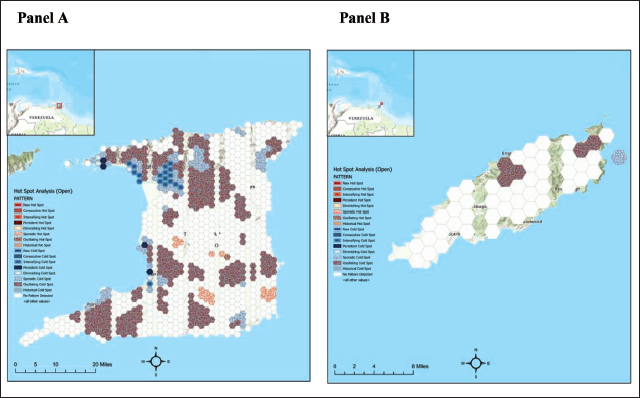
Results of emerging hot spot analysis confirm large-scale reductions in population movement patterns during the peak of the lockdown period. Specifically, we see significant new and emerging cold spots in and around the city centres of Port of Spain, San Fernando and Scarborough Tobago during the peak of when social distancing measures were implemented (see Figure 1—panels A and B). On the other hand, we find areas of persistent hot spots in population movement in more rural communities of central, eastern and south Trinidad and also central Tobago. Interestingly, we also find an increase in population movement in much more rural areas relative to urban towns and cities during the peak ‘lockdown period’.

During the reopening phase of the economy, we find continued persistent cold spots in key urban locations of Trinidad, in particular, but some increasing mobility in surrounding regions (Figure 2—panels A and B).
The Effectiveness of SIPOs and Speed to Return to Work
Preliminary results, as seen in Figure 3—Panels A–D, point to a significant reduction in population movement during the peak of COVID-19 throughout urban centres in Trinidad and Tobago, including Port of Spain, San Fernando, Chaguanas and Scarborough. Interestingly, these figures also show a general decrease in population movement among key urban centres in the post ‘lockdown period’ beginning 11th May 2020.

Next, we evaluate the effects of social distancing measures based on difference-in-differences estimation. As seen in Table 1, we find that most key social distancing measures had a negative impact on population movement patterns throughout Trinidad (except for the closure of beaches and recreational sites). The largest impact stems from the second phase of the closure of businesses, which results in a 0.6% reduction in population movement patterns.
Restrictive Shelter-in-Place Orders (SIPOs) on Population Movement.

Results of our event study analysis shown in Figure 4—panels A–D display significant fluctuations in population movements over time. However, we note significant reductions in population movement after the closure of businesses, phase 2. Once again, other social distancing measures such as the closure of beaches and recreational sites resulted in an increase in population movements during this period. These results are largely consistent with Dave et al. (2020), who also provide empirical evidence that SIPOs result in a reduction in population movement.
Panels A to D – Results of event study of policies of interest on presence at home. Panel A reflects the closure of restaurants, B, the closure of beaches, C the closure of businesses (Phase 1), and D the closure of businesses (Phase 2). Gray areas highlight the 95% confidence intervals.

Figure 4. Panels A–D—Results of Event Study of Policies of Interest on Presence at Home. Panel A reflects the Closure of Restaurants, Panel B reflects the Closure of Beaches, Panel C reflects the Closure of Businesses (Phase 1) and Panel D reflects the Closure of Businesses (Phase 2). Grey Areas Highlight the 95% Confidence Intervals.
In the case of the reopening of the economy, interestingly, results of the difference-in-differences model estimate shown in Table 2 indicate a continued negative impact in population movement after the implementation of each of the phased reopening measures was implemented in Trinidad and Tobago. The only positive impact in population movement patterns occurred after the opening of public places (phase 1), which included an increase in limits of group gatherings from 5 to 10 persons. This policy measure increased population movement by 0.4–0.7% over the sample period.
Relaxation of Shelter-in-Place Orders (SIPOs) on Population Movement.

It should be noted that the lagged announcement of new positive cases resulted in a decline in population movement patterns over both periods. There also appears to be a ‘relative stickiness’ of population movement patterns in the face of relaxed social distancing measures. This supports the view that fear, as well as adjustments to virtual work patterns, can also contribute to reductions in population movement patterns (Goolsbee & Syverson, 2020). Of the measures implemented during the five phases of the reopening of the economy of Trinidad and Tobago, the opening of all key public places (phase 3—of the overall reopening strategy) was found to be associated with an increase in population movement patterns.
These results are largely confirmed by event models displayed in Figure 5—panels A–F, which continue to display a pattern of decline in population movement patterns during the re-opening phase of the economy. Interestingly, the announcement of confirmed cases during the previous period continues to have a negative impact on population movement patterns during this second period. Finally, we find that announcements of new infections by the government to be associated with lower rates of population movement. This finding indicates that public information and awareness-driven voluntary actions by individuals can reduce population movement during the COVID-19 pandemic and consequently reduce the number of cases and deaths.
Panels A–F—Results of Event Study of Policies of Interest on Presence at Home. Panel A reflects the Opening of Restaurants, Panel B reflects the Opening of Manufacturing, Panel C reflects the Opening of Retailers, Panel D reflects the Opening of Public Spaces—Phase 1, Panel E reflects the Opening of Places of Worship and Panel F reflects the Opening of Public Spaces—Phase II. Grey Areas Highlight the 95% Confidence Intervals.

Robustness Checks
To verify the results of our model, we examined whether the impact of our results may vary 2–3 days after the policy announcement. We do this to test the extent to which there may be a delayed rather than more immediate response to policy changes. Indeed, we find these results to be robust and consistent 2 days after the implementation of the policy measures as seen in Tables 3 and 4. 6
Two Days after Implementation of Restrictive Shelter-in-Place Orders (SIPOs) on Population Movement.

Two Days Lag in the Relaxation of Shelter-in-Place Orders (SIPOs) on Population Movement.

Impact of New Information
The second question remains in terms of the extent to which reductions in population movements were due to changes in government policy or rather heightening fear of infection, driven by new information on the spread of confirmed infections (Goolsbee & Syverson, 2020). We consider this to be a robust natural experiment since no new SIPOs were introduced during this period. To more clearly identify this impact, we leveraged the period after phase five of the reopening of public places and the end of the sample period, 31st July 2020. During this narrow window, the number of new infections increased primarily due to community spread. Additionally, on 26th July 2020, government officials published a spatial map showing a new geo-location of new community-based infections (see Appendix Figure A4). Interestingly, during this period, the government chose not to introduce new SIPOs but rather continue to urge strong preventative measures such as sanitising and wearing of face masks in public places. Therefore, we expect that any changes in population movement patterns during this period to be a response to the threat of new infections, rather than new SIPOs.
Table 5 outlines the results from the difference-in-differences estimation. It shows that on average information on new infection rates decreased population movement patterns by approximately 0.04% even during the relaxation of social distancing measures. 7 Also, information on new COVID-19 infections from the daily information updates was associated with a decline in population movement patterns across communities by as much as 0.07% even during the period when SIPO measures have been relaxed, and declines significantly, two to three periods after the information is published. The publication of the spatial map on locations of infections was associated with decreased population movement patterns of over 1%.
Information on new infections on Population Movement.

These results are confirmed by the event study model given in Figure 6, which suggests that the impact is somewhat delayed since population movement patterns decline two or three periods after the new information was disseminated. Abouk and Heydari (2020), Anderson et al. (2020) and Lipsitch et al. (2020) similarly provide evidence of the importance of communicating the threat posed by COVID-19 to lead to voluntary compliance to social distancing behaviour.
Results of event study examining the response to the publication of a map with locations of COVID-19 infections. Grey areas highlight the 95% confidence intervals.

Collectively, the results of this study suggest that changes in population movement patterns may be driven by person’s adaptions to the threat of new infections as well as specific shelter-in-place policy measures implemented by the government. These findings add to the literature on voluntary compliance behaviour and managing the COVID-19 pandemic (Clark et al., 2020; Painter & Qiu, 2020).
Lessons Learned
This study empirically illustrates that reduced population movement in Trinidad and Tobago during the COVID-19 pandemic was driven by SIPOs implemented by the government, as well as voluntary compliance from the public as a result of information released on new infections and locations. The reduced population movement would have contributed to a lower spread of the virus and avoided a strain on the public health sector. The use of these SIPOs measures and the public information campaign was undertaken to restrict population movement in Trinidad and Tobago in response to the COVID-19 could provide lessons as the pandemic continues and for future disease outbreaks.
The government of Trinidad and Tobago first took action early on to tackle COVID-19. As early as January 2020, travel restrictions to and from China were implemented, and as the outbreak continued, the list of restricted countries later included South Korea, Singapore, Japan, Italy, Germany, France and Spain, and the borders were completely closed in March. Upon the declaration of the first confirmed case of COVID-19 on Thursday 12th March, which was imported, all early childcare and educational institutions were immediately closed. This was followed by other SIPOs, which included a national lockdown and stay-at-home orders for nonessential workers, along with the closure of beaches, rivers, hotels, restaurants, bars, manufacturing operations and cinemas, and a cessation placed on mass gatherings which occurred between 29th March and 15th April 2020. Our results demonstrate that SIPOs measures, particularly the scaled-back business operations, have indeed reduced population movement patterns and, more importantly, have been associated with a lower rate of community spread of COVID-19.
The government through the Ministry of Health also embarked on near-daily information press briefings to update the population in terms of the number of infections and deaths, as well as new measures taken to counteract the spread of the virus. Geo-spatial maps were also updated regularly, showing locations of new infections. As the government began a phased re-opening program for the economy, the population was continuously reminded that everyone had an important role to play in the fight against COVID-19 and that success in fighting the virus depended on individual behaviour. For individuals to change their behaviour by reducing their movement to decrease the transmission risk of the virus, they must trust the health message on COVID-19. These information updates resulted in adaptive behaviour by citizens in the form of voluntary restrictions in population movement in response to the threat of COVID-19 infections. Additionally, stay-at-home orders are common in the Caribbean given the high frequency of tropical storms experienced. As storms approach these islands, there is a psychological readiness that might have contributed to a general willingness among the public to accept the SIPOs implemented by the government (Murphy et al., 2020).
The results of the study also provide strong evidence of a much more prolonged dampening effect on population movement patterns and by extension economic activity among SIDS in an immediate post-COVID-19 era. Collectively, these results highlight the challenge most governments of SIDS face balancing the implementation of SIPOs to control the spread of the virus without simultaneously generating an entrenched ‘lockdown’ in national activity. It also highlights the importance of having a cautionary but deliberate strategy to regenerate activity post-COVID-19 and increase citizens’ capability in the day-to-day management of the risks related to contracting the virus. Finally, it highlights the importance of providing support and incentives to those who may be most affected by a protracted reduction in activity, such as small and micro-enterprises, the youth, the elderly and the unemployed.
Conclusion
This article utilises novel data on population movement patterns and difference-in-differences and event study models to examine the impact of SIPOs implemented by the government of Trinidad and Tobago, a small island economy, during the early stages of the COVID-19 pandemic. We find timely population response to SIPOs, particularly in response to the closure of businesses. Not surprisingly these results are found to be more pronounced in urban regions. Interestingly, measures such as the closure of beaches and recreational sites were found to be less effective in terms of regulating population movement. When we examine population movement patterns during the phased reopening of the economy, we find most reopening measures to be associated with reduced population movement patterns. Indeed, the first uptake in population movement patterns is only realised after phase 3 of the reopening of public places by the government. This suggests some level of adaptation among the population to reduce movement and activity (such as voluntary work-from-home arrangements) due to the emergence of the novel COVID-19 virus. Additionally, a natural experiment to test the impact of the announcement of new infections as well as the publication of a map highlighting the exact locations of new infections highlight that new information on confirmed infections may negatively impact people’s decisions to move.
In summary, these results suggest that apart from government shelter-in-place measures, population awareness and voluntary adaptation to the virus can be a significant and positive deterrent against the spread of the virus and can also result in a much more prolonged reduction in activity at the community and national level. This places an increasing need for governments of SIDS to carefully plan options for reopening and generating both confidence and activity. It also highlights the importance of providing extended support to those most at risk from the economic fallout the virus might bring.
Appendix A


The Timeline of Shelter-in-Place Order (SIPO) Measures in Trinidad and Tobago.

Example of a Space-time Cube.


Footnotes
Declaration of Conflicting Interests
The authors declared no potential conflicts of interest with respect to the research, authorship and/or publication of this article.
Funding
The authors received no financial support for the research, authorship and/or publication of this article.