



Abstract
Currently, COVID-19 is the most lethal menace in the world. Due to its health and economic consequences, it becomes a serious challenge for the economy. The present article aims to explore India’s interstate disparities of efficiency in combating COVID-19 based on secondary data. Besides, an attempt has been made to pinpoint the factors responsible for the inefficiency of resisting this deadly virus. The interstate efficiency measurement is facilitated by applying stochastic production frontier analysis. The empirical result divulges that among the Indian states, Bihar is the most efficient in combating COVID-19. The empirical estimation of the frontier model discloses that the number of doctors, nurses, police force, isolation beds and hotspots positively and significantly influence the recovery rate from COVID-19 in Indian states. The empirical results of the inefficiency effects model suggest that the share of elderly and urbanisation reversely influence the efficiency in combating the virus, while favourable sex ratio, literacy rate, regular salaried employment, digitalisation and ruralisation stimulate the efficiency of the concerned state. The study concludes that efficient utilisation, coupled with the advancement of the existing health infrastructure, is imperative for the acceleration of the recovery rate from this pandemic.
Introduction
Currently, novel coronavirus or COVID-19 is a global menace. Almost every country in the world is affected by this disease. According to WHO, the mortality rate from the virus is only 3.4%, which is lower than numerous types of influenzas. Although the mortality rate from the virus is very low, it is a severe challenge that the world encountered in recent times. This is not only because of the threat associated with health concern but also for gloomy economic insinuation. In fact, the speed of spreading of the disease makes it more pandemic than other types of influenzas. The spread of the virus is mainly determined by the structures of societal communication (Singh & Adhikari, 2020).
The outbreak of novel coronavirus was first pinpointed in Wuhan, China and since then it has been spreading globally (McKibbin & Fernando, 2020). In India, the first case of COVID-19 was reported on 30 January of this year in Kerala and subsequently, it spread in almost every state of the country except Sikkim and Nagaland. Among the affected states, Maharashtra is the worst suffered state followed by Tamil Nadu. Health consequences of COVID-19 are very prominent as it affects almost 43,349 persons and among them, the total number of deaths is 1,398 up to 4 May 2020, including every age group (see
However, despite the enormous effort from the side of the government, COVID-19 appeared as a critical challenge for welfare and economic prosperity. In fact, India is recognised as one of the 15 most affected nations in the world due to novel coronavirus concerning economic catastrophe (Koshle et al., 2020). It affects the welfare of almost every section of the society. The workers from the informal sectors, like farmers and daily wagers, are the worst sufferers from the disease. Besides, small and marginal businesses are severely overblown by the disease (Jha, 2020).
The implications of COVID-19 on the Indian economy can be realised through many channels. First, the disease outbreak influences the economy in terms of direct and indirect economic costs of illness which create a burden on the economy. Second, it disrupts the economy through loss in world trade. The influence of the novel coronavirus pandemic on India’s international trade is projected to be around $348 million because of the slowdown in production (Koshle et al., 2020). As a result, the growth rate is expected to come down to 5.3%, from the previous estimate of 5.7% (Mohan, 2020). Third, India’s complete lockdown has resulted in the disruption of the food supply chain, and with a deficiency in demand and the shortage of labour making it even worse (Abhishek et al., 2020). Finally, the pandemic may create a fiscal deficit as a result of the shortfall of tax and output. It is expected that the central government faces a fiscal deficit of 8.4% in the most distrustful circumstance (Balajee et al., 2020).
A comprehensive number of pertinent literature is reviewed to understand the upshot of different dimensions of novel coronavirus. But the specific issue of the interstate disparity in the efficiency of controlling the novel coronavirus or COVID-19 is not properly addressed. This study is the first of its kind to address this issue. This backdrop motivates us to pursue this study. Accordingly, the objective of the study is twofold. The initial objective of this study is to investigate the comparative efficiency of Indian states to combat COVID-19 measured by the recovery rate from COVID-19. Then the article tries to unfold the factors responsible for the interstate divergences in efficiency in controlling COVID-19.
The article is structured in the following sections: First, the concept and methodology of the study are developed in the next section. Then, the econometric model is discussed in the following section. A detailed discussion of methods, data sources and variable are presented next. The estimated results have been discoursed in the subsequent section. Finally, conclusion and policy formulation are presented in the last section.
Concept and Methodology
In terms of the neoclassical production function, efficiency is defined as an act of the economic agent to produce specified output at the minimum costs. This conveys that the economic unit should choose inputs in order to minimise production costs. However, when the matter of concern is health care aftermath is most important. Thus in health care efficiency fundamentally connotes furtherance of individual’s health. This can be accomplished in two alternative ways, viz., either through maximum utilisation of the level of the current input or through enlarging the available inputs to attain a higher outcome level. This can be consummated through pinpointing the health agents who are performing preferably than the others and by exploring the constituents who are helping in amplifying their performances.
In an attempt to recon the efficiency of different Indian states in combating COVID-19, the notion of health system efficiency is elucidated following Murray and Frenk (1999) and Evans et al. (2000). Following Murray and Frenk (1999) and Evans et al. (2000), the desired aim (goal) of the health system, in our case ‘recovery rate of COVID-19’, is measured on the vertical axis as shown in Figure 1.

On the contrary, the inputs to attain the desired outcome are measured on the horizontal axis. The upper line in the figure delineates the maximum possible health aftermath attainable from the given set of health inputs. In literature, it is designated as ‘frontier’. On the contrary, the lower line in the figure portrays the level of attainable health sequel in the absence of any health system. The principal contrast between the farm output and health system outcome is that in the absence of inputs, farm output would be zero, but the health outcome would not be zero in the absence of any health expenditures, as all individuals in a nation will not die together.
We are presuming that the country and/or the state has accomplished (x+y) units of health outcomes. The maximum possible attainable health outcome is (x+y+z) (see Figure 1). Under this diegesis, Murray and Frenk (1999) and Evans et al. (2000), defined ‘system performance’ as:
Interstate Recovery Rate from COVID-19.

where (y+z) is the potential outcome and y is the level of health outcome achieved.
Thus, Equation (1) can be interpreted as the ‘system achieves compared to its potential’ (Murray & Frenk, 1999). The question is how to measure the performance of the health system systematically so we can permit inter- as well as intra-country and/or state comparison over time. This is exactly perused in the present article in terms of combating COVID-19.
The two alternative methods are there for measuring the maximum attainable health outcomes from an accessible set of resources, viz., cost-effectiveness analysis (CEA) and production frontier analysis (Kathuria & Sankar, 2005; Sankar & Kathuria, 2004). In applied economics, traditionally, measurement of efficiency is practised within the realm of agricultural and industrial economics. The methodological pioneering credit hegemonised by Farrell (1957). Farrell (1957) initiated a methodology, referred to as ‘FRONTIER approach’, for measuring technical and allocative efficiency and proved that economic efficiency is the sum of technical and allocative efficiency (Maity, 2011). In ‘frontier’ framework, technical efficiency is defined as farm’s capability to produce the maximum possible output from a given set of inputs (or farm’s ability to produce the same level of output with a lower amount of inputs). It is measured by the ratio of the observed to maximum achievable outputs. In terms of Figure 1, it means the ratio (x+y)/(x+y+z). This definition is known as the ‘output-based measure of technical efficiency’ (Maity, 2011). We adopt this definition for measuring the performance of the health system of different states of India in combating COVID-19 because in health system performance, we are willing to measure the relationship between what the system attains relative to its potential. Thus according to our definition, health system efficiency is synonymous to health system performance. Henceforth, in the subsequent discussion, we will use the term ‘efficiency’ to allude to ‘system performance’. In this article, we consider the measurement of technical efficiency only by using ‘stochastic frontier approach’ (SFA) by considering availability and access of health care infrastructures as inputs and health sector performance as a single output. In this article, we consider Battese and Coelli (1995) inefficiency effects model of stochastic production frontier. Thus, the estimation follows a two-step procedure, viz., first, we measure the efficiency score of the different states of India and second, we identify the components responsible for the differences in the performances of different Indian states in combating COVID-19. The detailed specification of the econometric model is presented next.
Econometric Model
At the beginning, we consider a stochastic frontier production function for the cross-sectional data,

where y is the health outcome, x and
The firm-specific technical efficiency (Kumbhakar & Hjalmarsson, 1991) which is assumed to be a random variable may be written as:

Here, the assumptions are that
where
Further,
Following Battese and Coelli (1995), the technical efficiency of the health sector for the ith state,

The random variable
The maximum likelihood estimation (MLE) technique is the best way to estimate simultaneously the parameters of the stochastic frontier and the technical inefficiency model (Battese & Coelli, 1995). Following Battese and Coelli (1993), the likelihood function is expressed in terms of the variance parameters, viz.,
Data and Variables
In this section, we will discuss the data sources and the specification of the variables in terms of output and input.
Data
The study entirely depends on secondary data compiled from various secondary sources. The present study is conducted based on 18 states and 2 union territories of India. The rest of the Indian states and union territories are excluded due to the non-availability of relevant data. Furthermore, the two Indian states, viz., Sikkim and Nagaland, remain unaffected by novel coronavirus; accordingly, we intentionally debar these states from our analysis.
In this investigation, the number of people who recover from COVID-19 and the number of COVID-19 hotspots are compiled from the Ministry of Health and Family Welfare, GOI. The information corresponding to the sum of total tested, number of isolation beds and total number of people in quarantine are retrieved from ‘https://www.covid19india.org’.
On the contrary, the percentage of 60 plus population, sex ratio, literacy rate, ruralisation and urbanisation are composed of the Census of India, 2011. Eventually, the information associated with regular wage/salaried employee, Internet subscriptions (millions) (as a proxy of digitalisation), per capita net state domestic product (NSDP), nurses per 1,000 population, total police per lakh of population and doctor–population ratio per 1,000 is assembled from National Sample Survey (NSS), 68th Round (2011–2012), Telecom Regulatory Authority of India (TRAI), RBI, Indian Nursing Council, Ministry of Home Affairs and Directorate of State Health Services & National Health Profile, respectively. It is noteworthy that the present study involved secondary data related to COVID-19 up to 24 April 2020.
Variables
For the measurement of the health system efficiency through ‘stochastic production frontier approach’, three types of variables are essential (Evans et al., 2000; Kathuria & Sankar, 2005; Sankar & Kathuria, 2004). First, it is imperative to pinpoint a pertinent output indicator representing the performance of the health sector. Second, it is mandatory to recognise a germane set of inputs that have a tête-à-tête footprint on the production of the output. Finally, it is highly recommended that we should also include some variables that can affect the outcome of the health sector positively or negatively but cannot be recognised as the inputs for the concerned output. These variables are non-health variables and can be pronounced as exogenous variables. These exogenous variables apprehend the effects of non-health variables on health outcomes.
Output Variables
To live a healthy, active and decent life is the most important human right. The improvement of the overall public health is the principal goal of any country’s health system and India is not an exception here. Under pandemic circumstances, it is the paramount concern of the authority to keep the citizens safe and healthy. COVID-19 is an imported disease for India and spread rapidly all over. India is a highly populated country with scarred age groups. The population density of India is 1,202 people per mi2. Under such circumstances, COVID-19 may become a catastrophe for India. The central and the state government are trying hard to withstand this awful disease. Therefore, for the output of the health performance, we should consider the success rate against this horrendous disease. Henceforth, we consider ‘the rate of recovery’ for different states of India as the output in the present model. Besides this, we can consider ‘the reciprocal of the total number of positive cases’ or ‘reciprocal of death rate’ as output indicator. The former is not a well-accepted indicator of the success against this disease as there may be some positive cases not yet identified. Moreover, the number of COVID-19 positive cases is increasing every hour, which makes it difficult for proper identification of positive cases. Thus consideration of ‘the reciprocal of the total number of positive cases’ as the output may underestimate the result. On the contrary, there are some states in India where we have COVID-19 positive cases with zero deaths. Consequently, considering ‘reciprocal of death rate’ as an output will induce us to consider only those states where deaths from COVID-19 are positive and thus the states with zero deaths up to date will be overestimated. With this backdrop, we consider ‘the recovery rate from COVID-19’ as output for our model. The definition of the output variable is presented in Table 1.
Descriptions of the Variables.

Input Variables
Apropos input variables, we have two alternatives; either we can use the monetary expenditures on health (such as per capita expenditures on public health) or the physical inputs. As we are dealing with different states of India, the non-availability of the data compelled us to consider the physical inputs. Besides that, the stock of expenditures of the past will be a better reflector of the current health status, as health expenditures in the past are echoed in contemporary health achievements. Moreover, the monetary expenditures on health will be more appropriate if we have panel data. For cross-sectional studies, the availability of the physical inputs at a particular time is more appropriate. The physical health inputs that will affect the state’s performances in combating COVID-19 are the number of doctors, number of nurses, etc. It is noteworthy that as population and area fluctuate across the states, this variation in population size affects the access to the available health facilities. Accordingly, it will be apposite to standardise the variables concerning the population. This is exactly performed in the case of the number of doctors, nurses and police. The list of the input variables along with their definition is furnished in Table 1.
Exogenous Variables
It is a well-established fact that improved health is not an exclusive outcome of the health service providers (Murray & Frenk, 1999). This is also patently true for fighting against COVID-19. Some pioneering studies accentuate the influence of non-health determinants, viz., income and educational level measured differently (Becker, 1992; Schultz, 1963). In the present study, we have considered several variables that have a strong influence on the efficient control of COVID-19 of different Indian states. However, these variables cannot be categorised as input variables. We recognise these variables as exogenous variables. These variables are exclusively considered for inefficiency effects analysis. The list of the exogenous variables with definitions is presented in Table 1.
After pointing out the output, input and exogenous variables for the present interstate comparison of efficiency in combating COVID-19, we present the model to be estimated in terms of the following equation:

where ln is the natural logarithm (i.e., to the base e).
The technical inefficiency effects are presumed to be defined by the following equation:

Equations (5) and (6) are estimated by using FRONTIER 4.1, developed by Coelli (1996).
Results and Discussion
This section begins with a discussion of the descriptive statistics of output, input and exogenous variables followed by the exploration of the efficiency assessment of different Indian states in combating COVID-19. The section ends with the analysis of the empirical results corresponding to the estimation of Equations (5) and (6).
The State-wise Recovery Rate from COVID-19 in India
Nowadays, the pandemic novel coronavirus or COVID-19 is a profound concern of the earth. Almost every country of the globe, including India, is agonising from this pandemic. The Indian government is doing everything to control the spread of this fatal disease. Because of the Indian government’s courageous endeavour, the infection rate is still under control despite the highly-dense large population. Nevertheless, India is still maintaining a lower mortality rate and high recovery rate from COVID-19 than many high-income countries, like, USA, UK, and Spain. Notwithstanding, India’s scenario is not copasetic. The paucity of testing kits makes it inefficacious to pinpoint the severity of the crisis.
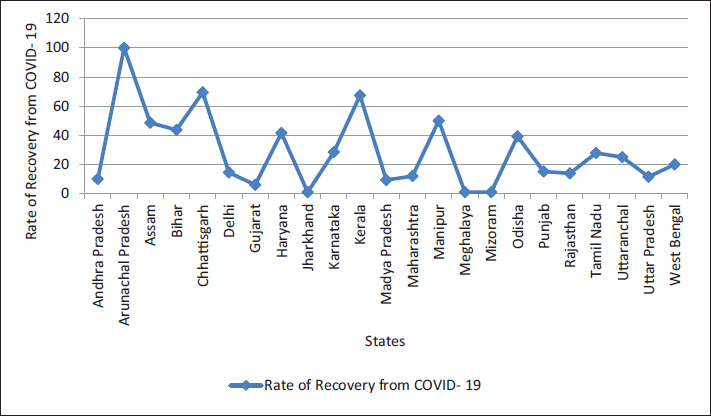
Without sufficient testing, it is very difficult to cope with the severity of the crisis. Consequently, it will be appropriate to dissect India’s state-wise recovery rate for a better finer comprehensive of the scenario. The graphical presentation (Figure 2) of India’s interstate COVID-19 recovery rate enables us to recognise the current scenario more prominently.
A close perusal of Figure 2 divulges that there is significant dissimilitude in the recovery rate among Indian states. The states which exhibit high recovery rate are Arunachal Pradesh followed by Chhattisgarh and Kerala. On the contrary, Jharkhand reported the lowest figure on the list. Again, more than 40% recovery rate is accomplished by Assam, Bihar, Haryana and Orissa. The disparity in the performances of the recovery rate is owing to the variances in the delivery of health services efficiency. These divergences in efficiency are conceivably contributed by the components, such as health infrastructure, differences in the alertness of the population, the share of the aged population, and divergence in the execution of law enforcement by the local governments.
Descriptive Statistics of Output, Input and Exogenous Variables
As we are dealing with cross-sectional data, the policy implication will be appropriate if the data is representative. The heterogeneity of the data is the paramount condition for the viability of the results. The discussion of the descriptive statistics will enable us to pinpoint the heterogeneity of the data. The descriptive statistics of the variables are presented in Table 2.
Descriptive Statistics of Output, Input and Exogenous Variables.

An inspection of Table 2 corroborates that among the selected states, the average recovery rate from novel coronavirus is approximately 29 with a maximum of 100% and a minimum of 1%. These figures ensure the extent of interstate variations in the recovery rate. This pronouncement is backed by the high value of SD. Concurrently, the average number of COVID-19 hotspots in India is 14 and on average 7,205.44 people are kept in quarantine within the states. In addition, on average, 14,249.83 persons are tested to detect COVID-19 positive cases in India. In contrast, typically on average, India has only 8,808.7 isolation beds, 0.15 doctor–population ratio and 2.51 nurses per 1,000 population to resist the pandemic. These figures evidence the meagreness of health infrastructures in Indian states. The table discloses the social structure of India, viz., 75% of the population is literate, mean sex ratio is 952.35, and only 33.59% of the total population is living in urban areas. Undeniably, police forces are the requisite component to resist COVID-19. Unfortunately, in Indian states, on average 275.89 police are serving 1 lakh people. Among the total workforce, only 26.84% are engaged in regular salaried employment in India. The average per capita NSDP is ₹107,148.90 with a maximum of ₹279,601.00 and a minimum of ₹30,617.00. Concerning digitalisation, it is noteworthy that on average 19.52 million people have access to Internet subscriptions. Notably, higher the value of SD, greater is the variation, and vice versa. The same table also confirms that SDs in all cases are very high. The highest value of SD is obtained for per capita NSDP, followed by the sum of total tested (14,417.54), confirming maximum state-wise dispersion.
Efficiency Analysis of Different States of India
In this section, we will investigate our main objective—the comparison of the health performance of Indian states in combating COVID-19. The efficiency score and the ranking of the states in terms of their efficiency scores are presented in Table 3. It is noteworthy that the relative efficiency scores show how efficiently states performed in combating COVID-19 compared with the most efficient state. To analyse the relative health sector efficiency in combating COVID-19 of the states, we consider the overall mean efficiency score, 0.4720, as the benchmark of efficiency (Dutta & Neogi, 2013; Maity & Neogi, 2014). Consequently, the state with achieved efficiency score higher than mean efficiency, that state will be conceded as relatively technically more efficient compared to other states and vice versa. For example, Kerala’s efficiency score is 0.8569 higher than the overall mean efficiency score of 0.4720. Henceforth, Kerala is contemplated as a technically efficient performer in combating COVID-19 relative to other Indian states (Dutta & Neogi, 2013; Maity & Neogi, 2014). Following this benchmark, only 8 Indian states, viz., Assam, Bihar, Chhattisgarh, Kerala, Maharashtra, Orissa, Punjab and Rajasthan, out of 21 states are performing amply in combating COVID-19. Therefore, only 40% of states are performing satisfactorily to combat COVID-19.
Efficiency Estimates and Ranking for Different States of India.

The same table also discloses the ranking of the states based on their efficiency scores and the topmost position is held by Bihar followed by Assam and Kerala. It is noteworthy that the efficiency ranks only show the relative performance of the states and do not indicate any hierarchy in actual health outcomes. For example, the 19th position is occupied by Arunachal Pradesh with a relative efficiency score of 0.1653. However, in terms of actual attainment, the state is in the first position concerning the recovery rate from COVID-19 amidst 21 states, with a recovery rate of 100.00%. The relative health system efficiency score of the state stipulates that given its health investment, the state has accomplished only approximately 17% of its prospective in resisting COVID-19. The state could have resisted COVID-19 to 99.99% if its health system operated as efficiently as the most efficient state. On the contrary, if the state’s health system was as inefficient as the least efficient state, Andhra Pradesh, the resisting ability of the state could have diminished to 12%, which may result in only a 10% recovery rate from COVID-19. It could be said that due to inappropriate utilisation of the available health infrastructure, we obtain variation in the efficiency among different Indian states. This is the reason for the low levels of health outcomes and achievements.
The absence of similar studies at the national and/or international level enable us to cross-verify the obtained result with others’ research.
Analysis of Stochastic Frontier Model: Factors Affecting Efficiency
The discussion of the results of stochastic production frontier estimation is presented in this section. The estimations of Equations (5) and (6) depict the result of the stochastic production frontier and the inefficiency effects, respectively. The SPF as presented in Equation (5) can be deemed as the log-linear version of the Cobb–Douglas production function. Maximum likelihood estimates of the parameters of the model are obtained by using the computer program, FRONTIER 4.1 (see Coelli, 1996). These estimates, together with the estimated standard errors, given to two significant digits are presented in Table 4.
Maximum Likelihood Estimates of the Stochastic Production Frontier Function of Performances in Combating COVID-19 of Different States of India (Dependent Variable: LRR (Log of Recovery Rate), No. of Observations: 20).

The estimated regression equations are presented below.
Stochastic Frontier

Inefficiency Model

The absence of multicollinearity is countenanced by Table A1 in the Appendix. The output variable of the SPF model is the ‘recovery rate’. The empirical estimates corroborate that the coefficients of the health care facilities, viz., ln(Doctor), ln(Nurse), ln(Tested) and ln(Isolation beds) have not only the correct sign but are also statistically significant. These variables are widely recognised inputs for convalescence from COVID-19. The increase in these inputs will certainly ameliorate the ‘recovery rate’ from COVID-19. The negative sign of the estimated coefficient is ln(Quarantine) because only COVID-19 suspected cases are likely to quarantine. Consequently, the increase in the number of quarantine is plausible to escalate the number of positive cases. Thus this input variable is negatively influencing the ‘recovery rate’ from COVID-19. In the prevailing circumstances, ln(Police) emerges as a predominant input variable. The positive sign of the estimated coefficient is re-establishing the patent fact. It is noteworthy that the coefficient is also statistically significant. The police forces are doing their duties here as health infrastructure input. The negative and significant effect of ln(PCNSDP) is perhaps because COVID-19 is an imported disease. The higher per capita NSDP does not essentially imply high expenditures on health and maintenance of law and order. To antagonise COVID-19, these two are the foremost appurtenances. Again, high per capita NSDP means higher economic activities concerning economic transactions. More the transaction in the present scenario escalates the likelihood of spreading COVID-19. Accordingly, states with higher per capita NSDP are encountering more COVID-19 positive cases. Moreover, the states may achieve higher per-capita NSDP because of high remittances from abroad and/or from other states. Thus high per capita NSDP may be a barometer for high out-migration. It is patently true that COVID-19 is an imported disease migrated from outside. Consequently, the more the mobility across states and/or countries, the more the probability of getting COVID-19 positive cases. This is the reason for the negative sign of the estimated coefficient of ln(PCNSDP).
The estimated coefficients in the inefficiency model are of particular interest to this study. The Elderly coefficient is positive and significant, which stipulates that the state with a higher percentage of veterans is more inefficient than a relatively young state. Because greater the percentage of older adults, greater the possibility of having more positive cases. Moreover, older adults are vulnerable to COVID-19 with a lower surviving rate, which results in lower ‘recovery rate’. The negative and significant estimates for sex ratio and literacy rate infer that the states with favourable sex ratio and higher literacy rate tend to be less inefficient. The result is patently true. As women are likely to stay at home, the greater female population enhances the potentiality of successful ‘lockdown’ without active coercion of the police force. The higher literacy rate means a more aware population and a greater probability of successful ‘lockdown’. The negative and significant coefficients of Rural, Employment and Digitalisation suggest a state with more ruralisation, salaried employee and proper broadcasting system is more efficient in combating COVID-19 than the others. On the contrary, the state with a higher rate of urbanisation is likely to be inefficient in combating COVID-19 as suggested by the positive sign of the estimated coefficient. The successful extirpates of COVID-19 hinges on the successful ‘lockdown’. The exogenous variables Rural, Employment and Digitalisation help in administrating and disseminating COVID-19, and thus the state is accredited as a saviour for withstanding COVID-19. The urban areas are characterised by more people mobility than rural areas. Urban areas offer informal employment. During ‘lockdown’, these informal labourers are interlocked in the faubourg. These people with limited resources are travelling to urban and town areas from the outskirts to earn money. For them ‘livelihood is more important than life’. On the contrary, salaried persons stayed home for their as well as their families’ safety. The awareness about ‘do’s and don’ts’ in connection to COVID-19 is well managed through the Internet. Transactions through ‘net banking’, ‘online purchase of necessary goods’, etc. become key constituents for making ‘lockdown’ successful. Consequently, the states with a higher proportion of salaried people, improved internet facility and larger coverage of rural areas experienced successful ‘lockdown’ and thus countered COVID-19 more efficiently than others.
Conclusion
The outbreak of novel coronavirus is emanating as a global crisis in the world. Although the infection and mortality rate of the virus is significantly lower than many other types of influenza, yet it emerged as an epidemic in almost every country of the world, including India. Identifying the rapid escalation of COVID-19 on 12 March 2020, WHO announced the COVID-19 outbreak as a pandemic. This is because the crisis bit by bit unfolded in the form of gigantic forfeiture of lives, fear of unforeseen loss of life in the future, loss of occupation, sharp decline in the growing economy of the globe, accompanied by a recession, etc. COVID-19, like a silent killer to the economy, is forcing the global economy towards a backwards or pre-crisis level. India is struggling to counter against the outbreak of novel coronavirus. The first incident of the infection was traced on 30 January 2020 and subsequently, it spread almost in every state of the nation. Regardless of the huge population, viz., 1.3 billion, having a high density of population and having limited health infrastructure facilities, India is still able to maintain a low rate of COVID-19 positive cases in juxtaposition to many developed nations. The main reason is that, at the very initial phase of the viral infection, the nation adopted averting measures to withstand against the spread of COVID-19. A sequence of policy responses, including a strategic lockdown policy along with the appropriate combination of monetary and fiscal policies, are adopted to arrest the virus effectively (Mohanty, 2020). However, despite the whopping effort of the Indian government, India still is tussling to resist the pandemic completely.
In this study, we have investigated the relative efficiency of Indian states in combating the novel coronavirus using stochastic frontier analysis. Besides, we have attempted to pinpoint the factors responsible for the states’ inefficiency in ameliorating the recovery rate. The results reveal that, among the states, Bihar is found to be the most efficient state in combating the virus followed by Assam and Kerala. On the contrary, the rate is lowest in Jharkhand. Considering overall mean efficiency as the benchmark of efficiency, only 8 Indian states, viz., Assam, Bihar, Chhattisgarh, Kerala, Maharashtra, Orissa, Punjab and Rajasthan, out of 21 states are articulated to combat COVID-19 efficiently. Further, the empirical results corroborate that, the number of doctors, nurses, police force and isolation beds and identification of hotspots positively and significantly influence the recovery rate from COVID-19 in India. Conversely, the numbers of persons under quarantine and per capita NSDP negatively influence the recovery rate. The inefficiency estimates profound that the share of elderly and urbanisation reversely ascendance the efficiency in combating the virus, while the favourable sex ratio, literacy rate, regular salaried employment, digitalisation and ruralisation positively and significantly stimulus the efficiency. Thus, in order to accelerate the growth of recovery from the pandemic, the efficient utilisation of health infrastructure is extremely obligatory. Subsequently, the government should also provide sufficient finance to pharmaceutical industries as it has greater potential in developing the vaccine to fight against this killer virus. Besides this, people need to cooperate with the government, police force and health workers to ensure a successful ‘lockdown’. Additionally, the people are advised to uphold social distance and appreciate the services of police and health workers through various means. Eventually, global accentuation should be thrust on research and development for producing effective and economically affordable vaccines (Balakrishnan, 2020).
Furthermore, novel coronavirus is not only a menace to human life therewithal it creates a deficiency in both demand and supply and as a result, it also becomes a paramount challenge to the global economy in recent time. Under such circumstances, the government should emphasise the agricultural sector for ‘social cohesion’ after the pandemic as recommended by Keynes (Chaturvedi, 2020). Simultaneously, it is highly recommended that the government adopt a suitable policy to strengthen the domestic industries. Furthermore, the government should emphasise MNREGA programme as it has not only the potential to shrink the problem of involuntary unemployment but also helps to lever up the effective demand to a greater extent.
Currently, COVID-19 is a compelling issue. Every day the numbers of COVID-19 suspected, affected and deaths are changing. Consequently, to conduct an empirical study related to COVID-19, we need to select the current information based on the availability. The present study is pursued based on the pertinent information up to 24 April 2020. Accordingly, there may be some dissimilitude with the latest figures. Moreover, as the states’ efficiency scores are obtained by using FRONTIER 4.1 program, the ranking of the states remains invariant over time. These are the limitations of the present study. There is no doubt someday the earth will recuperate from COVID-19 and on that day such efficiency analysis will be opportune. This is the future research scope of the study. In the future study, with complete knowledge of COVID-19, we will be skilled to pinpoint a couple more apropos inputs and exogenous variables based on the scientific conclusion about COVID-19.
Appendix
Corelation Matrix.

Footnotes
Declaration of Conflicting Interests
The authors declared no potential conflicts of interest with respect to the research, authorship and/or publication of this article.
Funding
The authors received no financial support for the research, authorship and/or publication of this article.