



Abstract
This article explores the relevance of different entry modes for Danish exporting small and medium enterprises (SMEs). Internal and external resources that influence the choice of entry modes into the Brazil, Russia, India and China (BRIC) markets are investigated from both a resource-based view (RBV) and a market-based view (MBV). The survey conducted by the University of Southern Denmark in 2012 is based on a sample of 177 Danish SMEs. Our results of this study show that Danish companies entering the BRIC markets mainly prefer low commitment modes. The more traditional internal factors (control, flexibility and risk) were evaluated less important than personnel and financial resources for the BRIC markets. The most important external factor was market potential whereas the trade barriers, cultural distance as well as the political and economical risk are viewed as main obstacles when internationalizing into distant markets. Managers can compensate the loss of control when choosing the lower commitment modes into distant markets by forming business networks and thereby gaining local knowledge.
Keywords
Introduction
The focus towards internationalization of the small and medium enterprises (SMEs) has increased widely because their survival often depends on the international growth. Internationalization decisions of the SMEs include the selection of the international markets in which they wish to operate and how to structure their activities in those markets (Carazo and Lumiste, 2010; Lee and Lieberman, 2010). The operations in the market depend on the firm’s choice of foreign entry mode. A company may enter the selected country via investment or non-investment modes (Nisar et al., 2012). As the SMEs grow internationally the need to understand, manage and balance multiple forces on different markets simultaneous has become essential. The activities in foreign markets have to be determined after the company has chosen which foreign market to enter (Kumar et al., 1994; Papadopoulos, 1988). Therefore, the foreign market entry has acquired increasing strategic significance (Madhok, 1996).
The entry mode decision may be influenced by different set of factors as the entry modes involve different levels of control, ownership and different resource commitment (Nisar et al., 2012; Shrader, 2001). Many researchers have tried to understand the entry mode decisions of international companies (Anderson and Gatignon, 1986; Erramilli and Rao, 1993; Estrin and Prevezer, 2010). However, research has usually examined the single mode decisions such as non-equity versus equity or franchising decisions (Baena, 2009; Brouthers et al., 2003), single factors (Kogut and Singh, 1988), internal factors (Dyhr Ulrich et al., 2012; Hollensen et al., 2011) or external factors (Agarwal and Ramaswami, 1992; Erramilli, 1992) that influence the export decision in selected markets. Only a small number of these studies provide knowledge of how both internal and external factors influence the choice of entry. The growth of SMEs, including the successful development of international markets, is being recognized as essential for the worldwide economic development. Larger companies and organizations recently concentrate on internationalizing to the Brazil, Russia, India and China (BRIC) countries which are considered to be the most important future growth markets. No study has analyzed how Danish SMEs internationalize into the BRIC markets and which internal and external factors influence their entry mode choice. The present study attempts to close this gap by using a number of theoretical perspectives linking them to the internal and external factors influencing the choice of entry. The goal is to provide a clear and broader picture of what affects Danish SMEs choice of entry to the BRIC markets. Such knowledge connection provides managers with guidelines for choosing the most suitable entry mode to the BRIC markets for their company.
Danish businesses were chosen because of Denmark being a small economy dominated by the SMEs (Gertsen et al., 2012). The European Commission applied a new definition of the SMEs in 2012. The main factors, determining whether a company is an SME, are the number of employees and either turnover or balance sheet total. The 2012 definition of an SME is a business which employ fewer than 250 employees and which have either an annual turnover not exceeding 50 million euros, or an annual balance sheet total not exceeding 43 million euros (European Commission, 2012).
This leads to the following three research questions which are listed below:
Which entry modes are preferred by Danish manufacturing SMEs when entering the BRIC and other markets (Europe and US)? Which internal factors influence this choice of entry mode to the BRIC and non-BRIC markets? Which external factors influence this choice of entry mode to the BRIC and non-BRIC markets?
The article is structured as follows: the next section present the theoretical framework, which is followed by a theoretical discus\sion of the selected internal and external factors. The fourth section focuses on the BRIC markets. Throughout the third and the fourth sections propositions are developed. The fifth section specifies the data collection procedure, and the sixth section explains the data analysis and discusses the results. The last section provides conclusion and managerial implications.
Theoretical Framework
An entry mode can be defined as ‘a structural agreement that allows a firm to implement its product market strategy in a host country either by carrying out only the marketing operations (i.e., via export modes), or both production and marketing operations there…’ (Sharma and Erramilli, 2004, p. 2). Research on entry modes being related to the international activity of a company includes studies on the choices and consequences of the entry modes but also international ownership levels (Canabal and White, 2008; Hollensen et al., 2011; Sharma and Erramilli, 2004).
Different theories and surveys on the entry modes try to explain the foreign entry mode decisions (Canabal and White, 2008). Agarwal and Ramaswami (1992) indicate that entry mode choices contain a commitment of four factors: resources, control, risk and profit. In this survey we differentiate between five main entry modes regarding the level of control, here specified from low to high: direct sales, online sales, agents/distributors, joint ventures/strategic alliances and wholly-owned subsidiaries.
The chosen perspective combines two theories to explain how the internal and external factors affect the choice of foreign entry modes. The resource-based view (RBV) focuses on the internal resources and capabilities of a firm. The market-based view (MBV) stresses that competitive advantages arise from the external structure of the market (Makhija, 2003). Other research has combined these two perspectives to understand and explain complex competitive situations. Peteraf and Bergen (2003) developed a market- and resource-based framework to identify broad competitors. They argue that these theories connect naturally to one another because the MBV is the counterpart to the RBV that has been criticized for lacking market relatedness. As stated by Sharma and Erramilli (2004) the MBV relates to an outside-in perspective from the product side of the firm whereas the RBV describes the firm from an inside-out view. This offers unique opportunities to explain entry mode choices from two opposite sides and helps in providing new explanations.
In more detail the selected internal factors are control, flexibility, risk, product complexity, international experience, economic and personnel resources. The internal factors were chosen because previous research on internationalization found they are based on resources and capabilities that can lead to competitive advantages regarding the entry mode choice (Dyhr Ulrich et al., 2012; Hollensen, 2011). Cultural distance, market potential, demand fluctuations, trade barriers, competition, networks, political and economic risk served as external factors. The selection of the external factors goes back to the market structure and that under certain conditions these factors lead to competitive advantages for a firm when entering a new market (Agarwal and Ramaswami, 1992; Hollensen, 2011). How the analysis of internal and external factors help to choose an entry mode will be explained in more detail in the next chapter. The research model in Figure 1 shows that the seven internal and eight external factors were analyzed for the BRIC and other countries (see Figure 1).
According to the research model the analysis will concentrate first on which entry modes are preferred by Danish manufacturing SMEs when entering the separate BRIC and other markets. Then the internal and external factors influencing this choice are investigated. As shown in the upper part of the model the influences of internal and external factors distinguish between the BRIC and non-BRIC markets. It was assumed that the differences among the BRIC countries would not give significant results because of the sample size. Moreover the number of questions could be kept at a manageable level to ensure a high enough response rate.
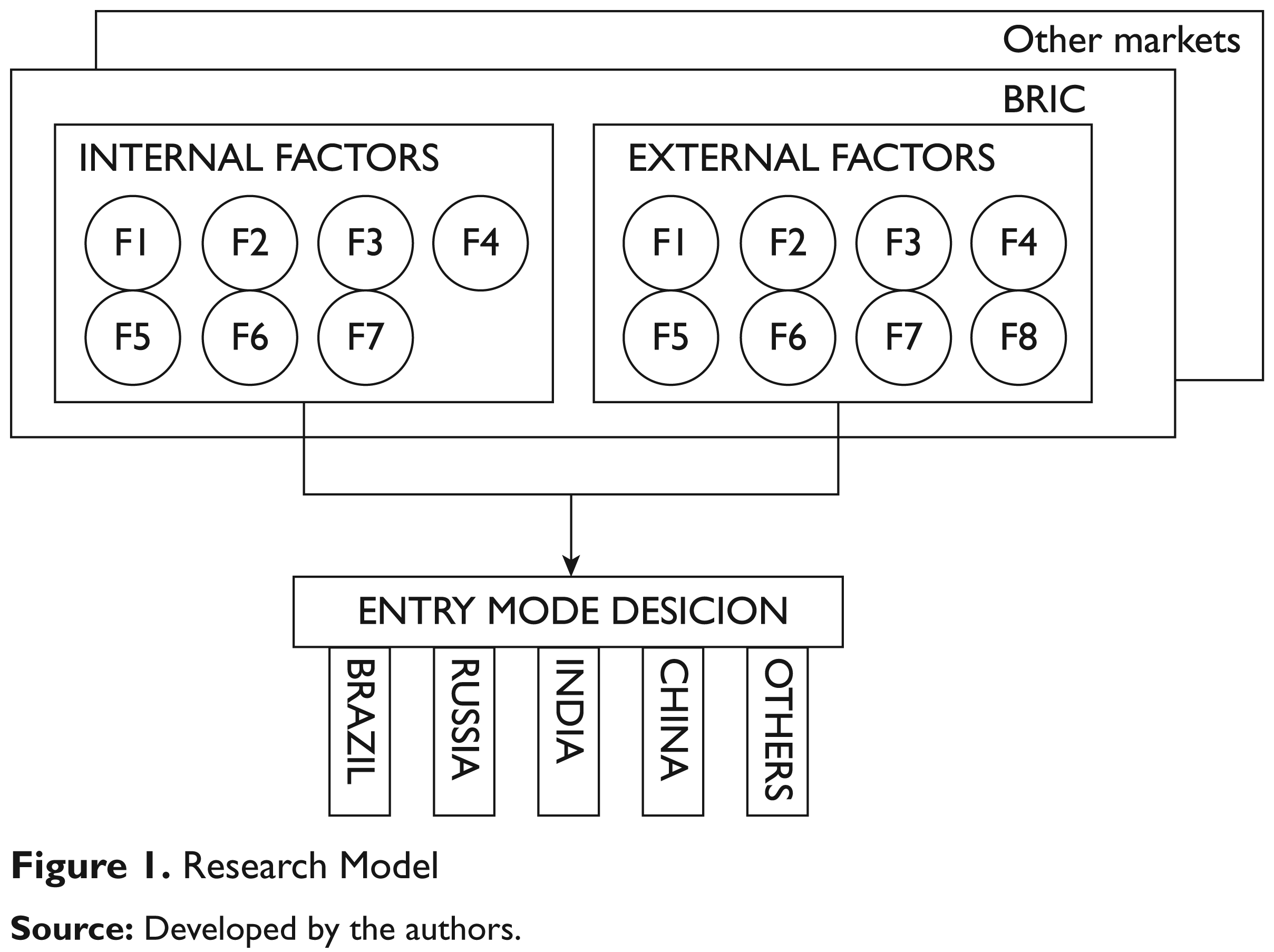
Factors for Entry Mode Choices
The focus of this article will mainly be to describe the role of internal and external factors when the Danish SMEs chose to enter the BRIC markets. Previous studies on internal factors of entry modes decisions show that besides control the turnover, personal networks and the interruption of international activities were influencing the internationalization decision (Dyhr Ulrich et al., 2012; Hollensen et al., 2011). Other studies have shown that external factors such as cultural distance, market potential and risk have a big impact on the entry mode decision as well (Agarwal and Ramaswami, 1992; Dow and Larimo, 2009; Gatignon and Anderson, 1988). The following section will explain different internal and external factors and how they connect to the entry mode literature.
First the internal factors control, flexibility, risk, product complexity, international experience, economic and personnel resources will be described. According the RBV the entry mode choice depends on internal resources and capabilities that will be discussed in the following part. The chosen external factors seen from the MBV are cultural distance, political and economic risk in the country, market potential, fluctuations in demand, trade barriers, competition and networks in the market. In the following section all factors are described from a theoretical perspective.
Internal Factors
Control
Control being closely related to the level of resource commitment is an important internal factor for the entry mode choice. Exporting indirectly via agents and distributors provides low control over the service conditions abroad but with the use of minimal resources. Higher control over international activities can be achieved by setting up joint ventures or strategic alliances with a medium level of resource commitment. Setting up a wholly-owned subsidiary requires an extensive level of resources but provides most control over the international activities (Sanchez-Peinado et al., 2007).
Flexibility
Under rapidly changing market conditions companies often have to change an entry mode strategy or withdraw from the market (Hollensen, 2011). Strategic flexibility can be described as a company’s capability to identify changes in the market and react by allocating the right resources to new directions (Sanchez, 1995; Shimizu and Hitt, 2004). Flexibility can lead to competitive advantages by increasing a company’s diversification, balancing the usage of resource commitment, using new technologies, engaging in cooperation’s and developing new structures in the company (Aaker and Mascarenhas, 1984; Shimizu and Hitt, 2004).
Risk
The level to which the company is willing to accept various business or country risks depends on its financial situation, strategic options, experiences and the competitive environment (Koch, 2001). A high risk may result in discontinuation of the company’s activities and the loss of company resources in a particular international market (Morschett et al., 2010). Export or low control entry modes require fewer resources on a lower risks level. Therefore exporting is considered as a low commitment mode since the firm engages agents and distributors to serve the market rather than using own company personnel resources (Hollensen et al., 2011). Furthermore, when companies have to withdraw from international activities and loose company resources in a certain market, they become risk-averse at following market entries and prefer low risk entry modes (Canabal and White, 2008; Kouznetsov and Jones, 2009).
Product Complexity
Different studies show that companies selling complex products such as, in a technology-intensive industry seek to acquire resources or invest directly in foreign markets to amortise their high R&D costs (McDougall et al., 2003; Ratten et al., 2007). This can be seen as factor to choose a higher commitment entry mode.
International Experience
Previous involvement in operating on an international level is another firm related factor of great importance for the entry mode decision. Through international experience a company can reduce its costs and uncertainties when entering a new market, which favours the investment in a new subsidiary (Dow and Larimo, 2009; Hollensen, 2011; Johanson and Vahlne, 1977).
As a result, foreign expansion decisions are likely to be influenced by prior knowledge and experiences of decision makers. The more experience a firm has gained in the international marketplace, the more knowledgeable and confident it will be about the opportunities and threats that the global marketplace presents. Therefore companies that have collected knowledge in a specific market prefer to invest in that region. Reliable information about international markets enhances a firm’s competitiveness by enabling it to better respond to the environmental changes (Abdul-Talib et al., 2011; Koch, 2001).
Economic Resources
The available economic or financial resources have an important impact on the entry mode decision. Financial instability of a company can limit the exposure to risk and result in lower commitment entry modes (Agarwal and Ramaswami, 1992; Wrona and Trapczynski, 2012).
Personnel Resources
Employees, managers or owners of a company accumulate knowledge and are therefore valuable resources when internationalizing (Koch, 2001; Lin, 2012).
Summing up the internal factors following propositions can be formulated for this survey:
P1: The entry mode choice of Danish manufacturing SMEs to the BRIC markets is differently influenced by the internal factors.
P2: The internal factors are of different importance for Danish manufacturing SMEs when entering the BRIC markets compared to entering other markets.
External Factors
Social and Cultural Distance
Cultural distance in international business research generally refers to the fundamental differences in norms and values between the company’s home country and the host country (Hollensen, 2011). Previous research shows that social and cultural distance leads to choosing a lower level of control of an entry mode (Gatignon and Anderson, 1988; Kogut and Singh, 1988; Root, 1994). Wrona and Trapczynski (2012) state that cultural proximity to transition economies results in a lower level of perceived risk. Including cultural context variables into the entry mode decision should then lead to better performance (Brouthers, 2002).
People within the same country might differ in how they behave, as the individual culture is varying according to the rules of the game, the context layer (Hollingsworth, 2000; Searle, 2005) and the value of the relationships (social capital; Adler and Kwon, 2002). There are therefore different interpretations of how to understand it, though researchers are generally talking about the same thing. Often culture is looked upon as a part of a broader context, which is affected by the cultural layers of institutions and policies surrounding it (Dow and Larimo, 2009).
Market Potential
The market potential regarding the size and growth of a country was found to be an important factor favouring high investment modes. Smaller firms prefer joint venture in high potential markets when the perceived contractual and investment risk is high (Agarwal and Ramaswami, 1992; Gatignon and Anderson, 1988).
Demand Fluctuations
Internationalizing into countries with high demand fluctuations can be very risky and prevent companies from entering a specific market. In transition economies the demand is based on low-income markets and instability but could rise steadily over a longer time (Wrona and Trapczynski, 2012). As demand fluctuations are difficult to predict, the entry mode decision should consider more factors.
Trade Barriers
More companies look for international growth if trade barriers have been removed or decreased. This could be observed in the European Union by implementing policies to reduce or remove barriers (Dana et al., 2005; Ratten et al., 2007). The development of polities in a country including trade barriers should therefore be observed when choosing an entry mode.
Competition Intensity
If the competitive market conditions in a country are intensive, small companies have difficulties to expand into these markets because of a lack of control. In markets and industries with high competition intensity SMEs choose low investment modes (Ratten et al., 2007).
Business Networks
The lack of resources in small firms can be diminished by using networks or alliances. Joining clusters was discovered as an important factor to increase international competitiveness (Han, 2006; Ratten et al., 2007). Building up networks can be useful when considering a high investment entry mode.
Political and Economic Risk
The risk of investing in a foreign country largely depends on the political and economic situation in the market. Favourable government policies and economic situations reduce the risk when entering a foreign market (Agarwal and Ramaswami, 1992; Dunning, 1988; Ratten et al., 2007).
P3: The entry mode choice of Danish manufacturing SMEs to the BRIC markets is differently influenced by the external factors.
P4: The external factors are of different importance for Danish manufacturing SMEs when entering the BRIC markets compared to entering other markets.
BRIC—The New Growth Markets of the World
The acronym BRIC was coined in 2001 by Goldman Sachs (O’Neill, 2001). It stands for BRIC.
In general, the total BRIC population accounts for approximately 42 per cent of the world’s population, but ‘only’ approximately 20 per cent of the world’s GDP (Wilson, 2003; The World Bank, 2012). However, this percentage is expected to increase in future as a result of the increasing economic activity in the BRIC countries compared with the ‘old’ economies in Europe and North America.
As a whole, the BRIC countries presented a GDP growth of 5.2 per cent yearly from 2010 to 2011, with China showing the highest annual growth with 7.4 per cent. As comparison, the US had a growth of 2.0 per cent and the Euro Zone even had a negative growth of 0.6 per cent in the same period (see Table 1).
The BRIC countries themselves have seemed quite happy with their status. For a couple of years, they have been organizing summits to develop collective strategies and to weigh in more on the global agenda. All four countries also emerged undamaged and fairly quickly from the financial crisis in 2008–2009 (Aloui et al., 2011).
However, some have questioned the BRIC categorization from the start. Fundamentally, the four countries have very little in common. Two countries are manufacturing-based economies and big importers (China and India), but two are huge exporters of natural resources (Brazil and Russia).
BRIC Main Indicators in 2011
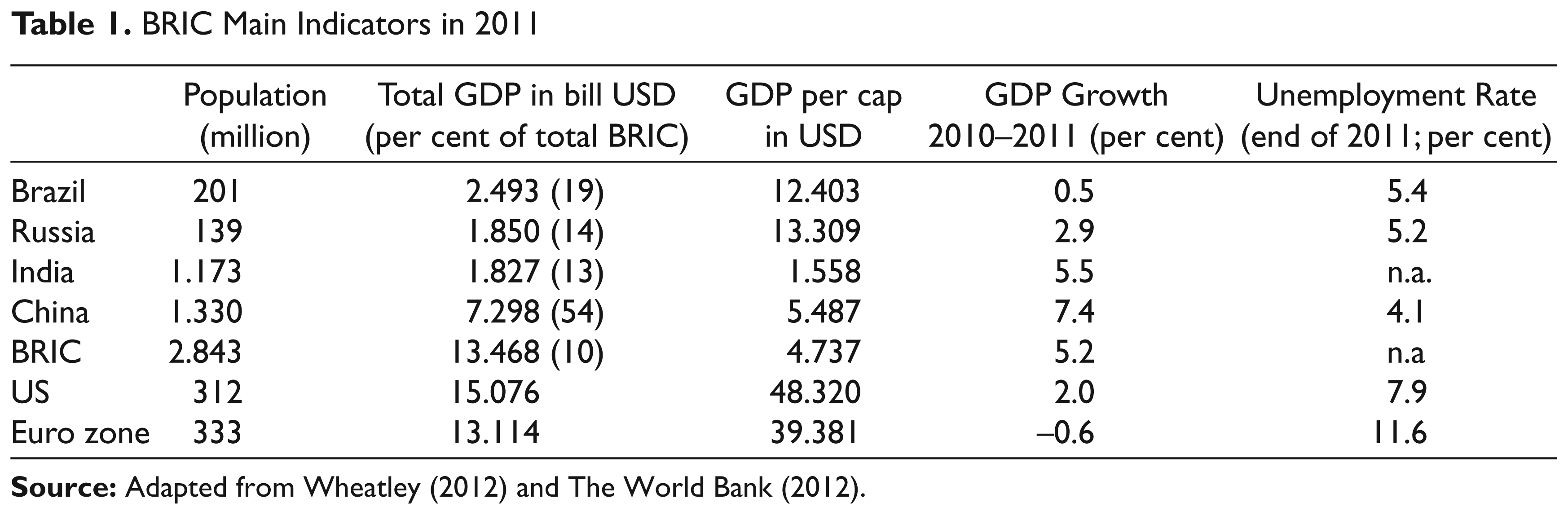
It has been suggested that China is in a league of its own compared to the other BRIC countries. The growth gap between China and other large emerging economies such as Brazil, Russia and India can be attributed to a large extent to China’s early focus on ambitious infrastructure projects: while China invested roughly 9 per cent of its GDP on infrastructure in the 1990s and 2000s, most emerging economies invested only 2–5 per cent of their GDP (The World Bank, 2012).
Especially Russia is sometimes said to be the odd one among the four countries; its characteristics are completely different from the other three. Brazil, China and India all have a demographic boom, counting on a populous young generation for innovation. Russia tends to resemble Europe with its ageing population and a decreasing birth rate. It owes its economic success mainly to its gas and oil reserves, while the other three thrive on services and manufacturing.
The recent success also feeds into the fear of overheating. The BRICs withstood the crisis so well that they have been used as a safe haven for capital. Yet as history has shown many times and in many places, an economic bubble is quickly made. Inflation has been surging in the emerging market world over the past years, driven by a strong run-up in agricultural commodities, thanks to supply shocks paired with the steady increase in demand due to rising wealth in places like the BRIC economies. Currently (end of 2012) the inflation rate in the four BRIC countries fluctuates around 5 per cent on a year-to-year base (The World Bank, 2012).
Indicators suggest that the BRICs are more relevant than ever. Further growth promises to lift hundreds of millions of people out of poverty. This emerging middle class will likely have an enormous influence on the remainder of the world. Not only will their demand for consumer goods change everything from energy consumption to export opportunities, but also they will weigh in more and more heavily on global decision-making. New players may arrive, but the original four BRICs remain the four to watch.
Non-BRIC Markets
It is of course problematic to treat the non-BRIC countries as one block of countries as they represent very different growth regions of the world, such as Asia, Africa and South America.
Danish Exports of Goods and Services in 2011
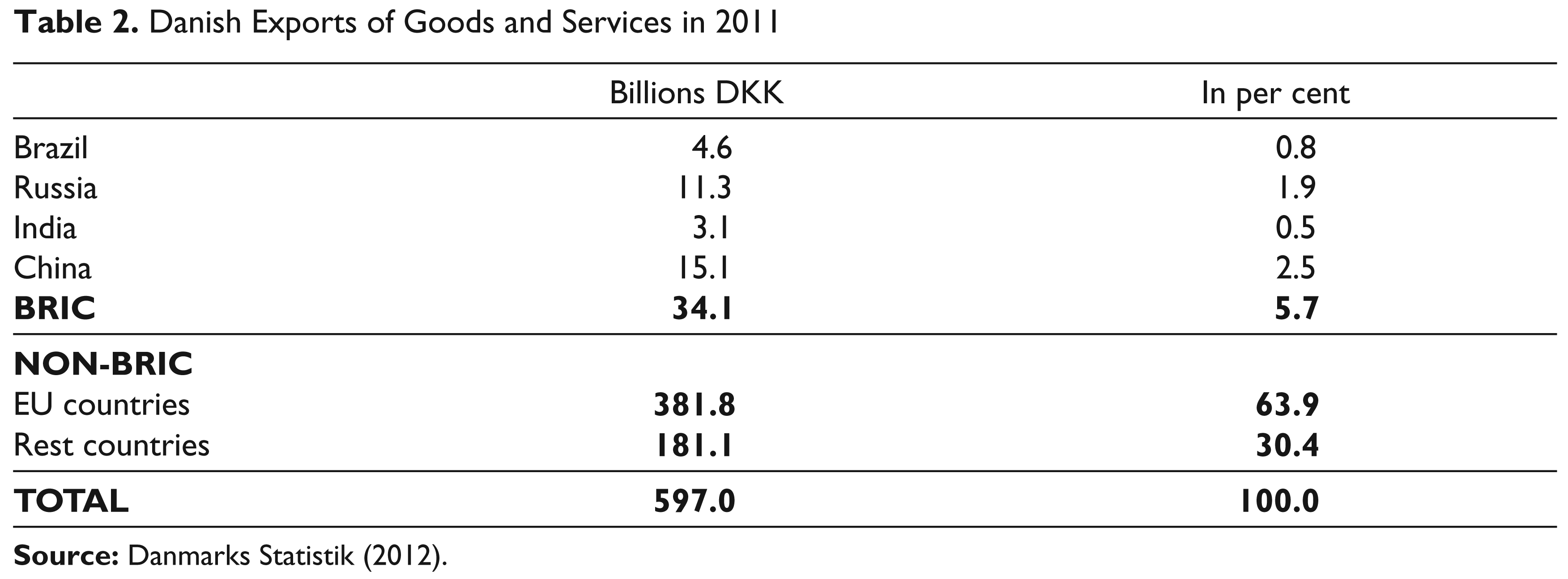
We can see from Table 2 that the BRIC countries account for 5.7 per cent of the total Danish exports, which means that the BRIC countries are underrepresented in the Danish exports, compared to the total value of BRIC’s GDP, which accounts to approximately 20 per cent of the world’s GDP (The World Bank, 2012). This leads to the following proposition:
P5: Danish manufacturing SMEs prefer low commitment modes (direct sales and agents/distributors) when entering the BRIC market.
Methodology
To examine the article’s hypotheses quantitative research techniques based on a positivistic paradigm was applied. The unit of analysis is the Danish SME defined by the European Commission where the number of employees ranges from 10 to 249 with a turnover between 2 and 50 million euros (European Commission, 2012). The sample consisted of Danish exporters operating on the B2B market with a minimum number of 10 employees. The respondents were selected by use of the database Kompass (
The data collection instrument used was a survey. The data were collected at an internationally known website dedicated to such activities (
General characteristics of the sample are as follows:
A total of 83.5 per cent of the companies have less than 200 employees. Nearly half of the respondent companies (48.4 per cent) had a turnover of 100 million DDK or more in 2011. A total of 53 per cent of the respondents generated 60–100 per cent of their turnover from export in 2011. A total of 85.1 per cent of the responding SMEs have more than 10 years export experience, and 69 per cent of the respondents export to 10 markets or more. A total of 29 per cent of the companies were exporting to Brazil, 49 per cent to Russia, 33 per cent to India and 48 per cent to China.
Data Analysis
P1: The entry mode choice of Danish manufacturing SMEs to the BRIC markets is differently influenced by the internal factors. The most important internal factors as shown in Figure 2 are personnel resources, financial resources and control of activities (see Figure 2).
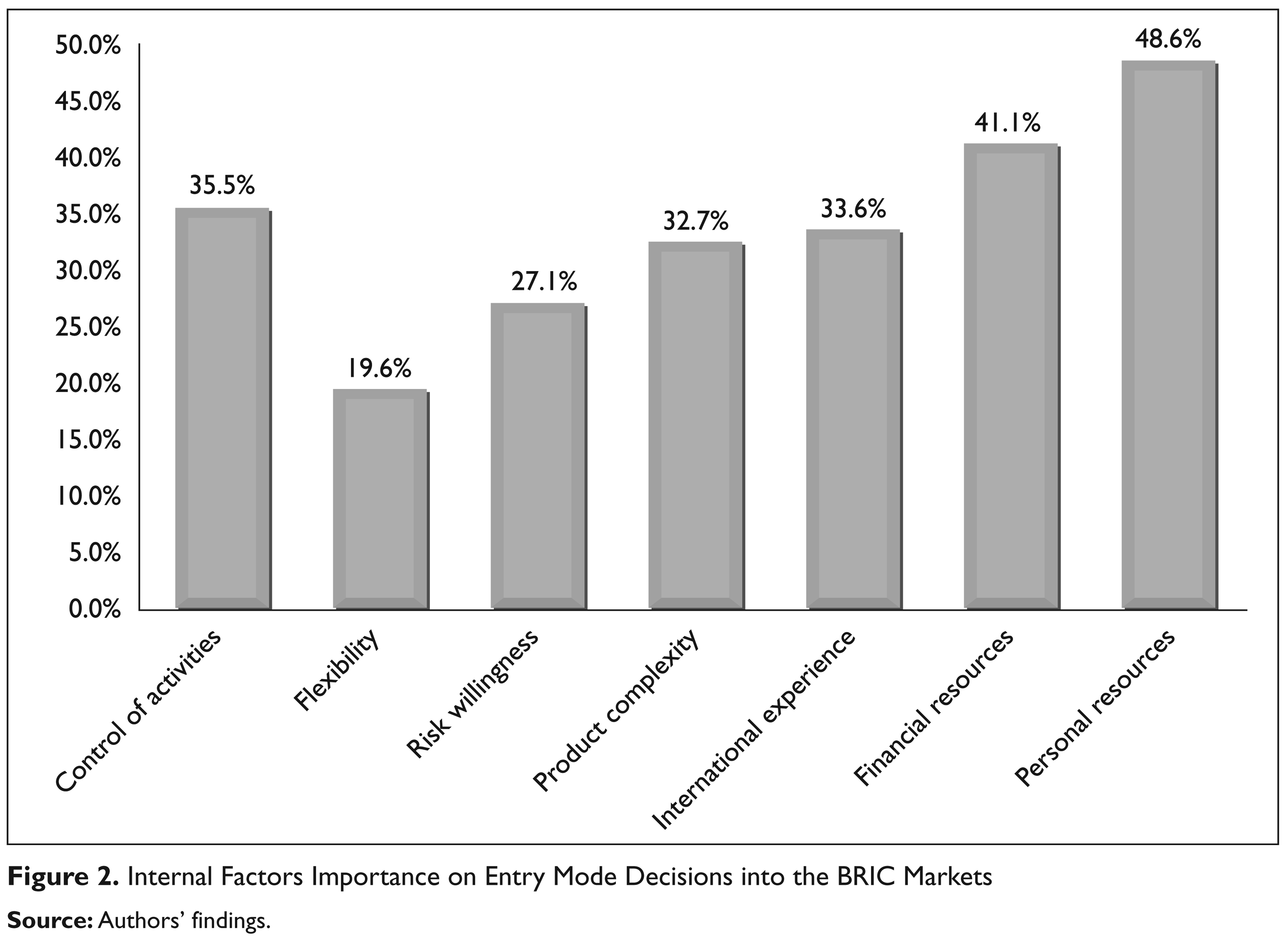
P2: The internal factors are of different importance for the Danish manufacturing SMEs when entering the BRIC markets compared to entering other markets (see Table 3).
Internal Factors Importance on Entry Mode Decisions
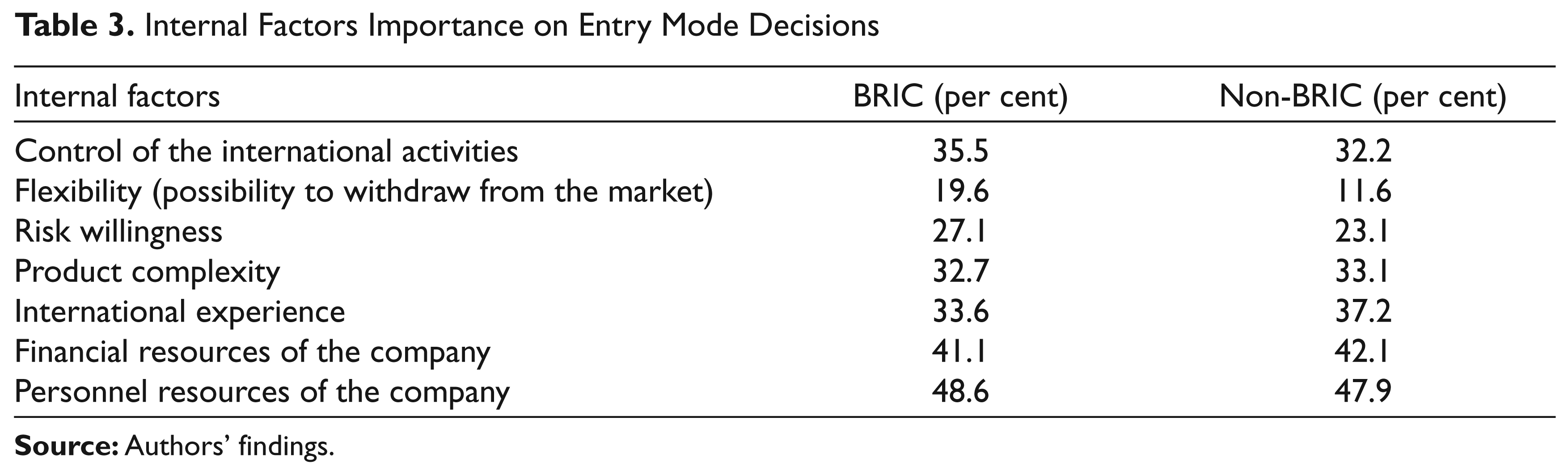
Table 3 compares the internal factors with regard to the BRIC and non-BRIC markets. There are no significant differences but tendencies can be seen where the BRIC markets show higher values when it comes to the factors flexibility or the possibility to withdraw from the market and the risk willingness.
P3: The entry mode choice of Danish manufacturing SMEs to the BRIC markets is differently influenced by the external factors (see Figure 3).
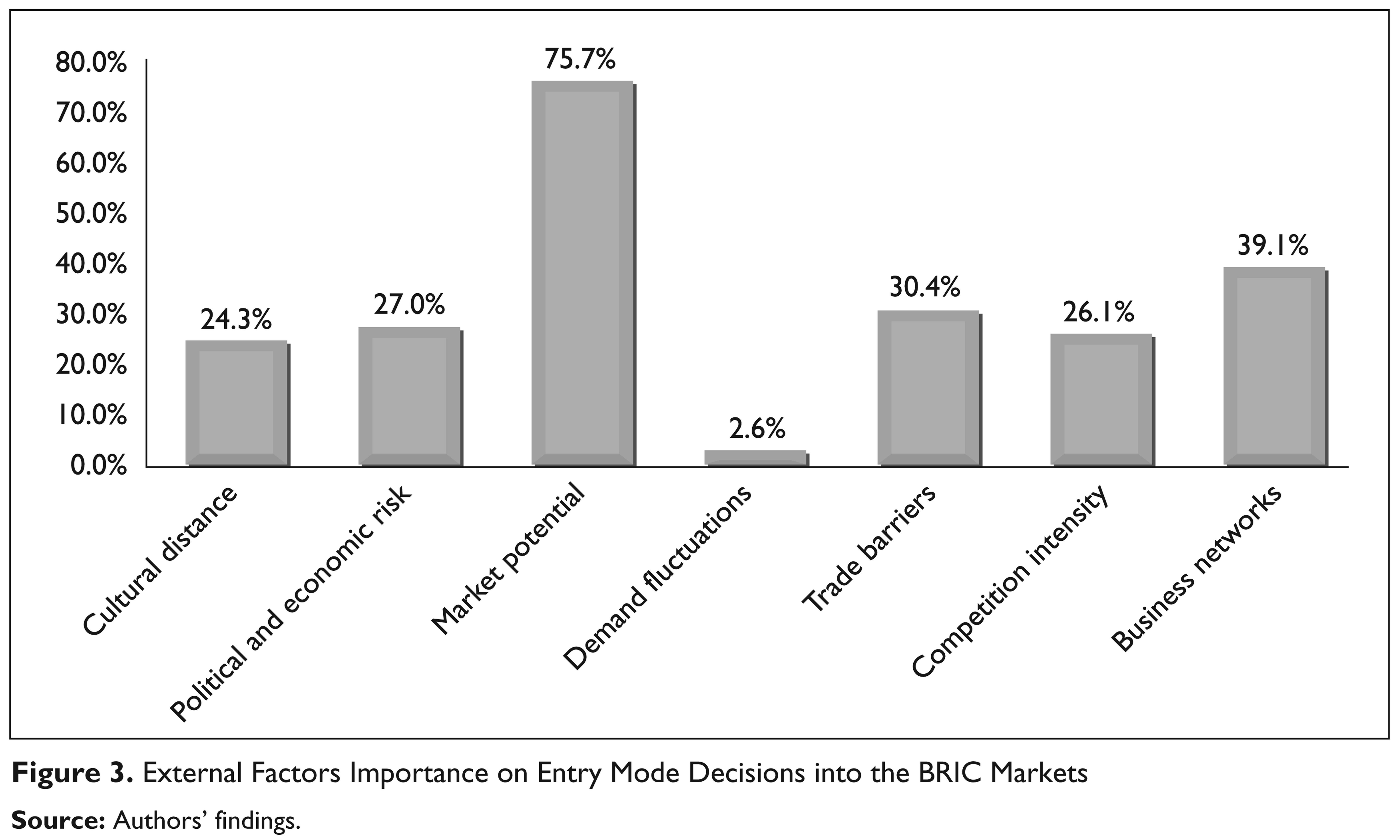
External Factors Importance on Entry Mode Decisions
Entry Modes into the BRIC and Other Markets

The Danish manufacturing SMEs regard market potential as main external factor for the choice of entry mode into the BRIC markets. The business networks with a value of nearly 40 per cent represent the second most important factor.
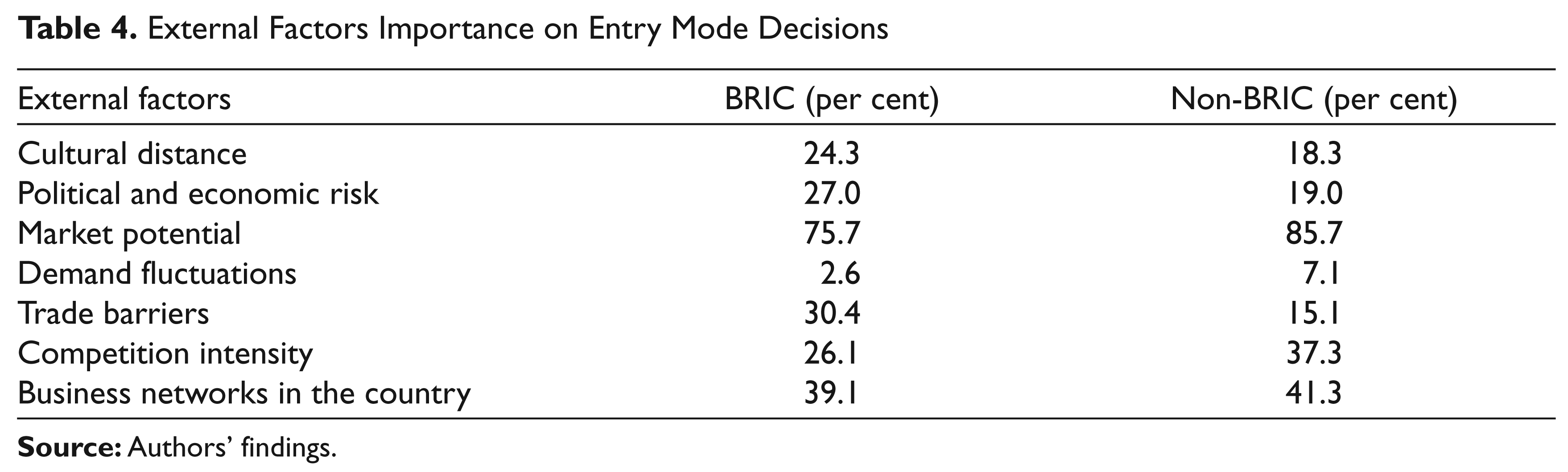
P4: The external factors are of different importance for Danish manufacturing SMEs when entering the BRIC markets compared to entering other markets (see Table 4).
The external factors trade barriers, cultural distance and political and economic risk show higher values in the BRIC markets whereas competition intensity is more important in the non-BRIC markets.
P5: Danish manufacturing SMEs prefer low commitment modes (direct sales and agents/distributors) when entering the BRIC markets (see Table 5).
The results in Table 5 illustrate that Danish manufacturing SMEs prefer low commitment modes when entering Brazil, Russia or India, compared to China where they favour JV/SA and subsidiaries.
Discussion
The contributions of this study highlights the importance of considering a much broader selection of entry mode options than usual considered. As small export companies are often using ‘low control’/‘low commitment’ modes like agents and distributors, the entry modes were arranged hierarchically according to the resources committed to each of them (agents and distributors, online sales, direct sales, joint ventures/strategic alliances and own subsidiaries).
We found that there were substantial differences in the internal and external factors determining the choice of entry mode. Also the use of the five entry modes was quite different in the BRIC countries. In China, Danish companies prefer the entry mode subsidiary to a much higher degree than in the other three BRIC countries. This result is in line with the Holtbrügge and Baron’s (2013) entry mode findings.
Internal Factors
Surprisingly, the traditional determining internal factors (control, flexibility and risk; Gatignon and Anderson, 1988; Hill et al., 1990) were evaluated less important than personnel and financial resources. The reason for this could be that the huge BRIC markets require a higher degree of personal relationships with local intermediaries. The size of the market requires higher commitment in terms of financial resources and control over the activities in order to build up long-term distribution networks in the distant markets.
As stated in the analysis the BRIC markets show higher values when it comes to the factors flexibility and risk willingness. This supports the theoretical discussion on flexibility being connected to the higher perceived risk in the BRIC markets (Hollensen et al., 2011; Shimizu and Hitt, 2004).
External Factors
The international business literature has widely recognized that cultural distance influences the company’s choice of entry mode (Tihanyi et al., 2005). However, whether high levels of cultural distance are associated with the choice of distributor (in one end of the entry mode scale) or a wholly owned subsidiary (in the other end of the scale) remains a paradox.
Very surprisingly, this study has not been able to confirm the importance of cultural differences. On contrary, cultural distance is far behind the market potential and business networks as determining factors for choice of entry mode.
As cultural distance increases, the company encounters greater difficulty in attaining complete or accurate information about their potential foreign distributors. This information asymmetry brings considerable challenges of finding an ideal distributor in the collaboration relationship.
High cultural distance also creates difficulties in understanding local distributors’ thinking, consequently limiting the accuracy of predicting their behaviour. Also evaluating distributors’ potential for opportunism becomes difficult. Even after a distributor is selected, the Danish company still needs to deal with the challenges of negotiating, monitoring and enforcing contractual agreements with the distributor, and these challenges may result in relative high costs for the Danish company. Under such circumstances, the Danish companies would prefer to fully control their foreign operations, which would result in choosing wholly owned subsidiary as the preferred mode of entry. Our results indicate that this is especially the case for Danish companies operating in China. However, the need for transferring knowledge from the parent Danish company to foreign subsidiaries also grows as cultural distance increases, unless the foreign subsidiary experiences a high degree of decentralized management style from the parent company.
According to the presented theory, support could be found with regard to the market potential being the most important external factor because of the size and growth of the BRIC markets (Agarwal and Ramaswami, 1992; Gatignon and Anderson, 1988). The lack of resources in small firms can favour the use of networks (Ratten et al., 2007) as shown in Figure 3. The high importance of the factor business networks also underlines the need for investing in personal resources (see also Figure 2). Personal relationship competences are therefore especially important in the relationship-oriented BRIC countries. This was supported by Liu and Person (2011) who found that a partnership or collaboration is likely to have an impact on facilitating business operations in China. They furthermore stated that external relationship building or development may continue to play an active role in the Chinese society, which may affect companies’ decision to invest in China (Liu and Person, 2011).
Trade barriers, cultural distance as well as the political and economical risk are viewed as main obstacles when internationalizing into distant markets (Ratten et al., 2007), which could be confirmed in the present survey. The findings also show a lower perceived competition intensity in the BRIC markets because they are still recognized as the new and emerging markets with fewer established competitors.
The main arguments for using higher commitment modes when entering China can be seen in the country’s high market potential and lower rated risk compared the other BRIC markets (Ripollés et al., 2012).
Conclusions
The purpose of this article is to provide an integrative conceptual framework to explain:
What entry modes are Danish companies using in the BRIC countries, in contrast to non-BRIC countries. Which factors (internal and external) influence the choice of entry mode in the BRIC and non-BRIC countries.
Our results underline the heterogeneity in the use of entry modes in the different BRIC countries, also compared to the non-BRIC countries.
In general, our findings show that Danish companies mainly prefer low commitment modes when entering the BRIC market. The agent/distributor solution is the most popular choice in Brazil and Russia, whereas direct sale (to customers) is as popular in India and China. The subsidiary solution is a much more popular entry mode in China compared to other countries.
When we studied the internal factors that determine the choice of entry mode, it was surprising that the traditional explaining factors (control, flexibility and risk) were evaluated less important than personnel and financial resources.
Regarding the external factors this study could not confirm the importance of cultural distance. On contrary, cultural distance from home country to host country is far behind the market potential and business networks as explaining factors for the choice of entry mode.
Our findings indicate that even if the companies mainly use low commitment modes when entering the BRIC countries, it is not just to reduce the market risks. It is much more about establishing a long-term business network and sustaining the established relationships with the agents and distributors in the BRIC country.
Limitations
This study is limited by a number of factors that must be considered when evaluating our findings and conclusions.
First, the BRIC countries do not constitute a homogeneous group of countries. Actually they are very heterogeneous, and consequently future studies could go in-depth with the external market factors that influence the choice of entry mode in the four countries. This could also be supplemented with some explorative case studies, in order to enrich the explanatory factors, which determine the entry mode decision.
Future empirical studies could also integrate other high growth emerging countries such as Turkey, South Africa, Argentina, Indonesia, Vietnam and Malaysia.
Managerial Implications
The study should help practitioners who are considering entering one of the BRIC countries.
Two implications stand out. First, the high importance of the personal resources of the company found in the study highlights the need for the management to gain knowledge through personal relationships in the market and it would also emphasize the experimental learning through interaction with local partners and customers. The financial resources could be used for establishing strong and long-term relationships with market and non-market partners and getting closer to the local customers through own local organizational set-up in the BRIC country. Consequently, investment in subsidiaries enables companies to gain access to their customers’ knowledge, which will also increase control. However, the financial risk will also increase and consequently the flexibility will be reduced as a consequence of the sunk costs.
Second, firms selling to the BRIC countries consequently face a ‘trade-off’: Firms entering a BRIC country through a 100 per cent owned subsidiary benefit from the full control over local operations which may provide protection of the firms’ tacit knowledge (e.g., from patent theft) in form of intellectual property rights. On the other hand, the use of ‘lower commitment’ entry modes also provides the opportunity to outsource the risks occurring from the country’s institutional weaknesses such as insufficient intellectual property rights protection and corruption. Furthermore, in high market potential countries like BRIC, there is a need to facilitate transfer and sharing of local knowledge when the cultural distance is great. Managers in culturally distant countries inevitably confront the challenge of larger knowledge barriers. Inviting local partners and customers to form a business network may reduce such barriers. Gaining local knowledge through these business networks can effectively compensate for the loss of control when choosing lower commitment modes.