



Abstract
Good governance and accountability issues have become a serious concern in Indonesia after the economic crisis and subsequent political transition in 1998. Consequently, the Indonesian government has increasingly given attention to the application of performance measurement for the governmental agencies, including local authorities, as part of bureaucratic reform and good governance practices. The purpose of this article is to review the regulations and guidelines while examining issues and consequences of implementing performance measurement system in Indonesian local governments using descriptive and analytical methods based on secondary data. Although a performance measurement system has been implemented in Indonesia for 14 years, the results have been far from satisfactory. The Performance Management System (PMS) regulation is quite comprehensive, except it lacks a punishment and reward system. Some evidence demonstrates implementation issues such as lack of compliance, lack of integration between planning and budgeting, and inaccurate indicators and data reporting.
Keywords
Introduction
There has been increased awareness for the need of good governance in Indonesia since the multi-dimensional crisis experienced by the country in 1997. One of the major factors for the crisis is the weak public sector governance which has resulted in corruption, collusion, nepotism and monopolistic practices. Consequently, due to the pressures and demand from the international bodies such as IMF and World Bank, major revolutionary reform of the public sector was instituted in Indonesia after the crisis.
It should be noted that the reform of the Indonesia public sector was initially implemented in the early 1980s and 1990s in line with the wave of new public management (NPM) worldwide. NPM has dominated the public administration reform agenda of most OECD countries from the late 1970s (Hood, 1991; Pollitt, 1993; Ridley, 1996). The concept of NPM encompasses management techniques in private and public sector organizations. NPM argues that to enhance the government performance, government should operate like a business organization and utilize entrepreneurial-based techniques (Adams, 2000; Barzelay, 1992; Hughes, 2003; Osborne & Gaebler, 1992). The NPM concept represents a new paradigm that attempts to transform the public sector through organizational reforms that focus on results in terms of efficiency, effectiveness and quality of service appears to fit nicely into the larger, political theory of governance (Stoker, 1998). Hence, NPM has led to major attention being paid for good governance.
Good governance encompasses participation, rule of law, transparencies, responsiveness, consensus of orientation, equity, efficiency and effectiveness, accountability and strategic vision, equity and rule of law (Mardiasmo, 2002; UNDP, 1997). As such, the availability and dissemination of information regarding policies, programmes, resource allocations and results relative to services are the core elements of good governance. The primary objective of good governance associated with NPM reforms is to improve accountability, because NPM provides greater attention to markets, citizen–consumer satisfaction and transparency of government. Hence, the issue of performance measurement is part of the agenda of institutional reform for greater productivity, transparency and accountability for government agencies, especially the local government.
Indonesia has also increasingly drawn attention to the application of performance measurement along with the notion of bureaucratic reform and good governance practices. The system and guidelines introduced is externally imposed by the central government to the local authorities rather than internally developed by the local authority themselves. Even though the system of measuring performance has been adopted in Indonesia after the political crisis since 1999, the results have been far from satisfactory. As such, this article aims to assess these guidelines, and the implementation of PMS and all regulations pertaining to the system that local governments must perform. The main objectives of this article are to review the guidelines and explore the implementation issues in local government and to determine whether the system might spur local governments to perform better and be held accountable. This article adopts descriptive analysis and is mainly based on secondary data. We review the performance management system required by central government, in terms of the governmental regulations and guidelines, and aim to identify the issues and problems with implementation of system of measuring performance.
This article is organized as follows: Starting with the review of literature about performance management system in public sector specifically in the context of local government, it goes on to review the guidelines of PMS from the Indonesian central government. The following section presents the evaluation of PMS adopted in Indonesia local government and the final section provides the conclusions of the article.
Performance Management System for the Public Sector
The increase intention to performance measurement in public sector coincides with the rise of public sector reform (Kloot & Martin, 2000). It is argued that measuring performance will lead to the sustainable transformation of the reform process (Durst & Newell, 1999; Nichols, 1997). Performance measurement system is needed in developing countries in view of limited institutional capacity such as weaknesses in regulatory practice, low level of public accountability, administrative inefficiencies, limited human resources, a lack of facilities and insufficient funding (IMF, 2002; Mimba et al., 2007; Nsouli, 2000; Van Crowder, 1996). This limited institutional capacity has led to a situation of inefficient bureaucracy and lacks of governmental transparency (Henderson, 2001). Thus, the use and implementation of system of measuring performance of public agencies can improve citizen trust in government directly through citizen participation in the evaluation process or indirectly by improving citizens’ perceptions of government performance (Yang & Holzer, 2006).
Thus, public sector PMS are critical to efforts to streamline governments, gain greater efficiency, productivity and effectiveness, enhance transparency and accountability, regain public trust in governmental institutions and contribute to a reorientation of the role and functions of government (Caiden & Caiden, 2004). Despite the potential benefits to be achieved in using a system to measure performance, there are several problematic issues in utilizing the system in the context of the public sector. It is problematic to measure performance in the public sector due to the existence of various stakeholders who have different and conflicting requirements which caused unclear target setting on governmental agencies (Brignall & Modell, 2000; Lawton, McKevitt & Millar, 2000; Wisniewski & Olafsson, 2004; Wisniewski & Stewart, 2004).
Performance measurement in local government rests on the potential value of such measures to three audiences, namely local government managers, elected officials and citizens (Ammons, 1995). The importance of performance measurement in local governments is not only as a management and communication tool, but also as an important source in the budgetary process (Melkers & Willoughby, 2002). In order to obtain the benefits from the system, the local government should be careful to select applicable standards and relevant performance indicators (Ammons, 1995). Otley (1999) offers performance management framework that covers five issues that need to be addressed in developing a framework for managing organizational performance.
The use of PMS still faces various challenges in developing countries. In Uganda, the use of national annual assessments (NAS) for performance appraisal has helped local governments, although in most local government plans, the focus is more on input–output relationships as opposed to outcomes and impacts (Kugonza et al., 2012). The emphasis is more on delivery of outputs rather than the outcome of such services delivery. Basically, measuring outcomes is more difficult than measuring output; therefore, some municipal governments use more output (efficiency) than outcome (effectiveness) measures (Chan, 2004; Poister & Streib, 1999; Pollanen, 2005).
The performance assessment of the Malaysian public sector to improve their efficiency and effectiveness has seen limited success since the government does not monitor the performance of public agencies, so there are no penalties if the government agency cannot meet a performance target (Siti Nabiha, 2008). Key performance indicator (KPI) data are collected, reported and analyzed for internal purposes only (Abdul-Khalid, 2010). Consequently, there were changes made in Malaysia since 2009 with the emphasis on outcome based measures, which are linked with planning and budgeting of the government agencies, but the impacts have not been seen yet (Jalaludin & Siti-Nabiha, 2013). In Indonesia, Akbar, Pilcher and Perrin (2012) in their survey of performance measurement used by Indonesian local government found legislative requirement has the strongest effect amongst metric difficulties, technical knowledge and management commitment. This implies that the main reason for developing indicators is simply to comply with central government regulations. In other words, motivation is more about conformance than performance, and coercive pressure is strongest from central government.
The local government must ensure the implementation of PMS cover five areas to achieve good result: First, organizational aims and objectives, and the mechanisms that have been put in place to measure and monitor goal attainment; second, the strategies or the processes used to implement and measure the achievement of the strategies such as strategic planning, performance indicators and budgeting; third, performance target setting and measurement of effectiveness and efficiency; fourth, a punishment and reward system for consequences from achievement or failure to achieve the performance targets; and fifth, information flow to enable the organization to learn from its experience.
Performance Accountability and Reporting System in Indonesia
The financial crisis in mid 1990 has a major impact on the public sector management in Indonesia. It has also lead to the demand for better governance of the public sector (Irawanto, Ramsey & Ryan, 2011). Before 1999, Indonesia had a highly centralized governmental system whereas the central government fully controls all of the local governments. At the end of Suharto era, there has been a widespread demand for democracy and control over their own affairs. Based on the pressures, the government approved two laws on decentralization, which concerns administrative and financial administration of local government (Law 22/1999 revised by Law 32/2004 and Law 25/1999 revised by Law 33/2004).
The decentralization supported the local government to manage their institution in accordance with the autonomy principles to accelerate the realization of public welfare. By law, there are two kinds of local governments under the central government, namely province and district/city. The central government provides greater powers for authorities at the sub-provincial level and the province is like a coordinating agent for a number of districts/cities besides its role as a representative of the central government. The districts/cities are responsible to the key public service and provided direct accountability to their local residents. The Indonesian governmental structure is shown in Figure 1. Therefore, PMS is needed and plays a significant role at the districts/city level than the province.

Prior to 1999, the performance reporting and accountability focused mainly on financial accountability of governmental agencies. The push for the adoption of performance measurement system and practice started since the issuance of Presidential Instruction (PI) No. 7/1999, which requires the government agencies to report both financial and non-financial performance. This regulation requires all government agencies to implement performance accountability system (SAKIP) and produce performance accountability report (LAKIP). The main purpose of this regulation is to ensure that government institutions can manage their institution in a more effective, efficient and responsible manner.
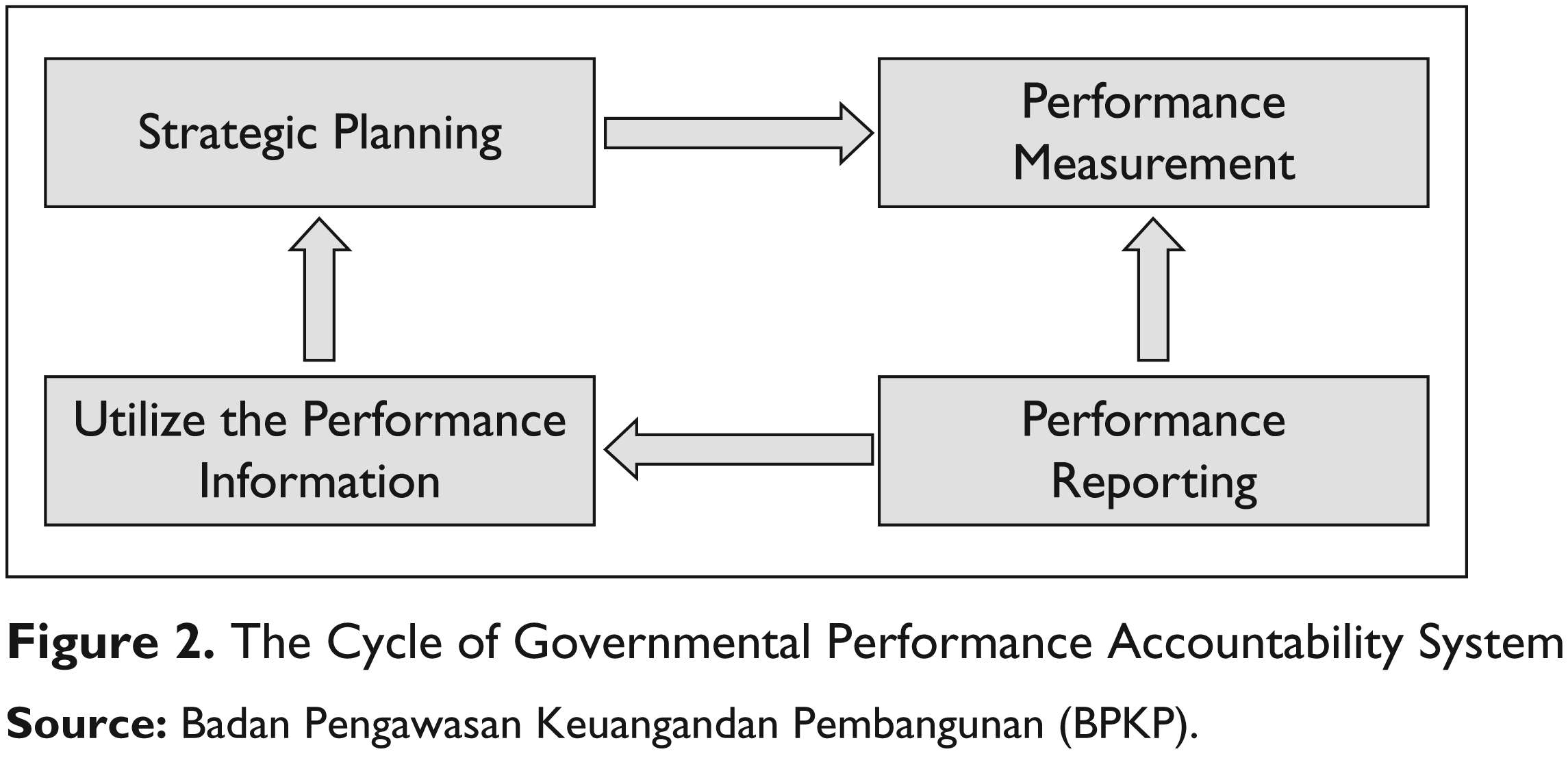
The operational guideline for the performance accountability system and reporting is regulated in Public Administration Agency (PAA) Decree No. 589/IX/6/Y/99 and refined by No. 239/IX/6/8/2003, which requires government institutions to develop strategic planning, performance planning and performance measurement for a performance accountability system to achieve the vision, mission and objectives of the organization. This regulation also requires government to prepare the well-defined planning, performance target, measurement indicators, data collection system and offer clear guidance in the implementation and evaluation of programmes to achieve a satisfactory result. Hence, government agencies were required to prepare and submit a performance report every year.
The performance accountability cycle consists of four steps (Figure 2). First, strategic planning that requires government institution to align vision and mission with the opportunity and hindrance to increase the performance accountability. Strategic planning consists of vision, mission, goal, objective and strategy to anticipate future development. Therefore, strategic planning should align with national long/medium-term planning. The agency’s strategic planning will be translated into performance planning. Second, performance measurement is used as a basis for assessing the success and failure of the implementation of strategies and activities. Systematic assessment based on the performance indicators such as inputs, outputs, outcomes, benefits and impacts needs to be done. The third step requires reporting of performance which consists of the summary of output and outcome of each activity and programmes. Finally, performance information should be used to continuously improve performance.
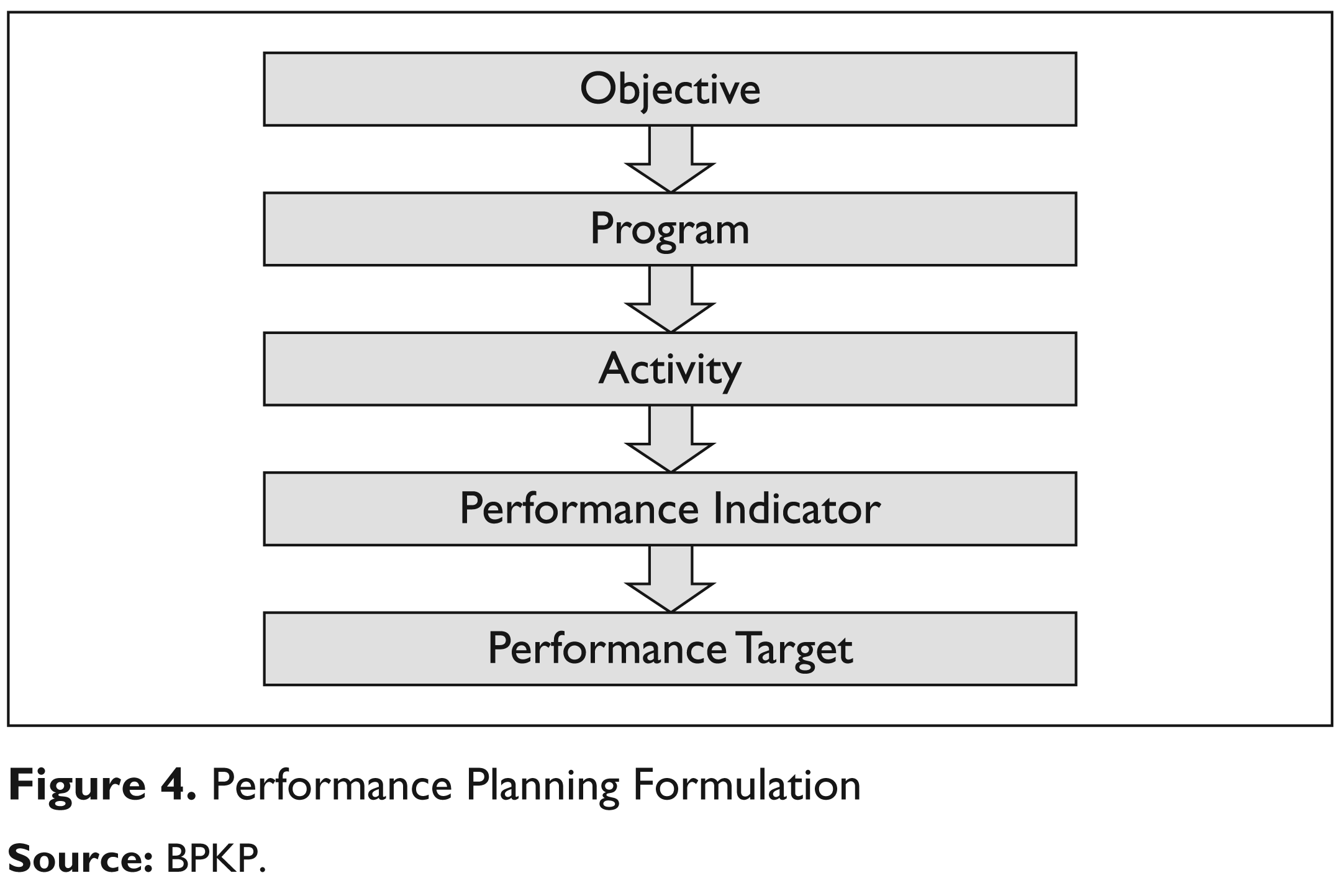
Performance planning is the process of preparing performance plan as a translation of performance targets and programmes from the strategic planning and will be implemented through the annual activities which consist of objective, programmes, activities, performance indicators and performance targets as shown in Figure 3.
All performance indicators of the objectives and activities will be set in the performance plan (see Figure 4). Budget preparation and policy formulation in the performance planning reflect the commitment to achieve the annual objective of the institution. Performance measurement is used as a basis for assessing the success and failure of the implementation of all activities. The measurement is the result of a systematic assessment based on the performance indicators such as activity indicators of inputs, outputs, outcomes, benefits and impacts. The use of performance information is meant to continuously improve performance.
The local government must establish KPIs based on guidelines from the Ministry of State Apparatus and Bureaucracy Reform (MSABR) Regulation No. 9/2007. This regulation enables the government institutions to measure their success or failure in achieving the organization’s strategic goals and objectives. It also requires local governments to develop their outcome-based indicators to improve performance and accountability. The KPIs should be formulated based on mid-term and strategic planning and meet the requirement of SMART criteria (specific, measurable, attainable, relevant and timely).

The central government also requires performance statement from the local government to monitor, control and assess their achievement (MSABR Regulation No. 29/2010). The head of local governments promise to achieve the performance target and responsible on the success and failure in achieving the target in the performance agreement.
The performance accountability report should be sent not more than three months after the end of the fiscal year. This report describes the performance achievement of local government including the financial aspect such as budgeting to measure the effectiveness and efficiency. Essentially, performance accountability report relies on self-assessment approach in performance measurement and reporting, to ensure that all governmental agencies comply with the established operating procedures and standards and attempts to strengthen result-orientation.
The information required in the report include the results of the performance measurement, evaluation and analysis, performance accountability, successes and failures, barriers and problems as well as solutions. In addition, the report also requires the information of budget allocation for implementation and realization including efficient performance indicators.
Performance Accountability Report Evaluation
The central government assesses the performance of local governments through performance accountability report. The purpose of the evaluation is to analyze the implementation of PMS and give recommendations for improvement.
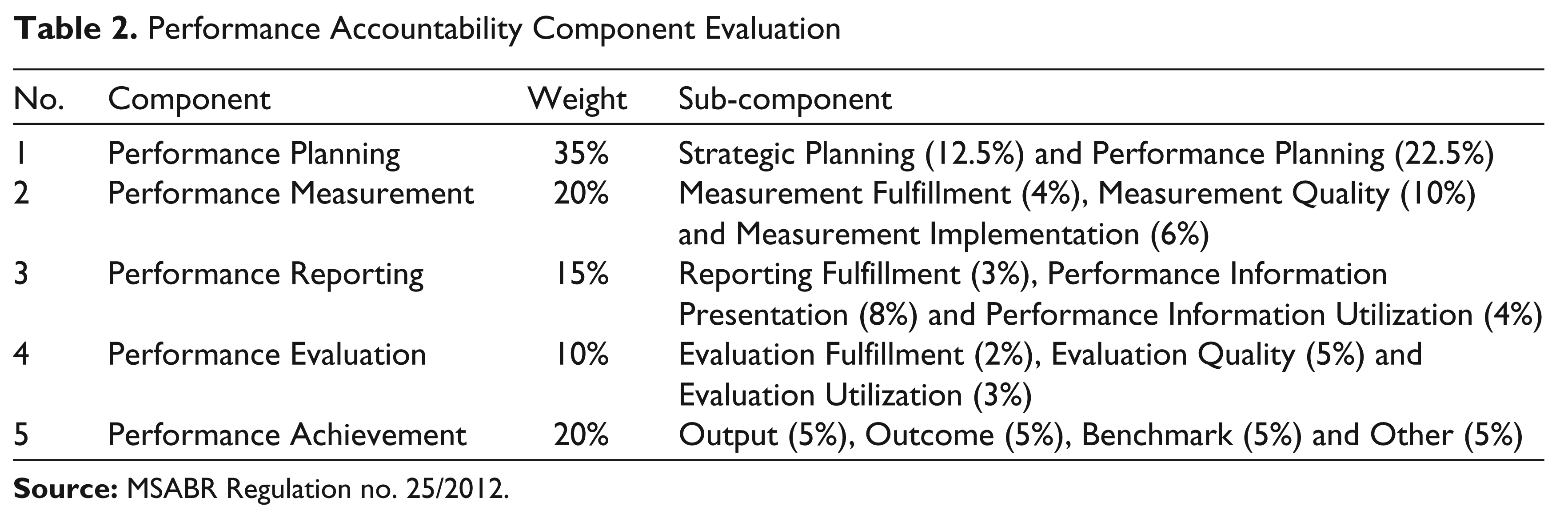
The evaluation guideline of the performance accountability report is regulated by MSABR (No. 135/2004 and refined by No. 25/2012). It requires the central government to evaluate the preparation of performance policy setting and key performance indicators, the implementation of the PM components such as performance planning, performance measurement, performance reporting, internal performance evaluation and achievement of organizational goals and objectives (Table 1). The evaluation of performance focuses more on process (80 per cent) than results (20 per cent). The total score is classified as follows: AA (>85–100); A (>75–85); B (>65–75); CC (>50–65); C (>30–50) and D (0–30).
List of PMS Regulation

Performance Accountability Component Evaluation
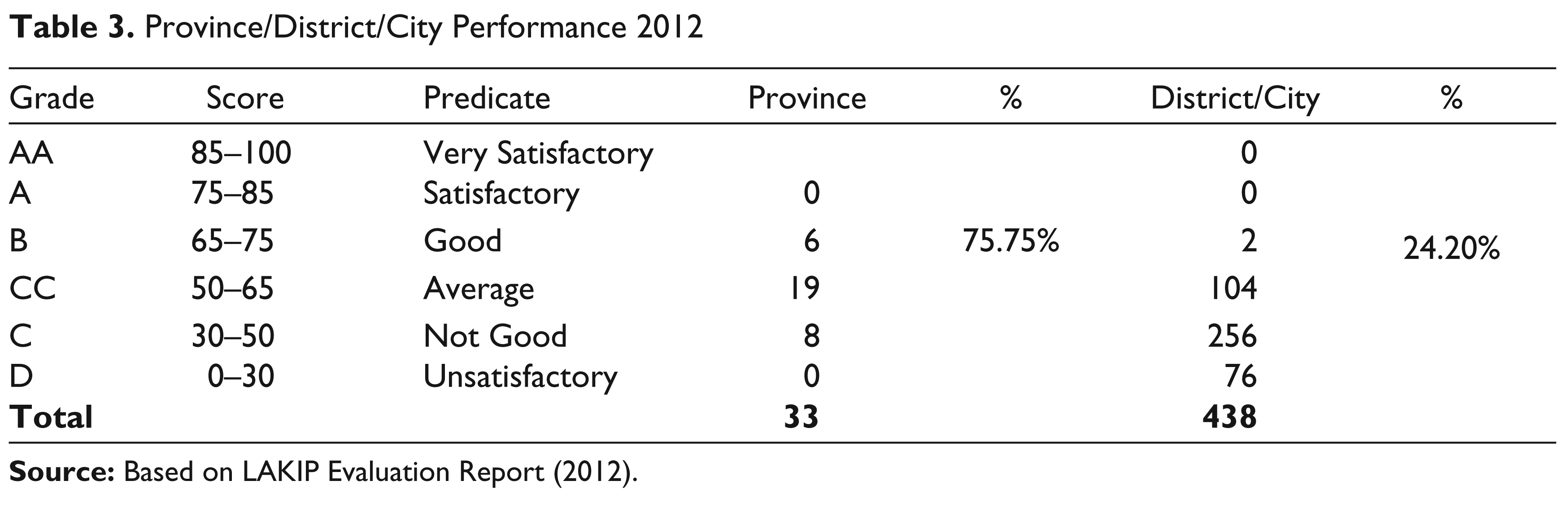
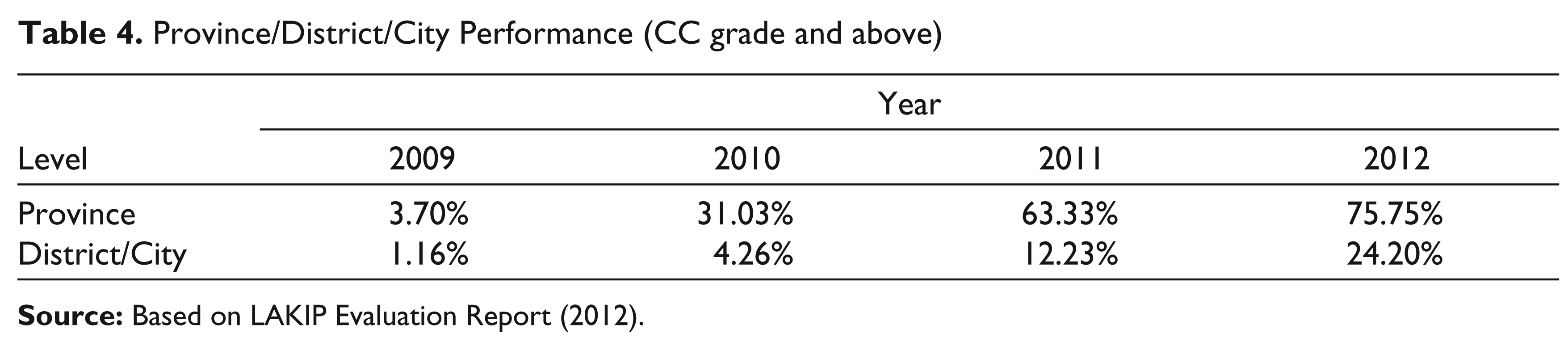
Fourteen years after implementation, the system does not show the good result or achieve what it intended to achieve. Based on performance evaluation 2012, 75.75 per cent of the province get good grade (CC and above) but only 24.20 per cent district/city get good grade (Table 2). Improvement at province level showed significant results from 2009, as only 3.7 per cent had a good grade, which increased to 75.75 per cent in 2012 (Table 3). In contrary, improvement at the district/city level shows unsatisfactory results. In 2009, only 1.16 per cent obtained a good grade, increased to 24.20 per cent in 2012 (Table 4). The district/city level needs more attention from the government to facilitate and guide them to perform better.
Province/District/City Performance 2012
Province/District/City Performance (CC grade and above)
The central government requires the local government to submit at least two performance reports, LPPD (sub-national governance performance report) to Ministry of Home Affairs (MoHA) and LAKIP from MSABR. All the reports contain information about governmental performance along a designated period and should be prepared by local governments. Even though the performance report has the same purpose, to measure local government performance, the format is different. Such as situation demands more workforce and energy from local government. Frequently, different central ministries have jurisdiction over planning and budgeting areas, but there is a lack of coordination (ICCMA, 2005).
The PAA Decree No. 239/IX/6/8/2003 requires local government to have strategic planning, objective, programmes, activities, performance indicators and reporting. The system introduced is quite comprehensive in the sense that the government has already regulated key objectives, strategies and plans, performance target and measurement, and performance information. This regulation fits four issues from Otley’s (1999) performance management framework which consists of formulation organizational aims and objectives, the strategies to implement and measure the achievement, performance target settings, measurement of effectiveness and efficiency, and performance information. However, regulations do not cover the punishment and reward system at the organization level and individual level. Consequently, the local governments are not motivated to perform well and more accountable if there is no punishment and reward system put in place.
The Indonesia central government evaluates the local government performance based on performance accountability report. The evaluation focuses more on the implementation of performance accountability system (80 per cent) than the performance achievement (20 per cent). It can be concluded that the evaluation system is focused more on process than results. In consequence, the local government can get good result (CC) if they can prepare the planning document and indicators, even without achievements.
Based on MSABR evaluation report, not all local governments have sent their performance accountability report, whereas the MSABR Regulation No. 29/2010 requires the local governments to submit their performance accountability report (LAKIP) not more than three months after the fiscal year. Some local governments have difficulties in preparing performance report and do not submit the report. One of the main issues is inadequate knowledge and skills of their staffs to implement PMS and produce the performance report.
Government through MoHA Regulation No. 54/2010 requires the local governments to set up long-term and medium-term development plan, and strategic planning for district/city and all the indicators must align with local government medium-term planning (MSABR 29/2010). As a matter a fact, the evaluation results from the MSABR in 2012 show that some local governments prepare strategic plans without aligning with medium-term development plan. Since the budget remains the chief motivating force in determining resource allocation, the performance targets should be matched with annual budgetary costs. However, there are plenty of examples showing some programmes and activities in performance accountability reports that have no budget or vice versa (PKMK-LAN, 2005).
The MSABR introduced KPIs regulation in 2007. This regulation requires outcome indicators at the local government level. Local governments must set KPIs such as activity indicators of inputs, outputs, outcomes, benefits and impacts. However, some local governments have difficulties linking input with output and distinguishing between output and outcome (Dendi, 2010). The outcomes, benefits and impacts, which are more difficult to be measured, are not identified well. Municipal governments usually use more output (efficiency) than outcome measures (Chan, 2004; Kugonza et al., 2012; Poister & Streib, 1999; Pollanen, 2005).
Another key problem in producing accurate reporting is an availability of reliable data. Theoretically, results data for each performance measure should be regularly collected during the year in order that the data can be analyzed and adjustments made to enable the programmes to continue to perform as expected (AGA, 2009). In Indonesia, the government usually lacks reliable and consistent data, especially sub-national government in most regions, although they have made substantial efforts to improve the data availability and reliability. As consequences, performance targets were defined without sufficient baseline data and some local governments determine the target indicators and performance indicator by using trend of previous year. Worse yet, some local governments determine the value of realization by using the predictions from the previous year and only a few local governments determine the value based on the database (PKMK-LAN, 2005).
Evaluation of the PMS in Indonesia’s Local Government
This article set out to examine the regulation, guidelines and issues of implementation the performance accountability system in local government. The findings show redundant performance reporting from the central government (MoHA and MSABR), which can switch the focus of local government from improving the quality of the PMS implementation to report preparation. Moreover, the local government is facing limited manpower. The current regulations overwhelm the local governments rather than stimulate and enable them to enhance their learning processes, strengthen their capacity for policy formulation and strategy alignments in addressing local/regional issues and emerging global challenges (Dendi, 2010). Therefore, it is necessary for central government to allow better coordination between ministries to regulate the local government performance report.
Most of the components in the performance management system have been discussed and imposed through the issuance of the various regulations, except the punishment and reward system. Based on Otley’s (1999) performance management framework, motivation and incentives are the main focus of the fourth question, which examine the consequences that follow from the success or the failure to achieve the performance targets. He argued that there should be a link between the measures and the appraisal and reward system. Therefore, the implementation of PMS has not taken seriously by some local governments in Indonesia. Moreover, some local governments do not submit a yearly performance report because no punishment for them. In contrary, compared to government Regulation No. 8/2006, which required the local government to submit the financial reporting on time, the delay of financial reports delivery leads to the delay cash disbursement funds from central government. In addition, the local governments must prepare performance statement every year (MSABR No. 29/2010). However, without clear punishment and reward in achieving performance target, this performance statement seems to be used for ceremonial purposes only. Therefore, the central government should use the punishment and reward system related to PMS.
The information dissemination regarding policies, programmes, resource allocations and results relative to services are the core elements to improve service delivery (Brinkerhoff & Wetterberg, 2013). Performance information disclosure also plays role to the submission of the report. LAKIP is one type of accountability report that is available to the public (NCSA, 2005). But in fact, most of local governments do not publish their performance report through their website. Without participation of local residents, there is no pressure for local governments to submit the report and the system will be handicapped if the performance information is kept away from the general public (Abu-Bakar, Saleh & Mohamad, 2011). Performance information should be published and treated as public documents which are easy to access with minimal costs; otherwise, it will create an unwarranted public perception that the government pledge is merely rhetoric (Siddiquee, 2006). Until now, the current practice the public participation has not reached a wider audience (Kurniawan, 2011). Therefore, it is important for the central government to regulate performance information disclosure to give more pressure to local government to perform better.
KPI was just introduced in 2007 and the implementation, on paper, was seen as revolutionary, starting with performance reporting in 1999. However, it can be argued that from 1999 until 2007, the local governments had difficulties to measure the success or failure of their strategic goals and objectives.
The KPI’s regulation requires the local government to develop their KPIs, but due to the unreliable data, lack of supervisory system from central government and inadequate skills, the quality of KPIs are still questionable. Even though some local governments have more comprehensive understanding of the importance of preparation and adoption of KPI, they still faced difficulties to set outcome-based KPI. The local government must improve their staff capability to improve the quality of KPI through training and supervisory system. Unfortunately, there are no supporting regulations for thorough monitoring and supervisory system from MSABR except the regular yearly evaluation.
In addition, the limitation of producing accurate indicators and reporting is the availability of reliable data. The use of standards depends critically upon information systems that enable tracking of the extent to which they are applied (Brinkerhoff & Wetterberg, 2013). The number of performance indicators requires robust and consistent baseline data to measure the performance target. In order to prepare an accurate performance report, the local government must have continuous performance data for each of the programmes, activities and achievements. Therefore, the local government should establish a performance information system that can provide reliable data in order to produce performance reporting accurately.
One of several challenges is the coherence between planning and budgeting. Theoretically, strategic planning must be coherent with the local government’s medium-term development plan, action plan and budget. Past experience shows the multiple and often conflicting political objectives of different stakeholders can force the local government to change the planning without considering the coherence between the medium-term development plan, strategic planning, action plan and budget. Moreover, the local governments also face inadequate human resources capability to align strategic planning and budget.
The evaluation of performance report focuses more on the process (80 per cent) than results (20 per cent). It can be concluded, the central government motivate the local government to focus more on the planning document and implementation process of PMS than the achievement. From a theoretical perspective, at the end, the implementation of effective PMS will improve the achievement of the goal. A focus on process is still acceptable in the earlier stage, but for the next stage the evaluation of achievement should have a significant portion.
Conclusion
There is a push for more accountability reporting for Indonesia local government which commenced with the issues of Presidential Instruction No. 7/1999, followed by other regulations which consequently accelerated the adoption of PMS. However, the results show that the implementation of PMS has been far from satisfactory. Due to the political and administrative culture in Indonesia, all the difficulties could drive some local governments to implement PMS just to fulfil formal obligations to the central government rather than to use it for applicative and realistic planning. The local governments’ performance does not achieve what is intended, although it can be concluded that most of the regulations meet the Otley’s (1999) performance management framework, except a punishment and reward system.
This article has also shown the discrepancies between policies and practices of PMS implementation. In order to improve the quality of PMS implementation, the central government should regulate the coordination between ministries, provide the monitoring and supervisory system, and improve the local staffs. However, local governments should strive to implement the PMS because it can help them develop a continuous system of improvement. The most important is that the performance measurements can encourage positive behavioural change (AGA, 2009). The limiting factor calls for a more comprehensive capacity building approach including individual, organizational and system levels. Therefore, detail an in-depth investigation is needed to analyze whether the regulations and its consequences will push the local government in Indonesia to provide better service delivery and be more accountable to the citizens.
Footnotes
Acknowledgements
The support of Chartered Institute of Management Accountants (CIMA) is gratefully acknowledged.