



Abstract
The existence of gender inequality at the workplace is a pervasive problem in many countries around the world. Although the situation may have improved in recent years, studies still point to the fact that men receive better rewards at work in terms of income, status, promotion and development opportunities among others. There may be a considerable amount of research on this topic in developed countries; however, there have been very few in the Middle East region. This research study aims to explore gender differences in the experiences of human resource (HR) management (HRM) policies in the workplace. Based on 100 participants in the country of Lebanon, the results of the study were somehow surprising. The findings show that women’s expectations at work were met to a larger extent than men’s. There was a significant difference in at least two HR practices including ‘recognition at work’ and ‘supporting managers/supervisors’. Results and discussions are presented.
Introduction
Women throughout the EU only occupy around 31 per cent of the most senior positions across 11 key sectors including business, politics and policing (Holt, 2012). Various studies support these statistics and point out to the existence of gender inequality in the workforce. Income, authority and prestige remain distributed unequally among male and female co-workers of the same occupational level (Britton & Williams, 2000). Organizational research studies on gender have studied different aspects of women’s proportional representation in the workforce in regard to their experiences in the workplace (Kanter, 1977; Konrad & Gutek, 1987; Wharton, 1992; Yoder, 1991; Zimmer, 1988). Their findings show that the under-representation of women in a workplace is associated with isolation of women from social and professional networks, increased pressure of performance and enclosing women in stereotype roles. Moreover, a study by Burchell et al. (2007) shows that there are gender differences regarding the quality of a job. Job quality is a varied concept that contains many dimensions reflecting different layers of what may constitute a good job (Gallie, 2007). Some scholars defined job quality as incorporating characteristics of work (such as, work autonomy, physical working conditions and risks for health and safety), characteristics of employee relations (such as, salary, work hours and job security) and finally, characteristics of the interface of work and employees (such as, participation and career development) (Muñoz de Bustillo et al., 2009).
In the Middle East region, women in a workplace fail to achieve the same levels of success as men due to the limited access to networking processes, lack of mentoring and limited training and development opportunities that cause women to stagnate at lower levels of management (Al-Lamki, 1999; Jamali et al., 2005; Metle, 2001; Wilkinson, 1996). Furthermore, in many cases, women in general struggle through worse work conditions than their male co-workers (Crosby, 1982; Mueller & Wallace, 1996; Phelan, 1994).
Various human resources (HR) management (HRM) practices are being applied by organizations in order to narrow the gender gap. Human resources management is a unifying approach which links the organization’s strategy on one hand, and the employees’ needs on the other (Beer & Spector, 1985; Lundy, 1994). The core of HRM is that disconnected personnel actions are frequently connected and integrated in order to reach a strategic goal (Truss & Gratton, 1994; Whright & McMahan, 1992). These linked actions are referred to by MacDuffie (1995) as HR domains. For example, Fombrun, Tichy and Devanna (1984) identified four HR domains, namely, staffing, appraisal, rewards and development. Human resource management policies are influenced by the social and cultural contexts within which the organization operates and they include ideology, national culture, economic conditions and the legal system. Religions, to a certain degree, do influence the cultural characteristics of individuals and corporations (Metcalfe, 2007). In Middle Eastern countries, Islam does have a significant relation with HRM. It does affect the cultural make up of certain countries (Tayeb, 1997). Human resource management policies in the Middle East are somehow shaped by such factors, and family networks patronage and informal relations are significant elements in this respect (Metcalfe, 2007).
This research aims to explore the differences in the experiences of HRM policies between males and females in Lebanese organizations. This area of study may have received reasonable amount of research in the West; however, research remains significantly limited in the Middle East region (Metcalfe, 2007). In particular, a number of common HR practices will be examined in this article. This study aims to provide a picture of the current work conditions in terms of gender differences in HR practices in a Middle Eastern country.
Literature Review
In almost every country around the globe, men seem to earn more than women (Reskin & Padavic, 1994). Women occupy inferior positions in the labour market in both developed and developing countries (Blau, Ferber & Winkler, 1998; Ngo, 1997). Females have been faced with prejudice towards occupying leadership roles due to the inconsistencies that many individuals believe to exist between the characteristics of females and the leadership role requirements (Chugh & Sahgal, 2007). In its 2003 report, the Arab Human Development stated facts pertaining to the important developments of the region’s future in terms of global society. These factors included complete empowerment of Arab women, acknowledgement of their rights to equal participation on the social, economical and political levels as well as their right to equal educational opportunities and other means and resources for building their capabilities (Metcalfe, 2006, 2007; World Bank, 2003a, 2003b, 2003c, 2005). The Millennium Development Goals (MDGs) which stress the importance of gender equality and the empowerment of women has been adopted by all Arab states (Acker, 2005; UNIFEM, 2004). It has also been noted that Middle East countries have made compelling efforts towards improving institutional frameworks tackling inequality (Gulf Centre for Strategic Studies, 2004; UNIFEM, 2004; World Bank, 2005). However, with such efforts and much more, it is still noted that in Middle Eastern countries, gender gap is significantly visible and women’s call for equality has been a challenging act (Mernissi, 1991; Metcalfe, 2007; Moghadam, 2005; UNIFEM, 2004). Most of the barriers that women’s progress faces in the labour market in the Arab world, in general, fall in line with those of the other regions of the world. Some of those barriers include persistent gender stereotypes (Powell, 2000; Reskin & Padavic, 1994; Walby, 1990), biases in recruitment and selection processes (Dickens, 1997; Harris, 2002; Powell, 2000; Truss, 1999) and limited female role models (Davidson & Burke, 2004; Powell, 2000). In addition to such common concerns that women share globally, specificities of sociocultural and political processes do exist and influence gender systems in the Middle East (Fagenson, 1993; Powell, 2000; Roald, 2001). For example, in a study conducted by Metcalfe (2007), she mentions six barriers to female managers in the Middle East. According to her findings, ‘business culture’ makes up 76.5 per cent of those barriers, ‘few female role models’ contributes to 72.5 per cent, ‘family commitment’, that is, children, 62.7 per cent, ‘limited training opportunities’ 56.9 per cent, ‘family commitments for grandparents or other relatives’ 37.3 per cent and finally, ‘stereotypical perceptions of women managers’ 60.8 per cent.
Challenges facing Arab women include discrimination in both economic and social spheres (CAWTAR, 2001; Seikaly, 1994; World Bank, 2003a). Women are incomparably under-represented in senior executive positions in legal systems, politics, public administration and private sector professional roles (Metcalfe, 2008). The region is facing demographic shifts, social transformations, civil struggles and economic changes all of which are shaping the presence of Arab women in the workforce (Ali, 1999; Noland & Pack, 2004; Norris & Inglehart, 2002). Despite the fact that such factors have contributed to the creation of more job opportunities for the Arab women in the region, causing a 47 per cent increase in women’s participation over the last three decades in the workforce for the Middle East and North Africa (MENA) region, this growth is still considered the lowest in the world (UNIFEM, 2004; Wirth, 2001; World Bank, 2003a, 2003b, 2003c).
According to the United Nations Development Fund for Women (UNIFEM) (2004), women’s university participation is on an increase. However, the education system in the Middle East still maintains gender stereotypes limiting women to certain education programs and professions (World Bank, 2003a, 2003b, 2003c, 2005). Recruitment and HR practices of private sector firms also limit female progression in the Arab region. Private sectors are not keen on hiring women for two main reasons: one being the social norms and the other is the additional costs that may be caused due to maternity provisions (Al-Lamki, 2000; Wirth, 2001). Occupational segregation also limits Arab women to public or service sectors (UNDP, 2003; UNIFEM, 2004). Arab women themselves favour public sector employments since the working conditions and benefits are more favourable (Wirth, 2001).
Compared to other countries in the region, some researchers explain that Lebanese women have experienced less restricted cultural barriers than women in other Arab countries (Jamali, Safieddine & Daouk, 2006). Unlike most Arab women who were being limited to their nurturing roles, Lebanese women maintained modern untraditional roles in the workplace (HDR, 2004). They are allowed to interact with men and have the freedom to wear the veil or not (Neal, Finlay & Tansey, 2005). Political, economic and demographic aspects are included in the explanation of the increase in Lebanese women’s workplace participation. The Lebanese Civil War, which stretched for over 15 years, has dragged the country to a troublesome financial and economic crisis. With high rates of unemployment, low salaries and difficult living conditions being the result of such a situation, emigration rates soared. Young educated Lebanese males fled the difficult socio-economic situation to other countries, especially to the Gulf region in an attempt to secure better job opportunities and living conditions (ILO, 2006). The drained situation that the country was in as a result of the increased rate of male emigration paved the way for the Lebanese women to fill the gap and establish their presence in non-traditional jobs (Jamali et al., 2005). Statistics show that education advancement for the Lebanese women has been on the rise since the Lebanese Civil War (Human Development Report, 2004). According to the Programme of Governance for the Arab Region, adult female illiteracy has drastically dropped 17.3 per cent from 1980 to 2000 (UNDP, 2009). Lebanese women have broken the educational barrier to enter the workplace by accounting for 48.1 per cent of the total enrolled students and 49.2 per cent of the total graduates from universities in 1994 (HDR, 2004). In 2009, women constituted more than half of the student population (UNDP, 2009; World Bank, 2005). Such advancements have enabled the Lebanese women to enter various sectors including banking, financial services, education, tourism and hospitality (ILO, 2006: MENA Gender Overview, 2007). However, like many other Middle Eastern countries, gender inequality seems to be present in aspects, such as, income and salary. Although they constitute 81 per cent of the services sector, for example, women still are paid less than men in Lebanon (Association of Lebanese Banks, 2000; MENA, 2007; UNDP, 2009). Lebanese women still have limited access to managerial positions where they occupy only 5 per cent of executive positions (Eid, 2002), and 13 per cent of mid-level managerial posts (Association of Lebanese Banks, 2000) in the service sector where they are dominant the most (81 per cent). Al-Lamki (1999) noted that organizations in Lebanon as well as other Arab countries have poorer salaries, lack performance appraisals, training and development and are structured against promoting women. Reasons behind the gender inequity in Lebanon can be attributed partially to the patriarchal nature of the Lebanese society that considers the man as the sole breadwinner (AHDR, 2005). Gender inequity is deeply rooted in the culture of Lebanese firms and thus affects female career development into higher positions (Wood, 2008).
According to the review above, it is hypothesized that females will have a more limited experience of HR practices compared to men.
Methods
The sample for this study consisted of 100 MBA students based at a reputed university in Beirut. The participants are considered as working professionals. All of the MBA students who took part in the study retain their employment status while studying for their MBA degree. Classes normally start after work, at 5:00 pm. Students filled the questionnaires in their classes and returned them to the researcher. Although participation was voluntary, none of the students who were approached declined participating in the study. Over 90 per cent of the respondents were between the age of 21 and 30 years, and 58 per cent of them were females. Furthermore, 90 per cent of those surveyed were single, 7 per cent were married and 2 per cent were divorced. There was some diversity regarding the size of the firms. It follows that 40 per cent came from large firms employing more than 500 employees, followed by 24 per cent whose organizations had between 101 and 500 employees. 19 per cent came from small firms with 50 workers or less, while the rest of the respondents, or 17 per cent, came from firms which had anywhere from 51 to 100 workers. Finally, Table 1 provides a description of the respondents’ occupational status including position and experience.
Sample Description: Position and Experience

Measures
The questionnaire was made up of two main parts. The first part describes the demographic characteristics including gender, age and marital status among other characteristics. Participants ticked the appropriate answers. The second part of the questionnaire assessed their perception of HR practices in the workplace. In particular, the participants in the study indicated the extent to which their HR expectations were met on a 7-point Likert scale (1 = strongly unmet to 7 = strongly met). We identified 11 HR practices frequently examined in the literature. The 11 HR practices are: salary/compensation, involvement with organizational decision making, career planning, job design, employee recognition, organizational/managerial support, job security, promotion opportunities, performance feedback, information sharing and training and development opportunities. Following the lead of previous researchers for measuring employees’ experiences of HR practices, each practice was measured with a single question (see, e.g., Guest, 2002). Having said this, the questionnaire was designed to assess whether the respondents’ HR expectations were met in the workplace (see Appendix).
Procedure
The Kruskal–Wallis test was used to identify whether the mean responses were significantly different or not. The tests were carried out for significance at the 5 per cent confidence level. The Kruskal–Wallis test is a non-parametric alternative to the analysis of variance (ANOVA) which is considered a powerful test statistic in a randomized design without assuming a normal distribution. Mean scores are converted to ranks which are then compared between the groups, which in this case represent males and females. Moreover, the Kruskal–Wallis test is considered one of the most widely used non-parametric tests for testing whether different samples are drawn from the same population (Daniel, 1990). For a complete description of the Kruskal–Wallis test, see Conover (1980).
Results and Discussion
The descriptive statistics for the study variables are presented in Table 2. On the whole, it is evident from the results that the HR expectations of both sexes are hardly met in the workplace. On a scale from 1 to 7, most of the HR practices barely ranked above 4, with some practices, such as, compensation/salary, employee involvement, career development and promotion even ranking below 4. This suggests that the overall picture is somewhat discouraging when it comes to the practice of HRM in the country of Lebanon.
Mean Scores and Standard Deviations: HR Practices and Gender
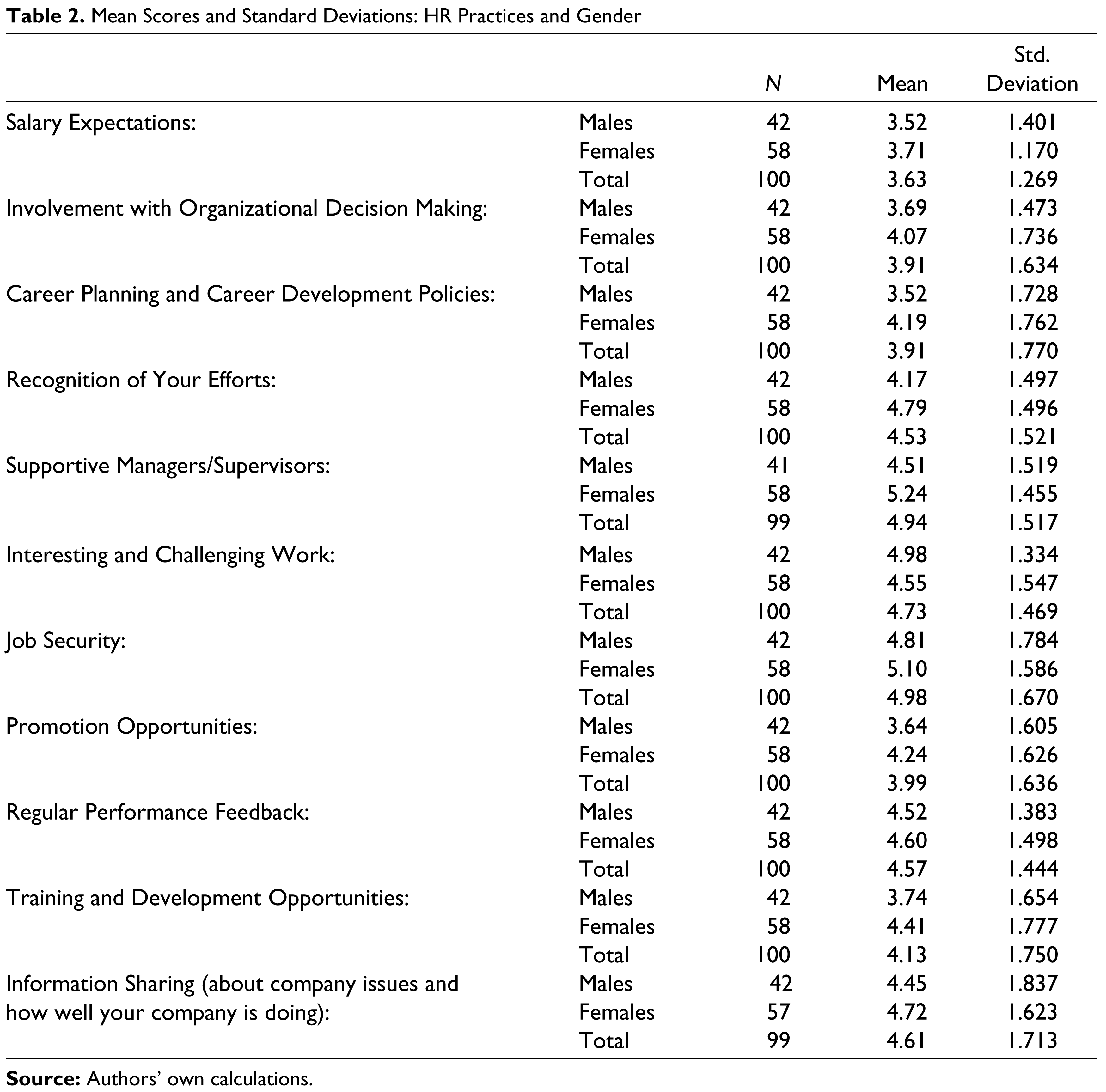
Regarding the main objective of this study, however, the findings are surprising when one inspects the mean scores across genders. The majority of HR practices, or 10 out of 11 HR practices studied, were ranked higher by females. It follows that the area of job design, described here in terms of the extent of interesting jobs provided to the employees, was the only HR practice that was ranked higher by men (males M = 4.98 versus females M = 4.55). To determine whether the differences were significant between males and females, the Kruskal–Wallis test was conducted. The results are portrayed in Table 3.
Kruskal–Wallis Test Results
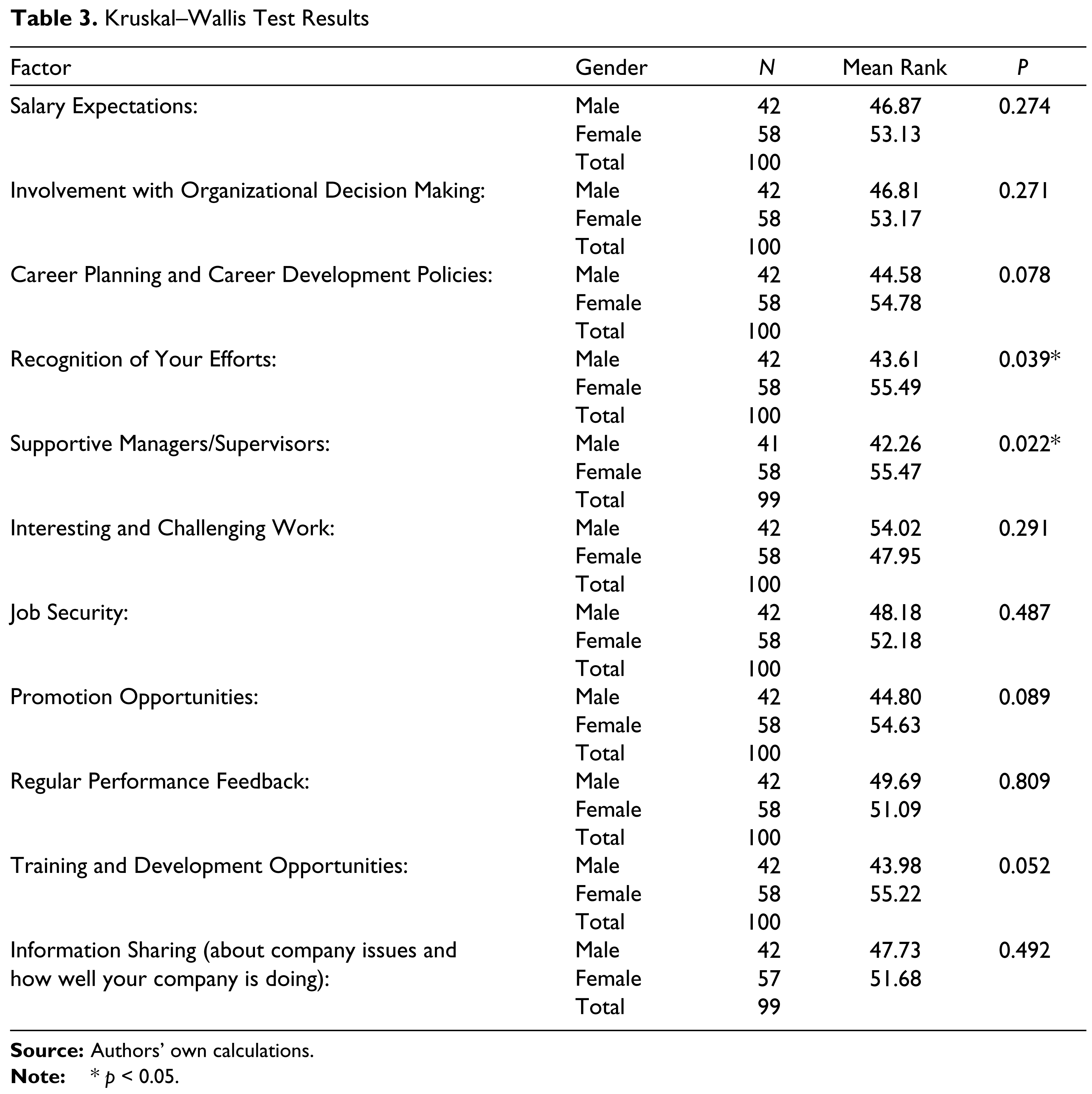
As shown in Table 3, the results of the Kruskal–Wallis test revealed that there are some significant differences between males and females in the perceptions of HRM. In particular, females perceived that their expectations were fulfilled to a higher extent than men in the workplace in two HR practices. Those practices were a supportive environment (p = 0.022) and employee recognition (p = 0.039). In effect, females scored higher on the HR practice relating to providing support for employees (females M = 55.47 versus males M = 42.26) and in the practice of recognizing employees’ contributions at work (females M = 55.49 versus males M = 43.61).
There were no differences between males and females at the 5 per cent significance level for the other HR practices. The results showed that there were no significant differences between males and females in the experience of compensation, career development, job design, job security, promotion, performance feedback, training and development and information sharing at the firm.
In general, contrary to expectations, the findings of this study show that women seem to have a more positive experience of HRM in the workplace compared to men in the context of the Lebanese work environment. In particular, the results demonstrate that females’ expectations were somehow met to a larger extent with respect to the recognition they received for their efforts at work. In addition, the results also show that the level of support to female workers from management was also identified as being greater than that for men. Regarding the other practices, such as, pay and careers, for example, it seems that men are no better than women according to this research.
One explanation for the surprising results attained here might be that men’s overall job expectations might be higher than women in the workplace. In his study about assessing parental influences on the expectations of adolescents in dual-earner families, Weinshenker (2005) explains that boys might manifest high expectations and pursue high career hopes as a result of being influenced by their working fathers. Women, on the other hand, tend to be more self-satisfied with what the workplace has to offer since they know in advance that it is a masculine society or that they cannot grow as much as men do. They kind of accepted the situation as it is. As Sousa-Poza and Sousa-Poza (2003, p. 691) state ‘even when one controls for a number of factors, job satisfaction remains significantly higher for women than men’. Souza-Poza and Sousa-Poza explain that this might be due to the fact that throughout history, females’ jobs have been much worse than that of males and hence they now have lower expectations. This however, does not necessarily mean that women’s jobs are better than men’s are (Haines, 2007). Furthermore, Middle Eastern women in general tend to give more importance to marriage and therefore, a women’s work might not be the first priority in her life but rather establishing and having a family. Sociological research shows different results concerning men’s and women’s career and family considerations. Research indicates that in general, emerging females and males have comparable commitments to work but women consider family more than men do (Friedman & Weissbrod, 2005).
Feminization of HR departments is another possible reason why females had a more positive experience of HR practices in general compared to men. There have been conflicting arguments with respect to gender in HRM (Reichel, Brandl & Mayrhofer, 2010). Due to the general trend in many countries to promote equal opportunity employment rights, both diversity and female participation are being pushed forward in different departments through an organization and the HR department is one of those in an effort to ‘practice what it preaches’. There has been an increased proportion of women reaching the top positions in HR. Some view such an act of promoting women as an endeavour to enhance the number of female seniors in the corporation without having to alter the top executives in the more influential and highly regarded posts, such as, finance and engineering (Parry, Stravrou & Lazarova, 2013). This proposition has been tested by the authors (Parry et al., 2013) using data from the Cranet Project from four consecutive rounds: 1994, 1995, 2004/2005 and 2008/2010 and it included four cluster countries. Their findings concerning gender of top HR managers suggested by the Cranet data show that females are increasingly occupying posts of top HR managers over the years in all but one cluster. For example, 18 per cent of the top HR managers in Southwestern Europe were females during 1995. In 2008, this figure was 53 per cent. The same trend is also evident in the other clusters. Therefore, there seems to be an apparent feminization of the senior posts (Reichel et al., 2010). In addition, Kanter’s (1997) pioneering work has led many organizational researchers to study and discuss women’s proportional representation in the workplace and its effect on the workplace experience (Konrad & Gutek, 1987; Martin, 1985; Wharton, 1992; Yoder, 1991; Zimmer, 1988). Such research studies explain that the underrepresentation of females is linked to increased performance pressure, isolation from informal social and professional networks and stereotyping of women. Therefore, their conclusion was that a balanced representation within the organization would eliminate such effects (Ely, 1994). In connection with the results of this research, where females’ HR expectations were better met than males, we can argue that female HR managers may be more supportive of female co-workers and therefore try to create a more hospitable environment for them.
Although Lebanon shares several contextual factors with other Arab countries in the region, it is still one out of many Arab countries with its own distinctive culture and history. Having said this, researchers should avoid generalizing the findings of this study across all Arab countries equally. For future research, this study can greatly benefit from repeating it across a number of countries in the Middle East to compare gender differences between countries in the region on the experiences of HR practices in organizations.
Limitations
The small sample size (n = 100) was one of the limitations in this study. Future researchers should repeat this study with a bigger sample size in order to increase the power of the tests. This is especially needed given that several variables almost achieved a 5 per cent significance level (see Table 3) but were not reported as statistically significant given that the authors restricted the p-value to 5 per cent. In addition, most of those surveyed were quite young, aged between 21 and 30 years, which might limit the extent to which the findings can be generalized to the broader population. However, the Lebanese population itself is considered relatively young, with a total median age at 29.34 years (CIA, 2014). Another limitation in the sample may lie in the distribution of males and females. The numbers of females were somewhat higher in this study. Although it is argued that an equal distribution of groups may not be required for the tests conducted here, this issue may still have to be addressed in future studies in order to maintain better equilibrium. Finally, future studies can also include control variables and employ stronger tests when the sample size permits.
Footnotes
Acknowledgements
The authors are grateful to the anonymous referees of the journal for their extremely useful suggestions to improve the quality of the article. Usual disclaimers apply.
Appendix
To what extent have these expectations been met at your work? Please circle your answer.