



Abstract
Extant organizational behaviour (OB) literature widely acknowledges the importance of perceived organizational support (POS) in affecting workplace attitude and behaviour. However, studies that investigate the role of individual’s mental disposition in shaping the aforementioned relationship are scant, particularly in the Indian context. This study is intended to address this gap. Here, we examine the role of POS in the development of organizational trust and organizational commitment. By virtue of its conceptualization, psychological capital represents individual’s positive state of mind. Therefore and more importantly, we test the moderating role of psychological capital in the aforementioned relationships. We undertook a field-based questionnaire survey (N = 289) in a leading Indian information technology (IT) company. Results revealed that POS was positively related to both organizational trust and organizational commitment, and the strength of these relationships diminished with higher levels of psychological capital, albeit in varying degree. Theoretical and practical implications of the findings are discussed, and the future course of research is suggested.
Keywords
Introduction
Management provides employees with various organizational inputs that consist of both tangible (e.g., pay and rewards) and intangible (e.g., justice and support) elements. Due to inherent intangibility and individual subjectivity, the perception of these elements may vary among employees. In the similar vein, it is argued in literature that the perception of organizational support plays a big role in developing workplace attitudes and manifestation of various behaviours (Greenberg, 1987; Ng & Sorensen, 2008). Therefore, ‘how it is perceived’ is at least as important as ‘what is perceived’. At the same time, researchers have demonstrated the influence of positive and negative affects in colouring employee perceptions (Thoresen, Kaplan, Barsky, Warren & de Chermont, 2003) and its subsequent impact on attitudes and behaviour (Forgas & George, 2001).
This article analyzes the relationship of perceived organizational support (POS; a perception) with organizational trust and organizational commitment (attitudes) under the interactive effect of psychological capital (positive mental state) in the Indian context. The study contributes by adding a new context and by exploring boundary conditions (moderator) to aforementioned relationships.
Theoretical Background
Perceived Organizational Support
The social exchange theory (Blau, 1964) proposes that employees assess and make judgement about relationships at work on the basis of the degree of reciprocity in the long run (Rousseau, 1989). These patterns of reciprocity determine the perceived balance of exchange and, in turn, the intensity of relationships. The healthy perception that organization takes care of employee’s socio-emotional needs, efforts, commitment and loyalty is defined as POS. It is well documented that POS is positively related to fairness perception, supervisory support, positive mood, satisfaction, organizational rewards, favourable job conditions, etc. (Rhoades & Eisenberger, 2002) as well as negatively related to stress and other workplace challenges (George et al., 1993).
Barling, MacEwen and Pratt (1988) demonstrated that people perceived informational support to be emotional in nature. Therefore, it may be concluded that stress and its various negative outcomes are mitigated by both informational and emotional support. Perceived organizational support is linked to many desirable workplace attitudes and behaviours, such as, organizational commitment and citizenship behaviour (Simosi, 2012; Wayne et al., 2002). Perceived organizational support has also been shown to be effective in organizational trust repair by building favourable context that improves the level of organizational trust in top management (Dirks & Ferrin, 2002). Most of these studies are conducted in the West, and the research in collectivistic cultures (and India in particular) is limited (Yoon & Lim, 1999).
Organizational Trust
Despite widespread research, the definition of trust in organizational context lacks clarity and specificity. A widely accepted definition of trust, given by Rousseau et al. (1998), regards trust as ‘a psychological state comprising the intention to accept the vulnerability based upon positive expectations of the intentions or behaviour of another’. Organizational trust is perceived as a key ingredient in building interpersonal relationships (Rempel, Holmes & Zanna, 1985) in workplace and also plays an important role in developing the attitude of mutual cooperation (Barnard, 1938; Blau, 1964). Literature suggests that competence, responsibility (Butler, 1991; Cook & Wall, 1980), reliability and dependability (Johnson-George & Swap, 1982; Rempel et al., 1985) are some of the important antecedents for organizational trust. Mayer, Davis and Schoorman (1995) suggested that ability, benevolence and integrity are the three key characteristics of trustee that are responsible for organizational trust. Interpersonal trust is based on both cognitive and affective foundations (Lewis & Weigert, 1985; McAllister, 1995). Cognition helps in deciding the rationale behind trusting ‘someone’. Affective foundation is built up when people make emotional investment in trust relationships and express genuine concern about their colleagues (Lewis & Weigert, 1985). Researchers also delineated trust in the organizational context and tried to identify specific dimensions. Gabarro and Athos (1976) identified factors that lay the foundation for trust in organizational setting. Some of these factors are: other’s integrity, motives and intentions, behavioural consistency, openness and discretion. Actions of managers, as mentor (Leck & Orser, 2013) and as leader (Yang & Mossholder, 2010), have prominent effect on subordinate’s level of organizational trust. Subordinates, in turn, make effort in maintaining the same level by reciprocating suitable actions. Therefore, trust in a supervisor might be affectively satisfactory to the employee. Modern human resource (HR) practices accord organizational trust a strategic importance in work context by linking it directly to returns to shareholders (Wyatt, 2002).
Organizational Commitment
Organizational commitment is an indicator of positive attitude towards one’s organization. The concept evolved from the Becker’s (1960) concept of ‘side bets’ that refer to all tangible and intangible investments (time, relationships, efforts, etc.) made by employee during the course of association with the organization. These investments develop consistency in their behaviour and fortify intention to stay. However, the notion of side bets was questioned by Meyer and Allen (1984) over its operationalization who opined that some investments might actually reduce the bets with the current organization. For example, the experience gained during the job increases job opportunities outside the organization. Modern scholarship considers it to be a dynamic construct which is linked to employees’ psychological contract (Chen & Indartono, 2011). Therefore, employees’ attitude towards work affects their organizational commitment (Elias, 2009).
Scholars have proposed conceptual alterations of commitment differ in focal referent. It may, intuitively, be believed that commitment towards one’s job would be different from commitment towards organization. We briefly mention a couple of models centred on organizational commitment.
Meyer and Allen (1991) proposed a three-dimensional model comprising affective, continuance and normative commitment. These dimensions, respectively, represent emotional attachment with organization, need for continuing membership (perceived economic value) and felt obligation towards the organization. It is evident from their operationalization (Allen & Meyer, 1990) of continuance commitment that continuation in the organization depended on available alternative employment opportunities (‘…too few options…’, ‘…scarcity of available alternatives…’). Therefore, this dimension reflects the evaluative side of employee’s commitment.
A more ‘self-less’ form of organizational commitment can be found in one of the earlier models proposed by Buchanan (1974). He identified three dimensions of commitment, namely, identification (adoption as one’s own the organization’s goals and values), involvement (psychological absorption in the activities of one’s role) and loyalty (affection or attachment to the organization). This conceptualization is relatively free from ‘what is there for me’ considerations. We therefore believe that Buchanan’s (1974) model portrays more desirable facets of organizational commitment and is considered in this study.
Psychological Capital
Psychological capital is a relatively new concept from the domain of positive psychology and positive organization behaviour (POB). Positive psychology stresses on the strengths of people rather than weaknesses. It deals with the possibility of individual growth and development by shifting the focus away from negative aspects and working on positive ones (Seligman & Csikszentmihalyi, 2000). POB is practitioner’s domain of positive psychology and is defined as ‘study and application of positively oriented human resource strengths and psychological capacities that can be measured, developed, and effectively managed for performance improvement in organizational context’ (Luthans, 2002).
Psychological capital is described as a concept under the wider rubric of positive psychology as it meets three criteria (Luthans et al., 2007a) suggested for inclusion. It is: (i) based on theory and research (ii) a state-like construct, that is, open to change and development and (iii) known to have favourable impact on organizational outcomes Luthans et al., 2007a). Recently, Shukla and Singh (2013) found the association of psychological capital with organizational citizenship behaviour and job satisfaction in the Indian context.
Psychological capital is a state-like construct and represents
an individual’s positive psychological state of development that is characterized by: (1) Confidence (self efficacy) to take on and put in the necessary effort to succeed at challenging tasks; (2) positive attribution (optimism) about succeeding now and in the future; (3) persevering toward goals and, when necessary, redirecting paths to goals (hope) in order to succeed; and (4) attitude to bounce back (resilience) when beset by problems and adversity to attain success. (Luthans, Youssef & Avolio, 2007b)
Psychological capital represents individual motivational propensities that accrue through aforementioned four positive constructs.
Evidently aforementioned constructs are fairly distinct and represent an individual’s positive frame of mind. Hence, there was a felt need to establish a conceptual framework which can link these four dimensions of POB to a core construct. Law et al. (1998) described a ‘latent model’ where the core concept of psychological capital captures these dimensions and accounts for the common variance therein. It is termed as a core concept as it differs significantly from other forms of organizational capitals (Luthans & Youssef, 2004), like human capital (cognitive accomplishments of individuals), social capital (strength of network) and financial capital (various financial resources). Moreover, it is suggested that organizations can gain competitive advantage by managing positive psychological capital of their employees (Luthans & Youssef, 2004).
Research Framework and Hypotheses
In this study, we focus on organizational trust and organizational commitment; two of the key outcomes of POS as mentioned in social exchange literature (Dirks & Ferrin, 2002; Podsakoff, MacKenzie & Bommer, 1996; Podsakoff, Bommer et al., 2006). However, the key emphasis of this study is to empirically examine the role of a positive mental state in moderating the relationship of POS with organizational trust and organizational commitment.
The relationship between POS and organizational trust is widely studied in organizational behaviour (OB) literature. DeConinck (2010) found POS to be a mediator between organizational justice and employee’s overall trust in organization. Similar findings were reported by Stinglhamber, De Cremer and Mercken (2006). Whitener et al. (1998) have emphasized that employees’ trust in their supervisors result from certain displayed behaviour by the latter. These behaviours germinate as a result of organizational (represented by POS), relational and individual (represented by perceived supervisory support) factors. Perception about support is built over time with the demonstration of beneficial decisions (career progression, rewards, developmental experiences, etc.) by superiors (Wayne, Shore & Liden, 1997). More recently, Narang and Singh (2012) found POS to be a mediator between HR practices and organizational trust. Thus, we may expect similar relationship in this study as well. We propose the following hypothesis.
Hypothesis 1(a): Perceived organizational support will be positively related to organizational trust.
Perceived organizational support is also demonstrated to have positive relationship with organizational commitment. This study is based on the conceptualization offered by Buchanan (1974) who proposes three dimensions of commitment: involvement, identification and loyalty. This particular framework was selected as we were more interested in a non-evaluative and organization-centred perspective of commitment. Perceived organizational support is found to be positively related to felt obligation towards organization’s welfare (Eisenberg et al., 2001). Favourable and equitable treatment by the management intensifies employees’ perceived obligation to remain employed with the organization (Meyer & Allen, 1991). Such treatment, in addition to prevailing interpersonal harmony and ethical practices, leads to the development of organizational commitment in public and private sector companies (Mohapatra & Sharma, 2008). Management can play a constructive role in building positive perceptions in employees by ensuring equitable treatment and creating harmony. Pathardikar and Sahu (2011) suggested workplace support as one of the important cultural antecedents to organizational commitment in Indian set-up.
On the basis of the above arguments, we propose the following hypothesis:
Hypothesis 1(b): Perceived organizational support will be positively related to organizational commitment.
Moderating Role by Psychological Capital
Previous studies have established the buffering capacity of psychological capital in mitigating the impact of negative emotions and attitudes. For example, Roberts, Scherer and Bowyer (2011) found that negative effect of job stress on workplace incivility was moderated by psychological capital. In another study by Cheung, Tang and Tang (2011), it was found that positive association between surface acting on depersonalization as well as negative association with job satisfaction was weaker when psychological capital was high.
Perceived organizational support also is likely to be shaped by internal cognitive processes. Individual’s state of mind is expected to buffer employees’ support perception (Forgas, 1987; Schiffenbauer, 1974). This expectation gains strength from the fact that previous studies have highlighted the role of personality traits, such as, the locus of control (Gulati & Bhal, 2004) and nature of organization (Sandhu & Mehta, 2007), in influencing employees’ attitude towards their jobs.
In an integrative model of organizational trust, Mayer et al. (1995) explained the role of trustor’s propensity in moderating the relationship between perceived worthiness and organizational trust. Trustor’s propensity is defined as general willingness to trust others and is termed as a personality trait.
Against this backdrop, we may expect psychological capital to alleviate the elements of mistrust between an employee and his or her supervisor. A person with a positive state of mind is expected to perceive events positively, and thereby develop trust towards organization.
Organizational commitment also gets influenced by the interaction of support perception and personality trait. For instance, Aube, Rousseau and Morin (2007) found moderating effect of the locus of control in the relationship between POS and affective commitment. In this research, we expect similar outcome with psychological capital.

In nutshell, we suggest that psychological capital would weaken the relationship of POS with organizational trust and commitment and propose the following hypotheses.
Hypotheses 2(a) and 2(b): Relationship between POS and (a) organizational trust and (b) organizational commitment will be moderated by psychological capital such that these relationships attenuate when psychological capital is high.
Both the proposed hypotheses are diagrammatically represented in Figure 1.
Methodology
Sampling and Data Collection
A field study was conducted in a large Indian information technology (IT) multinational corporation with prior permission from its HR department. Junior and mid-level executives participated in an article-based questionnaire survey on a pre-assigned date. These executives were briefed about the study and ensured about confidentiality. The questionnaires were administered during their lunch break and collected the next day. After scrutinizing for missing data, 289 complete responses were obtained and considered for subsequent analyses. The average organizational tenure of respondents was 4.99 years (SD = 4.76 years) and the average age was 29.89 years (standard deviation [SD] = 5.09 years). A total of 143 (49.48 per cent) respondents were female.
Measures
The following paragraphs briefly outline the scales that were used in this study and their alpha reliabilities. Evidently, none of the alpha values were below the suggested cut-off of 0.60 (Sekaran, 1992).
Perceived Organizational Support
An eight-item scale developed by Eisenberger et al. (1997) was used to measure POS. Samples of items are ‘My organization really cares about my well-being’, ‘Help is available from my organization when I have a problem’ and ‘My organization is willing to help me if I need a special favour’. In this study, the value of alpha was 0.83.
Organizational Trust
Organizational trust was measured through the seven-item measure developed by Gabarro and Athos (1976). Samples of items are ‘My organization is open and frank with me’ and ‘In general, I believe my employer’s motives and intentions are good’. In this study, the value of alpha was 0.87.
Organizational Commitment
Cook and Wall’s (1980) nine-item scale was used for measuring the commitment. It was based on Buchanan’s (1974) model. The sample of item is ‘I feel myself to be part of the organization’. In this study, the value of alpha was 0.77.
Psychological Capital
Psychological capital was measured by the shorter version of PCQ-24 (PCQ-12) developed by Luthans et al. (2007b). It is a 12-item instrument and measures psychological capitals across four dimensions (hope, optimism, self-efficacy and resilience). Samples of items are ‘I can think of many ways to reach my current work goals’ (hope) and ‘I feel confident presenting information to a group of colleagues’ (self-efficacy).
Alpha values for different dimensions of psychological capital, namely, hope (0.83), optimism (0.79), self-efficacy (0.64) and resilience (0.60), qualified the suggested stipulation.
Besides these items, the respondents were asked to indicate their age, gender and tenure as control variables due to its possible confounding effect on results. Barring questions on demographic details, all survey items were rated on a five-point Likert-type scale ranging from 1 (‘Strongly disagree’) to 5 (‘Strongly agree’).
Results
Preliminary Analysis
Descriptive statistics and first-order correlations are shown in Table 1. The constructs of psychological capital, organizational trust and organizational commitment are indicated as PsyCap, Trust and OC in this section for the sake of brevity.
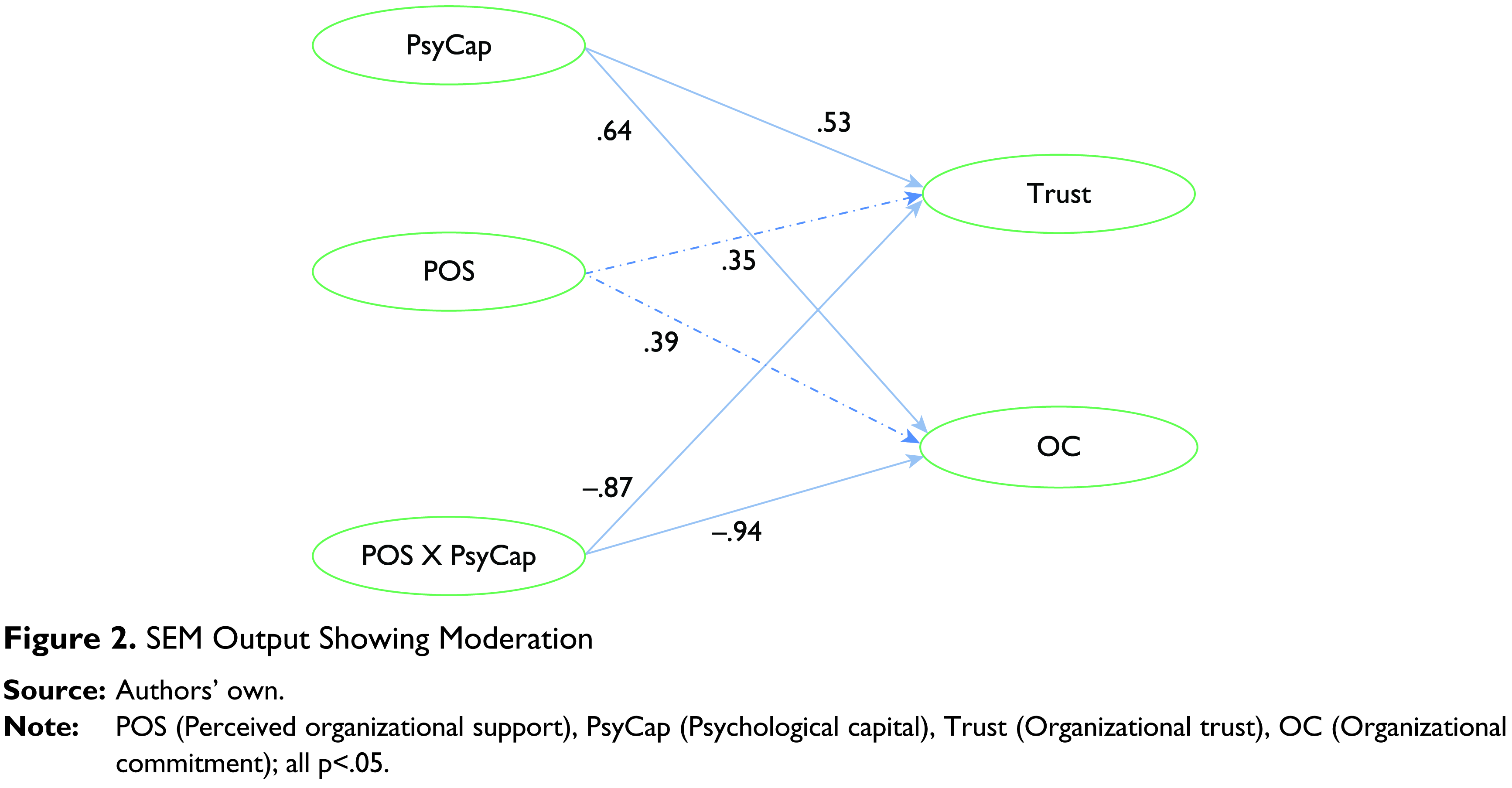
The mean value for POS was slightly lesser (2.99) than the mean scale score of 3, indicating the overall low level in the sample. Gender was found to be significantly and positively correlated with both PsyCap (r = 0.13, p < 0.05) and Trust (r = 0.19, p < 0.01), indicating their relatively higher values for female participants as compared to males. However, Age and Tenure were found to be significantly and positively correlated with POS only (r = 0.13, p < 0.05 and r = 0.15, p < 0.05, respectively). It is clear from the table that POS is positively and significantly correlated with Trust (r = 0.46, p < 0.01) and OC (r = 0.49, p < 0.01). Similar associations were obtained in path analysis using structural equation modelling (SEM) as well (Figure 2). Hence, our hypotheses 1(a) and 1(b) are accepted.
Descriptive Statistics and Correlations

Test for Common Method Variance
An assessment for the common method variance (CMV) was made with one-factor test using confirmatory factor analysis (CFA; Podsakoff et al., 2003). All the items were loaded on a single factor and fit indices (χ2/df = 13.19; root mean square error of approximation [RMSEA] = 0.206; non-normed fit index [NNFI] = 0.61; parsimony goodness-of-fit index [PGFI] = 0.38) indicated a poor fit (Byrne, 1998). Hence, we concluded that CMV was not a serious threat in this study.
Construct Validity
Construct validity refers to the degree of correspondence between constructs and their measures and is a necessary condition for theory development (Peter, 1981). It indicates the uniqueness of construct amid a network of other constructs. Computation of average variance extracted (AVE) provides one of the methods for its assessment in a given study. AVE is the ratio of the square of sum of factor loadings to the square of sum of factor loadings plus sum of error variance of variables. Construct validity is indicated if AVE is greater than 0.50 (Hair et al., 1998) and the square root of AVE is greater than all the correlation coefficients with other variables (Fornell & Larcker, 1981). Apart from Cronbach’s alpha, the reliability of a construct is also indicated by composite reliability (CR) which is the ratio of the sum of square of factor loadings to the sum of square of factor loadings plus the sum of error variance of variables (Fornell & Larcker, 1981). A measurement is considered reliable if the value of CR is above 0.60 (Diamantopoulos & Siguaw, 2000). The values of both AVE and CR for variables in consideration are presented in Table 2.
Discriminant and Convergent Validity of Variables
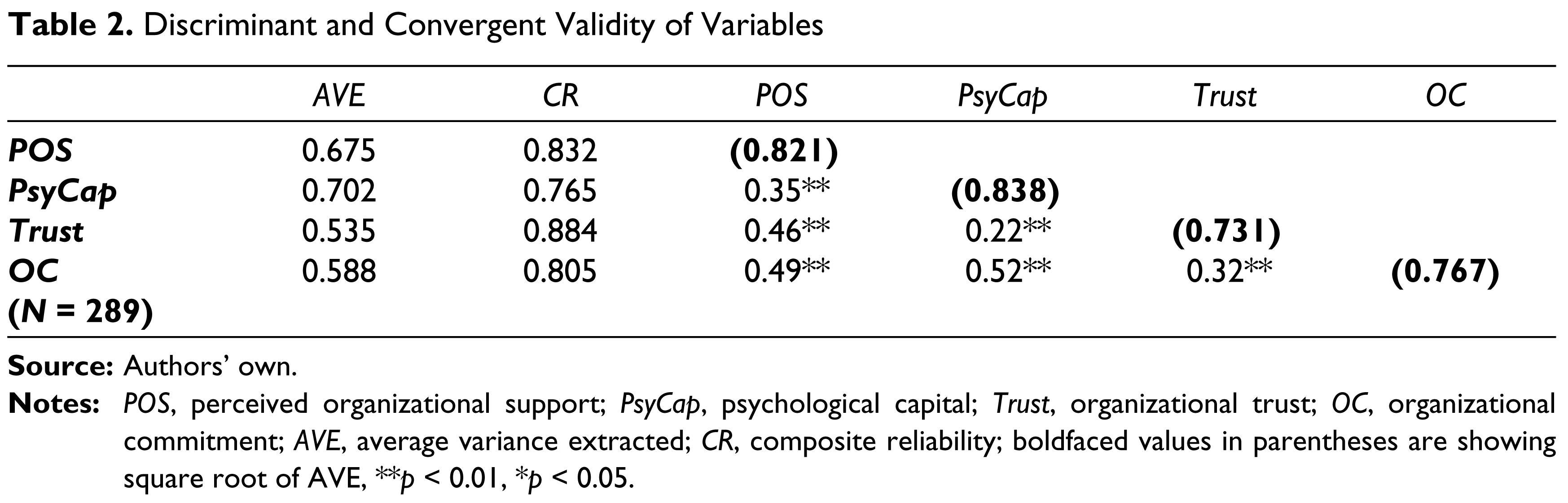
It is evident that all the values of AVE are greater than 0.50 and values of square root of AVE for given construct are greater than its correlations with other constructs. Likewise, all the values of CR are larger than minimum cut-off (0.60). Therefore, we can say that all the constructs considered in this study possess adequate construct validity and reliability.
Test for Moderation
Table 3 shows the results of hierarchical regression analysis (HRA) using SPSS 17.0 version.
Summary of Hierarchical Regression Analysis
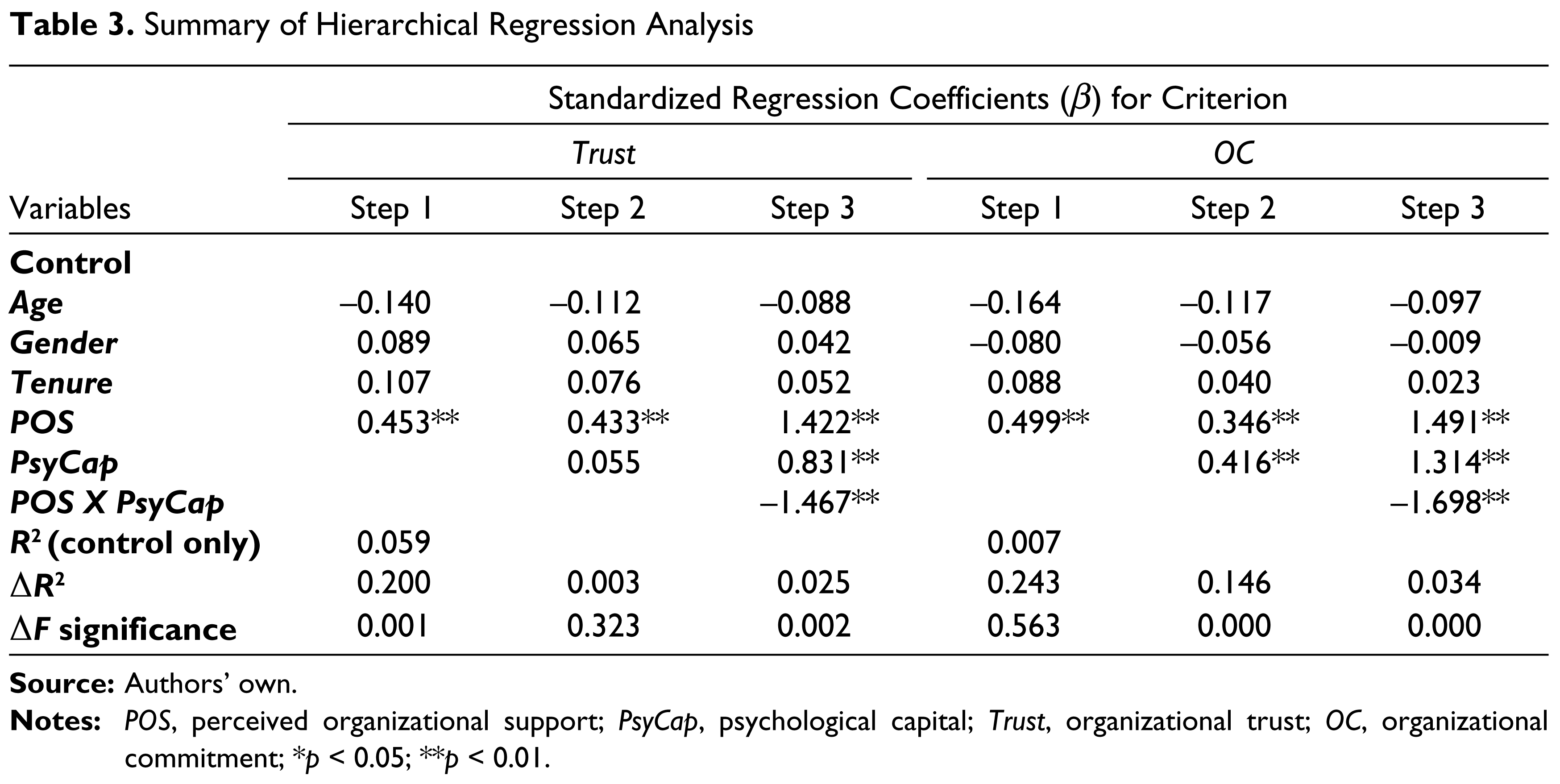
Hierarchical regression analysis was used to test moderation hypotheses using Baron and Kenny’s (1986) method. In this method, predictor, moderator and interaction terms (predictor X moderator) are simultaneously regressed on criterion variable. Moderation is confirmed if regression coefficient of interaction term is significant. All three control variables, POS, PsyCap and the interaction term (POS X PsyCap), were entered in successive steps in the regression equation. In the case of Trust as criterion variable, the variance explained was 5.9 per cent (by control variables only), which increases to 28.7 per cent in the overall model (step 3). Regression coefficients of control variables were non-significant in all the steps. The result on the significance of control variables is similar in the case of OC though variance explained is comparatively less (0.7 per cent only). The overall model (step 3) accounted for 43 per cent of variance in OC. POS accounted for a significant 20 per cent and 24.3 per cent variance in Trust and OC, respectively. PsyCap showed a significant association with OC (β = 0.416, p < 0.01) but not with Trust (β = 0.055, n.s.) in the second step. In the third step, however, it is evident that PsyCap is positively related to both Trust (β = 0.831, p < 0.01) and OC (β = 1.341, p < 0.01). It is noteworthy that the inclusion of PsyCap does not significantly add to the variance explained in Trust. However, this is not the case with OC. Further, the interaction term is negatively but significantly related to both Trust (β = –1.467, p < 0.01) and OC (β = –1.698, p < 0.01). The negative sign of betas of interaction term suggests that there is a negative moderation effect of PsyCap on both POS–Trust and POS–OC relationships. Hence, proposed moderation relationships are supported. Moderation effect was also tested with SEM (using LISREL 8.52) for the simultaneous assessment of the effect of POS on Trust and OC. The outcome is presented in Figure 2.
We got the similar results here as well as the interaction term significantly and negatively relates with both Trust and OC. Other path coefficients are also significant. Different fit indices (χ2/df = 2.14; RMSEA = 0.063; NNFI = 0.99; PGFI = 0.20) indicate a good model fit (Byrne, 1998). Thus, hypotheses 2(a) and 2(b) are supported. To examine the nature of moderation further, values of criterion variables (Trust and OC) were plotted against relatively high and low values of POS, in conjunction with high and low values of PsyCap (see Figures 3 and 4). High and low values were taken at one SD above and below mean values, as suggested by Cohen and Cohen (1983).


Moderation plots pictorially represent the impact of PsyCap on the relationship of POS with Trust and OC. It is obvious that PsyCap negatively moderates the proposed relationships. Figures 3 and 4 show that (a) POS is positively and monotonically related to Trust and OC, (b) higher level of PsyCap marks upward shift in linear relationships but with the reduction in slopes. The slopes for lower and higher PsyCap in the case of Trust are 1.141 and 0.251, respectively. The corresponding values for OC are 0.409 and 0.095, respectively. It is evident that both the slopes are different, and further discussion is made in the next section.
Discussion
The study aimed to assess the relationship of POS with organizational trust and organizational commitment, and the moderating effect of psychological capital therein. We found that POS and the moderating variable (psychological capital) were positively related to organizational trust and organizational commitment. However their interaction term was negatively related to both the criterion variables. In general, it can be deduced that the relationship between predictor and criterion weakens with the increase in the level of moderating variable. Therefore, the finding confirmed attenuating effect of moderating variable as proposed originally. Similar kind of moderating effect has been previously reported (e.g., Brockner et al., 1997).
The attenuating effect of psychological capital can be interpreted in the context of this study. We can say that the impact of POS over organizational trust and organizational commitment dwindles with the increase in individual’s psychological capital. In other words, psychological capital reduces the dependence on POS as far as the development of the aforementioned attitudinal outcomes is concerned. The results may be attributed to the fact that the positivity paves the way for more favourable perceptions not only about organizations (Forgas, 1987; Schiffenbauer, 1974) but also about the personal resources, such as, self-efficacy, optimism and resilience (Luthans, 2002). Thus, high psychological capital reduces the ‘support-seeking’ proclivity of employees from their organization. The event of diminishing support perception is counterbalanced by individual’s psychological capital (Aube et al., 2007). For example, high self-efficacy will improve the perception of self-sufficiency and reduce the expectation for organizational support and there will not be concomitant reduction in organizational trust or organizational commitment. Similarly, optimism will help in maintaining positive expectations about future, and low support perception will be seen as a temporary phenomenon. Thus, psychological capital buffers the ill-effect of drop in support perception for both the attitudes under consideration.
The next issue pertains to magnitude of moderation. Although we found attenuation in both the cases, the degree varied for organizational trust and organizational commitment. The ‘weakening’ effect turned out to be more pronounced in POS–organizational trust linkage in comparison to POS–organizational commitment, on the basis of corresponding slopes (Figures 3 and 4). The finding can be explained on the basis of difference in the degree of reciprocity between the two dyads under the study. It is suggested that organizational trust and organizational commitment develop in response to social exchange between employee and organization. Organizational commitment is shown to hold a strong reciprocity vis-à-vis POS both in Western (Eisenberg et al., 2001) and Asian settings (Cheung, 2000). Till date, no study reported similar reciprocal relationship between POS and organizational trust. On the contrary, the possibility was ruled out by Stinglhamber et al. (2006). Therefore, the higher reciprocity between POS and organizational commitment entails greater mutual dependence between these variables which explains lower attenuation effect by psychological capital in the case of POS and organizational commitment relationship. It results in comparatively smaller slope for POS–organizational commitment plot for both the levels of psychological capital.
At least two deductions can be made on the basis of results obtained. First, a drop in support perception is likely to have more detrimental effect on organizational trust than in organizational commitment. This assertion finds support in literature as well where POS is suggested as a mechanism for reposing broken trust in top management (Webber, Bishop & O’Neill, 2012). Second, psychological capital not only buffers but also can compensate for the reduction in favourable organizational inputs, such as, POS. It is statistically evident in our result by the positive and significant regression coefficients between psychological capital and organizational trust (and commitment). This association finds support in literature for both organizational trust (Avey et al., 2011) and organizational commitment (Norman, Avolio & Luthans, 2010).
To summarize, we can say that both POS and psychological capital are vital for the development of positive attitudes, such as, organizational trust and commitment, and psychological capital may offset an inadvertent drop in POS.
Implications for Managers
This study establishes the facts that support perceptions can improve organizational trust and commitment in Indian organizations and that psychological capital can compensate for a dip in support perception for sustaining these attitudes. Thus, managers should not only extend adequate support to their supervisors but also enrich their psychological capital.
Being a state-like concept, psychological capital is malleable, that is, open to change and improvement. A recent empirical study (Luthans et al., 2010) showed that psychological capital can be improved with certain specific training interventions (termed as ‘psychological capital intervention’ or PCI). PCI included a series of exercises and group discussions that were designed to impact the participants’ level of efficacy, hope, optimism and resilience. A comparison between control and experiment group revealed that psychological capital improved considerably and the process also had a positive effect on the job performance. Hence, organizations can be benefited by conducting such training programmes to protect and nurture their human capital.
Conclusion and Direction for Future Research
Our research provided fresh insights into the relationship of POS with organizational trust and commitment by empirically exploring boundary conditions. Employee’s psychological capital emerged as a potential (attenuating) moderator in shaping both these relationships. The research also contributed to the external validity of POS–organizational trust and POS–organizational commitment relationships by testing them in a new context.
Researchers may further like to assess cross-level variation in the present context. Temporal effect was not reckoned in the present work, and hence, longitudinal studies are suggested for definitive assessment of causality. Another issue is related to the generalizability of findings as the data were collected from a single service-based organization. Therefore, it is desirable that the proposed relationship be tested in other types of organizations.
Another interesting domain would be to test moderation effect by individual dimensions of psychological capital on proposed relationships. The impact of other contextual variables on the hypothesized relationships can be examined. The type of industry (manufacturing or service based), type of ownership (private, public or family owned), type of job (repetitive or non-repetitive) and degree of centralization could be some of these variables, and these studies may generate rich insight.
Footnotes
Acknowledgements
The authors are grateful to the editor and anonymous referees for their extremely useful suggestions to improve the quality of the article.