



Abstract
This study focuses on the present, and the possible future, economic dynamics in the Lower Rio Grande Valley region. The main goal of the study is to identify factors that can be used to transform the region into a major global economic region. Since the Lower Rio Grande Valley region is not yet a major global economic region, this study also analyzes how to design and implement the frameworks of factors that will transform the region into such a major global economic region. A new conceptual framework, termed premier global economic/business region conceptual or theoretical framework, is created by this study to guide and gird this study. The Oresund region (Denmark–Sweden) and the Puget Sound region (United States–Canada) are models of what Lower Rio Grande Valley can be transformed into in the future. Therefore, this study draws from the main features of the Oresund region and the Puget Sound region to create the premier global economic/business region conceptual or theoretical framework. Essentially, this theoretical framework consists of 12 factors or variables that can be used to transform an international region into a premier global economic/business region. A significant portion of this study analyzes how each of these factors or variables can be designed and utilized to help transform the Lower Rio Grande Valley region into premier global economic/business region.
Keywords
Introduction
The focus of this study is the Rio Grande Valley (RGV) region. The region currently has economic and social challenges. This study aims to examine how the region can be positively changed.
The Lower RGV region is the more correct name for the region that is the focus of this study. It consists of Cameron, Hidalgo, Starr and Willacy counties in the state of Texas in the United States, and the north-east part of the state of Tamaulipas in Mexico. The major urban areas in the Texas side of the region are the city of Brownsville, the city of Harlingen and the metropolitan area consisting of the cities of McAllen, Edinburg, Mission and Pharr. Matamoros and Reynosa are the major cities on the Mexican side of the region. The city of Brownsville is directly opposite the city of Matamoros, and the metropolitan area consisting of the cities of McAllen, Edinburg, Mission and Pharr is directly opposite the city of Reynosa.
There have been very close historical, sociocultural, economic and family ties, that span centuries and up to the present, between the Texas (and the United States) part and the Mexican part of the RGV (Garza, 1996; McAllen Amberson, McAllen & McAllen, 2003; Valerio-Jiménez, 2013). These shared contacts, spanning centuries, have given RGV a profile of a region with a shared profile across the international boundary. Past contacts continuously increase present and future contacts. These dynamics continuously bind the region together.
For analytic ease and convenience, this study is divided into eight sections. The first section of this study is this introductory section. The other sections of this study are the review of literature, the objectives of this study, the rationale for this study, the methodology, the analysis, the conclusions and the references sections.
Review of Literature
The literature that informs this study falls into six different categories. These six categories are the international management/business literature, management studies literature, the Caribbean region literature, start-up firm literature, high-technology regions literature and global economic/business regions literature.
This study focuses on global economic/business regions that straddle international boundaries. Economic activities in these global economic/business regions, therefore, involve a great amount of international economic and business activities. Thus, this study being informed by international management/business literature is essential. An excellent example of international management/business literature that informs this study is ‘Globalization, Policy Reforms and Productivity Growth in Developing Countries: Evidence from Sri Lanka’ by Yapa M.W.Y. Bandara and Neil D. Karunaratne (2013). Bandara and Karunaratne (2013) present an excellent analysis of the dynamic linkages that exits among economic, policy reforms and globalization. The work by W. Charles Sawyer and Richard L. Sprinkle (2006) is a comprehensive text on the principles and analysis of international economics. Also, the work by John D. Daniels and Lee H. Radebaugh (1992) is a comprehensive text that provides the fundamental principles, the operational frameworks and the environment of international business. The article by Sheelan Misra (2012), which examines international mobility of students in India and other countries, is linked to movement of labour across international boundaries, which is an important factor in international economic activities. The excellent roles that people from Lebanon have played, for a very long time, as entrepreneurs in many countries in the world (including countries in North, Central and South America, and the Caribbean region) is the focus of the article by Zafar U. Ahmed and Craig C. Julian (2012).
Since global economic/business regions are known for their booming economy and excellent firms, this study is also informed by management literature. For an example, the book by Warren R. Plunkett, Raymond F. Attner and Gemmy S. Allen (2002) is an outstanding management text that shows how firms can be managed in ways that exceeds the expectations of all stakeholders. The growth of firms in the manufacturing sector of the economy is the focus of the article by Mohammad Ali Jamali and Nor Ghani Md Nor (2012). ‘Strategic Management and Multinational Corporations: A Case Study of Bacardi Limited’, by the author (Inamete, 2014), is an analysis of strategic management in a multinational corporation. The state of the academic discipline of management, in terms of the analysis of the state of the key subfields of management (and also in terms of how the knowledge bases in these subfields can be utilized to help develop the growing academic discipline of homeland security studies), is the focus of ‘The Academic Discipline of Management and Homeland Security’, by the author (Inamete, 2009–2010). Also, the creation of a taxonomy and a theoretical framework for the phenomenon of organizational culture is the focus of ‘Organizational Culture: A Taxonomy and a Theoretical Framework’, by the author (Inamete, 2006). The book Organization Development and Change by T.G. Cumming and C.G. Worley (1997) is a work that presents an excellent analysis of the pivotal phenomena and processes of organizational change and organizational development.
Since the eastern border of the RGV is the Gulf of Mexico, and the RGV is also geographically part of the Caribbean region, studies about the Caribbean region also aids this study. A very good example of this is the excellent pioneering study of the frameworks and the dynamics of three cases of project management (in terms of linkage to the factor of human capital) in the Caribbean region done by Professor Arindam Banik and Professor P. Bhaumik (2006). In the case of the work by T. Klak (1995), the focus is on industrial policy in the Caribbean region. Additionally, one study by the author (Inamete, 2013) analyzes the frameworks and profiles of Executive Master of Business Administration (EMBA) degree programmes in universities in the Caribbean region. Another study by the author (Inamete, 2010) focuses on the state of the academic discipline of diplomacy in countries and territories in the Caribbean region. Also, politics and governance in Trinidad and Tobago is the subject of another study by the author (Inamete, 1992).
Literature on start-up firms also informs this study, since the goal of this study is the designing and the creation of the factors that can be used to transform RGV into a major global economic region (and start-up firms are also seen by this study as constituting one of these factors). An example is the study of business incubation globally, in order to provide policy guidance to Gulf Cooperation Council (GCC) countries done by Hanadi Mubarak Al-Mubaraki and Michael Busler (2010). A study by Adli Abouzeedan (2010) focuses on small- and medium-sized firms. A study by Jefferson Graham (2013) focuses on the dynamic growth of start-up firms in the metro area of the city of Atlanta in the United States.
Studies of high-technology regions are also important for this study. A case study by Arya Kumar Sengupta (2009) analyzes the impact of linkages between industry and academic in the development of innovations and growth. An edited text by Ikujiro Nonaka and David Teece (2001) contains classic studies of the dynamics and parameters of the creation, development, sharing and usage of scientific and technological innovations. The variables that combine to impact on the choice of employers by graduates of management schools in India are focus of the study by Andrew Dutta and Eldos Punnose (2010). This study is very relevant to high-technology regions, since the attraction of a very large number of the best world-class talents by firms in high-technology regions is very vital to the accelerating technological innovations that are the hallmarks of these regions. A study of the role airports play in the economic growth of regions, including high-technology regions, is the focus of an article by the author (Inamete, 1993). A study of various regions of the world by H.J. de Blij and Peter O. Muller (2008) helps in the understanding of varying conditions in these various regions. A pioneering work by Annalise Saxenian (1996), which compared the Silicon Valley region and the Greater Boston region, analyze the vital impact that regional cultures has on the growth of high-technology firms.
This study is also informed by literature on global economic/business regions. An example of this is the article by Nick Waddell (2013), which analyzes the factors that makes the Vancouver region the premier high-technology region of Canada. Business in Vancouver (2013) examines high-tech firms in Vancouver region, and provides excellent local knowledge about the high-tech scene in the region. Similarly, Oresund region (2014a–2014c) examines the high-tech dynamics in the Oresund region, and provides excellent local knowledge about the high-tech landscape of the region. An article by Emily Parkhurst (2012) provides information about Seattle region (which is the home of big high-tech firms like Microsoft, Amazon and T-Mobile), a major high-tech region. Mary Margaret McAllen Amberson, James McAllen and Margaret H. McAllen have written a book that provides vital information about the history of RGV. The socio-economic challenges that RGV currently faces is the focus of the study by Sergio Garza (1996). Conversely, a study by Omar S. Valerio-Jimenez examines the strong shared identities across the border, that has been created over the years in RGV, and sees a very hopeful future for the region.
The Objectives of This Study
The main goal of this study is to examine how the RGV can be transformed into a major global economic region. Therefore, the essential research question that this study seeks to answer is to identify the factors that are needed and necessary to transform the RGV region into a premier international region, with an extremely robust economy and an expansive scientific and technological innovations and creativity landscape. Since the region is not yet at this level, the goal of this study is to examine the factors and paths that will take the region to this kind of very high level of economic development.
The Rationale for This Study
The idea for this study came from the visit of the author to University of Texas RGV (UTRGV) in Edinburg, Texas, in 2014. During the visit, Dr Cynthia Lynch, Dr Aziza Zemrani and other faculty members in that university noted the position of the region as an important international border region. Being made aware of this importance of the region, the author decided to give a brief presentation in that university on how the region can be transformed into a major international border region. This study is an expansion of that very brief presentation into a systematic study about the possible transformation of the region. Without the visit of the author to UTRGV, this study would not have been possible. The visit of the author to this border made the author to be aware of the situation in the region. Additionally, this visit also made the author to arrive at the conclusion that it is possible to change the situation in the region.
The Methodology
A qualitative methodology is used for this study. Essentially, and more specifically, it uses a qualitative case method.
In order to provide an adequate conceptual framework for the achievement of the goal of this study, this study has created a conceptual/theoretical framework. This study coins the name premier global economic/business region (PGER) for this onceptual/theoretical framework. The goal of PGER conceptual/theoretical framework is to systematically guide and gird this study.
This goal of this study of designing and creating a conceptual/theoretical framework, that can be used to transform RGV into a very robust economic region with many world-class high-technology firms, and into a scientific and technological innovation hub, holds the Oresund region and the Puget Sound region as models for RGV. Therefore, the core goal of this study is to identify the factors and paths that will transform RGV into a region that has the robust economic profile, and the high-technology and scientific/technological innovation profile, of the Oresund region and the Puget Sound region. The Oresund region consists of the eastern part of Denmark (specifically, Zealand Island in Denmark) and the southern part of Sweden (specifically, the Scania [or Skane in Swedish] Province in Sweden). Its major cities are Copenhagen in Denmark and Malmo in Sweden. Oresund region is a region with world-class universities, a very high level of scientific and technological innovations, many high-technology firms, many start-up high-technology firms, a very high level of economy and a very high standard of living (Oresund Region, 2014a–2014c). The Puget Sound region also has these attributes (Forbes, 2014a; German American Chambers of Commerce, 2014; Parkhurst, 2012; Waddell, 2013) of the Oresund region. The Puget Sound region consists of the north-west part of the state of Washington in the United States and the southern part of the province of British Columbia in Canada. Its major urban areas are the Seattle–Tacoma metropolitan area and the city of Bellingham in the state of Washington, and the Vancouver metropolitan area and the city of Victoria (both in the province of British Columbia, and though Vancouver is a far bigger city than Victoria, Victoria is the capital of the province of British Columbia).
Since the goal of this study is to identify the factors and paths that can be used to transform RGV into a premier global region like Oresund region and the Puget Sound region, this study distils the main attributes of the Oresund region and the Puget Sound region to create the PGER conceptual/theoretical framework.
Therefore, the main attributes of the PGER conceptual/theoretical framework are as follows. One major attribute of a PGER is that the economic prosperity of a PGER is mostly and primarily based on the manufacturing, and the production, of high-technology goods and services within the boundaries of the PGER. Therefore, PGERs are different from other international border areas or regions that have economies that are mostly, and primarily, based on cross-border selling and buying of products (that are manufactured outside of the international border regions), and on international money transactions services.
A second, and related, attribute of PGERs is that the majority of jobs in PGERs are very high-paying and high-tech jobs (Business in Vancouver, 2013; Forbes, 2014a; German American Chambers of Commerce, 2014; Oresund Region, 2014a–2014c; Parkhurst, 2012; Waddell, 2013). This reality results from the fact that the economies of PGERs are primarily and mostly based on the manufacturing and the production of high-technology goods and services. This fact makes PGERs to be different from other international border regions that mostly have low-paying retail marketing jobs, due to the fact that their economies are primarily and mostly based on cross-border selling and buying of products (that are manufactured outside of the international border regions), and on international money transaction services.
A third attribute is that PGERs have profiles of ‘producing’ economies, while other international border regions have the profiles of ‘transaction’ economies.
A fourth attribute is that the key foundations and anchors of the economies of PGERs are world-class major research universities. Illustratively, it has been stated that ‘knowledge is supplanting physical capital as the source of present and future wealth and changing world economy’ (Misra, 2012, p. 466). The fourth attribute posits that world-class economies are anchored by world-class universities. This dynamics is due to the fact that it is these world-class research universities that create the scientific and technological innovations, which, in turn, give rise to the numerous firms that manufacture or produce high-technology goods and services within each respective PGER. For example, there are 12 world-class research universities in the Oresund region (Oresund Region, 2014c). University of Copenhagen, Technical University of Denmark and Roskilde University are examples of these universities in the Danish part of the Oresund region. Also, in the Swedish part of the Oresund region, examples of these universities are Lund University, University College of Malmo and Kristianstad University College. Similarly, in the United States side of the Puget Sound region, there are many major universities in Seattle–Tacoma area, including the University of Washington, and on the Canadian side of the Puget Sound region are University of British Columbia, University of Victoria and Simon Fraser University.
Research universities are often seen as playing vital roles, in terms of working with industry to create new products and services (Sengupta, 2009), and in terms of ‘university science and technology parks’ also directly helping to accelerate technological innovations (Al-Mubaraki & Busler, 2010, p. 5). These innovations also help to create more new products and more new jobs (Jamali & Nor, 2012, p. 51). Therefore, roles of research universities in innovations, economic growth and job growth are vital.
The fifth attribute is that PGERs are major scientific and technological innovations and creativity hubs. For an example, Seattle–Tacoma–Bellevue metropolitan area, in the heart of the Puget Sound region, are global high-technological giant firms like Microsoft, Amazon and T-Mobile (German American Chambers of Commerce, 2014). As noted earlier, the existence of many world-class research universities in PGERs play vital role in creating this attribute. Both Puget Sound region (Forbes, 2014a; German American Chambers of Commerce, 2014; Parkhurst, 2012; Waddell, 2013) and Oresund region (Oresund Region, 2014a–2014c) are some of the world’s most excellent and prominent scientific and technological innovations and creativity international regions. Illustratively, globalization and economic growth are often seen as interlinked factors (Bandara & Karunaratne, 2013).
The sixth attribute is directly tied to the fifth attribute. The sixth attribute is that PGERs are global leaders in terms of the number of start-up high technology firms in PGERs (Forbes, 2014a; German American Chambers of Commerce, 2014; Oresund Region, 2014a–2014c; Parkhurst, 2012; Waddell, 2013). This is due to the fact that high-technology innovators introduce ‘new products to new markets’ (Ahmed & Julian, 2012, p. 28). Obviously, and expectedly, the very high concentration levels of scientific and technological innovations and creativity in PGERs lead to very high number of start-up high technology firms in PGERs. For examples, both Puget Sound region (Forbes, 2014a; German American Chambers of Commerce, 2014; Parkhurst, 2012; Waddell, 2013) and Oresund region (Oresund Region, 2014a–2014c) are meccas for start-up high-technology firms. Most high-technology firms are also often information technology intensive. This dynamics is an advantage for start-up high-technology firms, since information technology is seen as ‘a resource that small firms can utilize to behave like bigger firms’ (Abouzeedan, 2010, p. 44).
Similarly, the seventh attribute is directly tied to the sixth attribute. The sixth attribute is that PGERs are homes to many of the world’s major, big and well-established high-technology firms. Obviously, and expectedly, the high concentration level of the number of start-up high-technological firms leads to many of these firms growing into global and big high-technology firms. For examples, ‘the Oresund Region is a hub for high tech companies and research organizations’, and the region is especially strong in the areas of information technology, communications technology, biotechnology, design and logistics (Oresund Region, 2014b). In the case of the Puget Sound region, on the Canadian side, Vancouver was declared the Tech Capital of Canada in 2013 (Waddell, 2013). There are numerous high-technological firms in Vancouver (Business in Vancouver, 2013). Interestingly, Vancouver is seen as ‘the natural extension of the west coast tech scene’ (Waddell, 2013). Therefore, Vancouver is seen as a part of the world’s most important and most excellent zone of scientific and technological innovations and creativity and world’s most important big high-technological firms. This West Coast Innovation Zone phenomenon consists of four geographically, and interactively, closely linked innovation hubs. These four hubs have Silicon Valley as the starting point and the most important hub. The next hub is the Portland, Oregon innovation hub, which some refer to as Silicon Forest. Seattle is the next innovation hub, and Vancouver innovation hub serves as the most northern hub in the West Coast Innovation Zone phenomenon. As shown here, two of the innovation hubs, in the West Coast Innovation Zone phenomenon, constitute the Puget Sound Region.
Seattle–Tacoma–Bellevue metropolitan area, in the United States side of the Puget Sound region, is one of the world’s most prominent and important high-technology region. It is the home to many of the world’s ‘largest and most successful software and IT companies, such as Microsoft, Nintendo, Amazon, Valve, Real Networks, T-Mobile and Expedia’ (German American Chambers of Commerce, 2014). Seattle’s ‘IT sector currently employs 109,000 people in software development and publishing’ and other related areas (German American Chambers of Commerce, 2014). Additionally, ‘Seattle is also a world center of video game development, with 16,500 employees across nearly 300 gaming companies’ (German American Chambers of Commerce, 2014). Also, in 2012, the Seattle area was ranked as being number one in terms of high-tech sector job growth (Forbes, 2014a; Parkhurst, 2012), ‘handily beating the performance of Silicon Valley’ (Forbes, 2014a). In the two years preceding 2012, Seattle area had ‘12% tech job growth’ (Forbes, 2014a), while in the same time period, Silicon Valley’s ‘tech sector employment’ grew by 8.2 per cent (Forbes, 2014g). It has been stated that Seattle having ‘such solid tech-oriented companies as Microsoft, Amazon and Boeing—and lower costs than the Bay area—may have’ accounted for the Seattle ranking number one in terms of tech job growth during that time period (Forbes, 2014a–2014j).
On the whole, as shown above, the Puget Sound region and the Oresund region are some of the world’s most important high-technology regions.
The eighth attribute is that PGERs have a very high proportion of very highly educated people. This attribute is the direct function of numerous world-class research universities in PGERs, and the fact that very high numbers of research and development (R&D) organizations, start-up firms and big high-technology firms, in PGERs, also bring more very highly educated people to PGERs, for an example, the Puget Sound region (and, specifically, the Seattle area). As the home of Microsoft, Amazon, T-Mobile and many other high-technology giant firms (German American Chambers of Commerce, 2014), and also many universities, Seattle area has a very high proportion of highly educated people. Another example is the Oresund region. The Oresund region ‘is home to the largest concentration of highly educated people in Northern Europe’ (Oresund Region, 2014a). Also, a typical person in Oresund region ‘is highly educated—33 per cent of the working population having completed a higher education course’ (Oresund Region, 2014b).
The ninth attribute is that the standard of living is very high in a PGER (Forbes, 2014a; Oresund Region, 2014a–2014c). This attribute is linked to some of the other attributes, which are high level of education, high level of innovation, high-paying and high-tech jobs and high level and concentration of high-technology companies. Obviously, and expectedly, a region, with very high number of highly educated people, high level of scientific and technological innovations and creativity, high-paying and high-tech jobs and a very high number of high-technology firms, will have a population with a very high standard of living. Also, it has been noted that firms that offer better opportunities for long-term career growth attract more excellent talents (Dutta & Punnose, 2010, p. 435).
The tenth attribute is that, due to the very high level of high-technology economies, PGERs are significantly more prosperous than other regions in their respective countries (Business in Vancouver, 2013; Forbes, 2014a; German American Chambers of Commerce, 2014; Oresund Region, 2014a–2014c; Parkhurst, 2012; Waddell, 2013).
The eleventh attribute is that PGERs have numerous venture capital firms. These venture capital firms are vital for the creation of many start-up firms. This is due to the fact that venture capital firms provide capital for persons with good innovations and ideas to create start-up high-tech firms.
The twelfth attribute is that, although PGERs are regions that have land portions in two or more countries, the people within each respective PGER are also socioculturally linked (in addition to the strong economic linkage) across international boundaries within each respective PGER (Oresund Region, 2014a–2014c). For an example, the close geographical proximity between the people in Vancouver metro area in Canada and the people in Seattle metro area in the United States makes them to share a lot socioculturally and economically. In fact, people in the Seattle metro area (in the United States) share more socioculturally and economically with people in Vancouver metro area (in Canada) than with people in the states of Arizona, West Virginia and Mississippi (all states in the United States). Also, in the Oresund region, the people of Zealand Island (in Denmark) and the Skane/Scania Province (in Sweden) have centuries-old historical, sociopolitical, linguistic, cultural and economic ties.
The above 12 attributes that have been created by this study for the PGER conceptual/theoretical framework constitute the variables in the PGER conceptual/theoretical framework. Therefore, by robustly creating, fostering, increasing and steadfastly sustaining these 12 attributes/variables, an international border region (with low socio-economic profile) can transform itself into a PGER. This is the task this study has. As noted in other sections of this study, the goal of this study is to identify the factors that can be used to transform RGV into a PGER. Therefore, this study analyzes how these 12 variables can be created, fostered, increased and steadfastly sustained, in order to transform RGV into a PGER.
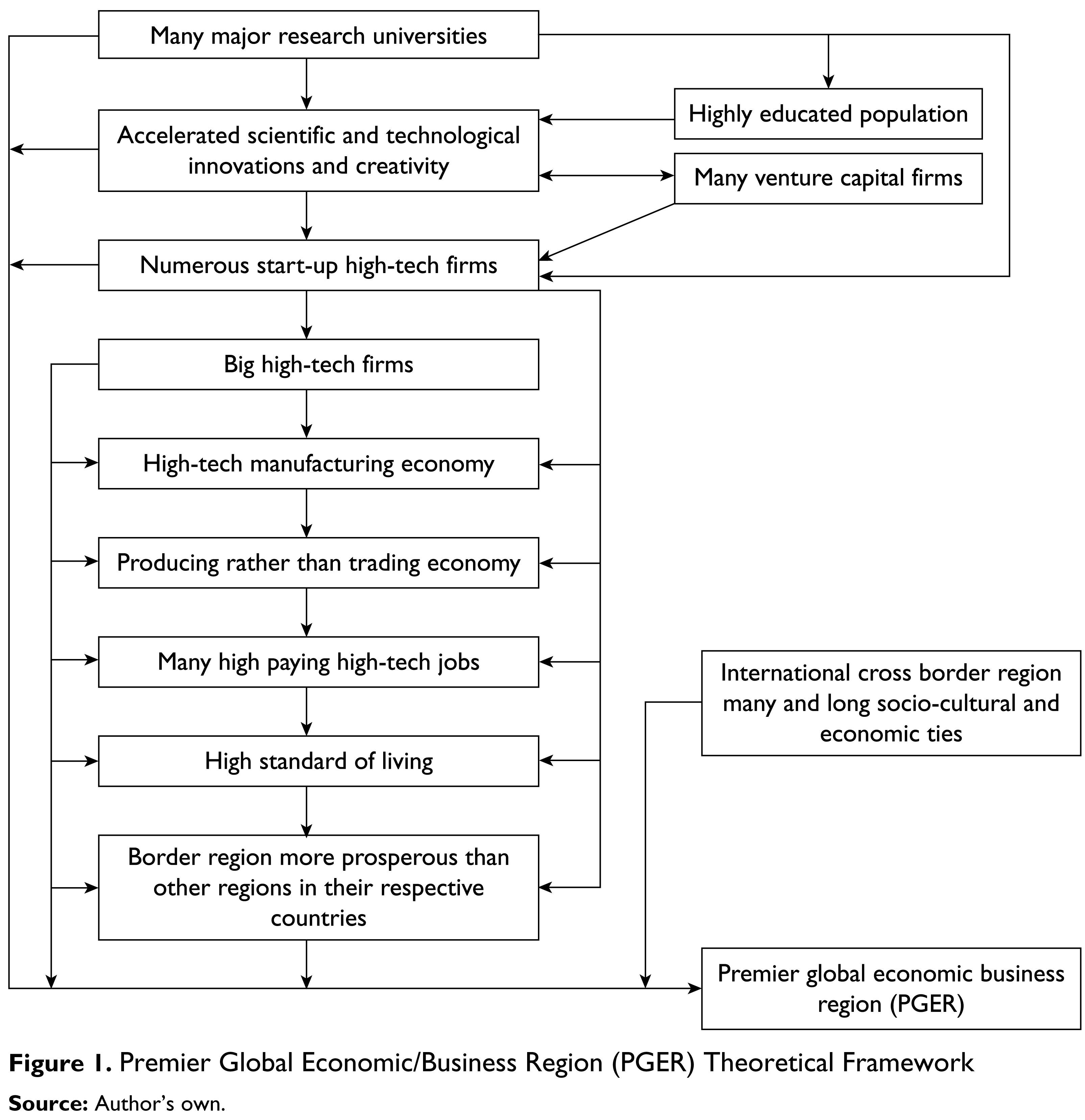
In order to clearly show how these 12 variables interact to create a PGER, this study creates the PGER theoretical framework, as shown in Figure 1. Due to the conceptual/theoretical clarity provided by this PGER theoretical framework, the framework is used to systematically achieve the goal of this study.
As Figure 1 shows, many major research universities in an international border region constitute a pivotal variable/factor in the transformation of such a region into a PGER (which is the dependent variable in this theoretical framework this study creates). Many major research universities in a region directly lead to a highly educated population, and an accelerated scientific and technological innovations and creativity, in such a region. Furthermore, many venture capital firms (which provide funds for creation of start-up high-tech firms), accelerated scientific and technological innovations and creativity (which creates the new scientific ideas and innovations that are to be commercialized) and many major universities (which also directly generate new scientific and technological ideas and innovations and creativity that are to be commercialized), in a region, all combine to lead to robust creation of numerous start-up high-technology firms in a region. Some of the start-up high-technology firms will later grow into big high-technology firms.
Additionally, Figure 1 also shows that big high-tech firms and start-up high-technology firms, in a region, combine to create high-tech manufacturing economy, producing (rather trading) economy, many high-paying high-tech jobs and high standard of living in the region, and, furthermore, make the border region to be more prosperous than other regions in their respective countries. As Figure 1 also shows, all these 12 variables combine with international border region many (and long) sociocultural and economic ties to create a PGER.
Analysis
Essentially and logically, the analysis of this study flows directly from the PGER conceptual/theoretical framework. Specifically, the analysis focuses on how the factors/variables created in the PGER conceptual/theoretical framework can be designed, developed and utilized to transform RGV into a PGER.
Source: Author’s own.
A Formidable Business Group in RGV to Lead a Possible Future RGV into a PGER Project
A plan to transform RGV into a PGER will need a group of leaders who will be very focused in achieving this goal. A group, consisting of the most powerful business leaders in RGV, will be the most appropriate group of leaders to handle this important task. This proposed group will have to be a very formidable and powerful group of leaders, due to the fact that the task of transforming RGV into a PGER is not for the faint hearted. This reality is due to the fact that, as expected in any major project of this magnitude, which will involve very dramatic, vast and fundamental economic, social and policy changes, the task will be challenging, arduous and strewn with significant challenges. The fact that it will be a hard task does not mean that it should not be carried out and achieved. In fact, this task should be carried out, and achieved, due to the fact that the achievement of the task will be very rewarding and inspiring. Transforming RGV into a PGER will prove that even though an international border area (e.g. RGV) may have socio-economic indicators (like educational, occupational, income and social mobility indicators) that are not very spectacular, such an area can be consciously transformed (through a very dedicated massive action plan) into a very prosperous high-technology economy area with a very high socio-economic indicators and a very high standard of living. This sort of achievement in transforming RGV into a PGER will also achieve another very important goal, in terms of this achievement providing a policy design and implementation blueprint that can be used to transform any other international border area (in any part of the world), with not very impressive socio-economic indicators, into a PGER.
The proposed group of very formidable and very powerful RGV business leaders, who will lead the transformation of RGV into a PGER, will need to be given a name that inspires and generates widespread public excitement for the goal of the group.
One important goal of this group will be to ensure that the political leaders of cities and counties in RGV are encouraged and made to enthusiastically support the goal of transforming RGV into a PGER, and not to focus on the narrow interests of their respective cities and counties in RGV. This can be done by making these political leaders to be aware that the massive economic progress, that transforming RGV into a PGER will bring, far massively outweigh the maintenance of narrow interests of particular cities and counties in RGV. The business group is also the group of people that will be most able to help political leaders of cities and counties, in RGV, to be very enthusiastic about transforming RGV into a PGER. This is due to the fact that, since most elected officials of cities and counties (and also at other levels of government) depend on business leaders for most of the financial resources for their electoral campaigns, city and county elected officials in RGV will mostly agree to be convinced by the proposed RGV business group that transforming RGV into a PGER is a very excellent idea. The prospect of a city or a county official in RGV losing the electoral financial support of RGV business leaders (and, therefore, very likely losing their elections), due to their lack of support for the plan to transform RGV into a PGER, will most likely very seriously focus the mind of elected city official or elected county official in RGV (and make these elected officials to agree to be convinced, by the proposed RGV business group, to be very enthusiastic about the plan to transform RGV into a PGER).
In order to be very successful in lobbying leaders at the city and county levels (and also at the state and national levels) to provide new optimal and massive social and economic infrastructures developments funding, PGER enabling legislations and policies and general political support, for the transformation of RGV into a PGER, the RGV business group that will lead this transformation will need to create an organizational structure will solely focus on systematically and continuously lobby these political leaders. This organizational structure will need to be in the form of a unit or department of the RGV business group organization. The unit will need to be staffed by the most talented professional lobbyists and political consultants. In order to provide an optimal and robust role and profile for the unit, the unit will need to be headed by a person who has the rank and title of the vice-president for governmental affairs.
The second task of this proposed RGV business group will be for the group to effectively lobby the elected officials in the executive branch and legislative branch of the government of the state of Texas to also be very enthusiastic about a plan to transform RGV into a PGER. The RGV business group stressing the obvious fact, that a future very economically prosperous high-technology economy of RGV will make the already very strong economy of Texas to become even more stronger (and help push Texas to become the state with the leading economy in the United States), will help to make the political leaders of the state of Texas to be very enthusiastic about the plan to transform RGV into a PGER. The RGV business group helping the political leaders of Texas to be very enthusiastic about this transformation plan is vital. This is due to the fact that the plan to transform RGV into a PGER will need the state of Texas taking certain legislative actions, executive policy actions and economic regulatory actions that will help to boost certain educational frameworks, research funding, support for business enterprises, vast and massive development of transportation infrastructures and economic development initiatives, in RGV.
The third task of this proposed RGV business group will be the task of helping to persuade certain agencies and departments of the federal government of the United States to provide more funds for scientific research in universities and colleges in RGV, airports improvements in RGV, construction of more federal highways in RGV, mass transit infrastructure and systems in RGV, economic development initiative in RGV, new immigration and border policies in RGV and positive international border area business regulations for business firms located in RGV. The RGV business group will get these positive federal actions more easily done through working very closely with all the members of the Texas United States Congressional Delegation (which consists of the two United States senators from Texas and the members of the United States House of Representatives from Texas).
The fourth task of the proposed RGV business group will be the task of the group making strong contacts with major high-technology companies, start-up high-tech firms, venture capital firms and all other corporations, in all parts of the United States and in other countries, and encourage them to relocate their head offices to (or establish their branches in) RGV, or help, through partnerships activities with RGV business leaders, to transform RGV into a PGER.
The fifth task of the proposed RGV business group will be the establishment of an educational and technology trust fund. Major corporations in the United States and other countries, philanthropic organizations (e.g. Ford Foundations, Rockefeller Foundations and others), grants from Texas state agencies, grants from agencies of the federal government of the United States, international organizations (e.g. Organization of American States, World Bank and North American Free Trade Agreement group) and prominent wealthy individuals, will be the sources of funds for this trust fund. The goal of this proposed RGV Educational and Technology Trust Fund will be to fund educational initiatives and science and technology research initiatives that public/governmental bodies are not able to fund. Due to the current need to robustly advance educational institutions (at the elementary, secondary and higher educational levels), and scientific and technological research outputs in RGV, these educational institutions (at all levels), and scientific and technological research organizations, in RGV, will need massive funding, in order for these institutions and organizations to be able to play their vital and essential roles in helping to transform RGV into a PGER. Therefore, the RGV Educational and Technology Trust Fund will need to have several billion dollars to use in achieving its goals.
Education as the Key Foundation and the Key Anchor
The educational system of RGV will be the key foundation for the transformation of RGV into a PGER. It is the creation of a world-class educational system in RGV that will lay a solid foundation for scientific and technology innovations and creativity to massively bloom in RGV, which, in turn, will lead to massive growth of high-technology, start-up firms and large high-technology corporations. Also, it will be a continuous world-class educational system in RGV that will anchor, accelerate and sustain a prosperous and booming high-technology economy that will be created in RGV. Therefore, the transformation of RGV into a PGER will rest squarely on a world-class education system being created in RGV. It is also important that world-class educational systems are created at all levels (elementary, secondary and higher education levels), due to the fact that the various levels of education impact on each other. For an example, the elementary level of education provides the foundations for the other levels of education. Therefore, a world-class elementary level of education leads to a world-class secondary level of education, which, in turn, leads to a world-class level of higher education. Conversely, a weak elementary level of education leads to a weak secondary level of education (where students have to repeat classes), which, in turn, leads to a weak higher education level (where universities and colleges have to provide remedial classes for a lot of students, and, therefore, these sort of universities and colleges cannot easily emerge as centres of world-class graduate degrees education and centres of word-class scientific and technological innovation and creativity).
In order to create word-class elementary and secondary levels of education in RGV, the proposed RGV business group will need to use funds from the proposed RGV Education and Technology Trust Fund to design and implement new and robust elementary and secondary levels of education. This new system will be public/private partnership elementary and secondary levels of education, through an agreement between the RGV business group and the government of the state of Texas/the local school districts in RGV. This will involve the elementary and secondary schools of the public school districts in RGV being leased to this new public/private partnership organization that is given the power to operate these schools as private schools (which are freed from suffocating state regulations, and given the freedom to use flexible systems to create world-class elementary and secondary schools in RGV). The first policy plank of this elementary/secondary schools educational system will be to ensure that almost all children in RGV complete both elementary and secondary schools education. The second policy plank will be to ensure that science and mathematics courses strongly dominate the curriculum of the schools. The third policy plank will be to ensure that the numbers of science and mathematics teachers in these schools in RGV are increased by about 300 per cent. The fourth policy plank will be to ensure that class size is reduced to about 15 students in each class. The fifth policy plank will be to ensure that an additional regular semester in the summer is created. Therefore, unlike other students in the country (who have only fall and spring semesters), all students in elementary and secondary schools in RGV will have three regular semesters (fall, spring and summer semesters). Therefore, while other students in the country have a three-month summer holiday period, students in RGV have only a one-month summer holiday period.
The sixth policy plank will be to ensure that students graduating from secondary schools in RGV will be expected to score about 30 per cent higher than the national average in Scholastic Assessment Test (SAT), and other national tests, for secondary school graduates.
In terms of higher education in RGV, the community colleges and the universities in RGV will need to be strongly separately tasked. The community colleges in RGV should be doubled in terms of the number of community colleges, and also vastly increased in terms of number of students attending community colleges in RGV. Additionally, the community colleges in RGV will need to be given four core missions. The first core mission for community colleges in RGV will be that they will provide open and free access to all high school graduates in RGV. This means that anybody graduating from a high school in RGV has an automatic admission into any community college in RGV, and, additionally, their education in the community colleges in RGV will be totally free of any tuition fee and any other fees. The second core mission for community colleges in RGV will be that they will provide excellent technical and vocational education that are tailored towards the specific manpower needs of all high-technology firms located in RGV, through their two-year Associate in Science/Technology (AS) degree programmes. The third core mission for community colleges in RGV will be that they will provide the vast majority of four-year bachelor’s degrees education for students in RGV. The goal of this mission is to ensure that universities in RGV will mainly focus on graduate degree programmes and advanced level research, while community colleges in RGV focus on four-year bachelor’s degree programmes and two-year associate degree programmes. Therefore, the universities in RGV will have to admit only a very small number of very selective, highly qualified undergraduate students. The vast majority of students in universities in RGV will be graduate students in science and engineering programmes (the core manpower needed to transform RGV into a PGER). The fourth core mission of the community colleges in RGV will be to provide open and free access to all adults and workers in RGV, through a very extensive, expansive and excellent, totally online four-year bachelor’s degree programme. Through this core mission, all RGV adults and workers (who do not have convenient time to attend traditional classes), who have a (General Educational Development) GED or a high school diploma, will have automatic admission into the totally online four-year bachelor’s degree programmes offered by community colleges in RGV, and earn these degrees without paying any tuition fees or any other fees.
The above four core missions for community colleges in RGV will enable RGV to have the kind of workforce that is needed in a booming high-technology economy, which is a highly educated population that has a very high percentage of people with a bachelor’s degree. The goal of the four core missions of community colleges in RGV will be to enable RGV to have the percentage of people with a bachelor’s degree that is double the national average.
As noted earlier, universities in RGV will have to be tasked to focus on graduate studies and on scientific and technological innovations and creativity. The universities in RGV will have to admit only a very small number of very selective and very highly qualified undergraduate students. The vast majority of students in universities in RGV will have to be graduate students. Additionally, most of the graduate students should be PhD students, in order to accelerate the research culture, which, in turn, will greatly accelerate research outputs and scientific and technological innovations (and all these are elements that will help RGV to quickly transform into a PGER).
In order to create world-class universities in RGV, these universities will have to attract the best graduate students and faculty members from all parts of the United States and from all parts of the world (as exemplified by Stanford University and University of California, Berkeley, both of which are in the Silicon Valley area). In order to attract the best graduate students, from all over the world, to universities in RGV, these universities will have to offer very many graduate assistantships and fellowships (while also defraying all or most of the educational costs for the graduate students) to a vast majority of the graduate students.
In order to attract the best faculty members, from all over the world, to universities in RGV, these universities will have to create many endowed professorships (with internationally very competitive and attractive salaries). Universities in RGV will also need to work hard to hire about two or more Nobel Prize winners to join their faculty ranks. This move will help to strategically raise the profile (and, therefore, strategically brand and position) of the universities in RGV in such ways that a very high number of the best professors and the best PhD students, from all over the world, will eagerly seek to belong to universities in RGV (since Nobel Prize winners in universities often signal to the best brains, all over the world, that such universities are conducting scientific research at the highest level, and, therefore, such universities are the best place for the best brains in the world).
All the above actions that will help bring the best professors and the best PhD students, from all over the world, to universities in RGV, will quickly result in accelerated scientific research outputs, and accelerated scientific and technological innovations and creativity, in RGV, which, in turn, will lead to growth of many start-up high-technology firms and large high-technology corporations in RGV (and all these attributes are the key elements that will accelerate the transformation of RGV into a PGER).
Also, universities in RGV being able to achieve such a world-class level of research and focus on graduate studies will result in, at least, one university in RGV being invited to become a member of Association of American Universities (AAU), which is a very prestigious group of the very best world-class research universities in North America. AAU currently has 60 universities in the United States, and two universities in Canada, as members. On the whole, therefore, a university in RGV being a member of AAU will further help to accelerate the transformation of RGV into a PGER.
Currently, there is only one university in RGV, due to the merger of the University of Texas Pan American in Edinburg with the University of Texas at Brownsville to create the UTRGV. The newly created UTRGV started with a brand new medical school. UTRGV, as a top tier one research university with a medical school, will be the most important factor in a plan to transform RGV into a PGER. It is a university that can be made to attract the best professors and the best graduate students, from all over the world, that will accelerate research outputs, and accelerate scientific and technological innovations and creativity, in RGV, and, thereby lead to creation of numerous start-up high-technology firms and large high-technology firms in RGV (and, therefore, help to transform RGV into a PGER). In order to achieve this goal, very strong PhD degree programmes need to be created, and vastly expanded, in all engineering, physical sciences and biological sciences disciplines, in UTRGV. Also, the medical school in UTRGV, in addition to its MD degree programme, need to also start with robust PhD degree programmes in all biomedical disciplines. UTRGV medical school also starting with PhD degree programmes in biomedical disciplines will help the medical school to start with a robust research culture. Dual MD/PhD degrees programmes in UTRGV medical school will also help the medical school to start with a strong research culture. UTRGV medical school also starting with some faculty members who will only engage in research will also help the medical school to start with strong research culture. A strong research culture at UTRGV medical school will lead to robust research outputs and scientific innovations, which will, in turn, lead to more start-up genetic engineering, and other biological sciences, high-technology firms (and, therefore, also helping to transform RGV into a PGER).
Since RGV now only has one university, adding about three more universities in the region will be a good idea. RGV business leaders creating a private world-class university, which only offers graduate degrees (with most of the graduate students being PhD students) in science and engineering disciplines, will aid the transformation of RGV into a PGER. A good name for the university will be a name like Pan American Graduate University of Technology (this sort of name will emphasize the international and global nature of RGV as a region). RGV business leaders need to create two more private universities, in order to have a total of three private universities and one public university in RGV. The second private university should only provide graduate degrees in business, science and engineering disciplines. The third private university should offer undergraduate and graduate degrees in all academic disciplines (humanities, social sciences, biological sciences, physical sciences and engineering), but have more graduate students than undergraduate students. The public university in RGV will be the current UTRGV. UTRGV will need to vastly increase its number of students, have more graduate students than undergraduate students, have mostly PhD students in its graduate programmes and vastly increase its research outputs. RGV having the four universities, with the profiles stated above, will greatly produce the sort of large numbers of highly educated scientists and engineers that will be needed to transform RGV into a PGER.
As shown in this section, education is the vital key for the transformation of RGV into a PGER. As also shown, the educational system in RGV will serve both as the foundation and as an accelerator for the transformation.
Building a Scientific and Technological Innovations and Creativity Hub
Since UTRGV is currently the only university in RGV, the university will play the pivotal role in terms of turning RGV into a scientific and technological innovations and creativity hub. One very practical way of doing this will be for UTRGV to establish a new and big research park or research campus (this UTRGV research campus should be bigger than the regular UTRGV university campus with classrooms buildings and office buildings, so that there will be enough land areas for further future expansions of UTRGV research activities and facilities). A model for this can be the Research Triangle in the Durham–Raleigh–Cary area in North Carolina. The research park/campus will provide ample research building and facilities (outside of the normal campus[es] of UTRGV with teaching classrooms buildings and office buildings) where advanced research activities are carried out in partnership with private high-tech companies and/or government agencies. Due to the very large expanse of land that the new UTRGV research park/campus will have, some of the land in the research park should be leased to private high-tech companies and government agencies to create and build their own research facilities. This concentration of research activities by UTRGV, high-tech companies and government agencies, in the new UTRGV research park/campus, will lead to synergy in scientific and technological innovations and inventions that will emanate from the new UTRGV research park/campus.
RGV as Start-up High-tech Heaven and Big High-tech Mecca
Similarly, since UTRGV is currently the only university in RGV, the university will also play a pivotal role in turning RGV into a haven for start-up high-tech firms and a mecca for big high-tech firms. This is due to the fact that it is scientific and technological innovations and inventions that lead to start-up high-tech firms being created in a region, and attract big high-tech firms into a region. Georgia Institute of Technology has developed numerous and elaborate programmes and frameworks that have enabled many of its current and former students, and also many of its professors, to create hundreds of very successful and very profitable start-up high-tech firms (Georgia Institute of Technology, 2014a–2014u; Graham, 2014). UTRGV can copy and replicate these very successful programmes, frameworks and activities, which have been very successful in Georgia Institute of Technology, to help make RGV a haven for start-up high-tech firms and a mecca for big high-tech firms. The RGV business group will also need to partner with UTRGV to make RGV achieve this goal of being a haven for start-up high-tech firms, and a mecca for big high-tech firms.
A Venture Capital Haven
In order for those who generate new ideas for scientific and technological innovations to be able to commercialize their ideas, they need adequate capital to create start-up high-tech firms. Naturally, widespread creations of new scientific and technological innovations and inventions in RGV will attract many venture capital firms to RGV, in order for these venture capital firms to earn excellent income through investments in new start-up high-tech firms that will grow to be very profitable firms. The RGV business group proactively marketing RGV, as a region for venture capital firms to make very profitable yields in start-up high-tech firms in RGV, will also help to attract more venture capital firms to RGV.
Regional Culture that Fosters and Promotes Innovations
Many studies have shown that certain regional cultures (within which are embedded organizational cultures that promote knowledge creation) more foster and promote creation and utilization scientific and technological innovations, while, conversely, certain regional cultures (and also the embedded organizational cultures) suffocates and stifles creation and utilization of scientific and technological innovations (Nonaka & Teece, 2001; Saxenian, 1996). Due to this reality, the RGV business group, and educational and sociocultural organizations in RGV, should always judiciously promote those cultural and social dynamics that foster and promote the creation and utilization of scientific and technological innovations and inventions.
RGV as Centre of Excellence in Health Care
Currently, RGV has very many excellent hospitals that are used by many (including people from Canada and the northern part of the United States) who have winter homes in RGV, and also by many from the Republic of Mexico. RGV can capitalize on this reality, by robustly strategically positioning, branding and marketing RGV as a foremost centre of excellence in health care. The new UTRGV medical school (together with its associated teaching hospital[s]) will robustly enhance this type of branding and marketing of RGV. This sort of development will also help to make RGV a haven for the creation of start-up biomedical high-tech firms. Therefore, strategically positioning, branding and marketing RGV, as a foremost hub of excellence in health care, will also help to accelerate the transformation of RGV into a PGER.
Premier Destination for Executive Health Care
Relevantly, the teaching hospitals associated with UTRGV medical school can add to its general public health care service a world-class very advanced executive health care service that cater specifically to leaders of countries, world business leaders and other very prominent individuals, from all over the world. Like other executive health care units, this unit at a UTRGV teaching hospital will need to be separate from the health service for the general public, cost astronomically more, provide world-class very advanced health care service, have luxurious facilities befitting the status of its very prominent clients and be strongly very strategically branded and marketed to its niche market of prominent world political, business, economic and sociocultural leaders (so that it attracts world leaders [especially from the Americas] just like Cleveland Clinic, Mayo Clinic and Johns Hopkins University Teaching Hospital). This sort of executive health care service will need to have the following three impacts on RGV: help foster the creation of many start-up high-tech firms in RGV that make very advanced medical devices (and, thus, help to accelerate the transformation of RGV into a PGER), help to foster the creation of biotech firms to manufacture very advanced genetically engineered drugs (and, thus, also help to accelerate the transformation of RGV into a PGER) and help to brand and market RGV as a scientific and economic hub of the Americas.
Expansion of Tourism
RGV is already a major tourist location, especially due to tourism in South Padre Island. Additional very strong marketing of tourism to all countries in the Americas (especially the expanding middle class of Brazil, Mexico, Chile and other countries in South and Central America), Europe and Asia (especially the expanding middle class in China, India and other countries in Asia) can vastly increase the number of tourists to RGV. This sort of development will help to greatly increase income and public revenue for RGV (which can be added to the funds to be used in transforming RGV into a PGER).
Rebranding of Tourism
RGV may also need to develop a two-tier tourism industry. While continuing to attract the general tourist population, as noted in above section, RGV can also be developed and marketed as a hub for academic and other types of conferences (through building more hotels with huge conference centres). This sort of development will also bring more income and public revenue (which can be added to funds to be used in transforming RGV into a PGER), and, more importantly, numerous major academic conferences in RGV will help to advance the profile of RGV as a scientific and technological hub region.
RGV as an International Diplomatic Conferences Hub
Relevantly, apart from academic and other conferences, RGV can also be strategically developed, positioned, branded and marketed as hub for international diplomatic meetings and conferences. Through their powerful contacts, the RGV business group can continuously encourage incumbent president of United States to host some North Atlantic Free Trade Agreement (NAFTA) meetings in RGV, encourage regional organizations in the Americas to host some of their meetings in RGV and also encourage incumbent president of the United States to host some G20 and G8 meetings in RGV. This sort of development will help to establish RGV as the political, economic and sociocultural hub of the Americas (and this sort of development will also help complement and advance the profile of RGV as a global high-tech hub).
Hub of the Free Trade Areas of the Americas
After NAFTA, the United States has continued to sign free trade agreements with individual countries in Central America, South America and the Caribbean region. This process will likely, sooner or later, lead to all the countries in the Americas belonging to one free trade area. Whether this free trade area consisting of all countries in the Americas is called the free trade area of the Americas, or any other name, such a free trade area will need a headquarters city. While many cities in the United States (e.g. Miami, Atlanta, New Orleans, Houston, Dallas, San Diego, Los Angeles, Phoenix and others), and cities in other countries in the Americas, will strongly vie to be such city, the fact that RGV has parts in both the United States and in Mexico, and the additional fact it is very centrally located (in terms of all the countries in the Americas), will make a city in RGV to be competitive in the competition to be selected as the headquarters city for a free trade area of the Americas. In fact, the location RGV makes RGV to be located in North America (the United States part of RGV), Central America (the Mexican part of RGV) and the Caribbean (due to the fact that the eastern part of RGV borders the Gulf of Mexico). This sort of reality also adds to the profile of RGV as a very centrally located area of the Americas. A city in RGV being the headquarters city of a free trade area of the Americas will also complement, and also help advance and accelerate, the profile of RGV as a high-tech hub.
A Global Airport for a Global Region
Airports are major economic engines for regions (Inamete, 1993). Therefore, the bigger the airports, the bigger the economic impacts for regions. Dallas–Fort Worth region is often seen as one region that most understands this sort of dynamics. In order to have a world-class huge airport that is globally known, and which has a very formidable economic impact in the Dallas–Fort Worth region, the two cities reduced the profile of their respective individual airports (in the case of Dallas, the Love Airport), and joined forces to build and operate a major global airport known as the Dallas–Fort Worth International Airport (which is one of the world’s big airports). RGV following the example of Dallas and Fort Worth region will be very good for RGV. Such a big international airport needs to be cited in between the major urban areas of RGV, just as Dallas–Fort Worth International Airport was located in between the cities of Dallas and Fort Worth. A big world-class international airport in RGV will attract more high-tech companies to locate in RGV, and, therefore, further advance and accelerate the transformation of RGV into a PGER. Also, such a big world-class international airport in RGV will help to make RGV to be the economic, political and sociocultural hub for all the countries in the Americas.
Strategic Positioning and Branding of RGV
An effective strategic management of the transformation of RGV into a PGER will ensure the success of the process. The proposed RGV business group (which will consist of prominent RGV business leaders who have their own businesses to operate) will need a full-time management team under them. Therefore, the RGV business group will function as board of directors, while the full-time management team will function as the organization that directly manages, on a full-time basis, the process of transforming RGV into a PGER (under the policy guidelines provided by the RGV business group). For the full-time management organization to be very successful in handling the project of transforming RGV into a PGER, the organization will need various employees who are experts in various fields, such as management studies (Cummings & Worley, 1997; Plunkett et al., 2002), project management in regional contexts (Banik & Bhaumik, 2006), international economics and international business (Daniels & Radebaugh, 1992; Klak, 1995; Sawyer & Sprinkle, 2006) and regional and global culture studies (De Blij & Muller 2008; Gannon, 2004; Inamete, 2009–2010). Transforming RGV into a PGER needs knowledge from all these areas of knowledge.
Apart from effective management of the project of transforming RGV into a PGER, the proposed RGV business group will also need to very vigorously use very effective public relations, marketing, and advertising platforms and techniques to robustly strategically position, brand and market RGV as a PGER, to scientific and technological groups, business groups and leaders and sociopolitical and governmental leaders in the state of Texas, other states in the United States, all provinces in Canada, all states in Mexico and countries in Central America, South America, the Caribbean region, Europe, Asia, Africa and the Pacific region. These sort of strong and effective strategic positioning, branding and marketing of RGV as a PGER will attract more scientists, engineers, high-tech firms and investors to RGV (and these sort of dynamics will help RGV to grow and expand as a PGER).
Conclusions
This study shows that, through a planned process and action plans, an international border region can be transformed into a PGER. The PGER theoretical framework, that this study creates and utilizes, also shows that this proposed transformation of RGV into a PGER can be systematically designed and implemented. This study also shows that this sort of transformation will have some serious challenges and may sometimes be arduous. Due to this reality, this study proposed a formidable RGV business group to be a clear and strongly empowered leadership body for the transformation of RGV into a PGER. As noted in another section of this study, even though this transformation of RGV into a PGER may face significant difficulties, using the PGER theoretical framework to carry out this sort of transformation in RGV is very important for two reasons. One reason is the fact that a region like RGV being able to be transformed into a PGER will be very inspirational, and will also enormously improve the quality of life of the people in RGV and make the region a global showcase. The second reason is that if RGV is able to utilize the PGER theoretical framework to transform itself into a PGER, any international border region (or any non-international region), in any country, can also use the PGER theoretical framework (as a blueprint or as a template) to transform itself into a PGER. However, the task of a region transforming itself into a PGER may be harder or easier for each region, based on the current status of the variables (in the PGER theoretical framework that interact to create a PGER). For an example, a region that already has many major research universities may have a less hard process of transformation into PGER. Conversely, a region that does not even have one major research university will have very tedious, hard and long process of transforming itself into a PGER. Such a region will also need to have a lot more several billion dollars (from public and/or private sources) to invest in the infrastructures that will be needed to transform such a region into a PGER.
It is also important to add that the PGER theoretical framework, that this study creates, can be an important policy instrument countries can use to advance and accelerate economic development in each respective country. This sort of approach will involve countries adopting a regional approach to national economic development. This approach involves each region in a country being designed separate and different economic development models, based on the existing socio-economic attributes of each respective region. Essentially, this approach will involve the use of PGER theoretical framework to create the economic development models for each region of the country, based also on the existing socio-economic attributes in each respective region. Through this sort of approach, countries can use the PGER theoretical framework to enormously transform the status of the economy of their respective countries, through a planned process/action plans for each region of respective countries. Therefore, an industrialized and developed country, with a stagnant economy, can use PGER theoretical framework to massively increase economic growth in such a country. Additionally, a country, with a non-industrialized and developing economy, can also use the PGER theoretical framework to very quickly and robustly industrialize and expand its economic (through the high-technology route).
One of the major subfields of the academic discipline of management is the subfield called innovation and creativity management studies. As the subject matter of this study shows, this study falls under this subfield of innovation and creativity management studies in the academic discipline of management. Importantly, the creation of the PGER theoretical framework, by this study, provides a new prism for studying and analyzing innovation and creativity management. Thus, this study provides a new instrument for generating new and additional knowledge in the subfield of innovation and creativity management studies, in the academic discipline of management.