




Abstract
This study examines the impact of female wages, unemployment, foreign remittances and globalization on female labour supply over the period from 1980 to 2010. We have applied the autoregressive distributive lag (ARDL) bounds testing to test whether cointegration exists between variables. Our results show that variables are integrated for a long-run relationship. Moreover, female wages attract female labour supply. Foreign remittances and globalization raise female labour supply, whereas unemployment lowers it. The relation between female wages and female labour supply is U-shaped. The causality analysis reveals that female wages, foreign remittances, globalization and unemployment Granger affect female labour supply.
Introduction
The dynamics of labour market is said to be the main route for establishing the nexus among macroeconomic policies, economic growth and poverty alleviation. A plethora of studies on the labour market conditions in Pakistan have focused on economic activity, the percentage of employed persons, unemployment rate, wage differentials, female working hours, poverty, gender development and gender empowerment (Abbas, 2013; Afzal, 2006; Arif, Muhammad & Khalid, 2002; Chaudhary & Khan, 1987; Ejaz, 2011). These are identified as important determinants of gender well-being as these determinants are interdependent on each other and one leads to another. For the last six and half decades, Pakistan has been experiencing different dimensions in growth performance with a wide variety of labour market outcomes. Pakistan adopted different polices in different periods, such as import substitution strategy, trade liberalization policy and structural adjustment and stabilization programme. The government took various measures in different phases, under the recommendations of the World Bank and the International Monetary Fund (IMF), to decrease the fiscal deficit, reduce subsidies on agricultural production, austerity measures, to cut down expenditures in social sectors like health and education and to restructure the tax structure such as general sales tax, income tax, corporate tax and increased user charges. These measures raise the cost of living along with a reduction in real income in the household. Pakistan is a patriarchal society where women are considered to be less privileged and the least important members of a family. A decline in household real income means less food available to the household, and among all the family members, as is our traditional set-up, food is first served to the male members, then sons and then daughters and in the end females. Females are denied their basic rights in terms of health facilities, education and an increase in working hours for social reproductive work. With the introduction of structural adjustment policies and programmes, the price in the market rises with the squeeze of income, which increases the unemployment rate and reduces wages for men. In short, the urban poor, that is, working class women are the most affected as they are the ‘shock absorbers’ of neoliberal economic policies. Moreover, privatization and technology advancements affect female participation negatively (Streeten, 1999). The stabilization and structural adjustment (SSA) programmes of 1987–1992 reflect that income inequalities had increased due to the reduction in employment opportunities and a regressive tax structure (Kemal, 1994).
Among the South Asian countries, Pakistan has the lowest participation of the female labour force. 1 It has been observed with great concern that the gap between female and male labour force participation and employment is mostly due to educational gaps in the form of literacy, enrolment and average year of schooling between females and males. For instance, in 2001, female literacy when compared with the percentage of male literacy was 50 per cent in Pakistan, 67 per cent in India and 94 per cent in Sri Lanka. Likewise, in 2000, the female and male unemployment ratio was 3.5 per cent, which implies that women are 3.5 times more likely than men to be unemployed, while in India, for the same year, women were 1.4 times more likely to be unemployed. In the case of Pakistan, the unemployment rate of females was 14.9 per cent in 2000, which decreased to 8.9 per cent in 2011. This shows a decrease in the female–male unemployment ratio, which was 1.74 per cent in 2011, showing a decline in the unemployment rate.
In Pakistan, the labour force participation is very low due to the lack of opportunities and capabilities. In Pakistan, labour force participation is very low due to lack of opportunities and capabilities. Rigid gender roles, ideologies, social stigma, cultural restrictions especially on female mobility, segmented labour markets, lack of education and skills, family responsibilities and gender biases show a low value of female labour due to the social reproductive work. The total labour force participation was 32.8 per cent in 2010–2011, which is almost equal to the rate in 2009–2010, that is, 33 per cent. In the case of rural–urban areas, the participation of females in the urban areas was 30 per cent in 2010–2011 and 2009–2010, while in the case of rural areas, the participation trends show a slight change, that is, 34.3 per cent to 34.5 per cent in 2009–2010 and 2010–2011. 2 Despite rapid industrialization, urban female participation rate derived from official labour force survey data shows a negligible increase over the past two decades, rising from 5 per cent in 1987–1988 to 21.7 per cent in 2010–2011, showing the refined activity rate. In Pakistan, unemployment rate for females is higher than for males. Most of the people are engaged in some sort of market or economic activities, irrespective of the considerations of the wage rate, working age and working hours. 3
This article contributes to the existing economic literature by investigating the impact of labour market conditions on labour force participation. We have extended labour force participation function by incorporating foreign remittances and globalization as the potential determinants of female labour force participation (FLFP), and hence economic growth. We have applied structural break unit root test in order to examine the stationary properties of the variables. The autoregressive distributive lag (ARDL) bounds testing approach is employed to test the existence of a long-run relationship between the variables. The causal relationship between the variables is tested by applying the vector error correction model (VECM) Granger causality approach. We find that the variables are cointegrated for a long-run relationship. The impact of female wage on FLFP is positive. Foreign remittances also add to FLFP. The relationship between globalization and FLFP is positive. Unemployment is inversely linked to FLFP. An inverted U-shaped relationship exists between female wage and FLFP. The causality analysis reveals the unidirectional causality running from female wage and globalization to FLFP. The feedback effect is found between unemployment and FLFP.
The rest of the article is organized into the following sections. The second section presents the review of literature. The analytical framework, methodological framework and data collection are described in the third section. The fourth section reports the results and their discussion. Conclusion and policy implications are presented in the fifth section.
Literature Review
A body of literature has studied wages, employment and unemployment rate, globalization and FLFP. For example, Standing (1989) has hypothesized ‘feminization of employment’ because of the increasing globalization of production searching for flexible forms of labour to retain or increase competitiveness, along with the job structures, in industrial enterprises. There are two propositions with the global economy: (i) that it increases the number of women in the labour force and (ii) that it has deteriorated the working conditions in terms of labour standards, income and employment status. The author stresses on the dual characteristics of feminization, which increase the participation of female labour force, on the one hand, and decrease the labour standards, employment and earnings, on the other. Brown (1992) highlights employment as the main indicator influencing women empowerment and reports that economic reforms may bring improvement as more females get associated with productive and market activities; moreover, more empowerment alleviates domestic violence. Basu and Van (1998) emphasize the theoretical consequences of added worker effect. It leads to multiple equilibriums. The authors are of the view that unemployment benefits can neutralize or mollify the inefficiencies caused by the potential of households to oversupply labour. An increase in unemployment leads to an increase in labour supply, which leads to the ‘added worker effect’. The authors assume that unemployment leads to an increase in the number of women and children in the supply of the labour force. Unemployment of the primary worker pushes the secondary worker to seek work, that is, what is known as the ‘added worker effect’ and its opposing force the ‘discouragement effect’. It reflects that the potential workers abandon their hopes and are discouraged.
A voluminous study in empirical research in this area highlights that the discouragement effect dominates the added worker effect and offsets it entirely (Layard, Barton & Zabalza, 1980; Maloney, 1991). It is worth noting that a female’s employment may be affected by her husband’s unemployment, or employment obstacles faced by the male labour supply. Drinkwater, Levine and Lotti (2003) employed aggregate data for 20 countries and developed the labour matching model for the years between 1996 and 2000 and identified the specific countries where remittances were at least 1 per cent of the gross domestic product (GDP) between 1996 and 2000. The nexus between remittances and unemployment is tested by employing data from a panel of developing countries. They postulate that higher unemployment rates are due to remittances as they are taken as welfare payments. However, income in the form of remittances has a non-significant effect on unemployment. The author is of the opinion that if ‘the investment effect’ offsets the ‘search income effect’, then remittances have the potential to contract the unemployment rate.
Amuedo-Dorantes and Pozo (2005) examined the relationship between foreign remittances and unemployment and found no significant evidence between remittance inflows and the decrease in unemployment rate. Funkhouser (2006) used longitudinal data from living standard measurement service for the period 1998–2001 in Nicaragua and found the significant effect of migration and remittances on labour supply. Canales (2007) argues that remittances compensate households for lower Mexico-based wages. The authors have identified four ways through which remittances can improve the well-being of the migrants’ families and promote economic development in the country. The authors found that in 70 per cent of the cases, remittances were mainly used for food consumption and 21 per cent of the amount was spent to buy or renovate a house or a buy a car. The author is of the opinion that remittance is like an injection of economic resources into particular sectors of the economy. A very small chunk of these flows was productively invested or saved. Gillani, Khan and Iqbal (1981) have compared the data related to migrants and remittances in a series of research reports, specifically on labour migration from Pakistan to the Middle East, and its impact on Pakistan’s economy. They empirically testify that migration provides an opportunity to earn five to eight times more on an average in the Middle East labour market, than in the home country, that is, Pakistan. Chaudhary and Khan (1987) investigated the determinants of female labour supply in rural Pakistan and noted that wage gap, education and customs play an important role in the supply of female labour. Arif et al. (2002) have explored the labour market dynamics in Pakistan by using the longitudinal data set. They have employed two rounds of Pakistan Socio-economic Survey (PSES) to identify the movement of individuals into and out of the labour market and labour force, and employment and unemployment. This study has divided the sample into three labour market statuses, that is, employed, unemployed and not in the labour force. They observed that the LFPR for the adult population increased from 44 per cent in 1998–1999 to 48 per cent in 2000–2001. They also found that the unemployment rate had increased from 6.4 per cent in 1998–1999 to 11.5 per cent in 2000–2001. Their analysis revealed that education has a negative impact on transition of labour to an outside labour market.
Sabir and Aftab (2007) explored the gender–wage gap in Pakistan by using data from the labour force survey at two different points in time, that is, 1996–1997 and then after a decade in 2005–2006. They have investigated the gender–wage gap based on occupation, as well as province-wise. They found that the decline in unequal treatment of both men and women shows an important factor for the increase in gender pay gap in the lower-middle part of the conditional wage distribution. Faridi and Basit (2011) probed the factors affecting rural labour supply by applying binomial logit regression. They claimed that education, economic and social capital have a positive impact on rural labour supply, but livestock and landholdings decrease it. Ejaz (2011) also examined the impact of determinants on female labour supply and found that the gender–wage gap and fertility impede female labour supply, while ownership of home appliances and co-residence increase it. Soomro, Kumbhar, Sheikh and Khooharo (2012) evaluated the implications of economic globalization on the unemployed and on the labour force participation in Pakistan, that is, at the national and international levels. Their findings revealed that there exists a significant positive effect of economic globalization on unemployment in Pakistan. Recently, Abbas (2013) investigated the determinants of female labour supply using data from Bangladesh and Pakistan. A U-shaped relationship exists between economic development and female labour supply. Infant mortality rate has a greater impact on female labour supply in Pakistan, while education impacts female labour supply more in Bangladesh.
The existing literature review reveals that there is no study investigating the impact of labour market conditions on female labour supply in the case of Pakistan. This study is a pioneering effort to fill that gap in the case of Pakistan.
Analytical Framework, Methodological Framework and Data Collection
The human capital theory of wage determination advocates that wages are tied to productivity and in a non-discriminatory atmosphere, which is evident in terms of differences in productivity of both the genders. The key variable influencing the FLFP is wages (either male or female). However, household income is inversely related to women’s entry in the labour market, as the lower the income of a male member, the higher the probability of a woman entering the labour market and vice versa. Economic theory also posits that the effect of wages on labour force participation depends on the relative strengths of substitution and income effects. The substitution effect will be positive as higher wages will mean more labour force participation. The income effect will be negative because as the income rises, workers desire for more leisure and less work. Assuming that the income effect is small, the overall effect of wages on labour force participation will be positive. The effect of male wage may also be negative on FLFP as higher wages of males suppressed female participation in the labour force by restricting them to the home. Remittances depict an income flow from the other part of the world to the parent country. It has a lot of positive impacts at the household level as well as on the economy. However, it has been noted that the pattern and trend in the use of remittances by the immigrant families reduce its effectiveness for economic development as it is believed that a substantial part of the remittances is mostly spent on current consumption, like consumable and durable commodities, unproductive investments such as residential real estate. It has been observed that as the family income increases due to the inflow of remittances, it reduces the participation of females in the labour market.
One important aspect is globalization, which has turned the world into a global village. The impact of globalization and openness to trade on women has been mixed in different countries of the world. One important aspect of economic globalization is the creation of job opportunities for both men and women and especially for females, as globalization promotes export processing zones, free trade zones and world market factories. According to Moghadam (1999), in the current global environment of open economies, new trade requirements and competitive export industries, global accumulation rates rely heavily on women’s labour, both waged and unwaged, in formal sectors and in the home, in manufacturing and in public and private services. This phenomenon has been termed as the ‘feminization of labour’. Standing (1989) has hypothesized that the increasing globalization of production, and the pursuit of flexible forces of labour to retain or increase competitiveness, as well as increasing job structures in industrial enterprises, favour the ‘feminization of employment’ in the dual sense of an increase in the number of women in the labour force and a deterioration of working conditions in terms of labour standards, income and employment status. On the one hand, women are gaining in terms of jobs availability but on the other hand, they are in a disadvantageous position in the new labour markets in terms of training, wages and occupational segregation, as they are mostly involved in temporary, part-time, casual and home-based work.
The most important factor determining the FLFP is the unemployment rate of both males and females. The local labour market conditions are best described by the unemployment rate. The female unemployment rate affects the probability that women entering the labour market will find a job. While on the other hand, the economic and psychological cost associated with job search is very high when female unemployment rate is high. Due to the above reasons, women may be discouraged to look for a job. However, when the male member of the family becomes unemployed, there are more chances of women entering the labour market to compensate the loss of family income. Hence, it is expected that FLFP increases with an increase in the unemployment rate of the male, as the family income declines and it decreases with the increase in the overall unemployment rate or female unemployment rate.
For empirical purposes, we have converted all series, except unemployment rate, into a logarithm. The logarithm form of the variables reduces the sharpness in the time series data. The empirical equation of the model is as follows:

where ln shows natural logarithm, FP t indicates FLFP per capita, Wt is female wages, Rt denotes foreign remittances per capita, Gt is the globalization proxies by the KOF index of globalization, Ut illustrates unemployment rate and εt is the residual term assumed to be normally distributed. The unrestricted error correction model (UECM) of ARDL bounds testing is modelled as follows:

where the difference operator is indicated by Δ, T is the trend variable and ε is the residual term assumed to have a normal distribution with finite variance and zero mean. The next step is to compute the ARDL F-statistic to examine whether cointegration between the variables exists or not. It is necessary to choose an appropriate lag order because the value of F-statistic varies with the lag order. We use Akaike information criterion (AIC) to choose the suitable lag length. We apply the F-test developed by Pesaran, Shin and Smith (2001) to examine the joint significance of estimates of the lagged level of the series. The null hypothesis of no cointegration is
Once a long-run relationship between labour market conditions and FLFP is established, it is necessary to find the short-run impact of labour market conditions on FLFP in the case of Pakistan. In doing so, we apply the error correction method (ECM). The empirical equation of ECM is modelled as follows:

where ECMt–1 is the lagged error term, ϑ is the estimate of lagged error term that captures the speed of adjustment from the short-run to the long-run equilibrium path. Here, we say that the differenced of FLFP is explained by the differenced of linear (non-linear) term of real GDP per capita plus lagged error term and stochastic term. We have conducted diagnostic tests to test the classical linear regression model (CLRM) assumptions, such as normality of error term, serial correlation, ARCH, white hetero-skedasticity and specification of short model. The reliability of the short-run estimates is investigated by applying the cumulative sum (CUSUM) and the cumulative sum of squares (CUSUMsq) suggested by Pesaran and Shin (1999).
We should apply the VECM to investigate the causal relationship between the variables once a cointegration relationship exists between the series. It is argued by Granger (1969) that the VECM is an appropriate approach to examine the causality between the variables when series are integrated at I(1). The empirical equation of the VECM Granger causality approach is modelled as follows:

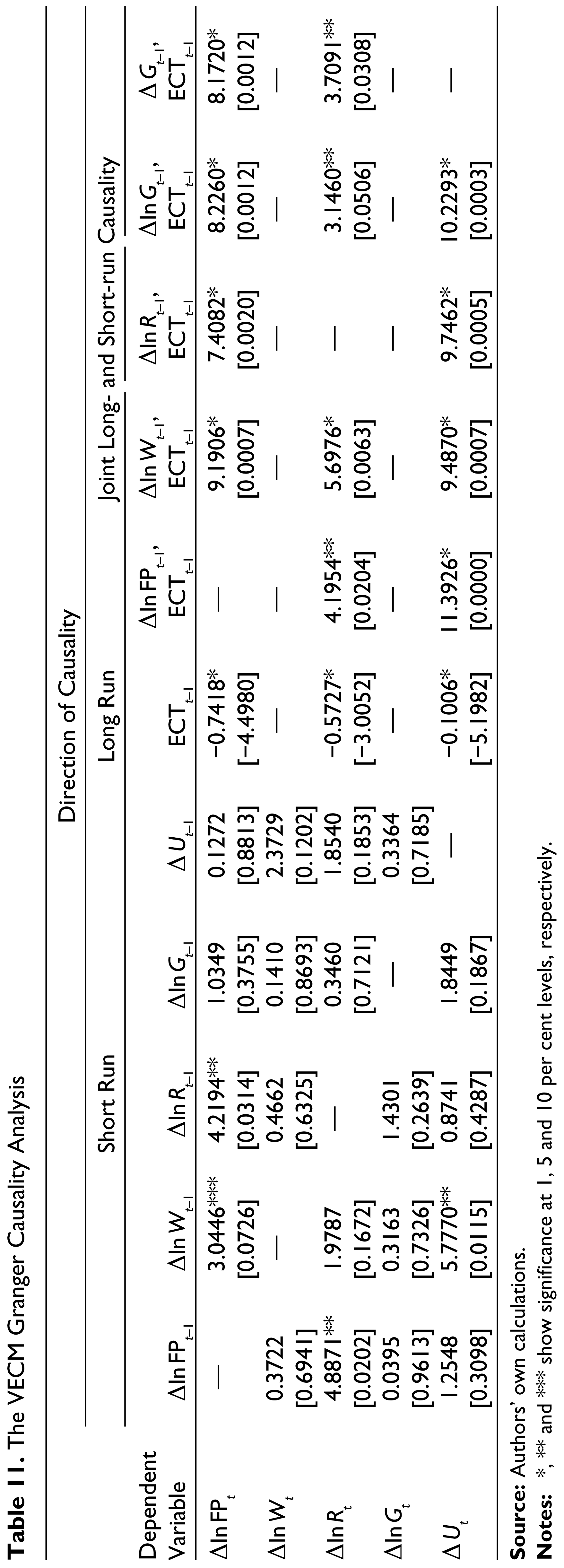
where (1–L) indicates the difference operator and the lagged residual term is indicated by ECTt–1, which is obtained from the long-run relationship, while ε1t, ε2t, ε3t, ε4t and ε5t are the error terms. These terms are supposed to be homoskedastic, that is, constant variance. The statistical significance of the coefficient of the lagged error term, that is, ECTt–1 using t-statistic shows a long-run causal relationship between the variables. The short-run causality is shown by the statistical significance of F-statistic using Wald test by incorporating the differenced and lagged differenced of independent variables in the model. Moreover, the joint significance of the lagged error term with differenced and lagged differences of independent variables provides the joint long- and short-run causality. For example,
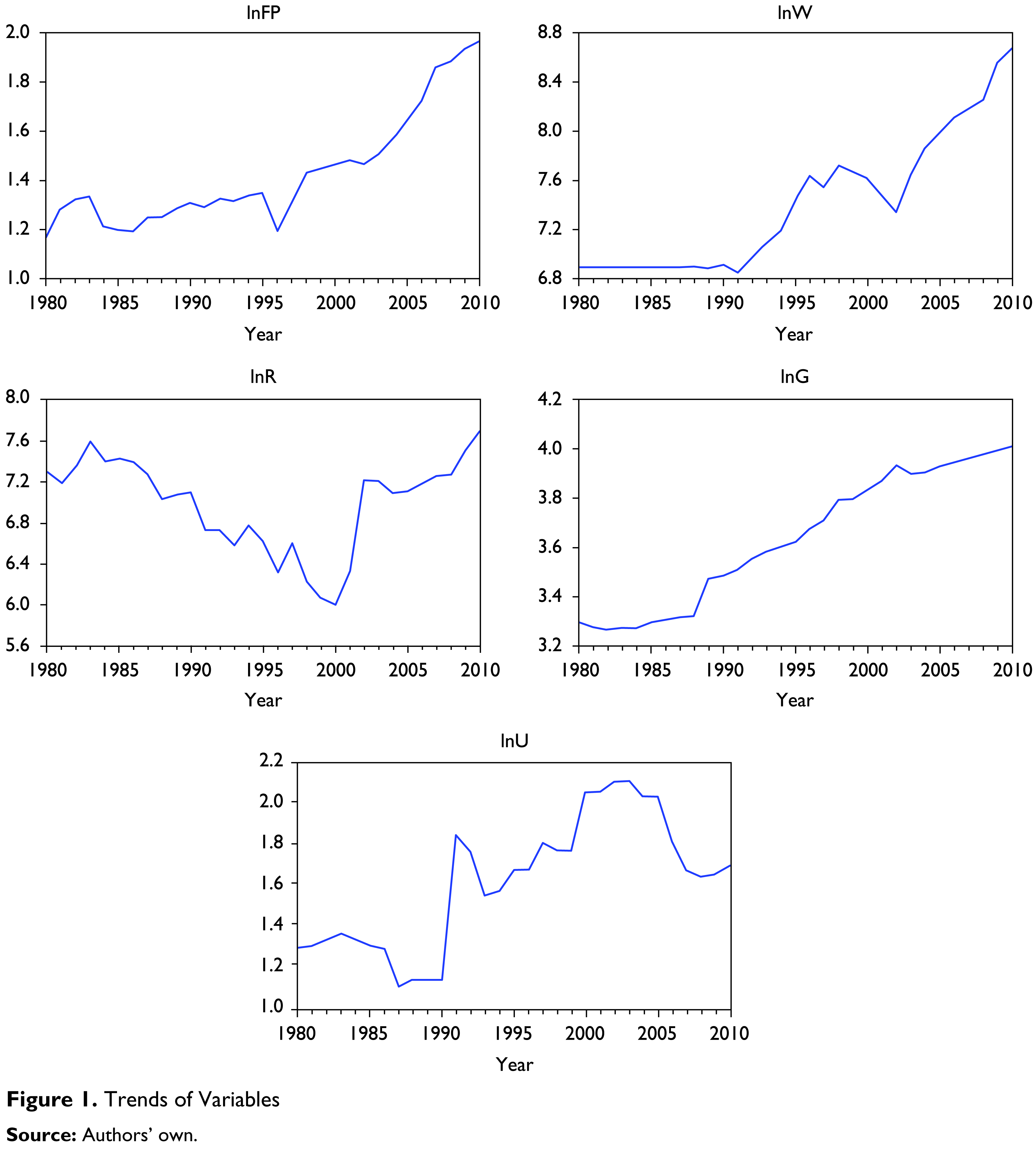
The study covers the period from 1980 to 2010. We have combed the Economic Survey of Pakistan (various issues) to collect data on FLFP, female nominal wages and unemployment rate. The world development indicators (CD-ROM, 2012) have been used to collect data on real foreign remittances. The population series is engaged to convert all the variables into per capita units (except unemployment rate). We have used the KOF index of globalization. All the variables have been transformed into log-linear specification (except unemployment rate) to attain consistent empirical results (Figure 1).
Results and Their Discussions
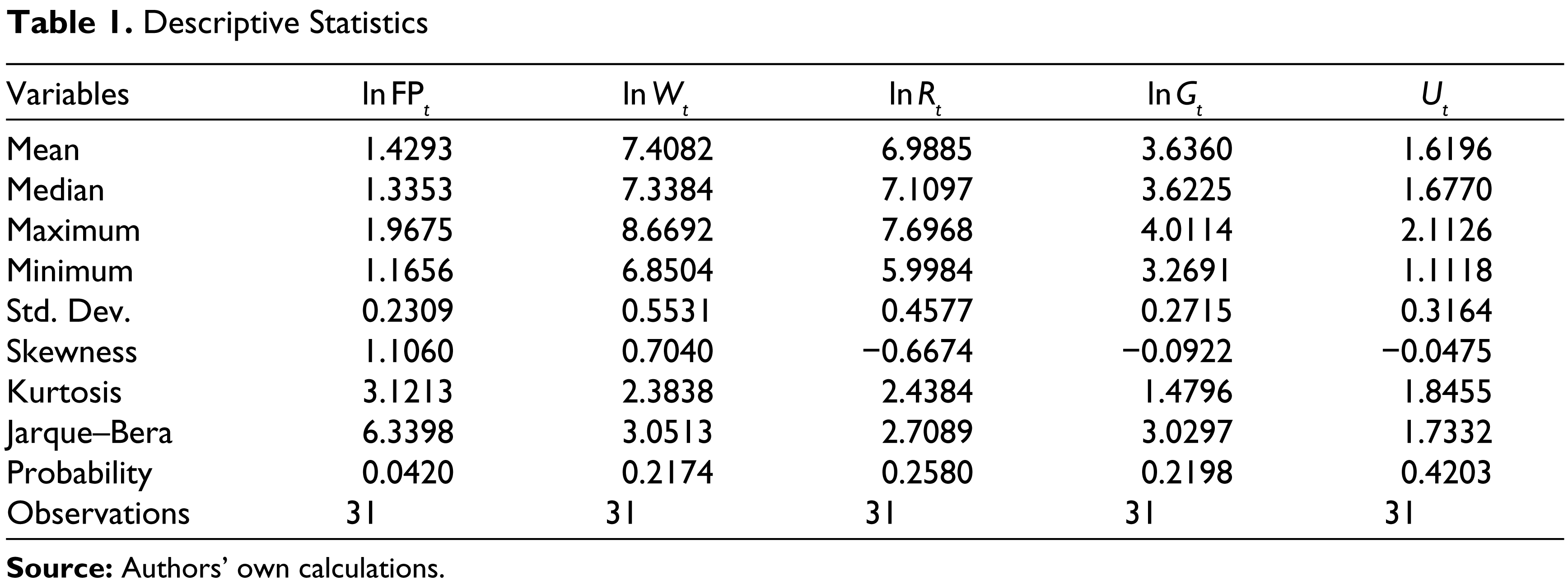
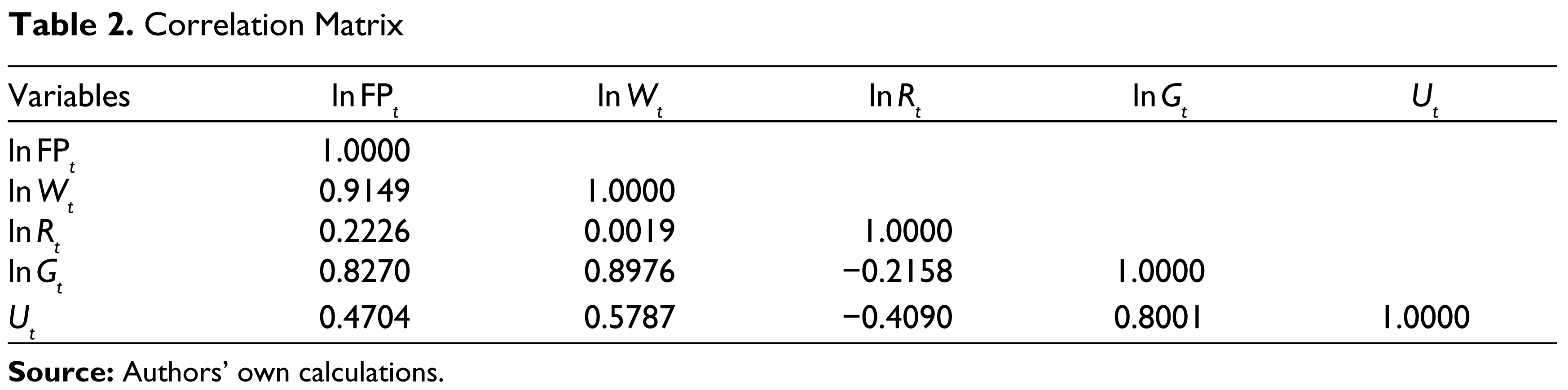
Tables 1 and 2 report the descriptive statistics and correlation matrix. Our empirical exercise indicates that the variables such as female wage, international remittances, globalization and unemployment rate have a normal distribution as shown by Jarque–Bera statistics, except for female labour supply. The correlation matrix reveals that a positive and a strong correlation exists between female labour supply and female wage. The correlation of international remittances and globalization with female labour supply is positive (the coefficient of correlation between globalization and female labour supply is also strong). Surprisingly, the unemployment rate and female labour supply are positively related. The association of remittances, globalization and unemployment rate with female wage is positive. There is a negative correlation between globalization and international remittances, and the same inference is drawn for unemployment rate and international remittances. A positive association is also found between unemployment rate and globalization.
Descriptive Statistics
Correlation Matrix
We have applied the battery of unit root tests to ensure that we are not going to disturb the fundamental assumption of the ARDL bounds testing approach to cointegration. The assumption of the ARDL bounds testing is that the variables should be integrated at or I(1) or I(0) or I(0)/I(1). Testing the unit root properties of the variables avoids the problem of biasness of empirical results. In doing so, we have applied all unit root tests step by step to observe the robustness of stationarity properties of the variables. These unit root tests are augmented Dickey–Fuller (ADF) test, Phillips–Perron (PP) test and Ng–Perron unit root test. The results are reported in Tables 3 and 4.
ADF and PP Unit Root Tests
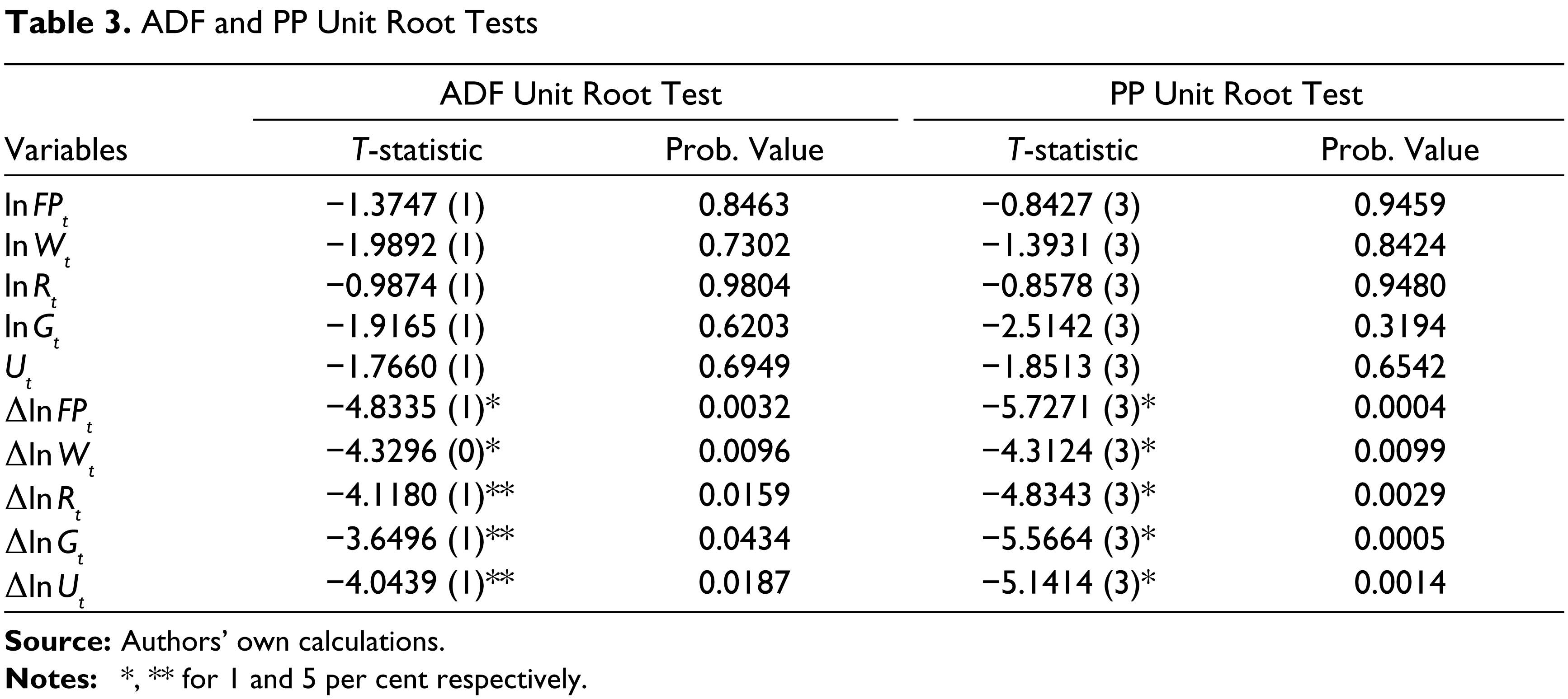
Table 3 deals with the findings of ADF and PP unit root tests, while the results of Ng–Perron unit root test are reported in Table 4. The results show that the variables are found to be non-stationary, at level with intercept and trend. Female labour supply, female wage, international remittances, globalization and unemployment rate are integrated at I(1). The same inference can be drawn about the variables provided by the results of Ng–Perron unit root test. The problem is that they are biased because such unit root tests do not have the information about structural break occurring in the series showing major events that have happened in the economy. This issue is solved by applying the Zivot–Andrews (ZA) (1992) unit root test. The ZA unit root test constrains information about one structural break stemming in the series. The results of ZA unit root test are reported in Table 5.
Ng–Perron Unit Root Test
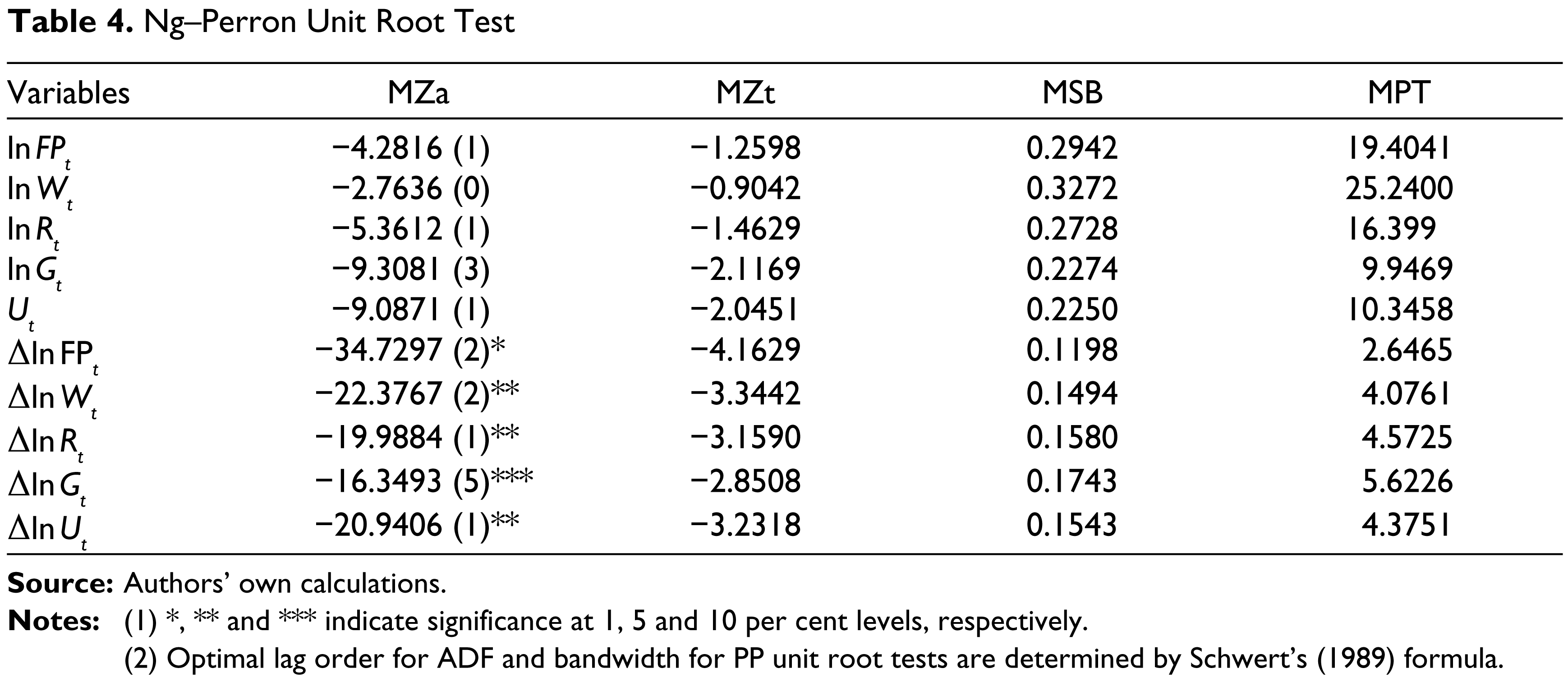
(2) Optimal lag order for ADF and bandwidth for PP unit root tests are determined by Schwert’s (1989) formula.
Our empirical exercise indicates that variables are non-stationary at level with intercept and trend in the presence of a structural break in the series which implies that variables seem to have a unique order of integration of the variables. It is our rationale to apply the ARDL bound testing approach to cointegration because there is no violation of fundamental assumption of the bounds testing. Table 6 provides the results of the appropriate lag order of the variables by using AIC. Although there are various other criteria, we follow AIC, which comparatively offers better and consistent results. The selection of lag length of the variables is a prerequisite to apply the ARDL bounds testing to compute F-statistic, which is very sensitive with lag length selection (Tiwari & Shahbaz, 2013). Our results indicate that lag 2 is appropriate for the computation of F-statistic to make a decision whether cointegration exists between the variables or not.
Zivot–Andrews Unit Root Test

(2): Critical T-values are −5.57 and −5.08 at 1 and 5 per cent levels, respectively.
(3) Lag order is shown in parentheses.
Lag Length Selection

(2) LR: Sequential modified likelihood ratio (LR) test statistic (each test at 5 per cent level).
(3) FPE: Final prediction error.
(4) AIC: Akaike information criterion.
(4) SIC: Schwarz information criterion.
(5) HQ: Hannan–Quinn information criterion.
The ARDL Cointegration Analysis

The results of the ARDL bounds testing approach to cointegration are reported in Table 7. We have used critical bounds generated by Narayan (2005) which are suited for a small data set. Our empirical exercise reveals that the computed F-statistic could not exceed LCB. The results show that there is no cointegration between the variables, which negates the existence of a long-run relationship between the variables. The diagnostic tests show that no serial correlation was found and the same inference is drawn about the ARCH. There exists a homoskedasticity and the model is well specified.
Results of Johansen Cointegration Test

It is reported by the unit root analysis that all the variables are integrated at 1st difference and this analysis lends us to apply the Johansen–Juselius (1990) multivariate cointegration approach. The results are reported in Table 8, which shows three (two) cointegrating vectors by trace test (maximum eigenvalue). It is indicated that a long-run relationship exists between the variables over the period 1980–2010 in the case of Pakistan.
The long-run results are detailed in Table 9. Our results indicate that female wage has a positive impact on female labour supply at 5 per cent significance level. Everything else is the same; a 1 per cent increase in female wage increases female labour supply by 0.1854 per cent. There is a positive relationship between foreign remittances and female labour force, which is statistically significant at 1 per cent level of significance. This shows that foreign remittances seem to increase female labour supply. It is found that a 0.1455 per cent increase in female labour supply is linked to foreign remittances by 1 per cent, everything else is same. Many researchers have studied remittances and have taken it as an additional non-labour income and hypothesized that the availability of remittances decreases the labour force participation among the recipient’s household members. Rodriguez and Tiongson (2001) and Funkhouser (1992) estimated data of Manila and Managua and concluded that remittances in fact contract the labour force participation. Gubert (2002) used the data from Mali and found that remittances help in the adoption of new technology at the agricultural household level. The author is of the view that remittances act as insurance, which reduce the work efforts. The effect of remittances on labour supply for both men and women is negative, which is in line with the traditional assumptions of leisure as a normal good (Emilsson, 2011). However, some authors ended up with other findings; for example, Funkhouser (1992) is of the view that remittances also increase self-employment along with contraction in the labour force participation, although both the effects are small. However, our results depict the positive affiliation between female economic activities and foreign remittances because Pakistan is in a debt trap along with the vicious circle of poverty. As poverty is persistent due to high inflation coupled with unemployment, females are compelled to remain involved and associated with the workforce. Our results are in conformity with the findings of Amuedo-Dorantes and Pozo (2005).
Long-run Results

(2) *, ** and *** show significance at 1, 5 and 10 per cent levels, respectively.
The results show that globalization supports female labour supply. The positive impact of globalization on female labour supply is dominant, and it is significant at 5 per cent level of significance. It is noted that a 1 per cent increase in globalization is 0.5339 per cent associated with female labour supply, keeping other factors constant. A negative and statistical significant impact of unemployment rate on female labour supply is found. This indicates that female labour supply depends on labour market conditions. Keeping all others same, a 1 per cent increase in unemployment will decrease female labour supply by 0.0246 per cent. According to the theoretical and empirical findings, the ‘added worker effect’ is derived from the increase in unemployment of the head of the family. The effect of 1 per cent unemployment among the primary worker, mostly the main head of the family, compels the other family members, who are basically secondary workers, to seek work. This is known as the ‘Added Worker Effect’. Maloney (1986) employed reported data on underemployment and found a significant added worker effect. Tano (1993) is of the opinion that the added worker effect and the discouragement effect coexist and are significant.
We have included the squared term of female wage, that is, ln Wt2, to investigate the monotonic impact of female wage on female labour supply. Our results show that both linear and non-linear terms are statistically significant at 5 per cent with negative and positive signs, respectively. The coefficients are −2.6889 and 0.1867; they show the existence of a U-shaped relationship between female wage and female labour supply, which implies that initially female labour supply increases with female wage and then declines when female wage reaches a certain threshold point. In the case of Pakistan, ₹ 1,538 is the turning point in the labour market, before which female labour supply decreases with female wage and after which female labour supply increases with female wage.
Finally, we have investigated the impact of private household consumption on female labour supply. The results are reported in Table 9; they show that private household consumption has positive (negligible) impacts on female labour supply, but its impact is statistically insignificant. The long-run model seems to pass all diagnostic tests. The diagnostic tests show that no serial correlation is found. The ARCH does not exist. Homoskedasticity exists and the model is well specified. This shows that the long-run model meets the assumptions of the classical linear regression model (CLRM).
Short-run Results
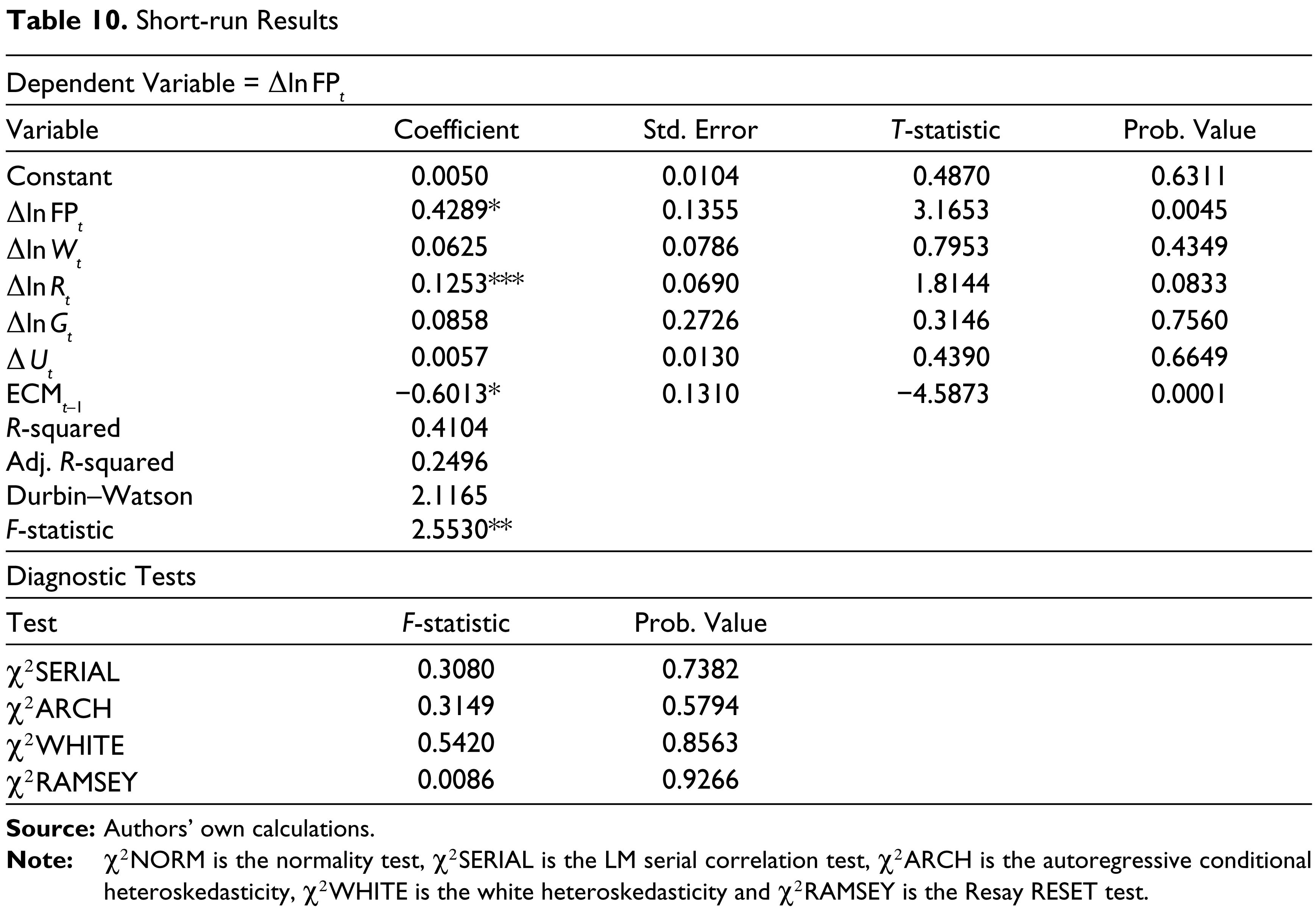
The short-run results are presented in Table 10. 4 The results indicate that future female labour supply is determined by female labour supply in the current period and it is statistically significant at 1 per cent. It is found that a 1 per cent female labour supply in the current period increases by 0.4289 per cent in the future period. The effect of female wage on female labour supply is positive and is statistically insignificant. This implies that females decide about their supply for labour after existing wage rate in labour market. There is a positive relationship between foreign remittances and female labour supply, and it is statistically significant at a 10 per cent level of significance. Globalization and unemployment affect female labour supply positively, but insignificantly. The statistical significance of the estimate of error correction term, that is, ECMt–1 indicates the speed of adjustment and further confirms our established long-run relationship between the series (Banerjee & Newman, 1993). The speed of adjustment shows how short-run changes converge towards a long-run stable equilibrium path. Our results indicate that the significance of the estimate of ECMt–1 is −0.6013, which is highly significant at 1 per cent level. This corroborates our long-run relationship between female labour supply and its determinants, and it validates the view by Bannerjee, Dolado and Mestre (1998). Our empirical evidence reveals that 60.13 per cent deviations are corrected from short run to long span of time. The coefficient of ECMt–1 is −0.6013, showing a high speed of adjustment towards a long-run stable equilibrium path. This indicates that following the female labour supply model, Pakistan would take 1 year and 8 months to reach a long-run stable equilibrium path.
The short-run model also passes diagnostic tests following CLRM assumptions. The results show that the variables are not serially correlated with the residual term. Autoregressive conditional heteroskedasticity does not exist. White heteroskedasticity is not found in the short-run model. The short-run model is well specified. The stability of long-run and short-run estimates has been tested by applying the CUSUM and the CUSUMsq. Pesaran and Shin (1999) suggested the application of these tests. The null hypothesis of both CUSUM and CUSUMsq may be accepted if plots of both the tests are moving between critical limits. The null hypothesis is ‘regressions equation is correctly specified’ (Bahmani-Oskooee & Nasir, 2004).
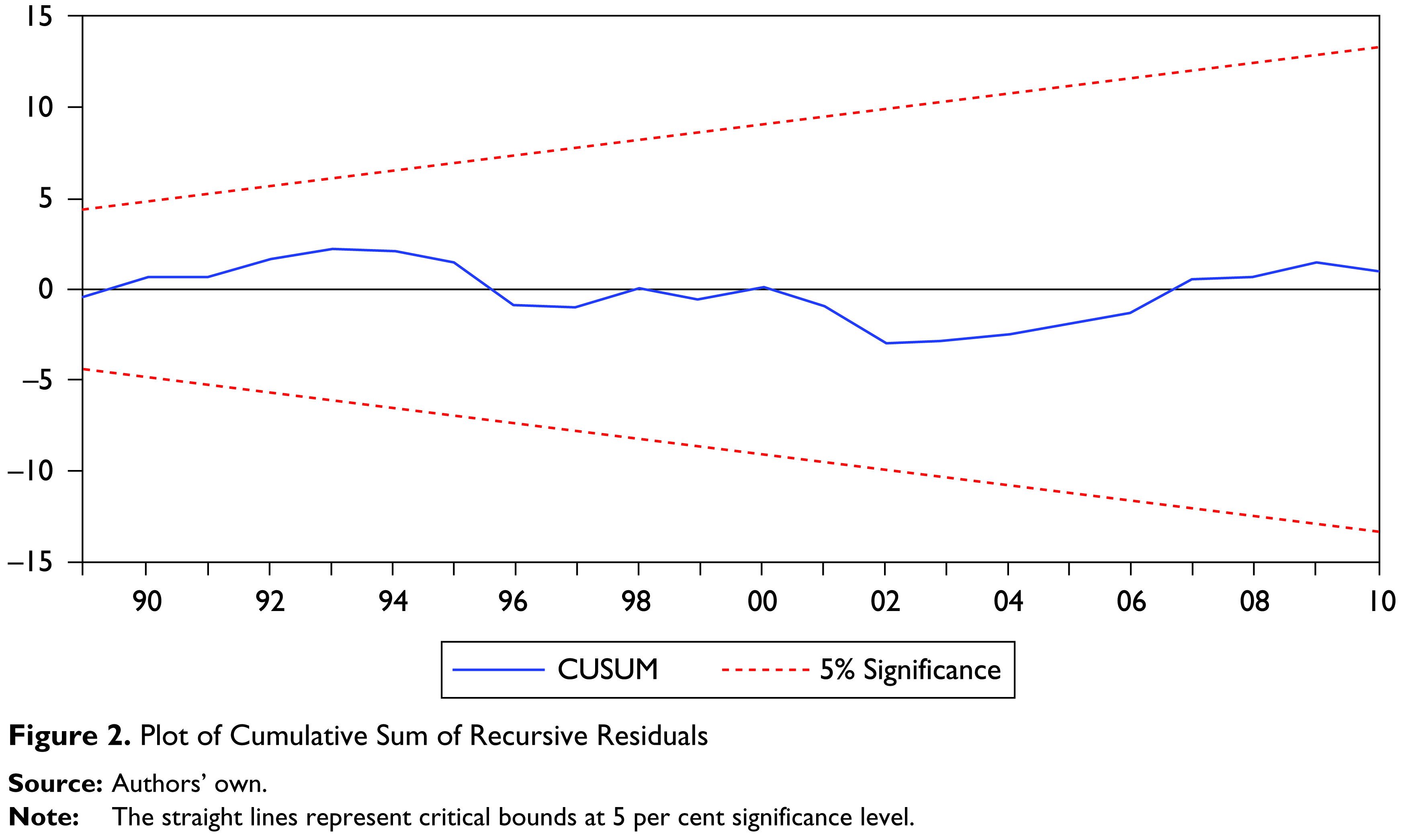
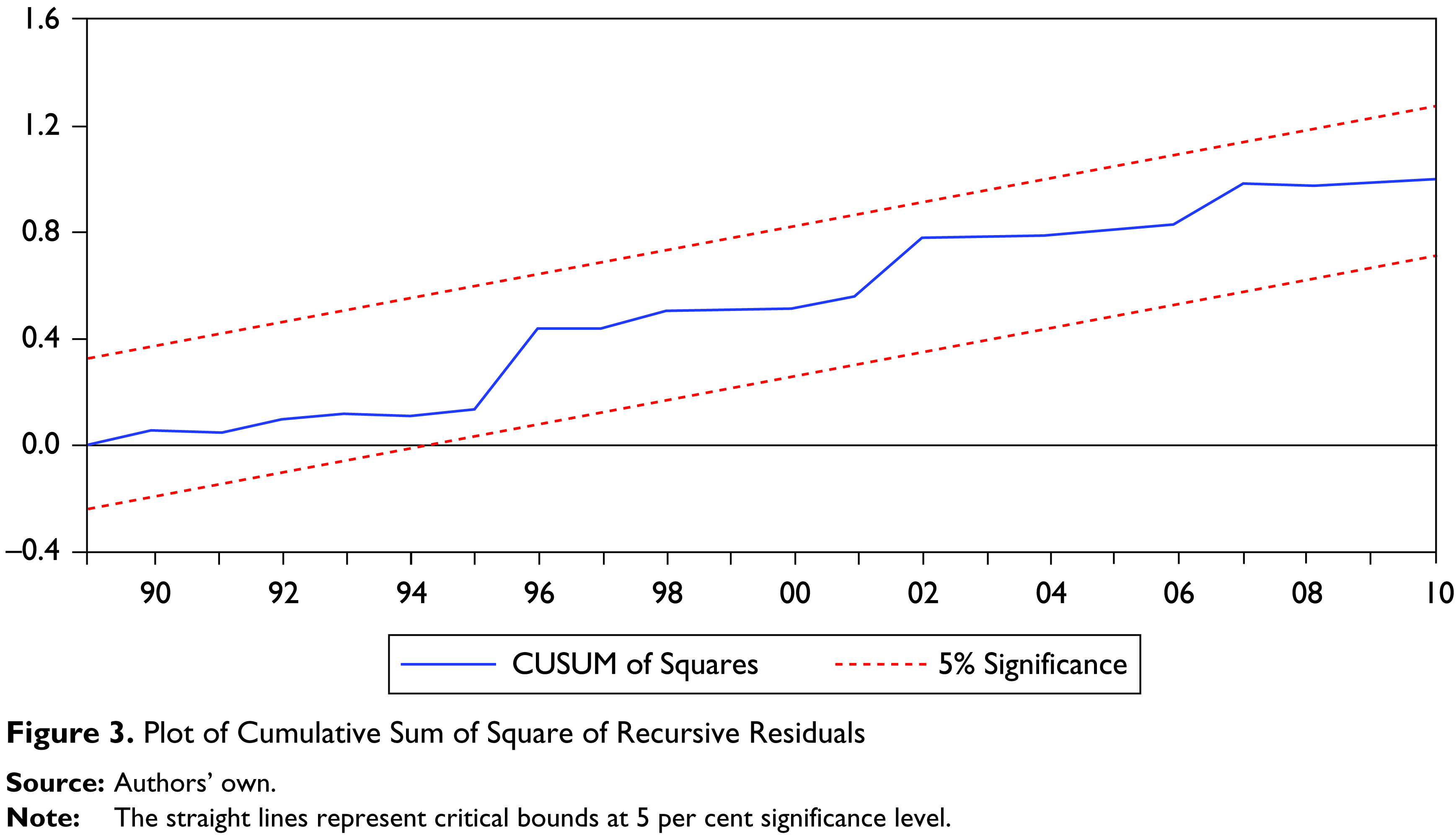
The CUSUM and CUSUMsq tests show that graphs of both tests do not cross the lower and upper critical limits. Hence, we can conclude that long-run and short-run estimates are reliable and efficient.
The VECM Granger Causality Analysis
Granger (1969) pointed out that the VECM Granger causality should be applied to investigate the causal relationship between the variables, if the variables are cointegrated for a long-run relationship and the order of integration of the series is I(1). The exact detection of causal relationship between the variables would help us know about the factor which is causing female labour supply change. Our analysis validated the cointegration between female wage, foreign remittances, globalization, unemployment rate and female labour supply, which further leads us to apply the VECM Granger causality to test the existence of a causal relationship between the said variables. The results of the VECM Granger causality are reported in Table 11. The convergence is high in female labour supply (−0.7418) equation, compared with foreign remittances (−0.5727) equation and unemployment rate (−0.1006) equation, respectively.
The results show that in the long run, the feedback effect is found between female labour supply and foreign remittances. A bidirectional causality exists between foreign remittances and unemployment rate. Female labour supply and unemployment rate Granger cause each other. Globalization Granger causes female labour supply.
In the short run, a bidirectional causal relationship is found between female labour supply and foreign remittances. The unidirectional causality runs from female wage to female labour supply and unemployment rate.
Conclusion and Policy Implications
This study differs with the other studies as it has analyzed the impact of female wages, foreign remittances, globalization and unemployment on female labour supply, which are important indicators of the labour market and help in the economic development of Pakistan. The study covers the period from 1980 to 2010. There is virtually no macroeconomic study that has been conducted so far in Pakistan that has employed the ARDL bounds testing approach to cointegration along with the VECM Granger causality in the context of the impact of female wages, foreign remittances, globalization and unemployment on female labour supply.
This article has investigated the impact of female wage, foreign remittances, globalization and unemployment on female labour participation in the case of Pakistan. In doing so, traditional unit root tests, such as ADF, PP and Ng–Perron, and structural break unit root tests, such as ZA, are applied to test the unit root properties of the variables. The long-run relationship between female wage, foreign remittances, globalization and unemployment rate and female labour participation is examined by employing the ARDL bounds testing approach to cointegration. Our empirical evidence shows that cointegration exists between female wage, foreign remittances, globalization, unemployment and female labour supply in the case of Pakistan. Results show that female wage encourages female labour supply. Female labour supply is also promoted by globalization. Unemployment is negatively linked to female labour supply. The causality analysis unveils that the feedback hypothesis is found between female labour supply and foreign remittances, and the same inference is drawn for female labour supply and unemployment, and foreign remittances and unemployment. Globalization and female wage Granger cause female labour supply.
The VECM Granger Causality Analysis
On the basis of this study, some recommendations and policy options have been framed, which would be equally useful for policy formulators and development planners. The informal sector needs to be formalized so that the conditions of women in this sector can improve. To increase the employment opportunities of women, especially in food chain activities such as processing, preservation and preparation, the government should build medium-sized processing plants that will create area employment in rural settings on the one hand and produce value-added products on the other, which is the demand of the hour. In the era of globalization, the informal sector needs restructuring by promoting female entrepreneurship in female-related professions, such as embroidery and stitching, which supports ‘feminization of employment’. The government should revive the exports of the country in the fields of garments, leather, jewellery, sports etc. where the role and association of females is dominant. Devising policies that encourage the job prospects of women will help in reducing unemployment in the economy. In a nutshell, an improvement in unemployment rates in the labour market will draw discouraged workers into the labour force. Therefore, measures to decrease unemployment rates, and improve labour market conditions will contribute to increasing FLFP, which will ultimately facilitate the economic development of Pakistan. For future research, we augment this article by investigating the impact of foreign direct investment and financial development on FLFP using Pakistani and Indian time series data, following Shahbaz and Rahman (2012). The factors contributing to human resource occupation may also be a good topic for research in the case of Pakistan (Mathew, 2012).