



Abstract
The purpose of this article, which exploits data gathered by Global Entrepreneurship Monitor (GEM, 2009), is to establish a typology of countries based on the intentions and the level of entrepreneurial activities while focusing on the position of Morocco. We then test the form of the relationship that links the level of development of the countries to the level of intentions and entrepreneurial activity by relying on the techniques of multidimensional analysis and ordinary least squares (OLS).
Results show that unlike popular belief, high-income countries are weakly involved in entrepreneurial activities. They also show that Moroccans have very favourable perceptions and intentions of entrepreneurship. However, the level of entrepreneurial activity at an early stage remains lower than the one recorded in other countries such as Yemen and Uganda. Thus in Morocco, policymakers should seize the opportunity linked to the very high status of the entrepreneur to encourage enterprise creation, and therefore wealth creation.
Introduction
Economists have long regarded the entrepreneur as a central element of economic development. According to Schumpeter (1911) and Jovanovic (2001), more entrepreneurs would generate extra economic activity. Paradoxically, many researchers estimate that entrepreneurship is the missing link in the theory of economic growth (Audretsch, 2005; Schmitz, 1989).
From a historical point of view, the definition of entrepreneurship goes back to the eighteenth century in the work of R. Cantillon. According to him, the ‘undertakers’ 1 are considered as economic agents who make decisions by integrating uncertainty. Schumpeter (1911, 1934) considers the entrepreneur as a genuine driving force of change and economic development. He distinguishes several aspects of the spirit of enterprise: a new method of production, the conquest of a new market, a new source of supply of intermediate goods and a new organization. Schumpeter asserts ‘whatever the type, everyone is an entrepreneur only when he actually carriers out new combination and loses that character as soon as he has built up his, business, when he settles down to running it as other people run their business’ (Schumpeter, 1934, p. 78). For him, when an entrepreneur ceases to innovate, he ceases to be an entrepreneur and hence does not need to participate in the daily management of the company. He has also introduced the notion of creative destruction, arguing that it represents the main source of economic growth. For Knight (1921), entrepreneurship is related to uncertainty: the risk can be calculated and uncertainty cannot be. Kirzner (1973) highlights the potential role of an entrepreneur in a competitive market. 2 Baumol (1990) makes a distinction between different forms of the spirit of enterprise. He stressed that entrepreneurs are people who are ingenious and creative, combining the means of production, wealth, power and prestige. Aghion and Howitt (1998) 3 point out that the concept of Schumpeterian creative destruction is a competitive process in which entrepreneurs are always looking for new ideas that will render those of their competitors obsolete. Parker (2004) recognizes that definitions of entrepreneurship overlap and are sometimes contradictory. 4 Carree and Thurik (2002) emphasize that the concepts of entrepreneurs, self-employed individuals and businessmen are different. They offer three typologies of entrepreneurs: the Schumpeterian types of entrepreneurs, intrapreneurs (corporate entrepreneurship) and the owners-managers of a company. Audretsch and Thurik (1999) have distinguished 13 definitions while Glancey and McQuaid (2000) have proposed 5. Beyond these aspects, these definitions highlight the multidimensional nature of the concept. 5
From an economic perspective, entrepreneurship is considered a key factor in improving the competitiveness among countries, promoting economic growth and increasing employment opportunities. Audretsch (2005) identifies three stages in the evolution of the economy after the war: capital economy (Solow, 1956), knowledge economy (Lucas, 1988; Romer, 1986, 1989) and the economy of entrepreneurship, which boomed in the 1990s (Acs & Audretsch, 2005; Caves, 1998).
The emergence of the economy of entrepreneurship as an engine of job creation, competitiveness and economic growth is currently undeniable, both in developed countries and in developing countries. In this context, Devi and Thangamuthu (2006) discussed the emerging paradigm shift in the concept of entrepreneurship in consonance with the different challenges/opportunities of globalization and liberalization.
In 2011 in Morocco, the number of newly established enterprises having legal personality has exceeded 28,609 new registrations in the trade register, that is, an increase of 7 per cent compared with 2010. In 2011, 55,322 intentions of creating companies were recorded at the national level, that is, an increase of 2 per cent compared with 2010. 6 These elements reveal the importance of entrepreneurship at the level of economic and social development. Despite this reality, because it lacks appropriate data, the number of studies focusing on entrepreneurial activity in Morocco is very limited, and work in existing analysis frameworks focus on a particular sector of activity. This does not allow generalization of the results of these studies to other economic sectors or to the Moroccan economy as a whole. In 2009, Global Entrepreneurship Monitor (GEM) has expanded the sample of countries concerned according to the measure of entrepreneurship, from 10 countries in 1999 to 55 in 2009. Taking advantage of the fact that the newly adopted country is Morocco, this article is devoted to the analysis of various aspects of entrepreneurship in Morocco by placing it in a regional and international perspective. The rest of the article is structured as follows: the second section describes the status of entrepreneurship in Morocco and the third section presents the methodology used to rank countries by level of involvement in entrepreneurial activities. Finally, the fourth section discusses the results and the fifth section concludes the article.
Entrepreneurial Attitudes Activity in Morocco: Evidence from GEM
To analyze the entrepreneurial situation in Morocco, we relied on the results of the 2009 survey. Face-to-face interviews were conducted with 1,500 adults, selected from a nationally representative sample of the population using the Brownian motion method. The survey focused on several topics, but we limit ourselves to the analysis of representations and entrepreneurial intentions, level of entrepreneurial activity (according to socio-demographic characteristics) and sources of training and consultancy to business creation.
Entrepreneurial Representations and Attitudes
Representations and attitudes of individuals towards entrepreneurship largely explain the orientation towards entrepreneurial activities. The data in Table 1 clearly show that Moroccans possess favourable perceptions and attitudes to entrepreneurship. Indeed, the vast majority of those interviewed in Morocco estimate that entrepreneurship constitutes a good career choice (83.3 per cent). Based on this issue, Morocco is ranked fifth in descending order with respect to all the countries of the Middle East and North Africa (MENA 7 ) region that participated in the survey in 2009. A much larger proportion (87.2 per cent) of Moroccans believe that entrepreneurs who succeed have a status and a high level of consideration in the country. The same source reveals that more than one Moroccan out of two (51.5 per cent) sees good opportunities for starting an enterprise in the next 6 months and nearly three out of four (74.6 per cent) believe that they possess the knowledge, competencies and experience required to start a new business. This proportion places Morocco in second place among the countries of the MENA region, behind Lebanon. The data in Table 1 also show that a quarter of Moroccan respondents (25.4 per cent) believe that the fear of failure is an impediment to the creation of an enterprise (the second lowest level).
The Level of Entrepreneurial Activity
In Morocco, about one person out of three in the population aged 18–64 years are involved in entrepreneurial activity. Disaggregated data show that 16.3 per cent have a business activity at an early stage (TEA), nascent entrepreneurs represent 6.9 per cent against 9.4 per cent of the owners of a young company and 15.3 per cent of owners of companies that have existed for more than 42 months (see Figure 1).
Entrepreneurial Perceptions and Attitudes of Moroccans


The data in Table 2, which show the level of entrepreneurial activity in some countries in the region of MENA, show that Saudi Arabia holds the lowest rate of TEA (4.7 per cent). On their side, Morocco and Algeria hold the highest TEA rates of 16.3 per cent and 16.9 per cent, respectively. Regarding the rate of established business ownership, Moroccans and Lebanese come first with a rate of 15.3 per cent and 16 per cent, respectively. The density of nascent entrepreneurs (6.9 per cent) is the third highest, after Yemen and Algeria. One can conclude that Moroccans are less involved in entrepreneurial activities at an early stage compared with other countries in the MENA region with which it shares the same cultural and institutional characteristics such as Algeria and Yemen.
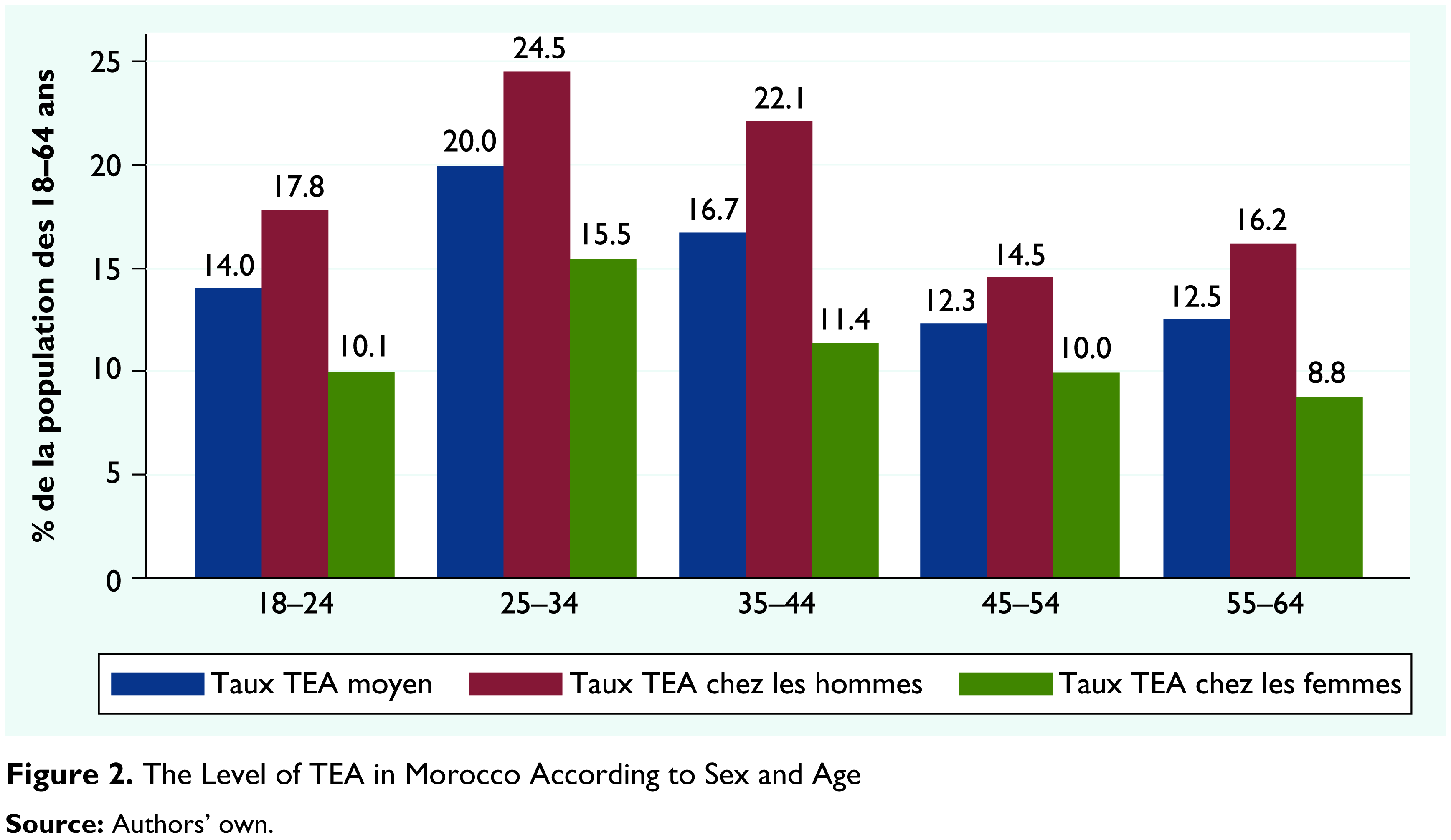
Figure data show that men are more involved in entrepreneurial activities than women (TEA rate for men representing 1.7 times of that of women). The highest age rate of TEA was observed in the 25–34 age group (20 per cent), followed by the age bracket of 35–44 years (16.7 per cent). It is clear from this analysis that the level of participation in entrepreneurial activity tends to increase among the young population and to lower among the elderly population. 8 For all age groups, the rate of TEA of men is higher than that of women. This finding prevails in all countries of the MENA region, with the exception of Yemen, where the women TEA rate is higher than that of men in the age group of 35–44 years.
The Level of Entrepreneurial Activity in Certain Countries of the Region

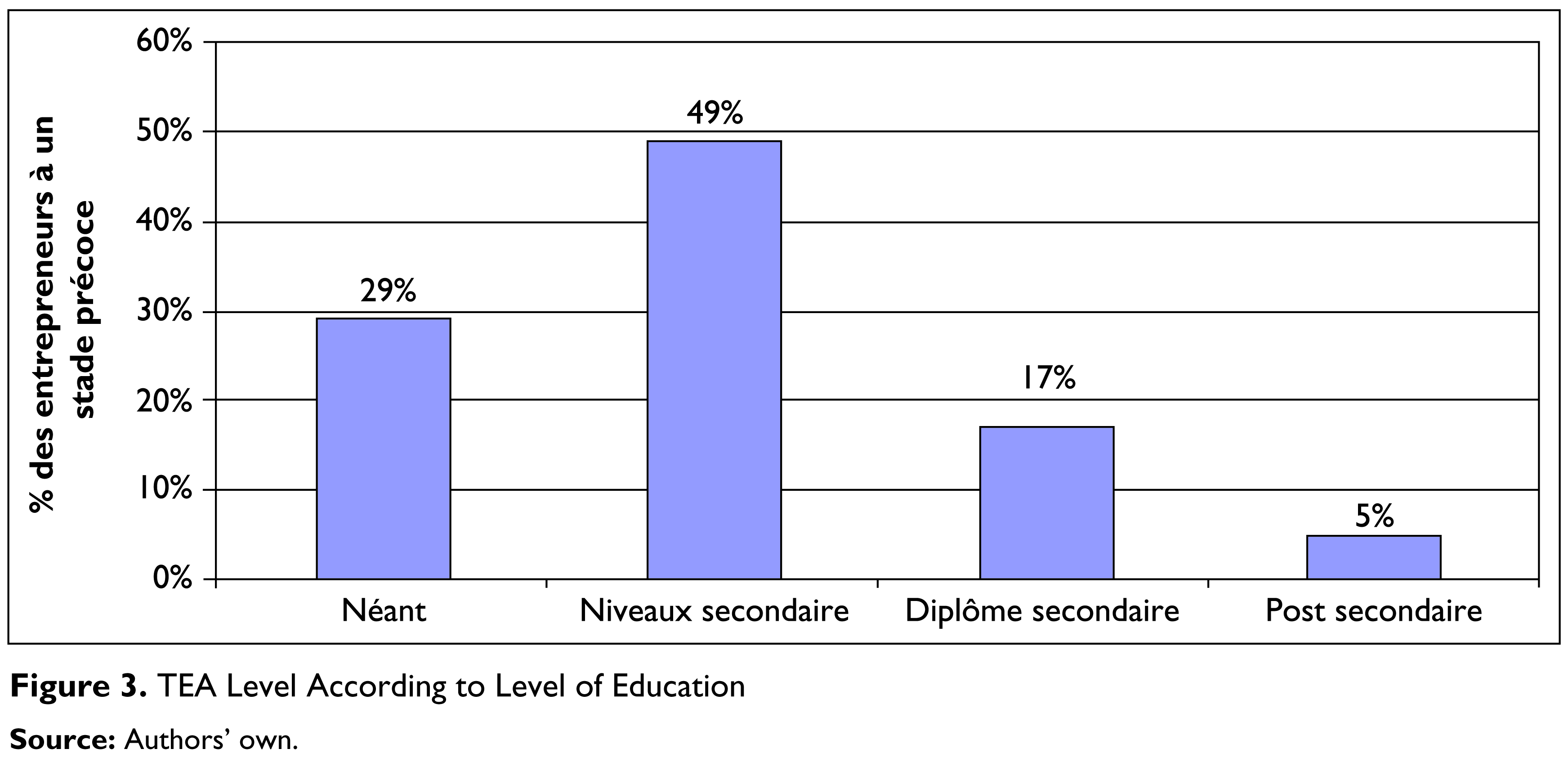
In Morocco, the rate of TEA does not follow the general trend—that the level of participation in entrepreneurial activity increases with the level of education. Indeed, about half (49 per cent) of the adult population involved in entrepreneurial activity at an early stage has a secondary level of education, against 17 per cent and 5 per cent for those with a high school and post-secondary diploma. Overall, 78 per cent of adults involved in entrepreneurial activity at an early stage did not complete secondary education. This result, which differs from the general trend of other countries in the MENA region, testifies to the low productivity of externalities of education (see Figure 3).
Sources of Advice in the Creation
Advice plays an important role in the process of creating and managing a young company. The sources of these tips are diverse and vary from one person to another. Heads of enterprises in the starting stage often use their private environment, their sphere of contact with experience, the professional milieu and the sphere of experts.
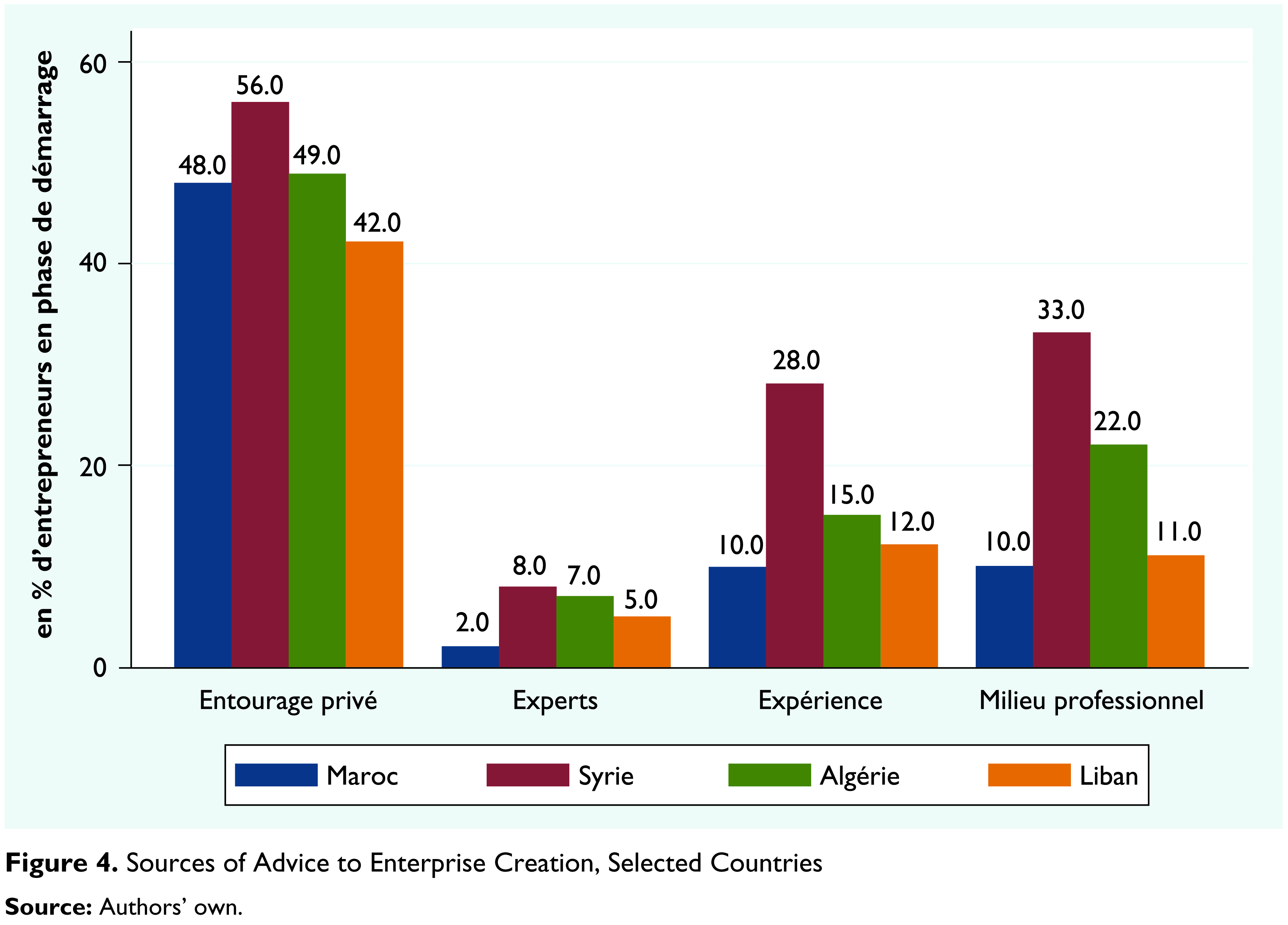
In Morocco, the source of advice generally preferred by entrepreneurs in the starting phase is private environment (parents, spouses, friends etc.), with a rate of 48 per cent. This source is also widely used in other countries in the MENA region, for example, 56 per cent in Syria, 49 per cent in Algeria and 42 per cent in Lebanon.
However, a very small proportion (2 per cent) of young Moroccan entrepreneurs use the advice of experts—accountants, lawyers, financial institutions and specialized organizations. This is one of the lowest levels in the MENA region. They are a little more frequently solicited in Algeria (8 per cent) and Syria (7 per cent). Syrian entrepreneurs at an early stage make frequent use of professional knowledge and the sphere of contacts with experience (Figure 4). These data clearly illustrate that young entrepreneurs in the development stage make intensive use of their social networks and neglect the sphere of experts. This observation can be explained by the weakness of human capital externalities (lack of information, distrust of institutions in place, lack of competence, etc.) and/or the fact that such services do not exist or are not very well developed.
Training in Enterprise Creation
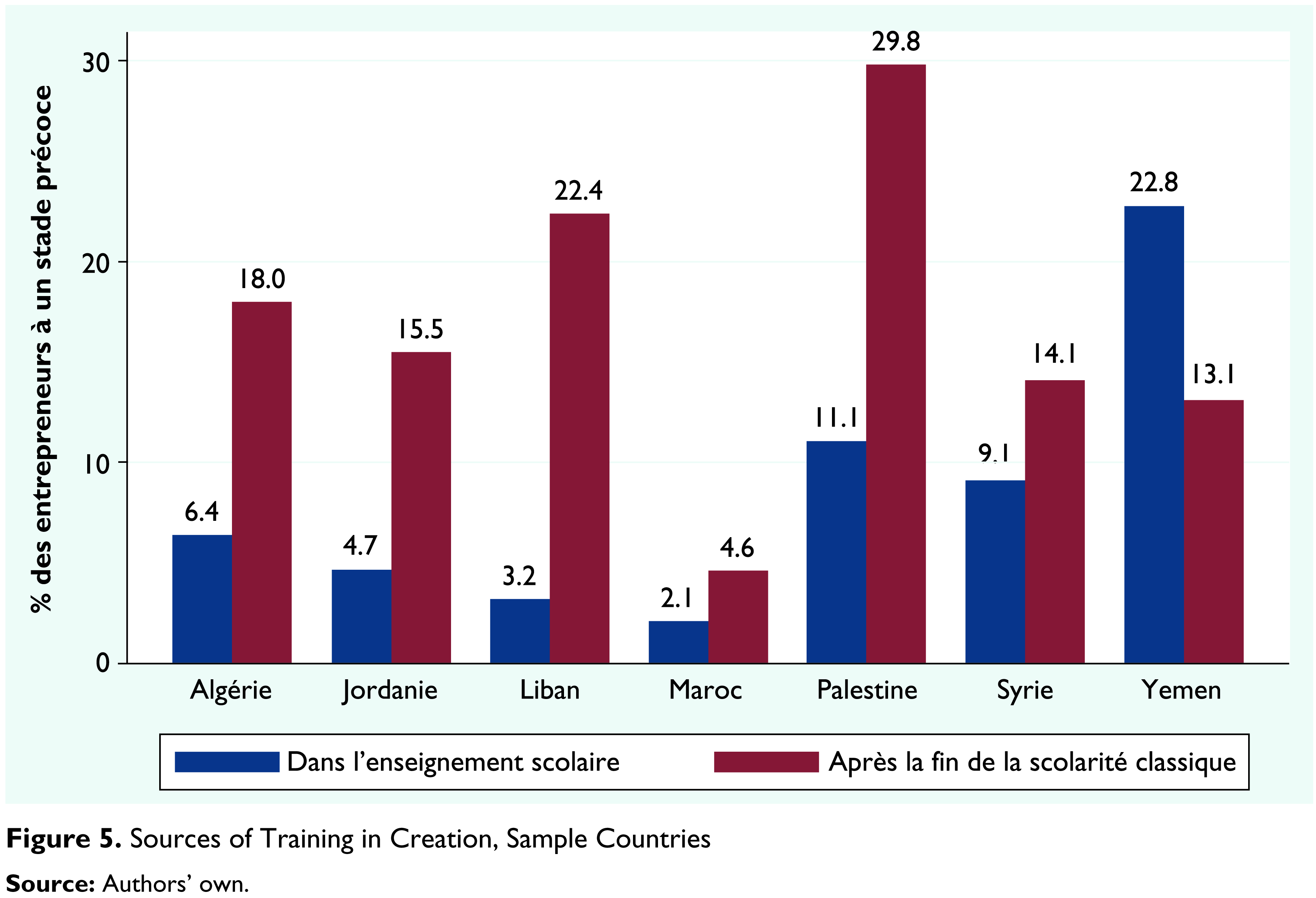
Entrepreneurship training during the start-up phase has a positive effect on entrepreneurial performance. In fact, it strengthens the ability to solve problems related to the creation of the company and also improves the viability of the business in the start-up phase. In Morocco, 2.1 per cent of young entrepreneurs reported receiving training in starting a business during their primary and secondary education, and 4.6 per cent reported receiving training during post-secondary education (Figure 5). This result highlights the hypothesis that training for the creation has a generally higher level of impact after secondary study. By comparison, it is in Yemen, where the rate concerning the training for the creation, in primary education and secondary, is the highest (22.8%). In Palestine, the percentage of young entrepreneurs who received training after mainstream schooling is 29.8 per cent. It is clear from these statistics that the training to establishment, either during mainstream schooling or after, remains marginal in Morocco.
Data and Methodology
Description of Variables
The indicators provided by GEM, widely used in the literature as a measure of entrepreneurship, is a valuable source of data. In this section, we will use the data obtained from the GEM 2009 survey to study the characteristics of participating countries according to two types of variables related to entrepreneurship.
We have used a new approach based on multivariate analysis. In this study, we use two types of variables: variables that measure the perception and entrepreneurial intentions as well as variables measuring the level of entrepreneurial activities.
Variables Measuring Entrepreneurial Perceptions and Intentions
With regard to this group of variables, we have used the following five indicators:
The fear of failure rate (Frfailop): Proportion of the population aged 18–64 years old who think that fear of failure would prevent them from starting a business. Entrepreneurial intentions (Futsupno): The percentage of population aged 18–64 (those involved in any stage of entrepreneurial activity are excluded) who have the intention to start a business in the next 3 years. Entrepreneurship as a desirable career choice (Nbgoodyy): The percentage of population aged 18–64 who believe that most people in the country consider entrepreneurship as a good career choice. That successful entrepreneurship receives a high status (Nbstatyy): The percentage of population aged between 18 and 64 believe that successful entrepreneurs receive a high status in the country. Perceived opportunities; the term is fuzzy (Opportyy): The percentage of population aged 18–64 who see good opportunities of starting a business in the area where they live.
Variables Measuring the Level of Entrepreneurial Activity
For the second group of variables, our choice was made of six other indicators:
Ownership rate of a new company (Babybuyy): The percentage of population aged 18–64 who are currently managers of their own new company for more than 3 months, but not more than 42 months. Nascent entrepreneurship rate (Suboanyy): Percentage of nascent entrepreneurs in the population aged 18–64. Entrepreneurial activity rate at an earlier stage (Teayy): Percentage of nascent entrepreneurs or owner-manager of a new business within the population, aged 18–64. Ownership rate of established companies (Estbbuyy): The percentage of population aged 18–64 who are currently the owner-manager of an established company of more than 42 months. Entrepreneurial activity rate motivated by opportunity (Teayyido): Percentage of respondents who are involved in entrepreneurial activities because they anticipate good opportunities. Rate of entrepreneurial activities driven by need (Teanec_p): Percentage of those involved in entrepreneurial activities because they had no other option for work.
The Principle of Multivariate Analysis
To provide an initial typology of countries based on selected variables, we have made a classification of countries according to the degree of similarity and dissimilarity using the techniques of multivariate analysis (in this article we have relied on hierarchical cluster). These are a set of techniques to address in block the data tables where each observation (i.e., each country in this case) is defined by several variables (variables related to entrepreneurship in this case). The obtained data table is usually in the form of a rectangular matrix. The techniques of multivariate analysis allow us to (i) measure similarities among the observations or variables within a data table; (ii) classify the observations or the variables into groups according to their similarities; (iii) order the observations and/or variables in a reduced space so as to highlight their main structures; (iv) model the relationship between the data to be analyzed and the explanatory variables as well as (v) testing these relationships.
Estimation of the Validity of the U-shaped Curve between the Level of Entrepreneurial Activity and That of Economic Development
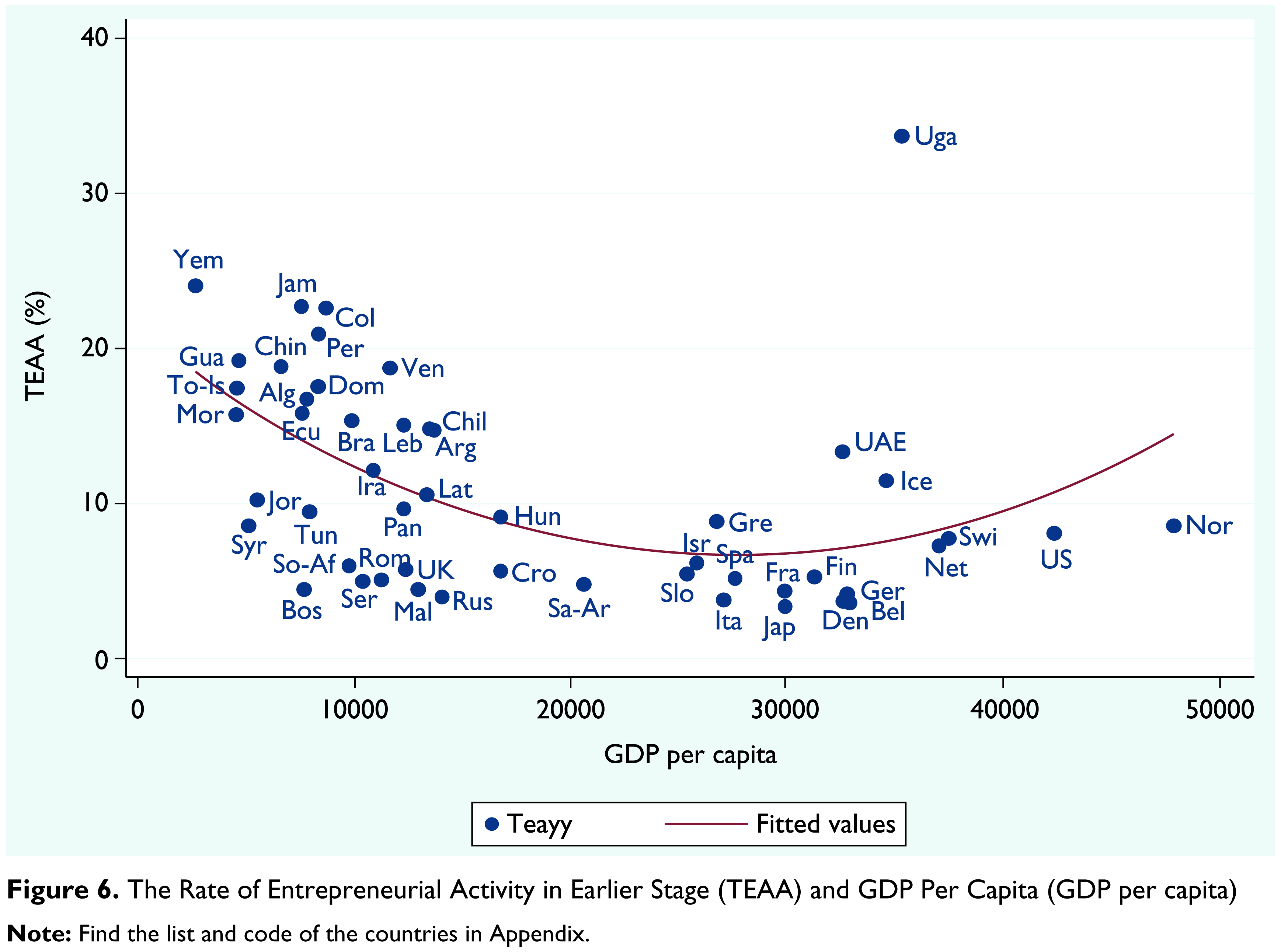
To test the validity of the obtained groups, we have empirically tested the relationship between the level of entrepreneurship and the level of economic development. Results of the graphical estimation are shown in Figure 6 (using both the rate of entrepreneurial activity at earlier stages and the rate of business ownership established as a measure of entrepreneurship, respectively). The relationship between entrepreneurship and economic development level can be expressed as follows:

Along with Ei as a measure adopted for entrepreneurship, Y is GPD per capita and ε is an error term. The estimation of the equation by ordinary least squares (OLS) provides significant coefficients to GPD and its square. 9
Results
The results of multivariate analysis allowed us to distinguish between eight heterogeneous groups. Group 1 is composed of 32 countries: Argentina, Belgium, Bosnia and Herzegovina, China, Croatia, Finland, France, Germany, Greece, Hong Kong, Hungary, Iceland, Iran, Israel, Italy, Korea (South), Latvia, Netherlands, Norway, Panama, Romania, Russia, Serbia, Slovenia, South Africa, Spain, Switzerland, United Arab Emirates, United Kingdom, United States of America, Uruguay. Group 2 consists of 14 countries: Brazil, Chile, Colombia, Dominican Republic, Ecuador, Guatemala, Jamaica, Jordan, Lebanon, Morocco, Palestine, Peru, Syria and Venezuela. Group 3 is composed of Japan. Group 4 includes Malaysia and the Tonga Islands. Group 5 is composed of Saudi Arabia. Group 6 is composed of Tunisia. Group 7 contains Uganda. Finally, Group 8 consists of Yemen.
It is obviously clear from these results that Morocco is closer to some of the countries of the MENA region, such as Lebanon, Palestine, Jordan and Syria. Algeria, Iran and the United Arab Emirates belong to Group 1, which brings the Organisation for Economic Co-operation and Development (OECD) countries together. On the contrary, countries, such as Tunisia, Saudi Arabia and Yemen are not close to any country. Indeed, each constitutes a separate group. Therefore, the MENA region countries constitute a very heterogeneous group regarding the issue of entrepreneurship.
Before analyzing the results according to the variables measuring entrepreneurial activity, we present the main features of the groups of countries, which have been identified according to perception and entrepreneurial intentions.
Variables Measuring Perceptions and Entrepreneurial Intentions
In the following list, we discuss the results of each variable measuring perception and entrepreneurial intentions:
The fear of failure rate: Results have shown that Morocco belongs to a group which has been recording a growth rate of 30.33 per cent. This rate is the lowest average of all groups (34.91 per cent). This finding is also observed in Group 1, to which Algeria belongs. On the other hand, 65 per cent of respondents in Yemen and Tunisia believe that the fear of failure can be a hindrance to the start of a business. The lowest value is recognized in Saudi Arabia (26 per cent). Entrepreneurial intentions: On the basis of this variable, the highest rate of intention to start a new business during the next3 years is observed in Uganda (58.4 per cent). This rate is slightly higher than that of Saudi Arabia. The lowest rate is marked in Tunisia (5.7 per cent). Group 2 performs an average of 26.99 per cent, which is far higher than the average of all groups (18.32 per cent). Entrepreneurship as a desirable career: With respect to this variable, 95 per cent of respondents in Yemen consider business ownership as a good choice, even if only 9 per cent of them revealed their intentions to start a business in the next few years. The lowest rate was observed in Japan (57 per cent). The countries of Group 2 have an average rate of 80.87 per cent, which surpasses the average rate of all groups (68.94 per cent) by a great margin. By contrast, the respondents in Group 1, essentially consisting the OECD countries, do not widely view entrepreneurship as a good career choice. From this analysis, it becomes clear that higher the income per capita is, the lesser is entrepreneurship considered a good career choice. Successful entrepreneurship receives a high status: Entrepreneur status has more prestige in Yemen and Saudi Arabia. At the same time, 97 and 91.50 per cent are respectively the rate of respondents surveyed in both countries. They believe that higher status is regarded to entrepreneurs. The percentage observed in the countries of Group 2, in which Morocco is included, is 76.73 per cent. This rate is higher than the average of all groups. Tunisians, on the other hand, put the least value on successful entrepreneurship, as only 52 per cent consider it. The observed rate in Group 1 is almost equal to the average rate of all groups. Perceived opportunities: Although the Yemeni have favourable perceptions of entrepreneurship, only 14 per cent reported perceiving good opportunities for starting a business in the area where they live. This rate is 47.67 per cent in Group 2, which includes Morocco—a much higher rate than the one observed in all groups (36.26 per cent). It is 56 per cent in Tunisia and only 34.5 per cent in Saudi Arabia. Paradoxically, the Japanese are less likely to glimpse good opportunities for starting a business.
Variables Measuring the Level of Entrepreneurial Activity
In this section, we present the results of each variable related to the level of entrepreneurial activity:
Nascent entrepreneurship rate: The average rate of nascent entrepreneurship for all the groups is 5.95 per cent. However, this achievement conceals disparities among the eight groups. The highest value of 22.8 per cent is observed in Group 8 (Yemen), followed by Uganda (12.40 per cent). Group 2 to which Morocco belongs has recorded 9.09 per cent. The lowest rate of a population starting up a new company is observed in Saudi Arabia (2.8 per cent). The Characteristics of Groups According to the Variables Measuring Entrepreneurial Perceptions and Intentions

Rate of new company ownership: With regard to the part of the population who started a new business which is less than 42 months, Uganda ranks first with a rate of 22.7 per cent. The average rate of Group 2 (8.11 per cent) is significantly higher than the overall average (5.14 per cent) but lower than the one observed in Group 6 (Tunisia). It is highly interesting to note that Group 1 (largely consisting of OECD countries) and Group 3 (Japan) have a low proportion of the population who own a young company.
Rate of entrepreneurial activity at earlier stages: Reiterating that this variable measures the rate of entrepreneurship at an early stage, that is to say, nascent entrepreneurship (Babyuyy). This variable is widely used in the economic analysis of entrepreneurship. Results have shown that one-third of Ugandans are involved in entrepreneurial activities in an earlier stage, whereas in Yemen it is a quarter of the population, 17.4 per cent in Tunisia, 16.7 per cent in Group 2, which includes Morocco and some countries of the MENA region. Other countries, including high-income countries, are poorly involved in this type of activity.
Rate of established business ownership: The highest rate of entrepreneurship established 42 months ago (21.9 per cent) is found in Uganda. This can be explained by the very favourable entrepreneurial perceptions. Group 2, to which Morocco belongs, has an average rate of 11.17 per cent. A higher than average rate is recorded across all the groups. So as expected, the high income countries are weakly involved in entrepreneurial activity that is established more than 42 months. The same observation is found in Tunisia and Yemen, which record the lowest rates of 2.9 and 2.3per cent, respectively.
Rate of entrepreneurial activity motivated by opportunity versus necessity: The choice to be engaged in an entrepreneurial activity is dictated by two types of motivation: motivation related to lack of work (necessity) and motivation linked to the existence of good opportunities in the market. Indeed, involvement in entrepreneurial activity for opportunity reasons is widely observed in Group 1, Group 4 (Malaysia and Tonga Island) and Group 5 (Saudi Arabia). By contrast, involvement in entrepreneurial activity for reasons of ‘necessity’ is largely recognized in Uganda and Yemen. For other groups, it is difficult to determine what the main motivation is, in the sense that the line of distinction between the two motivations is not clear.
It is clear from this analysis that perceptions about entrepreneurship vary widely among the countries of this sample. These perceptions affect intentions and the level of entrepreneurial activity. Some countries have very positive perceptions, but its entrepreneurial activity in an earlier stage is low. This is the case of Group 2, which includes Morocco. Other countries (high-income ones) have less favourable perceptions of entrepreneurship, and their level of entrepreneurial activity in an earlier stage is low.
The Characteristics of Groups According to Variables Measuring the Level of Entrepreneurial Activity

The following paradox also arises from this analysis: Where perceptions are very favourable, governments are not a making great effort to stimulate entrepreneurship; so, only where perceptions are less favourable, governments continue to propose ambitious programmes to cater to entrepreneurship.
This result confirms the hypothesis that intention does not necessarily result in entrepreneurial behavior (Shapero & Sokol, 1982). This situation can be explained, among other countries, by the lack of an effective economic policy that encourages involvement in entrepreneurial activities. Intentions and the level of entrepreneurial activities are low within the majority of OECD countries. This may be an alternative explanation to the high rates of unemployment observed in these countries. Audretsch (2007) has showed that the low level of entrepreneurial activities is a European paradox; that is to say, European countries invest highly in human capital, but in turn they get poor results in terms of reduction of unemployment. Involvement in entrepreneurship activities is the missing link in the economic development process. The results of the estimation of the U-shaped relationship between the level of entrepreneurial activities and the level of economic development applies not only to the rate of entrepreneurial activity at an early stage but also to the rate of established business ownership. This indicates that the level of entrepreneurial activity declines as the GDP increases to a certain level (called the point of diversion), where it starts to grow as the income rises further. In wealthy countries, the level of entrepreneurship increases hand in hand with the level of economic development (in countries such as, Norway, Finland, Iceland, Sweden, and United States). In developing countries, the level of entrepreneurial activities increases with decreasing income. Some of the modern economy countries (France, Belgium and Germany) are located in the transitional phase (around the turning point).
Conclusion and Implications
In this article, we have discussed the historical evolution of the concept of entrepreneurship and its importance in the economic development process of countries. Generally speaking, the findings have shown that Moroccans have highly favourable perceptions towards entrepreneurship. However, the rate of entrepreneurial activity is still low with reference to the observed level in other countries. This can be explained by the poor performance of externalities of education, the predominance of social networks as the primary source of legal advice and poor training in business start-ups. The following paradox has also emerged from the analyses: Where perceptions are very favourable, governments do not make great efforts to stimulate entrepreneurship (in the case of developing countries); so, only where perceptions are less favourable, governments continue to propose ambitious programmes to cater to entrepreneurship (some of the developed countries). Accordingly, we propose that all public policy should be based on the following principles: (i) investing more in human capital; (ii) raising awareness of entrepreneurial culture from early school education (implicitly during the primary cycles and college, and explicitly from the upper-secondary cycle); (iii) introduce modules throughout all disciplines of higher education to stimulate entrepreneurship while focusing on innovative high-value projects; and (vi) new programmes promoting entrepreneurship should overcome the shortcomings of previous experiences in terms of lack of communication, difficulties in securing funding from banks, delayed procedures and the lack of qualified trainers to complete the programme in the future.
However, this source is still suffering from many deficiencies arising from the use of surveys to measure entrepreneurship. One of these gaps is the fact that some companies have been created for the purpose of illegal activities for example, to launder money. It is very likely that when conducting surveys on entrepreneurship or the owners of these companies, they state that they are “entrepreneurs” when in reality they are not. If we suppose that this process takes place several times, it is therefore evident that the collected data will be biased. On this issue, we can refer to the example of Bertrand et al. (2001) who have reported that it is not always without cost.

Footnotes
Appendix
List of the Codes of Selected Countries

| Code | Country | Code | Country |
| Alg | Algeria | Gua | Guatemala |
| Arg | Argentina | Hun | Hungary |
| Bel | Belgium | Ice | Iceland |
| Bo-He | Bosnia and Herzegovina | Ira | Iran |
| Bra | Brazil | Isr | Israel |
| Chi | Chile | Ita | Italy |
| Chi | China | Jam | Jamaica |
| Col | Colombia | Jap | Japan |
| Cro | Croatia | Jor | Jordan |
| Den | Denmark | Lat | Latvia |
| Dom | Dominican Republic | Leb | Lebanon |
| Ecu | Ecuador | Mal | Malaysia |
| Fin | Finland | Mor | Morocco |
| Fra | France | Net | Netherlands |
| Ger | Germany | Nor | Norway |
| Gre | Greece | Pan | Panama |
| Per | Peru | Syr | Syria |
| Rom | Romania | To-Is | Tonga |
| Rus | Russia | Tun | Tunisia |
| Sa-Ar | Saudi Arabia | Uga | Uganda |
| Ser | Serbia | UAE | UAE |
| Slo | Slovenia | UK | UK |
| So-Af | South Africa | USA | United States of America |
| Spa | Spain | Ven | Venezuela |
| Swi | Switzerland | Yem | Yemen |