



Abstract
Job embeddedness (JE) theory is concerned with forces that keep an employee from leaving his or her job, while binding him or her to the organization, the location, people and issues at work. Presently, scholars increasingly pay attention to the JE of expatriates in order to explain retention in the host organization. Until today, this vein of research has brought various insights that are difficult to overview. Especially, what the relatively stable general patterns in this research field are cannot easily be understood. For this reason, I applied the stylized facts (SFs) method, a tool to structure an academic body of knowledge, in order to identify the stable and reproducible results of preliminary studies. I aggregated these findings and built five SFs. These are (i) ‘JE increases expatriates’ retention in the host organization’, (ii) ‘Home country pulls decrease expatriates’ retention’, (iii) ‘Expatriates trust and relationship building with co-workers increase JE’, (iv) ‘JE increases the career expectations of expatriates’ and (v) ‘JE increases the incorporation of an international self-concept’. With this work, I structure the current state of research and provide a ground for further academic discourse.
Introduction
The starting point of research about employees’ voluntary turnover was marked by March and Simon’s (1958) seminal work. These authors provided a theory of organizational equilibrium that suggests that turnover has to be seen as a function of the perceived ease of movement and desirability of leaving one’s job. Therefore, turnover is the result of a rational, cost–benefit decision process that makes people leave if they find a better alternative. This vein of research has led to numerous turnover models but, according to Zhang, Fried and Griffeth (2012), with only modest predictive strength. In line with this, Griffeth, Hom and Gaertner (2000) found that these turnover models explain just a limited percentage of all quits. In 2001, Mitchell and colleagues introduced a new concept that emphasizes the roles of non-attitudinal and off-the-job factors in order to explain why people stay in an organization (Mitchell, Holtom, Lee, Sablynski & Erez, 2001; Mitchell & Lee, 2001). The so-called job embeddedness (JE) theory shifts its focus away from factors that predict the likelihood of turnover—such as job dissatisfaction or comparison with alternatives—to factors that encourage employees to remain in an organization. It is argued that employees become embedded, or stuck, in their jobs as a result of various organizational and community-related forces (Lee, Mitchell, Sablynski, Burton & Holtom, 2004; Mitchell & Lee, 2001; Mitchell et al., 2001). These forces may be interpreted as pulls that affect people to remain rather than to leave. In this respect, JE is a construct composed of contextual and perceptual forces that keep an employee from leaving his or her job, while binding him or her to the organization, the location, people and issues at work (Yao, Lee, Mitchell, Burton & Sablynski, 2004).
Today, JE is an established theory which has brought a significant contribution to extant turnover literature. Currently, researchers apply the concept of JE, increasingly, to explain expatriates’ retention, which results in a number of retention models that show contradictory findings in some cases. Besides various theories and research methods, samples differ in size and composition. In addition, different sender and receiver regions, as well as the cultural socialization of interviewed expatriates, make it difficult to reconstruct whether results are subject to cultural or social singularities or we deal with context-independent facts. Finally, different kinds of expatriation, such as self-initiated expatriates (SIEs), assigned expatriates (AEs) (Biemann & Andresen, 2010), inpatriates (Harvey, Novicevic & Speier, 1999), repatriates (Tahir & Azhar, 2013) or a number of short-term foreign assignments that are driven by different intentions and motivation (Tahvanainen, Welch & Worm, 2005), do not make it easy to compare research findings. Therefore, this article aims to structure the actual state of knowledge, by identifying relatively stable results within the research field of JE and expatriation. The used method is stylized facts (SFs), an approach that allows to structure qualitative as well as quantitative research findings in a transparent and systematic way (Heine, Meyer & Strangfeld, 2007; Helfat, 2007). In analogy to Kaldor (1961) and the so-called Kaldor’s facts (Jones & Romer, 2010), I present the findings as five SFs, namely, (i) ‘JE increases expatriates’ retention’, (ii) ‘Home country pulls decrease expatriates’ retention’, (iii) ‘Expatriates trust and relationship building with co-workers increase JE’, (iv) ‘JE increases the career expectations of expatriates’ and (v) ‘JE increases the incorporation of an international self-concept’.
With these findings, the study at hand contributes to the international human resource (HR) management research, in that it provides a structured overview about the current state of research towards the effects of JE on expatriates’ intention to stay in their organization. Further, this article presents SFs about JE and evaluates them with the purpose to give scholars the opportunity to comprehend and compare findings of preliminary studies. Thereby, the findings are rated according to an unfolding and comprehensible system that allows further discussions about job retention in an international context. In addition, there exist some attempts to improve the JE construct (Crossley, Bennett, Jex & Burnfield, 2007; Holtom, Mitchell, Lee & Tidd, 2006; Lo, Wong, Yam & Whitfield, 2012), which encouraged Zhang et al. (2012) to emphasize the necessity for more theoretical development and appropriate measures in order to advance the JE construct, by mentioning five areas for further development. One of them is the cultural boundary of JE. With this research, I provide a structured overview of the current application of JE in cross-cultural context and the SFs.
In order to do so, we structure our article as follows: After presenting SFs method, I describe the analyzed studies and how we identified them. Further, I present the different notions of JE and expatriation and extract empirical findings. After that, I aggregate them and built SFs. I evaluate these SFs and derive actual research directions. This article closes with recommendations for enhancing the JE construct for expatriation retention studies and highlights the gaps in current research that call out for more investigation.
The Approach to Deduct Stylized Facts
The development of SFs is a qualitative research method to structure and evaluate the scientific progress in an academic field. It is a method that allows a comparison of study results by pooling expert knowledge (Cooper & Lindsay, 1998; Heine et al., 2007). Hereby SFs ignore individual details or singularities in the research landscape in order to focus on more general patterns due to the detection of greater lines of findings within the academic field. In this respect, Helfat (2007) pointed out that idiosyncratic empirical observations generally do not push forward the frontiers of knowledge and therefore offer much less generalized understanding of the world than the accumulation of evidence that points to principal rules. Similarly, but with a more technical focus, Hanisch, Hulin and Roznowski (1998) note that the ultimate validity of a construct or measure can only be seen through its repeated successful use. Stylized facts are able to deduce these generalized facts and allow assessment of the findings achieved by both the JE construct in the context of expatriation and the conceptualization of applied construct. This study is concerned to which degrees SFs about JE are reproduced by existing retention models. The SFs method is able to classify current research findings, which give researchers the opportunity to evaluate results, according to their reproducibility. This, however, points to the general pattern in this research field and reveals singularities in the current state of research. Stylized facts are also able to reveal explicit and implicit assumptions and accordingly give opportunities for scientific discourse based on systematic structuring of research approaches. In order to analyze the existing SFs towards embeddedness and expatriation, this article follows the recommendation by Heine, Meyer and Strangfeld (2005) and Heine et al. (2007). According to these authors, the SFs method is best applied by using a five-step approach. Before the first step, the research question has to be formulated, which in our case is: ‘What is the current state of knowledge according to JE and expatriates’ retention?’ In the first step then, main concepts have to be defined, which are, namely, JE and expatriation. The second step is concerned with explaining which studies are included in the analysis. The third step describes how empirical results will be identified in this sample. The fourth step summarizes the results according to the similar pattern. Finally, the fifth step condenses the similar pattern to SFs, which are the foundation of lining out the current state of knowledge. The first four steps are similar to a classical literature review (Booth, Papaioannou & Sutton, 2012; Galvan, 2006), but SFs provide an additional fifth step in which the findings are evaluated and assessed according to their reproducibility.
The intention is to build a basis for further scientific discourse by identifying underlying theories, research methods, findings and research gaps.
Main Concepts: Job Embeddedness and Expatriation
Job Embeddedness
Embeddedness describes the state of being located or secured within a larger entity. Management research is mostly concerned with organizational structure, occupation, culture or community as specific settings in which individuals or groups are embedded and the predictive power of embeddedness for organizationally relevant behaviour. This intention is conceptualized in the JE construct that combines psychological, social and financial factors. These factors are often compared to a web or a net, in which an individual may get stuck (Lee et al., 2004; Mitchell & Lee, 2001; Mitchell et al., 2001; Yao et al., 2004). The initial concept by Mitchell et al. (2001) combines three key dimensions that encourage people to stay with their organizations. The three key dimensions are links, fit and sacrifice. Links represent the ties that an employee has to other people or groups in the organization or community. These are the formal and informal connections an individual have either on or off the job (Mitchell & Lee, 2001). Such ties describe a social web of attachments that differs in the sheer number, the strength and emotional quality and thus expresses the connectedness of an individual to the social environment. Links are positively correlated with retention. That means that the more an individual is bounded to colleagues, principals, friends and other groups, the higher the likelihood is that he or she will remain in the job position and the organization (Mitchell & Lee, 2001; Mitchell et al., 2001). The fit dimension expresses the perceived compatibility or comforts of an employee with the requirements, the skills, the knowledge, the values, the interest, the career goals, the organization and the community (Mitchell & Lee, 2001). It is argued that the better the fit of an individual with the organization is, the stronger the ties to the organization are (Lee et al., 2004). Finally, the sacrifices dimension represents the psychological and material costs of leaving the organization and the community (Lee et al., 2004; Mitchell & Lee, 2001; Mitchell et al., 2001). Leaving the organization means one has to give up the habits, familiar environment, friends and regular contact to colleagues. Thereby the amount of sacrifices affects retention, in that higher sacrifices lead to higher likelihood to stay in an organization. Job embeddedness is operationalized as a combination of two mid-level sub-factors that are on-the-job and off-the-job embeddedness (Mitchell et al., 2001). This means that the overall JE construct consists of a 2 × 3 matrix, on-the-job and off-the-job factors each with the three underlying dimensions. The statistical implication on the classical JE construct is that each facet of the construct is equally weighted, assuming that the whole is represented by the sum of its facets (Burton, Sablynski, Holtom, Mitchell & Lee, 2010).
Today, there is a vital discussion about the appropriateness or the advantages and disadvantages of using composite or global measures (Burton et al., 2010; Crossley et al., 2007; Zhang et al., 2012). In order to conceptualize JE for our analysis, we include both measurement philosophies in our sample. The reason for this is that we value that researchers do apply exactly not only the classical construct but also its further developments as well as its adjustment to the specific setting. It is not only common in academia that constructs and scales are adjusted over time. On the contrary, it is the nature of science that one researcher intends to find a better answer or solution than his or her predecessor. Hence, the limiting aspect for inclusion in our analysis is that the study in question applied a concept of JE that is inspired by Mitchell and colleagues’ JE theory and claims that there are forces that bind people to an organization. We include only studies in our sample that follow this idea.
Expatriation
The second concept is expatriation, which is a special form of international work experience. Expatriates are commonly separated into two groups: SIEs and AEs. The first group refers to individuals who relocate to a foreign country on their own initiative. These employees are independent of any employer and without the assistance of an organization. Finally, they are mostly hired under a local, host country contract (Andresen, Bergdolt, Margenfeld & Dickmann, 2014). The second group denotes individuals who are sent abroad at the instigation of the employing company to foreign subsidiaries and who usually receive an expatriate contract (Peltokorpi & Jintae Froese, 2009). Besides these efforts, various authors differentiate it into expatriates and inpatriates (Reiche, Kraimer & Harzing, 2011). The latter term refers to employees from foreign subsidiaries who work temporarily in their corporate headquarters (Harvey et al., 1999). Finally, there exist some new ‘quasi-expatriation’ assignments. Such non-standard international assignments, short-term, commuter, rotational, contractual and virtual assignments, have received more interest in practice as well as academia, in recent times (Collings, Scullion & Morley, 2007; Tahvanainen et al., 2005).
All described kinds of expatriation are included, whether self-initiated or assigned. The reason for this is that studies rarely differentiate between these models but often apply to the more generic concept of expatriates that includes both subgroups: SIEs and AEs. Nevertheless, all new forms of quasiexpatriation were excluded from this study due to an unsystematic and unclear use of these terms. Since the quasi kinds of expatriation are neither explicitly excluded nor sufficiently described, studies can be hardly differentiated in a way in which consistent propositions can be deduced.
Methodology: Identification of Relevant Studies and Descriptive Findings
The Sample
I followed an approach proposed by Booth et al. (2012) to identify a sample of studies that used JE to analyze the retention of expatriates. To identify this sample, I set the requirement, in order to be relevant for our analysis, that studies have to be published in peer-reviewed scholarly journals (Mainela, Puhakka & Servais, 2014). Other forms of publication such as books, book chapters and online publication were excluded due to the intention to enhance the quality of the findings within the sample (Wang & Chugh, 2014). Therefore, quantitative studies are included. In contrast to common meta-analysis, a major strength of SFs method is the ability to assess qualitative as well as conceptual studies. Thus, both qualitative and conceptual analyses were taken into account, too. The studies were collected using the Social Sciences Citation Index (via ISI Web of Science). The used search terms are ‘embeddedness’ and ‘expatriation’ as described previously and limited the time frame from 2001 to the end of 2013. The reason for this limitation was that JE was first introduced in 2001. With this approach, 12 articles could be found. These articles were checked to see whether they comprehend JE and expatriates in the aforementioned way. After this step, 10 studies remained. In addition, co-citation analysis was used as proposed by Fink (2010) in order to find further relevant articles. This approach led to four more articles, so that in total, 14 articles were included in the sample. PsycINFO, Business Source Complete (via EBSCO Host), Google Scholar and JSTOR were also checked, which did not reveal other studies. This sample size (N = 14) represents the current state of JE and expatriates research and is sufficient for SFs method. Compared to similar studies (e.g., Heine et al., 2007, N = 12; Weißenberger & Löhr, 2007, N = 15; and Reiter, Fettke & Loos, 2013, N = 23), this sample is average in size and contains publications of highly ranked journals. Finally, the sample includes studies from journals such as Journal of International Business Studies (2 times), Academy of Management Journal (2 times), Personnel Psychology (2 times), Human Resource Management, Management International Review, Journal of Management Development, Career Development International, Journal of Managerial Psychology, The International Journal of Human Resource Management and Journal of World Business.
Descriptive Findings
The method of inquiry of the sample (N = 14) was mainly quantitative by nature (n = 9). The research design in three further studies was qualitative and one study was conceptual. The study by Ren, Shaffer, Harrison, Fu and Fodchuk (2013) was taken in account twice, since the authors presented a multi-study for dual pathways of expatriates’ retention research in one article. Thus, this study analyzes JE and its effect on expatriates’ retention. This article was decomposed. Ren and colleagues provided two conceptualizations of JE, one inspired by Mitchell et al. (2001) and one by Crossley et al. (2007). Both were analyzed using different samples and the results were presented separately. This justified that the SFs were deduced from both study parts. Table 1 shows the evaluated articles.
Sample Characteristics

** t1, t2, t3 and t4 represent the different points of time.
*** EX = expatriates; IN = inpatriates; SIEs = self-initiated expatriates; AEs = assigned expatriates.
The used theoretical foundations as well as the applied models were very diverse. Only two studies applied the same theory (identity theory used by Reiche et al. [2011] and Kraimer, Shaffer, Harrison and Ren [2012]). The applied theories are mainly psychologically oriented and focus on the explanation of expatriates’ embeddedness perception, attention, expectations and identity creation. Only Shen and Hall (2009) conducted their analysis from an agency theory point of view that is considered as non-psychological. The most often applied research method is regression analysis, applied as hierarchical, multiple, linear and logical version (n = 7). Five times structural equation modelling was used and approximated with LISREL. In one case, confirmatory factor analysis was applied. Qualitative studies were conducted by semi-structured or in-depth interviews, either face-to-face or via telephone. The average sample size was N = 264 (SD = 145) for quantitative studies and N = 37 (SD = 19) for qualitative studies. There is a consistent advocacy for longitudinal studies in retention research of expatriates (e.g., Harrison, Shaffer & Bhaskar-Shrinivas, 2004) that encouraged the authors of two studies to evaluate the retention intention at multiple points of time. Ren et al. (2013) measured four different times, while Tharenou and Caulfield (2010) analyzed retention at two different points of time. However, the majority of studies only provide a snapshot. The regional focus clearly lies on Asia Pacific and China, which is explicitly analyzed by five studies. As a reason for this focus, the growing weight of these regions in the global economy is cited (Sharma 2010; Wakabayashi, Kondo & Chen, 2001). Three studies focused on North America or the United States and two others on Germany. Countries like the Netherlands, Turkey, United Arab Emirates and Singapore are represented one time each. Other studies note that they analyzed expatriation to various locations but did not reveal all the countries exactly. Due to the use of samples from multinational enterprises (MNEs), they did not focus on a particular region but on expatriation in general. The exact industry is only uncovered in five studies and is as diverse as hospitality industry, professional service firms, technology companies, universities and teachers. All 14 studies used self-reported interviews and retrospective sense-making. This is said to be a limitation, since such approaches are likely to suffer from hindsight bias and attributed bias (Huber & Power, 1985) as well as illusory correlations and consistency motif (Dougherty & Dreher, 2008). Today, there is an ongoing discussion about the differences between SIEs and AEs. A great consensus can be found in that motivation (Doherty, Dickmann & Mills, 2011), initiative for the own career (Carr, Inkson & Thorn, 2005), mobility (Mirvis & Hall, 1994) and career orientation (Inkson, Arthur, Pringle & Barry, 1997; Suutari & Brewster, 2000) as well as the challenges SIEs and AEs face during their foreign assignments differ. Moreover, Biemann and Andresen (2010) found that SIEs and AEs respond differently to JE. Therefore, researchers paid attention to this fact by differentiating their sample. It was found that six studies explicitly focus on SIEs, three studies on AEs, one study on inpatriates and three additional studies on the generic concept of expatriates that involve the other forms. In this respect, it is helpful to bear in mind that the strength of the SFs method lies in the ability to abstract in a way that allows conclusive findings on a higher degree of generalization (Heine et al., 2007), which is the generic term ‘expatriates’ in our case.
Job Embeddedness Constructs Used
In order to assess the used construct, I refer to the distinction between on-the-job and off-the-job embeddedness and the three dimensions: links, fit and sacrifice (Mitchell et al., 2001) result in a manifestation of a 2 × 3 matrix. Since in the current discussion about expatriation and embeddedness, different concepts with multiple notions are used, the operationalization of the JE construct as well as the applied scales and items are of interest. Therefore, the operationalizations of the quantitative studies were clustered according to the main focus of the applied construct. Table 2 shows the scales and the sources from which they were adopted, as well as the authors’ conceptualizations. Even if scholars use an existing scale, they modify them to their specific needs. Thus, not all indicators from the original scale are applied. Finally, the facets of JE construct were quantified by linking the focus of the applied construct to the JE dimensions of the classical construct.
Job Embeddedness Dimension and Scales Used

** The study by Ren and colleagues provided two conceptualizations of JE, one inspired by Mitchell et al. (2001) and one by Crossley et al. (2007). Both were analyzed using different samples and the results were presented separately. Therefore, the article consists of two parts ‘a’ and ‘b’, which are separately analyzed.
*** The construct segmentation complies with Mitchell et al. (2001) operationalization.
**** Total sum of construct operationalization concerned with the JE dimension; in brackets, the average number of items used.
It was found that initial operationalization by Mitchell et al. (2001) builds the foundation for five studies, whereby none of them applied the original scale as provided in the JE questionnaire. Modification by Lee et al. (2004) was applied 3 times, while by Burton et al. (2010), Uzzi (1999), Ng and Feldman (2007) and Crossley et al. (2007) were used once each. It is noteworthy that five studies act like cherry-picking by using a mixture of different scales. For doing so, the authors of the studies in question stated as the reason their specific research interest. In this respect, Reiche et al. (2011) refer to Ng and Feldman’s (2007) definition of organizational embeddedness as the totality of forces that keep people in their current organizations. This definition has a broader focus since this concept exceeds three dimensions by Mitchell et al. (2001), in that it allows inter-job mobility. Ng and Feldman’s (2007) concept is also narrower, in that it is not concerned with an off-the-job perspective. The advantage is seen in the focus on developing the relationships among the dimensions of organizational embeddedness vis-à-vis retention (Reiche et al., 2011). Lo et al. (2012) argue that previous turnover literature has demonstrated that different JE can be seen as separate constructs that have different impacts on expatriates’ work attitudes and turnover decisions. These authors decomposed the JE construct and built three new scales called home country community embeddedness (HomeCCE), host country organization embeddedness (HostCOE) and host country community embeddedness (HostCCE). HomeCCE is a new construct that pays attention to the fact that community loyalties of expatriates are most likely to be split between the home community where they were brought up and the host community in which they are currently living and working (Lo et al., 2012). These authors argue for a more fine-grained operationalization of their construct compared to the classical JE construct. Tharenou and Caulfield (2010) take a pull perspective towards the intention to remain in the host country and a pull perspective towards repatriation. They theorized host country career embeddedness and host country community embeddedness, both with reference to Lee et al. (2004) and Mitchell et al. (2001). Each category was evaluated in terms of community/career fits, community/career sacrifices and community/career links. Hence, their operationalization only covered a relatively narrow aspect of the initial JE construct. In this respect, the authors used a reduced scale. Yin and Bao (2006) call their construct ‘individual level’ embeddedness, but meaning something similar to organizational embeddedness in the sense of initial introduction by Mitchell et al. (2001). These authors follow Uzzi’s (1999) definition of individual embeddedness as the degree to which expatriates from foreign parent firms are embedded in social relations in the joint venture. Yin and Bao (2006) highlight that their concept of ‘individual level’ embeddedness is able to measure an essential aspect in creating personal ‘intimacy’ with the foreign social environment. Kraimer et al. (2012) state that their definition directly follows Mitchell et al. (2001), which results in an adoption with a minor modification of the used items, in that they add an additional four items to the already known scale. Ren et al. (2013) examined, based on job demands-resources model, both reactive demand-based and proactive resource-based pathways to expatriate retention. Therefore, these authors applied two conceptualizations of the JE construct: one inspired by Crossley et al. (2007) and one by Mitchell et al. (2001). The construct of Crossley et al. (2007) was understood as superior with the focus on organizational embeddedness, and in this case, especially for links and sacrifices, while the construct of Mitchell et al. (2001) was used to shed light on on-the-job and off-the-job fit. Finally, Biemann and Andresen (2010) adopted the scale of Lee et al. (2004) and applied it to home country embeddedness in order to analyze the different responses of SIEs and AEs in reference.
The problematic nature of different and overlapping conceptualizations of embeddedness raises some issues concerning the comparability and validity of research findings. It was found that all authors provide arguments for why they modify the JE construct which results in a highly diverse body of construct operationalization. Today, there is an ongoing discussion about the validity of the JE construct that leads to fairly good operationalization of organizational embeddedness and community embeddedness (Oyler, 2014). However, since construct validation is a permanent process that evaluates evidence from multiple applications of the construct, and scholars’ previous attempts to develop a construct further (Angoff 1988; Shepard 1993), it is at least questionable to what extent modifications can draw resources on the preliminary effort to increase the validity of JE. By analyzing the precise operationalization according to the JE dimensions, Table 2 reveals that even if authors state that they used JE as an underlying theory and consequently interpreted their results as supporting or contradicting the assumptions derived from this theory, only selected aspects are taken into account. While the initial JE questionnaire (Mitchell et al., 2001) involved 34 items, expatriation researchers in our sample used between 4 items (Yin & Bao, 2006) and 56 items (Lo et al., 2012). Concerning the content, authors focus on on-the -job embeddedness, and in this case, especially on links to co-workers or superiors. The on-the-job dimension is covered in seven studies, whereas the off-the-job embeddedness dimension ‘sacrifice’ is only covered in two cases. If we talk about JE and expatriation today, we refer to results that are mainly generated from the on-the-job perspective. An additional concern is raised in the relation between the six JE dimensions. The theoretical assumption behind JE is holistic, in that the individual, or in our case the expatriate, becomes embedded into a new social environment that is expired as a new living situation. It is holistic in that not just each particular dimension affects the individual’s recognition of his or her situation abroad, but the overall satisfaction with the whole situation. Theoretical assumptions see these facets as interrelated. Mitchell and colleagues expressed that by suggesting ‘that there are numerous strands that connect an employee and his or her family in a social, psychological, and financial web that includes work and non-work friends, groups, the community, and the physical environment in which he or she lives’ (2001, p. 1104). Shedding light on only a limited number of aspects may not allow drawing conclusions to the whole concept of JE.
Analysis: Derivation of Stylized Facts
Extraction of Empirical Findings and Aggregation of Similar Pattern
In order to extract empirical findings, quantitative articles were scanned according to the applied models and the relation between JE as a predictor and consequent constructs. In addition, it was searched for model specifications where JE was treated as a dependent variable. Further findings from qualitative and conceptual studies were extracted. This leads to 63 results in total. These findings were analyzed according to their content by using the content analysis approach proposed by Duriau, Reger and Pfarrer (2007). I clustered the results according to propositions towards JE and expatriation. In particular, five streams of findings were identified and aggregated to five SFs. Table 3 shows one representative finding per study and the SFs.
Besides the five SFs, Table 3 reveals the number of studies that reproduce the particular SFs, the research method of the study, the number of contradicting findings, the construct covering as well as a measure for the quality of the SFs. The quality of SFs is assessed according to the approach provided by Weißenberger and Löhr (2007). Each SF is classified as good (7–9 dots), moderate (4–6 dots) or weak (0–3 dots). Therefore, each SF was rated according to its reproduction in other studies. Since not every study has the same research focus, we introduced a subcategory partly supported to introduce studies that found evidence using, for example, different wording but similar concepts. Weißenberger and Löhr (2007) suggest that SFs with four or more supporting studies should be considered as well supported, and weak if only supported by one study. In order to increase the quality of findings, I modified their evaluation system. In contrast to these authors, I only took SFs into account if evidence in more than one study was found. I further valued if evidence was reproduced by different methodological approaches. Results are considered as more stable if they were found by multi-method or multi-trail (Campbell & Fiske, 1959; Webb, Campbell, Schwartz & Sechrest, 1966) or by triangulation (Denzin, 1978; Jick, 1979). It is argued that reproducibility of findings by different methodological approaches is an indication of the evidence of the results. Since I included only positivistic studies in our sample, this view is consistent with critical rationalism. Finally, the construct covering was taken into account. Since the traditional construct is composed of six dimensions (Mitchell et al., 2001) (but as shown in Table 2, only certain aspects were taken into account), I created an index for the fraction of covering the traditional six dimensions. It is assumed that results are stronger if they were found based on the whole JE construct instead of only certain selected dimensions. At the bottom, Table 3 provides an explanation of the perceived evaluation.
Stylized Facts

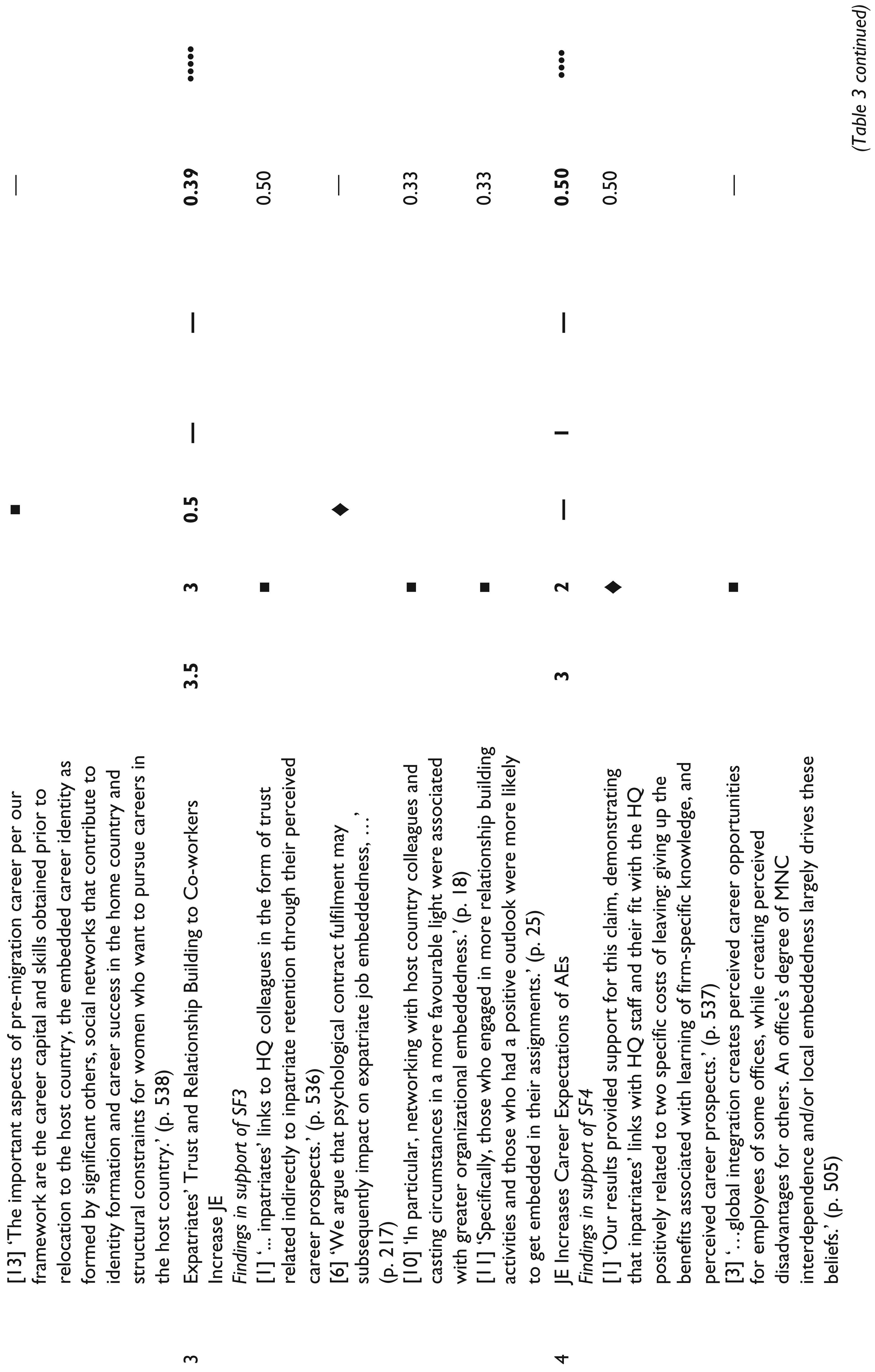

** Number of studies that document the SF.
*** Research method of the study (quan = quantitative, qual = qualitative, conc = conceptual).
**** Construct covering states the percentage of the covered dimensions of the JE construct.
***** The quality of SFs is evaluated as good (9–7 dots), moderate (6–4 dots) and weak (3–1 dots). Dots are given for the number of reproductions in other studies (1–2 findings = weak, one dot; 3–4 findings = moderate, two dots; 5 and more findings = strong, three dots). Further, we assets studies according to the research method. Reproduction by only one method was evaluated by one dot. If findings were confirmed by two or more methods, we give two or respectively three dots. Finally, we took the construct covering into account. <50 per cent was evaluated with one dot. Between 50 and 75 per cent with two dots and >75 per cent with three dots.
****** ‘Unsolicited job offer’ is understood as negative work situation that is accepted as costs for returning home. Strong home country pulls increase the acceptance of such costs.
Stylized Facts
As Table 3 shows, the identified SFs are (i) ‘JE increases expatriates’ retention’, (ii) ‘Home country pulls decrease expatriates’ retention’, (iii) ‘Expatriates’ trust and relationship building to co-workers increase JE’, (iv) ‘JE increases career expectations of expatriates’ and (v) ‘JE increases the incorporation of an international self-concept’. These five identified SFs were analyzed according the reproducibility. Table 4 shows the studies, the SFs as well as the covered dimensions of JE theory by the applied construct operationalization.
SF 1: JE Increases Expatriates’ Retention
According to the findings of this study, the claim that JE increases expatriates’ retention is well supported. Five quantitative articles were identified that provide evidence for the theoretical implication of JE. Empirical evidence shows that social ties and perceived fit with the host unit positively relate to the two sacrifices: firm-specific learning during the assignment and perceived career prospects in the organization (Reiche et al., 2011). Thus, it can be adhered that the results from national context can be reproduced in international settings. In this respect, Tsui, Pearce, Porter and Tripoli (1997) argued that firm-specific knowledge works like sunk costs, binding employees to the organization. These costs limit the external mobility (Hom et al., 2009) and the employability elsewhere (Tsui, Pearce, Porter & Hite, 1995). Similar evidence for the impact of JE on career was found outside expatriation (e.g., Feldman & Ng, 2007). In addition, it was found that the positive effects of JE on retention reduce the likelihood of expatriates’ turnover in the case of positive or negative events. Moreover, so-called shocks are jarring events that cause employees to reassess their employment situation, which may lead to turnover. Especially unsolicited job offers have proved to be one of the most common among all the shocks experienced by employees (Allen & Griffeth, 1999; Lee, Gerhart, Weller & Trevor, 2008). In the case of expatriates, findings show that JE may explain why people do not leave when they experience shocks (Oyler, 2014). Studies supporting SF 1 suggest that both host country shocks (understood as pushes out of the foreign assignment) (Lo et al., 2012) and home country shocks (understood as pulls to the home country) (Tharenou & Caulfield, 2010) get mitigated against JE and thus increase retention intention. To sum up, SF 1 indicates that retention is associated with JE. According to our findings, only Kraimer et al. (2012) found that JE did not predict turnover, while five other studies do expect this relation. If we take a closer look at the used JE constructs (Table 2), it becomes obvious that three out of five studies do not cover community embeddedness. Since it is known from prior research that community embeddedness is seen as a less stable predictor of turnover in comparison to organizational embeddedness (Oyler, 2014; Zhang et al., 2012), contradicting results may be subject to the application of substantially different constructs.
Reproducibility of Stylized Facts

** Const represents the dimension of the used constructs (on = on-the-job embeddedness; off = off-the-job embeddedness; l = links; f = fit; s = sacrifices).
SF 2: Home Country Pulls Decrease Expatriates’ Retention
In this sample, two quantitative and one qualitative study found support for this claim, which leads in sum to moderate strength. SF 2 has no equivalent in a national context, and for this reason, it is a new aspect of JE research. Conceptually, Lo et al. (2012) and Tharenou and Caulfield (2010) applied two different approaches. Lo et al. (2012) developed a new scale in order to expand the dimensionality of the JE construct, the so-called home country community embeddedness (HomeCCE) scale. These authors derived qualitative data from an analysis among HR managers. Similar to their work, only two previous studies applied embeddedness in home and host countries (Ramesh and Gelfand [2010] in terms of family embeddedness and Tharenou and Caulfield [2010] by using the Mitchell et al. [2001] and classical scale of Lee et al. [2004]). In this respect, Lo et al. (2012) pioneer in making JE more applicable, for cross-cultural research. Their findings suggest that on-the-job embeddedness plays a mediating role between expatriates HomeCCE, and the retention intention in that expatriates are more likely to accept an unsolicited job offer back home if the embeddedness in the home country community is still strong. In contrast, Tharenou and Caulfield (2010) applied the classical scale to home and host countries. This approach is in line with Biemann and Andresen’s (2010) proceeding.
SF 3: Expatriates Trust and Relationship Building to Co-workers Increase JE
There is moderate support for the claim that trust and relationship are antecedents of JE. Four studies were identified that reproduce this result full or partly. Job embeddedness research focuses mainly on the impact of JE on various outcomes such as retention, performance (e.g., Halbesleben & Wheeler, 2008), job satisfaction (e.g., Harris, Wheeler & Kacmar, 2011) or commitment (e.g., Oyler, 2014), while few studies analyze the antecedents of JE, especially in an international context. Based on social resource theory, Reiche et al. (2011) theorize that one’s informal social network provides information and/or support that help the expatriate to achieve her or his personal goal. The underlying assumption is that expatriates’ intended goal with an international assignment is mostly career driven. Thus, access to information, gaining support and receiving opportunities increase their perceived career prospects (Cross & Cummings, 2004). This leads to increased organizational JE through higher perceived fit and through the links to co-worker and superiors in the new organization. Ren et al. (2013) support these findings with reference to relationship building, and in this case, especially, friendship networks with co-workers as well as host country nationals (HCNs). On an aggregated level, SF 3 is concerned with relationships. On a more detailed level, it is the relationship with superiors and co-workers as well as with HCN friends that increases JE. McNulty, De Cieri and Hutchings (2013) argue from a psychological contract theory point of view, which is understood as the individual’s subjective expectations about the terms of an exchange agreement in the expatriate’s assignment. Met and unmet expectations are particularly in terms of goal conflict between expatriates and new organizations, outcome uncertainty of international assignments and issues arising from geographical distance and cultural differences. A violation of expatriates’ expectations will negatively influence attitudes and/or actions such as adjustment, commitment or knowledge transfer (Lazarova & Caligiuri, 2001), which reduces trust and organizational commitment (Haslberger & Brewster, 2009). McNulty et al. (2013) found that psychological contract fulfilment positively impacts on JE. Their research did not fully support SF 3, but since trust is seen as one element for building relations and friendship, we classified these findings as partly supportive.
SF 4: JE Increases Career Expectations of Expatriates
Moderate support was found for the claim that JE increases career expectations. However, the relation is at least partly reproduced by three studies. Expatriation is seen as one part of the ‘new careers’. In line with this, employees admit to international assignments with the intention to build career capital through international work experience (Zikic, Novicevic, Harvey & Breland, 2006). In this sample, JE’s impact on career expectation is conceptualized via firm-specific learning that may be sacrificed by leaving the organization. In addition, links to higher-level managers may create expectations of career prospects in the MNE that have to be sacrificed if the expatriate decides to shortcut the assignment (Reiche et al., 2011). In a similar vein, Newburry (2001) argues that expatriates value a largely international embeddedness because this is perceived as a source for career opportunities. Shen and Hall (2009) provide a more differentiated four-field matrix, based on the organizational and community dimension of JE for repatriates’ intention to stay with the organization. Their results indicate that JE affects career exploration, either internal or external. The decision to search outside the company is understood as a result of detachment from the employer during the international assignment. The effort to explore career opportunities within the organization is an expression of principal satisfaction with the employer and the intention to make a better feature of the new competencies and knowledge. In conclusion, JE affects career expectations, in that higher embeddedness promotes the expatriate to plan her or his further/future career with the dispatching organization.
SF 5: JE Increases Expatriates’ Self-concept as International Employee
There is moderate support for the claim that JE increases the expatriates’ identification with the firm and the associated role as an international employee. Being an expatriate is a life situation that requires the adoption of new work, new culture and new social relationships. Under this impression, many expatriates develop a new identity as a result of these challenges (Kohonen, 2008; Suutari & Mäkela, 2008). Per definition high JE is associated with the feeling that one fits into the new social environment. This should also expand one’s comprehension of people and cultures. Being deeply embedded strengthens the cognitive awareness of culturally different life concepts and thus contributes to developing a self-concept as an international employee (Bell & Harrison, 1996). Cultural first-hand experience, or the knowledge that people from other cultures may do things differently and have good reasons for that, is a value that differentiates the expatriate from employees without international experience. This awareness is crucial for an identity formation process that leads to an adjustment of self-definition (Flum & Blustein, 2000). This forming process is a permanent readjustment that is influenced by the degree of JE. In addition, there is evidence that greater cultural distance has greater impact on this process of self-definition (Dickman & Harris, 2005) that affects expatriates to develop a broader worldview (Kohonen, 2008). Kraimer et al. (2012) found in particular that off-the-job embeddedness increases the likelihood that expatriates incorporate their international employee role into their self-concept. With respect to the identification with the organization, Biemann and Andresen (2010) found that corporate assistance in the development of both dimensions, organizational and community embeddedness, may help to increase personal identification with the firm. To sum up, JE makes it more likely that expatriates adjust their self-concept towards their international assignment and the assigning company. In this respect, SF 5 is consistent with former research in the international employee identity.
Conclusion
With this study, I provided an overview of the SFs concerning JE and expatriation. Stylized fact method was used as a systematic approach to structure preliminary findings in order to identify stable and reproducible results within this pretty young academic field. This study was interested in the general pattern and the accumulation of evidence within JE and expatriation research. Thus, I collected 14 relevant publications—that represent the current state of research to the best of my knowledge—and condensed their findings to SFs. The findings show that the research focus is on quantitative studies mainly conducted in the Asia Pacific area.
From a theoretical point of view, heterogenic theoretical results found were mainly psychologically oriented. The most often used empirical method was regression analysis, or structural equation modelling, while scholars used exclusively self-reported questionnaires. Only two studies measured the retention intention at multiple times. Instead of analyzing the ‘real’ retention (e.g., after external shocks or jarring events), the intention to turnover or retention is evaluated by using hypothetical questions. This has to be considered as a weakness of all studies, since such an approach suffers from bias from retrospective sense-making or illusionary correlation (Dougherty & Dreher, 2008; Huber & Power, 1985). Most studies differentiate between SIEs and AEs, while a few use the generic concept of expatriates that combines the others. This is in line with the current discussion about the difference between SIEs and AEs (Andresen et al., 2014; Biemann & Andresen, 2010; Doherty et al., 2011).
Researchers most often apply scales inspired by Mitchell et al. (2001) and Lee et al. (2004), but in any case the original one. Modifications of the JE scale provided by Burton et al. (2010), Ng and Feldman (2007), Uzzi (1999) and Crossley et al. (2007) were also found. Scholars argue for scale adopting by referring to their special research interest. This, however, suggests that the original JE scale, as it is developed for retention research in a national context, may not fully satisfy the research interested in expatriation research. Accordingly, the modification of constructs only captured certain aspects of the initial JE construct operationalization. While holistic construct of Mitchell et al. (2001) covered 3 × 2 on-the-job and off-the-job dimensions, in order to assess the overall embeddedness of an employee to organizational and community-related factors, the identified JE construct adoptions clearly set one focus. Links to peers and superiors followed by the perceived fit to the values, norms and culture at work clearly dominate the research interest. While JE is also concerned with community issues, we are hardly able to draw conclusion on the links to friends and the fit to the local community values and culture, even if the JE theory suggests that being embedded means precisely being embedded in both the foreign organization and work situation as well as the community and the social context. Implicitly, JE covers the effect of community embeddedness on expatriates’ retention, but according to our findings, only a few studies (four for links and fit and two for sacrifices) analyzed that issue.
This research was conducted with the intention to identify the effects of JE on expatriation. As a result, five relatively stable SFs were found. In this respect, it is safe to say that JE increases expatriates’ retention (SF 1). Strong support for this relation was found. Results from research in a national context (Crossley et al., 2007; Lee et al., 2004; Mitchell et al., 2001) could be reproduced for international assignees. In addition, JE even increases the retention intention in cases of positive or negative shocks (Lo et al., 2012; Tharenou & Caulfield, 2010). Therefore, one stable fact that the research brought to light so far is the positive effect of JE on the retention intention of expatriates. Furthermore, there is moderate support for the claim that home country pulls decrease expatriates’ retention (SF 2). To be wedged between home country and host country pulls is one feature of foreign assignments that every expatriate experiences to a variable extent. There is moderate evidence that split loyalty between home and host country organization and community may decrease retention in cases where the links and ties to the home country are strong (Ramesh & Gelfand, 2010; Tharenou & Caulfield, 2010). In addition, there exists moderate evidence that expatriates trust and relationship building to co-workers increases JE (SF 3). In contrast to the common use of JE as a predictor for retention, there is moderate evidence that trust and relationship to co-workers are crucial to developing a feeling of being embedded into the host organization (McNulty et al., 2013; Ren et al., 2013). Therefore, SF 3 highlights the relationship to HCNs and social aspects of international assignments for expatriates’ intention to stay with the company. Further, moderate support was found for the claim that JE increases the career expectations of expatriates (SF 4). International assignees expatriate with the intention to gain career capital (Zikic et al., 2006). Thus, they expect positive effects for their career progress if the number of links and ties to higher-level managers increase. Being embedded into the organization is understood as a source for career opportunities (Newburry, 2001). A low JE prompts expatriates consequently to search for new job opportunities outside the organization (Shen & Hall, 2009). Finally, moderate support for the claim that JE increases the incorporation of an international self-concept (SF 5) was found. Expatriates develop a self-concept as international employees and identify with the associated role when feeling deeply embedded into the organization and community (Kraimer et al., 2012). This in turn leads to a stronger identification with the firm.
This research contributes to international HR management research in multiple ways. First, the five SFs represent the present state of research in JE and expatriates’ retention. This allows for further discussions about future research directions. It shows where further research may help to strengthen weak evidence and which studies may be used as a starting point for further research. In addition, it gave scholars the opportunity to gain a systematic overview about this research field, the constructs used, their advantages as well as the applied methods, analyzed world regions and branches and the particular research questions and approaches. Such overview is helpful to locate new research within the academic field. Moreover, the construct operationalization and the covered dimensions were summarized. Thus, this article contributes to the discussion about the JE construct and its application, especially in a cross-cultural context. The described adoptions gave an overview about the research interest and the application of JE theory in expatriation research. Particularly the fact that each study modified the classical scale may be an indicator that the JE construct did not fully satisfy the needs of expatriation research. In general, this study contributes to a better understanding of JE and expatriates’ retention.
Limitation
As every study, this analysis also has limitations. One limitation is clearly the sample size. However, to the best of my knowledge, all available studies were used. Since this research application of JE to expatriates’ retention is a relatively young study field, all available studies were included. According to the requirements of literature reviews, this analysis is based on a sufficient and, compared to other studies using the SFs method, average sample size. Nevertheless, a bigger sample size would probably provide more SFs, which would allow a more differentiated view. I took care that used sample consisted of studies published in highly ranked journals. However, the one strength of the SFs method is not to analyze journal publications as well as publications in book chapters and proceedings. In this case, SFs method provides a judgement approach that qualifies publications according to their quality of findings. I decided to limit the sample to highly ranked journals. The intention was to contribute to the scientific discussion, and in this respect, the quality of publication plays an even higher role than for derivation of practical implication. With such approach, a contribution to the scientific community could be secured, but this limited the opportunity to provide practical implications. Furthermore, I set a focus on construct operationalization and construct covering. Thereby, I neglected a discussion about the used theories and the methodological approach. Since the sample is richer than the analyzed aspects, some interesting insights in the sample did not get uncovered.
Further Research
Based on the analysis at hand, the need for further investigation could be divided into research gaps concerning the SFs, the JE construct and the SF method. The five SFs represent the current state of knowledge. It was found one SF with strong support in multiple studies. Other SFs had moderate support that calls out for further research. As Helfat (2007) pointed out, idiosyncratic empirical observations generally do not push forward the frontiers of knowledge. Thus, in order to generate generalized understanding, I recommend further research to verify existing SFs by accumulation of evidence, instead of producing incoherent findings with limited force of expression. Furthermore, the call for a longitudinal study of expatriates’ retention appears in all studies in unison, but in the sample, only two articles did so (Reiche et al., 2011; Tharenou & Caulfield, 2010). Therefore, I would like to repeat that call and extend it to the need for more analysis of real retention or turnover cases. Nearly, all studies not only provide a snapshot but also use hypothetical questions about different intentions towards turnover and retention. This is seen as a weakness of the current state of research because all five SFs were based on self-reported evaluation towards theoretical or hypothetical questions. Since actual turnover or retention could be explored, there may also be scope for longitudinal studies that track expatriates over the life cycle. Such approaches may investigate the real behaviour instead of hypothetical behaviour. What is found today in the literature about embeddedness and expatriation is a confusing application of labels that sometimes sound the same and mean something different and sometimes sound different and mean the same. In this respect, JE suggests that all six dimensions are taken into account when making statements based on that theory. A closer look reveals that only a few studies consider both organizational and community aspects. It was also found that researchers enhance the initial construct or simply modify it to better fit their research interest. The problematic nature of different and overlapping conceptualization of embeddedness raises some issues concerning the comparability and validity of research findings. It can also be seen as an expression that the JE construct is unfit for expatriation research needs. Therefore, more research in modification of the JE construct for the requirements of expatriation research is needed. Since host and home countries pulls only count in a cross-cultural context, such aspects may be incorporated into an extended JE scale. In addition, a modified scale needs to be validated (Shepard, 1993). Thus, it is at least questionable to what extent modifications can draw resources on the preliminary effort to increase the JE construct validity. Therefore, a methodical discussion is needed, too. Since Kaldor’s (1961) initial application of the SFs method was invented, this method is frequently used in economics and finance but only rarely in social science. For this reason, I like to speak out for the use of the SFs method in management studies in general, and in HR studies in particular (Heine et al., 2005). The method provides a set of techniques that goes beyond classical literature review and holds some valuable opportunities for HR studies. One of these is the ability to classify results according to their quality. However, the SFs method can be developed further to the special needs of HR studies. Thus, I believe that it is a powerful tool for further literature analysis.
Footnotes
Acknowledgements
The author is grateful to the anonymous referees of the journal for their extremely useful suggestions to improve the quality of the article. Usual disclaimers apply.