



Abstract
The present study has explored the relationship between certain organizational-level factors, such as perceived organizational support (POS), procedural justice (PJ) and communication, as determinants of organizational trust (OT) and their impact on organizational citizenship behaviour (OCB). The data were collected from 303 respondents from top, middle and lower managerial levels, belonging to various companies in manufacturing and services sector. Standard scales were used to assess OT and its antecedent and consequent factors. The results showed that antecedent variables did help in enhancing the level of OT. The presence of OT is positively associated with all the dimensions of OCB revealed by the members of the organization. Organizational trust also partially mediated the relationship between the organizational-level factors and OCB. In view of these results, it was suggested that organizations should facilitate the process leading to trust in management, so that employees are better engaged in extra-role behaviour resulting in increased individual and organizational effectiveness.
Keywords
Introduction
Two decades of structural reforms have brought significant changes in organizational structure, functions, process and behaviour of employees. It has been noticed that there has been a general decline of trust in the organization among the employees due to organizational policies and structural adjustments. Shaw (1997) suggests that employees’ trust is a vital component of competitive changes taking place in an organization for its success, and thus, for managers and professionals; building and maintaining a trusting relationship are critical to effective organizational functioning. Many studies have reported lack of trust and the consequent problems in all kinds of organizations (Ferres, Connell & Travaglione, 2004). Researchers have explored a number of factors associated with human element related to organizational effectiveness, such as organizational citizenship behaviour (OCB) (Konvosky & Pugh, 1994; Koys, 2001), organizational justice (Cropanzano & Randall, 1993; Lind & Tyler, 1988; McFarlin & Sweeny, 1992) and perceived organizational support (POS) (Eisenberger, Fasolo & Davis-LaMastro, 1990). There is a lack of literature in the area of trust in organization/management and less attention has been paid on the relationship of organizational trust (OT), its antecedents and its consequences. Again, the literature does not provide enough evidence about the extent to which these variables are instrumental in determining OT, thus influencing the citizenship behaviour of employees. This study is expected to contribute to research and practice by expanding the knowledge base of OT and its relationship with organizational-level variables and its impact on OCB in Indian cultural context.
Organizational Trust
Gambetta (1988) defined OT as ‘the global evaluation of an organization’s trustworthiness as perceived by the employees’. It is the employees’ confidence that the organization will perform an action that is meaningful or at least not detrimental to them. Faith in management, assurance about their action, honesty and positive expectation form few of the similar components of the construct (Yilmaz & Atalay, 2009). It results from a social exchange process (Blau, 1964), where employees interpret and reciprocate the actions and constantly monitor the work environment to assess whether they should trust the top management. Seal (1998) advocated that trust in a person or a company arises by assessing their characteristics. And a trust relationship with an organization develops with personal interaction between staff, particularly the key decision makers. The existence of a trustworthy culture guarantees that the promises are kept by the senior management, which reduces ambiguity and uncertainty to a great extent (Connell & Mannion, 2006). This aspect highlights the reciprocal nature of trust. The study endorses the view that the management’s attitude towards its employees is communicated through its decisions and policies. Employees will reciprocate trust communicated by the management. Conversely, if the structures, roles and climate of an organization communicate a lack of trust in employees, they will respond with distrust. Shockley-Zalabak, Ellis and Wirogard (2000) indicated that organizations with high levels of trust are more successful, adaptive and innovative than those with low level of trust, which can be detrimental to organizations in many ways, such as decreased transaction cost and productivity and individual and group health (Whitney, 1994). Sonnenberg (1994) found that distrust may lead to poor decision making by teams, higher stress levels, employees losing focus on work and being less creative and innovative and avoiding challenges at the workplace.
Trust in an organization is associated with system-wide variables, such as fairness of an organization’s performance appraisal system and job security, which can explain the variance in trust in management over job and relational variables (such as job autonomy and supervisory support) (McCauley & Kuhnet, 1992). Higher level of trust motivates employees towards team and organizational goals rather than individual objectives (Mishra, 1996). The study proposes to examine the relevant organization or system-wide variables influencing OT, such as procedural justice (PJ), POS and communication, and the association of trust with OCB.
Procedural Justice
Procedural justice is concerned with the impact of the fairness of decision-making procedures on the attitude and behaviour of people involved in and affected by those decisions (Korsgaard, Schweiger & Sapienza, 1995). Research on PJ has evolved from equity theory (Adams, 1965), which is concerned with fair distribution of resources.
Since the conceptual development of PJ (e.g., Leventhal, 1976; Thibaut & Walker, 1975), several studies have demonstrated that the perception of PJ is positively related to the trust in leader or management. Trust depends not only on the perception of fairness of allocation and outcome but also on the procedures used to arrive at such decisions. Brockner and Siegel (1996) found that an individual’s positive view of process and PJ was likely to be linked to higher levels of trust in an organization and the supervisor.
Fair procedures show that the individuals are treated as ends rather than means. The employees may see fair procedure as reflecting institutional values. Outcomes are viewed as happening only once, while procedures are considered to have a more enduring quality (Tyler, 1989). The use of procedurally fair practices impresses higher-order issues, such as employees’ commitment to the system and trust in its authorities. The use of fair procedures demonstrates an authority’s respect for the rights and dignities of the employees.
Procedural justice is a typical metric for judging the fairness of social exchange. Leventhal (1980) proposed that procedures are judged based on their consistency of application, prevailing ethical standards, the degree of their bias, accuracy, correctability and the extent to which they represent all people concerned. Furthermore, it is claimed that the structural aspects of PJ can change, but the nature of institutional forces suggests that they are likely to be stable over time for an organization. Thus, if an organization uses fair procedures once, they are believed to use fair procedures consistently leading employees to believe that the organization can be trusted to operate this way in the long run (Brockner & Siegel, 1996; Konovsky & Cropanzano, 1991; Konvosky & Pugh, 1994).
Although all the three dimensions of justice (i.e., distributive, procedural and interactional justice) can predict trust, PJ is expected to be the strongest predictor, as it is more likely to be controlled by, or at least constrained by, the larger organizational system. The findings of Hubbell and Chory-Assad (2005) confirm that PJ was the strongest predictor of OT compared to other forms of justice. Judgements based on PJ demonstrate a positive and significant effect on the higher-order attitudes of trust in strategic decision-making teams (Kim & Mauborgne, 1991). Cropanzano, Prehar and Chen (2002) demonstrate that PJ in performance appraisal determines trust in an organization. Gopinath and Becker (2002) find that high PJ in divestment in an year is associated with a higher level of trust and commitment among new shareholders. Stinglhamber, De Cremer and Mercken (2006) established a direct relationship between PJ and OT, even when the effect of POS is taken into account. The relationship between PJ and trust follows a social exchange perspective, and is also in line with group value model (Tyler & Lind, 1992), which argues that people wish to have a good relationship with their authority and as such they consider benevolence and trustworthiness of this authority. One way by which this trust is communicated is enactment of fair procedures. In sum, perceived justice represents favourable work conditions, displayed by the organization or its agent, that give rise to positive reaction from employees in terms of trust in the source of this favourable treatment.
Perceived Organizational Support
Perceived organizational support refers to the extent to which employees perceive that they are valued by their organization and that it cares about their well-being (Eisenberger, Huntington, Hutchison & Sowa, 1986). It assures that help will be available from the organization when needed to carry out one’s job effectively and to deal with stressful situations (George, Reed, Ballard, Colin & Fielding, 1993). The theoretical linkages with POS and trust are based on social exchange theory (Blau, 1964). Employees feel obliged to repay the organization if they feel that their organization is supportive to them (Setton, Bennett & Liden, 1996). Employees will have confidence and perform an action that is beneficial (or at least not detrimental) to them, and the organization will continue to notice and reward employees’ effort by providing them a conducive work climate and strong support. Chen, Aryee & Lee (2005) advocated that employees may perceive an organization’s concern about their well-being as benevolent evidence of the organization’s trustworthiness. The positive work experiences provided by the organization (e.g., fair treatment) would make the employees believe that the organization values their contributions and cares for their well-being, which generates trust towards the organization. It was found that organizations conducting employee developmental programmes and granting promotions on performance have a significant positive impact on employees’ perceptions of organizational support (Wayne, Shore & Liden, 1997). The meta-analysis by Rhoades and Eisenberger (2002) suggests that three general categories of treatment received by the employees (fairness of treatment, supervisory support and rewards and job conditions) are related to POS. Eisenberger et al. (1986) also found that the POS would be significantly related to a variety of employee attitudes and behaviours, including trust. A study by Albrecht and Travaglione (2003) revealed that POS was a significant determinant of trust in public sector senior management. Few more findings also confirmed that POS is a potential antecedent of trust in management (Narang & Singh, 2012; Riggle, 2007; Tan & Tan, 2000; Tremblay, Cloutier, Simard, Cheˆnevert & Vandenberghe, 2010). On this basis, it can be said that POS may be considered as an important predictor affecting OT. Thus, the study attempts to explore the relationship between POS and OT.
Communication
Professionals and researchers seem to believe that employees, who perceive the communication climate in their organization in a positive manner, would develop positive perceptions towards their work and organizations. Evidence suggests that management’s action can substantially influence employees’ perception of communication climate (Kulhavy & Schwartz, 1981). Loomis’ (1959) research examined the role of communication in a trusting relationship and concluded that communication is positively related to perceptions of trust, and the level of trust increases with communication (Loomis, 1959; Mahajan, Bishop & Scott, 2012). Many communication variables contribute to trust formation. Cufaude (1999) found that frequency, timeliness and forthrightness of communication are conducive to trust. Gilbert and Tang (1998) emphasized that communication provides increased levels of information. Two important aspects which make the communication meaningful are openness and accuracy, and are considered to be the essential factors determining trust. Companies with open and accurate communication (OP & ACC) give contextually relevant information to employees about the company, explain the rationale behind the management and human resource (HR) decisions, encourage employees’ involvement and communicate the company’s values (Caudron, 2002). Elsbach and Elofson (2000) advocated that employees who are well informed about organizational achievements are more likely to develop a higher level of cognitive-based trust in the top management. This enhances transparency and faith between employees and management. Gilbert and Tang (1998) found that if an individual is part of the channel, providing essential information, then he/she is more likely to experience OT. The communication climate encouraging employee openness and participation helped employees to better identify with their organization (Smidts, Pruyn & Van Riel, 2001). Employees who are informed about organizational achievements are more likely to develop a higher level of cognitive-based trust towards the organization (Elsbach & Elofson, 2000) which is indicative of employee faith in the ability of top management. Korsgaard, Brodt and Whitener (2002) found that the negative outcome of a disagreement between an employee and a manager does not necessarily result in low trust, when managers communicated openly with and in a transparent manner and demonstrated concern. In general, trust can be developed through increasing the quantity and/or quality of communication over time. The relationship between communication and trust is guided by social exchange theory, where communication gives employees a positive feeling about the company, and they reciprocate with improved trust in management. Nevertheless, research to date presents inadequate understanding of which communication factors will bring about greater employee trust on management. Studies of OT from communication perspective are scant as most of the studies have focused on interpersonal trust. Therefore, the present study aims to investigate the two broad aspects of communication, that is, openness and accuracy, in relation to trust on organization/management.
Organizational Citizenship Behaviour
Extra-role performance refers to work behaviour that is beyond formal job descriptions. The extra-role performance is operationalized as OCB. Organ (1988) described five categories of OCB, which include (i) Altruism—helping other members of the organization in their tasks (e.g., voluntarily helping less skilled or new employees, assisting co-workers who are overloaded or absent and sharing work strategies), (ii) Courtesy—that an employee treats others with respect and prevents problems arising from the work relationship, (iii) Sportsmanship—indicates that employees do not complain but have positive attitudes (e.g., petty grievances), (iv) Civic Virtue—suggests that the employees responsibly participate in the political life of the organization (e.g., attending meetings/functions that are not required but are helpful for the organization, keeping up with the changes in the organization and taking the initiative to recommend how procedures can be improved) and (iv) Conscientiousness—means that employees carry out in-role behaviour well beyond the minimum required levels (e.g., working long days, voluntarily doing things besides duties, following the organization’s rules and never wasting time). Furthermore, Williams (1988) divided various citizenship behaviours under two categories, namely benefits directed towards the organization (OCBO), which include sportsmanship, civic virtue and conscientiousness, and benefits directed towards the individual in the organization (OCBI), which include altruism and courtesy.
The link between trust in an organization and OCB has been examined in a number of studies. Social exchange theory (Blau, 1964) accounts for OCB by encouraging the employees to behave in ways that are not strictly mandated by their employers (Rousseau & Parks, 1993). Organ (1990) argued that social exchange is necessary for OCB because the mutual trust that underlies social exchange relationships ensures that OCB will be reciprocated in the long run. Dirks and Ferrin (2002) reported that trust in an organization has a positive relationship with altruism, civic virtue, conscientiousness, courtesy and sportsmanship. Lester and Brower (2003) found that subordinates’ perceptions of their leaders’ trust in them influenced their performance and OCB. In a Chinese joint venture, the OCB of employees was affected by their trust in the organization as well as their trust in the supervisor (Wong, Ngo & Wong, 2006). Findings of Tyler and Blader (2003) and Gould-Williams (2003) found that trust significantly influences extra-role behaviours. However, only few studies have examined the impact of OT on various dimensions of OCB in Indian organizations which needs further exploration.
Thus, it is evident from the literature that OT is positively related to PJ, POS, communication and OCB. However, the role of trust in the Indian context with PJ, POS and dimensions of communication as predictors and OCB as outcome remains unexplored. Therefore, the main objective of the study was to examine the effect of PJ, POS and communication in determining OT. In order to examine the relationship between OT and OCB, the following hypotheses were formulated.
Method
Sample
The sample consisted of 303 managers from top, middle and lower managerial levels from manufacturing and service organizations through stratified random sampling. The organizations were located in metropolitan and capital cities, such as Bangalore, Hyderabad, Calcutta, Delhi, Mumbai, Jaipur, Jamshedpur and Durgapur, where most of the manufacturing and information and technology and information technology-enabled services (IT&ITES) corporate offices are situated. The data were collected in person with the support of the HR department and some data were even collected through mails. A total of 500 survey instruments were distributed, out of which 360 (72 per cent) were returned. The response rate was considered satisfactory for self-report survey of this type (Babbie, 2001; Miller, 1991; Yammarino, Skinner & Childers, 1991). Out of these questionnaires, 57 had to be rejected because of missing data or high response bias, leaving an overall sample size of 303. Out of the total sample, 24 per cent managers belonged to top levels, 34 per cent belonged to middle levels and 42 per cent belonged to lower levels of hierarchy. The percentage of graduates, postgraduates and doctorates was 56, 40 and 4, respectively. The average age of the participants was 37 years. The tenure of the participants with the present employer was 10 years, whereas the tenure of participants in the present career was 13 years.
Participants were assured of confidentiality and that the data would be reported in aggregate. No administrative personnel had access to the study data at any point in time in the data collection process.
Measures
The questionnaire administered in the survey consisted of 106 items using different scales on a 7-point Likert scale. The items were selected from standardized scales and few of them were modified as per the requirement of the study. Brief descriptions of measures are given below.
Organizational Trust: This variable was assessed with a nine-item scale developed by Pearce, Branyiczki and Bakacsi (1994) to measure employees trust in the organization to take care of their interests. The Cronbach’s alpha for the scale was 0.82.
Procedural Justice: Procedural justice was measured using the seven-item formal procedures scale developed by Moorman (1991). This was consistent with the conceptualization of the PJ construct in the present study. The Cronbach’s alpha of this scale was 0.92.
Perceived Organizational Support: In order to measure the POS, a scale developed by Eisenberger et al. (1990) was used. The reliability of this scale based on Cronbach’s alpha was 0.89.
Communication: Communication was measured with a 10-item scale developed by O’Reilly and Roberts (1976). The scale covered two dimensions of communication, namely accuracy and openness. Each of these dimensions had five items. After item analysis, one item was dropped from this scale, as it showed very poor correlation (i.e., < 0.30) with the item total. The reliability coefficient was 0.80.
Organizational Citizenship Behaviour: OCB was measured using the five-dimension scale consisting of 20 items developed by Podsakoff and Mackenzie (1989). Each of the five dimensions—altruism, courtesy, sportsmanship, conscientiousness and civic virtue—had four items describing the specific behaviour, and managers indicated their agreement on each item for employees working with them. The Cronbach’s alpha for this scale was 0.88.
Results and Discussion
The study was conducted in an exploratory framework to examine the strength of the association between determinants of OT and further its impact on the dimensions of OCB. All the variables identified in the study were factor analyzed using principal component with varimax rotation. The items which loaded highly were considered to be the representatives of the respective scales showing the construct validity of the scales. Factors of all the scales obtained from factor analysis were further subjected to statistical analysis to draw the inferences. The summaries of factor analysis result of the scales used are as follows.
Organizational Trust
The factor analysis result of the nine-item OT scale formed only one factor as it was in the original scale. Therefore, OT emerged as a single factor with an eigenvalue of 2.57 and explained total variance of 28.53 per cent.
Procedural Justice
Factor analysis was performed on the seven-item scale of PJ which resulted in only one distinct factor with an eigenvalue of 4.21 accounting for 60.19 per cent of variance.
Perceived Organizational Support
The scale of POS was factor analyzed, which resulted in one factor with an eigenvalue of 3.19 accounting for 58 per cent of variance.
Communication
Factor analysis was performed for the communication scale which resulted in two factors conforming to the original scale, that is, OP & ACC, with eigenvalues of 3.13 and 1.99, respectively, accounting for 57 per cent of variance. The eighth item of the scale was dropped because of its poor loading.
Organizational Citizenship Behaviour
The factor analysis result of this scale showed five distinct factors which were similar to the original scale. The fourth item was dropped as it had below 0.50 loading. The eigenvalue of altruism was 2.58, for civic virtue it was 2.34, for courtesy it was 2.15, for sportsmanship it was 2.02 and for conscientiousness it was 1.96. All the five factors together accounted for 55 per cent of variance.
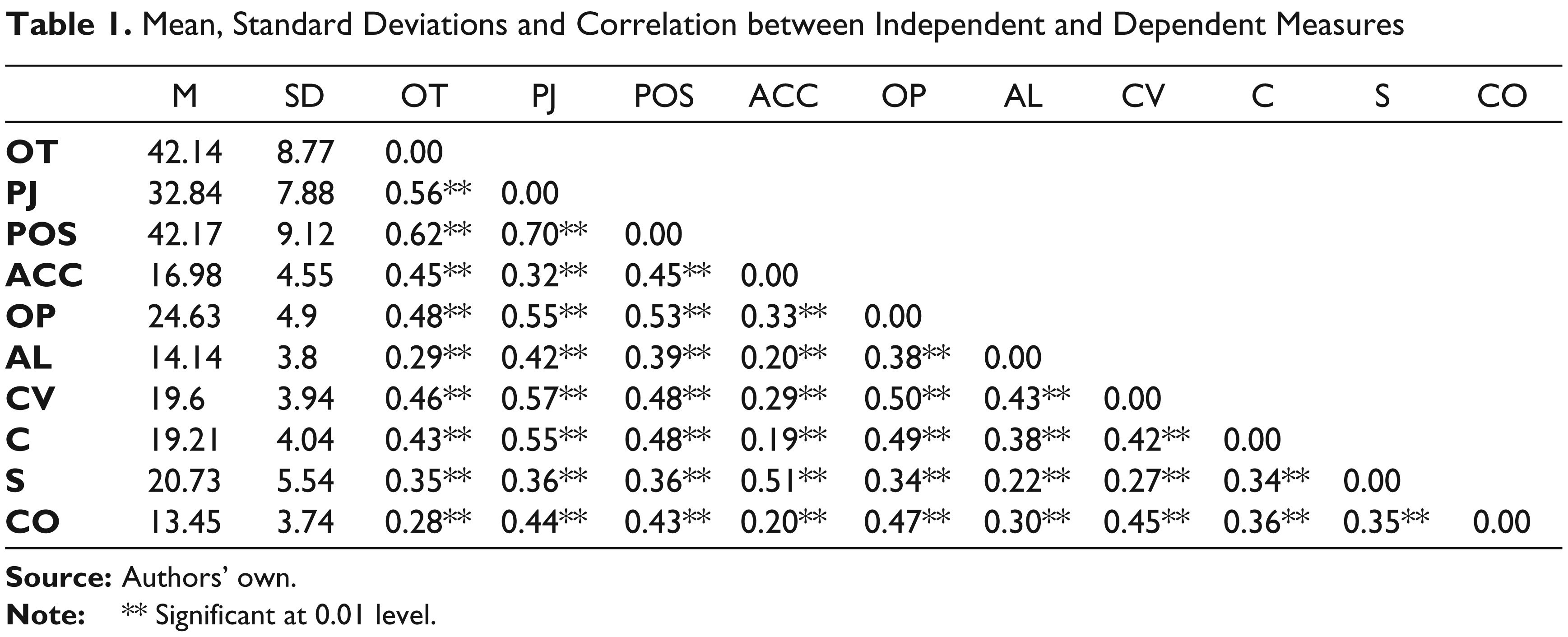
Inter-correlations among all the variables were computed to examine the degree of relationship among them. The results showed that multicollinearity was not a problem as the correlation coefficient of all the variables was not very high and was below 0.75 (Table 1). The results indicated a positive relationship of PJ, POS and OP & ACC with OT. Further, OT also showed a positive correlation with all the dimensions of OCB.
In order to examine the strength of association, a multiple regression analysis was carried out.
The results in Table 2 showed that organizational trust was significantly predicted by POS (β = 0.32), PJ (β = 0.27), accuracy (β = 0.21) and open communication (β = 0.14) which together accounted for 46 per cent of variance (R2 = 0.46, F = 64.295, p < 0.01).
Perceived organizational support emerged to be the strongest predictor of OT (β = 0.32). This shows that employees value the relational aspects, such as care and concern, shown by the management and the work-related support given by the organization to perform their jobs effectively. Perceived organizational support goes a step ahead to explain the human approach shown by the management of the organization, and hence was valued more by the employees. Thus, it can be argued that trust, being relational in nature, is influenced more by the relational aspect of employment relationship. Studies did confirm a positive relationship between POS and trust. A study by Albrecht and Travaglione (2003) revealed that POS was a significant determinant of trust in public sector senior management. Tan and Tan (2000) and Narang and Singh (2012) also found that organizational support is a potential antecedent of trust in management. The present study clearly indicates that the care dimension of POS had a strong influence on trust in an organization.
Mean, Standard Deviations and Correlation between Independent and Dependent Measures
Procedural justice was another predictor which showed a strong association with OT (β = 0.27). If employees perceive fairness in the formal procedures for allocation of resources, decisions and outcome of their performance, then they show a higher level of trust towards the organization. Thus, this result, while confirming the findings of earlier researches, supported the view that PJ is a potent predictor of employees’ support for pro-social behaviour towards the organizational members and institutions (Tyler, 1990). It can be explained by using relational models of justice such as the group-value model (Lind & Tyler, 1988), the relational model of authority (Tyler & Lind, 1992) and the group-engagement model (Tyler & Blader, 2003). The models point out that leaders’ adoption of fair procedures communicates to employees that they are valued and worthy members of the organization, and the enacting authority or leader can be trusted in treating them well in the future. Indeed, being treated fairly is something that is awarded to core group and organizational members, and as such PJ significantly influences employees’ sense of self-esteem and perceptions of the authorities’ trustworthiness (Tyler & Degoey, 1996; Tyler & Kramer, 1996). In a cross-cultural study, Pillai, Williams and Tan (2001) confirmed that in India, PJ was related only to trust. It is possible that the nurturant and benevolent style of leadership which is prevalent in India (Sinha, 1995) generates a certain degree of confidence in the supervisor’s ability to take care of procedural issue. Wong (2012) confirmed that in Chinese Joint Venture (JV), PJ predicted employees’ trust towards management which shares similar cultural context with India.
MRA Results Showing Perceived Organizational Support, Procedural Justice and Communication as Predictor Variables and Organizational Trust as Criterion Variable
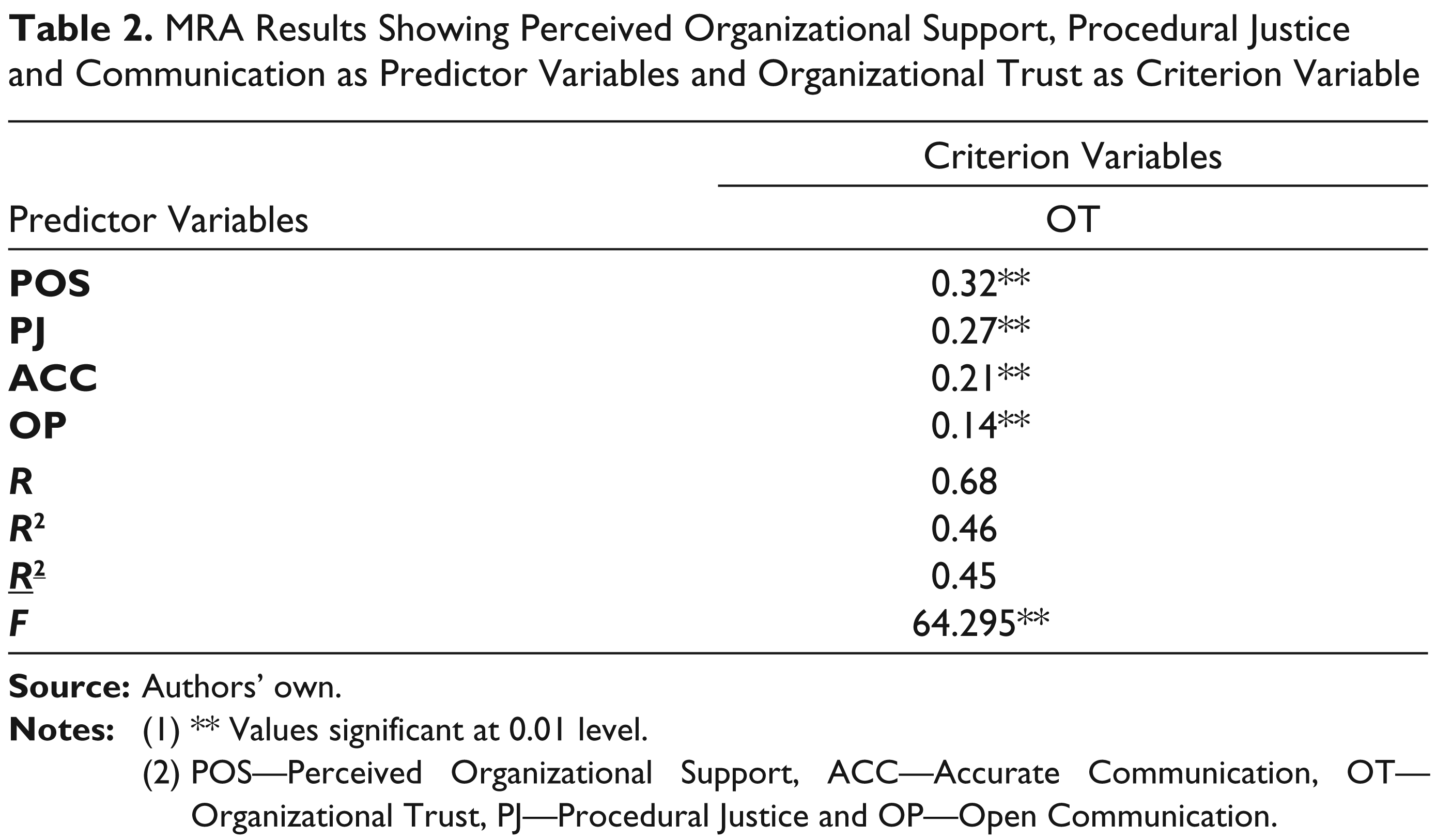
(2) POS—Perceived Organizational Support, ACC—Accurate Communication, OT—Organizational Trust, PJ—Procedural Justice and OP—Open Communication.
The findings provide an insight into the importance of employees’ perceptions of the communication climate in the organization. Both the dimensions of communication, that is, openness and accuracy, were positively associated with OT for the overall sample, thereby confirming the earlier findings that open communication in which managers exchange thoughts and ideas freely with employees enhances the perception of trust (Butler, 1991; Tzafrir, Harel, Baruch & Dolan, 2003). Open communication generates a large image for employees, helping them to understand their role within the organization (Bowen & Lawler, 1995). Open communication in organizations reduces the fear of unknown effects of change, reduces anxieties stemming from ambiguity and enhances a feeling of belonging to an organizational community. In addition, employees see the manager as trustworthy when the manager’s communication is accurate (Konovsky & Cropanzano, 1991). The results of the study indicated that among the communication dimensions, accuracy of information was a better predictor of OT (β = 0.21) when compared to openness (β = 0.14). Previous researches have confirmed the importance of both accurate and open communication, but research to date presents inadequate understanding of which communication action by the management will most probably bring about the desired results, such as greater employee trust in management. Therefore, the present study throws light on this aspect and explains that accuracy of information communicated significantly contributes to the development of trust in an organization.
MRA Results Showing Organizational Trust as Predictor Variable and Factors of Organizational Citizenship Behaviour as Criterion Variable
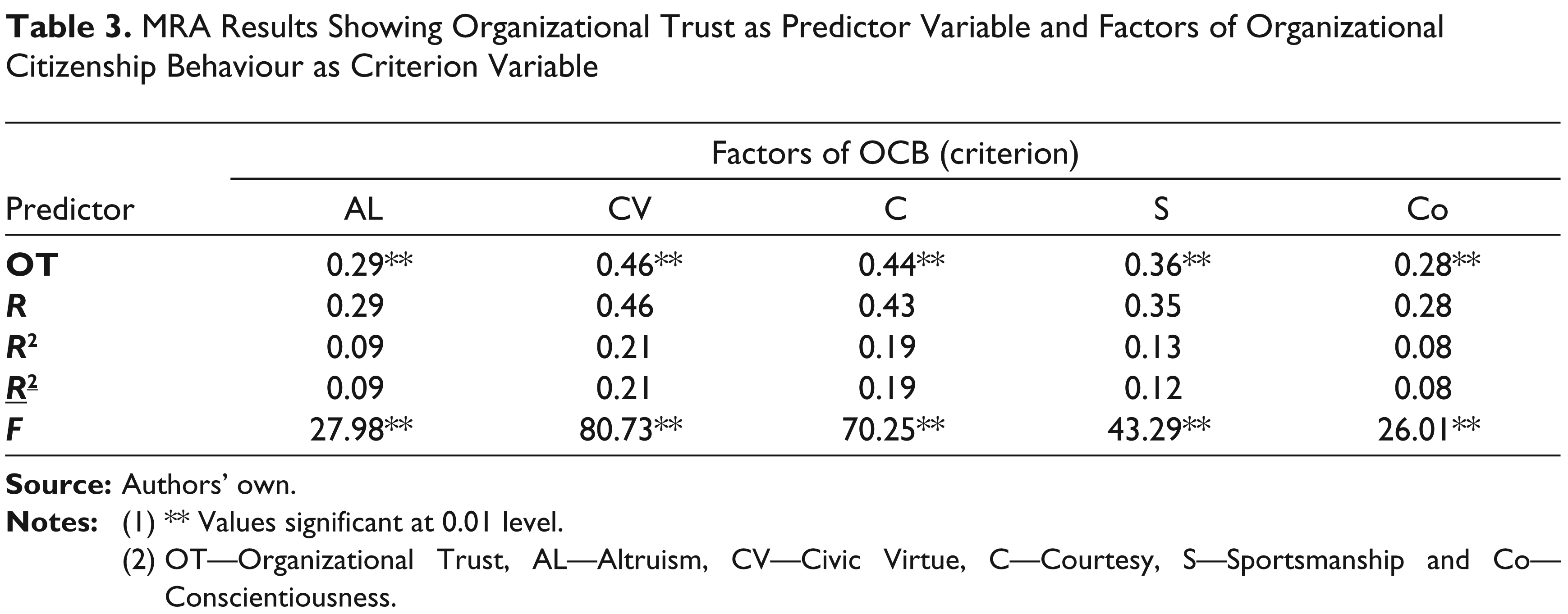
(2) OT—Organizational Trust, AL—Altruism, CV—Civic Virtue, C—Courtesy, S—Sportsmanship and Co—Conscientiousness.
The results in Table 3 revealed that organizational trust predicted all the dimensions of OCB directed towards an individual and the organization. The OT accounted for 9 per cent of variance in altruism (AL) shown by the employees (β = 0.29, R2 = 0.09, F = 27.98, p < 0.01). It explained 21 per cent variance in civic virtue (CV) (β = 0.46, R2 = 0.21, F = 80.73, p < 0.01); 19 per cent variance was accounted in the courtesy shown by the employees (β = 0.44, R2 = 0.19, F = 70.25, p < 0.01), followed by sportsmanship (S) and conscientiousness (Co) in which OT explained 13 per cent (β = 0.36, R2 = 0.13, F = 43.29, p < 0.01) and 8 per cent of variance (β = 0.28, R2 = 0.08, F = 26.01, p < 0.01), respectively.
The OCB is grounded in social exchange theory, which states that individuals sharing trusting relationships try to reciprocate with extra-role behaviour. Organ (1988) suggested that OCB is one likely avenue for employee reciprocation. Organizational trust is influenced by a company’s overall policies and procedures. Employees sharing a trusting relationship with their organization reciprocate OCB directed towards both an individual and the organization contributing to the smooth functioning of the organization. Using meta-analyses, Dirks and Ferrin (2002) reported that trust in an organization had a positive relationship with altruism, civic virtue, conscientiousness, courtesy and sportsmanship. Therefore, the results confirmed the past findings and revealed that OT is associated with all the dimensions of OCB. The interesting observation from the results was that the OT provided greater variance in behaviour directed towards the organization, such as civic virtue, when compared to extra-role behaviour directed towards individuals, such as altruism, courtesy and conscientiousness. With the present findings, the role of other dimensions of trust, such as trust in supervisors and trust in colleagues, as well as other factors related to job and organizational climate cannot be undermined. The extra-role behaviour directed towards individuals is more influenced by employees’ individual relationship shared by their boss and colleagues rather than the overall trusting relationship shared by the management. The findings of McAllister (1995) indicated that trust in peers was positively related to OCB. Studies have established that employees who trust their managers specifically increase their supervisor-directed OCB (Aryee, Budhwar & Chen, 2002; Podsakoff, Mackenzie, Moorman & Fetter, 1990). In the recent findings of Singh and Srivastava (2009), it was revealed that trust on colleagues was instrumental in predicting extra-role behaviour directed towards an individual, and trust in supervisor explained OCB directed towards both an individual and the organization. Therefore, it can be concluded that though OT does have an impact on various dimensions of OCB, the presence of other factors, such as trust in colleagues and supervisor, would complement each other and add to the stronger predictability of OCB directed towards both an individual and the organization.
An effort was made to examine the role of OT as a mediator between predictor variables (PJ, POS and OP & ACC) and dependent variables (factors of OCB). The mediation analysis was carried out based on certain assumptions (Baron & Kenny, 1986). The first step is to see that the independent variable affects the dependent variable (factors of OCB). The second step is to see that the independent variable affects the mediator (OT). The third step is to see that the mediator has a significant effect on the dependent variable and the fourth step is to see that the mediator (trust) along with the independent variable affects the dependent variables. If trust has a mediating effect, a significant relationship between independent and dependent variables should disappear (perfect mediation) or be reduced (partial mediation), when trust is added to the model.
Table 4 reflects the results examining the role of OT as a mediator between organizationally relevant variables and employees’ OCB revealed that OT partially mediated the relationship for two out of five factors of OCB. In the model with civic virtue (CV) as the dependent variable, with the introduction of OT (β = 0.14) the effect of PJ (β = 0.34) and open communication (β = 0.13) was marginally reduced, but remained significant. In the model with courtesy (C) as the dependent variable, the effect of PJ (β = 0.35) and open communication (β = 0.18) was reduced marginally but remained significant. Besides, in these two models, OT was significantly related to the dependent variables. The results reveal that OT partially mediated the relationship between independent variables (PJ and open communication) and dependent variables (civic virtue and courtesy). To a certain extent, the employees felt that their citizenship behaviours, such as civic virtue and courtesy, were facilitated by OT. The partial mediation models suggest that fair treatment of employees through PJ and dimensions of communication (OP & ACC) not only engenders trust in organization but also directly influences employees’ extra-role behaviour. The results reinforce the social exchange basis of employee work behaviour where employees positively reciprocate fair, supportive and open approach shown by the management towards them. Rupp and Cropanzano (2002) report that justice from organizations is associated with extra-role behaviour beneficial to organization and that justice from supervisors leads to extra-role behaviour relevant to the supervisor. The weak mediation provided by OT could be attributed to a number of factors. In the current business scenario, there is cut-throat competition among the employers to follow the best HR practices to attract and retain the talent. On the flip side, there is competition among the employees to grab the best career opportunity available in the market. Employees are more loyal to their profession than to the organization. Therefore, generally, organizations do adhere to fair, just and transparent practices, such as PJ, OP & ACC, care and support to the employees, which does not make them distinct from their competitors. Apart from this, with better career opportunity available, employee turnover is high which leaves less scope for the development of trust, which is a more time-bound process. Further, OT, being impersonal in nature, fails to make the required impact in comparison to interpersonal trust, which is more personal and plays a more important role in facilitating the relationship between the independent and dependent variable (Singh & Srivastava, 2009). Therefore, the system-wide variables identified in this study, such as PJ, factors of communication (OP & ACC) and POS directly contribute to the citizenship behaviour of the employees.
MRA Showing the Mediating Role of Organizational Trust between Organizational-level Factors as Predictor and Criterion Variables for Overall Sample
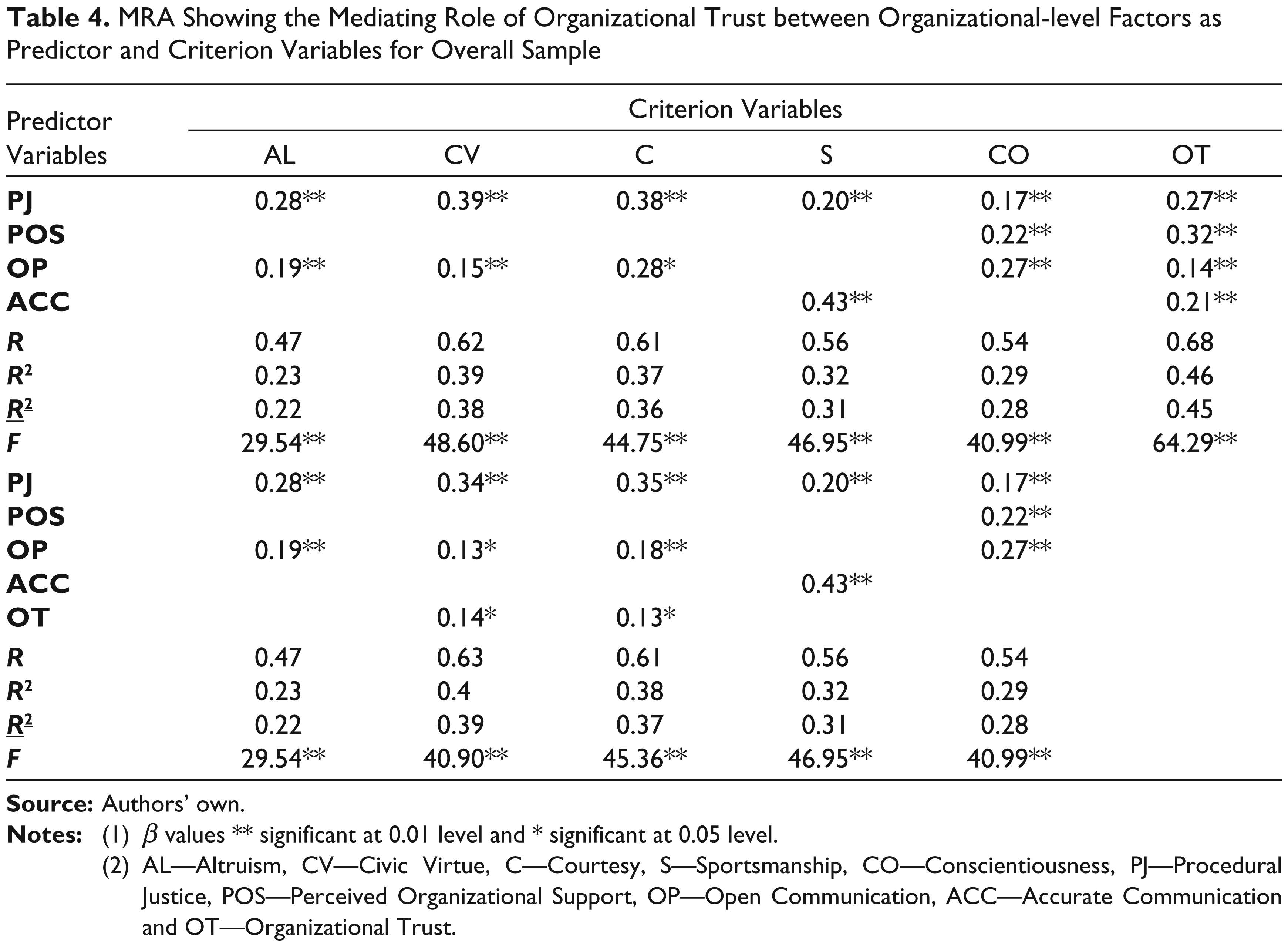
(2) AL—Altruism, CV—Civic Virtue, C—Courtesy, S—Sportsmanship, CO—Conscientiousness, PJ—Procedural Justice, POS—Perceived Organizational Support, OP—Open Communication, ACC—Accurate Communication and OT—Organizational Trust.
Conclusions
The study endeavours to make both theoretical and practical contribution to the existing literature. First, it enhances our understanding of OT in Indian organizations. The study evaluates the impact of PJ, POS held by the employees and communication practices on OCB and trust. In the dynamic business environment where employees’ extra-role behaviour is valued as it adds greater effectiveness to organizational performance, the study emphasizes the importance of OT in influencing all the dimensions of OCB. Practically speaking, knowing exactly which dimension of the predictor variable goes ahead to strongly affect OT and OCB allows practitioners to take appropriate action to improve the HR practices and organizational design. It has been shown that trust in an organization was experienced only when employees had higher levels of POS, PJ and accuracy in information communicated by the management and that trust also contributes towards OCB. Thus with these findings, the management can adjust its policies and system to achieve the desired results.
Several limitations concerning this study need to be acknowledged. First, the common method variance is noted because all the data were obtained from a single questionnaire from employees. Future studies could overcome this problem by collecting data from multiple sources and by using a longitudinal design. The present study mainly emphasized quantitative data; though some interviews were conducted, they only examined a few specific issues. Understanding of this concept would be greatly enhanced through qualitative as well as quantitative data. Another limitation of this study was the lack of generalizability. The findings of this study cannot be extended to all types of service and manufacturing organizations, as only software, telecommunication and steel-manufacturing companies were included in the sample, while it is quite possible that these findings may or may not hold true in other manufacturing or service settings. Therefore, future research should include companies involved in various service and manufacturing activities to increase the generalizability of the findings.
Footnotes
Acknowledgements
The authors are grateful to the anonymous referees of the journal for their extremely useful suggestions to improve the quality of the article. Usual disclaimers apply.