



Abstract
Focus of contemporary organizations is continuous creativity and innovation to face market dynamism. Therefore, organizations need to encourage research and development teams to launch new and innovative products/ideas. This article reviewed literature to identify variables that propagate the innovation adoption process in research and development teams. The variables that promote creativity and innovation within team members are the emotionally intelligent resonant leadership style of supervisors, team members’ characteristics, information sharing processes and task reflexivity. This study adopted a systematic review of literature analyzing publications from the 1990s to 2014, followed by the development of a conceptual framework, a discussion including a critical analysis, conclusion and managerial implications.
Keywords
Introduction
Economic liberalization, technological innovation, changing government norms and informed customers have escalated competition in the market. Contemporary organizations are vulnerable to market fluctuations and their concern is not growth, but sustainability. They are shifting their focus from commoditization to a knowledge-based economy where work cannot be done in isolation. Thus, teamwork under the supervision of a strategic leader would be a viable option in a dynamic and disruptive market. These leaders sense both internal and external market dynamics and motivate subordinates to be creative. Their initiatives result in product and process innovations, acquired through imitation, acquisition and incubation (Damanpour & Gopalakrishnan, 1998). Imitation is mimicking other organizations; acquisition is procurement through licensing and purchasing; and incubation is innovation through research and development (R&D) teams.
Organizations like pharmaceutical, telecommunication and software designing create and innovate with R&D as their backbone. However, generation and adoption of new products is an important decision for these organizations as it involves a huge investment of time and cost (Das, 2003). Success during the trial phase of innovation adoption is meagre, resulting in frustration among members. Innovation adoption process is a complex phenomenon encompassing several social and psychological variables having interdependent relationships. Thus, academic attention is required for developing an integrated framework of individual, team and contextual variables. This study tries to overcome the limitation of past studies to develop an interactionist model of innovation adoption on the central theme of input–process–output model. However, few competing models exist in the literature (Somech & Drach-Zahavy, 2011; Woodman, Sawyer & Griffin, 1993; Woodman & Schoenfeldt, 1990). But, these models have been analyzed from individual and team-level perspectives ignoring contextual-level variables. Innovation is not only an outcome of individual creativity, but it is an iterative process of people, structure and processes (Drach-Zahavy & Somech, 2001). Team innovation models have emphasized on the role of interaction processes as key antecedent variable.
The existing literature on innovation adoption has highlighted the contribution of climate for innovation in motivating subordinates by giving incentives (Gopalakrishnan & Damanpour, 1994; Klein & Sorra, 1996). The employees feel encouraged to share their experiences with others. Another review analyzes innovation research from the perspectives of economist, technologist and sociologist (Gopalakrishnan & Damanpour, 1997). Economists view innovation on the basis of number of product and process patents produced. Technologists view innovation as a continuous process to foster change in operations. Sociologists view innovation on the basis of its degree of innovation: radical and incremental. Imperfect design, management intervention, frequent change in roles and responsibilities, cost and time over run, organizational norms and routines have been identified as impediments in the process of innovation adoption (Klein & Knight, 2005). Training, reward, communication, climate for trust and openness, vision and shared objectives, team collaboration, management support, investment in R&D, learning orientation of employees and their patience and adoption of new technology are few antecedents of innovation implementation, perceived to be organizational priority and have been empirically tested (Farr & Ford, 1990; Klein, Conn & Sorra, 2001; West, 1990; West & Wallace, 1991). However, few studies have been constructively reviewed, but few have been empirically investigated. Hence, this conceptual article critically reviews enablers of innovation adoption process studying variables at individual, team and organizational level. Certain social and psychological variables like leadership style of team leader, team members’ characteristics such as their personality, emotional intelligence and trust are enablers of creativity and innovation adoption process. Task reflexivity mediates the relationship between these enablers and creativity of team members. However, team information sharing process and climate for innovation have been considered as moderators in the innovation adoption process. These variables can have direct and indirect relationship among them as per the input–process–output approach. Moreover, the previous studies were either conceptual studies or competing models empirically tested in different cultural context. Thus, the present study tries to overcome these limitations with the proposed integrated conceptual framework of innovation adoption process.
Literature Review
Leadership Style of Team Leaders
In order to overcome ingrained negativity generated among members of innovation adoption teams, there is an emerging need for emotionally intelligent leaders to boost employee morale and raise their self-efficacy. Self-awareness, self-management, social awareness and relationship management are four dimensions of emotionally intelligent leaders (Goleman, Boyatzis & McKee, 2002). Resonant leaders are emotionally intelligent leaders who are optimistic, compassionate and instil positive emotions within their team members through a clear vision and expunge negative emotions of fear, aggression, anger and sadness (Boyatzis, Smith, Van Oosten & Woolford, 2013). Emotional contagion theory states that leaders produce emotional responses among members (Hatfield, Cacioppo & Rapson, 1993). Their positive emotions influence followers’ moods. The transfer of emotions occurs through facial expressions and verbal intonation. They mimic each other’s emotional cues to develop a climate of positivity (Boyatzis et al., 2012).
However, transformational and transactional leaders also develop subordinates’ potentials (Harris & Lambert, 1998). Transformational leaders clarify goals, inspire and empower followers to improve their performance. They motivate them through influence, inspiration, intellectual stimulation and interact with them as individuals (Bass & Avolio, 1990). Such leaders provide vision and generate a sense of belongingness among employees. With a clear vision, organizational goals seem attainable to members and they feel committed to organization. Goal-setting theory states that members with clearly defined vision align their objectives with organizational goals and share their creative ideas with their teammates confidently and diligently (Locke & Latham, 1990; Zhang, Tsui & Wang, 2011). Transactional leaders also motivate subordinates through reward and punishment (Elkins & Keller, 2003). Both these leadership styles focus on the dyadic relationship between leader and follower. A study conducted on 122 R&D teams of seven Japanese companies has identified that transformational leaders focus more on group norms and ignores followers’ views disrupting team performance (Ishikawa, 2012). They encourage subordinates to follow organizational rules, policies and procedures. However, resonant leaders are enriched with self and social intelligence. A survey of 370 leaders in American bank and 20 executives in American health care teams was done through observation and interview, highlighting the contribution of resonant leaders in effective team performance (Boyatzis, Passarelli, et al., 2012; Boyatzis, Smith, Oosten & Woolford, 2013). These leaders empathize with the frustration of members during trial and error processes. They console members by developing their self-efficacy. They develop the behavioural competency of subordinates by integrating their personal and professional goals with competitive strategy of organizations. They go beyond organizational policies and procedures to invoke positive emotions among members experiencing work stress (Boyatzis & McKee, 2005; McKee & Massimilian, 2006). A study on health care teams also reveals that resonant leaders enhance reflexive decision making among members to enhance their creativity (Boyatzis & Soler, 2012). The rejuvenated workforce is ready to expend efforts with hope, compassion and positive mood to facilitate communication for reflexive decision making.
Team Members’ Characteristics
However, reflexive decision making can be enhanced with active involvement of team members with characteristics such as personality, emotional intelligence and trust. Members’ personality comprises of openness to experience, conscientiousness, extraversion, agreeableness and neuroticism. Team members with high levels of conscientiousness are meticulous, hardworking, organized and perform tasks diligently (Kichuk & Wiesner, 1997). Members high on extraversion are sociable and solve complex problems, whereas members low on neuroticism show inability to adjust with others (Mount, Barrick & Stewart, 1998). Agreeable members are cooperative and those with openness to experience are curious, intelligent and artistic. They access information and share ideas through social interactions. They are dynamic, optimistic, innovative and prefer working in flexible environment (Lepine, Buckman, Crawford & Methot, 2011). Socially acceptable, enthusiastic and optimistic members conform to group norms. As per McClelland’s need achievement theory (1961), members strive to attain desired objectives to improve task with motivation. A survey conducted on 419 engineering students working in product design teams has identified the positive impact of team member’s personality characteristics on team performance (Kichuk & Wiesner, 1997). A case study conducted on Generation Y employees also reveals that members having access to social networking promotes idea sharing within teams (DeCusatis, 2008). Therefore, proactive personality of team members helps in managing emotions of self and others during the innovation adoption process when their colleagues are distressed.
Mayer and Salovey emotional intelligence theory (1993) states that emotional intelligence is individuals’ ability to learn and adapt. They learn to control their emotions and respond to situations. They understand their colleagues’ feelings through their response, body language and facial expression. They tackle emotional demands according to the situation for better information exchange, decision making and conflict resolution. A survey of 817 Australian employees showed the role of members’ emotional intelligence on team decision making (Jordan & Lawrence, 2009). A study on 82 American students have identified the impact of member’s emotional intelligence, collaborative culture and trust among members to enhance knowledge sharing and domain specific expertise (Barczak, Lassl & Mulki, 2010).
Emotionally intelligent members share knowledge and expertise with colleagues because of cognitive and affective trust among themselves. Cognitive trust is generated because of the knowledge and professional competence of team members, while affective trust is generated because of their interpersonal relationship. Social exchange theory states that trust is developed through belief and reliance on each other (Homans, 1958). However, a study on 164 management students in 31 teams states that trust alone does not lead to information sharing and decision making (Chowdhury, 2005). Rather, built-in capabilities of risk taking and idea sharing without fear of criticism results in a creative solution to the task (Edmondson, 1999). A study conducted on 270 Taiwanese members and their leaders working in 68 R&D teams reveals that teams having members who trust each other are more creative (Tsai, Chi, Grandey & Fung, 2012). For knowledge sharing and reflexive decision-making, cognitive trust is considered as a primary requirement. Thus, it has been proposed that team characteristics comprising of team members’ proactive personality, emotional intelligence and trust also influence reflexive decision making among members.
Task Reflexivity
Task reflexivity is a repetitive process of reflection, planning and adaptation (Schippers, Den Hartog & Koopman, 2007). The theory of reasoned action states that members’ favourable attitude towards innovation fosters adoption (Ajzen & Fishbein, 1977). The reason is, members recall their past experiences to overcome bottlenecks and improve decision making. A study conducted on 368 supervisors in 46 project teams of Netherlands states that members continuously reflect, plan and frame strategies (De Dreu, 2007). Reflection is asking questions to explore members’ diverse perspectives and experiences by collective learning. It helps in identifying new ways of working as per the current changes in environment. Planning facilitates developing new strategies and policies through past experiences. A study on 454 members working in 59 production teams of 14 Dutch firms revealed that reflexive members focus on long-term planning by adapting to environmental dynamism (Schippers, Den Hartog & Koopman, 2007). Revan’s theory of action learning states that members generate new knowledge through questioning prior assumptions in a given situation (Yeo & Gold, 2011). Adaptation is the action-oriented behaviour of team members. They try to achieve planned changes in team objectives, strategies and processes formulated during reflection and planning stages. This approach helps members to propagate learning. Highly reflexive members continuously monitor environmental demands to overcome uncertainty. Better use of members’ knowledge and skills helps in accomplishing team objectives. A study conducted on 454 members of 59 production teams of 14 Dutch firms and 147 students from Dutch universities have shown that task reflexivity evaluates team processes, strategies and objectives to promote job satisfaction and commitment among members to enhance team creativity (Nederveen Pieterse, van Knippenberg & van Ginkel, 2011).
However, members alone cannot take decisions to achieve their objectives, they must collect divergent viewpoints and discuss with their leaders to take appropriate decisions. Leaders sense market risk and uncertainty to guide members for developing team goals and strategies. This reduces the chances of error and risk. Therefore, we expect a positive relationship between leaders and task reflexivity. On the other hand, team members’ proactive personality has also been identified as an antecedent in task reflexivity because members with such personality characteristic challenge existing norms and values. They show reflexive behaviour to share divergent opinion with less fear of rejection and criticism. Their emotional intelligence and trust on their fellow colleagues motivate them to address complex situations. Thus, we expect a positive relationship of team members’ characteristics encompassing proactive personality, emotional intelligence and trust with task reflexivity and team creativity.
Team Information Sharing Process
Reflexive decision making propagates creativity among members through information exchange, learning and collaborative problem solving termed as team interaction process (Van Offenbeek & Koopman, 1996). Information exchange facilitates sharing of knowledge and experiences to improve problem solving among members. The competency developed through information exchange does not alone change members’ behaviour. But it changes with team learning process, where members collaboratively reflect on team objectives, strategies and processes to adopt change and creativity. Bandura’s social learning theory (1977) states that social interaction helps in identifying problems through environmental scanning that helps them in setting specific and attainable goals. Members feel confident to achieve organizational goals. These members collaboratively solve problems by inviting divergent opinions to enhance creativity and innovation. This information exchange within members is referred as team information sharing process in this study.
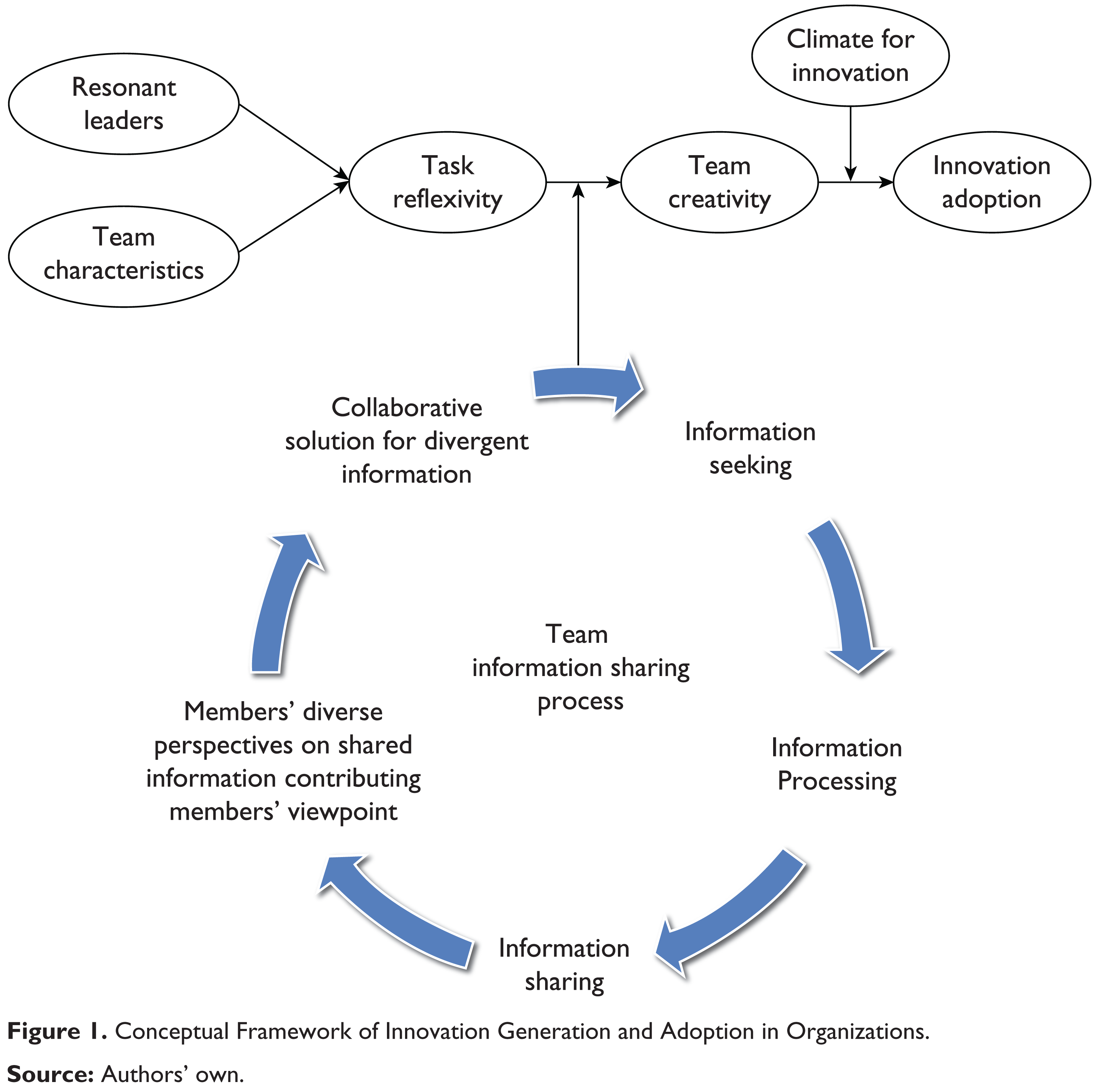
Team information sharing process is an iterative process of seeking, processing and sharing of information and knowledge, assessing members’ divergent views on shared information, and collaborative problem solving. Members seek information through customer feedback (Hirst & Mann, 2004). The information procured from customers helps them to improve products and processes. Information processing encompasses thinking, analyzing, situational modification and obstacle evaluation. Members’ cognitively evaluate and analyze situations. They recall past experiences and take inference to handle future uncertainties. Information processing theory also supports that processing the acquired information helps in attaining goals, rather than responding to unforeseen situations. Effective information transmission among members enables learning to generate new knowledge.
Social learning theory indicates that members generate new knowledge by sharing their ideas and experiences called socialization (Nonaka, 1994). Knowledge sharing is an integral part of the information-sharing process where members share both tacit and explicit knowledge and experiences to learn from each other (Huang, 2009). Members brainstorm to provide feasible solutions and forward this idea to an advanced stage in the form of mental model. The theory of mental models states that these mental models influence decision making to accomplish organizational mission, strategies and goals (Cockburn, Henderson & Stern, 2000). Mental models are knowledge structures for describing, explaining and predicting future state of actions (Klimoski & Mohammed, 1994; Rouse, Cannon-Bowers & Salas, 1992). A study on 40 American undergraduate students have identified that members develop a common knowledge structure in the form of shared mental model for planning and effective decisions making (Stout, Cannon-Bowers, Salas & Milanovich, 1999). A survey of 112 American graduate students was done to identify the impact of shared mental model on team processes and performance (Mathieu, Heffner, Goodwin, Salas & Cannon-Bowers, 2000). Their responses were analyzed using ANOVA, T-test and Kolmogorov–Smirnov test and the findings explain that shared mental model is categorized as team and task model. Team mental model allows members to anticipate each others’ actions, enhance coordination among them and improve their performance. Task mental model are the procedures and strategies for task accomplishment.
Extracting knowledge from an expert, sharing it among members for the collective use of teams is a complicated process involving interpersonal relationship among members. Experts may not be willing to share their knowledge with others. Group thinking, fear of rejection or sense of superiority are complex social issues that need to be addressed. A collaborative problem-solving approach amicably resolves such interpersonal conflict among members. Solving problems through collaboration satisfies all members of the team. Members utilize their personal skills, information and resources to redefine a problem. It helps them in dealing with strategic issues, organizational objectives and policies leading to team creativity. The more members share information, the better they learn and take reflexive decisions. Reflexive decision making and information sharing among team members propagates creativity. Thus, team information sharing process acts as a moderator between task reflexivity and team creativity.
Team Creativity
Team creativity is the transformation of imaginative ideas into novel and useful products. It is the initial step of the innovation adoption process. Members’ personality, technical proficiency, emotional intelligence, risk taking ability and knowledge are certain individual level factors that generate creative ideas (Amabile, 1996). Certain organizational factors like a climate for innovation and team information sharing process reinforce team creativity. Leaders act as facilitators to identify members’ talent and encourage them to share their knowledge and experience to generate new products and improve existing processes (Nijhof, Krabbendam & Looise, 2002). Amabile’s creativity theory (1996) proposed three major components of individual level creativity, namely, individual expertise, creative thinking and intrinsic motivation, provided the person the motivation to take challenges in the nature of job. Individuals with proactive personality, having intense need for achievement and internal locus of control are intrinsically motivated and strive to attain the challenging goals. Therefore, researchers’ focus is on intrinsic motivation of members. Similarly, most of the existing literature on creativity exists at individual and organizational level variables ignoring team-level variables. However, team-level variables are utmost important to meet environmental dynamism. Eight French laboratory experts working in R&D teams have been surveyed during training session to explore antecedents of team creativity (De Vreede, Boughzala, De Vreede & Reiter-Palmon, 2012). The study explicates team creativity as amalgamation of team member’s creative efforts. However, leaders’ intervention during the continuous trial and error process of innovative R&D teams fosters employee morale and encourages them to work collaboratively to attain challenging goals (Amabile, Conti, Coon, Lazenby & Herron, 1996).
The successful generation and adoption of creative ideas in an organization promotes innovation (Gopalakrishnan & Damanpour, 1997). Rogers’ diffusion of innovation theory states that acceptance of new idea among members of a team/organization depends on their perception towards certain attributes of innovation. These attributes are relative advantage, compatibility, complexity, trialability and observability (Rogers, 1995). Relative advantage is members’ perception of advantages of innovation with respect to time and cost. Compatibility is consistency of innovation with respect to organization’s culture and values. Complexity is simplicity/complexity of innovation so that it is easier for members to accept. Trialability is degree to which innovation is experimented for its usefulness. Observability is visibility of idea to the wider audience of social system, or in other words the relevance of the idea to the lives of potential adopters. It gives an immense sense of intrinsic motivation to team members when they see the perceived usefulness of these attributes.
Several studies have categorized innovation adoption processes as: generation and adoption stages (Gopalakrishnan & Damanpour, 1994, 1997; Klein & Knight, 2005; Klein & Sorra, 1996; Taylor & McAdam, 2004). Generation stage encompasses idea generation, project definition, problem-solving, design and development, production and marketing. Adoption stage is acceptance of new and fine-tuning existing products. Adoption stage is further divided into innovation initiation and implementation (Cooper, 1998). Innovation initiation includes awareness of innovation, form a favourable attitude and evaluating its worth from organizational viewpoint. Innovation implementation is verifying utility through trial and finally approving the product for mass consumption. A survey of 1,219 managers, team members, and technology users working in 39 manufacturing plants of American companies was done to assess the implementation of computerized technology (Klein, Conn & Sporra, 2001). Members perceive implementation of new technology is consistent with the organizational policies as per Rogers’ diffusion theory. Similarly, 996 Israeli members working in 96 health care teams of 1,200 clinics have been surveyed through interview and questionnaire method to identify the impact of team composition on creativity (Somech & Drach-Zahavy, 2011). Creativity influences innovation with climate for innovation in moderating the relationship between team creativity and innovation implementation. Members’ functional heterogeneity, climate for innovation and shared vision generates trust among members to foster creativity into innovation implementation. However, innovation implementation has been limited to team level of analysis. Therefore, we propose that creativity fosters innovation implementation not only at team level but at the organizational level at large.
Climate for Innovation
Continuous support for members’ creative ideas and intrinsic motivation is a prerequisite for encouraging creativity among members. These requirements can be met by a climate which supports innovation and encourages risk taking called intrapreneurship. When members’ perception of their personal needs of achievement, accepting challenges on the job and aggressiveness is supported by organization they feel intrinsically motivated. The social identity theory also suffices that such support make members feel their contribution is significant (Tajfel & Turner, 1979). Members introduce new and improved ways of doing things with sense of affective commitment. Providing adequate resources and support to the members enhances their self-efficacy and psychologically prepares them to dispense their knowledge and creative ideas for organizational success. With support for innovation, team creativity is more likely to be transformed into innovations.
Care, concern and empowerment bestowed by the nurturing organizational climate promote intrapreneurship and risk-taking among members. Intrapreneurs are involved in the continuous process of uncovering and developing an opportunity to create value. They take initiatives to introduce new methods or techniques, improvise traditional working methods, challenge existing norms and values and offer insights to develop new products, services and technologies. Intrapreneurship empowers subordinates to be aggressive and competitive to enhance their creative ability. The success or failure of any team effort depends upon the team’s context or its environment. Thus, a climate for innovation encompassing support for innovation and intrapreneurship moderates the relationship of team creativity and innovation (see Figure 1).
Methodology
The literature review was conducted from 1962 to 2014. The term innovation adoption process came into existence from Rogers’ diffusion theory—also the central theme of the study—which explains how companies generate and adopt innovations. Moreover, literature was reviewed using the databases EBSCO, Science Direct, Emerald, and Scopus for maintaining the reliability of the literature. The next section will discuss the key variables of the conceptual framework of innovation adoption process. In further sections, the model is discussed along with the limitations and future directions of the study.
Discussion and Conclusion
Business organizations confront vulnerable market conditions of economic slowdowns, plummeting sales and shorter shelf lives. Creativity and innovation is panacea to organizations such as Mahindra, IBM, IndiGo, Micromax, Piramal (Sarvjal), Attero Recycling and Skymet. These organizations have leveraged the creative ability of their employees. Smartphones, expensive passenger lounges, exclusive retail outlets, shopping malls and complexes are a few such examples to delight customers and establish benchmarks for competitors. Organization harnesses innovative ideas by deploying members with diverse characteristics. Their creative ideas metamorphose into market innovations and strengthen firms’ competitive position. Creativity proliferates in an environment promoting flexibility, risk taking, intrapreneurship, experimentation and learning by action and reflection. This paper reviews enablers of R&D team creativity, including emotionally intelligent resonant leaders, team characteristics of proactive personality, emotional intelligence, and trust, task reflexivity, team information sharing process and climate for innovation. An in-depth review of literature unearths the antecedents and consequences of innovation adoption process in organizations.
Transformational leaders also motivate members through their idealized influence, intellectual stimulation, inspirational motivation and individualized consideration. However, such leaders have concern for developing subordinates’ capabilities within the frame of organization’s rules and regulations (Ishikawa, 2012). Therefore, emotionally intelligent resonant leaders would be suitable to propagate flexibility, enthuse positive emotions and reduce frictions among members.
In nurturing their creative thoughts, team characteristics play a significant role. The proactive personality of members, emotional quotient and trust propagates teamwork. However, differences among members in personality and emotional incompatibility causes distrust and conflict. Therefore, it is imperative to have a convivial atmosphere where members trust each other, provided they are working under the supervision of an emotionally intelligent leader. Moreover, team creativity is nurtured when organizations facilitate innovation and intrapreneurship, and experimentation to promote a culture of creativity. Members learn from their past mistakes to take better decisions. Therefore, task reflexivity assesses alternative solutions to learn and exploit business opportunities and transform into creative solutions.
Academic literature on innovation studies have emphasized on its importance and necessity for organizational sustainability. However, a conceptual framework on innovation adoption process has been ignored so far. There is a dearth of literature on innovation as a multidimensional perspective. This paper addresses these literature gaps by giving a comprehensive review. The paper identifies enablers of innovation adoption process including resonant leaders, proactive personality of members, their emotional intelligence and trust among them, team information sharing process, reflexive decision making and climate for innovation. Leadership style and team characteristics have been considered at individual level. Task reflexivity, team creativity and team information sharing process have been considered at team level. Climate for innovation and innovation adoption have been considered at organizational level. It also explains the cause and effect relationship between variables at individual, team and organizational level resulting in a moderated mediation model. Team information sharing process moderates the relationship between task reflexivity and team creativity. While climate for innovation moderates the relationship between team creativity and innovation adoption process. This review has identified a complex phenomenon of multiple relationships between variables, resulting in a moderated mediation model that enriches the literature.
With the moderated effects of team information sharing process and climate for innovation, team creativity is enhanced by adopting more innovations. Considering the fact that innovation adoption is a complex process, organizations have to closely monitor each stage of innovation. These stages are categorized as initiation and implementation. Initiation starts with problem recognition and searching for an alternative solution. Organization makes rational decisions with various stakeholders/team members to adopt an innovative idea. The implementation phase focuses on team member’s perception, their experiences on adoption decision, and strategies for planning and implementation. For an innovation adoption decision, members must reflect–plan–act because the adoption decision involves enormous risk. This conceptual framework provides the platform for organizations to monitor varied steps of innovation adoption process.
Survival of the fittest is the new adage for every organization in a dynamic and competitive environment. Companies must innovate and transform themselves continuously to meet consumer needs. This is possible through R&D teams whose sole focus is on generating and adopting innovations. They develop and innovate new product, process and ideas that are in tandem with dynamic environment.