



Abstract
Cooperation is an association of business partners, formed to assist each other in both good and bad times and is regarded as the apex silent body that assists the partners in dealing with contemporary business issues. This article explores the implications of cooperation among 44 owners/managers of small-scale industries (SSIs), 74 wholesalers and 120 retailers in the district of Udhampur in the state of Jammu and Kashmir (J&K). A primary survey was conducted to gather data which, after being properly sanitized, were validated through factor analysis. The data, thereafter, were analyzed using multivariate tools for drawing meaningful conclusions. The results of hierarchal regression model and analysis of variance (ANOVA) revealed that cooperation enhances effectiveness and efficiency, promotes shared goals and values, promotes honesty and openness and endorses acquiescence between business parties in order to enhance business relationships. Further, it was observed that managers with different qualifications significantly differ with regard to formulating sturdy cooperative business relationships, whereas managers with different work experience do not differ significantly with regard to cooperative relations. The study reveals that cooperation in business leads to business growth and profitability.
Introduction
Cooperation generally means helping each other voluntarily, which benefits both sides or parties. By cooperation, we mean informal cooperation that ‘involves adaptable arrangements in which behavioral norms rather than contractual obligations determine the contributions of parties’ (Smith, Carroll & Ashford, 1995). ‘Cooperation’ as a general term describes the strategic relationships between business organizations, which are more than arm’s length transactions but less than the complete consolidation of resources.
Cooperation, however, is considered as an engine of business partners that assists the entire working of business relationships, as it portrays performance outcomes among the channel members. Cooperation promotes sturdy relationships among channel members by achieving everyday targets and building trustworthy relationships among business intermediaries, such as wholesalers, retailers, customers, competitors and financial institutions. Cooperation exists when organizations exchange the required information and have enduring business relationships with contended reputable suppliers and a large customer base (Danny et al., 2006). Cooperation is framed from the viewpoint of reason, from associations/state of affairs or from behaviours (Chen, Chen & Meindl, 1998). Cooperation is regarded as shared acuity of a situation in which two parties act harmoniously (Morgan & Hunt, 1994). Cooperation broadly ‘reflects the firm’s capability to work together in a mutual mode towards their particular purpose’ (Humphrey & Schmitz, 1998), whereas Hewett and Bearden (2001) define cooperation as ‘harmonizing coordinated measures taken by the partners to achieve joint results’. Cooperation is possible when the goals of every party member are completely interrelated to each other, and are identified as such (Chen et al., 1998). Cooperation between business organizations and parties perks up efficacy in the buyer–supplier affiliation, leads to enhanced supplier logistics performance, supports in upholding an appropriate inventory level and leads to growth orientation (Heide & George, 1992; Soch & Sandhu, 2008). Consequently, the decisive responsibility of profitable cooperation cannot be overlooked in the contemporary epoch as it is a necessity in businesses which leads to the development of sturdy business relationships.
Further, it is connoted that cooperation between partners creates value, increases learning and knowledge (Dyer & Singh, 1998) and enables them to deal with contingencies (Gibbons, 2005). According to Lazzarini, Poppo and Zenger (2004), cooperation is an important safety instrument that mitigates external and internal perils. Firms that are involved in cooperative undertakings benefit from the sharing of costs and from diminution of risks that are associated with the development of a new process or product. The customers knowledge & experrience regarding market had raised pressure on firms to launch their products on time in the market. In the world of competing technologies, cooperation helps in creating compatibility among technologies. As a result, the market tends to select the appropriate technology while this technology becomes extensively attuned and its adoption presents network externality.
The importance of cooperation is that it first develops highly cooperative relationships where two parties agree that the relationship is mutually cooperative rather than being one of dominance or compliance. It leads to further development of shared values which in turn facilitate highly cooperative relationships, thereby resulting in a continuity in the relationship and in overcoming competitive pressures easily. The desire of increased cooperation in the industry collectively contributes to the formulation of a climate for cooperation which in turn impacts the level of planning and flexibility in cooperative relationships. Therefore, the cooperative climate is vital as it upholds the values held by participants directly involved in the relationship and improves the capability of the organizations to participate in highly cooperative relationships. Further, establishing highly cooperative relationships leads to improved financial performance indexes, such as return on investment, net income and return on sales, and improved operating performance indexes, such as on-time delivery and responsiveness (Carr & Pearson, 1999). Therefore, cooperation develops cooperative relationships and strong values among business partners which in turn bestow numerous benefits to the parties involved.
A firm is said to be in relationship when it’s strongly associated & with channel parties such as suppliers, retailers, customers. But what is a relationship? An oft-used definition is that a relationship is a mutually oriented interaction between two reciprocally committed partners (Håkansson & Snehota, 1995; Narang & Singh, 2012). A business relationship is one where two firms or two types of organizations form strong and extensive social, economic, service and technical ties over time, with the intent of lowering total costs and/or increasing value, thereby achieving mutual benefit (Anderson & Narus, 1990; Pathardikar & Sahu, 2011). The author in this research clearly portrays the imperativeness of cooperation among business intermediaries/partners that develops and maintains strong business relationships by adopting cooperation. Further, the author seeks to understand and explain how cooperation works in small manufacturing firms and how it can be promoted among these business intermediaries, as the key thrust area of this research is cooperation, which entails enormous benefits. Therefore, glimpses of cooperation benefits are hypothesized to throw light on exact facts, figures and results. The research conducted on small-scale industries (SSIs) provides fresh insights to the existing literature that cooperation enhances effectiveness and efficiency, promotes shared goals and values, inculcates honesty and openness and endorses acquiescence between business parties in order to enhance business relationships. The article structure contains a review of the existing literature; the next section covers the need of the study, objectives and hypotheses framework subsequently followed by research design and methodology. Further, the study proceeds with data analysis and interpretation where major findings/results of the research have been portrayed followed by conclusion and references.
Literature Review
Although resource-based theories can explain the rationale of inter-firm cooperation to some extent, they have been criticized for focusing too much on value appropriation from the single firms’ perspective rather than on value creation in the relationship itself (Duschek, 2004; Gulati, Nohria & Zaheer, 2000). As part of this criticism, the first theory to explicitly address the cooperation relationship perspective was introduced by Dyer and Singh (1998). They identified four sources of inter-organizational cooperation: relation-specific assets, knowledge-sharing routines, complementary resources and capabilities and effective governance. According to an empirical study conducted by Dyer and Nobeoka (2000), a network that has a strong identity and coordinating rules may be superior to a single firm in recombining and creating knowledge. The notion of complementary resources is also an implicit assumption in the resource-based view (RBV) with respect to inter-firm cooperation (Das & Teng, 2000). The relational view thus draws attention to inter-firm cooperation as a source of competitive advantage by taking inter-firm relationships as the unit of analysis (Molina & Dyer, 1999).
Jap (1999) proposed that coordinative efforts between buyers and suppliers assists in formulating collaborative exchange relationships. Johnston, McCutcheon, Stuart and Kerwood (2004) established that shared planning and flexibility in arrangements in dealing with unpredicted circumstances, which are part of extremely cooperative buyer–supplier relationships, significantly affected buyer performance dealings. Stuart (1993) concluded that similar effects were present not only in situations linking product and process contemporariness but also in the facilitation of the exchange of goods and services over time between partners. Cooperation even results in shared planning between buyers and suppliers in joint decisions in order to promote cost-efficiency, monitor entry procedures, delivery schedules, product/service design or quality monitoring/improvement, besides the actions that both parties take towards strategic planning (Johnston et al., 2004). Cooperative buyer–supplier relationship entails the exchange of information for longer time periods in order to maintain the relationship and promote success for both the parties involved in the exchange (Mentzer, Min & Zacharia, 2000; Weitz & Jap, 1995; Whipple, Frankel & Daugherty, 2002). Cooperation increases flexibility in arrangements that have been ubiquitous in the literature on buyer–supplier relationships (Heide & Miner, 1992). The importance of capable supply partners who respond appropriately to an environment of hasty product change and demand volatility has been implied in the literature on agile manufacturing and supply chains (Swafford, Ghosh & Murthy, 2006). In an effort to clarify the nature of this relationship, authors have conducted many studies which almost focused on inter-firm cooperation. Some authors investigated factors influencing this type of relationship (Edelenbos & Klijn, 2007; Rindfleisch, 2000). The others, in different objectives, have built up theories to explain cooperative relationships (Anderson & Narus, 1990; Evan, 1965; Morgan & Hunt, 1994). All these researches have been studied in the business and management field and they confirmed that these factors directly affect inter-firm relations, especially inter-firm cooperation (Barber, 1983; Clegg, 2004; Croom, Romano & Giannakis, 2000; Ishaya & Macaulay, 1999; Morgan & Hunt, 1994; Wicks, Berman & Jones, 1999). The role that cooperation plays should be regarded as a complement rather than a surrogate to a firm’s inner R&D. Firms should develop internal capabilities for generating trade in cooperation and harvest the reimbursement of cooperation (Katz & Shapiro, 1985). Cooperation promotes adaptation and commitment, abolishes abrasion in daily operations, advances financial recital, promotes efficiency, productivity and effectiveness, brings in openness, brings joint acceptance and assent and shares tacit acquaintance for innovation resulting in an augmented rate of relational proceeds (Beamon, 1999; Brownell & Reynolds, 2002; Dyer & Chu, 2003; Johnston et al., 2004; Madhok, 1995; Monczka, Peterson, Handfield & Ragatz, 1998; Walter, Miller, Helfert & Ritter, 2003; Wicks et al., 1999; Zineldin & Jonsson, 2000). Organizations found that, by addressing measures of efficiency, their operations became more flexible in adjusting to the ongoing changes. Collaboration assists in shortening purchasing cost by lowering contracting cost, reducing unwanted communications, adhering to better coordination practices and a rational approach to solve common problems (Cannon & Homburg, 2001; Scannell, Vickery & Droge, 2000; Zineldin & Jonsson, 2004). This implies that buyers who cooperate with their suppliers exchange pertinent, complete, exact and judicious information that results in collaborative problem-solving and planning efforts (Johnston et al., 2004; Zand, 1972). The present study considers cooperation as an important tool for developing and maintaining strong and fruitful business relationships in SSIs operating in the district of Udhampur in Jammu and Kashmir (J&K).
Need of the Study
The study was conducted on SSIs operating in the district Udhampur in J&K. Barring a few, majority of small manufacturing units are facing high demand uncertainty, low profit margins, high working capital, are unable to take full advantage of market opportunities, facing erratic supply of raw material from Punjab, Gujarat, Uttar Pradesh (UP) markets, etc. Besides these, the other constraints are costly transportation network in dispatching products to terminal markets, difficulty in procuring raw material from open markets, poor-quality local inputs at higher prices, mounting unsold stock due to inadequate demand assessment, constraints in finding wholesalers and retailers, frequent labour problems, high rates of taxation, non-availability of transportation and if available, at steep rates during off seasons and little support from North India Transport Company (NICTO) and Transportation Corporation of India (TCI) resulting in poor-quality production at higher cost. A high level of strong cooperation among supply chain partners promotes efficiency, productivity, effectiveness, reduces opportunistic behaviours and uncertainties in strategic partnerships which involve a higher degree of interdependency between competitors (Morgan & Hunt, 1994). Therefore, a research gap was created and a need was felt for identifying cooperation variables which can eradicate maximum hindrances being faced by small manufacturing units functioning in the district of Udhampur.
Objective of the Study
The main objective of the study is to analyze the fact that the existence of cooperation really acts as a vital tool for maintaining strong business relationships in SSIs.
Testable Hypotheses
On the basis of an in-depth analysis of existing literature and its meaningful conclusions, the following hypotheses emerged in order to make the study more reliable and responsive. From the defined need of the study, the objective of the study, that is, to analyze that the existence of cooperation really acts as a vital tool for maintaining strong business relationships, was emphasized. Based on the extensive review of literature, the following main hypotheses were framed for the research work. First, cooperation enhances effectiveness and efficiency in business relationships, second, cooperation promotes shared goals and values among business partners, third, cooperative links promote honesty and openness in inter-firm relationships, fourth, cooperation endorses acquiescence between business parties or members, fifth, managers with different qualifications differ significantly with regard to formulating sturdy cooperative business relationships and finally, the sixth hypothesis was regarding work experience of the respondents, that the managers with different work experience do not differ significantly with regard to cooperative relations.
Research Design and Methodology
The research design and methodology comprises the nature of the study, area of research, the nature of data/information (primary or secondary), questionnaire/schedule, research tools applied, etc. The research methodology adopted proceeds as follows:
Nature of the Study
The present study is both vivid and evaluative in nature as it evaluates the importance of cooperation that develops significant long-term business relationships. This study takes into preview only SSIs working under the State Industrial Development Corporation (SIDCO) and Small-scale Industries Development Corporation Limited (SICOP), functioning in the district of Udhampur in J&K.
Area Selection
Cooperation is voluntary effort and support entrusted to other persons or parties during both good and bad times. Small-scale industries play a vital role in the development of any economy. This sector plays a noteworthy role in providing employment to minorities, backward classes and also to women. There is paucity of research regarding cooperation in the SSIs functioning in Udhampur district; hence, this area has been projected by the author for research purpose.
Nature of Location
In Udhampur, 44 units/firms were operating under SIDCO & SICOP, and it was found that 77.3 per cent (34 units) were working under SIDCO and 22.7 per cent were functioning under SICOP. Thus, it was inferred that more units were operating under SIDCO.
Sampling
There are approximately 3,686 registered SSIs operating in Udhampur out of which two industrial areas, SIDCO & SICOP, were selected for obtaining primary surveys for the study; 49 functional registered firms operating under District Industries Centre (DIC), Udhampur, J&K were found during the research time period. The manufacturing units were subdivided into 10 lines of operation representing cement (8), pesticide (3), steel (3), battery/lead/alloy (5), menthol (2), guns (2), conduit pipes (2), gates/grills/varnish (5), maize/atta/dal mills (3) and miscellaneous (11). The miscellaneous category includes small-scale units, namely, M/s Supertech Industry, M/s Luxmi Electronics Works, Shaj Nath Vanaspati Ltd, M/s Aditiya Cables, Poles and Transformers, Shankar Lime Industry, M/s Unique Carbon Industries, M/s B.S. Traders, M/s Vijay Candles, Everest Health Care Products, M/s J.K. Petro Chemicals and M/s Ajay Ice Factory. The nature and number of downward members in the supply chain included in the study were 74 (wholesalers) and 120 (retailers). The number of wholesalers identified was cement (12), pesticide (2), steel (2), battery/lead/alloy (12), menthol (1), guns (3), conduit pipes (2), gates/grills/varnish (5), maize/atta/dal mills (14) and miscellaneous (20). The number of retailers identified was cement (22), pesticide (4), steel (4), battery/lead/alloy (20), menthol (2), conduit pipes (8), gates/grills/varnish (5), maize/atta/dal mills (33) and miscellaneous (27).
The Survey Instrument and Generation of Scale Items
The number of statements of cooperation in the questionnaire which were self-developed and prepared after consulting experts and support from extensive review of literature was 37. The statements were extracted from the works of Danny et al. (2006), Chen et al. (1998), Morgan and Hunt (1994), Heide and George (1992), Rindfleisch (2000) and Edelenbos and Klijn (2007). The statements underlying the questionnaire were in the descriptive form, ranking, dichotomous, open-ended and based on a 5-point Likert scale, where 1 stands for strongly disagree and 5 for strongly agree.
Collection of Data
As the nature of data formulated for the study was primary, it was collected rigorously by personally visiting the respondents three to four times. Census method was used to draw response from owners/managers of the SSIs and snowball/referral sampling for attaining data from wholesalers and retailers. The secondary information was collected from various sources, namely books, empirical research papers published online and hard copies of journals. The major journals evaluated were International Journal of Supply Chain Management, Journal of Supply Chain Management Systems, International Journal of Production Management, Journal of Marketing, Harvard Business Review and International Journal of Logistics and Distribution.
Population and Response Rate: Primary data from all the 49 units were collected out of which 5 units were found to be forfeited as they did not bestow any response. All units were visited personally and out of the 49 SSIs, 44 owners/managers responded to the framed questionnaire representing a response rate of 89.79 per cent.
Statistical Tools Applied: Various multivariate tools, such as mean, standard deviation, regression and analysis of variance (ANOVA), were used to test hypotheses and for drawing consequential conjectures.
Reliability and Validity of the Instrument: The data collected were further analyzed with the help of SPSS (Version 16.00) for data purification and checking the validity and reliability.
Reliability: Cronbach’s alpha values portrayed the reliability of the data which assists in judging the internal consistency and comparability, wherein the value above 0.50 is generally considered as acceptable for representing internal consistency. The alpha reliability coefficients for F1 (0.936), F2 (0.838), F4 (0.861) and F5 (0.788) were higher than the criterion of 0.77 obtained by Gordon and Narayanan (1984) indicating high consistency. F3 (0.699) and F6 (0.638) were also seen at a minimum acceptable level of 0.50 as recommended by Kakati and Dhar (2002) thereby obtaining satisfactory internal consistency (Table 1).
Validity: The content validity of the scale was calculated by meeting various research experts, benevolent academicians and eminent research scholars. The five factors obtained alpha reliability higher and equal to 0.50 and a satisfactory Kaiser–Mayer–Olkin (KMO) value of 0.751, indicating significant construct validity (Hair, Anderson, Tatham & Black, 1995).
Data Analysis and Interpretation
Scale Purification: Purification of construct administered on managers was carried out by using SPSS (Version 16.00).
Managers’/Owners’ Perception Regarding Cooperation
The raw data appropriate for factor analysis (16.00 Version of SPSS) was acquired from SSIs’ managers. Factor analysis condenses the number of statements into a few meaningful sets (Stewart, 1981). Thereafter, the statements were properly edited, purified and reduced through factor analysis on SPSS. The study used principal component analysis with a varimax rotation, the best rotation procedure, which minimizes the number of items with high loading on one factor, thereby enhancing the interpretability of the factors (Malhotra, 2004). The process of R-mode principal components analysis (PCA) with varimax rotation in eight iterations brought the construct to the level of 24 items out of the 37 statements originally kept in the domain of cooperation. Six factors emerged in eight iterations. The first round did not give any KMO value, thus with the help of anti-image (values less than 0.500 were deleted), the feasible KMO value (0.751) arrived in the eighth round. Therefore, factor loadings in the final factorial design are consistent with conservative criteria, thereby resulting in a six-factor solution using Kaiser criteria (i.e., eigenvalue ≥1) with 78.82 per cent of the total variance explained. The test of appropriateness of factor analysis has been verified through KMO measure of sampling adequacy, where the value greater than 0.5 is acceptable, values between 0.5 and 0.7 are mediocre, 0.7 and 0.8 are good, 0.8 and 0.9 great and above 0.9 superb (Malhotra, 2004). The KMO value was 0.751, portraying a significant and acceptable value, and Bartlett’s test of sphericity, BTS = 739.282 (p-value = 0.000), which is also called zero identity matrix, indicated sufficient common variance and correlation matrix (Dess, Lumpkin & Covin, 1997; Field, 2000). The communalities for 21 items (Table 1) fluctuate from 0.602 to 0.924, indicating moderate to high degree of linear association among the variables. The factor loading ranges from 0.538 to 0.923 and the cumulative variance extracted ranges from 20.67 to 78.82 per cent.
The communalities and percentage of variance explained by each factor are displayed in the Table 1. The resulting factors are as follows.
Factor 1 (Enhancement of Effectiveness and Efficiency): It contained five variables, namely, ‘Cooperation improves work efficiency & effectiveness’, ‘Cooperation in Supply Chain (SC) network gives improved customer service’, ‘Cooperation enhances firm reputation’, ‘Cooperation enhances trust among SC members’ and ‘Internal & external cooperation is vital for SC performance’, signifying mean values between 4.15 and 4.34), factor loadings of 0.85–0.89 and communalities of 0.82–0.84 which indicate that cooperation is practically vital for SC relationships.
Results Showing Factor Loadings and Variance Explained after Scale Purification (rotated component method) for Cooperation
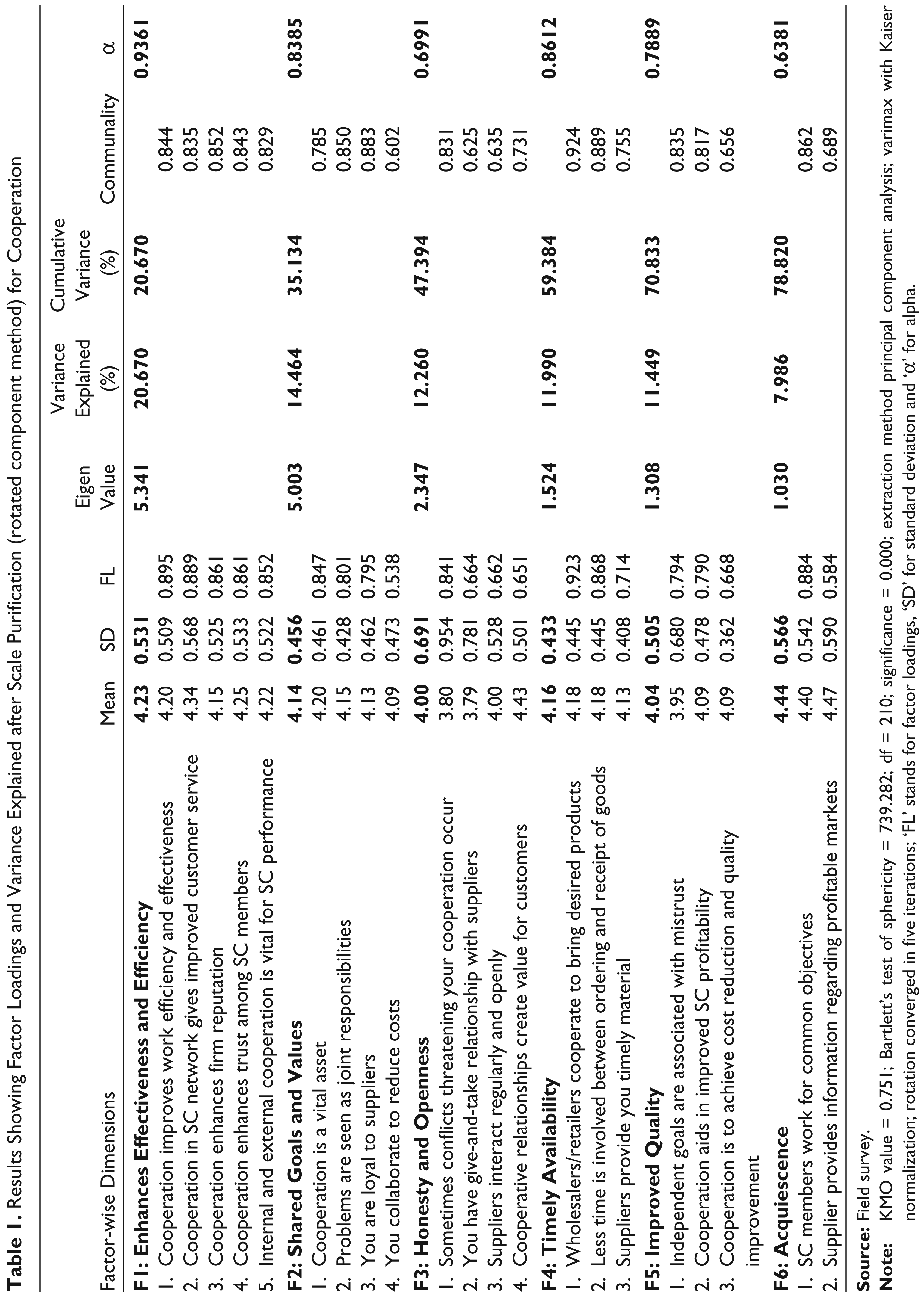
Factor 2 (Shared Goals and Values): The four variables included in this factor are ‘Cooperation is a vital asset’, ‘Problems are seen as joint responsibilities’, ‘You are loyal to suppliers’ and ‘You collaborate to reduce costs’ which reflected significant mean scores, valuable factor loadings and supportive communalities. This factor highlighted cooperation as a valuable asset among firms and that managers should give due recognition to it.
Factor 3 (Honesty and Openness): This factor included four items, namely, ‘Sometimes conflicts threatening your cooperation occurs’, ‘You have give-n-take relationships with suppliers’, ‘Suppliers interact regularly & openly’ and ‘Cooperative relationships creates value for customers’, and scored moderate response (3.75–4.43), and manifested that mangers should cooperate in order to create value for customers.
Factor 4 (Availability of Time): It considered three items, namely, ‘Wholesalers/retailers cooperate to bring desired products’, ‘Less time is involved between ordering & receipt of goods’ and ‘Suppliers provide you timely material’, and gauged ‘Wholesalers/retailers cooperate to bring desired products’ to be the highest with a factor loading of 0.923 and a communality of 0.924. A high level of cooperation exists among managers, wholesalers and retailers.
Factor 5 (Quality Improvement): It included three items, namely, ‘Independent goals are associated with mistrust’, ‘Cooperation aids in improved SC profitability’ and ‘Cooperation is to achieve cost-reduction & quality improvement’, reflecting moderate values of mean, high factor loading and communalities. Suppliers must cooperate to enhance SC profitability.
Factor 6 (Acquiescence): This factor consisted of two items, namely, ‘SC members work for common objective’ and ‘suppliers provide information relating to profitable markets’, depicting moderate mean values, factor loadings and communalities. This means that suppliers somewhat provide information relating to profitable markets.
Profile of SSI Owners/Managers
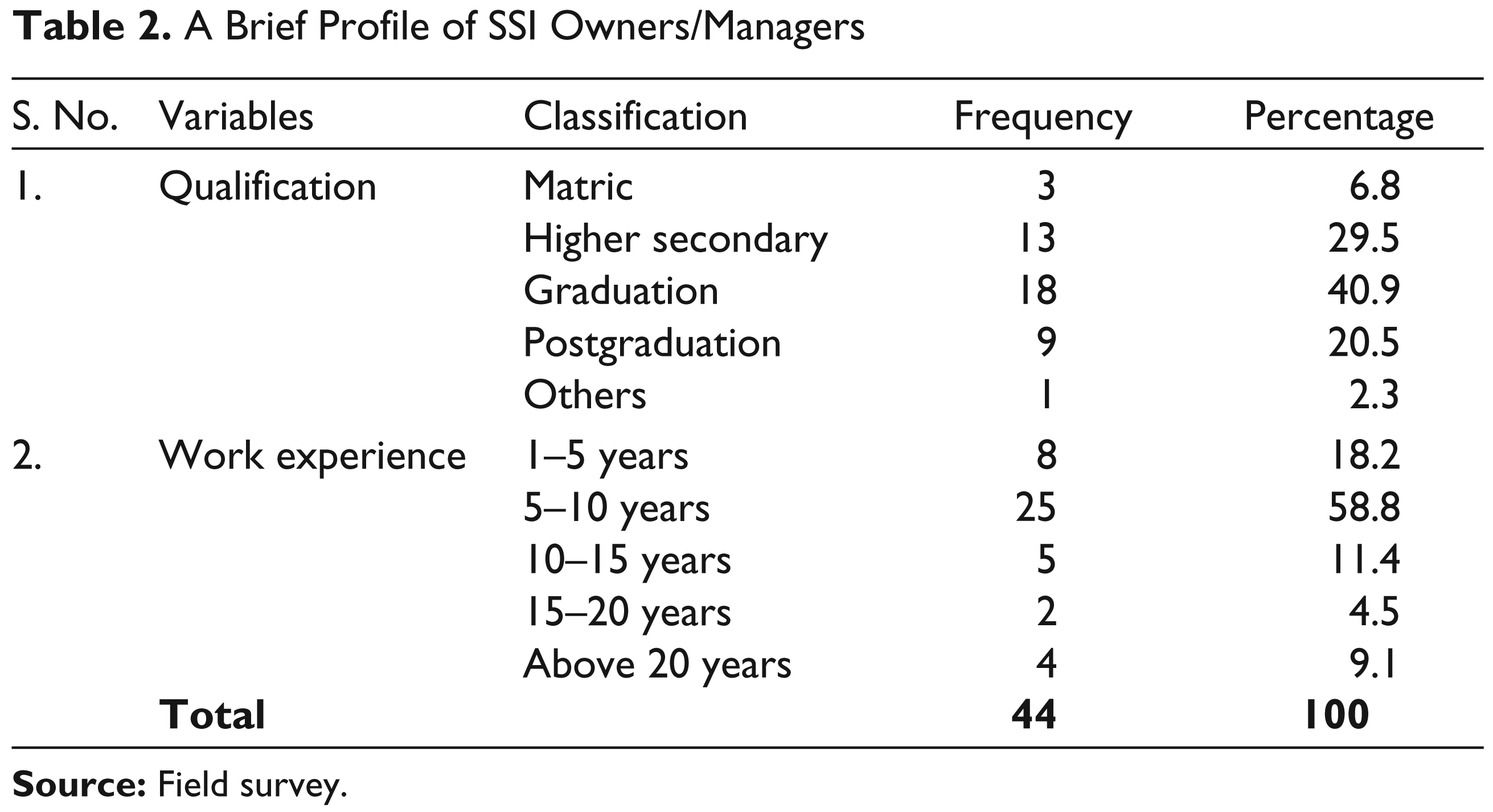
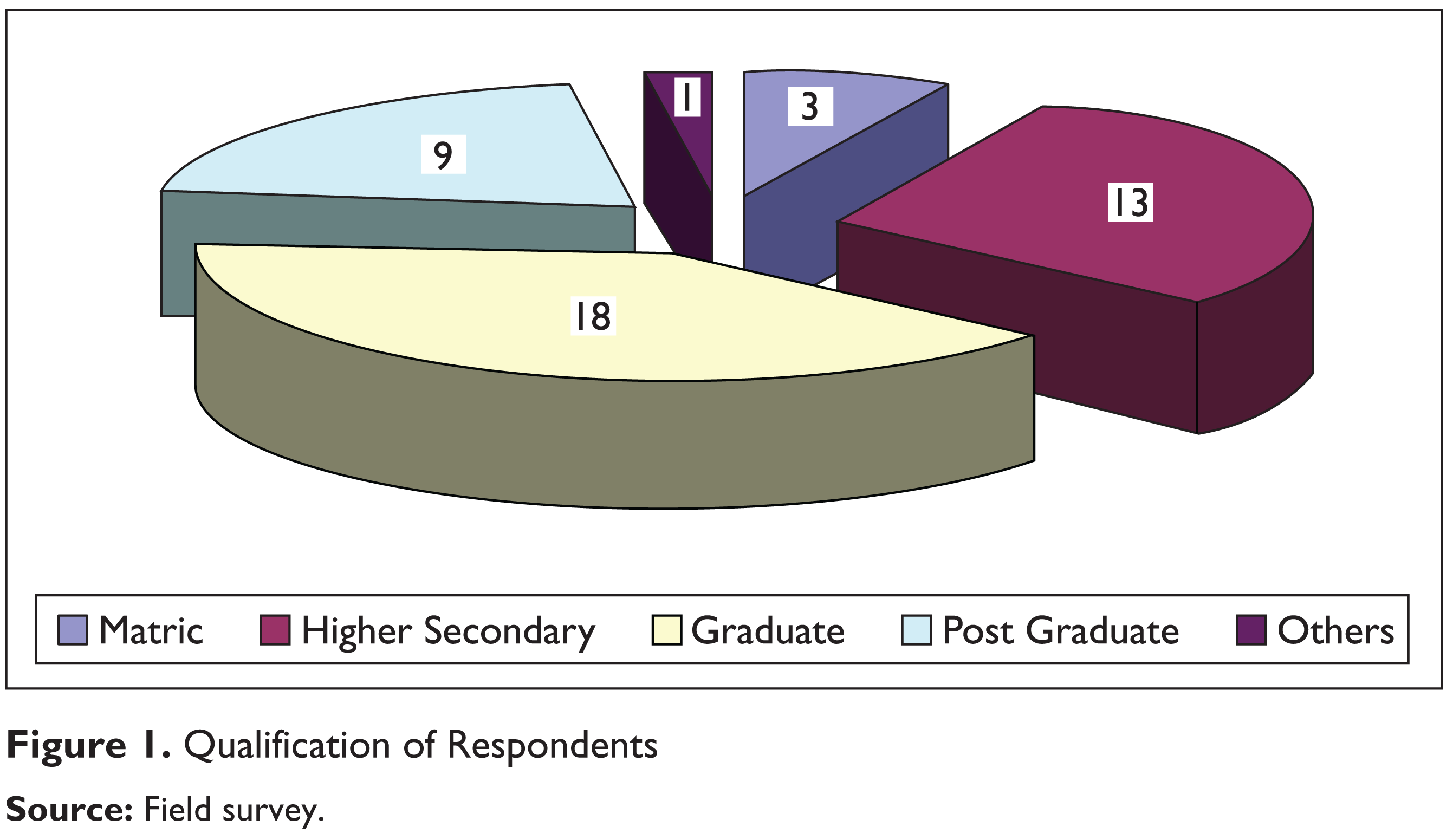
Qualification of Respondents: It was found that 40.9 per cent (18) of the entrepreneurs were graduates and 20.5 per cent (9) entrepreneurs were postgraduates. Three entrepreneurs were just matric pass, constituting 6.8 per cent of the total respondents. The percentage of another group of entrepreneurs who were qualified up to higher secondary was 29.5 (13). The number of those who had done technical courses was just 1 out of the total 44 respondents (Table 2). Thus, it becomes clear that large proportion of entrepreneurs are enlightened and well educated. Thus, qualification of entrepreneurs highlights the enlightened nature of owners/managers operating SSIs. Figure 1 shows the categorization of respondents as per their qualification.
Work Experience
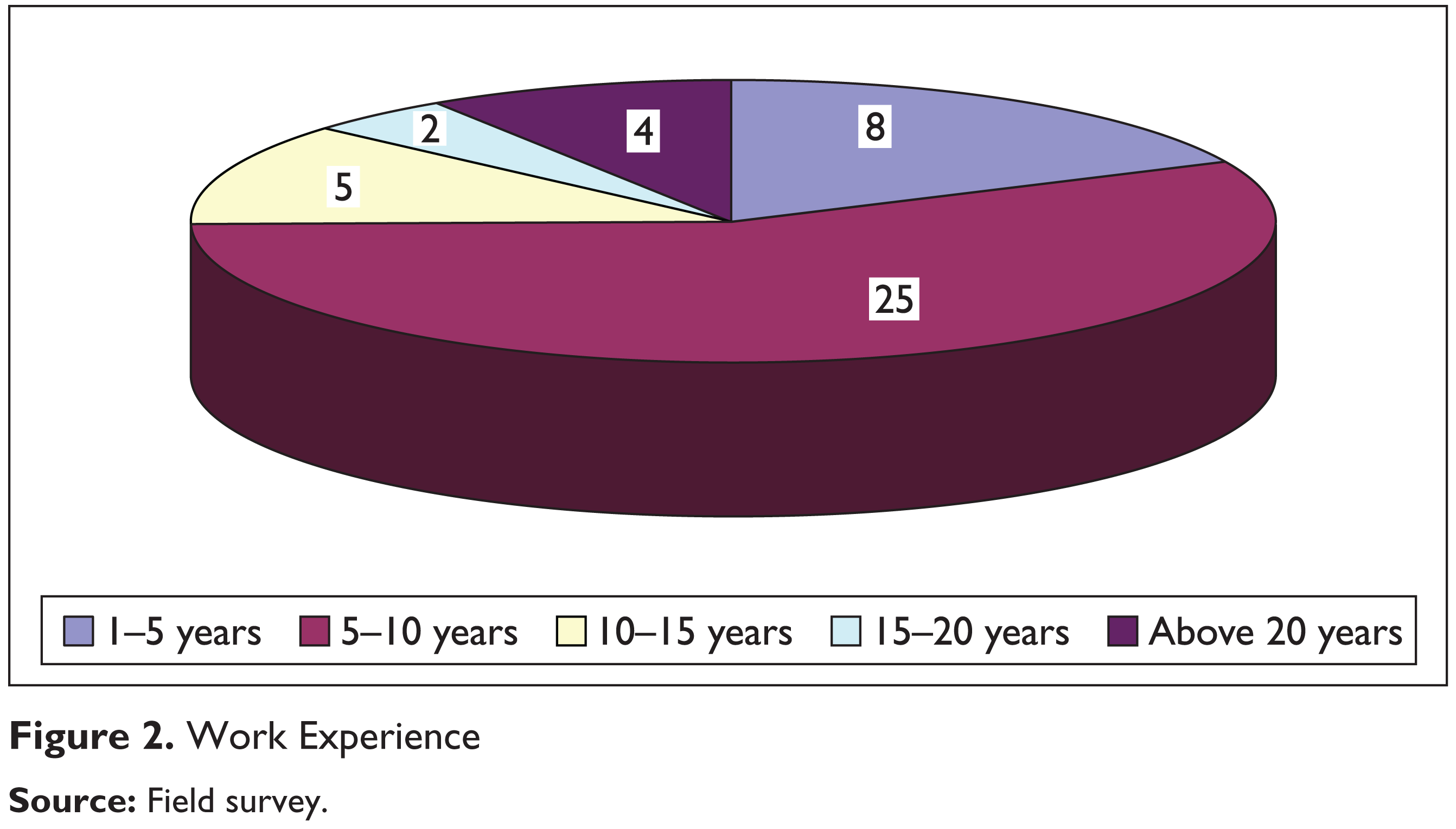
As far as the past experience of owners is concerned, it was found that 58.8 per cent (25) had past working experience of 5–10 years, as SIDCO is a newly formed industrial complex in Udhampur. Eight respondents had work experience of 1–5 years which contributed to 18.2 per cent of the total respondents. Five owners had previous work experience ranging between 10 and 15 years, with 11.4 per cent constitution; 4.5 per cent (2) of the respondents had a rich experience of 15–20 years and 9.1 per cent (4) of the respondents were with extensive experience and exposure of beyond 20 years. Hence, past experience of the owners indicated their business success (Figure 2).
A Brief Profile of SSI Owners/Managers
Regression Analysis
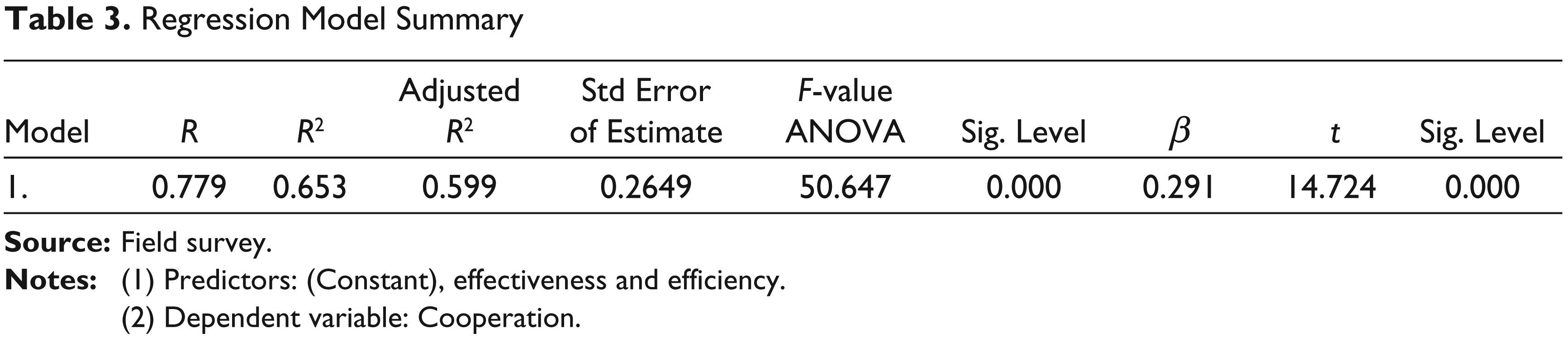
Table 3 exhibits output from regression analysis to elicit the impact of cooperation on effectiveness and efficiency. The dependent variable is cooperation and the predictor is effectiveness and efficiency which is considered as one of the determinants of cooperation. Enter method for estimating the regression model was employed. The result of linear regression analysis (Table 3) showed that the correlation between predictor and outcome is positive with the value of R as 0.779, which signifies good correlation between predictor and the outcome, that is, between effectiveness and efficiency and cooperation. In the model 1, R is 0.779 which indicates 77 per cent association between dependent and independent variable. R2 for this model is 0.653 which means that 65 per cent of variation in cooperation can be explained from the independent variable, that is, effectiveness and efficiency. Adjusted R2 (0.599) is significant at 1 per cent level which divulges that the model is adequate and appropriate. The adjusted R2 value further reveals that if at any point another independent variable is added to the model, the value of R2 will increase, that is, there is a significant relationship of the independent variable with the dependent variable.
Regression Model Summary
(2) Dependent variable: Cooperation.
Further, beta value, that is, β = 0.291, reveals a significant relationship of the independent variable with the dependent variable. Change in R2 is also found to be significant with F-value, that is, F = 50.647, significant at 5 per cent confidence level. The value of t = 14.724, that is, it is acceptable and significant. The overall model is significant as depicted by p-value of 0.000 (p < 0.05). Thus the hypothesis ‘Cooperation enhances effectiveness & efficiency in business relationships’ is accepted as represented by its significance level, p < 0.05.
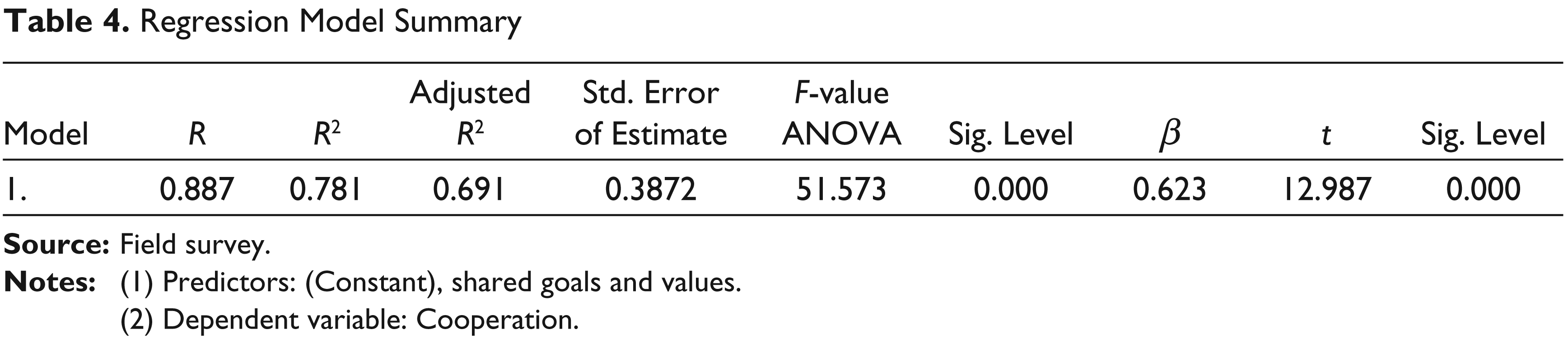
Table 4 displays output from regression analysis to extract the impact of cooperation on shared goals and values. The linear regression model summary (Table 4) depicted the values of R, R2, adjusted R2, standard error of estimate, ANOVA value, beta value, t-value and significance level. The model summary explains the following:
R = 0.887, that is, 88 per cent association between cooperation and shared goals and values. R2 = 0.781, that is, 78 per cent of variation in cooperation can be explained from shared goals and values.
Regression Model Summary
(2) Dependent variable: Cooperation.
Adjusted R2 = 0.691, that is, if another independent variable is added, the value of R2 will increase.
β = 0.623, that is, indicates a significant relationship of the independent variable with the dependent variable.
F = 51.573, that is, significant at 5 per cent confidence level.
t = 12.987, that is, acceptable and significant value.
Significance level = 0.007, that is, p < 0.05.
Hypothesis = Accepted, that is, ‘Cooperation promotes shared goals & values among business partners’.
Table 5 shows the output from regression analysis to elicit the impact of cooperation on honesty and openness. As shown, the model is statistically significant with a p-value of 0.009. It also has a good fit, as indicated by an R2 of 0.615 which means that 61 per cent of variation in cooperation can be explained from the independent variable, that is, honesty and openness. The result of linear regression analysis (Table 5) showed that the correlation between the predictor, that is, honesty and openness, and the outcome, that is, cooperation, is positive with value of R as 0.707, which signifies high positive correlation between the predictor and the outcome. In this model, R is 0.707 which indicates 70 per cent association between the dependent and the independent variable. Adjusted R2 (0.608) shows that if anytime another independent variable is added to the model, the R2 will increase. Further, beta value of 0.781 reveals the significant relationship of the independent variable with the dependent variable. Change in R2 is also found to be significant with an F-value of 46.827, significant at 5 per cent confidence level. The value of t = 8.523 is acceptable and significant. The overall model is significant as depicted by the p-value of 0.000 (p < 0.05). Thus, the hypothesis ‘Cooperative links dwells honesty & openness in inter firm relationships’ is accepted as represented by its significance level, p < 0.05.
Regression Model Summary

(2) Dependent variable: Cooperation.
Moreover, it is noted that honesty and openness has a significant positive impact on cooperation.
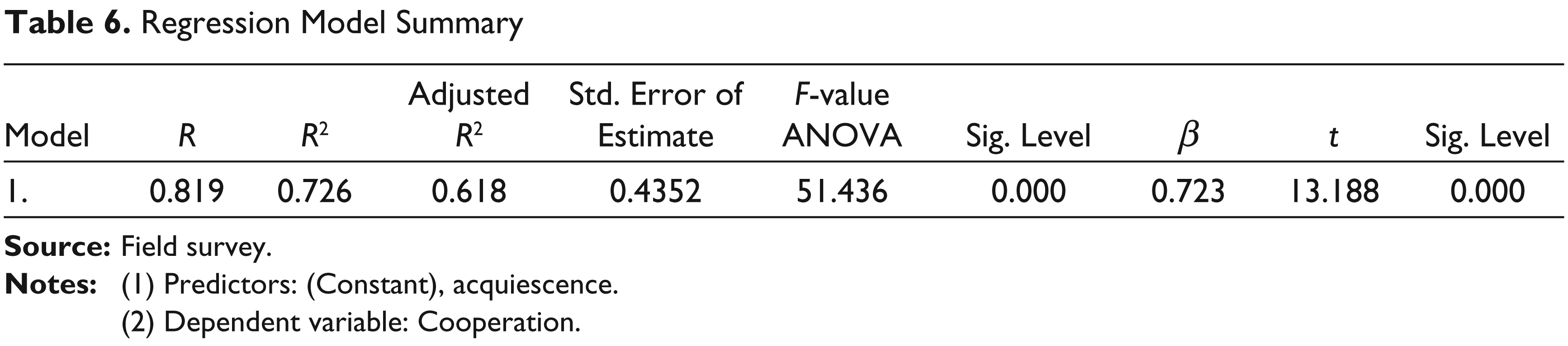
Table 6 reveals the output from regression analysis to find out the impact of cooperation on acquiescence which means acceptance or assent. The results in Table 6 reveal significant results as p < 0.05 (0.000). The beta value of 0.723 implies that acquiescence makes strongest unique contribution in explaining the dependent variable, that is, cooperation. It is a statistically significant factor/dimension contributing to the perception of cooperation. The value of t = 13.188 is highly significant and acceptable. In this model, the value of adjusted R2 revealed that acquiescence accounts for 61.8 per cent variance in cooperation, a satisfactory statistical result. Further, it also shows that if anytime another independent variable is added to the model, the R2 will increase. The result of hierarchical linear regression analysis (Table 6) showed that the correlation between the predictor and the outcome is positive with the value of R as 0.819, which signifies high positive correlation between the predictor and the outcome. In this model, R = 0.819 which indicates 81 per cent association between the dependent (cooperation) and the independent variable (acquiescence). R2 for this model is 0.726 which means that 72 per cent of variation in cooperation can be explained from the independent variable. Further, the beta value reveals the significant relationship of the independent variable with the dependent variable. Change in R2 is also found to be significant with an F-value of 51.436 which stood significant at 5 per cent confidence level. Thus, the hypothesis ‘Cooperation endorses acquiescence between business parties or members’ is accepted as represented by its significance level, p < 0.05.
Regression Model Summary
(2) Dependent variable: Cooperation.
One-way ANOVA
To test the fifth hypothesis, the qualification of respondents was taken into consideration. The qualification was divided into five categories, namely matric, higher secondary, graduate, postgraduate and other professional qualification. The results of ANOVA (Table 7) revealed that ‘Managers with different qualification significantly differs with regard to formulating sturdy cooperative business relationships’ (sig. 0.003) as the p-value is less than 0.05. Therefore, the hypothesis is accepted.
ANOVA for Qualification

Further, in order to test the sixth and final hypothesis AVOVA was applied. This was analyzed by taking into consideration the previous work experience of the respondents (managers/owners). The respondents’ work experience was classified into five categories, namely, 1–5 years, 5–10 years, 10–15 years, 15–20 years and above 20 years. The ANOVA results showed that ‘Managers with different work experience doesn’t significantly differ with regard to cooperative relations
ANOVA for Work Experience

Conclusion
Cooperation is an instrument that answers the question why some firms perform better than others. The reason is that cooperation is an important factor that ensures sustained superior performance; it has specifiable causes which are routes to the concept of competitive advantage. Cooperation in businesses promotes trust, win–win outcome, long-term orientation, coordination, joint problem-solving, flexibility and the like. The triumph of firms, regions, sectors and nations has become ever more reliant on how successfully they generate and use knowledge in an increasingly mutually supporting economy. A strong cooperation among business partners not only promotes efficiency, productivity, healthy decision making, collaboration, flexibility, strengthening of market and technological abilities, and availability of high-quality products but also reduces opportunistic behaviours and uncertainties in strategic partnerships which involve a higher degree of interdependency between competitors. Its significance cannot be ignored in SSIs which continually face erratic production, demand uncertainty, low margins and fragmented markets. Based on the data obtained from the 44 SSIs operating in the district of Udhampur, J&K, the existence of cooperation level was examined. The study revealed that cooperation enhances effectiveness and efficiency among business partners, promotes shared goals and values in business relationships, promotes honesty and openness and endorses acquiescence between business parties in order to enhance business relationships, thus promoting overall sturdy business relations. Further, it was identified that managers with different qualifications significantly differ with regard to formulating sturdy cooperative business relationships and that managers with different work experience do not differ significantly with regard to cooperative relations. This preliminary result confirms the rising importance of cooperation among business organizations and portrays that cooperation fosters trust and promotes innovation process or knowledge production with apt information distribution (Gibbons, 2005). A firm’s networking capability with suppliers, customers and knowledge-creating organizations asserts a decisive influence on cooperation. Moreover, the research article argues that from the practical perspective, managers must entrust the firms with full arm’s length cooperation, must organize trade shows and seminars in assistance from the university or other marketing experts and make the business class aware by delivering qualitative lectures in order to promote cooperation and the benefits it can accrue to the businesses. The article suggests that this type of convocation becomes a more powerful factor in influencing firms’ inter- and intra-cooperation. However, co-operation is a medium to build trust among business partners. Firms urgently need to learn how to manage inter-organizational cooperation and this includes learning about partner selection, mutual trust building and the materialization of resulting benefits.
Practical Implications of the Research
Suppliers need to be more service oriented, clear, focused and prompt in giving feedback on quality and delivery performance among business intermediaries. This will not only improve coordination and cooperation among channel members but also lead to high-quality innovative products reaching the consumers.
To generate cooperation in business paradigm, channel members should jointly indulge in healthy decision making, build collaborative relationships, foster risk and shared resources.
To foster cooperation at a wider level, suppliers must develop positive attitude and feelings and willingness to make short-term sacrifices to maintain stable relationships. Frequent performance discussions will give partners an opportunity to improve their work and their level of commitment.
Integrity in relationships must begin at the top (suppliers) and then move down (wholesalers and retailers). Supply chain intermediaries must keep their respective promises by revealing the truth. If members have integrity, a cooperative chain relationship can be established.
Cooperation in small firms can be enhanced with time frame perspectives, attitude/behaviour orientations and with goal orientations/decision rules. Firms should encourage an open-door policy with channel intermediaries for prompt redressal of grievances of channel members and customers.
Government functionaries must take initiatives to organize trade shows, seminars, workshops, conferences to strengthen supply chain linkages by integrating fragmented supply chain intermediaries. Sensitizing managers through periodic training and education programmes for the need and strategies to build trust for profitable inter-firm relationships should be given due consideration.
Limitations
This study was done at a one-sectional level, that is, SSIs. Business relationships develop with the passage of time; therefore, it would be more appropriate to conduct such studies at the longitudinal level.
The results of the study are limited to SSIs of the district of Udhampur, J&K; hence, the results drawn cannot be generalized for medium- or large-scale industries functioning in other parts of the country having disparate business milieu.
Future Research
First, from the appropriate aspects, this research envisaged a demanding context with theoretical affirmations and validation. Most of the findings are tentative unless verified in any follow-up studies. Thus, a research boulevard is opened for further validation in different regions or country context.
The study can be extended to different types of industries beyond SSIs, such as medium- and large-scale industries.
Footnotes
Acknowledgements
The author is grateful to the anonymous referees of the journal for their extremely useful suggestions to improve the quality of the article. I will say that you have really made a despondent an elated author.