




Abstract
Although research supports the association between environmentally specific transformational leadership and employees’ green behaviour, the role of environmental concern in this relation is less understood. This study examined the possible mediating influence of environmental concern in the relation between environmentally specific transformational leadership and green behaviour at work among a sample of 171 public sector employees in Nigeria using a partial least square structural equation modelling (PLS-SEM). Results revealed that after controlling for age, education and gender, environmentally specific transformational leadership has a significant positive relationship with environmental concern, which in turn predicted the green behaviour at work in a positive direction. The results further revealed that environmental concern mediated the relationship between environmentally specific transformational leadership and green behaviour at work.
Keywords
Introduction
Global climate change represents one of the most serious environmental issues that pose the greatest risk to human health and natural systems (Kovats & Akhtar, 2008; McMichael, Woodruff & Hales, 2006; Punyatoya, 2014). It has been estimated that climate change is costing the world more than $1.2 trillion per annum, thereby taking away 1.6 per cent annually from global gross domestic product (GDP) (Harvey, 2012). In Africa, it has been projected that the economic costs of global climate change could be equivalent to 1.5–3 per cent of GDP each year by 2030 (Watkiss, Downing & Dyszynski, 2010). Furthermore, it has been reported that in Nigeria both public and private organizations are vulnerable to the threat of global climate change. Specifically, the most significant impact of global climate change on organizations include higher electricity cost, as well as extensive damage of the industrial installations (Ajao, Fodeke, Gardner & Ujor, 2008).
Given the significant costs of climate change to organizations, many have adopted environmental management systems aimed at engaging in green processes and practises to address the challenges of global climate change (Darnall, Henriques & Sadorsky, 2008; Gotschol, De Giovanni & Esposito Vinzi, 2014). However, relying mainly on these systems is not sufficient enough to address the threat of climate change to organizations (Robertson & Barling, 2013). While it is generally agreed that global climate change is largely attributed to human activities (e.g., Gbadegesin, Olorunfemi & Raheem, 2011; Intergovernmental Panel on Climate Change, 2014), the success of environmental actions in organizations also depend largely on employees’ behaviours (Daily, Bishop & Govindarajulu, 2009; Paillé, Boiral & Chen, 2013). Thus, there is a need to encourage the employees to practise green behaviour at work in order to address the growing threat of climate change (Ones & Dilchert, 2012; Paillé & Boiral, 2013). Adding to that, understanding the fundamental reason why employees engage in green behaviour at work has become imperative. The purpose of this study is to examine the potential mediating role of environmental concern on the link between environmentally specific transformational leadership and green behaviour at work. Towards this end, the rest of this article is structured as follows. We first review the important concepts of environmental sustainability in the workplace. In particular, we explore the concepts of green behaviour at work, environmentally specific transformational leadership, as well as environmental concern. Then, we review the extant empirical studies that relate the concepts towards the development of hypotheses. In the next section, we describe the research method including the participants and procedure, measurement instruments, analytical approach and model estimation. Next, we present and discuss the findings of the study. Finally, we draw conclusion.
Review of Literature
Environmentally Specific Transformational Leadership and Green Behaviour at Work
Over the past few years, organizational researchers have paid considerable attention to the concept of green behaviour at work (Norton, Zacher & Ashkanasy, 2012; Renwick, Redman & Maguire, 2013; Sharma, 2014; Unsworth, Dmitrieva & Adriasola, 2013). Possibly, the attention given to green behaviour at work spring from the need for employees to use resources wisely and responsibly; protect the environment; and eliminate toxins that harm people in the workplace (Alfred & Adam, 2009). Green behaviour at work has been defined as ‘a broad set of environmentally responsible activities such as learning more about the environment, developing and applying ideas for reducing the company’s environmental impact, developing green processes and products, recycling and reusing, and questioning practices that hurt the environment’ (Graves, Sarkis & Zhu, 2013, p. 81).
Theory and empirical evidence suggest that individual and situational variables can affect the likelihood that employees will engage in green behaviour at work. For instance, researchers have suggested that transformational leadership plays an important role in fostering the green behaviour at work (Graves et al., 2013; Robertson & Barling, 2013). Accordingly, environmentally specific transformational leadership has been defined by Chen and Chang (2013) as ‘behaviours of leaders who motivate followers to achieve environmental goals and inspire followers to perform beyond expected levels of environmental performance’ (p. 109). Bass (1990) as well as Bass and Riggio (2006) has identified four characteristics of the transformational leader: idealized influence, inspirational motivation, intellectual stimulation and individualized consideration, each of which is applicable in influencing green behaviour within the organizations (Robertson & Barling, 2013).
According to transformational leadership theory, when leaders practise green behaviour at work, subordinates emulate such behaviours because leaders serve as their role models by sharing their environmental values, communicating clearly the importance of environmental sustainability, as well as developing and applying ideas for addressing the environmental impact (Bass, 1988, 1995; Graves et al., 2013; Robertson & Barling, 2013). Based on prior research and theoretical evidence, we advanced the hypothesis: Environmentally specific transformational leadership is positively related to green behaviour at work.
Environmental Concern as a Potential Mediating Variable
Although theory and empirical evidence suggests a positive relationship between environmentally specific transformational leadership and green behaviour at work in a variety of studies (e.g., Graves et al., 2013), little work has examined the mechanisms and processes by which environmentally specific transformational leaders exert their influence on their followers’ likelihood to engage in green behaviour at work. Accordingly, there is a need to pay greater attention to understand the fundamental reason why environmentally specific transformational leadership influences green behaviour at work (Avolio, Zhu, Koh & Bhatia, 2004; Bass, 1999; Chen & Chang, 2013). The present study conjectured that environmental concern may be a key mechanism in explaining the link between environmentally specific transformational leadership and green behaviour at work. Environmental concern refers to the extent to which individuals are concerned and well informed about environmental problems and support efforts to solve them and/or indicate their readiness to contribute personally to their solutions (Dunlap & Jones, 2002). Environmental concern has shown to be an important prerequisite of fostering long-lasting green behaviour at work, and subsequently decrease the growing threat of climate change (Takács-Sánta, 2007).
Furthermore, environmental concern has been established to be a significant predictor of employee’s green behaviour at work (Bissing-Olson, Iyer, Fielding & Zacher, 2013; Fujii, 2006; Huddart Kennedy, Krahn & Krogman, 2013). This prediction is supported by the theory of planned behaviour (Ajzen, 1991), which postulates that individuals who are well concerned about natural environment are more likely to engage in green behaviour at work.
Because the theory of planned behaviour (Ajzen, 1991) posits that attitudes are immediate predictors of the actual behaviour, it is logical here to argue that environmental concern should be the fundamental reason why environmentally specific transformational leadership affects the employees’ green behaviour at work. Accordingly, it is expected that environmental concern might mediate the relationship between environmentally specific transformational leadership and employees’ green behaviour at work. Building on previous studies on transformational leadership, environmental concern and employee’s green behaviour, we developed the hypothesis: Environmental concern mediates the positive relationship between environmentally specific transformational leadership and green behaviour at work.
Methodology
Participants and Procedure
The participants were 171 public sector employees in a wide variety of organizations in Nigeria, including government ministries, parastatals, commissions and agencies. Of the 171 employees invited to participate in this study, 134 were males and 37 were females, whose mean age was 36.79 years (standard deviation = 9.38). Approximately, 45 per cent of the participants were administrative officers, 13 per cent were procurement officers, 9 per cent were accountants, 21 per cent were cashiers and 12 per cent were departmental secretaries. In terms of educational qualification, 43 per cent of the participants were master’s degree holders, 37 per cent hold either diploma or certificate and the remaining 20 per cent hold bachelor’s degree holders.

We distributed self-administered questionnaires to 260 employees who voluntarily agreed to participate in the survey. In an attempt to address the common method variance, participants were assured complete anonymity of their participation in the survey. They were further assured that they could opt out from the survey at any time without affecting their career. Given that the sample frame was unavailable, a non-probability sampling technique was employed in this study. Of the 260 employees, 198 returned the survey; however, due to missing values and multivariate outliers, the final sample size was reduced to 171 for a valid response rate of 66 per cent.
Measures
Environmentally Specific Transformational Leadership
Environmentally specific transformational leadership was assessed through the Carless, Wearing and Mann’s (2000) seven-item transformational leadership scale. This scale which represents the global measure of transformational leadership was adapted to ensure that it was suitable in the context of influencing subordinates towards environmental sustainability. Participants indicated their responses on a seven-point Likert scale ranging from 1 (strongly disagree) to 7 (strongly agree). Sample item from the measure of transformational leadership is, ‘My immediate supervisor/manager communicates a clear and positive vision of the future’.
Environmental Concern
To measure the environmental concern, 12 items were adapted from the literature on environmental psychology (e.g., Hansla, Gamble, Juliusson & Gärling, 2008; Schultz, 2001). Participants indicated their responses on a seven-point Likert scale ranging from 1 (not at all concerned) to 7 (extremely concerned). Sample item is, ‘I am concerned about environmental problems because of the consequences for my health’.
Green Behaviour at Work
Robertson and Barling’s (2013) seven-item workplace environment-friendly behaviour scale was used to assess the green behaviour at work on a seven-point Likert scale ranging from 1 (strongly disagree) to 7 (strongly agree). Sample item for this scale is, ‘I turn lights off when not in use’.
Analytical Approach and Model Estimation
Structural equation models can be estimated using either covariance-based approaches (Bock & Bargmann, 1966; Byrne, 2010; Jöreskog, 1978) or variance-based approaches, which are mostly represented by partial least squares structural equation modelling (PLS-SEM) path modelling (Chin, 1998; Henseler, Ringle & Sinkovics, 2009; Wold, 1974, 1985). In this study, variance-based PLS-SEM approach was chosen for the following reasons. First, PLS-SEM approach was chosen based on its ability to simultaneously estimate the relationships between latent constructs, as reflected by the structural model and relationships between indicators and their corresponding latent constructs, which is represented by the measurement model (Hair, Hult, Ringle & Sarstedt, 2013a; Henseler et al., 2009). Second, variance-based PLS-SEM approach is considered suitable in this study because of its advantage to provide statistically reliable estimates of indirect effects in simple mediation models based on bootstrapping techniques, which employs standard errors for path coefficients (cf., Baron & Kenny, 1986; Hair et al., 2013a; Kock, 2014; Preacher & Hayes, 2008). Third, the present study is prediction-oriented, aimed at explaining the effect of environmentally specific transformational leadership and environmental concern on green behaviour at work. As such, PLS-SEM approach is deemed appropriate. Finally, regarding the tool of analysis, SmartPLS 3 (Ringle, Wende & Becker, 2014) was chosen on the basis of its friendly graphical user interface, which helps users to create and estimate a PLS path model easily. In line with Anderson and Gerbing’s (1988) general recommendations, as well as PLS-SEM-specific guidelines, put forward by Henseler et al. (2009), we first established the measurement model before testing the structural model. This was followed by the supplementary PLS-SEM analysis (i.e., mediator analysis).
Results and Discussions
Measurement Model
In order to establish the reliability and validity of measures, individual item reliability, internal consistency reliability, convergent validity, as well as discriminant validity were evaluated (Hair et al., 2013a; Hair, Sarstedt, Ringle & Mena, 2012; Henseler et al., 2009) as presented in Table 1. First, individual item reliabilities were evaluated by examining the outer loadings of each construct’s measure (Hulland, 1999). Following Hair et al.’s (2013a) benchmark for retaining items with loadings between 0.40 and 0.70, out of 26 items, only four were deleted having loadings below the benchmark of 0.40. Hence, in the whole model, 22 items with loadings between 0.682 and 0.859 were retained. Second, as the upper bound for the true reliability, internal consistency reliability was examined by means of composite reliability coefficient (Hair, Ringle & Sarstedt, 2013b). It is generally recommended that the composite reliability coefficient for each latent construct should exceed 0.70 (Bagozzi & Yi, 1988).
Results of Measurement Model
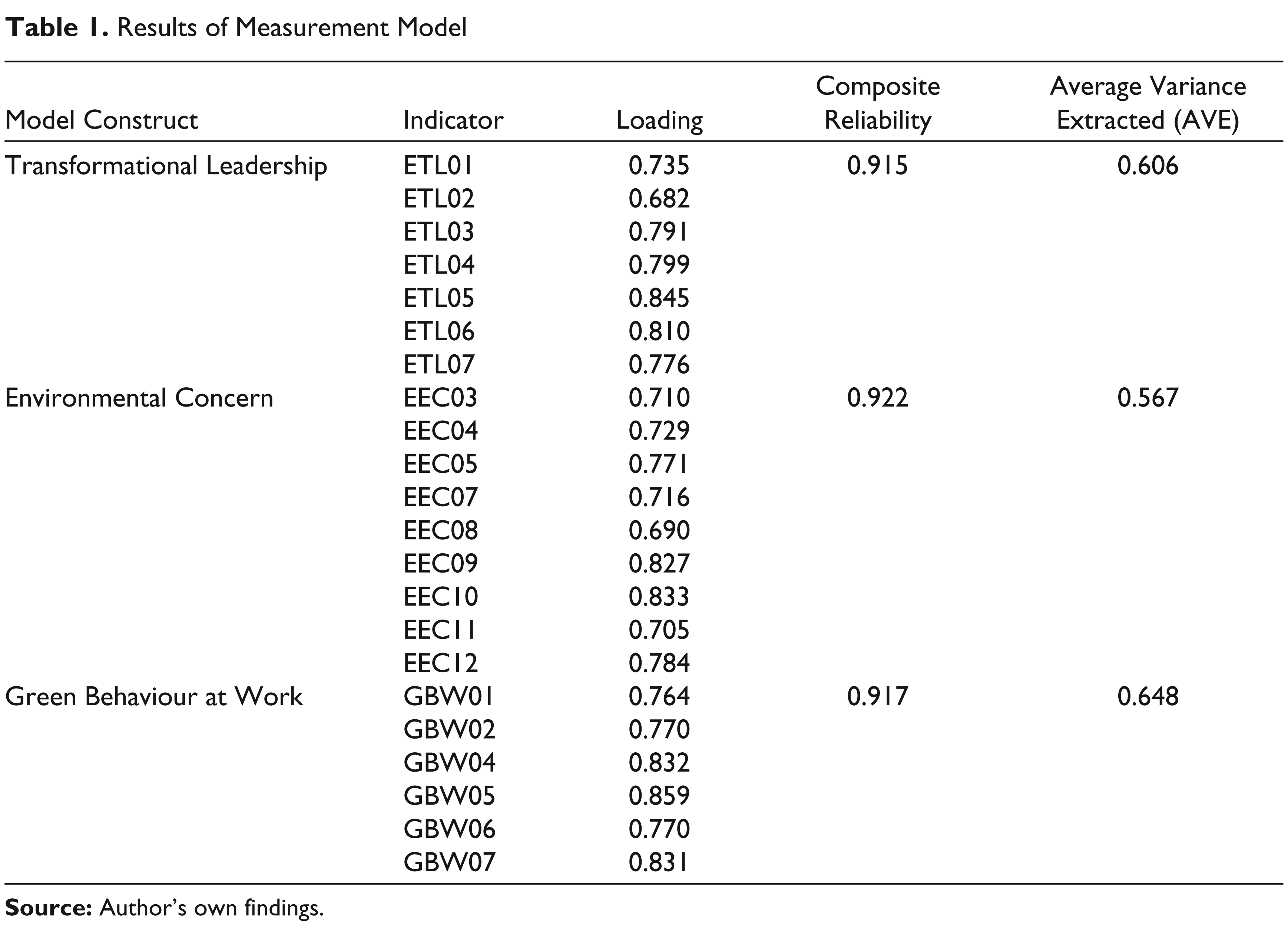
As shown in Table 1, the composite reliability coefficients, which range between 0.915 and 0.922, demonstrate adequate internal consistency reliability, as each was above 0.70 as traditionally recommended by Bagozzi and Yi (1988). Third, to ascertain the convergent validity, the average variance extracted (AVE) for each latent construct was analyzed. Generally, the AVE for each latent construct should exceed 0.50 (Bagozzi & Yi, 1988; Hair et al., 2013a). As shown in Table 1, the AVE for each latent construct has exceeded the threshold value of 0.50, hence, suggesting satisfactory convergent validity. Finally, Fornell-Larcker’s criterion was used to ascertain the discriminant validity of measures as shown in Table 2a. According to Fornell and Larcker (1981), discriminant validity is established only if the AVE for each latent construct is statistically significant and exceeds its squared correlation with any other construct. In Table 2a, the squared correlations among the latent constructs were compared with the square root of the AVEs (values in bold face). Table 2a suggests adequate discriminant validity as the AVE for each latent construct exceeded its squared correlation with any other construct (Fornell & Larcker, 1981).
Structural Model
Having established the reliability and validity of the measurement model, several steps have been taken to evaluate the structural model. Specifically, based on the assessment criteria recommended by Henseler et al. (2009), as well as Hair et al. (2013a), three logical metrics were used to judge the structural model, namely the significance of path coefficients, coefficient of determination (R2), and the cross-validated redundancy (Q2). To assess the significance of path coefficients, we followed Preacher and Hayes’ (2004, 2008) procedures for estimating indirect effects in mediation models by first testing the structural model without incorporating a mediating variable. The results are presented in Figure 2 and Table 2a.
Discriminant Validity of Measures

As shown in Figure 2 and Table 2b, there was a statistically significant positive relationship between transformational leadership and green behaviour at work, regardless of age, education and gender (β = 0.669, SE = 0.048, t = 13.824, CI = [0.593; 0.755], p < 0.01). Hence, Hypothesis 1 was fully supported. Next, the structural model was tested after incorporating a mediating variable as presented in Figure 3 and Table 3.
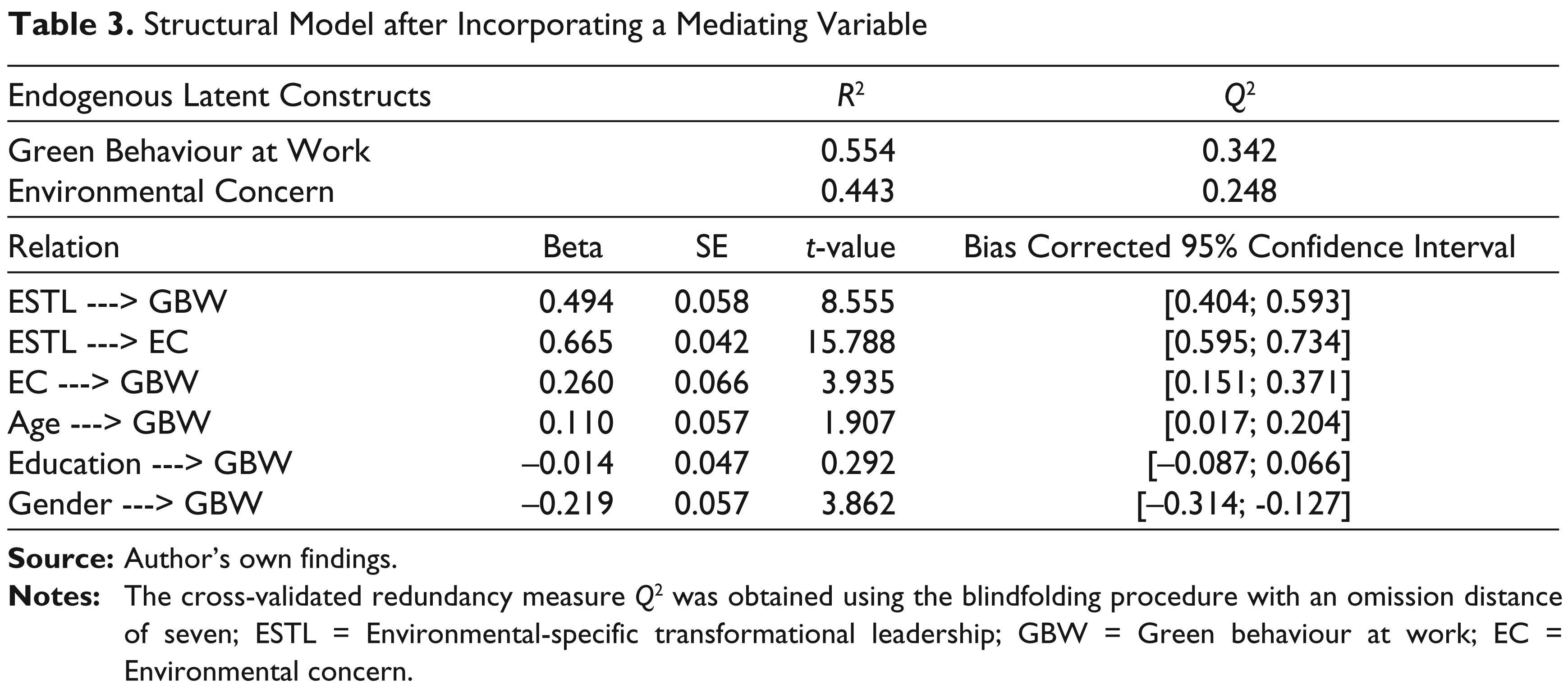
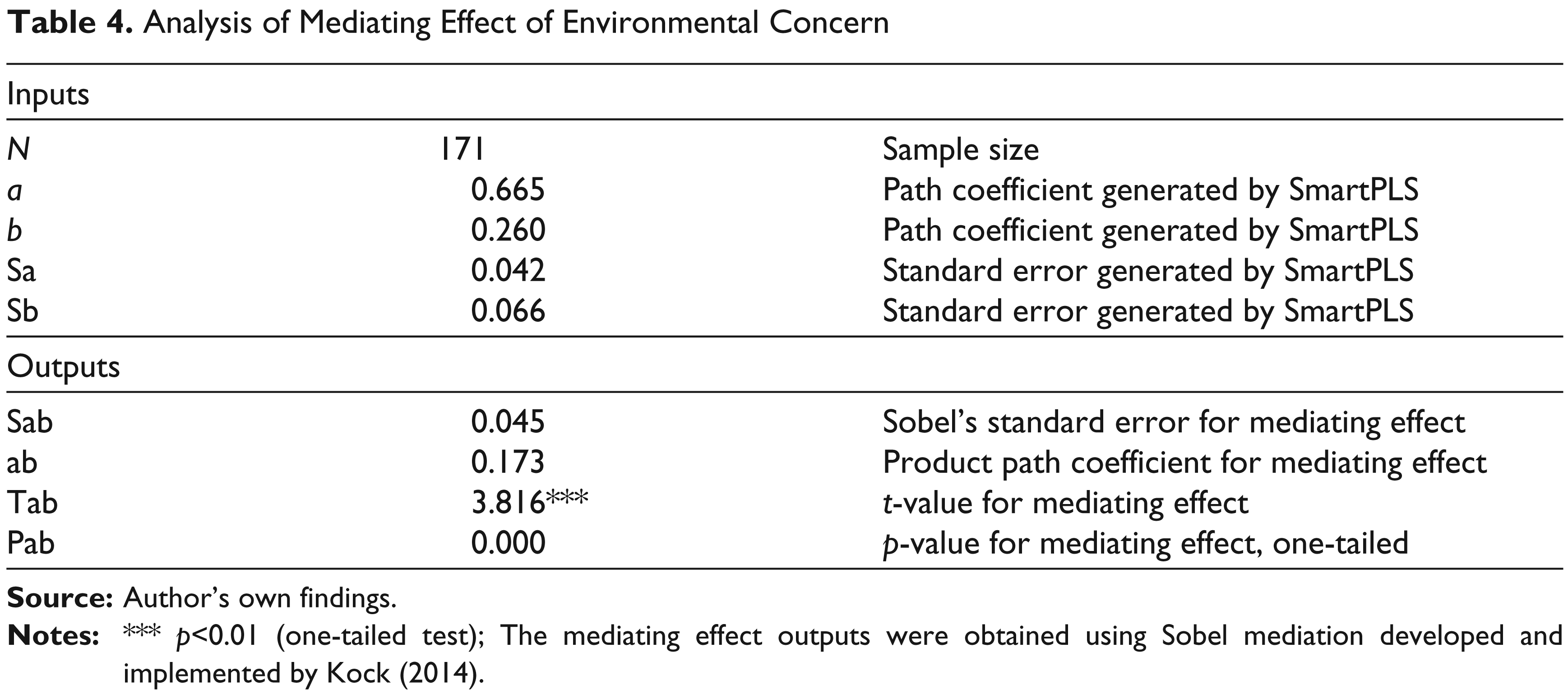
As indicated in Figure 3 and Table 3, after controlling for age, education and gender, environmentally specific transformational leadership has a significant positive relationship with environmental concern, which in turn predicted the green behaviour at work in a positive direction. The indirect effect of environmentally specific transformational leadership (β = 0.173, SE = 0.045, t = 3.816, p < 0.01) via the mediator variable environmental concern was found to be significant, regardless of age, education and gender (Table 4).

Structural Model without a Mediating Variable

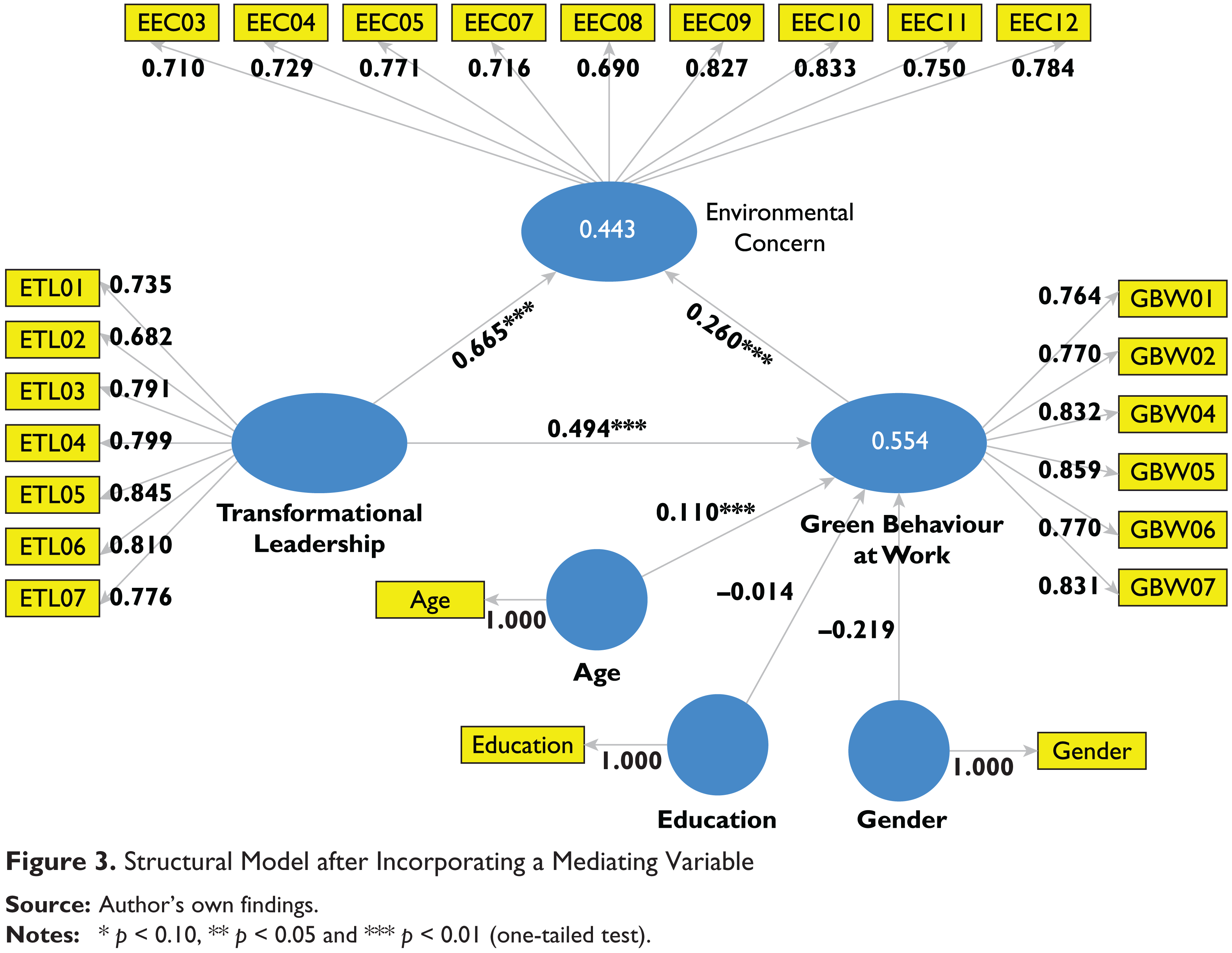
Similarly, the relationship between environmentally specific transformational leadership and green behaviour at work remains significant (Figure 3; β = 0.494, SE = 0.058, t = 8.555, CI = [0.404; 0.593], p < 0.01) but, with a difference of 0.175, which is significantly lower than when environmental concern was not incorporated, even after controlling for the three demographic variables. As such, environmental concern mediates the relationship between environmentally specific transformational leadership and green behaviour at work, regardless of age, education and gender, which lends support for Hypothesis 2.
Structural Model after Incorporating a Mediating Variable
Analysis of Mediating Effect of Environmental Concern
Regarding the coefficient of determination (R2), the model demonstrates that the percentages of explained variance for the environmentally specific transformational leadership and environmental concern were 0.554 and 0.443, respectively. This suggests that the model accounts for 55.4 and 44.3 per cent of explained variance for the environmentally specific transformational leadership and environmental concern, Falk and Miller (1992) recommended that the coefficient of determination for an endogenous latent construct should be at least 0.10. Hence, following Falk and Miller’s (1992) benchmark for determining the acceptable level of coefficient of determination, it can be concluded that the two endogenous latent variables demonstrate the acceptable levels of R-squared values.
Finally, in order to assess the model’s predictive validity, cross-validated redundancy measure Q² was applied in this study (Geisser, 1974; Stone, 1974). Cross-validated redundancy measure is sample reuse techniques consisting of cross-validation and function fitting that fits PLS-SEM like a hand in a glove (Wold, 1982). According to Henseler et al. (2009), a research model with Q2 statistic(s) greater than zero is indicative of predictive relevance. As shown in Table 3, the cross-validation redundancy measure Q² for the two endogenous latent variables (i.e., green behaviour at work and environmental concern) were 0.342 and 0.248, respectively. Hence, this suggest that the model has predictive relevance (Henseler et al., 2009).
While extant research has established a positive association between environmentally specific transformational leadership and green behaviour at work, the findings of this study replicate and extend the prior research on sustainable environmental practices by examining an explanatory mechanism behind this relationship. In particular, the present investigation replicates and extends prior research in the following ways. First, this study replicates prior findings (e.g., Graves et al., 2013; Robertson & Barling, 2013) demonstrating environmentally specific transformational leadership as a significant predictor of employees’ green behaviour at work. Hence, as hypothesized, the results of this investigation supported the positive relationship between environmentally specific transformational leadership and green behaviour at work. Second, although prior studies have examined the direct relationship between environmentally specific transformational leadership and green behaviour at work, the present study extends the past research by proposing and testing a mediation model to explain more about a mechanism through which environmental concern is translated into green behaviour at work (Bissing-Olson et al., 2013; Fujii, 2006; Huddart Kennedy et al., 2013). Specifically, employees who are inspired and intellectually stimulated by environmentally specific transformational leader may be more likely to show concern about environment, which in turn positively influence them to engage in green behaviour at work.
Although the results of this study provides an initial support regarding the role of environmental concern as a mediating link between environmentally specific transformational leadership and green behaviour at work, before conclusions can be drawn, a number of limitations of this study must be acknowledged. First, the empirical results of this study are limited to a relatively small sample of public sector employees in Nigeria, and the research design is considered somewhat exploratory in nature, which does not provide the final answers to the research question. Therefore, future research is encouraged to cover a broader sample of employees from both public and private sector across many organizations. Second, the present study has focused mainly on environmental concern as a mediating link. Future research should consider other environmentally specific work attitudes, such as environmental awareness, environmental consciousness and environmental responsibility as the missing link between environmentally specific transformational leadership and green behaviour at work. Finally, as suggested by Podsakoff, MacKenzie and Podsakoff (2012), statistical analyses were ran, and common method bias was not a major concern in the present. However, it is possible that the correlations among constructs might have been spuriously inflated due to common method bias. Future research might replicate this study using multisource measures to assess the three key constructs in order to control for the common method bias.
Despite the aforementioned limitations, the results of this study offer several practical implications. First, the results suggest that environmentally specific transformational leadership was positively associated with environmental concern, which in turn predicted the green behaviour at work. As noted by Robertson and Barling (2013), organizations that can foster green behaviour at work by designing environmentally specific transformational leadership programmes to help employees reach their potential as individual leaders who transform their workplace into environment-friendly business that help in reducing the impact of global climate change. Second, the findings of this study suggest that organizations might increase the employees’ concern for environment through positive environmental cues (Unsworth et al., 2013). Specifically, this environmental intervention can be achieved by providing cues in employees’ offices, restrooms and cubicles, stairs and elevators to help in activating the employees’ green behaviour at work.
Conclusions
In conclusion, the present study has provided an initial support for environmental concern as a mediating link between environmentally specific transformational leadership and green behaviour at work. Theoretically, this study has also added to the domain of transformational leadership theory by replicating past studies that examined the direct influence of environmentally specific transformational leadership on green behaviour at work. Although being green at work is a monster task, however, if organizations are committed to developing environmental intervention, such as designing environmentally specific transformational leadership programmes, which typically focused on reducing the greenhouse gas emissions and fostering green behaviour at work environment, employees’ environmental performance will be improved beyond the expectations.
Footnotes
Acknowledgements
The author is grateful to the anonymous referees of the journal for their extremely useful suggestions to improve the quality of the article.